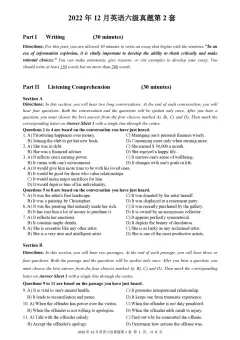
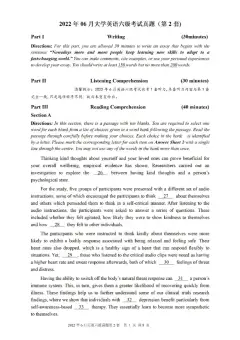
2022 年 12 月英语六级真题第 2 套
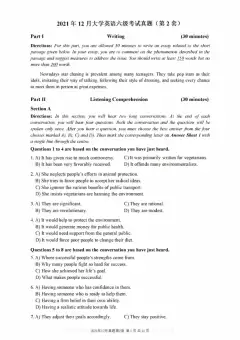
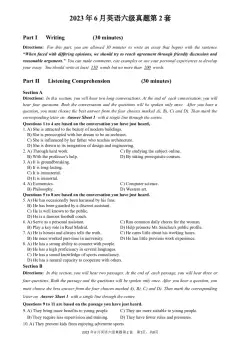
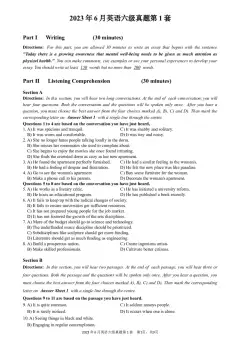
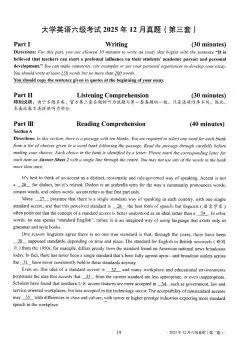
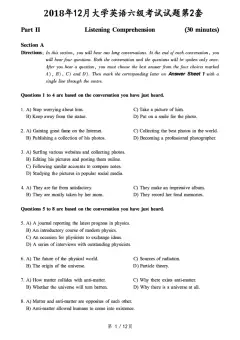
Part I Writing (30 minutes)
Directions: For this part, you are allowed 30 minutes to write an essay that begins with the sentence "In
an era of information explosion, it is vitally important to develop the ability to think critically and make
rational choices." You can make statements, give reasons, or cite examples to develop your essay. You
should write at least 150 words but no more than 200 words.
Part II Listening Comprehension (30 minutes)
Section A
Directions: In this section, you will hear two long conversations. At the end of each conversation, you will
hear four questions. Both the conversation and the questions will be spoken only once. After you hear a
question, you must choose the best answer from the four choices marked A), B), C) and D). Then mark the
corresponding letter on Answer Sheet 1 with a single line through the centre.
Questions 1 to 4 are based on the conversation you have just heard.
1. A) Prioritizing happiness over money. C) Managing one's personal finances wisely.
B) Joining the club to get her new book. D) Consuming more only when earning more.
2. A) She was in debt. C) She earned $ 30,000 a month.
B) She was a financial adviser. D) She enjoyed a happy life.
3. A) It reflects one's earning power. C) It mirrors one's sense of wellbeing.
B) It varies with one's environment. D) It changes with one's goals in life.
4. A) It would give him more time to be with his loved ones.
B) It would be good for those who value relationships.
C) It would mean major sacrifices for him.
D) It would deprive him of his individuality.
Questions 5 to 8 are based on the conversation you have just heard.
5. A) It was the artist's first landscape. C) It was donated by the artist herself.
B) It was a painting by Christopher. D) It was displayed at a retirement party.
6. A) It was the painting that instantly made her rich. C) It was recently purchased by the gallery.
B) It has cost him a lot of money to purchase it. D) It is owned by an anonymous collector.
7. A) It reflects her emotions. C) It appears perfectly symmetrical.
B) It contains ample details. D) It depicts the beauty of desolation.
8. A) She is eccentric like any other artist. C) She is as lucky as any acclaimed artist.
B) She is a very nice and intelligent artist. D) She is one of the most productive artists.
Section B
Directions: In this section, you will hear two passages. At the end of each passage, you will hear three or
four questions. Both the passage and the questions will be spoken only once. After you hear a question, you
must choose the best answer from the four choices marked A), B), C) and D). Then mark the corresponding
letter on Answer Sheet 1 with a single line through the centre.
Questions 9 to 11 are based on the passage you have just heard.
9. A) It is vital to one's mental health. C) It promotes interpersonal relationship.
B) It leads to reconciliation and peace. D) It keeps one from traumatic experience.
10. A) When the offender has power over the victim. C) When the offender is not duly penalized.
B) When the offender is not willing to apologize. D) When the offender adds insult to injury.
11. A) Talk with the offender calmly. C) Find out why he committed the offense.
B) Accept the offender's apology. D) Determine how serious the offense was.
2022年12月英语六级真题第2套 第 1 页,共 8 页Questions 12 to 15 are based on the passage you have just heard.
12. A) The number of passengers dropped sharply. C) The number of stations increased to 50.
B) It served more and more commuters. D) It became the longest in the United Kingdom.
13. A) To increase capacity to meet growing needs. C) To have its systems modernised.
B) To make way for other means of transport. D) To avoid further financial losses.
14. A) It is generally recognised as a world heritage site.
B) It is the fastest way to reach the city's south side.
C) It constitutes a source of revenue for the city.
D). It helps reduce traffic jams in the city centre.
15. A) They are usually crowded. C) They accept smartcards only.
B) They use high-tech systems. D) They are colourfully decorated.
Section C
Directions: In this section, you will hear three recordings of lectures or talks followed by three or four
questions. The recordings will be played only once. After you hear a question, you must choose the best
answer from the four choices marked A), B), C) and D). Then mark the corresponding letter on Answer
Sheet 1 with a single line through the centre.
Questions 16 to 18 are based on the recording you have just heard.
16. A) They are quite friendly to humans. C) They are unafraid of humans.
B) They are shrinking in numbers. D) They are especially fond of garbage.
17. A) It is strictly forbidden. C) It is a gesture of human generosity.
B) It is an uncommon sight. D) It is allowed only in certain areas.
18. A) Share their food with the bear they see.
B) Be prepared to run into a hungry bear.
C) Try to be friendly with the bear they meet.
D) Refrain from teasing bears with cubs.
Questions 19 to 21 are based on the recording you have just heard.
19. A) It refers to opinions that are radical and widespread.
B) It means making judgments without adequate knowledge.
C) It refers to deep-rooted beliefs about someone or something.
D) It means sticking to one's judgments even when proved wrong.
20. A) They often lead to war between religious groups.
B) They keep certain occupations from thriving.
C) They allow myths and half-truths to persist.
D) They prevent us from getting to the truth.
21. A) When we start to feel superior.
B) When we mix with prejudiced people.
C) When we live in an isolated neighborhood.
D) When we try to keep up with those around us.
Questions 22 to 25 are based on the recording you have just heard.
22. A) Motivated. C) Perplexed.
B) Disappointed. D) Shocked.
23. A) They would change with the passage of time.
B) They would benefit young people's adult life.
C) They would help kids grow.
D) They would last a lifetime.
24. A) He had become mature. C) He had lots of stories to tell.
2022年12月英语六级真题第2套 第 2 页,共 8 页B) He suffered poor health. D) He regretted leaving Vietnam.
25. A) Make friends with his students.
B) Show his students how to do their best.
C) Help his students get through the growing pains.
D) Share his personal experience with his students.
Part III Reading Comprehension (40 minutes)
Section A
Directions: In this section, there is a passage with ten blanks. You are required to select one word for each
blank from a list of choices given in a word bank following the passage. Read the passage through carefully
before making your choices. Each choice in the bank is identified by a letter. Please mark the corresponding
letter for each item on Answer Sheet 2 with a single line through the centre. You may not use any of the
words in the bank more than once.
The task of the global strategist of a business is to build a platform of capabilities derived from the
resources, experiences and innovations of units operating in multiple locations, to transplant those
capabilities wherever ___26___, and then to systematically upgrade and renew them-ahead of the
competition.
Apple is an outstanding case of a company whose unique capabilities give it a worldwide ___27___
advantage, particularly with respect to its ability to build platforms from a product base that integrates
functional and ___28___ design. Apple has been able to leverage and exploit its California-based design and
marketing advantages successfully throughout the world. IKEA is another such case. The do-it-yourself
furniture and houseware company first developed a compelling set of capabilities to design, manufacture and
___29___ furniture at low cost and sell it in a novel way in Sweden. Later, IKEA successfully ___30___ this
formula in many other countries.
By contrast, Telefónica, a Spanish telecommunications company that is now the world's fifth largest
telecom by ___31___, first developed its special advantage abroad. In 1989 and 1990, Telefónica had the
opportunity to enter Chile and Argentina, countries that shared many institutional and cultural characteristics
with its home country but that were ___32___ more rapid market reform. Throughout the 1990s, Telefónica
took what it learned in Chile and Argentina about reconstructing former state-owned telecoms to other Latin
American countries that were privatizing their state telecoms and deregulating their telecom markets.
These examples might lead the reader to believe that creating a global advantage is an easy task. But
many other ___33___ of expensive failed experiments suggest that creating a lasting global advantage
actually requires a great deal of ___34___ and operational finesse (技巧). Our research suggests that
global winners typically create and sustain their international presence through a systematic process
of ___35___, renewing and enhancing their core capabilities.
A) aesthetic I) reproduced
B) appropriate J) revenues
C) clusters K) safeguarding
D) competitive L) ship
E) exploiting M) strategic
F) fiscal N) transcend
G) instances O) undergoing
H) rehabilitated
2022年12月英语六级真题第2套 第 3 页,共 8 页Section B
Directions: In this section, you are going to read a passage with ten statements attached to it. Each
statement contains information given in one of the paragraphs. Identify the paragraph from which the
information is derived. You may choose a paragraph more than once. Each paragraph is marked with a
letter. Answer the questions by making the corresponding letter on Answer Sheet 2.
Fear of Nature: An Emerging Threat to Conservation
A) What do we lose when natural spaces and species disappear? Increasingly, research has shown that as
species and ecosystems vanish, it also chips away at our ability to preserve what remains—because we no
longer understand what we're losing.
B) You probably see it all the time. The neighbor who puts pesticides on his lawn rather than deal with
annoying bees. The politician who votes against wildlife protection because she's never seen a wolf in the
wild. The corporation that wants to bulldoze (用推土机推平) the habitat of a rare frog.
C) At best this can be termed "the extinction of experience," where our cultural and natural histories fade
from our memories and therefore our reality. At its worst it becomes something even more concerning:
"biophobia," the fear of living things and a complete aversion to nature.
D) This isn't the fiction of living in a cold, empty dystopia (绝望的世界). Sadly, it's becoming a
way of life for too many people—especially children. A recent study in Japan paints a striking
portrait of this problem. A survey of more than 5,300 school children in the Tochigi Prefecture
examined their perception of 14 local insect species and one spider. The results? A collective "ew!" Most
of the students saw the species as things to dislike or fear, or even as sources of danger. The less
experience the students had with nature, the more negative their feelings.
E) The results were published earlier this year in the journal Biological Conservation. Lead researcher
Masashi Soga with the University of Tokyo says the study stemmed from observations about today's
nature-deficient children. "Humans inherently avoid dangerous organisms such as bees, but children
these days avoid even harmless insects such as butterflies and dragonflies (蜻蜓)," he says. "I
have long wondered why so many of today's children react like this."
F) Although the children's reactions were somewhat expected, the new study did contain an unexpected
finding: Many of the surveyed children revealed that their parents also expressed fear or disgust of the
same animals. In fact these parental emotions were strong enough to overwhelm any positive experiences
the children might have gained from direct experiences in nature. As Soga and his coauthors wrote in
their paper, "Our results suggest that there is likely a feedback loop in which an increase in people who
have negative attitudes towards nature in one generation will lead to a further increase in people with
similar attitudes in the next generation."
G) And that's possibly the greater threat posed by extinction of experience. Soga suggests the
generational loss—a condition previously dubbed environmental generational amnesia (遗忘)-could
chip away at our societal ability to preserve what we're losing. "I believe that increased biophobia
is a major, but invisible, threat to global biodiversity," Soga says. "As the number of children who have
biophobia increases, public interest and support for biodiversity conservation will gradually decline.
Although many conservation biologists still consider that preventing the loss of wildlife habitat is the
most important way to conserve biodiversity, I think preventing increased biophobia is also important for
conservation."
H) What's to be done about this? The paper makes several recommendations, the most obvious of which is
that children should experience nature more often. The authors also suggest establishing policies to guide
these natural experiences and increasing educational programs about the natural world.
I) Helping parents to see species around them in a new light would make a difference, too. And, of course,
maintaining support for preserving the wild spaces where these "scary" creatures live is the most
important thing of all. That's a point reinforced by another recent study, which found that wild spaces
2022年12月英语六级真题第2套 第 4 页,共 8 页located within urban areas and the plants and animals that thrive in them-are particularly important for
human health and well-being.
J) Published in the journal Frontiers in Sustainable Cities, the study examined attitudes toward Discovery
Park, the heavily forested 534-acre public park in Seattle, Washington. It found that the public had the
most appreciation for-and gained the most value from-the wildest parts of the park. "I have seen whales,
seals, fish, eagles, shorebirds and many other sea creatures in their natural habitat," one survey participant
wrote. "Coming here with people has allowed me to connect and talk with them about conversation that
simply does not happen in everyday life," wrote another.
K) The participants reported that their most valuable experiences in the park included encountering wildlife,
walking through open spaces, exploring the beach and finding beautiful views. "We saw that a large
majority of participants' interactions, especially their most meaningful interactions, depended on
Discovery Park's relative wildness," says lead author Elizabeth Lev, a master's student in the university of
Washington's Human Interaction with Nature Lab. This is only possible because the park is relatively
wild. After all, you can't enjoy watching birds if there are no birds to follow; gaze at the sunset if it's
obscured by skyscrapers; or stop and smell the flowers if they don't have room to grow.
L) And yet even this long-protected space could someday become less hospitable to nature. Over the past
few years a lot of people and organizations have suggested developing parts of Discovery Park or the
neighboring area. Most recently a plan proposed building 34 acres of much-needed affordable housing
and parking spaces adjacent to the park, bringing with them noise, traffic and pollution.
M) If anything like that happened, both the park and the people of Seattle could lose something vital. And
that would continue the trend of chipping away at Seattle's-and the world's-natural spaces, leaving just
tiny pocket parks and green-but-empty spaces that offer little real value to wildlife, plants or people.
N) "It is true that any interaction with nature is better than none, but I don't want people to be satisfied with
any small bit of grass and trees," Lev says. "We have been in this cycle of environmental generational
amnesia for a long time, where the baseline keeps shifting and we don't even realize what we're losing
until it's gone. If we can get people to understand how much meaning and value can come from having
more experiences with more wild forms of nature, then maybe we can stop this cycle and move toward
conserving and restoring what we have left.
O) Building this understanding in an ever-more fearful and disconnected world may be the biggest challenge.
Peter Kahn, the senior author of Lev's paper and the director of the Human Interaction with Nature Lab,
made several suggestions for bridging this gap in this 2011 book, Technological Nature. They echo the
recommendation about getting children into nature, but also include telling stories of how things used to
be, imagining what things might be like in the future, and developing a common language about nature,
"a way of speaking about wild and domestic interaction patterns, and the meaningful, deep and often
joyful feelings that they generate."
P) No matter what techniques we use, this growing field of research illustrates that saving nature requires
encouraging people to experience it more often and more deeply. That calls for additional research-Lev
and her coauthors have published a toolkit that other municipalities can follow to study the value of their
own wild spaces-and clear communication of the results. "If we can continue to show people the benefits
of these wild spaces," Lev says, "maybe people will begin to see more value in keeping these areas
undeveloped—for the sake of our mutual benefit.”
36. A new study found parents' aversion to certain animals would pass on to their children.
37. The disappearance of species and ecological systems erodes our ability to keep what is left.
38. A study showed that the wildest areas of Discovery Park appealed most to the public.
39. The fear of living organisms is becoming more worrisome.
40. Preventing the increase in children's fear of living creatures is also important for conserving biodiversity.
harmless ones.
2022年12月英语六级真题第2套 第 5 页,共 8 页41. Research shows that more and deeper experience people have with nature will help save it.
42. Though humans naturally tend to avoid dangerous animals, today's children try to stay away from even
residents.
43. Development in and around Discovery Park could cause heavy losses to the park and the local
44. A large survey of school children found that their negative feelings grew as their experience with nature
diminished.
45. Elizabeth Lev believes increased contact with more wildlife helps conserve biodiversity.
Section C
Directions: There are 2 passages in this section. Each passage is followed by some questions or
unfinished statements. For each of them there are four choices marked A),B),C)and D).You should
decide on the best choice and mark the corresponding letter on Answer Sheet 2 with a single line
through the centre.
Passage One
Questions 46 to 50 are based on the following passage.
Some people in the US have asserted that forgiving student loan debt is one way to stimulate the
economy and give assistance to those in need. One government proposition is to eliminate $ 10,000 of
debt for 'economically distressed' students. Some in US Congress have gone so far as to suggest
forgiving up to $ 50,000 in debt per student borrower, but does forgiving student debt necessarily
correlate to helping the economically disadvantaged?
The answer is no. This policy is just giving money away to universities and the most affluent
students in attendance. Federal Reserve data reveals that the highest-income 40 percent of households
owe approximately 60 percent of outstanding student debt, while the lowest 40 percent owe just under
20percent. This could be due to a combination of factors: students from high-income households are
more likely to go to expensive colleges, less likely to receive financial aid, and more likely to have high
incomes post-graduation. Plus, the majority of student debt is held by graduate degree earners, who earn
approximately 25 percent more than their undergraduate counterparts. Clearly, giving free reign to banks
to forgive student debt is a step in the wrong direction.
Other proposals for broader, long-term student loan plans have some fundamental problems. One
idea is to cancel student debt only for undergraduate degrees and for students making less than $
125,000.
This attempts to address the fact that Congress' previously mentioned student loan forgiveness plan
largely helps out the wealthy, but is an adverse incentive for universities to keep raising tuition and for
students to choose to major in low-earning degree programs. Colleges have no reason to make their
programs more affordable if they believe students will just take out more debt. And, students will feel
more comfortable making the irresponsible decision to go tens of thousands of dollars in debt to major
in impractical or idealistic subjects if they know their loans will be forgiven.
This is especially concerning given the pandemic (大流行病) has rendered a college
education practically worthless. Students are paying tens of thousands of dollars per year to live
at home and be lectured on the Internet. Do we really want to tell colleges that they can get
away with providing below-average service for an outrageous cost?
In the case of any of these student debt plans, working-class Americans who chose not to or could
not afford to go to college will be subsidizing the education of the professional class. Plumbers and
retail workers will be paying for the degrees of doctors and lawyers.
The US government's effort to help those in debt is commendable but is this really the solution that
will help the poor financially recover?
46. Why do some people advocate forgiving student loan debt?
2022年12月英语六级真题第2套 第 6 页,共 8 页A) They assert it will narrow the gap between the wealthy and the poor.
B) They believe it will benefit both the economy and the underprivileged.
C) They claim it will eliminate economic distress among college students.
D) They think the cost of education is the responsibility of the government.
47. What do we learn from the Federal Reserve data?
A) Approximately 60% of student debt remains unpaid.
B) Cancelling student debt benefits wealthy families most.
C) Forgiving student debt provides little benefit to universities.
D) Low-income families owe the biggest amount of student debt.
48. What does the author say students are likely to do if they know they needn't repay their loans?
A) They will choose to study subjects without considering their job prospects.
B) They will be free to pursue their goals without being burdened financially.
C) They will over-borrow and live beyond their means.
D) They will be able to enroll in expensive universities.
49. What does the author imply about colleges offering online education?
A) They cannot get away with the serious consequences.
B) They have suffered greatly from the current pandemic.
C) The tuition they charge is not justified by the quality of their service.
D) The tuition they charge has surged outrageously during the pandemic.
50. What will happen if any of the proposed student debt plans is implemented?
A) Plumbers and retail workers will have a chance of becoming professionals.
B) Working-class students will have increasing access to subsidized education.
C) Blue-collar workers will have to bear the cost of educating would-be high-earners.
D) A growing number of students will be able to earn degrees in medicine and law.
Passage Two
Questions 51 to 55 are based on the following passage.
If there's one rule that most parents cling to in the confusing, fast-changing world of kids and media, it’s
"No screens before age 2."
As of today, that rule has been thrown out the window.
The American Academy of Pediatrics (AAP), which first issued that recommendation back in 1999,has
extensively updated and revised its guidelines for children and adolescents to reflect new research and new
habits.
The new guidelines, especially for very young children, shift the focus from WHAT is on the screen to
WHO else is in the room. And in doing so, they raise some intriguing points about the future of learning
from media.
For babies younger than 18 months, AAP still says no screens at all are the best idea-with one notable
exception: Live video chat. Surveys indicate that families already popularly believe that "Face time doesn't
count", or at least that the benefit of virtual visits with grandparents or other relatives outweighs the potential
cost of exposing babies to the laptop or smartphone.
The AAP doesn't cite positive evidence that infants actually get something out of this kind of
"conversation", the way that they clearly do from live social interaction. But there's some observational
research that infants as young as six months old are emotionally engaged by playing live peekaboo (躲猫
猫游戏) with Grandma online.
For infants and toddlers (学步儿童), ages 15 months to 2 years old, there's limited evidence
from a couple of very small studies that they can learn new words from educational media, if and
only if parents are watching alongside them, repeating what the video says and/or drawing attention to
what is on the screen. In other words, treating a video or an app like a picture book is the best bet.
2022年12月英语六级真题第2套 第 7 页,共 8 页The flip side of this is that many studies have actually shown poorer language skills correlated with
earlier solo viewing of "educational" videos. There's also research that shows language delays in children
who watch more TV and start watching earlier. In both cases, the problem seems to be media replacing
interaction with people. For this reason, the new AAP guideline has changed from "avoid all screens under
age 2" to "avoid solo media use in this age group.”
For preschoolers ages 2 to 5, there's more evidence that they have the ability to transfer knowledge from
screens to the real world, including early literacy and math. For this age group, AAP recommends no more
than an hour a day of screen use. And, just as with younger children, they want care-givers to take part in
screen time: "Co-view with your children, help children understand what they are seeing, and help them
apply what they learn to the world around them."
51. What do we learn about the "No screens under 2" rule?
A) It has met more and more resistance from parents.
B) It has proved helpful to children's healthy growth.
C) It confuses parents with regard to kids' education.
D) It has been discarded in line with recent research.
52. What do the new AAP guidelines advocate?
A) Young children should be accompanied by parents during screen time.
B) Parents should be emotionally involved in their children's upbringing.
C) Young children should watch videos carefully selected by parents.
D) Parents should protect their children from too much media exposure.
53. What do families think of live video chat according to surveys?
A) It should not be regarded as screen time.
B) It helps babies to develop their verbal skills.
C) It is not as harmful as playing games on laptops.
D) It is a good substitute for video viewing.
54. What do researches find about kids solo viewing educational videos?
A) It arouses their interest in language learning.
B) It works no better than reading picture books.
C) It hampers their development of language skills.
D) It helps them acquire independent learning skills.
55. What does the author say about preschoolers ages 2 to 5?
A) They can understand pretty well what they see on the screen.
B) They can learn on their own without much parental guidance.
C) They can make use of educational videos to develop digital literacy.
D) They can relate what they learn on the screen to real life situations.
Part IV Translation (30 minutes)
Directions: For this part, you are allowed 30 minutes to translate a passage from Chinese into English. You
should write your answer on Answer Sheet 2.
黄土高原(the Loess Plateau)是中国第三大高原,面积约60万平方公里,平均海拔1000-2000米,绝大
部分覆盖着50-80米厚的黄土,是世界上黄土分布最集中、覆盖厚度最大的区域。这是大自然创造的一个
奇迹,在世界上也是绝无仅有的。
黄土高原是中华民族的发祥地之一。早在5500年前,人们就已经在黄土高原上开始农耕。随着农耕
业的持续发展,黄土高原人口不断增加,在秦汉时期就成为中国的政治和经济中心。如今,随着西部大开发
战略的实施,黄土高原地区的经济得到了迅速发展。
2022年12月英语六级真题第2套 第 8 页,共 8 页