2020 年普通高等学校招生全国统一考试·新高考Ⅱ卷
英语
注意事项:
1.答卷前,考生务必将自己的姓名、准考证号填写在答题卡上。
2.回答选择题时,选出每小题答案后,用铅笔把答题卡上对应题目的答案标号涂黑。如需改动,用橡
皮擦干净后,再选涂其他答案标号,回答非选择题时,将答案写在答题卡上,写在本试卷上无效。
3.考试结束后,将本试卷和答题卡一并交回。
第一部分听力(共两节,满分30分)
做题时,先将答案标在试卷上。录音内容结束后,你将有两分钟的时间将试卷上的答案转涂到答题卡
上。
第一节(共5小题;每小题1.5分,满分7.5分)
听下面5段对话,每段对话后有一个小题,从题中所给的A、B、C三个选项中选出最佳选项。听完每
段对话后,你都有10秒钟的时间来回答有关小题和阅读下一小题。每段对话仅读一遍。
例:How much is the shirt?
A. £19.15. B. £9.18. C. £9. 15.
答案是c
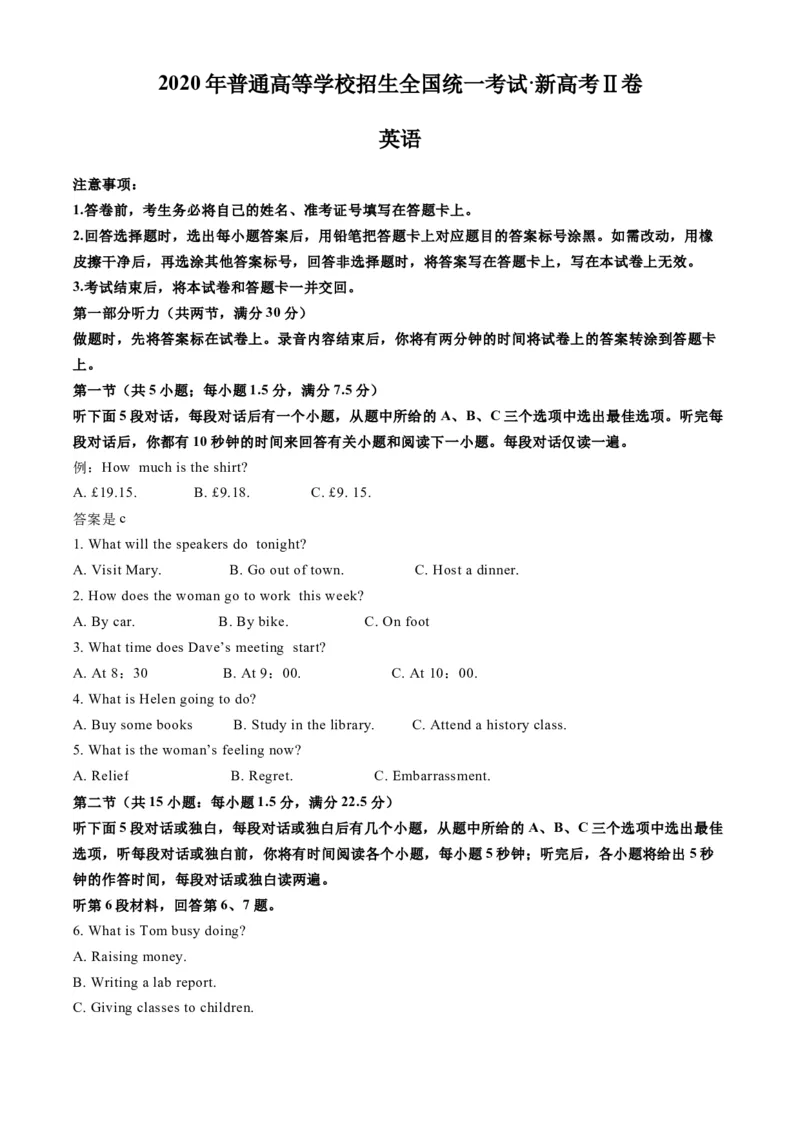
1. What will the speakers do tonight?
A. Visit Mary. B. Go out of town. C. Host a dinner.
2. How does the woman go to work this week?
A. By car. B. By bike. C. On foot
3. What time does Dave’s meeting start?
A. At 8:30 B. At 9:00. C. At 10:00.
4. What is Helen going to do?
A. Buy some books B. Study in the library. C. Attend a history class.
5. What is the woman’s feeling now?
A. Relief B. Regret. C. Embarrassment.
第二节(共15小题:每小题1.5分,满分22.5分)
听下面5段对话或独白,每段对话或独白后有几个小题,从题中所给的A、B、C三个选项中选出最佳
选项,听每段对话或独白前,你将有时间阅读各个小题,每小题5秒钟;听完后,各小题将给出5秒
钟的作答时间,每段对话或独白读两遍。
听第6段材料,回答第6、7题。
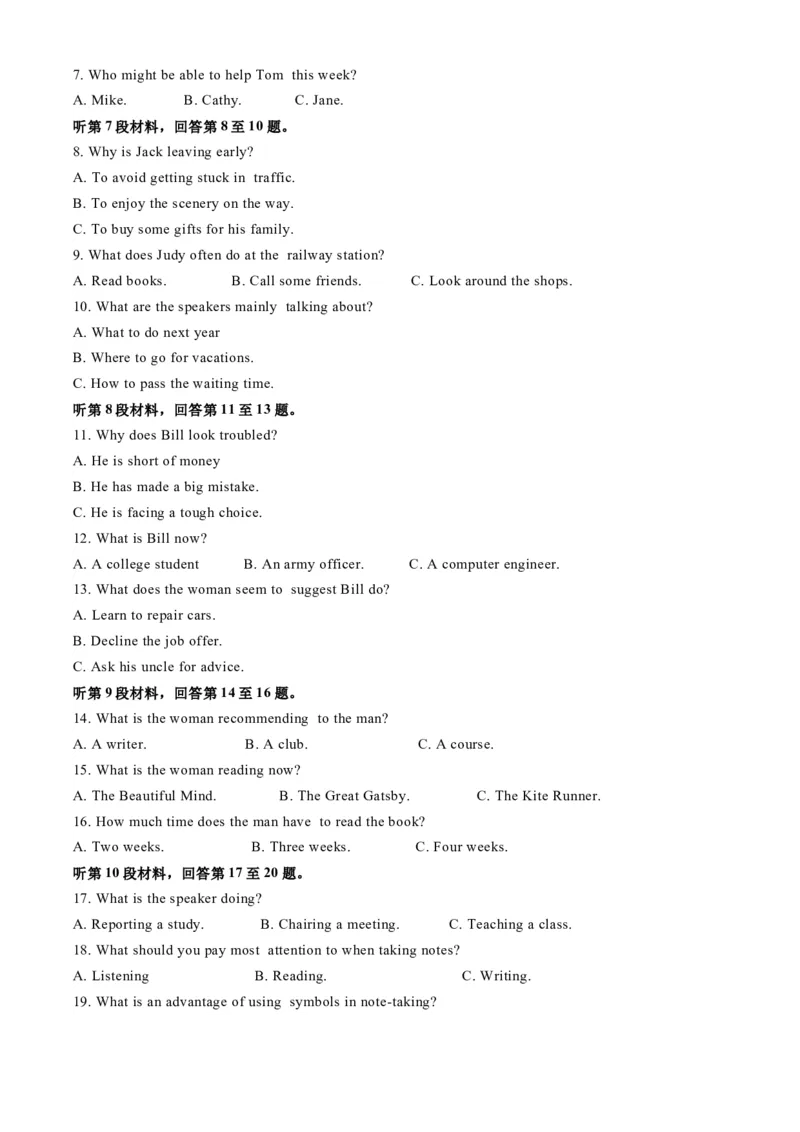
6. What is Tom busy doing?
A. Raising money.
B. Writing a lab report.
C. Giving classes to children.7. Who might be able to help Tom this week?
A. Mike. B. Cathy. C. Jane.
听第7段材料,回答第8至10题。
8. Why is Jack leaving early?
A. To avoid getting stuck in traffic.
B. To enjoy the scenery on the way.
C. To buy some gifts for his family.
9. What does Judy often do at the railway station?
A. Read books. B. Call some friends. C. Look around the shops.
10. What are the speakers mainly talking about?
A. What to do next year
B. Where to go for vacations.
C. How to pass the waiting time.
听第8段材料,回答第11至13题。
11. Why does Bill look troubled?
A. He is short of money
B. He has made a big mistake.
C. He is facing a tough choice.
12. What is Bill now?
A. A college student B. An army officer. C. A computer engineer.
13. What does the woman seem to suggest Bill do?
A. Learn to repair cars.
B. Decline the job offer.
C. Ask his uncle for advice.
听第9段材料,回答第14至16题。
14. What is the woman recommending to the man?
A. A writer. B. A club. C. A course.
15. What is the woman reading now?
A. The Beautiful Mind. B. The Great Gatsby. C. The Kite Runner.
16. How much time does the man have to read the book?
A. Two weeks. B. Three weeks. C. Four weeks.
听第10段材料,回答第17至20题。
17. What is the speaker doing?
A. Reporting a study. B. Chairing a meeting. C. Teaching a class.
18. What should you pay most attention to when taking notes?
A. Listening B. Reading. C. Writing.
19. What is an advantage of using symbols in note-taking?A. It keeps information secret.
B. It leaves space for future use.
C. It makes key words noticeable.
20. What will the speaker do next?
A. Ask a few questions. B. Show some notes. C. Make a summary.
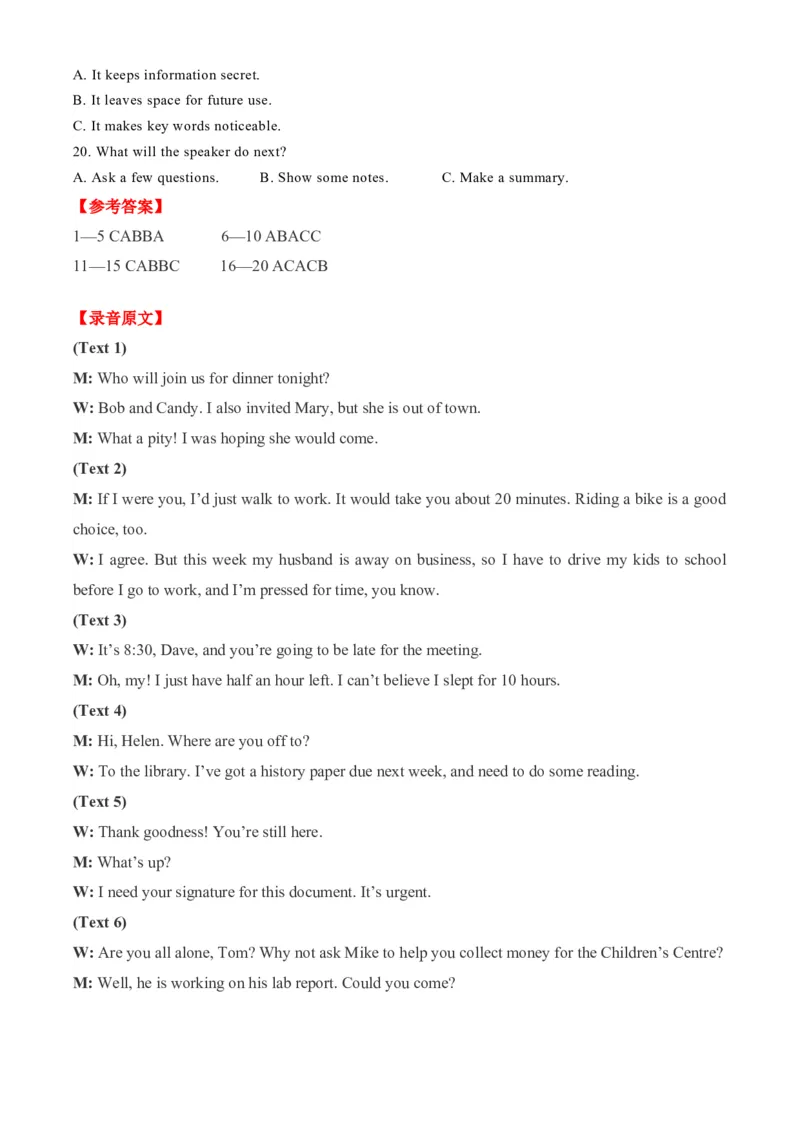
【参考答案】
1—5 CABBA 6—10 ABACC
11—15 CABBC 16—20 ACACB
【录音原文】
(Text 1)
M: Who will join us for dinner tonight?
W: Bob and Candy. I also invited Mary, but she is out of town.
M: What a pity! I was hoping she would come.
(Text 2)
M: If I were you, I’d just walk to work. It would take you about 20 minutes. Riding a bike is a good
choice, too.
W: I agree. But this week my husband is away on business, so I have to drive my kids to school
before I go to work, and I’m pressed for time, you know.
(Text 3)
W: It’s 8:30, Dave, and you’re going to be late for the meeting.
M: Oh, my! I just have half an hour left. I can’t believe I slept for 10 hours.
(Text 4)
M: Hi, Helen. Where are you off to?
W: To the library. I’ve got a history paper due next week, and need to do some reading.
(Text 5)
W: Thank goodness! You’re still here.
M: What’s up?
W: I need your signature for this document. It’s urgent.
(Text 6)
W: Are you all alone, Tom? Why not ask Mike to help you collect money for the Children’s Centre?
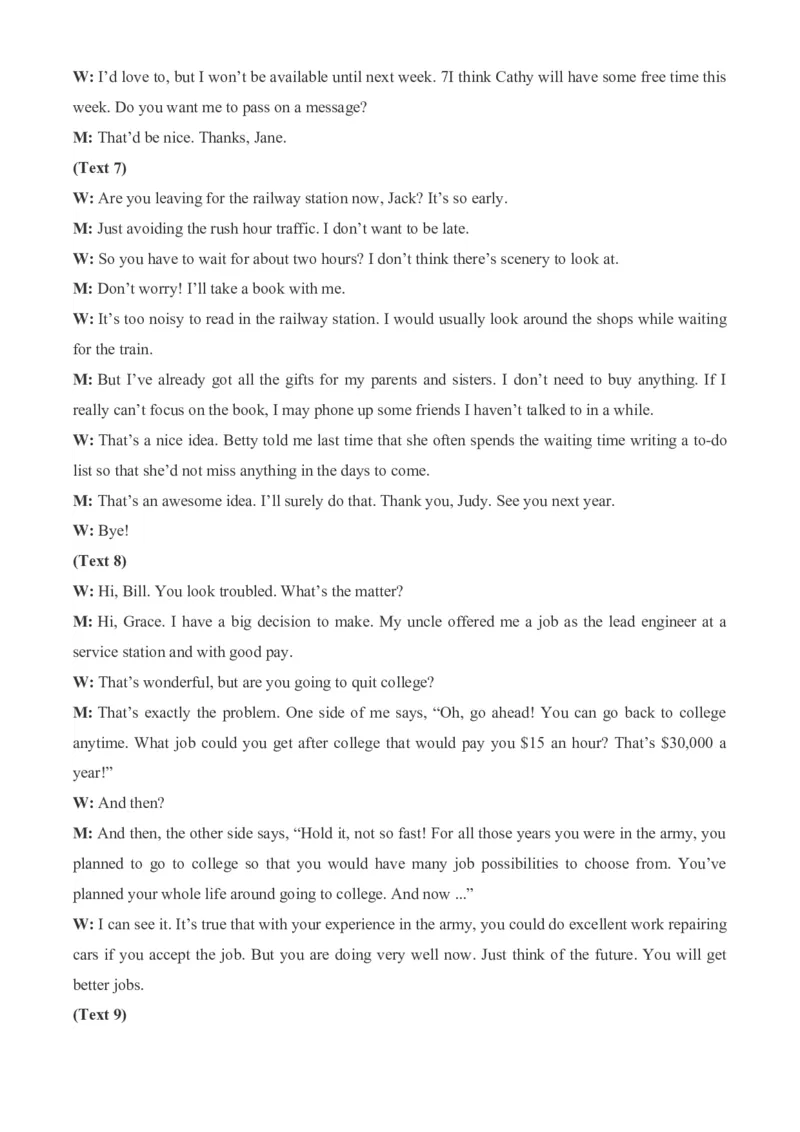
M: Well, he is working on his lab report. Could you come?W: I’d love to, but I won’t be available until next week. 7I think Cathy will have some free time this
week. Do you want me to pass on a message?
M: That’d be nice. Thanks, Jane.
(Text 7)
W: Are you leaving for the railway station now, Jack? It’s so early.
M: Just avoiding the rush hour traffic. I don’t want to be late.
W: So you have to wait for about two hours? I don’t think there’s scenery to look at.
M: Don’t worry! I’ll take a book with me.
W: It’s too noisy to read in the railway station. I would usually look around the shops while waiting
for the train.
M: But I’ve already got all the gifts for my parents and sisters. I don’t need to buy anything. If I
really can’t focus on the book, I may phone up some friends I haven’t talked to in a while.
W: That’s a nice idea. Betty told me last time that she often spends the waiting time writing a to-do
list so that she’d not miss anything in the days to come.
M: That’s an awesome idea. I’ll surely do that. Thank you, Judy. See you next year.
W: Bye!
(Text 8)
W: Hi, Bill. You look troubled. What’s the matter?
M: Hi, Grace. I have a big decision to make. My uncle offered me a job as the lead engineer at a
service station and with good pay.
W: That’s wonderful, but are you going to quit college?
M: That’s exactly the problem. One side of me says, “Oh, go ahead! You can go back to college
anytime. What job could you get after college that would pay you $15 an hour? That’s $30,000 a
year!”
W: And then?
M: And then, the other side says, “Hold it, not so fast! For all those years you were in the army, you
planned to go to college so that you would have many job possibilities to choose from. You’ve
planned your whole life around going to college. And now ...”
W: I can see it. It’s true that with your experience in the army, you could do excellent work repairing
cars if you accept the job. But you are doing very well now. Just think of the future. You will get
better jobs.
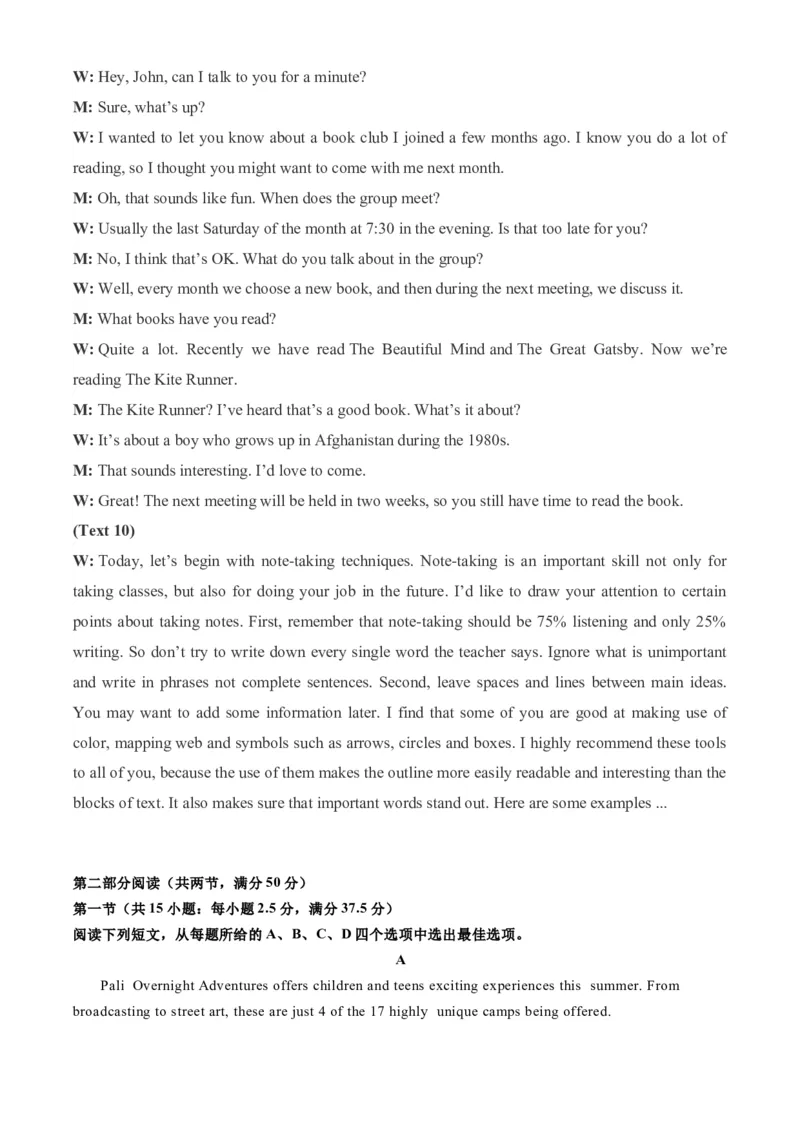
(Text 9)W: Hey, John, can I talk to you for a minute?
M: Sure, what’s up?
W: I wanted to let you know about a book club I joined a few months ago. I know you do a lot of
reading, so I thought you might want to come with me next month.
M: Oh, that sounds like fun. When does the group meet?
W: Usually the last Saturday of the month at 7:30 in the evening. Is that too late for you?
M: No, I think that’s OK. What do you talk about in the group?
W: Well, every month we choose a new book, and then during the next meeting, we discuss it.
M: What books have you read?
W: Quite a lot. Recently we have read The Beautiful Mind and The Great Gatsby. Now we’re
reading The Kite Runner.
M: The Kite Runner? I’ve heard that’s a good book. What’s it about?
W: It’s about a boy who grows up in Afghanistan during the 1980s.
M: That sounds interesting. I’d love to come.
W: Great! The next meeting will be held in two weeks, so you still have time to read the book.
(Text 10)
W: Today, let’s begin with note-taking techniques. Note-taking is an important skill not only for
taking classes, but also for doing your job in the future. I’d like to draw your attention to certain
points about taking notes. First, remember that note-taking should be 75% listening and only 25%
writing. So don’t try to write down every single word the teacher says. Ignore what is unimportant
and write in phrases not complete sentences. Second, leave spaces and lines between main ideas.
You may want to add some information later. I find that some of you are good at making use of
color, mapping web and symbols such as arrows, circles and boxes. I highly recommend these tools
to all of you, because the use of them makes the outline more easily readable and interesting than the
blocks of text. It also makes sure that important words stand out. Here are some examples ...
第二部分阅读(共两节,满分50分)
第一节(共15小题:每小题2.5分,满分37.5分)
阅读下列短文,从每题所给的A、B、C、D四个选项中选出最佳选项。
A
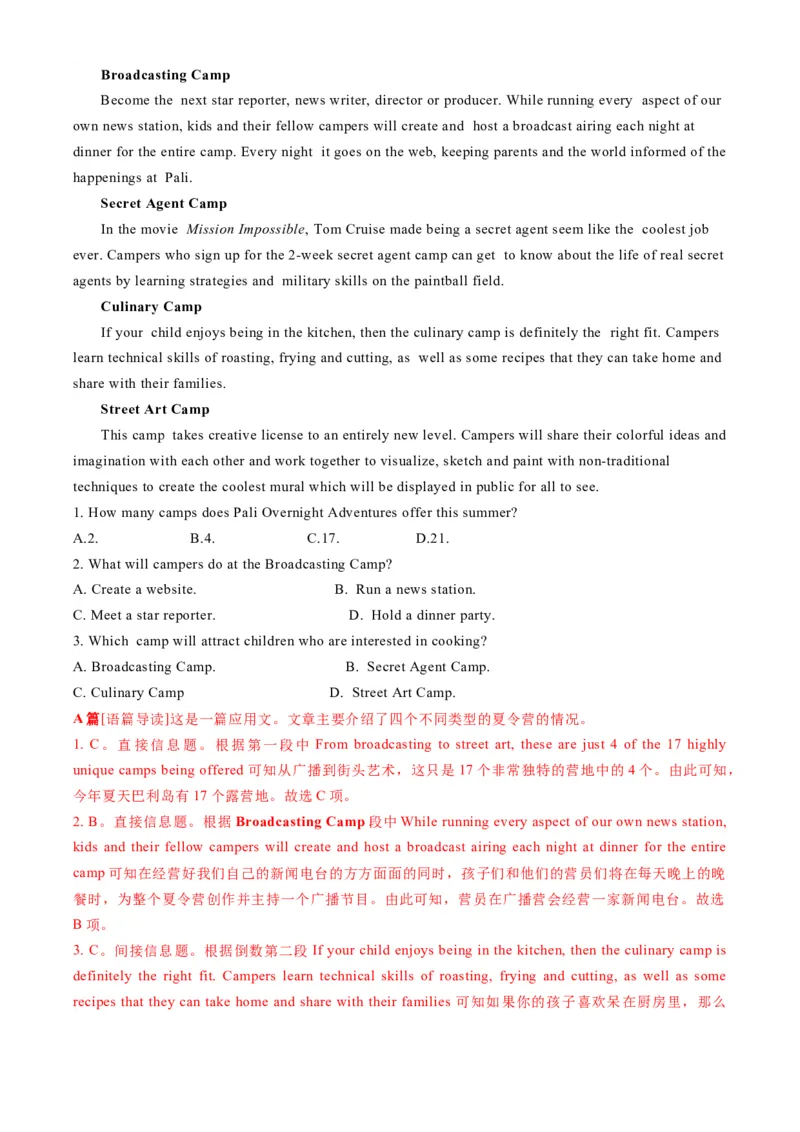
Pali Overnight Adventures offers children and teens exciting experiences this summer. From
broadcasting to street art, these are just 4 of the 17 highly unique camps being offered.Broadcasting Camp
Become the next star reporter, news writer, director or producer. While running every aspect of our
own news station, kids and their fellow campers will create and host a broadcast airing each night at
dinner for the entire camp. Every night it goes on the web, keeping parents and the world informed of the
happenings at Pali.
Secret Agent Camp
In the movie Mission Impossible, Tom Cruise made being a secret agent seem like the coolest job
ever. Campers who sign up for the 2-week secret agent camp can get to know about the life of real secret
agents by learning strategies and military skills on the paintball field.
Culinary Camp
If your child enjoys being in the kitchen, then the culinary camp is definitely the right fit. Campers
learn technical skills of roasting, frying and cutting, as well as some recipes that they can take home and
share with their families.
Street Art Camp
This camp takes creative license to an entirely new level. Campers will share their colorful ideas and
imagination with each other and work together to visualize, sketch and paint with non-traditional
techniques to create the coolest mural which will be displayed in public for all to see.
1. How many camps does Pali Overnight Adventures offer this summer?
A.2. B.4. C.17. D.21.
2. What will campers do at the Broadcasting Camp?
A. Create a website. B. Run a news station.
C. Meet a star reporter. D. Hold a dinner party.
3. Which camp will attract children who are interested in cooking?
A. Broadcasting Camp. B. Secret Agent Camp.
C. Culinary Camp D. Street Art Camp.
A篇[语篇导读]这是一篇应用文。文章主要介绍了四个不同类型的夏令营的情况。
1. C。直接信息题。根据第一段中 From broadcasting to street art, these are just 4 of the 17 highly
unique camps being offered可知从广播到街头艺术,这只是 17个非常独特的营地中的4个。由此可知,
今年夏天巴利岛有17个露营地。故选C项。
2. B。直接信息题。根据Broadcasting Camp段中While running every aspect of our own news station,
kids and their fellow campers will create and host a broadcast airing each night at dinner for the entire
camp可知在经营好我们自己的新闻电台的方方面面的同时,孩子们和他们的营员们将在每天晚上的晚
餐时,为整个夏令营创作并主持一个广播节目。由此可知,营员在广播营会经营一家新闻电台。故选
B项。
3. C。间接信息题。根据倒数第二段 If your child enjoys being in the kitchen, then the culinary camp is
definitely the right fit. Campers learn technical skills of roasting, frying and cutting, as well as some
recipes that they can take home and share with their families 可知如果你的孩子喜欢呆在厨房里,那么烹饪夏令营绝对是最合适的选择。露营者学习烘焙、油炸和切菜的技术技能,以及一些他们可以带回
家和家人分享的食谱。由此可知,Culinary Camp会吸引对烹饪感兴趣的孩子。故选C项。
◎读后知识积累:overnight/ˌəʊvəˈnaɪt/adj. 晚上的,一夜的;director/daɪˈrektə/n. 主任,主管;导演;
aspect/ˈæspekt/ n. 方面;方向;airing/ˈeərɪŋ/ n. 通风;晾干;节目;agent/ˈeɪdʒənt/n. 代理人,代理商
(secret agent间谍;特务);sign up for注册,选课;报名参加;strategy/ˈstrætədʒi/ n. 战略,策略;
military/ˈmɪlətri/adj. 军事的;culinary/ˈkʌlɪnəri/adj. 烹饪的;roast/rəʊst/v. 烘,烤(肉等);recipe/
ˈresəpi/ n. 食谱;处方;
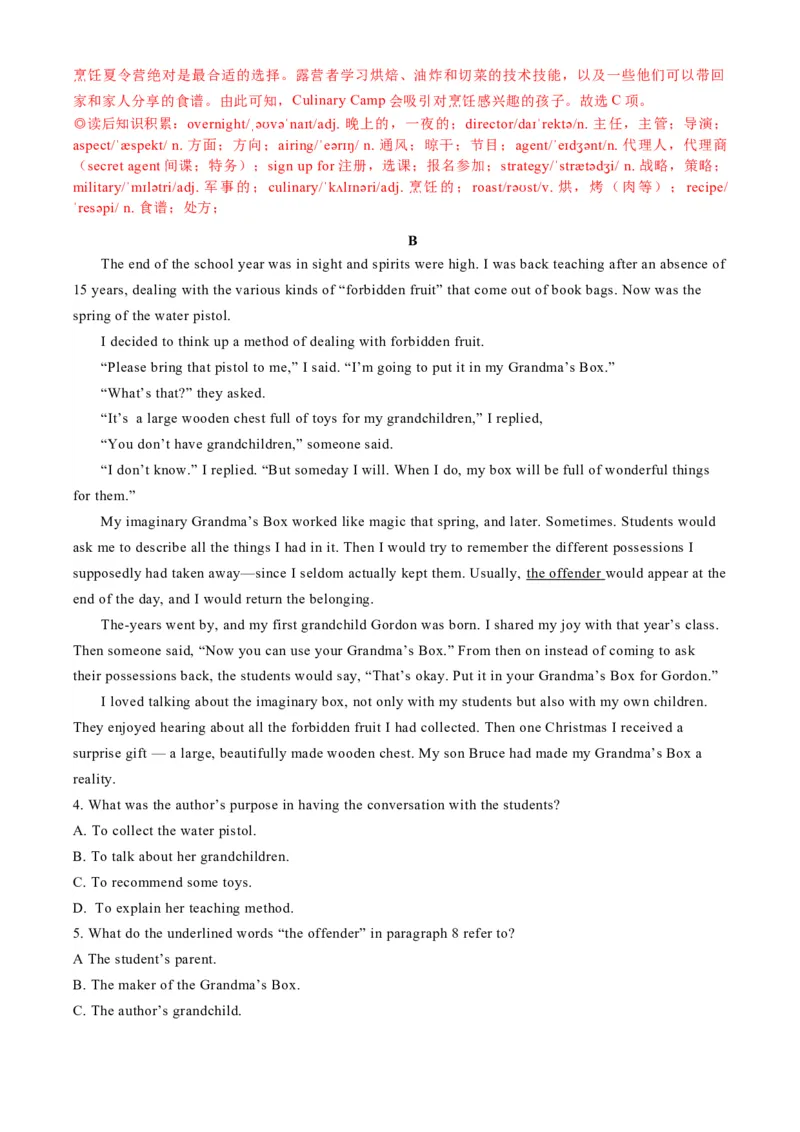
B
The end of the school year was in sight and spirits were high. I was back teaching after an absence of
15 years, dealing with the various kinds of “forbidden fruit” that come out of book bags. Now was the
spring of the water pistol.
I decided to think up a method of dealing with forbidden fruit.
“Please bring that pistol to me,” I said. “I’m going to put it in my Grandma’s Box.”
“What’s that?” they asked.
“It’s a large wooden chest full of toys for my grandchildren,” I replied,
“You don’t have grandchildren,” someone said.
“I don’t know.” I replied. “But someday I will. When I do, my box will be full of wonderful things
for them.”
My imaginary Grandma’s Box worked like magic that spring, and later. Sometimes. Students would
ask me to describe all the things I had in it. Then I would try to remember the different possessions I
supposedly had taken away—since I seldom actually kept them. Usually, the offender would appear at the
end of the day, and I would return the belonging.
The-years went by, and my first grandchild Gordon was born. I shared my joy with that year’s class.
Then someone said, “Now you can use your Grandma’s Box.” From then on instead of coming to ask
their possessions back, the students would say, “That’s okay. Put it in your Grandma’s Box for Gordon.”
I loved talking about the imaginary box, not only with my students but also with my own children.
They enjoyed hearing about all the forbidden fruit I had collected. Then one Christmas I received a
surprise gift — a large, beautifully made wooden chest. My son Bruce had made my Grandma’s Box a
reality.
4. What was the author’s purpose in having the conversation with the students?
A. To collect the water pistol.
B. To talk about her grandchildren.
C. To recommend some toys.
D. To explain her teaching method.
5. What do the underlined words “the offender” in paragraph 8 refer to?
A The student’s parent.
B. The maker of the Grandma’s Box.
C. The author’s grandchild.D. The owner of the forbidden fruit.
6. What did the students do after they learned about the birth of Gordon?
A. They went to play with the baby.
B. They asked to see the Grandma’s Box.
C. They made a present for Gordon.
D. They stopped asking their toys back.
7. What can we infer about the author?
A. She enjoys telling jokes.
B. She is a strict and smart teacher.
C. She loves doing woodwork.
D. She is a responsible grandmother
B篇[语篇导读]这是一篇记叙文。文章主要讲叙了作者为了收集学生们带到学校的玩具,想出了一个
“奶奶的盒子”的办法。到后来,作者的第一个孙子出生,学生们也不再来要求归还他们的财物了,
作者也在某一年圣诞节收到了儿子制作的大木箱,将“奶奶的盒子”变成了现实。
4. A。动作倾向题。根据第一段中 I was back teaching after an absence of 15 years, dealing with the
various kinds of “forbidden fruit” that come out of book bags. Now was the spring of the water pistol(在
缺席了15年之后,我又回到了教书的地方,处理从书包里掏出的各种各样的“禁果”。现在流行的是
水枪)以及第三段中“Please bring that pistol to me,” I said. “I’m going to put it in my Grandma’s
Box.” (“请把那支水枪给我,”我说。“我要把它放在我奶奶的盒子里。”)由此可知,作者与学
生进行对话的目的是收集水枪。故选A项。
5. D。词句猜测题。根据划线词后文I would return the belonging结合上文提到作者把学生带到学校的
玩具称为“禁果”,且作者的“盒子”里装的就是“好禁果”,所以作者等到这些禁果的拥有者在一
天结束的时候出现,然后就会归还他们的物品。由此可知,划线词意思为“禁果的拥有者”。故选 D
项。
6. D。直接信息题。根据倒数第二段中From then on instead of coming to ask their possessions back, the
students would say, “That’s okay. Put it in your Grandma’s Box for Gordon.”(从那时起,学生们不再来
要求归还他们的财物,而是说:“没关系。把它放在你奶奶给戈登的盒子”里),由此可知,学生们
在得知了戈登的出生后,他们不再索要玩具。故选D项。
7. B。隐含意义推断题。根据文章中作者要收集学生们从书包里掏出的各种各样的“禁果”,说明作
者对待学生很严格;同时作者又想出了“奶奶的盒子”这个的方法来收集学生们的玩具,说明作者很
聪明,由此可推知,作者是一个严格而聪明的老师。故选B项。
◎读后知识积累:pistol/ˈpɪstl/ n. 手枪;possession/pəˈzeʃn/ n. 拥有;财产;woodwork /ˈwʊdwɜːk/ n. 木
制 品 ; think up a method 想 出 一 个 方 法 ; imaginary/ɪˈmædʒɪnəri/ adj. 虚 构 的 , 假 想 的 ;
chest/tʃest/ n. 胸部;衣柜;箱子。
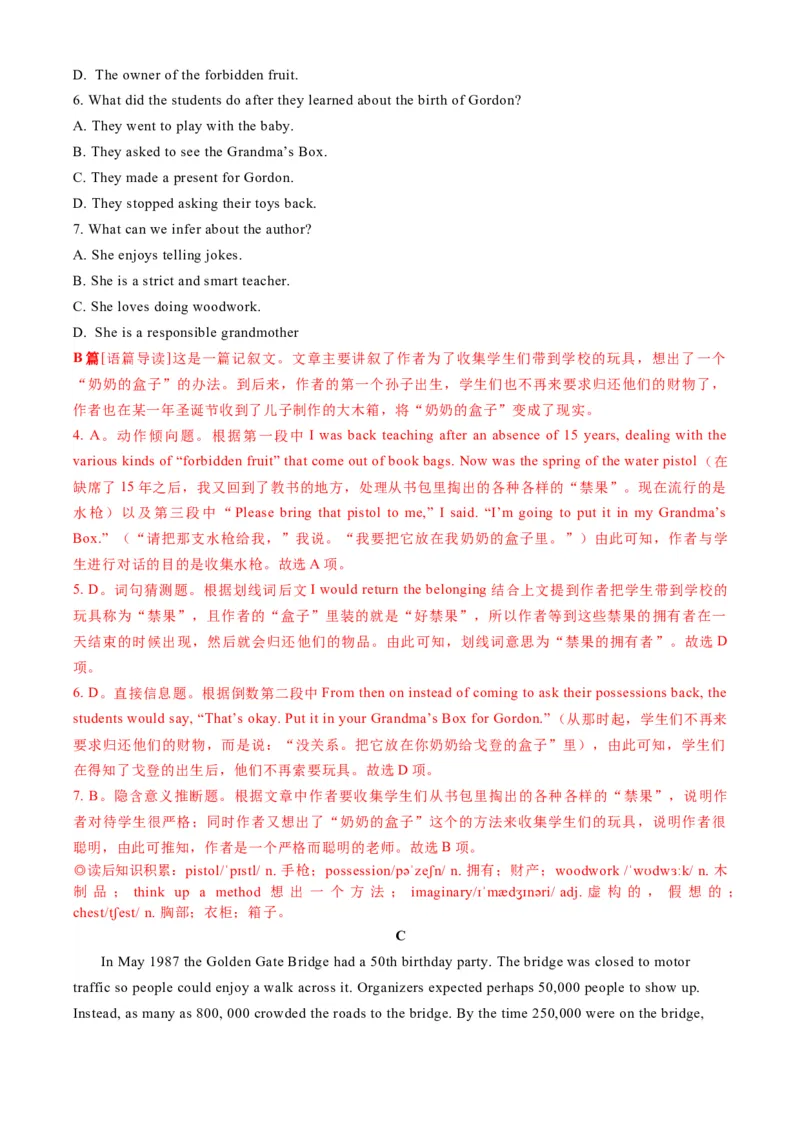
C
In May 1987 the Golden Gate Bridge had a 50th birthday party. The bridge was closed to motor
traffic so people could enjoy a walk across it. Organizers expected perhaps 50,000 people to show up.
Instead, as many as 800, 000 crowded the roads to the bridge. By the time 250,000 were on the bridge,engineers noticed something terrible:the roadway was flattening under what turned out to be the
heaviest load it had ever been asked to carry. Worse, it was beginning to sway(晃动). The authorities
closed access to the bridge and tens of thousands of people made their way back to land. A disaster was
avoided.
The story is one of scores in To Forgive Design:Understanding Failure, a book that is at once a
love letter to engineering and a paean(赞歌)to its breakdowns. Its author, Dr. Henry Petroski, has long
been writing about disasters. In this book, he includes the loss of the space shuttles(航天飞机)
Challenger and Columbia, and the sinking of the Titanic.
Though he acknowledges that engineering works can fail because the person who thought them up or
engineered them simply got things wrong, in this book Dr. Petroski widens his view to consider the larger
context in which such failures occur. Sometimes devices fail because a good design is constructed with
low quality materials incompetently applied. Or perhaps a design works so well it is adopted elsewhere
again and again, with seemingly harmless improvements, until, suddenly, it does not work at all anymore.
Readers will encounter not only stories they have heard before, but some new stories and a moving
discussion of the responsibility of the engineer to the public and the ways young engineers can be helped
to grasp them.
“Success is success but that is all that it is,” Dr. Petroski writes. It is failure that brings
improvement.
8. What happened to the Golden Gate Bridge on its50th birthday?
A. It carried more weight than it could.
B. It swayed violently in a strong wind
C Its roadway was damaged by vehicles
D. Its access was blocked by many people.
9. Which of the following is Dr. Petroski’s idea according to paragraph 3?
A. No design is well received everywhere
B. Construction is more important than design.
C. Not all disasters are caused by engineering design
D. Improvements on engineering works are necessary.
10. What does the last paragraph suggest?
A. Failure can lead to progress.
B. Success results in overconfidence
C. Failure should be avoided.
D. Success comes from joint efforts.
11. What is the text?
A. A news report B.A short story.
C. A book review D.A research article.C篇[语篇导读]这是一篇议论文。主要讲述了对彼得罗斯基博士的书《原谅设计:理解失败》的评论,
工程设计可能会因为某些原因带来失败,但失败了才能带来进步。
8. A。间接信息题。根据文章第一段In May 1987 the Golden Gate Bridge had a 50th birthday party. The
bridge was closed to motor traffic so people could enjoy a walk across it. Organizers expected perhaps
50,000 people to show up. Instead, as many as 800,000 crowded the roads to the bridge. By the time
250,000 were on the bridge, engineers noticed something terrible :the roadway was flattening under
what turned out to be the heaviest load it had ever been asked to carry. Worse, it was beginning to sway
可以看出,1987年5月,金门大桥举行了一个50岁生日聚会。这座桥禁止机动车通行,人们可以在桥
上散步。组织者预计将有5万人到场。结果,多达80万人挤满了通往大桥的道路。当25万人在桥上
时,工程师们注意到了一个可怕的现象:路面在被要求承载的最重荷载作用下变得平了。更糟的是,
它开始晃动。因此可以看出,金门大桥50岁生日那天,它的重量超过了它的承受能力。故选A项。
9. C。观点态度题。根据文章第三段 Though he acknowledges that engineering works can fail because
the person who thought them up or engineered them simply got things wrong, in this book Dr. Petroski
widens his view to consider the larger context in which such failures occur. Sometimes devices fail
because a good design is constructed with low quality materials incompetently applied. Or perhaps a
design works So well it is adopted elsewhere again and again, with seemingly harmless improvements,
until, suddenly, it does not work at all anymore 可知,虽然他承认工程设计可能会因为那些想出或设计
它们的人只是把事情弄错了失败,但在这本书中,彼得罗斯基博士拓宽了他的视野,考虑了这种失败
发生的更大背景。有时,由于一个好的设计是用不合格的低质量材料建造的,所以装置会失败。或者,
一个设计工作得如此好,以至于在其他地方一次又一次地被采用,似乎是无害的改进,直到突然间,
它完全不起作用了。因此可以推测出,不是所有的灾难都是由工程设计引起的是彼得罗斯基博士的想
法。故选C项。
10. A。直接信息题。根据文章最后一段的 It is failure that brings improvement 可知,失败才能带来进
步。因此可以看出,A项与此相呼应,即失败能带来进步,故选A项。
11. C。文章出处题。根据文章第二段 The story is one of scores in To Forgive Design:Understanding
Failure, a book that is at once a love letter to engineering and a paean(赞歌)to its breakdowns可知,
这个故事是《原谅设计:理解失败》一书中的一个,这本书既是对工程的一封情书,也是对其崩溃的
赞歌。并且后面两段都在写这本书里的内容以及评价,再根据倒数第二段的 Readers will encounter not
only stories they have heard before, but some new stories and a moving discussion of the responsibility of
the engineer to the public and the ways young engineers can be helped to grasp them 可知,读者不仅会
遇到他们以前听过的故事,还会遇到一些新的故事和关于工程师对公众的责任以及如何帮助年轻工程
师掌握它们的动人讨论。再结合最后一段It is failure that brings improvement可知,失败才能带来进步。
因此可以推测出,这些内容都是关于这本书的评论,因为这篇文章是书评,故选C项。
◎读后知识积累:motor traffic 汽车交通;show up 露面;露出;揭露;flatten/'flætn/ v. 压扁;
violently/ˈvaɪələntli/ adv. 激烈地;厉害地;暴力地;vehicle/ˈviːəkl/ n. 车辆;工具;access/ˈækses/ n.
通道;进入;机会;使用权;block/blɒk/ n.块;街区;大厦;vt.阻塞;context/ˈkɒntekst/ n. 环境;上
下文;背景;device /dɪˈvaɪs/n. 装置;策略;图案;计划;construct /kənˈstrʌkt/v. 建造,修建;quality/ˈkwɒləti/n. 质量;incompetently /ɪnˈkɒmpɪtəntli/ adv. 无能力地;engineering /ˌendʒɪˈnɪərɪŋ/n. 工程,
工程学;encounter /ɪnˈkaʊntə/v. 遭遇;邂逅。
D
Rainforests are home to a rich variety of medicinal plants, food, birds and animals. Can you believe
that a single bush(灌木丛)in the Amazon may have more species of ants than the whole of Britain!
About 480 varieties of trees may be found in just one hectare of rainforest.
Rainforests are the lungs of the planet-storing vast quantities of carbon dioxide and producing a
significant amount of the world’s oxygen. Rainforests have their own perfect system for ensuring their
own survival; the tall trees make a canopy(树冠层)of branches and leaves which protect themselves,
smaller plants, and the forest animals from heavy rain, intense dry heat from the sun and strong winds.
Amazingly, the trees grow in such a way that their leaves and branches, although close together,
never actually touch those of another tree. Scientists think this is the plants’ way to prevent the spread of
any tree diseases and make life more difficult for leaf-eating insects like caterpillars. To survive in the
forest, animals must climb, jump or fly across the gaps. The ground floor of the forest is not all tangled
leaves and bushes, like in films, but is actually fairly clear. It is where dead leaves turn into food for the
trees and other forest life.
They are not called rainforests for nothing! Rainforests can generate 75%of their own rain. At least
80 inches of rain a year is normal-and in some areas there may be as much as 430 inches of rain annually.
This is real rain-your umbrella may protect you in a shower, but it won’t keep you dry if there is a full
rainstorm. In just two hours, streams can rise ten to twenty feet. The humidity(湿气)of large
rainforests contributes to the formation of rainclouds that may travel to other countries in need of rain.
12. What can we learn about rainforests from the first paragraph?
A. They produce oxygen.
B. They cover a vast area.
C. They are well managed.
D. They are rich in wildlife.
13. Which of the following contributes most to the survival of rainforests?
A. Heavy rains B. Big trees.
C. Small plants. D. Forest animals.
14. Why do the leaves and branches of different trees avoid touching each other?
A. For more sunlight. B. For more growing space.
C. For self-protection. D. For the detection of insects.
15. What can be a suitable title for the text?
A. Life-Giving Rainforests B. The Law of the Jungle
C. Animals in the Amazon D. Weather in RainforestsD篇[语篇导读]本文是说明文。热带雨林被称为“世界上最大的药房”,因为超过25%的现代药物是由
其植物提炼。热带雨林也享有“地球之肺”的美誉,其植物的光合作用净化地球空气,仅亚马逊热带
雨林产生的氧气就占全球氧气总量的1/3。
12. D。直接信息题。根据第一段 Rainforests are home to a rich variety of medicinal plants, food, birds
and animals得知,热带雨林蕴藏了丰富多彩的药用植物、食物以及鸟禽猛兽。可知,热带雨林有丰富
的野生动物,故选D项。
13. B。直接信息题。根据第二段 Rainforests have their own perfect system for ensuring their own
survival; the tall trees make a canopy(树冠层)of branches and leaves which protect themselves,
smaller plants, and the forest animals from heavy rain, intense dry heat from the sun and strong winds 得
知,热带雨林有自己完美的生存体系,高大的树木有枝干,树叶的树冠层保护树木本身、小植物、动
物们免受大雨和太阳强风带来的干燥热浪的伤害。可知,大树有助于热带雨林生存,故选B项。
14. C。间接信息题。根据第三段 Scientists think this is the plants’ way to prevent the spread of any tree
diseases and make life more difficult for leaf-eating insects like caterpillars 得知,科学家们认为这是植
物阻止任何树木疾病扩散和让比如毛毛虫这种食用树叶的昆虫难以生存。可以判断出不同树木的树叶
和树枝避免彼此触碰是为了自我保护,故选C项。
15. A。主旨大意题。本文首先讲述了热带雨林蕴藏了丰富多彩的药用植物、食物以及鸟禽猛兽。其次,
热带雨林就是地球的肺——它吸纳了大量的二氧化碳,并制造了全球氧气的很大部分。然后,雨林可
以自我形成所需降雨的75%,而庞大的热带雨林湿气则可以形成雨云,这些雨云则可以飘往那些缺雨
水的国家。可以判断出本文最佳标题是“给予生命的热带雨林”,故选A项。
◎读后知识积累:medicinal/məˈdɪsɪnl/ adj. 药的;药用的;rainforest/ˈreɪnfɒrɪst/n. (热带)雨林;
vast/vɑːst/adj. 广阔的;巨大的;大量的;hectare/ˈhekteə/n. 公顷;intense /ɪnˈtens/adj. 强烈的;紧张的;
detection/dɪˈtekʃn/n. 侦查,探测;发现;察觉。
第二节(共5小题:每小题2.5分,满分12.5分)
阅读下面短文,从短文后的选项中选出可以填入空白处的最佳选项,选项中有两项为多余选项。
Talking with your doctor
Talking freely with your doctor can make you feel better and gives your doctor the information she
or he needs to give you the best care. Don’t be afraid or embarrassed to discuss something that is
bothering you.____16____
●Stay positive.
Goto your doctor’s visits with a good attitude.____17____ Thinkteamwork! Think positive!
●Keep track of how you are feeling.
____18____ This will make it easier for you to answer questions about your symptoms(症状)and
how medicines make you feel. It also makes it easier for you to bring up anything that you are worried
about. Make sure to be honest about how you feel and how long you’ve felt that way.
●____19____
Your medical history is a list of your illnesses, treatments, what the doctors told you to do, and
anything else you think your doctor should know. Also, if you are allergic(过敏)to any medicines, be
sure to mention that to your doctor.●Ask questions.
Do not be afraid to ask your doctor any questions you have. To remember all the questions you have
when you are not in the doctor’s office, write them down and bring the list with you to your
appointment.____20____ Remember—there’s no such thing as a stupid question. If you don’t understand
the answer to a question, ask the doctor to explain it again until you do understand.
A. This will make getting answers easier.
B. Here are some tips for talking with your doctor.
C. You can talk to another doctor if the treatments don’t work.
D. Before your doctor’s visit, keep notes on how you are feeling.
E. Remember, your doctor and other caregivers are on your side.
F. Bring your medical history, including a list of your current medicines.
G. Writing down what the doctor says will help you remember important information.
[语篇导读]这是一篇应用文,文章讲述了与医生谈话的几个小建议。
16. B。考查过渡句。根据文章第一段 Talking freely with your doctor can make you feel better and gives
your doctor the information she or he needs to give you the best care. Don’t be afraid or embarrassed to
discuss something that is bothering you.可知,与你的医生畅所欲言可以让你感觉好些,并向你的医生
提供她或他需要的信息,以便为你提供最好的护理。不要害怕或尴尬地讨论困扰你的事情。再结合下
文为几条具体的建议,所以选B项(这里有一些与你的医生交谈的小建议)为顺承关系。
17. E。考查细节句。根据空后 teamwork!(团队合作)可知,选 E项(记住,你的医生和其他护理人
员都站在你这边)。
18. D。考查主题句。根据标题(记录你的感受)及空后 This will make it easier for you to answer
questions about your symptoms(症状)and how medicines make you feel. It also makes it easier for you
to bring up anything that you are worried about. Make sure to be honest about how you feel and how long
you’ve felt that way可知,这将使你更容易回答关于你的症状和药物让你感觉如何的问题。这也让你更
容易提出你担心的任何事情。一定要诚实地说出你的感受,以及你这种感觉持续了多久。由此可知,
这都是在讲感受,故选D项(在你的医生来之前,记下你的感受)。
19. F。考查标题句。根据文章 Your medical history is a list of your illnesses, treatments, what the
doctors told you to do, and anything else you think your doctor should know.可知,你的病史是你的疾病,
治疗,医生告诉你做什么,以及你认为你的医生应该知道的任何事情的清单。故选F项(带上你的病
史,包括你目前的药物清单)符合题意,相呼应,故F。
20. A。考查过渡句。根据空前Don’t be afraid to ask your doctor any questions you have. To remember
all the questions you have when you are not in the doctor’s office, write them down and bring the list
with you to your appointment可知,不要害怕问你的医生你有的任何问题。当你不在医生办公室时,为
了记住你的所有问题,把它们写下来,并带着清单去你的预约。以及 Remember—there’s no such thing
as a stupid question. If you don’t understand the answer to a question, ask the doctor to explain it again
until you do understand可知,记住,没有什么愚蠢的问题。如果你不明白问题的答案,请医生再解释一遍,直到你明白为止。因此中间缺少过渡句,A选项(这将使获得答案更容易。)正好可以连接两
句。
◎读后知识积累:bother/ˈbɒðə/ vt. 烦扰,打扰;caregiver/ˈkeəɡɪvər/ n. 照料者,护理者;看护者;
teamwork团队合作;bring up提出;keepnotes on记下;keep track of记录;list /lɪst/ n. 列表,清单,
目录;current/ˈkʌrənt/ adj. 现在的;流通的
第三部分语言运用(共两节,满分30分)
第一节(共15小题;每小题1分,满分15分)
阅读下面短文,从每题所给的A、B、C、D四个选项中选出可以填入空白处的最佳选项。
When Jim Grant spotted black smoke coming out of a building on his way to work, he____21____ his
car to call 911. Then he____22____ a U-turn, circling back to take another look.
Pulling up to the building, Grant saw flames(火焰)shooting out of a second-floor window. Not
seeing or hearing any fire engines____23____ . Grant rushed to a side____24____ and ran up the stairs.
On the second floor, he ____25____ every apartment door. “Get-out!” Grant shouted, No
one ____26____ and he assumed that people had already____27____ . Reaching the end of the hallway,
though, Grant____28____ a half-open door. He kicked it wide open, finding a____29____ woman in a
wheelchair with a little boy and a tiny baby. “Let’s_____30_____ !” he screamed. The woman looked at
him in confusion and said something about changing her clothes. Grant didn’t wait, clutching(抓牢)the
baby to his chest and_____31_____ the boy alongside, Grant ran down the hallway. When he
was_____32_____ outside, the only_____33_____ in sight was a policeman. Grant told him about
the_____34_____ and they rushed into the smoky building.
Thanks to them, a family was saved from the fire. Grant and the policeman were honored for
their_____35_____ .
21. A. drove B. stopped C. reached D. abandoned
22. A. saw B. made C. missed D. crossed
23. A. burning B. leaving C. approaching D. waiting
24. A. entrance B. road C. building D. window
25. A. locked B. kicked C. counted D. repaired
26. A. agreed B. cared C. responded D. understood
27. A. arrived B. returned C. hidden D. escaped
28. A. skipped B. closed C. noticed D. remembered
29. A. frightened B. curious C. patient D. grateful
30. A. turn back B. go up C. get out D. lie down
31. A. following B. dragging C. examining D. passing
32. A. safely B. secretly C. suddenly D. previously
33. A. witness B. guide C. service D. help
34. A. woman B. door C. car D. baby
35. A. wisdom B. generosity C. honesty D. courage
[语篇导读]这是一篇记叙文,文章讲述了格兰特在上班的路上发现一栋大楼冒出黑烟并且楼上窗户喷火,
他就冲上楼救了两个孩子,并且告诉警察上面还有一个女人,于是女人也获救了。
21. B。语境结构衔接的考查。句意:当吉姆·格兰特在上班的路上发现一栋大楼冒出黑烟时,他停下车
打911。A. drove驾驶;B. stopped停下来;C. reached到达;D. abandoned抛弃。分析可知,大楼冒
黑烟是着火了,所以停下车去拨打911报警符合题意,故选B项。22. B。惯用衔接的考查。句意:然后他掉头,绕回来再看一眼。A. saw看;B. made做;C. missed错
过;D. crossed交叉;横过。make a U-turn意为掉头,固定搭配。故选B项。
23. C。语境结构衔接的考查。考查动词词义辨析。句意:格兰特把车停到大楼前,看见火焰从二楼窗
户里喷出来。没有看到或听到任何消防车接近。格兰特冲到一个侧门跑上楼梯。A. burning燃烧;B.
leaving离开;C. approaching接近;D. waiting等待。分析可知,火焰都已经从二楼喷出来,并且可以
看出格兰特跑上楼梯去救火,可以推测是因为消防车没来,此处approaching表示接近,符合题意,故
选C项。
24. A。语境结构衔接的考查。句意:格兰特把车停到大楼前,看见火焰从二楼的窗户里喷出来。没有
看到或听到任何消防车接近。格兰特冲到一个侧门口跑上楼梯。A. entrance 入口;B. road 路;C.
building楼;D. window窗户。根据语境可知,二楼窗户喷火并且消防车没来所以格兰特冲到侧门口是
为了救火, side entrance侧门口。故选A项。
25. B。语境结构衔接的考查。句意:在二楼,他踢了每个公寓的门。A. locked锁;B. kicked踢;C.
counted计算;D. repaired修。根据上文可知,大楼着火了。格兰特冲上楼去救火,所以踢门是为了看
里面是否有人。根据后暗示Get out!也可得出答案,故选B项。
26. C。语境结构衔接的考查。句意:没有人回应,他以为人们已经逃走了。A. agreed同意;B. cared
照顾;C. responded回应;D. understood理解。分析可知,格兰特踢门问里面是否有人,再结合后面
他认为人已经逃走了可以判断出是没有人回应他。故选C项。
27. D。语境结构衔接的考查。句意:没有人回应,他以为人们已经逃走了。A. arrived 到达;B.
returned返回;C. hidden藏;D. escaped逃离。分析可知,格兰特踢门但没有人回应,所以他以为人
们已经逃走(escaped)符合题意,故选D项。
28. C。惯用衔接的考查。句意:然而,到达走廊尽头时,格兰特注意到一扇半开的门。A. skipped跳;
B. closed关闭;C. noticed注意;D. remembered记得。分析可知,上文格兰特以为人们都逃走了,并
且格兰特是来救人的,所以格兰特注意到一扇半开的门符合题意,故选C项。
29. A。语境结构衔接的考查。考查形容词词义辨析。句意:他把门踢开,发现一个坐在轮椅上的吓坏
了的女人,她带着一个小男孩和一个小婴儿。A. frightened害怕的;B. curious好奇的;C. patient耐
心的;D. grateful感谢的。分析可知,发生了火灾,所以女人是害怕的符合题意,故选A项。
30. C。语境结构衔接的考查。句意:“我们出去吧!”他大声喊道。A. turn back返回;B. go up上升;
C. get out出去;D. lie down躺下。分析可知,格兰特找到了被困人员,所以要带他们出去符合句意,
故选C项。
31. B。语境结构衔接的考查。句意:格兰特没有等,他把婴儿抱起来,把男孩拖到旁边,沿着走廊跑
去。A. following跟随;B. dragging拖;C. examining测试;D. passing通过。分析可知,要救他们出
去,所以拖着男孩跑出去符合题意,故选B项。
32. A。语境结构衔接的考查。句意:当他安全地到外面时,唯一看得见的帮助就是一个警察。A.
safely安全地;B. secretly秘密地;C. suddenly突然地;D. previously以前地。分析可知,格兰特把
被困人员救了出来,所以只有安全地到达外面符合题意,故选A项。33. D。语境结构衔接的考查。句意:当他安全地在外面时,看得见的唯一能够帮忙的人就是一个警察。
A. witness目击者;B. guide指南;C. service服务;D. help帮助。分析可知,警察是提供帮助的,故
选D项。
34. A。语义衔接的考查。句意:格兰特告诉他那个女人(还在里面),他们冲进烟雾弥漫的大楼。A.
woman 女人;B. door 门;C. car 车;D. baby 婴儿。根据前提示 woman in a wheelchair with a little
boy and a tiny baby及clutching the baby to his chest and dragging the boy alongside可知,格兰特把婴
儿和男孩救出来了,女人还没有出来,所以他告诉警察那个女人还在里面,此属原词复现,故选A项。
35. D。语境结构衔接的考查。句意:多亏了他们,一家人才从火灾中获救。格兰特和警察因他们的勇
气而受到表彰。A. wisdom智慧;B. generosity慷慨;C. honesty诚实;D. courage勇气。分析可知,
警察和格兰特冲进大火里救了这一家人,是非常有勇气的,所以因他们的勇气而受到表彰符合常识,
故选D项。
◎读后知识积累:fire engines 消防车;assume/əˈsjuːm/ vt. 假定;hallway/ˈhɔːlweɪ/ n. 走廊;门厅;in
confusion乱七八糟;困惑;alongside /əˌlɒŋˈsaɪd/ adv. 在旁边;abandoned抛弃;make a U-turn意为掉
头;skipped跳;previously以前地;witness目击者;generosity慷慨。
第二节(共10小题;每小题1.5分,满分15分)
阅读下面短文,在空白处填入1个适当的单词或括号内单词的正确形式。
These days, it is not unusual for 10-to 12-year-olds to publish their own websites or for second and
third graders____36____ (begin)computer classes. At the same time, computer games are becoming
increasingly popular as major publishing houses continue to develop____37____ (education)computer
programs for children in preschool. Also, technological know-how has become a____38____ (require)
foremost jobs in an increasingly digital world, as the computer has become a common tool in
most____39____ (profession)
The Digital World is a set of volumes____40____ aim to describe how digital systems influence
society and help readers understand the nature of digital systems and their many interacting parts. Each
volume in the setexplores____41____ wide range of material, explains the basic concepts of major
applications of digital systems, ____42____ discusses the influences they have on everyday life. Because
the number of possible topics____43____ (be)practically limitless, we focus on a sample of the most
interesting and useful applications and tools and explain the basic principles of technology.
Readers____44____ (encourage)to continue exploring the digital world with the guidance
of_____45_____ (we)Further Resources section featured in each volume.
[语篇导读]本文是一篇说明文。文章主要介绍了《数字世界》丛书的出版的背景和目的等方面信息。
36. to begin。考查非谓语动词。句意:如今,10到12岁的孩子发布自己的网站,二年级和三年级
学生开始上计算机课,这些都很常见。本题考查”It is + adj. + for sb. To do sth.”结构,该结构it作形
式主语,真正的主语为不定式。故填to begin。
37. educational。考查形容词。句意:与此同时,电脑游戏越来越受欢迎,主要出版社继续为学前儿童
开发教育电脑程序。修饰名词computer programs,前用形容词形式。故填educational。38. requirement。考查名词。句意:此外,在日益数字化的世界中,技术知识已成为大多数工作的必备
条件,因为计算机已成为大多数职业的通用工具。动词 become后接名词作宾语,根据前面的不定冠词
a可知,用名词的单数形式。故填requirement。
39. professions。考查名词的数。句意:此外,在日益数字化的世界中,技术知识已成为大多数工作的
必备条件,因为计算机已成为大多数职业的通用工具。名词 profession为可数名词,根据前面的most
修饰可知用复数形式。故填professions。
40. that/which。考查定语从句。句意:《数字世界》是一套旨在描述数字系统如何影响社会并帮助读
者理解数字系统的本质及其众多交互部分的丛书。句中先行词为volumes,在定语从句中作主语,所以
用关系代词which或that引导。故填that/which。
41. a。考查冠词。句意:系列中的每卷探索了广泛的材料,解释数字系统的主要应用的基本概念,并
讨论了他们对日常生活的影响。a range of 一套;一系列。wide是以辅音音素发音开头,所以用不定冠
词a。故填a。
42. and。考查连词。句意:系列中的每卷探索了广泛的材料,解释数字系统的主要应用的基本概念,
并讨论了他们对日常生活的影响。前后句为并列关系,所以用连词and。故填and。
43. is。考查主谓一致。句意:因为可能的主题的数量几乎是无限的,所以我们关注最有趣和最有用的
应用程序和工具的一个示例,并解释技术的基本原理。the number of ……的数目,后接可数名词的复
数形式,谓语动词用单数。根据文章中的时态可知,用一般现在时。故填is。
44. are encouraged。考查语态。句意:我们鼓励读者继续探索数字世界,并在每一卷的参考资料部分
提供指导。主语Readers与encourage之间为被动关系,所以用被动语态。根据文章中的时态可知,用
一般现在时。故填are encouraged。
45. our。考查代词。句意:我们鼓励读者继续探索数字世界,并在每一卷的参考资料部分提供指导。
修饰名词Further Resources section,前用形容词性物主代词。故填our。
◎读后知识积累:skipped 跳;previously 以前地;witness 目击者;publishing houses 出版社;
preschool/ˈpriːskuːl/ n. 幼儿园,育幼院;technological/ˌteknəˈlɒdʒɪkl/ adj. 技术的;工艺的;concept/
ˈkɒnsept/ n. 观念,概念; sample/ˈsɑːmpl/ n. 样品,样本; principle/ˈprɪnsəpl/ n. 原理,原则;
guidance/ˈɡaɪdns/ n. 指导,引导。
第四部分写作(共两节,满分40分)
第一节(满分15分)
假定你是李华, 上周日你校举办了5公里越野赛跑活动。请你为校英文报写一篇报道, 内容包括:
1. 参加人员:
2. 跑步路线:从校门口到南山脚下:
3. 活动反响
注意:
1. 写作词数应为80左右:
2. 请按如下格式在答题卡的相应位置作答。
A Cross-Country Running Race
______________________________________________________________________________________
____________________________________________________________________________________________________________________________________________________________________________
__________________
【题型解读】所谓新闻采访报道类,就是对新近发生事实的报道。新闻是对客观事实进行报道而
形成的信息,反映在新闻信息中的内容必须具有真实性和可传达性。报道语言要平实客观,考生不必
追求过分花哨的词汇和过于复杂的句型。
【锦囊妙计】报道一般包含:导语、正文和结语三大部分。导语:开头第一段,简要叙述报道核
心的内容(时间、地点、人物、事件、目的等);主体:第二段,详写事件的具体细节或采访的内容;
结语:一般是最后一段话,通常是对全文内容的总结或简要概括。
【名师导学】
1. 慎审题,开好局
审 文 体 : _________ ; 审 格 式 : __________ ; 审 话 题 : ______________ ; 审 要 点 :
___________________________________ ; 审 人 称 : _______________ ; 审 时 态 : 以
____________________为主。
2. 巧谋篇,拟提纲
根据提示,考生写作时可分三段进行。第一段:____________________________;第二段:
__________________________;最后一段:__________________________________。
3. 提笔写,不留白
组词成句:根据汉语提示,将括号中的英语短语组成对应的句子。
⑴上周日我们学校举行了一场5000米越野跑比赛。(a5000-metre Cross-Country Running Race,
hold,school,last Sunday)
__________________________________________________________________________________
_
__________________________________________________________________________________
_.
⑵目的为了提高我们的健康和丰富我们的校园生活(improve,fitness,enrich,campus life)
__________________________________________________________________________________
_
__________________________________________________________________________________
_.
⑶来自 20 个班的 90 名学生参加了这次比赛,其中 30 名是女生。(ninety students,twenty
classes,take part in the race,thirty,girls,among them)
__________________________________________________________________________________
_
__________________________________________________________________________________
_.
⑷参加者于上午9点从学校门口出发。(participants,set out,from the gate of the school)
__________________________________________________________________________________
_.
⑸参加者到达了南山山脚下。(participants,arrive,the foot of Nanshan Mountain)
__________________________________________________________________________________
_.
⑹我们觉得这个活动锻炼了我们的身体。(feel,event,strengthen,body)
__________________________________________________________________________________
_.⑺我们觉得这个活动帮助我们建立了积极的生活态度。(feel,event,help,build a positive
attitude,towards life)
__________________________________________________________________________________
_.
⑻我们希望学校今后能开展更多类似的活动。(hope,school,carry out,similar,activities,
future)
__________________________________________________________________________________
_.
4. 合并句,巧升级
句子改写:根据所给英语原句改写句子,注意保持句意不变。
①用there be句型升级句⑵,动词不定式作目的状语合并句⑴和句⑵。
__________________________________________________________________________________
_.
②用be involved in和非限制性定语从句升级句⑶。
__________________________________________________________________________________
_.
③用并列句升级句⑷和句⑸。
__________________________________________________________________________________
_.
④巧用not only…but also…升级句⑹和句⑺。
__________________________________________________________________________________
_.
⑤用助动词do升级句⑻。
__________________________________________________________________________________
_.
5. 连成文,细检查
请根据上述组句和改写句,添加恰当的过渡语句(finally,after the race等),修订表达成文。
【点津演练】
1. 慎审题,开好局:应用文;新闻采访报道类;体育冒险;写一篇越野赛跑活动的报道;第三人称;
一般过去时。
2. 巧谋篇,拟提纲:参加人员、时间、地点、目的;活动的过程和细节;结语。
3. 提笔写,不留白:⑴A 5000-metre Cross-Country Running Race was held in our school last Sunday;
⑵The aim is to improve our fitness and enrich our campus life.;⑶Ninety students from twenty classes
took part in the race. thirty were girls among then;⑷ Participants set out at 9 am from the gate of the
school;⑸Participants arrived at the foot of Nanshan Mountain.;⑹We felt that the event strengthened
our body.;⑺ We felt that the event helped us build a positive attitude towards life.;⑻ We hope that
the school will carry out more similar activities in the future.。
4. 合并句,巧升级:① In order to improve our fitness and enrich our campus life, there was a 5000-
metre Cross-Country Running Race held in our school last Sunday.;② Ninety students from twenty
classes were involved in the race, among whom thirty were girls.;③ Participants set out at 9 am from
the gate of the school and finally arrived at the foot of Nanshan Mountain.;④We felt that not only did
the event strengthen our body, but it also helped us build a positive attitude towards life.;⑤We do hope
that the school will carry out more similar activities in the future.。
5. 连成文、细检查:
A Cross-country Running Race[ 事 件 的 人 物 、 时 间 、 地 点 、 目 的 ] In order to improve
our fitness and enrich our campus life, there was a 5000-metre Cross-Country Running
Race held in our school last Sunday.
[事件的过程和细节]Ninety students from twenty classes were involved in the
race, among whom thirty were girls. Participants set out at 9 am from the gate of the school
and finally arrived at the foot of Nanshan Mountain.
[ 总 结 或 简 要 评 论 ] After the race, we felt that not only did the event
strengthen our body, but it also helped us build a positive attitude towards life. We do
hope that the school will carry out more similar activities in the future.
【点睛】范文内容完整,要点全面,语言规范,语篇连贯,词数适当,上下文意思连贯,
符合逻辑关系。作者在范文中使用了一些高分句型,例如:非限制性定语从句 among
whom thirty were girls ; 倒 装 句 : not only did the event improve our physical and
psychological quality,but it also helped us build positive attitude towards life;强调句:
We do hope that the school will carry out more similar activities in the future。亮点词汇,
例 如 : enrich our campus life , participate in , physical and psychological
quality, carryout等
第二节(满分25分)
阅读下面材料,根据其内容和所给段落开头语续写两段,使之构成一个完整的短文。
续写的词数应为150左右。
The Meredith family lived in a small community. As the economy was in decline, some
people in the town had lost their jobs. Many of their families were struggling to make ends
meet. People were trying to help each other meet the challenges.
Mrs. Meredith was a most kind and thoughtful woman. She spent a great deal of time
visiting the poor. She knew they had problems, and they needed all kinds of help. When she
had time, she would bring food and medicine to them.
One morning she told her children about a family she had visited the day before. There
was a man sick in bed, his wife, who took care of him and could not go out to work, and their
little boy. The little boy—his name was Bernard—had interested her very much.
“I wish you could see him,” she said to her own children, John, Harry, and Clara. “He is
such a help to his mother. He wants very much to earn some money, but I don’t see what he
can do.”
After their mother left the room, the children sat thinking about Bernard. “I wish we
could help him to earn money,” said Clara. “His family is suffering so much.”
“So do I,” said Harry. “We really should do something to assist them.”
For some moments, John said nothing, but, suddenly, he sprang to his feet and cried, “I
have a great idea! I have a solution that we can all help accomplish(完成).”
The other children also jumped up all attention. When John had an idea, it was sure to be
a good one. “I’ll tell you what we can do,” said John. “You know that big box of corn Uncle
John sent us? Well, we can make popcorn (爆米花), and put it into paper bags, and
Bernard can take it around to the houses and sell it.”
注意:1. 续写词数应为150左右;
2. 请按如下格式作答。
When Mrs. Meredith heard of John’s idea, she thought it was a good one, too.
With everything ready, Bernard started out on his new business.
【参考范文】
When Mrs. Meredith heard of John's idea, she thought it was a good one, too . So, they
went to the local supermarket together. They bought a bag of corn and some special bags for
popcorn. When they got home, they made a lot of popcorn and put it in the special bags. With
the popcorn, they went to Bernard's
home. They told Bernard how to sell the popcorn. Bernard and his parents were very grateful.
And the Meredith family also felt very happy to help this family.
With everything ready, Bernard started out on his new business . He took the popcorn
around to the houses and sold all his popcorn. He earned a lot of money. Then, he wanted to
be self-dependent. Therefore, he asked Mrs. Meredith to teach him how to make popcorn.
After that, not only did he sell
popcorn, but he also added cream and salt to the popcorn to make it taste better. Bernard
grew up to be a remarkable man. He did not forget the help of Meredith's family, and he also
did what he could to help those in need.