北京市 2026 年初中学业水平考试
英 语
满分60分,考试时间90分钟。
第一部分
本部分共33题,共40分。在每题列出的四个选项中,选出最符合题目要求的一项。
一、单项填空(每题0.5分,共6分)
从下面各题所给的A、B、C、D四个选项中,选择可以填入空白处的最佳选项。
1. My father is a nature lover. ________ favourite activity is hiking in the forest.
A. His B. Her C. Their D. Your
2. Joe started to study Traditional Chinese Medicine ________ the age of 18.
A. on B. at C. to D. for
3. The traffic laws say that everyone ________ wear the seat belt when travelling by car.
A. must B. can C. may D. would
4. The Mid-Autumn Festival is one of ________ festivals in China.
A. popular B. more popular C. most popular D. the most popular
5. — ________ do you visit the science museum?
— Once a month.
A. How much B. How long C. How often D. How soon
6. We lost the game, ________ we didn’t lose hope in ourselves.
A. and B. but C. so D. or
7. The “Reading Beijing” event ________ thousands of students every year.
A. draws B. drew C. will draw D. has drawn
8. —What is Dad doing in the study?
—He ________ on his laptop.
A. works B. worked C. will work D. is working
9. So far, they ________ several meetings to discuss their plans for a field trip.
A. have B. had C. are having D. have had
10. Mum ________ dinner for us when I got home from school.
A. cooks B. is cooking C. was cooking D. will cook
11. A charity concert ________ in the gym the day before yesterday.
A. held B. was held C. will hold D. will be held
第1页/共10页
学科网(北京)股份有限公司12. —Could you tell me ________ as volunteers tomorrow?
—Yes. We’re going to clean up litter in the park.
A. what we did B. what did we do C. what we will do D. what will we do
二、完形填空(每题1分,共8分)
阅读下面的短文,掌握其大意,然后从短文后各题所给的A、B、C、D四个选项中,选择最佳选项。
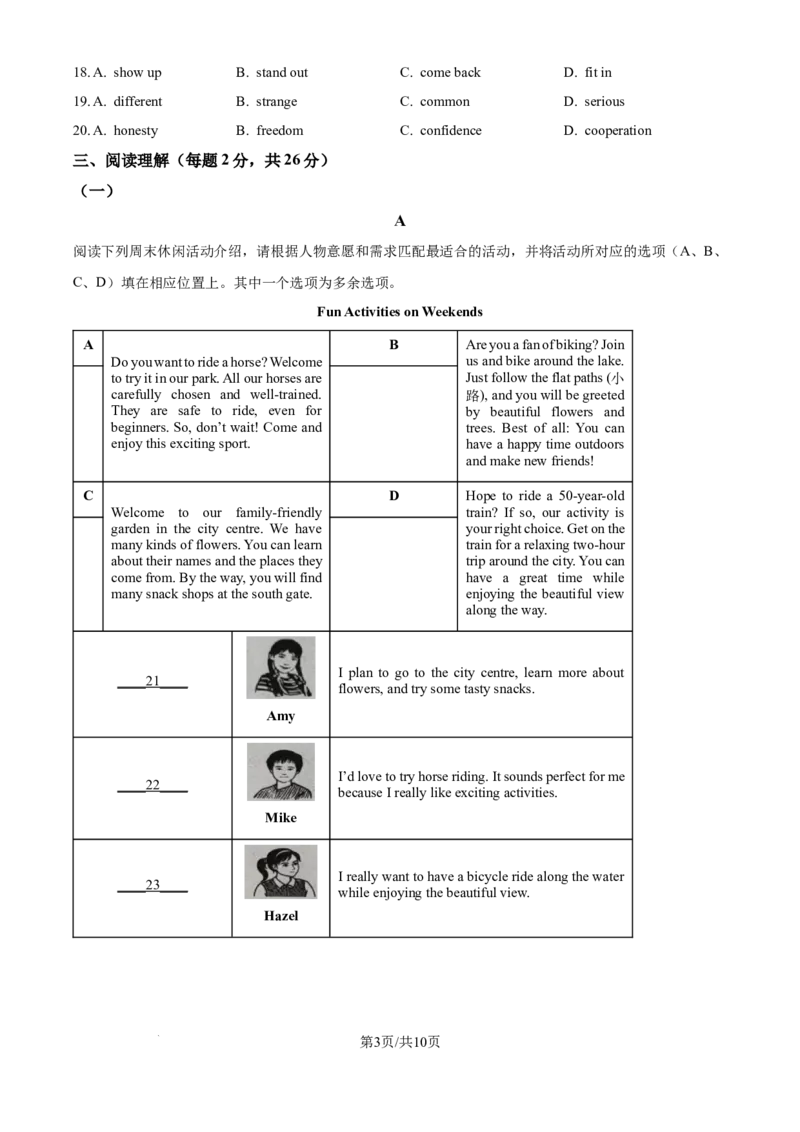
The day I walked into Westfield High School, I felt like everyone in the hallway somehow knew I was the new
kid. Three weeks earlier, my family moved across the country after my mum changed jobs. ____13____ a new
school in the middle of the term felt like hitting reset on my whole life.
At lunch that first day, I sat at a corner table pretending (假装) to be very interested in my phone while
____14____ searching for “how to survive being the new kid”. Teen articles kept saying the same thing—feeling
worried during a school transition (过渡期) is normal. That helped a little, but it still felt ____15____.
The first week was awful. I got lost looking for the chemistry class, mispronounced a teacher’s name, and
accidentally walked into the wrong classroom twice. But something small started to ____16____ when a boy asked if
I wanted to join his group in the science lab. That made the whole day easier. One thing I learned quickly is that most
students don’t ____17____ you as much as you think. Everyone is busy worrying about their own things.
Slowly, I found a way to ____18____. Instead of trying to do many big things right away, I focused on simple
things, like learning two classmates’ names a week and asking one question in a class. Those small wins slowly built
up my confidence.
By the end of the term, things looked very ____19____. I joined the photography club and started hanging out
with my classmates after school. Changing schools in the middle of the term was not easy, but it taught me something
important about resilience (适应力) and ____20____. Feeling uneasy does not last forever. If you are the new kid
right now, hang in there. The hallway that feels strange today may become the place where you begin your new stage
of life.
13. A. Starting B. Visiting C. Supporting D. Enjoying
14. A. suddenly B. excitedly C. angrily D. secretly
15. A. unwise B. unreasonable C. uncomfortable D. unimportant
16. A. return B. change C. increase D. move
17. A. push B. judge C. protect D. respect
第2页/共10页
学科网(北京)股份有限公司18. A. show up B. stand out C. come back D. fit in
19. A. different B. strange C. common D. serious
20. A. honesty B. freedom C. confidence D. cooperation
三、阅读理解(每题2分,共26分)
(一)
A
阅读下列周末休闲活动介绍,请根据人物意愿和需求匹配最适合的活动,并将活动所对应的选项(A、B、
C、D)填在相应位置上。其中一个选项为多余选项。
Fun Activities on Weekends
A B Are you a fan of biking? Join
Do you want to ride a horse? Welcome us and bike around the lake.
to try it in our park. All our horses are Just follow the flat paths (小
carefully chosen and well-trained. 路), and you will be greeted
They are safe to ride, even for by beautiful flowers and
beginners. So, don’t wait! Come and trees. Best of all: You can
enjoy this exciting sport. have a happy time outdoors
and make new friends!
C D Hope to ride a 50-year-old
Welcome to our family-friendly train? If so, our activity is
garden in the city centre. We have your right choice. Get on the
many kinds of flowers. You can learn train for a relaxing two-hour
about their names and the places they trip around the city. You can
come from. By the way, you will find have a great time while
many snack shops at the south gate. enjoying the beautiful view
along the way.
I plan to go to the city centre, learn more about
____21____
flowers, and try some tasty snacks.
Amy
I’d love to try horse riding. It sounds perfect for me
____22____
because I really like exciting activities.
Mike
I really want to have a bicycle ride along the water
____23____
while enjoying the beautiful view.
Hazel
第3页/共10页
学科网(北京)股份有限公司(二)阅读下列短文,根据短文内容,从短文后各题所给的 A、B、C、D 四个选项中,选
择最佳选项。
B
Linda always dreamed of having many great toys, but buying them all was almost impossible.
One afternoon, exploring behind her apartment building, Linda discovered something wonderful. An elderly
woman was creating beautiful playthings using thrown-away materials and natural objects. She built a tower from
parts of cardboard boxes, and a tiny house with sticks, leaves, and stones.
“How do you make such wonderful toys without buying anything?” Linda asked, amazed.
“The best toys aren’t bought in stores,” the woman smiled warmly. “They’re created with your own hands and
imagination. Everything, even the things people throw away, can become something magical. You just need a little
creativity.”
Inspired (受到启发), Linda began trying out some ideas at home. She found treasures everywhere. A shoe box
became a toy theatre. Old socks turned into materials for fashion dolls and old magazines became their clothes. Plastic
bottles were used to build rocket ships. Soon, Linda’s bedroom became a world of wonder. Each creation taught her
something about design, engineering, and storytelling.
One day, Linda went to see her teacher, Mr. Thompson, with an idea. “What if we have a toy-making workshop
where students can make their own toys for show-and-tell?” Mr. Thompson was uncertain. Linda then presented the
toys she had made, showing him how well-designed and interesting they were.
Surprised by her creativity, Mr. Thompson decided to have an activity named “Invention and Innovation (创
新) Week” to encourage students to make and show their creative works. Linda was excited and began to teach other
students her toy-making skills.
During the week, something magical happened. The handmade toys fired everyone’s imagination in ways
store toys never could, inspiring stories, games and plays. Some teachers even started to include creative toy-making
in their lessons. A local newspaper reported on these young inventors. Other schools wanted to follow their creative
practice.
The big success of the activity filled Linda with pride. She realised creativity can also be about finding
possibilities in seemingly useless materials.
24. How did Linda feel when she saw the elderly woman making playthings?
A. Proud. B. Satisfied. C. Warm. D. Amazed.
25. What activity did Linda suggest to Mr. Thompson?
A. A fashion design show. B. A toy-making workshop.
第4页/共10页
学科网(北京)股份有限公司C. A storytelling competition D. A second-hand magazine fair
26. What did Linda learn from her experience?
A. Teaching others helps us learn more quickly.
B. Friendship may develop from sharing stories.
C. Creativity can mean finding hidden possibilities.
D. Exploring nature leads to the discovery of beauty.
C
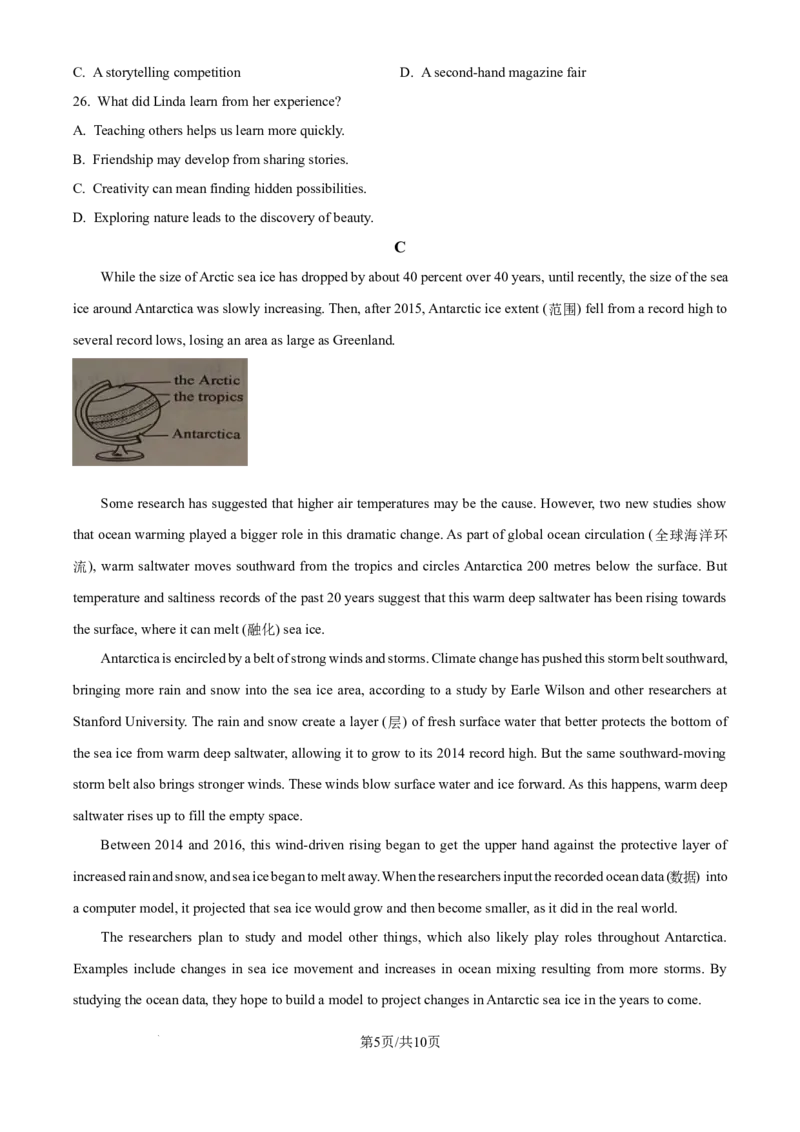
While the size of Arctic sea ice has dropped by about 40 percent over 40 years, until recently, the size of the sea
ice around Antarctica was slowly increasing. Then, after 2015, Antarctic ice extent (范围) fell from a record high to
several record lows, losing an area as large as Greenland.
Some research has suggested that higher air temperatures may be the cause. However, two new studies show
that ocean warming played a bigger role in this dramatic change. As part of global ocean circulation (全球海洋环
流), warm saltwater moves southward from the tropics and circles Antarctica 200 metres below the surface. But
temperature and saltiness records of the past 20 years suggest that this warm deep saltwater has been rising towards
the surface, where it can melt (融化) sea ice.
Antarctica is encircled by a belt of strong winds and storms. Climate change has pushed this storm belt southward,
bringing more rain and snow into the sea ice area, according to a study by Earle Wilson and other researchers at
Stanford University. The rain and snow create a layer (层) of fresh surface water that better protects the bottom of
the sea ice from warm deep saltwater, allowing it to grow to its 2014 record high. But the same southward-moving
storm belt also brings stronger winds. These winds blow surface water and ice forward. As this happens, warm deep
saltwater rises up to fill the empty space.
Between 2014 and 2016, this wind-driven rising began to get the upper hand against the protective layer of
increased rain and snow, and sea ice began to melt away. When the researchers input the recorded ocean data (数据) into
a computer model, it projected that sea ice would grow and then become smaller, as it did in the real world.
The researchers plan to study and model other things, which also likely play roles throughout Antarctica.
Examples include changes in sea ice movement and increases in ocean mixing resulting from more storms. By
studying the ocean data, they hope to build a model to project changes in Antarctic sea ice in the years to come.
第5页/共10页
学科网(北京)股份有限公司27. Which of the following best shows the Antarctic sea ice changes around 2015?
A. B.
C. D.
28. In which order are the following events discussed in Paragraph 3?
①Warm deep saltwater rises to the surface.
②A layer of fresh surface water is created.
③Surface water and ice are blown forward.
④More rain and snow are brought into the sea ice area.
A. ②④①③ B. ②④③① C. ④②①③ D. ④②③①
29. Which of the following is the best title for this passage?
A. Where is Antarctic sea ice loss taking us?
B. Is this the cause of Antarctic sea ice loss?
C. Will a new model explain Antarctic sea ice melting?
D. How does fresh surface water protect Antarctic sea ice?
D
The internet has provided us with unmatched ways to get information but it is also sounding alarms. Some
experts argue that the internet will produce forgetfulness in the minds of those learning to use it, because they won’t
practise their memory.
Is the internet really doing harm to our memories—or will our doubtful experts be proven wrong? After all, the
brain’s attention system (系统) and preferences for novel experiences were already there long before the digital age,
and our ability to remember is nearly inexhaustible (无穷尽的). According to Michael Merzenich, a brain researcher,
every brain is a work in progress; it keeps changing throughout our lives, depending on how we use it.
But our brains don’t work well when we’re not focused. When we repeatedly check text messages and social
media during work, we are weakening our ability to form both short-and long-term memories, experts say. The
第6页/共10页
学科网(北京)股份有限公司flooding of information influences our ability to remember, too. Though our brains are designed to look for new data,
too much of it may be causing this natural drive to go wild. The compulsion to continuously take in information
means we often check social media when we should be doing “memory housekeeping” by giving our brains some
rest. Another problem: the effortless way of receiving information online. Trying to actively recall (回忆) data is a
good workout for the brain, but today we are using online search tools instead.
However, the internet may be changing only what we remember, not our ability to do so, suggests Columbia
University psychologist (心理学家) Betsy Sparrow. In fact, the internet is becoming an outside hard drive for our
memories. Some worry that this is having a negative effect on society, but Sparrow suggests this will change our way
of learning from a focus on remembering facts to one on understanding ideas.
As is shown in a 2008 study, using the internet exercised the brain more than reading among older adults with
strong computer skills. And two Harvard psychologists argue that not needing to remember facts might free our minds
to focus on more meaningful tasks.
“There may be costs caused by our increased dependence on the internet, but generally the benefits are going to
outweigh those costs,” says Benjamin Storm, a psychologist. “It seems pretty clear that memory is changing, but is
it changing for the better? At this point, we don’t know.”
30. What does the word “compulsion” in Paragraph 3 most probably mean?
A. Longing. B. Ability. C. Chance. D. Promise.
31. What can we learn from the passage?
A. Internet users remember facts better than non-users.
B. Novel experiences improve the brain’s attention system.
C. Checking social media can give the brain proper breaks.
D. The internet may produce a change of focus in learning.
32. How does Benjamin Storm feel about the effects of the internet on memory?
A. Uneasy and doubtful. B. Positive but still uncertain.
C. Negative but still hopeful. D. Encouraged and confident.
33. What is the writer’s main purpose in writing this passage?
A. To argue for a belief. B. To challenge a solution.
C. To present different views. D. To examine causes and effects.
第二部分
本部分共5题,共20分。根据题目要求,完成相应任务。
四、阅读表达(第34 — 36题每题2分,第37题4分,共10分)
阅读短文,根据短文内容回答问题。
第7页/共10页
学科网(北京)股份有限公司Being busy often seems important in today’s world. Full calendars, nonstop notifications (消息提醒), and long
to-do lists make it feel like progress is always happening. However, many people end their days very tired and wonder
why their big goals are still far away. The truth is that being busy is different from being effective: One fills time and
the other creates results. Understanding the difference is important because it helps you control your attention, make
smarter choices, and focus on what truly matters.
Busyness gives a false sense of achievement because it fills time with activity. Answering emails, attending
meetings, and checking off small tasks create the illusion (幻觉) of progress. However, activities of this kind often
have no real purpose and fail to move important goals forward. What’s more, busy people often let outside tasks take
over their time. As a result, they have little control over time, which leads to stress and little progress.
Effectiveness, however, is measured (衡量) by results, not activity. Rather than ask how much was done, effective
people ask what was achieved. They prioritise (优先考虑) tasks that create meaningful change, even if those tasks
require more focus and more effort. For example, they decide ahead of time what is worth their energy and then
prioritise their time for important work. This planned method reduces unnecessary tasks and creates space for deep,
focused effort.
The real cost of busyness lies not in time spent, but in progress lost. Being busy often hides the fact that little of
real value is being achieved. Effective people, on the other hand, often take a break from their work to check if they
are keeping to their goals. When you stop measuring your days by how full they are and start measuring them by
what truly moves you forward, work becomes more purposeful and life feels more satisfying.
34. Why is it important to understand the difference between being busy and being effective?
___________________________________________________________
35. What is the result when busy people let outside tasks take over their time?
___________________________________________________________
36. How does the planned method of effective people work?
___________________________________________________________
37. What do you plan to do to be an effective student? Why? (Please give two reasons.)
___________________________________________________________
五、文段表达(10 分)
38.从下面两个题目中任选一题,根据所给的中文和英文提示,完成一篇不少于 50 词的英
语文段写作。文中已给出的内容不计入总词数。所给提示词语仅供选用。请不要写出真实的
校名、姓名和地名。
第8页/共10页
学科网(北京)股份有限公司题目①
38. 假设你是李华,你们学校正在开展“Green Graduation”主题活动。为此,英语社团公众号进行了
关于毕业生处理学习资料方式的问卷调查。下表展示了部分调查结果。请结合表格内容,用英语给公众号
留言,谈谈你毕业后处理学习资料的打算和理由。
What students will do with used learning materials
What students will do Percentage of students
Take them to a
62%
recycling centre
Give them away for
35%
reuse
Throw them away 3%
提示词语:environment, save, reduce, useful
内容提示:
• What can you learn from the results?
• What will you do with your used learning materials?
Why?
This table shows what students will do with their used learning materials after graduation.
____________________________________________________________________________________________
____________________________________________________________________________________________
____________________________________________________________________________________________
____________________________________________________________________________________________
____________________________________________________________________________________________
____________________________________________________________________________________________
______________________________________________________________________________________
题目②
39. 假设你是李华,你们学校正在开展“科学护眼,光明未来”主题活动。为此,英语社团公众号计
划推出“我的护眼好习惯”专栏,现面向全体师生征稿。请用英语给公众号投稿,分享你的护眼习惯及其
带来的益处。
提示词语:eye exercises, take a break, outdoors, relax, avoid
内容提示:
• What do you often do to protect your eyes?
• What benefits have you got?
第9页/共10页
学科网(北京)股份有限公司Eye health matters to everyone.
____________________________________________________________________________________________
____________________________________________________________________________________________
____________________________________________________________________________________________
____________________________________________________________________________________________
____________________________________________________________________________________________
____________________________________________________________________________________________
________________________________________________________
第10页/共10页
学科网(北京)股份有限公司