模拟测试题3
Passage A
话题:交通安全 词数:269 参考用时: 8 分钟
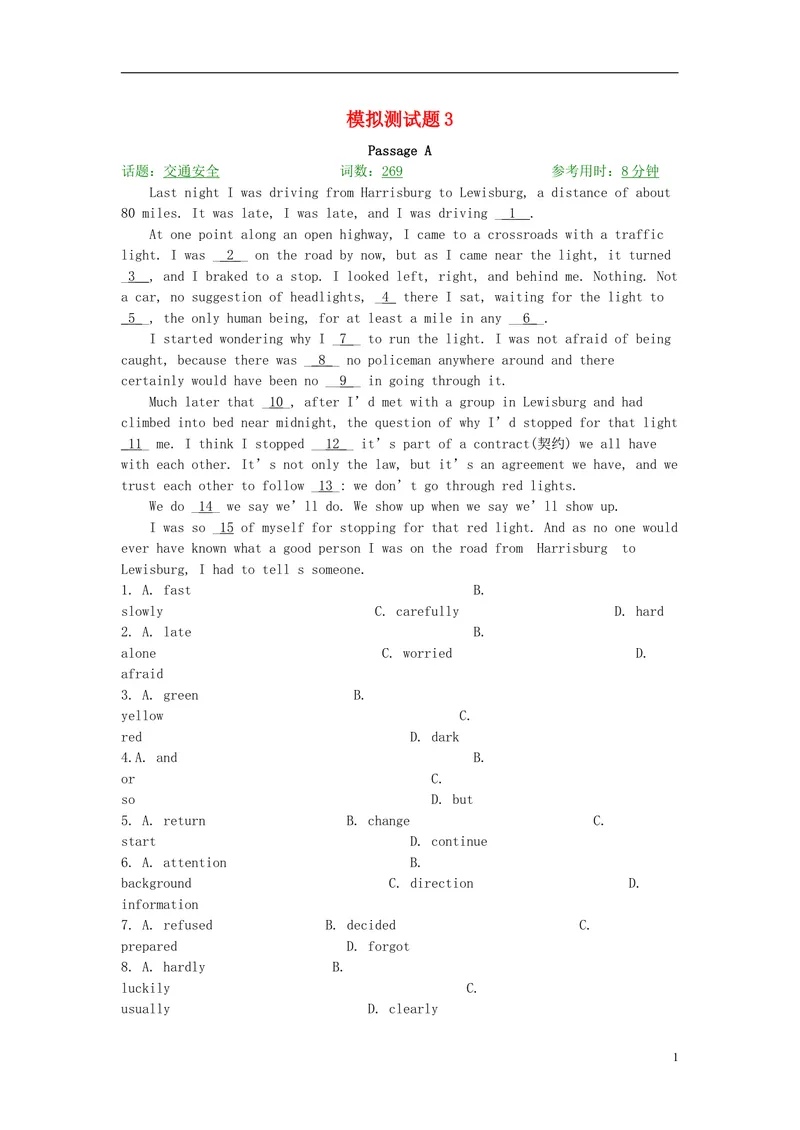
Last night I was driving from Harrisburg to Lewisburg, a distance of about
80 miles. It was late, I was late, and I was driving __1__.
At one point along an open highway, I came to a crossroads with a traffic
light. I was __2__ on the road by now, but as I came near the light, it turned
_3__, and I braked to a stop. I looked left, right, and behind me. Nothing. Not
a car, no suggestion of headlights, _4_ there I sat, waiting for the light to
_5__, the only human being, for at least a mile in any __6__.
I started wondering why I _7__ to run the light. I was not afraid of being
caught, because there was __8__ no policeman anywhere around and there
certainly would have been no __9__ in going through it.
Much later that _10_, after I’d met with a group in Lewisburg and had
climbed into bed near midnight, the question of why I’d stopped for that light
_11_ me. I think I stopped __12__ it’s part of a contract(契约) we all have
with each other. It’s not only the law, but it’s an agreement we have, and we
trust each other to follow _13_: we don’t go through red lights.
We do _14_ we say we’ll do. We show up when we say we’ll show up.
I was so _15 of myself for stopping for that red light. And as no one would
ever have known what a good person I was on the road from Harrisburg to
Lewisburg, I had to tell s someone.
1. A. fast B.
slowly C. carefully D. hard
2. A. late B.
alone C. worried D.
afraid
3. A. green B.
yellow C.
red D. dark
4.A. and B.
or C.
so D. but
5. A. return B. change C.
start D. continue
6. A. attention B.
background C. direction D.
information
7. A. refused B. decided C.
prepared D. forgot
8. A. hardly B.
luckily C.
usually D. clearly
19.A. danger B. excuse C.
space D. energy
10. A. moment B.
night C. afternoon D.
morning
11. A. depended on B. looked forward to C. stayed away
from D. came back to
12. A. though B. unless C.
because D. until
13. A. me B.
it C.
him D. us
14. A. what B.
how C.
why D. that
15. A. tired B.
ready C. proud D.
sorry
读后自主学习
【答案速查】
【自我评价】我做对了_____题,我很棒!我做错了____题,没关系,再努力!
【答案还原】将正确答案填写到文中空格处。
【诵读全文】大声朗读文章3-4遍、整体感知全文,体悟作者意图。
【我来总结】完成下列学习任务,并加以背诵。
1. 短语互译
(1) a distance of _________ (2) at one point ______________
(3) 至少__________________ (4) 相互之间 ____________________
2. 佳句翻译
(1) It was late, I was late, and I was driving __1fast__.
_______________________________________________________________________
(2) I started wondering why I _7_refused_ to run the light.
_______________________________________________________________________
(3) We show up when we say we’ll show up.
_______________________________________________________________________
Passage B
话题:学校生活 词数:244 参考用时: 8 分钟
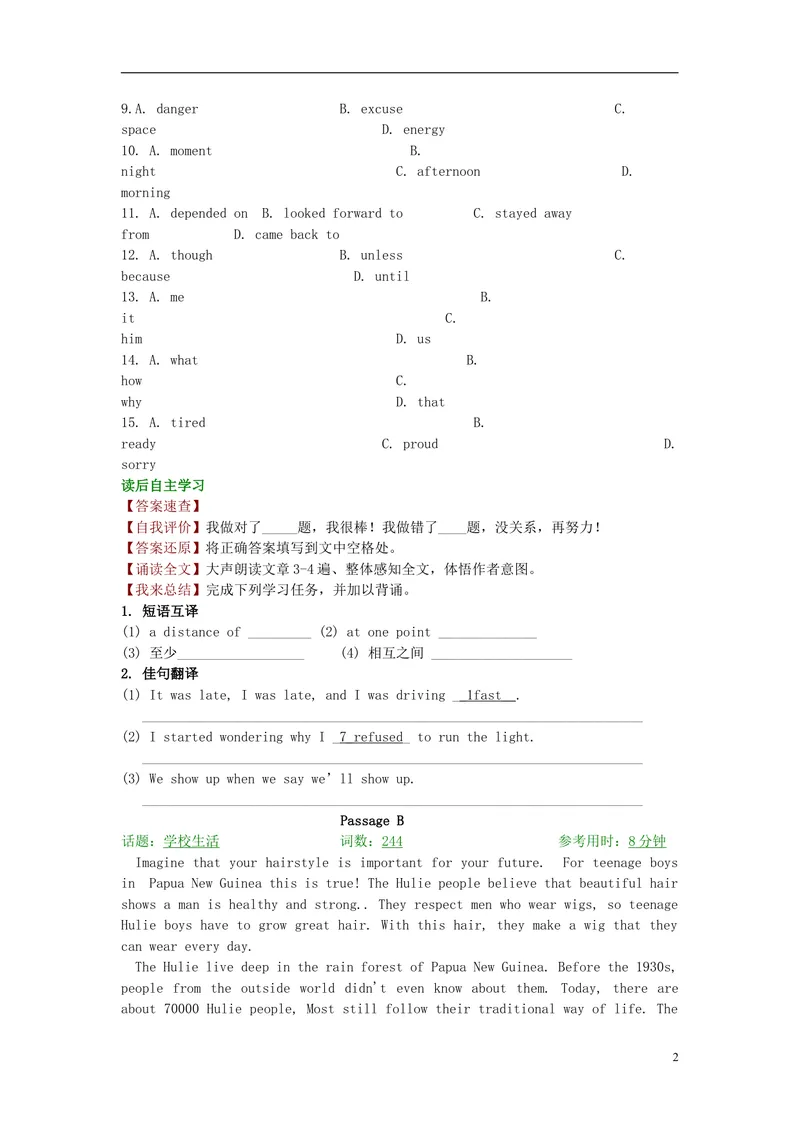
Imagine that your hairstyle is important for your future. For teenage boys
in Papua New Guinea this is true! The Hulie people believe that beautiful hair
shows a man is healthy and strong.. They respect men who wear wigs, so teenage
Hulie boys have to grow great hair. With this hair, they make a wig that they
can wear every day.
The Hulie live deep in the rain forest of Papua New Guinea. Before the 1930s,
people from the outside world didn't even know about them. Today, there are
about 70000 Hulie people, Most still follow their traditional way of life. The
2Hulie live in small villages, but families. do not live together. Women and
small children live in one house and. men live together in another house. When
boys are eight years old, they have to leave their mothers to live with their
fathers.
Some Hulie children go to school to study reading and math. But after middle
school. While teenage girls babysit their younger brothers and sisters, most
teenage boys,to wig school. At wig school, they learn how to grow their hair
and how to make wigs. The rules are pretty serious
1 .They cannot run, because their hair can be damaged.
2. They have to stay away from fire.
3. They have to put water on their hair 12 times a day to make it grow
faster.
When a Hulie teen wears his wig for the first time, he shows he is a man now,
he can get married. To prepare, boys grow their hair for 18 months or longer.
Then they cut it and use their own hair to make a mushroom-shaped wig. Later
they grow their hair again for special wigs. These special wigs are for
celebrations and festivals. Hulie men wear their mushroom-shaped wigs every
day, but they like to be fashionable, too. To add style, they decorate their
wigs with flowers and feathers.
1.The article is mainly about________
A. teenage Hulie girls B. teenage Hulie boys C. Hulie men and women
2. People didn't know the Hulie people until the 1930s because______
A .they lived in small villages
B. there are only 2700Huli people
C. they were hidden in the rain forest
3. The underlined phrase "people from the outside world" means______
A. people who don't live in the rain forest
B. people who follow their old traditions
C. people who do things outside of the forest
4.According to the article we can refer that Huli_________
A. teenage boys live with the mothers B. teenage girls live with their
fathers
C. husbands and wives do not live together
5.Hulie boys do not decorate their wigs with_______
A. flowers B. mushrooms C. feathers
读后自主学习
【答案速查】参见答案P
【我来总结】完成下列学习任务,并加以背诵。
1. 短语互译
(1) know about ____________________ (2) stay away from ____________________
(3) 生活在一起____________________ (4) 一天12次____________________
2. 佳句翻译
(1) Imagine that your hairstyle is important for your future.
_______________________________________________________________________
3(2) With this hair, they make a wig that they can wear every day.
_______________________________________________________________________
(3) The rules are pretty serious
_______________________________________________________________________
(4) To add style, they decorate their wigs with flowers and feathers.
_______________________________________________________________________
Passage C
话题:学校生活 词数:191 参考用时: 4 分钟
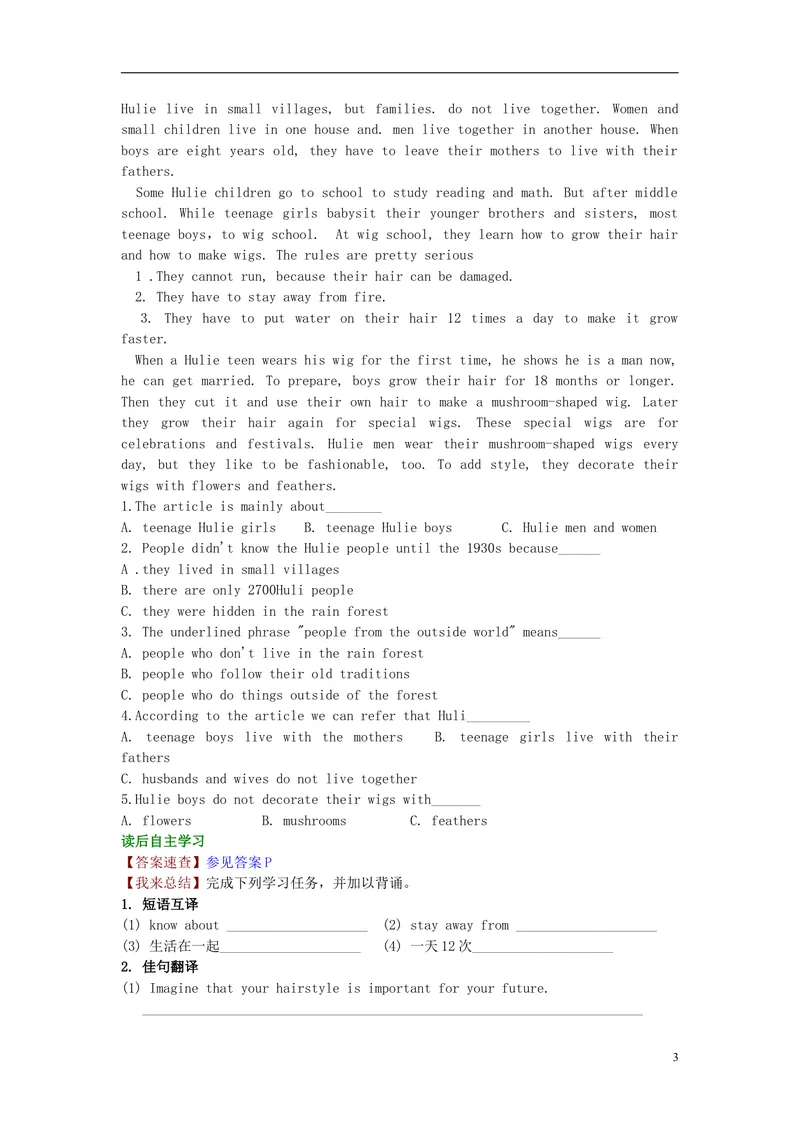
Want to say “hello” from Disneyland? Send a post card!
Beautiful scenes of paradise(乐园), wild animals, silly pictures—you can
find them all in one place. Where? On a post card! Have people always sent post
cards? No. Before post cards, people liked sealed(密封的) letters.
The idea for the first decorated(装饰) post card came to John P. Charlton in
1861.He thought a simple card with decorations would be a great way to send a
note. Then in the late 1800s, post cards with pictures appeared. By law, people
had to write their note on the front—on the picture! The back was only for the
address. Several years later, England allowed a divided-back post card. Then
people could write their note on the back left side and put the address on the
right. During the early 1900s, the golden age of post cards, picture post cards
became a craze of the world. In 1908, Americans alone mailed over 677 million
post cards. Today, post cards are the third most popular collection in the
world after stamps and coins.
Judge the following sentences true (T) or false (F) according to the passage.
()1. We can see some silly pictures on the post cards.
()2. Post cards were produced before sealed letters.
()3. In 1861, the first decorated post card appeared.
()4. Post cards were the most popular during the early 1900s.
()5. Stamps, coins and post cards are the most popular collections in the
world.
读后自主学习
【答案速查】参见答案P
【我来总结】完成下列学习任务,并加以背诵。
1. 短语互译
(1) send post cards ______________ (2) by law ____________________
(3) 在前面____________________ (4) 密封的信件 ____________________
2. 佳句翻译
(1) You can find them all in one place.
_______________________________________________________________________
(2) The idea for the first decorated(装饰) post card came to John P. Charlton
in 1861.
_______________________________________________________________________
(3) The back was only for the address.
_______________________________________________________________________
4(4) Today, post cards are the third most popular collection in the world
after stamps and coins.
_______________________________________________________________________
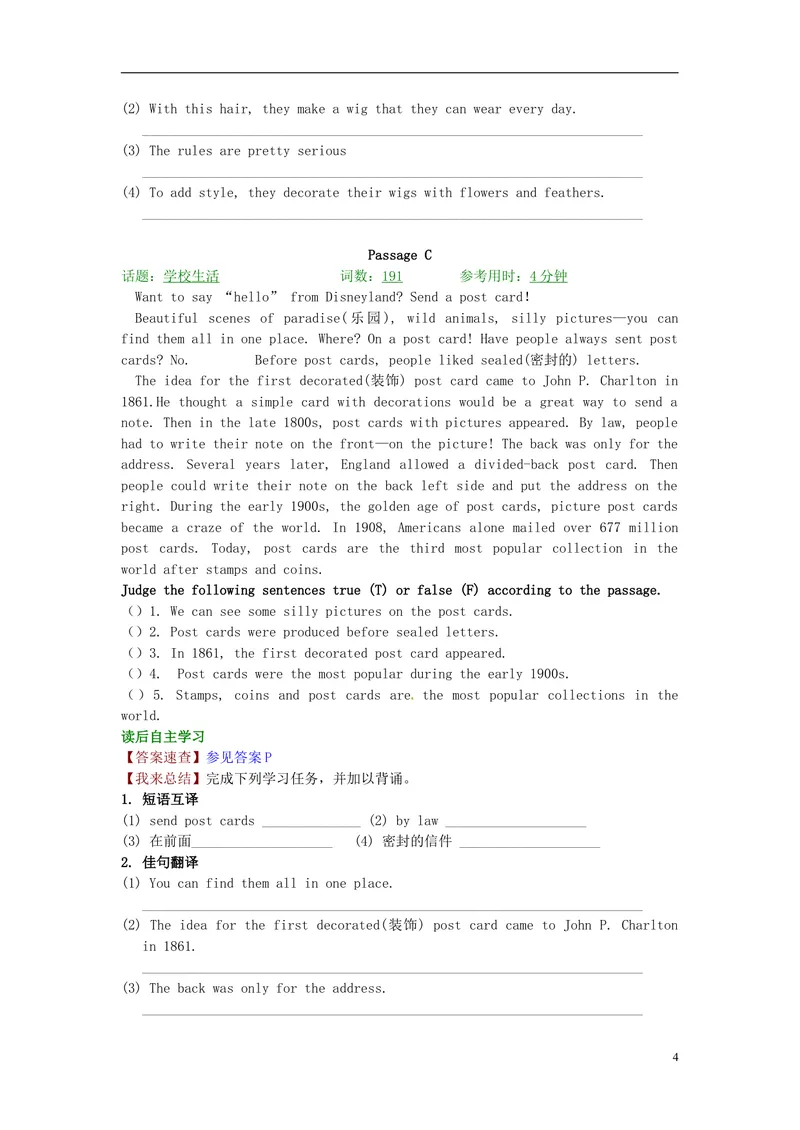
5模拟测试题3
Passage A
【答案详解】1-5 ABCDB 6-10CADAB 11-15DCBAC
1. 【解析】选A。逻辑推理题。由上文中的late可知天已黑,作者回家晚了,故可推断开车
加速,故选A项,意为“迅速地”。
2. 【解析】选B。细节理解和逻辑推理题。由下文中的 Nothing, Not和no可推
知作者一个人,故答案选B项,意为“独自的”。
3. 【解析】选C。细节理解题。由下文 中的stop和交通常识可知红灯亮了。
4. 【解析】选D。细节理解题。由下文中的 waiting for the light可知虽然路上什么都
没有,“可是”作者依然停下车等候。
5. 【解析】选B。逻辑推理题。根据上文可知红灯亮了,所以作者停下来等交通灯变绿后通
行,故答案选B项,意为“改变”。
6. 【解析】选C。细节理解题。由上文中的 a mile可知指的是“距离”,故答案选C项。
7. 【解析】选A。逻辑推理题。由下文I was not afraid of being caught可知作者不害怕
被逮住,故可推知“作者想知道自己为什么没有闯红灯呢?”,故答案选A项,意为“拒绝”。
8. 【解析】选D。逻辑推理题。由上文可知作者“不害怕被逮住”可推知是“因为清楚周围
没有警察”,故答案选D项,意为“清晰地;清楚地”。
9.. 【解析】选A。逻辑推理题。由上文可知没有警察,故可推知“闯红灯”就没有“被逮
住”的“危险”了,故答案选A项。
10. 【解析】选B。细节理解题。由下文中的bed和 near midnight可知是晚上。
11. 【解析】选D。细节理解题。根据上文中的I started wondering why I refused to
run the light和 the question of why I’d stopped for that light可知“晚上”作
者思考的是同样的问题,故答案选D项,意为“回到……”。
12. 【解析】选 C。逻辑推理题。由下文 It’s not only the law, but it’s an
agreement we have可知作者之所以停下来的“原因”是这是彼此之间的一份承诺,故答案
选C项,意为“因为”。
13. 【解析】选B。细节理解题。由下文we don’t go through red lights可知这是“一
条”交通规则,故答案选B项,相当于the rule。
14. 【解析】选A。what连接的从句,在句中作宾语。
15. 【解析】选C。联系上下文可推知作者为自己没有在任何监督的情况下能自觉遵守交通
规则而感到“自豪”,故答案选C项,意为“骄傲的;自豪的”。
读后自主学习
1. 短语互译
(1) ……的距离(2) 在某一地点 (3) at least (4) each other
2. 佳句翻译
(1) 很晚了,我要迟到了,所以我驾驶得很快。
(2) 我开始纳闷为什么我没有闯红灯。
(3) 当我们说炫耀的时候,我们就要炫耀。
PassageB
【答案详解】1-5BCACB
1.B 主旨大意题。这篇文章主要讲了 Huhie男孩子的头发的有关情况,故选B。
2.C 细节理解题。根据文中原句 The Hulie live in the rain forest of Papua New
Guinea.(他们居住在巴布亚新几内亚的热带雨林深处)可知此题C。
63.A 语义猜测题。根据原句理解,划线部分词组的含义是A。
4.C推理判断题。根据文中原句 The Hulie live in villages= but families, do not
live together. Women and small children live in one house and men live together
in another house. (Huile人住在小村庄里,但是家人不住在一起。女人和小孩子住在一个
房间里,男人们在另一个房间里住在一起)可知此题答案是C。
5. B细节理解题。根据文中原句they decorate their wigs with flowers and feathers.
(他们用花和羽毛来装饰他们的假发)可知此题答案是B。
读后自主学习
1. 短语互译
(1) 知道,了解 (2) 远离 (3) live together (4) 12 times a day
2. 佳句翻译
(1) 假设你的发型对你的未来很重要。
(2) 用这个头发,他们做一个假发,他们每天都可以戴。
(3) 制度相当严格。
(4) 为了添加风格,他们用鲜花和羽毛装饰他们的假发。
Passage C
【答案详解】1-5 TFFTT
1.T 根据第一段可知在 on a post card 我们可以看到Beautiful scenes of paradise
(乐园),wild animals,silly pictures,能够看到silly pictures,故答案是T。
2. F根据Before post cards: people liked sealed(密封的)letters.在明信片之前人们
喜欢密封的信件,故选 F。
3.F 根据 The idea for the first decorated(装饰)post card came to john P.
Charlton in 1861 可知在1861 年带有装饰的明信片的想法出现在John P. Charlton的
脑海里,并没有出现真正的明信片,故选F。
4.T 根据 During the early 1900s, the golden age of post cards;picture post
cards became a craze of the world 可知在20世纪的早期,明信片很受欢迎,故选T。
5.T 根据 Today,post cards are the third most popular collection in the world
after stamps and coins.可知由邮票、硬币及明信片都是很受欢迎的,故选T。
读后自主学习
1. 短语互译
(1) 寄明信片(2) 根据法律 (3) on the front (4) sealed letters
2. 佳句翻译
(1) 你可以在一个地方全部找到他们。
(2) 第一个装饰明信片的想法是约翰·p·查尔顿在1861年想出来的。
(3) 后面只写地址。
(4) 今天,明信片是继邮票和硬币之后世界上第三大最受欢迎收集。
7