Unit 12 Life is full of the unexpected.
Section B(1a-1e)
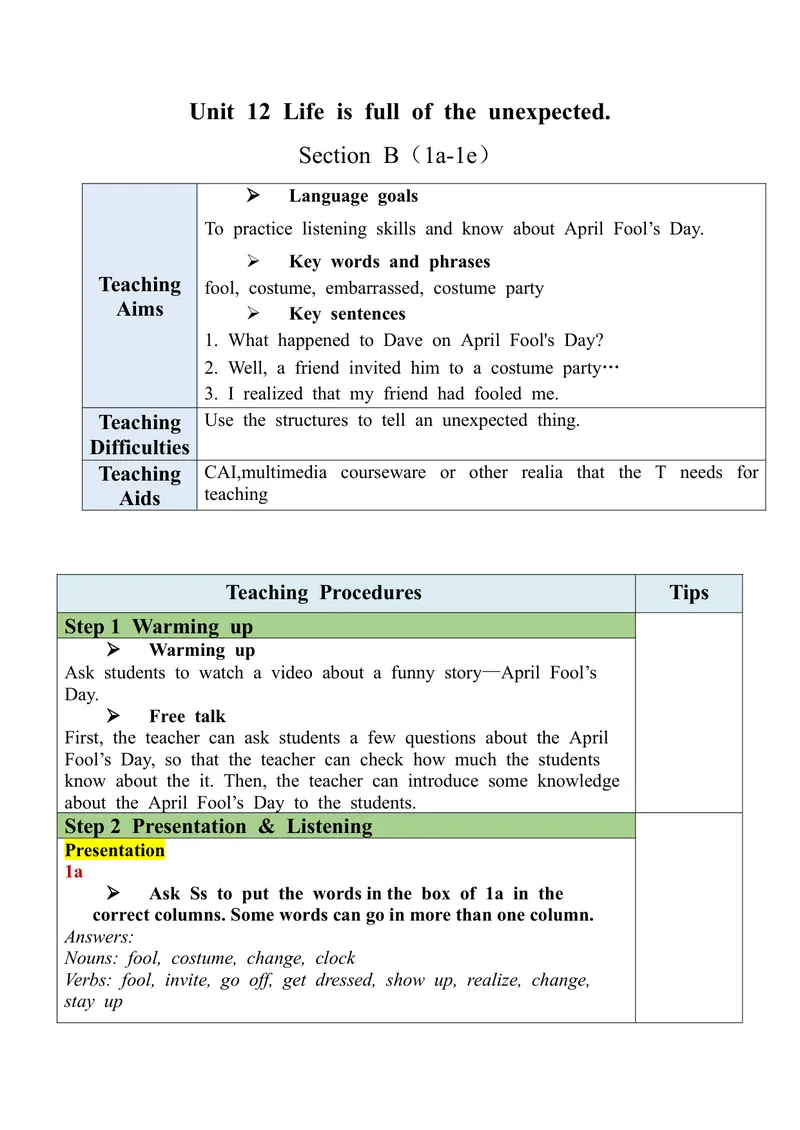
Language goals
To practice listening skills and know about April Fool’s Day.
Key words and phrases
Teaching
fool, costume, embarrassed, costume party
Aims
Key sentences
1. What happened to Dave on April Fool's Day?
2. Well, a friend invited him to a costume party…
3. I realized that my friend had fooled me.
Teaching Use the structures to tell an unexpected thing.
Difficulties
Teaching CAI,multimedia courseware or other realia that the T needs for
Aids teaching
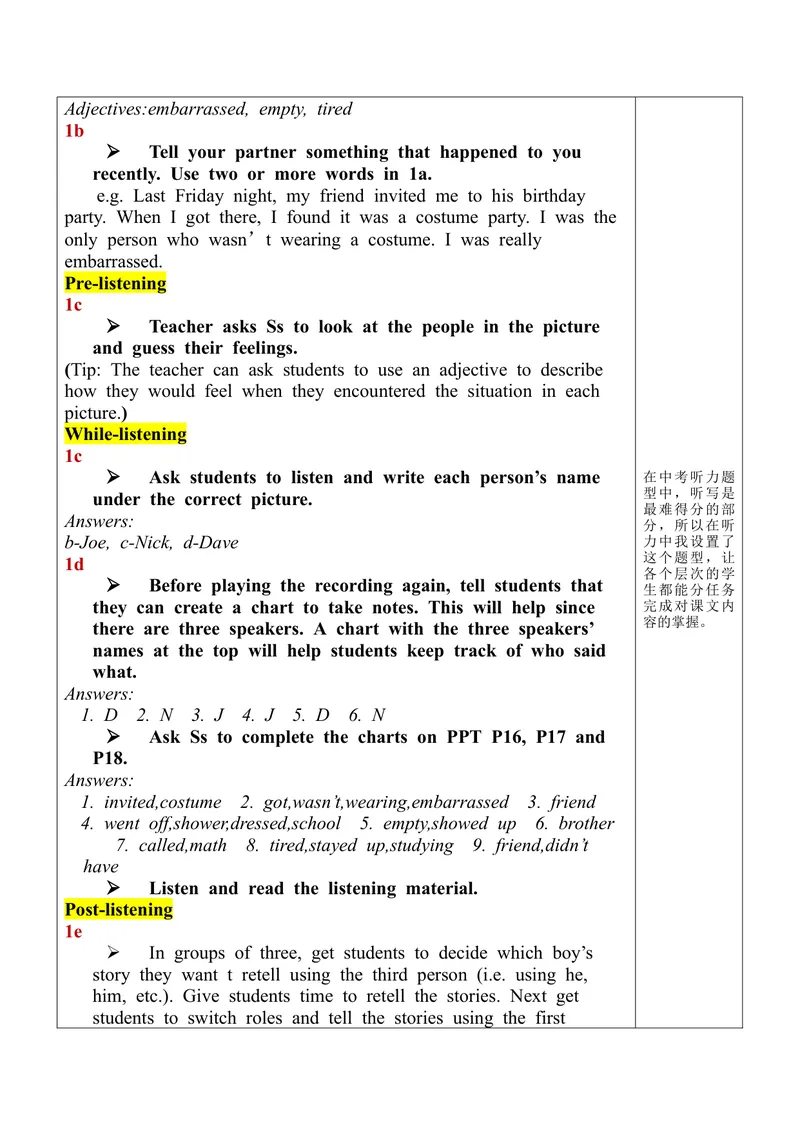
Teaching Procedures Tips
Step 1 Warming up
Warming up
Ask students to watch a video about a funny story—April Fool’s
Day.
Free talk
First, the teacher can ask students a few questions about the April
Fool’s Day, so that the teacher can check how much the students
know about the it. Then, the teacher can introduce some knowledge
about the April Fool’s Day to the students.
Step 2 Presentation & Listening
Presentation
1a
Ask Ss to put the words in the box of 1a in the
correct columns. Some words can go in more than one column.
Answers:
Nouns: fool, costume, change, clock
Verbs: fool, invite, go off, get dressed, show up, realize, change,
stay upAdjectives:embarrassed, empty, tired
1b
Tell your partner something that happened to you
recently. Use two or more words in 1a.
e.g. Last Friday night, my friend invited me to his birthday
party. When I got there, I found it was a costume party. I was the
only person who wasn’t wearing a costume. I was really
embarrassed.
Pre-listening
1c
Teacher asks Ss to look at the people in the picture
and guess their feelings.
(Tip: The teacher can ask students to use an adjective to describe
how they would feel when they encountered the situation in each
picture.)
While-listening
1c
Ask students to listen and write each person’s name 在中考听力题
under the correct picture.
型中,听写是
最难得分的部
Answers:
分,所以在听
b-Joe, c-Nick, d-Dave 力中我设置了
这个题型,让
1d
各个层次的学
Before playing the recording again, tell students that
生都能分任务
they can create a chart to take notes. This will help since 完成对课文内
there are three speakers. A chart with the three speakers’
容的掌握。
names at the top will help students keep track of who said
what.
Answers:
1. D 2. N 3. J 4. J 5. D 6. N
Ask Ss to complete the charts on PPT P16, P17 and
P18.
Answers:
1. invited,costume 2. got,wasn’t,wearing,embarrassed 3. friend
4. went off,shower,dressed,school 5. empty,showed up 6. brother
7. called,math 8. tired,stayed up,studying 9. friend,didn’t
have
Listen and read the listening material.
Post-listening
1e
In groups of three, get students to decide which boy’s
story they want t retell using the third person (i.e. using he,
him, etc.). Give students time to retell the stories. Next get
students to switch roles and tell the stories using the firstperson. This means that each students will tell another boy’s
story as if he / she were that boy (i.e. using I, me, etc.)
Step 3 Language points learning
fool /fuːl/ n. 蠢人;傻瓜 v. 愚弄
(1) fool作名词,意为“蠢人;傻瓜”。make a fool of… “欺骗······;
愚弄······”,play the fool “扮丑相,装傻”。
(2) fool 还可作动词,意为“欺骗;愚弄”。
(3) foolish 为形容词,意为“愚蠢的;傻的”。
Step 4 Exercise,Summary& Homework
Exercise
Complete the exercises on PPT P27.
Summary
The T can encourage Ss to summarize the key points of
this class to help Ss consolidate the knowledge.
Homework
Preview the passage in Section B 2b.
Do the exercises in students’ book.
In this period, we should get the students to do more practice in
listening and speaking by asking them to listen to others' stories and
Teaching telling their own stories. Students will improve their spoken English
Reflection through listening and speaking activities. Besides, they will learn new
words and phrases when doing listening activities. And they will learn
new words and phrases quickly.