文档文本内容
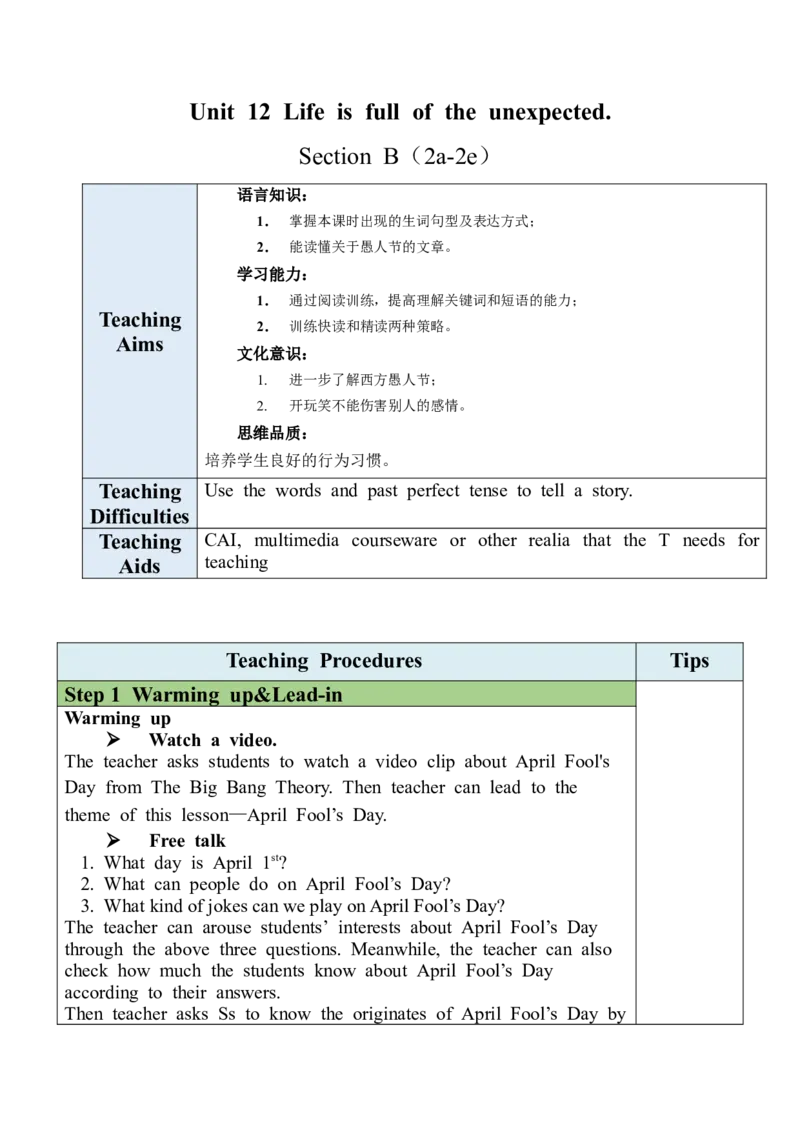
Unit 12 Life is full of the unexpected.
Section B(2a-2e)
语言知识:
1. 掌握本课时出现的生词句型及表达方式;
2. 能读懂关于愚人节的文章。
学习能力:
1. 通过阅读训练,提高理解关键词和短语的能力;
Teaching
2. 训练快读和精读两种策略。
Aims
文化意识:
1. 进一步了解西方愚人节;
2. 开玩笑不能伤害别人的感情。
思维品质:
培养学生良好的行为习惯。
Teaching Use the words and past perfect tense to tell a story.
Difficulties
Teaching CAI, multimedia courseware or other realia that the T needs for
Aids teaching
Teaching Procedures Tips
Step 1 Warming up&Lead-in
Warming up
Watch a video.
The teacher asks students to watch a video clip about April Fool's
Day from The Big Bang Theory. Then teacher can lead to the
theme of this lesson—April Fool’s Day.
Free talk
1. What day is April 1st?
2. What can people do on April Fool’s Day?
3. What kind of jokes can we play on April Fool’s Day?
The teacher can arouse students’ interests about April Fool’s Day
through the above three questions. Meanwhile, the teacher can also
check how much the students know about April Fool’s Day
according to their answers.
Then teacher asks Ss to know the originates of April Fool’s Day bywatching the other video.
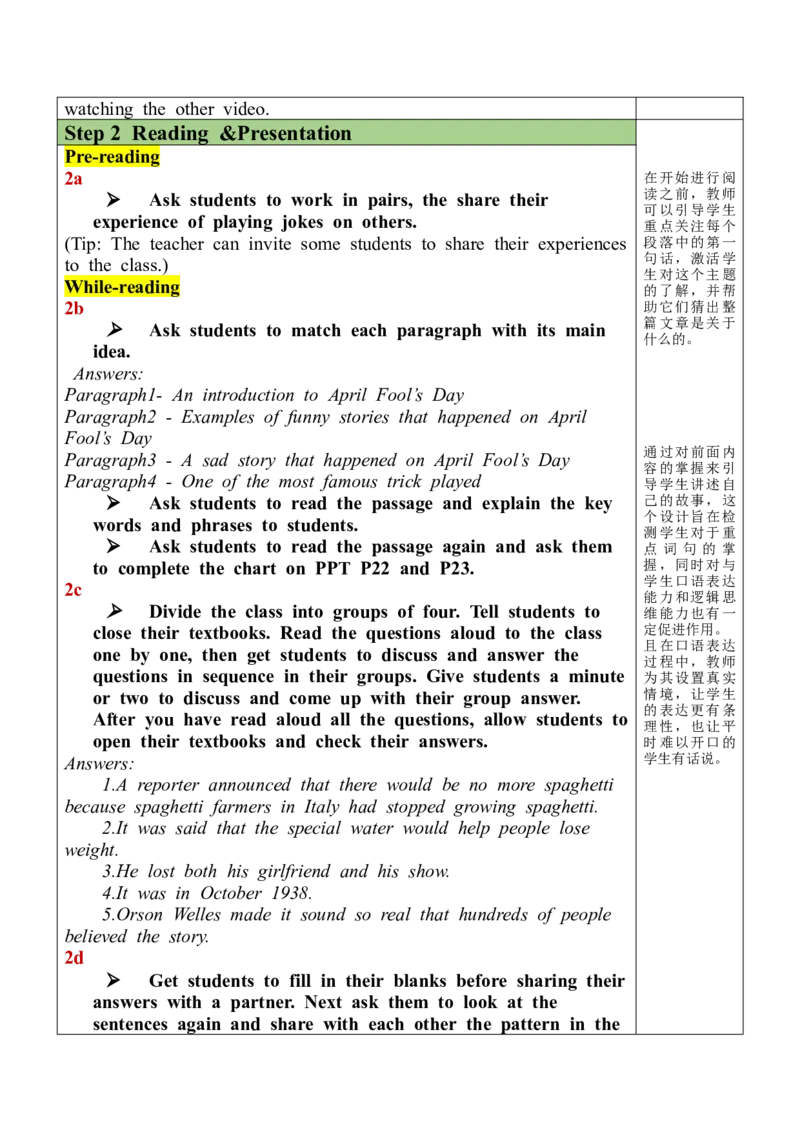
Step 2 Reading &Presentation
Pre-reading
2a 在开始进行阅
Ask students to work in pairs, the share their
读之前,教师
可以引导学生
experience of playing jokes on others.
重点关注每个
(Tip: The teacher can invite some students to share their experiences 段落中的第一
to the class.)
句话,激活学
生对这个主题
While-reading
的了解,并帮
2b 助它们猜出整
篇文章是关于
Ask students to match each paragraph with its main
什么的。
idea.
Answers:
Paragraph1- An introduction to April Fool’s Day
Paragraph2 - Examples of funny stories that happened on April
Fool’s Day
通过对前面内
Paragraph3 - A sad story that happened on April Fool’s Day
容的掌握来引
Paragraph4 - One of the most famous trick played 导学生讲述自
Ask students to read the passage and explain the key 己的故事,这
个设计旨在检
words and phrases to students.
测学生对于重
Ask students to read the passage again and ask them 点 词 句 的 掌
to complete the chart on PPT P22 and P23. 握,同时对与
学生口语表达
2c
能力和逻辑思
Divide the class into groups of four. Tell students to 维能力也有一
close their textbooks. Read the questions aloud to the class 定促进作用。
且在口语表达
one by one, then get students to discuss and answer the
过程中,教师
questions in sequence in their groups. Give students a minute 为其设置真实
or two to discuss and come up with their group answer. 情境,让学生
的表达更有条
After you have read aloud all the questions, allow students to
理性,也让平
open their textbooks and check their answers. 时难以开口的
Answers: 学生有话说。
1.A reporter announced that there would be no more spaghetti
because spaghetti farmers in Italy had stopped growing spaghetti.
2.It was said that the special water would help people lose
weight.
3.He lost both his girlfriend and his show.
4.It was in October 1938.
5.Orson Welles made it sound so real that hundreds of people
believed the story.
2d
Get students to fill in their blanks before sharing their
answers with a partner. Next ask them to look at the
sentences again and share with each other the pattern in thesentences, if any. They should be able to see that for all the
sentences that have “by the time” in it, the answers contain
both the simple past and the past perfect tense. This is
because the sentence is expressing the idea that one thing
occurred before another in the past.
Answers:
1.appeared,rushed 2.found out,had disappeared 3.ended,had called
4.ended,had lost 5.told,had run away.
Post-reading
2e
Divide the class into groups of three or four. Tell
students to share their individual funny stories with the
members of their group. Each group will then vote for the
best story, and the student with the best story in the group
will then represent his / her group and share his / her story
with the rest of the class. After the representatives from all
the groups have shared their stories, the class will vote for
the funniest, most embarrassing and most creative ones.
Step 3 Language points learning
discovery 作名词,可意为“发现;发觉”,还可意 为“被发现的事
物 (或真相、人)”。
cancel在课文中用作及物动词,其过去式和过去分词均为canceled或
cancelled,现在分词为canceling 或cancelling。
believable作形容词,由动词believe去e再加形容词后缀-able构成。
believe believable adj. belief
v. 相信;认定 可相信的;可信任的 n. 信念
unbelievable
adj. 难以置信
Step 4 Exercises,Summary& Homework 一节课后的练
的
习是必不可少
的环节,学生
Exercises
通过练习可以
Complete the exercises from PPT P34-P35. 加强对基础知
Summary 识的巩固。
The T can encourage Ss to summarize the key points of
this class to help Ss consolidate the knowledge.
Homework
Read and recite the new words and phrases .
Do the exercises in students’ book.
In this period, the most important thing is reading. It is a good time
Teaching
to train the students' ability of reading quickly and efficiently. In
Reflection
reading, they do a lot of exercises too. They learn how to readquickly and find the main idea in the paragraphs.
After reading, they use the words and phrases to tell their own
stories. In this way,they can learn and remember the new words and
phrases well.