文档文本内容
Unit 14 I remember meeting all of you in Grade
7.
Section B(2a-2e)
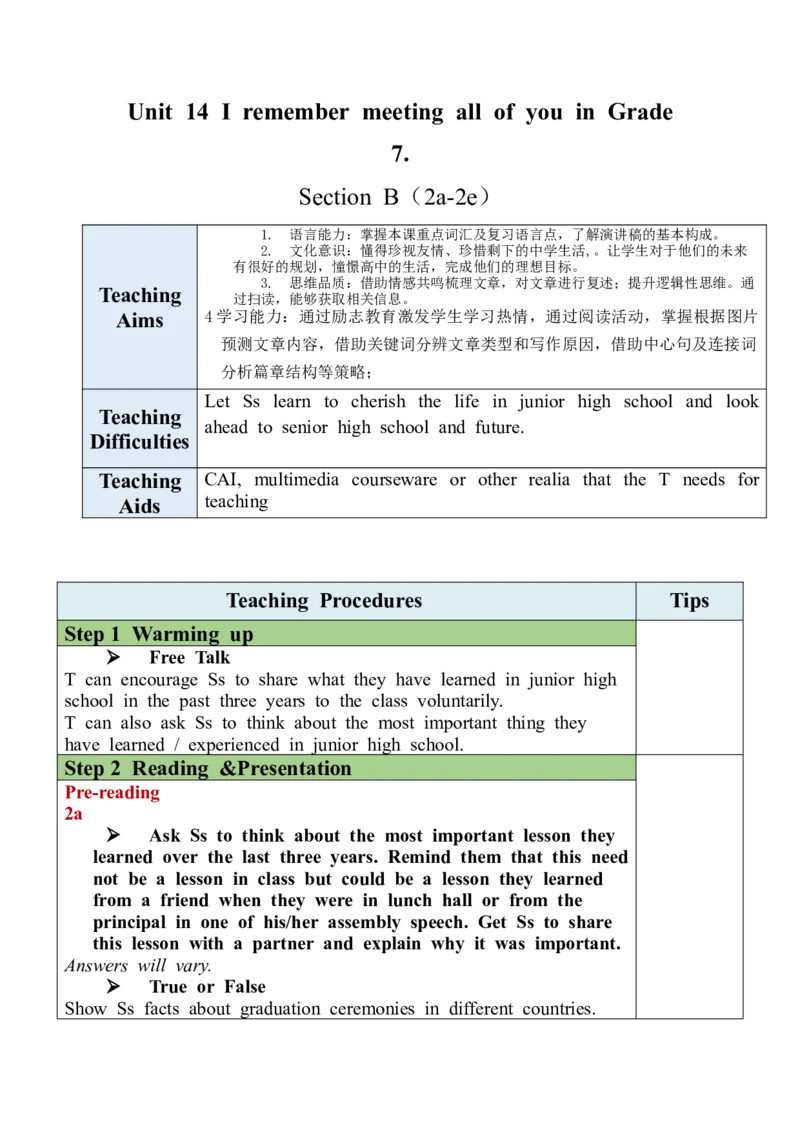
1. 语言能力:掌握本课重点词汇及复习语言点,了解演讲稿的基本构成。
2. 文化意识:懂得珍视友情、珍惜剩下的中学生活,。让学生对于他们的未来
有很好的规划,憧憬高中的生活,完成他们的理想目标。
3. 思维品质:借助情感共鸣梳理文章,对文章进行复述;提升逻辑性思维。通
Teaching
过扫读,能够获取相关信息。
Aims 4学习能力:通过励志教育激发学生学习热情,通过阅读活动,掌握根据图片
预测文章内容,借助关键词分辨文章类型和写作原因,借助中心句及连接词
分析篇章结构等策略;
Let Ss learn to cherish the life in junior high school and look
Teaching
ahead to senior high school and future.
Difficulties
Teaching CAI, multimedia courseware or other realia that the T needs for
Aids teaching
Teaching Procedures Tips
Step 1 Warming up
Free Talk
T can encourage Ss to share what they have learned in junior high
school in the past three years to the class voluntarily.
T can also ask Ss to think about the most important thing they
have learned / experienced in junior high school.
Step 2 Reading &Presentation
Pre-reading
2a
Ask Ss to think about the most important lesson they
learned over the last three years. Remind them that this need
not be a lesson in class but could be a lesson they learned
from a friend when they were in lunch hall or from the
principal in one of his/her assembly speech. Get Ss to share
this lesson with a partner and explain why it was important.
Answers will vary.
True or False
Show Ss facts about graduation ceremonies in different countries.Ask them to guess which one is true and which one is false. Ss
can get some knowledge about graduation ceremonies in different
countries through this activity.
While-reading
Get Ss to read the passage. T can explain the text
type and the structure of the passage to Ss.
2b
Ask Ss to read the passage and answer the questions.
In addition of the three questions in the textbook, ask Ss to discuss
with a partner how they know what type of text the passage is.
They should be able to point out the opening salutation, the parting
wish, and the content of the speech. Randomly ask pairs to share
their discussions. Remind Ss that the clues that tell them the text
type are also the same ingredients they will have to include if the
have to write something for that particular text type.
Answers: 1. It is a speech. 2. The principal of the school is
probably the person who wrote it. 3. It’s for the graduating
students of the school.
Let Ss read the passage sentence by sentence. T
explains the key words and phrases to them.
Task 1 Skimming and matching
Ask Ss to read the passage quickly and match each paragraph with
its main idea.
Answers:
paragraph 1: changes in the students
paragraph 2: learn to be thankful
paragraph 3: hopes for the students
Task 2 Scanning and answer
Ask Ss to read the first two paragraphs and answer the questions:
1. Do you think the headmaster likes the students?
2. How do you know that?
3. Who should the students thank and why?
Ask Ss to read the third paragraph and fill in the blanks.
Answers: harder, many difficult tasks ahead of them, Learn from,
never give up, Choose wisely, be responsible, set out, shouldn’t
forget where they come from
2c
In their pairs, ask one S to answer all the odd-
numbered questions and the other to answer all the even-
numbered questions. Did they agree on the answers?
Answers:
1. They were all so full of energy and thirsty for knowledge.
2. They have become talented young adults who are full of hope for thefuture.
3. They should thank the important people in their lives — their
parents, teachers and friends, because these are the people who have
helped and supported them.
4. Life in senior high will be harder and they will have many difficult
tasks ahead of them.
5. They should learn from their mistakes and never give up, choose
wisely and be responsible for their decisions and actions, and not forget
where they came from.
6. Answers will vary.
2d
Get Ss to share their answers with a partner and then
explain to each other why they chose that form of the word.
This is to ensure that they did not just guess which form they
should use but truly understand the different tenses.
Answers: 1. none 2. set out 3. are thirsty for 4. attend 5. be
proud of
Post-reading
Ask each S to write a passage about what he/she has
gotten in junior high school and his/her plan for senior high
school.
(Tip: If necessary, T can ask Ss complete the sample passage on
PPT P32.)
Step 3 Language points learning
be thirsty for 渴望;渴求
be thirsty for为固定短语,其后可跟名词、代词或动词-ing形式作宾
语。其中thirsty作形容词,意为“渴望的,渴求的”。
never fail to do sth. 从来不会忘记做某事
fail to do sth. 未能做某事
separate在此处作动词,意为“分开;分离”。separate from意为
“分离;隔开”,separate A from B意为“把A和B分开”。
Step 4 Exercises,Summary& Homework
Exercises
Complete the exercises from PPT P36-P38.
Homework
Read and recite the passage in 2b.
Do the exercises in students’ book.
In the reading period, students learn something about the speech at the
Teaching
graduation ceremony. We'll learn some new words and phrases and useful
Reflection
structures about the speech. We will get the students to collect thesentences they like in the speech. They will learn what they can say in the
speech. It is a good time to train the students' ability of reading quickly and
efficiently. While reading, students learn to find the main ideas and
the most important ideas in each paragraph as quickly as they can.
They should learn the oral language as well as pronunciation and
intonation about a speech.