基数词和序数词
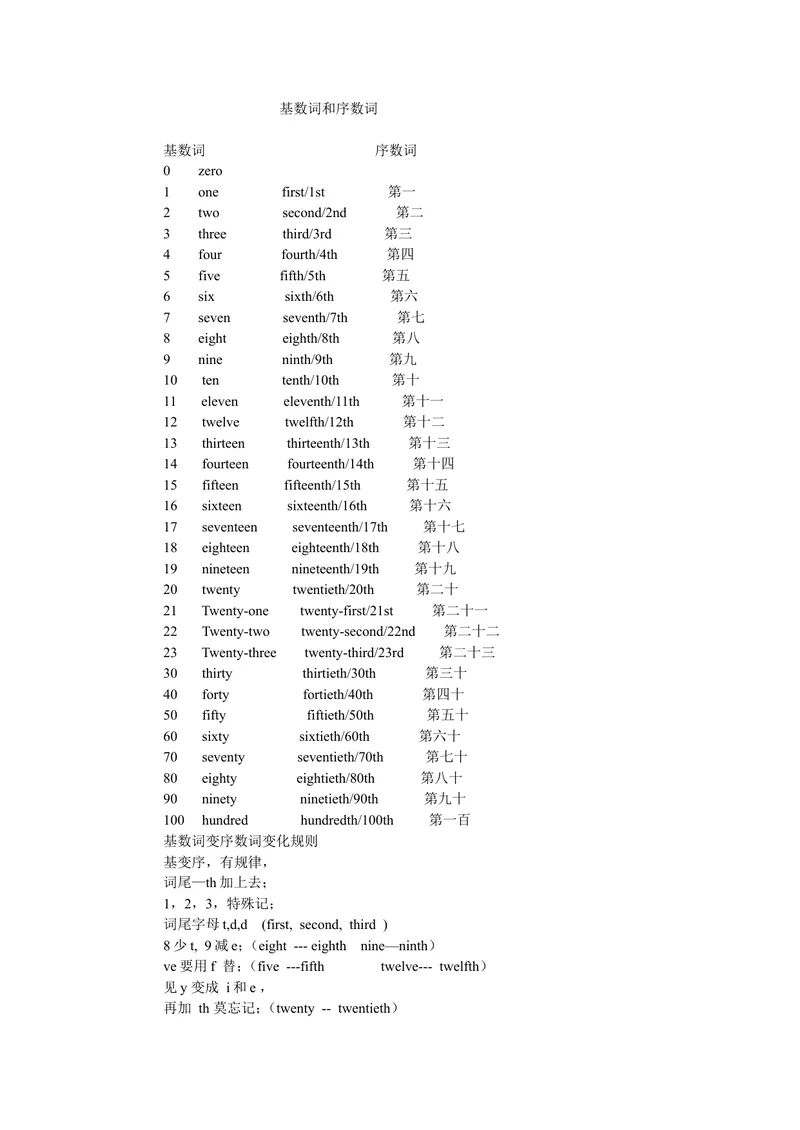
基数词 序数词
0 zero
1 one first/1st 第一
2 two second/2nd 第二
3 three third/3rd 第三
4 four fourth/4th 第四
5 five fifth/5th 第五
6 six sixth/6th 第六
7 seven seventh/7th 第七
8 eight eighth/8th 第八
9 nine ninth/9th 第九
10 ten tenth/10th 第十
11 eleven eleventh/11th 第十一
12 twelve twelfth/12th 第十二
13 thirteen thirteenth/13th 第十三
14 fourteen fourteenth/14th 第十四
15 fifteen fifteenth/15th 第十五
16 sixteen sixteenth/16th 第十六
17 seventeen seventeenth/17th 第十七
18 eighteen eighteenth/18th 第十八
19 nineteen nineteenth/19th 第十九
20 twenty twentieth/20th 第二十
21 Twenty-one twenty-first/21st 第二十一
22 Twenty-two twenty-second/22nd 第二十二
23 Twenty-three twenty-third/23rd 第二十三
30 thirty thirtieth/30th 第三十
40 forty fortieth/40th 第四十
50 fifty fiftieth/50th 第五十
60 sixty sixtieth/60th 第六十
70 seventy seventieth/70th 第七十
80 eighty eightieth/80th 第八十
90 ninety ninetieth/90th 第九十
100 hundred hundredth/100th 第一百
基数词变序数词变化规则
基变序,有规律,
词尾—th加上去;
1,2,3,特殊记;
词尾字母t,d,d (first, second, third )
8少t, 9减e;(eight --- eighth nine—ninth)
ve要用f 替;(five ---fifth twelve--- twelfth)
见y 变成 i和e ,
再加 th 莫忘记;(twenty -- twentieth)若要遇到几十几,
只变个位就可以。(forty –four ----- forty –fouth)
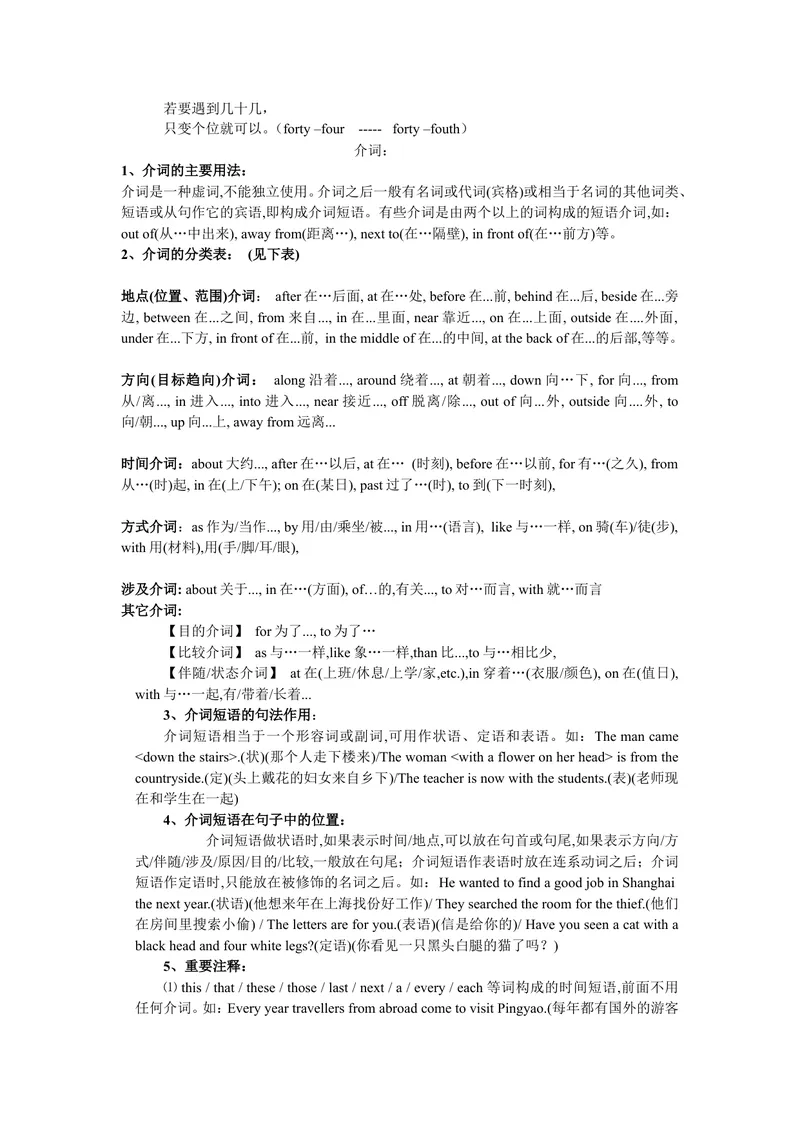
介词:
1、介词的主要用法:
介词是一种虚词,不能独立使用。介词之后一般有名词或代词(宾格)或相当于名词的其他词类、
短语或从句作它的宾语,即构成介词短语。有些介词是由两个以上的词构成的短语介词,如:
out of(从…中出来), away from(距离…), next to(在…隔壁), in front of(在…前方)等。
2、介词的分类表: (见下表)
地点(位置、范围)介词: after在…后面, at在…处, before在...前, behind在...后, beside在...旁
边, between在...之间, from来自..., in在...里面, near靠近..., on在...上面, outside在....外面,
under在...下方, in front of在...前, in the middle of在...的中间, at the back of在...的后部,等等。
方向(目标趋向)介词: along沿着..., around绕着..., at朝着..., down向…下, for向..., from
从/离..., in进入..., into进入..., near接近..., off脱离/除..., out of向...外, outside向....外, to
向/朝..., up向...上, away from远离...
时间介词:about大约..., after在…以后, at在… (时刻), before在…以前, for有…(之久), from
从…(时)起, in在(上/下午); on在(某日), past过了…(时), to到(下一时刻),
方式介词:as作为/当作..., by用/由/乘坐/被..., in用…(语言), like与…一样, on骑(车)/徒(步),
with用(材料),用(手/脚/耳/眼),
涉及介词: about关于..., in在…(方面), of…的,有关..., to对…而言, with就…而言
其它介词:
【目的介词】 for为了..., to为了…
【比较介词】 as与…一样,like象…一样,than比...,to与…相比少,
【伴随/状态介词】 at在(上班/休息/上学/家,etc.),in穿着…(衣服/颜色), on在(值日),
with与…一起,有/带着/长着...
3、介词短语的句法作用:
介词短语相当于一个形容词或副词,可用作状语、定语和表语。如:The man came
<down the stairs>.(状)(那个人走下楼来)/The woman <with a flower on her head> is from the
countryside.(定)(头上戴花的妇女来自乡下)/The teacher is now with the students.(表)(老师现
在和学生在一起)
4、介词短语在句子中的位置:
介词短语做状语时,如果表示时间/地点,可以放在句首或句尾,如果表示方向/方
式/伴随/涉及/原因/目的/比较,一般放在句尾;介词短语作表语时放在连系动词之后;介词
短语作定语时,只能放在被修饰的名词之后。如:He wanted to find a good job in Shanghai
the next year.(状语)(他想来年在上海找份好工作)/ They searched the room for the thief.(他们
在房间里搜索小偷) / The letters are for you.(表语)(信是给你的)/ Have you seen a cat with a
black head and four white legs?(定语)(你看见一只黑头白腿的猫了吗?)
5、重要注释:
⑴ this / that / these / those / last / next / a / every / each等词构成的时间短语,前面不用
任何介词。如:Every year travellers from abroad come to visit Pingyao.(每年都有国外的游客来游览平窑镇)/ He had a bad cold that week.(那个星期他患重感冒)
⑵ 记住一些固定词组: on foot(步行), at night(在晚上), play with(玩耍……),look out
of(朝…外面看), with one’s help(在…的帮助下),look after(照料…),look for(寻找…),on a
bike(=by bike)骑车, help sb. with(帮某人做…)等等。
6、某些介词的用法辨析:
⑴ 时间或地点介词in、on、at的用法区别:表示时间时, in表示在一段时间里(在将
来时句子中则表示在一段时间之后), on表示在具体的某一天或者某天的上下午等, at表示
在某个时刻或者瞬间; 表示地点时, in表示在某个范围之内, on表示在某个平面上或与
一个面相接触,at则表示在某个具体的场所或地点。如:He was born on the morning of May
10th.(他出生于五月十日的早晨)/ I usually get up at 7:00 in the morning.(我通常在早上的七
点钟起床) / His glasses are right on his nose.(他的眼镜就架在他的鼻子上)/ He is at the
cinema at the moment.(此刻他正在电影院)
⑵ after与in表示时间的用法区别:“after+(具体时刻/从句)”表示“在…时刻之后”
常用于一般时态;“in+(一段时间)”表示“在(多久)之后”,常用于将来时态。如:He said
that he would be here after 6:00.(他说他六点钟之后会来这儿)/ My father is coming back
from England in about a month.(我父亲大约一个月以后从英国回来)
⑶ by、in与with表示方式的用法区别:都可以表示“工具、手段”,但是by主要表示
“乘坐”某个交通工具或“以……方式”, in表示“使用”某种语言/文字,with表示“使
用”某个具体的工具、手段。如:We see with our eyes and walk with our feet.(我们用眼睛看
东西,用双脚走路)/ Please write that article(文章) in English.(请你用英语写那篇文章)/ Let’s
go to the zoo by taxi.(我们打的去动物园吧。)/ It was written by Lao She.(那是老舍写的)
⑸ in front of 与in the front of: in front of“在…的前面”, 与in the front of“在…的前
部”。如:A car was parking in front of the hall.(大厅跟前停着一辆汽车)/ In the front of the
hall stood a big desk.(大厅前部立着一个大讲台)
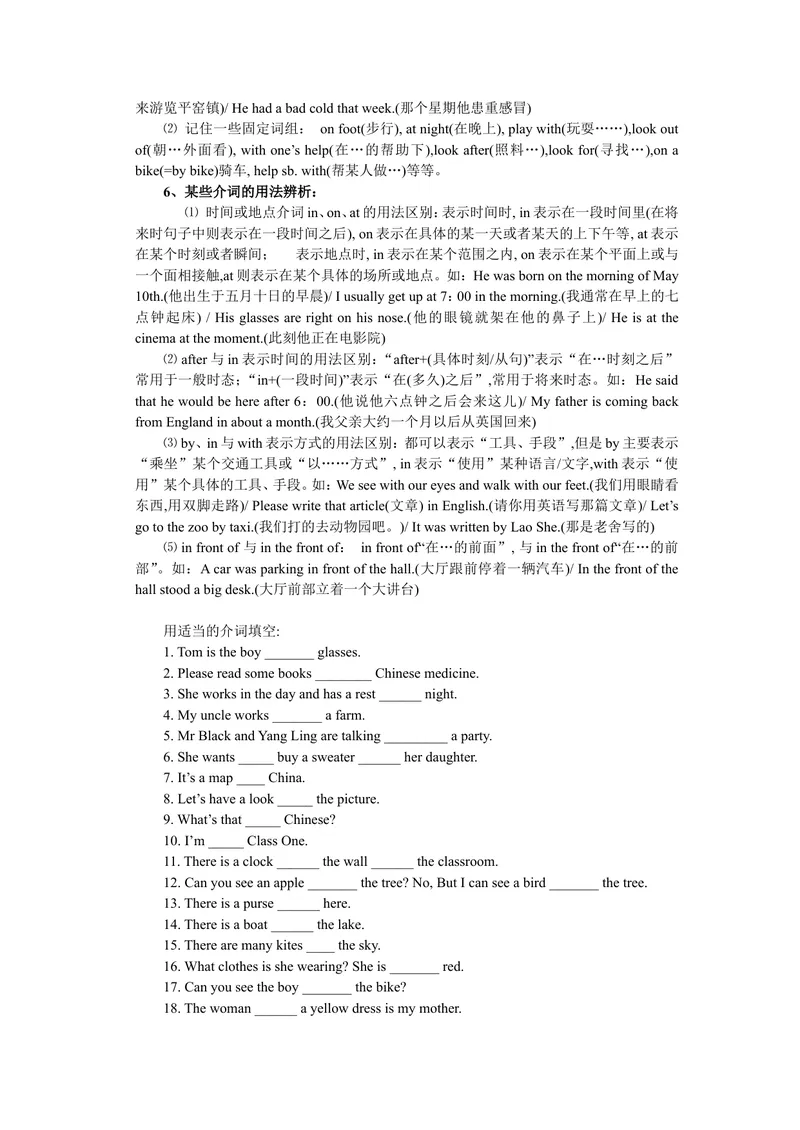
用适当的介词填空:
1. Tom is the boy _______ glasses.
2. Please read some books ________ Chinese medicine.
3. She works in the day and has a rest ______ night.
4. My uncle works _______ a farm.
5. Mr Black and Yang Ling are talking _________ a party.
6. She wants _____ buy a sweater ______ her daughter.
7. It’s a map ____ China.
8. Let’s have a look _____ the picture.
9. What’s that _____ Chinese?
10. I’m _____ Class One.
11. There is a clock ______ the wall ______ the classroom.
12. Can you see an apple _______ the tree? No, But I can see a bird _______ the tree.
13. There is a purse ______ here.
14. There is a boat ______ the lake.
15. There are many kites ____ the sky.
16. What clothes is she wearing? She is _______ red.
17. Can you see the boy _______ the bike?
18. The woman ______ a yellow dress is my mother.19. Who can you see ______ the picture?
20. Who’s the man __________ your mother and father?
21. Gao Shan gets up ______ 6:00 _______ the morning.
22. We don’t have classes _______ Sunday morning.
23. What do you often do ______ Saturday?
24. Can you help me ______ my maths?
25. What’s wrong ______ you?
26. Who’s _____ duty?
27. It’s time _____ supper.
28. She can’t find the way. So she asks the policeman _____ help.
29. A man ______ Shanghai goes to the park _______ his daughter.
30. Your socks are _____ the desk. Put them away. You must look _______ your things.
31. My sister is drawing a picture ________ crayons.
32. I’m thirsty. What _____ you?
33. What would you like _______ breakfast?
34. He is American. He is _______ the USA.
35. He is _______ home. He isn’t ______ school.
36. The lunch ______ our school is good.
37. He is playing _______ a you-you.
38. I am good _____ running. Tom does well _____ jumping.
39. The girls play cards _______ class.
40. Take ______ the old coat. Put ______ the new one.
41. I’m looking _____ my dog. I can’t find it.
42. They are talking ______ Mr. Green. They are talk ______ the film.
43. The cat is running _______ the mouse.
44. Peter looks ______ his father.
45. He is learning French _________ the tape.
46. Frenchmen come ________ France.
47. Please write _____ me soon.
48. Jack goes to school ______ foot. Jim goes to school ______ bike.
49. The farm is not far ________ his home.
50. Don’t be late ______ school.
51. She’s ill. She stays ______ bed all day.
52. There are a lot of people ________ Red Apple Hotel.
53. The supermarket is open _______ 9:00 a.m. ________ 9:00 p.m..
54. They are getting ______ the bus.
55. We are playing football ________ the playground.
56. _______ weekends, when do you get up?
57. The bookshop is not _____ Shanghai Street, it is ________ Beijing Road.
58. Don’t laugh _____ anyone.
59. He looks ________, there is no one nearby.
60. The thief is running ________ ______ the shop.
61. The hospital is 5 kilometers _______ ________ the shopping center.
62. Class One is _______ _______ Class Two.63. There is a river _____ ______ _____ my house.
64. They are walking ______ the lake.