2 0 2 5 年 全 国 教 师 资 格
主讲老师 李婉君
粉笔教师教育 粉笔教师数 词
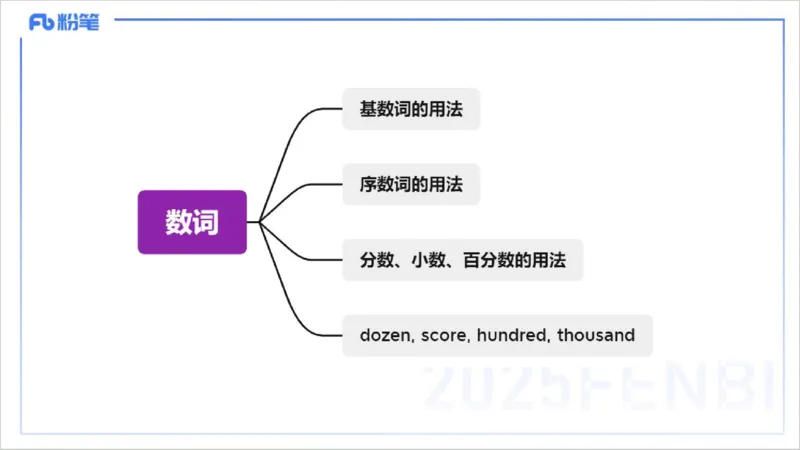
Numeral一 、基 数词 用 法 要 点
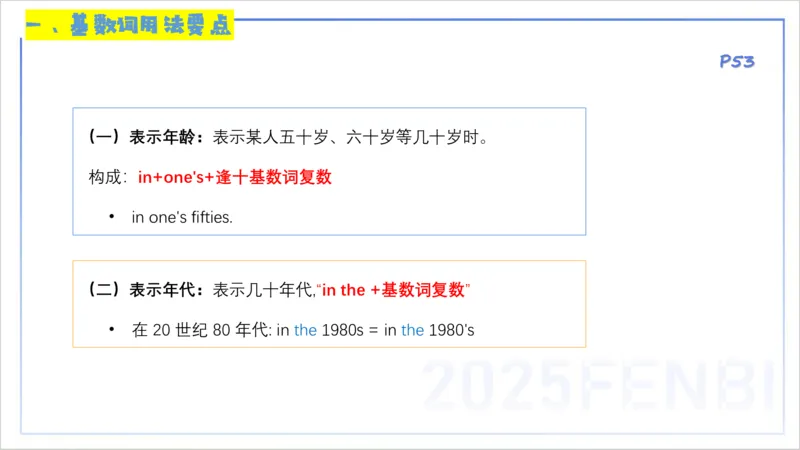
(一)表示年龄:表示某人五十岁、六十岁等几十岁时。
构成:in+one's+逢十基数词复数
• in one's fifties.
(二)表示年代:表示几十年代,“in the +基数词复数”
• 在 20 世纪 80 年代: in the 1980s = in the 1980's一 、基 数词 用 法 要 点
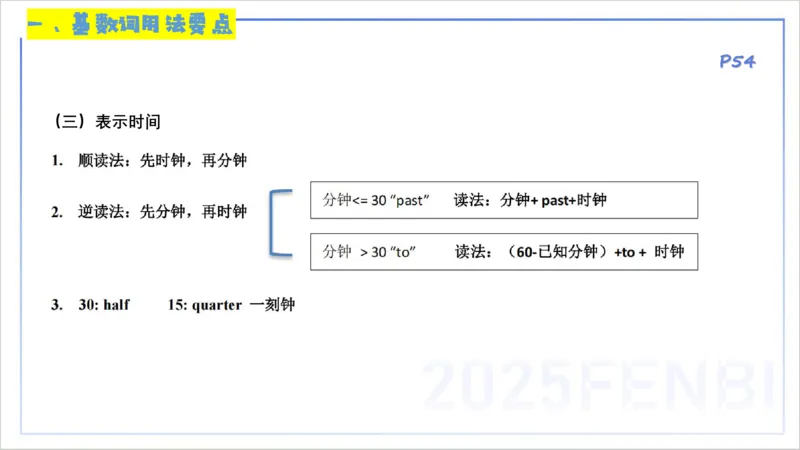
(三)表示时间二 、序 数词 用 法 要 点
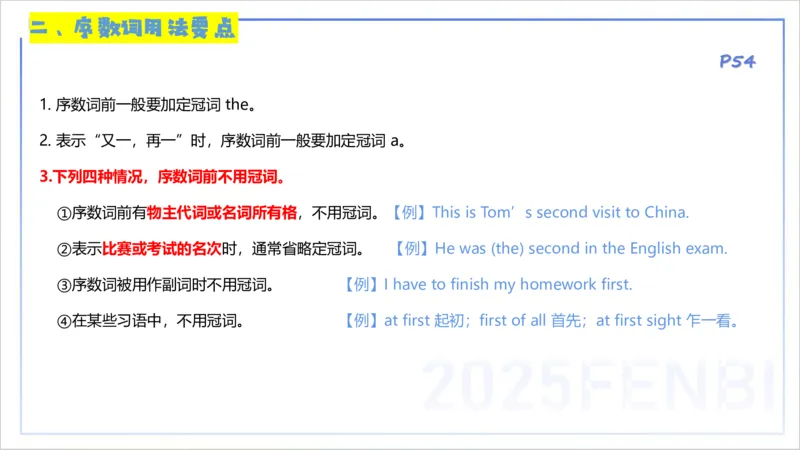
1. 序数词前一般要加定冠词 the。
2. 表示“又一,再一”时,序数词前一般要加定冠词 a。
3.下列四种情况,序数词前不用冠词。
①序数词前有物主代词或名词所有格,不用冠词。【例】This is Tom’s second visit to China.
②表示比赛或考试的名次时,通常省略定冠词。 【例】He was (the) second in the English exam.
③序数词被用作副词时不用冠词。 【例】I have to finish my homework first.
④在某些习语中,不用冠词。 【例】at first 起初;first of all 首先;at first sight 乍一看。三 、分 数、小 数、百 分 比的表 达法
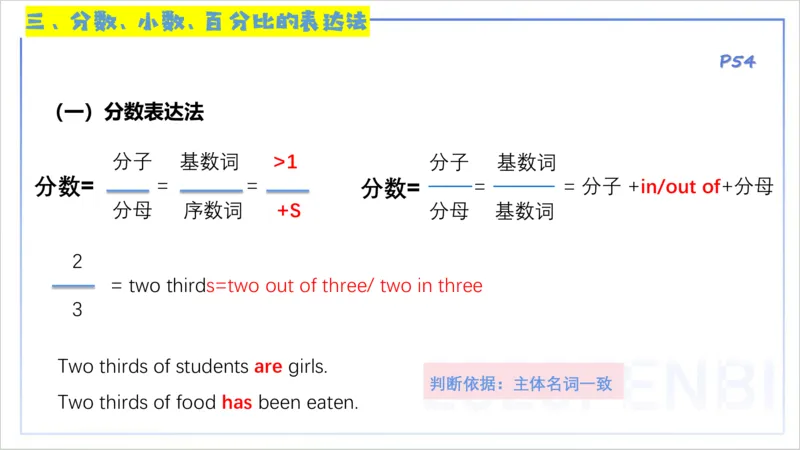
(一)分数表达法
分子 基数词 >1 分子 基数词
分数 = = = 分数 = = = 分子 +in/out of+分母
分母 序数词 +S 分母 基数词
2
= two thirds=two out of three/ two in three
3
Two thirds of students are girls.
判断依据:主体名词一致
Two thirds of food has been eaten.三 、分 数、小 数、百 分 比的表 达法
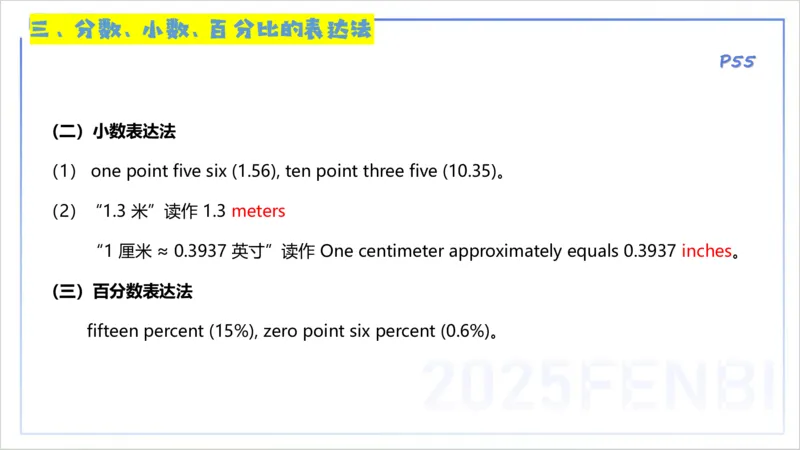
(二)小数表达法
(1) one point five six (1.56), ten point three five (10.35)。
(2)“1.3 米”读作 1.3 meters
“1 厘米 ≈ 0.3937 英寸”读作 One centimeter approximately equals 0.3937 inches。
(三)百分数表达法
fifteen percent (15%), zero point six percent (0.6%)。四 、 用 法 要 点
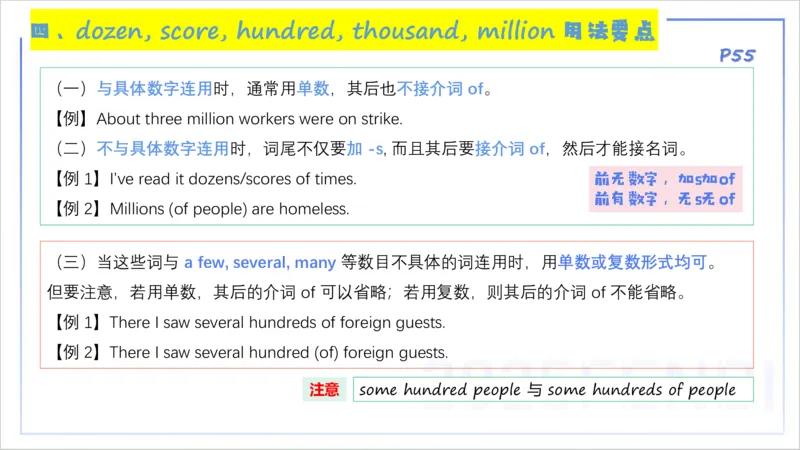
dozen, score, hundred, thousand, million
(一)与具体数字连用时,通常用单数,其后也不接介词 of。
【例】About three million workers were on strike.
(二)不与具体数字连用时,词尾不仅要加 -s, 而且其后要接介词 of,然后才能接名词。
【例 1】I’ve read it dozens/scores of times. 前无 数字 ,加s加of
前有 数字 ,无 s无 of
【例 2】Millions (of people) are homeless.
(三)当这些词与 a few, several, many 等数目不具体的词连用时,用单数或复数形式均可。
但要注意,若用单数,其后的介词 of 可以省略;若用复数,则其后的介词 of 不能省略。
【例 1】There I saw several hundreds of foreign guests.
【例 2】There I saw several hundred (of) foreign guests.
注意 与
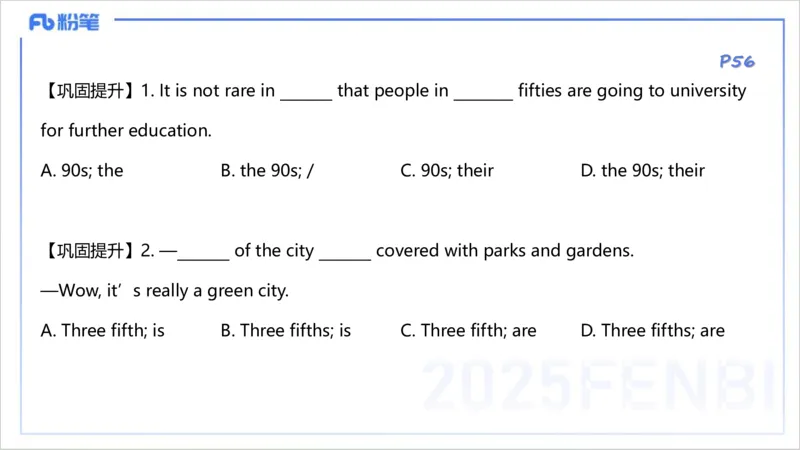
some hundred people some hundreds of people【巩固提升】1. It is not rare in _______ that people in ________ fifties are going to university
for further education.
A. 90s; the B. the 90s; / C. 90s; their D. the 90s; their
【巩固提升】2. —_______ of the city _______ covered with parks and gardens.
—Wow, it’s really a green city.
A. Three fifth; is B. Three fifths; is C. Three fifth; are D. Three fifths; are【巩固提升】3. It is reported that the floods have left about ________ people homeless.
A. two thousand B. two-thousands
C. two thousands D. two thousands of连 词
Conjunction一 、连 词 的分 类
了解即可
种类(功能) 功能 连词
从属连词 引导从句 when, while, if, although, so that 等
and, but, or, as well as, both...and, not
并列连词 连接平行的词、词组及句子 only...but also, either...or, neither...nor
等二 、连 词 的用 法
【例1】We were singing and dancing all the evening.
【例2】Would you like to leave or would you like to stay?
【例3】I would like to come but I am so busy.
【例4】I will not say a word, for I don’t want anything to do with it.【巩固提升1】Leave the reference books behind, ______ you won’t be able to think
independently.
A. or B. and C. so D. but
【巩固提升2】Most whales must come up for air after several minutes, ______ a few can stay
under water for an hour or more.
A. while B. or C. for D. so动 词
Verb(三 )实 义 动词 -时 态
1.动词时态变化(以do为例)
方式/时间 现在 过去 将来 过去将来
一般 do(does) did shall/will do should/would do
am/is/are was/were shall/will be should/would be
进行
doing doing doing doing
have/has shall/will have should/would/could
完成 had done
done done have done
have/has had been shall/will have should/would have
完成进行
been doing doing been doing been doing( )一 般 现在 时
1 Simple present tense
① 表示经常性或习惯性的动作,常与表示频度的时间状语连用(always,usually,often,sometimes,never)
• I leave home for school at 7 every morning.
② 表示客观真理、客观存在、科学事实
• The earth moves around the sun.
• Columbus proved that the earth is round.
③ 用在格言或警句中 Pride goes before a fall.骄兵必败
④ 表示现在时刻的状态、能力、性格、个性等
⑤ 主句是一般将来时,时间或条件状语从句中用一般现在时表示将来(主将从现)
⑥ 在以 here, there 开头的句子中,go, come 等少数动词的一般现在时表示正在发生的动作
• There goes the bell./Here she comes.
⑦ 按照计划表、时刻表安排好的事情。
• The plane takes off at 7:30 a.m.
• The meeting starts at five o’clock this afternoon.( )一 般 过 去 时
2 Simple past tense
①表示过去某个特定时间发生的动作或存在的状态
He suddenly fell ill last night.
②表示过去习惯性或经常性的动作,常和 often(经常), always(总是), once a week(一周
一次)等表示频度的时间状语连用
When I was in the countryside, I often walked by the riverside.
She went to the cinema once a month when she was at school.( )一 般 将来 时
3 Simple future tense
“不与明确的时间状语连用”• He concluded his speech with a remark that failure _______ the mother of success.
A. is B. were C.was D. must be
• There _______ a meeting tomorrow afternoon.
A. will be going to B. will going to be
C. is going to be D. will go to be( )现在 进 行 时
4 Present continuous tense
is/am/are doing
① 代替一般将来时,表示按计划安排即将发生的动作。
She is leaving for Beijing.
② 代替一般现在时,描绘更加生动。
The Yangtze River is flowing into the east.
③ be always/continuously/constantly doing sth. 表示夸奖、埋怨等感情色彩。
You are always helping others.
He is always finding fault with me.( )过 去 进 行 时
5 Past continuous tense
was/were doing
① 表示过去某一个特定时刻正在发生的事情
• I was discussing my thesis with my director at this time last night.
② 与一般过去时配合使用。此时,过去进行时通常表示一个历时较长的体现“背景”的动作或状
态;而一般过去时则表示此“背景”下发生的、短暂的动作或状态。过去进行时动作先发生,一
般过去时动作后发生。
• The phone rang while I was having my bath, as usual.He said that he __________ with Mr. Black at that time.
A. talked B. was talking
C. is talking D. talks将来 进 行 时
(6) Future continuous tense
shall/will be doing
表示在将来某一特定时刻正在进行的活动。
• I’ll be lying on a beach in Sanya this time tomorrow.
• Don’t telephone me after eight tomorrow. I’ll be having a meeting.现在 完 成时
(7) Present perfect tense
have/has done
① 表示动作或状态从过去某一时刻开始一直延续到现在,而且可能还要继续下去。
• I’ve known Bob for three years.
• I’ve been at this school for over two years.
② 表示过去发生或已经完成的某一动作对现在造成的影响或结果
• He has broken his leg.(通常不与明确的时间状语连用)
• I have had my lunch.
常见的标志词:recently, so far, lately, since, in the past few years, for+段时间
③表示到目前为止的一个时间段内重复发生的动作。
• We have taken three tests so far this week.④ have/has been to 表示 “去过”(双程票)
have/has gone to 表示 “去了”(单程票)
• They have been to Beijing twice.
• ---Where’s Tony? ---He has gone to Beijing.
⑤ 短暂动词(即瞬间动词)
come, go, arrive, reach, hear, close, leave, begin, start, lose, buy, fall, join, die, borrow, marry,
finish, complete等,在完成时态中,其肯定式不能和表示一段时间的状语连用。
(错)I have received his letter for a month.
(对)I haven’t received his letter for a month.1. -How long has your grandma _____? -About three months.
A. fallen ill B. been ill C. fall ill D. be ill
2. -Is your father a party member?
-He __________ the party three years ago. He __________ a party member for three years.
A. has joined; has been B. joined; has been
C. joined; has become D. has joined; has become容 易 混淆 的时 态比较 ( )
1
一般过去时 & 现在完成时
练一练
1. We haven’t heard from Jane for a long time. What do you suppose ______ to her?
A. was happening B. happens C. has happened D. happened
2. Mr. Lee, who _______ as a carpenter for over 10 years, is now a very famous statesman in this country.
A. has worked B. had worked C. worked D. works容 易 混淆 的时 态比较 ( )
2
现在完成时 & 现在完成进行时
现在完成时:着重表示动作的结果
现在完成进行时:着重表示动作一直在进行,即动作的延续性。(看此时此刻动作有没有发生)
练一练
—Hi, Tracy, you look tired.
—I am tired. I ______ the living room all day. It will be finished in two hours.
A. painted B. had painted C. have been painting D. have painted1. All the preparations for the task ___________, and we’re ready to start.
A. completed B. complete
C. had been completed D. have been completed
2. We ___________ English in this school since we came here.
A. have studied B. studied
C. had studied D. were studying过 去 完 成时
(8) Past perfect tense
had done
(过去的过去)
• He had shut the door before the dog came in.
now
had shut came
• At the age of ten, he had learned 500 English words.
now
had learned ten
常见标志词:by/before +过去时间
试填:The thief _______( run ) away when the police________(arrive).③ 常用hope, expect, think, intend, want, suppose等动词的过去完成时来表示未实现的希望、打
算或意图。(本打算,本期望)
We had expected that you would be able to win the match.
④ 固定句型:hardly/scarcely...when...;no sooner...than...;it was the first time that ... had done...将来 完 成时
(9) Future perfect tense
will have done
①表示截至未来某个时刻已经完成的动作或状态;常与将来完成时搭配的时间状语 by the time...,
by the end of... 等
We will have covered thirty miles by the end of the day.
②表示将来某一时刻之前发生的动作对将来有影响
We will have been married for a year on June 25th.了解即可【巩固提升】1. The boy remembered that his grandfather ________ him to keep ice on the ankle
when he twisted his ankle at school.
A. tells B. had told C. was told D. was telling
【巩固提升】2. The professor ________ his thoughts before giving his lecture so that he could
make himself understood well.
A. organized B. admitted C. realized D. advertised【巩固提升】3. I still live in that old apartment. My new house ________ and the work will be
done next month.
A. has decorated B. had been decorated
C. is decorated D. is being decorated