文档文本内容
Unit 2 Vacation plans 知识总结及课文翻译
单词
plan[plæn]动词,名词,计划--发音: a发/æ/
例:make a plan 制订计划
love[lʌv]动词,名词,喜爱--近义词: like
love doing sth. 喜爱做某事
ship[ʃɪp]名词,轮船
形近词: shop
词组: by ship
train[treɪn]名词,火车--发音: ai发/eɪ/
词组: by train
bus[bʌs]名词,公共汽车--发音: u发/ʌ/
词组: by bus
by(ship/plane/ bus/ train) 同音词:bye-buy
stay in a hotel住在旅馆里
[来源:学。科。网]
[steɪ]动词,停留,待发音: ay发/eɪ/--stay up 熬夜
stay with my aunt and uncle 住在伯/婶/姑/姨/舅母和伯/叔/姑/姨/舅父
家里
go sightseeing去观光
Tibet[tɪˈbɛt]名词,西藏--发音: e发/ɛ/
hurray[hʊ'reɪ]动词,万岁,太棒了。形近词: hurry 匆忙
wolf(wolves) [wʊlf]名词,狼--复数:wolves(f变v再加es)
Unit 2 Story故事翻译
The children are talking about their vacation in the garden.
孩子们正在花园里谈论他们的假期。
We're going to Tibet for a vacation.我们将要去西藏度假。
Hurray! I love beaches!太棒了!我喜爱海滩!
No, Gogo! There are no beaches in Tibet! There are mountains.
不,戈高!西藏没有海滩!有山。
Mountains? I like them, too!山?我也喜欢山!
How are we going there?我们将要怎样去那里?
We're going by plane.我们将要乘坐飞机去。
Can we go camping?我们能去野营吗?
It's too cold for camping, Gogo.We're going to stay in a hotel.
就野营而言天气太冷了,戈高。我们将要住在旅馆里。
I like camping! I'm going camping!我喜欢野营!我将要去野营!
OK, you can camp with the bears and the wolves.好的,你可以与熊和狼
一起野营。
Er...No. I'm going to stay in the hotel.呃……不。我将要住在旅馆里。
[来源:Zxxk.Com]
录音原文:
A. —How are you going to Shanghai?
—I'm going by plane.
B. —Are you going to Beijing by plane?—No, I'm going by train.
C. —Where is he going to stay?
—He's going to stay with his aunt and uncle.
D. —Are you going to visit your friends?
—No, I'm going to go sightseeing.
Match the questions for planning:1-5e-a-b-d-c
a.How are we going to get there?
b.What are we going to do there?
c.What do we need to bring?
d.Where are we going to stay?
e.Where are we going this weekend?
Le’s go camping
Ms. Black:We're going camping this weekend.Do you want to come,
kids?
Kids:Great!
Tony:1.
Ms. Black: We're going to Green Hill.
Jenny:2.
Ms. Black: It's not very far. We're going by bus.
Lisa:3.
Ms.Black: We're going to walk up the hill. Green Hill is very beautiful.
There are flowers and green grass. There's a lake, too. We're going torow boats on the lake.
Ben:4.
Ms.Black: We're going to stay in tents, of course!
Gogo: 5.
Ms.Black: It's cold at night. Please take some warm clothes and your
camera!
Kids: Hurray!
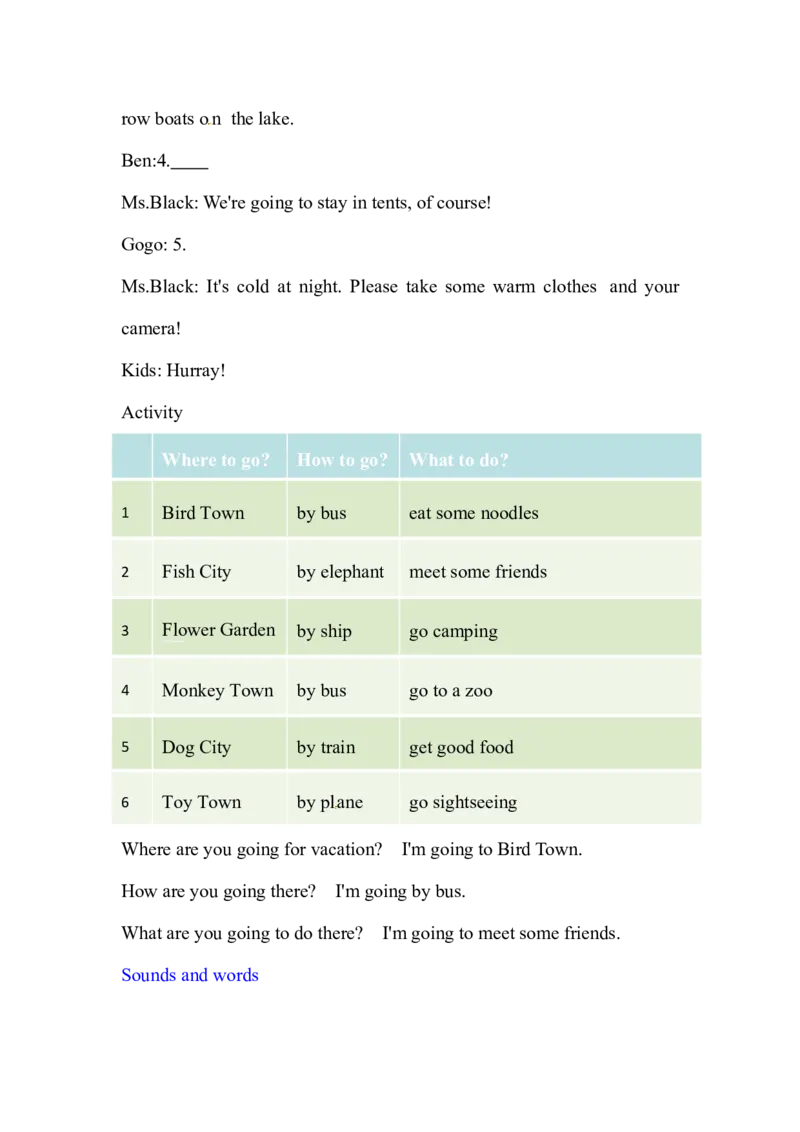
Activity
Where to go? How to go? What to do?
1 Bird Town by bus eat some noodles
2 Fish City by elephant meet some friends
3 Flower Garden by ship go camping
[来源:Z§xx§k.Com]
4 Monkey Town by bus go to a zoo
5 Dog City by train get good food
6 Toy Town by plane go sightseeing
Where are you going for vacation? I'm going to Bird Town.
How are you going there? I'm going by bus.
What are you going to do there? I'm going to meet some friends.
Sounds and wordsFly, fly, fly a kite.
So high in the sky.
Why, why, why do you cry?
My kite is not in the sky.
Dry, dry, dry your eyes.
The kite is now flying high!
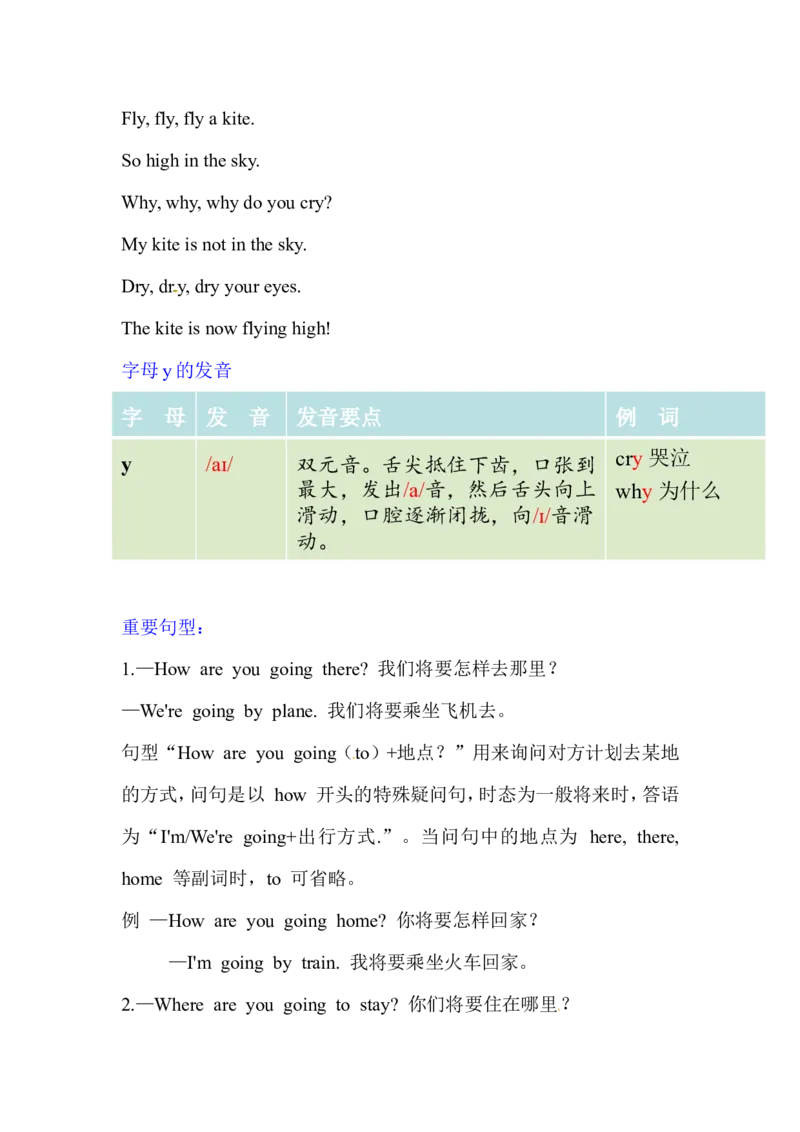
字母y的发音
字 母 发 音 发音要点 例 词
cry 哭泣
y /aɪ/ 双元音。舌尖抵住下齿,口张到
最大,发出/a/音,然后舌头向上 why 为什么
滑动,口腔逐渐闭拢,向/ɪ/音滑
动。
重要句型:
1.—How are you going there? 我们将要怎样去那里?
—We're going by plane. 我们将要乘坐飞机去。
句型“How are you going(to)+地点?”用来询问对方计划去某地
的方式,问句是以 how 开头的特殊疑问句,时态为一般将来时,答语
为“I'm/We're going+出行方式.”。当问句中的地点为 here, there,
home 等副词时,to 可省略。
例 —How are you going home? 你将要怎样回家?
—I'm going by train. 我将要乘坐火车回家。
2.—Where are you going to stay? 你们将要住在哪里?—We're going to stay in a hotel. 我们将要住在旅馆里。
句型“Where are you going to stay?”用来询问对方将要住在何处,答
语为“We're/I'm going to stay(+其他).”。
例 —Where are you going to stay, Peter?
[来源:学科网]
彼得,你们将要住在哪里?
—We are going to stay with my uncle.
我们将要住在我叔叔家里。
[来源:学。科。网Z。X。X。K]
知识解读:
一、“by + 交通工具”表示出行方式
课文应用:Sometimes I come by bus. 有时我乘公共汽车来。
“by+交通工具”表示“乘/骑……”,常用的表达方式有:
train乘火车 plane乘飞机
car乘小汽车 by ship乘船
bike骑自行车 subway乘地铁
要点提示:by后面一定要直接加交通工具的单数形式。另外,“小脚
丫”foot与on搭配,即“步行”要用“on foot”表示。
英汉有别:汉语中“乘火车”,“骑自行车”等是动词短语,但在英
语中“by train” “by bike”等为介词短语,在句子中不能作谓语。易混辨析:“take a + 交通工具”与“by + 交通工具”
“take a + 交通工具”的意思同样为“乘某种交通工具”。此短语为动
词短语,在句中“take a + 交通工具”可以作谓语,并且交通工具前需
要有冠词;而“by + 交通工具” 是一个介词短语,可以充当方式状
语,但不能作谓语,并且交通工具前不加冠词。
例如:We take a bus to school. = We come to school by bus. 我们乘公共
汽车来学校。
语法小贴士:方式状语简介
状语部分
Work工作 hard. 努力。
Walk走 slowly. 慢慢地。
Go去 by bike. 骑自行车。
Travel旅行 by plane. 乘飞机。
二、一般将来时。
一般将来时的概念:表示将要发生的动作或存在的状态及打算、计划
或准备做某事。如:
I am going to play basketball tomorrow. 我打算明天去打篮球。
She is going to the party. 她将要去参加聚会。
1. 一般将来时的基本结构及用法。
基本结构:主语+be(is,am,are) going to+do (动词原形)
2. 表示将来的时间状语
tomorrow,next day/week/month/year,soon,the day after tomorrow (后
天)等。如:He will go to Beijing next week. 他下周将要去北京。
3.表示主语事先打算好、安排好、计划好要做某事。
①肯定句:主语+be going to +v.(原形)+其他.
I am going to see a film this weekend.
②否定句:主语+be not going to +v.(原形)+其他.
I’m not going to see a film this weekend .
4.一般疑问句:Be + 主语 +going to +V.(原形)+其他 ?
肯定回答:Yes,主语+ be. 否定回答:No,主语+be not.
Are you going to see a film tomorrow ?
Yes,I am. No, I’m not.
5.特殊疑问句:特殊疑问词+一般疑问句:特殊疑问词+be + 主语
+going to +V.(原形)+其他 ?
①询问主语打算干什么?
问:What be 主语 going to do ?
答:主语+ be going to +v.(原形)+其他.
Eg:What is Lin Yan going to do ?
He is going to play ping-pong.
②询问主语打算去哪里?
Where: 对地点提问,表示哪里问:Where be 主语 going ?
答:主语 + be going to sp.(地点)
Where is Shengyan going ?
She is going to Shanghai.
③询问主语怎样去(某地)
How:对方式提问,表示怎么样
问:How be 主语 going (to sp.)
答:主语 + be going(to sp)+by(交通工具).
How are you going to Guangzhou?
We're going by bus.