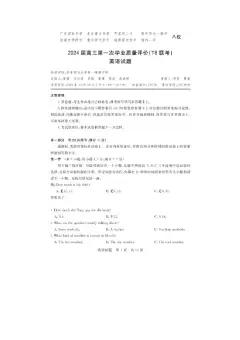
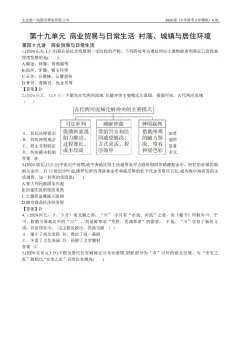
2024 届唐山市普通高等学校招生统一考试第二次模拟演练英语
第一节 (共5小题;每小题1.5分,满分7.5分)
听下面 5段对话。每段对话后有一个小题,从题中所给的A、B、C 三个选项中选出最佳选项。
听完每段对话后,你都有 10 秒钟的时间来回答有关小题和阅读下一小题。每段对话仅读一遍。
1. When will the movie end?
A. At 8:00. B. At 10:00. C. At 10:30.
2. What does the club need?
A. A drum. B. A violin. C. A piano.
3. Why does the man feel sorry for the woman?
A. Her mother was ill. B. She failed to meet Emma. C. She missed the picnic.
4. Where did the woman probably play football?
A. In the yard. B. În the park. C. In the street.
5. What's the conversation mainly about?
A. Repairing a car. B. Handling an accident. C. Improving driving skills.
第二节(共15小题; 每小题1.5分, 满分22.5分)
听下面5段对话或独白。每段对话或独白后有几个小题,从题中所给的 A、B、C 三个选项中选
出最佳选项。听每段对话或独白前,你将有时间阅读各个小题,每小题 5 秒钟;听完后,各小题将给
出5秒钟的作答时间。每段对话或独白读两遍。
听第6段材料,回答第6、7题。
6. What does Ron think of his cooking ability?
A. Basic. B. Creative. C. Expert.
7. Why does Ron prefer grilling?
A. It is simple. B. It is done outside. C. It produces tasty food.
听第7 段材料,回答第8至10题。
8. What animal does the woman prefer?
A. Rabbits. B. Snakes. C. Parrots.
9. Where does the conversation probably take place?
A. In the zoo. B. In a pet shop. C. In an animal shelter.
10. What will the woman do next?
A. Go home. B. Have a party. C. Stay here.
听第8段材料,回答第11至13题。
11. What worries Clare?
A. Taking a course, B. Having an exam. C. Making notes.
12. What is the man's view on the notes?
A. They are quite formal. B. They are perfectly complete. C. They are unnecessarily long.
13. What does the man suggest the woman do?
A. Use symbols. B. Improve memory. C. Remember key terms.
听第9段材料,回答第14至17题。
14. What happened to Laura in the South Pole?
A. Her fingers got hurt. B. Her glasses broke. C. Some stories frightened her.
15. Why was the trip to Áustralia the worst one?
A. The laptop was stolen.B. The owner failed his duty.
C. The police were unprofessional.
16. How does Laura spend a normal holiday?
A. By reading a lot. B. By learning boat riding. C. By enjoying herself leisurely.
17. What is Laura's next plan?
A. Going to islands. B. Getting married. C. Climbing a mountain.
听第10段材料,回答第18至20题。
18. Where did the speaker use to live as a child?
A. In the city. B. In a village. C. In the town.
19. What does the speaker do?
A. She is a writer. B. She is an editor. C. She is a village official.
20. Why does the speaker go back to the tree?
A. To display her success. B. To get inspiration. C. To show her regret.
第二部分 阅读(共两节,满分50分)
第一节(共15小题; 每小题2.5分, 满分37.5分)
阅读下列短文,从每题所给的A、B、C、D四个选项中选出最佳选项。
Grand Canyo n River Hike
July 28-30
The coolest thing to do in Summer! A river hike is a combination of normal hiking and hiking along the
course of rivers. It often involves walking in the water and on rocks, low-level rock climbing, crossing rivers,
and swimming.
River hikes are fun but require average to high fitness level, good balance and swimming skills, Climbing
skills are not necessary. They are not recommended for people afraid of heights.or water, nor for children
under the age of 15.
TRIP SCHEDULE
Day I Friday
18:45 We're going to get out of Los Angeles. I'm waiting for you at Griffith Park!
19:00 Everyone's here, time to go!
23:30 Arrive at the Guesthouse. Let's quickly get the room and go for some quality sleep to recharge for
the hike tomorrow.
Day 2 Saturday
07:00 Get up and have breakfast.
07:30 Pack all your belongings; we'll be on the bus for about 2 hours before reaching our drop-off point.
09:30 We will walk on the road for about 30 mins to reach the starting point. Then we have15 mins to put
our swimming suits on and wear some sun creams before getting ready for the hiking!
For the rest of the day, we will mainly be hiking on the rocks, stopping on the way for your self-prepared
lunch when you want.
16:30 Finish the hike and get on the bus waiting for us. We're going to spend the night in the Guesthouse
village.
18:30 Let's have dinner and enjoy the night!
Day 3 Sunday
9:00 Get up and have breakfast. After yesterday's exciting hike, today is mainly relaxing!10:00 We reach a nice river spot for swimming and jump from rocks before going back to the village
where we will have lunch. Or you can just stay in the village, walk around and relax.
13:00 After group lunch we will take our private bus and head back to Los Angeles.
19:30/20:00 Estimated arrival time in Los Angeles.
Note: For details on costs and safety measures, please refer to the next page on our website.
21. What is clearly stated as a recommendation for the activity?
A. Age. B. Climbing skill. C. Fitness certificate. D. Physical height.
22. At about what time does the river hiking start?
A.7:30, B.9:30. C.9:45. D. 10:15.
23. What can we learn about the river hiking?
A. It's a weekend getaway. B. Two lunches are provided.
C. It takes place in Los Angeles. D. Hiking the whole trip is required.
B
I like an organized, clean house. I am, however, often in the minority in the house.
Every time I walk in the front door and make the turn to hang my coat in the mudroom (Amudroom is a
space set aside in a house where people can take off their outdoor clothing, remove their soiled shoes, store
equipment), I frown at the mess that meets my eyes. Lots of shoes littered all over the floor, along with slippers
(拖鞋) and anything you can imagine. No matter how many times I attempt to restore the scene, this room
immediately ends up back in mess.
The other day I started to think about why the mu droom is the most challenging room to keep in order. I
came to the realization that it is because the mu droom is both the beginning and the end, it is the jumping off
point to the adventures of our day and it is the storage ground when the sun sets. In turn, those four walls have
become a holder of memories, and a museum of my family's treasures, as each item tells a story of those that I
love most.
The bright white Nike high tops cast off on the floor belong to my oldest son, nearing 12,presenting his
emerging fashion sense. The worn black and blue runners introduce my youngest,a lively tornado in a 10-year-
old's body.
The slippers belong to my husband. They were a Christmas present from the boys and me many years ago.
During the colder months, it is the first thing that my husband does when he return s home from work, he slips
on those grey wool slippers and continues to settle in. He loves and wears them so much that the initial pair
wore right through the toe. He won't part with those treasures but now has a second pair; the exact same make
and model.
Recently it occurred to me that my annoyance at the mudroom chaos is temporary. This disorder will last
only a few years. The boys are getting older, and the toys and mess will move on ... as will my sons eventually.
This makes me sad for what I know will feel like a big loss.Each day that I see that collection of goods means
that my house is full of love, energy, passion and family.
24. What does the author intend to tell us in paragraph 2?
A. Intense desire to be clean. B. Strong ha te of the mudroom.
C. Ongoing struggle to maintain order. D. Great tension between her and her family.
25. What can we learn from the author's reflection?
A. Her regret and restart. B. Her wonder and willpower.
C. Her frustration and forgiveness. D. Her acceptance and appreciation.26. Why does the story refer to the husband's slippers?
A. To prove their comfort. B. To show their emotional value.
C. To offer insight into his daily life. D. To praise his money management.
27. What is the best title of the text?
A. Loss? Universal Gain! B. Chaos? Life's Loving Marks!
C. Litter? Proof of Daily Routine! D. Mudroom? Family's Obligation!
C
The Last Generation is an activist group in Germany, the name implying that our unsustainability will
push us to extinction. To force their government into action, some of the group went on a month-long hunger
strike in August 2021, I t wasn't a half-hearted effort: several ended up in hospital.
But I'd like to take the opposite framing. I think we have the opportunity to be the first generation that
leave s the environment in a better state.
There are two kinds of optimism: complacent optimism and conditional optimism.Complacent optimism
is the feeling of a child waiting for presents . Conditional optimism is the feeling of a child who is thinking
about building a tree house,“If I get some wood and nails and persuade some other kids to help do the work,
we can end up with something really cool.”The group actually did take bold action, yet I want to address the
climate crisis from a different angle.
Yes, my framing seems hard to believe. I'll explain why. Here I'm using the term“generation”loosely. I am
from a generation that will be defined by our environmental problems.I was a child when cimate change really
began. I will see countries move from being almost
entirely dependent on fossil fuels to being free of them. I will be 57 when governments hit the“2050
deadline”of reaching net-zero carbon emissions that so many have promised.
But, of course, there will be several generations involved in this project. There are a couple above me and
a couple below me. And we all need to work together to achieve that.
For a conditional optimişt, criticism is essential. We need to work through ideas to find the most
promising ones. Most innovators have been optimists. But they were also strongly critical:no one would pick
apart the ideas of Thomas Edison or Marie Curie more than they did themselves.
Don't look away from the climate crisis that faces us. Let's face up to it, not from a place of“damage
control”but with a clear vision of the future we can build: one that not only stops warming in its tracks but
builds a better world for us—all of us——and the species that we share the planet with.
28. Why is The Last Generation introduced?
A. To blame them for their action. B. To remind Germany of its duties.
C. To discuss the author's perspective. D. To demand urgent action from everyone.
29. What is the core of complacent optimism?
A. Belief in kindness. B. Passive expectation.
C. Brief satisfaction. D. Love of presents.
30. What does the underlined phrase“pick apart”in paragraph 6 mean?
A. Turn to. B. Identify with.
C. Find fault with. D. Make an assessment of.
31. What does the author intend the readers to do?
A. Envision and engage. B. Adapt and advance.
C. Inspire and Innovate. D. Explore and expand.
DWhen Mark Twain visited Florence (佛罗伦萨) in 1867, he dutifully visited the city's museums,
churches, and tombs. But as he stood by the Arno, he began to sense the Italians'insistence that it was a river,
not a stream.“They all call it a river, and they honestly think it is a ríver, do these dark and bloody
Florentines,”he complained,“I might enter Florence under happier circumstances a month hence and find it
all beautiful, all attractive. But I do not care to think of it now, at all.”
It's normal to feel uncomfortable outside your home culture. Feelings of discomfort,dislocation, and
overload among travelers are referred to by many as“culture shock.”But SusanGoldstein, a professor at the
University of Redlands says,“Though the term has existed for many years,‘Culture shock’implies’a dramatic,
unexpected, negative event. Though many travelers will experience such challenges, a real sense of‘shock’is
untypical. So untypical that many researchers no longer use the term.”
It was the vivid description of culture shock by Canadian researcher Oberg, written in 1960in response to
his own multicultural experiences, that won over audiences. The researcher spoke of the adjustment process
as“an occupational disease of people who have suddenly been transplanted abroad”—a“disease”that
progressed from a honeymoon phase, through rejecting the new environment, to finally adjusting fully to it. By
the 1970s many researchers adopted the idea that, like physical illnesses, culture shock progressed through a
remarkably consistent and universal set of stages.
Modern research, however, suggests that the experiences of adaptation are individual, not
universal.“People will have their ups and downs, but for the most part, they will become increasingly
comfortable and competent over time,*Goldstein says. And while many connect the causes of culture shock to
the host culture itself, an individual's internal expectations and differences are just as important.
As for Mark Twain, the moody author was able to rí de out his feelings of upset and di slocation while
traveling. He eventually finished out his European tour - and in his bestselling travel memoir The Innocents
Abroad, famously remarked that travel is“fatal to prejudi ce and narrow-mindedness.”With the right attitude–
and the willingness to seek help if you need it –it's more than likely that you, too, can adapt and grow in new
settings, building new memories–and toughness— with each new stamp in your passport.
32. How did Mark Twain feel about Italians'insistence?
A. Annoyed. B. Calm. C. Uninterested. D. Curious.
33. What can be inferred about culture shock?
A. It would lead to physical diseases. B. It was regarded as an avoidable thing.
C. It was named for people's adjustment. D. It had gained wide acceptance by the 1970s.
34. What is paragraph 4 mainly about?
A. Suggestions about culture shock. B. A change in understanding culture shock.
C. Stress of the importance of culture shock. D. A criticism of previous idea of culture shock.
35. Why is Mark Twain mentioned in the last paragraph?
A. To remember him. B. To inform and anticipate.
C. To conclude and encourage. D. To make the ending humorous.
第二节 (共5小题; 每小题2.5分, 满分12.5分)
阅读下面短文,从短文后的选项中选出可以填入空白处的最佳选项。选项中有两项为多余选项。
The teenage years are a transformative period marked by great physical, psychological, and emotional
changes. 36 They refer to the feelings that arise during interactions with others,such as gratitude, shame,
sympathy, guilt, and pride.
Understanding and managing social emotions can help develop teenagers’ identities.Teenagers experience
a wide range of emotions from social interactions, which significantly influences their self-understanding andsocial awareness. In the process, they learn to understand,and appropriately respond to both their own emotions
and those of others. 37
In academic settings, social emotional competencies like self-regulation, motivation, and social a
wareness directly impact a teenager's ability to learn, participate, and engage in school activities. 38
Teenagers with strong social emotional skills are better equipped to handle stress, resist peer pressure, and
avoid risky behaviors, reducing the likelihood of developing mental health issues.
Learning social emotions involves a combination of personal experience, guidance, and formal education.
39 This environment influences teenagers’ earliest understanding of how to communicate and manage their
emotions. They feel safe and supportive to express their emotions free ly and learn to manage them without
fear of judgment. Schools also play a significant role through social emotional learning programs that teach
these skills in a structured environment. Community involvement, extracurricular activities, and peer (同伴)
interactions offer additional opportunities for teenagers to practice and refine their social emotional skills.
40 It contributes to a teenager's ability to manage their own emotions, understand others' emotions,
and face social complexities. This learning is a cornerstone for shaping their identity, influencing their
interpersonal relationships, academic success, mental health, and future life outcomes.
A. What exactly are social emotions?
B. The journey into mature emotion is quite easy.
C. Social emotion learning for teenagers is essential.
D. Central to this phase is the concept of social emotions.
E. This helps shape their own personal principles and beliefs.
F. Families play a crucial role in modeling and developing these skills.
G. Moreover, social emotional skills are closely linked to mental health.
第三部分 语言运用(共两节,满分30分)
第一节 (共15小题;每小题1分,满分15分)
阅读下面短文,从每题所给的A、B、C、D四个选项中选出可以填入空白处的最佳选项。
“If after the first 50 pages of a book you don't get engaged, you're allowed to stop reading and try again
later when you feel ready for it,"" my father told me.
My father holds this 41 responsible for his lifelong love of literature. As a busy labourer, he has
regarded reading books as an almost sacred 42 . He feels a strong, perhaps.irresistible 43 to read
frequently and a lot.
I don't think my father 44 to hand the advice down to me. He's not the sort to give advice and I'm not
the sort to 45 it. But I find it's the advice that's delivered 46 that.is most likely to be listened to.
I like this advice“reading first 50 pages”, for the generosity and respect it extends to a book's 47 and
their craft. A reader, it suggests, needs a little 48 to adapt to a book's particular tone and voice.
Meanwhile, this advice gives a person permission to 49 reading.Nobody, it implies, need force
themselves to struggle through a book they're not 50 .
I particularly like the 51 advice to return to a book“when you feel ready for it.”It's a 52 that
reading is naturally relational and that the readers need time.
Even when I'm more than ready to stop reading by page 50, 53 the exercise feels worth doing. Just
like stopping swimming halfway makes the muscles in my legs ache 54 __ it uses them in a different way
from cycling. But in both cases, it's a satisfying kind of hurt because it's a 5 5__ of getting stronger.41. A. warning B. request C. guarantee D. advice
42. A. debate B. escape C. beg D. protest
43. A. trend B. view C. urge D. influence
44. A. dared B. forgot C. hesitated D. intended
45. A. invite B. write C. drop D. support
46. A. safely B. quickly C. indirectly D. personally
47. A. reader B. author C. editor D. publisher
48. A. patience B. luck C. help D. grace
49. A. finish B. teach C. love D. stop
50. A. referring to B. talking about C. connecting with D. commenting on
51. A. strong B. gentle C. honest D. timely
52. A. recognition B. duty C. pity D. wonder
53. A. thus B. just C. then D. still
54. A. unless B. because C. once D. before
55. A. sign B. rule C. question D. goal
第二节 (共10小题; 每小题1.5分, 满分15分)
阅读下面短文,在空白处填入1个适当的单词或括号内单词的正确形式。
The core value of Chinese traditional culture is the concept of harmony. Harmony is, in fact,a complete
cultural system that consists of not only 56 (value) but also a philosophy with its own world outlook.
Harmony means“proper and balanced cooperation between things”.
57 harmony at the heart, traditional Chinese principles suggest that there is a built-in dynamic in the
universe that turns imbalance into balance. This concept, deeply 58 ___ (mix) into the history of Chinese
society, advocates for a balanced and 59 (peace)coexistence within the individual, between people, and
between humanity and nature.
At the centre of Chínese cultural harmony is the belief in the interconnectedness of all things. It 60
(reflect) in various aspects of Chinese life, from the emphasis on family unity and social bond 61 the
practice of traditional arts and the governance of the state.
The significance of harmony in Chinese culture eannơt be overstated. It has shaped China's approach to.
international relations, 62 (highlight) harmonious coexistence and shared benefit. In taking care of the
ervironment, 63 inspires efforts to live according to natural cycles and to respect all forms of life.
Moreover, the concept of harmony, 64 has enabled China to maintain social stability and cultural
consistency despite the challenges of history, offers a model for settling conflicts and promoting a sense of
community and belonging.As the world becomes 65 (steady) intercannected, the principle s of
Chînese cultural harmony offer valuable insights for creating a more balanced and sustainable global society.
第四部分 写作(共两节,满分40分)
第一节 (满分15分)
你校英文报做了“Factors That Influence the Applicants’Choices of Major”的问卷调查。请你选择其中
一个因素写一篇短文,内容包括:1.该因素数据描述; 2.该因素驱动原因分析。Factors That Influence
the Applicants' Choices of Major
注意:1. 词数应为 80 左右; 2.请按要求在答题卡的相应位置作答。
第二节 (满分 25分)
阅读下面材料,根据其内容和所给段落开头语续写两段,使之构成一篇完整的短文。
1 . have an older brother who suffers from cerebral palsy (脑瘫). For as long as I can remember, his
struggles with basic movements and speech caused me a deep sense of embarrassment, I was afraid of the
stares and the whispered questions from others, so I kept my distance, thinking it would protect me from their
judgment. This avoidance became a habit, a way to protect myself from the discomfort I felt over something I
didn't fully understand.Eventually, it became a barrier I built not around my heart, but around my life.
Even when I kept my distance, my brother would often offer me warm smiles, providing comfort and help
during my difficult moments. There were times when I directed my frustrations towards him, perhaps because
he was an easy target or because I hated his existence. His reactions, however, often took the form of silent
understanding. He wouldn't demand explanations for my behavior. Instead, he might reach out with a gentle
gesture -- a touch, a smile,or simply his presence-reminding me that, despite my unnecessary outbursts, I was
not alone.
The more he cared about me, the more I hated him. I believed he brought me shame,disgrace, and
embarrassment. How I wished to stay away from him! But I had to choose a university in our city in order to
see my ill mother when convenient. My brother, however,would prepare meals and have them delivered to my
school, each time attaching a note filled with concern, asking why I hadn't come home, if I was unwell, or if
something was wrong. After my graduation and the loss of my mother, I decided to distance myself from my
city and, more significantly, from my brother, to seek a fresh start in a different city.
注意:
1.续写词数应为150左右;。
2.请按如下格式在相应位置作答。
Paragraph 1 : I was in my own world in the city when I was badly ill with COVID-19 and had nobody to
turn to.
Paragraph 2: I returned to my city with a newfound purpose.
第一部分 听力
1. B 2. C3. A4. C 5.B 6. A7. C8. A9. B 10. C
11. B12.C 13. A14.B 15. A 16. C17.A18. B 19. A20. B
第二部分 阅读理解21. A22. D 23. A 24. C 25. D26. B27. B28. C29. B 30. C
31. A32. A33. D34. B 35. C36. D37. E38. G39. F 40. C
第三部分 语言知识运用
第一节
41. D42. B43. C44. D45. A46. C47. B48. A49. D50. C
51. B52. A53. D54. B 55. A
第二节
56. values 57. With 58. mixed 59. peaceful 60. is reflected
61. to 62. highlighting 63. it 64. which 65. steadily
第四部分 写作
第一节
Possible Version
Our school newspaper recently conducted a survey of “Factors That Influence the Applicants’Choices of
Major”.
In the survey, “career prospect” emerges as the most significant, accounting for 35% of the
decision-making process. This shows the practical approach many applicants adopt when selecting their
academic major. They seek majors that do not necessarily correspond to the trends but offer
opportunities for advancement, competitive salaries, and stability.
Different factors mean different preferences. Individuals are seeking paths that lead to their own goals.
第二节:读后续写