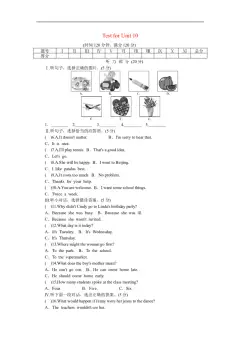
课时提升作业(十八)
Unit 9 Section B
(20 分钟 50 分)
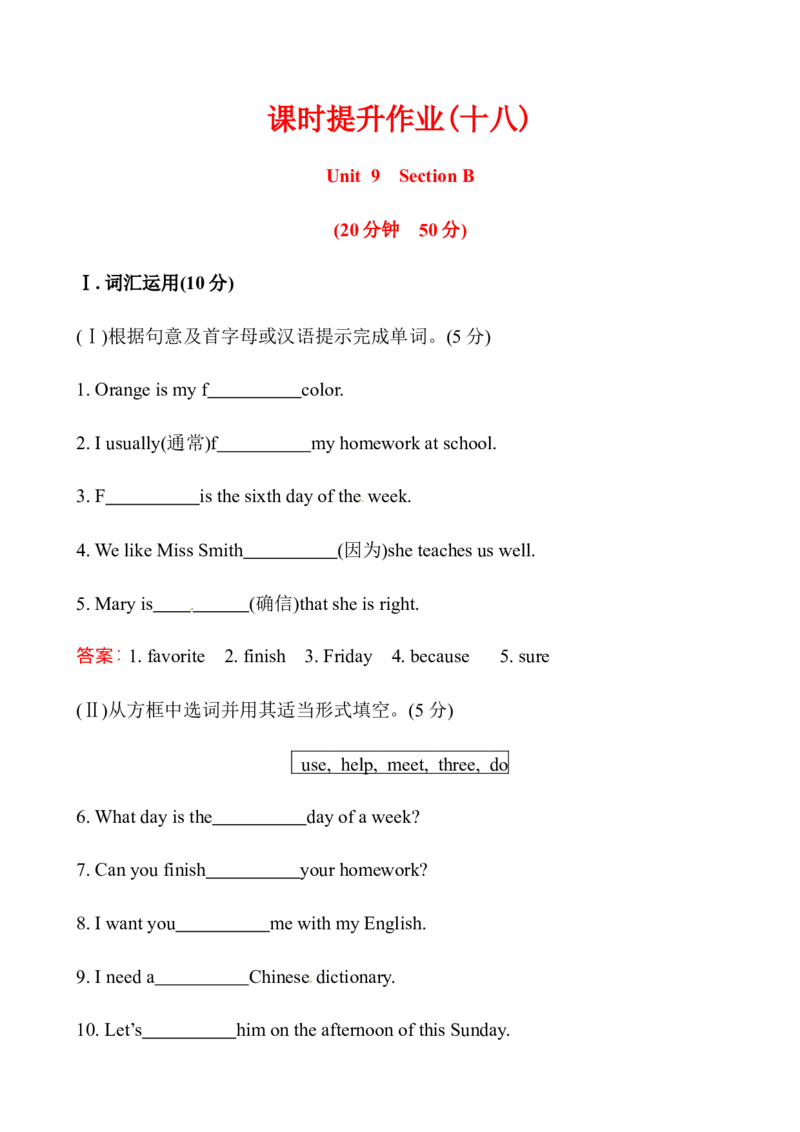
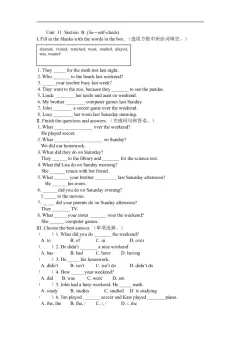
Ⅰ. 词汇运用(10 分)
(Ⅰ)根据句意及首字母或汉语提示完成单词。(5 分)[来源:Z.xx.k.Com]
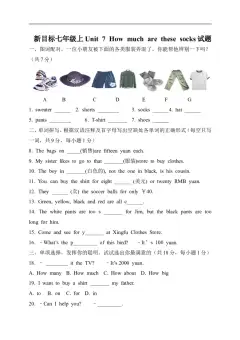
1. Orange is my f     color.
2. I usually(通常)f     my homework at school.
3. F     is the sixth day of the week.
4. We like Miss Smith     (因为)she teaches us well.
5. Mary is     (确信)that she is right.
答案: 1. favorite 2. finish 3. Friday 4. because
5. sure
(Ⅱ)从方框中选词并用其适当形式填空。(5 分)
 use, help, meet, three, do
6. What day is the     day of a week?
7. Can you finish     your homework?
8. I want you     me with my English.
9. I need a     Chinese dictionary.
10. Let’s     him on the afternoon of this Sunday.
答案: 6. third 7. doing 8. to help 9. useful 10. meet
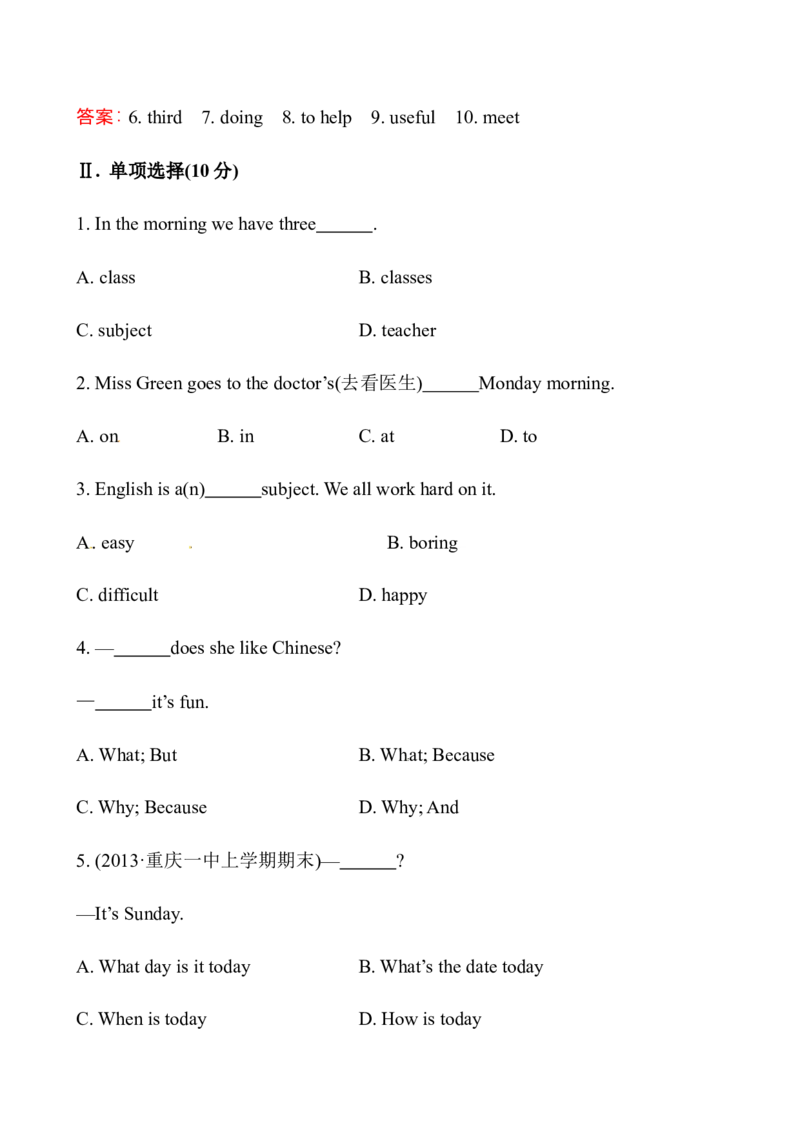
Ⅱ. 单项选择(10 分)
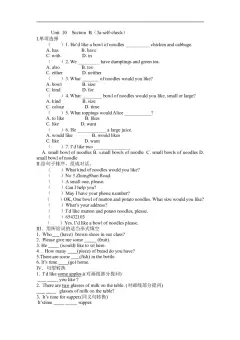
1. In the morning we have three   .
A. class
B. classes
C. subject
D. teacher
2. Miss Green goes to the doctor’s(去看医生)   Monday morning.
A. on
B. in
C. at
D. to
3. English is a(n)   subject. We all work hard on it.
A. easy
B. boring[来源:学&科&网]
C. difficult
D. happy
4. —   does she like Chinese?
—   it’s fun.
A. What; But
B. What; Because
C. Why; Because
D. Why; And
5. (2013·重庆一中上学期期末)—   ?
—It’s Sunday.
A. What day is it today
B. What’s the date today
C. When is today
D. How is today
【
】
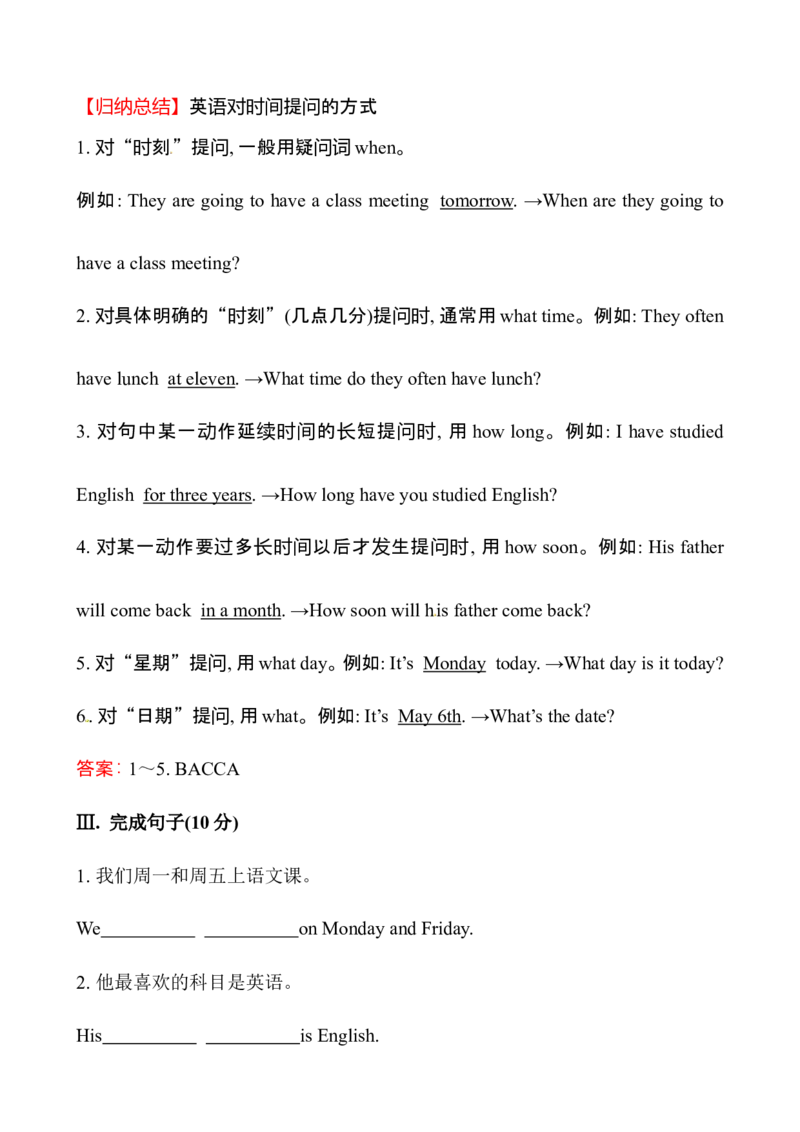
归纳总结
英
提
的方式
语对时间
问
1.
“
刻
对
时
”提问, 一般用疑问词when。
例如: They are going to have a class meeting tomorrow. →When are they going to
have a class meeting?
2.
具体明确的“
刻”
对
时
(几点几分)提问时, 通常用what time。例如: They often
have lunch at eleven. →What time do they often have lunch?
3.
句中某一
作延
的
短提
对
动
续时间
长
问时, 用how long。例如: I have studied
English for three years. →How long have you studied English?
4.
某一
作要
多
以后才
生提
对
动
过
长时间
发
问时, 用how soon。例如: His father
will come back in a month. →How soon will his father come back?
5.
“星期”提
对
问, 用what day。例如: It’s Monday today. →What day is it today?
6 .
“日期”提
对
问, 用what。例如: It’s May 6th. →What’s the date?
答案: 1~5. BACCA
Ⅲ. 完成句子(10 分)
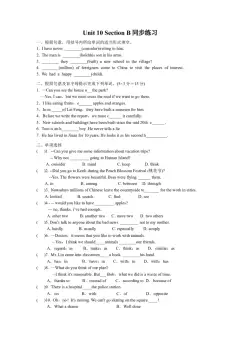
1. 我们周一和周五上语文课。
We           on Monday and Friday.
2. 他最喜欢的科目是英语。
His           is English.
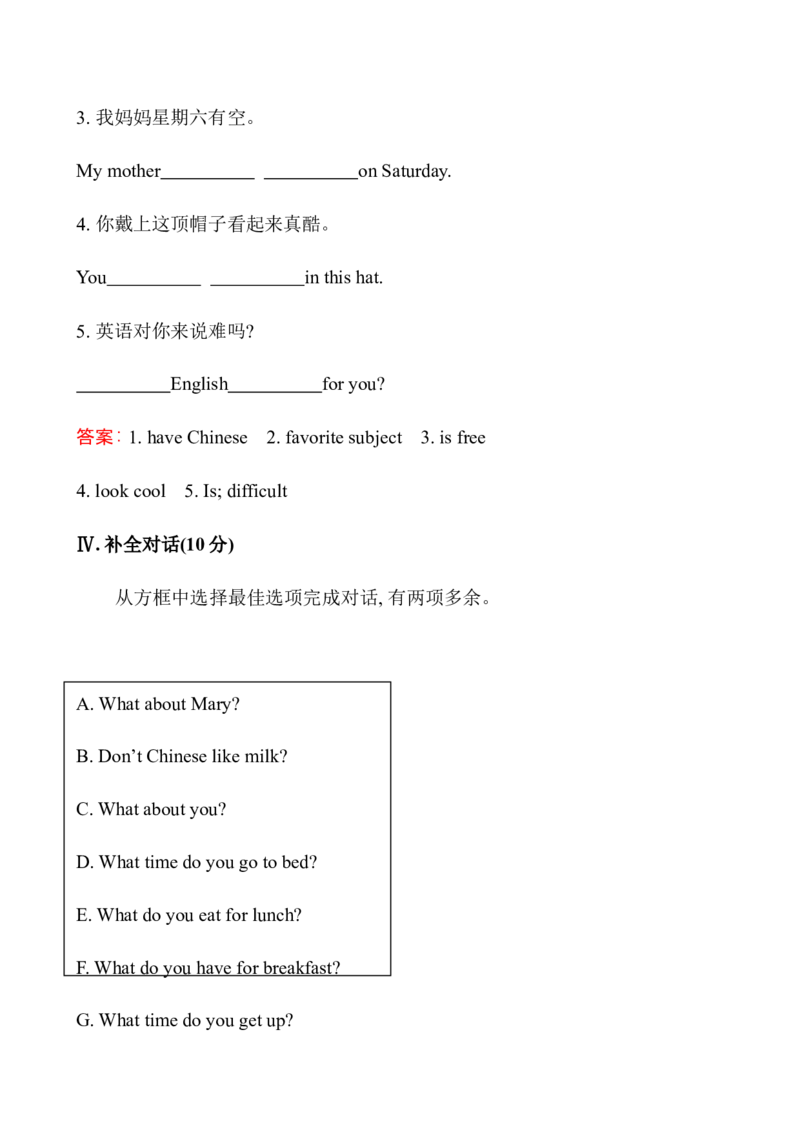
3. 我妈妈星期六有空。
My mother           on Saturday.
4. 你戴上这顶帽子看起来真酷。
You           in this hat.
5. 英语对你来说难吗?
     English     for you?
答案: 1. have Chinese 2. favorite subject 3. is free
4. look cool 5. Is; difficult
Ⅳ. 补全对话(10 分)
从方框中选择最佳选项完成对话, 有两项多余。
A. What about Mary?
B. Don’t Chinese like milk?
C. What about you?
D. What time do you go to bed?
E. What do you eat for lunch?
F. What do you have for breakfast?
G. What time do you get up?
Ann: Hello, Han Mei!
Han Mei: Oh, hi, Ann.
  1
Ann: About six on weekdays. I have breakfast at about six thirty.
Han Mei:
  2
Ann: She gets up at about six thirty. [来源:学_科_网Z_X_X_K]
Han Mei:
  3
Ann: Oh, bread and milk. Sometimes an egg, but Mary likes hamburgers and tea.
  4
Han Mei: Tea and bread. I don’t like milk very much.
Ann:
  5
Han Mei: Yes, many Chinese do, but I don’t.
1.       2.       3.
4.       5.


  [
来源
:Z.xx.k.Com]
答案: 1~5. GAFCB
Ⅴ. 阅读理解(10 分)
(2013·山东省诸城市七年级上学期期末)
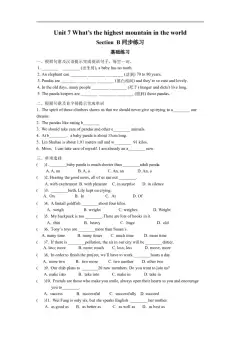
  From Monday to Friday on school days, American students usually get up at 7 a.
m. . Most students walk or take a yellow school bus. Some students ride bikes. When
they get to school at about 8: 00 a. m. , they meet their friends and talk about their
activities. They put their backpacks on desks and take out books for the subjects. In
middle schools, they learn many subjects. At noon, the students eat lunch at school.
They usually have meat, vegetables, fruit and some drinks. However, some students
would like pizza, hot dogs or hamburgers. After lunch, they have three classes.
School is over at 3 p. m. and then they go back home.
1. What time do American students get up on school days? [来源:Zxxk.Com]
A. At 7 a. m. .
B. At 8: 30 a. m. .
C. At 7: 30 a. m. .
D. At 8: 00 a. m. .
2. How many days do American students go to school in a week?
A. Four days.
B. Five days.
C. Six days.
D. Seven days .
3. Where do American students have lunch?
A. At home.
B. In restaurants.
C. In parks.
D. At school.
4. What do American students do after school?
A. Do sports.
B. Go home.
C. Have classes.
D. Watch TV.
5. The passage mainly talks about   .
A. lunch in American schools
B. classes in American schools
C. sports in American schools
D. life in American schools
【方法技巧】
略
法解主旨大意
读
题
  略
法是理解文章大意的快速而有效的方法
读
, 略
的关
是在能抓住文章
读
键
要点的前提下, 以个人最快的速度阅读, 主要目的是尽快
得足
的信息以便准
获
够
确地回答问题, 利用略
法去做
读
阅读时, 要特
注意首尾两段
别
, 要学会
找文章
寻
段落的主
句
题
,
是高效省事地抓住段落要点的捷径
这
, 同
也是准确理解文章大
时
意的有效途径。在做
要注意以下步
题时
骤(如第5 小题):
1. 先看问题, 看是否有和主旨相关的
目
题
, 了解
目
和提
方式。
题
类别
问
2. 再看文章首尾和各段开头, 找出主
句或通
全文
题
过浏览
, 抓住关
字眼
键
, 把握
主旨。
3. 以掌握主旨
前提
为
,
理、推断作者
气或意
等其他深
次
。
处
语
图
层
问题
答案: 1~5. ABDBD