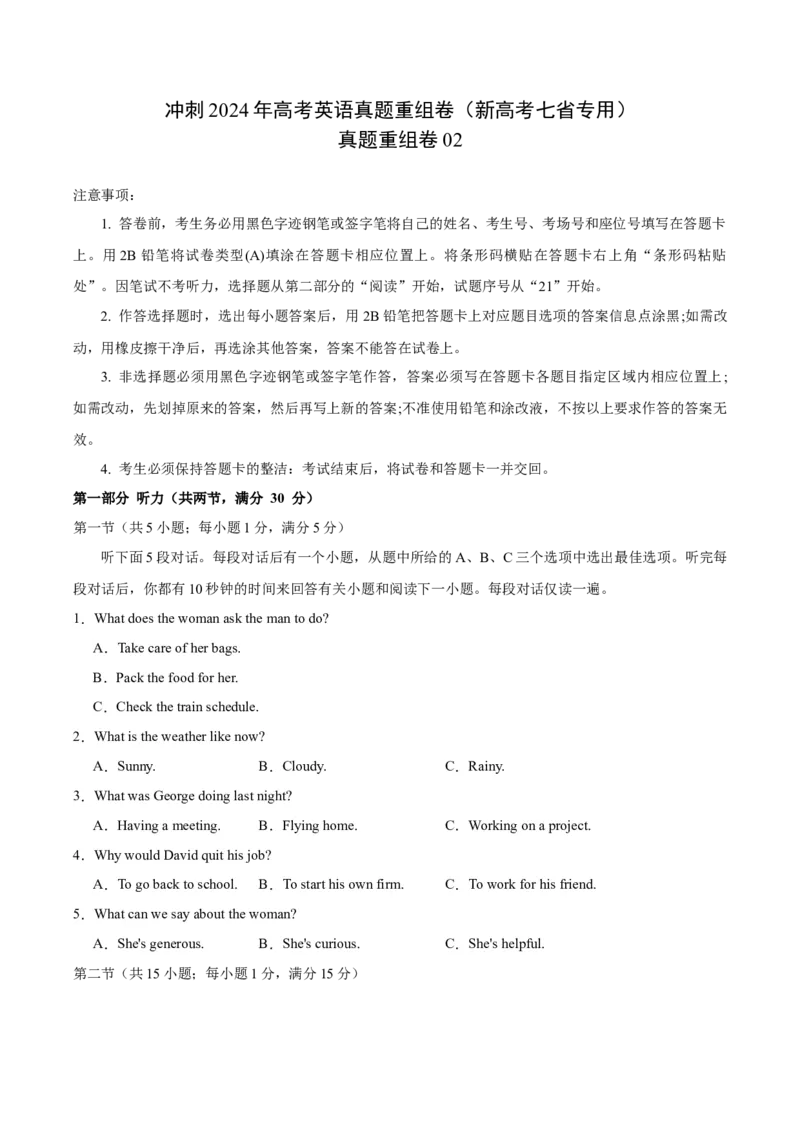
冲刺2024年高考英语真题重组卷(新高考七省专用)
真题重组卷02
注意事项:
1. 答卷前,考生务必用黑色字迹钢笔或签字笔将自己的姓名、考生号、考场号和座位号填写在答题卡
上。用2B铅笔将试卷类型(A)填涂在答题卡相应位置上。将条形码横贴在答题卡右上角“条形码粘贴
处”。因笔试不考听力,选择题从第二部分的“阅读”开始,试题序号从“21”开始。
2. 作答选择题时,选出每小题答案后,用2B铅笔把答题卡上对应题目选项的答案信息点涂黑;如需改
动,用橡皮擦干净后,再选涂其他答案,答案不能答在试卷上。
3. 非选择题必须用黑色字迹钢笔或签字笔作答,答案必须写在答题卡各题目指定区域内相应位置上;
如需改动,先划掉原来的答案,然后再写上新的答案;不准使用铅笔和涂改液,不按以上要求作答的答案无
效。
4. 考生必须保持答题卡的整洁:考试结束后,将试卷和答题卡一并交回。
第一部分 听力(共两节,满分 30 分)
第一节(共5小题;每小题1分,满分5分)
听下面5段对话。每段对话后有一个小题,从题中所给的A、B、C三个选项中选出最佳选项。听完每
段对话后,你都有10秒钟的时间来回答有关小题和阅读下一小题。每段对话仅读一遍。
1.What does the woman ask the man to do?
A.Take care of her bags.
B.Pack the food for her.
C.Check the train schedule.
2.What is the weather like now?
A.Sunny. B.Cloudy. C.Rainy.
3.What was George doing last night?
A.Having a meeting. B.Flying home. C.Working on a project.
4.Why would David quit his job?
A.To go back to school. B.To start his own firm. C.To work for his friend.
5.What can we say about the woman?
A.She's generous. B.She's curious. C.She's helpful.
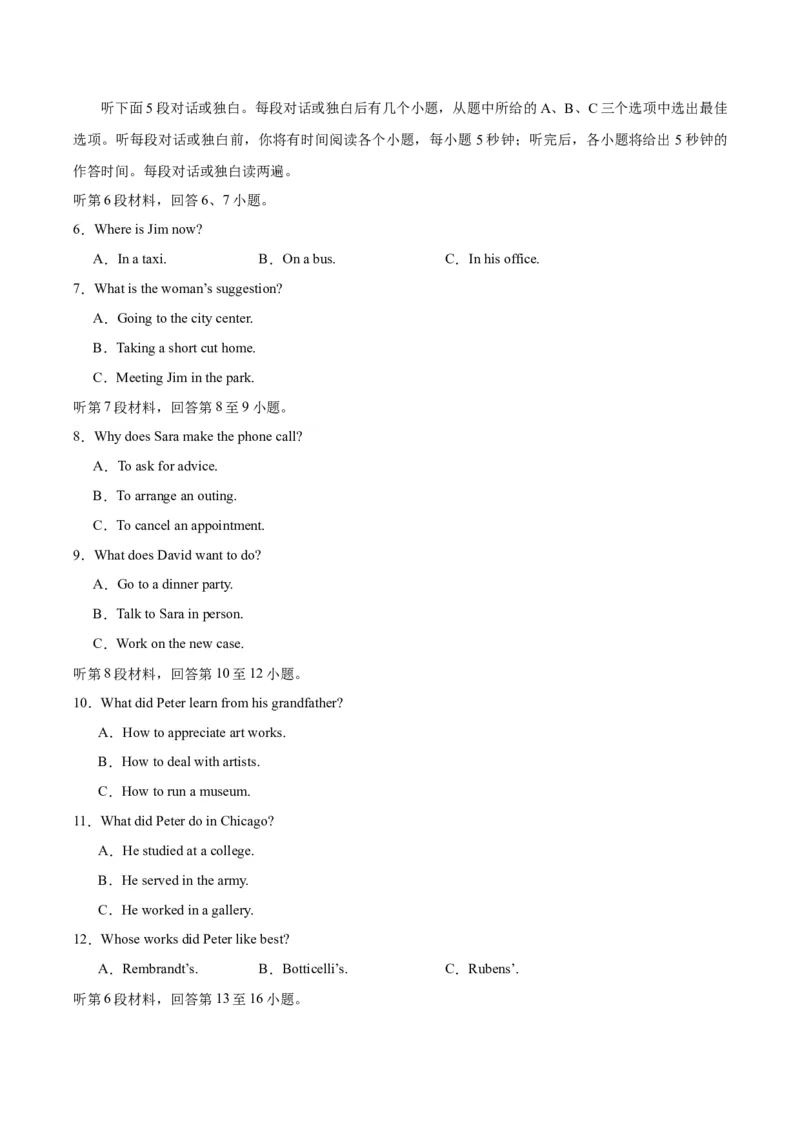
第二节(共15小题;每小题1分,满分15分)听下面5段对话或独白。每段对话或独白后有几个小题,从题中所给的A、B、C三个选项中选出最佳
选项。听每段对话或独白前,你将有时间阅读各个小题,每小题 5秒钟;听完后,各小题将给出5秒钟的
作答时间。每段对话或独白读两遍。
听第6段材料,回答6、7小题。
6.Where is Jim now?
A.In a taxi. B.On a bus. C.In his office.
7.What is the woman’s suggestion?
A.Going to the city center.
B.Taking a short cut home.
C.Meeting Jim in the park.
听第7段材料,回答第8至9小题。
8.Why does Sara make the phone call?
A.To ask for advice.
B.To arrange an outing.
C.To cancel an appointment.
9.What does David want to do?
A.Go to a dinner party.
B.Talk to Sara in person.
C.Work on the new case.
听第8段材料,回答第10至12小题。
10.What did Peter learn from his grandfather?
A.How to appreciate art works.
B.How to deal with artists.
C.How to run a museum.
11.What did Peter do in Chicago?
A.He studied at a college.
B.He served in the army.
C.He worked in a gallery.
12.Whose works did Peter like best?
A.Rembrandt’s. B.Botticelli’s. C.Rubens’.
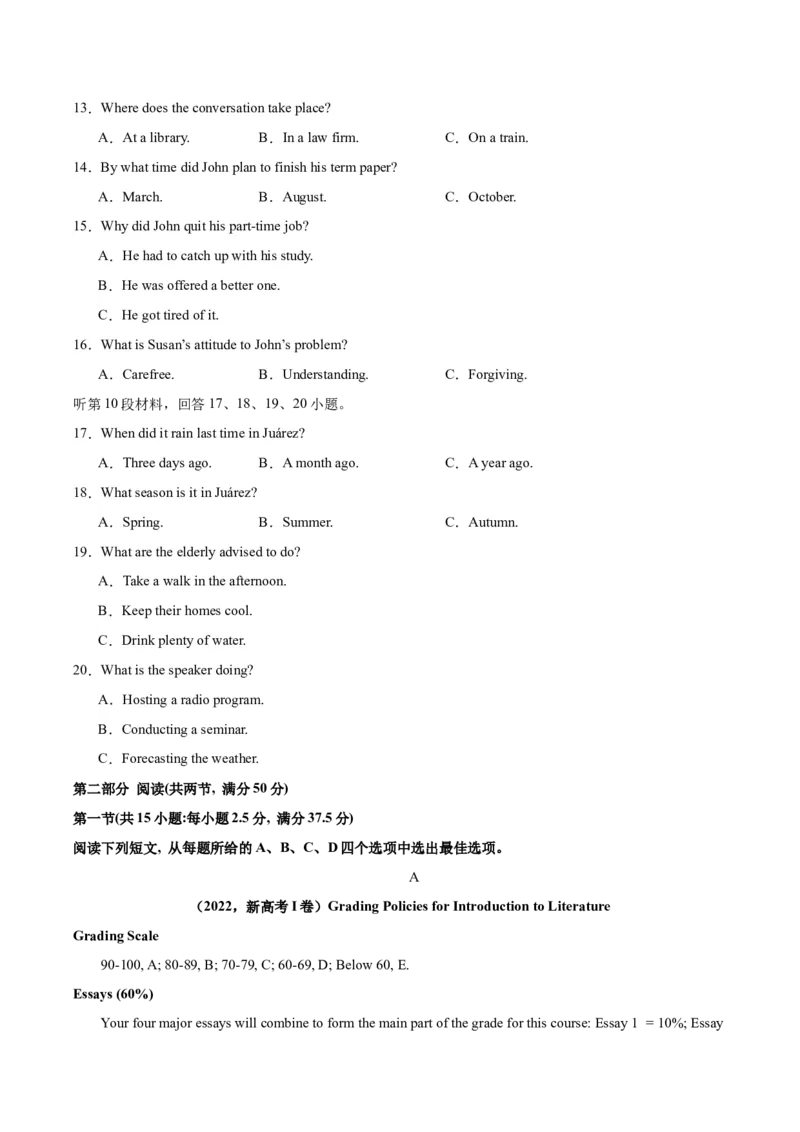
听第6段材料,回答第13至16小题。13.Where does the conversation take place?
A.At a library. B.In a law firm. C.On a train.
14.By what time did John plan to finish his term paper?
A.March. B.August. C.October.
15.Why did John quit his part-time job?
A.He had to catch up with his study.
B.He was offered a better one.
C.He got tired of it.
16.What is Susan’s attitude to John’s problem?
A.Carefree. B.Understanding. C.Forgiving.
听第10段材料,回答17、18、19、20小题。
17.When did it rain last time in Juárez?
A.Three days ago. B.A month ago. C.A year ago.
18.What season is it in Juárez?
A.Spring. B.Summer. C.Autumn.
19.What are the elderly advised to do?
A.Take a walk in the afternoon.
B.Keep their homes cool.
C.Drink plenty of water.
20.What is the speaker doing?
A.Hosting a radio program.
B.Conducting a seminar.
C.Forecasting the weather.
第二部分 阅读(共两节, 满分50分)
第一节(共15小题:每小题2.5分, 满分37.5分)
阅读下列短文, 从每题所给的A、B、C、D四个选项中选出最佳选项。
A
(2022,新高考I卷)Grading Policies for Introduction to Literature
Grading Scale
90-100, A; 80-89, B; 70-79, C; 60-69, D; Below 60, E.
Essays (60%)
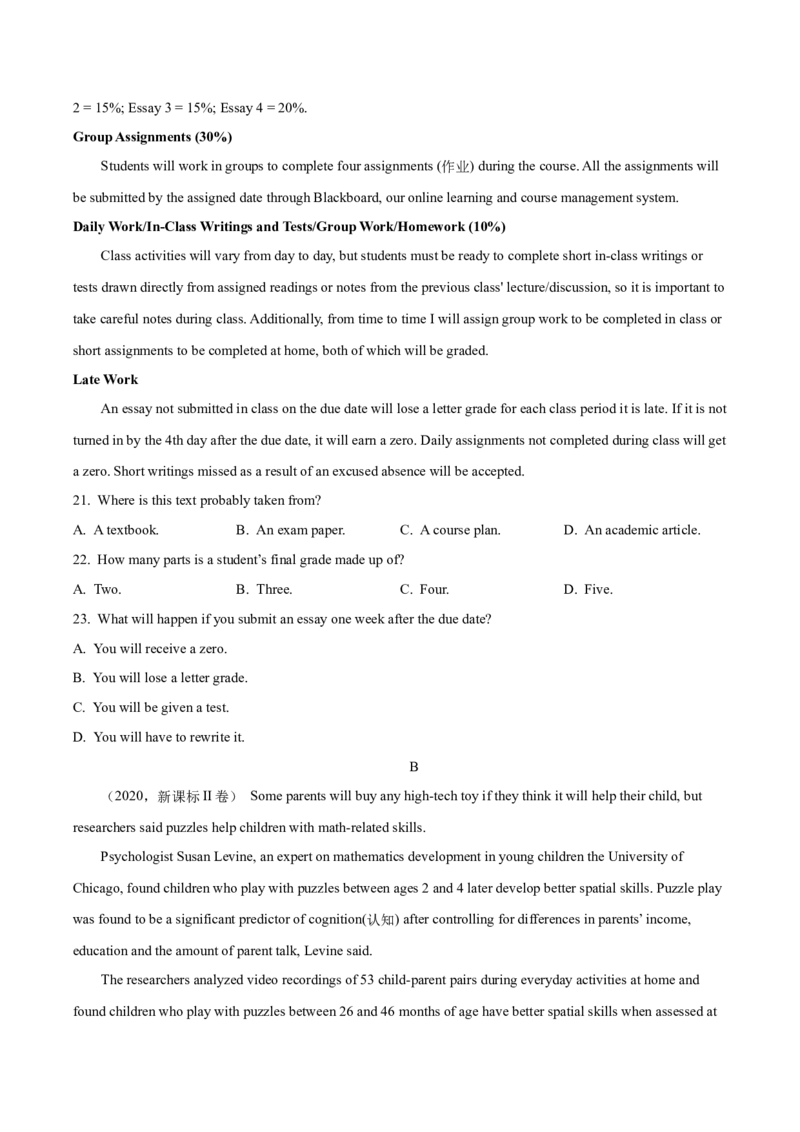
Your four major essays will combine to form the main part of the grade for this course: Essay 1 = 10%; Essay2 = 15%; Essay 3 = 15%; Essay 4 = 20%.
Group Assignments (30%)
Students will work in groups to complete four assignments (作业) during the course. All the assignments will
be submitted by the assigned date through Blackboard, our online learning and course management system.
Daily Work/In-Class Writings and Tests/Group Work/Homework (10%)
Class activities will vary from day to day, but students must be ready to complete short in-class writings or
tests drawn directly from assigned readings or notes from the previous class' lecture/discussion, so it is important to
take careful notes during class. Additionally, from time to time I will assign group work to be completed in class or
short assignments to be completed at home, both of which will be graded.
Late Work
An essay not submitted in class on the due date will lose a letter grade for each class period it is late. If it is not
turned in by the 4th day after the due date, it will earn a zero. Daily assignments not completed during class will get
a zero. Short writings missed as a result of an excused absence will be accepted.
21. Where is this text probably taken from?
A. A textbook. B. An exam paper. C. A course plan. D. An academic article.
22. How many parts is a student’s final grade made up of?
A. Two. B. Three. C. Four. D. Five.
23. What will happen if you submit an essay one week after the due date?
A. You will receive a zero.
B. You will lose a letter grade.
C. You will be given a test.
D. You will have to rewrite it.
B
(2020,新课标II卷) Some parents will buy any high-tech toy if they think it will help their child, but
researchers said puzzles help children with math-related skills.
Psychologist Susan Levine, an expert on mathematics development in young children the University of
Chicago, found children who play with puzzles between ages 2 and 4 later develop better spatial skills. Puzzle play
was found to be a significant predictor of cognition(认知) after controlling for differences in parents’ income,
education and the amount of parent talk, Levine said.
The researchers analyzed video recordings of 53 child-parent pairs during everyday activities at home and
found children who play with puzzles between 26 and 46 months of age have better spatial skills when assessed at54 months of age.
“The children who played with puzzles performed better than those who did not, on tasks that assessed their
ability to rotate(旋转)and translate shapes,” Levine said in a statement.
The parents were asked to interact with their children as they normally would, and about half of children in the
study played with puzzles at one time. Higher-income parents tended to have children play with puzzles more
frequently, and both boys and girls who played with puzzles had better spatial skills. However, boys tended to play
with more complex puzzles than girls, and the parents of boys provided more spatial language and were more
active during puzzle play than parents of girls.
The findings were published in the journal Developmental Science.
24. In which aspect do children benefit from puzzle play?
A. Building confidence.
B. Developing spatial skills.
C. Learning self-control.
D. Gaining high-tech knowledge.
25. What did Levine take into consideration when designing her experiment?
A. Parents’ age.
B. Children’s imagination.
C. Parents’ education.
D. Child-parent relationship.
26. How do boy differ from girls in puzzle play?
A. They play with puzzles more often.
B. They tend to talk less during the game.
C. They prefer to use more spatial language.
D. They are likely to play with tougher puzzles.
27. What is the text mainly about?
A. A mathematical method. B. A scientific study.
C. A woman psychologist D. A teaching program.
C
(2021,新高考I卷)When the explorers first set foot upon the continent of North America, the skies and
lands were alive with an astonishing variety of wildlife. Native Americans had taken care of these precious natural
resources wisely. Unfortunately, it took the explorers and the settlers who followed only a few decades todecimate a large part of these resources. Millions of waterfowl ( 水 禽 ) were killed at the hands of market
hunters and a handful of overly ambitious sportsmen. Millions of acres of wetlands were dried to feed and house
the ever-increasing populations, greatly reducing waterfowl habitat.
In 1934, with the passage of the Migratory Bird Hunting Stamp Act (Act), an increasingly concerned nation
took firm action to stop the destruction of migratory ( 迁徙的) waterfowl and the wetlands so vital to their
survival. Under this Act, all waterfowl hunters 16 years of age and over must annually purchase and carry a Federal
Duck Stamp. The very first Federal Duck Stamp was designed by J.N. “Ding” Darling, a political cartoonist from
Des Moines, lowa, who at that time was appointed by President Franklin Roosevelt as Director of the Bureau of
Biological Survey. Hunters willingly pay the stamp price to ensure the survival of our natural resources.
About 98 cents of every duck stamp dollar goes directly into the Migratory Bird Conservation Fund to
purchase wetlands and wildlife habitat for inclusion into the National Wildlife Refuge System — a fact that ensures
,
this land will be protected and available for all generations to come. Since 1934 better than half a billion dollars
has gone into that Fund to purchase more than 5 million acres of habitat. Little wonder the Federal Duck Stamp
Program has been called one of the most successful conservation programs ever initiated.
28. What was a cause of the waterfowl population decline in North America?
A. Loss of wetlands.
B. Popularity of water sports.
C. Pollution of rivers.
D. Arrival of other wild animals.
29. What does the underlined word “decimate” mean in the first paragraph?
A. Acquire. B. Export.
C. Destroy. D. Distribute.
30. What is a direct result of the Act passed in 1934?
A. The stamp price has gone down.
B. The migratory birds have flown away.
C. The hunters have stopped hunting.
D. The government has collected money.
31. Which of the following is a suitable title for the text?
A. The Federal Duck Stamp Story
B. The National Wildlife Refuge System
C. The Benefits of Saving WaterfowlD. The History of Migratory Bird Hunting
D
(2022,新高考II卷)Human speech contains more than 2,000 different sounds, from the common “m” and
“a” to the rare clicks of some southern African languages. But why are certain sounds more common than others? A
ground-breaking, five-year study shows that diet-related changes in human bite led to new speech sounds that are
now found in half the world’s languages.
More than 30 years ago, the scholar Charles Hockett noted that speech sounds called labiodentals, such as “f”
and “v”, were more common in the languages of societies that ate softer foods. Now a team of researchers led by
Damián Blasi at the University of Zurich, Switzerland, has found how and why this trend arose.
They discovered that the upper and lower front teeth of ancient human adults were aligned (对齐), making it
hard to produce labiodentals, which are formed by touching the lower lip to the upper teeth. Later, our jaws
changed to an overbite structure (结构), making it easier to produce such sounds.
The team showed that this change in bite was connected with the development of agriculture in the Neolithic
period. Food became easier to chew at this point. The jawbone didn’t have to do as much work and so didn’t grow
to be so large.
Analyses of a language database also confirmed that there was a global change in the sound of world
languages after the Neolithic age, with the use of “f” and “v” increasing remarkably during the last few thousand
years. These sounds are still not found in the languages of many hunter-gatherer people today.
This research overturns the popular view that all human speech sounds were present when human beings
evolved around 300,000 years ago. ”The set of speech sounds we use has not necessarily remained stable since the
appearance of human beings, but rather the huge variety of speech sounds that we find today is the product of a
complex interplay of things like biological change and cultural evolution,“ said Steven Moran, a member of the
research team.
32. Which aspect of the human speech sound does Damián Blasi’s research focus on?
A. Its variety. B. Its distribution. C. Its quantity. D. Its development.
33. Why was it difficult for ancient human adults to produce labiodentals?
A. They had fewer upper teeth than lower teeth.
B. They could not open and close their lips easily.
C. Their jaws were not conveniently structured.
.
D Their lower front teeth were not large enough.
34. What is paragraph 5 mainly about?A. Supporting evidence for the research results.
B. Potential application of the research findings.
C. A further explanation of the research methods.
D. A reasonable doubt about the research process.
35. What does Steven Moran say about the set of human speech sounds?
A. It is key to effective communication.
B. It contributes much to cultural diversity.
C. It is a complex and dynamic system.
D. It drives the evolution of human beings.
第二节(共5小题:每小题2. 5分, 满分12. 5分)
阅读下面短文, 从短文后的选项中选出可以填入空白处的最佳选项。选项中有两项为多余选项。
(2021,新高考II卷)If the only reading you ever do is the novel or magazine, the speed at which you read
-probably does not matter very much. But if you have to read a great deal for study, you will appreciate the benefits
of being able to read more quickly. ____ 3 6____
Before you open the book, make sure that you are comfortable. You need a seat which supports your back and
the book should be at the right distance from your eyes. ___ 3 7____
____ 3 8____ Look at the table of contents, the preface, the chapter heading,etc.This will help you to decide
whether you really need to read the whole book or only certain parts of it. Ten minutes spent in this way could save
you quite a lot of time in the long run.
If you decide that you need to read the whole book, decide how much you can read at a time. ____ 3 9____ A
history book which may contain the facts in story form will be easier to read than one dealing with scientific
subjects. In the former case you may be able to read a chapter. In the latter you may only be able to read one page.
Always keep a pencil and paper beside you. ____ 4 0____ Note also the facts important for your purpose as
well as anything which leads you to further research. You don't have to write these things in detail. It is enough to
put the page number and one or two words as a reminder .
A. Stop to have a rest now and then.
B. Spend a few minutes looking through the book.
C. This depends on the type of book you are reading.
D. Here are some tips to help improve your reading speed.
E. Make a note of any page which is of special importance.
F. You may find yourself having to leam something by heart.G. Keep the room cool rather than warm to avoid feeling sleepy.
第三部分语言运用(共两节,满分30分)
第一节(共15小题:每小题1分,满分15分)
阅读下面短文, 从每题所给的A、B、C、D四个选项中选出可以填入空白处的最佳选项。
(2023,新高考 I 卷)On Oct. 11, hundreds of runners competed in a cross-country race in Minnesota.
Melanie Bailey should have ____ 4 1____ the course earlier than she did. Her ____ 4 2____ came because she was
carrying a ____ 4 3____ across the finish line.
As reported by a local newspaper, Bailey was more than two-thirds of the way through her ____ 4 4____ when
a runner in front of her began crying in pain. She ___ 4 5____ to help her fellow runner, Danielle Lenoue. Bailey
took her arm to see if she could walk forward with ____ 4 6____ . She couldn’t. Bailey then ____ 4 7____ to let
Lenoue climb onto her back and carried her all the way to the finish line, then another 300 feet to where Lenoue
could get ____ 4 8____ attention.
Once there, Lenoue was ___ 4 9____ and later taken to a hospital, where she learned that she had serious
injuries in one of her knees. She would have struggled with extreme ____ 4 0____ to make it to that aid checkpoint
without Bailey’s help.
As for Bailey, she is more ____ 5 1____ about why her act is considered a big ____ 5 2____ . “She was just
crying. I couldn’t ____ 5 3____ her,” Bailey told the reporter. “I feel like I was just doing the right thing.”
Although the two young women were strangers before the ____34____, they’ve since become friends.
Neither won the race, but the ___ 5 5____ of human kindness won the day.
41. A. designed B. followed C. changed D. finished
42. A. delay B. chance C. trouble D. excuse
43. A. judge B. volunteer C. classmate D. competitor
44. A. race B. school C. town D. training
45. A. agreed B. returned C. stopped D. promised
46. A. courage B. aid C. patience D. advice
47. A. went away B. stood up C. stepped aside D. bent down
48. A. medical B. public C. constant D. equal
49. A. interrupted B. assessed C. identified D. appreciated
50. A. hunger B. pain C. cold D. tiredness
51. A. worried B. ashamed C. confused D. discouraged
52. A. game B. problem C. lesson D. deal53. A. leave B. cure C. bother D. understand
54. A. ride B. test C. meet D. show
55. A. secret B. display C. benefit D. exchange
第二节(共10小题:每小题1. 5分, 满分15分)
阅读下面短文, 在空白处填入1个适当的单词或括号内单词的正确形式。
(2022,浙江卷6月)To understand a painting, we’re taught to look for color, composition, and light. But
how can a painting ___ 5 6___ (appreciate)by someone who’s blind? Through touch, the one thing gallery signs tell
you not ___ 5 7___ (do). John Olson, a former ___ 5 8___ (photograph)and his team turn paintings into fully
textured 3D models.
The tactile(可触知的)paintings work as a way to show art to ___ 5 9___ blind because we don’t see with just
Our eyes: We see with our brains. Research in the field of neuroplasticity-the brain’s adaptability-shows that the
visual cortex(大脑皮层)is made active by touch. Blind people recognize shapes with their ___ 6 0___ (exist) senses,
in a way similar to that of ___ 6 1___ (sight )people, says Ella Striem-Amit, a Harvard scientist.
Luc Gandarias, who’s now thirteen, went blind suddenly ___ 6 2___ age seven. When he felt a 3D version of
Leonardo da Vinci’s “Mona Lisa” he ___ 6 3___ (notice)her smile right away. ”I can actually feel what you see
when you look at it,” he said.
For Luc, this means ___ 6 4___ (independent). "The feeling of being able to see it ___ 6 5___ to form my
opinion is like breaking down another wall as a blind person.”
第四部分 写作(共两节, 满分40分)
第一节(满分15分)
(2020,浙江卷6月)假定你是李华,你校来自爱尔兰的外教Peter因病回国休假。请给他写一封电子邮
件,内容包括:1. 询问近况;2. 分享班级最新消息;3. 表达祝愿。
注意:1. 词数80左右;2. 可适当增加细节,以使行文连贯。
____________________________________________________________________________________________
____________________________________________________________________________________________
____________________________________________________________________________________________
第二节(满分25分)
(2023,新高考I卷)阅读下面材料,根据其内容和所给段落开头语续写两段,使之构成一篇完整的短
文。
When I was in middle school, my social studies teacher asked me to enter a writing contest. I said no without
thinking. I did not love writing. My family came from Brazil, so English was only my second language. Writingwas so difficult and painful for me that my teacher had allowed me to present my paper on the sinking of the
Titanic by acting out a play, where I played all the parts. No one laughed harder than he did.
So, why did he suddenly force me to do something at which I was sure to fail? His reply: “Because I love your
stories. If you’re willing to apply yourself, I think you have a good shot at this.” Encouraged by his words, I agreed
to give it a try.
I chose Paul Revere’s horse as my subject. Paul Revere was a silversmith (银匠) in Boston who rode a horse at
night on April 18, 1775 to Lexington to warn people that British soldiers were coming. My story would come
straight from the horse’s mouth. Not a brilliant idea, but funny; and unlikely to be anyone else’s choice.
What did the horse think, as he sped through the night? Did he get tired? Have doubts? Did he want to quit? I
sympathized immediately. I got tired. I had doubts. I wanted to quit. But, like Revere’s horse, I kept going. I
worked hard. I checked my spelling. I asked my older sister to correct my grammar. I checked out a half dozen
books on Paul Revere from the library. I even read a few of them.
When I handed in the essay to my teacher, he read it, laughed out loud, and said, “Great. Now, write it again.”
I wrote it again, and again and again. When I finally finished it, the thought of winning had given way to the
enjoyment of writing. If I didn’t win, I wouldn’t care.
注意:
1. 续写词数应为150个左右;
2. 请按如下格式在答题卡的相应位置作答。
A few weeks later, when I almost forgot the contest, there came the news.
____________________________________________________________________________________________
____________________________________________________________________________________________
____________________________________________________________________________________________
____________________________________________________________________________________________
______________________________________________________________________________________
I went to my teacher’s office after the award presentation.
____________________________________________________________________________________________
____________________________________________________________________________________________
____________________________________________________________________________________________
____________________________________________________________________________________________
______________________________________________________________________________________