2026 年高考第一次模拟考试
高三英语·全解全析
(考试时间:120分钟 试卷满分:120分)
注意事项:
1.答卷前,考生务必将自己的姓名、准考证号等填写在答题卡和试卷指定位置上。
2.回答选择题时,选出每小题答案后,用铅笔把答题卡上对应题目的答案标号涂黑。如需改动,用
橡皮擦干净后,再选涂其他答案标号。回答非选择题时,将答案写在答题卡上。写在本试卷上无效。
3.考试结束后,将本试卷和答题卡一并交回。
第二部分 阅读(共两节, 满分50分)
第一节(共15小题;每小题2.5分, 满分37.5分)
阅读下列短文, 从每题所给的A、B、C和D四个选项中选出最佳选项。
A
(新题材)Welcome to the Future Filmmakers Challenge
Calling all creative students! The Future Filmmakers Challenge is now open for entries. This annual contest
invites you to create a short film (2–4 minutes long) using AI tools, such as AI-generated visuals, voices, or music,
while keeping your own original story at the heart of the work.
Key Rules & Scoring Criteria:
Story & Message (40%): Is your idea clear, original, and meaningful? Does it connect with real-life feelings or
social themes?
AI Integration (30%): How creatively and smoothly do you use AI tools? Avoid overusing AI, as your voice
should still lead the film.
Technical Quality (20%): Is the audio clear? Is the pacing right? Even simple shots should be well-edited.
Timeliness & Ethics (10%): Submit by January 10, 2026. All AI-generated content must be labeled, and no
copyrighted material may be used.
Prizes:
Grand Prize: ¥2,000 + a mentorship session with a professional filmmaker
Best New Creator (for first-time entrants)
Audience Choice Award (voted online)
Tips for Success:
Start with a strong script—even one powerful scene can move an audience.
Try free AI tools like Canva Video, Runway ML, or Suno AI for sound. Keep your main character relatable—many winning films focus on everyday moments: a lost pet, a family dinner,
or a quiet act of kindness.
All entries must be uploaded through the official school media portal (门户网站). Finalists will be invited to
screen their films at the Spring Arts Festival.
For further inquiries, you are welcome to attend the workshop scheduled for this Friday at 4:00 PM in Room
302, or reach out to us at media@school.edu.cn.
Let your imagination lead, and technology is just your brush!
21.What is Lily’s final score based on the report below?
Lily’s Future Filmmakers Entry Score
Story & AI Technical Timeliness
NOTES
Message Integration Quality & Ethics
90 80 90 100 Bonus (for first-time entry): +4
A.88. B.90. C.91. D.92.
22. What is required for a film to be accepted?
A. It must be longer than 4 minutes. B. It must use only human-made voices.
C. AI parts must be clearly labeled. D. It must include professional actors.
23. Which film idea best fits the contest’s spirit?
A. A remake of a famous action movie. B. A short story about helping a neighbor’s dog.
C. A video of a school concert. D. A tutorial on how to use AI software.
【答案】21.D 22.C 23.B
【解析】这是一篇应用文,主要介绍了“未来电影人挑战赛”的参赛要求、评分标准、奖项设置及实用建
议。文章旨在鼓励学生以原创故事为核心,合理运用AI工具创作2–4分钟的短片,并强调作品的真实性、
技术规范与伦理合规。
21.细节理解题。根据文中“Story & Message (40%)”、“AI Integration (30%)”、“Technical Quality
(20%)”、“Timeliness & Ethics (10%)”以及“bonus points are added to the total score after weighting”可知,最
终成绩按各部分权重计算后,再加入奖励分。Lily的得分为:90×40% + 80×30% + 90×20% + 100×10% = 36
+ 24 + 18 + 10 = 88,再加上首次参赛奖励4分,最终成绩为 88 + 4 = 92。故选D。
22.细节理解题。根据“Timeliness & Ethics (10%)”部分中“All AI-generated content must be labeled(所有
AI生成内容必须标明)”可知,C选项正确。A项错误,因短片需为2–4分钟;B项错误,因允许使用AI
生成声音;D项未被提及,且与“relatable characters”和“everyday moments”的鼓励方向不符。故选C。
23.推理判断题。根据“Tips for Success”中提到“many winning films focus on everyday moments: a lost pet,a family dinner, or a quiet act of kindness”可知,贴近生活、富有情感的故事更符合比赛精神。B选项“一个
帮助邻居狗狗的短故事”正体现了这一理念。A项“翻拍著名动作片”缺乏原创性;C项“学校音乐会录
像”属于记录而非创作;D项“AI软件教程”偏离叙事与情感表达的核心。故选B。
B
(原创题)In October 2020, 71-year-old Bill Sumiel faced a health crisis. He had kidney failure and needed
regular dialysis (透析). After a treatment failed unexpectedly, he had to return to the clinic the next day for a
second procedure. With no family available to drive him, he booked an Uber for the trip home.
The driver, 31-year-old Timothy Letts, was an Army veteran (退役军人) on his way to visit a friend. Though
the ride was out of his way, he accepted it, guessing his passenger, who was coming from a medical center, likely
needed help. During the 40-minute drive, they began chatting. Sumiel shared his past work in his community and
on the city council, but explained that dialysis now left him too exhausted to stay active. He also mentioned he was
on a waiting list for a kidney transplant, with no matches found yet.
Hearing this, Letts, whose healthy lifestyle meant he didn’t smoke or drink, half-jokingly said he might be a
good donor. But as they neared Sumiel’s home, Letts made a sincere offer: “I’d like to see if I could be a match to
give you a kidney.” Sumiel was stunned but overjoyed, later telling his wife, “The Uber driver just offered me his
kidney!”
At first, Sumiel worried it was just a kind moment that wouldn’t lead anywhere. But Letts called just hours
later. He contacted the transplant program and completed a months-long screening process, including medical tests
and interviews. Amazingly, he was a perfect match.
Fourteen months after their chance encounter, the transplant surgery succeeded. Today, Sumiel is healthy,
works full-time from home, and is free from dialysis. Letts has since moved to Germany for a civilian job with the
Army, but they keep in touch. Sumiel deeply believes, “Living donors are special people.”
24. Why did Bill Sumiel have to take an Uber back home?
A. He lived far from the clinic. B. No family could drive him.
C. He preferred to travel alone. D. His treatment was very urgent.
25. What can we infer about Timothy Letts from the text?
A. He knew Bill Sumiel before the ride.
B. He offered his kidney on a sudden thought.
C. He is a kind and responsible person.
D. He needed a new job in Germany.
26. How did Bill Sumiel feel after receiving Letts’s offer?
A. He was excited at first but then became doubtful.B. He was certain the offer would be kept.
C. He was too sick to understand the offer.
D. He refused the offer politely.
27. What is the best title for the text?
A. The Power of a Chance Meeting. B. The Long Road to Recovery.
C. A Veteran’s New Mission. D. The Waiting List Miracle.
【答案】24. B 25. C 26. A 27. A
【解析】本文讲述了一位71岁的肾病患者比尔·苏米尔在一次偶然的网约车行程中,与司机、退伍军人蒂
莫西·莱茨相识,后者随后主动提出捐肾并最终成功配型,挽救了苏米尔的生命。文章通过这一真实故事,
展现了陌生人之间善意的力量和一次偶然相遇所能带来的深远影响。
24. 细节理解题。根据第一段最后一句“With no family available to drive him, he booked an Uber for the trip
home”可推知,第二天他打车是因为家人无法再送他。因此选项 B“No family could drive him”符合文意。选
项A虽提到距离远,但并非打车的直接原因;C和D在文中均无依据。
25. 推理判断题。莱茨本可拒绝绕路的订单,却因猜测乘客需要帮助而接单;在得知对方需要肾源后,他
不仅认真提出捐赠意愿,还在几小时后主动联系移植中心,并完成长达数月的严格筛查,最终成功捐肾。
这些行为体现出他既有同情心(kind),又信守承诺、做事可靠(responsible)。因此选项C正确。选项A
与事实不符(两人素不相识);B错误,因为他的行为是深思熟虑而非冲动;D属于无关信息。
26. 情感态度题。文章明确描述了苏米尔的心理变化:“He was stunned but overjoyed”说明他最初非常激
动;但紧接着写道“After the initial excitement, Sumiel started feeling a bit less optimistic. He... wondered if it
had just been an emotional moment.”这表明他随后产生了疑虑。因此选项A“他起初很兴奋,但后来变得怀
疑”准确反映了这一情感起伏。B、C、D均与原文矛盾。
27. 最佳标题题。全文核心在于一次偶然的网约车相遇(chance meeting)引发了改变生命的善举,强调
“偶然连接”与“人性善意”的力量。选项A“The Power of a Chance Meeting”精准概括了这一主题。选项
B侧重康复过程,非重点;C过度聚焦莱茨的军人身份;D强调等待名单的“奇迹”,但文中突出的是主
动捐赠而非被动等待。因此A为最佳标题。
C
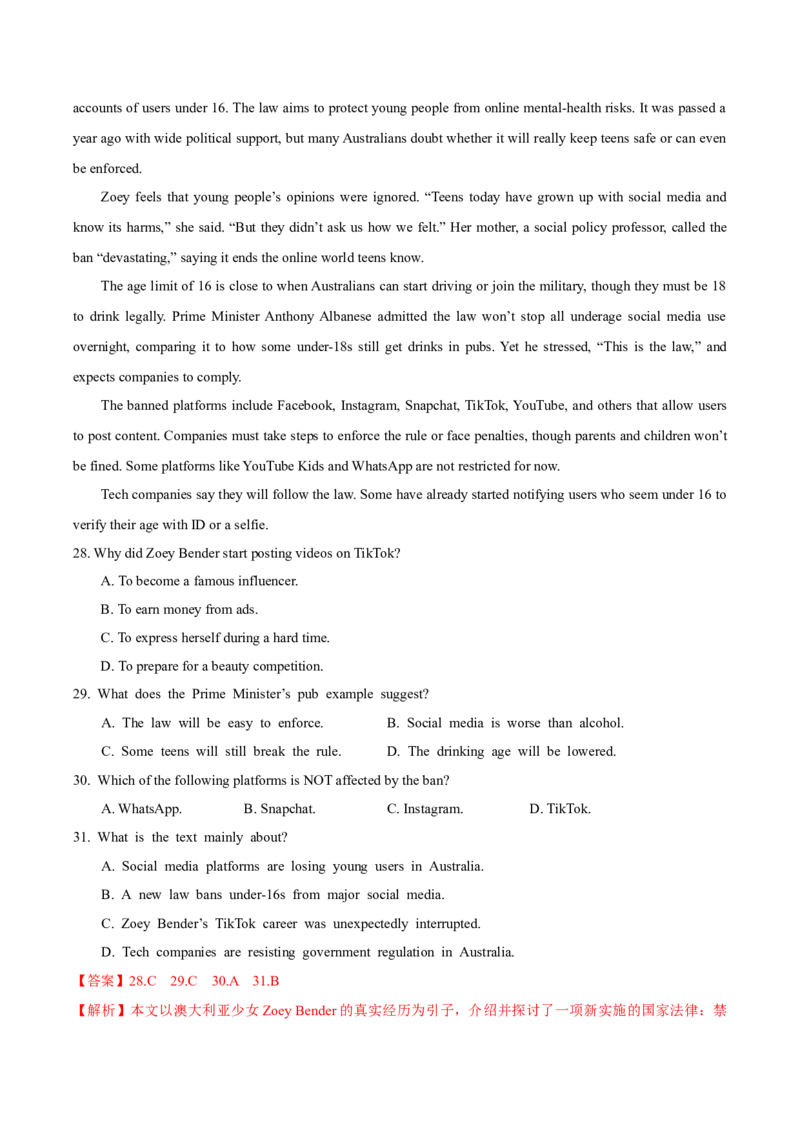
(原创题)Zoey Bender, a 14-year-old Australian girl, started posting “get ready with me” videos on TikTok
a year ago to express herself during a tough time. She gained nearly 60,000 followers and made friends and
business contacts through the platform. She even connected with beauty professionals who could help her future
career.
However, a new Australian law now requires TikTok and nine other social media platforms to close theaccounts of users under 16. The law aims to protect young people from online mental-health risks. It was passed a
year ago with wide political support, but many Australians doubt whether it will really keep teens safe or can even
be enforced.
Zoey feels that young people’s opinions were ignored. “Teens today have grown up with social media and
know its harms,” she said. “But they didn’t ask us how we felt.” Her mother, a social policy professor, called the
ban “devastating,” saying it ends the online world teens know.
The age limit of 16 is close to when Australians can start driving or join the military, though they must be 18
to drink legally. Prime Minister Anthony Albanese admitted the law won’t stop all underage social media use
overnight, comparing it to how some under-18s still get drinks in pubs. Yet he stressed, “This is the law,” and
expects companies to comply.
The banned platforms include Facebook, Instagram, Snapchat, TikTok, YouTube, and others that allow users
to post content. Companies must take steps to enforce the rule or face penalties, though parents and children won’t
be fined. Some platforms like YouTube Kids and WhatsApp are not restricted for now.
Tech companies say they will follow the law. Some have already started notifying users who seem under 16 to
verify their age with ID or a selfie.
28. Why did Zoey Bender start posting videos on TikTok?
A. To become a famous influencer.
B. To earn money from ads.
C. To express herself during a hard time.
D. To prepare for a beauty competition.
29. What does the Prime Minister’s pub example suggest?
A. The law will be easy to enforce. B. Social media is worse than alcohol.
C. Some teens will still break the rule. D. The drinking age will be lowered.
30. Which of the following platforms is NOT affected by the ban?
A. WhatsApp. B. Snapchat. C. Instagram. D. TikTok.
31. What is the text mainly about?
A. Social media platforms are losing young users in Australia.
B. A new law bans under-16s from major social media.
C. Zoey Bender’s TikTok career was unexpectedly interrupted.
D. Tech companies are resisting government regulation in Australia.
【答案】28.C 29.C 30.A 31.B
【解析】本文以澳大利亚少女Zoey Bender的真实经历为引子,介绍并探讨了一项新实施的国家法律:禁止16岁以下青少年使用包括TikTok、Instagram、YouTube等在内的十大主流社交平台。文章不仅说明了该
法律的立法初衷——保护青少年免受网络环境带来的心理健康风险,还客观呈现了多方立场:青少年认为
政策制定过程中忽视了他们的声音,家长担忧此举切断了年轻人重要的社交与成长空间,而政府则承认执
法存在挑战,但仍强调“这是法律”,要求平台履行合规义务。
28. 细节理解题。文章首句明确指出:“Zoey Bender... started posting... videos on TikTok a year ago to express
herself during a tough time.” 选项C“在困难时期表达自己”是对原文的直接转述,准确无误。A、B、D均
为无中生有,文中未提及成名、赚钱或参赛动机。
29. 推理判断题。文中总理提到:“Just like… someone under 18 got a drink in a pub”,用“未成年人仍能
在酒吧买到酒”来类比新社交媒体禁令的执行情况。这一比喻意在说明:即使有法律禁止,总会有青少年
设法绕过限制。这反映出他对执法难度的清醒认识,而非对法律效果的盲目乐观。选项C“有些青少年还是
会违反规定”准确推断出这层含义。A与文中“won’t stop… overnight”矛盾;B和D在文中均无依据。
30. 细节判断题。文章第五段明确指出:“Some platforms like YouTube Kids and WhatsApp are not restricted
for now.” 同时,前文已将Snapchat、Instagram和TikTok列入“banned platforms”。因此,只有WhatsApp
不在禁令范围内,选项A正确。
31. 主旨大意题。虽然文章以Zoey的故事开头,但全文主体围绕“澳大利亚禁止16岁以下用户使用主流
社交平台的新法律”展开,涵盖其目的、内容、争议与执行方式。选项 B“A new law bans under-16s from
major social media”全面、客观地概括了这一核心主题。选项A片面强调结果;C以个人案例代替整体;D
与事实相反(文中明确说“Tech companies say they will follow the law”)。因此,B是最佳答案。
D
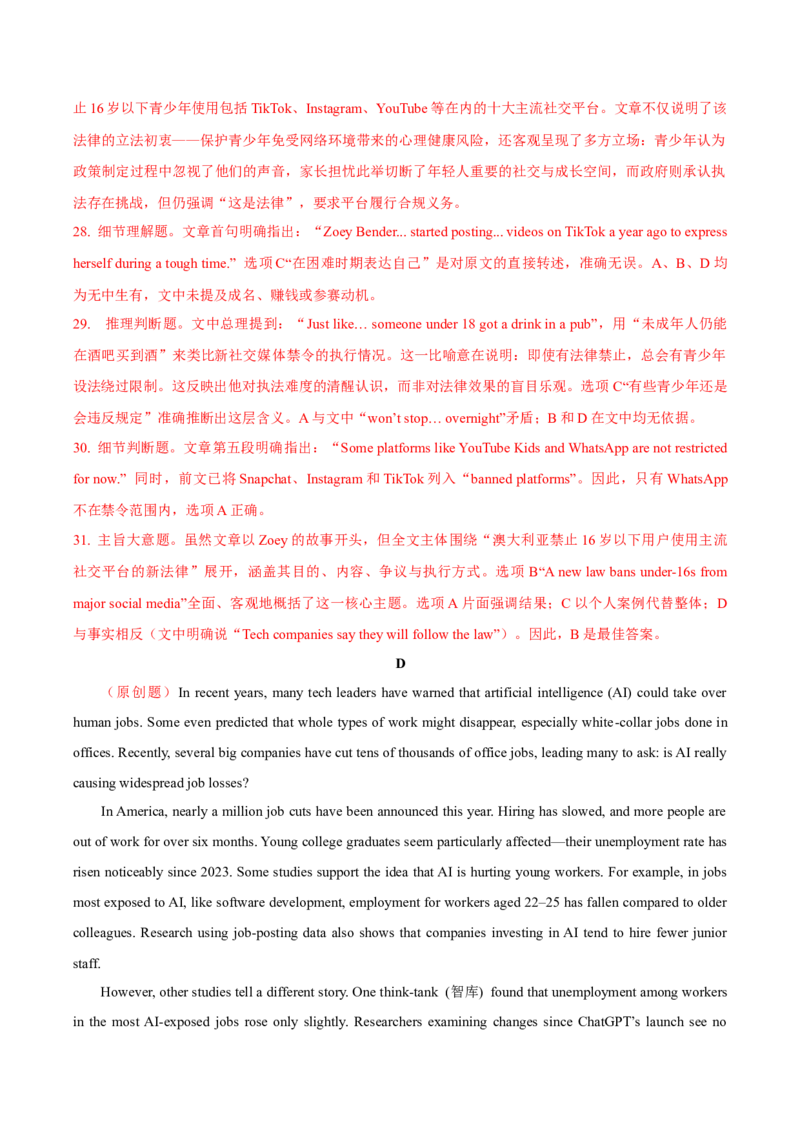
(原创题)In recent years, many tech leaders have warned that artificial intelligence (AI) could take over
human jobs. Some even predicted that whole types of work might disappear, especially white-collar jobs done in
offices. Recently, several big companies have cut tens of thousands of office jobs, leading many to ask: is AI really
causing widespread job losses?
In America, nearly a million job cuts have been announced this year. Hiring has slowed, and more people are
out of work for over six months. Young college graduates seem particularly affected—their unemployment rate has
risen noticeably since 2023. Some studies support the idea that AI is hurting young workers. For example, in jobs
most exposed to AI, like software development, employment for workers aged 22–25 has fallen compared to older
colleagues. Research using job-posting data also shows that companies investing in AI tend to hire fewer junior
staff.
However, other studies tell a different story. One think-tank (智库) found that unemployment among workers
in the most AI-exposed jobs rose only slightly. Researchers examining changes since ChatGPT’s launch see noclear sign that AI has reshaped America’s job market. Many experts doubt that recent job cuts were truly driven by
AI. Instead, they may just reflect normal business adjustments.
What else could explain the job losses? One likely reason is the “post-pandemic hangover.” During the
pandemic, certain sectors like information services and professional business services grew very fast. Now they are
cooling down, returning to more normal levels. Even software development, highly exposed to AI, followed a
similar boom-and-bust pattern: job openings rose sharply after the pandemic, then fell. As one analyst put it, many
companies simply “over-hired” during the boom and are now correcting that.
Another factor is the economic cycle. When ChatGPT was released, America’s job market was extremely
tight. Since then, conditions have eased. Historically, young workers’ unemployment rises faster than the overall
rate when the economy slows.
Still, young graduates face deeper challenges. AI may not yet be taking their jobs, but when the economy
eventually improves, there could be fewer opportunities left for them.
32. What has happened to young college graduates in the job market recently?
A. Their hiring rate has reached a record high. B. Their unemployment rate has increased.
C. They are getting higher wages than before. D. They are moving to blue-collar jobs.
33. Which of the following statements is TRUE according to some studies?
A. AI has clearly changed America’s job-market structure.
B. Companies investing in AI hire more junior staff.
C. Young workers in AI-exposed jobs lost more jobs than older ones.
D. Unemployment rose most in jobs least exposed to AI.
34.What does the phrase “post-pandemic hangover” in paragraph 5 most likely refer to?
A. People feeling tired after the pandemic.
B. A sudden drop in public health standards due to the pandemic.
C. The economic slowdown after a period of rapid growth.
D. Companies refusing to return to office work.
35.What is the author’s attitude toward the idea that “AI is replacing all jobs”?
A. Strongly supportive. B. Completely indifferent.
C. Emotionally opposed. D. Doubtful but cautious.
【答案】32. B 33. C 34. C 35. D
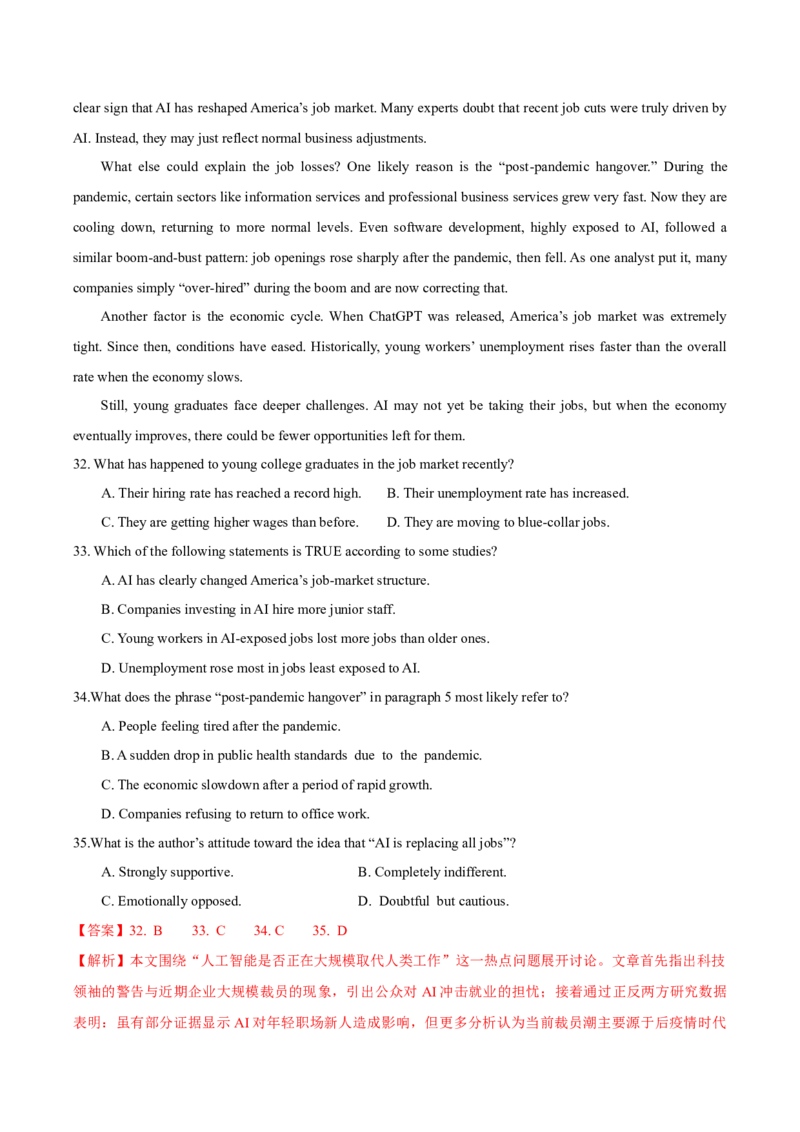
【解析】本文围绕“人工智能是否正在大规模取代人类工作”这一热点问题展开讨论。文章首先指出科技
领袖的警告与近期企业大规模裁员的现象,引出公众对AI冲击就业的担忧;接着通过正反两方研究数据
表明:虽有部分证据显示AI对年轻职场新人造成影响,但更多分析认为当前裁员潮主要源于后疫情时代的经济回调和周期性调整,而非AI的直接作用。作者并未全盘否定AI的潜在影响,但强调应理性看待现
实原因,体现出谨慎而审慎的态度。
32. 细节理解题。根据第三段首句“Young college graduates seem particularly affected—their unemployment
rate has risen noticeably since 2023”可知,年轻大学毕业生的失业率近期明显上升。选项B“他们的失业率增
加了”与原文一致。A、C在文中无依据;D未被提及。
33. 推理判断题。文章第三段提到:“in jobs most exposed to AI, like software development, employment for
workers aged 22–25 has fallen compared to older colleagues.” 这说明在受AI影响较大的岗位中,年轻员工的
就业情况比年长员工更差。选项C“在受AI影响的岗位中,年轻工作者比年长者失去了更多工作”正确。
A与后文“no clear sign that AI has reshaped America’s job market”矛盾;B与“companies… tend to hire fewer
junior staff”相反;D与研究结果不符。
34. 词义推断题。第五段用“post-pandemic hangover”解释当前裁员现象,并指出疫情期某些行业“grew
very fast”,如今“cooling down”“returning to normal”,且企业“over-hired… and are now correcting that”。可
见该短语并非指身体不适,而是比喻经济过热后的回调。选项C“一段快速增长后的经济放缓”准确传达了
这层含义。A为字面误读;B、D在文中均无依据。
35. 观点态度题。作者在文中反复使用“However”“Many experts doubt”“may just reflect”等表达,并指出裁
员更可能源于“business adjustments”“economic cycle”等常规因素,同时承认“AI may not yet be taking their
jobs”但未来“could be fewer opportunities”。这表明作者不轻信‘AI正在取代所有工作’的说法,但也不完
全排除其长远风险,态度为“ doubtful but cautious”(怀疑但谨慎)。选项D正确。A、C态度过于极端;
B与作者认真分析的态度不符。
第二节(共5小题;每小题2. 5分, 满分12. 5分)
阅读下面短文, 从短文后的选项中选出可以填入空白处的最佳选项。选项中有两项为多余选项。
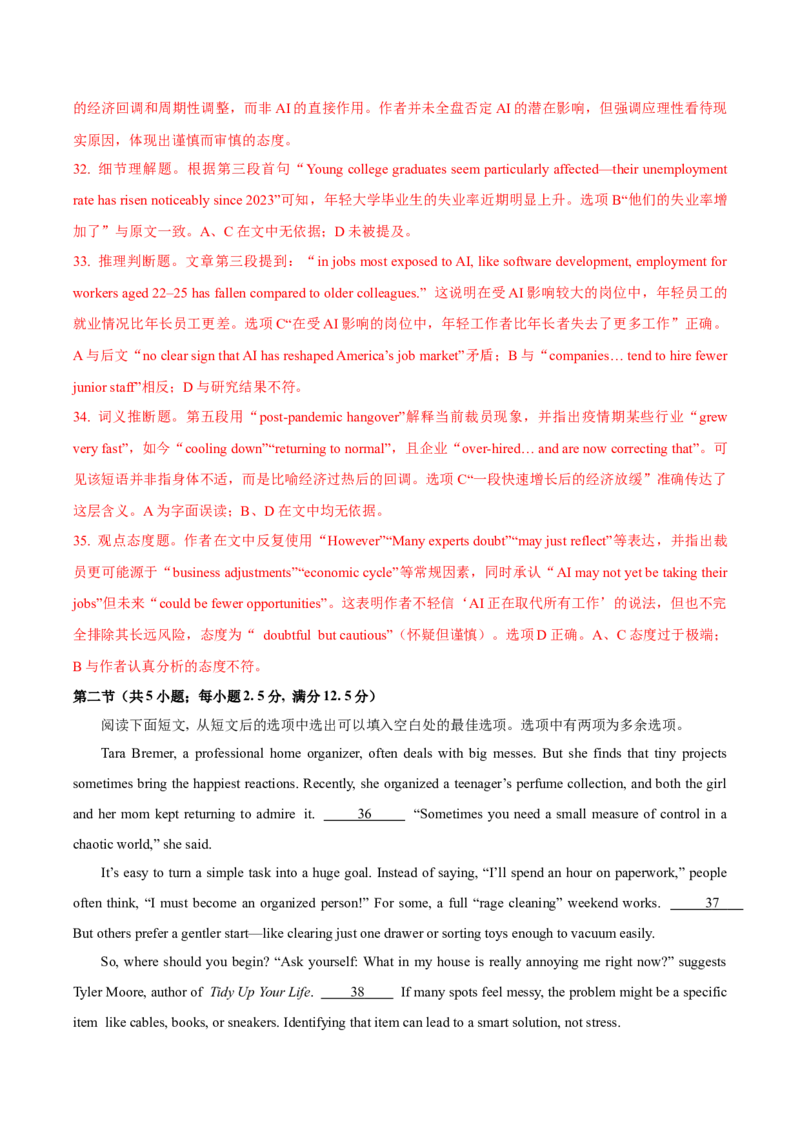
Tara Bremer, a professional home organizer, often deals with big messes. But she finds that tiny projects
sometimes bring the happiest reactions. Recently, she organized a teenager’s perfume collection, and both the girl
and her mom kept returning to admire it. 36 “Sometimes you need a small measure of control in a
chaotic world,” she said.
It’s easy to turn a simple task into a huge goal. Instead of saying, “I’ll spend an hour on paperwork,” people
often think, “I must become an organized person!” For some, a full “rage cleaning” weekend works. 3 7
But others prefer a gentler start—like clearing just one drawer or sorting toys enough to vacuum easily.
So, where should you begin? “Ask yourself: What in my house is really annoying me right now?” suggests
Tyler Moore, author of Tidy Up Your Life. 3 8 If many spots feel messy, the problem might be a specific
item like cables, books, or sneakers. Identifying that item can lead to a smart solution, not stress.When asked which space troubles clients most, Ms. Bremer said: the pantry (食品柜). “People keep too
much packaging,” she explained. Mr. Moore, however, finds the bathroom most satisfying to tidy by removing old
products and giving each family member their own spot. 3 9
Before you start, think about your real goal. Do you want a neat home for guests? Or to make chores easier for
your kids? 40 Also, don’t feel pressured to throw away things that have special meaning to you—unless
they bother someone else. In shared homes, compromise is key.
A. Set a clear, small time goal—like “one hour on Tuesday.”
B. That small success can lighten your mental load and bring real joy.
C. Some people enjoy intense challenges to build new habits.
D. She once cleaned an entire garage in just two hours.
E. Focus on one quick-win area that affects your daily life.
F. Always take before-and-after photos to share on social media.
G. A tidy bathroom helps you start the day calmly and smoothly.
【答案】36.B 37.C 38.E 39.G 40.A
【解析】本文是一篇说明文。文章通过多位整理专家和心理学家的观点,说明“从小处着手整理”不仅能
带来实际便利,还能缓解心理压力,提升生活幸福感。
36.上文提到Tara Bremer整理了一位青少年的香水收藏后,女孩和她母亲反复回来欣赏这个小角落,并感
到非常开心。B选项“That small success can lighten your mental load and bring real joy.(这种小小的成功可
以减轻心理负担并带来真正的快乐)”精准概括了该细节的意义,并自然引出她接下来所说的“在混乱世
界中需要一点掌控感”,逻辑衔接紧密。故选B项。
37.前句说有些人通过“rage cleaning”(疯狂大扫除)整个周末来整理,C选项“Some people enjoy intense
challenges to build new habits.(有些人喜欢通过高强度挑战来建立新习惯)”解释了这类人的心理动机,与
后文“But others prefer a gentler start…”(但另一些人喜欢温和开始)形成鲜明对比,构成“一部分人……
另一部分人……”的平行结构。故选C项。
38.前句Tyler Moore建议读者自问“家里什么最让你烦?”E选项“Focus on one quick-win area that
affects your daily life.(专注于一个能快速见效且影响你日常生活的区域)”是对该建议的具体化,提供可
操作方法;后文进一步说明:如果多处杂乱,问题可能出在某一类物品上,这也印证了“聚焦具体问题区
域”的思路。故选E项。
39.前句提到Mr. Moore认为整理浴室最令人满足,因为他会清理过期用品并为每位家庭成员分配专属位
置。G选项“A tidy bathroom helps you start the day calmly and smoothly.(一个整洁的浴室能帮助你平静顺
利地开启一天)”说明了整理浴室带来的实际好处,与“most satisfying”形成因果支撑,语义连贯。故选G项。
40.前文提出“开始前要想清楚你的真实目标是什么”,A选项“Set a clear, small time goal—like ‘one hour
on Tuesday.’(设定一个清晰、微小的时间目标,比如‘周二花一小时’)”为实现目标提供了具体策略,
与心理学家Dr. Preston在原文中“设定时间目标比模糊计划更有效”的观点一致。后文转到“不要因他人
眼光而丢弃有情感价值的物品”,也反衬出“目标应源于自我需求而非外界压力”,因此A项承上启下,
逻辑合理。故选A项。
第三部分 语言运用(共两节,满分30分)
第一节(共15小题,每小题1分,满分15分)
阅读下面短文, 从每题所给的A、B、C和D四个选项中选出可以填入空白处的最佳选项。
It was the third time this week I'd forgotten my umbrella. Rain poured as I stood outside school. I pulled my
thin jacket tighter, already 4 1 I'd be soaked by the time I reached home.
Then a voice said, "You look like you could use this." An elderly woman held out a red umbrella. Her coat was
wet, but she 4 2 warmly. "I live just down the road," she said before I could 4 3 . "Take it."
I hesitated. "But you'll get even wetter!" She laughed. "Rain never hurt anyone's heart—only forgetting to be
kind might." She walked off, 4 4 me holding it like a gift.
The next day, I returned the umbrella. A guard told me she came daily to "watch the children leave," though
her grandson had 4 5 five years ago. This routine helped her feel less 4 6 .
That evening, I knocked on her door. Her eyes lit up as if she'd been 4 7 me. We talked for hours,
and she even showed me an old photo of her grandson. "The best thanks," she said, "is to 4 8 it on."
I left with a new 49 : to visit her every weekend. Our tea-time chats became the highlight of my
week. She taught me that loneliness isn't cured by noise, but rather by the 50 of someone who truly sees
you.
One rainy afternoon, I asked why she’d helped me. She looked out the window: "Because I saw myself in you
—standing there, 51 for someone to notice."
Now, I always carry an extra umbrella for the 52 that I might meet someone who needs it more.
Mrs. Li, as I later learned her name was, showed me that small acts can 53 lives. Kindness is never
wasted. It may seem small, but it 54 deep roots. And often, the giver ends up 55 far more
than the receiver.
41. A. realizing B. hoping C. fearing D. doubting
42. A. nodded B. smiled C. waved D. trembled
43. A. agree B. answer C. refuse D. thank
44. A. leaving B. watching C. finding D. helping45. A. moved B. graduated C. disappeared D. died
46. A. tired B. forgotten C. alone D. old
47. A. waiting for B. looking for C. caring for D. asking for
48. A. send B. keep C. give D. pass
49. A. habit B. promise C. rule D. chance
50. A. care B. presence C. attention D. understanding
51. A. standing B. waiting C. hoping D. looking
52. A. reason B. moment C. opportunity D. belief
53. A. save B. change C. touch D. improve
54. A. grows B. plants C. sends D. builds
55. A. knowing B. feeling C. learning D. receiving
【答案】41.C 42.B 43.C 44.A 45.D 46.C 47.A 48.D 49.B
50.B 51.B 52.C 53.C 54.A 55.D
【解析】本文是一篇记叙文,讲述了作者忘带雨伞时被李奶奶善意赠予雨伞,后续通过交往了解到奶奶的
故事,进而深受启发,养成随身携带备用雨伞、传递善意的习惯,诠释了 “小善举能温暖人心,施与者
往往比受助者收获更多” 的道理。
41.考查动词词义辨析。句意:我把单薄的夹克裹得更紧了,已经担心到家时会浑身湿透。A. realizing 意
识到;B. hoping 希望;C. fearing 担心;D. doubting 怀疑。结合 “雨下得很大”“夹克单薄” 的语境,
作者此时应是 “担心” 被淋湿,fearing 符合情绪逻辑。故选 C 项。
42.考查动词词义辨析。句意:她的外套湿了,但笑得很温暖。A. nodded 点头;B. smiled 微笑;C.
waved 挥手;D. trembled 颤抖。根据 “warmly” 以及后文奶奶的善意行为,此处应是 “微笑”,体现她
的友善。故选 B 项。
43.考查动词词义辨析。句意:我还没来得及拒绝,她说:“我就住在这条路尽头。拿着吧。”A. agree
同意;B. answer 回答;C. refuse 拒绝;D. thank 感谢。前文作者 “犹豫”,担心奶奶淋雨,所以没来得
及 “拒绝”,refuse 符合语境。故选 C 项。
44.考查动词词义辨析。句意:她走开了,留下我像捧着礼物一样拿着雨伞。A. leaving 留下;B.
watching 观看;C. finding 发现;D. helping 帮助。奶奶送完雨伞就离开了,“leave sb. doing sth.” 表示
“让某人处于某种状态”,符合语境。故选 A 项。
45.考查动词词义辨析。句意:一名保安告诉我,她每天都来 “看着孩子们放学”,尽管她的孙子五年
前就去世了。A. moved 搬家;B. graduated 毕业;C. disappeared 消失;D. died 去世。结合 “奶奶坚持
来看孩子” 的深情,以及 “loneliness”(孤独)的提示,可推测孙子已 “去世”,died 符合逻辑。故选D 项。
46.考查形容词词义辨析。句意:这个习惯让她感觉不那么孤单。A. tired 疲惫的;B. forgotten 被遗忘的;
C. alone 孤单的;D. old 年老的。孙子去世后,奶奶内心是孤独的,“看着孩子们放学” 的习惯能缓解这
种孤独,alone 符合语境。故选 C 项。
47.考查动词短语辨析。句意:她的眼睛亮了起来,仿佛一直在等我。A. waiting for 等待;B. looking for
寻找;C. caring for 照顾;D. asking for 要求。作者主动上门还伞并拜访,奶奶的反应很欣喜,像是 “一
直等着” 有人来访,waiting for 符合语境。故选 A 项。
48.考查动词词义辨析。句意:“最好的感谢,” 她说,“就是把善意传递下去。”A. send 发送;B.
keep 保持;C. give 给予;D. pass 传递。“pass it on” 是固定搭配,指 “把(善意、精神等)传递下
去”,呼应后文作者随身携带备用雨伞的行为。故选 D 项。
49.考查名词词义辨析。句意:我带着一个新的承诺离开:每个周末都去看望她。A. habit 习惯;B.
promise 承诺;C. rule 规则;D. chance 机会。“每个周末拜访” 是作者主动许下的 “承诺”,promise
符合语境。故选 B 项。
50.考查名词词义辨析。句意:她教会我,孤独不是靠喧闹治愈的,而是靠真正有人关注你的陪伴。A.
care 关心;B. presence 陪伴;C. attention 关注;D. understanding 理解。奶奶通过 “看着孩子们放学”
“和作者聊天” 的陪伴缓解孤独,presence 强调 “实实在在的陪伴”,符合语境。故选 B 项。
51.考查动词词义辨析。句意:因为我在你身上看到了自己 —— 站在那里,等着有人注意到。A.
standing 站立;B. waiting 等待;C. hoping 希望;D. looking 寻找。作者当时站在雨中,渴望有人帮助,
就像奶奶可能曾有过的 “等待被关注、被帮助” 的时刻,waiting 符合语境。故选 B 项。
52.考查名词词义辨析。句意:现在,我总是随身携带一把备用雨伞,希望能遇到更需要它的人。A.
reason 理由;B. moment 时刻;C. opportunity 机会;D. belief 信念。随身携带雨伞是为了抓住 “帮助他
人的机会”,opportunity 符合语境。故选 C 项。
53.考查动词词义辨析。句意:李奶奶(后来我知道了她的名字)让我明白,小善举能温暖人心。A. save
拯救;B. change 改变;C. touch 触动、温暖;D. improve 改善。奶奶的小善举触动了作者,作者的行为
也可能触动他人,touch 体现 “情感上的温暖与触动”,符合文意。故选 C 项。
54.考查动词词义辨析。句意:它可能看起来微不足道,但却能深深扎根。A. grows 生长;B. plants 种植;
C. sends 发送;D. builds 建造。此处用比喻,善意像种子一样 “生长” 出深根,grows 符合比喻逻辑,
且与 “roots”(根)搭配恰当。故选 A 项。
55.考查动词词义辨析。句意:而且通常,施与者最终收获的比受助者多得多。A. knowing 知道;B.
feeling 感觉;C. learning 学习;D. receiving 收获、得到。作者从奶奶的善意中收获了陪伴、成长和传递善意的信念,比当初收到雨伞的 “收获” 更多,receiving 符合语境。故选 D 项。
第二节(共10小题;每小题1.5分 ,满分15分)
阅读下面短文,在空白处填入1个适当的单词或括号内单词的正确形式。
(原创题)We’ve all heard that sitting too much is bad for health. In fact, it might even 56 (short) your
life. “Sitting is actually aging you faster,” said Katy Bowman, a biomechanist.
A 13-year study in Taiwan followed 480,000 people and found those with the most sedentary (久坐的) jobs
had a 34% higher risk of 5 7 (die) from heart disease than others.
One effective way to reduce the risk, the authors wrote, was 5 8 (add) 15 to 30 minutes of physical
activity to your daily routine. Other studies go further, suggesting people who often sit for a long time need to the
usual 5 9 (week) exercise.
The American Heart Association warns that sitting for long periods raises the risk of developing heart disease,
60 you exercise regularly or not. Just 30 minutes of sitting 61 a break can affect blood flow. And the longer
you sit, the higher the risk becomes. Meanwhile, your leg muscles can begin to weaken after only 30 minutes of
sitting, 6 2 may lead to knee or back problems.
What’s more, sitting burns very few calories. Nowadays, people burn about 100 fewer calories per day than
they did fifty years ago. Over time, this can affect blood sugar control and fat breakdown, possibly 63 (lead) to
weight gain or Type 2 diabetes (糖尿病).
Long sitting time has also been linked to poor mental health. Studies show it can increase 64 chances of
feeling sad or anxious. So, stand up, stretch, and move. Your body will thank you for this. After all, movement, not
stillness, is 65 human bodies are truly designed for.
【答案】56. shorten 57. dying 58. to add 59. weekly 60. whether
61. without 62. which 63. leading 64. the 65. what
【解析】本文围绕久坐对健康的危害展开,介绍了久坐与心脏病、肌肉衰退、体重增加、心理健康等问题
的关联,并强调运动对缓解久坐危害的重要性。
56. 考查词性转换。句意:事实上,它甚至可能缩短你的寿命。情态动词 might 后接动词原形,short 的
动词形式为 shorten(缩短),故填 shorten。
57. 考查动名词。句意:台湾一项为期 13 年的研究追踪了 48 万人,发现那些从事最久坐工作的人死于
心脏病的风险比其他人高 34%。介词 of 后接动名词作宾语,die 的动名词形式为 dying,故填 dying。
58. 考查动词不定式。句意:作者写道,降低风险的一个有效方法是在日常生活中增加 15 到 30 分钟的
体育锻炼。此处用动词不定式作表语,说明主语 “way” 的具体内容,故填 to add。
59. 考查形容词。句意:其他研究更进一步,表明经常久坐的人需要常规的每周锻炼。该空修饰名词“exercise”,应用形容词,选项的形容词形式为 weekly(每周的),故填 weekly。
60. 考查连词。句意:美国心脏协会警告说,无论你是否经常锻炼,长时间久坐都会增加患心脏病的风
险。“whether...or not” 是固定搭配,表示 “无论是否”,故填 whether。
61. 考查介词。句意:仅仅 30 分钟不休息的久坐就会影响血液流动。根据语境,此处表示 “没有休
息”,应用介词 without,故填 without。
62. 考查定语从句引导词。句意:同时,仅久坐 30 分钟后,你的腿部肌肉就可能开始衰退,这可能会导
致膝盖或背部问题。此处为非限制性定语从句,先行词是前面整个句子,关系词在从句中作主语,应用
which 引导,故填 which。
63. 考查现在分词。句意:随着时间的推移,这会影响血糖控制和脂肪分解,可能导致体重增加或 2 型糖
尿病。此处用现在分词作结果状语,表示自然而然的结果,lead 的现在分词形式为 leading,故填
leading。64. 考查冠词。句意:研究表明,它会增加感到悲伤或焦虑的可能性。“the chances of doing sth”
是固定搭配,表示 “做某事的可能性”,此处用定冠词 the 表特指,故填 the。
65. 考查表语从句引导词。句意:毕竟,人类的身体真正被设计用于的是运动,而不是静止。此处为表语
从句,从句中缺少介词 for 的宾语,且表示 “…… 的事物”,应用 what 引导,故填 what。
第四部分 写作(共两节, 满分40分)
第一节(满分15分)
假定你是李华,学校英文网站要推出“Traditional Chinese Art”专栏。请你给编辑写一封信,推荐一项
中国传统艺术(如剪纸、书法、京剧等),内容包括:
(1) 你推荐的艺术形式;
(2) 推荐理由;
(3) 建议如何展示。
要求:1. 格式正确,符合书信要求;
2. 逻辑清晰,涵盖“推荐的艺术—理由—展示方法”;
3. 语言流畅,词数80词左右。
____________________________________________________________________________________________
____________________________________________________________________________________________
【参考范文】
Dear Editor,
I’m Li Hua, a student keen on traditional culture. I sincerely recommend paper-cutting for the “Traditional
Chinese Art” column.
Paper-cutting is a traditional folk art with a long history and deep cultural meaning. It often expresses
people’s wishes for happiness and good luck. Although it looks delicate, it’s actually easy to learn, making itperfect for international students to understand Chinese values.
I suggest displaying classic paper-cut works, sharing their creation stories, even organizing an online
paper-cutting workshop, which can help more students appreciate the beauty of traditional Chinese art.
Yours sincerely,
Li Hua
【写作解析】本篇书面表达属于应用文,要求考生给学校英文网站编辑写一封信,推荐一项中国传统艺术,
需说明推荐的艺术形式、理由及展示建议。
1.词汇积累
热衷于:fond of →keen on
精美的:beautiful→delicate
欣赏:enjoy→appreciate
展示:show→display
2.句式拓展
简单句变复合句
原句:Paper-cutting is a traditional Chinese folk art with a long history and deep cultural meaning.
拓展句:What makes paper-cutting special is not only its long history but also its deep cultural meaning.
[高分句型1] Although it looks delicate, it’s actually easy to learn, making it perfect for international students to
understand Chinese values. (运用了 although引导的让步状语从句和现在分词做结果状语从句)
[高分句型2] I suggest displaying classic paper-cut works, sharing their creation stories, and even organizing an
online paper-cutting workshop, which can help more students appreciate the beauty of traditional Chinese art. (运
用了which 引导的非限制性定语从句)
第二节(满分25分)
阅读下面材料,根据其内容和所给段落开头语续写两段,使之构成一篇完整的短文。
It was a sunny Saturday morning. Sam, a 14-year-old boy, decided to go hiking alone on a small mountain
near his home. He packed some water, bread, a first-aid kit, and a whistle his father gave him for safety. The forest
was quiet and beautiful, with sunlight dancing through the leaves. Birds sang cheerfully above him. Sam felt happy
and free as he walked along the narrow dirt path, enjoying the fresh air and the sense of adventure.
After about an hour, Sam began to feel tired. He stopped to rest under a big tree. Suddenly, he heard a strange
noise, like an animal digging in the ground. He held his breath and looked carefully between the trees. There, about
twenty steps away, was a wild boar (野猪). It was big and dark, with two sharp, curved teeth sticking out from its
mouth. It was using its nose to push through the dirt, looking for roots or insects to eat.Sam’s heart beat fast. His hands felt cold. He remembered something from a TV show about wildlife: “If you
see a wild animal, don’t run. Stay calm and back away slowly.” He stood very still, trying not to make a sound. The
pig hadn’t seen him yet, but he was afraid it might smell him. Wild pigs can be dangerous if they are surprised or if
their babies are nearby. Sam glanced around but saw no sign of baby pigs.
Sam looked around for a way out. Behind him was the path he came from. To his left was a steep hill covered
with many loose stones. To his right were several thick trees that he could maybe hide behind. He needed to leave
quietly, but how? Just then, the pig lifted its head and looked around. Its small, dark eyes moved toward Sam’s
direction. Sam’s hand touched the whistle around his neck, but he didn’t blow it. He knew a loud sound might make
the pig angry or scared..
注意:1.续写词数应为150个左右;
2.请按如下格式在答题纸的相应位置作答。
Sam took a slow, deep breath and recalled something important from his science class.
____________________________________________________________________________________________
____________________________________________________________________________________________
____________________________________________________________________________________________
When Sam finally got back to the start of the path, he was tired but felt strong inside.
____________________________________________________________________________________________
____________________________________________________________________________________________
____________________________________________________________________________________________
【参考范文】
Sam took a slow, deep breath and recalled something important from his science class. His teacher once said,
“Animals often avoid humans if they feel no threat.” So instead of turning away, Sam slowly raised his arms to
look taller, stayed facing the boar, and stepped backward, one quiet step at a time. He kept his eyes on the animal
but avoided direct staring, which might seem threatening. The boar breathed hard, shook its head, and after a few
tense seconds, turned back to the ground. Sam continued moving back until the trees hid him from view.
When Sam finally got back to the start of the path, he was tired but felt strong inside. He sat down on a rock,
heart still racing, but a calm smile spread across his face. He realized that staying calm and using what he’d learned
had saved him. That evening, he told his father everything. His dad hugged him and said, “You didn’t just hike a
mountain. You conquered your fear.” From then on, Sam always carried his whistle not just around his neck, but in
his mind, along with a quiet confidence that grew with every new trail he walked.
【写作解析】本文以“野外遇险与冷静应对”为线索展开,讲述了14岁男孩Sam在独自徒步时遭遇野猪,凭借科学课所学知识和冷静判断成功化险为夷,并在此过程中克服恐惧、收获成长的故事。
1. 段落续写:
①由第一段首句内容“Sam缓缓地深吸了一口气,回想起科学课上学过的一个重要知识点”可知, 第一
段应描写Sam如何回忆课堂知识,采取正确应对措施,并细致刻画野猪的反应及紧张氛围的缓解过程。
②由第二段首句内容“当Sam终于回到小径的起点时,他虽然感到疲惫,但内心却充满了力量”可知,第
二段应着重描写Sam脱险后的心理感受、与家人的交流以及从事件中获得的成长领悟,从而点明“勇气源
于冷静与知识”的主题。
2. 续写线索:遇险冷静——回忆知识——缓慢后退——安全撤离——返回反思——获得成长
3. 词汇激活
行为类
① 回忆:recall / remember / think back to
② 后退:step backward / move back / retreat slowly
③ 避免直视:avoid direct eye contact / not stare directly
情绪类
① 紧张/害怕:heart racing / hands cold / feel scared
② 平静/坚定:feel calm / feel strong inside / a quiet confidence
③ 释然/自豪:a calm smile / conquer fear
【高分句型1】He kept his eyes on the animal but avoided direct staring, which might seem threatening. (运用
which 引导非限制性定语从句)
【高分句型2】From then on, Sam always carried his whistle not just around his neck, but in his mind, along with
a quiet confidence that grew with every new trail he walked.(运用not just…but…结构和that引导的定语从
句)