2026 年高考第一次模拟考试
高三英语·全解全析
(考试时间:120 分钟 试卷满分:120 分)
注意事项:
1.答卷前,考生务必将自己的姓名、准考证号等填写在答题卡和试卷指定位置上。
2.回答选择题时,选出每小题答案后,用铅笔把答题卡上对应题目的答案标号涂黑。如需改动,用
橡皮擦干净后,再选涂其他答案标号。回答非选择题时,将答案写在答题卡上。写在本试卷上无效。
3.考试结束后,将本试卷和答题卡一并交回。
第二部分 阅读(共两节, 满分50 分)
第一节(共15 小题;每小题2.5 分, 满分37.5 分)
阅读下列短文, 从每题所给的A、B、C 和D 四个选项中选出最佳选项。
A
(新题材)Campus Shopper Rewards Program
To encourage smart and sustainable shopping, our campus store is launching the Smart Shopper Program—a
rewards system where you earn points every time you make a purchase. Earn enough points, and you can exchange
them for snacks, school supplies, or even donate them to charity!
How It Works:
1. Earn 1 point for every ¥10 spent (e.g., ¥25 = 2 points).
2. Bonus Points:
+5 points for bringing your own bag
+3 points for buying eco-friendly products (look for the green label)
+2 points for shopping during “Happy Hour” (3:00–4:00 PM, weekdays)
Rewards You Can Choose:
50 points = a bottle of water
80 points = a notebook
120 points = a ¥10 store coupon
200 points = donate a school kit to a child in need
Rules You Need to Know:
Points expire (过期) after 6 months.
Only one bonus per purchase (e.g., you can’t get both bag and eco-bonus in the same purchase unless you meet
both conditions. All applicable bonuses are added).
Points are tracked via your student ID card or the campus app.
An Example to Follow:
On Tuesday at 3:30 PM, Lisa spent ¥30, brought her own bag, and bought a green-labeled notebook.
Base points: ¥30 = 3 points
Bonus: +5 (own bag) + 3 (eco-product) + 2 (Happy Hour) = +10
Total: 13 points
Shop wisely, and every point makes a difference! Students are welcome to join by showing your student ID
card at checkout. For questions, please visit the store service desk or email shop@school.edu.cn.
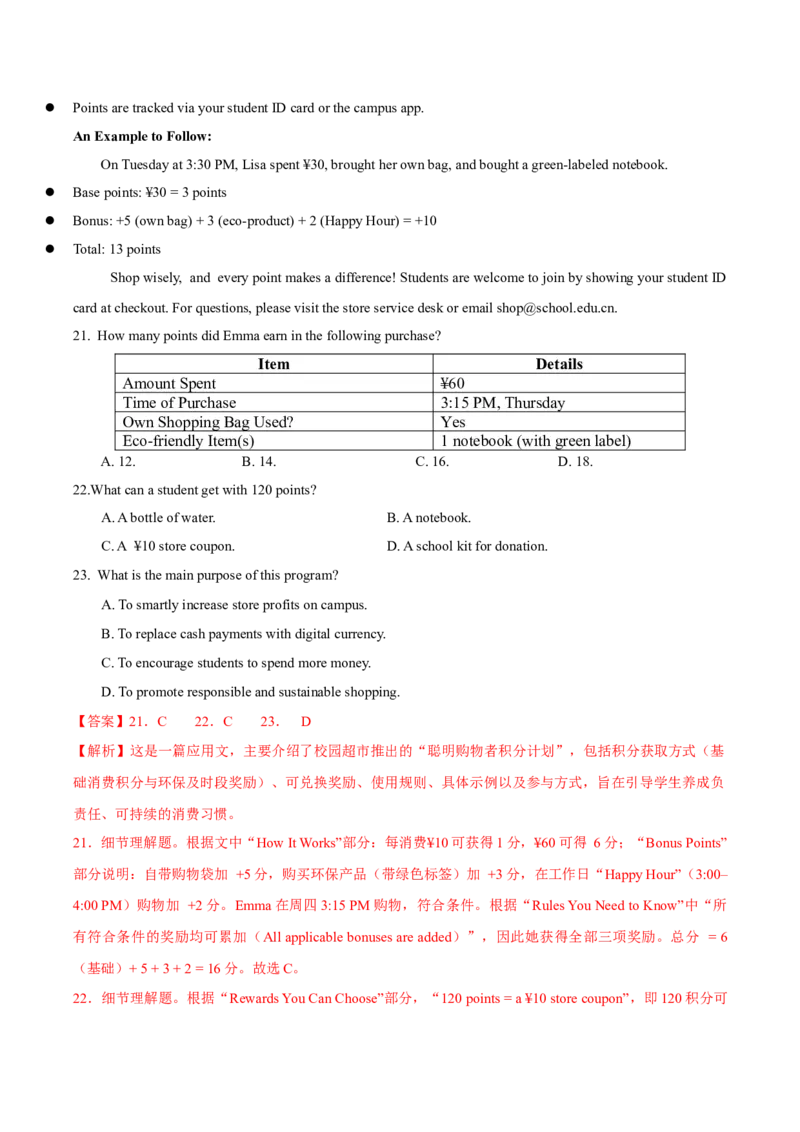
21. How many points did Emma earn in the following purchase?
Item
Details
Amount Spent
¥60
Time of Purchase
3:15 PM, Thursday
Own Shopping Bag Used?
Yes
Eco-friendly Item(s)
1 notebook (with green label)
A. 12.
B. 14.
C. 16.
D. 18.
22.What can a student get with 120 points?
A. A bottle of water.
B. A notebook.
C. A ¥10 store coupon.
D. A school kit for donation.
23. What is the main purpose of this program?
A. To smartly increase store profits on campus.
B. To replace cash payments with digital currency.
C. To encourage students to spend more money.
D. To promote responsible and sustainable shopping.
【答案】21.C 22.C 23.
D
【解析】这是一篇应用文,主要介绍了校园超市推出的“聪明购物者积分计划”,包括积分获取方式(基
础消费积分与环保及时段奖励)、可兑换奖励、使用规则、具体示例以及参与方式,旨在引导学生养成负
责任、可持续的消费习惯。
21.细节理解题。根据文中“How It Works”部分:每消费¥10 可获得1 分,¥60 可得 6 分;“Bonus Points”
部分说明:自带购物袋加 +5 分,购买环保产品(带绿色标签)加 +3 分,在工作日“Happy Hour”(3:00–
4:00 PM)购物加 +2 分。Emma 在周四3:15 PM 购物,符合条件。根据“Rules You Need to Know”中“所
有符合条件的奖励均可累加(All applicable bonuses are added)”,因此她获得全部三项奖励。总分 = 6
(基础)+ 5 + 3 + 2 = 16 分。故选C。
22.细节理解题。根据“Rewards You Can Choose”部分,“120 points = a ¥10 store coupon”,即120 积分可
兑换一张10 元店铺优惠券。A 项对应50 分,B 项对应80 分,D 项对应200 分。故选C。
文章首句明确指出:“To encourage smart and sustainable shopping(鼓励明智且可持续的购物)”,且积分
奖励重点偏向环保行为(如自带购物袋、购买绿色标签商品),说明该计划的核心目的是培养学生的环保
意识和理性消费习惯,而非盈利或刺激消费。A、B、C 均曲解了作者意图。故选D。
B
(原创题)I was watching TV when I heard a soft knock. I opened the door, but no one was there—just a pile
of boxes and the sound of a deliveryman running downstairs.
This scene is common across China. By October 11, the country’s express delivery ( 快递) companies had
already handled over 150 billion parcels, 37 days faster than last year. At this speed, the yearly total may reach
nearly 190 billion.
The growth of China’s delivery business is amazing. In 2014, only about 14 billion parcels were delivered.
Since then, the sector has grown at an annual rate of nearly 30%. Like smartphones, express delivery has changed
our lifestyle and become a key industry.
Years ago, weekend shopping once meant going to malls. Now, people just order online. Food or medicine can
arrive in minutes. Because of this, many malls have turned into food courts. I haven’t been to one in Beijing for
five or six years.
The express delivery business also creates many jobs. The top 10 companies alone employ about 3 million
people. There are over 1 million registered (注册) delivery companies in China, so total workers may reach 10
million. Most workers are from rural areas, earning 5,000–10,000 yuan a month by working long hours. Some are
graduates looking for better jobs.
But the job has risks. Delivery workers often run red lights or use sidewalks to save time because they get paid
per delivery, and lateness brings complaints or fines. Some companies even refused to buy social insurance for
them until the government stepped in to protect their rights.
To keep the business going long term, we must improve working conditions for delivery workers. With better
support, the industry can continue to grow and benefit everyone.
24. What can we learn about China’s express delivery parcels this year?
A. They hit 150 billion on Oct 11.
B. They were 37 days late last year.
C. They will surely reach 190 billion.
D. They are less than last year’s total.
25. How has express delivery changed people's life?
A. People no longer make shopping lists.
B. Online ordering becomes common.
C. Malls have all closed down.
D. Smartphones are not needed now.
26. What can we infer about delivery companies from the government’s intervention?
A. They all follow traffic rules strictly.
B. They used to ignore workers’ rights.
C. They pay workers very high salaries.
D. They have more than 10 million workers.
27. What is the main idea of the passage?
A. How to order things online easily.
B. How to protect delivery workers' rights effectively.
C. The difficult working life of delivery workers.
D. The growth and problems of China’s express delivery.
【答案】24. A 25. B 26. B 27. D
【解析】本文介绍了中国快递行业的迅猛发展、对人们生活方式的深刻影响、创造的就业机会,以及快递
员面临的劳动权益问题,最后呼吁改善其工作条件以实现行业可持续发展。
24. 细节理解题。根据第二段第一句:“By October 11, the country’s express delivery companies had already
handled over 150 billion parcels, 37 days faster than last year.” 可知,到10 月11 日,快递包裹量已超过1500
亿件,比去年提前了37 天。因此选项A“它们在10 月11 日达到1500 亿”正确。选项B 曲解原文,“37
days faster”是指比去年提前37 天达到该数量,而非“去年晚了37 天”;选项C 中“surely”过于绝对,原
文是“may reach nearly 190 billion”;选项D 与事实相反,今年包裹量明显多于去年。故选A。
25. 细节理解题。第三段指出:“Years ago, weekend shopping once meant going to malls. Now, people just
order online... I haven’t been to one in Beijing for five or six years.” 说明快递使线上购物成为常态,改变了消
费习惯。选项B“在线订购变得普遍”符合文意。选项A 未提及;选项C“all closed down”过于绝对,原文
只说“many malls have turned into food courts”;选项D 与原文矛盾,文中将快递与智能手机并列为改变生
活的技术。故选B。
26. 推理判断题。第五段提到:“Some companies even refused to buy social insurance for them until the
government stepped in to protect their rights.” 说明在政府介入前,一些公司未为快递员缴纳社保,忽视其基
本权益。因此可推断选项B“他们过去曾忽视工人的权利”正确。选项A 与文中“delivery workers often run
red lights”矛盾;选项C 与“earning 5,000–10,000 yuan”不符,不算“very high”;选项D 混淆概念,1000 万
是全行业从业者估算总数,非单指前十家公司。故选B。
27. 主旨大意题。全文从快递业务量激增谈起,阐述其对生活、就业的积极影响,同时指出快递员工作风
险与权益保障缺失的问题,最后呼吁改善工作条件以促进行业可持续发展。因此选项D“中国快递业的增长
与问题”全面概括了文章内容。选项A 偏离主题;选项B 和C 仅涉及部分内容,不够全面。故选D。
C
(原创题)New research from Australia shows that listening to music in later life may help reduce the risk of
dementia (痴呆). Scientists studied over 10,800 adults aged 70 or older. They found that people who often listened
to music were 39% less likely to develop dementia than those who never or only sometimes listened.
Those who always listened to music not only had a lower chance of dementia but also showed better brain
function. They had 17% less cognitive impairment (a decline in thinking skills), higher overall cognitive scores,
and stronger episodic memory—the ability to remember daily events, such as what they ate for lunch or where
they left their keys.
Playing a musical instrument also brought benefits. People who played an instrument had a 35% lower risk of
dementia. Those who both listened to and played music saw a 33% drop in dementia risk and a 22% lower risk of
cognitive decline.
Emma Jaffa, a researcher at Monash University, said music may be an easy and enjoyable way for older adults
to support brain health. However, she added that the study is observational—it shows a connection but does not
prove that music directly causes these benefits. Moreover, the research did not distinguish between different music
styles, leaving open the question of whether classical, pop, or other types might be more effective.
The researchers also noted limitations: data came from self-reports, which may not be fully accurate, and the
results could be affected by “reverse causation”—meaning people with healthier brains might simply be more
likely to enjoy music. They stressed the need for careful interpretation and called for future studies to explore
whether certain music styles offer greater protection.
Dementia is a growing global health concern. More than 57 million people live with it worldwide, and about
10 million new cases appear each year—one every 3.2 seconds. As populations age, simple strategies like music
could play an important role in helping protect the brain.
28. What is the main purpose of the passage?
A. Encourage older adults to take up musical training.
B. Present research suggesting music may help reduce dementia risk.
C. Compare brain benefits of listening to music and playing instruments
D. Highlight global dementia rise and call for medical solutions.
29.Which of the following best describes “episodic memory” in paragraph 2?
A. Remembering historical dates.
B. Learning new vocabulary
C. Recognizing famous songs.
D. Recalling personal daily experiences.
30.Why can’t the researchers be sure music causes better brain health?
A. The study only used young people.
B. The findings are based on observation.
C. Music was not used in the study.
D. All participants had suffered from dementia.
31. What can we infer from the last paragraph?
A. Dementia is no longer a serious problem.
B. Music has already cured millions of patients.
C. Finding easy ways to fight dementia is urgent.
D. Only Europe is affected by dementia.
【答案】28.B 29.D 30.B 31.C
【解析】本文介绍了澳大利亚一项关于音乐与老年人大脑健康关系的新研究,指出经常听音乐或演奏乐器
可能与较低的痴呆风险相关,同时强调该研究为观察性研究,不能证明因果关系,并呼吁未来进一步探索
不同音乐类型的效果。
28. 主旨大意题。全文以一项针对10,800 名70 岁以上成年人的观察性研究为核心,说明音乐活动(包括听
音乐和演奏乐器)与较低的痴呆风险及更好的认知功能存在关联,同时也客观指出研究的局限性。文章并
未鼓励行动(排除A)、未以比较听与奏为主要目的(排除C)、也未呼吁医疗手段(排除D)。选项
B“呈现研究表明音乐可能有助于降低痴呆风险”准确反映文章的说明性目的和核心内容。故选B。
29. 词义推断题。第二段明确解释了“episodic memory”是指“the ability to remember daily events, such as
what they ate for lunch or where they left their keys”(回忆日常事件的能力),这属于个人日常生活经历的回
忆。选项D“回忆个人日常经历”与之完全一致。其他选项均不符合该定义。故选D。
30. 细节理解题。第四段指出:“the study is observational—it shows a connection but does not prove that
music directly causes these benefits.” 说明研究仅显示关联,不能证明因果,正是因为其基于观察而非实验
干预。因此选项B“研究结果基于观察”正确。选项A、C、D 均与原文事实不符。故选B。
31. 推理判断题。最后一段强调“Dementia is a growing global health concern”“As populations age, simple
strategies like music could play an important role”,说明面对日益严峻的痴呆问题,寻找简便有效的干预方式
(如音乐)十分紧迫。选项C“寻找简单方法对抗痴呆是当务之急”符合推断。选项A、B、D 与原文信息
矛盾或无依据。故选C。
D
(原创题)“Time” is the most common noun in English. We all feel time passing: our present becomes the
past instantly, today turns into yesterday, and seasons change year after year. As we grow older, we’re more aware
of years slipping by.
Neuroscientists (神经科学家) haven’t found one “clock” in the brain that tells time, yet humans are quite
good at judging it. If someone says, “I’ll be there in five minutes,” we know roughly when to expect them. Most
people think time moves steadily from past to future at a fixed rate.
However, our view of time may be shaped more by culture than biology. The Amondawa tribe in the Amazon
has no word for “time.” Some believe this means they don’t see time as a container for events, though others argue
it’s just a language difference.
Also, we can’t scientifically know how ancient people viewed time, as time-perception experiments only
started 150 years ago. We do know Aristotle saw the present as always changing, and Roman Marcus Aurelius
described time as a river of events. Many in the West still agree with these ideas.
However, physics tells a different story. Einstein showed that time is not fixed but relative ( 相对的). Time
slows down for fast-moving objects. There is no single universal “now.” Events don’t always happen in a set order.
Some physics equations (公式) work the same whether time runs forward or backward. A few scientists, like Carlo
Rovelli, even suggest that time might be an illusion—it doesn’t really exist.
Yet, even if time doesn’t exist in physics, our perception of time is real. The way we experience “past” and
“future” may not apply to the whole universe, but it reflects human life on Earth. After all, we plan for tomorrow,
remember yesterday, and feel the pressure of deadlines. This sense of time gives structure to our days and connects
us through shared moments like birthdays or holidays.
And just as Newton’s idea of absolute time was later questioned, our everyday understanding of time may also
be incomplete.
32. What do most people think about time’s movement?
A. It’s steady from past to future.
B. It stops sometimes.
C. It speeds up for adults.
D. It’s controlled by the brain.
33. What can be inferred about the Amondawa tribe?
A. They live in North America.
B. Their language lacks the word "time".
C. They invented a new calendar system.
D. They reject modern technology.
34. Why can’t we know ancient people’s view of time?
A. They left no written records.
B. Neuroscientists didn’t study them.
C. Their languages had no “time”.
D. Time-perception experiments started late.
35.What does our sense of time bring to daily life?
A. More free time.
B. Structure to our days.
C. Fewer deadlines.
D. No shared moments.
【答案】32. A 33. B 34. D 35. B
【解析】本文探讨了人类对时间的感知,指出尽管大多数人认为时间以固定速率从过去流向未来,但这种
观念可能受文化影响,而非纯粹生物本能。文章还对比了古代哲学家、现代物理学(如爱因斯坦相对论)
以及语言学案例(如Amondawa 部落)对时间的不同理解,并强调:即使物理学质疑时间的客观存在,人
类对时间的主观体验依然真实且具有社会与心理意义。
32. 本题为细节理解题,解题关键是定位原文中关于 “大多数人对时间流动的看法” 的表述。根据文章
第二段 “Most people think time moves steadily from past to future at a fixed rate” 可知,大多数人认为时间以
固定的速度从过去稳步流向未来。选项 B “有时会停止”未在原文提及,选项C “对成年人来说会加速”
和选项D “由大脑控制” 与原文表述不符,故选 A。
33. 推理判断题。第三段提到:“The Amondawa tribe in the Amazon has no word for ‘time.’” 由此可合理推
断其语言中缺少“time”这一词汇。选项B 正确。选项A 地理错误(亚马逊位于南美洲);C、D 属无中生
有。故选B。
34. 细节理解题。第四段说明:“ we can’t scientifically know how ancient people viewed time, as time-
perception experiments only started 150 years ago.” 这表明我们无法了解古人时间观的原因是相关科学实验起
步较晚。选项D“时间感知实验开始得晚”准确对应原文。故选D。
35. 细节理解题。倒数第二段指出:“This sense of time gives structure to our days and connects us through
shared moments like birthdays or holidays.” 说明时间感为日常生活提供了结构。选项B“为我们的日子提供
结构”正确。A、C、D 均与文意相悖。故选B。
第二节(共5 小题;每小题2. 5 分, 满分12. 5 分)
阅读下面短文, 从短文后的选项中选出可以填入空白处的最佳选项。选项中有两项为多余选项。
We all know our phones aren’t great for our relationships, but we still reach for them many times a day.
This habit is called “phubbing”, which means ignoring someone to look at your phone. 3
6
It makes
partners feel ignored. Parental phone use can also affect children, weakening bonds with younger ones and hurting
the self-esteem of older ones.
Rather than blame yourself, trying to be more mindful when using your phone can help. 37 Dr.
Kaitlyn Regehr from University College London suggests a simple method: every time you pick up your phone, tell
the person with you why, and put it down again when finished.
It may sound easy, but this small step can change our behavior. We often check messages or notifications
without thinking. 3
8
For example, say “I need to reply to this message, then I’ll focus on you again.”
By explaining what you’re doing, you break the habit of automatic phone-checking and show others they still
matter. 3
9
It also helps you stay focused instead of moving to other apps.
A study led by Dr. Claire Hart supports this idea. When people feel ignored, their relationships tend to get
worse. Not everyone reacts the same way, but once someone feels ignored, they may pick up their own phone.
40
.
Every time you are “phubbed”, you lose connection and once you've left a shared moment to look at a screen,
it can take a while to get back to what was going on before.
A. What really helps is being clear about why you’re using your phone.
B. This can slowly damage your close relationships over time.
C. Therefore, it’s better to avoid using phones in public places.
D. In this way, the other person won’t feel forgotten or unimportant.
E. The key is not to stop using phones completely, but to use them wisely.
F. This can start a harmful cycle where both people feel less valued than what’s on the screen.
G. According to a psychologist, being intentional with phone use is more effective.
【答案】36.B 37.G 38.A 39.D 40.F
【解析】本文是一篇说明文,探讨了“phubbing”(低头看手机而冷落他人)对人际关系的负面影响,并介
绍了心理学家提出的应对策略:通过主动说明使用手机的原因,减少对方被忽视的感受,从而维护亲密关
系。
36.上文指出“phubbing”会让伴侣感到被忽视,父母使用手机还会削弱与年幼孩子的亲密关系,并伤害青
少年的自尊。B 项“This can slowly damage your close relationships over time.”(这会随着时间的推移慢慢损
害你的亲密关系)是对上述现象的总结与深化,既承接上文,又自然引出该行为的长期危害,逻辑连贯。
故选B 项。
37.前句提出“与其自责,不如更有意识地使用手机”,G 项“According to a psychologist, being
intentional with phone use is more effective.”(据心理学家称,有意识地使用手机更有效)直接呼应“trying
to be more mindful”,并自然引出后文Dr. Regehr 的具体建议,起到承上启下的作用。故选G 项。
38.后文是一个具体示例:“比如,说‘我需要回复这条消息,然后我会专注你’”,A 项“What really
helps is being clear about why you’re using your phone.”(真正有帮助的是清楚说明你为什么使用手机)是对
该例子的概括,也解释了为何这种做法有效,与上下文形成“观点—例证”结构。故选A 项。
39.上文说“通过解释你在做什么……表明对方依然重要”,D 项“In this way, the other person won’t feel
forgotten or unimportant.”(这样,对方就不会感到被遗忘或不重要)正是对“show others they still matter”的
同义转述,语义紧密衔接。故选D 项。
40.前文提到“一旦有人感到被忽视,就可能拿起自己的手机”,F 项“This can start a harmful cycle where
both people feel less valued than what’s on the screen.”(这会引发一种有害循环,双方都觉得自己不如屏幕上
的内容重要)精准承接并深化该观点,揭示“phubbing”可能引发的恶性互动。故选F 项。
第三部分 语言运用(共两节,满分30 分)
第一节(共15 小题,每小题1 分,满分15 分)
阅读下面短文, 从每题所给的A、B、C 和D 四个选项中选出可以填入空白处的最佳选项。
All day long the little boy worked hard in the field. His family was poor, and the only
41
that was
truly his own came when there was no work after sunset. Then he would climb a hill and look at a house far away.
From the hilltop, its windows
4 2
like gold and diamonds. The light was so bright it made him
4 3
. But soon the windows
4 4
, and the house looked ordinary.
One day, his father said, “You’ve been a good boy. Take this day as a
4 5
.” The boy
4 6
his parents and set off with a piece of bread in his pocket to find the golden windows.
It was a
4 7
walk. His bare feet made marks in the dust, and his footprints seemed to follow,
keeping him
4 8
. His shadow also kept beside him, and would dance with him as he pleased.
After a long time, he reached the green hill. But when he got to the house, the windows were just
49
glass—no gold at all.
He felt deeply
50
. A kind woman came to the door. “I came to see the golden windows,” he said
sadly. She smiled. “We’re poor farmers. We don’t have gold on our windows. But clear glass is
51
—
you can see through it.” The boy stood silent. Then he turned to go home.
As he walked, the sun began to set. And
52
, when he looked back at his own hill, he saw his
own home.
53
, the windows of his home were shining like gold! At the moment, he
54
: what looked golden from afar was just ordinary up close and what was ordinary at home looked golden from a
distance. he learned that true value isn’t in the faraway dream, but in the
55
you already have.
41. A. time
B. moment
C. break
D. freedom
42. A. burned
B. shone
C. flashed
D. glowed
43. A. blink
B. smile
C. stare
D. cry
44. A. opened
B. broke
C. closed
D. darkened
45. A. gift
B. rest
C. holiday
D. reward
46. A. hugged
B. kissed
C. thanked
D. waved
47. A. tiring
B. lonely
C. short
D. pleasant
48. A. safe
B. warm
C. company
D. quiet
49. A. broken
B. clear
C. old
D. dirty
50. A. confused
B. ashamed
C. disappointed
D. angry
51. A. cheaper
B. stronger
C. better
D. cleaner
52. A. suddenly
B. finally
C. slowly
D. quietly
53. A. To his joy
B. To his surprise
C. As expected
D. By chance
54. A. remembered
B. believed
C. understood
D. accepted
55. A. mind B. home
C. family
D. place
【答案】 41. A 42. B 43. A 44. D 45. C 46. C 47. D 48. C 49. B 50. C
51. C 52. A 53. B 54. C 55. B
【解析】本文是一篇记叙文,讲述小男孩因家境贫寒终日劳作,日落时会眺望远方房屋 “金色的窗户”,
在获得假期后前往探寻,却发现窗户只是普通玻璃,返程时偶然发现自家窗户在夕阳下也闪耀 “金色”
光芒,最终领悟 “真正的价值不在远方的梦想,而在已拥有的家园” 的道理。
41.考查名词词义辨析。句意:他家境贫寒,唯一真正属于他自己的时间,是日落后没有农活的时候。A.
time 时间(泛指时间,不可数);B. moment 时刻(特指短暂的瞬间,可数);C. break 休息;D.
freedom 自由。此处强调 “一段可自由支配的时间”,而非短暂瞬间或休息,time 符合语境。故选 A 项。
42.考查动词词义辨析。句意:从山顶望去,那间房子的窗户像金子和钻石一样闪耀。A. burned 燃烧;
B. shone 闪耀(强调持续发光,符合 “金色窗户” 的视觉效果);C. flashed 闪烁(强调短暂、突然的
闪光);D. glowed 发微光(强调柔和、微弱的光)。窗户因夕阳反射呈现 “金色”,是持续的闪耀效果,
shone 最贴切。故选 B 项。
43.考查动词词义辨析。句意:光线太亮,让他不禁眨眼。A. blink 眨眼(因光线过强或刺激自然做出的
动作);B. smile 微笑;C. stare 凝视;D. cry 哭泣。根据 “光线太亮” 的语境,眨眼是自然反应,
blink 符合逻辑。故选 A 项。
44.考查动词词义辨析。句意:但很快窗户暗了下来,房子看起来和普通房屋没两样。A. opened 打开;
B. broke 破碎;C. closed 关闭;D. darkened 变暗。后文提到 “房子看起来普通”,结合前文 “窗户闪
耀金光”,可知是光线变化导致窗户 “变暗”,darkened 符合语境(若选 closed,会直接说明 “关上百
叶窗”,与原文逻辑不符)。故选 D 项。
45.考查名词词义辨析。句意:一天,他父亲说:“你一直很乖,就把今天当作假期吧。”A. gift 礼物;
B. rest 休息;C. holiday 假期(指完整的一天休息时间,呼应后文 “全天去探寻窗户”);D. reward 奖
励。根据前文 “小男孩终日劳作” 和后文 “出发去寻找金色窗户”,可知父亲给的是 “完整的一天假
期”,holiday 更符合语境。故选 C 项。
46.考查动词词义辨析。句意:男孩感谢了父母,口袋里装了一片面包就出发了。A. hugged 拥抱;B.
kissed 亲吻;C. thanked 感谢(呼应父亲给假期的善意);D. waved 挥手。父亲给予假期是善意的安排,
男孩的回应应是 “感谢”,thanked 符合礼仪逻辑。故选 C 项。
47.句意:这是一段愉快的旅程。A. tiring(令人疲惫的);B. lonely(孤独的);C. short(短暂的);
D. pleasant(愉快的)。后文提到“影子陪他跳舞”,说明他心情轻松愉快,与 disappointment 形成对比,
因此 pleasant 更符合语境。故选 D 项。
48.考查名词和形容词词义辨析。句意:他的影子在身边跳舞,尘土中的脚印仿佛在跟着他,陪伴着他。
A. safe 安全的;B. warm 温暖的;C. company 陪伴(keep sb. company 是固定搭配,意为 “陪伴某
人”);D. quiet 安静的。根据 “脚印仿佛在跟着他”,可知是 “陪伴” 的效果,company 符合固定搭
配和语境。故选 C 项。
49.考查形容词词义辨析。句意:但当他走到房子前,却发现窗户只是普通的透明玻璃 —— 根本没有金
色。A. broken 破碎的;B. clear 透明的(呼应后文女士所说 “clear glass”);C. old 旧的;D. dirty 脏的。
后文女士明确提到 “clear glass”,此处是原词复现,clear 符合语境。故选 B 项。
50.考查形容词词义辨析。句意:他感到极度失望。A. confused 困惑的;B. ashamed 羞愧的;C.
disappointed 失望的(因 “寻找金色窗户却发现只是普通玻璃” 的期待落空);D. angry 生气的。男孩
满怀期待寻找 “金色窗户”,结果与预期不符,内心应是 “失望”,disappointed 符合情绪逻辑。故选
C 项。
51.考查形容词词义辨析。句意:“我们是贫穷的农民,窗户上没有金子。但透明玻璃更好 —— 你能透
过它看到外面。”A. cheaper 更便宜的;B. stronger 更坚固的;C. better 更好的(女士从实用角度强调玻
璃的优势,反驳 “金色” 的虚幻);D. cleaner 更干净的。女士想表达 “透明玻璃虽无金色,却有实用
价值,因此更好”,better 符合语境。故选 C 项。
52.考查副词词义辨析。句意:突然,当他回头望向自己的小山时,他看到了令他惊讶的一幕 —— 自家
的窗户正像金子一样闪耀!A. suddenly 突然(强调意外发现,符合 “回头时偶然看到” 的场景);B.
finally 最终;C. slowly 慢慢地;D. quietly 安静地。男孩原本失落返程,并未刻意观察,“看到自家窗户
发光” 是意外情况,suddenly 符合语境。故选 A 项。
53.考查固定短语辨析。句意:突然,当他回头望向自己的小山时,他看到了令他惊讶的一幕 —— 自家
的窗户正像金子一样闪耀!A. to his joy 令他高兴的是;B. to his surprise 令他惊讶的是(因从未想过自家
普通窗户会 “发光”,符合意外感);C. as expected 正如预期;D. by chance 偶然。男孩此前只关注远
方房屋的 “金色窗户”,从未留意自家,此时的发现是 “惊讶的”,to his surprise 符合情绪。故选 B
项。
54.考查动词词义辨析。句意:在那一刻,他明白了:远看金光闪闪的东西,近看却很普通;而家里普通
的事物,从远处看却像金子一样。A. remembered 记得;B. believed 相信;C. understood 明白(领悟到背
后的道理);D. accepted 接受。男孩通过 “远方与自家窗户” 的对比,终于 “明白” 事物的表象与距
离的关系,understood 符合 “领悟” 的语境。故选 C 项。
55.考查名词词义辨析。句意:他领悟到,真正的价值不在远方的梦想,而在你已拥有的家园。A. mind
想法;B. home 家园(呼应前文 “自家窗户发光”,指 “自己的家”);C. family 家人;D. place 地方
(泛指地点,不够具体)。男孩最终意识到 “自家” 才是有价值的,而非泛泛的 “生活” 或 “地
方”,home 更贴合主题。故选 B 项。
第二节(共10 小题;每小题1.5 分 ,满分15 分)
阅读下面短文,在空白处填入1 个适当的单词或括号内单词的正确形式。
(原创题)An AI “actor” named Tilly Norwood
56
(cause) a heated discussion recently. At first glance,
Norwood looks like a young actress active
57
social media, where she posts many photos and acts in
computer-made videos. Her team even posted: “I may be AI, but I feel real emotions!”
However, Hollywood is not welcoming it. An actors’ union has criticized the creation, saying that Norwood “is
not an actor, but a character made by a computer.” They argue it has no real feelings or life experience,
58
makes it hard to touch people’s hearts.
Norwood’s creator, a Dutch comedian, Eline Van der Velden, hoped Norwood would become “the next big
star.” In response to 59
(criticise), Van der Velden said Tilly was not meant to replace humans but instead was
a piece of art.
“Creating Tilly was an act of imagination and skill,” she wrote, adding that such AI performers should 60
(judge) in their own way. Yet, many people remain unconvinced that AI actors take away human jobs and
61
(serious) lower the value of real art.
AI in movies and TV has been a serious problem. In 2023, actors and writers went on strike 62
(ask) for
rules against machines taking their jobs. The union recently warned that 63
(use) AI actors might break those
new rules.
64
is still unknown is whether companies will keep using AI like this. But one thing is clear: the
discussion about AI in art is just beginning. As technology grows, we must think about
65
to protect human
creativity. After all, behind every great performance, there is a real person working hard.
【答案】56. has caused 57. on 58. which 59. criticism 60. be judged
61. seriously 62. to ask 63. using 64. What 65. how
【解析】本文介绍了由荷兰创作者开发的人工智能“演员”Tilly Norwood 引发的争议。文章指出,尽管
Tilly 在社交媒体上展现出逼真的形象和表演,但好莱坞演员工会和多位明星对其表示反对,认为AI 缺乏
真实情感与生活体验,无法替代人类演员。创作者则强调Tilly 是一件艺术作品,而非人类的替代品。文章
还回顾了2023 年好莱坞罢工事件中AI 技术引发的劳资矛盾,并呼吁在技术发展中保护人类创造力的价
值。
56. 考查动词的时态。句意是“一个人工智能‘演员’名叫Tilly Norwood,最近引发了一场热烈讨论。”
主语为单数(Tilly Norwood),recently 常与现在完成时连用,表示对现在仍有影响的过去动作,故填
has caused。
57. 考查介词。句意是“乍看之下,Norwood 看起来像一位在社交媒体上活跃的年轻女演员。”“ on
social media” 是固定搭配,表示“在社交媒体上活跃”,故填 on。
58. 考查定语从句引导词。此处为非限制性定语从句,指代前面整个句子(“它没有真实情感或生活经
验”),关系代词在从句中作主语,且指代事物,故用 which。
59. 考查名词。句意是“面对批评,Van der Velden 表示……”。“in response to” 后接名词,criticise 是
动词,其名词形式为 criticism(不可数),故填 criticism。
60. 考查动词的语态。句意是“她补充说,这类AI 表演者应当以它们自己的方式被评判。”AI performers
与 judge 之间是被动关系,情态动词 should 后接被动语态,故填 be judged。
61. 考查副词。句意是“许多人仍不相信AI 演员会夺走人类的工作并严重地降低真实艺术的价值。”空格
修饰动词 lower,需用副词,serious 的副词形式为 seriously,故填 seriously。
62. 考查非谓语动词(不定式表目的)。句意是“2023 年,演员和编剧罢工,以争取防止机器抢走他们工
作的规则。”此处 to ask 表示罢工的目的,故填 to ask。
63. 考查非谓语动词(动名词作主语)。句意是“工会最近警告说,使用AI 演员可能会违反那些新规
则。”that 从句中缺少主语,use 作主语时需用动名词形式 using,故填 using。
64. 考查主语从句引导词。句意是“尚不清楚的是,公司是否会继续使用此类AI。”主语从句中缺少主
语,表示“……的事情”,故用 What 引导整个主语从句。
65. 考查“疑问词 + 不定式”结构。句意是“我们必须思考如何保护人类的创造力。”think about 后接
“how to protect...” 表示“如何做某事”,故填 how。
第四部分 写作(共两节, 满分40 分)
第一节(满分15 分)
假定你是李华,你校将招募学生参与 2026 年亚运会(Asian Games)志愿服务。请你给项目负责人
Ms. Wang 写一封邮件,申请加入,内容包括:
(1) 表达申请意愿;
(2) 说明自身优势;
(3) 表达期待。
要求:1. 格式正确,符合书信要求;
2. 逻辑清晰,涵盖“意愿—优势—期待”;
3. 语言流畅,词数80 词左右。
____________________________________________________________________________________________
____________________________________________________________________________________________
【参考范文】
Dear Ms Wang,
I’m Li Hua, a senior three student from our school. I’m writing to apply for the volunteer work for the
2026 Asian Games.
I believe I can be a helpful and friendly volunteer. I have strong English skills and good communication
abilities, which allow me to communicate with foreign athletes and guests easily. I also have experience in
volunteer work. Last year, I volunteered at the National Games. I helped foreign visitors find their way and
answer questions.
I’d be grateful if you could consider my application. I’m looking forward to contributing my efforts to the
games.
Yours sincerely,
Li Hua
【写作解析】本篇书面表达属于应用文(申请信),要求考生以李华的身份给亚运会志愿服务项目负责人
Ms. Wang 写一封邮件,申请成为志愿者,核心内容需涵盖表达申请意愿、说明自身优势、表达期待三方
面。
1.词汇积累
工作岗位:work→position
有帮助的:helpful→supportive
轻松地:easily→smoothly
感激的:grateful→appreciated
2.句式拓展
简单句变复合句
原句: Last year, I volunteered at the National Games. I helped foreign visitors find their way and answer
questions.
拓展句: Last year, I volunteered at the National Games, where I helped foreign visitors find their way and
answer questions.
[高分句型1] I have strong English skills and good communication abilities, which allow me to communicate with
foreign athletes and guests easily. (运用了which 引导的非限制性定语从句)
[高分句型2] I’d be grateful if if you could consider my application. (运用了if 引导的条件状语从句)
第二节(满分25 分)
阅读下面材料,根据其内容和所给段落开头语续写两段,使之构成一篇完整的短文。
For weeks, Leo had barely spoken to his grandfather. Ever since Grandpa moved in after Grandma passed
away, everything felt different. The house was quieter, and Grandpa spent most days sitting by the window, staring
at old photos. Leo missed the way things used to be—when Grandma would bake apple pies and Grandpa would
tell stories about his childhood.
One afternoon, Leo found his favorite toy robot broken on the floor. Its arm was broken, and the battery cover
was missing. He immediately blamed Grandpa. “You never pay attention!” Leo shouted, tears in his eyes. Grandpa
looked up, confused, but said nothing. Leo ran away angrily to his room and didn’t come out for dinner.
The next morning, rain poured heavily. Grandpa insisted on walking to the market to buy ingredients “for a
proper dinner.” Leo refused to go with him. “You’ll just forget what we need again,” he muttered. Grandpa went
alone.
An hour later, Leo’s mother received a call from a neighbor: Grandpa had slipped on the wet sidewalk near the
park. He wasn’t seriously hurt, but his ankle was sprained (扭伤的), and he was soaked and shivering. Leo’s heart
sank. He remembered how Grandpa had been coughing all week, and yet he still went out in the rain, just to cook
for them.
When Leo arrived at the clinic, Grandpa was sitting on a bench, holding a small paper bag. Inside were apples,
sugar, flour, and a new battery—the exact type Leo’s robot needed. “I didn’t break it,” Grandpa said softly. “I found
it like that and tried to fix it… but my hands aren’t as steady as they used to be.”
Leo noticed the scratches (擦伤) on Grandpa’s ankle and the way he the way his face tightened with pain
when he moved. Outside, the rain had softened to a gentle drizzle, as if the sky, too, was holding its breath.
注意:1.续写词数应为150 个左右;
2.请按如下格式在答题纸的相应位置作答。
Leo’s throat tightened, and he couldn’t speak for a moment.
____________________________________________________________________________________________
____________________________________________________________________________________________
____________________________________________________________________________________________
That evening, the smell of warm apple pie filled the house once more.
____________________________________________________________________________________________
____________________________________________________________________________________________
____________________________________________________________________________________________
【参考范文】
Leo’s throat tightened, and he couldn’t speak for a moment. Then he stepped forward and gently took
Grandpa’s hand. “I’m sorry,” he whispered, tears welling up in his eyes. “I shouldn’t have yelled at you.” Grandpa
gave a small, tired smile and patted Leo’s head. On the way home, Leo helped him walk slowly, holding the paper
bag tightly. That afternoon, they sat together at the kitchen table, with Grandpa mixing the dough and Leo carefully
placing apple slices into the pie pan. They didn’t talk much, but the silence felt warm, not empty.
That evening, the smell of warm apple pie filled the house once more. As they sat down to eat, Leo placed a
piece of pie on a small plate and set it beside Grandpa. “This one’s for you,” he said with a shy smile. Grandpa’s
eyes sparkled, just like in the old photos. He took a bite slowly, then reached over and gently patted Leo’s hand.
“Just like Grandma used to make,” he whispered. Leo smiled and leaned a little closer. From that day on, Leo made
sure to listen—not just to stories, but to the quiet love behind them.
根据此范文,按下列格式给出写作解析
【写作解析】本文以“误会、愧疚与亲情和解”为线索展开,讲述了男孩Leo 因误解祖父弄坏了心爱的玩
具机器人而与其疏远,直到祖父冒雨买食材摔倒后仍心系家人,Leo 才意识到自己的冲动与祖父沉默的爱,
最终主动道歉、共同做苹果派,修复了祖孙关系。
1. 段落续写:
① 由第一段首句 “Leo’s throat tightened, and he couldn’t speak for a moment.” 可知,第一段应聚焦Leo 情
绪的转折点:从震惊、愧疚到主动靠近、道歉,并描写他如何用行动表达关心(如搀扶祖父回家、一起做
派),体现情感从隔阂走向修复。
② 由第二段首句 “That evening, the smell of warm apple pie filled the house once more.” 可知,第二段应描
写和解后的温馨场景及Leo 的内心成长,通过细节(如分派、祖父的反应)展现亲情的重新流动,并升华
主题:真正的爱藏在日常的沉默与付出中。
2. 续写线索:主动道歉 → 共同做苹果派 → 领悟“沉默的爱” → 决心用心倾听
3. 词汇激活
行为类
① 搀扶/帮助行走:help (sb) walk / support / lend a hand
② 轻轻握住:gently take / hold softly
③ 低声说:whisper / say quietly
情绪类
① 愧疚/心揪紧:throat tighten / heart sink / feel ashamed
② 眼泪涌出:tears well up in one’s eyes / tears fill one’s eyes
③ 感动/温暖:feel warm inside / moved / touched
【高分句型1】That afternoon, they sat together at the kitchen table, with Grandpa mixing the dough and Leo
carefully placing apple slices into the pie pan.
(运用“with + 名词 + 现在分词” 构成的独立主格结构)
【高分句型2】
They didn’t talk much, but the silence felt warm, not empty — like the quiet love that had always been there, just
waiting to be noticed.
(运用关系代词that 引导的定语从句)