2025 年高考英语二轮复习时文阅读训练
专题 09
二月二龙抬头
Ⅰ.文章话题导入
Ⅱ.外刊原文阅读
Ш.阅读理解专项针对性练习
Ⅳ.话题高频词汇强化训练
Ⅴ.参考译文赏析
【导语·话题导入】
“龙抬头”是中国农历二月二日举行的一个传统节日。所以,它也被称为二月儿节。二月儿在中文中
意为二月份的第二天。在中国文化中,龙是一种主宰云和雨的吉祥动物。根据中国民间传说,农历二月二
日被认为是龙苏醒并抬头的日子。所以这一天被称为龙首节。还有一个流行的中国成语“二月二龙”(èr
yuèr,lóng táitóu),意思是“农历二月二,龙抬头”。过了一天,春天来了,雨水会越来越多。人们认为
这些功劳都归功于龙。所以这一天也被称为春节。自唐朝(公元618-907年)以来,中国人就有过过过春
节的习俗。
【原文·外刊阅读】
DRAGON HEADS-RAISING DAY (LONGTAITOU FESTIVAL)
(文章来源:Your Chinese Astrology)
Traditions and Customs
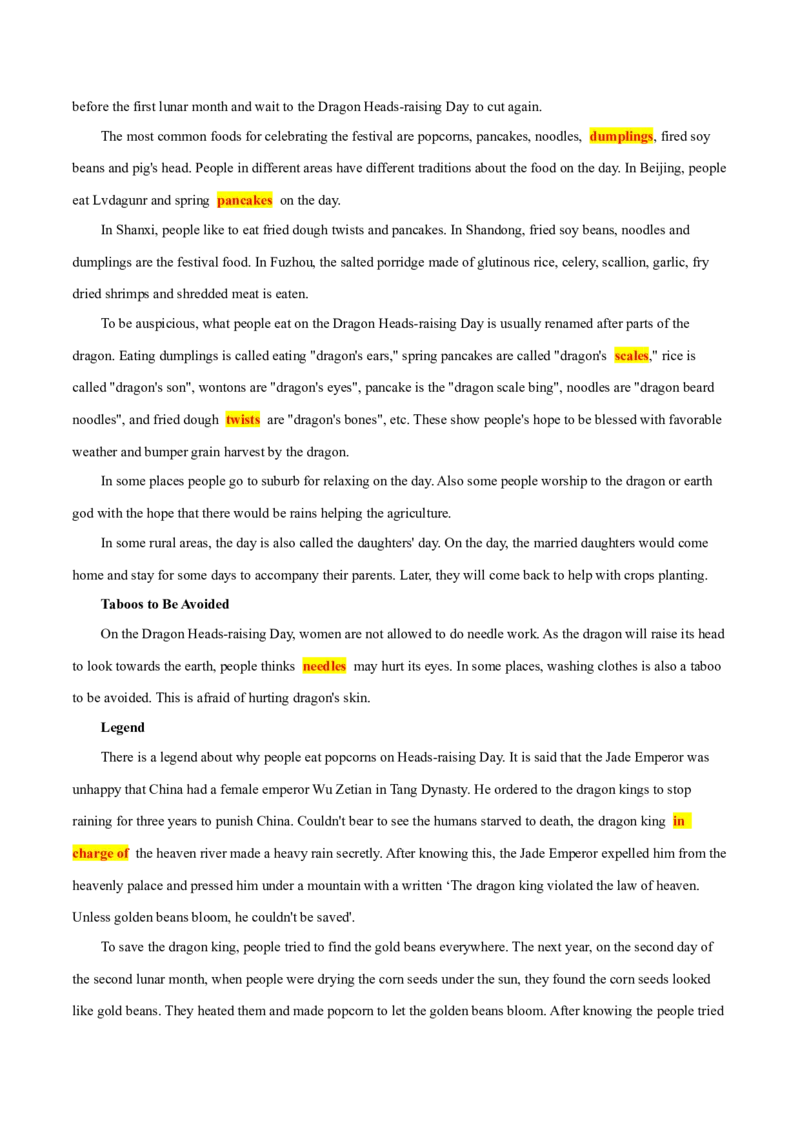
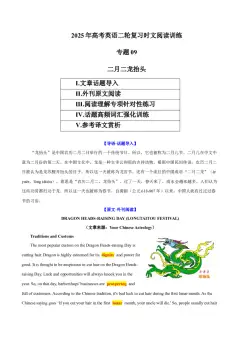
The most popular custom on the Dragon Heads-raising Day is
cutting hair. Dragon is highly esteemed for its dignity and power for
good. It is thought to be auspicious to cut hair on the Dragon Heads-
raising Day. Luck and opportunities will always knock you in the
year. So, on that day, barbershops' businesses are prospering and
full of customers. According to the Chinese tradition, it's bad luck to cut hair during the first lunar month. As the
Chinese saying goes ‘If you cut your hair in the first lunar month, your uncle will die.' So, people usually cut hairbefore the first lunar month and wait to the Dragon Heads-raising Day to cut again.
The most common foods for celebrating the festival are popcorns, pancakes, noodles, dumplings, fired soy
beans and pig's head. People in different areas have different traditions about the food on the day. In Beijing, people
eat Lvdagunr and spring pancakes on the day.
In Shanxi, people like to eat fried dough twists and pancakes. In Shandong, fried soy beans, noodles and
dumplings are the festival food. In Fuzhou, the salted porridge made of glutinous rice, celery, scallion, garlic, fry
dried shrimps and shredded meat is eaten.
To be auspicious, what people eat on the Dragon Heads-raising Day is usually renamed after parts of the
dragon. Eating dumplings is called eating "dragon's ears," spring pancakes are called "dragon's scales," rice is
called "dragon's son", wontons are "dragon's eyes", pancake is the "dragon scale bing", noodles are "dragon beard
noodles", and fried dough twists are "dragon's bones", etc. These show people's hope to be blessed with favorable
weather and bumper grain harvest by the dragon.
In some places people go to suburb for relaxing on the day. Also some people worship to the dragon or earth
god with the hope that there would be rains helping the agriculture.
In some rural areas, the day is also called the daughters' day. On the day, the married daughters would come
home and stay for some days to accompany their parents. Later, they will come back to help with crops planting.
Taboos to Be Avoided
On the Dragon Heads-raising Day, women are not allowed to do needle work. As the dragon will raise its head
to look towards the earth, people thinks needles may hurt its eyes. In some places, washing clothes is also a taboo
to be avoided. This is afraid of hurting dragon's skin.
Legend
There is a legend about why people eat popcorns on Heads-raising Day. It is said that the Jade Emperor was
unhappy that China had a female emperor Wu Zetian in Tang Dynasty. He ordered to the dragon kings to stop
raining for three years to punish China. Couldn't bear to see the humans starved to death, the dragon king in
charge of the heaven river made a heavy rain secretly. After knowing this, the Jade Emperor expelled him from the
heavenly palace and pressed him under a mountain with a written ‘The dragon king violated the law of heaven.
Unless golden beans bloom, he couldn't be saved'.
To save the dragon king, people tried to find the gold beans everywhere. The next year, on the second day of
the second lunar month, when people were drying the corn seeds under the sun, they found the corn seeds looked
like gold beans. They heated them and made popcorn to let the golden beans bloom. After knowing the people triedto save him, the dragon king raised its head and shouted to the Jade Emperor to see the golden beans bloom in
families. After seeing this, the Jade Emperor was allowed to return to the heavenly palace and in charge of making
wind and rain. From then on, there is the custom of eating popcorns on the 2nd day of the 2nd lunar month.
【原创·阅读理解】
1. Why is it considered auspicious to cut hair on the Dragon Heads - raising Day?
A. Because it is a long - standing tradition.
B. Because the dragon is highly respected.
C. Because people believe it can avoid bad luck.
D. Because barbershops offer special discounts on this day.
【答案】B
【解析】文章提到“龙因其威严和带来福祉的力量而备受尊崇。人们认为在龙抬头这天理发是吉祥的。在
这一年里,好运和机遇总会降临。” 所以在这天理发与对龙的尊崇以及期望获得好运和机遇有关。选项A
错误,因为有明确的原因;选项C说的是正月理发的厄运,并非龙抬头这天理发吉祥的原因;选项D在文
中未提及。
2. What food is NOT commonly associated with the Dragon Heads - raising Day according to the passage?
A. Popcorn
B. Pizza
C. Pancakes
D. Noodles
【答案】B
【解析】文章列举了“庆祝这个节日最常见的食物有爆米花、煎饼、面条、饺子、炒黄豆和猪头”。披萨
并不在这些龙抬头的传统食物之列。选项A、C和D都被提及是常见的节日食物。
3. Why are women not allowed to do needlework on the Dragon Heads - raising Day?
A. Because it is a day for women to rest.
B. Because people think needles may hurt the dragon's eyes as it raises its head.
C. Because doing needlework is considered bad luck on any day.
D. Because women need to prepare festival food.
【答案】B【解析】正如文章所说,“在龙抬头这天,妇女不被允许做针线活。因为龙会抬起头看向大地,人们认为
针可能会伤到它的眼睛”。选项A不是文中给出的原因;选项C错误,因为做针线活只是在这个特定日子
因特定原因受到限制;选项D与禁止做针线活没有关系。
4. According to the legend, why did the Jade Emperor punish China?
A. Because the dragon king made a heavy rain secretly.
B. Because people ate popcorn on the wrong day.
C. Because there was a female emperor Wu Zetian in Tang Dynasty.
D. Because people worshiped the dragon instead of the Jade Emperor.
【答案】C
【解析】文章中传说部分提到“据说玉皇大帝因为唐朝有女皇帝武则天而不高兴。他命令龙王三年不下雨
来惩罚中国”。选项A是龙王怜悯人类的结果,并非玉皇大帝惩罚的原因;选项B与玉皇大帝的惩罚毫无
关系;选项D未被提及是惩罚的原因。
【巩固·高频词汇】
1.To raise your interest in writing poetry, the Student Union plans to hold Poetry Writing Contest. (英译汉)
【答案】为了提高你们写诗的兴趣,学生会计划举办诗歌写作比赛。
【详解】考查非谓语动词和短语。不定式短语To raise your interest in writing poetry,作目的状语,表“为
了提高你们写诗的兴趣”;主语the Student Union表示“学生会”;plans to表示“计划”;hold Poetry
Writing Contest表示“举办诗歌写作比赛”。为一般现在时。故翻译为:为了提高你们写诗的兴趣,学生
会计划举办诗歌写作比赛。
2.所有的路,无论它们如何曲折扭转,都能指引我们回到心灵的家园。(twist, 让步状语从句)(汉译英)
【答案】All roads, no matter how much they twist and turn, can lead us home in our hearts.
【详解】考查状语从句和动词时态。表示“所有的路”应用all roads;表示“无论如何”应用no matter
how much,引导让步状语从句;表示“他们”应用they;表示“曲折和扭转”应用twist and turn,此处陈
述客观事实,使用一般现在时,主语为they,谓语动词用原形;表示“能够”应用can;表示“指引我们
回到心灵的家园”应用 lead us home in our hearts,位于情态动词can后面,使用动词原形。故翻译成:All
roads, no matter how much they twist and turn, can lead us home in our hearts.
3.The festival falls on the fourth day of the six month of the lunar calendar, usually lasting for three days. (英译
汉)【答案】该节日于每年农历六月初四开始的,通常为期3天。
【详解】考查动词短语,非谓语短语。动词短语falls on译为“适逢某一天”;the fourth day of the six
month of the lunar calendar译为“阴历六月的第四天”;伴随状语usually lasting for three days译为“通常为
期3天”。结合其他单词,可翻译为:该节日于每年农历六月初四开始的,通常为期3天。
4.She accepted the criticism with quiet dignity. (英译汉)
【答案】她大度地接受了批评。
【详解】考查句子结构。本句为主谓宾装结构;主语为she,accepted the criticism表示“接受了批评”,
accept是谓语,the critism是宾语;短语with quiet dignity表示“大度地”,作状语。故翻译为:她大度地
接受了批评。
5.销售经理进行了大规模调查,旨在了解产品的潜在消费群。(scale) (汉译英)
【答案】The sales manager conducted the surveys on a large scale, aiming to have a knowledge of/to know about
the potential consumer group/consumers.
【详解】考查名词,动词时态以及非谓语动词。根据汉语提示,句子表述过去事实,故使用一般过去时。
表示“销售经理”用the sales manager;表示“实施调查”用conduct the surveys;表示“大规模”用 on a
large scale,此处使用介词短语作状语;表示“旨在做某事”用aim at doing sth,此处the sales manager与
aim之间是主动关系,故使用现在分词作状语;表示“了解……”用have a knowledge of sth或者know
about sth;表示“产品的潜在消费群”用the potential consumer group/consumers。故翻译为The sales
manager conducted the surveys on a large scale, aiming to have a knowledge of/to know about the potential
consumer group/consumers.
6.Chinese dumplings, also called jiaozi, are small pieces of dough wrapped around a filling.
中国的水饺, , 是 小块生面团。
【答案】 也叫饺子 里面包着馅的
【详解】考查句子结构。分析句子结构可知,also called jiaozi“也叫饺子”在句中作定语,of dough wrapped
around a filling.“里面包着馅的”也是定语,故设空处可译为①也叫饺子②里面包着馅的。
7.The man who had taken charge of the company was charged with taking drugs.
→The man who had been in charge of the company .(accuse) (句型转换)
【答案】was accused of taking drugs【详解】考查固定短语,时态和主谓一致。对比两句话可知,空格处替换的是上一句中的“was charged
with taking drugs”,“was charged with”意为“被控”,可换为was accused of,后跟taking drugs作宾语,
因此空格处是was accused of taking drugs。故填was accused of taking drugs。
8.句型公式:as引导时间状语从句
随着公共汽车逐渐靠近城镇,汤姆浑身颤抖,如坐针毡。(心理描写)
, Tom shook all over, feeling like sitting on pins and needles.
【答案】As the bus got closer and closer to the town
【详解】考查状语从句和时态。表示“随着”应用as引导时间状语从句;表示“公共汽车”应用the bus;
表示“逐渐靠近城镇”应用get closer and closer to the town,结合“shook”可知,此处使用一般过去时。故
填:As the bus got closer and closer to the town。
9.The first pancake was made of corn.
你早餐吃的第一个煎饼是玉米做的。
【答案】that you had for breakfast
【详解】考查定语从句。中英文对比可知缺少“你早餐吃的”,可以使用定语从句修饰先行词 pancake ,
关系词替代先行词在从句作宾语,且先行词由序数词修饰,只能用that引导;定语从句中主语为you;表
示“吃早饭”have sth. for breakfast。结合后文was可知句子时态为一般过去时。故填that you had for
breakfast。
【参考·中文翻译】
二月二龙抬头这一天最流行的习俗是理发。龙因其威严和带来福祉的力量而备受尊崇。人们认为在龙
抬头这一天理发是吉祥的,这一年里好运和机遇将会常伴左右。所以,在那一天,理发店生意兴隆,顾客
盈门。按照中国传统,正月里理发不吉利。正如中国的一句俗语所说:“正月不剃头,剃头死舅舅。”
所以,人们通常会在正月之前理发,然后等到龙抬头这一天再理发。
庆祝这个节日最常见的食物有爆米花、烙饼、面条、饺子、炒黄豆和猪头肉。不同地区的人们在这一
天对于食物有着不同的传统。在北京,人们在这一天会吃驴打滚和春饼。
在山西,人们喜欢吃麻花和烙饼。在山东,炒黄豆、面条和饺子是节日食物。在福州,人们会吃由糯
米、芹菜、葱、蒜、炒海米和肉丝做成的咸粥。
为了图个吉利,人们在龙抬头这一天吃的东西通常会以龙的身体部位来重新命名。吃饺子被叫做吃
“龙耳”,春饼被叫做“龙鳞”,米饭被叫做“龙子”,馄饨是“龙眼”,烙饼是“龙鳞饼”,面条是
“龙须面”,麻花是“龙骨”等等。这些都体现了人们希望得到龙的庇佑,风调雨顺、五谷丰登的愿望。在一些地方,人们会在这一天去郊区放松身心。也有一些人会祭拜龙王或土地神,希望能有降雨来助
力农业生产。
在一些农村地区,这一天也被称为“闺女节”。在这一天,出嫁的女儿会回娘家,并待上几天陪伴父
母。之后,她们会回来帮忙种植庄稼。
需避免的禁忌
在龙抬头这一天,妇女不允许做针线活。因为龙会抬起头看向人间,人们认为针可能会伤到它的眼睛。
在一些地方,洗衣服也是需要避免的禁忌,这是因为担心会伤到龙皮。
传说
关于为什么人们在龙抬头这一天吃爆米花,有一个传说。据说,玉皇大帝对唐朝出了一位女皇帝武则
天感到不满。他命令龙王三年不准降雨来惩罚人间。掌管天河的龙王不忍心看到人类饿死,便偷偷下了一
场大雨。玉皇大帝得知此事后,将龙王逐出天宫,并把他压在一座山下,还立了一块石碑,上面写道:
“龙王犯天条,当受人间千秋罪。若想重登凌霄阁,除非金豆开花时。”
为了救龙王,人们四处寻找金豆子。第二年,农历二月初二,人们在晒玉米种子的时候,发现玉米种
子看起来就像金豆子。他们把玉米种子炒熟做成爆米花,让“金豆子”开花。龙王得知人们在想办法救他
后,抬起头向玉皇大帝呼喊,让他看看家家户户“金豆开花”了。玉皇大帝看到后,便允许龙王返回天宫,
继续掌管风雨。从那以后,就有了农历二月初二吃爆米花的习俗。