Lesson 6 Lucky Number and Lucky Culture
幸运号码和吉祥文化
Auspicious numbers have long played a part in Chinese culture -- witness the 9,999 rooms of Beijing's Forbidden
City -- and the right digits can still play a role in the choice of a home, telephone
number or even a birthday.
Even numbers are luckier than odd. Two suggests harmony, six smooth
progress. Four, a homonym for
death, is unlucky, while nine, as
highest single digit, stands for longevity.
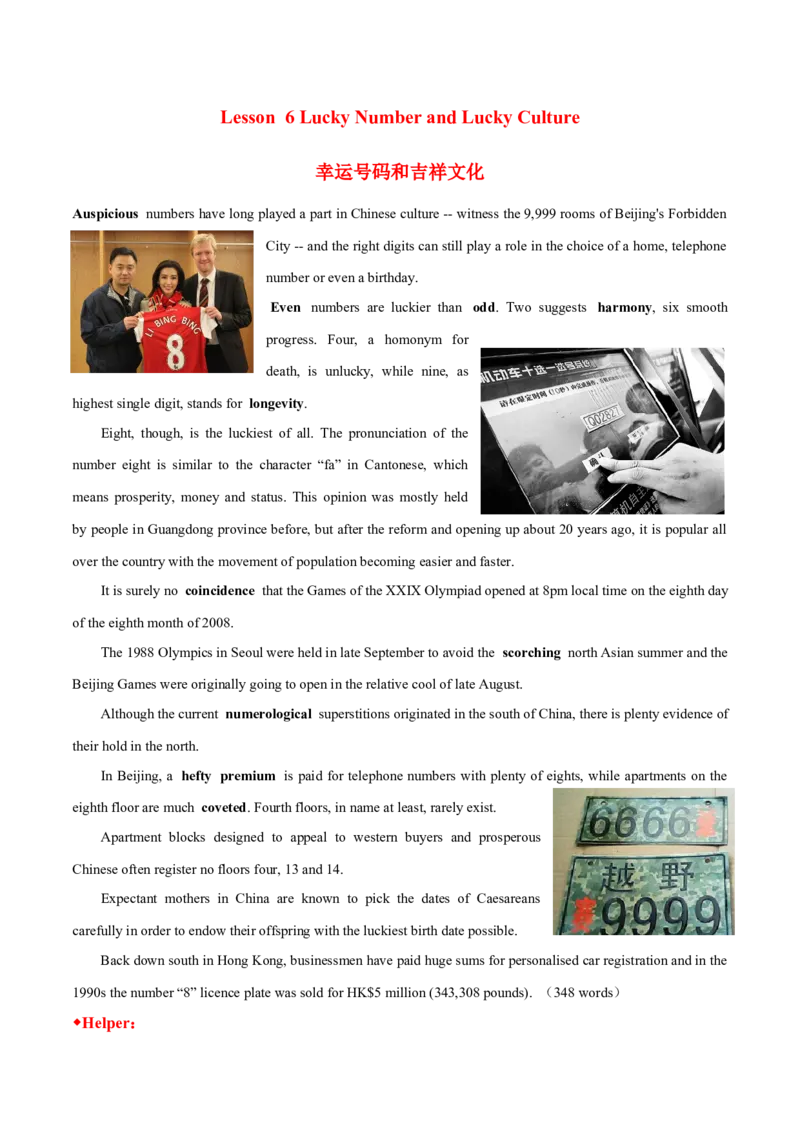
Eight, though, is the luckiest of all. The pronunciation of the
number eight is similar to the character “fa” in Cantonese, which
means prosperity, money and status. This opinion was mostly held
by people in Guangdong province before, but after the reform and opening up about 20 years ago, it is popular all
over the country with the movement of population becoming easier and faster.
It is surely no coincidence that the Games of the XXIX Olympiad opened at 8pm local time on the eighth day
of the eighth month of 2008.
The 1988 Olympics in Seoul were held in late September to avoid the scorching north Asian summer and the
Beijing Games were originally going to open in the relative cool of late August.
Although the current numerological superstitions originated in the south of China, there is plenty evidence of
their hold in the north.
In Beijing, a hefty premium is paid for telephone numbers with plenty of eights, while apartments on the
eighth floor are much coveted. Fourth floors, in name at least, rarely exist.
Apartment blocks designed to appeal to western buyers and prosperous
Chinese often register no floors four, 13 and 14.
Expectant mothers in China are known to pick the dates of Caesareans
carefully in order to endow their offspring with the luckiest birth date possible.
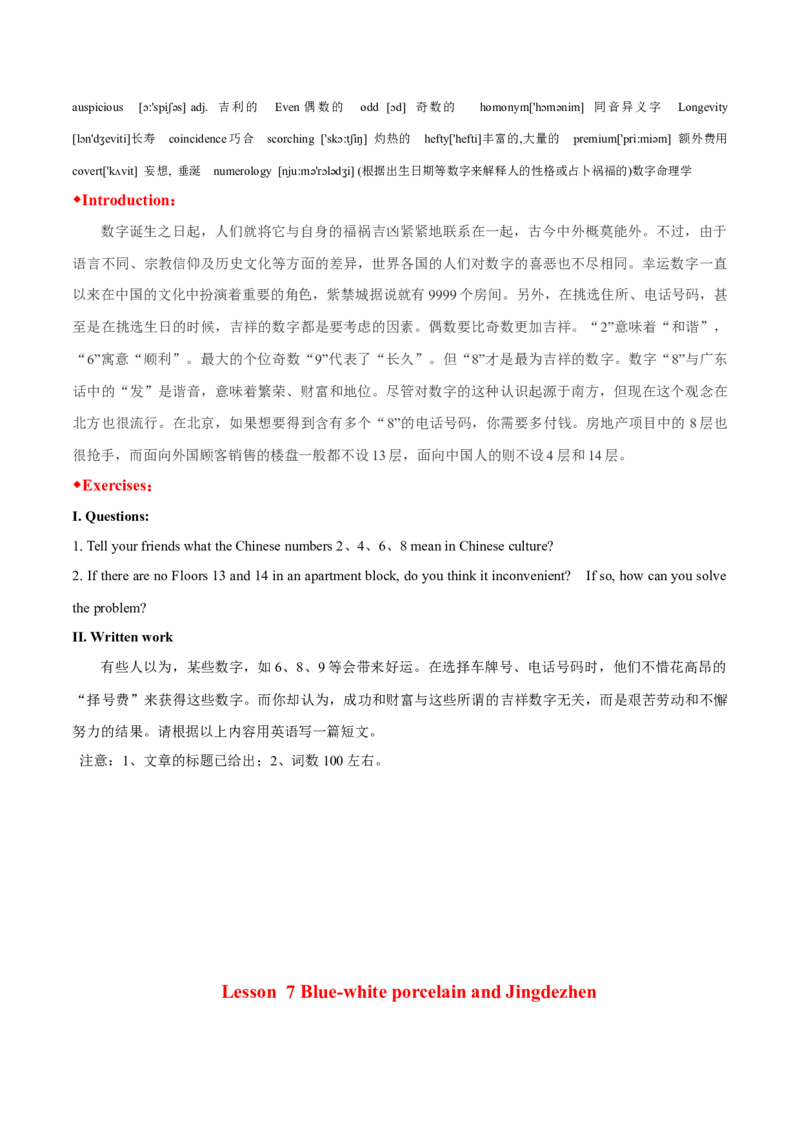
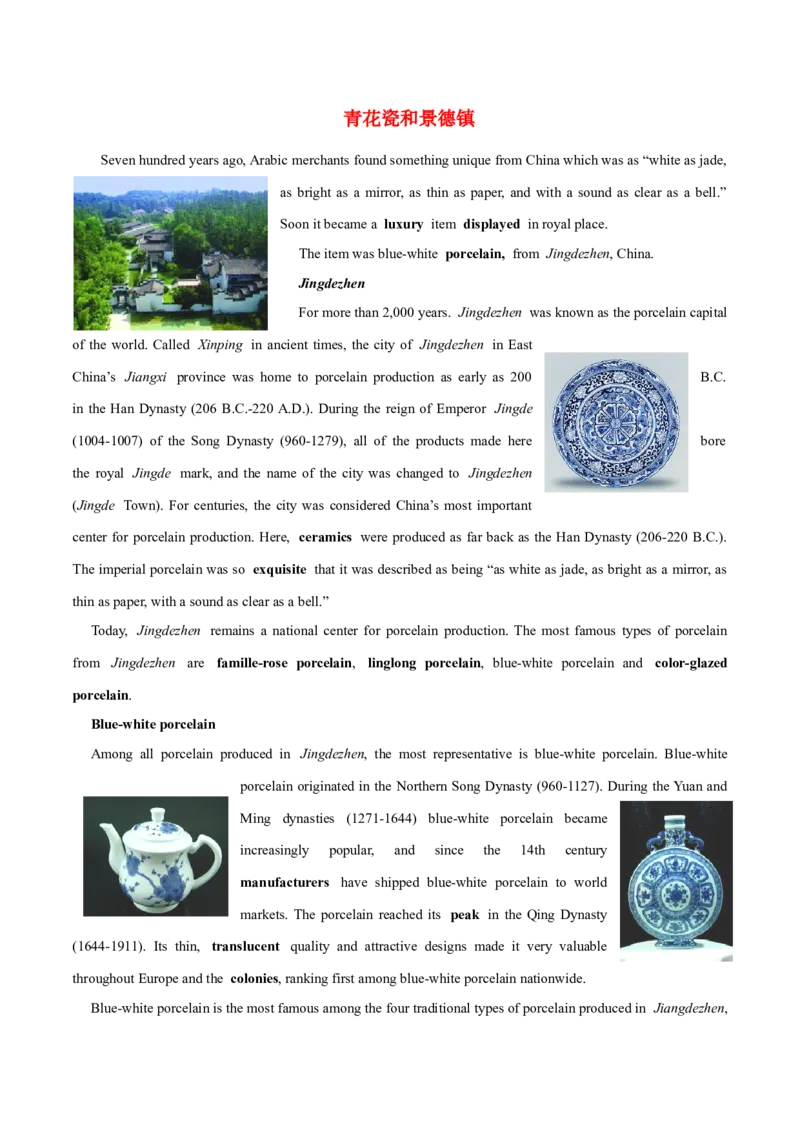
Back down south in Hong Kong, businessmen have paid huge sums for personalised car registration and in the
1990s the number “8” licence plate was sold for HK$5 million (343,308 pounds). (348 words)
◆Helper:auspicious [ɔ:'spiʃəs] adj. 吉利的 Even 偶数的 odd [ɔd] 奇数的 homonym['hɔmənim] 同音异义字 Longevity
[lɔn'dʒeviti]长寿 coincidence巧合 scorching ['skɔ:tʃiŋ] 灼热的 hefty['hefti]丰富的,大量的 premium['pri:miəm] 额外费用
covert['kʌvit] 妄想, 垂涎 numerology [nju:mə'rɔlədʒi] (根据出生日期等数字来解释人的性格或占卜祸福的)数字命理学
◆Introduction:
数字诞生之日起,人们就将它与自身的福祸吉凶紧紧地联系在一起,古今中外概莫能外。不过,由于
语言不同、宗教信仰及历史文化等方面的差异,世界各国的人们对数字的喜恶也不尽相同。幸运数字一直
以来在中国的文化中扮演着重要的角色,紫禁城据说就有9999个房间。另外,在挑选住所、电话号码,甚
至是在挑选生日的时候,吉祥的数字都是要考虑的因素。偶数要比奇数更加吉祥。“2”意味着“和谐”,
“6”寓意“顺利”。最大的个位奇数“9”代表了“长久”。但“8”才是最为吉祥的数字。数字“8”与广东
话中的“发”是谐音,意味着繁荣、财富和地位。尽管对数字的这种认识起源于南方,但现在这个观念在
北方也很流行。在北京,如果想要得到含有多个“8”的电话号码,你需要多付钱。房地产项目中的 8层也
很抢手,而面向外国顾客销售的楼盘一般都不设13层,面向中国人的则不设4层和14层。
◆Exercises:
I. Questions:
1. Tell your friends what the Chinese numbers 2、4、6、8 mean in Chinese culture?
2. If there are no Floors 13 and 14 in an apartment block, do you think it inconvenient? If so, how can you solve
the problem?
II. Written work
有些人以为,某些数字,如6、8、9等会带来好运。在选择车牌号、电话号码时,他们不惜花高昂的
“择号费”来获得这些数字。而你却认为,成功和财富与这些所谓的吉祥数字无关,而是艰苦劳动和不懈
努力的结果。请根据以上内容用英语写一篇短文。
注意:1、文章的标题已给出;2、词数100左右。
Lesson 7 Blue-white porcelain and Jingdezhen青花瓷和景德镇
Seven hundred years ago, Arabic merchants found something unique from China which was as “white as jade,
as bright as a mirror, as thin as paper, and with a sound as clear as a bell.”
Soon it became a luxury item displayed in royal place.
The item was blue-white porcelain, from Jingdezhen, China.
Jingdezhen
For more than 2,000 years. Jingdezhen was known as the porcelain capital
of the world. Called Xinping in ancient times, the city of Jingdezhen in East
China’s Jiangxi province was home to porcelain production as early as 200 B.C.
in the Han Dynasty (206 B.C.-220 A.D.). During the reign of Emperor Jingde
(1004-1007) of the Song Dynasty (960-1279), all of the products made here bore
the royal Jingde mark, and the name of the city was changed to Jingdezhen
(Jingde Town). For centuries, the city was considered China’s most important
center for porcelain production. Here, ceramics were produced as far back as the Han Dynasty (206-220 B.C.).
The imperial porcelain was so exquisite that it was described as being “as white as jade, as bright as a mirror, as
thin as paper, with a sound as clear as a bell.”
Today, Jingdezhen remains a national center for porcelain production. The most famous types of porcelain
from Jingdezhen are famille-rose porcelain, linglong porcelain, blue-white porcelain and color-glazed
porcelain.
Blue-white porcelain
Among all porcelain produced in Jingdezhen, the most representative is blue-white porcelain. Blue-white
porcelain originated in the Northern Song Dynasty (960-1127). During the Yuan and
Ming dynasties (1271-1644) blue-white porcelain became
increasingly popular, and since the 14th century
manufacturers have shipped blue-white porcelain to world
markets. The porcelain reached its peak in the Qing Dynasty
(1644-1911). Its thin, translucent quality and attractive designs made it very valuable
throughout Europe and the colonies, ranking first among blue-white porcelain nationwide.
Blue-white porcelain is the most famous among the four traditional types of porcelain produced in Jiangdezhen,and is famous as the “ever-lasting blue flower.” The blue-white style is created by drawing the design with cobalt
pigment onto the stoneware body and painting over it with a transparent glaze. This style is also known as
“underglazed blue.” The piece is then fired at a high temperature. Blue-white porcelain has been in production
ever since thanks to its bright colors, simple yet elegant patterns, and smooth glaze that never fades.
The Yuan Dynasty was a key period for the development of firing techniques for blue-white porcelain in China.
Its unique characteristics were based on the techniques of former dynasties. It was during this
period that blue and white porcelain was perfected and came to characterize the Ming
Dynasty. China's multi-colored porcelain was often given as gifts on diplomatic missions.
In 1979 Jingdezhen blue-white porcelain won a national golden prize and in 1985 it was
honored with three gold medals at different international fairs. Since then, the name
“Jingdezhen Blue-white Porcelain” has spread far and wide. It is by far a top product in the
porcelain business, boasting the most prizes and the highest standards. (502 words)
◆Helper:
luxury [ˈlʌkʃəri] 奢华的,豪华的 display [disˈplei] 显示,陈列 porcelain [ˈpɔ:slin] 瓷,瓷器 ceramic[sɪ'ræmɪk] 陶瓷制品
exquisite [ɪkˈskwɪzɪt] 精致的,细腻的 famille-rose porcelain粉彩瓷 color-glazed porcelain颜色釉瓷器 linglong porcelain玲
珑瓷 manufacturer [ˌmænjuˈfæktʃərə] 制造商,制造厂 peak [pi:k] 山峰,最高点 translucent [trænsˈlu:snt] 半透明的,有
光泽的 colony [ˈkɔləni] 侨民, 侨居地 cobalt ['kəʊbɔ:lt] 钴类颜料, 深蓝色 pigment ['pɪɡmənt] 颜料,色料 underglazed
blue [ˈʌndəɡleiz blu:] 青花 fade [feid] 失去光泽 boast [bəust] 以有…而自豪, 自夸
◆Chinese Brief Introduction:
景德镇由于制瓷历史悠久,瓷器产品质地精良,对外影响大,“瓷都”两字成了景德镇的称号。被誉
为“世界瓷都”,更是“中国瓷都”。青花瓷(blue and white porcelain),又称白地青花瓷,常简称青
花,是中国瓷器的主流品种之一,属釉下彩瓷。青花瓷是用含氧化钴的钴矿为原料,在陶瓷坯体上描绘纹
饰,再罩上一层透明釉,经高温还原焰一次烧成。钴料烧成后呈蓝色,具有着色力强、发色鲜艳、烧成率
高、呈色稳定的特点。原始青花瓷于唐宋已见端倪,成熟的青花瓷则出现在元代景德镇的湖田窑。明代青
花成为瓷器的主流。清康熙时发展到了顶峰。明清时期,还创烧了青花五彩、孔雀绿釉青花、豆青釉青
花、青花红彩、黄地青花、哥釉青花等衍生品种。
◆Exercise:
Questions:
1. How was the imperial porcelain described?
2. When was Xinping changed to Jingde Town?3. How many famous types of porcelain from Jingdezhen are there? What are they?
4. What made blue-white porcelain very valuable throughout Europe and the colonies?
5. What is “underglazed blue”?
6. When was it that blue-white porcelain in China was perfected?SUGGESTED ANSWERS:
6. Lucky Number and Lucky Culture Popular in China
II. Written work
Do "Lucky Numbers" Really Bring Good Luck?
Some people think certain numbers may bring good luck to them. These numbers include "6, 8, 9" and so on.
Therefore, when they want to choose a car number or a phone number, they buy the number which ends with these
lucky numbers at a high price.
In my opinion, success and luck have nothing to do with such so-called lucky numbers. The only key to success
or wealth lies in hard work and persistence. If we are too dependent on the lucky numbers, we may become lazy or
even discouraged when they proved to be useless. We should believe in ourselves and make great efforts to struggle
for success as well as wealth.