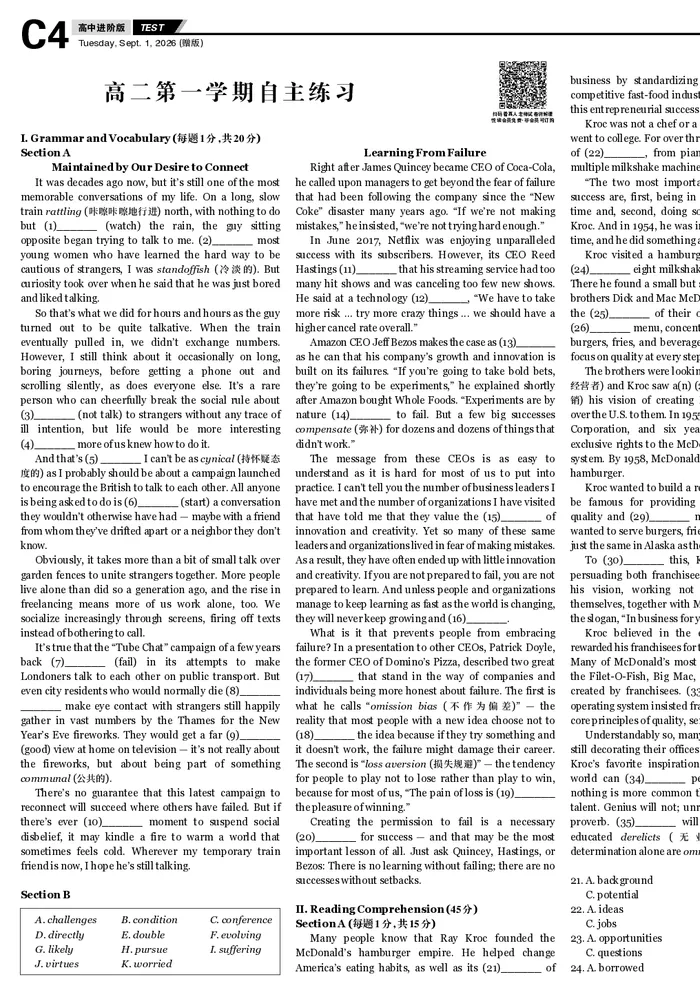
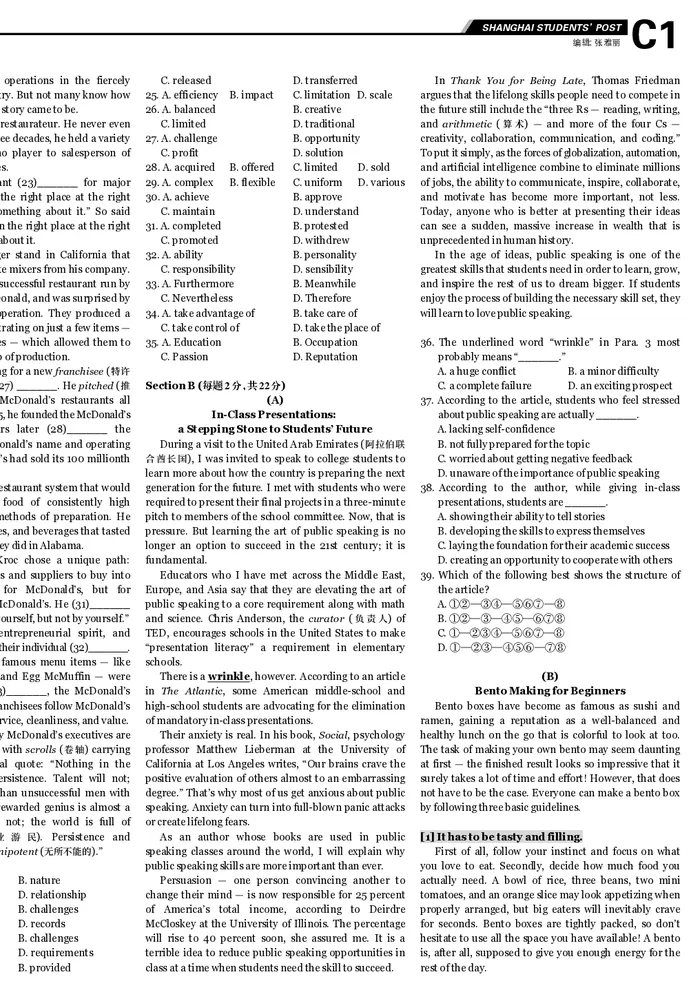
I. Grammar and Vocabulary (每题1分,共20分)
Section A
Maintained by Our Desire to Connect
It was decades ago now, but it’s still one of the most
memorable conversations of my life. On a long, slow
train rattling (咔嚓咔嚓地行进) north, with nothing to do
but (1)______ (watch) the rain, the guy sitting
opposite began trying to talk to me. (2)______ most
young women who have learned the hard way to be
cautious of strangers, I was standoffish ( 冷淡的). But
curiosity took over when he said that he was just bored
and liked talking.
So that’s what we did for hours and hours as the guy
turned out to be quite talkative. When the train
eventually pulled in, we didn’t exchange numbers.
However, I still think about it occasionally on long,
boring journeys, before getting a phone out and
scrolling silently, as does everyone else. It’s a rare
person who can cheerfully break the social rule about
(3)______ (not talk) to strangers without any trace of
ill intention, but life would be more interesting
(4)______ more of us knew how to do it.
And that’s (5) ______ I can’t be as cynical (持怀疑态
度的) as I probably should be about a campaign launched
to encourage the British to talk to each other. All anyone
is being asked to do is (6)______ (start) a conversation
they wouldn’t otherwise have had — maybe with a friend
from whom they’ve drifted apart or a neighbor they don’t
know.
Obviously, it takes more than a bit of small talk over
garden fences to unite strangers together. More people
live alone than did so a generation ago, and the rise in
freelancing means more of us work alone, too. We
socialize increasingly through screens, firing off texts
instead of bothering to call.
It’s true that the “Tube Chat” campaign of a few years
back (7)______ (fail) in its attempts to make
Londoners talk to each other on public transport. But
even city residents who would normally die (8)______
______ make eye contact with strangers still happily
gather in vast numbers by the Thames for the New
Year’s Eve fireworks. They would get a far (9)______
(good) view at home on television — it’s not really about
the fireworks, but about being part of something
communal (公共的).
There’s no guarantee that this latest campaign to
reconnect will succeed where others have failed. But if
there’s ever (10)______ moment to suspend social
disbelief, it may kindle a fire to warm a world that
sometimes feels cold. Wherever my temporary train
friend is now, I hope he’s still talking.
Section B
A. challenges        B. condition
C. conference
D. directly
        E. double
F. evolving
G. likely
        H. pursue
I. suffering
J. virtues
        K. worried
Learning From Failure
Right after James Quincey became CEO of Coca-Cola,
he called upon managers to get beyond the fear of failure
that had been following the company since the “New
Coke” disaster many years ago. “If we’re not making
mistakes,” he insisted, “we’re not trying hard enough.”
In June 2017, Netflix was enjoying unparalleled
success with its subscribers. However, its CEO Reed
Hastings (11)______ that his streaming service had too
many hit shows and was canceling too few new shows.
He said at a technology (12)______, “We have to take
more risk ... try more crazy things ... we should have a
higher cancel rate overall.”
Amazon CEO Jeff Bezos makes the case as (13)______
as he can that his company’s growth and innovation is
built on its failures. “If you’re going to take bold bets,
they’re going to be experiments,” he explained shortly
after Amazon bought Whole Foods. “Experiments are by
nature (14)______ to fail. But a few big successes
compensate (弥补) for dozens and dozens of things that
didn’t work.”
The message from these CEOs is as easy to
understand as it is hard for most of us to put into
practice. I can’t tell you the number of business leaders I
have met and the number of organizations I have visited
that have told me that they value the (15)______ of
innovation and creativity. Yet so many of these same
leaders and organizations lived in fear of making mistakes.
As a result, they have often ended up with little innovation
and creativity. If you are not prepared to fail, you are not
prepared to learn. And unless people and organizations
manage to keep learning as fast as the world is changing,
they will never keep growing and (16)______.
What is it that prevents people from embracing
failure? In a presentation to other CEOs, Patrick Doyle,
the former CEO of Domino’s Pizza, described two great
(17)______ that stand in the way of companies and
individuals being more honest about failure. The first is
what he calls “omission bias ( 不作为偏差)” — the
reality that most people with a new idea choose not to
(18)______ the idea because if they try something and
it doesn’t work, the failure might damage their career.
The second is “loss aversion (损失规避)” — the tendency
for people to play not to lose rather than play to win,
because for most of us, “The pain of loss is (19)______
the pleasure of winning.”
Creating the permission to fail is a necessary
(20)______ for success — and that may be the most
important lesson of all. Just ask Quincey, Hastings, or
Bezos: There is no learning without failing; there are no
successes without setbacks.
II. Reading Comprehension (45分)
Section A (每题1分,共15分)
Many people know that Ray Kroc founded the
McDonald’s hamburger empire. He helped change
America’s eating habits, as well as its (21)______ of
business by standardizing
competitive fast-food indust
this entrepreneurial success
Kroc was not a chef or a
went to college. For over thr
of (22)______, from pian
multiple milkshake machine
“The two most importa
success are, first, being in
time and, second, doing so
Kroc. And in 1954, he was in
time, and he did something a
Kroc visited a hamburg
(24)______ eight milkshak
There he found a small but s
brothers Dick and Mac McD
the (25)______ of their o
(26)______ menu, concent
burgers, fries, and beverage
focus on quality at every step
The brothers were lookin
经营者) and Kroc saw a(n) (2
销) his vision of creating M
over the U.S. to them. In 1955
Corporation, and six yea
exclusive rights to the McDo
system. By 1958, McDonald
hamburger.
Kroc wanted to build a re
be famous for providing
quality and (29)______ m
wanted to serve burgers, frie
just the same in Alaska as the
To (30)______ this, K
persuading both franchisee
his vision, working not
themselves, together with M
the slogan, “In business for y
Kroc believed in the e
rewarded his franchisees for t
Many of McDonald’s most
the Filet-O-Fish, Big Mac,
created by franchisees. (33
operating system insisted fra
core principles of quality, ser
Understandably so, many
still decorating their offices
Kroc’s favorite inspirationa
world can (34)______ pe
nothing is more common th
talent. Genius will not; unr
proverb. (35)______ will
educated derelicts ( 无业
determination alone are omn
21. A. background
C. potential
22. A. ideas
C. jobs
23. A. opportunities
C. questions
24. A. borrowed
Tuesday, Sept. 1, 2026 (赠版)
C4
高中进阶版
高二第一学期自主练习
TEST
扫码看真人老师试卷讲解课
悦读会员免费·非会员可订购
operations in the fiercely
try. But not many know how
story came to be.
restaurateur. He never even
ee decades, he held a variety
no player to salesperson of
es.
ant (23)______ for major
the right place at the right
omething about it.” So said
n the right place at the right
about it.
ger stand in California that
ke mixers from his company.
successful restaurant run by
Donald, and was surprised by
operation. They produced a
trating on just a few items —
es — which allowed them to
p of production.
ng for a new franchisee (特许
27) ______. He pitched (推
McDonald’s restaurants all
5, he founded the McDonald’s
rs later (28)______ the
onald’s name and operating
’s had sold its 100 millionth
estaurant system that would
food of consistently high
methods of preparation. He
es, and beverages that tasted
ey did in Alabama.
Kroc chose a unique path:
s and suppliers to buy into
for McDonald’s, but for
McDonald’s. He (31)______
yourself, but not by yourself.”
entrepreneurial spirit, and
their individual (32)______.
famous menu items — like
and Egg McMuffin — were
3)______, the McDonald’s
anchisees follow McDonald’s
rvice, cleanliness, and value.
y McDonald’s executives are
with scrolls (卷轴) carrying
al quote: “Nothing in the
ersistence. Talent will not;
han unsuccessful men with
rewarded genius is almost a
not; the world is full of
业游民). Persistence and
nipotent (无所不能的).”
B. nature
D. relationship
B. challenges
D. records
B. challenges
D. requirements
B. provided
C. released
D. transferred
25. A. efficiency
B. impact
C. limitation   D. scale
26. A. balanced
B. creative
C. limited
D. traditional
27. A. challenge
B. opportunity
C. profit
D. solution
28. A. acquired
B. offered
C. limited
 D. sold
29. A. complex
B. flexible
C. uniform
 D. various
30. A. achieve
B. approve
C. maintain
D. understand
31. A. completed
B. protested
C. promoted
D. withdrew
32. A. ability
B. personality
C. responsibility
D. sensibility
33. A. Furthermore
B. Meanwhile
C. Nevertheless
D. Therefore
34. A. take advantage of
B. take care of
C. take control of
D. take the place of
35. A. Education
B. Occupation
C. Passion
D. Reputation
Section B (每题2分,共22分)
(A)
In-Class Presentations:
a Stepping Stone to Students’ Future
During a visit to the United Arab Emirates (阿拉伯联
合酋长国), I was invited to speak to college students to
learn more about how the country is preparing the next
generation for the future. I met with students who were
required to present their final projects in a three-minute
pitch to members of the school committee. Now, that is
pressure. But learning the art of public speaking is no
longer an option to succeed in the 21st century; it is
fundamental.
Educators who I have met across the Middle East,
Europe, and Asia say that they are elevating the art of
public speaking to a core requirement along with math
and science. Chris Anderson, the curator ( 负责人) of
TED, encourages schools in the United States to make
“presentation literacy” a requirement in elementary
schools.
There is a wrinkle, however. According to an article
in The Atlantic, some American middle-school and
high-school students are advocating for the elimination
of mandatory in-class presentations.
Their anxiety is real. In his book, Social, psychology
professor Matthew Lieberman at the University of
California at Los Angeles writes, “Our brains crave the
positive evaluation of others almost to an embarrassing
degree.” That’s why most of us get anxious about public
speaking. Anxiety can turn into full-blown panic attacks
or create lifelong fears.
As an author whose books are used in public
speaking classes around the world, I will explain why
public speaking skills are more important than ever.
Persuasion — one person convincing another to
change their mind — is now responsible for 25 percent
of America’s total income, according to Deirdre
McCloskey at the University of Illinois. The percentage
will rise to 40 percent soon, she assured me. It is a
terrible idea to reduce public speaking opportunities in
class at a time when students need the skill to succeed.
In Thank You for Being Late, Thomas Friedman
argues that the lifelong skills people need to compete in
the future still include the “three Rs — reading, writing,
and arithmetic ( 算术) — and more of the four Cs —
creativity, collaboration, communication, and coding.”
To put it simply, as the forces of globalization, automation,
and artificial intelligence combine to eliminate millions
of jobs, the ability to communicate, inspire, collaborate,
and motivate has become more important, not less.
Today, anyone who is better at presenting their ideas
can see a sudden, massive increase in wealth that is
unprecedented in human history.
In the age of ideas, public speaking is one of the
greatest skills that students need in order to learn, grow,
and inspire the rest of us to dream bigger. If students
enjoy the process of building the necessary skill set, they
will learn to love public speaking.
36. The underlined word “wrinkle” in Para. 3 most
probably means “______.”
A. a huge conflict
B. a minor difficulty
C. a complete failure
D. an exciting prospect
37. According to the article, students who feel stressed
about public speaking are actually ______.
A. lacking self-confidence
B. not fully prepared for the topic
C. worried about getting negative feedback
D. unaware of the importance of public speaking
38. According to the author, while giving in-class
presentations, students are ______.
A. showing their ability to tell stories
B. developing the skills to express themselves
C. laying the foundation for their academic success
D. creating an opportunity to cooperate with others
39. Which of the following best shows the structure of
the article?
A. ①②—③④—⑤⑥⑦—⑧
B. ①②—③—④⑤—⑥⑦⑧
C. ①—②③④—⑤⑥⑦—⑧
D. ①—②③—④⑤⑥—⑦⑧
(B)
Bento Making for Beginners
Bento boxes have become as famous as sushi and
ramen, gaining a reputation as a well-balanced and
healthy lunch on the go that is colorful to look at too.
The task of making your own bento may seem daunting
at first — the finished result looks so impressive that it
surely takes a lot of time and effort! However, that does
not have to be the case. Everyone can make a bento box
by following three basic guidelines.
[1] It has to be tasty and filling.
First of all, follow your instinct and focus on what
you love to eat. Secondly, decide how much food you
actually need. A bowl of rice, three beans, two mini
tomatoes, and an orange slice may look appetizing when
properly arranged, but big eaters will inevitably crave
for seconds. Bento boxes are tightly packed, so don’t
hesitate to use all the space you have available! A bento
is, after all, supposed to give you enough energy for the
rest of the day.
C1
编辑: 罗梦佳
编辑: 张雅丽
SHANGHAI STUDENTS’ POST
C2
[2] ______
A bento box is designed to be carried around for a
few hours before you dive in to recharge your energy.
The food inside needs to withstand room temperatures
while keeping its shape. The food you choose does not
always have to be dry. Pickled ( 腌制的) vegetables in
plastic cups, for example, will not spill over into the
other ingredients.
While a bento can easily be made of leftovers, rice
should be either freshly made in the morning or frozen.
On hot days, add vinegar ( 醋) to your rice to keep it
from spoiling, or salt it and shape it into rice balls. Other
carbohydrates (碳水化合物) are surprisingly great bento
choices. Pasta, for example, will keep for a long time if
your sauce is not dairy-based.
[3] Balance is key.
The word “balance” is important when you plan a
bento. Indeed, it affects every aspect of the box.
● Ingredients
For traditional Japanese bento boxes, the balance
starts with 50% carbohydrates vs. 50% proteins,
vegetables, and other sides. While you are the chef of
your bento, remember to bring balance to your food
with different dishes.
● Colors
Bento boxes always feature a variety of colors. One
common problem with many cooked dishes is that they
look rather brown in color. You can add simple
ingredients such as bell peppers, mini tomatoes,
broccoli (西兰花), or a boiled egg to introduce some vivid
colors to your box.
● Textures
A good bento also features various textures. Fried
chicken is tender, and carrot salad is crunchy (爽脆的);
rice is chunky (厚实的) but soft, and mini tomatoes are
juicy. You can include different textures by combining
different foods, and cooking them in different ways.
40. Which of the following is NOT suggested to be packed
in a bento box?
A. Creamy pasta.
B. Salted rice balls.
C. Hard-boiled eggs.
D. Vinegar carrot salad.
41. Which of the following best completes the blank in
the article?
A. Use the right food.
B. Skill comes with practice.
C. Be careful with salt and milk.
D. Design your own cooking methods.
42. Which of the following statements is TRUE according
to the third basic guideline?
A. Chefs ought to reduce ingredients that look brown
in color in a bento box.
B. Traditional Japanese bento boxes contain more
carbohydrates than proteins.
C. A balanced bento must feature both tender fried
chicken and crunchy carrot salad.
D. It can be challenging to include various textures
by cooking different foods using different
methods in a single bento.
(C)
The Bitter Truth Behind Vanilla
Vanilla is one of the world’s most popular spices (香
料) and an important ingredient in products ranging
from chocolate to perfume. However, the wholesale
price of vanilla has reached up to $600 per kilogram,
when just a few years ago it fetched a tenth of that. What
is happening?
Madagascar ( 马达加斯加) supplies more than 80
percent of the world’s natural vanilla. In the 19th
century, the French introduced Bourbon vanilla to their
African island colony. Today, vanilla represents 20
percent of Madagascan exports, worth around $600
million at current prices. However, it is a difficult crop
to grow. A vine ( 藤蔓) takes three to four years to
mature. The flowers open for just one day a year, so
pollination ( 授粉) is done completely by hand. Nine
months later, the green beans must be hand-picked
when perfectly ripe to optimize their vanillin content
(the compound that gives vanilla its flavor). Months of
blanching (焯水), sweating (焖煮), and gradual drying in
the sun are then necessary to produce the aromatic (芳
香的) spice. Six hundred hand-pollinated blossoms yield
about six kilos of green beans, which convert to one kilo
of dried beans.
The price of Madagascan vanilla was once set by the
government. But such were the prices it demanded for
vanilla that in the 1980s buyers turned their attention to
the cheaper, poorer-quality version available elsewhere,
in particular Indonesia. Madagascar’s government was
eventually forced to end its price-fixing regime ( 体制).
Food giants such as Unilever and Nestlé also increased
their use of synthetic vanillin, which can be produced
from reliable sources, adding to the pressure. For 30
years, Madagascar’s vanilla farmers earned just a
pittance, and many ended up leaving the business. But
even with fewer producers, the price of natural vanilla
stayed low.
It was not until public tastes started shifting towards
all things natural that farmers’ fortunes revived. From
around 2011, some manufacturers began focusing once
more on natural vanilla. In 2015, Nestlé announced
plans to use only natural ingredients in five years, and
Hershey’s followed suit. Demand has therefore surged,
and with it prices — in part because _____________.
Extreme weather, weak crop-security, and exporters
who hoard inventory ( 囤货) and speculate on further
rises have also kept prices high.
This rise has not been without its challenges. To
prevent theft of their now rather valuable crops, farmers
have taken to harvesting the beans early, thereby
reducing the overall quality of the crop. That forces the
government to make greater efforts to enforce penalties
( 处罚). If it manages this, Madagascar could yet savor
the benefits of its near monopoly (垄断).
43. The underlined words “a pittance” in Para. 3
probably mean “______.”
A. very little respect
B. a very bad reputation
C. a very high rate of interest
D. a very small amount of money
44. Which of the following
the sentence in Para. 4?
A. vanilla takes months t
B. many growers had alre
C. natural supplies are in
D. processing methods b
45. Which of the followin
historical trend of the pri
A.

C.

46. Which of the following st
natural vanilla?
A. It is only grown in Mad
B. It takes a long time f
bloom.
C. Its price rises as the m
vanillin falls.
D. The pollination and h
manual labor.
Section C (每题2分,共8分
Directions: Read the follo
blank with a sentence from
be used only once. Note
sentences than you will need
A. Animal rights advoc
change.
B. Animatronic dolphins
than real ones.
C. But the public’s hung
experience these anima
D. We have to persuade th
business, even more
animals.
E. But if we think about
they spend far more
electronic games online
F. The robotic creatures
creators’ unease with s
caging of real dolphins

Robotic Dolphins: the
They can respond to q
display tanks, and withstan
usually be harmful to real an
problems. And they could so
Entrepreneurs in New Zea
American creators of some o
creatures to develop animat
look almost the same as their
A robotic dolphin that
child — thanks to the human
might sound unappealing.
1980s   1990s   2000s   2010s
price
time
1980s   1990s   2000s   2010s
price
time
Tuesday, Sept. 1, 2026 (赠版)
高中进阶版
TEST
C3
statements best completes
to mature
eady quit
nsufficient
ecame more complicated
ng charts best shows the
ice of Madagascan vanilla?
     B.
     D.
tatements is NOT true about
dagascar and Indonesia.
for the plant to mature and
market demand for synthetic
harvest of it requires much
分)
owing passage. Fill in each
 the box. Each sentence can
that there are two more
d.
cates also welcomed the
do cost four times more
ger to learn about and
als is as strong as ever.
hem that it is a profitable
e profitable than live
the younger generation,
e time than us playing
e.
s were born out of their
supporting the continued
s.
Future for Aquariums
questions, swim happily in
nd close contact that would
nimals — without any ethical
oon be coming to aquariums.
aland are working with the
of Hollywood’s most famous
tronic (仿生的) dolphins that
r living counterparts.
can nod an answer to a
n controlling it by remote —
However, as marine parks
around the world face increasing pressure to abandon
exhibitions featuring real whales and dolphins, the
creatures provide an acceptable alternative.
“The marine park industry has had falling revenues
for over a decade because of ethical concerns and the
cost of live animals,” said Roger Holzberg, a Californian
designer of the life-size robotic dolphins. “___47___
We believe it’s time to reimagine this industry and that
this approach can be more humane.”
However, with a price tag of about £20.8 million per
dolphin, the biggest obstacle for the creators is proving
to potential clients that the robotic sea creatures will
work out to be cheaper in the long run. “___48___ Yet
they don’t require the same expensive upkeep (保养成本)
or carefully calibrated (校准) water temperature as live
creatures,” said Li Wang, a business developer for Edge
Innovation.
The first model for the man-made dolphin weighs
more than 270 kilograms. A test audience turned out to
be unable to recognize that the dolphin was not real.
Mike Wang, a vice president at Red Star Macalline
Group, said the company had sponsored the first phase
of the robotic dolphins’ development and was eager to
be part of the creatures’ distribution throughout the
country.
___49___ Elisa Allen, the U.K. director for PETA,
said in a statement that she hoped robotic dolphins “will
replace real ones in marine parks worldwide.” In nature,
dolphins swim up to 40 miles a day and live in tight-knit
( 紧密团结的) family groups. But when kept enclosed,
animals are confined to pools filled with chemically
treated water and forced to interact with strangers. “In
2020, cutting-edge technology allows us to experience
nature without harming it,” said Allen.
Li Wang did not believe people would mind that the
robots were not genuine dolphins. “I liken authentic to
natural,” he said. “___50___ We actually need to ask
ourselves what is real and what is fake.”
III. Summary Writing (10分)
Directions: Read the following passage. Summarize
the main idea and the main point(s) of the passage in
no more than 60 words. Use your own words as far as
possible.
51.
Imagine a future where our streets are filled with
200-meter-tall
advertisements,
where
billboards
change before our eyes to give us polarized messages,
and where companies track our every move as we walk
through a city, pinging ( 推送) our smartphones with
special offers as we move near their shops. In fact, all of
these forms of advertising are being tested in different
parts of the world.
Back in 1982, science fiction movie Blade Runner
(《银翼杀手》) imagined a futuristic cityscape where giant
advertisements stretched the full height of skyscrapers.
And now, British media technology company Lightvert
is doing something similar, with one crucial difference.
Instead of making immense physical advertisements,
they have patented a device that will enable advertisers
to project images without the need for a billboard. The
technology uses augmented reality and high-speed light
scanners to project images from reflective strips
attached to tall buildings. This means the image does
not exist in reality, but only on the retina (视网膜) of the
viewer.
However, not everyone is sold on the idea of living in
a world of endless advertisements. Would you want a
billboard to target advertisements at you specifically?
That is what is happening in Moscow now. Drivers
approaching a particular digital billboard in the city are
shown advertisements for Jaguar’s new SUV, but only if
they are driving a different make of vehicle. The sensors
in the billboard can detect the specific kind of car, and
“decide” whether to show the advertisement. The
billboard image is adaptive, too. It shows the Jaguar
against a dark background at night, or maneuvering
through snow if the weather happens to be bad. While
this may seem novel, observers are concerned that such
advertisements
can
be
dangerously
distracting.
Researchers in Sweden have found that digital
billboards attract the gaze of drivers for more than two
seconds at a time. Other studies have shown this to be a
dangerous amount of time to be distracted for a driver.
Some other advertisers have turned to “proximity
marketing,” where retailers detect where the consumers
are on the street and send tailored advertisements to
their phone. Devicescape’s software establishes a
person’s presence based on their proximity to the Wi-Fi
network at that location. Then the system triggers the
delivery of an advertisement to that smartphone
containing a discount offer for use in the shop the
person is visiting, or a piece of content such as a movie
trailer ( 预告片). But Chris Daly, chief executive of the
Chartered Institute of Marketing, says that customers
are instinctively skeptical about how their data is being
used. “The industry will need to be very careful about
that,” he cautioned.
IV. Translation (3+3+4+5,共15分)
52. 学习的真正意义在于培养独立思考的能力。 (consist
in)
53. 办展最难的地方,不是把文物 (artifact) 摆出来,而是
让观众看得懂。 (display v.)
54. 近期欧洲出现的极端高温天气,推动了中国空调产品
在当地市场的热销。 (boost v.)
55. 摄影比赛是否应该允许使用人工智能技术,是一个值
得深入探讨的问题。 (deserve)
V. Guided Writing (25分)
Directions: Write an English composition in 120-150
words according to the instructions given below in
Chinese.
56.
假如你是李明,在校英语报上看到一篇关于“数字时
代是否应该重新提倡写信”的讨论文章。有人认为给亲友
写信能够带来比微信消息更深的情感连接,也有人认为这
种交流方式已经不适应现代快节奏生活。请你给校英语报
写封信,发表你的看法并说明理由。
1980s   1990s   2000s   2010s
price
time
1980s   1990s   2000s   2010s
price
time
编辑: 罗梦佳
编辑: 张雅丽
SHANGHAI STUDENTS’ POST