2026 年 9 月 4 日初中进阶版(3282 期)参考答案
B1-1
Aha! It Takes More Than a Math Brain! (A1)
I.
1. A 2. A 3. A
II.
1. stuck 2. secret
3. secret 4. award
5. stuck 6. award
7. research 8. research
III.
1. Once every four years.
2. They felt proud of their historic achievement. / They felt proud and celebrated their achievements.
3. They both enjoy reading manga and taking walks (in nature).
4. To show that they (truly love math and) see math as a part of life.
5. We shouldn’t study only for exams. We should see learning as part of life and use our curiosity to
understand the world and face challenges.
IV. (以下示例仅供参考)
1. When I feel stressed about my studies, I listen to light music. I also like running alongside rivers
and playing table tennis. Talking with friends helps me relax, too. (29 words)
2. I like traveling. Last summer, I visited Mount Lu. As I watched the falls, I suddenly understood Li
Bai’s famous line, “Its torrent dashes down three thousand feet from high. / As if the Silver River
fell from the blue sky.” (41 words)
B1-2
It’s No Longer Just a Water Crisis (A4)
I.
1. B 2. C
II.
1. term 2. recognize
3. recognize 4. covers
5. covers 6. term
III.
1. no longer play in a World Cup game
2. less than half the weight of
3. the first country to stop
4. to restart your computer
IV.
1. It refers to “Water bankruptcy.”
2. people are using water faster than nature can provide it
或 water resources have been overused and damaged so badly that they can no longer fully recover
3. An area almost half the size of China.
4. To show that some places fail to recognize water problems and continue to take water for granted.
5. He expected the report to encourage action. / He expected people to recognize the problem and take
action to protect water resources.
6. Growing crops that need less water and using AI to better monitor water resources.
V. (以下示例仅供参考)
1. Madani’s words remind me to save water in my daily life. I should turn off the tap when I don’tneed water and encourage people around me to develop better water-saving habits. (32 words)
或 Madani’s words remind me to review my lessons regularly. If I don’t understand something in class,
I should ask my teachers about it as soon as possible rather than wait until the night before an exam.
(36 words)
2. No, I don’t think so. Many people care more about convenience and cost than environmental
protection. They may not make serious changes until they experience the effects of water problems
themselves. (31 words)
B2-1
Pedal Your Way to Pure Water (A4)
I.
1. display 2. chemical
3. chemical 4. average
5. display 6. average
II.
1. Competition 2. exhibit
3. cycle 4. useful
5. stored
III.
1. B 2. C 3. A 4. C 5. B 6. D
B2-2
Fixing Roads, One Click at a Time
I.
1. decide to do sth.
2. fight back against
3. stand out
4. work on sth.
5. so far
6. make a difference
II.
1. whether she wants to run for class monitor
2. we can work together to fix the problem
3. you can turn your dreams into reality
4. improve your memory and concentration
5. read the latest report on AI technology
6. While the task seems difficult
III.
1. C 2. A 3. D 4. D 5. D
B3
My Guide Through the “Storm” (A4-5)
Language focus
I.
1. support 2. struggle
3. support 4. chance
5. natural 6. performance
7. natural 8. struggle
9. chance 10. performance
II.1. I am looking forward to working with you on this new project.
2. If team members do not coomunicate well with each other, their work will not go smoothly.
3. A good school library should be much more than just a quiet place to store books.
4. The story shows us that young students can also make a difference in society.
5. If I had not joined this training project, my life might have taken a different path.
6. When it comes time to pick which club to join, many students feel hesitant because there are too
many options.
Reading focus
III.
1. D 2. A 3. D 4. C 5. A
IV. (Answers may vary.)
1. The “storm” was the difficult period the author experienced after learning about her genetic
condition and going through her operation. Her guide was Ms. Tedesco, her school counselor.
2. She probably felt shocked, worried, and afraid because she learned that she had a high risk of
developing cancer and worried that the operation might affect her plans for success in school and
sports.
3. Before the operation, she viewed her mainly as an academic advisor who helped her organize her
schedule and prepare for college. After the operation, she viewed her as a guide and supporter who
built a strong support network to help her through the difficult time.
V. (Answers may vary.)
Thank you for supporting me during that difficult time. Your care and encouragement helped me
understand the importance of helping others. I’m proud to tell you that I am now on my way to
becoming a school counselor. I hope to support students the way you supported me. (48 words)
Writing skill
(1) happy and confident
(2) worried and shocked
(3) uncertain / worried
(4) anxious
(5) supported / relieved
(6) grateful
(7) Social and emotional support can help students succeed.
或 A school counselor can make a big difference in a student’s life.
B4
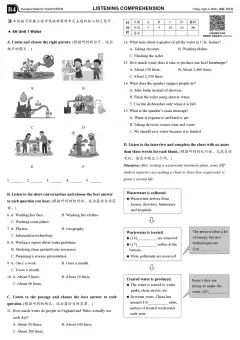
A.
1. D 2. A 3. F 4. E 5. C
B.
6. C 7. B 8. C 9. B 10. A
C.
11. B 12. C 13. B 14. C 15. C
D.
16. Large objects
17. Mud
18. improving the situation/making it energy-efficient
19. over 20 billion
20. safe to drink
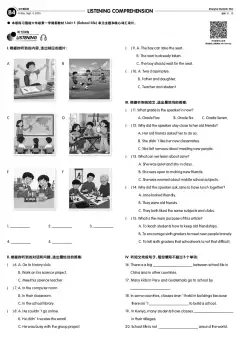
录音文本Listening comprehension
A. Listen and choose the right picture.
1. This special machine can turn salty seawater into clean, safe drinking water.
2. The cotton plant is a thirsty crop that requires huge amounts of water to grow.
3. People living in deserts often have only a limited amount of fresh water each day.
4. An energy-saving dishwasher can help your family use much less water for daily cleaning.
5. Research shows that factories may use up to three liters of water to produce one liter of bottled water.
B. Listen to the short conversations and choose the best answer to each question you hear.
6. M: Amy, don’t leave the plates in the water for too long.
F: Sorry, Dad. Should I just put them into the dishwasher?
M: Sure! It’s an energy-saving model and uses much less water.
Q: What is Amy doing?
7. M: Look at this photo. This dry desert has no plants at all.
F: What caused this, Mr. White?
M: That is because water is very rare and limited there, Ann.
Q: What class is Ann taking?
8. F: Leo, I think our science presentation tomorrow must include an important fact. More than two
billion people around the world don’t have safe drinking water.
M: I agree. We should also explain how rare clean groundwater is becoming.
Q: What are the students doing?
9. F: What is this big event today? Why are there so many people on the riverbank?
M: We’re holding our monthly river cleanup. We want to raise awareness about the environment in
our city.
F: That sounds cool. Do you need more volunteers?
Q: How often do the volunteers clean up the river?
10. F: Steve, take a look at this chart. A standard shower uses about nine liters of water every minute!
M: Wow! So, a ten-minute shower uses ninety liters of water? That is a lot of water!
F: Yes! That’s why our dad told us to take shorter showers.
Q: How much water does a standard shower use every minute?
C. Listen to the passage and choose the best answer to each question.
Have you ever thought about how much water you use every day? A recent survey found that
people in England and Wales believe they use only about 30 liters of water daily. However, the actual
amount is much bigger — around 140 liters! This shows that most people do not know their true
water footprint.
How do we use all this water? Most household water is used in the bathroom. For example, taking
a shower can use 6 to 15 liters of water per minute. If you take a 10-minute shower, you could use up
to 150 liters! Flushing the toilet also uses a lot of water. In fact, about a quarter of all the water used
in U.K. homes goes down the toilet.
But water use is not just about what we see at home. There is also indirect water use. Do you like
beef hamburgers? It takes about 2,400 liters of water to produce just one! A cotton T-shirt needs about
2,700 liters of water to produce. Even a kilo of rice requires a lot of water to grow. This is our indirect
water footprint.
The good news is that we can all take steps to save water. For example, use a dishwasher only
when it is completely full. Turn off the tap while brushing your teeth. Take shorter showers. If everyonemakes these small changes, together we can save a large amount of water.
Water is a limited resource, and we must use it carefully. Our future depends on the choices we
make today.
D. Listen to the interview and complete the chart with no more than three words for each blank.
Guide: Welcome to our wastewater treatment plant! Here, you’ll see how we clean wastewater and
reuse it.
Student 1: This place doesn’t smell as bad as I thought!
Guide: We use different methods to remove pollutants and make the water cleaner. You can see it here.
First, the wastewater comes from homes, factories, businesses and hospitals. We remove large objects
and let the mud settle at the bottom.
Student 2: Then what happens?
Guide: Then we use other methods to remove more pollutants.
Student 1: Does the treatment process use a lot of energy?
Guide: Yes, it does. But new technologies are making it more energy-efficient. Some plants are even
trying to produce energy from the waste!
Student 2: Where is the treated water used?
Guide: After proper treatment, the water can be reused for things like watering parks, cleaning streets,
and even farming. In China, more than 20 billion cubic meters of treated wastewater has been reused
every year in recent years.
Student 1: Amazing! That’s like having a second water source!
Guide: Exactly.
Student 2: Is the water safe to drink?
Guide: No, not at the moment. But some cities are working to make it possible. It requires very strict
safety checks.
Student 1: I see. Wastewater is no longer waste. Thanks to plants like yours, it’s becoming useful in
more and more places!
Guide: Exactly. Fresh water is a valuable resource, so we must never waste it.
C2-3 八年级第一学期开学自主练习
Part 1 Grammar and Vocabulary
I.
1. A 2. A 3. B 4. C 5. A
6. A 7. B 8. C 9. A 10. C
II.
11. B 12. D 13. E 14. A
15. E 16. A 17. D 18. B
III.
19. how you became interested in curiosity 或where your interest in curiosity came from
20. What makes it (so) special?
21. Do you think heavy schoolwork can affect students’ curiosity / make students lose curiosity?
22. How can we keep our curiosity?
23. Why is curiosity important for students? 或 What good can curiosity bring to students?
24. How/Where can students learn more about curiosity?
IV.
A.
25. B 26. A 27. C 28. E 29. D 30. G
B.
31. D 32. A 33. A 34. B 35. C 36. C
C.37. B 38. D 39. D 40. B 41. A 42. D
D.
43. They lived next to Central Park in New York City.
44. She asked him to buy some bread.
45. Because the jogger bumped into him, and he thought he might be a thief.
或 Because the jogger bumped into him, and he thought he might have stolen his money.
46. He caught up with the jogger, grabbed him, and shouted at him.
47. He was scared.
48. He felt embarrassed and sorry.
Reason 1: He wrongly believed the jogger had stolen his money and treated him rudely.
Reason 2: He realized that he had left the money at home.
V.
49. Rubbing my eyes, I got up and set off for the water hole.
50. It turned out that the more curious group came up with more wonderful ideas.
51. The smart walking stick can send out/give a warning as soon as its user gets close to any dangerous
object.
52. Digital technology makes it easier for us to share knowledge, no matter where we live.
VI.
53. (以下示例仅供参考)
Many students use AI to help with their studies. It’s convenient and can be a useful learning tool.
However, in my opinion, we should also be aware of its disadvantages.
First of all, AI may make students too dependent on it. Some students spend too much time asking
AI for answers instead of thinking through problems on their own. Over time, this may weaken their
ability to think independently.
What’s more, AI is not always reliable. It may provide inaccurate information when answering
questions. If we don’t check the information, we may form wrong ideas that are hard to change later.
In conclusion, AI can bring many benefits to our studies, but it can also create challenges.
Therefore, we should learn to use it wisely and treat it as a helper rather than a replacement for our
own thinking. (139 words)
C1、C4 九年级第一学期开学自主练习
Part 1 Grammar and Vocabulary
I.
1. B 2. B 3. A 4. C 5. B 6. C 7. A 8. C 9. A 10. C
II.
11. C 12. A 13. D 14. E 15. E 16. B 17. A 18. D
III.
19. When did you first become interested in art?
20. What kind of material do you prefer to work with?
21. what creating (wood) sculptures means to you
22. Yes, it is.
Part 2 Reading and Writing
IV.
A.
23. C 24. D 25. B 26. E
B.
27. C 28. C 29. D 30. C 31. D
C.32. A 33. B 34. A 35. B 36. D 37. B
D.
38. On city trains and in subway stations, cinemas, and even hospitals.
39. No, it isn’t.
40. Because of cheap and frequent travel, warmer weather / warm(er) cities / a warmer climate, and
bedbugs’ resistance to insecticides. (一个原因 0.5分,语法0.5分)
41. They hide in dark places. / They hide in furniture or small cracks in walls.
42. Bedbugs are making a comeback not just in Paris / the French capital but in many parts of the
world.
43. You can check your hotel bed before sleeping, wash your clothes in hot water after traveling, and
check your furniture regularly (Answers may vary.)
V.
44. (以下习作仅供参考)
Dear Mr. Wang,
I’m Li Hua, a resident of our community. I’m glad that we are going to hold an event about safety
and first aid. I would like to learn more about first aid because I once saw someone get injured but
didn’t know how to help. I believe it is an important skill that everyone should have.
My suggestion is to show some videos about basic first aid skills first. Then, you could invite
some doctors or nurses to teach us simple skills, such as performing CPR and dealing with cuts or
burns. What’s more, everyone should have a chance to practice. After all, the best way to learn is by
doing.
I hope this event will help me and others learn how to help people in need and make our
community a warmer and more caring place.
Thank you for considering my suggestions.
Yours sincerely,
Li Hua