编辑: 张雅丽
A8 Tuesday, Sept. 8, 2026
2026年9月8日 第1647期(总第3293期)·逢周二出版
W
ith
one
of
China’s
most
popular comedians Shen Teng
( 沈腾) featured on the poster
for Once Upon a Time in the Middle East
(《欢迎来龙餐馆》), many viewers walked
into cinemas expecting a lighthearted
summer comedy. What they got instead
was a harrowing (令人揪心的) war drama
that left many in tears.
Much of the film’s emotional power
comes from its portrayal of ordinary
people
caught
in
extraordinary
circumstances. At the center of this story
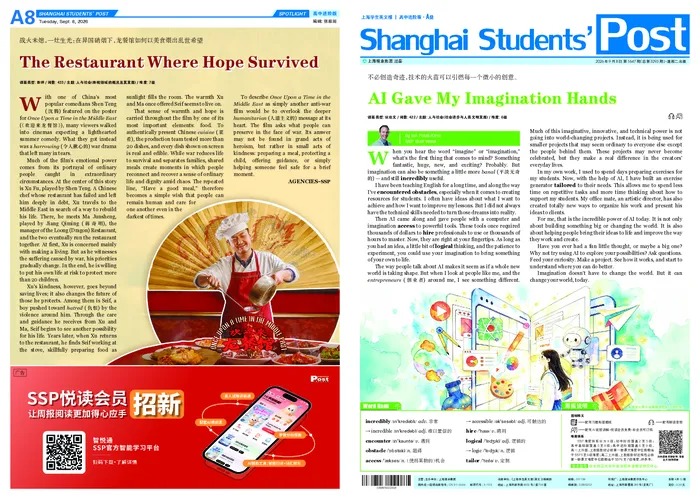
is Xu Fu, played by Shen Teng. A Chinese
chef whose restaurant has failed and left
him deeply in debt, Xu travels to the
Middle East in search of a way to rebuild
his life. There, he meets Ma Junsheng,
played by Jiang Qiming ( 蒋奇明), the
manager of the Loong (Dragon) Restaurant,
and the two eventually run the restaurant
together. At first, Xu is concerned mainly
with making a living. But as he witnesses
the suffering caused by war, his priorities
gradually change. In the end, he is willing
to put his own life at risk to protect more
than 20 children.
Xu’s kindness, however, goes beyond
saving lives; it also changes the future of
those he protects. Among them is Seif, a
boy pushed toward hatred ( 仇恨) by the
violence around him. Through the care
and guidance he receives from Xu and
Ma, Seif begins to see another possibility
for his life. Years later, when Xu returns
to the restaurant, he finds Seif working at
the stove, skillfully preparing food as
sunlight fills the room. The warmth Xu
and Ma once offered Seif seems to live on.
That sense of warmth and hope is
carried throughout the film by one of its
most important elements: food. To
authentically present Chinese cuisine ( 菜
肴), the production team tested more than
20 dishes, and every dish shown on screen
is real and edible. While war reduces life
to survival and separates families, shared
meals create moments in which people
reconnect and recover a sense of ordinary
life and dignity amid chaos. The repeated
line, “Have a good meal,” therefore
becomes a simple wish that people can
remain human and care for
one another even in the
darkest of times.
To describe Once Upon a Time in the
Middle East as simply another anti-war
film would be to overlook the deeper
humanitarian (人道主义的) message at its
heart. The film asks what people can
preserve in the face of war. Its answer
may not be found in grand acts of
heroism, but rather in small acts of
kindness: preparing a meal, protecting a
child,
offering
guidance,
or
simply
helping someone feel safe for a brief
moment.

AGENCIES-SSP
语篇类型: 影评 / 词数: 433 / 主题: 人与社会(影视领域的概况及其发展) / 难度: 7级
高中进阶版
SHANGHAI STUDENTS’ POST
SPOTLIGHT
战火未熄,一灶生光:在异国硝烟下,龙餐馆如何以美食煨出乱世希望
The Restaurant Where Hope Survived
The Restaurant Where Hope Survived
The Restaurant Where Hope Survived
The Restaurant Where Hope Survived
The Restaurant Where Hope Survived
The Restaurant Where Hope Survived
The Restaurant Where Hope Survived
The Restaurant Where Hope Survived
The Restaurant Where Hope Survived
The Restaurant Where Hope Survived
The Restaurant Where Hope Survived
The Restaurant Where Hope Survived
The Restaurant Where Hope Survived
The Restaurant Where Hope Survived
The Restaurant Where Hope Survived
The Restaurant Where Hope Survived
The Restaurant Where Hope Survived
The Restaurant Where Hope Survived
The Restaurant Where Hope Survived
The Restaurant Where Hope Survived
The Restaurant Where Hope Survived
The Restaurant Where Hope Survived
The Restaurant Where Hope Survived
The Restaurant Where Hope Survived
The Restaurant Where Hope Survived
The Restaurant Where Hope Survived
The Restaurant Where Hope Survived
The Restaurant Where Hope Survived
The Restaurant Where Hope Survived
The Restaurant Where Hope Survived
The Restaurant Where Hope Survived
W
hen you hear the word “imagine” or “imagination,”
what’s the first thing that comes to mind? Something
fantastic, huge, new, and exciting? Probably. But
imagination can also be something a little more banal (平淡无奇
的) — and still incredibly useful.
I have been teaching English for a long time, and along the way
I’ve encountered obstacles, especially when it comes to creating
resources for students. I often have ideas about what I want to
achieve and how I want to improve my lessons. But I did not always
have the technical skills needed to turn those dreams into reality.
Then AI came along and gave people with a computer and
imagination access to powerful tools. These tools once required
thousands of dollars to hire professionals to use or thousands of
hours to master. Now, they are right at your fingertips. As long as
you had an idea, a little bit of logical thinking, and the patience to
experiment, you could use your imagination to bring something
of your own to life.
The way people talk about AI makes it seem as if a whole new
world is taking shape. But when I look at people like me, and the
entrepreneurs ( 创业者) around me, I see something different.
Much of this imaginative, innovative, and technical power is not
going into world-changing projects. Instead, it is being used for
smaller projects that may seem ordinary to everyone else except
the people behind them. These projects may never become
celebrated, but they make a real difference in the creators’
everyday lives.
In my own work, I used to spend days preparing exercises for
my students. Now, with the help of AI, I have built an exercise
generator tailored to their needs. This allows me to spend less
time on repetitive tasks and more time thinking about how to
support my students. My office mate, an artistic director, has also
created totally new ways to organize his work and present his
ideas to clients.
For me, that is the incredible power of AI today. It is not only
about building something big or changing the world. It is also
about helping people bring their ideas to life and improve the way
they work and create.
Have you ever had a fun little thought, or maybe a big one?
Why not try using AI to explore your possibilities? Ask questions.
Feed your curiosity. Make a project. See how it works, and start to
understand where you can do better.
Imagination doesn’t have to change the world. But it can
change your world, today.
AI Gave My Imagination Hands
AI Gave My Imagination Hands
AI Gave My Imagination Hands
AI Gave My Imagination Hands
AI Gave My Imagination Hands
AI Gave My Imagination Hands
AI Gave My Imagination Hands
AI Gave My Imagination Hands
AI Gave My Imagination Hands
AI Gave My Imagination Hands
AI Gave My Imagination Hands
AI Gave My Imagination Hands
AI Gave My Imagination Hands
AI Gave My Imagination Hands
AI Gave My Imagination Hands
AI Gave My Imagination Hands
AI Gave My Imagination Hands
AI Gave My Imagination Hands
AI Gave My Imagination Hands
AI Gave My Imagination Hands
AI Gave My Imagination Hands
AI Gave My Imagination Hands
AI Gave My Imagination Hands
AI Gave My Imagination Hands
AI Gave My Imagination Hands
AI Gave My Imagination Hands
AI Gave My Imagination Hands
AI Gave My Imagination Hands
AI Gave My Imagination Hands
AI Gave My Imagination Hands
AI Gave My Imagination Hands
incredibly /In'kred=blI/ adv. 非常
→ incredible /In'kred=bl/ adj. 难以置信的
encounter /In'kaUnt=/ v. 遇到
obstacle /'^bst=kl/ n. 阻碍
access /'7kses/ n. (使用某物的)机会
→ accessible /=k'ses=bl/ adj. 可触达的
hire /'haI=/ v. 聘用
logical /'l^d3Ikl/ adj. 逻辑的
→ logic /'l^d3Ik/ n. 逻辑
tailor /'teIl=/ v. 定制
图标释义
——配有习题和答题纸
                                                           ——配有朗读音频
——配有AI视频讲解·悦读会员免费·非会员可订购
难度体系
SSP 难度体系分为9 级:初中阶段覆盖2 至5 级;
高中基础版覆盖5 至8 级;高中进阶版覆盖6 至9 级。
高一上外版、上教版教材必修第一册课文难度中位数相当
于SSP5 至6 级难度;高二上外版、上教版教材选择性必修
第一册课文难度中位数相当于SSP6至7级难度,供参考。
  学术指导    华东师范大学外语学院外语教学研究中心
扫码获取本期音频、答案
及AI视频讲解
用报说明
本报部分图片由编辑使用
本报部分图片由编辑使用AI
AI工具生成
工具生成。
By Ian Polak-Kime
SSP Staff Writer
不必创造奇迹,技术的火苗可以引燃每一个微小的创意。
语篇类型: 议论文 / 词数: 422 / 主题: 人与社会(社会进步与人类文明发展) / 难度: 6级
Word Bank
主管、主办单位: 上海报业集团

出版单位: 《上海学生英文报(英文)》编辑部
邮编: 201199
印刷厂: 上海报业集团印务中心
本期4开12版
国内统一连续出版物号: CN 31-0044      邮发代号: 3-103
地址: 上海市都市路4855号2座706室
编辑部: 22895253
地址: 上海市联曹路289号(龙吴厂)
定价: 3.00元
广告
Agatha Christie: 阿加莎·克里斯蒂,英国作家,
代表作有《东方快车谋杀案》、
《无人生还》等
Lee Child: 李·柴尔德,英国作家,以杰克·雷彻
(Jack Reacher)系列惊悚小说闻名
Harlan Coben: 哈兰·科本,美国悬疑、惊悚小
说家,代表作包括《天使的隐私》、
《无罪之最》等
Edgar Allan Poe: 埃德加·爱伦·坡,美国作家、
诗人,代表作包括《乌鸦》、
《黑猫》等
Sir Arthur Conan Doyle: 阿瑟·柯南·道尔爵
士,英国作家,夏洛克·福尔摩斯(Sherlock
Holmes)系列的作者
All Those Mystery Writers
A2 Tuesday, Sept. 8, 2026
编辑: 张雅丽 (A1版)  洪伟良 (本版)
China Achieves Its First Rocket
Recovery on Land
中国首次实现火箭陆地回收,正式迈入海陆双回收时代。
语篇类型: 新闻报道 / 词数: 422 / 主题: 人与自然(地球与宇宙奥秘探索) / 难度: 8级
Decoding the Enduring Appeal of Mysteries
语篇类型: 说明文 / 词数: 319 / 主题: 人与社会(小说、文学名著等) / 难度: 6级
从爱伦·坡到柯南·道尔,悬疑推理为何经久不衰?
A7
Tuesday, Sept. 8, 2026
编辑: 洪伟良
让阿加莎“重返人间”:AI带你走进侦探小说家的写作世界。
For nearly 175 years, Western mysteries
have remained mainstays ( 中流砥柱) of
summer beach-read recommendations. So
what accounts for their enduring popularity?
Murder mystery writer David Freed says
one main appeal is that they invite reader
engagement. “A well-constructed murder
mystery offers the pleasure of solving a
puzzle,” he said. “It also allows readers to
confront dark subjects within boundaries.
There’s an emotional thrill without real danger.”
Edgar Allan Poe is widely credited with
pioneering the modern detective story with
The Murders in the Rue Morgue (《莫格街凶杀
案》) in 1841. Since then, the field has expanded
into subgenres ranging from classic detective
stories to more hard-boiled (硬汉派的) tales,
psychological thrillers to cozy mysteries,
among many others. And it has given birth to
legendary fictional figures such as Sherlock
Holmes, Sir Arthur Conan Doyle’s brainchild,
and detectives Miss Marple and Hercule
Poirot, both created by Agatha Christie, one
of the bestselling crime writers of all time.
Beyond their entertainment value, some
scholars
view
the
works
as
cultural
documents. Maura Henry, who teaches a
course on Christie, sees both Christie and
Conan Doyle as writers who documented the
world they lived in and offered insights into
British society at the time. “The fact that
they’re so popular is revealing of their
literary, cultural, and historical value,” she
said. “Christie is an astute (敏锐的) observer
of the time in which she lives. She’s offering
us lenses into British society at the time.”
Despite the literary and cultural weight,
the genre’s lasting appeal lies in the reading
experience itself. Mystery readers seek an
intricate (错综复杂的) plot and good style of
writing, but they mostly want to experience
the suspense ( 悬疑) of page-turners, said
Freed, and the satisfaction that good wins
over evil. “In one way or another, ultimately
all mysteries follow the same construct,” he
added. “You’ve got a good guy; you’ve got a
bad guy; and ultimately, justice is delivered.”
THE HARVARD GAZETTE-SSP
Bringing Back the Queen of Crime
语篇类型: 说明文 / 词数: 435 / 主题: 人与社会(小说、文学名著等) / 难度: 7级
E
veryone has a book inside them, or so
the saying goes. In this day and age,
those who want to write stories can
receive instruction online from some of the
world’s most popular authors.
Lee Child and Harlan Coben teach thriller
writing. Jojo Moyes offers tips on romances.
And now Agatha Christie, one of the world’s
bestselling writers of fiction, with more than
two billion copies sold, is instructing viewers
in the art of the whodunnit*, even though she
died in 1976.
Christie’s course is the result not of
recently discovered archival footage (档案影
像资料), but of artificial intelligence (AI). BBC
Maestro, an online education platform, brought
the idea to the Christie family. They agreed to
bring the “Queen of Crime” back to life and
teach others the mysterious charm of her style.
A team of almost 100, including Christie
scholars as well as AI experts, worked on the
project. Vivien Keene, an actress, provided a
stand-in (替身演员) for the author; Christie’s
face was mapped on top. Crucially, Keene’s
credible performance employs only Christie’s
words: a series of extracts ( 摘录) from her
own writings, notebooks, and interviews.
In this way, the creator of Hercule Poirot
and Miss Marple shares handy writing tips,
such as the neatest ways to murder fictional
victims. Many of Christie’s writing rules
concern playing fair. She practiced misdirection
and laid “false clues” alongside true ones, but
insisted that her plots did not cheat or hide key
evidence: “I never deceive (欺骗) my readers.”
In sections devoted to plot and setting, she
explains how to plant key clues “in plain
sight” and plan events with detailed “maps
and diagrams.” She advises viewers to watch
and listen to strangers on buses or in shops.
By relying on Christie’s own words, BBC
Maestro hopes to avoid accusations of creepy
deepfake teaching. At the same time, it is that
focus on quotation ( 引语) which limits the
course’s value as a creative-writing toolbox.
The woman born Agatha Miller in 1890
speaks from her own time and place. She tells
wannabe writers to use snowstorms to isolate
murder scenes (as they bring down telephone
wires) and cites the clue-generating value of
railway timetables, ink stains ( 墨迹) and
cut-up newspapers. These charming details
are irrelevant to modern writers.
Furthermore, Christie’s juiciest mysteries
smash crime-writing rules. The narrator (叙
述者) does it; the detective does it; all the
suspects do it. Sometimes there isn’t even a
detective in the story: In The Hollow (《空幻之
屋》), Christie regretted that Poirot appeared
at all. This high-tech version of the author feels
smaller and flatter than the brilliant original.
THE ECONOMIST-SSP
*whodunnit 作名词时译为“侦探小说”,
是“who done it?”的变体,指一种以解开
“谁实施了犯罪”为核心谜团的侦探或神
秘故事类型,常见于小说、戏剧或电影中。
高中进阶版
CULTURE
SHANGHAI STUDENTS’ POST
高中进阶版
SHANGHAI STUDENTS’ POST
NEWS
C
hina has successfully landed the
booster of an orbital rocket rather
than discarding (丢弃) it for the first
time. This achievement paves the way for
more sustainable rocket launches and
could potentially cut future launch costs by
tens of millions of yuan.
The 66.1-meter-tall Zhuque-3 Y2 rocket
lifted off from the Dongfeng Commercial
Space Innovation Pilot Zone in the northern
Inner Mongolia Autonomous Region on
August 19. It then delivered an internet
satellite into its designated ( 指定的) orbit.
The rocket’s stainless-steel (不锈钢) booster,
powered by nine liquid oxygen-methane
engines, later landed 390 kilometers away in
neighboring Gansu Province.
The milestone, achieved by Chinese
aerospace startup LandSpace ( 蓝箭航天),
makes China the second country after the
U.S. to successfully recover rocket boosters
on both solid ground and at sea, with the
latter feat (壮举) accomplished on July 10.
Previously, U.S.-based aerospace companies
SpaceX and Blue Origin were the only
enterprises to have successfully landed
rocket boosters on solid ground. SpaceX has
also recovered boosters at sea — by landing
them vertically ( 垂直地) on drone ships —
compared with China’s net-capture method.
China’s push to build extensive low
Earth orbit satellite networks is driving
growing demand for cheaper and more
frequent rocket launches. Such networks aim
to provide services like high-speed internet
access in remote areas. The country currently
has more than one thousand satellites in
orbit,
with
tens
of
thousands
more
ultimately planned.
A rocket’s booster is located at the bottom
of the vehicle and is used during the initial
stage of launch. It is commonly the most
expensive component, accounting for 70%
or more of a rocket’s hardware costs.
Traditionally,
however,
boosters
are
discarded after launch, while the upper part
of the rocket continues toward orbit.
Reusing a common nine-engine booster
could save at least 20 million to 50 million
yuan, said Zhang Liang, the technical lead of
a reusable rocket research team. He added
that China still faces a shortage of launch
facilities. The cost advantage of reusable
rockets will only become significant if there
are enough launches for rockets to be reused
several times a year.
Over the past decade, supportive policies
from the central government have led more
private companies to enter China’s space
sector, which was previously dominated by
state-owned enterprises. Last November, the
China
National
Space
Administration
released a two-year action plan. It aims to
expand access to rocket testing facilities and
strengthen international cooperation. The
space sector is also listed as a strategic
priority in China’s 15th Five-Year Plan,
which began this year.
SIXTH TONE-SSP
A Chinese Robot Beat Usain
Bolt’s 100-Meter Record
In 2009, Usain Bolt set the men’s
100-meter sprint ( 短跑) world record of
9.58 seconds at the World Athletics
Championships in Berlin. On August 22, a
humanoid robot developed by Chinese
company X-Humanoid beat that record by
0.19 seconds at the World Humanoid Robot
Games (世界人形机器人运动会) in Beijing.
Such
high-profile
feats
of
robotic
athleticism
have
become
increasingly
common in China, where the humanoid
robotics industry has thrived with strong
public support and billions of dollars in
investment. Robots have danced, performed
martial arts ( 武术), boxed, and played
soccer at major events.
But what do these superhuman feats
mean? “A factory robot does not need to
win a sprint, nor does a service robot need
a medal,” read a commentary by Xinhua
News Agency. “But every gain in speed,
stability, and precision on the competition
floor can bring robots one step closer to
becoming genuinely useful beyond it.”
A new exhibition at Zikawei Library (徐家汇书院)
in Shanghai is bringing Agatha Christie’s world of
mystery to life from August to October, marking
the 50th anniversary of her death and the 130th
anniversary of the introduction of detective fiction
in China. The show features around 140 rare
items, including manuscripts ( 手稿), signed first
editions, and film and stage materials.
Word Bank
thriller /'0rIl=/ n. 惊险小说(或戏剧、电影)
employ /Im'pl6I/ v. 使用
diagram /'daI=Gr7m/ n. 图解,示意图
cite /saIt/ v. (尤指作为例证)引用
smash /sm75/ v. 粉碎
suspect /'s2spekt/ n. 嫌疑犯,可疑对象
boundary /'baUndrI/ n. 边界,界限
literary /'lIt=r=rI/ adj. 文学的
Did You Know?
booster n. 助推器
orbital rocket 入轨级火箭,轨道运载火箭
Zhuque-3 Y2 rocket 朱雀三号遥二运载火箭
Dongfeng Commercial Space Innovation
Pilot Zone 东风商业航天创新试验区
liquid oxygen-methane engine
液氧甲烷发动机
drone ship 无人回收船
low Earth orbit 近地轨道
China National Space Administration
中国国家航天局
sustainable /s='steIn=bl/ adj. 可持续的
accomplish /='k2mplI5/ v. 完成,达成
enterprise /'ent=praIz/ n. 企业,公司
extensive /Ik'stensIv/ adj. 广阔的,大量的
ultimately /'2ltIm=tlI/ adv. 最终,最后
component /k=m'p=Un=nt/ n. 组成部分,部件
dominate /'d^mIneIt/ v. 支配,控制
priority /praI'^r=tI/ n. 优先事项
Word Bank
Topic Vocabulary
Slide Show
Liang and Wang Claim
World Men’s Doubles Title
Liang Weikeng ( 梁伟铿) and Wang
Chang (王昶) secured the men’s doubles title
at the 2026 BWF World Championships in
New Delhi on August 23, ending China’s
eight-year wait for another men’s doubles
world title. The Chinese pair defeated
Malaysia’s Aaron Chia and Soh Wooi Yik
21-17, 21-16 in the final, securing their first
World Championships title as a pair.
People in Focus
heat dome 热穹顶
meteorological adj. 气象的
meteorologist n. 气象学者
atmospheric adj. 与大气有关的
atmospheric circulation 大气环流
jet stream 急流
heatwave n. 热浪
cold spell 寒潮
drought n. 干旱
high-pressure ridge 高压脊
Arctic n. 北极地区
phenomenon /f='n^mIn=n/ n. 现象
expand /Ik'sp7nd/ v. 扩大,增加
persist /p='sIst/ v. 持续存在,坚持
→ persistently /p='sIst=ntlI/ adv. 持续地
→ persistence /p='sIst=ns/ n. 持续存在
innovation /;In='veI5n/ n. 创新
Topic Vocabulary
Word Bank

       Hi
gh-pr
essur
e cir
culati
on
Within the dome, the air sinks and
is compressed at the surface,
creating heat waves.
The heat dome prevents clouds
from forming within the dome,
which lessens relief from
the sun’s heat.
High pressure conditions push
the rising warm air down.
Dry hot air rises into
the atmosphere.
Tuesday, Sept. 8, 2026 A3
编辑: 洪伟良
编辑: 张雅丽
A6 Tuesday, Sept. 8, 2026
How Heat Domes Are Reshaping Summer
夏季酷热难耐,
“热穹顶”为何会带来滚滚热浪?
语篇类型: 说明文 / 词数: 474 / 主题: 人与自然(自然环境) / 难度: 9级
H
ave you ever felt as though you were trapped in a sweltering
oven ( 闷热的烤箱) during a midsummer night, when the
humidity is soaring and there is no respite (暂缓) from the
heat? This is often caused by a heat dome. But what exactly is a heat
dome, and why does it bring such extreme and lasting heat?
[1] What is a heat dome?
A heat dome is a meteorological phenomenon that occurs when
a large area of high pressure traps warm air over a region and stays
there for days or even weeks. “This ‘dome’ acts like a lid, preventing
heat from escaping and blocking cloud formation, which leads to
persistently high temperatures and minimal relief from the heat,”
explains meteorologist Brandon Buckingham.
[2] __________
A heat dome is usually caused by a change in atmospheric
patterns. When these patterns disrupt the flow of the jet stream, areas
can experience extreme weather. The jet stream is an aerial river of
strong, fast-flowing winds that moves across the continent from west
to east in a wavy pattern. Such changes can lead to heatwaves, floods,
cold spells, storms, and droughts. If the north and south loops of a jet
stream become too large, they slow or stagnate (停滞), which stalls (暂
缓) the high-pressure system that forms at the top of the heat dome.
Atmospheric patterns are not the only factor, however. Conditions
in the oceans can also help create the right conditions for a heat
dome. ⑥Ocean climate patterns can help lay the groundwork for a
heat dome when warmer-than-usual sea surface temperatures alter
these patterns of air flow.
[3] How do heat domes move?
Unfortunately for those experiencing them, heat domes often
move slowly and remain over large areas for a long time. Their course
and duration are generally steered (引导) by patterns of atmospheric
circulation, and particularly, the jet stream.
“The positioning of the jet stream often determines how long a
region will suffer under the dome and whether cooler air from higher
latitudes (纬度) can move in,” Buckingham says. “When the jet stream
shifts or weakens, the dome may expand in size or move into new
areas. Relief finally arrives when the ridge of high pressure breaks
down, causing the dome to dissipate quickly.”
While the movement of heat domes depends largely on
atmospheric patterns, their growing frequency and persistence raise a
bigger question: Is the climate itself playing a role?
[4] How is climate change impacting heat domes?
Climate change may be altering jet stream behaviors that
contribute to heat domes. “Changes in atmospheric circulation, which
are linked to warming in the Arctic, can lead to more stagnant
weather patterns that allow heat domes to persist,” explains Ashley
Ward, director of the Heat Policy Innovation Hub at Duke
University.
Not only are heat domes more common, but they are also lasting
longer. Some, like the 2021 heatwave in the Pacific Northwest,
smashed so many records that they are altering scientists’
understanding of extreme heat in a changing world.
NATIONAL GEOGRAPHIC-SSP
高中进阶版
STUDENT VOICES
SHANGHAI STUDENTS’ POST
高中进阶版
SHANGHAI STUDENTS’ POST
SCIENCE & TECH
A1: Social media platforms are built to maximize attention, not
children’s development. Their endless recommendations can harm
users whose judgment and self-control are still developing. Children
can become addicted and trapped in information cocoons (信息茧房),
consequently pressured by unrealistic beauty standards. This puts
their attention, privacy, safety, and mental health at risk.
The Negative may argue that social media helps children learn.
However, education does not require access to platforms designed to
keep users scrolling. Schools, books, and websites can provide
knowledge without any of these risks. Therefore, governments must
set a boundary and prohibit access to social media until children
reach the age of 16.
N1: While we acknowledge the risks associated with social media, a
total ban would be overly strict and ineffective. Social media is not
just a form of entertainment. Students use it to explore science, news,
languages, and creative ideas. A ban would remove these opportunities
and prevent children from learning necessary digital skills.
It may also be difficult to enforce in practice. Children can lie
about their age, and their use of social media could go unnoticed. The
real problems are unsafe design and harmful use, not individual
platforms. Governments should enforce safety standards and parental
controls while schools should teach responsible use. Protection
should prepare children for technology, not isolate them from it.
A2: The Negative claims that education and guidance are sufficient,
but they underestimate the power of platforms to override self-control.
A twelve-year-old may know that endless scrolling is harmful and still be
unable to stop due to the influence of algorithms (算法) and peer pressure.
While they highlight educational content, this is an instance of
survivorship bias (幸存者偏差): A few success stories do not outweigh
the many children who waste time or experience anxiety.
Enforcement does not need to be perfect to be effective. The
question is whether the limited educational benefits outweigh the
widespread risks to children’s health, attention, privacy, and safety.
They do not.
N2: The Affirmative’s proposition treats all social media use as
equally harmful. Watching a science lecture or following a museum
account is not the same as endless scrolling through content. Policy
should target addictive design, harmful content, and weak privacy
protections instead of banning these platforms once and for all.
The Affirmative’s logic also fails. If imperfect self-control justified
prohibition, the government could ban games or even the Internet.
While a ban may reduce exposure, it can also limit educational and
social opportunities, be easily circumvented, and drive users toward
more hidden forms of use. Strong platform rules and digital education
can address these issues and help children become responsible users.
This approach is safer and more practical than a total ban.

作者: 丁大为(上海市格致初级中学) 王宇宸(上海松江区爱菊学校)

司嘉佑、张睿泽(上海外国语大学附属浦东外国语学校)

指导老师: 秦凯旋(上海外国语大学) 陶雨涵(上海市格致初级中学)
Should Governments Prohibit Children
Under the Age of 16 From Using Social Media?
Should Schools Allow Students to Use AI Tools for Homework?
              学校是否应该允许学生在作业中使用AI工具?
A1: AI can act as a 24/7 personal tutor,
offering personalized explanations and
feedback to improve learning outcomes.
Learning to use AI effectively for homework
can also build AI literacy and critical-thinking
skills, enhancing learning rather than
replacing it.
N1: The purpose of homework is to
encourage independent thinking. Relying
on AI for answers bypasses this important
process. While long-term AI use may
improve homework scores, it could lead to
lower exam results. AI also frequently
makes errors that students often fail to spot,
resulting in misinformation.
A2: AI is only used to create the basic
framework. Students still have to verify the
information and solve problems independently,
which strengthens their critical thinking skills.
The error rate of AI is low. Banning it on that
basis would also mean banning search engines
and social media. It is better to teach students
how to use it properly than ban it outright.
N2: Not all students have the self-discipline to
use AI responsibly. AI can function like a “crutch
( 拐杖)” — prolonged reliance on it can lead to
poorer performance in closed-book exams and
college entrance exams. Cheaper, weaker AI models
are also more likely to spread misinformation.
A3: AI is simply an advanced tool, much
like a calculator or dictionary. It performs
routine tasks, freeing up time for critical
thinking and creative work. Its risks should
be managed through rules and guidance,
not through an outright ban.
N3: Learning is fundamentally about the
process of thinking, not just finding the
right answers. The struggle and trial-and-
error involved in doing homework build
strong minds, whereas instant AI answers
turn students into passive recipients. AI
still makes frequent errors that young
students may not always be able to detect.
              政府是否应该禁止16岁以下儿童使用社交媒体?
由上海外国语大学SciTalk 科研团队联合科学家们设计了沉浸体验式的综合性科普演讲者夏季活动, 旨在科学
家和大众之间建立桥梁, 普及科学知识, 提升国民科学素养。 今年7月,来自全国多所学校的同学们参加了安排
丰富的夏令营,在导师指导下分组开展项目研究并输出成果。本版文章改编自各项目组的研究汇报展示辩论稿。
A: The Affirmative (正方); N: The Negative (反方)
本版文章系上海外国语大学SciTalk 科研团队项目成果, 项目负责人: 孙海琴( 上海外国语大学高级翻译学院 )。

作者: 潘绍谦、孙双成(上海外国语大学附属外国语学校) 王林铄(常州市淹城初级中学)

丁墨颜(上海市民办桃李园实验学校) 李博君(上海市刘行新华实验学校) 闫丁文(尚德实验学校)

指导老师: 白语然(华东政法大学)
话题一
话题二
One morning, I come across “Big JOY” while scrolling on my
phone. The citizen science project invites people to spend just
seven minutes a day for seven days completing simple activities
to discover what brings them joy — and do more of those things.
The idea catches my attention because, as I turn 50, learning
to squeeze more joy from life feels increasingly urgent. I’m not
optimistic that a week of “micro-acts” is the answer, but I’m
ready to give Big JOY a chance.
Once I’ve signed up, my week kicks off with a questionnaire
that asks me to assess my life satisfaction and emotions. I
understand it is meant to establish a baseline, and I’m curious
about what’s to come.
My first challenge is to ask someone about a recent moment
of joy. I try it at choir. Helen tells me about holding her first
granddaughter; Cristina observed a goldcrest (金冠鹪鹩) sitting
on a bare branch; and Anna says she felt joy when we started
singing a folk song. During the late-night check-in, I realize that
the activity has lifted my mood. ❶I enjoy it so much that I start
asking my friends whenever I can.
On day 2, I have to think of a recent experience that made me
feel frustrated or upset, and identify three positive things that
came from it. I choose my dog’s death. I take a deep breath and
remember how writing about the experience connected me to
people who had experienced similar losses. Even months later, I
still find myself sharing my dog’s story with strangers. The
shared experience of grief, I suppose, can become a powerful
source of connection.
Over the following days, I explore other ways of finding joy,
from practicing gratitude and recollecting moments of awe to
reflecting on my values and thinking about how I could make a
positive difference. These activities help me see that joy can exist
even when life is difficult.
Doing something kind for others is my final challenge. At
first, the idea of identifying five people to help can seem
impossible, but I soon come up with small acts of kindness, from
darning (织补) my husband’s jumper to sending a care package
to a friend. Taking action and ticking things off my to-do list
feels surprisingly good.
Following a final check-in, I learn that my well-being has
gone up 14.13%, though this is lower than the project’s average
increase of 23%. ❷More importantly, Big JOY has reminded me
of how happy other people make me, especially if I can make
them feel good too. The conclusion seems to be that to feel more
joy, I need to become a more connected, outward-looking
person, ruminate ( 沉思) less, and focus on finding ways,
however small, of doing good in the world.
THE GUARDIAN-SSP
S
ome years ago, Helen Keyes was pushing her way through a
World Cup crowd with her soccer-loving brother and father.
“What is it about this sport or this event that you like?” she
remembers asking them. They looked confused and replied that
they had never thought about it. “I thought, I’d really like to think
about it,” remembers Keyes.
Keyes is one of many psychologists who view the World Cup as
part of the quest to answer this question: What do people get out of
watching sports? And the important follow-up: Does being a sports
fan come with any benefits for health?
Using data from a survey of more than 7,000 people in the U.K.,
Keyes and her colleagues set out in 2023 to study the effects of
attending live sporting events. They looked at whether such
experiences changed people’s self-reported anxiety, loneliness, and
sense that life was worth living, among other measures.
What they found was that attending a live match significantly
boosted some measures of well-being. “It was associated with a
greater sense that your life is worthwhile,” Keyes says. Life
satisfaction increased, while loneliness decreased.
A 2020 study by another group found that watching sports on
TV also positively affected life satisfaction and well-being.
However, it did not reduce loneliness to the same degree that being
there in person does, says Keyes.
Anyone who has felt the incredible highs and lows of following a
sports match might wonder: Is this a net benefit ( 净收益)? “They
know there is a 50% chance that they will end up feeling annoyed
after watching a game,” says Daniel Wann, a psychologist who has
studied sports fandom for decades. The question has inspired a lot
of research, including on the phenomena of CORFing and
BIRGing: terms for “cutting off reflected failure” when teams lose
and “basking in ( 沉浸在) reflected glory” when they win. These
behaviors demonstrate that fans can adjust their psychological
connection with a team in response to both wins and losses.
In general, the psychological benefits of following a team are
substantial. “Individuals who are deeply involved in a sports
team tend to have higher self-esteem, lower levels of loneliness,
and a stronger sense of social connection,” Wann says. “Fandom
helps individuals meet basic psychological needs, like the need to
belong.” At the same time, sports fandom allows people to set
themselves apart from the group, giving them a unique identity
within the community. This sense of individuality is also a basic
psychological need.
The regular cycles of sports also provide fans’ lives with a kind
of structure. Someone might remember where they were during the
last World Cup, or they might start counting down the days to the
next Olympics. These rituals are comforting, says Wann, and
give people something to look forward to.
TIME-SSP
Why Watching Sports Makes People Happy
Why Watching Sports Makes People Happy
Why Watching Sports Makes People Happy
Why Watching Sports Makes People Happy
Why Watching Sports Makes People Happy
Why Watching Sports Makes People Happy
Why Watching Sports Makes People Happy
Why Watching Sports Makes People Happy
Why Watching Sports Makes People Happy
Why Watching Sports Makes People Happy
Why Watching Sports Makes People Happy
Why Watching Sports Makes People Happy
Why Watching Sports Makes People Happy
Why Watching Sports Makes People Happy
Why Watching Sports Makes People Happy
Why Watching Sports Makes People Happy
Why Watching Sports Makes People Happy
Why Watching Sports Makes People Happy
Why Watching Sports Makes People Happy
Why Watching Sports Makes People Happy
Why Watching Sports Makes People Happy
Why Watching Sports Makes People Happy
Why Watching Sports Makes People Happy
Why Watching Sports Makes People Happy
Why Watching Sports Makes People Happy
Why Watching Sports Makes People Happy
Why Watching Sports Makes People Happy
Why Watching Sports Makes People Happy
Why Watching Sports Makes People Happy
Why Watching Sports Makes People Happy
Why Watching Sports Makes People Happy
赛场边此起彼伏的助威声怎样驱散了生活中的烦恼和沉闷?
语篇类型: 说明文 / 词数: 460 / 主题: 人与社会(体育与健康) / 难度: 7级
My late mother was a renowned
artist in the Pacific Northwest. She had
excellent techniques: If she decided to
paint a guy holding a guitar, bearing a
striking resemblance to her adolescent son,
that’s exactly what it looked like.
Growing up, I could draw a little myself, but I never
had her talent. Once, I asked her how I could improve. She told me to
look at what I wanted to draw. ___1___
“You probably aren’t,” she explained. “People almost never
actually look carefully at anything; they glance at it and then rely on
their brain to fill in the details, leading to poor drawing.” So I did as I
was told, and looked long and hard at what I wanted to draw at that
moment: a tree. I found that I noticed much more about its shape,
colors, and shadows. ❸I drew each detail, and sure enough, it turned
out to be a pretty well-drawn tree.
More than that, I loved the experience of really looking: It was
both creative and immersive (沉浸的). ❹What my mom was telling
me to do, I came to understand, was to savor (欣赏) the encounter of
seeing something deeply and drawing it carefully.
Savoring has been defined by psychologists as the capacity to
attend to, appreciate, and enhance the positive experiences in one’s
life. ___2___ For example, we can be fully attentive to a gorgeous
sunset, recall a happy memory with a friend, or eagerly anticipate a
fun party.
Research shows that savoring stimulates the brain’s striatum
(纹状体), which is involved in processing rewards and helping reduce
symptoms of depression. In a 2012 study, researchers asked
participants to record the frequency and intensity of their daily
positive experiences. When some were asked to savor the pleasant
events, the scholars found that these people were significantly
happier after the experiment than those who had not been asked to
do any savoring.
___3___ Researchers in 2024 arrived at this conclusion in an
experiment that required participants to write down any positive
events that had happened to them. The researchers found that when
they instructed people to savor these experiences more fully as they
recorded them, their subsequent memories were more vivid, and in
effect they enjoyed the experiences more.
Savoring is a secret to greater happiness, but it does not come
naturally. ___4___ Psychologists have identified four techniques
that are especially effective. These are expressing positive emotions
through nonverbal behaviors, such as smiling on purpose; mindfully
focusing
on
pleasant
experiences;
sharing
and
celebrating
unforgettable moments with others; and vividly remembering or
anticipating positive events. ❺The researchers found that the more
often people used these techniques, the happier they became.
THE ATLANTIC-SSP
My Mom’s Guide
to the Art of Living
语篇类型: 议论文 / 词数: 437
主题: 人与自我(积极的生活态度) / 难度: 7级
幸福,藏在用心品味生活的每一个瞬间。
optimistic /;^ptI'mIstIk/ adj. 乐观的
assess /='ses/ v. 评估,评定
gratitude /'Gr7tItju:d/ n. 感激
boost /bu:st/ v. 提高
associate /='s=UsIeIt/ v. 把……和……联系起来
substantial /s=b'st7n5l/ adj. 大量的,实质性的
ritual /'rIt5U=l/ n. 仪式
comforting /'k2mf=tI9/ adj. 令人安心的
glance /Gl1:ns/ v. 瞥一眼,匆匆一看
capacity /k='p7s=tI/ n. 感受能力
anticipate /7n'tIsIpeIt/ v. 期待
stimulate /'stImjUleIt/ v. 刺激
快乐捕手:在共鸣中丰盈,以举手之劳递他人一束暖光
Can Micro-Acts of Joy
Make You Happier?
A5
编辑: 张雅丽
A4
语篇类型: 记叙文 / 词数: 459 / 主题: 人与自我(个人生活) / 难度: 6级
Word Bank
Tuesday, Sept. 8, 2026
教材链接: 上教版选择性必修1 Unit 1 Feeling Good
SHANGHAI STUDENTS’ POST
CLASSROOM PLUS
高中进阶版
丂丂丂丂丂丂丂丂丂丂丂丂丂丂丂丂丂丂
丂丂丂丂丂丂丂丂丂丂丂丂丂丂丂丂丂丂
丂丂丂丂丂丂丂丂丂丂丂丂丂丂丂丂丂丂
It can boost self-esteem,
strengthen social connections,
reduce loneliness, and
(5)___________, such as the
need for belonging and identity.
丂丂丂丂丂丂丂丂丂丂丂丂丂丂丂丂丂丂
丂丂丂丂丂丂丂丂丂丂丂丂丂丂丂丂丂丂
丂丂丂丂丂丂丂丂丂丂丂丂丂丂丂丂丂丂
The regular schedule of sports
events adds structure to fans’
lives, giving them a sense of
(6)___________.
丂丂丂丂丂丂丂丂丂丂丂丂丂丂
丂丂丂丂丂丂丂丂丂丂丂丂丂丂
丂丂丂丂丂丂丂丂丂丂丂丂丂丂
Psychologists explored
why people enjoy
watching sports and
whether it
(1)___________.
丂丂丂丂丂丂丂丂丂丂丂丂丂丂丂丂丂丂丂
丂丂丂丂丂丂丂丂丂丂丂丂丂丂丂丂丂丂丂
丂丂丂丂丂丂丂丂丂丂丂丂丂丂丂丂丂丂丂
A large-scale survey showed
that going to sports events made
people feel (2)___________
and less lonely. Watching sports
on TV also helped, but it was
less effective at easing loneliness
than (3)___________.
丂丂丂丂丂丂丂丂丂丂丂丂丂丂丂
丂丂丂丂丂丂丂丂丂丂丂丂丂丂丂
丂丂丂丂丂丂丂丂丂丂丂丂丂丂
Despite the emotional
ups and downs that
come with supporting a
team, being a sports fan
can have surprising
benefits for
(4)___________.
Summary Writing
高中进阶版
编辑: 罗梦佳
编辑: 张雅丽
B4
SHANGHAI STUDENTS’ POST
WRITING
Tuesday, Sept. 8, 2026
 ▶▶   本版(B1)围绕A4-5 版文章,设置词汇与阅读的配套练习,引导读者深化语篇理解。
 A4   Can Micro-Acts of Joy Make You Happier?
I. Translate the following expressions into Chinese.
1. come across
2. give sth. a chance
3. kick off with
4. be curious about what’s to come
5. lift one’s mood
6. make a positive difference
7. come up with
II. Complete the sentences with the given words in their
proper forms. Each word can be used twice.
average                                reflect                                upset
1. The old man sat quietly by the lake, ______ on his long life
journey.
2. The ______ rainfall in this region has dropped significantly over
the past decade.
3. The news that her best friend was moving abroad ______ her
more than she had ever expected.
4. The steady decline in traditional gasoline car sales ______ a
wider change in consumer choices.
5. The little girl was extremely ______ because her beloved pet dog
had suddenly run away from home.
6. On ______, each student in this class spends about three hours
per week doing volunteer work in the community.
III. Choose the best answer.
1. What’s the author’s initial attitude toward Big JOY?
A. Skeptical yet willing to give it a try.
B. Stressed by its strict requirements.
C. Confident in its life-changing potential.
D. Curious but reluctant to spend time on it.
2. The author details her choir friends’ moments of joy in Para. 4 to
______.
A. prove that singing is an effective way to bring joy
B. show how exploring others’ joy can uplift her unexpectedly
C. argue that finding joy requires seeking out profound life
experiences
D. show that sharing joyful moments is essential to deepening
friendships
3. The author found value in reflecting on her dog’s death because it
______.
A. helped her turn a private loss into a bridge to others
B. reminded her to focus more on happy memories of her dog
C. allowed her to see how writing could reduce emotional pain
D. showed her that grief disappears when shared with strangers
4. According to the last paragraph, which of the following would the
author most likely see as a way to experience joy?
A. Keeping a journal to write down feelings.
B. Starting a conversation with a stranger every day.
C. Taking a 30-minute walk in nature every morning.
D. Volunteering to read stories to children at a local library.
 A4  Why Watching Sports Makes People Happy
I. Complete the mind map according to the article.
II. Use the mind map as a guide and write a summary of no more than 60 words.
_________________________________________________________________________________________________
_________________________________________________________________________________________________
Learn to Write
 A5   My Mom’s Guide to the Art of Living
I. Complete the sentences with the given words
in their proper forms. Each word can be used
twice.
encounter                                glance                                reward
1. He gave the crowded room a quick ______, looking for someone
he recognized.
2. Those who dare to take risks are often ______ with discoveries
that others never make.
3. That brief ______ with the elderly woman on the train left a
lasting impression on me.
4. While out running in the park one morning, I ______ a stray dog
that had been following me for almost a mile.
5. The girl ______ at her phone for the tenth time, hoping for a
message from her friend, but the screen was still blank.
6. The committee awarded her the first prize, but the greatest
______ was the confidence she gained from the experience.
II. First change the given words into different forms, and
then complete the sentences.
① appreciate   ______ n. 欣赏,理解,领会,感谢
② depression   ______ v. 使沮丧; ______ adj. 沮丧的
③  frequency   ______ adj. 频繁的; ______ adv. 频繁地
1. A simple “thank you” can go a long way in showing ______ for
someone’s hard work.
2. She ______ poetry not for its meaning, but for the way the words
sound when read aloud.
3. It really ______ me when old friends stop replying to my
messages and gradually drift away.
4. The fact that she is a(n) ______ visitor to the historical society
shows her genuine curiosity about history.
5. I felt ______ when I stepped on the scale after a week of dieting
and saw that the number hadn’t changed.
6. This chef ______ experiments with seasonal ingredients to create
innovative dishes, keeping his restaurant’s menu fresh and
exciting year-round.
III. Read the passage and fill in each blank with a sentence
from the box. Each sentence can be used only once. Note
that there are two more sentences than you will need.
A. Therefore, we need to consciously develop this skill.
B. This finding was especially clear for people who experienced
fewer positive events.
C. Savoring positive experiences in the moment also leads to
happier memories later on.
D. This confused me because that’ s obviously what I thought I
had been doing, as I said to her.
E. This can mean focusing on a current, future, or past experience
with particular attention to the positive parts.
F. And this kind of savoring, it turns out, can be applied to many
areas of life in ways that help us become more adept at living
and much happier.
Letter From Emma
Hello Alex,
①How’s everything going? I remember you said you were feeling a bit stressed about
your studies. I hope you’ve had some time to relax.
Guess what! A few weeks ago, I tried a project called Big JOY. It helped people discover
more joy through small daily activities. Honestly, I didn’t expect much at first, but it
definitely surprised me.
One day, I asked my friends about their happiest moments. Their stories about family,
nature, and music brought a smile to my face. Another activity reminded me of losing
my dog. I realized that sharing my sadness with others helped me feel less alone.
This project taught me that joy is usually right there in everyday moments — a good
word, a happy memory, or a small act of kindness.
②I hope you’ll find some little moments that make you smile, too. Let me know if you do!
③Take care,
Emma
Writing Strategies
Style: informal and conversational
① use friendly greetings to create a personal
connection
② invite the reader to respond and keep the
conversation going
③ end with a warm, friendly closing
Content: to share a recent experience with
Alex
● use simple, everyday expressions to convey
feelings naturally
● use specific details to make the experience
vivid and engaging
Letter to Emma
Hi Emma,
______________________________________________________________
______________________________________________________________
______________________________________________________________
______________________________________________________________
______________________________________________________________
Best wishes,
Alex
For Your Reference
① be glad to hear that
② forget about one’s stress
③ how comforting sth. can be
④ prepare for an important exam
⑤ move forward to the next stage
⑥ share one’s feelings with others
⑦ bring sb. so many happy memories
⑧ thanks for sharing your experience
2026年9月8日 第1647期(总第3293期)
扫码使用习题AI批阅
与答案解析
悦读会员免费·非会员可订购
 ▶▶   本专栏每周聚焦一个高中教材单元的写作任务,通过提供写作方向、参考示例和实用词块,帮助你打开思路、积累表达,一步步提升英语写作能力。
本期写作任务:
(1)请阅读下方信件,分析其如何通过语言和内容体现个人书信的风格。
(2)假设你是Alex,参考所提供的实用词块给Emma 写一封
120-150 词的回信,信中可融入个人经历。
(上教版选择性必修1 Unit 1)
A3 邀你投稿
邀你投稿
完成本期写作练习后,你是否也想分享自己的作文?欢迎将Learn to Write 栏目原创作文投递至SSP 信箱 (sspchina@jfdaily.com),在文末注明学校全称、年
级及姓名,并在邮件主题中标明“高中进阶周报习作”。请确保作品为个人独立完成,切勿抄袭或使用人工智能生成内容。期待在文字中遇见你真实的成长足迹!
高中进阶版
READING PLUS
SHANGHAI STUDENTS’ POST
Tuesday, Sept. 8, 2026
编辑: 罗梦佳
B3
编辑: 张雅丽
B2
高中进阶版
编辑: 罗梦佳
SHANGHAI STUDENTS’ POST
QUIZ
Tuesday, Sept. 8, 2026
编辑: 张雅丽、洪伟良 (B1版、本版)
 A4  Can Micro-Acts of Joy Make You Happier?
1. I enjoy it so much that I start asking my friends whenever I can.
【句型】 本句采用so + adj./adv. + that 引导的结果状语从句,表示
“如此……以至于……”,突出作者对这件事的强烈兴趣,并引出由此
产生的行为。
【仿写1】 这汤闻起来太棒了,大家纷纷向她要她研制出来的那份食谱。
_____________________________________________
【仿写2】 我太喜欢那家老书店了,每周六都会去那里,风雨无阻。
_____________________________________________
2. More importantly, Big JOY has reminded me of how happy other
people make me, especially if I can make them feel good too.
【句型】 短语remind sb. of 表示“……使某人想起/意识到……”。介词
of 后接 how 引导的宾语从句,其中how 修饰happy 表示程度,意为
“他人能带给我多少快乐”。
【仿写1】 这次志愿服务经历提醒了我,不求回报地为他人付出时光
是何等充实。
_____________________________________________
【仿写2】 这一个月的尝试提醒了我,一次只专注做一件事,而不是一
心多用,效率能有多高。
_____________________________________________
 A5  My Mom’s Guide to the Art of Living
3. I drew each detail, and sure enough, it turned out to be a pretty
well-drawn tree.
【句型】 “turn out to be + 名词”意为“结果证明……”,用于表示经过
一番过程后,某人或某物最终被发现具有某种身份、性质或特征。原
句中,作者仔细画完每一个细节后,发现自己画出的是一棵画得相当
不错的树。turn out to be 将前面的绘画过程与最终呈现的结果自然
连接起来,突出了“原本不确定,最终得到证实”的意味。
【仿写1】 尽管我们选了最便宜的酒店,但没想到住起来相当舒适。
_____________________________________________
【仿写2】 我主动提出帮她搬家,没想到这成了我们建立深厚友谊的
开始。
_____________________________________________
4. What my mom was telling me to do, I came to understand, was to
savor the encounter of seeing something deeply and drawing it
carefully.
【句型】 本句为what 引导的主语从句 + be + 表语。其中what 引导的
主语从句指“母亲叫我做的事”;was 后面的不定式短语作表语,具体
说明这件事的内容,即“用心观察某物并认真描绘它”。I came to
understand 是插入语,表示“我后来逐渐明白”,使句子呈现出“起初
不明白,后来才理解母亲用意”的语气。
【仿写1】 我渐渐领悟到,成长教会我的,是去拥抱不确定性,而不是
畏惧它。
_____________________________________________
【仿写2】 我的教授教过我,要注意电子邮件中的细节,比如加上主
题,因为这体现了一种尊重。
_____________________________________________
5. The researchers found that the more often people used these
techniques, the happier they became.
【句型】 “the more ..., the more ...”结构表示“越……,就越……”。用
于表达前一个条件或变化程度增加时,后一个结果也随之发生相应
变化。原句中,the more often 修饰动词used,表示使用这些技巧的频
率越高;the happier 作表语,表示人们的幸福感也随之增强,呈现出
“使用技巧的频率”与“幸福程度”之间的变化关系。
【仿写1】 我们越常跨出自己的舒适区,在面对新挑战时就会变得越
发自信。
_____________________________________________
【仿写2】 社交媒体上出现的AI 生成艺术作品越多,就越难仅凭直观
感受将真正的创造力与机器产物区分开来。
_____________________________________________
 A6  How Heat Domes Are Reshaping Summer
6. Ocean climate patterns can help lay the groundwork for a heat
dome when warmer-than-usual sea surface temperatures alter
these patterns of air flow.
【句型】 短语lay the groundwork for 意为“为……打下基础”或“为
……做好准备”,表示某因素为某事的发生或发展提供有利条件。本
句中,这一短语说明海洋气候模式可能为热穹顶的形成创造条件。
【仿写1】 这次成功的试飞为未来的商业太空旅行奠定了基础。
_____________________________________________
【仿写2】 在网上分享创作成果并没有让他立即走红,但这为他后来
的成功铺平了道路。
_____________________________________________
Meeting the Great White
Vocabulary
Sentence Structures
My wife, Kay, looked quite miserable standing there as I said
goodbye at 6:30 a.m. that Sunday morning in December 1963. She
was expecting our first child, and the doctor had firmly told her not to
go. I wish now that the doctor’s advice had (1)______ to me as well.
Two hours later, I was standing on the cliff at Aldinga Beach, 55
kilometers south of our home in South Australia, a paradise for
underwater spear (鱼叉) fishermen like me. Forty of us — each with
black rubber suits and flippers ( 脚蹼), glass-windowed face masks,
and spearfishing guns — were waiting for the whistle to announce the
(2)______ of the annual South Australian Spearfishing Championship.
We all had five hours to bring the judges a bag of fish. The winner would
be (3)______ both by total weight and by number of different species.
At the whistle blast, we waded into the surf. As fish naturally grew
scarcer in the inshore areas, I (4)______ just over a kilometer out
for bigger and better game. I drifted easily over the short weeds and
lined up for a perfect shot, but there was a sudden (5)______. Then
something huge hit me with (6)______ force on my left side and
pulled me through the water. Now the “thing” was pushing me
forward with wild speed. I became (7)______ sick. The pressure on
my back and chest was large, and I felt as if my insides (内脏) on my
left were being pressed over to my right side. Having lost my face
mask, I couldn’t see in the darkness. When everything became clear,
I realized my predicament (困境): a shark had me in its jaws.
Although filled with (8)______, I still felt no pain. In fact, there
was no sharp feeling at all except for the crushing pressure on my
back and chest. Suddenly and miraculously, the pressure was gone.
The creature had relaxed its jaws. I pushed myself away, but my right
arm went straight into its mouth. As I pulled my arm loose from the
shark’s jagged teeth, I felt pain I could have never imagined. But I
had (9)______ in freeing myself.
I knew the shark would come back for me, so I had to get back to
the surface. When I reached it, the water was crimson (暗红色的) with
my blood. The shark surfaced a few meters away. Its body was like a
great rolling tree trunk, but rust-colored ( 赤褐色的), with huge
pectoral fins (胸鳍). The great head belonged (10)______ to a great
white. Here was the Great White itself!
 A6   How Heat Domes Are Reshaping Summer
I. Guess the meaning of each underlined word below.
1. Ocean climate patterns can help lay the groundwork for a heat
dome when warmer-than-usual sea surface temperatures alter
these patterns of air flow.
A. change
B. disturb
C. follow
2. Relief finally arrives when the ridge of high pressure breaks down,
causing the dome to dissipate quickly.
A. form
B. move
C. disappear
3. Some, like the 2021 heatwave in the Pacific Northwest, smashed
so many records that they are altering scientists’ understanding of
extreme heat in a changing world.
A. set
B. broke
C. checked
II. Complete the sentences with the given words in their
proper forms. Each word can be used twice.
flow                                    shift                                    trap
1. The dog got ______ in the garage when the door accidentally
closed behind it.
2. The essay ______ smoothly from one argument to the next, with
no abrupt jumps in logic.
3. Once I get into the ______ of my work, I lose all track of time and
don’t want to be interrupted.
4. A noticeable ______ in travel preferences shows that tourists are
increasingly seeking local experiences.
5. The way we consume news has ______ dramatically, with many
now getting their updates from social media.
6. The ______ of social media is that it constantly makes you
compare your everyday life with others’ highlights.
III. Choose the best answer.
1. Based on the diagram, high pressure contributes to the formation
of a heat dome by ______.
A. blocking cool air from entering the region
B. forcing rising warm air back down toward the ground
C. creating a cloud blanket that traps heat under the dome
D. absorbing the sun’s heat directly to warm up the atmosphere
2. Which of the following best completes the blank in the article?
A. What leads to heat domes?
B. What effects do heat domes have?
C. How long do heat domes usually last?
D. Why are heat domes becoming more common?
3. What determines how long a region suffers under a heat dome?
A. The latitude of the region.
B. The speed of ocean currents.
C. The positioning of the jet stream.
D. The formation of new high-pressure ridges.
4. According to the article, how is climate change affecting heat
domes?
A. Making them move faster across regions.
B. Preventing them from expanding in size.
C. Reducing their frequency in the Pacific Northwest.
D. Allowing them to persist through stagnant patterns.
 A7   Bringing Back the Queen of Crime
I. First change the given words into different forms, and
then complete the sentences.
①  instruction   ______ v. 传授;______ adj. 有启发性的
②  isolate   ______ n. 隔离;______ adj. 孤独的
③  original   ______ n. 起源;______ adv. 起初
1. The small village was so ______ that it took hours to reach the
nearest town.
2. Living in ______ for too long can have a negative effect on your
mental health.
3. The manual clearly ______ users how to install the software on
their computers.
4. Scientists are still trying to determine the ______ of the
mysterious disease.
5. The visit to the science museum proved to be highly ______ for
all the students in our class.
6. The story was ______ written in French, and later it was
translated into many languages.
II. Complete the sentences with the given words in their
proper forms. Each word can be used twice.
charge                            concern                            regret
1. I ______ to tell you that your application has not been accepted.
2. The rising cost of food has become a serious ______ for many
families.
3. What ______ me most is that many teenagers spend too much
time online.
4. The tour guide will ______ you an extra fee if you arrive late for
the group activity.
5. She expressed her ______ about not spending enough time with
her grandparents.
6. The police have had to drop ______ against her because they
couldn’t find any evidence.
III. Choose the best answer.
1. BBC Maestro created the course featuring Christie to ______.
A. prove that AI can replace famous writers
B. recreate Christie’s unpublished novels with the help of AI
C. introduce Christie’s writing techniques to modern readers
D. promote Christie’s best-known detective novels to a new generation
2. What can be learned about Christie’s approach to writing from the
article?
A. She followed the same set of rules to write her detective stories.
B. She drew heavily on modern technology to create her mysteries.
C. She believed mystery writers should keep evidence from readers.
D. She allowed readers to solve the mysteries by making the clues
easy to find.
3. What does the author mean by saying that the course’s focus on
quotation limits its value in Para. 6?
A. The course offers limited examples from Christie’s best-known
novels.
B. The AI version of Christie does not fully reproduce her original
words.
C.  Christie’s idea reflects her time and may not always suit modern
writers.
D. Christie’s writing advice is difficult for most beginner writers to
understand.
4. The author’s attitude toward the AI version of Christie is ______.
A. neutral, because the author focuses on how the project was
created
B. critical, because the use of AI to recreate writers raises ethical
concerns
C. doubtful, because the recreated Christie cannot fully capture
the creativity of the original
D. supportive, because the project makes Christie’s writing more
accessible to a new generation
A. applied
   B. beginning
C. determined
     D. horror
        E. immediately
           F. schedule
G. silence
   H. succeeded
I. tremendous
     J. unmistakably
        K. wandered

▶▶   本版(B2)围绕A6-7 版文章,设置词汇与阅读的配套练习,引导读者深化语篇理解。
 ▶▶   本版(B3)围绕A4-6 版三则语篇,梳理文中精妙短语与长难句,并配套基于翻译的仿写练习,引导读者将阅读所得运用到写作中。同时设有专项练习
板块,语法填空、选词填空和完形填空每周轮换,帮助读者在日常训练中夯实基础。