2025 年高考押题预测卷
英 语
(考试时间:120分钟 试卷满分:140分)
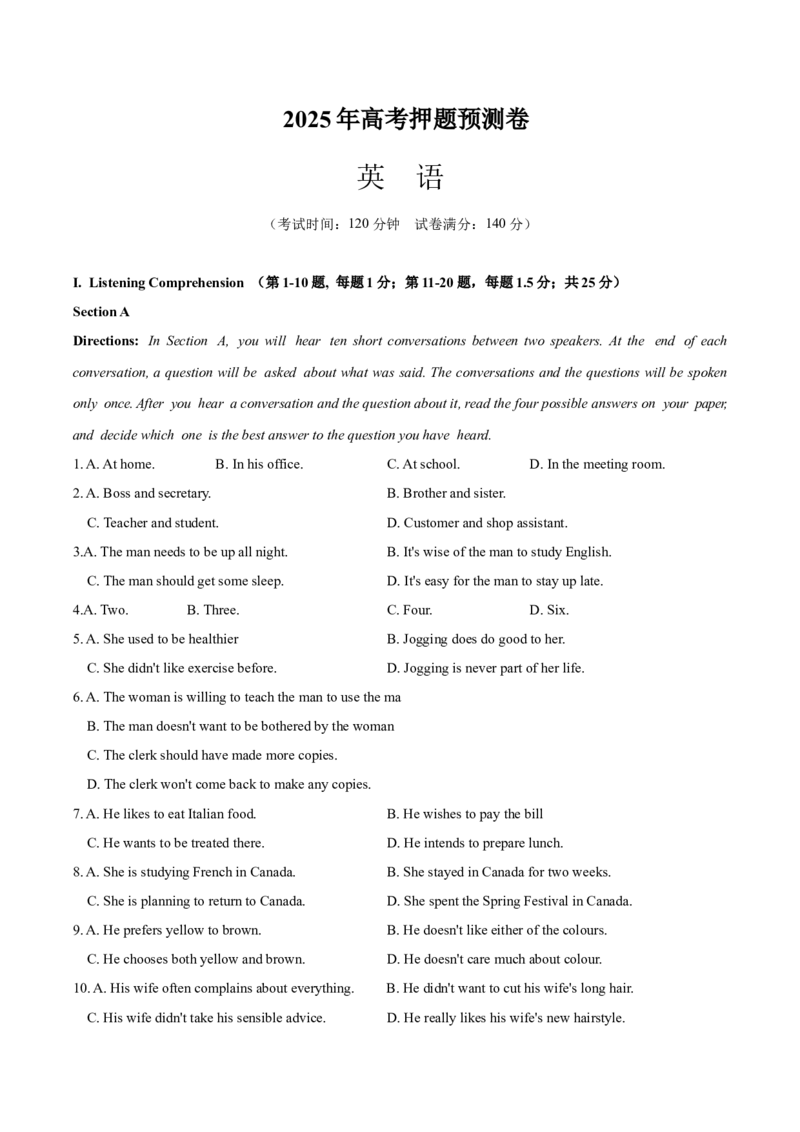
I. Listening Comprehension (第1-10题, 每题1分;第11-20题,每题1.5分;共25分)
Section A
Directions: In Section A, you will hear ten short conversations between two speakers. At the end of each
conversation, a question will be asked about what was said. The conversations and the questions will be spoken
only once. After you hear a conversation and the question about it, read the four possible answers on your paper,
and decide which one is the best answer to the question you have heard.
1. A. At home. B. In his office. C. At school. D. In the meeting room.
2. A. Boss and secretary. B. Brother and sister.
C. Teacher and student. D. Customer and shop assistant.
3.A. The man needs to be up all night. B. It's wise of the man to study English.
C. The man should get some sleep. D. It's easy for the man to stay up late.
4.A. Two. B. Three. C. Four. D. Six.
5. A. She used to be healthier B. Jogging does do good to her.
C. She didn't like exercise before. D. Jogging is never part of her life.
6. A. The woman is willing to teach the man to use the ma
B. The man doesn't want to be bothered by the woman
C. The clerk should have made more copies.
D. The clerk won't come back to make any copies.
7. A. He likes to eat Italian food. B. He wishes to pay the bill
C. He wants to be treated there. D. He intends to prepare lunch.
8. A. She is studying French in Canada. B. She stayed in Canada for two weeks.
C. She is planning to return to Canada. D. She spent the Spring Festival in Canada.
9. A. He prefers yellow to brown. B. He doesn't like either of the colours.
C. He chooses both yellow and brown. D. He doesn't care much about colour.
10. A. His wife often complains about everything. B. He didn't want to cut his wife's long hair.
C. His wife didn't take his sensible advice. D. He really likes his wife's new hairstyle.Section B
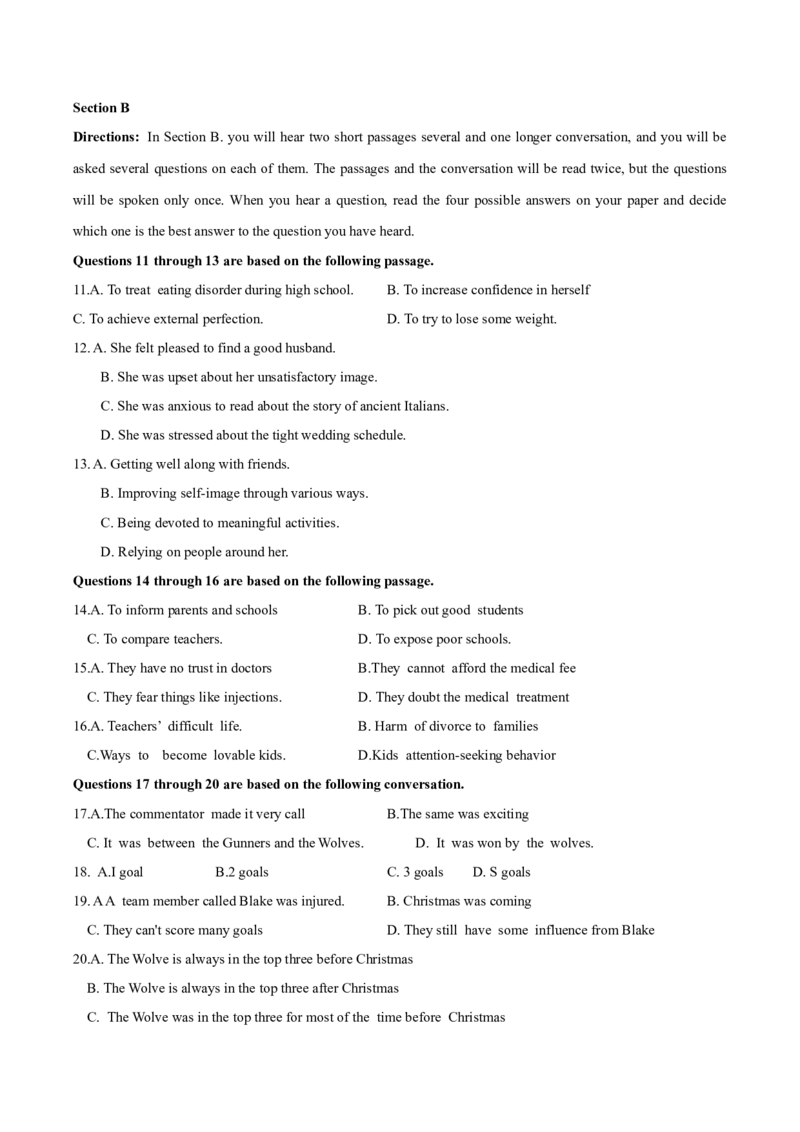
Directions: In Section B. you will hear two short passages several and one longer conversation, and you will be
asked several questions on each of them. The passages and the conversation will be read twice, but the questions
will be spoken only once. When you hear a question, read the four possible answers on your paper and decide
which one is the best answer to the question you have heard.
Questions 11 through 13 are based on the following passage.
11.A. To treat eating disorder during high school. B. To increase confidence in herself
C. To achieve external perfection. D. To try to lose some weight.
12. A. She felt pleased to find a good husband.
B. She was upset about her unsatisfactory image.
C. She was anxious to read about the story of ancient Italians.
D. She was stressed about the tight wedding schedule.
13. A. Getting well along with friends.
B. Improving self-image through various ways.
C. Being devoted to meaningful activities.
D. Relying on people around her.
Questions 14 through 16 are based on the following passage.
14.A. To inform parents and schools B. To pick out good students
C. To compare teachers. D. To expose poor schools.
15.A. They have no trust in doctors B.They cannot afford the medical fee
C. They fear things like injections. D. They doubt the medical treatment
16.A. Teachers’ difficult life. B. Harm of divorce to families
C.Ways to become lovable kids. D.Kids attention-seeking behavior
Questions 17 through 20 are based on the following conversation.
17.A.The commentator made it very call B.The same was exciting
C. It was between the Gunners and the Wolves. D. It was won by the wolves.
18. A.I goal B.2 goals C. 3 goals D. S goals
19. A A team member called Blake was injured. B. Christmas was coming
C. They can't score many goals D. They still have some influence from Blake
20.A. The Wolve is always in the top three before Christmas
B. The Wolve is always in the top three after Christmas
C. The Wolve was in the top three for most of the time before ChristmasD.The Wolve was in the top three for most of the time after Christmas
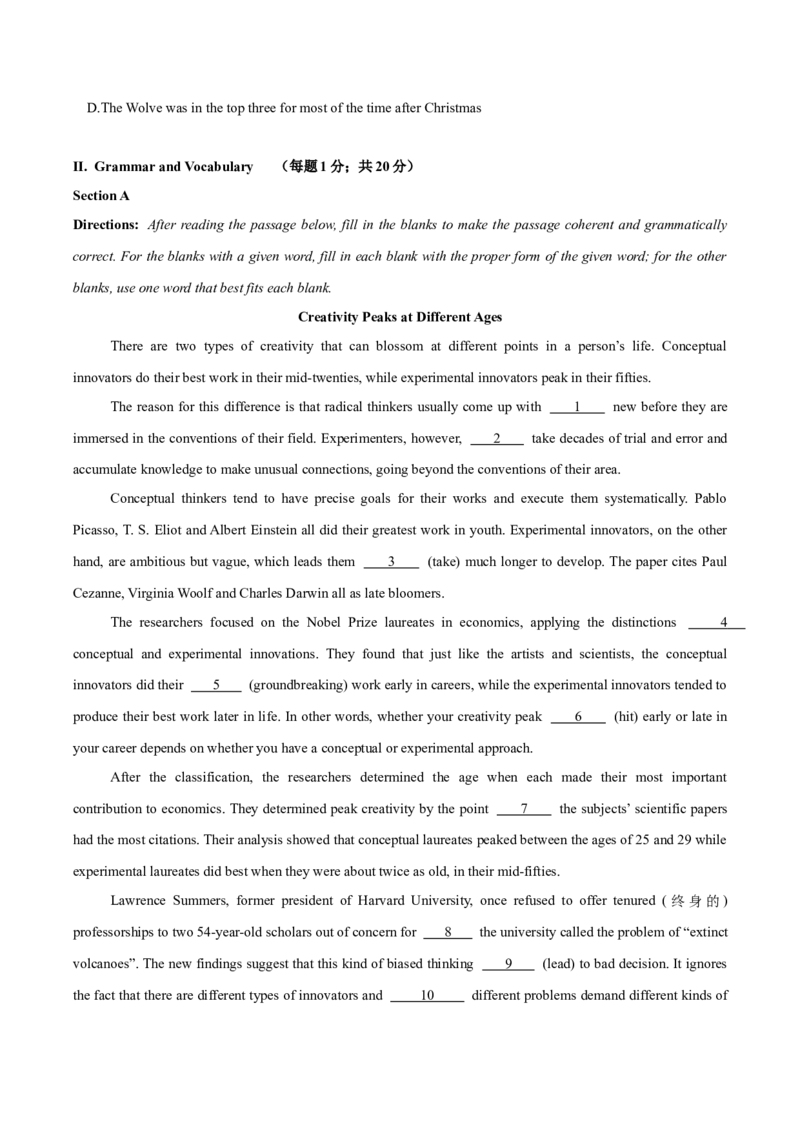
II. Grammar and Vocabulary (每题1分;共20分)
Section A
Directions: After reading the passage below, fill in the blanks to make the passage coherent and grammatically
correct. For the blanks with a given word, fill in each blank with the proper form of the given word; for the other
blanks, use one word that best fits each blank.
Creativity Peaks at Different Ages
There are two types of creativity that can blossom at different points in a person’s life. Conceptual
innovators do their best work in their mid-twenties, while experimental innovators peak in their fifties.
The reason for this difference is that radical thinkers usually come up with 1 new before they are
immersed in the conventions of their field. Experimenters, however, 2 take decades of trial and error and
accumulate knowledge to make unusual connections, going beyond the conventions of their area.
Conceptual thinkers tend to have precise goals for their works and execute them systematically. Pablo
Picasso, T. S. Eliot and Albert Einstein all did their greatest work in youth. Experimental innovators, on the other
hand, are ambitious but vague, which leads them 3 (take) much longer to develop. The paper cites Paul
Cezanne, Virginia Woolf and Charles Darwin all as late bloomers.
The researchers focused on the Nobel Prize laureates in economics, applying the distinctions 4
conceptual and experimental innovations. They found that just like the artists and scientists, the conceptual
innovators did their 5 (groundbreaking) work early in careers, while the experimental innovators tended to
produce their best work later in life. In other words, whether your creativity peak 6 (hit) early or late in
your career depends on whether you have a conceptual or experimental approach.
After the classification, the researchers determined the age when each made their most important
contribution to economics. They determined peak creativity by the point 7 the subjects’ scientific papers
had the most citations. Their analysis showed that conceptual laureates peaked between the ages of 25 and 29 while
experimental laureates did best when they were about twice as old, in their mid-fifties.
Lawrence Summers, former president of Harvard University, once refused to offer tenured (终身的)
professorships to two 54-year-old scholars out of concern for 8 the university called the problem of “extinct
volcanoes”. The new findings suggest that this kind of biased thinking 9 (lead) to bad decision. It ignores
the fact that there are different types of innovators and 10 different problems demand different kinds ofcontributions and solutions. The researchers hope that their work will reduce the world’s favoritism for precocious
geniuses and its ignorance of the creativity that comes with age.
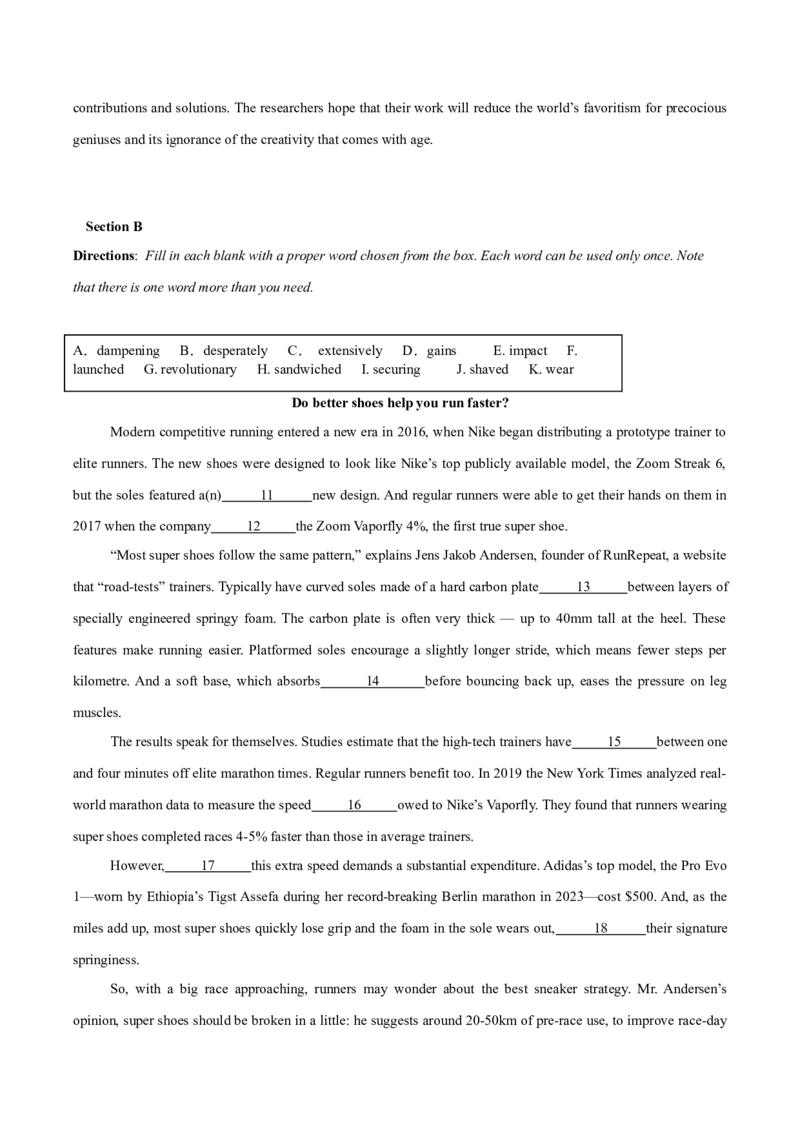
Section B
Directions: Fill in each blank with a proper word chosen from the box. Each word can be used only once. Note
that there is one word more than you need.
A.dampening B.desperately C. extensively D.gains E. impact F.
launched G. revolutionary H. sandwiched I. securing J. shaved K. wear
Do better shoes help you run faster?
Modern competitive running entered a new era in 2016, when Nike began distributing a prototype trainer to
elite runners. The new shoes were designed to look like Nike’s top publicly available model, the Zoom Streak 6,
but the soles featured a(n) 11 new design. And regular runners were able to get their hands on them in
2017 when the company 12 the Zoom Vaporfly 4%, the first true super shoe.
“Most super shoes follow the same pattern,” explains Jens Jakob Andersen, founder of RunRepeat, a website
that “road-tests” trainers. Typically have curved soles made of a hard carbon plate 13 between layers of
specially engineered springy foam. The carbon plate is often very thick — up to 40mm tall at the heel. These
features make running easier. Platformed soles encourage a slightly longer stride, which means fewer steps per
kilometre. And a soft base, which absorbs 14 before bouncing back up, eases the pressure on leg
muscles.
The results speak for themselves. Studies estimate that the high-tech trainers have 15 between one
and four minutes off elite marathon times. Regular runners benefit too. In 2019 the New York Times analyzed real-
world marathon data to measure the speed 16 owed to Nike’s Vaporfly. They found that runners wearing
super shoes completed races 4-5% faster than those in average trainers.
However, 17 this extra speed demands a substantial expenditure. Adidas’s top model, the Pro Evo
1—worn by Ethiopia’s Tigst Assefa during her record-breaking Berlin marathon in 2023—cost $500. And, as the
miles add up, most super shoes quickly lose grip and the foam in the sole wears out, 18 their signature
springiness.
So, with a big race approaching, runners may wonder about the best sneaker strategy. Mr. Andersen’s
opinion, super shoes should be broken in a little: he suggests around 20-50km of pre-race use, to improve race-dayperformance since some foams get bouncier after a small amount of 19 . Buying a new pair of shoes for
every race makes an expensive habit, but it could be worth it for those 20 chasing a personal best.
III. Reading Comprehension
Section A
Directions: For each blank in the following passage there are four words or phrases marked A. B.C and D.
Fill in each blank with the word or phrase that best fits the context
Insects are disappearing. The world has 25 per cent fewer insects now than in 1990.This includes those we
depend on to pollinate (授粉) our crops and clean our rivers. If we don’t solve this problem very soon, some
species will 21 .
There are many causes for the insect decline, but pesticides (杀虫剂) are a major part of the problem. Those
used today are 22 and up to 10000 times more poisonous than some that were banned in the 1970s. Adding
to the problem is that these pesticides are now applied to crops as preventive measures, whether pests are 23
or not.
Overall, the amount of insecticide applied to the land is 24 , but this is a very misleading statistic. A
recent paper found that, between 2005 and 2015, there was a 40 percent reduction in the amount of pesticide
applied to crops measured by weight. 25 , the global toxicity (毒性) of treated land to pollinating insects has
more than doubled in the same period.
Governments and regulating agencies are aware of the problem, and some have moved to 26 the use
of certain pesticides outdoors in an attempt to help bees survive. But the pesticides used instead are just as
hazardous.
One 27 approach is to use pesticide-free pest control methods, referred to as integrated pest
management (IPM). Having been around for decades, they offer effective crop protection and include methods such
as planting resistant varieties, 28 pest habitats and releasing natural enemies of pests. But their adoption has
been incredibly 29 , because spraying pesticides is viewed as an easy option. As a result, IPM methods are
30 seldom used today.
Neither changing insecticides nor adopting IPM is a quick 31 . We argue instead that we need a
gradual 32 in focus, away from killing pests and towards protecting crops.
By using the 33 dose (剂量) we need to protect crops, we could reduce the amount of insecticide to
a small portion of what is used today. Farmers would benefit from these changes. 34 , they could spend lessmoney on pesticides and improve crop production by keeping healthy pollinator insects about. It is also a move that
could win us time to make food production more 35 and integrate farmlands well with the natural
ecosystems we crucially depend on. And that will allow insects to recover in the end.
21.A.come out B.leave out C.die out D.set out
22.A.efficient B.economical C.persisting D.temporary
23.A.energetic B.healthy C.present D.current
24.A.decreasing B.increasing C.multiplying D.rising
25.A.Therefore B.Moreover C.Furthermore D.However
26.A.ban B.embrace C.permit D.make
27.A.highly-recommended B.well-received C.widely-applied D.over-estimated
28.A.harvesting B.producing C.removing D.locating
29.A.slow B.rapid C.simple D.popular
30.A.willingly B.luckily C.purposefully D.unfortunately
31.A.problem B.decision C.action D.fix
32.A.progress B.improvement C.process D.shift
33.A.medium B.heavy C.minimal D.high
34.A.All in all B.First of all C.In all D.After all
35.A.efficient B.nutritious C.profitable D.sustainable
Section B
Directions: Read the following three passages. Each passage is followed by several questions or unfinished
statements. For each of them there are four choices marked A, B, C and D. Choose the one that fits best according
to the information given in the passage you have just read.
(A)
When I look back on my childhood, one aspect stands out in my memory: my love of history. I can
remember a time when history hasn’t been a part of my life, and my passion for it was aroused in my earliest days.
I was only two or three years old when my mum began to read me tales of King Arthur and the Knights of the
Round Table, and before long, they became a regular part of my bedtime routine. I was fascinated by the stories of
the sword in the stone and the Holy Grail, and I was attracted by Lancelot and Guinevere.
When I was four, though, I received a gift that would prove so inspirational that — without my knowledge atthe time — it helped to steer the direction of my career: The Webtastic Illustrated British History Book. When my
mum gave this to me, published in 1989, I doubt she thought much beyond the fact that it might open for me a
gateway to something or someone other than King Arthur—and she was absolutely right.
I vividly remember leafing through the pages and admiring the pictures — and then I came to one image that
really captured my attention: Henry VIII and his six wives. The idea of a king who had married six times fascinated
the infant me, and I used the book to memorize the classic rhyme about their fate: divorced, beheaded, died,
divorced, beheaded, survived. Simply from viewing pictures of a king and his spouses, my love of the Tudors (都铎
王朝) was born — and snowballed.
That slim volume was my starting point, and soon it began to show signs of wear. I became determined to
find out all I could about Henry VIII and his extraordinary family — a journey that I’m still undertaking to this day.
If I hadn’t been given that book as a child, I’m certain that my career would’ve taken an entirely different direction.
It was a small thing — but one that made a far-reaching impact.
36.Why did the mother give the author The Webtastic Illustrated British History Book?
A.To make bedtime more enjoyable for the author.
B.To encourage the author to pursue a career in history.
C.To help the author understand the importance of reading.
D.To introduce the author to other historical topics besides King Arthur.
37.Why does the author mention seeing the image of Henry VIII in the book?
A.To describe her fascination with royal marriages.
B.To show how this image excited her deep interest in history.
C.To highlight how essential illustrations are in a children’s history book.
D.To suggest that the image influenced her view of historical events.
38.Which piece of the following advice is the author most likely to give to parents?
A.Expose children to history early on because it is important for their growth.
B.Prioritize content over engaging illustrations when choosing books for children.
C.Introduce children to academics to shape their future careers.
D.Encourage children’s exploration of interests with resources.
39.Which of the following proverbs best reflects the main theme of the passage?
A.A tiny flame can start a fire. B.You reap what you sow.
C.Still waters run deep. D.The early bird catches the worm.(B)
Staying Safe After a Disaster
Although each type of disaster brings its own unique challenges, the steps listed here are applicable to many
different situations you may face. For information on safety and recovery after specific types of disasters and
emergencies, please visit
https: // www.redcross.org/get-help/how-to-prepare-for-emergencies.html.
→Some natural disasters, such as severe storms or earthquakes, may recur in the form of new storms or
aftershocks over the next several days. Take all safety precautions in case the disaster strikes again. For an
earthquake aftershock, remember to DROP, COVER and HOLD ON just like you did during the initial earthquake.
→If you had to leave your home, return only when local authorities advise that it is safe to do so. Make a
careful and thorough inspection of your home:
·Sniff for gas. If you detect natural gas or hear a hissing noise, leave the property immediately and get far
away from it. Call the fire department after you reach safety.
·Beware of animals, such as rodents (啮齿动物), snakes, spiders and insects, that may have entered your
home. If you suspect your home, tap loudly and often on the floor with a stick to give notice that you are there.
Flooding and storms can create conditions in which disease -bearing mosquitoes can breed. Remove standing water
(积水) where possible. If you can’t get rid of it, use a commercial product that kills mosquito larvae (幼虫) or apply
a thin film of cooking oil on the water. Repeat the application within a few days if rain disturbs the film of oil.
·Water damage, either from a flood or in the aftermath of a fire, is not just unsanitary-it can also be
dangerous. From wallboard to rugs, items that are not thoroughly dried can grow mold (霉菌). Keep the windows
open and run fans so as to pull moisture out of wooden furniture. Throw out items that have absorbed water and
cannot be cleaned or disinfected.
→Disasters are upsetting experiences for everyone involved. Some people feel better after a few days, while
others find that their stress does not go away as quickly as they would like it to. If you find yourself experiencing
some of the feelings and reactions listed below for two weeks or longer, this may be a sign to reach out for
additional assistance.
·Having difficulty in eating or sleeping;
·Feeling guilty, helpless or hopeless;
·Avoiding family and friends;
·Suffering from increased physical symptoms such as headaches or stomachaches.40.You shouldn’t return home after a disaster if ______.
A.the area is still suffering from aftershocks
B.you find traces of wild animals around your house
C.you catch a smell of gas as soon as you open the door
D.your house has not been inspected by local authorities
41.Which of the following actions can cause harm to your health after a flood?
A.Throwing away tissues before using them.
B.Drying out soft items before using them.
C.Driving off hidden animals before moving in again.
D.Leaving standing water that can’t be removed where it is.
42.Which of the following survivors need to reach out for the additional assistance mentioned in the last
paragraph?
A.Peter, who lost contact with his family and best friends.
B.Vivian, who found herself in low spirits within the first week of the disaster.
C.Libby, who constantly woke up at midnight from bad dreams months after a disaster.
D.David, who had no idea how to thoroughly disinfect his house and has been feeling overwhelmed by the
cleanup process.
(C)
eens Are Still Developing Empathy Skills
The teen years are often fraught with door-slamming, eye-rolling and seeming insensitivity even by kids who
behaved kindly before. Some parents worry that they are doing something wrong or that their children will never
think of anyone but themselves. A six -year study shows that biology is partly to blame.
In adolescence, critical social skills that are needed for one to feel concern for other people and to understand
how they think are undergoing major changes. Adolescence has long been known as prime time for developing
cognitive skills (认知能力) for self-regulation and executive function (执行功能).
“Cognitive empathy,” or the mental ability to take others’ perspective, begins to rise steadily in girls at the
age of 13, according to the study co-authored by Jolien van der Graaff at Utrecht University in the Netherlands. By
comparison, boys do not begin until the age of 15 to show increases in perspective-taking, which helps in problem
-solving and avoiding conflict.
Adolescent boys actually show a temporary decline, between the ages of 13 and 16, in a related skill —“affective empathy (情感同理心),” or the ability to recognize and respond to others’ feelings. This may be the
result, at least in part, of a dramatic rise in testosterone (睾酮), the primary male sex hormone, during adolescence,
which sparks a desire for dominance and power. Fortunately, the boys’ sensitivity recovers in their late teens. Girls
affective empathy remains relatively high and stable throughout adolescence.
This doesn’t mean, however, that we can do nothing but just wait for teenagers to develop a feeling of
empathy. In fact, parents can help instill affective empathy into their children. Affective empathy is grounded in the
limbic region (边缘区) of the brain, which regulates emotions. This capacity begins to develop in infancy. Children
learn to practice empathy by watching their parents and by experiencing it themselves-being well treated by adults
who sensitively respond to their emotions. While cognitive empathy arises from a different part of the brain called
the medial prefrontal cortex (内侧前额叶皮层), the two abilities are linked. Children’s affective empathy predicts
their level of cognitive empathy as teens, says Caspar Van Lissa at Utrecht University.
The findings reflect a major expansion in researchers’ understanding of cognitive growth during
adolescence. They used to believe that both forms of empathy were fully formed in childhood. Now, it is clear that
“the brain regions that support social cognition, which helps us successfully understand and interact with others,
continue to change dramatically”, in our teens, says Jennifer Pfeifer at the University of Oregon. Research in her
lab also suggests that cognitive empathy rises in teens. The discoveries serve as a new lens for exploring such teen
behavior as bullying and drug abuse.
43.Teenage boys are less likely to put themselves in other people’s shoes ______.
A.until the age of 15 B.in their late teens
C.during adolescence D.between the ages of 13 and 16
44.Adolescent boys tend to ignore the feelings of another person partly because ______.
A.they are born with a natural desire for dominance and power
B.their affective empathy becomes unstable during adolescence
C.they think being sensitive and caring is seen as uncool for guys
D.their emotional reactions are highly influenced by peer pressure
45.Which of the following kids is most likely to grow more empathetic during their adolescence?
A.Mike, raised by his grandparents who only care if he’s hungry.
B.Jack, raised by parents who buy anything he wants to keep him quiet.
C.Leila, raised by parents who properly guide her through her emotions.
D.Carla, raised by parents who always ask her to handle her feelings on her own.
46.Which of the following statements about the study co-authored by Graaff is NOT true?A.It took her team a long time to reach their conclusions.
B.It was the first of its kind to have studied teen empathy.
C.Its findings were supported by Jennifer Pfeifer’s research.
D.It will pave the way for further research on some typical teen behavior.
Section C
Directions: Complete the following passage by using the sentences in the box Each sentence can only be used
once. Note that there are two sentences more than you need.
A.It encourages creators to shorten their filming
B.Therefore, specialists are hired to recommend most popular content.
C.The accessible entry point can allow creators to reach a wider audience and increase their chances of success.
D.In the current climate, what is it about short-form video content that makes it so appealing?
E.It breaks down creative and production barriers even further.
F.As a result, shortform platforms have improved their ability to deliver content that matches different audiences’
needs and expectations.
The past few years have seen a rapid rise in short-form videos’ popularity. Many people, especially the
younger generations, are now heavy users of these short, straightforward video clips. Major social media platforms
are offering opportunities for all users to create and share short content. 47
It encourages creator and viewer participation
When it comes to viewers, I believe they’re looking for a sense of belonging and the chance to interact with
others who share their passions. That’s why it’s very important to promote active viewer participation through
interesting content. And short-form content provides that in several ways. Firstly, short-form content creators are
able to adapt to trends, memes and culturally important news quickly. This vastly encourages participation and the
formation of communities. Secondly, platforms have made content creation simple. This simplicity encourages
people to get involved.
Content is generally free to access
Today, short-form platforms tend to rely on advertising rather than subscription fees. 48 For viewers,
the economic benefits are attractive, and short-form content is a good choice for those trying to avoid spending
money on a subscription.
49 Longer-form online videos already provided everyone with the possibility to become creators.
Still, back in 2010, you needed to get your hands on a camera and have a basic understanding of video editing andpublishing in order to get started. Short-form video has made the act of creating content much easier. Short videos
with music and filters make it easy for almost anyone to produce and share content and even add special effects.
Technology no longer acts as a barrier and limit to a creator’s ability to create content.
Content is tailored for you
Audiences often want to instantly find something to please themselves — though not necessarily by seeking
it out themselves. 50 Thanks to advanced algorithms and machine learning, each viewer gets their own
tailored feed of content.
IV.Summary Writing
Directions: Read the following passage. Summarize the main idea and the main point( s)of the passage in no more
than 60 words. Use your own words as far as possible.
Problems on the Production of Coffee Beans
The production of coffee beans is a huge, profitable business, but, unfortunately, full -sun production is
taking over the industry and bringing about a lot of damage. The change in how coffee is grown from shade -grown
production to full -sun production endangers the very existence of certain animals and birds and even disturbs the
world’s ecological balance.
On a local level, the damage of the forest required by full -sun fields affects the area’s birds and animals. The
shade of the forest trees provides a home for birds and other species that depend on the trees’ flowers and fruits.
Full -sun coffee growers destroy this forest home. As a result, many species are quickly dying out.
Moreover, the continued spread of full -sun coffee plantations could mean the destruction of the rainforest
ecology. The loss of shade trees is already causing a slight change in the world’s climate, and studies show that loss
of oxygen -giving trees also leads to air pollution and global warming. Besides, the new growing techniques are
contributing to acidic soil conditions.
On a more global level, the destruction of the rainforest for full -sun coffee fields also threatens human life.
Medical research often makes use of the forests’ plant and animal life, and the destruction of such species could
prevent researchers from finding cures for certain diseases. In addition, new coffee -growing techniques are
poisoning the water locally and eventually the world’s groundwater.
It is obvious that the way much coffee is grown affects many aspects of life, from the local environment to
the global ecology. But consumers do have a choice. They can purchase shade -grown coffee whenever possible,
although at a higher cost. The future health of the planet and mankind is surely worth more than an inexpensive cupof coffee.
51.__________________________________________________________________________________________
____________________________________________________________________________________________
____________________________________________________________________________________________
____________________________________________________________________________________________
____________________________________________________________________________________________
__
V.Translation (共15分。第1小题和第2小题,每题3分;第3题4分;第4题5分。)
Directions:Translate the following sentences into English, using the words given in the brackets
52.他忘了往锅里倒油,鸡蛋粘在了锅底。(forget)
53.令我们惊喜的是,我们昨天巧遇的学生知识非常渊博。(range)
54.正是其产品始终如一、坚如磐石的品质,这家国产电子元器件公司才能够驰名中外,成为行业标杆。
(It)
55.影片哪吒,改编自中国民间故事,以其生动鲜明的角色,引人入胜的故事情节和高质量的特效,吸引
了各个年龄层次的观众。(which)
VI.Guided Writing (共25分)
Directions: Write an English composition in 120-150 words according to the instructions given below in Chinese
假设你是明启中学高三学生李明,你校校园广播台计划新增一档文化类节目,节目主题从“Traditional
Festivals in My Eyes”,“Cultural Icons I Admire”, “The Joys of Hobbies and Collections”中选择一个,现
向全校同学征求意见。写一封邮件给广播台负责人,内容须包括:
1.你推荐的节目主题;
2.你的理由。
____________________________________________________________________________________________
____________________________________________________________________________________________
________________________________________________________________________________________________________________________________________________________________________________________
____________________________________________________________________________________________