文档文本内容
【如何从 130 提到 140?】
“高原训练”
——每天边查字典边画括号边真读懂一篇四级/六级/考研/新四的文章!
(有没有真读懂,自己良心最清楚)
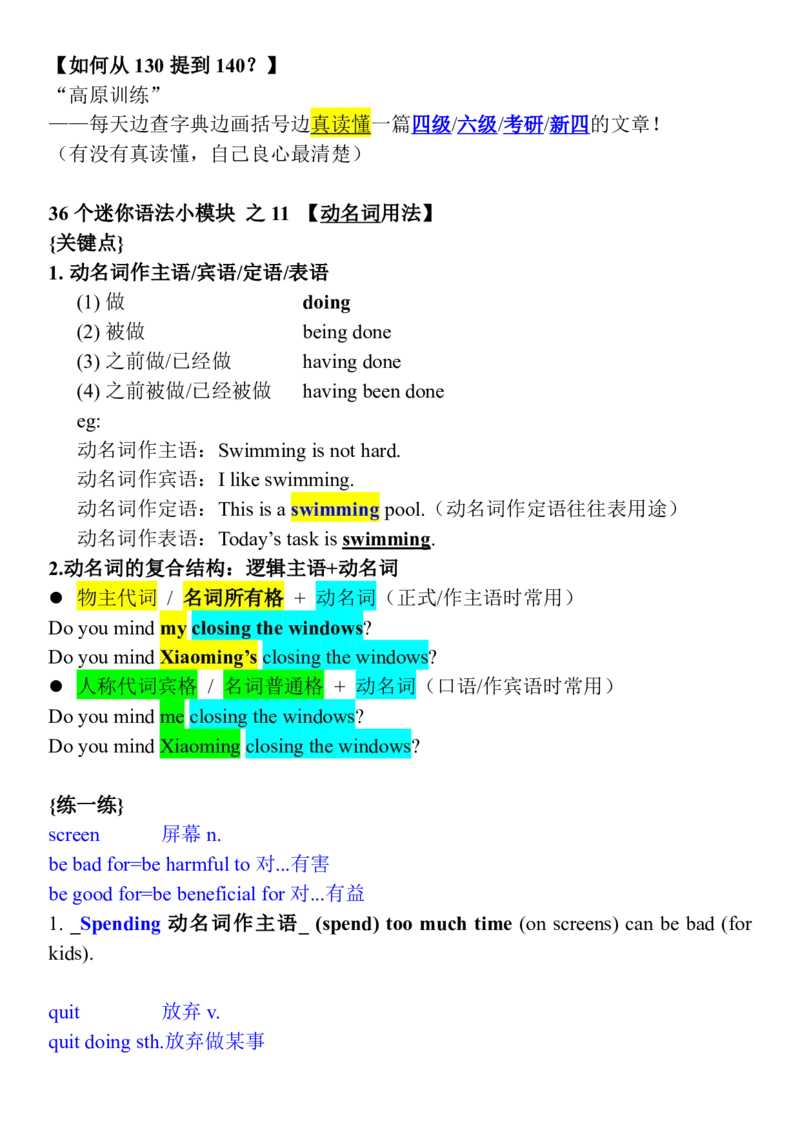
36 个迷你语法小模块 之 11 【动名词用法】
{关键点}
1. 动名词作主语/宾语/定语/表语
(1) 做 doing
(2) 被做 being done
(3) 之前做/已经做 having done
(4) 之前被做/已经被做 having been done
eg:
动名词作主语:Swimming is not hard.
动名词作宾语:I like swimming.
动名词作定语:This is a swimming pool.(动名词作定语往往表用途)
动名词作表语:Today’s task is swimming.
2.动名词的复合结构:逻辑主语+动名词
物主代词 / 名词所有格 + 动名词(正式/作主语时常用)
Do you mind my closing the windows?
Do you mind Xiaoming’s closing the windows?
人称代词宾格 / 名词普通格 + 动名词(口语/作宾语时常用)
Do you mind me closing the windows?
Do you mind Xiaoming closing the windows?
{练一练}
screen 屏幕 n.
be bad for=be harmful to 对...有害
be good for=be beneficial for 对...有益
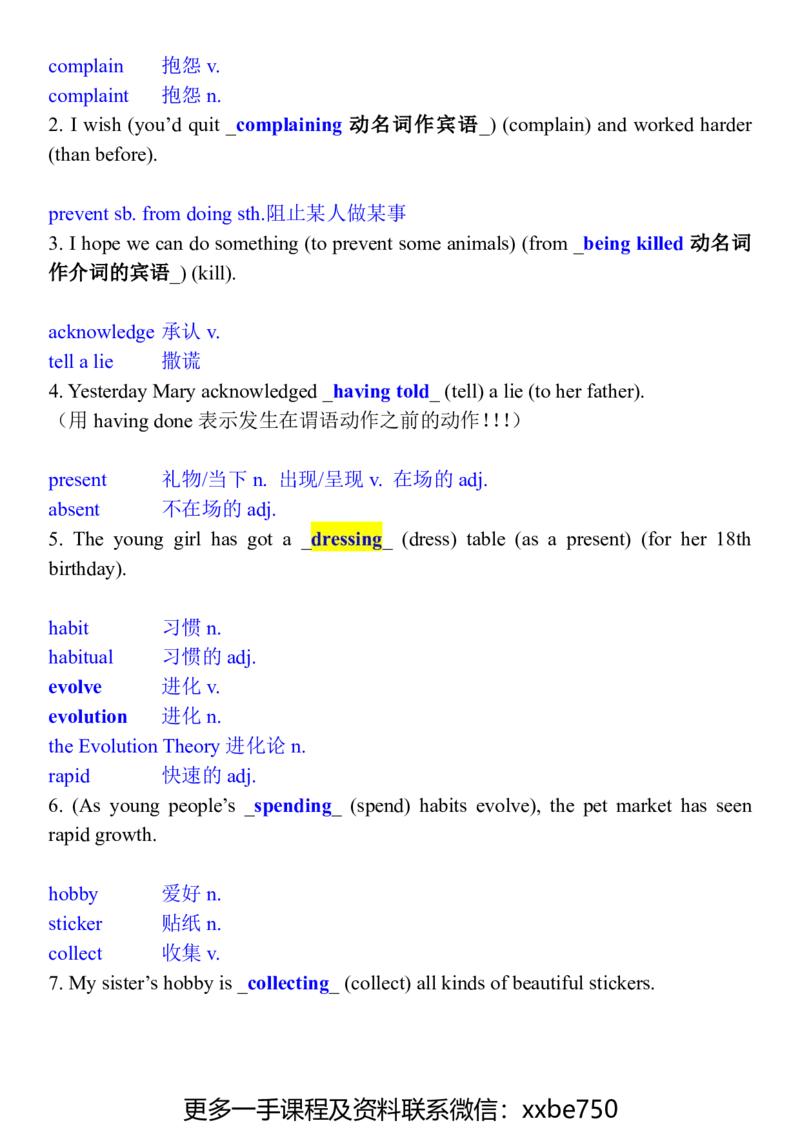
1. _Spending 动名词作主语_ (spend) too much time (on screens) can be bad (for
kids).
quit 放弃 v.
quit doing sth.放弃做某事complain 抱怨 v.
complaint 抱怨 n.
2. I wish (you’d quit _complaining 动名词作宾语_) (complain) and worked harder
(than before).
prevent sb. from doing sth.阻止某人做某事
3. I hope we can do something (to prevent some animals) (from _being killed 动名词
作介词的宾语_) (kill).
acknowledge 承认 v.
tell a lie 撒谎
4. Yesterday Mary acknowledged _having told_ (tell) a lie (to her father).
(用 having done 表示发生在谓语动作之前的动作!!!)
present 礼物/当下 n. 出现/呈现 v. 在场的 adj.
absent 不在场的 adj.
5. The young girl has got a _dressing_ (dress) table (as a present) (for her 18th
birthday).
habit 习惯 n.
habitual 习惯的 adj.
evolve 进化 v.
evolution 进化 n.
the Evolution Theory 进化论 n.
rapid 快速的 adj.
6. (As young people’s _spending_ (spend) habits evolve), the pet market has seen
rapid growth.
hobby 爱好 n.
sticker 贴纸 n.
collect 收集 v.
7. My sister’s hobby is _collecting_ (collect) all kinds of beautiful stickers.
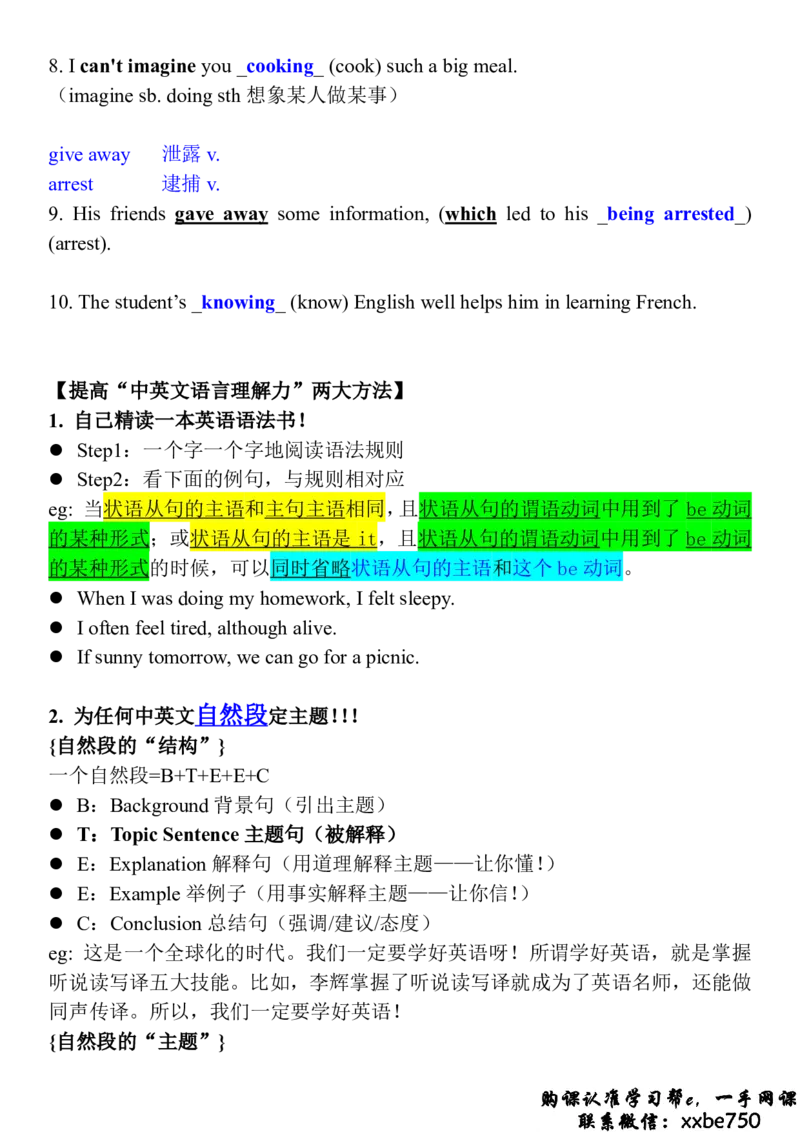
更多一手课程及资料联系微信:xxbe7508. I can't imagine you _cooking_ (cook) such a big meal.
(imagine sb. doing sth 想象某人做某事)
give away 泄露 v.
arrest 逮捕 v.
9. His friends gave away some information, (which led to his _being arrested_)
(arrest).
10. The student’s _knowing_ (know) English well helps him in learning French.
【提高“中英文语言理解力”两大方法】
1. 自己精读一本英语语法书!
Step1:一个字一个字地阅读语法规则
Step2:看下面的例句,与规则相对应
eg: 当状语从句的主语和主句主语相同,且状语从句的谓语动词中用到了 be 动词
的某种形式;或状语从句的主语是 it,且状语从句的谓语动词中用到了 be 动词
的某种形式的时候,可以同时省略状语从句的主语和这个 be 动词。
When I was doing my homework, I felt sleepy.
I often feel tired, although alive.
If sunny tomorrow, we can go for a picnic.
2.
为任何中英文自然段定主题!!!
{自然段的“结构”}
一个自然段=B+T+E+E+C
B:Background 背景句(引出主题)
T:Topic Sentence 主题句(被解释)
E:Explanation 解释句(用道理解释主题——让你懂!)
E:Example 举例子(用事实解释主题——让你信!)
C:Conclusion 总结句(强调/建议/态度)
eg: 这是一个全球化的时代。我们一定要学好英语呀!所谓学好英语,就是掌握
听说读写译五大技能。比如,李辉掌握了听说读写译就成为了英语名师,还能做
同声传译。所以,我们一定要学好英语!
{自然段的“主题”}两种抓主题的方法:
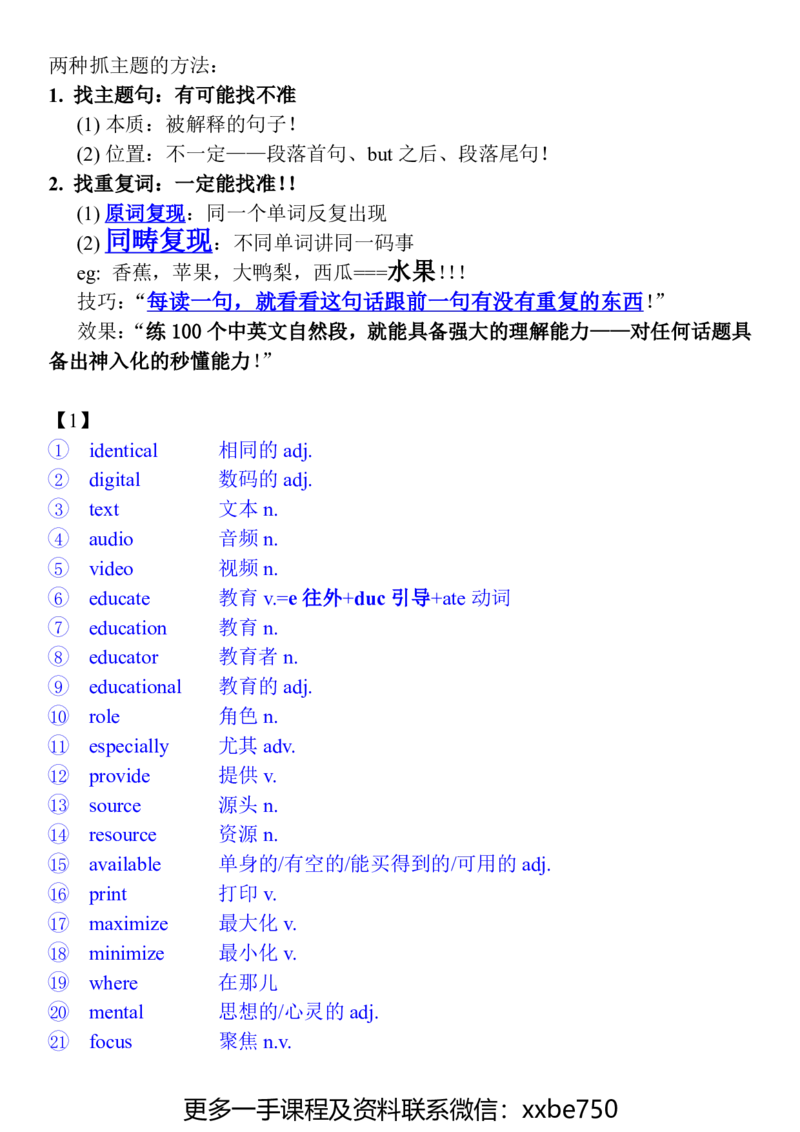
1. 找主题句:有可能找不准
(1) 本质:被解释的句子!
(2) 位置:不一定——段落首句、but 之后、段落尾句!
2. 找重复词:一定能找准!!
(1) 原词复现:同一个单词反复出现
同畴复现
(2) :不同单词讲同一码事
eg: 香蕉,苹果,大鸭梨,西瓜=== 水果!!!
技巧:“每读一句,就看看这句话跟前一句有没有重复的东西!”
效果:“练 100 个中英文自然段,就能具备强大的理解能力——对任何话题具
备出神入化的秒懂能力!”
【1】
1 identical 相同的 adj.
2 digital 数码的 adj.
3 text 文本 n.
4 audio 音频 n.
5 video 视频 n.
6 educate 教育 v.=e 往外+duc 引导+ate 动词
7 education 教育 n.
8 educator 教育者 n.
9 educational 教育的 adj.
10 role 角色 n.
11 especially 尤其 adv.
12 provide 提供 v.
13 source 源头 n.
14 resource 资源 n.
15 available 单身的/有空的/能买得到的/可用的 adj.
16 print 打印 v.
17 maximize 最大化 v.
18 minimize 最小化 v.
19 where 在那儿
20 mental 思想的/心灵的 adj.
21 focus 聚焦 n.v.
更多一手课程及资料联系微信:xxbe75022 reflect 反射/反思/反映 v.
23 reflection 反射/反思/反映 n.
24 assume 假定 v.
25 media 媒介 n.
26 contain 包含 v.
27 container 容器 n.
28 identical 一样的 adj.
Digital texts, audio and video all have educational roles, especially (when
providing resources) not available (in print). However, (for maximizing learning)
(where mental focus and reflection are called for), educators shouldn’t assume all
media are the same, even (when they contain identical words).
4. What does the author imply in the last paragraph?
A. Students should apply multiple learning techniques.
B. Teachers should produce their own teaching material.
C. Print texts cannot be entirely replaced (in education).
D. Education outside the classroom cannot be ignored.
正确选项:跟原文之间有种转化过程
错误选项:其中往往包含幻觉的内容
转化过程有时不太容易理解,
幻觉内容往往比较容易识破,
所以阅读理解常用“排除法”做题!
【2】
serious 严重的 adj. heart attack 心脏病 n.
condition 状况 n. treat 治疗/对待/请客吃饭 v.
treatment 治疗/对待/请客吃饭 n.
ease 消除 v. suffer 遭罪 v.
suffering 痛苦 n. so...that... 如此...以至于...
keep sb. alive 保持某人活着 additional 额外的 adj.
report 报告 v. adjust 调整 v.
adjustment 调整 n. chiropractic 脊椎按摩疗法 n.*
Leigh Tindale’s dog Charlie had a serious heart condition. (After Charlie had aheart attack), Tindale says, she was prepared (to put him) (to sleep), but Farber’s
treatments eased her dog’s suffering so much (that she was able) (to keep him
alive)(for an additional five months). And Priscilla Dewing reports (that her horse,
Nappy, “moves more easily and rides more comfortably”) (after a chiropractic
adjustment).
7. What does paragraph 3 mainly talk about?
A. Steps (of a chiropractic treatment).
B. The complexity (of veterinarians’work).
C. Examples (of rare animal diseases).
D. The effectiveness (of holistic medicine).
【3】
undertake 从事 v. undertaking 事业 n.
spirit 精神 n. spiritual 精神的 adj.
nature 自然/天性/本质 n. pure 纯的 adj.
pleasure 快乐 n. explore 探索 v.
surround 围绕 v. surroundings 周遭的事物 n.
acquire 获得 v. experience 经验/经历 n.v.
aboriginal 澳大利亚土著的 adj. initial 最初的 adj.
initiate 发起 v. initiation 创始 n.
ritual 仪式 n. involve 包含/涉及 v.
exactly 精确地 adv. hike 徒步 n.
indigenous 本土的 adj. walkabout (澳洲土著的)短期丛林流浪
refer to 提及 v. temporary 临时的 adj.
mobility 移动性 n. former 前者 n.
latter 后者 n. derogatory 贬义的 adj.
term 词语 n.
(Among all the different types of journey) (that people undertake) there are also
those (of a spiritual nature). Some (of the trips) (we do) (in our lives) are purely (for
pleasure), some are meant (to make us stronger), sometimes we travel (to explore and
learn), and (in all of these undertakings) we grow and become wiser.
There is a lot (we can learn) (from the land) (that surrounds us) and the best way
(to acquire that knowledge) is (by traveling and experiencing).This ancient aboriginal
initiation ritual involves exactly this: a long spiritual hike (across the indigenous
更多一手课程及资料联系微信:xxbe750land). (Although widely known) (as “Walkabout”)(in later years) the ritual has been
referred to (as “temporary mobility”) (because the former is often used) (as a
derogatory term) (inAustralian culture).
9. What can be referred (from the first two paragraphs) (of the passage)?
A.Australians like (to engage) (in all kinds of travel).
B. People can gain knowledge (through travel).
C. Travel is usually purely (for pleasure).
D. Walkabout is a long spiritual journey.
【4】
The books (we read) (when we’re young) have a special sort of power: they can
inspire us (to be brave and resilient) (Matilda by Roald Dahi),take us (on thrilling
adventures) (Divergent by Veronica Roth) and even introduce us (to tragedy) (The
Bridge to Terabithia by Katherine Paterson). They’re (as formative) (as anything else)
(in our young lives), and sometimes they’re the first place (we encounter
larger-than-life ideas). Consider the lasting cultural import (of To Kill a Mockingbird)
or even the urgency (of a newer best seller) (like I’ll Give You the Sun), Jandy
Nelson’s 2014 novel (centering) (on a contradictory issue). (In The Magic Words),
Cheryl B. Klein, an executive editor (at Scholastic) (whose projects include the last
two Harry Potter books), sets out (to inform would-be writers) (on) (how great novels)
(for young readers) (work).
13.According to the first paragraph, it can be learned that _______.
A. The Bridge to Terabithia can inspire us to be brave and resilient 张冠李戴
B. Matilda by Roald Dahi can take us on thrilling adventures 张冠李戴
C. Divergent by Veronica Roth even introduce us to tragedy 张冠李戴
D. To Kill a Mockingbird has lasting cultural significance
【5】
note 注意 v. item 项目 n. menu 菜单 n. technically 技术上 adv.
garbage 垃圾 n. instead 作为替换 adv. produce 农产品 n. serve 端上桌 v.
kale 羽衣甘蓝 rib 肋排 n. collar 领子 n. reject 拒绝 v.
sweet potato 红薯 n. cucumber 黄瓜 n. butt 屁股 n.
re-appropriated 重新利用 v. chef 厨师 n. cuisine 烹饪 n.
It should be noted (that none of the items) (on wastED’s menu) was technicallymade (from garbage). Instead, all the ingredients (配料) (used) were examples (of
meat cuts and produce) (that most restaurants would never consider serving). Things
(like kale ribs, fish collars, rejected sweet potatoes, and cucumber butts)were all
re-appropriated and, (with the help) (of a number of good chefs), turned (into excellent
cuisine).
19. What is paragraph 5 mainly about?
A. Why the ingredients were used. B. Which dishes were best liked.
C. What the dishes were made of. D. Where the ingredients were bought.
【阅读理解满分方法】
“重复对应法”
i. 找重复定主题!!!
ii. 找对应做题目!!!
更多一手课程及资料联系微信:xxbe750