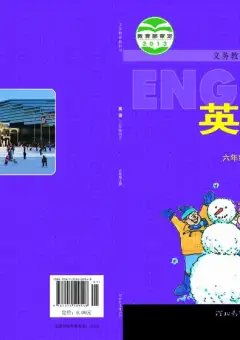
(三年级起点)
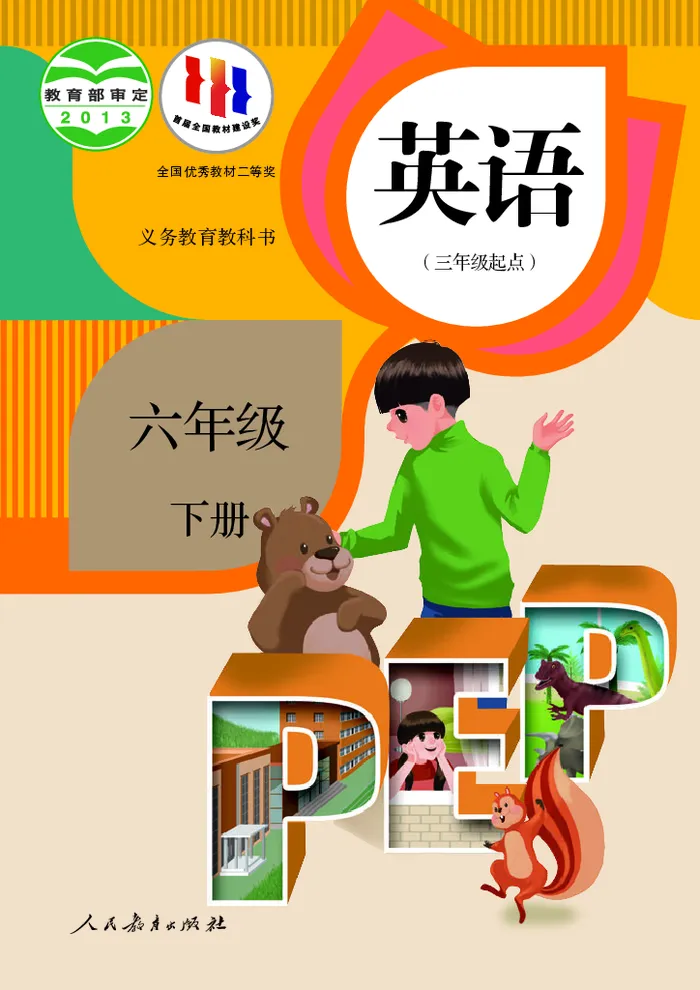
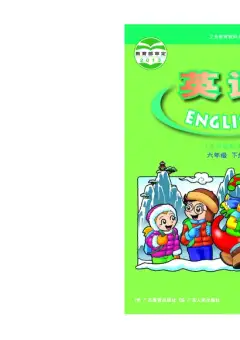
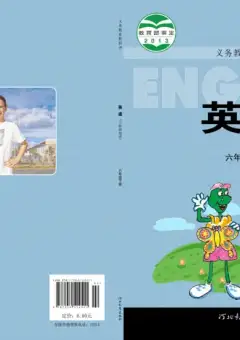
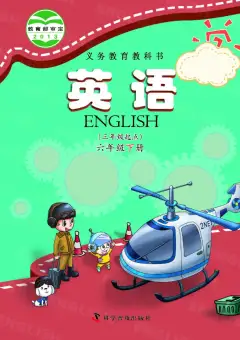
英语
六年级
下册
全国优秀教材二等奖
义务教育教科书
六年级
下册
(三年级起点)
人民教育出版社 课程教材研究所
英语课程教材研究开发中心
灵
通
教
育
有
限
公
司
编著
(中 国)
(加拿大)
·北 京·
义务教育教科书
(PEP)
英语
主 编:吴欣 Larry Swartz Beth Levy
副主编:曹洁
主要编写人员:马剑辉 周佳 刘荔芳 Fraser Bewick
责任编辑:马剑辉 周佳
版式设计:刘欣 焦洁
插 图:焦洁(含封面) 葛南 陈露茜 刘欣
Copyright © 2013 by People’s Education Press Ltd. and Lingo Learning Inc.
No part of this publication may be reproduced or transmitted in any form or by any means,
without permission in writing from the publisher.
版权共有,未经出版社书面同意,任何人不得以任何形式或方式复制或转换本作品的任何部分。
义务教育教科书 英语(三年级起点) 六年级 下册
(中 国) 人民教育出版社 课程教材研究所
英语课程教材研究开发中心
编著
(加拿大) 灵
通
教
育
有
限
公
司
出
网
版
(北京市海淀区中关村南大街17号院1号楼 邮编:100081)
址 http://www.pep.com.cn
版权所有·未经许可不得采用任何方式擅自复制或使用本产品任何部分·违者必究
如发现内容质量问题,请登录中小学教材意见反馈平台:jcyjfk.pep.com.cn
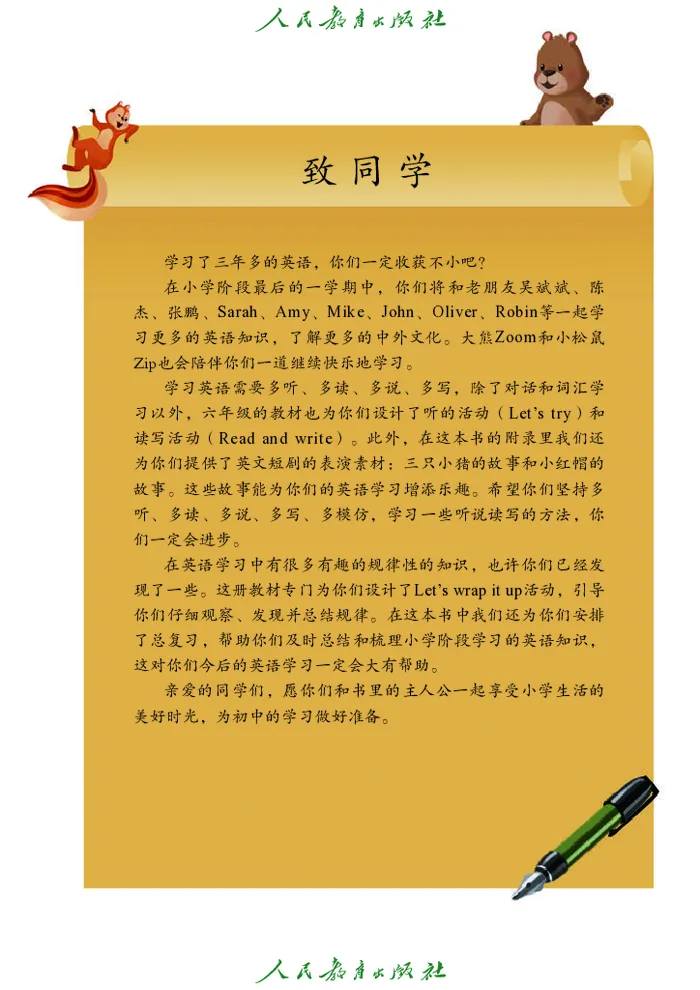
致 同 学
学习了三年多的英语,你们一定收获不小吧?
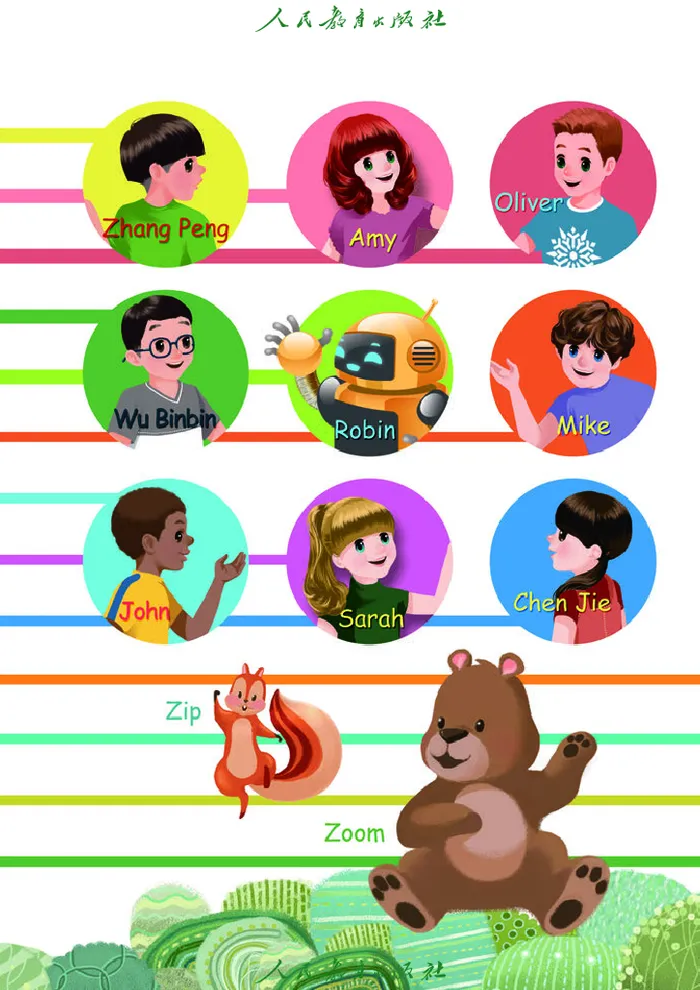
在小学阶段最后的一学期中,你们将和老朋友吴斌斌、陈
杰、张鹏、Sarah、Amy、Mike、John、Oliver、Robin等一起学
习更多的英语知识,了解更多的中外文化。大熊Zoom和小松鼠
Zip也会陪伴你们一道继续快乐地学习。
学习英语需要多听、多读、多说、多写,除了对话和词汇学
习以外,六年级的教材也为你们设计了听的活动(Let’s try)和
读写活动(Read and write)。此外,在这本书的附录里我们还
为你们提供了英文短剧的表演素材:三只小猪的故事和小红帽的
故事。这些故事能为你们的英语学习增添乐趣。希望你们坚持多
听、多读、多说、多写、多模仿,学习一些听说读写的方法,你
们一定会进步。
在英语学习中有很多有趣的规律性的知识,也许你们已经发
现了一些。这册教材专门为你们设计了Let’s wrap it up活动,引导
你们仔细观察、发现并总结规律。在这本书中我们还为你们安排
了总复习,帮助你们及时总结和梳理小学阶段学习的英语知识,
这对你们今后的英语学习一定会大有帮助。
亲爱的同学们,愿你们和书里的主人公一起享受小学生活的
美好时光,为初中的学习做好准备。
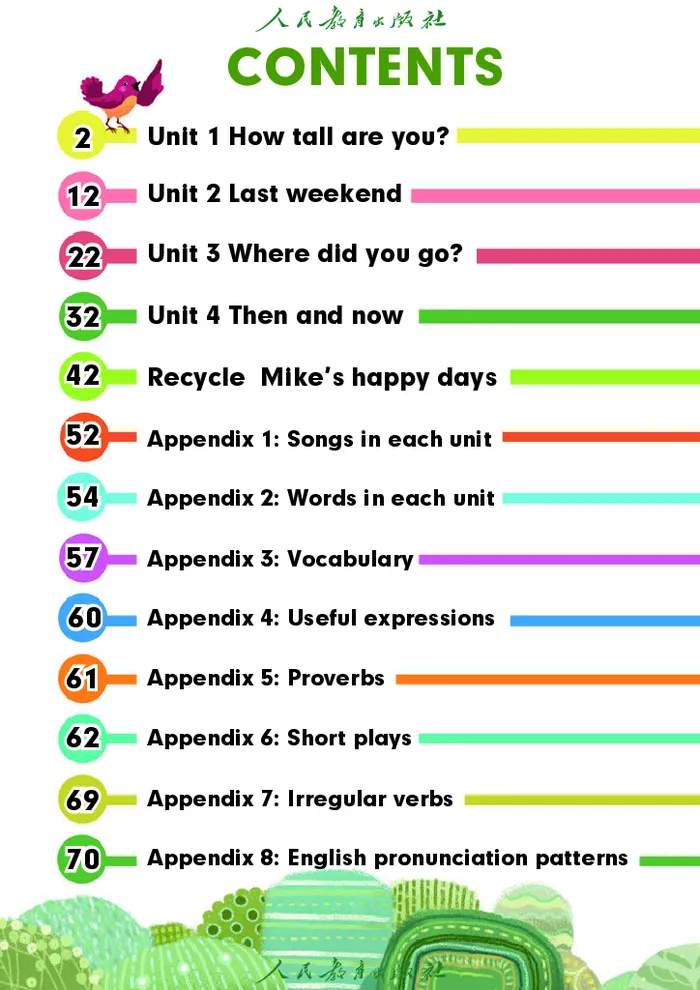
2
12
22
32
42
52
54
57
60
61
62
69
70
Unit 3 Where did you go?
Appendix 2: Words in each unit
CONTENTS
Unit 1 How tall are you?
Unit 2 Last weekend
Unit 4 Then and now
Recycle Mike’s happy days
Appendix 1: Songs in each unit
Appendix 3: Vocabulary
Appendix 4: Useful expressions
Appendix 6: Short plays
Appendix 7: Irregular verbs
Appendix 8: English pronunciation patterns
Appendix 5: Proverbs
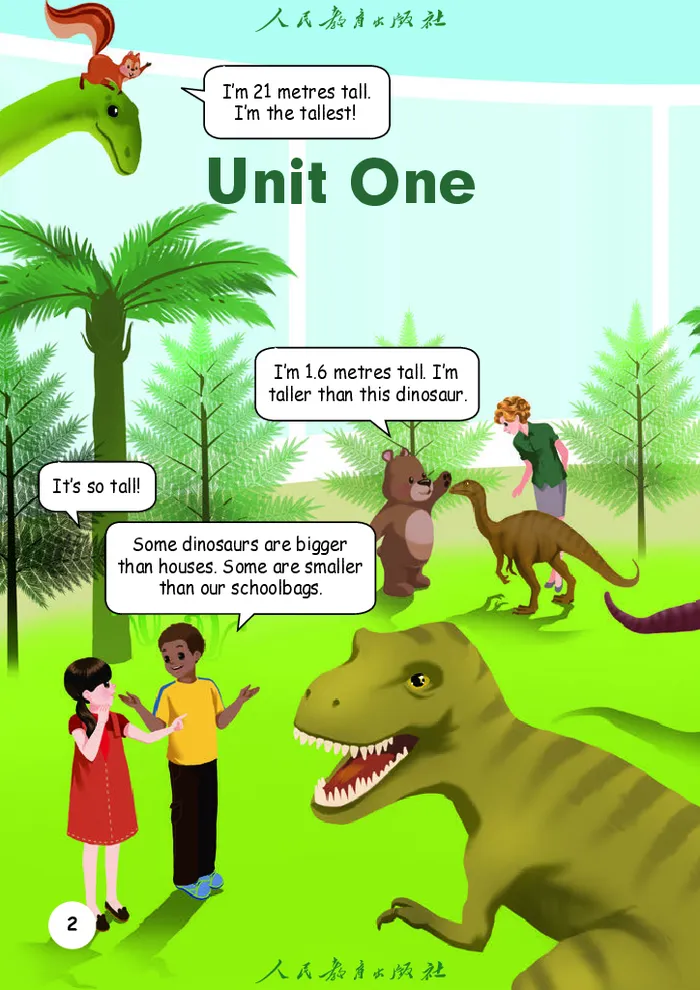
Some dinosaurs are bigger
than houses. Some are smaller
than our schoolbags.
It’s so tall!
I’m 1.6 metres tall. I’m
taller than this dinosaur.
I’m 21 metres tall.
I’m the tallest!
Unit One
2
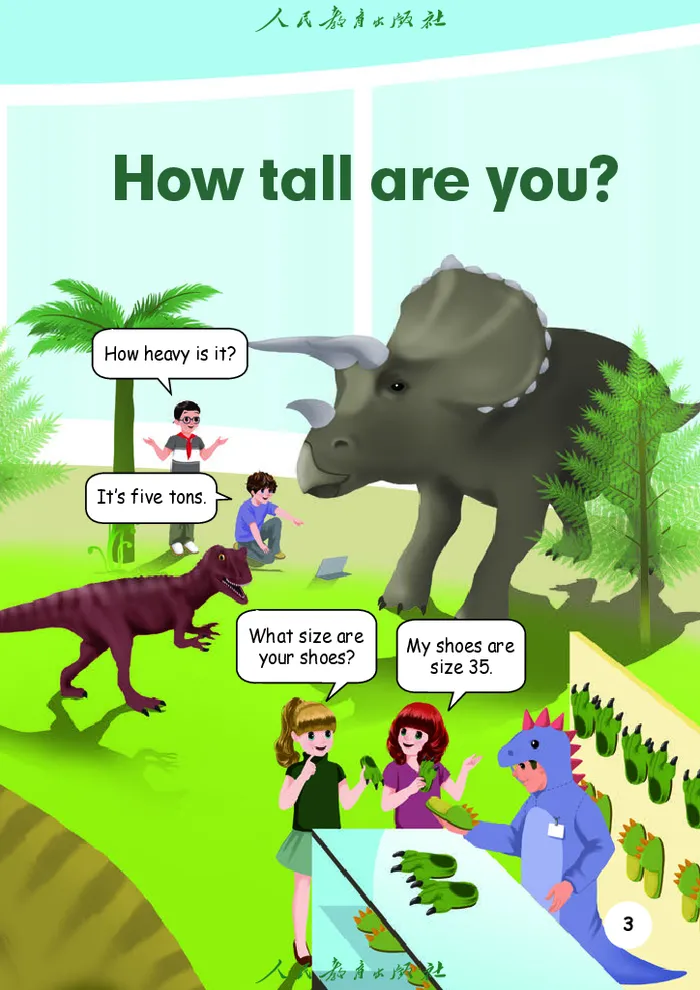
How heavy is it?
What size are
your shoes?
My shoes are
size 35.
It’s five tons.
How tall are you?
3
A
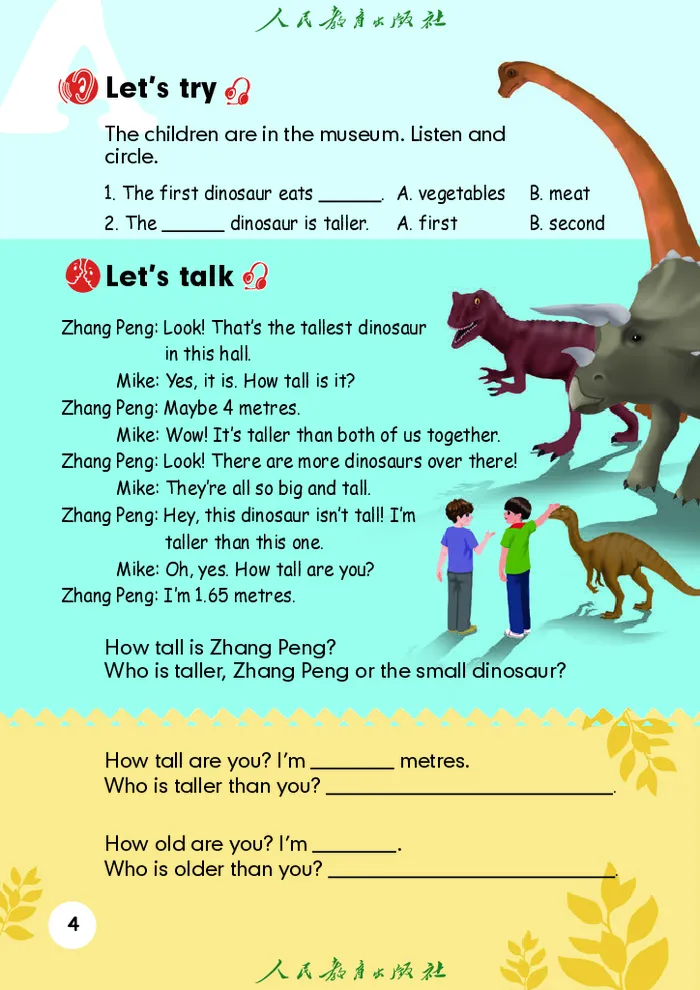
Zhang Peng: Look! That’s the tallest dinosaur
in this hall.
Mike: Yes, it is. How tall is it?
Zhang Peng: Maybe 4 metres.
Mike: Wow! It’s taller than both of us together.
Zhang Peng: Look! There are more dinosaurs over there!
Mike: They’re all so big and tall.
Zhang Peng: Hey, this dinosaur isn’t tall! I’m
taller than this one.
Mike: Oh, yes. How tall are you?
Zhang Peng: I’m 1.65 metres.
1. The first dinosaur eats . A. vegetables
B. meat
2. The dinosaur is taller.
A. first
B. second
How tall are you? I’m metres.
Who is taller than you? .
How old are you? I’m .
Who is older than you? .
The children are in the museum. Listen and
circle.
Let’s try
How tall is Zhang Peng?
Who is taller, Zhang Peng or the small dinosaur?
Let’s talk
4
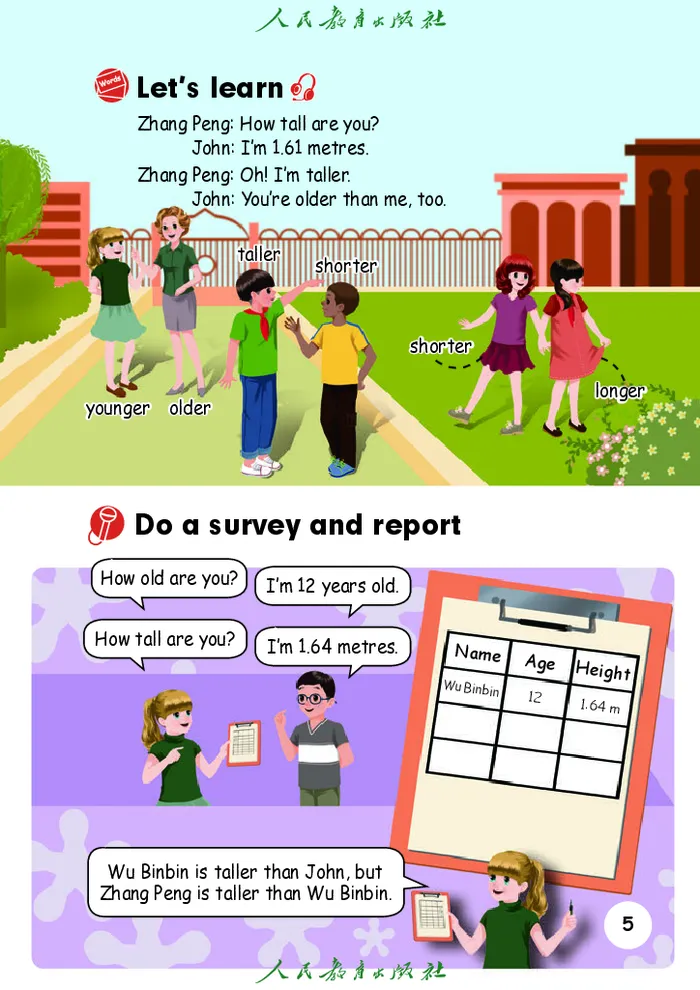
Zhang Peng: How tall are you?
John: I’m 1.61 metres.
Zhang Peng: Oh! I’m taller.
John: You’re older than me, too.
Name Age Height
Wu Binbin 12 1.64 m
younger
older
taller
shorter
shorter
longer
How old are you?
I’m 12 years old.
How tall are you?
I’m 1.64 metres.
Wu Binbin is taller than John, but
Zhang Peng is taller than Wu Binbin.
Let’s learn
Do a survey and report
Words
5
B
Mike: Those shoes in the window are
nice! Let’s have a look.
Wu Binbin: What size are your shoes, Mike?
Mike: Size 7.
Wu Binbin: Size 7? That’s so small.
Mike: In China I wear size 40 shoes.
Wu Binbin: Oh! Your feet are bigger than
mine. My shoes are size 37.
Mike: Really? You look taller than me.
Wu Binbin: But I think you are heavier.
How heavy are you?
Mike: I’m 48 kilograms.
Wu Binbin: Yes, you’re heavier. I’m 46 kilograms.
1. What do Wu Binbin and Mike want to do first?
A. Go hiking.
B. Go shopping.
2. What are they going to buy?
A. Hiking clothes and shoes.
B. Magazines.
How heavy are you?
Who is heavier than you? .
What size are your shoes?
Whose shoes are bigger? .
Let’s try
Mike and Wu Binbin are talking about the weekend.
Listen and circle.
Let’s talk
What size are Wu Binbin’s shoes?
How heavy is Wu Binbin?
6
John: How heavy are you, Jim?
Jim: I’m 52 kilograms.
John: You’re heavier than me.
thinner
heavier
stronger
bigger
smaller
Mike’s fish is _____ than _____.
Let’s learn
Match and say
Words
7
(Title)
Little Duck is watching the sun
go down. It is getting lower and
lower, but his shadow is getting
longer and longer.
"Why is that?" Little Duck asks
his friend Old Tree. "You are
older and smarter than me. Tell
me — why is my shadow longer
when the sun gets lower?"
Old Tree says,
"That’s easy, Little
Duck. The sun goes
down every day, and
we grow older every
day. Your shadow
grows longer because
you are growing taller.
You are becoming a big
beautiful bird!"
Can you answer Little
Duck’s question, Robin?
Read and write
Spring is coming! The sky is clearer and the sun is
brighter. Can you think of any other changes? Look
and tick.
Wu Binbin and his family are going on a trip to the
countryside. Wu Binbin has a story to tell Robin.
8
1. Choose a title for the story.
A. Little Duck’s shadow
B. Old Tree’s shadow
2. Who is younger?
A. The tree.
B. The duck.
3. When is the duck’s shadow longer?
A. In the morning.
B. In the afternoon.
1. Do you agree with Old Tree? Why?
2. Can you answer Little Duck’s question?
What’s your answer?
3. Please circle the words with "-er". Then talk
about the changes in your friends.
Little Duck: Old Tree, the sun gets _______, but my shadow
gets _______. Why?
Old Tree: That’s easy. Your shadow gets longer because you
are getting _______ and growing _______ every
day.
Little Duck: So what will happen to me?
Old Tree: Well, …
Read and circle.
Think and discuss.
Read the story again and finish the dialogue.
9
1. John is older.
2. ___________________________________________
3. ___________________________________________
4. ___________________________________________
long strong big sad hot
_____ _____ _____ _____ _____
angry sunny funny happy windy
_____ _____ _____ _____ _____
tall — taller
thin — thinner
heavy — heavier
Listen and tick.
Let’s check
Let’s wrap it up
Read and write.
Listen again and write the answers to the questions.
10
C
Zebra: They need a new
goalkeeper.
Deer: I’d like to have a try.
Giraffe: Me too.
Dog: I can’t wait.
Zoom: How tall are you?
Deer: I’m 1.8 metres.
Zip: How heavy are you?
Deer: I’m 86 kilograms.
Zip: Mr Zebra is 10
centimetres taller than
Mr Deer.
Zoom: Yes, and he’s stronger.
But he can’t catch the ball!
Giraffe: I’m the tallest one.
Zip: Sorry. Your neck is
too long. The others
can’t reach you.
Football needs
teamwork.
Hippo: What’s happening here?
Zip: Oh! Here’s the one
we want!
Zoom: Why? He’s too heavy!
Zip: We need a big guy!
Zoom: Oh! He’s almost bigger
than the goal!
Dog: Yes! He’s an excellent
goalkeeper.
Story time
11
Unit Two
12
What did you do
last weekend?
Did you play football
with Zhang Peng?
I cleaned my room
and washed my
clothes on Saturday.
Yes, I did. We played
football on Sunday.
Last weekend
13
A
Mike: Hi, Grandpa. How are you? How was
your weekend?
Grandpa: I’m fine, Mike. It was good, thank you.
Mike: What did you do?
Grandpa: Well, I stayed at home with your
grandma. We drank tea in the
afternoon and watched TV.
Mike: I watched TV, too.
I watched some children’s shows on TV.
Grandpa: That’s nice. Did you do anything else?
Mike: Yes, I cleaned my room and washed
my clothes.
Grandpa: You are a good boy!
1. Sarah and Mike are talking on .
A. Saturday
B. Sunday
2. Who is Mike going to call?
A. His grandparents.
B. His parents.
How was your weekend?
What did you do last weekend?
What are you going to do next weekend?
Sarah and Mike are talking about this weekend.
Listen and circle.
Let’s try
What did Mike’s grandpa do last
weekend?
Let’s talk
14
Mike: How was your weekend?
Chen Jie: It was fine, thanks.
Mike: What did you do?
Chen Jie: I stayed at home and watched TV.
washed my clothes
stayed at home
watched TV
cleaned my room
did something else
√√
Last weekend, two students washed their clothes ...
cleaned my room
stayed at home
washed my clothes
watched TV
How was your
weekend?
What did
you do?
I washed
my clothes.
It was OK.
Let’s learn
Do a survey and report
Words
Ask six students.
Now tell the class.
15
B
John: Hey, Amy. Let’s go to the bookstore. I want
to buy the new film magazine.
Amy: Oh, I read it last weekend.
John: Was it interesting?
Amy: Yes, it talked about a lot of new films.
What did you do last weekend? Did you see a film?
John: No, I had a cold. I stayed at home all weekend and slept.
Amy: Oh, I’m sorry. I’m happy you feel better now.
John: Thanks. Let’s go by bus. It’s faster than walking.
1. What did John do last weekend?
A. He slept.
B. He read a new film magazine.
2. Are Wu Binbin and John going to meet Amy together?
A. Yes, they are.
B. No, they aren’t.
What did you do yesterday/last night …?
What do you usually do on weekends?
Let’s try
Wu Binbin is asking John about last weekend. Listen
and circle.
Let’s talk
Did John see a film last weekend? What did he do?
16
saw a film
John: What did you do last weekend?
Amy: I saw a film.
John: Did you like it?
Amy: Yes, I did. It was great.
slept
read a book
had a cold
last weekend
last night
last Monday
yesterday
the day before yesterday
John
Mike
Chen Jie
Amy
Sarah
slept, had a cold
went boating
read a book
saw a film
washed her clothes
What did John do
yesterday?
Did he have a
cold yesterday?
He slept.
Yes,
he did.
Let’s learn
Look and talk
Words
Look at the table below for a few seconds. Then cover
it. Ask and answer.
17
Dear Sir,
Our weekend at your hotel was bad. Our room was big but
everything was very old. Our friend Robin cleaned our room and
fixed a broken chair.
My mother wanted to read a book but the lamp was too small.
My dad got some hamburgers from the hotel kitchen, but they
were cold and tasted bad.
I wanted to watch TV but the TV didn’t work. The people in
Room 301 listened to loud music. I didn’t sleep all night.
I’m sorry, but we didn’t enjoy our stay very much.
Wu Binbin and family
made the beds
cooked the food
cleaned the rooms
Read and write
This is Mrs Broom. She works in a hotel.
She is a housekeeper. What do you think
she did yesterday?
Wu Binbin and his family stayed at the Holiday Hotel.
It was not a happy time.
18
was
Dear Manager,
Last weekend, the Wu family were not happy with their room.
The people in Room 301 ____________________ all night. It
was very noisy. The father ____________________ from the
kitchen but ________________________. Also, the mother
____________________ but the lamp ____________________.
The TV didn’t work either.
It wasn’t a good stay. Maybe we can write an email and say sorry to
them.
Mrs Broom
is
Read the letter again quickly. Find the sentences that
describe Pictures 1-3.
Circle all the verbs in the text and complete the table.
Read and finish the letter.
19
saw a film went boating read storybooks slept
had a cold watched TV cleaned my room
talk → talked
stay → stayed
live → lived
want → wanted
plan → planned
cry → cried
I (cook) ________ dinner last Monday.
I (play) ________ football last weekend.
I (like) _________ the food yesterday.
I (visit) ________ my grandparents last weekend.
I (stop) _______ to look at the flower.
I (study) __________ English last night.
Listen again and number the phrases.
Let’s check
Listen and number.
Let’s wrap it up
Read and complete the sentences.
20
C
Zip: How was your weekend?
Zoom: It was a busy one.
Zip: What did you do on
Sunday morning?
Zoom: I cleaned my room. Then
I visited my grandparents.
Zip: What did you do on
Sunday afternoon?
Zoom: I played football.
Then I watched TV.
Zip: That was a busy weekend.
Zoom: Yes, it was. Now I need
another weekend.
Zip: What did you do on
Saturday afternoon?
Zoom: I did my homework.
Then I went fishing.
Zip: What did you do on
Saturday morning?
Zoom: I washed my schoolbag.
Then I went to the park.
Story time
21
You didn’t come to school.
What happened?
Oh dear! Are you all right?
Can I come and visit you?
Yes, I’m OK. Thanks.
I fell off my bike
and hurt my foot.
Sure! You can see
my photos from the
Labour Day holiday.
Unit Three
22
Yes, I did. I saw lots of
grapes and ate lots of mutton
kebabs. They were delicious.
Did you go to Turpan?
Who did you go with?
My parents and my uncle.
Where did you go?
23
A
Amy: What happened?
John: I fell off my bike last Saturday and
hurt my foot.
Amy: That’s too bad! Are you all right?
John: I’m OK now. Come and look at my
photos from the Labour Day holiday.
Amy: Where did you go?
John: Mt. Tianshan, Xinjiang. I rode a horse.
Look, it’s very small!
Amy: Oh, yes. It looks like a mule! Did you go to Turpan?
John: Yes, we did. We saw lots of grapes there, but we couldn’t eat
them. They won’t be ready till August.
The second class is beginning.
John is at home.
John hurt his foot.
Where did you go over your holiday?
What did you do?
John answered a phone call from Amy. Listen and tick
or cross.
Let’s try
Where did John go over his holiday? What did he do?
Let’s talk
24
He
and .
She .
He
and .
went camping
went fishing
rode a horse
rode a bike
hurt my foot
Where did you go last
Saturday?
What did you do there?
I went to a forest park.
I rode a bike.
Let’s learn
Listen, answer and write
Words
What did they do yesterday?
25
B
Sarah: Where did you go over the winter holiday?
Amy: My family and I went to Sanya.
Wu Binbin: Really? Did you like it?
Amy: Yes, it was so warm.
Sarah: Hainan is far from here. How did you
go there?
Amy: We went there by plane.
Wu Binbin: How was the beach? What did you do
there?
Amy: It was beautiful. I took lots of pictures,
and I also went swimming.
Sarah: Sounds great! Can I see your pictures
sometime?
Amy: Sure.
1. What are they talking about?
A. School.
B. Holidays.
2. Who did Sarah buy gifts for?
A. Amy and John.
B. Wu Binbin and Amy.
Day 1
Day 2
Day 3
Day 4
Talk about your winter holiday.
Let’s try
Wu Binbin and Amy meet Sarah at school. Listen and
circle.
Let’s talk
Where did Amy go last winter holiday?
How did she go there? What did she do?
26
Amy: How was your summer holiday, Binbin?
Wu Binbin: It was good. I went swimming every weekend and took
lots of pictures.
ate fresh food
went swimming
bought gifts
took pictures
Last summer holiday, Andy ate …
He took pictures of …
He went …
He bought …
Robin is not for sale!
How much
is this?
Sorry. You can’t buy
him. He’s my friend!
Oops!
Let’s learn
Look and say
Words
27
Saturday, April 23rd
Today was a sunny day. In the morning, we rode a bike for
three people. Max sat in a basket on the front of the bike.
That was fun! We took pictures of the beautiful countryside.
We bought some gifts and ate some delicious food.
In the afternoon, Mum ate some bad fruit and didn’t feel
well. So we stayed in the hotel. Dad and I wanted to make her
happy. We dressed up and made a funny play. Robin played
the part of a dog. He was so cute. Max liked him so much. He
jumped on him and licked him. Of course, Robin didn’t like it.
We laughed and laughed.
It was a bad day but also a good day!
What’s your name?
How about "Max"?
Hello, Max!
Read and write
Discuss with your partner. How did Wu Binbin meet
Max? What will happen next?
28
Today was a bad but good day for me.
First, it was a bad day. ____________________________.
But what did I do then? ___________________________.
So it was also a good day.
As the saying goes, "Bad luck often brings good luck."
Bad:
_____________________
_____________________
Good:
_____________________
_____________________
_____________________
Now write about your bad but good day.
Number the pictures.
What happened to Wu Binbin’s family?
29
1. What did Mike do last weekend?
2. Why did Sarah think her weekend was great?
3. Why did Amy go to school by car today?
4. What did Zhang Peng do in Harbin?
There lots of dinosaurs many years ago.
Some of them plants.
Some of them ______ faster, so they could eat other smaller
dinosaurs.
But we can only see dinosaurs in museums now.
am/is → was are → were
eat → ate drink → drank run → ran
Let‘s check
Listen and write T (true) or F (false).
Let’s wrap it up
Look at the pictures. Choose words to fi ll in the blanks.
Listen again and answer the questions.
30
C
Zoom: Am I now on the moon? I can’t
believe it! She must be Chang’e.
Oh, there is the rabbit.
Zip: Where did you go?
Zoom: I went to the moon.
Zip: How did you go there?
Zoom: By spaceship.
Zip: What did you see?
Zoom: I saw Chang’e, the rabbit and
the tree.
Zip: Did you take any pictures?
Zoom: Yes, I did. Oops, where did
I put the pictures?
Zoom: Oh, it was a
dream.
Zip: How was your holiday?
Zoom: It was fun.
Zoom: It’s time to go.
Good! Here comes
a spaceship.
Story time
31
Binbin, that’s
your father.
You weren’t very
big then, Mr Wu!
No, so I didn’t like
PE class very much.
I couldn’t run fast or
play basketball well.
Wow!
Unit Four
32
Our school
was small!
There was no
gym either!
We didn’t have a library,
and there weren’t any
computer rooms at all.
Then and now
33
A
Grandpa: Wow, a library! There was no
library in my old school.
Sarah: Tell us about your school, please.
Grandpa: There was only one small building
on a hill.
Wu Binbin: Could you see stars at night?
Grandpa: Yes, I liked the stars.
Sarah: Me too. One day I’m going to
visit the moon.
Wu Binbin: The Americans took about
five days to get there in 1969.
Sarah: How do you know that?
Wu Binbin: Easy, I looked it up on the Internet.
Grandpa: Ah! There were no computers
or Internet in my time.
The school changed a little.
Grandpa could use computers when he was at school.
1.
2.
What was your school like five years ago? What is it
like now? Draw and talk.
Today, there is a guest visiting the school.
Listen and tick or cross.
Let’s try
Let’s talk
What was Grandpa’s school like?
34
grass
gym
dining hall
Wu Binbin’s father: There was no gym in my school thirty years ago.
Wu Binbin: Now there’s a new one in our school.
… years ago
… months ago
last year
last month
At that time, there were no gyms. People didn’t
go by bus. People couldn’t use the Internet.
Let’s learn
Find the mistakes
Words
In the Tang dynasty …
35
B
Chen Jie: John, come and look at Mike’s old photos!
John: That’s funny, Mike! You’re wearing
a pink T-shirt.
Mike: Yes, but I don’t like pink now.
Chen Jie: We are all different now!
Mike: Right. Before, I was quiet. Now, I’m
very active in class. How about you?
John: Well, I was short, so I couldn’t
ride my bike well. Now, I go cycling
every day. I like it very much.
Chen Jie: That’s good exercise.
1. What are they talking about?
A. Mike’s hobby. B. Mike’s old photos.
2. What grade was Mike in?
A. Grade 1. B. Grade 5.
wasn’t tall/…
had long/… hair
didn’t wear glasses/…
didn’t like maths/…
didn’t like cats/…
didn’t like eggs/…
Talk about your friends or family members.
How did they change?
Let’s try
Mike’s friends are visiting his home.
Listen and circle.
Let’s talk
How did Mike change?
36
Wu Binbin: I didn’t like winter before. I thought
it was too cold, and I couldn’t
go cycling.
Mike: How about now?
Wu Binbin: Now I love to ice-skate,
so I like winter.
Before, Allen couldn’t … Now …
go cycling
ice-skate
play badminton
Let’s learn
Listen, match and say
Words
37
1. What animal can run very fast?
2. What makes you feel worried?
What a dream!
Wu Binbin had a race with his father and Max. There were many
people there. His father ran very fast, but Wu Binbin could not.
There was nothing he could do. He was so worried. "I could run
fast at school," he thought. "Why am I so slow now?"
Then Robin said, "Drink this!" and gave Wu Binbin some water. Wu
Binbin drank it and suddenly he felt good. He could run fast again.
There was a second race. There were many animals in that race.
Wu Binbin ran like a cheetah. He could win the
race! But suddenly he tripped and fell. Then he
woke up. He was in bed. It was all a dream!
Tell your partner.
Read and write
Number the pictures.
38
Wu Binbin: Mum, I an interesting dream last night.
Mum: What did you dream about?
Wu Binbin: I had a race with Dad and Max, but I .
Mum: What happened then?
Wu Binbin: Robin me some water. I it and then could
run very fast. Suddenly I tripped and fell. Then I woke up.
Mum: What a dream!
I had a dream last night. In my dream, I …
What a dream!
Wu Binbin is telling his mother about the
dream. Listen and fill in the blanks.
Did you have an interesting dream? Tell your dream
to your partner. Then write several sentences about it.
39
gym
dining hall
grass
cycling
ice-skating
badminton
It was raining.
Now …
In summer, the tree
was green. Now …
It was an egg.
Now ...
There was a
building before.
Now …
The cat was on the
chair. Now …
Chen Jie was short.
Now she is 1.5
metres tall.
Cross out the words you didn’t hear.
Let’s check
Listen and number.
Let’s wrap it up
Changes are all around us. Talk about the changes
below.
40
C
Zip: Oh, cavemen didn’t cook their meat?
Zoom: It’s OK. They didn’t do the dishes either!
Zip: Heal the world!
Zoom: Make it a better place!
Zip: Look! How beautiful the world was! Oh!
What will the birds do?
Zoom: Don’t worry. People will help them.
Cavemen often ate
raw meat. They
didn’t cook their
food.
Before humans lived
on the earth, whales
already lived in the
sea.
There were many
trees, and there were
many clean rivers.
Now there are many
things to help you
cook.
Now, there are not
many whales.
Now, there are more
and more buildings.
In 2050, there will
be house robots.
They will cook, clean
and wash the dishes.
If we change now,
whales and humans
will have a bright
future.
We should help the
earth now, so birds
will have homes and
the forests will be
healthy and green
again.
Story time
41
a pear jacket egg orange
umbrella apples horses tomatoes
a an some
Fruit
apple
orange
egg
cake
jacket
shoes
horse
tomato
What else can you see?
Recycle
Day 1 A beautiful farm
Mike visited a farm. What can you see on the
farm?
Can you name the groups of words?
Can you think of one more word group? Can you add more
words to the groups?
42
Bill
Mrs Booth
short
young
a red bag
white shoes
Now make a new word map with your partner.
tall
thin
long hair
Bill is my new friend.
He’s short and heavy.
Mike met new friends. Help him talk about them.
Mrs Booth and Bill want to go shopping. Help them finish
their mind map.
Mike’s happy days
Day 2 Farmers’ market
43
He goes fishing.
She does the cleaning.
He plays music.
They have some juice.
Bill is playing ping-pong.
Day 3 Life on the farm
These are things people often do on the farm. Circle the
words in the puzzle. Write down what he, she or they do
every day.
These people are having fun on the farm. Write down
three sentences about what they are doing.
44
There are three pictures.
Saturday was a busy day for me.
In the morning, I got up early.
Then I __________________.
After that, I _________________.
Next, I __________________.
In the afternoon, I _______________.
In the evening, I ________________.
Finally, I __________________ at 10 p.m.
Can you retell what Mike did on Saturday?
1. Show one picture.
Bill: It’s an elephant. It’s big.
Bill: Guess! Is this bigger or smaller than the elephant?
Mike: I think it’s bigger than the elephant.
Bill: No, it isn’t. It’s smaller. Look. It’s a tiger.
Bill: Look. The other card is a whale.
Mike: So the whale is the biggest, and the
tiger is the smallest.
2. Get another picture, but don’t turn it over.
3. Show the last picture.
What did Mike do on the farm?
Day 4 Mike’s day on the farm
Now read about Mike and Bill’s game.
45
1. Mike likes Monday best. His favourite class is English.
2. English is his first class on Monday. He reads many English stories,
and he likes to speak English with his friends.
3. In the maths class, Mike often answers very difficult maths
questions.
4. In the PE class, Mike sometimes plays basketball or exercises in
the gym. He likes basketball best.
I go to school from
Monday to Friday.
My favourite day is
Monday.
In English class, I
read many English
stories, and I like to
speak English with
my friends.
On Monday I have
maths, English, music
and PE. I like PE
best.
I play the piano or
sing songs in music
class. This is very
noisy and often
great fun.
Maths is my first
class. I often answer
maths questions.
Sometimes they’re
difficult.
In the afternoon I
have PE class. I
sometimes play
football or exercise
in the gym. I’m not
good at running, but
I like football best!
Mike is my new friend …
Day 5 Mike and his new friends: Part 1
Mike’s PPT about his school life.
Bill told his friends about Mike. Read and
underline the mistakes.
46
1.
Bill liked candy.
2.
Bill is taller than before.
3.
Bill will wear a red hat to work.
4.
Bill likes to read storybooks.
5.
Bill was smaller before.
6.
Bill will be thinner than he is now.
candy
basketball
skip rope
music
storybooks
swim
drive a red car
wear a yellow hat
Look at Bill’s poster.
Day 6 Mike and his new friends: Part 2
Read and tick or cross.
Design your own poster.
47
Dear ,
Thank you for your invitation. I am going to on .
I will
.
Best wishes,
Dear Friends,
It is time to leave our school. We are all going to middle
school soon, so we will say goodbye to each other. We are
going to have a farewell party. You can bring your friends.
Place: Our music room Time: Friday 3 p.m.
Activities:
We will draw pictures and sing songs. We are going to give prizes for
the best pictures. We are going to have cake, candy and juice, too.
Yum!
We will also give many prizes to our good students. For example, who
helped others the most? Who studied hard? Who wrote the best story?
We will listen to music, play games and dance. It will be great fun.
See you at the party!
Write a reply. Are you going to go to the party? What will
you do at the party?
Who is going to the party? Listen and tick.
Mike Robin John Zhang Peng Wu Binbin
Now design your
own invitation!
What are they going to do at the party?
Day 7 Mike’s surprise
Mike’s school sent him an invitation.
48
cl
pl br
fr ch sh th
ng
nk
clock
brown bread
cheese
cake
fresh fruit
milk
orange juice
tea bags
chocolates
plates
knives
forks
English books
maths books
pink party hats
prizes
paints
balloons
ping-pong balls
clock
Now make your own list of things for the party!
What can you see in the picture?
Look and match.
Day 8 A farewell party
Group the words. Can you write more?
Find words with the following patterns.
49
The party is on Friday.
It’s time to say goodbye.
We won’t sing any sad songs,
And we’ll have lots of fun.
The party is on Friday.
We’ll dance and sing and play.
Don’t be late for the party.
We’ll have a happy, happy day.
Write soon.
Good luck!
Keep in touch.
Take care.
Have a
good trip!
Read the many ways to say goodbye.
Read the chant.
50
Zip: I have some good news
and some bad news.
Zoom: What is it?
Zip: I’m going away for a long
time.
Zoom: I’m sorry to hear that.
Zoom: Where are you going?
Zip: America. My father has
a new job there.
Zoom: That is good news for
your father. It’s sad
news for me.
Zip: Me too.
Zoom: Are you going to a new
school?
Zip: I’m going to a new middle
school. I’ll be in Grade 7.
Zoom: Will you promise to
write to me?
Zip: Of course.
Zoom: Take care.
Zip: Take care.
Story time
51
Unit 1 My small cat
My small cat, my small cat,
My small cat is smaller than yours.
He’s smaller and shorter and younger than yours.
My small cat.
My big dog, my big dog,
My big dog is bigger than yours.
He’s bigger and longer and stronger than yours.
My big dog.
Unit 2 Last weekend
Last weekend I went to the zoo.
What did you do last weekend?
I saw a film and played ping-pong.
What did you do last weekend?
Last night I watched TV.
What did you do last night?
I stayed at home and read a book.
What did you do last night?
Songs in each unit
Appendix 1
52
Unit 3 Tell me about your holiday
Where did you go on your holiday, holiday, holiday?
Did you swim? Did you shop?
What did you do?
I went swimming in the sea, in the sea, in the sea.
I went shopping near the sea.
I bought a gift for you.
Where did you go on your holiday, holiday, holiday?
Did you run? Did you jump?
What did you do?
I rode a bike in the park, in the park, in the park.
I didn’t see a big round stone,
And ouch, I hurt my foot!
Unit 4 Changes in me
Now I am taller, taller than before.
Every day I grow bigger. Every day I grow more.
Once I was a young boy, younger than I am today.
Now I am a big boy, and I’m bigger every day.
For school I get up early, earlier than before.
Every day I get up early, sometimes at four!
Once I didn’t talk a lot. I wasn’t an active boy,
But now I talk more than before. I always talk with joy!
Appendix 1
53
Words in each unit
单 元 词 汇 表
(注:黑体词要求学生能够听、说、读、写;白体词要求听、说、认读。)
Unit 1
younger//(young 的比较
级)更年轻的
p.5
older//(old 的比较级)
更年长的
p.5
taller//(tall 的比较级)
更高的
p.5
shorter//(short 的比较
级)更矮的;更短的
p.5
longer//(long 的比较级)
更长的
p.5
thinner//(thin 的比较级)
更瘦的
p.7
heavier//(heavy/hevi/
的比较级)更重的
p.7
bigger//(big 的比较级)
更大的
p.7
smaller//(small 的比较
级)更小的
p.7
stronger//(strong 的
比较级)更强壮的
p.7
dinosaur //恐龙
p.4
hall //大厅
p.4
metre //米(美式英语:
meter //)
p.4
than //比
p.4
both //两个都
p.4
kilogram //千克;公斤 p.6
countryside //乡村
p.8
lower //(low // 的比较级)
更低
p.8
shadow //阴影;影子
p.8
smarter //(smart //
的比较级)更聪明的
p.8
become //开始变得;变成 p.8
Unit 2
cleaned//(clean 的过去式)
打扫
p.15
stayed//(stay 的过去式)
停留;待
p.15
washed//(wash 的过去式)
洗
p.15
watched//(watch 的过去式)
看
p.15
had//(have 的过去式)
患病;得病
p.17
had a cold感冒
p.17
slept/(sleep 的过去式)
睡觉
p.17
Appendix 2
54
read//(read// 的过去式)
读
p.17
saw//(see 的过去式)看见 p.17
last//最近的;上一个的
p.17
yesterday//昨天
p.17
before//在……之前
p.17
drank//(drink 的过去式)
喝
p.14
show //演出
p.14
magazine /%/杂志
p.16
better //(well 的比较级)
更好的
p.16
faster //(fast 的比较级)
更快的
p.16
hotel //旅馆
p.18
fixed //(fix // 的过去式)
修理
p.18
broken //破损的
p.18
lamp //台灯
p.18
loud //喧闹的;大声的
p.18
enjoy //享受……乐趣;
喜爱
p.18
stay //暂住;逗留
p.18
Unit 3
went //(go 的过去式)去
p.25
camp //野营
p.25
went camping(尤指在假日)
野营
p.25
fish //钓鱼;捕鱼
p.25
went fishing 去钓鱼
p.25
rode //(ride // 的过去式)
骑(马;自行车)
p.25
hurt //(hurt 的过去式)
(使)受伤
p.25
ate //(eat 的过去式)吃
p.27
took //(take 的过去式)拍照 p.27
took pictures 照相
p.27
bought //(buy 的过去式)买 p.27
gift //礼物
p.27
fell //(fall的过去式)摔倒
p.24
off //从(某处)落下
p.24
mule //骡子
p.24
Turpan //吐鲁番
p.24
could //(can 的过去式)
能
p.24
till //直到
p.24
beach //海滩;沙滩
p.26
basket //篮;筐
p.28
part //角色
p.28
licked //(lick //的过去式)
舔
p.28
laughed /t/(laugh //的
过去式)笑
p.28
Unit 4
dining hall /%/饭厅
p.35
grass //草坪
p.35
gym //体育馆
p.35
Appendix 2
55
ago //以前
p.35
cycling //骑自行车运动
(或活动)
p.37
go cycling 去骑自行车
p.37
ice-skate //滑冰
p.37
badminton //
羽毛球运动
p.37
star //星
p.34
easy //容易的
p.34
look up(在词典中或通过电脑)
查阅
p.34
Internet //互联网
p.34
different //不同的
p.36
active //积极的;活跃的
p.36
race //赛跑
p.38
nothing //没有什么
p.38
thought //(think 的过去式)
想
p.38
felt //(feel 的过去式)感觉 p.38
cheetah //猎豹
p.38
trip //绊倒
p.38
woke // (wake 的过去式)
醒
p.38
dream //梦
p.38
Appendix 2
56
Vocabulary
词 汇 表
(注:黑体词要求学生能够听、说、读、写;白体词要求听、说、认读。)
A
active //积极的;活跃的
p.36
ago //以前
p.35
ate //(eat 的过去式)吃
p.27
B
badminton //
羽毛球运动
p.37
basket //篮;筐
p.28
beach //海滩;沙滩
p.26
become //开始变得;变成 p.8
before//在⋯⋯之前
p.17
better //(well 的比较级)
更好的
p.16
bigger//(big 的比较级)
更大的
p.7
both //两个都
p.4
bought //(buy 的过去式)买 p.27
broken //破损的
p.18
C
camp //野营
p.25
cheetah //猎豹
p.38
cleaned//(clean 的过去式)
打扫
p.15
could //(can 的过去式)
能
p.24
countryside //乡村
p.8
cycling //骑自行车运动
(或活动)
p.37
D
different //不同的
p.36
dining hall /%/饭厅
p.35
dinosaur //恐龙
p.4
drank//(drink 的过去式)
喝
p.14
dream //梦
p.38
E
easy //容易的
p.34
enjoy //享受⋯⋯乐趣;
喜爱
p.18
F
faster //(fast 的比较级)
更快的
p.16
fell //(fall的过去式)摔倒
p.24
felt //(feel 的过去式)感觉 p.38
Appendix 3
57
fish //钓鱼;捕鱼
p.25
fixed //(fix // 的过去式)
修理
p.18
G
gift //礼物
p.27
go cycling 去骑自行车
p.37
grass //草坪
p.35
gym //体育馆
p.35
H
had//(have 的过去式)
患病;得病
p.17
had a cold感冒
p.17
hall //大厅
p.4
heavier//(heavy/hevi/
的比较级)更重的
p.7
hotel //旅馆
p.18
hurt //(hurt 的过去式)
(使)受伤
p.25
I
ice-skate //滑冰
p.37
Internet //互联网
p.34
K
kilogram //千克;公斤 p.6
L
lamp //台灯
p.18
last//最近的;上一个的
p.17
laughed /t/(laugh //的
过去式)笑
p.28
licked //(lick //的过去式)
舔
p.28
longer//(long 的比较级)
更长的
p.5
look up(在词典中或通过电脑)
查阅
p.34
loud //喧闹的;大声的
p.18
lower //(low // 的比较级)
更低
p.8
M
magazine /%/杂志
p.16
metre //米(美式英语:
meter //)
p.4
mule //骡子
p.24
N
nothing //没有什么
p.38
O
off //从(某处)落下
p.24
older//(old 的比较级)
更年长的
p.5
P
part //角色
p.28
R
race //赛跑
p.38
read//(read// 的过去式)读 p.17
Appendix 3
58
rode //(ride // 的过去式)
骑(马;自行车)
p.25
S
saw//(see 的过去式)看见 p.17
shadow //阴影;影子
p.8
shorter//(short 的比较
级)更矮的;更短的
p.5
show //演出
p.14
slept//(sleep 的过去式)
睡觉
p.17
smaller//(small 的比较
级)更小的
p.7
smarter //(smart //
的比较级)更聪明的
p.8
star //星
p.34
stay //暂住;逗留
p.18
stayed//(stay 的过去式)
停留;待
p.15
stronger//(strong 的
比较级)更强壮的
p.7
T
taller//(tall 的比较级)
更高的
p.5
than //比
p.4
thinner//(thin 的比较级)
更瘦的
p.7
thought //(think 的过去式)
想
p.38
till //直到
p.24
took //(take 的过去式)拍照 p.27
took pictures 照相
p.27
trip //绊倒
p.38
Turpan //吐鲁番
p.24
W
washed//(wash 的过去式)
洗
p.15
watched//(watch 的过去式)
看
p.15
went //(go 的过去式)去
p.25
went camping(尤指在假日)
野营
p.25
went fishing 去钓鱼
p.25
woke // (wake 的过去式)
醒
p.38
Y
yesterday//昨天
p.17
younger//(young 的比较
级)更年轻的
p.5
Appendix 3
59
Unit 1
That’s the tallest dinosaur in
this hall.
那是这个厅里最高的恐龙。 p.4
It’s taller than both of us
together.
它比我俩加起来还高。
p.4
How tall are you?
你有多高?
p.4
I’m 1.65 metres.
我身高1.65米。
p.4
What size are your shoes,
Mike?
迈克,你穿多大号的鞋?
p.6
Your feet are bigger than mine.
My shoes are size 37.
你的脚比我的大。我穿37号的鞋。 p.6
How heavy are you?
你体重多少?
p.6
I’m 48 kilograms.
我体重48公斤。
p.6
Unit 2
How was your weekend?
你周末过得怎么样?
p.14
It was good, thank you.
很好,谢谢。
p.14
What did you do?
你(周末)干什么了?
p.14
I stayed at home with your
grandma. We drank tea in the
afternoon and watched TV.
我和你外婆待在家里。我们喝了
下午茶,还看了电视。
p.14
Did you do anything else?
你还做了其他什么事吗?
p.14
Yes, I cleaned my room and
washed my clothes.
是的,我打扫了房间,还洗了衣服。 p.14
I want to buy the new film
magazine.
我想买期新的电影杂志。
p.16
What did you do last weekend?
Did you see a film?
你上周末干什么了?你看电影了
吗?
p.16
No, I had a cold. I stayed at
home all weekend and slept.
没有,我感冒了。整个周末都待在
家里睡觉。
p.16
Useful expressions
常用表达法
Appendix 4
60
Unit 3
What happened?
怎么了?
p.24
Are you all right?
你还好吧?
p.24
I’m OK now.
我现在没事了。
p.24
Where did you go?
你去哪儿了?
p.24
It looks like a mule!
它看起来像头骡子!
p.24
Did you go to Turpan?
你们去吐鲁番了吗?
p.24
Yes, we did.
是的,去了。
p.24
How did you go there?
你们怎么去的?
p.26
We went there by plane.
我们坐飞机去的。
p.26
Sounds great!
听上去不错!
p.26
Unit 4
There was no library in my
old school.
我以前的学校里没有图书馆。
p.34
Tell us about your school, please.
请给我们讲讲您的学校吧。 p.34
How do you know that?
你怎么知道的?
p.34
There were no computers or
Internet in my time.
我那时候没有电脑也没有网络。 p.34
Before, I was quiet. Now, I’m
very active in class.
以前我很安静。现在我在课堂上
很活跃。
p.36
I was short, so I couldn’t ride my
bike well. Now, I go cycling every
day.
我以前个子小,自行车骑得不好。
现在我天天骑车。
p.36
Proverbs
谚语
Less is more.
少即是多。
All work and no play makes Jack a
dull boy.
只工作不玩耍,聪明杰克也变傻。
All’s well that ends well.
结果好,一切都好。
Life is what you make it.
生活是自己创造出来的。
Appendix 4
Appendix 5
61
The three little pigs
Narrator: Once upon a time, there were three little pigs, named Pete,
Pat and Paul. They were brothers. One day, they left their
mother’s house. The winter was coming. They wanted
to build a new house. One day, Pete met a man.
He had straw to sell.
Pete: Can I please buy your straw?
Straw-seller: Sure. What for?
Pete: I am going to build a house with it.
Straw-seller: Straw is not strong.
Pete: That’s OK. I need a house before winter.
Narrator: So Pete built his house of straw. The next day, Pat met a
man. He sold sticks.
Pat: Can I please buy your sticks?
Stick-seller: Sure. What for?
Pat: I am going to build a house with them.
Stick-seller: Sticks are not strong.
Pat: That’s OK. I need a house before winter.
Appendix 6
Short plays
62
Narrator: So Pat built his house of sticks. Then Paul met
a man. He sold bricks.
Paul: Can I please buy your bricks?
Brick-seller: Sure. What for?
Paul: I am going to build a house with them.
Brick-seller: Great! Bricks are very strong.
Pete: It is hard work to build a house of
bricks.
Pat: Bricks are very heavy.
Paul: Bricks are heavier than straw and sticks.
Brick houses are stronger than straw houses and stick houses.
Narrator: The man sold Paul the bricks. Paul built his house of bricks.
Pat built his house of sticks. Pete built his house of straw.
Then one day, a hungry wolf came out of the woods. He went
to the first house. It was Pete’s house, made of straw.
Wolf: Little Pig, Little Pig, let me in!
Pete: No way! No way! Not by the hair on my chin.
Wolf: Then I will blow your house down.
Appendix 6
63
Appendix 6
Narrator: The wolf blew the straw house down. Pete ran to
Pat’s house. The wolf went to the second house. It was the
house made of sticks.
Wolf: Little Pig, Little Pig, let me in!
Pete & Pat: No way! No way! Not by the hair on my chin.
Wolf: Then I will blow your house down.
Narrator: The wolf blew the stick house down. Pete and Pat
ran to Paul’s house. So the wolf went to the brick house.
Wolf: Little Pig, Little Pig, let me in!
Pete, Pat & Paul: No way! No way! Not by the hair on my chin.
Wolf: Then I will blow your house down.
Narrator: The wolf blew and blew. The house would not come down. He
blew harder. The house would not come down. Finally, the
wolf climbed on the top of the house. He went down
the chimney. He fell into fire.
Pete, Pat & Paul: Hurray!
64
Appendix 6
Little Red-Cap
Narrator: Once upon a time, there was a pretty little girl. She wore
a little red cap. It was from her grandmother.
The girl loved the cap very much. She was
always wearing it. So everyone called her
“Little Red-Cap”. One day, her mother
called her from the garden.
Mother: Little Red-Cap!
Little Red-Cap: Yes, Mum?
Mother: Here is a piece of sweet cake and some medicine. Please
take them to your grandmother.
Little Red-Cap: Sure!
Mother: Don’t run off the path. Don’t go into the woods. It’s
dangerous. Walk nicely and don’t break the bottle. Don’t
forget to say "Good morning!" to your grandmother.
Little Red-Cap: Yes, Mum. I will be careful.
Narrator: Little Red-Cap set out. She was so excited. She saw the
woods. She wanted to go into the woods. She forgot her
mother’s words.
65
Little Red-Cap: What’s in the woods? I’d like to see the trees and the
birds.
Narrator: She went into the woods. She saw a wolf.
Wolf: Good morning, Little Red-Cap.
Little Red-Cap: Good morning, Wolf.
Wolf: Where are you going?
Little Red-Cap: I’m going to my
grandmother’s house.
Wolf: What do you have there?
Little Red-Cap: I have some cake and medicine for my grandmother.
Wolf: Where does your grandmother live?
Little Red-Cap: Her house is far. She lives near the mountain.
Wolf: Listen, Little Red-Cap. Can you hear the sweet little birds?
They are singing. And look! How pretty the flowers are!
Why don’t you take some flowers to your grandmother?
Little Red-Cap: Good idea!
Narrator: Little Red-Cap picked some flowers for her grandmother.
The wolf ran to the grandmother’s house. He knocked at
the door.
Grandmother: Who is there?
Appendix 6
66
Wolf: Little Red-Cap. It’s me,
Grandmother. I have some cake
for you. Open the door, please.
Grandmother: I’m in bed. Come in.
Narrator: The wolf went
into the house.
Wolf: Good morning, Grandmother.
Grandmother: What a strange voice you have, Little Red-Cap.
Wolf: I have a cold. My throat is sore.
Grandmother: I’m sorry.
Narrator: The wolf jumped onto the bed and ate the grandmother. He
got into the grandmother’s bed. Little Red-Cap came to
the house. She went into the house.
Little Red-Cap: Good morning, Grandmother.
Wolf: Good morning, my dear.
Little Red-Cap: What a strange voice you have, Grandmother!
Wolf: I have a cold. My throat is sore.
Narrator: Little Red-Cap went to the bed. She saw the wolf. She
was surprised.
Little Red-Cap: What big eyes you have, Grandmother!
Wolf: They help me see you better.
Appendix 6
67
Little Red-Cap: What big ears you have, Grandmother!
Wolf: They help me hear you better.
Little Red-Cap: What large hands you have, Grandmother!
Wolf: They help me hug you better.
Little Red-Cap: What big teeth you have, Grandmother!
Wolf: They help me eat you better.
Narrator: The wolf jumped out of the bed. He ate Little Red-Cap.
Then he went to sleep. A hunter came to the grandmother’s
house.
Hunter: How does the old woman feel now? Is she better? I must
go and see her.
Narrator: He went to the grandmother’s bed, but he didn’t see
her. He saw the wolf. He killed the wolf.
Grandmother
and Little Red-Cap jumped out of the wolf’s stomach.
Little Red-Cap: Thank you, Mr Hunter. I will
never go into the woods
again by myself!
Grandmother: Thank you for helping us!
Appendix 6
68
be (am, is, are)
was, were
become
became
begin
began
bring
brought
buy
bought
can
could
come
came
cut
cut
do
did
draw
drew
drink
drank
drive
drove
eat
ate
fall
fell
feel
felt
find
found
fly
flew
get
got
give
gave
go
went
have (has)
had
hear
heard
hurt
hurt
keep
kept
know
knew
learn
learnt, learned
leave
left
let
let
lose
lost
make
made
meet
met
put
put
read
read
run
ran
say
said
see
saw
sell
sold
send
sent
shall
should
sing
sang
sit
sat
sleep
slept
speak
spoke
stand
stood
swim
swam
take
took
teach
taught
tell
told
think
thought
wake
woke
wear
wore
will
would
win
won
write
wrote
Irregular verbs
不规则动词
Infinitive
Past tense
不定式
过去式
Infinitive
Past tense
不定式
过去式
Appendix 7
69
b
bag book bird
n
near on open
c
cake cat crayon
p
pear pig cup
d
dog duck red
r
red ruler rice
f
father five left
s
six skirt sister
g
girl go dog
t
/t/
tea ten white
h
hat hand hair
v
/v/
vest seven five
j
jump jeep jacket
w
/w/
water woman sweater
k
key kite milk
x
/ks/
six box fox
l
leg like eleven
y
/j/
yes you yellow
m
man woman room
z
/z/
zoo zebra size
1. 辅音字母的读音
2. 辅音字母组合的读音
br
bread brown brother library
ch
chair China teacher lunch
cl
clean clock class clever
gr
green grape grow grandmother
ng
sing long young ring
nk
monkey think thank pink
pl
plane play please plant
qu
quick quite question
sh
she shoe shirt fish
th
three thank thin math
that this mother father
wh
what why where when
who whose whole
English pronunciation patterns
Appendix 8
70
3. 元音字母与元音字母组合的读音
a
dad bag apple ant
e
egg bed pen hen
i
it his big ship
o
on long hot body
u
bus cup duck under
a-e
cake face name make
i-e
ice rice like bike
o-e
nose note hope home
u-e
use cute excuse
-e
he she be me
er
ruler tiger sister dinner
ir
bird girl shirt skirt
ur
nurse turn hurt Thursday
ar
art car card park
al
wall tall ball talk
or
for fork horse born
world work word
-y
baby windy rainy snowy
ee
see feet meet sheep
ea
eat tea meat read
ow
snow slow grow window
cow now brown down
oo
food room zoo too cool
cook book look foot
ou
cloud house about mouth
ai
rain mail wait paint
ay
day say play Monday
Appendix 8
71
本册教科书是人民教育出版社课程教材研究所英语课程教材研究开发中心
依据教育部《义务教育英语课程标准》(2011年版)与加拿大灵通教育有限公
司(Lingo Learning Inc.)合作编写的,2013年经国家基础教育课程教材专家工作
委员会审核通过。
本册教科书集中反映了基础教育教科书研究与实验的成果,凝聚了参与课
改实验的教育专家、学科专家、教研人员以及一线教师的集体智慧。我们感谢
所有对教科书的编写、出版提供过帮助与支持的同仁和社会各界朋友。特别感
谢原教材主要编写人员龚亚夫、吴悦心、徐永红、李红燕、朱伟明、李剑春、
David Booth、Jack Booth、Sandra Purchase、Suzanne Robare 等。
本册教科书出版之前,我们通过多种渠道与教科书选用作品(包括照片、
画作)的作者进行了联系,得到了他们的大力支持。对此,我们表示衷心的感
谢!但仍有部分作者未能取得联系,恳请入选作品的作者与我们联系,以便支
付稿酬。
本册教科书投入使用后,我们根据各方意见作了修订,真诚希望广大师生
和家长继续提出宝贵意见!
联系方式
电 话:010-58758286 010-58758273
电子邮箱:jcfk@pep.com.cn
后 记
人民教育出版社 课程教材研究所
英语课程教材研究开发中心
六年级 下册
英语
®
YINGYU
YIWU JIAOYU JIAOKESHU
绿色印刷产品
绿色印刷产品