文档文本内容
䈍仈˖Ӫо㠚❦˄ছ⭏оڕᓧ˅
փ㻱˖䈤᰾᮷
ᶕⓀ˖BBC News
䇽ᮠ˖490
FK Grade Level: 9.9

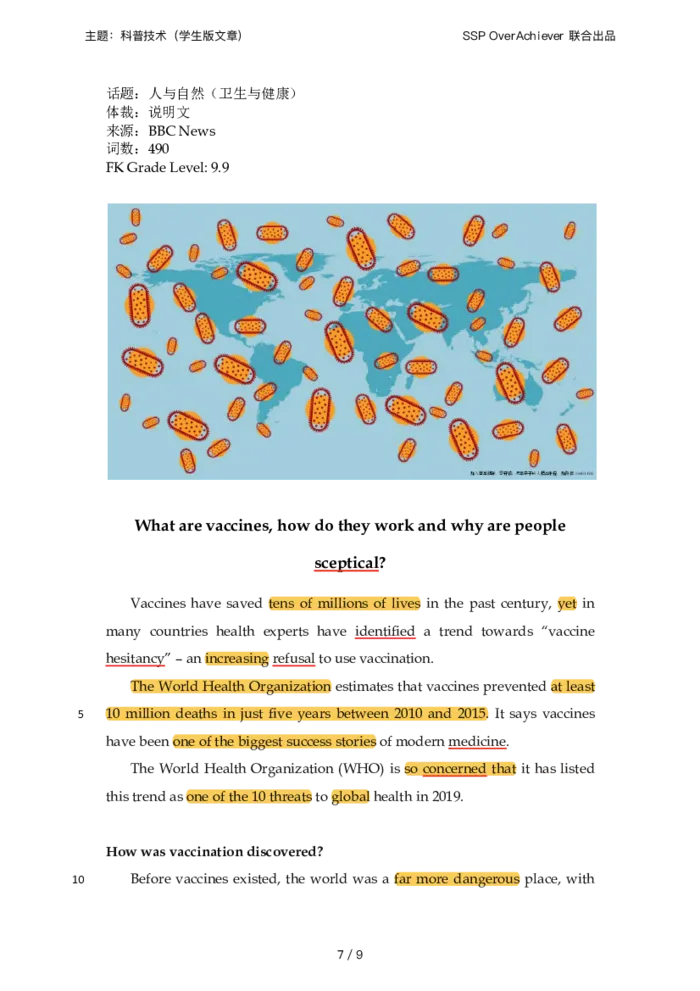
What are vaccines, how do they work and why are people
sceptical?
Vaccines have saved tens of millions of lives in the past century, yet in
many countries health experts have identified a trend towards “vaccine
hesitancy” – an increasing refusal to use vaccination.
The World Health Organization estimates that vaccines prevented at least
10 million deaths in just five years between 2010 and 2015. It says vaccines
5
have been one of the biggest success stories of modern medicine.
The World Health Organization (WHO) is so concerned that it has listed
this trend as one of the 10 threats to global health in 2019.

How was vaccination discovered?
Before vaccines existed, the world was a far more dangerous place, with
10
主题:科普技术(学⽣版⽂章)
SSP OverAchiever 联合出品
7/9
加入慧享社群,零开销,尽享亲子成人精品课程,加微信 396014713
millions dying each year to now preventable illnesses.
The Chinese were the first to discover an early form of vaccination in the
10th Century.
Eight centuries later, British doctor Edward Jenner noticed how
milkmaids caught mild cowpox, but rarely went on to contract the deadly
15
smallpox.
In 1796 Jenner carried out an experiment on eight-year-old James Phipps.
The doctor inserted pus from a cowpox wound into the boy, who soon
developed symptoms.
Once Phipps had recovered, Jenner inserted smallpox into the boy but he
20
remained healthy. The cowpox had made him immune.
In 1798, the results were published and the word vaccine - from the Latin
‘vacca’ for cow - was coined.

What have been the successes?
Vaccines have helped drastically reduce the damage done by many
25
diseases in the past century.
About 2.6m people were dying from measles every year before the first
vaccination for the disease was introduced in the 1960s. Vaccination resulted
in an 80% drop in measles deaths between 2000 and 2017 worldwide,
according to the WHO.
30

What are the risks of avoiding vaccination?
When a high proportion of the population is vaccinated it helps prevent
the spread of disease which in turn provides protection for those who have
not developed immunity or who cannot be vaccinated.
This is called herd immunity and when it breaks down there is a risk to
35
the wider population.
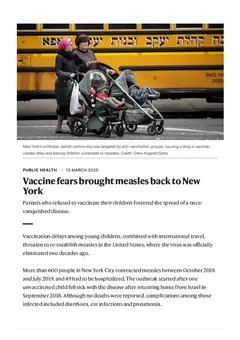
Last year in an ultra-Orthodox Jewish community in Brooklyn, USA, fliers
were distributed wrongly claiming links between vaccines and autism.
主题:科普技术(学⽣版⽂章)
SSP OverAchiever 联合出品
8/9
That same community has been at the centre of one of the largest
outbreaks of measles in the US in decades.
40
The proportion of the world’s children who receive recommended
vaccines has remained unchanged at 85% for the past few years, according to
the World Health Organization.
The WHO says vaccines continue to prevent between two and three
million deaths worldwide every year.
45
The biggest challenges to vaccination, and the lowest rates of
immunisation, are in countries with a recent history of conflict and extremely
poor healthcare systems, including Afghanistan, Angola and the Democratic
Republic of Congo.
But the WHO has also identified complacency as a key issue in developed
50
countries; put simply people have forgotten the harm a disease can do.
主题:科普技术(学⽣版⽂章)
SSP OverAchiever 联合出品
9/9