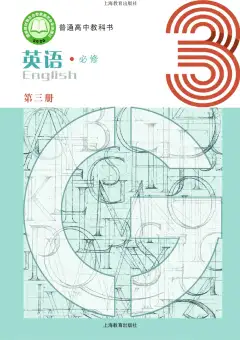
普通高中教科书
英 语
普

通

高

中

教

科

书
必修
第三册
英

语

必
修

第
三
册
定价:9.95 元
普通高中教科书
英 语
必修
第三册
书    名    普通高中教科书 · 英语  必修  第三册
出  版
http://www.hbep.com
        ( 石家庄市联盟路705 号,050061)
发  行    河北省新华书店
印  刷    石家庄联创博美印刷有限公司
开  本    890×1240 1/16
印  张    8.5
字    数    220 千字
版  次    2019 年9 月第1 版
印  次    2019 年9 月第1 次印刷
印  数   1-3,000
书  号    ISBN 978-7-5545-5376-3
定  价    9.95 元
版权所有·请勿擅用本书制作各类出版物·违者必究
如有印刷质量问题,请与本社出版部联系调换,电话:18603114066
购书电话:0311-88643600
    图书在版编目(CIP)数据
    普通高中教科书. 英语 : 必修. 第三册 / 田贵森著.
-- 石家庄 : 河北教育出版社, 2019.9
    ISBN 978-7-5545-5376-3
    Ⅰ. ①普… Ⅱ. ①田… Ⅲ. ①英语课-高中-教材
Ⅳ. ①G634
    中国版本图书馆CIP 数据核字(2019) 第193822 号
主    编  田贵森
副 主 编  杨永军  付晓丽  Guo Yangsheng
编    者  杨  琳  王显志  曹九珍  张敬彩  苏丽平  周  红
          Ingrid Johnston  Leonard Judge  Naama Bar-David  Anja Pujic
责任编辑  李  蘅  李  超  焦维棉
美术编辑  张尧杰
绘    画  李  奥
出版者的话
亲爱的同学们:
欢迎使用冀教版高中英语教科书。这套教材由国内外富有英语教育经验的学者、科研人员
及一线教师根据2017 版《普通高中英语课程标准》编写。
本套教材必修阶段共3 册,满足高中毕业基本要求;选择性必修阶段有4 册,满足高考升
学要求;提高类阶段有3 册,满足有意继续提高英语能力的发展需求。
让我们了解一下教材的结构。每册教材有5 个单元,每个单元包括4 个板块。第1 板块
(Reading for Meaning)为同学们提供了地道、优美的语篇,文章体裁丰富多样、内容有趣且
富有时代特色;第2 板块(Learning through Practice)提供了有意义的语言探究和语言实践活动,
同学们通过完成任务可以体验语言并归纳知识,提高语言运用能力;第3 板块(Using English
in Context)设计有专题调查、访问纪实、讨论汇总、活动设计等多种形式的项目活动,帮助同
学们发展听、说、读、看、写等语言技能,为真实语言交际打下基础。第4 板块(Expanding
Our Horizons)为同学们提供了更多与单元主题相关的经典、有趣的文章。
另外,教材中的评价部分(Evaluate yourself)可以帮助同学们积极反思学习过程,及时调
整学习策略,提高学习效率;单元反思(Unit Reflection)帮助同学们对整个单元进行回顾;链
接部分(More Connection)便于同学们拓展相关主题知识。
本套教材内容涉及人文、社会、自然、科学等多个领域,注重中外文化的介绍与比较。通
过学习本套教材,同学们会在提高语言能力的同时,增强对中华优秀传统文化和社会主义先进
文化的认识,成长为新时代有文明素养和社会责任感的人。
同学们,中学时代是人生美好的一段时光,相信在使用这套教材的过程中,你们通过自
己不懈的努力和老师的正确引导,能够顺利完成教科书中的学习任务,为终身学习打下良好
基础。
愿同学们在英语学海中徜徉,感受英语学习带给你们的新奇、充实与快乐。
Contents
1
UNIT
2
UNIT
ATTITUDES
TOWARDS
OUR
ELDERS
MANAGING
YOUR TIME
SECTION 1  READING FOR MEANING
Grandma Moves into a Nursing Home

2
SECTION 2  LEARNING THROUGH PRACTICE
Task One  Introducing the Chongyang Festival
6
Task Two  Describing a Visit to Your Grandparent(s)
8
     (Grammar: the v-ing form as object complement)
SECTION 3  USING ENGLISH IN CONTEXT
Project  Making a Plan to Take Care of
     the Elderly


10
SECTION 4  EXPANDING OUR HORIZONS
Grandma’s Reply


14
Filial Piety: An Important Chinese Cultural Value	 15
Caring for the Elderly across Cultures

17
SECTION 1  READING FOR MEANING
Timely Tips


20
SECTION 2  LEARNING THROUGH PRACTICE
Task One   Reporting Time-management
     Problems


24
Task Two  Writing about Your Time Management
26
     (Grammar: the v-ed form as attributive)
SECTION 3  USING ENGLISH IN CONTEXT
Project  Delivering a Speech on How to Manage
     Your Time Effectively


28
SECTION 4  EXPANDING OUR HORIZONS
Achieving a Balance between Studies and Play	 32
The Key to Winston Churchill’s Time
     Management


33
Time Is Life: A Story of Lu Xun


34
3
UNIT
4
UNIT
THE
STORY OF
SUCCESS
LITERATURE
FOR
IDENTITY
SECTION 1  READING FOR MEANING
A Story of Success: Stephen William Hawking
38
SECTION 2  LEARNING THROUGH PRACTICE
Task One   Creating a Dream Tree


42
     (Grammar: the v-ed form as adverbial)
Task Two  Writing Your Own Story of Success
44
SECTION 3  USING ENGLISH IN CONTEXT
Project  Exploring the Qualities of Successful People	 46
SECTION 4  EXPANDING OUR HORIZONS
Meet the Celebrities


50
On Achieving Success


52
SECTION 1  READING FOR MEANING
The Last Lesson


56
SECTION 2  LEARNING THROUGH PRACTICE
Task One   Writing a Character Sketch

60
     (Grammar: the v-ed form as complement)
Task Two  Summarizing a Narrative


62
SECTION 3  USING ENGLISH IN CONTEXT
Project  Writing a Book Report


64
SECTION 4  EXPANDING OUR HORIZONS
The Last Lesson (continued)


68
An Interview with a Poet


69
Return the Complete Jade to Zhao


71
5
UNIT ANIMALS
AROUND
US
SECTION 1  READING FOR MEANING
An Elephant Never Forgets


74
SECTION 2  LEARNING THROUGH PRACTICE
Task One   Describing an Amazing Animal

78
Task Two  Making a Dialogue to Ask for Help
80
     (Grammar: ellipsis)
SECTION 3  USING ENGLISH IN CONTEXT
Project  Writing a Proposal to Protect Endangered
      Animals


82
SECTION 4  EXPANDING OUR HORIZONS
How Do Animals Communicate?


86
Giant Panda, Featured Animal in China

87
The Conservation of Koalas in Australia

89
APPENDICES
WRAP IT UP!


93
PRONUNCIATION


103
VOCABULARY (I)


106
VOCABULARY (II)


111
LIST OF PROPER NAMES


117
GRAMMAR


119
IRREGULAR VERBS


123
Treat your elders as elders, and extend it to the elders of others.
– Mencius, Chinese philosopher
To be respected when people are old is one of the best privileges of the human beings.
– Stendhal, French writer
If you’re lucky enough to still have grandparents, visit them, cherish them and
celebrate them while you can.
– Regina Brett, American author
1
UNIT
ATTITUDES TOWARDS
OUR ELDERS
1
READING FOR MEANING
1
BEFORE YOU READ
1	 How often do you see your grandparent(s)? How do you spend time with them?
2	 What is a nursing home? Have you visited one?
3	 What do you expect the story to be about based on its title?
Grandma Moves into a Nursing Home
“What do you mean you want to send Grandma to a
nursing home?” Mary cried. It was Sunday evening. Mary
and her mother had just returned from visiting Mary’s
grandmother. Grandma Thomas is 92 years old and she
lives in a seniors’ lodge.
A seniors’ lodge is a special kind of accommodation for
elderly people. The apartments are small and come with a
bedroom and a bathroom but no kitchen. At mealtime, all the
residents gather in a large central dining area where they are
served food prepared by the staff cooks. Their laundry and
housecleaning are taken care of by the staff as well.
Grandma moved there two years ago after Grandpa died
in a crash. It was very sad for her to leave the house that
had been her home for over forty years, but she knew it
was time to move on. Grandma was able to accept the
move to the seniors’ lodge more easily because many
of her friends already lived there. It was a great help to
know that she would not be alone and that a friendly
face would always be in sight.
Back at Mary’s house, Mary was not thinking about that.
She was worried about her grandma. The thought of her
A nursing home is a hospital
for old people, whereas a seniors’
lodge is an apartment for old
people.
DO YOU KNOW?
2
 UNIT 1 ATTITUDES TOWARDS OUR ELDERS
grandma spending her last days in a nursing home made
Mary feel sad and sick. “There’s no justice. Why does it
have to be this way?” thought Mary. “It seems so unfair.”
To Mary it seemed so obvious. Her grandma was the
most loving and giving person she knew, and it was her
family’s duty to take care of her. How could her mom send
Grandma to a nursing home where she would spend the last
months, maybe only weeks or days of her life in a hospital
bed? She had to find a way to make her mom understand.
“Mom, I hate to see Grandma living in a hospital bed for the rest of her life. She’s not so ill.
I know she needs a lot of help with daily things like washing and getting dressed, but she can
still do many things. Remember, only two years ago she was organizing the town gathering and
telling everyone what to do and how to do it.” Mary had warm memories of her grandmother as
a strong and independent woman. It was hard for her to believe that she was that ill.
Medication means both medical
treatment and medicine.
QUICK CHECK!
“Mary, I know you love your grandma,” Mom said
calmly. “We all do. We have to think of what is best for
her. She’ll be happy at the nursing home. Everything
there is neat and tidy. She will get the care and attention
that she needs there. They will make sure that she gets her
medications on time, and if anything happens, there are
nurses and doctors to help her right away. Plus, there are
so many recreational activities for her. I think she’s going
to be very comfortable there.”
Mary was so confused and sad that she found it hard to
speak. She went to her room and shut the door. She needed
some quiet time to think.
No matter how many different ways she thought about it,
Mary could see no way that Grandma could be happy there.
Mary was angry at her parents for not inviting Grandma
to live with them. She doubted that her parents were being
selfish. They had a big house and a spare bedroom where
3
 UNIT 1 ATTITUDES TOWARDS OUR ELDERS
AFTER YOU READ

Reading Comprehension
1	 What made it easier for Grandma to accept the move to the
seniors’ lodge?
2	 Why does Mary think that it is unfair to send Grandma to a
nursing home?
3	 In Paragraph 5, Mary said, “Remember, only two years ago she
was organizing the town gathering and telling everyone what to
do and how to do it.” What can we infer from the sentence?
4	 What do Mary’s parents believe is best for Grandma?
5 Do you think Mary’s parents are selfish? Why or why not?
6	 Why does Mary think that it would be better for her grandma to live with her family in their house?

Post-reading Activities
1	 Mary wrote a long letter to her grandma to ask her to come and live with her and her parents.
Besides asking her grandma to live with them, what else do you think Mary would have said in her
letter? How do you think her grandma would respond to this letter?
Grandma could sleep. It was not as though they were
struggling to make ends meet and needed to tighten their
belt. They could learn how to give her the medication that
she needed, and Mary and her mother could help Grandma
bathe. In the evening, when all her homework was finished,
Mary could sit with Grandma and play cards or just talk
for a while. She remembered the times when she was a
little girl, she would go to Grandma’s house for summer
holidays. She had such sweet memories of the time she
spent with Grandma, baking buns, taking care of the garden
and playing cards in the evening.
She sat down at the computer and wrote a long letter to
Grandma inviting her to come to live with them.
To make ends meet means to
earn just enough money to be able to
buy the things you need.
QUICK CHECK!
4
 UNIT 1 ATTITUDES TOWARDS OUR ELDERS
             SONG
Your ancestors are special.
We all feel the same.
It’s a connection to the past.
They give to you your name.
It’s important that we remember,
The things we learn from them.
About honour and duty,
Their wisdom is a gem.
Chorus
Let’s remember our ancestors.
They have done so very much.
Let’s remember our ancestors.
It’s the way we keep in touch.
Our Ancestors
They worked very hard,
To try to get ahead.
They got up very early,
And didn’t lie in bed.
In every single culture,
From Egypt to Peru,
In the tree of life,
Ancestors are the roots.
Repeat Chorus
2	 Mary couldn’t stand the idea of her grandma living in a nursing house. It made her feel sad and sick.
Imagine that your grandparent(s) had to move into a nursing home. How would you feel about it?
3	 Grandparents love their grandchildren very much. In groups, share some stories about your
grandparents, and discuss what you can do for your grandparents if they need help.
4	 The aging population is rapidly increasing in China. There are now different ways of taking care of
elderly people who need help. Investigate how elderly people are taken care of in your community.
Bring your investigation to class and present it to your group.
5
LEARNING THROUGH PRACTICE
2
Task One  Introducing the Chongyang Festival
Suppose a group of foreign students is going to visit your school on the Chongyang Festival.
Please get ready to introduce the festival to them with the help of a poster.
Step 1  Pre-task Resources
Listen to an introduction about the Chongyang Festival. Write down key information such as
the time, food and activities that take place during the festival.
Step 2  Task Cycle
1
Read the poster for the Mid-Autumn Festival. Observe the layout of the poster and pay
attention to the title, keywords and pictures.
the Chongyang
Festival
time
food
activities
The Mid-Autumn Festival, Join Us!
The Mid-Autumn Festival, Join Us!
The Mid-Autumn Festival is coming.
Come and join us!
There are many interesting activities waiting for you.
Time: 7:00 p.m., September 29
Place: playground
Activities: a. enjoying mooncakes
                    b. admiring the beautiful moon
                    c. singing and dancing
                    d. playing interesting games
                    e. making I-Miss-You cards for your parents
6
CHONGYANG
Title:
Title:
2
Listen to the introduction in Step 1 again and pay special attention to the information you
wrote down about the Chongyang Festival.
3
Make a poster with the information you have learned about the Chongyang Festival so far.
Remember to use v-ing forms to describe activities in general.
4
Share your work with a partner. Together, revise the language used in the poster to make
it clear.
 UNIT 1 ATTITUDES TOWARDS OUR ELDERS
Step 3  Language Focus
V-ing forms have a verb base, so they give us a sense of action. The v-ing form is often used
as a noun or an adjective in the sentence. Examine how v-ing forms function in the following
sentences.
● Running is a great sport.
● The emphasis was on teaching rather than learning.
● There are indoor swimming pools on campus.
An impressive poster should include a short but interesting
title as well as bold and colourful words with attractive
pictures that are related to the theme.
Learning tips
Time:
Place:
Activities:
7
If we want to describe and list some activities we are going to do, we often use v-ing forms.
Look at the following examples used to describe festival activities.
● enjoying mooncakes
● playing interesting games
● climbing heights
 Task Two  Describing a Visit to Your Grandparent(s)
Have you ever spent a lot of time with your grandparent(s)? What are your favourite
memories with them? In this task, you will write a passage about it.
Step 1  Pre-task Resources
The following passage is about a visit to a nursing home.
I arrived at a nursing home at 8:00 on Sunday morning. Miss Wang, a caretaker at the
nursing home, showed me around and gave me instructions on how I could help out. I
saw her combing a woman’s hair gently. She told me that she is fond of working there,
and she treats the seniors as if they were her own family. I watched her talking and playing
memory games with them, as well as making sure they were clean. Overall, she treated
them with a lot of respect.
I attended to John, a 79-year-old man. He sat on his
chair and showed me some of his pictures. I listened
to him telling stories about his pictures for nearly
half an hour. He told me about his son, who lives
abroad. He said he didn’t want to end up here with
someone else wiping his body.
On the way home, I thought of my own grandparents and what it would be like for me
when I’m old. I realized how important it is to help elderly people enjoy a comfortable life.
Step 2  Exploring the Language
Look at the sentences and identify the structure they have in common. Discuss with a partner.
 UNIT 1 ATTITUDES TOWARDS OUR ELDERS
8
 UNIT 1 ATTITUDES TOWARDS OUR ELDERS
Step 3  Task Cycle
Here are four interesting sentences from Step 1. Notice the expressions in red.
Can you identify the structure that these sentences have in common?
1. I saw her combing a woman’s hair gently.
2. I watched her talking and playing memory games with them.
3. I listened to him telling stories about his pictures for nearly half an hour.
4. He said he didn’t want to end up here with someone else wiping his body.
There are two types of v-ing structures in the four sentences above.
Sentences 1 to 3 share the following structure:
a. see/watch/listen to somebody/something doing
Sentence 4 has the following structure:
b. with somebody/something doing
In both structures, v-ing forms act as object complements.
Please look for sentences that have the same structure in the text of Section 1 and
write them down here. Share your findings with your partner.
_________________________________________________________________
Read the passage in Step 1 again.
Make sure you understand it
completely. If not, use a dictionary
or turn to your classmates for help.
Write a short passage to describe a time you
visited your grandparent(s) (or a visit you ever
paid to an elderly man/lady). Remember to use
the “see/hear somebody doing” structure.
Share your work with a partner. Revise
and improve it together.
9
3
USING ENGLISH IN CONTEXT
Project  Making a Plan to Take Care of the Elderly
The aging problem is more and more prominent across the world, and it has attracted
people’s attention. In this project, you will explore different care systems and develop a plan
to help care for the elderly in your neighbourhood.
Step 1  Read and Discuss
Read the following passage about senior care in Norway and then discuss the questions
in groups.
Norway presents a perfect case
of social care to its population,
particularly with the elderly. Various
levels of elderly care services are
provided based on the different
needs of individuals.
Home visit: Healthcare workers
visit elderly people in their own
homes to provide them with some basic aid and to educate them about how they can
be responsible for their own health.
Homecare system: In this system, healthcare workers help the elderly with basic
daily activities. This level of care is largely for those who need the least help with
ordinary tasks.
Day care system: When seniors require more than just occasional homecare
visits, day care systems offer help with things like cooking, cleaning and bathing.
Nursing homes: Nursing homes have existed in Norway in various forms for over
a hundred years. They provide medical and nursing care for long-term and short-
term residents.
10
Residential flats: Norway offers specially constructed flats that take into
consideration the special needs of the elderly and make it easier for them to live
independently.
Community hospitals: These facilities provide the care that elderly patients need
after they get out of the hospital. The main goal is to help them move back to their
home without any need for further advanced hospital care.
1
What are the differences between homecare and day care systems?
2
If an elderly person can live independently, which care service is most suitable for him/her?
Step 2  View, Listen and Fill in Blanks
View the pictures. Listen to the stories of the elderly people and fill in the blanks.
 UNIT 1 ATTITUDES TOWARDS OUR ELDERS
Sagaram
Age _________
Country _________
Hussein
 Age _________
Country _________
Pinto
Age _________
Country _________
Contreras
Age _________
Country _________
Cuba
Egypt
He has been living
________, but now
he hopes to live with
________ ________.
She prefers to
________ ________,
because she doesn’t
want to ________ her
children.
He is living in a
local ________
________. The
government helps
him.
He is living with his
________ ________,
but he hopes to
live in a ________
________.
11
 UNIT 1 ATTITUDES TOWARDS OUR ELDERS
Step 3  Compare, Discuss and Brainstorm
In groups, discuss the major advantages and disadvantages of the three different ways of
living. Then brainstorm some other ways we can provide elderly people with assistance.
Complete the form below.
● Advantages:
● Disadvantages:
Living with
family
● Advantages:
● Disadvantages:
Living alone
● Advantages:
● Disadvantages:
Living in a
nursing home
12
● Would you prefer to live on your own or with other people?
● What can family members do for you?
● What would you do during the day when you are alone at home?
● Do you have any friends in a home for the elderly?
● How would you feel about moving into a home for the elderly?
● What do you usually do with your friends?
● What are your favourite activities?
 UNIT 1 ATTITUDES TOWARDS OUR ELDERS
Step 4  Interview and Write
A suitable elderly-care plan depends on knowing the needs of the elderly and the family’s
economic status. Develop a plan to take care of the elderly in your neighbourhood.
1
Interview some elders in your neighbourhood. You can use some of the questions below to
help you get started.
Learning tips
● While interviewing the elders, focus on their needs and requirements.
● Take the family economic status into account.
2
Make a well-organized plan to take good care of the elderly.
Evaluate yourself!
Can you start and maintain a conversation in English on elderly care?
Can you understand and explain the implicit logical relations between sentences in the text?
How well have you done with the following? Tick the circles that best reflect your performance.
Taking notes of the useful information when
listening, reading and viewing
Using strategies of “repetition”, “explanation” and
“clarification” to overcome language problems
Understanding the intention of the elderly
people according to their mood and intonation in
listening and interviewing
Excellent    Very Good    Good    Needs Improvement
13
EXPANDING OUR HORIZONS
4
Grandma’s Reply
In Section 1, we learned that Mary wrote a letter to her grandma to ask her to come and live
with her and her parents. The letter below is her grandma’s response.
Dearest Mary,
Thank you for the lovely letter and your kind invitation. You
are truly special to me. But, my dear, I cannot come to live
with you. Moving into the nursing home is what I want to do.
It is the best thing for me.
I’m very proud of you, Mary, and everything you do. You play
basketball, take music lessons, and you work hard at school.
You are a very busy girl, and I think that’s wonderful. Your
parents are good people, and they work hard to give you a good
life. I know you all love me, but you and your parents don’t
have the time to take care of me.
An old lady like me needs more than a soft pillow to lay my
head on. I need help preparing my meals, and it’s important
for me to have companionship during the days. How can I
feel at peace when I am either alone all day or causing my
loving family to give up important things in their lives to stay
home with me? And besides, moving to your house would
mean that I have to leave my hometown and move to a new
city where I don’t have any friends. I think I would feel very
lonely without my friends to keep me company during the
day. Do you remember my friends Linda and Len? They
come over every Wednesday to take me to the store if I need
Expressing
thanks
● Thank you (for...).
● Thanks a million.
● Words cannot
express how
thankful I am.
● All I could say is...
thanks.
14
Filial  Piety:
An Important  Chinese  Cultural  Value
For centuries, Chinese people have taken pride in the way they
have treated their parents, which is called xiaodao, or filial
piety. Filial piety was an important virtue in early Confucianism
and is still recognized as an unavoidable part of human life.
Nowadays, authorities in rural areas have even turned to a filial
piety fund to help maintain China’s most treasured virtue.
Luoning, a less developed county in Central China, started the
POST-READING QUESTIONS
1	 Why does Grandma think living in the nursing home would be better for her than living with Mary and
her parents?
2	 What does Grandma hope Mary will continue to do when she moves into the nursing home?
3	 Mary thought her parents were being selfish to send Grandma to a nursing home. After reading
Grandma’s letter, do you think Mary will change her mind? Why or why not?
 UNIT 1 ATTITUDES TOWARDS OUR ELDERS
something. My friend Ruth Norton comes over every Friday to take me to play games at
the seniors’ recreation centre, where smiling faces always welcome us at the entrance.
I do feel sorry for some of the old people in the senior’s lodge who have no family to
visit them. I am so happy when you come to visit, and I love hearing about all of your
adventures, your studies and your friends. I hope you continue to visit me and share
your life with me when I move into the nursing home. I hope your young and loving
heart can understand an old lady like me.
Much love,
Grandma Thomas
virtue: (1) the quality of being
morally good (2) a quality that
is good or admirable (3) a good
quality or habit that a person has
QUICK CHECK!
15
voluntary fund program in 2017 to encourage grown-up children to support their elderly
parents. Luoning is home to more than 16,000 residents over 70. All its villages have set
up filial piety funds and every elderly villager has an account. The funds received nearly 4
million yuan and most of the money was contributed by the 40,000-plus grown-up children
of the county’s elderly.
An 80-year-old woman in Gaowan Village is satisfied as she no longer has to worry about
her income. Her grown-up children are regular contributors to the piety fund, through
which she receives a certain amount of money each month. Her daughter-in-law said, “We
are not well-off, but it is not an excuse for failing to carry out filial duties. We should set a
good example for our children and pass down our traditional beliefs to the next generation.”
It is an ancient Chinese custom to rely on their grown-up children to take care of them, or
gongyang them in their old age. The term gongyang means the special feeding of elders. The
basic meaning of gong is “to provide” or “to supply”, but it also includes the definition “to
offer respectfully”. Yang generally signifies “to feed”, but also extends to the verb “to raise”.
Thus, gongyang means something like “care with respect”. The grown-up children’s kind
and respectful treatment of their parents would gain them a good name for being filial.
The Chinese saying, “Of all virtues, filial piety is the first” demonstrates the cultural
importance of respecting one’s elders. According to the Classic of Filial Piety (xiaojing),
only when the grown-ups do well in the following five aspects, can they meet the standards
of truly filial person:
● show parents real respect by tending to their needs and desires;
● bring parents enjoyment while caring for them;
● express worries when parents are in sickness;
● convey deep sorrow for parents’ passing;
● show the late parents true respect when giving them the offerings.
POST-READING QUESTIONS
1	 According to the text, what does xiaodao mean in Chinese culture?
2	 What’s your opinion about the daughter-in-law’s words in the text?
3 How can a person be recognized as filial according to the Classic of Filial Piety?
 UNIT 1 ATTITUDES TOWARDS OUR ELDERS
16
Caring for the Elderly across Cultures
How different cultures care for the elderly is closely linked
to their most prized values and qualities.
China
China’s population has been aging at a historically high
rate in recent years, and elderly care has been attracting
people’s attention lately.
The majority of seniors spend their remaining years at
home. Many communities in cities have established
service centres for the elderly to provide them with food,
medical care and housekeeping services. The monthly cost
is affordable for most people, which is making this kind of
community care more and more popular. The percentage
of elderly people using the community care is increasing
every year.
Australia
Independence, well-being and quality of life for every
older person are promoted in Australia through health and
elderly-care support systems. The country continues to
develop the model of care intended to achieve the goal –
ensuring people get the right care, at the right time, by the
right team and in the right place.
 UNIT 1 ATTITUDES TOWARDS OUR ELDERS
We can sometimes guess the meaning
of a word by referring to its prefix or
suffix.
Afford means “to be able to buy
or to do something”. If you cannot
afford something, you do not have
enough money to pay for it. Now can
you explain the word affordable?
DO YOU KNOW?
17
 UNIT 1 ATTITUDES TOWARDS OUR ELDERS
POST-READING QUESTIONS
1	 Do you think that community care is becoming more and more popular in China? Why or why not?
2	 What is the intended goal of Australia’s model of care?
3	 What are the two types of elderly care that are being implemented in the U.S.?
Unit Reflection
Review the whole unit and reflect on what you have learned.
1	 Respecting the elderly and protecting the young is a traditional virtue in Chinese culture.
What have you learned in this unit about elderly people and the meaning of taking care of
elderly people?
2	 What does respecting your grandparents mean to you? What can you learn from your
parents in terms of respecting your elders and ancestors?
3	 Explain your understanding of the sentence “Treat others as you would like to be treated”.
America
One relatively new service in the United States that can help
keep the elderly in their homes longer is respite care. This type
of care allows care givers the opportunity to go on vacation or
a business trip and know that their elders have good-quality
care. Without this help, the elderly would have to move to an
outside facility for a long time. Another unique type of care
in American hospitals is called acute care of elder units (ACE
units). It provides “a homelike setting” within a medical centre specifically for the elderly.
More Connections
●	 How are the elderly treated around the world? Are they viewed and treated in the same
way in spite of different cultures? What kind of support do the elderly really need? Try to
surf the Internet. Here are some key words for your reference: aging, elderly care, filial
piety, homecare system, and nursing home.
●	 Have you seen the movie Full Circle? It’s a Chinese film about some elderly people who
try to achieve the value and significance of their lives. Watch the movie and tell what you
think of it.
18
If you do not study hard when young, you’ll end up bewailing your failures as
you grow up.
– Chinese proverb
To choose time is to save time.
– Francis Bacon, British philosopher
We always have time enough, if we will but use it aright.
– Johann Wolfgang von Goethe, German writer and poet
2
UNIT
MANAGING YOUR TIME
19
READING FOR MEANING
1
BEFORE YOU READ
1	 Do you ever feel like you are pressed for time? What are the possible causes of this pressure?
2	 Do you wish to manage your time in a way that makes you feel like you have control over your life?
3	 What do you expect to read when you see the title “Timely Tips”?
Timely Tips
Jenny was in trouble. “I feel as though I am sinking beneath the waves,” she told her friend
Alex. “It seems to get worse every day. The water just keeps getting deeper. It’s up to my
nose. Help!”
“What’s going on, Jenny?” asked Alex.
20
 UNIT 2 MANAGING YOUR TIME
Jenny took a deep breath and began to explain, “First I
decided to try out for the track team, so I’ve been waking
up at 5 a.m. almost every day this week to train and
prepare for try-outs. Then I joined the choir because I love
to sing. Choir practice is two nights a week. I also found
a part-time job at the mall, so I could earn some spending
money. I work three times a week. Now it’s exam time, and
I can’t find the time to study. I have too much on my plate,
and I don’t know how I’m going to do it all. Sometimes I
feel like I can’t breathe.”
Jenny and Alex were walking from the subway exit to the
mall where Jenny worked. She has a job working at a pet
store. It was her job to feed the puppies, talk to the birds
and make sure that all of the animals were happy.
She loved working with animals. “If only they could help me
with my homework!” she thought.
When they arrived at the pet store, Jenny turned to Alex
and said, “What should I do? I am sinking fast.”
Alex was about to leave for his part-time job at the library,
across the street from the shopping mall. He was just as
busy as Jenny. Besides his job at the library, he had joined a
chess club. He also played soccer twice a week, and every
Thursday night he took a baking class where he learned how
to make all kinds of desserts, from chocolate cake to cookies
decorated with small candies and nuts. He would eat most
of the goodies he made while he watched television for two
hours in a row. Yet even with all of these activities he usually
found a way to finish his homework on time.
“Check your email when you get home,” Alex told Jenny.
“I’ll send you my secrets for living a well-managed life.”
Spending money is money
that you have or are given to spend
on personal things for pleasure,
especially on holiday.
QUICK CHECK!
21
Then he went on his way to his job at the library across the street.
...
When Jenny returned home that night, there was an email
from Alex waiting for her. “Follow these tips,” Alex wrote,
“and you will reduce your anxiety and bring some order to
your messy life.”
Alex’s secrets for living a well-managed life
●	 Change your attitude. You are not drowning. You are learning to swim. Be positive!
●	 Get organized. Make a list of all the things you do each week. Then organize your
to-do list with your schedule. Put your “must-do” jobs at the top of your schedule, so
you can see what you must do each day.
●	 Restructure and reconsider. Is it practical for you to get up at five o’clock in the
morning for track practice and then work late at the mall? If not, you have to make
some different choices and reconsider what’s really important to you. You can’t do
everything.
●	 Prioritize. Plan your schedule based on what needs to get done first and postpone the
rest. What is important and what is less important? If you have to make more time for
studying, think about what you can drop from your schedule.
●	 Set future goals. Write down all the things you intend to achieve in the next year.
This will help you stay on track. You need to have a target. You have to have an idea of
where you’re going if you want to get there. When you set your long-term goals, you
can judge whether your daily and weekly activities are working to help you achieve
those goals.
“He’s right,” Jenny thought. “But I don’t have time for this. I’ll go crazy writing lists
and making schedules that I don’t even have time to follow.” Then she noticed the final
tip from Alex.
●	 Make time to make schedules. A small amount of planning will permit you to
organize and structure your life so that you can do the things you need to do and make
the time to do the things you want to do.
 UNIT 2 MANAGING YOUR TIME
22

Reading Comprehension
1	 Jenny was so busy that she felt she was sinking beneath the waves. Why?
2	 List THREE things Alex did with his time when he was not at school.

3	 What does “it” mean in “It seems to get worse every day” in Paragraph 1?
4	 What does “they” mean in “If only they could help me with my homework!” in Paragraph 5?
5	 What are Alex’s tips for living a well-managed life? Can you think of other tips for managing time
wisely?
6	 What’s the writer’s purpose in writing the text?

Post-reading Activities
1	 Work with a partner or in groups to decide which of Alex’s tips to Jenny are equally useful and
helpful to you and explain how.
2 Share your experience of time management, and find out who is the person that manages his/her
time best in your group.
3	 A Chinese saying goes, “Never put off till
tomorrow what you can do today.” How do you
understand this? Do you agree?
4	 Good time management can help us not only
save time but also achieve more and feel more
confident. In groups, discuss other benefits of
good time management.
AFTER YOU READ
 UNIT 2 MANAGING YOUR TIME
23
LEARNING THROUGH PRACTICE
2
Task One  Reporting Time-management Problems
In this task, you will listen to a short passage about time management. You will collect your
problems in your group and give a brief oral report in the class.
Step 1  Pre-task Resources
Listen carefully and rearrange the headings in the order you hear them. Then match the
headings with the detailed information.


Taking on too much

       emails, WeChat, or phone calls


Not taking breaks


       having a hard time saying “No”


Failing to focus


       studying 8 – 10 hours straight


Others


       worrying about unimportant things
Step 2  Task Cycle
1
Think of the time-management problems in your daily life and put them into different
categories.
Taking on too
much
Not taking breaks
Failing to
focus
Others
24
 UNIT 2 MANAGING YOUR TIME
2
Work in groups of four or five, and discuss your problems with managing time. What do you
think is the biggest problem right now? Explain why.
nouns
job
list
goals
work/jobs
 part-time
       to-do
long-term
  must-do
compounds that
function
as adjectives
This is an easy way to build new concepts that function as adjectives.
Compounds specify particular aspects or features of the noun, such as the type
or material.
Compounds as modifying adjectives are singular in form even when their
meaning is plural. They are normally hyphenated.
3
Present your group’s time-management problem to the class. Remember to use the new
words and phrases whenever possible.
Step 3  Language Focus
In Step 1, you heard the noun phrase time-management problems. In this pattern, the
compound time-management is used to modify the noun, problems. Here are more examples
from the text in Section 1:
The biggest time-management problem
Why
25
 UNIT 2 MANAGING YOUR TIME
Task Two  Writing about Your Time Management
In this task, you will learn how Jenny improved her management of time and then write a
short paragraph to share your story of time use.
Step 1  Pre-task Resources
1
View the video about using time wisely and try to grasp the key points.
2
Read the following passage and learn how Jenny gets organized this time.
Jenny accepted the advice given by Alex and managed
to use her time more wisely.
First, she considered all her daily activities listed on
the schedule and estimated their importance.
Then she gave up some less important tasks. She quit
her try-outs for the track team so that she could get
enough sleep. As to singing in the choir, Jenny believed
it was important. However, she also realized that compared with her homework,
singing in the choir was less important. So, she decided to go to the choir only once
a week. She would make up for the missed practice during her summer vacation.
Besides, Jenny decided to ignore some unwanted emails because reading them was
not that important.
Step 2  Exploring the Language
Here are two noun phrases from Step 1. Can you find the features they
have in common?
● missed practice (practice that was missed)
● unwanted emails (emails that are not wanted)
26
 UNIT 2 MANAGING YOUR TIME
The -ed forms of regular and irregular verbs are used as attributive adjectives.
The v-ed forms may occur before or after the modified nouns. Here are some
examples:
● an advertised product
● A burnt child dreads fire.
● a man called Tom
● the clothes bought online
Look for the v-ed forms as attributive adjectives in Section 1 and 2.
Share your analysis in your group.
● v-ed forms in Section 1
   _____________________________
● v-ed forms in Section 2
   _____________________________
Step 3  Task Cycle
1
Read Jenny’s story in Step 1 again. Make sure you understand every word. If not, look up the
words you don’t know in the dictionary.
2
Recall a successful time-management experience and report it to a partner. Focus on two
questions:

● What did you do?

● How did you do it?
3
Write a short paragraph describing how you managed your time efficiently. Remember to use
v-ed forms as attributes. Revise the paragraph with a partner to make it clear and concise.
27
3
USING ENGLISH IN CONTEXT
Project  Delivering a Speech on How to Manage Your Time
                Effectively
Time management is of vital importance in one’s daily life. In this project, you will research
time-management skills and deliver a speech on the topic.
Step 1  Review and Reflect
Remind yourself of the speech-making tips you learned in Unit 1, Module 1. A complete
speech should include greetings, purpose, main arguments and an ending.


Step 2  Listen, Fill in Blanks and Discuss
Listen to a mini-talk by Mr. Smart, a time-management expert, fill in the blanks, and then discuss
in groups about the common mistakes people usually make in terms of time management.
●	 The purpose of this talk is to ________________________________________.
●	 We may learn from the talk that time management is about _____________________
_____________________.
●	 Use the following table to write down the common mistakes people make in terms of
time management.
Number
Mistakes
1
2
3
4
My fellow students,
Today I’d like to make a speech on...
...
In one word, ...
Thank you for...
28
Step 3  Read, Reflect and Extend
Li Ming, one of the top learners in class, wrote some tips on time management. Please read
his suggestions and reflect on your own time management.
 UNIT 2 MANAGING YOUR TIME
Follow these tips, and you will effectively manage your time and simplify your life.
A.	 Record class times in day/hour blocks on a time schedule sheet.
B.	 Record meal times.
C.	 Record all regularly scheduled personal activities.
D.	 Insert any special activities you need to do or want to do on a regular basis.
E.	 Schedule a preview time (5 – 20 minutes) the evening before your classes
whenever possible. During the preview, review all or some of your notes in
preparation for the next class.
F.	 Schedule a review time immediately after your classes (10 – 20 minutes)
whenever possible. Use this time to write a summary of your notes.
G.	 Schedule a study/review time for each class. Try to schedule some study time
each day for each class.
H.	 Schedule a weekly review for each subject. Do it at the end of the week if
possible.
I.	 Keep open some day or evening time to go outside for some physical activity!
J.	 Be selfish and give yourself some relief! Schedule some time on Friday,
Saturday and Sunday to play, relax or do whatever you want to do.
 Suggestions on Time Management
29
Step 4  Search and Select
Search for the time-management tips for high school students on the Internet and select 5 to
fill in the following table.
Number
Tips
1
2
3
4
5
 UNIT 2 MANAGING YOUR TIME
1
Read Li Ming’s tips for time management again. Think and classify them into three groups.
2
Add more secrets for managing time effectively based on your own knowledge and experience.
It is very helpful
for me.
It is a good idea, but
not very practical.
I’m not sure if it
works for me.
30
3	 Present your
speech in class.
 UNIT 2 MANAGING YOUR TIME
Step 5  Prepare and Present
Learning tips
When you deliver your speech on time management to your group or class,
pay attention to your language and body language. Keep your gestures
natural and comfortable. Practice helps a lot. If you are speaking with real
conviction, your gestures will be real.
1	 Collect and summarize all the
tips on time management in
this unit.
2	 Remind yourself of what a
speech includes and prepare
your speech.
Evaluate yourself!
Can you evaluate and comment in English on a text about time management?
Can you understand and analyze the structure of a text and characteristics of its language?
How well have you done with the following? Tick the circles that best reflect your performance.
Identifying the coherence and cohesive
relationship in the text
Getting more information about time management
through reading, and online resources
Using gestures, stress, facial expressions,
intonation and rhythm to make my points of view
and attitude clearer when delivering a speech
Excellent    Very Good    Good    Needs Improvement
31
EXPANDING OUR HORIZONS
4
Achieving a Balance between
Studies and Play
Perhaps you have heard the English saying, “All work and no play makes Jack a dull boy.” It
means that without some time off from work, a person can become very bored or boring.
Today’s students tend to experience a great deal of stress. For them, the best way to relax is
to take part in physical activities. This does not necessarily mean that you need to spend a
large amount of time and money.
For example, you could play basketball, swim or dance in a studio. In fact, swimming is a
good choice of exercise or sport. It increases your desire for food and helps you burn fat/
calories while helping you stay in shape. Some research states that swimming can also make
you grow taller, although there is not enough scientific evidence to prove this is true.
Sports and games also contribute to the development of one’s mind. For example, they
teach you to be calm in all kinds of situations. You learn to become a good observer of things
32
The Key to Winston Churchill’s Time
Management
It is interesting that when you study the most effective
individuals throughout history, you see the same theme
again and again in how they managed their time. The key is
to focus on a few very significant priorities, and to keep in
mind what is centrally important at the moment.
We see this especially in Winston Churchill. Here’s
how Steven Hayward summarizes Churchill’s approach
in Churchill on Leadership:
POST-READING QUESTIONS
1	 Do you believe “All work and no play makes Jack a dull boy”? Why or why not?
2 In what ways would “all play and no work/studies” be disastrous?
3	 Have you ever met someone who achieved a balance between studies and play? Interview this person
to learn how he/she manages time.
around you. You also learn to be accurate and to make good choices. Games help you to
develop a sense of confidence, something we could all use more of. Sports and games are
also great for helping you develop team-building skills. Knowing how to work well with
others is an important life skill. Above all, sports and games can teach you that it doesn’t
matter if you win or lose. What matters is how you play the game.
Don’t forget to give yourself a break. Don’t overwork yourself or you are likely to get
too tired or fall ill. Play carefully to avoid getting hurt. Moreover, make sure you do not
drink water immediately after playing sports or games. Drink water only after your body
temperature has returned to normal.
It is important to bear in mind that your teen years are important for your studies and future
career. Therefore, a balance needs to be struck between your studies and physical activities.
 UNIT 2 MANAGING YOUR TIME
Winston Leonard Spencer-
Churchill was a British statesman,
army officer and writer, who served as
Prime Minister of the United Kingdom
from 1940 to 1945 and again from
1951 to 1955.
DO YOU KNOW?
33
Time Is Life: A Story of Lu Xun
Lu Xun is generally regarded as a great writer, thinker and revolutionary of the 20th
century.
Some people said that Lu was a talent, but he said, “I am far from a talent, only doing my work
while others drinking coffee.” Lu Xun always wanted to do more for the Chinese revolution in a
POST-READING QUESTIONS
1	 Which sentence(s) in the text can best explain Churchill’s method of work?
2	 Do you think Churchill’s method might work for you? Why or why not?
3 In groups, find a famous figure in China who manages his/her time effectively.
Despite his wide-ranging attention and interests, he
always kept in mind what was centrally important
to the moment. He was always able to focus on the
immediate task at hand, and he sent clear signals
to his subordinates when a directive was of special
importance. “When his mind was occupied with
any particular problem,” Sir Ian Jacob wrote,
“it was always focused upon it and would not be
turned aside.” This served as the key to his time-
management system.
His general method of work was to concentrate his
personal attention on the two or three things that
mattered most at any given moment, and to give
each of these all the time and attention that it needed.
Effective people put first things first, and do one
thing at a time. This is the key.
 UNIT 2 MANAGING YOUR TIME
34
 UNIT 2 MANAGING YOUR TIME
limited period of time. He once said, “To save
time is to prolong the life of a human being.”
So he worked hard as if he never felt tired,
doing his work during the day, writing at night
and staying up all night long. He always sat in
front of the desk and worked without a break.
Sometimes he would lean on the couch reading
books, which he took as his rest.
In his later years, he worked even harder than
before in order to lose no time. Even when he
was seriously ill, he was thinking about what
he was going to do after he recovered.
He began to work as soon as he was able to
sit up. Shortly before his death, he suffered
high body temperature and weighed less
than 40 kilograms. But he never dropped his
weapon – his pen, which he used to fight with
the enemies for years. Even in his last few
days, he still kept writing a preface for a novel.
He fought to the last day of his life and never
wasted one second of his time.
Lu Xun valued not only his own time, but
also the time of others. He was very punctual,
never being late or making others wait. In Lu
Xun’s eyes, time is life. “Americans say time
is money, but I think time is life. If one wastes
others’ time, he is killing others.” Lu Xun
felt that gossip was one of the greatest wastes
of time, and so he hated those who always
gossiped with others.
To prolong something means to make it last a
longer period of time.
QUICK CHECK!
35
 UNIT 2 MANAGING YOUR TIME
Unit Reflection
Review the whole unit and reflect on what you have learned.
1	 Throughout human history, many famous figures have come up with their own set of “tips”
for time management. What have you learned about time management in this unit? What
tips do you think will be the most helpful and important to you in the future?
2	 What have you learned in this unit about the major benefits of time management? What are
the major mistakes people make with managing time? How can these mistakes affect one’s
life? What advice would you give to a new student in your school about time management?
3	 What does the v-ed form mean? What have you learned about the function and use of v-ed
forms in English?
POST-READING QUESTIONS
1	 According to the text, what can you learn from Lu Xun?
2	 Some people believe Lu Xun is the greatest writer in contemporary China. Do you agree? Why or why not?
3	 Do you agree with Lu Xun when he says “Americans say time is money, but I think time is life”?
More Connections
●	 If you would like to know more about time management, then take a look at Getting
Things Done written by David Allen. The book can transform the way we work by
showing us how to manage our time without wearing ourselves down. It has been
translated into Chinese and published in China.
●	 There is an electronic encyclopedia, offering a detailed explanation and exploration in the
area of time management. Here are some key words for the access: time management,
setting priorities and goals.
36
No road of flowers leads to glory.
– English proverb
If your mind is strong, all difficult things will become easy; if your mind is
weak, all easy things will become difficult.
– Chinese proverb
Success is no accident. It is hard work, perseverance, learning, studying,
sacrifice and most of all, love of what you are doing or learning to do.
– Pelé, Brazilian football player
3
UNIT
THE STORY OF SUCCESS
37
READING FOR MEANING
1
A Story of Success:
Stephen William Hawking
BEFORE YOU READ
1	 What do you think it means to be successful?
2	 Who is Stephen Hawking? What do you know about him?
3	 Based on the title “A Story of Success: Stephen William Hawking”, what do you expect to read in this text?
Bertrand Russell (1872 –
1970), was a British philosopher,
mathematician and social
reformer. He studied at Cambridge
University from 1890 to 1894,
where later he was a fellow and
lecturer (1910 – 1916). During
this time, he published his most
important works in philosophy and
mathematics.
It matters if you just don’t give up.
                                                 – Stephen William Hawking
Professor Stephen W. Hawking is one of those people who
combine great academic success with the ability to face and
overcome all kinds of difficulties, and finally succeed in both
their personal and professional life. He has become a symbol
of not only what it means to be successful, but also of courage,
struggle and determination.
Stephen W. Hawking was born on January 8, 1942 in Oxford,
England. As a child, he was curious, always asking questions about
the world around him. However, Hawking was not the brightest
child in his class. Most people did not consider him a talent.
Inspired by his mathematics teacher in high school, Hawking
began to find his love for mathematics. Hawking admired Bertrand
Russell, a man known not only for his work in mathematics, but
also for his writings on freedom of thought. Later, like Russell,
Hawking didn’t limit his satisfaction only to understanding
certain parts of the universe. He also wanted to know how the
universe as a whole came to, and continues to, exist.
DO YOU KNOW?
Stephen William Hawking
(1942 – 2018)
38
 UNIT 3 THE STORY OF SUCCESS
When studying in Oxford University, Hawking spent the
majority of his time in studies, as he was overcome by a desire
to understand the world and to uncover the mysteries of the
universe. After three years, he graduated with first-class honours.
In 1963, Hawking’s life changed when he learned that he had
been attacked by Lou Gehrig’s disease. His doctors told him
that he would see, hear and taste as before, but soon he would
not be able to walk, write or even feed himself. As a result, he
would probably die before he earned his degree. However, he
found both comfort and a reason to live in his future wife Jane
Wilde. He became even more determined to finish his PhD
studies so that he would be able to marry her.
Struggling to overcome his illness, Hawking moved on to study
cosmology, successfully earning his PhD at Cambridge in
1966. After that, he became a research fellow, then a professor.
At the young age of 32, he was named a fellow of the Royal
Society. He later received the Albert Einstein Award, the most
famous in physics.
In 1982, Hawking decided to write a popular book on
cosmology. However, when he started the book, he suffered
another illness and had trouble breathing. Hawking was rushed
to hospital and had an operation on his neck. The operation
helped him recover from the illness, but it left him without
his voice. Still, Hawking was not ready to quit. His friends in
England and America joined to help him. They developed a
special computer software program and attached the system
to his wheelchair. What Hawking needed to do was to press a
button to operate his computer which enabled him to have an
electronic voice. This technology made it possible for him to
finish A Brief History of Time. The book was published in 1988
and soon became one of the top-selling books.
Cosmology is a theory about
the origin and nature of the
universe.
QUICK CHECK!
39
 UNIT 3 THE STORY OF SUCCESS

Reading Comprehension
1	 Who was Stephen Hawking inspired by when he was in high school?
2	 The text states: “When studying in Oxford University, Hawking spent the majority of his time in
studies, as he was overcome by a desire to understand the world and to uncover the mysteries of
the universe.” What does “was overcome by” mean in this sentence?
3	 While struggling with Lou Gehrig’s disease and losing his voice, how did Stephen Hawking manage
to finish his book A Brief History of Time?
4	 The text is a brief summary of Stephen Hawking’s life story. What parts of his life does this text
focus on?
5	 What is Stephen Hawking’s attitude towards life and how has it helped him succeed?
6	 What can we learn from a scientist like Stephen Hawking?

Post-reading Activities
1	 Life is a journey of growth and self-development. In groups, complete the table below by examining
Stephen Hawking’s life and work. Use “O” if no relevant information can be found in the text.

AFTER YOU READ
Stage
Hawking’s experience
Hawking’s attitudes/achievements
Childhood
High School
University
Career
Hawking earned many honourary degrees, and received numerous awards, medals
and prizes. His positive view of the world, his life, and his modest sense of humour
influenced the world. Hawking’s success is not only the result of strength of mind, but
also the result of great strength of spirit.
40
 UNIT 3 THE STORY OF SUCCESS
2	 It is said that struggles enter our lives as unwelcome guests, but they also bring valuable gifts. What
“gifts” can struggles bring? Brainstorm in groups and complete the chart below.
3 There are many well-known stories of figures who have achieved greatness throughout history. Who
do you look up to or admire? Do some research on this person and share his/her story in groups.
4 What are some of the challenges or difficulties you have had to face in your life? Were you able to
overcome these difficulties? Share your experiences in groups.
strong will
gifts
struggles
             SONG
Success
Success is more than money, big houses and fast cars.
Success is helping others and reaching for the stars.
Success is knowing who you are – hard work will pull you through.
It’s the story of a peasant girl who made her dream come true.
It’s the story of a young boy who’s looking at the night.
But that’s too hard – he tells himself – I’ll never get it right.
Remember Stephen Hawking when you think you can’t go far.
41
LEARNING THROUGH PRACTICE
2
Task One  Creating a Dream Tree
It is said that “Success occurs when your dreams get bigger than your excuses.” In this
task, you’ll read a passage about dream trees. Then you’ll create your own dream tree and
present it.
Step 1  Pre-task Resources
Read the passage below about dream trees.
What Is a Dream Tree?
Dreams are about goals – and more. Having a dream or a goal gives us a purpose and
direction, and it shapes our lives as well as the choices we make. Working towards a
dream or a goal can make us happy and give us a sense of achievement by inspiring us
to express who we are and what’s important to us. Happy and inspired people can also
make the world a better place. But making a dream come true takes time, work, patience
and care. You can’t expect quick results. You need a strong base and a plan with step-by-
step actions. Trying to achieve a dream can be like growing a big, strong tree.
Motivated by the ideas, students at Mapleton School in Maine began to create their own
images of dreams growing like trees. In the picture, there are: the seed (the idea, or the
start of the dream), the roots from the seed (the base of the dream), the stem of the
tree, tree branches (steps along the way to achieving the dream) and the top (the kind
of person he/she would like to be, and how he/she will feel when he/she achieves his/
her dream). In the picture, there are also things, with which trees need to grow, such as
water, care and sunlight.
At the beginning of the school
year, students are encouraged
to make their dream trees. Then,
they will post and share the
dreams to inspire the entire class.
All these dream trees help make
the school a better place.
42
Step 2  Exploring the Language
Study the following sentences and try to understand the usage of the words “motivated” and
“inspired”.
● Motivated by the ideas (a v-ed form phrase used as an adverbial), students at
Mapleton School in Maine began to create their own images of dreams growing
like trees.

 Students at Mapleton School in Maine were motivated by the ideas. They
began to create their own images of dreams growing like trees.
● Inspired by his mathematics teacher in high school (a v-ed form phrase used as an
adverbial), Hawking began to find his love for mathematics.
 Hawking was inspired by his mathematics teacher in high school. He began
to find his love for mathematics.
V-ed form phrases as adverbials give information about condition, reason, manner, etc.
● Looked after carefully, this coat will keep you warm through many winters.
 If you look after it carefully, this coat will keep you warm through many
winters.
● Having been told the bad news, Susan sat down and cried.
 Someone had told Susan the bad news, so she sat down and cried.
● A bit frightened, I handed it to her.
 I handed it to her, and I felt a bit frightened.
A v-ed form can play a role in sentences similar to that of an adjective. It indicates the state
of somebody or something and the state is a result of a passive action.
● The burned bread tasted awful.
 The bread was burned. It tasted awful.
● We need to repair the broken window.
 The window is broken. We need to repair it.
 UNIT 3 THE STORY OF SUCCESS
43
Step 3  Task Cycle
■
In groups, share what your dreams are. What inspires or motivates you to go after your
dreams?
■
Draw your own dream tree. Include a passage describing the goal, steps and crown of
your dream to go with the dream tree you have drawn.
■
Present your dream tree to the class.
Task Two  Writing Your Own Story of Success
From time to time, life gives us a sweet taste of achievement, however small it may be. In this
task, reflect on your own experience of doing something successfully and write a story about it.
Were you able to succeed right away? What challenges did you face before you succeeded?
Step 1  Pre-task Resources
Read the passage and follow the instruction.
Rubik’s Cube
I carry a Rubik’s Cube in my bag. Solving it quickly is a terrific conversation starter. It has
made me believe that sometimes you have to take a few steps back to move forward.
This was like my own life when I had to leave public school after the fourth grade. It’s
embarrassing to admit, but I still couldn’t spell my full name correctly back then. I had
difficulty learning to read and write.
As a fifth-grader at a new school that majored in what’s called language-processing
disorder, I had to start over. I spent the next four years learning how to learn and
finding ways that allowed me to return to my area’s high school with the ability to
express my ideas.
It took me four weeks to teach myself to solve the Rubik’s Cube. I discovered that, just
before it’s solved, a problem can look hard, and then suddenly you can find the solution.
I learned that it’s important to spend a lot of time thinking to try to find connections and
patterns. Often there are surprises waiting for you around the corner.
Like reading a difficult text or sometimes like life itself, the Rubik’s Cube can be a difficult
puzzle. So I carry one in my bag to remind me that I can achieve my goals, no matter
what troubles I face.
 UNIT 3 THE STORY OF SUCCESS
44
 UNIT 3 THE STORY OF SUCCESS
Fill in the notepads below with the blue words from the passage. Organize the words according
to the descriptions (“sense of success” or “sense of failure”).
Step 2  Task Cycle
■
Reflect on some of the experiences you have had
with overcoming difficulties and challenges before
you were able to succeed at something. Choose one
experience and talk about it.
■
Draw an outline for your story and make a note
of some words and expressions you think will be
useful. Use a dictionary if necessary. Then write your story of success.
■
Present your stories in groups.
Step 3  Language Focus
In English, some words express feelings. We call this “emotive language” (or emotional
language). Words like “sad” or “happy” are examples of “emotive language”. Emotive
language is used in newspapers, speeches, advertisements, literature and conversations to
create a desired emotional response to the listener or reader.
Compare the words in the two notepads, and you will see that the words in the first notepad
give you a positive or good feeling and those in the second one give you a negative or bad
feeling. In our study of the English language, it is important for us to learn how to use words
that describe different types of feelings. If we can choose words carefully, our readers or
listeners will be better able to understand our feelings.
sense of success
sense of failure
terrific
embarrassing
45
3
USING ENGLISH IN CONTEXT
Project  Exploring the Qualities of Successful People
The qualities and character of a person are revealed through what he/she does and says. In
this project, you will first explore personal qualities of successful people, and then investigate
what contributes to academic success in high school.
Step 1  Listen, Fill in Blanks and Discuss
Listen to the story, fill in the blanks, and then discuss the meaning of the story in groups.
When I was growing up poor in the south Bronx, one of four boys raised by a single mom,
I probably looked like I was heading __________, hanging out on the street with my
friends and getting into fights and __________. I would have ended up dead or in prison
like many of my friends if it had not been for a couple of __________ and family members
who saw something underneath my teenage tough-guy act. They noticed my desire for
reading, and they made sure I had great books to read.
Back in 1975, when I was coming out of the Harvard Graduate School of Education,
I worked in a summer camp in Ossipee, N.H., for kids with the absolute toughest
__________, kids that everyone – even their parents – had given up on.
One of the things that I and the staff would do is __________ with the kids. These children
didn’t know baking powder from table salt, but once they tried a warm biscuit out of the
oven, covered with melted butter, they were eager to __________ how to make some more.
Suddenly, kids who couldn’t sit still or focus were __________ looking at kinds of material
as we measured them out, learning the simple math
and __________ lessons. By the end of the summer, I
remembered parents breaking down and crying when
they saw the __________ their children had made.
Today, I run two __________ and a series of educational
programs, and we work with over 10,000 kids a
year.
46
 UNIT 3 THE STORY OF SUCCESS
Step 2  View, Read and Discuss
1
A global leadership consulting firm summed up the top 10 qualities of highly successful
people, as is shown in the graph. View and read. Learn more about the 10 qualities listed.
Learning tips
Did you know there are three types of listening?
● Listening for gist. You listen in order to understand the main idea of the text.
● Listening for specific information. You want to find out specific details, such as keywords.
● Listening for detailed understanding. You want to understand all the information the
text provides.
Top 10 Qualities of
Highly Successful
People
1  Self-confidence
Trust yourself. When you have trust in yourself, you’re already one
step closer to success.
2  Self-reliance
Depend on yourself. You make hard decisions and stand by them.
To think for yourself is to know yourself.
47
 UNIT 3 THE STORY OF SUCCESS
2
In groups, share some success stories you have read about in books or on the Internet.
Discuss what qualities contributed to the person’s success and how these qualities can
contribute to your own success.
3  Willpower
When you want it, you make it happen. The world’s greatest achievers
are those who have stayed focused on their goals and been consistent
in their efforts.
5  Drive
You have the determination to work harder. You drive yourself with
purpose and align yourself with excellence.
4  Integrity
Honesty is the best policy for everything you do. Integrity creates
character and defines who you are.
6  Communication
You hear what is being said. When communication is present, trust
and respect follow.
7  Connection
You have the ability to relate to others. Connection makes everything
reach further and deepen in importance.
9  Patience
You are willing to be patient, and you understand that, in everything,
there are failures. Don’t take them personally.
8  Optimism
You know there is much to achieve and much good in this world,
and you know what’s worth fighting for. Optimism is a strategy for
making a better future.
10  Passion
If you want to succeed, passion will get you there. Life is 10 percent
what you experience and 90 percent how you respond to it.
48
 UNIT 3 THE STORY OF SUCCESS
Learning tips
When writing a report, start by including when, where, why and how you did the
report. Then state the results of your report using numbers whenever necessary.
Finally, end your report by summarizing your findings and drawing a final conclusion.
Step 3  Survey, Interview and Summarize
Conduct a survey with the top students in your grade about what qualities they think
contribute to their excellent academic performance.
1
Choose five to eight students who you think have achieved academic success in overall
learning or in a certain subject. Develop a survey that will assess what qualities they believe
contribute to a person’s success.
2
Interview these students about what qualities they think contribute to their excellence in
academics and why. Take notes during your interviews.
3
Summarize the results of your surveys/interviews by drawing a graph or diagram.
Step 4  Write and Report
Write a report based on the results you summarized in your survey. Title the report “What
Contributes to Academic Success in High School” and present it to the class.
Evaluate yourself!
Can you state and explain the meaning and function of “repetition”, “pause”, and “explanation” in oral discourse?
Can you plan, monitor, and evaluate your learning activities?
How well have you done with the following? Tick the circles that best reflect your performance.
Identifying the key vocabulary and concept to
find out the target information
Being active in cooperative learning in groups, and
willing to share learning resources with others
Understanding the meaning and its development
of the key issues in the passage
Excellent    Very Good    Good    Needs Improvement
49
EXPANDING OUR HORIZONS
4
Meet the Celebrities
The Landmark Success of Expert Tu Youyou
Tu Youyou, born in 1930, joined a medicine discovery
project in developing a malaria treatment in 1967.
Before that, scientists worldwide had examined over
240,000 compounds without success. In 1969, Tu, then
39 years old, had an idea of testing Chinese plants. She
first examined the historical Chinese medical classics,
visiting experts of traditional Chinese medicine all
over the country on her own. Her team also tested over
2,000 traditional Chinese recipes. Tu Youyou discovered
that a low-temperature process could be used to get an
effective matter from sweet wormwood. The animal
tests  showed it was completely effective on mice
and monkeys. Furthermore, Tu volunteered to be the
first human subject. It was safe, so she did successful
experiments with human patients.
Tu Youyou won the 2015 Nobel Prize for discovering the
medicine that has significantly reduced the death rates
for patients suffering from malaria.
“The discovery is a successful example of collective
research on traditional Chinese medicine. The prize
winning is an honour for China’s scientific cause and
traditional Chinese medicine in their course of reaching out
to the world,” she said.
Nobel Prize: It is one of the
six international prizes given each
year for excellent work in physics,
chemistry, medicine, literature,
economics and work towards world
peace. The Nobel prizes were
established by Alfred Nobel and are
given in Sweden.
DO YOU KNOW?
50
Dr. Glenn Cunningham – A Sports Star
Once, a young school boy was caught in a fire accident in his
school and his mother was told that he was sure to die, for the
terrible fire had damaged the lower half of his body. Even if he
were to survive, he would be disabled throughout his life.
But the brave boy did not want to die, nor did he want to be a
cripple. Much to the surprise of the doctor, he did survive.
At home, when he was not in bed, he was limited to
a wheelchair. One day, he threw himself from the chair and
pulled himself across the grass, dragging his legs behind
him. He reached the wall, raised himself up and then step by
step, he began pulling himself along the wall, determined to
walk. He did this every day, with belief in himself that he would
be able to walk. With his strong will, he did develop the ability
to stand up, then to walk, and then to run. He began to walk to
school, then to run to school, and finally to run for the joy of
running. Later in college he made the track team.
This young man, who was not expected to survive, who
would surely never walk, who could never hope to run – this
determined young man, Dr. Glenn Cunningham – made an
outstanding athlete who ran the world’s fastest mile.
J.K. Rowling – A Best-selling Author
J.K. Rowling is the author of the Harry Potter series. Her
books have sold more than 400 million copies worldwide. But
there was a time in her life when she suffered from serious
depression. Her marriage had failed, and she was jobless with a
small child. She signed up for government aid (she was so poor
and she could not afford to support herself and her daughter),
describing her economic state as “poor as it is possible to be in
modern Britain, without being homeless”.
Harry Potter is a series of
fantasy novels. The main character
is a young wizard, Harry Potter.
He and his friends Hermione
Granger and Ron Weasley fight
against Lord Voldemort, a dark
wizard. The stories are about
growth, friendship and courage.
DO YOU KNOW?
 UNIT 3 THE STORY OF SUCCESS
51
On Achieving Success
We cannot travel every path. Success must be won along
one line. We must make our business the one life purpose
to which every other must be subordinate.
I hate a thing done by halves. If it be right, do it bravely. If
it be wrong, leave it undone.
The men of history were not repeatedly looking into the
mirror to make sure of their own size. Attracted by their
POST-READING QUESTIONS
1	 For what did Tu Youyou win the 2015 Nobel Prize?
2	 In what sense was Dr. Glenn Cunningham a determined man?
3 What was J.K. Rowling’s life like when she decided to write her first book?
4	 What new understanding can the stories above give you of the word “impossible”?
 UNIT 3 THE STORY OF SUCCESS
In 1990, while she was on a train ride from Manchester to
London, the idea for a story about a young boy attending
a school of wizardry flashed into her mind. In 1995,
she finished her first book on an old typewriter. The
book was sent to twelve publishing houses, all of which
refused it. Editor Barry Cunningham from Bloomsbury
advised her to get a day job since it was unlikely that she
would profit from writing children’s books. But he never
expected her books would be popular in the U.K. and
become bestsellers in the overseas market. Nor did he
expect she would progress from living on state benefits
to becoming a wealthy lady in the upper ranks of society
within five years.
The text is adapted from Hemingway’s
work “On Achieving Success”. Ernest
Miller Hemingway (1899 – 1961) was
an American novelist, short-story
writer and journalist. He won the
Nobel Prize for Literature in 1954.
Many of his works are considered
classics of American literature.
DO YOU KNOW?
52
 UNIT 3 THE STORY OF SUCCESS
work they did it. They did it so well that the wondering
world sees them to be great, and labelled them.
To live with a high ideal is a successful life. It is not what
one does, but what one tries to do, that makes a man strong.
“Lasting effort is the price of success.” If we do not work
with our power, others will; and they will go ahead of us
in the race, and take away the prize from us.
Success grows less and less dependent on luck and chance. Self-distrust is the cause of most
of our failures.
The great and necessary help to success is character. Character is a long developed habit, the
result of training and strong belief. Every character is influenced by family and education.
But these apart, if every man were not, to a great extent, the designer of his own character,
he would be an irresponsible person of situation.
Instead of saying that man is a person of situation, it would be nearer the mark to say that
man is the designer of situation. From the same materials one man builds palaces, another
hut. Materials are only materials, until the designer can make them something else.
The true way to gain much is never to desire to gain too much.
Wise men don’t care for what they can’t have.
53
 UNIT 3 THE STORY OF SUCCESS
Unit Reflection
Review the whole unit and reflect on what you have learned.
1	 What did you learn from reading Hawking’s story of success? What does Hawking’s story
mean to you? What lessons can you take from this story to help you in your life and in
your studies?
2  Based on what you have learned in this unit, what is success? What is the secret to
success?
3  According to the stories of success you have read in this unit, how do people succeed?
What do the successful people in the stories have in common? Have you been inspired by
these stories? If yes, how?
POST-READING QUESTIONS
1	 What advice does the writer give for achieving success?
2 Is it right for one to blame his/her failure on character? Why or why not?
3	 Should we aim to be “a person of situation” or “the designer of situation”? Why?
More Connections
●	 Do you find it hard to achieve your life goals effectively? There is a best-selling book
called The 7 Habits of Highly Effective People, published in 1989 by Stephen Covey, an
American educator, author, businessman, and keynote speaker. It has sold more than 25
million copies worldwide since its first publication. The audio version became the first
non-fiction audio-book in U.S. publishing history to sell more than one million copies.
●	 Do you need motivation and inspiration from time to time? Watch the movie The Pursuit
of Happiness and learn how Chris Gardner survived the Great Depression and started his
career in Wall Street.
54
Literature adds to reality, it does not simply describe it.
– C. S. Lewis, British writer
A jade stone is useless before it is processed; a man is good for nothing
until he is educated.
– Chinese proverb
Great literature is simply language charged with meaning to the utmost
possible degree.
– Ezra Pound, American poet and critic
4
UNIT
LITERATURE FOR
IDENTITY
55
READING FOR MEANING
1
BEFORE YOU READ
1	 What is literature? This unit is entitled “Literature for Identity”. What do you think it’s about?
2	 What does “identity” mean to you? How does a language contribute to a country’s identity?
3	 Based on the title “The Last Lesson”, what would you guess this story is about?
Alphonse Daudet (1840 – 1897) was a French writer. He
was born in Nimes, and grew up in Lyon, France. He moved
to Paris when he was 17 and worked for newspapers as a
writer. He joined the army during the Franco-Prussian War
(1870 – 1871).
Daudet’s first book of poetry, “Women in Love”, was
published when he was 18. He had written his first novel at
14. He achieved literary success with the 1874 publication
of “Fromont the Younger and Risler the Elder”, for which
he won an award from the French Academy.
In the following adaptation of Daudet’s short story, “The Last
Lesson”, we will learn of a time during the Franco-Prussian
War when parts of France were under German occupation.
It was a tense time in the history of France. Read this moving
short story and enjoy Alphonse Daudet’s great skill as a writer.
I started for school very late that morning and was fearful of
being scolded, especially because M. Hamel had said that
he would question us on verbs, and I did not know a thing
yet. For a moment I thought of running away and spending
the day outdoors. It was so warm, so bright! The birds were
singing their beautiful songs at the edge of the woods. It
The Last Lesson (adapted)
56
 UNIT 4
LITERATURE FOR IDENTITY
was all much more tempting than the rules for verbs, but I had
the strength to resist, and hurried off to school.
When I passed the town hall there was a crowd in front of the
bulletin board. For the last two years they had all our bad news
put there – the lost battles, the draft, the orders – and I thought
to myself, without stopping: “What can be the matter now?”
I reached M. Hamel’s little garden all out of breath. Usually,
when school began, there was a great noise which could be
heard out in the street: the opening and closing of desks, lessons
repeated all together, very loud, with our hands over our ears
to understand better, and the teacher’s great ruler hitting on the
table. But that day everything was as quiet as Sunday morning.
Through the window I saw my classmates, already in their
places. I had to open the door and go in before everybody. But M.
Hamel saw me and said very kindly: “Go to your place quickly,
little Franz. We were beginning without you.”
I jumped over the bench and sat down at my desk. Not till then
did I see that our teacher had on his beautiful green coat, which
he never wore except on inspection and prize days. But the thing
that surprised me most was to see, on the back benches that were
always empty, the village people sitting quietly like ourselves.
Everybody looked sad.
While I was wondering about it all, M. Hamel said: “My
children, this is the last lesson I shall give you. The order has
come from Berlin to teach only German in the schools of Alsace
and Lorraine. The new master comes tomorrow. This is your last
French lesson. I want you to be very attentive.”
What a thunderclap these words were to me!
Oh, the fools; that was what they had put up at the town hall! My
last French lesson! Why, I hardly knew how to write! I should
resist: to refuse to accept
sth. and try to stop it from
happening
QUICK CHECK!
Alsace and Lorraine were
two provinces of France that
were occupied by Germany.
DO YOU KNOW?
57
 UNIT 4
LITERATURE FOR IDENTITY

Reading Comprehension
1	 Why was little Franz afraid of going to school that day? What temptations did he resist when he
finally chose to go to school?
2	 What is a bulletin board? What unusual differences did Franz notice when he arrived at school?
3	 Franz said, “What a thunderclap these words were to me!” What were the words that shocked and
surprised him?
4	 What was the order from Berlin and how did it affect the class, Franz and M. Hamel?
AFTER YOU READ
never learn any more! I must stop there, then! Oh, how sorry I was for not learning my lessons!
My books, that had seemed such a hardship a while ago, my grammar, and my history
books, were now old friends that I couldn’t give up. And M. Hamel, too; the idea that he
was going away, that I should never see him again, made me forget all about his ruler and
how strict he was.
Poor man! It was in honour of this last lesson that he had put on his fine Sunday clothes, and
now I understood why the old men of the village were sitting in the room. It was because they
were sorry, too. It was their way of thanking our master for his forty years’ service and of
showing their respect for the country that was theirs no more.
(to be continued)
58
Elements
in The Last Lesson
Setting
Character
Plot
Conflict
Theme
2	 Franz did not like to study because he didn’t feel it was important. Then he felt sorry that day
because he would not have a chance to study with his wonderful teacher anymore. He realized
then how important it is to do the necessary things when you have the opportunity to do them.
How does the quote “Never put off until tomorrow what you can do today” relate to Franz’s
situation? In groups, share an experience from your own life when you “put something off” and
how it affected you.
3	 People have a strong connection to their native language or mother tongue. Why do you think that
is? How is it related to one’s national identity?
4	 M. Hamel dressed himself differently that day to express his respect for his country and his love of
the French language. What are some occasions that people dress up for? Can you think of a time
when you dressed up? What was the occasion? Share in groups.
 UNIT 4
LITERATURE FOR IDENTITY
5	 What does Alphonse Daudet hope to tell the readers through this story about the social situation in
France at that time?
6	 What is the writer’s attitude towards the subject matter in this story?

Post-reading Activities
1	 There are many different forms of literature, such as short stories, novels, poems and plays. Major
elements of a short story include setting, character, plot, conflict and theme. Can you recognize the
important elements of the short story The Last Lesson? Discuss in groups and fill in the table below.
59
LEARNING THROUGH PRACTICE
2
Task One  Writing a Character Sketch
A character sketch is a way to bring someone alive on paper. It goes beyond just describing
a person’s physical characteristics. It is most effective when character sketches reveal “telling”
details that capture the essence of someone’s personality. In this task you are going to write
a character sketch. You will first read one sketch about Franz in The Last Lesson.
Step 1  Pre-task Resources
Read the following passage and pay attention to the words in blue.
Character Sketch of Franz in The Last Lesson
Franz was a very young boy living in Alsace. He did not like to go to school because he
didn’t feel it was important. He did not like his teacher, M. Hamel, who was very strict
and often raised his voice to make himself heard in the classroom. At the beginning, we
find Franz tempted to run away from his school. However, we also learn about his inner
strength of character when he overcame that temptation.
We come to know his patriotism and love for his teacher after he learned about the sad
news. The bulletin from Berlin ordered that the teaching of French be replaced with
German. He was shocked and his feelings about M. Hamel and the school changed. Franz
came to know that it was the last lesson in French that
M. Hamel would give them. From the next day, they
would be taught only German.
Then he felt sorry that he had lots of school time spent
in seeking birds’ eggs, and not learning his lessons
properly. His books, which seemed a burden earlier,
were now old friends. He forgot all about M. Hamel’s
ruler and how strict he was.
Step 2  Task Cycle
1
Read the passage in Step 1 again. Notice the words and expressions used to describe Franz.
Pay particular attention to strong visual words and quality adjectives.
60
2
Select a figure you will write about. The figure can be a fictional hero in a novel or a non-
fictional character in a real story. You may share your decision with your partner.
3
Write a character sketch with your partner’s help. Remember to use v-ed forms as
complements in your writing. The following information should be included in your writing:
● opening – introduction to your character
● a physical description – appearance, habits, likes and dislikes, etc.
● personality traits and supporting evidence
● closing comment
4
Present your character sketch in groups and see what you can learn from your classmates
about their character sketches.
Step 3  Language Focus
The sentences in the box below are what you have learned from Step 1. Read them carefully
and examine the words in blue.
●	He did not like his teacher, M. Hamel, who was very strict and often raised his
voice to make himself heard in the classroom.
●	At the beginning, we find Franz tempted to run away from his school.
●	Then he felt sorry that he had lots of school time spent in seeking birds’ eggs,
and not learning his lessons properly.
You will find that the words in blue are v-ed forms which act as complements. This is a simple
way of expressing passive action performed by the object.
●	Don’t leave such an important thing undone.
V-ed forms may act as object complements when they occur after these verbs “have”, “get”
and “make”.
●	She had her hair cut yesterday.
●	I will get my bike repaired tomorrow.
●	How can I make myself understood?
V-ed forms provide additional information about the object of the clause when they occur
after the sensory verbs like “look”, “see”, “hear” and “feel”, etc.
●	Mr. Yang felt his face lost in front of his colleagues.
●	When we got there, we saw the door locked.
 UNIT 4
LITERATURE FOR IDENTITY
61
Task Two  Summarizing a Narrative
In this task, you will read a short extract from a novel and write a plot summary of it.
Step 1  Pre-task Resources
Below is a passage adapted from Sophie’s World. The novel follows the events of Sophie
Amundsen, a teenage girl living in Norway in 1990. Read this passage carefully and pay
attention to the expressions in red.
One day, Sophie Amundsen went back home after school.
As Sophie opened her garden gate, she looked in the mailbox. There was usually
a lot of junk mail and a few big envelopes for her mother, a pile to dump on the
kitchen table before she went up to her room to start her homework.
There was only one letter in the mailbox – and it was for Sophie. The white
envelope read: “Sophie Amundsen, 3 Clover Close.” That was all; it did not say
who it was from. There was no stamp on it either.
As soon as Sophie had closed the gate behind her she opened the envelope. It
contained only a slip of paper no bigger than the envelope. It read: Who are you?
Nothing else, only the three words, written by hand, and followed by a large
question mark.
She looked at the envelope again. The letter was definitely for her. Who could
have dropped it in the mailbox?
Sophie stepped quickly into her house. She sat down on a kitchen chair with the
strange letter in her hand.
Who are you?
She had no idea. She was Sophie Amundsen, of course, but who was that? She
had not really figured that out – yet.
What if she had been given a different name? Anne Knutsen, for instance. Would
she then have been someone else?
 UNIT 4
LITERATURE FOR IDENTITY
62
 UNIT 4
LITERATURE FOR IDENTITY
Step 2  Exploring the Language
1
Match the items on the left with the related information on the right.
2
Fill in the blanks. Use the information from the words and expressions in red from the
passage. Reformulate as necessary. The first one is done.
At the beginning, Sophie Amundsen went back home after school.
After she looked in the mailbox, ________________________________.
Then, ________________________________.
Next, ________________________________.
The narrative ended when ________________________________.
Step 3  Task Cycle
1
Read the passage in Step 1 again and make sure you understand what happened to
Sophie and how she felt. How would you feel and respond if you were asked the question
“Who are you”?
2
Discuss with your partner the main idea of the passage. Focus on “Who is Sophie?” “What
happened to her?” and “How did she feel?” .
3
Write a short paragraph of three to five sentences to summarize the passage. Try to make
it clear and concise.
4
Share your summary with your partner. Revise it together to make sure that there are no
spelling mistakes or grammatical errors.
(1)	Sophie
(2)	Sophie’s mother
(3)	a girl’s name Sophie imagined
(4)	the strange letter
(5)	Who are you?
a. Anne Knutsen
b. written by hand, and followed by
a large question mark
c. a housewife who often receives a
lot of mail
d. a teenage girl coming back home
e. a white envelope read: “Sophie
Amundsen, 3 Clover Close.”
63
3
USING ENGLISH IN CONTEXT
Project  Writing a Book Report
The Last Lesson is a short story. It has a recognizable patriotic theme. Try to appreciate the
theme, organization, characterization and language in it. Then go and read another short
story either from school library or the Internet. After your reading, you are going to write a
book report about the story and share it with your classmates.
Step 1  Read and Learn
Read the passage and get to know the major elements of a short story.
Understanding Elements That Make Up
a Short Story
The most basic elements of a short story are the setting, characters, plot, conflict and
theme. Understanding how these elements work together also gives the reader an
appreciation for the purpose of the story.
Setting
The setting is the time and the place in which a short story takes place. The setting puts
boundaries and expectations in place for the reader.
Characters
A character is a person, or sometimes even an animal, who takes part in the action of a
short story or other literary work.
In understanding a character, it is important to discover what kind of character the author
has created.
Plot
The plot is the events that happen within a story. In a successful
short story, a plot should build suspense, becoming more
exciting as the story moves through
the events until it reaches the climax,
or the most exciting part of the
story.
64
 UNIT 4
LITERATURE FOR IDENTITY
Conflict
The conflict is the problem that the characters meet within the plot of the story. This
problem is an important part of storytelling, because without a conflict, a story lacks
excitement. A conflict is usually introduced near the beginning of the story and continues
to build until it is finally dealt with in the climax.
Theme
The theme is the main idea of a story or a lesson the author wants the reader to learn.
Themes can be implied or they can be a central belief clearly expressed by the author
about one or more of life’s issues.
Step 2  Listen and Choose
Listen to a short passage about how we examine and appreciate the major elements in The
Last Lesson, and then choose the correct answer.
1	 What do you think is the major theme of the story The Last Lesson?
	 A French people’s deep love of their nation.
	 B French people’s deep love for food.
2	 What did the leading character feel early in the story?
	 A Pitiful and angry.
	 B Anxious and angry.
3	 How many days does the plot of The Last Lesson span?
	 A Two days.
	 B One day.
4	 Who is the leading character?
	 A The teacher.
	 B The little boy.
5	 What was NOT included in the detailed
description in the story?
	 A The teacher’s psychological activities.
	 B The teacher’s words.
65
 UNIT 4
LITERATURE FOR IDENTITY
Step 3  Read and Reflect
Read the guidelines for writing a book report.
How to Write a Book Report
Writing a book report can be a lot of fun. It gives you a chance to read
a new book or a new story and then tell your partner what you thought
about it.
Here are some of the things you need to include in your book report:
The Book Details
List the name of the book and who wrote it. Why did you choose this
book? Describe what made you pick this book.
The Setting
Where did the story take place? Give a good description of the place with
as much detail as possible.
The Characters
Who was the story about? Was there just one main character or were there
a few? When you write about the characters, include their names and what
they look like.
The Story
What happened in the book? Was there a problem the characters were
trying to solve? Describe what happened in the beginning, the middle and
at the end of the book.
Your Thoughts
Did you like the book? Write a little bit about why you liked or didn’t like
the book. Talk about how the book made you feel – happy, sad or excited.
Would you recommend this book to your friends?
When you have finished writing the report, read it over carefully to make
sure everything is spelled correctly. You can ask a grown-up to help look
for spelling mistakes too.
66
 UNIT 4
LITERATURE FOR IDENTITY
Step 4  Recall, Write and Present
You have read the story, The Last Lesson, and many other stories in English and Chinese.
It is now your turn to recall and think how you can talk about these stories. Writing a book
report is a great way of sharing the stories you have read and your thoughts on the stories
with your classmates. Here, a book report could be a report on a book or it could also be a
report on a short story like The Last Lesson. Below is what you should do:
● Do a quick review of all the stories you have read.
● Choose one that impresses you most or you may choose to read a new story.
● Read the story again and use the major elements of a short story from Step 1 for your
reference.
● Discuss your story and your thoughts about the story with your classmates.
● Follow the instructions in Step 3, and write your book report.
● Present your book report to the class and share your thoughts on your story – give all
the supporting details in terms of theme, plot, characters, setting and moral lesson, etc.
Evaluate yourself!
Can you write a book report about short stories using vocabulary for literature?
Can you analyze the causes of your learning difficulties and try to overcome them?
How well have you done with the following? Tick the circles that best reflect your performance.
Grasping the key concepts and important details
when reading a text
Appreciating the theme, organization,
characterization and the language in the story
Having after-school activities of reading, listening
to or viewing videos in English every week
Excellent    Very Good    Good    Needs Improvement
67
EXPANDING OUR HORIZONS
4
The Last Lesson
 (continued)
While I was thinking of all this, I heard my name called. It
was my turn to recite. But I got mixed up on the first words,
hesitated and stood there, and not daring to look up. I
heard M. Hamel say to me: “I won’t scold you, little Franz;
you must feel bad enough. See how it is! Every day we
have said to ourselves: ‘Bah! I’ve plenty of time. I’ll learn
it tomorrow.’ And now you see where we’ve come out. Ah,
hesitate: to be slow to speak or
act because you feel uncertain or
nervous
QUICK CHECK!
that’s the great trouble with Alsace; she puts off learning till tomorrow. Now those fellows
out there will have the right to say to you: ‘How is it; you pretend to be Frenchmen, and yet
you can neither speak nor write your own language?’ We all have a great deal to answer for.”
Then M. Hamel went on to talk of the French language, saying that it was the most beautiful
language in the world; that we must guard it among us and never forget it. Then he opened
the grammar book and read us our lesson. I was amazed to see how well I understood
it. Then, we had a lesson in writing. The copies were written in a beautiful round hand:
France, Alsace, France, Alsace. Somehow, they looked like little flags to me. On the roof
the pigeons cooed very low, and I thought to myself: “Will they make them sing in German,
even the pigeons?”
Whenever I looked up from my writing, I saw M. Hamel
sitting motionless. How it must have broken his heart to
leave the country. Poor man! But he had the courage to hear
every lesson to the very last. After the writing, we had a
lesson in history, and then the babies chanted their ba, be, bi,
bo, bu. Down there at the back of the room old Hauser, too,
was crying. Ah, how well I remember it, that last lesson!
All at once the church-clock struck twelve. The trumpets
68
An Interview with a Poet
What an exciting day! A famous poet from North
America was visiting Li Ming’s school. Li Ming was
chosen to interview the poet. Here is the interview he
had with the poet, Amy Nelson.
Li Ming: Hello, Ms. Nelson. Welcome to our school. We are very honoured to have you
visit us. Do you mind if I ask you a few questions?
Ms. Nelson: Not at all. What would you like to know?
Li Ming: You produced your first book of poems when you were only seven years old.
Why did you start writing poetry?
Ms. Nelson: Because I was writing everything at that time. I started my first novel about
then, too. The central character was an ant. Don’t ask me why. I never finished that
book, but I started writing cartoon books.
Li Ming: When did you really start to write poetry?
POST-READING QUESTIONS
1	 “Will they make them sing in German, even the pigeons?” What does the author mean?
2	 “I never saw him (M. Hamel) look so tall.” What does the author mean?
3	 “Then” was used many times in this text. What role does “Then” play in this personal narrative?
 UNIT 4
LITERATURE FOR IDENTITY
of the Prussians, returning from drill, sounded under our windows. M. Hamel stood up, very
pale, from his chair. I never saw him look so tall.
“My friends,” said he, “I – I –” But something choked him. He could not go on.
Then he turned to the blackboard, took a piece of chalk, and, bearing on with all his might,
he wrote as large as he could: “Vive La France!”
Then he stopped and leaned his head against the wall, and, without a word, he made a gesture
to us with his hand: “School is dismissed – you may go.”
69
● Sorry for interrupting
you, but...
● Can I interrupt a
moment?
● I’d just like to say...
● May I jump in?
Interrupting
people
Ms. Nelson: I started when I was sixteen, in high school. It was all pretty bad though. It
all rhymed, but it just said something shallow in ideas. It’s full of sadness, the sort
of stuff that teenagers often write.
Li Ming: Yes, I know what you mean, especially in nineteenth century poetry.
Ms. Nelson: Yes, I read a lot of the older works, but I got really excited when I discovered
modern poetry. I loved it! I loved it because you could put rubbish in your poetry.
POST-READING QUESTIONS
1	 When did Ms. Nelson start writing? What does she think about the content of her early writing?
2	 What does Ms. Nelson mean when she says she could put rubbish in her poetry? How do you
understand the word “rubbish” here?
3	 Have you ever talked to a writer or a poet? What do you know about being a poet or writer?
 UNIT 4
LITERATURE FOR IDENTITY
Li Ming: Sorry for interrupting you, but what do you mean
by rubbish? What kind of rubbish?
Ms. Nelson: Rubbish, you know, rubbish blowing around
in the streets, the kind you have in rubbish cans. So
I put some of that in my early poems, and leaves,
dried leaves, not spring leaves.
Li Ming: So you like your poetry to be realistic, and yet
you are very distant in your poetry.
Ms. Nelson: I’m not sure. I suppose when people write poetry
they often write roles for themselves, which they then play
in the poems. But what people recognize in the poems is
not me, but themselves! That’s what we do when we read
literature – poetry or stories. We enter those worlds. And
in some way the story is always about us.
Li Ming: Well, Ms. Nelson, I want to thank you so much
for speaking with me today. I have certainly learned
a lot about what it’s like to be a poet.
Ms. Nelson: You’re welcome. Thank you for inviting
me to your lovely school. I hope we will have the
chance to meet again one day.
70
Return the Complete Jade to Zhao
Zhao and Qin were states during the Warring States Period. The King of Zhao got the
invaluable jade of Bian He. When the King of Qin, keen on jade collection, knew about it, he
offered Zhao fifteen cities for the jade.
The King of Zhao and his ministers hesitated. They feared that they might be tricked and get
nothing in return, yet if they refused the deal, Qin might attack Zhao.
Lin Xiangru, who was frank, brave, and intelligent, was recommended to the King of Zhao
for advice.
“Should I accept the King of Qin’s offer?” the King of Zhao asked.
“Qin is strong, while we are weak,” replied Lin. “We cannot refuse.”
“What if he will not give me the cities?” the King of Zhao continued.
“If we refuse Qin’s offer, that puts us in the wrong; but if we give up the jade and get no
cities, that puts Qin in the wrong. Of these two courses, the better one is to agree and put Qin
in the wrong.”
The King of Zhao finally agreed and sent Lin with the jade to Qin.
The King of Qin received Lin, who presented the
jade to him. He was very pleased, and had it shown
everyone around him. But he did not mention the
exchange. Lin said, “Your Majesty, observe the jade
carefully and you can find a tiny flaw on it. Could I
show it to you?”
After he got the jade, Lin stepped backward. With
his back to a pillar, he said, “I can see you have
no intention of giving us those cities, so I’ve taken
back the jade. If you use force against me, I’ll
smash my head and the jade against this pillar.”
 UNIT 4
LITERATURE FOR IDENTITY
71
 UNIT 4
LITERATURE FOR IDENTITY
POST-READING QUESTIONS
1	 Why did the King of Zhao hesitate to accept the offer of the King of Qin?
2	 How did Lin Xiangru see the King of Qin would not keep his promise?
3	 What can you learn from Lin Xiangru?
Unit Reflection
Review the whole unit and reflect on what you have learned.
1	 What do you think of Alphonse Daudet’s story? What have you learned about the
functions of great literature? What have you learned from Daudet’s success in his story?
2	 In the story, The Last Lesson, the teacher told the students that they should hold fast to
their language, which was a part of their national identity. What have you learned about
the significance of a national identity? What role does language play in shaping and
maintaining a nation’s identity?
3  What do you think of the teacher, M. Hamel, as a patriotic character? What have you
learned from his actions and behaviours in the story? And what have you learned from his
attitude towards his native language (French)?
More Connections
●	 If you want to learn more about the literature for identity, you may surf the Internet. Here
are some key words for your reference: identity in literature, cultural identity, literary
identity, identity in Chinese literature, and identity in English literature.
●	 American high-school students are supposed to read classic works and contemplate
the major themes in literature. Their reading list may include world-famous novels and
plays such as The Great Gatsby, The Bluest Eye, The Scarlet Letter, Othello, The Divine
Comedy, The Decameron, The Prince, Macbeth and A Separate Peace.
To save the jade, the King of Qin apologized, and then showed Lin the cities on the map.
But Lin would not believe the King of Qin anymore. He ordered his man to take the jade
secretly back to Zhao. He himself would stay there and face the King of Qin.
Although the King of Qin was very angry, he had no better choice but set Lin free. Lin
Xiangru returned to Zhao safely.
72
It is glorious to love animals and shameful to hurt them.
― Chinese proverb
The greatness of a nation and its moral progress can be judged by the way its
animals are treated.
― Mohandas K. Gandhi, Indian politician
Each species is a masterpiece, a creation assembled with extreme care and genius.
― Edward O. Wilson, American biologist
5
UNIT
ANIMALS AROUND US
73
READING FOR MEANING
1
An Elephant Never Forgets
BEFORE YOU READ
1	 Have you seen an elephant in real life? If so, when and where?
2	 What do you know about elephants? Where did you get the knowledge?
3	 What would you expect to read based on the title “An Elephant Never Forgets”?
Scientists estimate that there are fewer than 550,000 wild elephants in Africa and as few as
39,000 in Asia, where they are considered in danger of extinction. A century ago, there were
at least twice as many wild elephants on our planet.
The first thing people notice about elephants is that they’re big – really big. Blue whales are
the largest animals on Earth and the elephant is the planet’s largest land animal and can stand
up to 10 feet tall and weigh up to 13,200 pounds. But there’s much more to these huge animals
than their size and power.
A matriarch is a woman who
is the head of a family or social
group.
Elephants have impressive brains. One thing their brains help
them do is work well together in groups. Elephants live in family
groups that include female elephants from several generations,
along with young elephants of various ages. Members of the
female stay in their groups for life. Males differ, and usually
leave between the ages of 12 and 17 to live alone or together in
small groups. Elephants recognize one specific female elephant
as a matriarch in each family group, and she is clearly the
leader who is in control of her group. The group profits from
this arrangement in many ways. She keeps her group together,
ensures its safety, and helps group members find food and water.
Thanks to their brains, elephants have remarkable memories.
They remember other elephants even after years of separation.
When reunited, they turn in circles, raise their heads high, and
QUICK CHECK!
74
bark: (1) the outer covering of a tree
(2) the short loud sound made by dogs
and some other animals
 UNIT 5 ANIMALS AROUND US
shout loudly. Elephants also remember places to find food
and water. A group might well survive a drought because
the matriarch remembers the location of a faraway water
hole she visited in previous time.
These large animals, which can live as long as you and me,
are a fascinating mix of strength and gentleness. Elephants
have various emotions, and the females in a group share
strong connections. They may take turns protecting a
wounded young elephant from bright sunlight or circle
around it when a lion is near. When spotting friends, they
often show affection by wrapping their trunks together
or resting them on each other’s foreheads. They play
games, such as throwing around objects, either alone or in
groups. Elephants may bury dead relatives with leaves and
branches, and people have seen them visit the bones even
years after the death.
Elephants are unusual not only for their brains, but also
for their unique features. Among these, their tusks may be
the most noticeable. Elephants have tusks and back teeth
the size of small bricks. They use tusks to carry things,
pull bark off trees, clear paths, dig for roots and water,
fight enemies and impress other elephants. Unfortunately,
it’s those amazing tusks that put elephants’ lives at risk.
QUICK CHECK!
75
 UNIT 5 ANIMALS AROUND US
Elephant numbers were greatly reduced during the 20th
century, largely due to a great deal of ivory trade. From the
days of ancient Egypt and Rome, ivory has been considered
valuable. Today, in many parts of the world, ivory or “white
gold” remains a symbol of wealth and status, especially in
Asia. It’s been used to make piano keys and decorations.
But it’s still unknown to many people that the only way to
get ivory is from a dead elephant. The killing of elephants
for their ivory is putting the survival of the elephant species
in danger of going the way of the dinosaur.
If the ivory trade is allowed to carry on, elephants will
continue to be in serious danger and eventually become
extinct. If so, it would be a terrible loss of one of the wisest
and most beloved of all animals.
AFTER YOU READ

Reading Comprehension
1	 According to the text, how many elephants were there on our planet a century ago?
2	 What is the topic sentence of the second paragraph?
3	 What attitude does the author convey by using “fascinating” in the first sentence of the fourth
paragraph?
4	 What do elephants do with their tusks? Why do those tusks put elephants in danger?
5	 At the end of the text, the author writes, “If so, it would be a terrible loss of one of the wisest and
most beloved of all animals.” What is the author referring to? Do you agree with this statement?
Why or why not?
6	 How good is an elephant’s memory? What does the saying “An elephant never forgets” imply?
76
 UNIT 5 ANIMALS AROUND US

Post-reading Activities
1	 Every language uses sayings or idioms to express or explain something more vividly. The English
language has many different kinds of idioms, including animal idioms. For example:

What do these idioms mean? Do you know any other animal idioms in English? Share and discuss
in groups.
2	 Humans have used animals for different purposes, like food, transportation and clothing throughout
history. In groups, discuss some of the ways we use animals today and how these have changed
over time.
3	 Human activities can affect the survival of endangered animals on Earth. In groups, discuss some
of the major causes of animal endangerment, and what we can do to help stop those animals from
becoming endangered.
4	 Some parents like to bring their children to see wild animals in circuses, while some people believe
it’s unfair for animals. Global awareness of animal rights and wildlife conservation efforts are
changing the situation. Some countries have banned animal circuses. What is your opinion on the
issue? Discuss in groups and share your points of view.
as cunning as a fox
fox
You can’t teach an old dog new tricks.
dog
An elephant never forgets.
 elephant
sweat like a pig
pig
77
LEARNING THROUGH PRACTICE
2
Task One  Describing an Amazing Animal
There are many animals that are cute and intelligent. In this task, you will read a passage
about dolphins, one of the smartest animals in the world. Then you will write a short passage
describing an animal which impressed and amazed you.
Step 1  Pre-task Resources
Read the following passage and pay attention to the adjectives.
Dolphins are cute, brilliant creatures that always amaze humans. Their admirable looks
make them the most popular of all the sea animals.
Dolphins’ ability to understand human language is remarkable. Not only do dolphins
understand the meaning of individual words, but they also understand the significance of
word order in a sentence.
People have been interested in the dolphins’ attractive sound for centuries. Ancient Greek
sailors listened to the sounds of dolphins through the bodies of their ships. The dolphin
makes a click which travels through the water, bounces off an object like a fish, thus
creating an echo. Yet we still don’t know what they are talking about.
Dolphins use a variety of sounds to keep in touch. Each dolphin has a unique sound,
which, like a name, allows other dolphins to identify it.
78
 UNIT 5 ANIMALS AROUND US
Dolphins are really cute. However, they are now at risk of becoming extinct. Hector’s
dolphins, for example, are the smallest and rarest dolphins in the sea. It is unfortunate
that they are critically endangered and estimated to have a population of only 55.
Step 2  Exploring the Language
In the previous passages, many adjectives are used to describe the characteristics of
dolphins as well as elephants. Adjectives are traditionally defined as “words that describe
nouns”. Examine how adjectives function in the following sentences.
● Elephants have impressive brains.
● Dolphins’ ability to understand human language is remarkable.
Adjectives describe nouns. We can use adjectives before nouns or after the verbs be,
become, look, seem, and other sense-perception verbs.
Some -ed words are adjectives: married, excited, frustrated, worried, tired, crowded, etc.
● They may take turns protecting a wounded young elephant from bright
sunlight or circle around it when a lion is near.
● People have been interested in the dolphins’ attractive sound for centuries.
Step 3  Task Cycle
1
2
3
Read the passages in this unit. Get familiar with
the new words and expressions you have learned.
Write your own passage in about 50
words to describe an animal you will
never forget. Remember to use adjectives
to show how the animal impressed and
amazed you.
Pair work. Share your passage and revise
it with the help of your partner.
79
 UNIT 5 ANIMALS AROUND US
Task Two  Making a Dialogue to Ask for Help
Suppose you have a pet dog. You are leaving for a two-week vacation, but you cannot travel
with it. Make a dialogue with your partner to ask him/her for help.
Step 1  Pre-task Resources
Read a dialogue between two neighbours, Cathy and Neil. Cathy is going on holiday and she
wants Neil to feed her cats while she’s away.
Neil: Oh Cathy, how are you doing?
Cathy: Hi Neil, I’m fine. Have you got a minute?
Neil: Yeah, sure.
Cathy: I’m not disturbing you, am I?
Neil: No, no.
Cathy: OK, well, I don’t know if I told you that I’m going on holiday next week for
a couple of weeks…
Neil: Oh right, cool. Very nice!
Cathy: Yes, and I was wondering if I could ask you a big favour. Would you mind
feeding the cats while I’m away?
Neil: Yeah, that’s fine. Sure, I mean. How often should I feed your cats? You know,
sometimes, I get home very late.
Cathy: Once or twice a day. Don’t worry. Just give me a call when you are not sure
what to do.
Neil: Yeah, that’s fine. No problem.
Cathy: Thank you so much Neil! I’ll bring you something nice back!
Neil: You don’t have to do that. Where are you going?
Cathy: An island in the Atlantic Ocean.
Neil: Oh, fantastic!
Cathy: I can’t wait!
80
 UNIT 5 ANIMALS AROUND US
Step 2  Task Cycle
Step 3  Language Focus
In the dialogue, we have observed several sentences using ellipsis. Ellipsis means leaving
out a word or words from a sentence, but the meaning can still be understood. Here are
three examples:
Cathy: OK, well, I don’t know if I told you that I’m going on holiday next week
for a couple of weeks…
Neil: Oh right, [It is] cool. [It is] Very nice!
Neil: Yeah, that’s fine. Sure, I mean. How often should I feed your cats? You
know, sometimes, I get home very late.
Cathy: [You should feed my cats] Once or twice a day. Don’t worry. Just give me
a call when you are not sure what to do.

Neil: You don’t have to do that. Where are you going?
Cathy: [I am going to] An island in the Atlantic Ocean.
It is clear from the examples above that using ellipsis in conversation will make the
communication more efficient. The ellipsis is also used in writing. The form of an ellipsis in
English usually is “...”.
1
Read the dialogue again. Pay attention to how a casual talk differs from a formal written text.
2
Working in pairs, make a dialogue asking for your partner’s help. Remember to follow the
conversational style of the dialogue in Step 1.
3
Change roles and rehearse the dialogue. Revise and improve it with your partner. Present the
dialogue to your class.
Making polite requests
● Would you mind...
● Could you possibly...
● I wonder if you...
● I would be extremely grateful if you...
● I wonder if I could...
● I would be happy if you...
81
3
USING ENGLISH IN CONTEXT
Project  Writing a Proposal to Protect Endangered Animals
A proposal writing competition will be held in your grade. The topic of the proposal is
endangered animals and you are interested in it. You want to take part in the competition. In
this project, you will learn how to write a proposal to protect an endangered animal.
Step 1  Read, View and Discuss
Read the passage, view the pictures, and discuss the following questions in groups.
Endangered Species
In the last 20 years the number of animals on the endangered species list has more than
doubled. An endangered species is a type of animal that is threatened by extinction.
Extinction is most often caused by extreme changes to the environment.
Previous human activities are largely responsible for animals becoming extinct or
endangered. One of the main reasons animals become endangered is the destruction of
their habitats. As human populations continue to grow, so does their need to develop
more land. That means the destruction of more forests to build areas for people to live in.
Trees are cut down to make room for homes and businesses. Wetlands are filled in so that
neighbourhoods can expand. When a habitat is destroyed, it means the animals’ homes
are also destroyed. With nowhere to go and nothing to eat, the animals die. If enough of
one species dies, then it becomes endangered and possibly extinct. Extinction reduces the
planet’s biodiversity and can have very negative consequences for all life on Earth.
82
 UNIT 5 ANIMALS AROUND US
Humans must prevent the extinction of animals due to the loss of habitats. We have to
become more aware of animal populations when considering building and expansion
projects. Other options may not be as convenient, but the survival of the animals needs
to be taken into consideration. Better planning and awareness of how human actions
affect animals can make a difference. It is still possible to maintain a diverse animal
population for future generations to enjoy.
Another major cause of animal endangerment is overhunting by humans. The practice of
shooting animals for sport can quickly harm animal populations. This is a worldwide problem.
Laws have been passed all around the world that work to restrict hunting as a sport and
protect our animals. These laws have helped a great deal in the protection and the increase
of animal populations. It has been proven that we can stop an endangered species from
becoming extinct. Some organizations are working hard to raise funds and recreate habitats
for endangered species. Breeding programs are also helping animal populations grow. More
awareness, compassion and action are needed from all of us if we are to save our planet’s
wildlife. We are not the only living things on this planet, and we must never forget that.
1
Which statement supports the idea that animals need to be protected?
2
Based on the passage, what does extinction mean?
3
What would happen if worldwide laws were passed to protect animals’ habitats?
4
Give an example of something that can be done to stop endangered animals from becoming extinct.
5
How do human activities affect animal populations?
Step 2  Listen and Judge
Listen to the short passage about wildlife protection. Judge the following statements as true or
false according to what you hear.
 Wildlife protection and the balance of nature are very important to human development.
 According to the passage, we cannot make any changes even if we work together.
 Fire as well as overcutting of trees should be avoided to protect the habitats of wild animals.
 Detailed laws in China have been already made to protect the wild animals.
 Heavy punishment shouldn’t be used to punish the wild animal smuggling.
 Reasonable use of wild animals is helpful to the development of Man and Nature.
83
 UNIT 5 ANIMALS AROUND US
Step 3  Read, Surf and Learn
Complete the passage with the phrases in the box. Then surf the Internet for more
information on how to develop and write a proposal.
In our action proposal for protecting endangered animals, we suggest including the
following three measures.
(1)_________, its main features, change of numbers, current
situation or conditions, major problems or challenges and causes of their problems;
(2)_________, and try to make them clear, specific, and easy to follow. Indicate who
will do what and how, when and where.
(3)_________ that will support your suggested
actions.
Step 4  Focus and Discuss
Focus on your topic. Work in groups and discuss the following questions. They are key
information for your proposal.
A. Provide persuading and convincing arguments and
viewpoints
B. Give a detailed introduction to the endangered species
C. Describe your suggested actions
Which animal has your
group chosen to protect?
What are the major features of the
endangered animal? Where does it
live? What is its main food source?
What can we do to help protect it? Who
else can help? What specific measures
or actions can be taken?
What are the
major causes of its
endangerment?
What are the benefits
of protecting this
endangered animal?
What is the current situation
of this endangered animal?
84
 UNIT 5 ANIMALS AROUND US
Step 5  Review, Reflect and Write
Using the answers you came up with in Step 4, write
your animal protection proposal. Your proposal is
more likely to be accepted and supported if you can
provide a detailed description of the current situation
of the selected animal, with clear and easy-to-follow
suggestions for protection. Your proposal should be
written in a clear, concise and engaging style.
Evaluate yourself!
Can you use gestures and facial expressions to enhance your language communication in English?
Can you find and choose key words when you try to find information about endangered animals on
the Internet?
How well have you done with the following? Tick the circles that best reflect your performance.
Learning about the purpose and content of
the text according to its genre and feature
Reflecting and improving my learning
strategies
Choosing formal or informal language in
communication according to context
Excellent    Very Good    Good    Needs Improvement
85
EXPANDING OUR HORIZONS
4
How Do Animals Communicate?
Many kinds of animals live in groups, and it is important for them to be able to
communicate with each other. Each kind of animal has its own separate language. Even
cats and dogs that share a home do not share a language. Certain warning noises may be
understood by some species, while these same sounds or signals may hold no significance
for other species. The ability to communicate is important for animals’ survival because it
helps them warn each other of danger, attract a mate, defend territories and work together
with others to find food and places to live.
Animals communicate in many different ways. One way some animals can give and receive
information is through smell. Smell, like a written message, has the advantage of remaining
even after the animal has gone. Many species use smell to mark their territory. Many others
use body language, often displaying specially coloured areas, such as the heads of roosters
and tails of cattle, to put across a simple message. Body language works only if the animals
can see each other, but it enables them to communicate from a distance.
An innate quality or ability is something
you are born with.
When animals are close together, they may use facial
expressions or other forms of physical expression to
communicate. For example, when you watch dogs play, you
can see how they open and narrow their eyes or how they
alter the position of their ears and lips to express meanings.
Some animals communicate through sounds. In a group,
dolphins can talk to others with sounds. Apes and some
species of birds are known to make at least 25 different
sounds that express specific meanings. Unlike human
language, message sounds (in birds at least) seem to be innate
and unchangeable, though the loud territory-proclaiming
songs of birds have to be learned and may be altered.
QUICK CHECK!
86
POST-READING QUESTIONS
1	 Do all species of animals understand the same warning signs and signals?
2	 What are some of the ways animals communicate?
3	 In what way are human language and message sounds of birds different?
China’s vast and diverse landscape is home to a great variety of wildlife and different types
of animals. When we think of giant pandas, we think of lovely black-and-white bears. They
are cute and have many fans all over the world. But what do you really know about giant
pandas? Here are some amazing facts about this beautiful animal.
The panda looks cute, but it’s much bigger than you might think. An adult panda weighs
more than 45 kilograms, and its length can reach 1.5 metres! Giant pandas are very good
at climbing trees and can start climbing at 7 months. Giant pandas are bears, and like other
bears, they can swim. Giant pandas are born furless, pink and blind. One to two weeks after
birth, the baby panda’s skin turns gray where its hair will eventually become black. Did you
know that not all giant pandas are black and white? A few are brown and white, but these are
very rare.
Giant Panda, Featured Animal in China
 UNIT 5 ANIMALS AROUND US
87
POST-READING QUESTIONS
1	 What have you learned about giant pandas in this passage?
2	 Give one reason why pandas are rare. Is the panda still an endangered animal in China? Explain why.
3	 Do you know or have you seen any other animals native to China? What are they? Do you know
anything about China’s Golden Monkey, Baiji, Tibetan Antelope or Chinese Pheasant?
 UNIT 5 ANIMALS AROUND US
Although giant pandas have sharp teeth like tigers,
they feed on plants like deer. Pandas’ favourite food is
bamboo shoots, but they like to eat certain fruits too. A
45-kilogram adult panda spends as many as 14 hours a
day eating and can eat 12 to 38 kilograms of bamboo a
day. Pandas are “lazy” – their days are mostly made up
of eating and sleeping.
Pandas are now mainly living in Sichuan Province of
China. One reason for pandas being so rare is that breeding
of young panda is not high on their list of priorities. Pandas
are usually born in August. Females mainly produce two
babies, but only the stronger one survives in the wild.
China protects giant pandas’ habitats by returning farmland
back to forested areas. On September 5, 2016, the giant
panda was removed from the endangered species list.
88
88
 UNIT 5 ANIMALS AROUND US
Koalas or koala-like animals probably first developed on the Australian continent during the
period when Australia began to move slowly towards the north, separating from the Antarctic
land 45 million years ago.
Aborigines are thought to have arrived in Australia 60,000 or more years ago. Koalas, like
the other well-known Australian animal – the kangaroo – are an important part of Aboriginal
culture, featuring in many myths and legends. They were a readily available source of food
for the Aborigines, but the koalas remained in a large amount until the arrival of Europeans
with the First Fleet in 1788.
As the new colony progressed, the clearing of forests for farmland began, and with it the
beginning of habitat loss for the native animals. European settlers considered the koala
a source of fur to trade until the 1930s. Millions of koalas were shot for their fur. Koalas
became so rare that animal experts believed the species would disappear altogether.
The Conservation of Koalas in Australia
Then, the government made new laws to protect them.
Large-scale hunting was completely banned. Koalas in
South Australia had already been driven out. Conservation
workers started projects to bring them back to areas
where they once lived. Koalas living farther north were
caught and released into suitable woodlands in the south.
These re-introductions worked well and the koalas bred
successfully.
The loss of their habitat is a serious problem, so protecting
koala habitats is the most important thing people can do to
help these animals. Groups such as the Australian Koala
Foundation (AKF) help protect koalas by working with
governments to make laws that conserve koalas’ homes.
They have set aside special areas with plenty of trees where
the koalas can live. These special areas are called reserves.
The Australian Koala Foundation
(AKF) is an international not-for-
profit scientific organization that aims
to diminish the threats to the survival
of koalas and, in doing so, to raise
awareness of the global community to
help save endangered fauna and flora.
DO YOU KNOW?
89
 UNIT 5 ANIMALS AROUND US
Unit Reflection
Review the whole unit and reflect on what you have learned.
1	 What new information about animals did you get from this unit? What have you learned
about the importance of relationships between human beings and animals? What are the
major benefits and functions of animals in our lives?
2	 What are the major causes that endanger animals? What should we do? What are the
major problems or difficulties in protecting an endangered species?
3	 Do you use ellipsis in daily conversation? What have you learned about the function and
use of ellipsis in English from this unit?
POST-READING QUESTIONS
1	 What measures did the government take to protect koalas?
2	 Where does the real future of koalas lie?
3	 Why were koalas important to the Aborigines?
In some parts of Australia, governments have built parks where koalas can live undisturbed
by people. Many koalas are rescued and taken to parks and refuges. These protected areas are
safe places for them to live. Others are placed in zoos, so more people can learn about them.
Although koala breeding in zoos is successful, it cannot help the long-term conservation of
these animals. The only real future for koalas lies in protecting wild koalas and their natural
surroundings. There are good reasons to be hopeful about the future of koalas. They are now
Australia’s most loved animals and are recognized worldwide as a symbol of the country.
More Connections
●	 Do you want to know more about animals, especially their inner world? There is a book
written by Virginia Morell titled Animal Wise: How We Know Animals Think and Feel. The
book explores animal minds through the stories and findings of the field’s top scientists and
leads you to a consideration of how we treat other species and what they think about us.
●	 If you want to learn more about the current situation of various endangered species and
the human efforts to protect them, surf the Internet. Here are some key words for your
reference: endangered species, endangered species list, top 20 endangered animals,
endangered species protection, endangered species protection programs.
90
APPENDICES
91
My Notes
92
UNIT 1  ATTITUDES TOWARDS OUR ELDERS
 Build Your Vocabulary
A 	Describe each of the following pictures with a proper word in this unit.


B 	Complete the passage with the correct forms of the words in the box. There are
two words you don’t need.
With the development of the nationwide experiment on building the beautiful countryside
which forms the core of beautiful China dreams, many villages have been
(1)____________
as the “beautiful countryside”.
Fanjiafang is one of the examples. You can see many
(2)____________ facilities for livelihood
and
(3)____________ cultural activities in the village. Old people often
(4)____________ together,
drinking tea and chatting. The person
(5)____________ for cultural activities is a retired teacher,
Mr. Chen, who
(6)____________ to live here after retiring as a teacher in a big city.
Villagers say Mr. Chen is a person of great
(7)____________ and he considers it a great
(8)____________ to work for his fellow villagers.
C 	Discuss with your partner and complete the following conversations.
1
— In what way is living alone an adventure for elderly people?

— ____________________________________________________________________
2
— What facilities are now available for old people and children in your community?

— ____________________________________________________________________
3
— Are there any opportunities for old people to get free treatment in the future? Why?

— ____________________________________________________________________
gather    various    duty    advanced    tough    responsible    honour    establish    prefer    exist
1
a_ _ _t_ _ _ _
2
s_ _ _ _  only
3
b_ _ _
4
e_ _ _ _ _c_
SIGH IN
5
a_ _ _ _ _t
WRAP IT UP!
93
WRAP IT UP!
Grammar Grammar Makes Sense
A 	Match the sentences in the left column with those in the right column. Then write
complete sentences using the v-ing form.
1
I heard Lucy.


a. He was helping an old lady cross the street.
2
He saw a dog in the garden.
b. Her daughter was sleeping in the bedroom.
3
He noticed a young man.

c. It was chasing a cat.
4
She prepared lunch.

d. She was singing a song.
1
___________________________________________________________________
2
___________________________________________________________________
3
___________________________________________________________________
4
___________________________________________________________________
B 	Describe the picture with the v-ing form.
This weekend, I went to the park with my friend to take some photos. The park was newly
built and full of people. We heard some students ____________ songs. We also found several
kids ____________ on the swings. Beside the lake we saw many old people ____________
to the music. They looked so happy and energetic. We couldn’t help taking a lot of photos of
them.
C 	Tom went to a nursing home to visit John. Complete the dialogue using the correct
forms of the words in brackets.
Tom: In which country is your son now?
John: He has been
(1)____________ (live) in China since he graduated from Peking University
20 years ago. I’m so proud of him. He found a job as soon as he
(2)____________ (leave)
school and now he is a
(3)____________ (manage) in his company.
Tom: It seems that he likes China a lot.
John: Sure, so do I. Whenever I went to Beijing, I found Chinese people
(4)____________ (work)
so hard. I experienced Chinese culture and made some friends. I enjoyed the time in China.
Tom: Then why don’t you live with your son?
John: I cannot live without my friends here. With so many old friends
(5)____________ (share)
feelings and stories, I think my life here is rather good. However, I feel a little lonely
when I think of my son’s family. Anyway, I have the pictures and we can often see each
other online. My grandson kept me
(6)____________ (laugh) for a couple of minutes last
Sunday when he told me a story about his school.
94
WRAP IT UP!
UNIT 2  MANAGING YOUR TIME
 Build Your Vocabulary
A 	Replace the blue part in each sentence with a proper word.
1
Could you put off your departure for five minutes? (               )
2
The underground railway plays a key role in the city’s transportation system. (               )
3
Your support and interest are important to your child. (               )
4
Each passenger is allowed 20 kilograms of baggage. (               )
5
I found the lost toy dog under a pile of leaves. (               )
B Complete the sentences with proper words. The first letter is given.
1
When you r_ _ _ _ _ _ from an illness or an injury, you become well again.
2
Children’s pictures are used to d_ _ _ _ _ _ _ the walls of the classroom.
3
How can he fit everything into his busy s_ _ _ _ _ _ _?
4
Football, or s_ _ _ _ _ has been played in Europe for more than one hundred years, thus
making it rather popular.
5
The volunteers c_ _ _ _ _ _ _ _ _d their own time to the project.
C 	Match the questions with the answers and paraphrase the blue part in English.
1
Why do you quit the job?
2
How many parts is the article divided into?
3
Do we have limited time?
4
Can you share everything with your close friend?
5
How long has he suffered from mental illness?
a.
Yes, it is a relief for me to
talk with my friend.
e.
Three parts: introduction,
discussion and summary.
c.
Yes, that’s why we are in a
hurry.
b. For almost five years.
d. Because I don’t like the
working conditions.
95
WRAP IT UP!
Grammar Grammar Makes Sense
A 	Replace the blue parts with the correct forms of the verbs in brackets.
Example: I offered to pay for any damage that was the result (cause).

                 I offered to pay for any caused damage.
1
Steps are being taken by telephone engineers to solve the problems which have been
noticed (identify).


_______________________________________________________________________
2
Visitors who want to find out more (interest) can buy a booklet with further information.


_______________________________________________________________________
3
Please answer the questions on the sheet that has been given to you (provide).


_______________________________________________________________________
4
The holiday cost $1,200, with flights which were part of the total (include).


_______________________________________________________________________
B 	Describe each picture with a sentence using that or those followed by the words
given. The first one is done for you.
June
June
July
July
2002
Average
temperature
10
15
20
25
2012
1
Average temperatures in June and July 2012 were
higher than those recorded in June and July 2002.
(recorded)
White
chocolate
20% added sugar
Dark
chocolate
5% added sugar
2
(found)
conventionally
Organic
30% more
vitamin C
3
(grown)
1990
Fuel efficiency
of cars
Today
4
(manufactured)
average
citizen
president:
salary×25
5
(earned)
96
WRAP IT UP!
UNIT 3  THE STORY OF SUCCESS
 Build Your Vocabulary
A 	Rewrite the following sentences using the words given in brackets.
1
The Old Man and the Sea is a short novel written by Ernest Hemingway. (author)

_______________________________________________________________________
2
The school thinks it very important for the students to have all-around development. (attach)

_______________________________________________________________________
3
With the help of a poverty-relief project, the farmer was able to build a chicken farm of
his own. (enable)

_______________________________________________________________________
4
When you said the “waiter rule” works perfectly, you didn’t consider all situations. (absolute)

_______________________________________________________________________
5
I feel the movie must be a success in foreign countries. (overseas)

_______________________________________________________________________
B 	Fill in the blanks with the correct forms of the words in the box.
Li Yun is my aunt. She has a perfect
(1)____________ in my mind. She graduated
from Beijing University ten years ago and now she works as a
(2)____________
manager of a big company. She is talented and devoted to her career. Once she had
an operation for a serious
(3)____________, but she was back to her working post
the day she got out of hospital. She was awarded in many ways for her outstanding
performance. Her career does not only mean bread and
(4)____________ but also
a sense of achievement and
(5)____________. She often says, “There is no easy
(6)____________ to success.
(7)____________ is a necessary part of being successful.
We must strive like an
(8)____________ for the
(9)____________ of the game and for
the honour of the
(10)____________.”
 butter    failure    disease    image    branch    medal    path
joy    athlete    satisfaction
97
WRAP IT UP!
Grammar Grammar Makes Sense
A 	Fill in the blanks with the correct forms of the words in brackets.
1
___________ (encourage) by her teacher, Lily decided to try out for the speech contest.
2
___________ (lose) in thought, the teacher didn’t notice what the students were doing.
3
___________ (interest) in science fiction, Li Dong read all the books of this category
that he could put his hands on.
4
___________ (praise) by his parents, Jonny is in high spirits.
5
___________ (drive) by the demand for shared bicycles, large companies have invested
a huge fund in the business.
B 	Complete the sentences with the v-ed form. Make sure your sentences make sense.
1
The ___________ fans cheered loudly when Messi scored a goal.
2
After working out for fifteen minutes, the students feel ___________.
3
After a whole day’s climbing in the Taihang mountains, the ___________ team returned
to their camp.
4
Getting the warning message of the approaching danger, the ___________ antelopes
started running for their lives.
5
The passengers felt ___________ when the announcement came that their plane was
delayed due to bad weather.
C 	Study the example and talk about the pictures using the same sentence structure.
Use your imagination and be creative.

1
Worried about the coming exam, Li Lin can’t focus on his homework.
2
_______________________________________________________________________
3
_______________________________________________________________________
2
1
3
98
WRAP IT UP!
UNIT 4  LITERATURE FOR IDENTITY
 Build Your Vocabulary
A 	Match the words with their explanations.
1
literature


a. the small facts or features of sth.
2
detail


b. a group of objects
3
observe


c. written artistic works
4
collection


d. to watch sb./sth. carefully
5
battle


e. a subject or problem
6
issue


f. a fight between armed forces
B 	Fill in the blanks with the correct forms of the words in the box.
1
It’s too general. Please tell me the ____________.
2
Plot is a very important ____________ in literature.
3
It was quite a ____________ to see the face of the thief on the TV screen.
4
He made a telescope through which he could ____________ the stars.
5
You need to be special so as to acquire your ____________.
6
____________ developed very well in the Tang Dynasty in China. Li Bai and Du Fu are
two of the most famous masters.
7
To be ____________, whether you like it or not, you have no other choice.
8
It is not easy to know which ____________ of mushrooms is poisonous.
9
He doesn’t ____________ to laugh at anything he finds amusing.
10	 That dish is too ____________ to serve soup.
identity    observe    shock    shallow    hesitate    element
detail    poetry    sort    frank
99
WRAP IT UP!
Grammar Grammar Makes Sense
A Read the following sentences. Tick (√) the right sentences and correct the wrong
ones.
1
He had his arm break in a car crash. (broken)
2
Grandma is aging and always leaves the door unlocking. (               )
3
The people here are in the habit of getting their houses painted. (               )
4
The problem is so hard to explain that I can hardly make myself understand. (               )
5
Returning from abroad, the old man found his hometown greatly changing. (               )
6
May I have a photo taken with you? (               )
7
I want to know when you will have the heater installed. (               )
B Rewrite the following sentences. The first one is done for you.
1
His hair was cut yesterday.
 	He had his hair cut yesterday.
2
He gave me advice on how to do car repairs right away after an accident.

___________________________________________________________________.
3
The newly-built high-speed rail will connect two cities.

___________________________________________________________________.
4
When Mom came back, she found her daughter had done all the housework.

___________________________________________________________________.
5
The managers wanted them to carry out the plan the next year.


___________________________________________________________________.
C 	Complete the passage with the correct forms of the words in brackets.
Last summer, I went to Scotland. Thanks to the right moment, I attended an
important ceremony, where I saw men
(1)____________ (wear) kilts. Meanwhile, I
heard bagpipe
(2)____________ (play). At night, I stayed in a hotel. The hotel owner
had it
(3)____________ (build) like a castle, but he got it
(4)____________ (decorate)
in a modern way, leaving the style
(5)____________ (mix). Two days later, I travelled
to Northern Ireland. I was eager
(6)____________ (see) the place where Bernard
Shaw once lived. As far as I knew, the local government ordered it untouched,
because they expected it to be left as it was. With a lot of work
(7)____________
(prepare) in advance, my journey went well.
100
WRAP IT UP!
cut down     fall down     go down     roll down
break down     tear down
UNIT 5  ANIMALS AROUND US
 Build Your Vocabulary
A 	Circle the odd word in each group and explain why.
1
review          reunite
   respect
   rewrite
regain
2
memory        boundary  	   dictionary   	   factory
imaginary
3
largely          friendly
   specially
   actually
especially
4
unusual         survival
   natural
   official
eventual
B 	Complete the sentences with the correct forms of the phrases in the box.
1
The colour of the sky deepened as the sun _______________.
2
Too much fat in the diet increases the risk of heart disease. Yet it’s easy to _______________
on fat without changing your diet completely or giving up all your favourite foods.
3
You probably _______________ many times before you finally learn to skate.
4
She stood there, a big tear beginning to _______________ her face and the corners of
her mouth shaking, trying not to cry.
5
They _______________ the old building and built a new one.
6
Write a to-do list for every project. It’s easier to work if you _______________ each one
into small parts.
C 	Fill in the blanks with the correct forms of the words in brackets.
1
We know of several mass _______________  in the earth’s history. (extinct)
2
Ideas on childcare may _______________ between the parents. (different)
3
The movie was shot entirely on _______________ in Italy. (locate)
4
What’s the _______________ between New York City and Boston? (distant)
5
The snake usually reaches a _______________ of 100 cm. (long)
6
I will do everything in my _______________ to help you. (powerful)
101
WRAP IT UP!
Grammar Grammar Makes Sense
A 	Compare and decide which one is more concise and explain why.
1
A. Cats use their sharp claws to grip when they are climbing trees.

B. Cats use their sharp claws to grip when climbing trees.
2
A. Don’t touch the dog until the owner allows you to touch it.

B. Don’t touch the dog until the owner allows you to.
3
A. Birds often make nests in the trees where they want to lay their eggs.

B. Birds often make nests in the trees where to lay their eggs.
4
A. Monkeys use facial expressions and they also use body movements to communicate
with each other.

B. Monkeys use facial expressions and body movements to communicate with each other.
B 	Rewrite the responses to make them brief.
1
A: Have you heard of Wolong Nature Reserve?

B: Yes, Wolong Nature Reserve is a well-known nature reserve.

_______________________________________________________________________
2
A: When did dinosaurs die out?

B: Sorry, I don’t know when dinosaurs died out.

_______________________________________________________________________
3
A: I would rather we didn’t hear about the news of endangered animals.

B: I would rather we didn’t hear about the news of endangered animals, either.

_______________________________________________________________________
4
A: Do you think measures should be taken to protect these elephants?

B: Yes, I think measures should be taken to protect these elephants.

_______________________________________________________________________
C 	Discuss when and how to use these expressions. In pairs make a dialogue with
one of them.
Example:  A: Let’s go to the zoo together.
                  B: Sounds like a good idea.
● Pardon?

● Sounds good.
● Terrible weather!
● More tea?

● Doesn’t matter.
● Haven’t seen you for ages.
● Sorry to hear that.	 ● Anything you want?
102
PRONUNCIATION
连音 liaison
句子根据要表达的意思和内在的结构关系分为若干部分,每一部分称为一个意群。意群
可以是一个词、一个词组或短语,甚至是一个句子。例如:
I / was happy / to see my classmates / after such a long holiday.
Lisa and I / are going to work on / our basketball project / together.
We / learn about / famous mountains and rivers / in geography.
My mum / shops / at the grocery store / in the shopping centre.
在连贯地说话或朗读时,同一个意群中有些相邻的两个词可以连起来读,即前者词尾和
后者词首可以连读。例如:
What are you good at?
What are your interests?
连读一般分为以下三种情况:
1  辅音结尾的单词与元音开头的单词相连,这两个词可以连读。例如:
Look at this plant.
Sara is very good at math.
a good job and a nice family
an old lady
an interesting one
a lot of homework
She told us to use English.
2 以r或re结尾的单词和元音开头的单词相连,可以连读,r或re读作/r/。例如:
a pair of pants
After you master it, it will become easier.
Mine was a picture of the ocean.
There are many Chinese restaurants in our city.
3  以元音结尾的单词和以元音开头的单词相连,可以连读。例如:
They are now at risk of being extinct.
He is ready to give his report to the class.
注意
“以辅音结尾”指的是单词中最后一个音素是辅音,而不是指单词结尾的字母是辅
音字母。如:star就不是以辅音结尾的单词。
103
PRONUNCIATION
That is very interesting.
Some of them are very old.
不完全爆破  incomplete plosion
在朗读一些单词和句子时,如果爆破音(/p/、/b/、/t/、/d/、/k/、/g/)后紧跟某些辅音,
这些爆破音只作出发音状,气流在口腔中稍作停顿,马上过渡到后面的辅音,不发生或不完
全发生爆破,这种现象称为不完全爆破或者失爆。不完全爆破不仅可以发生在某一单词内部
的某一音节内,还可以发生于两个相邻的音节之间或是相邻的单词之间。不完全爆破分为五
种情况:
1  爆破音+爆破音
任意两个爆破音相遇时,第一个爆破音不发生爆破,而第二个爆破音完全爆破。例如:
basketball      activity      September      first time      a good game
2 爆破音+摩擦音
当爆破音后面出现摩擦音(/f/、/v/、/s/、/z/、/θ/、/ð/、/ʃ/、/h/)中的任意一个时,该爆
破音发生不完全爆破。例如:
best friend
loud voice
white shirt
    a big zoo
that thing
look at this
broad shoulder	    at home
3 爆破音+破擦音
当爆破音遇到破擦音(/tʃ/、/dʒ/、/tr/、/dr/)中的任意一个时,该爆破音发生不完全爆
破。例如:
picture
great changes
good job
big tree
a fast train

cold drink
4 爆破音+鼻音
当爆破音遇到鼻音(/m/或者/n/)时,该爆破音发生不完全爆破。例如:
good morning
lightning
hope not
5 爆破音+舌侧音
当爆破音遇到舌侧音(/l/)时,该爆破音发生不完全爆破。例如:
candle
at last
look like
弱读 reduction
在用英语讲话或朗读句子时,为了节奏的需要,有些单词相对要弱读。这些单词大都是
单音节的冠词、连词、介词、系动词、助动词等,在句子中不能独立担当成分。弱读单词中的
元音多数会缩短音的长度或者弱化为/ə/音。例如:
an /ən/
but /bət/
or /ə/

than /ðən/
to /tə/
at /ət/
for /fə/
of /əv/
are /ə/
from /frəm/
同化 assimilation
英语辅音同化现象指的是前一音节的结尾辅音与后一音节的开头辅音相邻时,前一个辅
音的发音受到影响而发生变化,或者两者相互影响发成了这两个音以外的第三个音。辅音的同
104
PRONUNCIATION
化使得音与音之间过渡更加自然。辅音同化属于较高级的读音技巧,我们可以简单了解一下:
1  在/ t /、/ p /、/ d /前,/ z /浊音清化为/ s/ 。例如:
在used to中的used单独存在时读作/ju:zd/,但在used to这一词组中,先是/d/受到后面清辅
音/t/的影响而变成了/t/,而它前面的浊辅音/z/又受到了影响而被同化变成了清音/s/,故used to
读作
。
2 在非重读音节中,/tj/和/dj/分别被同化成/tʃ/ 和/dʒ/。例如:
英语语音同化现象属于语音音变,多发生在口语和方言中,和说话者的背景和个人风格
有很大关系。
105
VOCABULARY
Unit 1
106
Unit 2
VOCABULARY
107
VOCABULARY
Unit 4
Unit 3
108
VOCABULARY
Unit 5
109
VOCABULARY
110
VOCABULARY
111
VOCABULARY
112
VOCABULARY
113
VOCABULARY
114
VOCABULARY
115
VOCABULARY
116
LIST OF PROPER NAMES
117
LIST OF PROPER NAMES
118
GRAMMAR
动词的-ing形式作宾语补足语
the v-ing form as object complement
一、概念
动词的-ing形式作宾语补足语,可以相当于形容词,表示宾语的性质或状态等,或者
保留“动词”特征,是宾语做出的“动作”,与宾语是主动关系,此动作常与谓语动词同
时发生。
二、用法
1 动词的-ing形式作宾语补足语,表示宾语的性质或状态。例如:
They’re sorry to find the speech boring.
They think this news very encouraging.
2 动词的-ing形式作宾语补足语,表示宾语做出的“动作”与谓语动词同时发生。例如:
While doing some shopping, he heard someone calling him from behind.
The police found a man climbing the wall.
I left him talking to Tom.
3 感官动词feel、find、notice、observe、hear、listen to、see、watch、smell、look at等和
leave、keep、have、get、set、catch等动词后常跟动词的-ing形式作宾语补足语。例如:
She smelt something burning.
I caught them stealing my pears.
She felt her heart beating wildly.
People often see her working in the fields.
Have you heard him singing that song?
Can you get the computer working?
She soon had them all laughing.
4 with常跟动词的-ing形式构成“with结构”,动词的-ing形式说明with所跟宾语的状态或
动作。例如:
She can’t go on a holiday with her father being ill.
With prices going up so fast, I can’t afford a house.
With the crowds cheering, he walked onto the stage.
He fell asleep with the lamp burning.
119
动词的-ed形式
the v-ed form
一、概念
动词的-ed形式是非谓语动词形式之一。及物动词的-ed形式,一般表示与相关名词(或代
词)的被动关系;不及物动词的-ed形式,表示该动作“已发生”。动词的-ed形式由“动词原
形 + ed” 构成,部分动词的-ed形式特殊。
二、用法
动词的-ed形式既具有动词特征,可以有自己的宾语和状语,又具有形容词和副词的特
征,可以充当表语、定语、宾语补足语和状语等句子成分。
1 作表语
动词的-ed形式作表语时与句子主语有“被动关系”,说明主语的状态或情况。一些表示
人的情绪变化的动词的-ed形式,如exhausted、surprised、delighted、disappointed、frightened、
pleased、puzzled、satisfied、worried等,常用作表语。例如:
The door remained locked.
He seemed quite delighted.
It seems that he’ll never be satisfied!
She felt confused, even frightened.
2 作定语
动词的-ed形式作定语,常置于所修饰的名词之前;动词的-ed形式短语作定语,一般置于
被修饰词之后。及物动词的-ed形式与被修饰名词有“被动关系”,不及物动词的-ed形式,表
示该动作“已发生”。例如:
The polluted air and water are harmful to people’s health.
He took the letter written last night to the post.
Suddenly there appeared a young girl dressed in red.
My parents are both retired teachers.
3 作宾语补足语
动词的-ed形式作宾语补足语时与宾语有“被动关系”,是宾语承受的动作,或者表示宾
语存在的状态或特征。例如:
My family heard my article broadcast on the radio.
She had her house repaired.
I found all the windows broken.
He felt a great weight taken off his mind.
4 作状语
动词的-ed形式作状语时与句子主语有“被动关系”,通常表示伴随、条件、原因等。
例如:
GRAMMAR
120
Given more time, we could do it better.(条件)
United, we stand; divided, we fall.(条件)
Injured in the leg, he couldn’t walk any farther. (原因)
Well designed and built, the building lasted long.(原因)
The teacher stood there, surrounded by many students.(伴随)
He hurried to the hall, followed by two guards.(方式)
The girl met with an accident when crossing the road, wounded in the head. (结果)
省略
ellipsis
一、概念
一个句子中有时会有一个或多个成分被省略,这种现象称为省略,存在这种现象的句
子,称为省略句。省略的目的是为了使句子言简意赅。
二、用法
1 简单句中的省略
● 口语交际中,答语承接上一句问话,省略重复的部分。例如:
— When are we due to arrive?
— (We are due to arrive) In about two hours.
— I hope I am not disturbing you too much.
— (You’re) Certainly not (disturbing me too much).
● 在陈述意见、提出问题或要求的句子中或感叹句中,使用省略。例如:
(Is) Anybody against it?
What a magnificent building (it is)!
How nice (it is)!
2 并列句中的省略
在并列句中,省略后一分句与前一分句相同的部分,避免重复。例如:
His mother is a teacher and his father (is) a writer.
We tried to persuade her but (we tried) in vain.
3 复合句中的省略
● 状语从句
在时间、地点、条件、方式和让步状语从句中,如果谓语动词为系动词be,其主语与主
句主语一致或为it,常将从句主语和系动词一起省略。例如:
Although (he was) young, he won all the prizes.
If (it is) possible, I’ll go outing.
He told me not to use more material than (it is) necessary.
比较状语从句中,常常只保留比较的对象,而把其余部分省略。例如:
GRAMMAR
121
GRAMMAR
They worked with as much enthusiasm as young people (did).
● 宾语从句
在which、when、where、how和why引导的宾语从句中,常可省略与主句相同的部分,仅
保留一个连词。例如:
She will go to Beijing, but I don’t know when (she will go to Beijing).
She can’t come, but I don’t know why (she can’t come).
注意
很多谚语使用省略结构,使句子精炼,韵律和谐,朗朗上口。
(It is) Never too late to mend.
(It is) Better (to be) untaught than (to be) ill taught.
(If you want to) Grasp all, (you would) lose all.
(If you make) More haste, (you would gain) less speed.
(Those who) Love me, (will) love my dog.
(Whether) East or west, home is best.
122
Irregular verbs 不规则动词
Infinitive


Past tense


Past participle
arise


arose


arisen
awake


awoke


awoken
be (am/is/are)

was/were


been
beat


beat


beaten
become


became


become
begin


began


begun
bend


bent


bent
bet


bet


bet
bite


bit


bitten
blow


blew


blown
break


broke


broken
bring


brought


brought
build


built


built
burn


burnt/burned


burnt/burned
buy


bought


bought
can


could


cast


cast


cast
catch


caught


caught
choose


chose


chosen
come


came


come
cost


cost


cost
cut


cut


cut
deal


dealt


dealt
dig


dug


dug
do


did


done
draw


drew


drawn
IRREGULAR VERBS
123
Infinitive


Past tense


Past participle
dream


dreamt/dreamed

dreamt/dreamed
drink


drank


drunk
drive


drove


driven
eat


ate


eaten
fall


fell


fallen
feed


fed


fed
feel


felt


felt
fight


fought


fought
find


found


found
fly


flew


flown
forbid


forbade


forbidden
foresee


foresaw


foreseen
forget


forgot


forgotten
forgive


forgave


forgiven
freeze


froze


frozen
get


got


got
give


gave


given
go


went


gone
grow


grew


grown
hang


hung/hanged


hung/hanged
have/has


had


had
hear


heard


heard
hide


hid


hidden
hit


hit


hit
hold


held


held
hurt


hurt


hurt
keep


kept


kept
know


knew


known
lay


laid


laid
lead


led


led
IRREGULAR VERBS
124
IRREGULAR VERBS
Infinitive


Past tense


Past participle
learn


learnt/learned

learnt/learned
leave


left


left
lend


lent


lent
let


let


let
lie


lay


lain
light


lit/lighted


lit/lighted
lose


lost


lost
make


made


made
may


might


mean


meant


meant
meet


met


met
mistake


mistook


mistaken
misunderstand

misunderstood

misunderstood
pay


paid


paid
prove


proved


proved/proven
put


put


put
quit


quit/quitted


quit/quitted
read


read


read
rebuild


rebuilt


rebuilt
retell


retold


retold
rid


rid


rid
ride


rode


ridden
rise


rose


risen
run


ran


run
say


said


said
see


saw


seen
seek


sought


sought
sell


sold


sold
send


sent


sent
set


set


set
125
Infinitive


Past tense


Past participle
sew


sewed


sewn/sewed
shake


shook


shaken
shall


should


shine


shone/shined


shone/shined

shoot


shot


shot
show


showed


shown
shut


shut


shut
sing


sang


sung
sink


sank


sunk
sit


sat


sat
sleep


slept


slept
slide


slid


slid
smell


smelt/smelled

smelt/smelled
sow


sowed


sown/sowed
speak


spoke


spoken
spell


spelt/spelled


spelt/spelled
spend


spent


spent
spin


spun


spun
spit


spat/spit


spat/spit
spread


spread


spread
stand


stood


stood
steal


stole


stolen
stick


stuck


stuck
strike


struck


struck/stricken
sweep


swept


swept
swell


swelled


swollen
swim


swam


swum
swing


swung


swung
take


took


taken
teach


taught


taught
IRREGULAR VERBS
126
Infinitive


Past tense


Past participle
tear


tore


torn
tell


told


told
think


thought


thought
throw


threw


thrown
understand


understood


understood
wake


woke


woken
wear


wore


worn
weave


wove


woven
will


would


win


won


won
write


wrote


written
IRREGULAR VERBS
127