普通高中教科书
英 语
普
通
高
中
教
科
书
选择性必修
第二册
英
语
选
择
性
必
修
第
二
册
定价:9.70 元
普通高中教科书
英 语
选择性必修
第二册
主    编    田贵森
副 主 编    杨永军  付晓丽  Guo Yangsheng
编    者    付晓丽  周  红  胡春来  张敬彩  曹九珍  田  民
            Ingrid Johnston  Leonard Judge  Naama Bar-David  Anja Pujic
责任编辑    李  超  杨慧敏
美术编辑    张尧杰
绘    画    李  奥
书    名    普通高中教科书 · 英语  选择性必修  第二册
出  版
http://www.hbep.com
        ( 石家庄市联盟路705 号,050061)
发  行    河北省新华书店
印  刷    河北省新华联合印刷有限公司
开  本    890×1240 1/16
印  张    8.25
字    数    210 千字
版  次    2020 年4 月第1 版
印  次    2020 年4 月第1 次印刷
印  数   1-3,000
书  号   ISBN 978-7-5545-5748-8
定  价   9.70 元
版权所有·请勿擅用本书制作各类出版物·违者必究
如有印刷质量问题,请与本社出版部联系调换,电话:18603114066
购书电话:0311-88643600
    图书在版编目(CIP)数据
    普通高中教科书. 英语 : 选择性必修. 第二册 / 田
贵森著. -- 石家庄 : 河北教育出版社, 2020.4
    ISBN 978-7-5545-5748-8
    Ⅰ. ①普… Ⅱ. ①田… Ⅲ. ①英语课-高中-教材
Ⅳ. ①G634
    中国版本图书馆CIP数据核字(2020)第053922号
出版者的话
亲爱的同学们:
欢迎使用冀教版高中英语教科书。这套教材由国内外富有英语教育经验的学者、科研人员
及一线教师根据2017 版《普通高中英语课程标准》编写。
本套教材必修阶段共3 册,满足高中毕业基本要求;选择性必修阶段有4 册,满足高考升
学要求;提高类阶段有3 册,满足有意继续提高英语能力的发展需求。
让我们了解一下教材的结构。每册教材有5 个单元,每个单元包括4 个板块。第1 板块
(Reading for Meaning)为同学们提供了地道、优美的语篇,文章体裁丰富多样、内容有趣且
富有时代特色;第2 板块(Learning through Practice)提供了有意义的语言探究和语言实践活动,
同学们通过完成任务可以体验语言并归纳知识,提高语言运用能力;第3 板块(Using English
in Context)设计有专题调查、访问纪实、讨论汇总、活动设计等多种形式的项目活动,帮助同
学们发展听、说、读、看、写等语言技能,为真实语言交际打下基础。第4 板块(Expanding
Our Horizons)为同学们提供了更多与单元主题相关的经典、有趣的文章。
另外,教材中的评价部分(Evaluate yourself)可以帮助同学们积极反思学习过程,及时调
整学习策略,提高学习效率;单元反思(Unit Reflection)帮助同学们对整个单元进行回顾;链
接部分(More Connections)便于同学们拓展相关主题知识。
本套教材内容涉及人文、社会、自然、科学等多个领域,注重中外文化的介绍与比较。通
过学习本套教材,同学们会在提高语言能力的同时,增强对中华优秀传统文化和社会主义先进
文化的认识,成长为新时代有文明素养和社会责任感的人。
同学们,中学时代是人生美好的一段时光,相信在使用这套教材的过程中,你们通过自
己不懈的努力和老师的正确引导,能够顺利完成教科书中的学习任务,为终身学习打下良好
基础。
愿同学们在英语学海中徜徉,感受英语学习带给你们的新奇、充实与快乐。
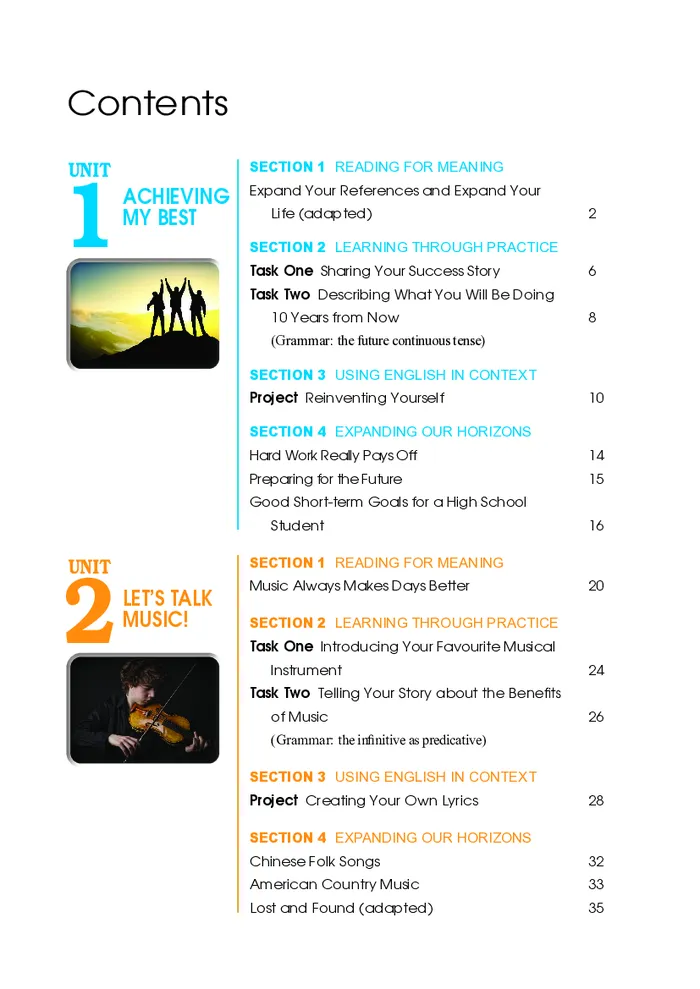
Contents
1
UNIT
2
UNIT
ACHIEVING
MY BEST
LET’S TALK
MUSIC!
SECTION 1  READING FOR MEANING
Expand Your References and Expand Your
      Life (adapted)


2
SECTION 2  LEARNING THROUGH PRACTICE
Task One  Sharing Your Success Story

6
Task Two  Describing What You Will Be Doing
      10 Years from Now


8
      (Grammar: the future continuous tense)
SECTION 3  USING ENGLISH IN CONTEXT
Project  Reinventing Yourself


10
SECTION 4  EXPANDING OUR HORIZONS
Hard Work Really Pays Off


14
Preparing for the Future


15
Good Short-term Goals for a High School
      Student


16
SECTION 1  READING FOR MEANING
Music Always Makes Days Better


20
SECTION 2  LEARNING THROUGH PRACTICE
Task One  Introducing Your Favourite Musical
      Instrument


24
Task Two  Telling Your Story about the Benefits
      of Music


26
      (Grammar: the infinitive as predicative)
SECTION 3  USING ENGLISH IN CONTEXT
Project  Creating Your Own Lyrics


28
SECTION 4  EXPANDING OUR HORIZONS
Chinese Folk Songs


32
American Country Music


33
Lost and Found (adapted)


35
3
UNIT
4
UNIT
RELIEVING
STRESS IN
YOUR LIFE
FAMILY
FESTIVALS
SECTION 1  READING FOR MEANING
Jenny’s Cure for Stress


38
SECTION 2  LEARNING THROUGH PRACTICE
Task One  Giving Suggestions on Reducing
     Exam Stress


42
Task Two  Testing Sex Difference about Stress
43
     (Grammar: the noun phrase and the adjective phrase)
SECTION 3  USING ENGLISH IN CONTEXT
Project  Investigating Sources of Stress among
     High School Students


46
SECTION 4  EXPANDING OUR HORIZONS
Types of Stress


50
A Magic Formula for Handling Worry Situations
51
Tai Chi, a Gentle Way to Fight Stress

52
SECTION 1  READING FOR MEANING
Christmas Memory


56
SECTION 2  LEARNING THROUGH PRACTICE
Task One  Telling Your Story of Family Festival
     Celebrations


60
Task Two  Describing One  Family Festival
     Celebration


62
     (Grammar: the past continuous passive voice)
SECTION 3  USING ENGLISH IN CONTEXT
Project  Reporting the Major Changes of
     Family Festival


64
SECTION 4  EXPANDING OUR HORIZONS
The Legend of Hanshi Day


68
One Mother’s Day Morning


69
5
UNIT
GEOGRAPHY
SECTION 1  READING FOR MEANING
Geography Is Everywhere


74
SECTION 2  LEARNING THROUGH PRACTICE
Task One  Describing an Impressive Place
78
Task Two  Discovering How Geographical
     Elements Affect People’s Diet


79
     (Grammar: the v-ing form as object)
SECTION 3  USING ENGLISH IN CONTEXT
Project  Exploring Human-environment Interaction


82
SECTION 4  EXPANDING OUR HORIZONS
The Difference Between the U.K., Great Britain,
     and England


86
The Silk Road


87
The UN Starts a Conservation Treaty for
     the High Seas


89
APPENDICES
WRAP IT UP!


91
VOCABULARY (I)


106
VOCABULARY (II)


113
LIST OF PROPER NAMES


120
GRAMMAR


122
1
UNIT
ACHIEVING MY BEST
Stop being who you were and become who you are.
           – Paulo Coelho, Brazilian novelist
Knowing others is intelligence; knowing yourself is true wisdom.
Mastering others is strength; mastering yourself is true power.
– Laozi, Chinese philosopher
When we are no longer able to change a situation, we are
challenged to change ourselves.
– Viktor Emil Frankl, Austrian neurologist and psychiatrist
1
READING FOR MEANING
1
Expand Your References and
Expand Your Life (adapted)
BEFORE YOU READ
1	 What does the title of the text mean to you? How do you understand the word “reference”?
2 Do you want to improve yourself? What’s your specific plan for it?
3	 How could you expand your life and make yourself a better person in the future?
Each day I look for ways to expand. Into my thirty-one
years I’ve packed literally hundreds of years of experience.
How can I say that? The number of challenging and
enriching experiences that I have on a monthly basis is
like what most people experience over a period of years.
One of the major ways I began to do this, starting at the
age of seventeen, was through the rich experiences that
books provide. Early in my life, I developed the belief that
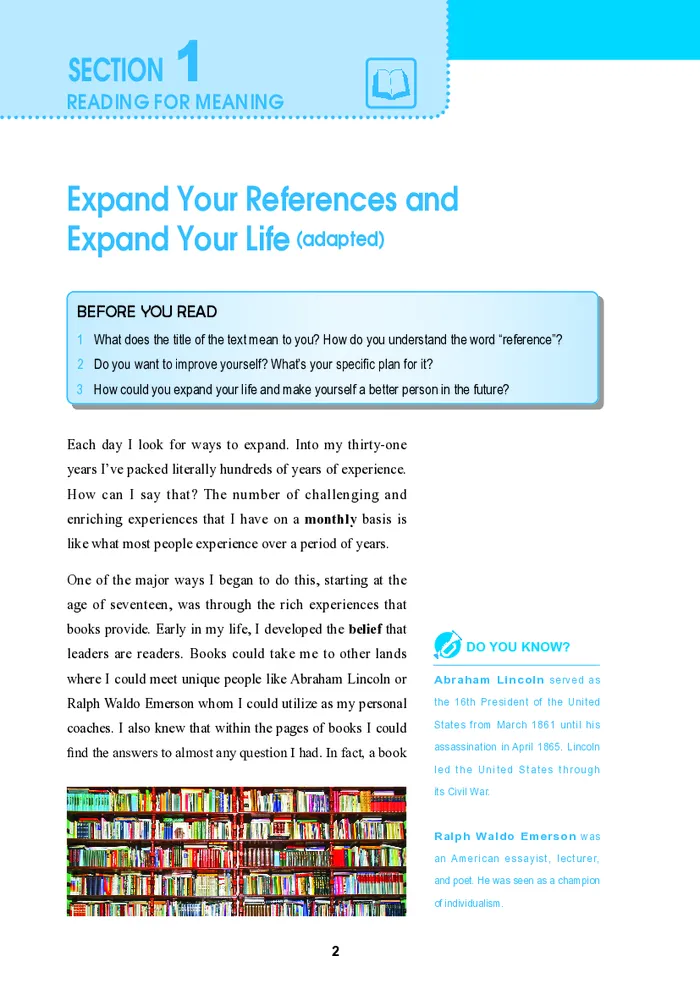
leaders are readers. Books could take me to other lands
where I could meet unique people like Abraham Lincoln or
Ralph Waldo Emerson whom I could utilize as my personal
coaches. I also knew that within the pages of books I could
find the answers to almost any question I had. In fact, a book
Abraham Lincoln served as
the 16th President of the United
States from March 1861 until his
assassination in April 1865. Lincoln
led the United States through
its Civil War.
Ralph Waldo Emerson was
an American essayist,  lecturer,
and poet. He was seen as a champion
of individualism.
DO YOU KNOW?
2
 UNIT 1
ACHIEVING MY BEST
can be, like a computer, a gigantic database of information.
The references I’ve found in hundreds of books have given me
countless ways to relate to people and assist them.
Remember, any limits that you have in your life are probably
just the result of limited references. Expand your references,
and you’ll immediately expand your life. The possibilities I’ve
touched on are exciting and inspiring, and will hopefully get
your creative juices flowing. Whole worlds open up with the
addition of just one new reference. It could be one new thing
you see or hear, a conversation or a movie, something you read
on the very next page – you never know when it may happen.
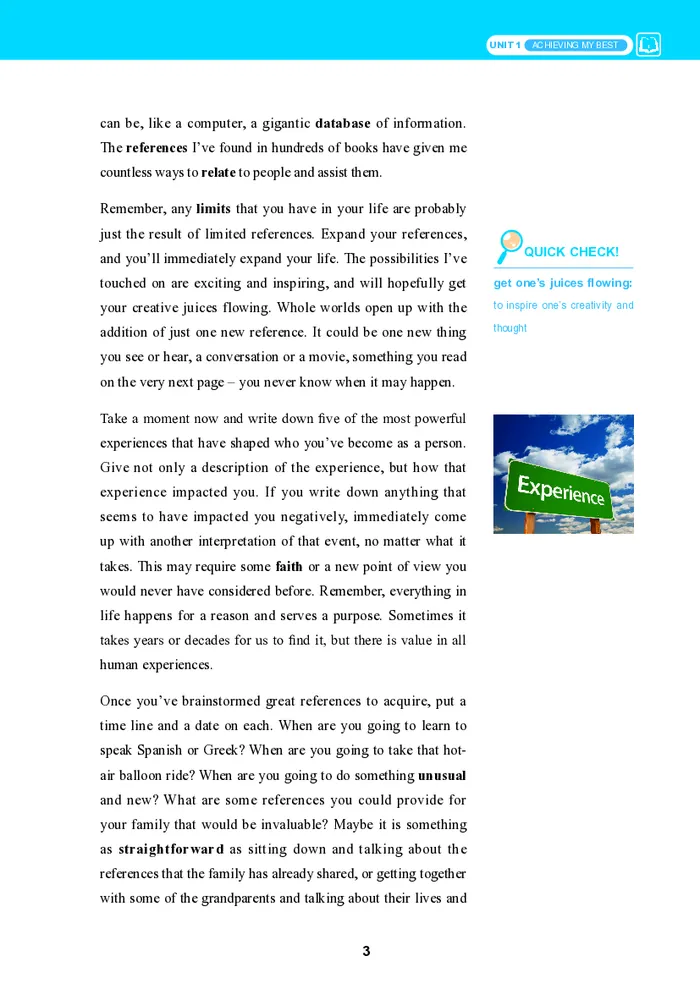
Take a moment now and write down five of the most powerful
experiences that have shaped who you’ve become as a person.
Give not only a description of the experience, but how that
experience impacted you. If you write down anything that
seems to have impacted you negatively, immediately come
up with another interpretation of that event, no matter what it
takes. This may require some faith or a new point of view you
would never have considered before. Remember, everything in
life happens for a reason and serves a purpose. Sometimes it
takes years or decades for us to find it, but there is value in all
human experiences.
Once you’ve brainstormed great references to acquire, put a
time line and a date on each. When are you going to learn to
speak Spanish or Greek? When are you going to take that hot-
air balloon ride? When are you going to do something unusual
and new? What are some references you could provide for
your family that would be invaluable? Maybe it is something
as straightforward as sitting down and talking about the
references that the family has already shared, or getting together
with some of the grandparents and talking about their lives and
QUICK CHECK!
get one’s juices flowing:
to inspire one’s creativity and
thought
3
 UNIT 1
ACHIEVING MY BEST
what they have learned. What invaluable
references these sixty-, seventy-, eighty-,
and ninety-plus year-olds have for those of
us who are younger!
One of the most powerful references I
have shared with my family is delivering
Thanksgiving dinners to those who cannot
or will not visit shelters. I’ll never forget
my youngest son’s reaction when he was
four years old. It was Jairek’s first time
participating, and we went to a park in
Oceanside, California. We found an old man
who was sleeping on the floor of a bathroom
with no doors, trying to cover himself with
pieces of dirty cloth. My son was surprised
at his very long beard and was a little bit
scared. I handed Jairek the basket of food
and other survival goodies, and said, “Go
on and give it to this man, and wish him a
Happy Thanksgiving.” Jairek approached
carefully. He went into the bathroom with
a basket that was as big as he was and set
it down gently. The man looked like he
was either drunk or asleep. Jairek touched
the man and said, “Happy Thanksgiving!”
All of a sudden, the man stood upright and
grabbed my son’s hand. My heart leaped
into my throat, and just as I started to spring
forward, the man took Jairek’s hand and
kissed it. He whispered, “Thank you for
caring.” Boy, what a reference for a four-
year-old!
QUICK CHECK!
spring: to move suddenly and with one quick movement
in a particular direction
          POEM
How Do You Think?
If you think you are beaten, you are
If you think you dare not, you don’t
If you’d like to win, but you think you can’t
It’s almost certain you won’t.
If you think you’ll lose, you’re lost
For out in the world we find
Success begins with a fellow’s will
It’s all in the state of mind.
If you think you’re outclassed, you are
You’ve got to think high to rise
You’ve got to be sure of yourself before
You can ever win the prize.
Life’s battles don’t always go
To the stronger or faster man
But sooner or later the man who wins
Is the person who thinks he can!
4
 UNIT 1
ACHIEVING MY BEST
AFTER YOU READ

Reading Comprehension
1	 What is the major message the author wants to give us through the text?
2	 How are Paragraph 1 and Paragraph 2 connected logically?
3	 What is the author’s belief about “reading books”?
4	 What could a reference be according to Paragraph 3?
5	 What is the topic sentence of Paragraph 6? How does the author use a story to support the theme?
6	 The author concludes the text with “...”. What does he mean? How would you complete the text with
the best choice?

Post-reading Activities
1	 What does the text remind you of in your life? Does it remind you of anything you have read?
Anything you have seen in the movies or TV series?
2	 Recall some unforgettable and powerful experiences in your life and reflect on how they have
shaped or influenced you, and share them in groups.
3	 In the text, the author believes that leaders are readers. What does he mean? Do you agree or
disagree with his view? Discuss in groups.
4	 The author holds that “It’s up to us to pursue, create and extend the moments that will lift us and not
limit us”. How can we pursue and create the moments as the author suggests? Share your ideas
with your classmates.
Remember, it’s the moments of our lives that shape us. It’s up to us to pursue, create and
extend the moments that will lift us and not limit us. Let your imagination run wild with the
possibilities of all those things you could explore and experience – and begin immediately.
What new experience could you pursue today that would expand your life? What kind of
person will you become? Take action and enjoy exploring the possibilities. Let’s discover
the great change that comes from…
5
LEARNING THROUGH PRACTICE
2
Task One  Sharing Your Success Story
Have you done anything that made you feel proud? Have you succeeded in doing anything
that nobody thought you could? Now, share such a story with your partner.
Step 1  Pre-task Resources
Sava, a Canadian, once volunteered to teach English in Hebei Province. Read her story carefully
and pay attention to how the time expressions are used to describe the events of the story.
When the time had come for me to retire, I was afraid of the thought of having to sit at home
and wait to die. Fortunately, for me, an event took place that played a major role in changing
my attitude towards life in general and retirement in particular.
I was invited to teach English at a high school in Xingtai,
Hebei after I retired. At first, I found that many of my
students were hard-working on their own, but shy and not
active in communicating with each other, even with their
parents. Later I decided to help them. As Mother’s Day
approached that year, my plan for the day was to give
each of my students the opportunity to stand up in front
of the class and express his or her feelings towards his or
her mother. Then, I started to help my students one by one
after school to prepare for the party. And I encouraged
them by saying words like “Go for it!” “You can do
it!”. When the day of the event finally came, I observed
in awe as my shy students stood elegantly and they
each beautifully expressed their genuine love for their
mothers. I watched many of the mothers hold back tears
as they were overcome with emotion and love for their
children. Frankly, I could not hold back my own tears. I
was so proud of my students and grateful to the school
administration and all the teachers that had helped make
Expressing
encouragement
● You can handle/do it!
● Don’t be afraid/
  give up/quit now.
● Keep your chin up!
● Never say never!
● Go for it!
6
the event possible. At the end of the event, most parents expressed their thanks to all of us,
which inspired me to continue holding the event every year as long as I would be teaching.
That night, on my way home, I was on cloud nine. I felt such a great sense of fulfillment and
a strong connection to my students and their families. I realized then that my greatest joy in
life was to share a connection and bring joy to others’ lives. From then on, I knew I would
seek more ways to do just that.
Step 2  Exploring the Language
Sava told us her story in chronological order. Read and compare the sentences with and
without time expressions. Discuss with your classmates in groups the function and use of
time expressions.
 UNIT 1
ACHIEVING MY BEST
Can you imagine a language without time expressions? In English, these time expressions
are called time connectives. We use these connectives as transitional words to connect and
relate sentences or paragraphs together and to signal the order or sequence of the story or
text. When we tell a story, it is important for us to use time connectives so that each separate
part of the story is connected into a coherent whole.
Collect and list more time connectives you know and then share your list in groups. Try using
them when you describe things or tell stories.
●	 I found that many of my students were
hard-working on their own, but shy and
not active in communicating with each
other, even with their parents.
●	 I decided to help them.
●	 I started to help my students one by one
after school to prepare for the party.
●	 Most parents expressed their thanks to
all of us,…
●	 At first, I found that many of my students
were hard-working on their own, but shy
and not active in communicating with
each other, even with their parents.
●	 Later I decided to help them.
●	 Then, I started to help my students one
by one after school to prepare for the
party.
●	 At the end of the event, most parents
expressed their thanks to all of us,…
7
Task Two  Describing What You Will Be Doing 10 Years from Now
In this task, you will listen to Li Ming and Jenny talking about their future plans. Interview
your partner about his or her future plan and he or she will also interview you. Then make a
dialogue with your interview results.
Step 1  Pre-task Resources
Listen to the dialogue between Li Ming and Jenny and answer the following questions.
 UNIT 1
ACHIEVING MY BEST
Step 3  Task Cycle
Work individually.
Think of a success
story of your own.
Work in pairs.
Tell your partner
your success story
and try to use what
you’ve learned in
the previous steps.
Write down your
story.
You may organize
your story in
three paragraphs:
introduction, main
body and ending.
1
2
3
What does Jenny know
about herself?
How does Jenny like Li Ming’s
characteristics?
Who influences Li Ming
on his career choice?
And how?
How many subjects
does Jenny mention?
What are they?
What is Li Ming’s
dream career?
8
 UNIT 1
ACHIEVING MY BEST
Step 2  Task Cycle
1
Interview your partner about his/her future plan.
2
Change roles. Your partner interviews you about your future plan.
3
Combine your interviews into a coherent dialogue. Try to use the future continuous structure
(will/shall be doing) in your dialogue.
Step 3  Language Focus
The form of the future continuous tense is will/shall + be + v-ing. It is used when there is
reference to something that will be in progress at some specified time in the future.
● Next week, I’ll be swimming every day in the Caribbean.
● I’ll be having a word with him when he returns.
● Don’t worry. I’ll be waiting for you at the station.
The future continuous tense is also used to refer to events which are due to happen and
which may result in other events taking place or make other events possible.
● I’ll be seeing the boss tomorrow morning. Do you want me to mention the
promotion?
The future continuous tense can also be used to soften questions about the future and make
them more polite.
● Will you be coming back on Friday night or Saturday morning?
Jenny, what will you
be doing ten years
from now?
9
3
USING ENGLISH IN CONTEXT
Project  Reinventing Yourself
Your school newspaper’s English version is calling for a reflection paper on personal growth.
You want to submit a paper about it. You will take one week to improve the interpersonal
interaction between you and your friends/family and write a weekly progress report to
summarize what you have experienced.
Step 1  Listen and Discuss
Here is a lecture on how to be a better person day by day. Listen to it carefully and then have
a discussion.
1
Listen to the lecture and complete the outline.
tips for
self-development
Keep a
 ____________
Choose to
____________
Make room for
____________
Learn from your
____________
Don’t expect ____________
results
Take ____________
10
 UNIT 1
ACHIEVING MY BEST
Always
Often
Sometimes
Never
1
is helpful and selfless.
2
is impatient when facing difficulties.
3
keeps things neat and tidy.
4
doesn’t like cleaning or other household chores.
5
is outgoing and sociable.
6
is shy and not good at expressing feelings.
7
can keep emotions under control.
8
is afraid of making mistakes.
9
is eager to experience new things.
10
has difficulty keeping a good habit.
2
Tick what the speaker suggests.
 Get to know about your weaknesses and strengths.
 Make choices to ensure that you can stay in your comfort zone.
 Growing physically is the most important task for you.
 Be patient since it takes time for you to grow.
 It’s a good way to keep a record of what you’ve experienced.
3
Discuss in pairs how you understand Moliere’s saying, “The trees that are slow to grow bear
the best fruit.”
Step 2  Self-check and Discuss
Better understand yourself by ticking the word that best describes you. After you finish,
discuss the results with your partner to find out what he/she thinks of you. See if you can
reach some agreement about ways to improve your weaknesses.
I am someone who...
11
 UNIT 1  ACHIEVING MY BEST
Step 3  Act and Record
Make a record of every detail of your daily progress, referring to the samples.
Action(s)
Monday
Thursday
Friday
Saturday
& Sunday
Tuesday
Wednesday
● Offer a warmer
greeting to
Xiaoming.
● ...
● Read a chapter
of my favourite
book.
● ...
● Clean up my
bedroom.
● ...
12
Step 4  Reflect, Write and Revise
You will write an essay of 150 words to reflect on your insights, opinion, and observations.
It should have an introduction, body and conclusion. The essay should include the following
information:
■
What were you like before?
■
What did you do in the previous week to improve yourself? And how did you feel about it?
■
How do your friends (family) like the “new you”?
You will submit your essay to the school newspaper. Before submitting, you need to edit and
revise it to make it better.
 UNIT 1
ACHIEVING MY BEST
Evaluate yourself!
Can you recall and describe in English one moment or event in your life which has shaped or greatly
influenced your growth?
Can you communicate better with the help of various means, such as pronunciation, intonation, stress,
rhythm, eye contact and gestures?
How well have you done with the following? Tick the circles that best reflect your performance.
Making a list of my weaknesses to improve
through pair work
Using textual cohesive devices to organize
information logically
Describing my life story and expressing my
views in English clearly and logically
Excellent    Very Good    Good    Needs Improvement
13
EXPANDING OUR HORIZONS
4
Hard Work Really Pays Off
The Chinese people have long been known for the strong
work ethic in their culture. As early as 1894 AD, Arthur
Smith, a missionary who spent 54 years in China, wrote books
introducing the hard-working Chinese people to Americans.
In his book Chinese Characteristics, Smith wrote about the
diligence and commitment of not just a single group of Chinese
people, but of the general Chinese populace: young and old,
rich and poor, farmers and scholars.
QUICK CHECK!
A missionary is a Christian
who has been sent to a foreign
country to teach people about
Christianity.
A great deal of Chinese literature has a tendency to relay moral tales about industrious
farmers. A strong work ethic and hard-working effort are characteristics that have long been
valued in Chinese culture since ancient times. Even today the Chinese people place great value
in working towards the greater good, which has rightfully earned the Chinese a reputation
around the world for having one of the most stable and industrious work forces on the planet.
Chinese people are socialized differently than Westerners. They grow up with different values,
including a different perspective on the importance of working hard. Hard work is embedded
in Chinese culture and is seen as a virtue, as opposed to a necessity in American culture.
The Chinese Communist Party is devoted to building the country into a strong, successful,
global nation under its core leadership. The country urges its citizens to participate in this
process alongside its governmental institutes. Diligence is part of political consciousness.
14
POST-READING QUESTIONS
1	 Who is Arthur Smith? What advantages did he have to write a book on Chinese culture?
2	 What is Arthur Smith’s opinion of the Chinese hard-working culture?
3	 What does the sentence “Diligence is part of political consciousness” mean?
Preparing for the Future
Ultimately Maria had to return to reality. The time had come for her to decide what she was
going to do with her life. A Polish girl at that time had only limited possibilities for higher
education, but there was another option. Maria could leave her beloved Poland to study in
a foreign country. Unfortunately, however, the financial barrier seemed too great for her to
overcome. Her family simply could not afford to send her away to study.
With her own goals in mind, Maria developed a plan to earn more money to get the
education she so wanted. Maria found a position as a governess, outside of Warsaw, and
saved the majority of her salary. Though taking this secure position would allow Maria to
earn a higher wage, it also meant that she would be away from her family and her beloved
hometown of Warsaw. After travelling for several hours by train she still had to drive five
hours more by horse before she reached her destination. She liked her new employers, the
Zorawskis. In a letter to her cousin, she described them as “excellent people”. She worked
with Bronka, the Zorawskis’ oldest daughter, for three hours each day and with Andzia,
the 10-year-old, for four. In her free time, she taught some of the young and less fortunate
children in the neighbourhood how to read and write. Though it could be a challenging task,
Maria enjoyed her time teaching the children.
 UNIT 1
ACHIEVING MY BEST
In today’s socialist China, people are achieving greater security in their work and home
life, and the standard of living has risen significantly. There is certainly much the world can
learn from the Chinese views on work ethic. Undoubtedly, the country’s current economic
standing and higher standard of living are a reflection of its strong cultural values.
15
Good Short-term Goals for a High School Student
A tried and true recipe for success in high school starts with learning how to set short-
term goals. Setting short-term goals is a good way to relieve the many pressures of high
school. They are also a direct path towards reaching your long-term goals. Whether you are
working towards going to college, achieving greatness in sports or extracurricular activities,
or finally getting straight A’s, choose realistic short-term goals that help you move forward
and keep you motivated.
POST-READING QUESTIONS
1 Do you think the first few sentences of the text are effective? In other words, did they grab your
attention? Why, or why not?
2	 Why couldn’t Marie access higher education at that time?
3 How did the years with the Zorawskis benefit Maria?
 UNIT 1
ACHIEVING MY BEST
DO YOU KNOW?
Marie Curie was a physicist and
chemist who conducted pioneering
research on radioactivity. She was the
first woman to win a Nobel Prize, the
first person and only woman to win
twice, and the only person to win a
Nobel Prize in two different sciences.
The years she spent working with the Zorawskis had many
benefits. Instead of taking time for leisure, Maria began
a rigid program of self-education, starting her studies at
nine o’clock in the evening and getting up at six in the
morning. She preferred to read several books at a time
rather than just concentrate on a single subject. Even
though she found literature and sociology as interesting
as science, she eventually decided that her future lay in
mathematics and physics.
Maria’s diligent planning, sacrifice, integrity and hard
work would eventually pay off.
She was later known as Marie Curie, a great chemist
and physicist who had great achievements, including the
discovery of the element, radium.
16
 UNIT 1
ACHIEVING MY BEST
Put Academics First
While a good long-term goal for a class might be to end the semester with an A, setting
several realistic and timely short-term goals helps you make smart decisions that benefit
you along the way. Try to remember why you got a certain grade and develop a strategy
to improve; this could include studying more in advance, teaming up with classmates to
review, or asking a teacher for extra help. Choose a goal that can be achieved within a set
time period and track your progress. Minor improvements make a difference.
Get Homework Done on Time
Managing your time in high school can be challenging because a typical high schooler’s life
can be busy. Showing up to school prepared for the day can ease the stress of going to class.
Try to set time aside each night for doing homework or writing papers. A good short-term
goal for homework might be, for two weeks, to have all assignments completed by 9 p.m. the
night before they’re due. Afterward, once you get used to the pattern, make it a long-term
goal. Divide your tasks and, again, track your progress for a set time period to see how you
did. Make adhering to this system a long-term goal.
Participate in Extracurricular Activities
The experience of being part of a team or in a play guides all participants towards achieving
reasonable goals of self-improvement. Once you get involved, listen to your coach’s or
teacher’s advice to decide how you can improve. A short-term goal for sports could be to
boost a certain statistic by a few points in a month or come up with a strategy to finally beat
a rival team. Actors can strive to memorize all their lines by a certain date. Even a writer for
an advice column on the school paper can aim to write articles at a certain frequency.
Take Advantage of Resources
Part of setting goals is knowing what you need to improve, which means being aware of your
weaknesses. A good short-term goal may be to join a club or organization that can better
your performance. If you’re struggling in French, for example, join the French club or get
a tutor who can help you with concepts that offer a greater challenge. Student organizations
in high school cater to many different interests, so take advantage of this ability to network.
You may find students who shine where you struggle or who share your difficulties; either
way, you’ll probably find someone eager and willing to help you study. You may also end
up getting to know the teachers better, which can help in the long run as well.
17
 UNIT 1
ACHIEVING MY BEST
Unit Reflection
Review the whole unit and reflect on what you have learned.
1	 What are the do’s and don’ts of self-improvement? Make a list of them and explain the
items clearly.
2	 Take a minute to evaluate your current academic achievements and your measures for
improvement? Suppose you are now asked to give a mini-lecture to younger students about
goal-setting. What would you say? How would you encourage them to work harder and
achieve their goals?
3	 What is the future continuous tense? What have you learned about the meaning and use of
the future continuous tense in this unit?
POST-READING QUESTIONS
1	 What is the author’s attitude towards short-term goals?
2	 How can a high school student achieve good short-term goals?
3	 What are your short-term goals and long-term goals? How can you achieve them?
More Connections
●	 Do you want to know more about your own personality? Have you heard about the “Big-
Five” personality traits? We recommend that you read a classic research article called An
Alternative “Description of Personality”: The Big-Five Factor Structure by Lewis R.
Goldberg. You can easily find this article online. Focus on the English descriptions of the
Big-Five personality traits.
●	 Many websites can help us become better in every aspect of life. Here are some key words
for you to search online: Lifehack, personal growth, and fulfillment daily. You will find
many interesting articles, such as 13 Tips from the Most Successful People and 27 Ways to
Instantly Feel Better When You’re Down. In addition, you may get free materials, such as
the text titled The Daily Checklist to Make Habits Stick in 21 Days, which is very useful to
help you form good habits.
18
2
UNIT
LET’S TALK MUSIC!
Heavenly music is interpreted differently by everyone.
– Chinese proverb
Music is the only universal language which needs no translation.
– Berthold Auerbach, German writer
Without music, life is a journey through a desert.
– Pat Conroy, American writer
19
READING FOR MEANING
1
Music Always Makes Days Better
BEFORE YOU READ
1	 Do you like music? What kind of music do you like best? Why?
2	 Who is your favourite singer? Which song is the most impressive for you and why?
3	 What does music mean to you?
Hi Li Ming,
My name is Brianne. My friend Jenny told me you are thinking about taking guitar
lessons. She suggested that I write to you because I’ve learned to play many different
instruments and even participated in a chorus one time as a kid! I’m very happy to share
my experience with you and offer some advice about learning a new musical instrument.
I’m sending you two of my favourite songs. I hope you enjoy them. I listen
to these songs every day, and I think you might enjoy them as well. Ed
Sheeran is very popular here. He composed many famous songs. Have
you ever heard his song “Photograph”? I like to listen to music on my way
to school every day. It makes the trip to school so pleasant!
I listen to a lot of pop music, but I really love all kinds of music. I think music is one
of the greatest joys in life. It’s been a big part of my life since I was young. When I
was only four, I started learning to play the violin. I performed in many concerts. As I
got older, I learned to play an antique piano, and eventually joined the band at school.
That’s when I was first introduced to jazz music and began to play the saxophone.
Once I learned to play the saxophone, I developed an even greater appreciation for
jazz music that eventually inspired me to start singing. Most recently, I have learned
to play the guitar. I registered for lessons six months ago and already I can play
20
 UNIT 2
LET’S TALK MUSIC!
several songs! I absolutely love it! Sometimes, I play until my fingers bleed! I find
that learning to play the guitar has also helped me develop my vocals for singing. I
was surprised to discover how easy it was to learn. I’m excited for you to get started,
and I’m sure that you will learn very quickly. Someday maybe we will be able to play
together. Wouldn’t that be fun?
Where I come from we have a saying that “Music is the language of the soul”. I
couldn’t agree more! Playing music allows me to experience emotions and express parts
of myself that I wouldn’t know how to describe in words. Whether I’m feeling down,
or having a good time, music always makes my day better. It also helps me push my
boundaries; now, I don’t freeze when I do a presentation in class.
I wonder if you’ll feel the same way once you learn to play the guitar. Actually, I can
think of one day, years ago, when my three friends and I were performing in a piano
concert. One at a time, we each stepped up to the baby grand piano on the stage.
There was a panel of judges in shirts with collars sitting in the audience there to
assess our performances. I was terrified! It was the first time I had to know how to
Have butterflies in one’s
stomach means to have a
nervous feeling before doing
something.
QUICK CHECK!
play a song entirely from memory. My first friend went
up and played her song; the audience applauded and
she returned to her seat. She had played beautifully. My
second friend also played well. Then the judge called
my name. I had butterflies in my stomach as I slowly
walked up to the stage. I began to play.
About halfway through the song, I completely forgot
the notes and my mind went blank! I stopped playing,
and then started again from the beginning, but when
I got to the same place in the song, I forgot the notes
again. I wished I could skip ahead to the end of the
song, but I didn’t remember a single note! This time I
stopped and looked up at the audience and saw one of
the judges slowly walking up to the stage to bring me
the music book. I had never been so embarrassed in all
21

Reading Comprehension
1	 What is the purpose of Brianne’s email to Li Ming? Please draw a timeline to show Brianne’s
journey of learning music.
2	 What major message does Brianne want to give Li Ming through this email? Do you agree with Brianne?
3	 Brianne quotes in her email, “Music is the language of the soul.” What does it mean to Brianne?
How do you understand the saying?
4	 What happened to Brianne in a piano concert years ago? How did she feel at the competition? How
did she feel when she was writing the email? What does this experience mean to Brianne?
5	 “Life is like a piano. The white keys represent happiness and the black show sadness. But as you
go through life’s journey, remember that the black keys also make music.” How do you understand
it? Can you share one of your experiences to interpret it?
6	 What can you learn from Brianne’s email? If you were Li Ming, how would you reply to Brianne’s email?
AFTER YOU READ
 UNIT 2
LET’S TALK MUSIC!
my life! I played my song, but I didn’t win the competition. I resigned myself to a life
of failure after that. Of course, that didn’t happen!
Whenever I remember this story, I laugh. It doesn’t seem so tragic now. Don’t let it
scare you. Just like the saying goes, “Life is like a piano. The white keys represent
happiness and the black show sadness. But as you go through life’s journey, remember
that the black keys also make music.” Most of my memories of music are good ones,
and I don’t ever want to stop playing and listening to music. Whether it’s pop, classical,
swing, jazz or even country music, I enjoy them all.
Thanks for letting me share my experience with you. I wish you all the best in learning
to play the guitar. Please let me know how it goes. I’d love to learn more about your
taste in music. I’m sure there is a lot I could learn from you. I’m looking forward to
hearing from you.
Your new friend,
Brianne
22
 UNIT 2
LET’S TALK MUSIC!
             SONG
Do you like to dance and move your feet?
Everyone likes a happy beat
I’m listening to the radio
Waiting for my favourite show.
Music makes me feel alive
My favourite dance is called the jive
First you swing your arms and twirl
It’s fun for every boy and girl.
Music I Like
Chorus
There’s rap and dance and hip hop
Some kind of music just won’t stop
Bossa Novas are okay
But rock and roll is here to stay.
Music does a lot of things
It brings us up and makes us sing
Without it my heart would drop
That’s why I’m doing hip hop.
Repeat Chorus

Post-reading Activities
1 What does MUSIC mean? Complete the following mind map first and then share your understanding
and experiences of “music” in groups.
2	 Music is an important medium for expression and communication among human beings. People
believe that music has many functions, for instance, listening to music can improve our health,
playing musical instruments helps develop our motor skills... Work in groups and make a list of all
the functions you think music is able to perform.
3	 As the saying goes, “Music is the only universal language which needs no translation.” How do you
understand it? If possible, use some stories to explain.
4	 Some teachers suggest that we learn to sing songs in English. They believe that English songs are
helpful in learning English. Do you agree or disagree with their points of view? Support your ideas
with examples from your own experiences of learning English.
music
types of music
_______________
great musicians
_______________
famous singers
_______________
unforgettable experiences
_______________
musical instruments
_______________
23
LEARNING THROUGH PRACTICE
2
Task One  Introducing Your Favourite Musical Instrument
Music is sound that has been organized by using rhythm, melody or harmony. A musical
instrument is a device used to make sounds that form a melody. The history of musical
instruments dates to the beginnings of human culture. Learn about the violin and then
introduce your favourite musical instrument to the class.
Step 1  Pre-task Resources
Read the following passage and focus on the words related to music.
Violin
The violin is a wooden string instrument popular in many countries around the
world. Most violins have a hollow wooden body. It is the smallest and highest-pitched
instrument in the family in regular use.
The violin typically has four strings tuned in perfect fifths, and is most commonly played
by drawing a bow across its strings, though it can also be played by plucking the strings
with the fingers and by striking the strings with the wooden side of the bow.
Violins are important instruments in a wide variety of musical genres. They are most
outstanding in the Western classical tradition, in many varieties of folk music, and
in jazz. Furthermore, the violin has come to be played in many non-Western music
cultures.
The violin was first known in 16th-century Italy, with some further improvements
occurring in the 18th and 19th centuries. In Europe, it served as the basis for the
development of other stringed instruments used in Western classical music.
24
 UNIT 2
LET’S TALK MUSIC!
The parts of a violin are usually made from different types of wood (although electric
violins may not be made of wood at all). Violins can be strung with catgut or other
man-made or steel strings. A person who makes or repairs violins is called a violinmaker.
One who makes or repairs bows is called a bowmaker.
Step 2  Exploring the Language
Complete the mind map with the information from the passage in Step 1.
Step 3  Task Cycle
Choose your favourite musical instrument and introduce it to the class. You should include:
(1) brief description of your instrument, (2) why it is your favourite, (3) anything you know and
you like to share (for example, famous music works, players, or stories associated with the
instrument).
erhu
piano
guitar
history
material
components
musical
genre
violin
wood
string
25
 UNIT 2
LET’S TALK MUSIC!
Task Two  Telling Your Story about the Benefits of Music
Music has become an inseparable part of our daily life. In this task, you will first read a
passage about how music improves health, and then you recall from your own experiences
about the benefits of music. Write your story and share it with your classmates in groups.
Step 1  Pre-task Resources
Read the passage about how music helps people live better.
How Music Improves Health
Music researchers are considering ways music
may improve our health and well-being. In some
cases, music’s positive impacts on health have
been more powerful than medication’s.
Music reduces stress, anxiety and pain
Music can prevent increases in heart rate and blood pressure related to anxiety, and
decrease stress levels. Music has a unique ability to help with pain management. It’s
not clear why music may reduce pain. Stress and pain are also closely linked, so music’s
impact on stress reduction may also partly explain these effects. Performing music is
also known to have a calming effect.
Music may improve immune function
Can listening to music actually help prevent disease? Some researchers think so. The
promise of music as medicine is that it’s natural, it’s cheap and it doesn’t have the
unwanted side effects that many medical products do.
Music may aid memory
Listening to music while you study can actually prove to be beneficial. What some
teenagers usually do is to listen to music while they study. Far from being a distraction,
many students claim music helps aid their memories when it comes to test time.
Evidence that music helps with memory has encouraged researchers to study the
impact of music on specific sections of the population, such as those who suffer
memory loss due to illness.
26
 UNIT 2
LET’S TALK MUSIC!
Fast-rhythm music can help you get a better workout
How many of us listen to rock and roll or other fast-rhythm music while working out? It
turns out that research supports what we feel: music helps us get more out of our exercise.
When listening to fast-rhythm music while you exercise, often your body moves to the
rhythm and beat and this encourages more efficient use of your oxygen intake.
According to researchers, “Music has the capacity to attract attention, lift spirits, generate
emotion, change or regulate mood, refresh memories, increase work output and encourage
rhythmic movement, all of which have potential applications in sport and exercise.”
Step 2  Task Cycle
1
Pair work. Discuss how we benefit from music.
Does music help language learning? Does music enhance our motor skills? Does music
cultivate our thinking skills? Does music foster our working memory? How does music
do it?
2
Recall from your experiences how you benefit from music. The benefits you get may come
from the melody of the music, content of the song, the beauty and power of the rhythm, your
favourite musical instruments, or singers you like best.
3
Write your story in English. In your story you will describe: (1) in which aspect of your life or
learning you benefit from music, and (2) how music helps or enriches your life or learning.
Step 3  Language Focus
The infinitive (to do) is one of the non-finite verb forms. We can find a sentence in Step 1.
● What some teenagers usually do is to listen to music while they study.
Translate the sentence into Chinese. Did you notice any grammatical difference between
English and Chinese?
The infinitive (phrase) often follows the linking verb and serves as a predicative of the
sentence.
● Jenny’s great hope is to climb Mount Tai.
● He seems to have lost interest in computer game.
A predicative infinitive phrase may be introduced by the pronouns, adverbs and conjunctions
such as what, how and when.
27
3
USING ENGLISH IN CONTEXT
Project  Creating Your Own Lyrics
You can write a song about anything, but sometimes it’s hard to get started. Some people
use experiences from their personal life as inspiration, and others write things that they
have read about. No matter what you choose to write about, you can write your own lyrics
with a bit of practice.
Step 1  View, Recognize and Describe
1
View a video and recognize what emotion the singer wants to express.
2
Describe the most impressive scene you feel and share your understanding of this video with
your partner.
Step 2  View, Focus and Discuss
1
View the video again and this time focus on the lyrics. Fill in the blanks with what you hear.
Dance with My Father
Luther Vandross
Back when I was a child
Before life __________ all the innocence
My father would __________ me __________
And dance with my mother and me and then
__________ me around ‘til I fell asleep
Then up the stairs he would __________ me
And I knew __________ __________ I was loved
If I could get another __________, another __________, another dance with him
I’d play a song that would never ever end
How I’d love, love, love
To dance with my father again
28
 UNIT 2
LET’S TALK MUSIC!
When I and my mother would __________
To get my way, I would __________ from her to him
He’d make me laugh just to __________ me
Then finally make me __________ just what my mama said
__________ that night when I was asleep
He left a __________ under my sheet
Never dreamed that he would be __________ from me
If I could steal one final glance, one final __________, one final dance with him
I’d play a song that would never ever end
‘Cause I’d love, love, love
To dance with my father again
Sometimes I’d listen outside her __________
And I’d hear how my mother __________ for him
I pray for her even more than me
I pray for her even more than me
I know I’m praying for much too much
But could you __________ __________ the only man she loved
I know you don’t do it usually
But dear Lord she’s __________
To dance with my father again
Every night I fall asleep and this is all I ever __________
2
According to the lyrics of the song, talk with your group members about the following questions.
Does the song have
a clear theme?
What’s the mood of
the song?
Does the song have
a climax?
Does the song use any
figures of speech?
29
 UNIT 2
LET’S TALK MUSIC!
Step 3  View and Brainstorm
1
View the flow chart below and learn the steps to write your own song.
Freewrite about
whatever is in your
mind.
Think of your song
like a small story.
Stick to one
idea or theme
per song.
Use the title of the song
to set the mood, theme,
or most important idea.
Know the
lyrical parts of
a song.
Use a few
metaphors and
similes.
2
Brainstorm ideas for your song with the help of the following mind map.
title
theme
mood
story
my song
Learning tips
A figure of speech is a phrase or word having different meanings than its
literal meanings. It conveys meaning by identifying or comparing one thing
to another, which has connotation or meaning familiar to the audience.
That is why it is helpful in creating vivid rhetorical effect.
30
 UNIT 2
LET’S TALK MUSIC!
Step 4  Write, Revise and Show
1
Complete your song lyrics and exchange them with your group members. Polish and write
down your favourite part below.
2
 Show time. Select or make a melody for your song and sing it aloud for your class.
Song Lyrics
Name of song:
Words and music by:
Verse

Chorus
Evaluate yourself!
Can you tell the meaning of your favourite song and explain why you love it in English?
Can you tell and explain situations where music can express meanings better than words?
How well have you done with the following? Tick the circles that best reflect your performance.
Willing to discover and appreciate the rhythms in
different kinds of English songs
Understanding how language and pictures or
signs construct meaning in multimodal discourse
Restarting communication using related
examples when working in a group
Excellent    Very Good    Good    Needs Improvement
31
EXPANDING OUR HORIZONS
4
Folk songs are songs that are made up by ordinary people,
like farmers or tailors, butchers or blacksmiths. Most of
these songs were made up long ago, and people have been
singing them for hundreds of years. In China, we have a
long and honoured tradition of folk songs and folk singers.
These folk songs give voice to the ordinary people. Billions
of people in China, young and old, have enjoyed these
traditional songs. They are often described as the glue that
unites all the people of this ancient civilization.
Have you ever heard the folk song “In a Far-away Land”
by Wang Luobin? Many of his songs have been performed
throughout China and around the world.
Wang Luobin was born in Beijing in 1913 and was
educated at the Department of Music, Beijing Normal
College, where he studied voice, piano, and composition.
As a young man, he toured northwestern China and was
fascinated by the local folk songs. His understanding of
music led him to conclude that Chinese folk songs were
Chinese Folk Songs
DO YOU KNOW?
Wang Luobin, a Chinese song
writer, specialized in publishing songs
based on the music of various ethnic
minorities in western China. He took
up residence in northwestern China for
more than 50 years, and devoted his
time there to transcribing, adapting,
collecting and revising western
Chinese folk songs.
among the best in the world. He decided to collect and rewrite hundreds of these traditional
songs. Many of his more than seven hundred folk songs have become national favourites.
Most Chinese people can sing at least one of his songs or their variations.
Wang Luobin passed away in 1996, but his music lives on in the hearts and minds of Chinese
people everywhere. He was, in many ways, a music archaeologist. He devoted himself to
uncovering and promoting the music of the people. Through his efforts, many of the old
songs have been kept for future generations to enjoy. Without his work, these songs might
have been lost forever.
32
 UNIT 2
LET’S TALK MUSIC!
There is a nice, pretty girl,
in a far-away land.
When people pass by her tent,
they always stop and do a double-take.
People said that she always keeps a
lamb beside her.
I wish I could be a young lamb,
running towards her,
until I am by her side.
I wish her narrow quirt always
whips me gently.
In a Far-away Land
POST-READING QUESTIONS
1	 Do you like folk songs? How did folk songs come into being?
2	 Why was Wang Luobin called “a music archaeologist”? What contributions has he made to
Chinese folk songs?
3	 How many Chinese folk songs do you know? Have you heard Hao Zi (sung by males), Xiao
Diao, and Shan Ge? What are they? Find one and share with your class.
American Country Music
Do you know “Old MacDonald Had a Farm”? Or “The Frog Went A’Courting”? They are
country music songs. Most country music is about the kinds of work that people do. Some
are just for fun. One of the oldest American country songs is “Turkey in the Snow”. It’s about
silly things that happen to a young farmer.
John Denver was an American country music singer-
songwriter who had numerous hits including “Take Me
Home, Country Roads” and “Rocky Mountain High”.
He was born on December 31, 1943, in Roswell, New
Mexico. After dropping out of college, he travelled to
New York City and began his music career. Peter, Paul
and Mary recorded his “Leaving on a Jet Plane” in 1967,
33
 UNIT 2
LET’S TALK MUSIC!
…
I hear her voice in the morning hours
She calls me
The radio reminds me of my home far away
And driving down the road
I get a feeling
That I should have been home
Yesterday, yesterday
Take Me Home, Country Roads
Country roads, take me home
To the place I belong
West Virginia Mountain Mama
Take me home, country roads
and his “Rocky Mountain High” became an official song of the state of Colorado. Among
numerous awards and recognition for his musical achievements, he received the Top Male
Recording Artist Award from Record World magazine for 1974 – 1975. Also in 1975, he was
named the Country Music Association Entertainer of the Year.
John Denver was a great fan of Wang Luobin. At a 1994 concert in Australia, he performed
a version of “In a Far-away Land”. You can hear this recording on The John Denver
Collection of 1997.
John Denver was also very active in environmental causes. He was one of the world’s best-
known and best-loved performers, a master communicator who could reach audiences
regardless of geographical frontiers, economics and language. He was a true international
figure, a world citizen, devoted to world peace and the end of hunger.
On October 12, 1997, at the age of 53, he was killed when the experimental plane he was
flying crashed into the Pacific Ocean just off the California coast. In its 2011 election, the
Colorado Music Hall of Fame elected Mr. Denver as its first inductee.
Music does bring people together; it allows us to experience the same emotions.
People everywhere are the same in heart and spirit. No matter what language we
speak, what colour we are… music proves: We are the same.
– John Denver
34
 UNIT 2
LET’S TALK MUSIC!
Lost and Found (adapted)
POST-READING QUESTIONS
1	 How do you like country music? What do you know about country music?
2	 What did John Denver sing about in his songs?
3	 What do Chinese folk songs and American country music have in common?
I’ve been a musician most of my life. In late October 2002, before I was to perform at a
company Halloween party, I experienced sudden numbness on my left side, as well as in my
left arm and hand. I missed the party. My wife and I spent that night in the hospital where I
was tested. The diagnosis was MS for which there are no pills to provide a cure.
I didn’t take it seriously at first. I ended up getting three other professional opinions before
I accepted it. I could no longer play guitar, drums, or keyboards. I couldn’t even do simple
things like putting on my own socks. As painful as this disability was, I knew giving up my
music was not an option.
I thought about my dad who, as a boy with severe CP, wanted to play the piano, in spite of
the fact that his hands were permanently clenched. He taught himself to play notes using
each thumb. He kept at it, and the impossible happened. His hands began to open until he
eventually had full use of his fingers. He went on to play the piano all over the South and in
Seattle, our hometown.
Like my dad, my deep love of music kept me trying to play. After several months of playing
dead-sounding notes, a natural process the brain uses to cure itself rerouted my neural
pathways, and my strength and musical ability eventually returned.
Thirteen years later, I am helping other musicians who suffer the same problem, thanks
to Seattle’s Multiple Sclerosis Centre, its physicians, and the generous donations of
musical equipment from music stores and individuals. It’s a free program called Get Back
Your Music, for which I organize one-on-one and group “jam sessions” that focus on
reconditioning the participants’ affected areas. By being persistent, patients can recover their
lost neural skills. Our final goal? To start a band.
35
 UNIT 2
LET’S TALK MUSIC!
Unit Reflection
Review the whole unit and reflect on what you have learned.
1	 What have you learned about the meaning and contents of music? Can you imagine what
our lives would be like without music? What have you learned about the functions and
roles of music in human life and human communication?
2	 What do you know about Chinese music? What do you know about music from other
countries? How can music help in communication among different countries and cultures?
3	 Do you use the infinitive as predicative in a sentence? What have you learned about the
use of the infinitive as predicative from this unit?
POST-READING QUESTIONS
1	 What happened to the author just before the Halloween party?
2	 Why did the author speak of his dad’s story?
3	 What do you think music can bring to our lives after reading this story?
More Connections
●	 China has a long and influential musical tradition based on the philosophy and culture of
ancient China. Understanding the history and meaning of classical Chinese music helps
you appreciate it more. Type the key words Classical Chinese Music and search online to
learn more about it.
●	 There’s always a story behind a song. For example, Eric Clapton and Will Jennings’ song
“Tears in Heaven” is a ballad about the death of Clapton’s four-year-old son, Conor, who
fell from a 53-storey building window in 1991. Shortly after the single was released,
Clapton recorded the song as part of a set for MTV Unplugged. The album topped charts
and was nominated for nine Grammy Awards the year it was released. Search “Tears in
Heaven” online and enjoy the song.
To this day, I have never had medication for MS. My resistance to the illness comes from
a healthy diet and exercise, and of course, not giving up my music. Music goes beyond
physical limits – whether one plays instruments or listens to them, the brain reacts. This can
work for anyone.
36
3
UNIT
RELIEVING STRESS
IN YOUR LIFE
Life is really simple, but we insist on making it complicated.
– Confucius, Chinese philosopher
A positive attitude may not solve all our problems but that is the
only option we have if we want to get out of problems.
– Subodh Gupta, Indian artist
My key to dealing with stress is simple, just stay cool and stay
focused.
– Ashton Eaton, retired American decathlete
37
1
Jenny’s Cure for Stress
BEFORE YOU READ
1	 More and more people are suffering from depression. What do you think are the possible causes?
2	 What kind of pressure are you feeling nowadays? Where does it come from?
3	 What do you expect to read in the following text “Jenny’s Cure for Stress”?
It was a Friday evening and Jenny, a resident of a suburb
near Edmonton, was walking up and down the aisles of
a video store. She was tired after a week of school. Her
schoolwork had become increasingly challenging. Each
year teachers were expecting more than the year before.
She was also beginning to find that her friendship and her
social life demanded more of her these days. In general,
Jenny had the sense that life had become more challenging
since she started high school a year ago.
By the time Friday arrived, Jenny was ready for an “escape”
to forget about the stress of the week. She liked her life
most of the time. It was not that she was unhappy with her
life.  She just felt like she needed a break.
Jenny looked through the movie titles on the shelves. She
could hear thunder rolling in the distance. Perfect time to
watch a movie wrapped in a warm blanket! She wasn’t
interested in watching high action movies with shootouts
and car chases or huge explosions. Though she typically
enjoyed action movies, she just wasn’t in the mood tonight.
She made her way to the drama section, but none of those
READING FOR MEANING
QUICK CHECK!
A shootout is a fight in which
people shoot at each other with guns.
38
 UNIT 3 RELIEVING STRESS IN YOUR LIFE
films were appealing to her either. She wanted something light and easy to watch. Then she
thought a comedy would be the perfect escape!
She was looking across the rows of shelves when she suddenly saw Karen, a girl from her
class. But it was clear that Karen didn’t see her. She seemed lost in thought. Karen was a
bright, quiet and plain-looking girl. She didn’t seem to have many friends. Jenny never saw her
talking to anyone. She always went from class to class with her books and her agenda in her
arms. She seldom spoke in class – Jenny thought she was embarrassed to have a heavy accent
– and barely smiled. She sat alone in the canteen and ate a ham sandwich for lunch every day.
In other words, Karen was not the most popular or liked girl at school. Jenny had heard
other students make fun of her for being a bit different. They criticised her fashion sense
and didn’t approve of the wrinkles in her clothes. Jenny could have joined her classmates
in ignoring Karen or making fun of her, but she didn’t. Jenny watched as Karen picked out a
movie from the shelf, examined the cover and put it back. Jenny moved closer to Karen and
softly said, “Hi, Karen. What movie are you thinking of getting?”
Karen was so surprised that she almost dropped the videos in her hand. Smiling nervously,
she said, “Oh hi, Jenny. I’m looking for something for my younger brother and sister, but I’m
having no luck. I think they’ve seen almost all of the movies in this store.” “Have they seen
Finding Rudy?” Jenny asked. “It just came out and it’s supposed to be good, better than Harry
Potter, I think.” “Yes,” Karen said. “They’ve seen it several times, even though they are in
kindergarten.” “Wow! They must watch a lot of movies,” said Jenny. Then, without warning,
Jenny saw Karen’s eyes filled with tears. “I’m sorry,” Jenny said. “Did I say something wrong?”
“No,” said Karen with a sigh. “It’s not you. My father is
not well. He smoked cigarettes his whole life and now he
has lung cancer. He’s been in hospital for some time. My
mother works nights to earn a living and she doesn’t get
home till very late. She doesn’t want us to go on welfare.
So when I get home from school, I have to prepare supper
and look after my brother and my sister, and then I usually
put on a movie for them to watch while I do my homework.
I even had to quit my rugby league. I just feel so tired, and
I don’t know how much longer I can do this.”
39
 UNIT 3 RELIEVING STRESS IN YOUR LIFE
Jenny was shocked by what she was hearing. All of a sudden, she realized that she had it
easy. Jenny had no idea how hard life could get. Putting her arms around Karen, she said
quietly, “Don’t worry. I’ll help you.”
They picked out an adventure movie for Karen’s brother and sister and a romantic comedy
for themselves. Jenny had a discount coupon for their movies.
“Maybe I can come over tonight, and we can watch this movie together!” It was obvious that
Karen was very happy to have the company. “Thanks, Jenny,” said Karen. “I’d love that!”
Jenny realized that even though Karen was going through a difficult phase of her life, her
dignity kept her from asking for help. Karen would continue to do everything alone until
she broke down. Jenny wanted to do more to help Karen, but what could she do? Jenny
knew of many methods to fight stress, like time management, getting enough sleep, eating
well and getting lots of exercise, but in this case, what Karen really needed was a friend and
a helping hand. Then she had an idea! Jenny would ask her friends to come together to help
Karen take care of her brother and sister, so that Karen could have more time to herself. It
didn’t seem fair to Jenny that Karen had to go through this difficult time alone, and suddenly
she remembered a saying she had heard once and for the first time it made sense to her. “A
friend in need is a friend indeed,” she thought.
Jenny looked at Karen, who a minute ago was crying and lost. “I have a new friend,”
Jenny thought.
Together, the two girls left the video store, hand in hand. They agreed to go to the art gallery
together this Sunday.
AFTER YOU READ

Reading Comprehension
1	 What does “Jenny’s Cure for Stress” mean? What is the theme of the text?
2	 What does the word “escape” mean for Jenny? What did Jenny do?
3	 What was Karen’s problem? How did Jenny respond to Karen’s problem?
4	 What was Jenny’s attitude towards “stress”? How did Jenny feel when she thought she could help
Karen?
40
 UNIT 3 RELIEVING STRESS IN YOUR LIFE
        POEM
Don’t Let It Get You Down
Every day it seems to me,
There’s more and more to do.
Don’t let it get you down!
Don’t let it make you blue!
Rise early in the morning,
Prepared to meet the day.
You’re a young student.
Don’t let stress get in your way!
It’s a matter of perspective.
It’s a matter of degree.
Keep stress away with laughter.
That’s the happy recipe!
5	 Where and when does the story take place? What is the effect of using past continuous tense in the
sentence “Jenny...was walking up and down the aisles of a video store” at the beginning of the text?
6	 The author begins the story with “It was a Friday evening...”, and concludes the story with “They
agreed to go to the art gallery together this Sunday.” How does the author tell the story and manage
to make it a coherent whole?

Post-reading Activities
1	 Everyone gets stressed now and then. Name some of the things that stress you out in school.
Describe four or five of those stressful situations on a piece of paper by completing the sentences:
I felt school-related stress when... Then put all your stressors together in your group and pick out
the top three.
2	 Some people think that school-related stress will do harm to students, but others think stress at
a certain degree will be helpful. What is your point of view? Discuss in groups and share your
opinions with some supporting examples.
3	 It is a global problem that more and more young people are suffering from stress. Make a list of the
strategies you know, and describe one or two you will choose when you feel stressed-out.
4	 Do you have the experience of helping others when they are experiencing stress? If yes, describe
your experience and how you feel when you help others fight stress.
41
LEARNING THROUGH PRACTICE
2
Task One  Giving Suggestions on Reducing Exam Stress
Suppose you are going to take an important exam next week and you are very busy now.
Many of your classmates feel worried and stressed. Discuss the issue in your group and find
some practical ways to cope with the stress.
Step 1  Pre-task Resources
Here is the material about how to relieve stress. Read it carefully and focus on the stress-
beating strategies or exercises.
Relax
If you’re feeling tired and stressed because you have too much going on, like lots of
after-school activities, you might need to make some adjustments to make it all more
manageable. Sometimes taking on too much, even if it’s things you enjoy doing, can
make you feel stressed. On the other hand, if the source of your stress is not task-related
but more emotional, then finding ways to keep your mind and body active may be just what
you need.
Relaxation exercises are another great way to keep your stress levels down. An easy one
to practice is to breathe in slowly and deeply through your nose, and then breathe out
slowly through your mouth. Do this two to four times, but don’t take in too much air
too quickly because this can make you feel dizzy.
If you’re having trouble sleeping, try tensing up your muscles and then relaxing them
slowly. Start at your toes and work your way up your body. Tense and relax your toes.
Then do the same with your toes and your ankles. Then your toes, ankles, and calves.
Keep going up your body until you get to the top of your head! The great thing about
an exercise like this is that you can do it anytime, without anyone noticing. You can even
do breathing exercises in class if you feel nervous before a test.
42
 UNIT 3 RELIEVING STRESS IN YOUR LIFE
Step 2  Exploring the Language
Pay attention to the words in blue in Step 1 and see how verbs are used together with other
words. Fill in the table below and discuss with your classmates the verb patterns and how
they are used in the passage.
In English, the structure of the clause depends on the verb, and different verbs are often used
in different verb patterns. For instance, we can say “feel stressed”, but we don’t say “make
stressed”. We can say “make someone feel stressed”, but we don’t say “feel someone stressed”.
Step 3  Task Cycle
Verb patterns
Examples from Step 1
Verb + object + adjective
Verb + object + the infinitive
Verb + object + v-ing
Verb + object + adverb
Task Two  Testing Sex Difference about Stress
Here is a snapshot of a survey report about the degree of stress different people had during
the past month. Read and think about the degree of stress of high school students. Do you
have similar levels of stress as the people in the survey do? In this task, you will test this
survey research with a similar survey in your class.
Read the text in Step 1 again. Make sure that you are clear about the stress-beating
strategies or exercises.
Analyze worries, fears or causes of the exam
stress and gather other possible stress-beating
methods. Then discuss in your group and
decide if they are helpful to your classmates.
Based on your discussions, make a brief talk
to the class. In your talk you give suggestions
about how your classmates can fight and
remove their exam stress, and get well-prepared
with confidence for the coming exam.
1
2
3
43
 UNIT 3 RELIEVING STRESS IN YOUR LIFE
Step 1  Pre-task Resources
Read the following Survey Snapshot and then make a survey with the sample form.
A Survey Snapshot
In a recent survey, 1950 persons (847 Men and 1103
Women) were asked the question: “How would you rate
your average level of stress during the past month?”
Women reported a higher level of stress in the past
month than men (5.5 vs. 4.8 on a 10-point scale, where
1 means you have little or no stress and 10 means you
have a great deal of stress). The statistics also showed
that women are more likely to say their stress is extreme
(24 percent of women vs. 17 percent of men).
In the past month, more women than men reported signs and symptoms of stress,
including:
●
Having a lack of interest, motivation or energy (44 percent vs. 33 percent of men).
●
Feeling overwhelmed (44 percent vs. 28 percent of men).
●
Experiencing fatigue (41 percent vs. 32 percent of men).
●
Being unable to control the important things in their life very or fairly often (27
percent vs. 21 percent of men).
●	 Being unable to cope with all the things that they had to do very or fairly often (19
percent vs. 13 percent of men).
Despite the challenges they report, women appear to be more aware than men of the
impact stress can have on their lives. Women are more likely to say stress has a strong
or very strong impact on their physical health and their mental health. They are also
more likely than men to say that a psychologist can help a great deal or a lot with stress
management.
Prepare 20 copies of survey form (see the example) first, then invite 10 girls and 10 boys
in your class to take the survey. Give one copy to each of them and ask them to finish
before class.
44
 UNIT 3 RELIEVING STRESS IN YOUR LIFE
Step 2  Task Cycle
■
Read the passage in Step 1 again. Make sure that you get the major research findings of the
survey report.
■
Divide the finished survey forms into TWO groups: girls’ group and boys’ group. Collect their
responses and then compare the scores of two groups.
■
Compare your test findings with those from the Survey Snapshot. Make an oral report to the class.
Step 3  Language Focus
The expressions in red in Step 1 are noun phrases and adjective phrases. A noun phrase is
a word group that most commonly functions as the subject, object or predicative.
● The quick, brown fox jumped over the dog. (subject)
● How would you rate your average level of stress during the past month? (object)
● Current economic weakness may be a result of high energy prices. (predicative)
An adjective phrase is a group of words that functions as an adjective in a sentence. An
adjective phrase most commonly functions as the attributive, predicative or complement.
● A man proud of his children is usually happy. (attributive)
● ... women appear to be more aware than men of the impact... (predicative)
● We hardly find the boy absent from class all the school year. (complement)
Survey Form for Testing Sex Difference about Stress
What level of stress were you experiencing during the last month? On a scale of 1 to 10,  where 1
means you have little or no stress and 10 means you have a great deal of stress. Choose a number to
indicate your level of stress.  (1   2   3   4   5   6   7   8   9   10)
1	 Do you think your stress during the last month went to extreme?
2	 Were you having a lack of interest, motivation or energy during the last month?
3	 Were you feeling overwhelmed during the last month?
4	 Were you experiencing fatigue during the last month?
5	 Were you being unable to control the important things in your life very or fairly often during
the last month?
6	 Do you think your stress during the last month has influenced your life?
7	 Do you think your stress during the last month has a strong impact on your physical health
and mental health?
8	 Do you think that a psychologist can help a lot with your stress?
45
3
USING ENGLISH IN CONTEXT
Project  Investigating Sources of Stress among High School Students
We all experience stress, which is a normal part of our daily life. Stress can come from any
situation or thought that makes us feel frustrated, angry or anxious. In this project, you will
investigate sources of stress and the strategies students often use when having stress.
Step 1  Read and Discuss
Read the following passage about stress of high school students first, and then discuss in
groups the sources of stress and how you should deal with it.
 Tips on Managing Daily Stress
What Is Stress?
Stress is the body’s natural reaction to changes and challenges. We experience stress
when we play sports, when there are deadlines to meet, when we get sick, during tough
exams at school, or when there is relationship stress with family or friends. Stress is
a natural and important part of life, but too much of it can be overwhelming and even
damaging to our health.
Where Does Stress Come from?
As a teenager, there is a lot to be stressed about. At school, there are heavy homework
loads, tests that require lots of studying, college applications, friction between groups of
friends, and sometimes even changing schools. Stressful issues at home can include parents’
expectations, loss of loved ones, and dealing with sisters or brothers. Teens must also face
bodily changes, peer pressure, and changes in relationships. With so much going on, it’s
easy to get overwhelmed.
How Should We Deal with Stress?
Here are seven easy, healthy ways to help relieve stress:
1
Ask for help – you don’t have to face everything on your own. Talk to people you trust
and look for good listeners. You can discuss what stresses you out, or just benefit from
good conversations.
46
Student’s Stressful Event Checklist
Rank
Value
Happened
Score
Life event
1
100
 Death of a close family member
2
73
 Death of a close friend
3
65
 Divorce between parents
4
63
 Serious legal problems
5
63
 Major personal injury or illness
6
47
 Difficulty with roommate(s)
7
45
 Change in health of a family member
8
40
 Serious disagreements with parents
9
39
 Change in lifestyle for financial reasons
10
39
 Serious argument with close family member
11
37
 Increased workload at school
12
31
 Change in living conditions
13
30
 Serious disagreements with a teacher
14
29
 Lower grades than expected
15
29
 Change in sleeping habits
16
29
 Change in social habits
17
28
 Change in eating habits
18
25
 Too many missed classes
19
23
 Dropped more than one class
 UNIT 3 RELIEVING STRESS IN YOUR LIFE
2
Breathe deeply. This simple act can lower your anxiety level.
3
Eat three healthy, balanced meals a day. The body needs good fuel to deal with stress.
4
Get plenty of sleep. It helps to be well rested and recharged.
5
Make time to relax. Take a break from a tough task to do something you enjoy. Walking
outside, listening to music, practicing yoga, and playing with a pet are a few good
options. You will be able to work more effectively after a short, relaxing break.
6
Exercise regularly; even just 15 minutes a day can help, but more is always better.
7
Break tasks down into small steps so they are less overwhelming.
Step 2  Read and Self-check
Here is a Student’s Stressful Event Checklist. Please read it and then tick the items that you
have experienced. Use it as a pilot test to measure if you have stress, and at what degree.
47
 UNIT 3  RELIEVING STRESS IN YOUR LIFE
Step 3  Listen, Fill in Blanks and Discuss
Listen to a short passage, fill in the blanks and discuss what the Checklist is used for.
This checklist will help you determine if there is
(1)________________________ in
your life.
In this checklist, each item indicates
(2)________________________ that requires
an individual to
(3)________________________ in his or her life. Therefore, a step
towards reducing stress is to become aware of the sources of stress in your life. By
assigning values to these 19 potential stress producers, you can determine whether
you have experienced
(4)________________________ in the past year. This scale
in its original format is from a 15-year research of stress in adults conducted by
insurance companies.
In the original checklist designed for adults, the higher the stress level,
(5)________________________ one was to have illness within the coming year. For
example, if one had a stress score of 300 or greater, that person was almost certain
to
(6)________________________ requiring time off from work within the next year.
Persons with low stress in their lives had significantly
(7)________________________
of illnesses.
Step 4  Survey and Interview
Now conduct a survey on students’ stress. Here are some suggested steps:
■
You are going to do a group project. Form a group of four or five people first.
■
Discuss and choose one or two major research questions for your survey. For instance:
Sources of stress; Degree of stress; or Major strategies students use in dealing with stress.
■
Discuss and select your subjects, students with whom you want to do a survey. It is suggested
that you choose 20 or more students to do the survey.
■
Prepare 20 or more copies of Student’s Stressful Event Checklist. Prepare some open-ended
questions for your interviewees. Here are some sample questions: Do you sometimes feel stressed
in school? What/Who makes you feel stressed? What do you usually do when you feel stressed?
■
Your group will then conduct your survey and interview. Make sure that your interviewees
have enough time to finish the Checklist. And when you do the interviews you should either
have their voices recorded or write the major points of what they have said.
48
 UNIT 3 RELIEVING STRESS IN YOUR LIFE
Step 5  Analyze and Write
Write your survey report about the sources of students’ stress. Based on your survey and
interview, your group will work together and analyze what you have collected.
●	Collect all the checklists, calculate their scores and see how many of them belong
to: Low stress, Moderate stress, and High stress.
●	You may also calculate and see major sources of stress.
●	Go over your interview data to see the major strategies for stress.
●	You may use graphic representations of data to present the results of your survey.
Based on your analysis, your group will write a brief survey report about major sources of
students’ stress and how they deal with their stress.
Evaluate yourself!
Can you tell in English your ways of relieving your stress? Are they effective?
Can you predict the semantic-logic relation of the discourse based on the connectives?
How well have you done with the following? Tick the circles that best reflect your performance.
Relieving stress effectively through oral
presentation or in written form
Reflecting on my ways of expression and
making timely adjustments
Understanding how to make full use of
charts while doing a survey
Excellent    Very Good    Good    Needs Improvement
49
EXPANDING OUR HORIZONS
4
Types of Stress
We all know how stress feels and that stress can affect people differently. There are four
different types of stress: survival, internally generated, environmental and job, and overwork.
Survival stress generally involves a life-threatening situation in which you experience “fight
or flight”. Internally generated stress results from a situation beyond your own control or
fast-paced lifestyle. Environmental and job stress is due to working conditions or housing
location. For example, one who hates noise would feel much stressed when the ambulance
comes and goes nonstop. Finally, overwork stress occurs when the stress builds over time
and can occur when you try to achieve too much in too little time, or when you are not using
effective time management strategies.
If you have a stress-related symptom,
you’re not alone! Nearly 85 percent of
visits to doctors are for stress-related
problems. You should learn how to
react to too much tension, which may
turn into headaches, sleep-disorder,
high blood pressure, pain in shoulders,
or any stress-related disorder. Learn
how you can begin doing something
about it right now!
POST-READING QUESTIONS
1	 What are the types of stress?
2	 Where do different types of stress come from?
3	 What kind of stress are you experiencing? Do you think foreign students have the same
pressure as you?
50
A Magic Formula for Handling Worry Situations
Would you like a quick cure for handling
worrisome situations? Here is a method worked
out by Willis H. Carrier, the brilliant engineer
who launched the air-conditioning industry.
I was defeated by my failure. It was almost as if
someone had struck me a blow on the head. My
stomach, my insides, began to twist and turn.
For a while I was so worried I couldn’t sleep. I
was always in a sour mood. Finally, common
sense reminded me that worry wasn’t getting
me anywhere; so I figured out a way to handle my problem without worrying. It worked
wonderfully. I have been using this same anti-worry technique for more than thirty years.
It is simple. Anyone can use it. It consists of three steps:
 UNIT 3 RELIEVING STRESS IN YOUR LIFE
QUICK CHECK!
(1) A jail is a place where criminals
are kept in order to punish them. (2) If
someone is jailed, they are put into
jail.
Step I I analyzed the situation fearlessly and honestly and
figured out what was the worst that could possibly happen
as a result of this failure. No one was going to jail me or
shoot me. That was certain. True, there was a chance that
I would lose my position; and there was also a chance that
my employers would have to lose the twenty thousand
dollars we had put in and that our rating would decrease
and we would have to struggle to sustain the company.
Step II After figuring out what was the worst that could
possibly happen, I persuaded myself to accept it, if
necessary. I said to myself: This failure will be a blow to
me, and it might possibly mean the loss of my job; but if it
does, I can always get another position.
51
 UNIT 3 RELIEVING STRESS IN YOUR LIFE
POST-READING QUESTIONS
1	 What worried Mr. Carrier?
2	 How did Mr. Carrier get relaxed and feel a sense of peace?
3	 How does the suggested magic formula work step by step?
Tai Chi, a Gentle Way to Fight Stress
If you’re looking for a way to reduce stress, consider Tai Chi. Originally developed for
self-defense, Tai Chi has become a beautiful form of exercise that’s now used for stress
After discovering the worst that could possibly happen and making myself accept it if
necessary, an extremely important thing happened. I immediately relaxed and felt a sense of
peace that I hadn’t experienced in days.
Step III From that time on, I calmly devoted my time and energy to trying to improve upon
the worst which I had already accepted mentally.
I now tried to figure out ways and means by which I might reduce the loss of twenty
thousand dollars that we faced. I made several tests and finally instead of the firm losing
twenty thousand, we made fifteen thousand and had patents on several inventions.
I probably would never have been able to do this if I had kept on worrying, because one of
the worst features about worrying is that it destroys our ability to concentrate. When we are
disturbed, our minds jump here and there and everywhere,
and we lose all power of decision. However, when we force
ourselves to face the worst and accept it mentally, we then get
rid of all those uncertain imaginings and put ourselves in a
position in which we are able to concentrate on our problem.
This incident that I have related occurred many years ago. It
worked so well that I have been using it ever since; and, as a
result, my life has been almost completely free from worry.
52
 UNIT 3 RELIEVING STRESS IN YOUR LIFE
reduction and a variety of other health conditions. Often described as thought in motion, Tai
Chi promotes calm through gentle, flowing movements.
What is Tai Chi?
Tai Chi has an ancient Chinese tradition, which involves a series of movements performed
in a slow, focused manner and accompanied by deep breathing.
Tai Chi is a noncompetitive, self-paced system of gentle physical exercise and stretching. It
is actually quite taxing on the body, though. Each action flows into the next without pause,
ensuring that your body is in constant motion.
Tai Chi has many different styles. Some styles may focus on keeping health, while others
focus on its art aspect.
Who can do Tai Chi?
Tai Chi puts minimal stress on muscles and joints, making it generally safe for all ages and
fitness levels. In fact, because Tai Chi is a low impact exercise, it may be especially suitable
if you’re an older adult who otherwise may not exercise.
You may also find it appealing because it’s inexpensive and requires no special equipment.
You can do it anywhere, indoors or outside. And you can do it alone or in a group.
Although Tai Chi is generally safe, women who are pregnant or people with joint problems,
back pain, and fractures should ask their doctors for advice before trying it.
Why try Tai Chi?
When learned correctly and performed regularly, Tai Chi can be a positive part of an overall
approach to improving your health.
53
 UNIT 3 RELIEVING STRESS IN YOUR LIFE
Unit Reflection
Review the whole unit and reflect on what you have learned.
1	 What have you learned about “STRESS” in this unit? Is it good or bad? Can we avoid
it? Where does stress come from? What have you learned about sources of stress? How
should we deal with stress?
2	 Did you learn any strategies of identifying and easing stress from this unit? What
suggestions will you give to people who suffer from stress?
3	 What new information did you get about the noun phrase and the adjective phrase in this
unit? What have you learned about the structures and functions of the phrases in English?
POST-READING QUESTIONS
1 What is Tai Chi? How can people benefit from Tai Chi?
2	 How can people learn to practice Tai Chi?
3	 Why are more and more people learning and performing Tai Chi?
The benefits may include:
● Decrease stress, anxiety and depression
● Improve mood
● Improve aerobic capacity
● Increase energy and strength
● Improve flexibility and balance
● Improve muscle strength
Some evidence indicates that Tai Chi
may also help:
● Enhance quality of sleep
● Enhance the immune system
● Lower blood pressure
● Improve overall well-being
● Reduce joint pains
● Reduce risk of falls in older adults
More Connections
●	 View the video about Tai Chi, which has spread worldwide, and try to
appreciate its grace and beauty.
●	 How do people from different countries fight stress? How do we Chinese fight stress
traditionally? Search online for more related information by typing such words as “stress
relief tips” in the search engine.
54
4
UNIT
FAMILY FESTIVALS
Home is the place where, when you have to go there, it has to
take you in.
– Robert Frost, American poet
The strength of a nation derives from the integrity of the home.
– Confucius, Chinese educator and philosopher
55
READING FOR MEANING
1
Christmas Memory
BEFORE YOU READ
1	 What does festival mean to you? What do you usually do on holidays?
2	 What is your most impressive memory of the Spring Festival? Why and what happened?
3 Read the following story and find out whether Terry Martin’s memories of Christmas are
pleasant or not.
Terry Martin sat in his favourite chair
watching the lights on the Christmas tree.
The house was peaceful and quiet. Upstairs
his young son and daughter were asleep in
their beds, dreaming of the presents they
would find under the tree in the morning.
Terry couldn’t wait to surprise his son
with a new skateboard and his daughter
a membership to an art club! His wife
had finished putting the last Christmas
gift under the tree, checked that everything was ready for
the big meal the next day, and she too had gone to sleep.
Pictures of his family sat next to a teapot and saucers:
Terry and his beautiful bride on their wedding day, their
children surrounded by their friends, Terry’s brother taking
the kids bowling... He could stare at the photos all night.
As he sat there in the stillness of Christmas Eve, his mind
wandered back to his childhood memories of Christmas,
when he was just a young boy. He smiled to himself,
thinking about the year when he and his twin brother
QUICK CHECK!
wander: (of a person’s mind or
thoughts) to stop being directed on
sth. and to move without much control
to other ideas, subjects, etc.
56
 UNIT 4
FAMILY FESTIVALS
received boxing gloves as a gift, and how his mother had to take them away shortly after
because their sparring and wrestling got so competitive that she feared somebody would
get hurt!
He remembered his brother and sisters, and the excitement and anticipation of Christmas
Day. They didn’t have much when he was a kid, but his mother made sure that everyone had
at least one big gift, and if they were lucky maybe even a couple of smaller gifts. One year,
she bought him a telescope and a tiny model rocket. He wanted to be an astronaut, or at
least an astronomer.
He could see his mother’s face, as if she were right there with him. She loved telling
stories and riddles to her kids, and using her sewing needles to repair her children’s
clothes. She had passed away many years ago, before Terry got married. He remembered
something she had told him long ago: regardless of how old we are, we are always
someone’s child. Our parents may be gone, but inside we still long for them, especially
at family festivals such as Christmas. Especially at Christmas, Terry thought to himself.
That is the time when we miss our parents the most.
DO YOU KNOW?
The Great Depression was a severe
worldwide economic depression that
took place mostly during the 1930s,
beginning in the United States. It
was the longest, deepest, and most
widespread depression of the 20th
century.
His mother grew up on a farm in Canada during the Great
Depression when the economy had collapsed and there
was little money to go around. “Things were different
back then,” she used to say. “Children did not receive lots
of presents like kids do today. We had food on the table,
and we had the joy of our family, but we had little else.
In those days,” she would say, “oranges were available in
Canada only during Christmas, and they were unbelievably
expensive. But each Christmas, my father, your grandfather,
somehow managed to save enough money to buy one
orange for me and one for each of my 10 brothers and
sisters. This was our Christmas present in those days, and
we looked forward to those oranges as if they were made
of gold!”
“During the Depression, it was hard to earn money. My
father tried his best. He usually sold some of the turkeys
57
 UNIT 4
FAMILY FESTIVALS
we had raised on our farm and then he’d use that extra money to buy us the oranges. But I
remember one year, when the townsfolk had no money and were unable to buy my father’s
fat turkeys.”
Terry sat in his chair smiling, as he used to when his mom would tell this story. “So, my
father made a plan,” his mother would continue. “He came home and told us all in a grave
and serious manner that Santa Claus had been in a huge accident near the North Pole and
damaged his sleigh. He said this year, he would be unable to make his regular Christmas
visits on time.” We believed father of course, and not one of us complained. We accepted
his story without demanding proof and did not expect any gifts for Christmas that year.
“My father still shaved his beard and called my mother ‘madam’ to make her smile. My
mother still cooked a grand turkey dinner, baking two of the unsold birds in her big wood-
fired oven, generously spicing them with salt and black pepper. We had potatoes and
carrots, cookies and her delicious apple pie! We drew shapes in the frost on the windows
and pretended we lived in a fancy castle. Later that evening we played outside in a fresh 14
centimetres of snow and sang Christmas songs around a warm fire.”
“A couple of months later, we got a big surprise. As we went down for breakfast one
morning, we found our Christmas stockings hanging on the brick wall by the cupboard!
In each stocking was an orange, one for each of us. Oh how we screamed and laughed and
hugged each other that morning! We each peeled our oranges and had one small piece, saving
the rest for later. Throughout the day we’d go back to have another little bite, always careful
not to let a single drop of its juice fall to the floor.”
His mother always paused here in her story and looked at her own five children. “It wasn’t
like it is today,” she would say again. “We didn’t have much, but we had each other, and we
had loving parents. We didn’t need lots of gifts to bring us joy.”
As he sat comfortably on the carpet in front of the fire on Christmas Eve, Terry was
reminded of how much his mother loved to tell this story every Christmas. She would
always finish by saying “Christmas was two months late that year and we only got an
orange. But it was the best Christmas I can ever remember.”
58
58
 UNIT 4
FAMILY FESTIVALS

Reading Comprehension
1	 What does “Christmas memory” refer to in the text? What is the major theme of the story?
2	 From which paragraph does Terry Martin begin his memory of his mother’s story?
3	 Why did Terry’s mother and her brothers and sisters get the Christmas oranges two months late?
4	 Terry’s mother only got an orange as the Christmas gift. But she said “But it was the best Christmas
I can ever remember”. Why?
5	 What is Terry’s Christmas memory? How is it different from his mother’s Christmas memory?
6	 How does Terry like his mother’s Christmas story? What do you learn from her story?

Post-reading Activities
1	 Compare and contrast the meaning of “festivals”, “family festivals” and “family celebrations”. First,
make a list of examples for each and then share it with your classmates in groups.
2	 Despite the great difference between Western and Chinese culture, there are some similarities
between the Spring Festival and Christmas. Please list some similarities by discussing in your
group and share in your class.
3	 In the text, Martin’s grandfather told his children that Santa had a huge accident and would be unable
to make his regular Christmas visits. Some people think that he is right because parents should hide
all these worries and fears from their children. Other people think that parents should be honest and
should not tell lies to their children. Discuss in groups and share your opinion with reasons.
4	 Different cultures have different festivals, and different families have different ways of celebrating
festivals. Work in groups, compare and contrast major similarities and differences in family festival
celebrations.
AFTER YOU READ
59
LEARNING THROUGH PRACTICE
2
Task One  Telling Your Story of Family Festival Celebrations
Different families have different ways of celebrating their family festivals. In this task, we
will read a story from Carissa about her family celebrations. Please see what makes her
celebrations special, and then tell your story of special family festival celebrations.
Step 1  Pre-task Resources
Please read the story, paying attention to the words and phrases in blue and examine the
language Carissa used to describe her family celebration of Children’s Day.
Children’s Day Celebration of Our Family
Seven years ago, while my husband and I were eagerly
waiting for the birth of my second daughter, my doctor
said, “I’m so sorry, Carissa. There’s no heartbeat.”
…
While this is a story about heartbreak, it’s also a very true love story, a true love story
between my husband and myself. My husband/life partner/co-parent held my hand all that
night as I cried into my handkerchief. Together, we faced one of those terrible life moments.
In the seven years since our daughter’s birth and death, our family has grown and
happiness has returned to not just most of our days, but to all of our days. Together, we
have welcomed two more daughters and wept with joy and relief upon hearing their
borning cries. Today we are a busy, grateful and happy family.
Early on, we decided that we didn’t want this day to be associated with sadness, so we
made Children’s Day a special day for our family to celebrate each other. We take a
vacation or spend time at a special place and call it her “Birthday Trip”. We laugh and play
and think about each other – and we think about her. Our love grows deeper.
As a family we will always live, have adventures and fun. We will find a way, not find an
excuse. We know just how low the lows can be, so we value and appreciate and defend
these highs. I’m so proud of our family love story.
60
 UNIT 4
FAMILY FESTIVALS
Step 2  Exploring the Language
Carissa told us her story with strong feelings and emotions. It is a touching story, and a
story full of love. Please read the following sentences, examine the words and phrases in
blue and discuss with your classmates how words with opposite meanings joined together
to create an effect.
● In the seven years since our daughter’s birth and death, our family has grown...
● Together, we have welcomed two more daughters and wept with joy and relief
upon hearing their borning cries.
● a love-hate relationship

● old news


● paid volunteers
● white darkness


● open secret

● true lies
● clever fool


● eager discomfort
In English, these phrases are called oxymorons. An oxymoron is a deliberate combination of
two words that seem to mean the opposite of each other.
People use oxymorons to produce contrasting and dramatic effects. They appeal to us
instantly, provoke our thoughts, and make us ponder the meaning of contradictory ideas.
Oxymorons appear confusing when we see them at the first sight, but they add flavour and
wit to our language use.
Step 3  Task Cycle
We see how Carissa was using oxymorons to make her story appealing. She and Terry
Martin told their stories about their family festivals. They all brought us lots of memories of
childhood and love. Please recall one of your family festival celebrations which you think
special, or recall one of similar stories you have read or heard of. Write down your story in
simple English and tell it in groups. See if you can use oxymorons in your story.
How do you understand the phrases in blue?
Please examine the meaning of similar examples:
61
Task Two  Describing One Family Festival Celebration
In this task, you will read an article about the Australian aboriginal Barunga Festival celebration.
Have you experienced a special family festival? What was it and why was it unique and
unforgettable in your life? Describe it and try to use the past continuous passive voice.
Step 1  Pre-task Resources
Read a journalist’s report about the the Barunga Festival celebration in Australia.
Australia’s Barunga Festival Keeps Alive the Aboriginal Spirit
Barunga Festival is a celebration and display of remote Australian local community life
through music, sport and culture. As the largest aboriginal festival in Australia’s Northern
Territory, it also serves as a family reunion.
Barunga is a local festival, which became popular in the 1990s but declined in recent
years. Last year, when I went there, it was being renewed by new management.
Australia’s most popular musician was invited to perform.
By mid-morning, crowds of onlookers had gathered in the shade of the stadium to watch
the popular sporting activities. There was an exciting basketball game, as well as some
children playing Australian football. Balls were being thrown at nets, bounced and chased
but there were no scoreboards. The main purpose of these games is always to have fun.
Later on people headed to a riverside tent for a lesson about Aboriginal culture.
Although there were lots of mosquitoes, nobody wanted to miss the lesson. A lady used
many idioms to explain the importance of the festival and how it has also served as a
traditional foundation for family reunions. They use these gatherings as an opportunity
to pass on valuable information about family relationships and traditional social rank.
In the evenings there is always a
fire-pit, followed by traditional
music and “fairy lights”, which
are meant to mirror a blanket of
stars. As the sun set that evening
to traditional bungul dancing, the
park was filled with laughter and a
 UNIT 4
FAMILY FESTIVALS
62
gentle haze of dust. While I was sitting on a log watching people enjoying the festival,
I found myself hoping that I may one day return to this great celebration, and that its
traditions would remain intact.
Step 2  Task Cycle
■
Recall one of your family festivals you experienced in your life with the help of the following
questions.
What was the name of your family festival?
When and where did you celebrate it?
In what aspects was it unique and unforgettable?
■
Review the report in Step 1 and learn to use different past tenses.
■
Describe the most unforgettable scene in your family festival and write it down.
■
Finish your description and swap with your partner to get advice.
■
Polish and present it to the class.
Step 3  Language Focus
Look at the following sentences that use the past continuous passive voice.
● Last year, when I went there, it was being renewed by new management.
● Balls were being thrown at nets, bounced and chased but there were no scoreboards.
When we describe events happening at a certain time in the past, we use the past
continuous tense.
● They were taking a speaking test at 9:00 in the morning.
● Last winter, she was writing a novel.
If the object of the verb becomes the subject, we use the past continuous passive voice.
The structure of the past continuous passive voice is as follows:
Subject + was/were + being + done (+ by…)
● A speaking test was being taken (by them) at 9:00 in the morning.
● Last winter, a novel was being written (by her).
 UNIT 4
FAMILY FESTIVALS
63
3
USING ENGLISH IN CONTEXT
Project  Reporting the Major Changes of Family Festival
Family festivals refer to festivals and family celebrations at home. They always bring richness
and joy to our life. These celebrations differ from family to family and they change over time.
In this project you will listen to, view and read about some family festival celebrations first,
and then you will investigate and report major changes of family festival celebrations.
Step 1  Listen, Fill in Blanks and Share
Listen to a passage. Recall some details of your family festival celebration and share in groups.
1
Listen for the gist.
Each family has their own ways of celebrating festivals and events of their life.
The important thing is to be courageous, creative and to use all the skills we
have
(1)____________ ____________ ____________ to our life together and to
our celebrations. This is what makes life
(2)____________,
(3)____________ and
(4)____________.
2
Listen for the details.
What can we do to celebrate our family festivals?
● Prepare a meal for a parent or child’s
(1)____________ after a trip and listen to the
stories of their
(2)____________.
● Sing a song expressing
(3)____________ and
(4)____________ ____________.
● Cut a
(5)____________ at the birthday party.
● Review the year’s
(6)____________ and
(7)____________ for the coming year in
New Year’s meal.
● Make
(8)____________, card lanterns, candles, and
(9)____________ ____________.
● Collect natural things and make
(10)____________.
3
Share one of your impressive family festival celebrations.
64
 UNIT 4
FAMILY FESTIVALS
Step 2  Read and Discuss
Read the following passage by an Indian woman about festival celebration changes first, and
then discuss in groups about the changes of family festival celebrations.
Festival Celebrations Then and Now
Most festivals have a historical and/or religious origin, while some are linked to seasonal
changes. All of them, however, bring people together from all walks of life and offer a
sense of belonging for religious, social, or geographical groups. These particular aspects of
festivals make the celebrations truly grand.
 If you were in school, festivals used to mean a vacation, a big meal, new clothes and
toys, and time to catch up with loved ones. In our family, Diwali meant our parents were
saving up to buy some new things for the house. Back then, there was certain kind of
innocence linked to the way we celebrated all those festivals; even people with limited
means could join and enjoy themselves.
As with everything else, the passage of time, the advent of globalization, and a booming
economy have had an impact on our festival celebrations. Today, many people are paid
better and have the luxury of buying new clothes, and other goods throughout the
year rather than having to wait for a festival to make such purchases. Now, festival
celebrations have become more self-centred and are moving away from tradition. They’re
more focused on instant satisfaction. The simple things that used to enthuse festival-
goers have become nearly meaningless.
Nowadays, the emphasis is on money and the idea that it buys happiness. Consequently,
people work more to make more money and spend less time with family and friends.
65
 UNIT 4  FAMILY FESTIVALS
People often work during holidays and focus only on their careers instead of finding a
balance. This can be considered an unwelcome change because, at some point, we
might completely forget the reason behind our festivals. Then, we would be celebrating
all our traditional festivals similarly to Valentine’s Day, Father’s Day, and Mother’s Day: as
a commercial opportunity.
In my opinion, the good old ways of festival celebrations were far better than the ugly
show of wealth that they’ve become. They say that change is for the better, but I think
some things are better left unchanged.
1
What are the major changes of family festival celebrations mentioned in the passage?
How are they different from the traditional celebrations?
2
What is the attitude of the writer towards the changes? Why?
3
Do you agree or disagree with the opinion expressed in the passage? What is your
attitude towards the changes?
4
How do you celebrate birthdays in your family? Are there any differences in the way
birthdays are celebrated among your classmates? Are there any changes in your family
celebrations of the Spring Festival?
Step 3  Prepare and Interview
Interview your parent(s) or grandparent(s). Here are some suggested steps for your
interview:
1
You are now going to do a group project. Form a group of three or four people first.
2
Have a discussion and choose the two or three major family festival celebrations you
want to investigate, for instance, the Spring Festival, birthday celebrations, graduation
celebrations, or others.
3
Prepare some open-ended questions to get the maximum amount of information from
your interviewees. Here are some sample questions: How did you celebrate the Spring
Festival (your birthday, etc.) when you were very young? What was the key activity in the
celebration? How did you feel then and how do you like the way it is celebrated nowadays?
What are some of the changes you have seen in the celebration over the years?
66
 UNIT 4
FAMILY FESTIVALS
4
Your group will then conduct an interview with the same questions. Allow your
parent(s) or grandparent(s) to talk  freely on the topic. Make sure that you either have
their voice recorded or write down the major points of what they have said.
Step 4  Analyze and Write
Based on your interview, your group will work together and
analyze the answers and data you have received. Then
your group will write a brief report of 150 words about major
changes of family festival celebrations. In your report, you
may briefly introduce the family festival you have worked
on, and then describe how it was celebrated before and
how it is celebrated now. Finally you may comment on how
you like the changes. Report your findings about the major
changes of family festival celebrations.
Evaluate yourself!
Can you describe the meaning and major celebration activities of your favourite festival in English?
Can you make your oral English clear and fluent using proper intonation, tone and rhythm?
How well have you done with the following? Tick the circles that best reflect your performance.
Understanding the changes of family festival
celebrations critically
Describing my family festival celebration
vividly
Listing the main information and organizing
basic information structure according to the
needs of the theme
Excellent    Very Good    Good    Needs Improvement
67
EXPANDING OUR HORIZONS
4
The Legend of Hanshi Day
Hanshi Day (or Cold Food Day) is the very day just before
the Qingming Festival (also named Tomb Sweeping Festival).
On the day every year, no fire or smoke is allowed and people
shall eat cold food for the whole day. According to the legend,
the day is in memory of Jie Zitui, who lived in the Spring
and Autumn Period (770 BCE – 476 BCE). Jie, being a loyal
servant followed his master Prince Chong’er into exile in 655
BCE, and supposedly even cut off a piece of his own flesh to
make soup, to feed the starving prince.
Chong’er wondered where Jie had obtained the soup. When he
found out what Jie had done, the prince was so moved that he
promised to reward him one day.
QUICK CHECK!
exile: a state of being sent to
live in another country or place
that is not your own, especially
for political reasons or as a
punishment
Nineteen years later, in 636 BCE, Prince Chong’er returned to his kingdom and took power
as Duke Wen of Jin (697 BCE – 628 BCE).
After taking power, Duke Wen greatly rewarded and honoured all of his followers, but he
forgot Jie Zitui, the man who once saved his life when he got involved in the kingdom’s
politics. When others spoke of Jie Zitui, Duke Wen remembered him and was ashamed.
He immediately sent his servants to invite Jie Zitui to his kingdom to receive his reward.
However, Jie Zitui refused resolutely, because he was not the type of person who sought
rewards. Instead, he just wanted to help the prince return to Jin to become a duke.
Then, the duke decided to mount his horse and go to see Jie in person. But, before he arrived,
Jie Zitui heard the news and hid on a nearby mountain with his aged mother. Jie Zitui refused
to see the duke, and no one could find him in his hiding spot on the mountain. Duke Wen
listened to his consultants and ordered the mountain to be set on fire to force Jie Zitui out of
hiding. Three days and nights later, the duke and his people were astonished to find two dead
68
 UNIT 4
FAMILY FESTIVALS
bodies – those of Jie Zitui and his mother – in a cave under
a willow tree on the mountain.
In honour of Jie Zitui, a man who never sought fame and
fortune, Duke Wen buried him and his mother respectfully,
held a memorial ceremony, and ordered not to use fire and
only to eat cold foods on that day. The mountain where their
dead bodies were discovered is now called Mian Mountain.
The next year, Duke Wen climbed the mountain to
commemorate Jie Zitui. When arriving at the tomb, he saw
the burnt willow tree was revived with lush leaves and
branches, and remembered Jie Zitui’s noble character.
He was so moved that he swept the tomb and declared the
day as “Cold Food Day”.
POST-READING QUESTIONS
1	 How did Jie Zitui save Prince Chong’er according to the passage?
2 What did Duke Wen and his people do in order to find Jie Zitui?
3	 Why did Duke Wen declare the day as “Cold Food Day”? What would the people do on that day?
QUICK CHECK!
commemorate: to remind people
of an important person or event from
the past with a special action or object
One Mother’s Day Morning
They grow up too fast. It seems we bring them into the world and before we know it, there
we are on the platform waving goodbye to our young son or daughter aboard the train,
carrying our babies off to university, college or work in some distant city. In the time it takes
to blink an eye, our babies are grown-up. They live in a dormitory with friends, and they
have a life of their own.
Where did the time go?
69
 UNIT 4
FAMILY FESTIVALS
I remember my own little boy on this Mother’s Day. He’s off
to university now, studying both how to be a journalist and a
lawyer. He calls me most weekends and never forgets to tell
me how much he loves me. He says things like, “Mom, you’re
the greatest.” He tells his friends that he has the best mother in
the whole universe, and it makes me smile inside when I hear
him saying things like that. He tells me I bake the best apple
pie, in fact, better than any bakery in the world, and he never
forgets to send a card and to call me on Mother’s Day. I keep
all his cards in a drawer near my bed and reread his loving
paragraphs at night. That’s just the kind of boy that he is, and I
love him dearly for being who he is.
I remember one Mother’s Day morning, many years ago, when
my boy was just 7 years old.
When I think about it, I feel happy and sad at the same time.
Happy that I have a son who is such a good boy, and sad, in
a way, that he is no longer that gorgeous little 7-year-old who
wanted to do something very special for me on that Mother’s
Day all those years ago.
It was Mother’s Day. Birds were singing on the wire outside my
window. I had just woken up, and I knew something was not
QUICK CHECK!
gorgeous: very beautiful and
attractive; giving pleasure and
enjoyment
70
 UNIT 4
FAMILY FESTIVALS
QUICK CHECK!
rummage: to move things
around carelessly while searching
for sth.
quite right in the house. Usually, I was the first to get up while
my husband and boy slept a little late. But this morning, I could
hear someone else up and rummaging around in the kitchen. I
wondered if someone was playing a trick on me. I heard the
sound of pots and pans clinking and the refrigerator door opening
and shutting and water running in the basin. I called out to see
what was going on. My little boy quickly answered me. “Don’t
get up, Mom!” he shouted as he came running to my bedroom
door. “I am making something special for you this Mother’s Day. I
am making a special breakfast so you can have breakfast in bed.”
I smiled, secretly thinking that my son had never cooked
breakfast before and wondering if I should get up and insist that
I help him. But better sense ruled, and I decided to lie back down
on my cotton blanket and wait to see what my little adorable
angel cooked up for me that Mother’s Day. It was all I could do
to stay in bed though. I smelled toast burning in the toaster and
heard the sound of bacon frying too quickly in the pan, but I
resisted the temptation to get up and help. He sure was making a
lot of noise out there cooking up a storm in the kitchen!
In a few minutes, I heard a polite knock at the bedroom door.
My little 7-year-old came in carrying a tray with a breakfast
sandwich and a glass of milk. The milk was spilling over, the
toast was burnt to a crisp and the bacon looked hard and dry.
He had tried his best, but he had never cooked anything before.
I could feel gravity dragging the tears of joy from my eyes
as the little guy proudly put the tray of food in front of me
and leaned over to kiss my cheek. “Happy Mother’s Day!” he
exclaimed happily. “Enjoy your breakfast in bed, Mom. You
deserve it after all the breakfasts you’ve made for me.”
I ate the meal happily. It was a bit challenging trying to get the
burnt toast and bacon down, but I ate every bit of my breakfast.
QUICK CHECK!
toast: slices of bread that have
been made brown and crisp by
heating them on both sides in a
toaster or under a grill
71
 UNIT 4
FAMILY FESTIVALS
POST-READING QUESTIONS
1	 What is special of the son that moved his mother?
2	 What is the family tradition the mother tells about in this story?
3	 Have you ever done anything special for your parents? What did you do? Did you feel good
about it? Why?
Unit Reflection
Review the whole unit and reflect on what you have learned.
1	 What have you learned about the function and significance of family festivals in this
unit? How did people keep their family identity while coping with the changes in family
festival celebrations?
2	 What words or phrases have you learned for the topic of festival celebrations? If you are
asked to create a new family festival, what festival would you propose? Could you give
your reasons?
3	 What is the past continuous passive voice in English? What have you learned about the
meaning and use of the past continuous passive voice in this unit?
That was many years ago and it remains one of my favourite memories.
Even now, all these years later, when he calls to wish me a happy Mother’s Day, we recall
that morning when he was only seven. We always laugh about it. It has become a special
story that we share.
That’s what family traditions are all about. This one will live in our hearts forever.
More Connections
●	 Without words, one can express very little. The Internet offers many collections of words
about family festivals. To build your larger word bank about family festivals, you can surf the
Internet with the following key words: family, holidays, celebrations, the Spring Festival, etc.
●	 Grammar in Use is a grammar book with pragmatic perspective and was published by
Cambridge University Press. It offers some interesting communicative exercises, too.
Hence it is proper for students’ self instruction of grammar.
72
5
UNIT
 GEOGRAPHY
Geography is the subject which holds the key to our future.
– Michael Palin, English writer
What makes a nation in the beginning is a good piece of geography.
– Robert Frost, American poet
Geography is unique and has an important impact on everything
in a country.
– Zhu Kezhen, Chinese geographer
73
Geography Is Everywhere
BEFORE YOU READ
1	 Do you like geography? How do you understand the title “Geography Is Everywhere”?
2	 What does “geography” mean to you? What can you learn from geography?
3	 How do you like geography as a subject you learn in high school?
Laurie, an Australian high school student, is into anything to
do with geography. She’s even a prize winner of a national
geography contest! Last month, her cousin Shirley came to her
for help, asking some common questions about geography. The
two decided to create a resource to help others like Shirley and
got to work right away. Within a week a leaflet is finished:
READING FOR MEANING
1
Most Frequently Asked Questions about Geography
1. Question: What is geography?
Answer: For many people, geography means knowing where places are. It is true
that being aware of locations and their characteristics is an aspect of geography, but
geography as a science involves far more. Geography is the study of the Earth’s places
and atmosphere. It also investigates resources, populations, locations, and their
relationships with each other. It is a diverse field that seeks to understand the world
and all of its human and natural complexities.
2. Question: What do geographers do?
Answer: Geographers study how people interact with the environment and with each
other from place to place. They classify the Earth into regions in order to draw general
and specific conclusions about the complex world in which we live. Geographers deal
Leaflet is a printed sheet of
paper or a few printed pages
that are given free to advertise
or give information about
something.
QUICK CHECK!
74
 UNIT 5
GEOGRAPHY
with data that allows for international understanding,
multi-cultural concerns, and environmental education.
3. Question: What can we learn from geography?
Answer: Geography teaches us how to read maps
and interpret information at geographical scales, from
local to global. We will be able to use data from maps,
tables, graphs, and texts to recognize patterns, forecast
future issues and solve problems. We can also integrate
concepts from many different areas of science, and use
our critical thinking to understand and deal with current
issues of local, national, and international importance.
Laurie was really excited about their work. She put her geography knowledge to good
use. She still remembered what she learned about the meaning of the word “geography”
during class. “Geography” comes from two Greek words: “geo”, which means “earth”, and
“graphy”, which means “writing”. By combining the two, you get “earth writing”. The girls
wrote this on the front of their leaflet.
As a geography lover, Laurie not only learned how to read the Earth, but also got a chance
When you integrate something,
you make all the parts into a
whole.
QUICK CHECK!
4. Question: How can geography contribute to international understanding?
Answer: The world’s economies are increasingly linked in an international network
of trade and exchange. The location and distribution of natural resources, the shape
of transportation networks such as airlines, and many other geographical factors
influence the trade patterns. If we are geographically well-informed about other
countries and cultures, we will do better in the global community.
5. Question: How does studying geography affect the environment?
Answer: Geographers divide environments into two kinds: human environments and
physical environments. Many geographers examine the organic relationship between
human beings and the environments in which they live – this can include pollution,
conservation efforts, and more  – while physical geographers are concerned with
how natural systems work and how they change over time.
75
AFTER YOU READ

Reading Comprehension
1	 What does “geography” mean?
2	 Who is Laurie? What is Laurie’s understanding of “geography”?
3	 What kind of work did Laurie do with Shirley? Were they excited about their work? Why?
4	 Have you learned something new about geography from their work? What have you learned?
5	 What do you know about geography? What do physical geographers do?
6	 Why does the author use “Geography Is Everywhere” as the title? Talk about what geography you
see in your daily life. Give examples.

Post-reading Activities
1	 Work with your group members to locate your residential area and describe the geographical
features of it.
2	 Some people think that geography means names of places and where places are, and it is not
necessary to make it a compulsory course in high school. But others think geography means
much more than that and it includes all of those human and natural complexities. So it is highly
necessary to make it a compulsory course. What is your point of view? Discuss and share your
opinions in groups.
 UNIT 5
GEOGRAPHY
Location
Weather
Landscape
Plants and animals
Natural resources
to introduce geography to other people. She helped Shirley
learn that geography is about much more than learning the
names of the continents, oceans, jungles, territories and
countries of the world and how they are formed. It’s also
about people and how we act and interact with the Earth.
76
3 Work with your group members to study a map of a country and fill in the blanks.
4	 There are places in nature that are truly natural wonders. Please surf the Internet for information
about these amazing places first, then select one of them and describe it in groups. When you
describe, make sure that you tell: Where is this place? What is this place like? What makes it
amazing, or unique? How is this place different from other places? Why do you choose this place?
capital city: ___________________________________________________________
oceans around: _________________________________________________________
mountains: ____________________________________________________________
plains: _______________________________________________________________
plateaus: ______________________________________________________________
lowlands: _____________________________________________________________
rivers and lakes: ________________________________________________________
 UNIT 5
GEOGRAPHY
             SONG
Verse
About a billion years ago
Or maybe it was five
Before the first creature
Ever was alive.
The mountains were building
And the seas were filling fast
The shape of this world
Was forming from the past.
Chorus
The story of this world
Is really plain to see
It’s sitting right in front of you
It’s called geography.
Verse
So when look out
And see the plains so fine
Or when you see a valley
Filled with trees of pine.
Geography is the story
It is the Earth’s glory
It’s yours and mine to share
From the ocean to the air.
Geography
77
LEARNING THROUGH PRACTICE
2
Task One  Describing an Impressive Place
Everyone has his own personality. Just like people, different places also have different
characteristics while they may have a lot in common. In this task, you are to learn about a
description of a place and then describe a place you are interested in to show your readers
what makes it different from other places.
Step 1  Pre-task Resources
Read the following passage about Scotland and pay attention to how it is described.
Scotland
Scotland has always been an interesting place to visit, with a vast landscape, delicious
local dishes and tons of history and culture to discover.
Scotland is divided into three distinct areas: the Southern Uplands, the Central Lowlands
and the Northern Highlands and Islands.
The Southern Uplands are characterized by fertile plains and hills which border England.
The scenery in the region is absolutely magnificent and of a rather gentle nature. The
Central Lowlands feature the industrial belt of the region and the two largest cities in the
region can be found here: Glasgow and Edinburgh. The majority of the population lives
in this area. The Northern Highlands and Islands offer visitors dramatic mountain ranges.
This is the place where you’ll find Britain’s tallest mountain peak, Ben Nevis.
78
 UNIT 5
GEOGRAPHY
Besides incredible sights of mountains covered in mist, rivers and lakes, the region also offers
a diverse set of activities, such as fishing, riding, rock climbing, skydiving and golf.
Step 2  Exploring the Language
Describing a place, we usually include its natural and social features. Brainstorm in your
group to add more information to the table.
Natural
Social
landforms
mountain, valley, plain,
forest
mountainous, flat
settlement &
population
village, town, city, building,
material, shape, colour, style,
height
water areas
river, stream, lake,
fountain, beach
calm, rapid, clean, deep
land use
urban, rural, residential,
industrial, farming
soil
fertile, infertile
occupations and
activities
jobs to make a living,
entertainment
climate
hot, cold, warm, wet
transport and
communication
road, railway, port
Step 3  Task Cycle
■
Recall several places you’re interested in. Think about their natural and social features to
decide which is the most impressive to you.
■
Write a short passage entitled “The Most Impressive Place I’ve Known”. You can refer to your
notes in Step 2.
■
Share your passage in your group. If possible, include some pictures in your passage.

Task Two  Discovering How Geographical Elements Affect People’s Diet
In this task, you are to find out the local food of different areas and try to discover how
geographical elements contribute to the popularity of the food in certain areas. Then you are
to write a passage on your discovery.
79
 UNIT 5
GEOGRAPHY
Step 1  Pre-task Resources
Read the following passage to see how geographical elements affect the Chinese diet and
pay attention to the sentences in blue.
Food and Geography
While China is one of the largest countries in the world in terms of land mass, only about
15 percent of the land can be used to grow crops, as most of the country is made of
mountains, hills and highlands. It used to be a challenge to grow enough food to feed
China’s large population.
Wheat and rice are a main source of food in China. Wheat flour is usually made into
noodles, pancakes and dumplings in the north of China, where plains of wheat and corn
can grow. Rice plays a crucial role in feeding the nation because more than twice as much
rice can be grown in a single acre than wheat, especially in the south of China.
In addition to grains and vegetables, meat is also an important part of the Chinese diet.
Chicken and pork are the most prominent in animal farming, as the animals require
minimal space to be raised. Fish, which is caught in rivers as well as raised in fish ponds is
also a source of food. Beef and mutton are mainly produced in the grassland areas, where
the soil is not suitable for crops but there is grass for cattle and sheep.
Traditionally, milk and dairy products are not common in the Chinese diet. Instead,
soybean is widely used as a source of protein and minerals, substances essential for
good health.
Another geographic influence on Chinese cuisine has been the historic shortage of fuels
used for fires and cooking. Chinese people like cutting food into small pieces before
cooking, which makes it cook quickly and saves fuel. As a result, stir frying is one of the
common Chinese cooking techniques. It not only makes cooking food quick, but also
preserves the flavour and nutrition of the food.
80
Step 2  Task Cycle
■
Brainstorm in pairs some local foods in different areas of China and finish the table below.
■
Talk about characteristics of foods and geographical elements with your partner to find out
the connection between them.
■
Choose one kind of food and write a passage on how it is affected by the geographical
elements.
■
Share your passage with your classmates.
Step 3  Language Focus
The following sentences with v-ing forms are from the passage in Step 1. Study them and
figure out how the v-ing forms function.
● Rice plays a crucial role in feeding the nation because...
●	Chinese people like cutting food into small pieces before cooking, ...
●	It not only makes cooking food quick, but also preserves the flavour and nutrition
of the food.
The v-ing form can be the direct object of certain verbs. Some verbs such as enjoy, admit,
avoid, consider, deny, discuss, keep, and practice are usually followed by a v-ing form.
●	Laurie enjoys learning geography.
●	The suspect finally admitted receiving the stolen goods but denied selling them.
 UNIT 5
GEOGRAPHY
Food (Diet)
Geographical Elements
place
landform
weather
crop
hotpot
Sichuan, Chongqing
mountainous
wet
pepper
81
3
USING ENGLISH IN CONTEXT
Project  Exploring Human-environment Interaction
Human-environment interaction is one of the major themes of geography. In this project, you
will look at how such interactions take place, and what benefits or costs these interactions
will have. Then you will explore some human-environment interactions and reflect on what
you should do to protect or improve the environment.
Step 1  View, Discuss and List
Below is an online forum screen shot. View it, discuss in groups of four and list your
opinions about the benefits and costs of human-environment interactions.
I agree with you, Brian. All human-environment interactions could have
positive, neutral or negative effects. Speaking of human-environment
interactions, I think there are two major types: human-environment
interaction, and environment-human interaction. In the first type, we will see
how humans react to or change their environment for economic, technological
or cultural gains. In the second type, we will see what impacts environments
have on humans.
Jenny
Great. I think this two-type distinction of human-environment interactions
is useful and helpful for people to explore the issue. When we try to build a
dam for more power, use coals for energy, produce plastic bags for people to
pack things in, they are human reaction towards environment.
Li Ming
That is right. They are all human-environment interactions. In the reactions
you mentioned, there are more human-benefits and environment-costs. I can
give you an example of human-environment interaction which has more
environment-benefits. That is “recycling”. It is time that we made more efforts
to reuse materials and protect our environment.
Brian
82
 UNIT 5
GEOGRAPHY
It’s my turn now. It’s also important to understand that natural environment
has an impact on human life. One way to understand is to look at natural
disasters, such as wild fire, earthquakes, and hurricanes. They greatly affect
our lives. We could not control or stop these events. But sometimes scientists
can use instruments to determine ahead of time if these natural disasters
will occur. The geographical knowledge we have learned will be useful and
helpful at the time of disasters.
Step 2  Listen and Discuss
1
Listen to a report about a joint project between Beijing and Zhangjiakou and answer the
following questions.
● Why is Zhangjiakou called “Beijing’s Northern Door”?
    __________________________________________________
● What’s this joint project between Beijing and Zhangjiakou?
    __________________________________________________
● What’s the main cause of air pollution in North China in winter?
    __________________________________________________
● What’s the purpose to carry out this project?
    __________________________________________________
● Is this a human-environment or an environment-human interaction? Give your reasons.
    _____________________________________________________________________
2
Discuss with your group members whether this joint project will bring positive effects to this area.
George
Expressions for discussion
● Shall we begin?
● Let’s get started.
● Would you please state your opinion?
● Who would like to begin/
open the discussion/go first?
● Any further comments/points/remarks?
● Who has something to say to that
remark/comment/point?
● Does anyone else have anything to
say/add?
● It’s your turn now.
● Go ahead!
83
 UNIT 5
GEOGRAPHY
Step 3  Read and Discuss
Read the following passage about Rice Fish Duck system. Discuss in groups the major
advantages of this system and what we can learn from this system.
Congjiang County is a mountainous region located in southeast Guizhou Province.
The Dong people have long been settled on the southeastern coast in Congjiang County.
And though it is not near any major rivers and oceans, the land produces incredible rice
crops and fishing remains a staple of the Dong people’s culture and food sources. The
Rice Fish Duck system facilitates multipurpose utilization of the same plot, meeting
farmers’ nutritional demands for animal and vegetable protein. Compared with the
monoculture rice fields, the Rice Fish Duck system helps to produce food and raise
animals with higher levels of nutrition.
The Dong people’s Rice Fish Duck system was recognized as a GIAHS (Globally
Important Agricultural Heritage Systems) site in 2011.
Step 4  View, Discuss and Explore
The following pictures are all examples of human-environment interactions. View these
pictures first, and then discuss in groups about the benefits and costs of these interactions.
the Three Gorges Dam
desert control in Ningxia
forest planting in Saihanba
solar electric field in Gansu
Based on your discussions, choose one human-environment interaction you are interested
in. Surf the Internet or read in the library to learn more about your choice.
84
 UNIT 5
GEOGRAPHY
Step 5  Write, Share and Present
Write an analysis of the human-environment interaction. Your analysis should include: (1)
brief introduction of the interaction, (2) analysis of its benefits or costs, (3) your comments
and suggestions for the interaction. You may use pictures, photos or graphs if necessary.
Share what you have written in your group first. Then put everyone’s analysis together under
the title “Exploring Human-environment Interaction” with a short introduction to your group’s
work and present it to class.
Evaluate yourself!
Can you draw maps and explain where places are in English?
Can you describe and comment on the use and function of geographical knowledge in English?
How well have you done with the following? Tick the circles that best reflect your performance.
Expanding my vocabulary related to geography
Using the Internet and the library to collect
both positive and negative examples of human-
environment interactions
Using pictures and data to deliver effective
information while exploring human-
environment interactions
Excellent    Very Good    Good    Needs Improvement
85
The Difference Between the U.K.,
Great Britain, and England
EXPANDING OUR HORIZONS
4
While many people use the terms the United Kingdom, Great Britain, and England
interchangeably, there is a difference between them.
The U.K.
The United Kingdom is an independent country off the northwestern coast of Europe. The
U.K. comprises four different regions that are not independent nations. These regions are
England, Wales, Scotland and Northern Ireland. In fact, the official name of the country is
the “United Kingdom of Great Britain and Northern Ireland”.
The Union Jack, or Union Flag,
is the flag of the United Kingdom.
The Union Jack has been in
existence since 1606, when
England and Scotland merged, but
changed to its current form in 1801
when Ireland joined the United
Kingdom.
DO YOU KNOW?
Great Britain
Great Britain is the name of the island northwest of France
and east of Ireland. Much of the United Kingdom consists of
the island of Great Britain. On the large island of Great Britain
there are three somewhat autonomous regions: England,
Wales, and Scotland.
Great Britain is the ninth largest island on the Earth and has
an area of 209,331 square kilometres. England occupies the
southeast portion of the island of Great Britain, Wales is in the
southwest, and Scotland is in the north.
England
England is located in the southern part of the island of Great
Britain. The United Kingdom includes the administrative
regions of England, Wales, Scotland, and Northern Ireland,
which is located across the strait from the island of Great
Britain. Each region varies in its level of autonomy, but they
are all parts of the United Kingdom.
86
 UNIT 5
GEOGRAPHY
While England has traditionally been thought of as the heart of the United Kingdom, some
use the term “England” to refer to the entire country, but this is not correct.
It is false to refer to the United Kingdom as Great Britain or England. Remember, the United
Kingdom (or the U.K.) is the country, Great Britain is the island, and England is one of the
U.K.’s four administrative regions.
POST-READING QUESTIONS
1	 Is it appropriate to use the terms the United Kingdom, Great Britain, and England interchangeably?
Why?
2	 What are the four regions that make up the U.K.?
3	 What does “Great Britain” mean exactly?
The Silk Road
The Silk Road was historically a vast trade network connecting
Eurasia and North Africa via land and sea routes. It earned
its name from Chinese silk, a highly valued good that traders
transported along these extensive trade networks. In time,
advances in technology and political stability caused a further
increase in trade.
Near the end of the second century BCE in the Han Dynasty,
the Xiongnu horsemen had been attacking the Han settlements
along the northern border for many years. Emperor Wu of Han
determined to look for a new source of horses for his army in
order to deal with the threat of the Xiongnu.
Emperor Wu, ambitious and enterprising, sent Zhang Qian
west to find allies to fight against the Xiongnu. When Zhang
Qian returned, he informed Emperor Wu of the wonders he had
seen in Ferghana (modern-day Uzbekistan). Along with rice,
Eurasia is used to refer to
the land which Europe and Asia
occupy.
QUICK CHECK!
87
 UNIT 5
GEOGRAPHY
wheat, and grapes, the region produced strong, “heavenly” horses, which the Han Dynasty
later imported in great numbers.
With a new supply of horses, the Han Dynasty projected its new military strength with a
wide extension of its power and influence in the region. As the country grew stronger, it
enjoyed a long prosperity and peace. The standard of living in the Han Dynasty rose and
cities grew in size. Economic expansion and political stability led to increased demand for
luxury goods from far-off places.
The Roman Empire was expanding during this time, as well. Like the Han Dynasty, political
stability brought more trade. Rome gained access to overseas trade routes to India via Egypt
and began to trade regularly. Although Rome and the Han Dynasty developed extensively
during this period, there was still a vast distance between them. Much of territory in Central
Asia was covered with mountains, deserts, and vast grasslands. Traders provided a link
between the Roman and the Han Dynasty. The use of camels made it possible to transport
goods overland in the vast and extensive territory along the Silk Road.
One obvious effect of trade along the Silk Road was that
more goods were available in more places. Silk, owing to
its soft texture, became so hotly desired that it was used
as currency in central Asia. The fact that China remained
the only source of silk during that time meant that trading
goods continued to travel across Asia. This involved many
people and locations in the Silk Road trade networks. Spices from India, glass from Rome,
silk and household goods from China all travelled on the Silk Road.
In addition to economic prosperity, some effects were cultural. Trade brought new faiths
and new ideas to places they had not previously been. For thousands of years, the Silk Road
spirit – “peace and cooperation, openness and inclusiveness, mutual learning and mutual
benefit” – has been passed down from generation to generation, promoting the progress
of human civilization, and contributing greatly to the prosperity and development of the
countries and districts along the Silk Road.
Symbolizing and strengthening communication and cooperation between the East and the
West, the Silk Road spirit is a historic and cultural heritage shared by all countries around
the world.
88
 UNIT 5
GEOGRAPHY
POST-READING QUESTIONS
1	 Why might economic expansion and political stability enhance more trade opportunities?
2 How did environmental factors influence trade patterns along the Silk Road?
3	 What effects did trade have beyond moving goods?
The UN Starts a Conservation Treaty for
the High Seas
  DECEMBER 24, 2017
The nations of the world have launched a historic two-year process to create the first-ever
international treaty to protect and sustain life in the high seas.
Covering nearly half of the planet, the high seas are international waters where no country
has jurisdiction. These waters, which reach depths of nearly seven miles, are filled with life,
from valuable fish to plankton. Plankton help generate the oxygen we breathe and regulate
the global climate.
“This is a once-in-a-generation opportunity to get ocean governance that puts conservation
and sustainable use first,” says Liz Karan, senior manager for the high seas program at the
Pew Charitable Trusts. “It’s said we should thank the ocean for every second breath of
oxygen we take.”
The governments of Mexico and New Zealand, with over 140 government sponsors,
coordinated the resolution. The treaty sends a “strong message of support for the high seas”,
according to statement by the High Seas Alliance.
After more than ten years of debate and discussion, countries voted at the United Nations
on Sunday, December 24, 2017 to hold an intergovernmental conference for full treaty
negotiations. Over the next two years the details of a legal treaty will be negotiated by the
89
Unit Reflection
Review the whole unit and reflect on what you have learned.
1	 How do you like geography? What new information have you learned about “geography”
in this unit? What have you learned about the major functions of geography?
2	 The text says that geography is everywhere. Do you see geography around you in your
everyday life? How does geography help us understand our environment and global
community?
3	 Do you use the v-ing form as object in writing or speech in English? What have you
learned about the structure and use of the v-ing form as object from this unit?
 UNIT 5
GEOGRAPHY
ministers under the Law of the Sea Convention. This “Paris Agreement for the Ocean”
would have the authority to create large marine protected areas in the high seas as ocean
scientists have long called for.
“The hope is to have a treaty ready for signing by the world’s nations mid-2020. Countries
are very focused on making this happen,” says Karan.
POST-READING QUESTIONS
1	 What does the term “high seas” mean?
2	 Why is it said that we should thank the ocean for every second breath of oxygen we take?
3	 For what purpose did countries vote at the United Nations on December 24, 2017?
More Connections
●	 Are you interested in reading about Chinese geography in English? China Scenic is the
English edition of Chinese National Geography, the source of geographical knowledge of
China and the senior reports on Chinese culture and society. You can download the free
app and get access to abundant resources.
●	 Are you curious about the world? You can search the Internet for geography books to
read, using the key words “best geography books” and choose the books you want to read
by reading the title, introduction and reviews. You can also use the key words “geography
websites” to search for the ones that may interest you and learn online.
90
WRAP IT UP!
UNIT 1  ACHIEVING MY BEST
 Build Your Vocabulary
A Complete the sentences with the correct forms of the given words.
1
The ____________ rent for a two-bedroom flat is 1,000 yuan.
2
The science teacher recognized that Tom had an ____________ ability.
3
Fortunately, Jason survived long enough in the field to turn his dream into ____________.
4
I hold a firm ____________ that my dream can come true.
5
We are ____________ not by our abilities but by our vision.
B Replace the words in brackets with a proper word in this unit.
1
Volunteer work is often a requirement for graduating high school because helping others
is a ____________ (particular good quality).
2
It’s a great way for students to enjoy ____________ (real) joy of offering help.
3
Being helpful is ____________ (connected) to happiness.
4
More important, volunteer work allows teens to work together and ____________ (help
the progress of) relationships.
5
Wondering where to volunteer? There are thousands of opportunities from working with
animals to volunteering in ____________ (buildings for homeless people).
real      believe      usual      limit      month
APPENDICES
91
WRAP IT UP!
C Fill in the blanks with the words you’ve learned in this unit. The first letter is given.
There are so many things in our life that we want to get better at, but for some
reason we keep feeling disappointed and falling short of our own or others’
expectations. Why is that? The problem is that we tend to try to better ourselves all
at once. In r_ _ _ _ _ _ it is a good way to concentrate on one important thing at a
time, allowing ourselves to break down the b_ _ _ _ _ _ over months and even years
or decades. We can eventually become a better overall person if we have a day-to-day
plan and stick to it. So there’s no need to u_ _ _ ourselves to become u_ _ _ _ _ _ _ _
outstanding in one day. Another way to become better at something is to stay on track.
And you can’t do that without some sort of daily or weekly review. By doing this
review, we will be g_ _ _ _ _ _ _ for what we have achieved, which can b_ _ _ _ our
confidence.
Grammar Grammar Makes Sense
A 	Choose the best choices.
1
I’m afraid I won’t be available then. I __________ a friend off at three this afternoon.

A see


B was seeing


C will be seeing


D will see
2
There __________ a dolphin show in the zoo tomorrow evening.

A was


B is going to have

C will have


D is going to be
3
– Dr. Jackson is not in his office at the moment.

– All right. I __________ him later.

A will call


B have called

C call


D will be calling
4
Li Ming said he __________ happy if Brian came to China next month.

A would be


B had been


C was about to be


D will be
5
– Is this raincoat yours?

– No, mine __________ there behind the door.

A is hanging


B has hung


C hangs


D hung
92
6
Don’t call Mr. Wang at nine tomorrow. He __________ to a lecture on the reform of the

college entrance examination.

A will listen


B will be listening

C is listening


D will have listened
7
I won’t be able to watch the concert on TV tonight because I __________ homework at
that time.

A shall have done


B shall be doing

C shall do


D have been doing
B 	Read the following sentences about John’s plan on his gap-year. Try to complete
the missing parts of each sentence with the words given.
1
John has got a visa for a long-term visit for further education in Russia this autumn and
surely he __________________________ (experience) a different culture there.
2
John has booked a ticket to China and he __________________________ (explore)
Xi’an this time in July.
3
According to his plan, he will take a trip to a lush valley in the far eastern foothills of the
Himalayas. In August, he __________________________ (enjoy) the quiet life there.
C 	Read Sun Xiaodong’s story and complete the passage with the correct forms of
the words given.
With college graduation season drawing
near, most of the graduates try their
best to find a job. But there is always an
exception. Sun Xiaodong
(1)____________
(not receive) a single job offer yet, but
he does not seem quite concerned. He
(2)____________  (have) no intentions of
starting work immediately after graduating.
Instead, the 23-year-old
(3)____________ (plan) a trip to Sichuan and Tibet with his
classmates to celebrate their graduation. Apart from its function of saying farewell
to college life, a graduation trip now also serves as a form of soul-searching for
graduates. Some of them
(4)____________ (go) on a bicycle tour deep into Qinghai
and Tibet for a month last year. If everything goes well, they
(5)____________ (travel)
in the coming two months.
WRAP IT UP!
93
UNIT 2  LET’S TALK MUSIC!
 Build Your Vocabulary
A Do the word puzzle.
Across
1
I made blackberry ____________ yesterday.
2
The conductor lifted his violin ____________ and the orchestra began to play.
3
A ____________ is a shopkeeper who cuts up and sells meat.
Down
4
A grown ____________ is a sheep.
5
By that time the steel ____________ will have greatly increased.
6
He made a successful ____________ in business.
B Fill in the blanks with the words you’ve learned in this unit. The first letter is given.
1
We may reasonably c_ _ _ _ _ _ _ that the meeting has been postponed.
2
There is no experimental e_ _ _ _ _ _ _ for the theory.
3
He wrapped the package in brown paper and tied it with s_ _ _ _ _.
4
They sent someone to a_ _ _ _ _ the value of the house.
5
The invention of paper was a great contribution to human c_ _ _ _ _ _ _ _ _ _ _.
6
The workmen want to d_ _ _ _ _ _ _ the working hours and to increase pay.
7
He is reading Hamlet in the original v_ _ _ _ _ _.
4
1
6
2
5
3
WRAP IT UP!
94
success     compose     outstanding     devote     late     recognize     effort     connect
WRAP IT UP!
C Fill in the blanks with the correct forms of the given words in box.
Ludwig van Beethoven, perhaps the
most
(1)____________ composer of all time,
apart from his other works, only wrote
nine symphonies. What made Beethoven
special was his
(2)____________ attempt
to break the mold of the highly structured
and refined rules of classical period
(3)____________. Many view Beethoven
as the bridge
(4)____________ the classical
period to the romantic period.
It took Beethoven twenty-five years to compose all nine symphonies. He
(5)____________ all his life to his work heart and soul. This desire to perfect his
music may have been caused in part to his loss of hearing while in his 20’s. How
could he win his
(6)____________ as a composer if he couldn’t hear his own music?
Nevertheless, his
(7)____________ have made a profound impact in the world. Nearly
190 years
(8)____________, orchestras all over the globe are playing his symphonies,
people are buying them on CDs, and millions of people are listening to them on
television and radio.
Grammar Grammar Makes Sense
A 	Fill in the blanks with the correct forms of the given words and identify their functions.
1
Do keep your promise ____________ (write) us.
2
The speech contest is ____________ (hold) next week.
3
I will leave him ____________ (solve) the problem for himself.
4
May I request you ____________ (be) present at the ceremony?
5
I want to get some novels ____________ (read) during the vacation.
6
Don’t forget to have him ____________ (come).
7
Mr. Smith wants his son ____________ (become) a lawyer.
95
WRAP IT UP!
8
I know the elegant lady ____________ (stand) there.
9
To see is ____________ (believe).
10 Let’s first find a room ____________ (put) the things in.
B 	Complete the following sentences with the infinitive.
1
The most difficult thing in life is ________________________________.
2
To know everything is ________________________________.
3
This form is for you ________________________________.
4
I want something ________________________________.
5
He found it impossible ________________________________.
6
Electricity makes machines ________________________________.
7
A letter from Clare gave her an excuse ________________________________.
8
Do you consider it worthwhile for them ________________________________?
9
You’ve given me much ________________________________.
10 Can you think up a good way ________________________________?
C 	Fill in the blanks with the correct forms of the given words in brackets.
A violent thunderstorm left the Arts
Centre without electrical power. The
unexpected storm hit just minutes
before the orchestra was about
(1)____________ (take) the stage along
with a guest violinist Sarah Chang.
Forty-five minutes later, the audience
was still waiting,
(2)____________ (hope) power would be restored and the concert
would get under way. A moment later, they saw Chang
(3)____________ (step) onto
the stage, alone except for her violin and a couple of stagehands
(4)____________
(equip) with flashlights
(5)____________ (light) her and her music.
The orchestra remained backstage. But Chang began
(6)____________ (play).
The performance was brief, but it
(7)____________ (deliver) with both skill and
grace, like a sort of “thank you” card for the audience’s presence and patience. The
applause was enthusiastic. Then, several thousand music lovers made their way
through
(8)____________ (pool) rainwater and went back to their cars.
96
WRAP IT UP!
UNIT 3  RELIEVING STRESS IN YOUR LIFE
 Build Your Vocabulary
A 	Do the word puzzle.
Across
1
We can probably claim the damage on our ____________.
2
I finally managed to ____________ her to go out for a drink with me.
3
Everyone’s working extremely hard to meet the ____________.
4
He agrees to ____________ her ankle and joints as soon as she is sent to hospital.
5
She spoke English with an ____________.
Down
6
We hope this unfortunate ____________ will not affect the relationship between us.
7
They refused to acknowledge ____________ and quarrelled with the judge.
8
Many small factories in that country closed down for lack of ____________.
9
Local residents ____________ angrily to the news.
B 	Complete the passage with correct forms of the words in the box.
There are different types of stress – all of which carry physical and mental health
risks. Stress is how the brain and body respond to any demand. Every type of
assign     demand     firm     handle     stress     lack
pace     react     suitable
1/6

7
8
2
9
3
4
5
97
WRAP IT UP!
waiting room    mobile phone    heart and soul    attitude to
influence on    reply to    side by side    no wonder
(1)____________, such as exercise, school,
(2)____________ work with a deadline, or
major life changes that strike people, can be
(3)____________.
Everyone feels stressed from time to time.
Different people may feel stress in different
ways. Some people may
(4)____________
stress more effectively or recover from
stressful events more quickly than others.
Others experience headaches, sadness, anger
or
(5)____________ of sleep.
The body’s
(6)____________ to acute stress is to produce “fight or flight” hormones.
In order to prepare the body against an immediate threat, these hormones step up or
slow down the
(7)____________ of the body, causing muscles to tense, blood vessels
to squeeze and the heart to beat faster, and the digestive tract to slow down.
Stress can also motivate people to prepare or perform, like when they need to take
a test or interview for a new job in a
(8)____________. In response to danger, your
body prepares to take
(9)____________ actions, facing a threat or fleeing to safety.
In these situations, your pulse quickens, you breathe faster, your muscles tense, your
brain uses more oxygen – all functions aim at survival.
Grammar Grammar Makes Sense
A 	Fill in the blanks with proper noun phrases in the box.
1
Nevertheless, I do not think that housework is a waste of time or has a negative
____________ children.
2
We should learn from Lei Feng and serve the people ____________.
3
_____________ you can’t find anybody here; they’re all away at a meeting.
4
He kept saying without waiting for a ____________ his question.
5
If you have an emergency, you can call the police with your ____________.
98
short of    willing to    confident in    beneficial to    attached to
accustomed to    popular with    worthy of
6
The two groups of people worked ____________ to hunt and prepare food as friends.
7
Why do patients have to sit so long in the ____________?
8
Self-respect comes when we value our ____________ life and other people.
B 	Fill in the blanks with the proper adjective phrases in the box.
1
He understands what guests like and what they are ____________ pay for.
2
There is a middle school in the neighborhood ____________ a famous university.
3
After going through the past year, I become more ____________ overcoming difficulties.
4
Your mother is right; you are a person ____________ trust and respect.
5
This is probably why songs about love are so ____________ the youth.
6
She is ____________ lying. That’s why all her friends have left her.
7
What will you do if you are ____________ money?
8
Eating fish overall is greatly ____________ your health, especially that of your brain.
C 	Choose the proper noun phrases or adjective phrases for the blanks from the eight
given options.
Teachers give you
(1)____________ what you have learned that day. Take advantage
of
(2)____________ and do your homework in or after class. Do as much at school
as you can, so you can ask the teacher just in case you need help. Make sure not to
rush on your homework and be
(3)____________ and make it
(4)____________. If you
really want to be a successful student, you should know right from the beginning
when you want to be
(5)____________, and when you have to put up with things
that just don’t seem fair. Doing your homework is not a big deal. Always remember
that homework can also help you develop
(6)____________. Always do what is
asked of you. Try to turn in your homework on time as much as possible. When
studying, be sure to take regular breaks. This will help refresh your mind, and make
it
(7)____________. Most teachers don’t accept
(8)____________, or if they do, they’ll
take away points from it.
WRAP IT UP!
A. late work

B. your free time

C. sure to check it
D. great at anything
E. as neat as possible
F. homework for you to review
G. good studying habits and attitudes  H. easier for you to absorb new information
99
UNIT 4  FAMILY FESTIVALS
 Build Your Vocabulary
A 	Look at the pictures and complete the words according to the given letters.
B 	Replace the blue part in each sentence with a proper word.
1
She was the only person to stand up for me at the meeting. (            )
2
Further information can be got from head office. (            )
3
Keep your receipt as proof of buying. (            )
4
He remembered that she always came home late on Wednesdays. (            )
5
We were surprised at the news. (            )
C 	Complete the sentences with the correct forms of words in the box.
1
The report ____________ careful consideration.
2
The child was found ____________ the street alone.
3
My mother was crying as I ____________ goodbye to her.
4
The course places ____________ on practical work.
5
He is an upright and ____________ man who is always willing to help others.
emphasis     deserve     noble     origin     wave     wander
weep     toast     reward     starve
WRAP IT UP!
1
2
3
4
 _ _ _d_ _ _
_ _ _ _o_
_ _ _q_ _ _ _
r_ _ _ _ _
100
WRAP IT UP!
6
The particular custom has its ____________ in Wales.
7
Parents often give their children ____________ for passing exams.
8
She is ____________ herself to try to lose weight.
9
James broke down and ____________.
10 I had a piece of ____________ for breakfast.
D 	Fill in the blanks with the words you’ve learned in this unit. The first letter is given.
Prepare for Dinner
Mum was busy preparing the dinner. The kitchen is not l____________, but it is
very clean, without any d____________. The
coffee was boiling in the p____________.
The newly f____________ bacon was in the
pan. Her children were b____________ balls
in the s____________ under the trees, who
were s____________ and laughing. She never
c____________ about the heavy housework. On
the contrary, the get-together dinner time was
precious for her.
Grammar Grammar Makes Sense
A 	Rewrite the sentences by using the past continuous passive voice.
1
Someone was photographing the tourists when I passed by.

_______________________________________________________________________
2
I didn’t realize someone was recording our conversation.

_______________________________________________________________________
3
People were using the basketball court then, so we played tennis.

_______________________________________________________________________
4
They were decorating the house when the accident happened.

_______________________________________________________________________
5
People are forgetting the practices of some traditional festivals.

_______________________________________________________________________
101
WRAP IT UP!
get connected    have been shown    was not being cut off    was sent
was always being given    are being looked after    had been warned
B 	Answer the questions in the past continuous passive voice by using the words
given.
1
Was the new train station there last year? (no/build)

_______________________________________________________________________
2
Why didn’t Aunt Mary come to the Thanksgiving dinner? (injury/accident/treat/hospital)

_______________________________________________________________________
3
Why didn’t Terry borrow the car from John? (repair)

_______________________________________________________________________
4
Linda was frightened on the way home. What happened to her then? (follow/a stranger)

_______________________________________________________________________
5
Why didn’t you meet Mr. Johnson at your office? (paint)

_______________________________________________________________________
C 	Complete the passage with the correct forms of the phrases in the box.
Dear Sally,
How are you? I’m having a great time in Namibia. Our group is small and we
(1)____________ very well by our guide. We
(2)____________ some amazing
things already and we’ve seen some fantastic landscapes.
Last week we went to the National Park. I
(3)____________ that the accommodations
there were quite basic, but they were fine. We were given a big tent each, and
the hot water
(4)____________ every day.
Our guide told us lots of funny stories. He
(5)____________ to South Africa by
his family to work in a bank. The boring repetitive work
(6)____________ to
him there, so he hated it. He behaved very badly in order to get dismissed.
I’ll email again when I can
(7)____________ to the Internet.
Maurice
102
WRAP IT UP!
UNIT 5  GEOGRAPHY
 Build Your Vocabulary
A 	Look at the pictures and then complete the words according to the given letters.
B 	Fill in the blanks with the words you’ve learned in this unit. The first letter is given.
1
The factory did nothing except simply let the waste air into the a_ _ _ _ _ _ _ _ _.
2
The sentence structure is c_ _ _ _ _ _ so it’s not easy to understand.
3
No c_ _ _ _ _ _ _ _ _ should be drawn before all the facts are known.
4
Much attention should be paid to the c_ _ _ _ _ _ _ _ _ _ _ of energy.
5
We should not swim in the pond. We know nothing about the d_ _ _ _ of the water.
6
The expansion of cities will o_ _ _ _ _ more and more farm land.
7
Jack came from another city, but he tried to i_ _ _ _ _ _ _ _ with the local community.
8
Fish was a major source of p_ _ _ _ _ _ for people in the seaside village.
9
The weatherman f_ _ _ _ _ _ _ that it was going to rain the next day.
10 The two sides were happy to n_ _ _ _ _ _ _ _ with each other in a peaceful way.
1
_ _ _p
2
g_ _ _
3
_a_ _ _
5
f_ _ _ _ _i_
4
_ _ _d
6
_ _t_
103
C 	Complete the passage with the correct forms of the words in the box.
The Xinjiang Uygur
(1)____________ Region is China’s most western region. It
(2)____________ Russia and Mongolia to its north. It has always been famed as the
kingdom of fruits. Its
(3)____________ fruit products have been laid on the tables all
over the world. Xinjiang has typical continental climate featured by a
(4)____________
of rainfall. However, the region is rich in snow melting water which is used to irrigate
the dry
(5)____________. What’s more, Xinjiang enjoys a long sunshine duration
and large temperature difference, making it suitable for the growing of fruits. Hami
melon is a typical example of Xinjiang fruits. It is rich in
(6)____________ and has
a refreshingly sweet
(7)____________. In ancient times the melons were sent from
Hami to the Emperor as a tribute. Nowadays
they are a kind of
(8)____________ fruit
to the locals. The melon is celebrated in
Xinjiang every summer at the annual Hami
Melon Festival with activities like melon
carving, painting
(9)____________, folk
art performances and tastings of over 100
different
(10)____________ of Hami melon.
Grammar Grammar Makes Sense
A 	Complete the simple sentence for each situation.
1

She suggested
2

He didn’t fancy
How should we get
there?
We can rent a car.
Do you want to go
swimming?
No, not really.
shortage    flavour    nutrition    autonomous    soil    diverse    household
vary    contest    border
WRAP IT UP!
104
You are not doing a
good job.
You’re right. Sorry.
Can you show me around
the house?
Sure, no problem.
Is parking allowed here?
No, we don’t allow it.
3

She admitted
4

He didn’t mind
5

They didn’t allow
B 	Complete the passage with the correct forms of the words in brackets. Add a
preposition when necessary.
Last Saturday my family went
(1)____________ (camp) in the mountain west of the
city. After
(2)____________ (arrive) there, my father suggested
(3)____________
(set) up our tent by the river but my mother insisted
(4)____________ (choose) a
higher plot of clear land to avoid
(5)____________ (wash) away by possible flood.
We followed my mother’s advice. We had a picnic lunch on the campsite and then
spent four hours
(6)____________ (climb) up and down a hill. Along the way, we
enjoyed beautiful views. In the evening, we sat round the campfire and had a good
time
(7)____________ (sing) and
(8)____________ (dance) around it. Soon it was
time to rest. Our tent was not as comfortable as our bedrooms at home but we didn’t
mind
(9)____________ (sleep) in it. We returned the next morning, but I was already
looking forward
(10)____________ (go) there again.
WRAP IT UP!
105
VOCABULARY
Unit 1
106
Unit 2
VOCABULARY
107
VOCABULARY
Unit 3
108
VOCABULARY
109
VOCABULARY
Unit 4
110
VOCABULARY
Unit 5
111
VOCABULARY
112
VOCABULARY
113
VOCABULARY
114
VOCABULARY
115
VOCABULARY
116
VOCABULARY
117
VOCABULARY
118
VOCABULARY
119
LIST OF PROPER NAMES
120
LIST OF PROPER NAMES
121
GRAMMAR
将来进行时
the future continuous tense
一、概念
将来进行时表示将来某一时刻或某段时间正在进行的动作,还可以表示安排要做的事或
预计会发生的事。
二、构成
将来进行时由“shall/will + be + doing”构成。Shall一般用于第一人称,will则用于所有人称。
三、用法
1 将来进行时可以表示将来某个时刻或某段时间正在进行的动作。该时态常与soon、
tomorrow、this evening、on Sunday、in two days、tomorrow evening、then等表示将来的
时间状语或从句连用。例如:
The rain will be arriving in a few minutes. Let’s be ready to get on board.
Daniel’s family will be enjoying their holiday in Zhangjiajie this time next week.
2 将来进行时可以用来表示按计划或安排即将要发生的动作。例如:
The Greenwood Boys are a group of pop singers. They will be coming by train and most of
the young people in the town will be meeting them at the station.
3 将来进行时可以表示预料不久要发生或势必要发生的事情。例如:
The “No.1 Document” is designed to help the rural population increase their incomes. I
believe that peasants’ life will be getting better and better.
4 将来进行时可以表示亲切或委婉的语气。例如:
Will you be passing the post office when you’re out?
5 将来进行时可以表示原因、结果或猜测。例如:
This time the teacher will not mark our English for spelling and grammar, because she will be
looking for pleasing expression.(表原因)
Catch that girl, or she will be dropping off.(表结果)
After you take the medicine, you will be feeling much better.(表推测)
不定式作表语
the infinitive as predicative
一、概念
不定式(to+动词原形)属于非谓语动词,可以用作表语,说明主语的具体内容,常表示
具体的行为,尤其是将来发生的动作。
122
二、用法
1 表示目的。例如:
The next step is to make sure who will attend the meeting.
The whole purpose of education is to turn mirrors into windows.
2 表示内容。例如:
My job is to clean the house today.
Her wish is to become an artist.
3 表示事态预期的结果。例如:
You must speak out, if we are to remain friends.
4 用于被动语态,相当于can/could、should、must等,具有情态意义。例如:
You are to be rewarded.(should)
It’s nowhere to be found.(can’t)
These books are not to be sold.(must not)
5 表示“同意、安排、命令、决定、劝告、意愿、禁止”等。例如:
They are to marry next week.(安排)
Children are not to smoke.(禁止)
名词短语
the noun phrase
一、概念
广义上讲,任何在句子中起名词作用的一组词,均称为名词短语。狭义上讲,以一个名
词为中心,由修饰词与该名词组合在一起,起一个名词作用的一组词,也就是带有修饰词的名
词,称为名词短语。
二、构成
名词短语由“修饰词+名词” 或“名词+修饰词”构成。
注意
1 如果作表语的不定式用于解释主语中do的具体内容,不定式中的to可以省略。
例如:
All I do is (to) sit here waiting for you.
2 动词不定式与动词-ing作表语时的区别:若主语与表语都是非谓语动词时,两
者在形式上保持一致。例如:
Seeing is believing.
To see is to believe.
GRAMMAR
123
GRAMMAR
    三、用法
一般来说,与单个名词一样,名词短语在句子中充当主语、宾语和表语等句子成分。例
如:
When the story(主语)was finished, I read it to my teacher(宾语), and I recall now
vividly the pleasure I felt(宾语)in the more beautiful passages(介词宾语).
1 作主语
The dog digging in the new flower bed is said to belong to Miss Green.
2 作宾语
The police are trying to catch the barking dog.
Women reported a higher level of stress in the past month than men.
In English grammar, a noun phrase is word group with a noun or pronoun as its head.
My father gave this book to my mother.
3 作表语
Current economic weakness may be a result of high energy prices.
形容词短语
the adjective phrase
一、概念
以形容词为中心,与其他若干个单词组合在一起,在句子中起形容词作用的一组词,称
为形容词短语。
二、构成
形容词短语由“副词+形容词”、“形容词+介词”和“形容词+动词不定式”等构成。
三、用法
一般来说,与单个形容词一样,形容词短语在句子中充当定语、表语、宾语(或主语)
补足语等句子成分。例如:
1 作定语
A player faster than you was on their team gaining weight.
Sentences can contain tremendously long phrases.
A man proud of his children is usually happy.
We should provide food enough to feed the flooded people.
2 作表语
Women are more likely to say stress has a strong or very strong impact on their physical
health and their mental health.
The people are angry with the high prices.
The guests said that they were glad to see us.
124
GRAMMAR
3 作宾语(或主语)补足语
We hardly find the boy absent from class all the school year.
We should make children aware of their responsibility.
After some practice, the girl was considered perfectly capable of taking care of herself.
过去进行时的被动语态
the past continuous passive voice
一、概念
过去进行时的被动语态通常表示过去某个时刻正在进行或者发生的被动性的动作。
二、构成
过去进行时的被动语态由“was/were + being +过去分词”构成。
三、用法
1 表示过去某一时刻正在进行的被动动作。例如:
Another bridge was being built over the Yangtze River then.
We couldn’t use the reading-room. It was being repaired.
A new supersonic aircraft was being designed.
2 强调被动动作在过去某一时间段的持续性。例如:
I was being asked about the film all day yesterday.
The phone was being answered the whole afternoon the day before yesterday.
3 表示过去经常性的被动行为,常与always、often、constantly等词连用,表示某种感
情色彩。例如:
The front seat was always being occupied by him when we studied in the university.
During the period of recent terrorist activities, people were always being warned not to
touch any unattended bag.
动词的-ing形式作宾语
the v-ing form as object
一、概念
    动词的-ing形式具有名词的特征,可以像名词一样作宾语。
二、构成
由“动词原形+ -ing”构成,否定形式由“not + doing”构成,被动形式由“being +
done”构成。
125
三、用法
1 动词的-ing形式作某些特定动词的宾语。这类动词包括:suggest、practice、advise、
fancy、enjoy、admit、mind、finish、keep、risk、avoid、allow、permit、consider、
imagine等。例如:
I suggest wearing something warm.
It’s better to avoid driving during the rush hour.
I hope you don’t mind my troubling you with so many questions.
The driver of one of the cars admitted causing the accident.
2 动词的-ing形式作介词宾语。例如:
What are the advantages of having a car?
I’m grateful for being invited to your party.
Why don’t you go out instead of staying at home all the time?
The burglars got into the house by breaking a window and climbing in.
3 动词的-ing形式用在某些特定短语和表达方法中作宾语。这类短语包括give up doing、
It’s no use/good doing、have trouble/difficulty (in) doing、spend/waste time (in) doing、be
busy/occupied/engaged (in) doing、go doing、feel like doing等。例如:
There is nothing you can do about the situation, so it’s no use worrying about it.
Each day, I waste a lot of time doing nothing.
People sometimes have difficulty understanding me when I speak broken English.
When was the last time you went shopping?
4 在某些短语中to为介词,需要用名词、代词或动词的-ing形式作宾语,这类短语包括
look forwards to、devote to、contribute to、lead to、be used/accustomed/adapted to、on
one’s way to等。例如:
He’s on his way to being one of the best centers in the game.
The students are looking forwards to going camping.
The new measures will contribute to improving air quality.
Having lived in China for years, David is used to drinking boiled water.
5 在某些特定表达方法中,动词的-ing形式的主动形式作宾语表示被动含义。这类用法包
括be worth doing和want/need/require doing。例如:
Thieves broke into the house, but didn’t take anything. There was nothing worth stealing.
The weather has been dry for some time. The lawn needs watering.
6 动词的-ing形式有时带有自己的逻辑主语,这样就构成了复合结构,即“名词所有格/
物主代词+动词的-ing形式”。例如:
Do you still remember my first meeting with you?(在口语中可用代词宾格:Do you still
remember me first meeting with you?)
GRAMMAR
126