From early childhood he was taken often to Britain to visit his
maternal grandmother, the Marchioness of Milford Haven; her
husband (and cousin), Prince Louis of Battenberg, a former first
sea lord, had been created marquess in 1917 after anglicising
his surname to Mountbatten. When Philip was asked to tea at
Buckingham Palace, Queen Mary found him "a nice little boy with
very blue eyes".
He grew up a male tearaway in a female-dominated family. A report
from his first school in Paris found him rugged, boisterous, full
of energy, polite. After an English preparatory school, Cheam, he
went to a secondary school founded in Germany by Hahn. In 1934,
he was transferred to Gordonstoun, the Scottish boarding school
Hahn established after his exile as a Jew from Germany. It was the
nearest thing to an unchanging home for Philip and he was strongly
influenced by its values.
Hahn's vision was to "build up the imagination of the boy of decision
and the willpower of the dreamer … so that in future, wise men
will have the nerve to lead the way that they have shown and men
of action will have the vision to imagine the consequences of their
decisions". Hahn also spoke of "training soldiers who at the same
time are lovers of peace".
Tiger Times 01
「赘婿」菲利普亲王(4):从海军和爱情,走
上人生巅峰
讲师丨林伯虎 来源丨The Guardian 日期丨2021.04.22 Thur.
▶ 菲利普的中学生涯在哪里度过?教育家哈恩的理念如何对他影响至深?
▶ 菲利普为什么要去当海军?他的蒙巴顿舅舅在其中扮演了何种角色?
▶ 菲利普如何邂逅了女王?他是被倒追的…吗?
▶ 从不招待见的赘婿,到突然降临的加冕,女王和菲利普亲王一路走来,
他们的爱情与婚姻能给我们何种启示?
扫码听课
听课笔记
Prince Philip, the Duke of Edinburgh,
obituary
讲解正文
He sought to instil a commitment to public service, self-reliance and
self-control in his pupils – only 30 of them in Philip's day. Hahn's
influence can be seen in the duke's award scheme, in Philip's interest
in outdoor activities and in his choice of Gordonstoun for his sons'
education. Philip had loved the school – he said it brought him
intense happiness and excitement.
Philip stayed with English relatives, family friends and sometimes
with the bursar of Gordonstoun. All of them found him cheerfully
adaptable, with no aristocratic conceit. His cousin Alexandra,
Queen of Yugoslavia, remembered him, on holiday with her family
in Venice, as "a huge, hungry dog, perhaps a friendly collie who
never had a basket of his own". His liking for women also stood out.
"Blondes, brunettes, red-headed charmers, Philip gallantly and quite
impartially squired them all," according to Alexandra.
He entered the Royal Navy aged 17. His uncle Louis Mountbatten,
who had taken over his upbringing and was ever anxious to act as
royal fixer-in-chief, claimed this was due to his influence, but Philip
disliked being thought of as dependent on him. Philip came 16th
out of 34 successful candidates in the navy's Dartmouth exams after
studying at a crammer. While his spelling was atrocious, he got
almost full marks in the examination interview. He took care to stress
that he had been following his father's and grandfather's, rather than
his uncle's, example. Philip said: "I suspect [Mountbatten] tried too
hard to make a son of me."
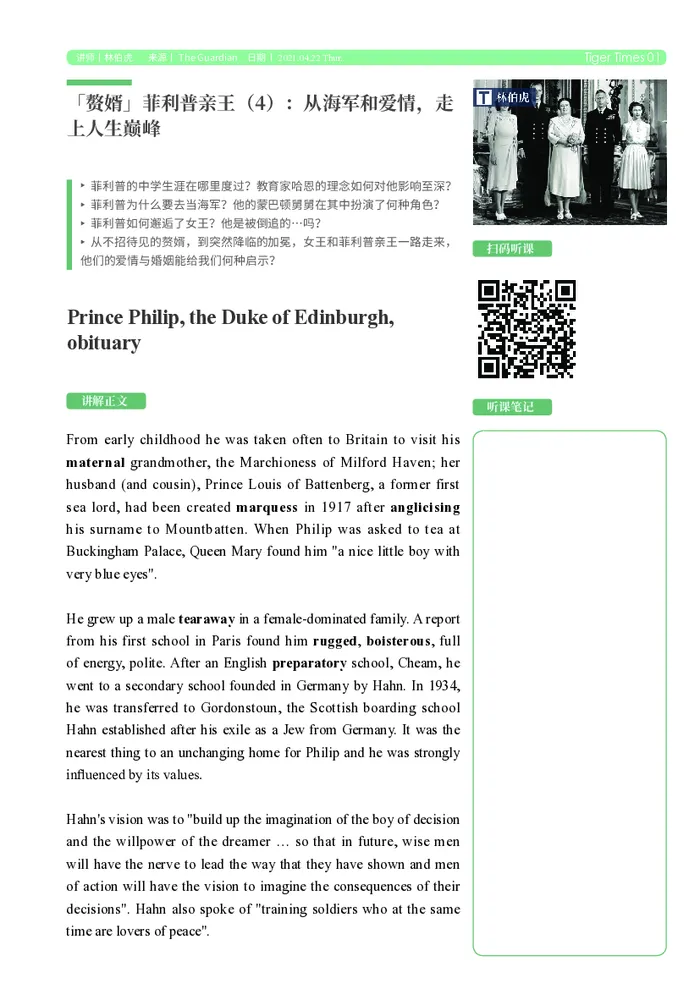
He was first introduced to the 13-year-old Princess Elizabeth during
a royal visit to the college. Maybe she was more smitten with the
handsome, blond, blue-eyed youth, five years older than her, than
he was with the adolescent princess. Nothing in his copious later
utterances hinted at a romantic nature, and the Dartmouth meeting
turned out to have been engineered by Mountbatten.
Philip won two awards at Dartmouth as best cadet and was enlisted
as a midshipman on the eve of the second world war. Kept away from
naval action until Greece entered the war, he had his first taste of
gunfire off Libya and Sicily, and became one of the navy's youngest
first lieutenants.
Tiger Times
02
As second-in-command of HMS Wallace during the allied landings
in Sicily in July 1943, he helped save many lives by launching a
wooden raft to burn, give off smoke and act as a decoy to a German
bomber. He spent much of the war patrolling for Uboats in the North
Sea. In 1942, he saw Elizabeth again, at a dance at the Duke of Kent's
home. Within two years he had become a virtual orphan following
his father's death in occupied France in 1944. He was bequeathed
little money but was occasionally asked to stay at Windsor Castle
while on leave, where he watched Elizabeth act, tap-dance and sing
in a family pantomime. The princess might have been besotted, but
the courtiers were not, and the footmen noted gleefully when they
unpacked his weekend valise that it contained no spare shoes – his
only pair was holed – pyjamas or slippers.
He was thought to be no gentleman and, in immediate postwar days,
to be little better than a German: the diplomat Harold Nicolson wrote
of him that he was "rough, ill-mannered, uneducated and … probably
not faithful".
The impoverished young serviceman's name was not in the first XI
of the Queen's list of acceptable suitors, but by 1946 he was being
invited to Balmoral, where he became engaged to Elizabeth. "It was
sort of fixed up," he said. "After all, if you spend 10 minutes thinking
about it – and a lot of these people spent a great deal more time
thinking about it – how many obviously eligible young men, other
than people living in this country, were available?"
The engagement had to be kept secret, but leaked. The palace denied
it. In a newspaper poll, 40% disapproved of him because of his
foreign background and Germanic relatives. Philip acquired British
citizenship, rejecting the SchleswigHolstein-Sonderburg-Glücksburg
surname in favour of Mountbatten. In July 1947, the engagement was
finally announced. The couple married the following November in
the first big public spectacle during postwar austerity. The clothing
ration had to be relaxed to provide a wedding dress. Elizabeth took
her corgi Susan on the honeymoon. Philip caught a cold.
Tiger Times
03
Tiger Times
04
maternal /məˈtɜːnl/ adj. 母系的,母亲一方的
○ related to a mother's side of the family
○ e.g. Her maternal grandmother is still alive. 她的外婆依然
健在。
marquess /ˈmɑːkwɪs/ n. 侯爵
○ a man who, in the British system of noble titles, has a rank
between duke and earl
anglicize /ˈæŋɡlɪsaɪz/ v. 使英国化,使英语化
○ to make something or someone more English
○ e.g. She married Norwegian immigrant Niels Larsen, who
later anglicized his name. 她嫁给了挪威移民尼尔斯• 拉尔
森,后来他把自己名字的发音英语化了。
tearaway /ˈteərəweɪ/ n. 小流氓,不良青年
○ (informal) a young person who behaves badly and often
gets into trouble
○ e.g. His car was wrecked by a couple of young tearaways.
他的车被几个不良青年撞毁了。
rugged /ˈrʌɡɪd/ adj. 坚强的,坚毅的
○ determined to succeed in a difficult situation, even if this
means using force or upsetting other people
○ e.g. a rugged individualist 坚毅的个人主义者
boisterous /ˈbɔɪstərəs/ adj. 喧闹的,精力旺盛的
○ someone, especially a child, who is boisterous makes a lot
of noise and has a lot of energy
○ e.g. boisterous children 爱吵闹的孩子们
preparatory /prɪˈpærətəri/ adj. 准备性的,预备性的
○ [only before noun] done in order to get ready for something
○ e.g. Lot of preparatory work still needs to be done. 仍然需
要做很多准备工作。
instil /ɪnˈstɪl/ v. 逐渐灌输
○ to teach someone to think, behave, or feel in a particular
way over a period of time
○ e.g. It is part of a teacher's job to instil confidence in his or
her students. 教师的部分职责是逐渐培养学生的信心。
bursar /ˈbɜːsə/ n. 财务主管
○ someone at a school or college who deals with the accounts
and office work
conceit /kənˈsiːt/ n. 自负,自大
○ an attitude that shows you have too high an opinion of
your own abilities or importance
○ e.g. The conceit of that man is incredible! 那人极度自负!
collie /ˈkɒli/ n. 柯利犬,长毛牧羊犬
○ a middle-sized dog with long hair, kept as a pet or trained
to control sheep
brunette /bruːˈnet/ n. 深色头发女子
○ a woman with dark brown hair
gallantly /'gæləntlɪ/ adv. 勇敢地;殷勤地
词汇
○ in a brave way, especially in a very difficult situation
○ e.g. She gallantly battled on alone. 她勇敢地独自战斗。
○ a man who behaves gallantly gives polite attention to
women
○ e.g. He bowed and gallantly kissed my hand. 他鞠了个躬,
殷勤地吻了我的手。
impartiality /ɪmˌpɑːʃiˈæləti/ n. 公正,公平
○ the fact of not supporting one person or group more than
another
○ e.g. political impartiality 政治公正
squire /skwaɪə/ v. 护送
○ (of a man) to escort (a woman)
upbringing /ˈʌpˌbrɪŋɪŋ/ n. 抚养,养育,教育
○ the way that your parents care for you and teach you to
behave when you are growing up
○ e.g. Mike had had a strict upbringing. 迈克受过严格的教
育。
crammer /ˈkræmə/ n. 速成学校,强化训练补习学校
○ a special school that prepares people quickly for
examinations
atrocious /əˈtrəʊʃəs/ adj. 恶劣的,糟糕的,差劲的
○ extremely bad
○ e.g. atrocious weather 恶劣气候
smitten /ˈsmɪtn/ adj. 突然迷上的,突然爱上的
○ [not before noun] suddenly feeling that you love someone
very much
○ e.g. As soon as he saw her, he was smitten. 他一看见她就
被她迷住了。
adolescent /ˌædəˈlesənt/ adj. 青春期的,青少年的
○ in or relating to the process of developing from a child into
an adult
○ e.g. adolescent traumas 青春期精神创伤
copious /ˈkəʊpiəs/ adj. 大量的,丰富的,过量的
○ existing or being produced in large quantities
○ e.g. She listened to me and took copious notes. 她听我说
话,做了大量的笔记。
utterance /ˈʌtərəns/ n. 话语,言论
○ (formal) something you say
○ e.g. Politicians are judged by their public utterances. 人们
根据政客们在公众面前的言论来评判他们。
hint /hɪnt/ v. 暗示
○ to suggest something in an indirect way, but so that
someone can guess your meaning
○ e.g. What are you hinting at? 你在暗示什么?
cadet /kəˈdet/ n. 军校学员,警校学员
○ someone who is training to be an officer in the army, navy,
air force, or police
○ e.g. By May the cadets had come to the end of their
Tiger Times
05
training. 到5 月份,学员们的训练已经结束。
enlist /ɪnˈlɪst/ v. 参军,入伍
○ to join the army, navy etc.
○ e.g. At the outbreak of war, he was enlisted in the army. 战
争爆发时,他被征召入伍。
lieutenant /lefˈtenənt/ n. 少尉
○ a fairly low rank in the armed forces, or an officer of this
rank
○ e.g. second lieutenant 少尉
decoy /ˈdiːkɔɪ/ n. 圈套, 用作诱饵的人
○ someone or something that is used to trick someone into
going somewhere or doing something, so that you can catch
them, attack them etc.
○ e.g. Officer Langley acted as a decoy to catch the rapist. 兰
利警官充当了诱捕强奸犯的诱饵。
bequeath /bɪˈkwiːθ/ v. 把… 遗赠给
○ to officially arrange for someone to have something that
you own after your death
○ e.g. His father bequeathed him a fortune. 他父亲给他留下
一笔遗产。
pantomime /ˈpæntəmaɪm/ n.(英国尤在圣诞节期间演出的)
童话剧
○ a type of play for children that is performed in Britain
around Christmas, in which traditional stories are performed
with jokes, music, and songs
besotted /bɪˈsɒtɪd/ adj. 迷恋的,爱得发狂的
○ be besotted (with somebody/something)
○ to love or want someone or something so much that you
cannot think or behave sensibly
○ e.g. He's completely besotted with her. 他完全被她迷住
了。
courtier /ˈkɔːtɪə/ n. 朝臣,侍臣
○ someone in the past with an important position at a royal
court
○ e.g. Many of the courtiers were strongly wedded to
traditional ways of doing things. 许多朝臣都恪守传统,循
规蹈矩。
gleefully /ˈɡliːfəli/ adv. 得意地,愉快地
○ in a happy way because of something good you have done
or something bad that has happened to somebody else
○ e.g. He gleefully told me about all the different diseases
that I could catch. 他高兴地告诉我我可能染上的各种疾病。
valise /vəˈliːz/ n. 旅行包,小件手提行李箱
○ a small suitcase
impoverished /ɪmˈpɒvərɪʃt/ adj. 赤贫的
○ very poor; without money
○ e.g. an impoverished student 一个贫困的学生
suitor /ˈsuːtə/ n. 求婚者,追求者
○ (old use) a man who wants to marry a particular woman
○ e.g. It's the story of a young woman who can't make up her
mind which of her many suitors she should marry. 这个故事
说的是一位年轻女子拿不定主意该嫁给众多追求者中的
哪一个。
eligible /ˈelɪdʒəbəl/ adj.(作为结婚对象)理想的,合适的
○ [only before noun] an eligible man or woman would
be good to marry because they are rich, attractive, and not
married
○ e.g. I can think of several eligible bachelors of my
acquaintance. 在认识的人当中我能想到有几位条件不错的
单身汉。
spectacle /ˈspektəkəl/ n. 壮观场面,壮观景象
○ a very impressive show or scene
○ e.g. The carnival was a magnificent spectacle. 嘉年华场面
十分壮观。
austerity /ɔːˈsterəti/ n. 紧缩,缩减
○ when a government has a deliberate policy of trying to
reduce the amount of money it spends
○ e.g. The government today announced new austerity
measures. 政府今天宣布了新的紧缩措施。
ration /ˈræʃən/ n. 配给量,定量配给
○ a fixed amount of something that people are allowed to
have when there is not enough, for example during a war
○ e.g. During the war, no one was allowed more than their
ration of food, clothing and fuel. 战争期间,所有人得到的
食物、衣服和燃料都不得超过其配给量。
Tiger Times
06
今日习题
1. 根据英文释义写出文中出现的对应词
______: very bad or unpleasant
______: the state of being too proud of yourself and your actions
2. 一词多义
Which of the following underlined word is closest in meaning to the one in the sentence "A report from
his first school in Paris found him rugged, boisterous, full of energy, polite." ____
A. Jeeps are rugged vehicles, designed for rough conditions.
B. She fell for his rugged good looks.
C. The countryside around here is very rugged.
D. Rugged individualism forged America's frontier society.
3. 翻译:根据给定中文回译英文
他寻求向他的学生灌输一种献身于公共服务、自力更生和自制的意识—在菲利普的时代,他的学
生只有30 人。
_____________________________________________________________________________________
_________________________________________________________________
习题答案
1. atrocious; conceit
2. D
3. He sought to instil a commitment to public service, self-reliance and self-control in his pupils –
only 30 of them in Philip's day.
编辑丨焰妮