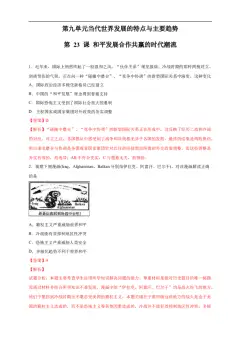
Soviet invasion of Afghanistan
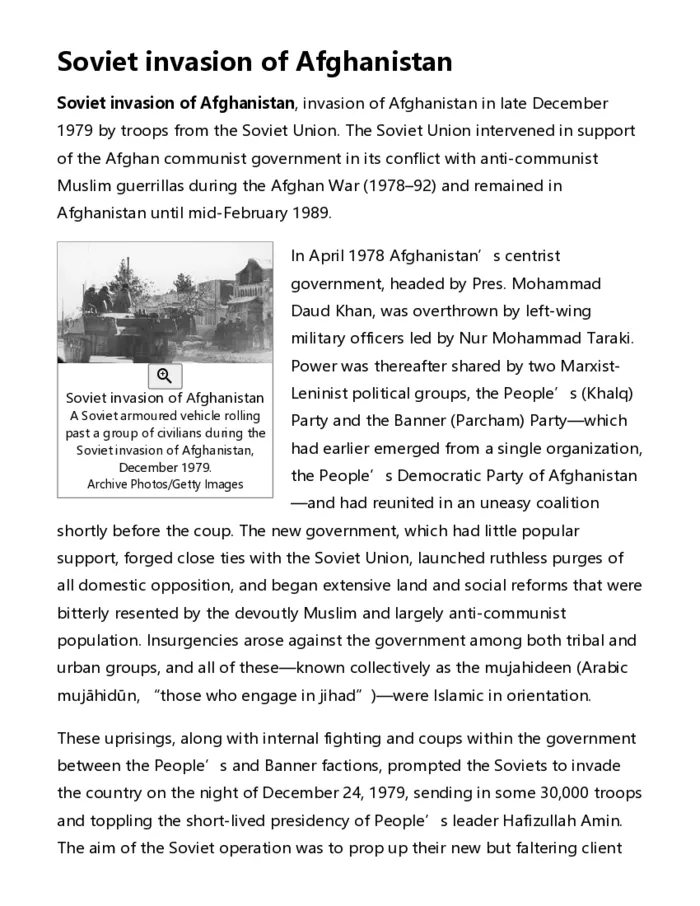
A Soviet armoured vehicle rolling
past a group of civilians during the
Soviet invasion of Afghanistan,
December 1979.
Archive Photos/Getty Images
Soviet invasion of Afghanistan
Soviet invasion of Afghanistan, invasion of Afghanistan in late December
1979 by troops from the Soviet Union. The Soviet Union intervened in support
of the Afghan communist government in its conflict with anti-communist
Muslim guerrillas during the Afghan War (1978–92) and remained in
Afghanistan until mid-February 1989.
In April 1978 Afghanistan’s centrist
government, headed by Pres. Mohammad
Daud Khan, was overthrown by left-wing
military officers led by Nur Mohammad Taraki.
Power was thereafter shared by two Marxist-
Leninist political groups, the People’s (Khalq)
Party and the Banner (Parcham) Party—which
had earlier emerged from a single organization,
the People’s Democratic Party of Afghanistan
—and had reunited in an uneasy coalition
shortly before the coup. The new government, which had little popular
support, forged close ties with the Soviet Union, launched ruthless purges of
all domestic opposition, and began extensive land and social reforms that were
bitterly resented by the devoutly Muslim and largely anti-communist
population. Insurgencies arose against the government among both tribal and
urban groups, and all of these—known collectively as the mujahideen (Arabic
mujāhidūn, “those who engage in jihad”)—were Islamic in orientation.
These uprisings, along with internal fighting and coups within the government
between the People’s and Banner factions, prompted the Soviets to invade
the country on the night of December 24, 1979, sending in some 30,000 troops
and toppling the short-lived presidency of People’s leader Hafizullah Amin.
The aim of the Soviet operation was to prop up their new but faltering client
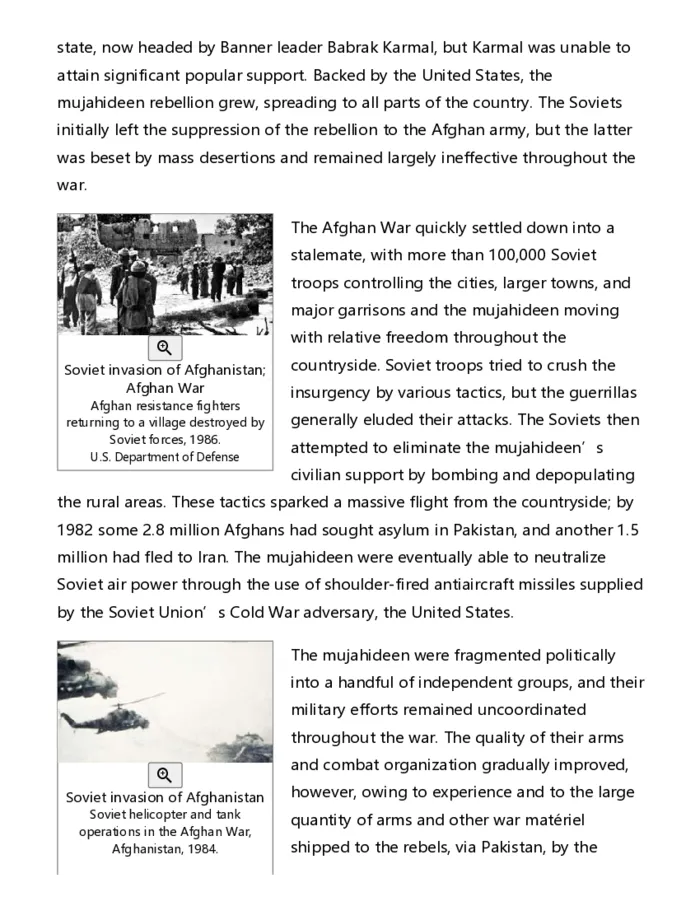
Soviet invasion of Afghanistan;
Afghan War
Afghan resistance fighters
returning to a village destroyed by
Soviet forces, 1986.
U.S. Department of Defense
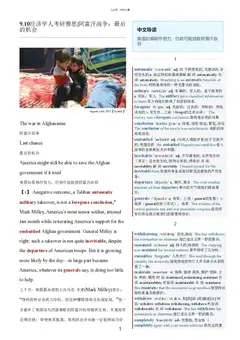
Soviet invasion of Afghanistan
Soviet helicopter and tank
operations in the Afghan War,
Afghanistan, 1984.
state, now headed by Banner leader Babrak Karmal, but Karmal was unable to
attain significant popular support. Backed by the United States, the
mujahideen rebellion grew, spreading to all parts of the country. The Soviets
initially left the suppression of the rebellion to the Afghan army, but the latter
was beset by mass desertions and remained largely ineffective throughout the
war.
The Afghan War quickly settled down into a
stalemate, with more than 100,000 Soviet
troops controlling the cities, larger towns, and
major garrisons and the mujahideen moving
with relative freedom throughout the
countryside. Soviet troops tried to crush the
insurgency by various tactics, but the guerrillas
generally eluded their attacks. The Soviets then
attempted to eliminate the mujahideen’s
civilian support by bombing and depopulating
the rural areas. These tactics sparked a massive flight from the countryside; by
1982 some 2.8 million Afghans had sought asylum in Pakistan, and another 1.5
million had fled to Iran. The mujahideen were eventually able to neutralize
Soviet air power through the use of shoulder-fired antiaircraft missiles supplied
by the Soviet Union’s Cold War adversary, the United States.
The mujahideen were fragmented politically
into a handful of independent groups, and their
military efforts remained uncoordinated
throughout the war. The quality of their arms
and combat organization gradually improved,
however, owing to experience and to the large
quantity of arms and other war matériel
shipped to the rebels, via Pakistan, by the
U.S. Department of Defense
Afghan War
Soviet paratroopers rolling through
Kabul, Afghanistan, in armoured
combat vehicles, 1986.
U.S. Department of Defense
Soviet invasion of Afghanistan;
Afghan War
A convoy of Soviet armoured
vehicles crossing a bridge at the
Soviet-Afghan border, February 15,
1989, during the withdrawal of the
Red Army from Afghanistan.
A. Solomonov/RIA Novosti Archive;
image no. 58833 (CC BY-SA 3.0)
United States and other countries and by
sympathetic Muslims from throughout the
world. In addition, an indeterminate number of Muslim volunteers—popularly
termed “Afghan-Arabs,” regardless of their ethnicity—traveled from all parts
of the world to join the opposition.
The war in Afghanistan became a quagmire for
what by the late 1980s was a disintegrating
Soviet Union. (The Soviets suffered some
15,000 dead and many more injured.) Despite
having failed to implement a sympathetic
regime in Afghanistan, in 1988 the Soviet
Union signed an accord with the United States,
Pakistan, and Afghanistan and agreed to
withdraw its troops. The Soviet withdrawal was
completed on February 15, 1989, and
Afghanistan returned to nonaligned status.
The Editors of Encyclopaedia BritannicaThis article was
most recently revised and updated by Michael Ray,
Editor.
Citation Information
Article Title: Soviet invasion of Afghanistan
Website Name: Encyclopaedia Britannica
Publisher: Encyclopaedia Britannica, Inc.
Date Published: 11 May 2020
URL: https://www.britannica.com/event/Soviet-invasion-of-Afghanistan
Access Date: April 18, 2021