专题05 阅读理解之记叙文
话题1
人生哲理
话题2
名人故事
话题3
个人经历
话题1:人生哲理
Passage 1(2024-2025·深圳高级中学集团)
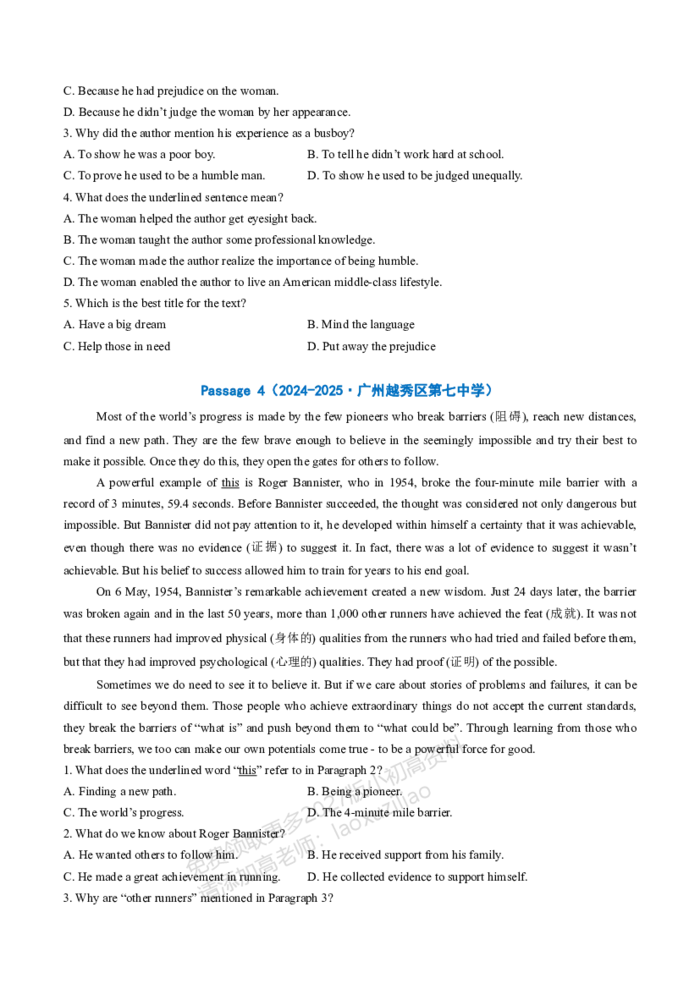
Libby loves science, especially chemistry. Her chemistry teacher, Mr. Darwin, once
said, “It’s okay to make mistakes because they can lead to new findings. And making
mistakes is more fun than cleaning up. ”
One day, Mr. Darwin said, “We will run the science station at our school’ s Autumn
Festival. The station with the most visitors wins an ice-cream party.” He chose Libby, Rosa,
and Finn to help with the station. The girls were excited. They picked three favourite experiments for the
festival-making big bubbles (泡泡), mixing soft slime (史莱姆), and launching a rocket. “I can’t wait!” said Libby.
The festival day finally came. All the stations were busy except the science station, so the girls decided to try
something interesting. They made big bubbles first. People started to come over. Then, Rosa used salty water to
make very soft slime. “Now for the rocket! If we use more baking soda (小苏打), the rocket might go higher,” said
Libby.
Unluckily, when Libby added the baking soda, an accident happened – water got on the kids. Everyone got
wet and ran away. In the end, they had no visitors.
The girls didn’t win. Libby felt sad. But Mr. Darwin told them, “You three did a great job!” “But we didn’t
win,” mumbled (嘟囔) Libby. “That DOESN’T mean we can’t be proud of how hard you tried. We can have our
OWN ice-cream party!” “We’ll get ice and milk! ” cheered the girls.
“Yum. This is delicious, ” said Finn after tasting their homemade ice-cream. “It’s okay to make mistakes,”
said Rosa. “And it’s so much more fun than cleaning up! ” smiled Libby.
1. What is Libby’s favourite subject?
A. Maths.
B. English.
C. Chemistry.
D. Geography.
2. Which experiments did the girls choose to do at the science station?
A. Making big bubbles, mixing soft slime, and launching a rocket.
B. Making big bubbles, mixing hard slime, and launching a rocket.
C. Making small bubbles, mixing soft slime, and launching a paper plane.
版小初高资料
2027
免费领取更多
laoxuziliao
:
请添加高老师
D. Making small bubbles, mixing hard slime, and launching a paper plane.
3. How did Libby feel when they lost?
A. Excited.
B. Angry.
C. Proud.
D. Unhappy.
4. What kind of person is Mr. Darwin?
A. Boring.
B. Helpful.
C. Energetic.
D. Careful.
5. What is the most important lesson to learn from this story?
A. Working together is the key to success.
B. Don’t do experiments without a teacher’s help.
C. Remember to clean up after doing an experiment.
D. Making mistakes gives us new ideas and helps us grow.
Passage 2(2024-2025·广州铁一中学)
I was playing at the front gate, trying to decide whether to walk down the street to play with Jenny, when I saw
a poor man coming up the road.
“Hello, little girl,” he said, “is your mama at home?”
I nodded and opened the gate to let him get in the yard. He looked like all the homeless men who came to my
home before. His messy hair hung below a shapeless hat, and his old shirt and trousers had been rained on and slept
in. He smelled bad.
He walked to the door. When my mother appeared, he asked, “Lady, could you spare something to eat?”
“I think so. Please sit on the step.”
Later, my mother came back and handed him a sandwich made from homemade bread and generous pieces of
boiled meat. She also gave him a bottle of milk. “I thank you, lady,” he said.
I played at the gate, watching the man wolf down the sandwich and empty the cup. After finishing the food, he
stood up and walked back through the gate. “▲” he told me on the way out.
Jenny had said all the homeless men told each other who would feed them. “They never come to my house!”
she had said proudly and happily.
“So why does Mama feed the poor man?” I wondered. I walked inside. “Jenny’s mama says those men are too
lazy to work. Why do we feed them?”
My mother smiled. “Sweetheart, we don’t know why these men don’t work,” she said, “but they were babies
once. And their mamas loved them, just like I love you.” She put her hands on my shoulders and drew me close to
her.
“For me, I fed them for their mothers, because if you were ever hungry and had nothing to eat, I would want
others’ mothers to feed you.”
I seemed to find out the answer to my question and understand that.
1. After the poor man came to the writer’s home, the mother ________.
A. made a cake for him
B. gave him some money
C. invited him to have some coffee
D. offered him some food
2. Which of the following can best fit in the ▲?
版小初高资料
2027
免费领取更多
laoxuziliao
:
请添加高老师
A. They said your mama would feed me.
B. I would like to come to play with you again.
C. It’s kind of you to let me stay here for one night.
D. We will ask Jenny’s mother to feed us, too.
3. The order of the story is ________.
a. My mother communicated with the poor man
b. I understood my mother after talking to her.
c. I played at the gate and watched the poor man having food.
d. I opened the gate to let the poor man get in the yard.
e. The poor man stood up and walked back through the gate.
A. d-c-a-b-e
B. a-e-d-c-b
C. c-a-e-d-b
D. d-a-c-e-b
4. The underlined word “that” in the last paragraph refers to ________.
A. the question that Jenny didn’t know before
B. the fact that Jenny’s family wouldn’t let the poor men in
C. the reason why the mother fed the poor man
D. the talk between the mother and the writer
Passage 3(2023-2024·深圳外国语学校)
Last fall, I went to New York for sightseeing. I visited many tourist attractions there, and I also saw many
unfortunate citizens on the street like beggars and homeless people.
Standing outside the Metropolitan Museum of Art, I heard a voice ask, “Can you do me a favor?” When I
turned around, I saw an elderly blind woman extending out her hand. Naturally, I reached into my pocket for some
change immediately and placed it in her hand without even looking at her. I was really annoyed at being bothered
by a beggar. What I only thought at that moment was to send her away.
But the blind woman said with a warm smile on her face, “I don’t want your money. I just need you to show
me the way to the subway entrance.”
Suddenly, I realized what I had done. Her unexpected words took me by surprise and shame. I had acted with
prejudice (偏见). I felt ashamed of myself and couldn’t face the old woman anymore. And I felt small beside her.
This reminded me that I believed in being humble (谦逊的), even though I had lost that belief for a moment.
The thing I had forgotten about myself is that I am an immigrant. I left Honduras and arrived n the U.S. at an early
age. Through the years, I have experienced many acts of prejudice. I remember a time when I was a busboy, I heard
a father tell his little boy that if he did not do well in school, he would end up like me. But now, living my
American middle-class lifestyle, it is too easy to forget who I am and where I have been, and to lose sight of where
I want to go. It is the blind woman who cured me of my blindness.
1. What did the author think the blind woman wanted at first sight?
A. To ask for directions.
B. To offer him some help.
C. To ask for some money.
D. To give him some money.
2. Why did the author feel ashamed?
A. Because he couldn’t face the woman.
B. Because he was an immigrant himself.
版小初高资料
2027
免费领取更多
laoxuziliao
:
请添加高老师
C. Because he had prejudice on the woman.
D. Because he didn’t judge the woman by her appearance.
3. Why did the author mention his experience as a busboy?
A. To show he was a poor boy.
B. To tell he didn’t work hard at school.
C. To prove he used to be a humble man.
D. To show he used to be judged unequally.
4. What does the underlined sentence mean?
A. The woman helped the author get eyesight back.
B. The woman taught the author some professional knowledge.
C. The woman made the author realize the importance of being humble.
D. The woman enabled the author to live an American middle-class lifestyle.
5. Which is the best title for the text?
A. Have a big dream
B. Mind the language
C. Help those in need
D. Put away the prejudice
Passage 4(2024-2025·广州越秀区第七中学)
Most of the world’s progress is made by the few pioneers who break barriers (阻碍), reach new distances,
and find a new path. They are the few brave enough to believe in the seemingly impossible and try their best to
make it possible. Once they do this, they open the gates for others to follow.
A powerful example of this is Roger Bannister, who in 1954, broke the four-minute mile barrier with a
record of 3 minutes, 59.4 seconds. Before Bannister succeeded, the thought was considered not only dangerous but
impossible. But Bannister did not pay attention to it, he developed within himself a certainty that it was achievable,
even though there was no evidence (证据) to suggest it. In fact, there was a lot of evidence to suggest it wasn’t
achievable. But his belief to success allowed him to train for years to his end goal.
On 6 May, 1954, Bannister’s remarkable achievement created a new wisdom. Just 24 days later, the barrier
was broken again and in the last 50 years, more than 1,000 other runners have achieved the feat (成就). It was not
that these runners had improved physical (身体的) qualities from the runners who had tried and failed before them,
but that they had improved psychological (心理的) qualities. They had proof (证明) of the possible.
Sometimes we do need to see it to believe it. But if we care about stories of problems and failures, it can be
difficult to see beyond them. Those people who achieve extraordinary things do not accept the current standards,
they break the barriers of “what is” and push beyond them to “what could be”. Through learning from those who
break barriers, we too can make our own potentials come true - to be a powerful force for good.
1. What does the underlined word “this” refer to in Paragraph 2?
A. Finding a new path.
B. Being a pioneer.
C. The world’s progress.
D. The 4-minute mile barrier.
2. What do we know about Roger Bannister?
A. He wanted others to follow him.
B. He received support from his family.
C. He made a great achievement in running.
D. He collected evidence to support himself.
3. Why are “other runners” mentioned in Paragraph 3?
版小初高资料
2027
免费领取更多
laoxuziliao
:
请添加高老师
A. To show the bravery of other runners.
B. To show the importance of pioneers.
C. To show the power of following others.
D. To show the importance of physical qualities.
4. What does the writer advise the readers to do in the last paragraph?
A. Forget the barriers.
B. Learn from failures.
C. Achieve the potentials.
D. Accept the current standards.
Passage 5(2024-2025·广州荔湾区真光中学)
A young man went to an expert on gems (宝石) and wanted to learn from him. The expert shook his head. He
worried that the young men wouldn’t have the patience to learn. In his opinion, they were always in a hurry.
The young man asked the expert many times to let him have a try. Finally the expert said, “Be here tomorrow.”
The next morning the expert put a jade (翡翠) stone in the man’s hand and told him to hold it. The expert then
went on his work, cutting, weighing and setting gems. The man sat and waited excitedly. The following morning
the expert again placed the jade stone in the man’s hand and told him to hold it. On the third, fourth, and fifth day
the expert repeated the action.
On the sixth day the young man still had to hold the jade stone, but he could no longer stand the silence. “Sir,”
he asked “when am I going to learn something?”
“ ▲,” the expert replied.
Several more days went by. The man became more and more impatient. However, when the expert placed a
stone in his hand one morning, the young man shouted without looking at it, “This is not the same jade stone!”
“You have begun to learn,” the expert said with a smile.
1. How long did the man hold the jade stone without asking anything?
A. For three days.
B. For five days.
C. For seven days.
D. For half a month.
2. Why did the expert ask the man to hold a stone for days?
A. It was a way of learning.
B. He was too busy to teach the man.
C. It was the most valuable gem he had.
D. There was no other work for the man to do.
3. Which of the following can be put in the
▲?
A. You should go home
B. You will learn
C. It is all that I could give you
D. It was yesterday
4. How did the young man’s feeling change?
A. worried →unhappy →nervous.
B. worried →nervous →unhappy.
C. excited →nervous →worried.
D. excited →unhappy →surprised.
5. What does the passage mainly tell us?
A. A real expert on gems.
B. Some good learning habits.
C. The importance of patience.
D. The secret to learning quickly.
Passage 6
版小初高资料
2027
免费领取更多
laoxuziliao
:
请添加高老师
①I teach English in Russia. For some reason I really don’t like that class “Talk about your family”. The
students say, “There are five people in my family. My mother, my father...” It sounds like that all families are the
same.
②Our families are one and only. All have their stories, jokes, nicknames and so on. They’re the place where
our personalities were made.
③We know our families so well that we even think they’re boring. Not a bit of it. Families are the most
special things. If you dig (挖) enough into your own, you will get everything you want for a great book.
④My mother started making our family tree years ago, not expecting to get far. However, reading the old
records (记录) and visiting libraries, she got back 300 years. She found some old stories. What happened to the big
family farm? Where did the family fortune (财富) go in the 1870s?
⑤I’m the traveler in my family, and I love travelling. I always think I got it from a great-grandfather. My two
favorite family heirlooms (传家宝) are a photo of him on a horse and a postcard from China. If you look at your
family, you open a window on the past.
⑥When my mother, still putting the family tree together, asked me for a few names from my Russian wife’s
family, my wife got on the phone to check a name or two. But she was still talking an hour later. So you can see that
start some people talking about their family stories and they might never stop.
⑦To go back to that English class, let’s look at some interesting ways to talk about families. English is rich in
idioms (习语) to talk about family life. The black sheep of the family is someone who brings family trouble. If
you’re true to your family, you can say “blood (血) is thicker than water”. “Who wears the trousers in your family?”
means “Who’s the head of your family?”. And stories behind them are what I want to hear.
1. The writer’s mother read the old records and visited libraries to ________.
A. make their family tree
B. find their family fortune
C. get the family heirlooms
D. talk about the family
2. We can infer (推断) that _________ .
A. the writer doesn’t really like his teaching job in Russia
B. every family in Russia is the same with five people
C. some people might never stop when talking about family stories
D. one of the writer’s great-grandfathers liked travelling
3. Jerry’s mother decides almost everything in the family, so ________ .
A. she is the black sheep of the family
B. her blood is thicker than water
C. she wears the trousers in the family
D. she is the breadwinner of the family
4. If we put the passage into four parts, which one is the best?
A. ①②/③/④⑤⑥/⑦
B. ①/②③/④⑤/⑥⑦
C. ①/②③/④⑤⑥/⑦
D. ①②③/④⑤/⑥/⑦
Passage 7
版小初高资料
2027
免费领取更多
laoxuziliao
:
请添加高老师
One day, a stork (鹳) saw a beautiful ring. It belonged to a rabbit. The rabbit went inside his hole, leaving the
ring outside. The stork decided to try it on without asking. However, when she tried to take the ring off, it got stuck
on her claw (爪子). She felt embarrassed. Since nobody had seen her, the stork flew off.
The rabbit was very angry to find that the ring had been stolen. Soon, everyone in the forest started to help the
rabbit to look for the thief. When the stork found out what was happening, she thought, “Oh no! I have to do
something.” She hid the ring by bandaging (用绷带包扎) her claws.
The stork thought she had solved the problem well, but later she ran into the rabbit. Seeing the bird was
injured, the rabbit suggested taking her to the hospital right away. The stork just couldn’t say no.
Since her house was on the way to the hospital, the stork asked the rabbit to go first when she went to have
some water. Once the stork got inside her house, she wrapped (包裹) her claws again and again so that the doctor
wouldn’t see the ring. Feeling more relaxed, the stork flew off to meet the rabbit. But because of the added weight,
she was not able to fly. She fell like a heavy stone and landed on the poor rabbit.
Soon, hundreds of animals rushed to them, and then they found the bandages and the ring. In one single
morning, the stork lost all her friends because of the ring. After a long time, the stork met the rabbit. She apologized
to the rabbit and told him the whole story. “I shouldn’t have kept making bigger lies to cover up the smaller ones,”
she said. “I remember
.” Seeing the stork had learned the lesson, the rabbit was happy and helped her get her
friends back.
1. What might be the stork’s facial expression when the ring was stuck on her claw?
A.
B.
C.
D.
2. According to the passage, which is the RIGHT order of the following sentences?
①The stork found a ring.
②The stork met the rabbit.
③The stork realized her mistake.
④The stork hid the ring with the bandage.
⑤The stork wrapped her claw again before gong to the hospital.
A. ①③⑤④②
B. ①②③⑤④
C. ①④②⑤③
D. ①④⑤
3. The stork fell down because ________.
A. she was too tired to fly
B. she put something else on her claw
C. she became quite fat
D. she carried some other rings
4. Which of the following can be put into “
.”
A. tomorrow is another day
B. honesty is the best policy
C. two heads are better than one
D. a friend in need is a friend indeed
话题2:名人故事
版小初高资料
2027
免费领取更多
laoxuziliao
:
请添加高老师
Passage 8(2024-2025·深圳宝安中学)
Lanaston Hughes was one of the most important American poets of the he loved century. He wrote poems,
novels, short stories, plays and children’s books. He loved writing about the life and dreams of black people.
Langston Hughes was born in Joplin,Missouri in 1902. When he was was very young, his grandmother read in
him from books, newspapers and magazines. But when Langston came back home from school, she made him stay
inside. He had no one to play with, so books were his only friends. When he was in Grade Eight, he was chosen to
be a class poet. His career as a writer began.
After Langston graduated from high school, he went to Columbia University in New York City, but he didn’t
like the university because white people there treated him badly. One year later, he decided to leave and travel
around the world. He found a job on a boat going to Africa. He wrote poems and articles o it. He sent them to
magazines in the United States. Some magazines published his writing.
Then Langston made a living by writing. He also helped other black writers get stories and poems published.
When he had money, Langston travelled around the world again.Whenever he went, he wrote and read his poems
aloud. Finally, back in the United States, he became a poetry teacher at different universities. Langston Hughes died
in 1967. Today people around the world still read his poems.
1. Langston Hughes was most famous for his ________.
A. short stories
B. novels
C. children’s books
D. poems
2. Langston Hughes didn’t like Columbia University because ________.
A. He didn’t want to study.
B. He was one of the black people.
C. He wanted to travel and write.
D. White people wasn’t friendly to him.
3. Langston Hughes’ career as a writer began ________.
A. when he was very young
B. in high school
C. in Grade Eight
D. on the boat
4. Which of the following is NOT true about Langston Hughes?
A. He read a lot of books in his childhood.
B. He studied in Columbia University for only one year.
C. He taught black people to write short stories at different universities.
D. He died at the age of 65.
5. What’s the best title of the passage?
A. Langston Fughes—a great American poet
B. How to be a successful poet
C. Love reading from an early age
D. The poems of Langston Hughes
Passage 9(2024-2025·深圳福田区侨香中学)
Sammie Vance, 14, knows there’s nothing worse than feeling left out. For years, she’s been helping kids who
feel lonely make friends.
What she was doing was running the Buddy Bench (伙伴长椅) program. She started it when she was in the
third grade, in Fort Wayne, Indiana. The idea was that anyone at school who was feeling lonely could sit on the
“buddy bench”. That let other kids know someone needed a friend. “It’s really helpful to have other people be able
版小初高资料
2027
免费领取更多
laoxuziliao
:
请添加高老师
to notice you,” Sammie says.
The idea quickly caught on (流行起来). The bench brought kids together. Since then, Sammie has helped
communities all over the country set up buddy benches. “It means a lot to me,” she says, “and this is making a
difference in people’s lives.”
Sammie got the idea for the Buddy Bench program at summer camp in
2017.She thought it would be cool to have a buddy bench in her school, so when she
got home, she presented the idea to her principal ( 校长), her teachers, and her
parents.
Getting approval (批准) for the project was just the first step. “There have
been a lot of small challenges, like money,” Sammie says.
To reduce costs and be eco-friendly (环保的), she asked her community to collect bottle caps. Soon Sammie
was getting caps from people in 50 states. She even got them from people in Germany, the Netherlands, and other
countries. In the end, she collected more than 1,200 pounds of bottle caps. A company was able to make these into
three benches.
Sammie says the effort has helped her overcome personal challenges. “I used to be really, really shy,” she
says. “I’m much more outgoing now.” What Sammie’s work shows is that we don’t have to be an adult to make a
difference. Even small acts of kindness can be powerful. She says, “Just be kind, in general.”
1. What’s the purpose of the Buddy Bench program?
A. To raise money for sick children.
B. To help lonely children make friends.
C. To give old people a seat to have a rest.
D. To remind others to save our environment.
2. What does the underlined word “overcome” mean?
A. give up
B. look over
C. get over
D. take up
3. Sammie’s benches are made out of ________.
A. recycled materials
B. eco-friendly bottles
C. wood collected in the world
D. old benches of a company
4. What can we learn from Sammie’s work?
A. It’s easy to become more outgoing.
B. It’s kind to make a bench for adults.
C. It’s never too young to make a difference.
D. It’s hard to overcome personal challenges.
5. What’s the best title for the passage?
A. The warm-hearted girl
B. The Buddy Bench program
C. The small acts of kindness
D. The ways to help make friends
Passage 10(2024-2025·广州荔湾区第一中学)
Maybe cars are one of the most important inventions. It is convenient to travel for people especially for
American. Cars were widely used by American thanks to Henry Ford. He produced a simple car called the Model T.
He sold the car at a low price that many Americans could afford. The car was easy to operate and became part of
everyday life in the United States. Henry Ford put America on wheels.
Henry Ford was born on July 30, 1863. He grew up on a farm, but he disliked farm work. He liked machines.
版小初高资料
2027
免费领取更多
laoxuziliao
:
请添加高老师
At the age of 16, Ford got a job in a machine shop. In his spare time, he built engines. After years of experiments,
Ford produced his first car in 1896.
Henry Ford founded the Ford Motor Company in 1903. Ford wanted to produce large numbers of cars at low
cost. He brought out the first Model T in 1908.
Ford set up factories that could make cars fast. As cars were being built on a line, each worker along the line
did one set of tasks, on car after car.
Workers often found their work boring. Many of them left after a short time. To keep his workers, Ford
doubled the pay for his workers.
Ford started a charity, the Ford Foundation in 1936. When Ford died in 1947, he left most of his money to the
Ford Foundation. The Ford Foundation is still giving money to help poor countries and poor areas.
1. What is the meaning of the underlined sentence “ Henry Ford put America on wheels” in paragraph 1?
A. Henry Ford bought many wheels.
B. Henry Ford gave Americans wheels.
C. Henry Ford let many Americans have cars.
D. Henry Ford set up factories that produced wheels.
2. Which is the right order of the following things according to the passage?
a. He set up some factories in order to make cars run fast.
b. He set up his company and brought out the first Model T.
c. He doubled the payment to make workers work harder.
d. He liked machines instead of doing the farm work.
e. He sold the car at a low price to put American on wheels.
A. e-b-a-d-c
B. e-d-b-a-c
C. d b-a-e-c
D. d-b-e-a-c
3. Why did Henry Ford give most of this money to the Ford Foundation?
A. He wanted to help people in poor places.
B. He hoped his workers could make faster cars.
C. He used the money to start a charity before his death.
D. He ordered the Ford Foundation to produce more cars.
4. From the article, we can know that Henry Ford was ________.
A. patient and kind
B. smart and honest
C. gentle and popular
D. rich and successful
5. What is the passage mainly about?
A. Cars called the Model.
B. Henry Ford.
C. The Ford Foundation.
D. The Ford Motor Company.
话题3:个人经历
Passage 11(2024-2025·广州执信中学)
One day, Ben was playing basketball in the living room after school, when he threw the ball at his mother’s
favourite vase on the shelf. The vase dropped to the floor and a large piece broke off. To cover his terrible action,
the terrified boy glued the pieces together discreetly and put the vase back to its place.
版小初高资料
2027
免费领取更多
laoxuziliao
:
请添加高老师
The mother soon noticed what had happened. To her surprise, the repair work was actually very good. At
dinner time, she asked her boy if he broke the vase. Fearing punishment, the boy said that a neighbor’s cat jumped
in from the window and he couldn’t drive it away no matter how hard he tried. It ran around the living room and
finally knocked the vase off its shelf. His mother was quite clear that her son was lying, because all the windows
were closed before she left for work each morning and opened after she returned. However, in the face of her son’s
nervous eyes, Ben’s mother remained calm. She realized she shouldn’t just blame and punish her son for lying. She
came up with another idea. Before going to bed, the boy found a note from his mother in his room, asking him to go
to the study at once. The boy thought he would now be punished but, as he had already lied, he decided to keep the
lie no matter how angry his mum became.
In the study, his mother’s face showed no sign of anger. On seeing her son push open the door and enter, she
took a chocolate box out of a drawer and gave him one. The mother said, “This chocolate is a reward for your
imagination: a window-opening cat!” The son was surprised. But before he could say anything, the mother
continued, “This chocolate is a reward for your ability to repair the vase. Well done!” The mother made no mention
of her son’s mistake, giving only encouragement and praise for what he did.
After the incident, life at home was the same as before. The only change was that the boy never lied again.
Whenever he thought of lying, the chocolates would flash before him at once.
1. What does the underlined word “discreetly” in Paragraph 1 probably mean?
A. Quickly.
B. Honestly.
C. Carefully.
D. Fearfully.
2. Why did mum know that Ben lied?
A. Because there were no cats in the neighbourhood.
B. Because Ben could catch the cat,
C. Because all the windows were closed at that time.
D. Because all the windows were opened at that time.
3. How did the mother correct Ben’s mistake?
A. By making chocolate flash in front of him.
B. By rewarding instead of blaming or punishment.
C. By buying a new vase.
D. By making no mention of her son’s mistake only.
4. What do you think of the mother?
A. Strict and hard-working.
B. Confident and kind.
C. Friendly and calm.
D. Patient and wise.
Passage 12(2024-2025·深圳麒麟中学)
When I was a child, my parents read bedtime stories to my sister and me each night. It is one of my favourite
childhood memories.
My sister and I had many books. As I grew older, I enjoyed staying in my father’s “library” and would read
for hours each day. To make me play with friends like other kids, my parents would have to take books away from
me.
版小初高资料
2027
免费领取更多
laoxuziliao
:
请添加高老师
I see reading as an important part of my life, not a hobby to pass my time. For me, reading opens up a whole
new world. It encourages new ideas, increases my knowledge, and makes me an everyday learner.
Although I enjoy communicating with people, I’m an introverted person and really need my alone time. Last
year, I had several experiences that began to make me feel worried about my being shy, and I felt that it would
make me lose many chances. Around this time, I read Susan Cain’s book Quiet: The Power of Introverts in a World
That Can’t Stop Talking. This book helped me understand myself. And I’m not afraid to be myself.
Charlie Jones says, “You will be the same person in five years as you are today except for the people you
meet and the books you read.” I’ve met great people and travelled around the world — all from my chair or bed
with a book in my hands.
1. One of the writer’s favourite childhood memories was ________.
A. watching TV with her sister
B. travelling around the world
C. communicating with people
D. listening to her parents read bedtime stories
2. Why would the writer’s parents stop her from reading?
A. Because she might lose her friends because of reading.
B. Because she liked reading books very much.
C. Because they wanted her to read her own books.
D. Because they thought it didn’t help her with study.
3. What does the writer think of reading?
A. A good way to learn new skills.
B. A favourite hobby in her free time.
C. An activity that makes her popular.
D. A bridge between the world and herself.
4. From the fourth paragraph, we can learn that an introverted person is ________.
A. outgoing
B. lazy
C. careless
D. shy
5. The writer met great people and travelled around the world by ________.
A. writing letters to the great people
B. making friends with others
C. reading books in her chair or on her bed
D. going sightseeing in every holiday
Passage 13(2024-2025·广州越秀区第三中学)
A farmer had a cow. He took very good care of this cow and one day when it was ill. He was very worried. He
telephoned the vet.
“What’s the problem?” The vet asked him when he arrived. “My cow is ill.” the farmer said. “I don’t know
what’s the matter with her. She’s lying down and won’t eat. She’s making a strange noise.” The vet looked over the
cow. “She’s certainly ill,” he said, “and she needs to take some very strong medicine.”
He took a bottle out of his box, put two pills into his hand and said, “The pills should make her better.” “How
should I give them to her?” the farmer asked. The vet gave him a tube (管子) and said, “Put this tube in her mouth,
then put the pills in the tube and blow. That’ll make it.”
The next day the vet came to the farm again. The farmer was sitting outside his house and looked more
worried.
“How’s your cow?” the vet asked.
版小初高资料
2027
免费领取更多
laoxuziliao
:
请添加高老师
“No change,” the farmer said. “And I’m feeling very strange myself.”
“Oh?” the vet said. “Why?”
“I did what you said”, the farmer answered. “I put the tube in the cow’s mouth and then put two pills down it.”
“And?” the vet asked.
“The cow blew first,” the farmer said.
1. The farmer asked the vet for help when: his cow ________.
A. couldn’t lie down
B. didn’t take the pills
C. couldn’t make any noise
D. was not well
2. The underlined word “them” in Paragraph 3 means ________.
A. a bottle of pills
B. long tubes
C. two pills
D. a small box and a long tube
3. The vet taught the farmer how to ________.
A. blow the tube
B. have the cow take the pills
C. take the medicine
D. put the tube in his mouth
4. Which of the following is true according to the passage?
A. The farmer took the pills himself.
B. The cow got better after taking the medicine.
C. The vet came and give the farmer another cow the next day.
D. The farmer waited outside the vet’s house the next day.
Passage 14(2024-2025·深圳外国语宝安学校)
Shining in Paris
On the night of Aug 11, the Paris 2024 Olympics closed in France. It opened 19 days ago. The Olympics had
329 events (项目) in 32 sports and brought together 10,500 athletes from more than 200 countries and regions. It is
a big event for sports lovers around the world. Which athlete do you look up to most, and what moments from the
Games do you still remember? Let’s look at some of them together.
The Chinese artistic swimming team perform at the Paris Olympics on Aug 6. Team China won 40 gold, 27
silver and 24 bronze medals. This is our best performance at the Olympics away from home soil.
Chinese divers won all eight diving gold medals. The table tennis team also took home every gold medal in the
sport. After years of hard work, the Chinese artistic swimming team won their first-ever Olympic gold medal in the
team event.
Young players also made history. Twenty-year-old Chinese swimmer Pan Zhanle broke his own world record
to win the men’s 100-meter freestyle (自由泳). He finished in only 46.40 seconds. Born in 2002, Zheng Qinwen
won China’s first Olympic tennis singles gold medal. Playing for her country helped keep her going.
Athletes left many heartwarming moments in Paris. After winning a silver in the women’s badminton singles,
Chinese athlete He Bingjiao, 27, took out a Team Spain Olympic pin (西班牙奥委会徽章). This was to show
respect for her opponent (对手) Carolina Marin. Marin didn’t finish the competition due to an injury (伤).
版小初高资料
2027
免费领取更多
laoxuziliao
:
请添加高老师
Luxembourg’s 61-year-old “table tennis grandma” Ni Xialian played against Chinese player Sun Yingsha. She
smiled when Sun hit a good shot. Ni used to play in Team China and won many medals. She even helped Sun and
her mixed doubles partner Wang Chuqin during their training before their final match.
1. How many medals did Team China win in total at the Paris Olympics?
A. 40 medals.
B. 27 medals.
C. 24 medals.
D. 91 medals.
2. What can we infer from the text about Pan Zhanle?
A. He is not very hardworking.
B. He is very confident.
C. He is very young and talented.
D. He likes history.
3. Why did He Bingjiao take out a Team Spain Olympic pin?
A. To show off her collection.
B. To express respect for her opponent.
C. Because she likes Spanish pins.
D. To trade with others.
4. What does the underlined word “heartwarming” mean in the sentence “Athletes left many heartwarming
moments in Paris.”?
A. Exciting and making people feel happy.
B. Moving and making people feel good.
C. Surprising and making people feel good.
D. Disappointing and making people feel sad.
5. What is the main purpose of this text?
A. To introduce the closing ceremony of the Paris 2024 Olympics.
B. To show the excellent performance of Chinese and some other athletes at the Paris 2024 Olympics.
C. To compare the performance of different countries’ athletes at the Paris 2024 Olympics.
D. To focus on the difficulties athletes faced during the Paris 2024 Olympics.
Passage 15(2024-2025·深圳福田区红岭实验学校新洲分校)
Late that night, we started our final part of the climb. Nervously we carried on after a short rest. Everyone
looked scared. Outside of the tent it was totally black. It was just after midnight. Snow was falling. It was freezing.
The group climbed silently through deep snow. I could not think. The height of the mountain was playing
tricks on my mind. I tried to keep concentrated (集中注意力) by watching my feet and counting to ten all the time.
People around me were just standing still as they tried to get their breath. I tried to encourage them to keep
walking. My friend looked at me helplessly. He was really tired. He kept trying to lie down and go to sleep. If he
did, he would freeze to death. I told him to keep moving. He climbed on. When I checked my watch, I saw, with
surprise, that I’d been walking for three hours already. I felt as if I was fighting every step of the way. All I wanted
to do was to turn round and go down- - but I must reach the top!
I began to wonder if I was not strong enough. I was losing my mind. My breathing was very rapid. Each step I
took made me more and more dizzy (晕眩的). Someone told me we had another hour and a half to go.
I forced myself to walk on. I had to be more careful because one careless step could make me die.
Then I saw Gilman’s Peak up ahead of me. Someone at the top was telling me to make one last effort. The sun
was beginning to rise above the clouds. I climbed up the last few meters and suddenly I realized I’d done it! I was
there! I was at the top of Africa!
1. What can we infer about the group members from Paragraph 1?
版小初高资料
2027
免费领取更多
laoxuziliao
:
请添加高老师
A. They were confident that they could reach the top.
B. They were tired and afraid of some dangers.
C. They started to climb the final part in the morning.
D. They did not have a rest before the final part of climb.
2. Why couldn’t the writer concentrate when he climbed the mountain?
A. Because his legs were badly hurt.
B. Because someone was playing tricks along the way.
C. Because he was really excited to climb the mountain.
D. Because the mountain was very high and he kept thinking about it.
3. What does the underlined word “rapid” in Paragraph 4 mean?
A. Fast
B. Serious
C. Low
D. Hopeful
4. How many hours did the group spend on the final climb?
A. Less than three hours.
B. Three and a half hours.
C. More than four and a half hours.
D. About one and a half hours.
5. In which part of a magazine can we most probably read the passage?
A. History and Culture
B. Travel and Adventure
C. Food and Health
D. Science and Development
Passage 16(2024-2025·广东省实验中学琶洲分校)
This year I entered my teens. I told my parents I wanted to play the piano. Thinking the piano accordion (键盘
式手风琴) a reasonable instrument, my parents asked me to attend lessons offered at weekends. After several
weeks, my teacher told Mum that I had talent and could be a musician. As a result, for Christmas I received a small
accordion as a gift.
Then, in 1983, I decided to return to full-time studies. Needing money to go on my education, I placed an
advertisement and found a buyer for my accordion. Over the years, I felt sorry when I thought of my father. He
once worked so hard to pay for the accordion. I always remembered how much happiness my practising and
playing it brought to him.
By 2013, Dad was in a nursing home and could just stay in bed all day and all night. Doctors said I could
bring something in to cheer him up. I began to think how I could bring that happiness to him when I visited. So I
asked my son, Sam, to find me a small accordion to be taken to play for my dad. Weeks later, I took the bus to
Thompson Pawnbrokers where Sam told me to check out the accordions he found.
When I knew that there were only two full-sized accordions, I explained that I wanted something smaller. As
soon as the shopkeeper placed another instrument on the counter, I found it was the one I used to have!
Before Dad passed away the following month, I brought the instrument to the nursing home. When I asked,
“Do you know what that is, Papa?” Although he had dementia (痴呆), he answered, “Of course, Lenny! It’s your
accordion.”
1. The writer sold his accordion because ________.
版小初高资料
2027
免费领取更多
laoxuziliao
:
请添加高老师
A. he was in need of money
B. he had no talent for music
C. he wanted a better one
D. he had no time to practise
2. Why was the writer looking for a small accordion?
A. To be a player again.
B. To make his son happy.
C. To find his old accordion.
D. To see his father’s smile.
3. Which accordion did the writer bring home finally?
A. An accordion that looks like his old one.
B. One of the two full-sized accordions.
C. A smaller accordion that he wanted.
D. The accordion that he used to have.
4. What happened when the writer showed his father the accordion?
A. His father was too excited to say a word.
B. His father showed little attention.
C. His father still remembered it.
D. His father asked for it as a gift.
Passage 17(2024-2025·深圳桂圆中学)
Every afternoon, the children played in the Giant’s garden. It was a large lovely garden,
and the birds sat on the trees and sang so sweetly. “How happy we are here!” the children
said to each other.
One day the Giant came back and he saw the children playing in the garden. The Giant
was angry and ordered the children to leave. Then, he built a high wall around the garden and no one entered the
garden any more. The poor children were sad and had nowhere to play. “How happy we were there,” they said to
each other.
Then the Spring came, and in the whole country there were flowers and birds. Only in the garden of the Giant
it was still winter. The birds did not want to sing in it as there were no children, and the trees forgot to blossom (开
花). “I cannot understand why the Spring is so late this year, ” said the selfish Giant when he looked out at his cold
white garden; “I hope the weather will change soon and only I will enjoy the beauty of my garden.” But the Spring
never came.
One morning after a year, the Giant woke up in bed when he heard some lovely music. He found that the
children had crept (悄悄进入) in the garden through a little hole in the wall. And they were having fun with birds
singing.
“How selfish I have been!” he said; “now I know why the Spring would not come here. I will knock down the
wall, and my garden shall be the children’s playground forever.” All walls were gone and children played happily in
the garden. Later that day, the children found the Giant sleeping under the tree, with beautiful flowers all over his
body.
1. How did the Giant feel when he saw the children?
A. He felt happy.
B. He felt angry.
C. He felt sad.
D. He felt lovely.
2. Why didn’t the birds sing in the Giant’s garden?
A. Because the garden is cold and white.
B. Because the children were not in the garden.
C. Because flowers were in the whole country.
D. Because the Summer is late this year.
3. What does the underlined word “selfish” probably mean?
版小初高资料
2027
免费领取更多
laoxuziliao
:
请添加高老师
A. not caring about others
B. not thinking cleverly
C. not working hard enough
D. not telling the truth
4. Which of the following can we know from the last two paragraphs?
A. The children could not get into the garden in the end.
B. The Giant didn’t know why the Spring would not come.
C. The Spring would return to the Giant’s garden soon.
D. The children were sleeping under the tree in the garden.
5. What is the best title of the passage?
A. Children and birds
B. Have patience for Spring
C. Uninvited guests
D. A lesson about sharing
Passage 18
One cold night, a policeman was walking down a quiet street in New York. He saw a man standing next to a
dark door and went to check on him.
“It’s okay, officer,” the man said. “I’m waiting for my friend Jimmy. We made a promise (承诺) to meet here
20 years ago.”
The policeman remembered the old restaurant that used to be there. The man explained that he and Jimmy
were like brothers. They had promised to meet again, no matter where they were.
“I’ve come a long way to keep that promise,” the man said, showing his pretty watch. “It’s almost time.”
The policeman wished him good luck and went on his rounds. The man waited, smoking his cigar (雪茄), until
a tall man in a big coat walked over to him.
“Is that you, Bob?” the tall man asked.
“Jimmy!” Bob cried.
They greeted each other warmly, but when they passed a bright (明亮的) store, Bob knew the tall man wasn’t
Jimmy.
“You’re not Jimmy Wells,” Bob said.
“No, I’m not,” the man answered. “I’m a police officer. You’re under arrest (逮捕), Bob. Chicago wants to talk
to you.”
Bob was surprised, but he didn’t resist (抵抗). The officer handed him a note from Patrolman (巡警) Wells,
who was real Jimmy.
“________ I saw it was you when you lighted (点燃) your cigar. it was the face of the man wanted in Chicago.
I couldn’t arrest you myself, so I got help.”
—After Twenty Years, O. Henry
1. Why was the man standing next to a door?
A. He was smoking there.
B. He was waiting for his friend.
C. He was selling things.
D. He was asking police for help.
2. What did Bob do according to the story?
版小初高资料
2027
免费领取更多
laoxuziliao
:
请添加高老师
A. He was a trader.
B. He was a policeman.
C. He was a waiter.
D. He was a criminal.
3. Which sentence (句子) can be put in the ________ ?
A. Bob, I miss you so much.
B. Bob, I’m sorry I didn’t come.
C. Bob, I was there on time.
D. Bob, I didn’t make a promise.
4. What can we learn from the passage?
A. Bob never came to New York before.
B. Jimmy did the right thing as a policeman.
C. The tall man in a big coat was Jimmy.
D. Bob was a hard-working and friendly man.
版小初高资料
2027
免费领取更多
laoxuziliao
:
请添加高老师