专题 02 真题体裁阅读微解—记叙文
第一节 解题技能微解
一、考情聚焦
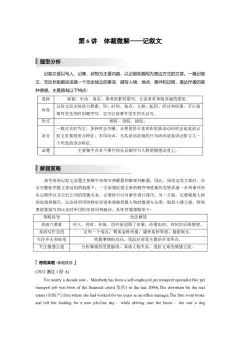
记叙文是以写人、记事、状物为主要内容,以记叙和描写为表达方式的文章。一篇记叙文,无论长短都
应该是一个完全独立的事实,描写人物、地点、事件和过程,表达作者的某种情感。
二、命题规律及解题策略
1.命题规律
纵观近三年高考试卷,通常一套卷有一篇记叙文,个别试卷选用两篇记叙文。所选的记叙文多以第一
人称或第三人称为主,讲述一个短小精悍、有教育意义的故事,有时也会选用生活中的轶闻趣事。所讲述
的故事题材丰富多样、富有生活气息,多按时间顺序叙述,偶尔也会有倒叙或插叙的情形。
从语言与结构特点上看,英语记叙文以描写叙述为主,主要描写人物、事件、地点或过程。其特点是:
主题往往隐藏在字里行间,没有直接地表达出来;文章主旨要通过人物、事件来进行提炼;文章大多按时
间跨度、空间顺序、上下顺序来展开。阅读记叙文应采取略读和扫读的方法,快速抓住文中描写的主要内
容,从整体上把握文章的连贯性,进而大体上揣测出作者的写作意图及文章的情感主线。
从命题上看,记叙文阅读理解以细节理解题和推理判断题为主,以观点态度题、写作意图题、词义猜
测题和代词指代题为辅,难度总体上属于中等程度。记叙文阅读理解题要求考生能理清记叙的顺序与所讲
故事的情节,能准确把握人物的情感态度和作者的写作目的。
一般来说,英语阅读理解中的记叙文主要分为两种。
★“人物传记”类记叙文
注重形容词、外表和心理描写,主旨便是突出人物的性格特点。
★“叙事”类记叙文
主要是利用事件发生的顺序为线索。
2.解题策略
(1)先题后文
先读试题,了解试题考点;明确目的,快速捕捉,获取信息。
①面对人物传记记叙文,学生应该重视文中人物学习以及工作情况的描写,并且理顺人物出生到死亡
的顺序。针对人物不同年龄阶段做过的事情、说过的话进行理解。主要是针对人物描写时间顺序、生活背
景、实践经历、名人名言几个要素进行认知。
②针对叙事为主的记叙文,学生应该注意:
☛ 记叙的要素(who、when、where、what、why、how)
☛ 叙述的人称(第一人称/第三人称)
☛ 记叙的顺序或方法(顺叙、倒叙和插叙)
☛ 叙述的线索 (以时间为线索;以地点为线索;以事件发展的过程为线索;以事物的象征意义为线
索;以人物的思想行为及认知的过程为线索)
(2)题干定向
根据题干关键词到文中定位答案范围(在定位和寻找信息点的时候,可以充分利用加粗字体的标题、
小标题、加下划线的语句等重要信息提高阅读和解题速度,如果每则信息的项目及其位置具有一致性和对
应性,就可利用其一致性和对应性快速查找答案,查找信息时不一定要读完全文),按照题目顺序依次而
下:问题与材料相同→对号入座;问题与原文相同→同义替换、归纳事实等。
(3)生词模糊
遇到生词;如与答题无关,直接跳过;涉及答题,则根据语境、构词法等猜词。
注意:记叙文中有大量的事件发展过程中的细节,包括记叙文的5W(what, who, when, where, why)要素,这些细节也不能放过,可能涉及细节题的答题。也要注意文章中各种人物的性格特点以及人物之间
的关系,人物是推动故事情节发展的关键。
三、技能透视
1. 顺藤摸瓜
记叙文中有大量的事件发展过程中的细节,包括记叙文的5W(what, who, when, where, why)要素。
因此我们作答细节题的时候,就没有那么复杂,一般只需要由前到后,从上到下,一题一题地做就可以了。
例1:(2020全国甲卷B)
Jenifer Mauer has needed more willpower than the typical college student to pursue her goal of earning a
nursing degree. That willpower bore fruit when Jennifer graduated from University of Wisconsin-Eau Claire and
became the first in her large family to earn a bachelor’s degree.
Mauer, of Edgar, Wisconsin, grew up on a farm in a family of 10 children. Her dad worked at a job away from
the farm, and her mother ran the farm with the kids. After high school, Jennifer attended a local technical college,
working to pay her tuition(学费), because there was no extra money set aside for a college education. After
graduation, she worked to help her sisters and brothers pay for their schooling.
Jennifer now is married and has three children of her own. She decided to go back to college to advance her
career and to be able to better support her family while doing something she loves: nursing. She chose the UW-Eau
Claire program at Ministry Saint Joseph’s Hospital in Marshfield because she was able to pursue her four-year
degree close to home. She could drive to class and be home in the evening to help with her kids. Jennifer received
great support from her family as she worked to earn her degree: Her husband worked two jobs to cover the bills,
and her 68-year-old mother helped take care of the children at times.
Through it all, she remained in good academic standing and graduated with honors. Jennifer sacrificed(牺牲)
to achieve her goal, giving up many nights with her kids and missing important events to study. “Some nights my
heart was breaking to have to pick between my kids and studying for exams or papers,” she says. However, her
children have learned an important lesson witnessing their mother earn her degree. Jennifer is a first-generation
graduate and an inspiration to her family — and that’s pretty powerful.
26. What did Jennifer sacrifice to achieve her goal?
A. Her health. B. Her time with family. C. Her reputation. D. Her chance of promotion.
【解析】B细节理解题 由题干关键词“sacrifice to achieve her goal”我们可以定位到最后一段的
“Jennifer sacrificed to achieve her goal, giving up many nights with her kids and missing important events to
study.”,由定位句句意可知,为了实现自己的目标Jennifer放弃了和家人待在一起的时光。B把这概括为:
Her time with family,故选B项。
2.左顾右盼
在做题过程中,我们大都不能在文中找到与题干一字不差的词语或句子。这时我们需要认真研究问题,
抓住题干中的关键词语,然后到文中准确地找到与之相关的语句,或是疑似语句的位置,接着去左顾,或
右盼,在前句或后句寻找线索。
例2:(2023虹口一模)
I know people who say they don’t watch television, and I always nod and agree. Reading requires
intelligence, and television is merely entertainment, right?
I’m going to Scotland this year, and three different people told me I must watch “Outlander” before I go, ------
When I stood up from the couch I felt sick, and it wasn’t just the cookies, popcorn and peanut butter sandwiches I’d
had without noticing. It was dark outside, and I felt ashamed. I had spent half a day on the couch. Research for
Scotland? Not exactly.
36. By “I always nod and agree” (paragraph 1), the author implies that _______.
A. she should be polite to get the conversation to go onB. she is reluctant to admit that she watches television
C. she believes those who say they don’t watch TV
D. she doesn’t think highly of TV either
【解析】D推理判断题 由题干关键词“I always nod and agree” (paragraph 1)(我总是点头表示同意),我
们可以阅读下文的“Reading requires intelligence, and television is merely entertainment(阅读需要智力,而电
视仅仅是娱乐)”,由句意可知,作者说“I always nod and agree”暗示了作者对电视也评价不高,故选D。
3.刨根问底
如前所述,主旨大意题或推理判断、作者意图题等实际上是同一类型的问题,或者说是可用同种方
法解答的题型。在解答此类题目的时候,不可被题干的表象所迷惑,要像剥洋葱一样,一层一层地剥;在
四个可选项中,一个一个地去证实,去排除。特别是解答推论或暗指类的题目,比如"What can be
inferred from …? “或是What does the author imply in…?”之类的题目,文中所陈述的往往不是答案。我
们要在文前文后去查找,在字里行间里去寻觅。有时还少不了借助自己的生活经验和常理来体会这言外之
意。
例3:(2023黄浦一模)
Writers say that Whelan has helped them understand their own work. “When I listen to Julia read my stories, it
sounds like she is calling you over to tell you a great story,” said Nuzzi, whose work has been narrated by Whelan.
“When I write now, I try to think like that, that I am calling a reader over to tell him a great story. It has completely
changed my approach.” Whelan said that she also learns about her writing when she experiences it as a narrator.
“There is something about it that changes when you’re performing it,” she said. “I read the book out loud during
every stage of its revisions but it’s different when you sit down and have the microphone in front of you, when I
finally am in all the characters and the story comes to life.”
39. What can be concluded from Whelan’s experience as a narrator and writer?
A. Excellent narration is based on convincing stories.
B. Narrating is a more rewarding ambition than writing.
C. An influential writer is definitely a wonderful narrator.
D. Experiences as a narrator can change the writing approach.
【解析】D推理判断题 由文章最后一段“‘When I write now, I try to think like that, that I am calling a reader
over to tell him a great story. ……I read the book out loud during every stage of its revisions but it’s different when
you sit down and have the microphone in front of you, when I finally am in all the characters and the story comes
to life.’(‘当我现在写作时,我试着这样想,我是在叫一位读者过来给他讲一个很棒的故事。这完全改变了
我的写作方式。’Whelan说,当她作为叙述者体验写作时,她也了解了自己的写作。她说:‘当你在表演
的时候,它会有一些变化。在每一个修改阶段,我都会大声朗读这本书,但当你坐下来,把麦克风放在面
前,当我最终融入所有角色,故事变得生动起来时,情况就不同了。’)”可知,作为读书人的经历让
Whelan的写作方式风格发生了改变。故选D项。
4.拨云见日
每年的高考阅读题中,特别是记叙文的阅读题,都会出现一至两道词义猜测题。而这些词汇往往是你
素昧平生的,或者和你有点头之交,在文中却另有新意的,总之,猜的是那些在高考词汇表要求之外的词
汇。小小的一个词,一个短语,考核的不是你的语法的熟练程度,也不是你的记忆力,而是你对文章通篇
或者一个段落的整体把握和变通能力。这时,你不仅需要"左顾右盼",还需要在几句话,一个段落,乃
至整篇文章的字里行间中快速搜寻,看看前面、后面都发生了些什么;反复琢磨人物、事物,或者人物与
事物之间的内在联系,才可能在最后拨开团团迷雾,从四个选项中选出正确答案。
例4:(2023奉贤一模)
In 2008, I went to Los Angeles where I tried to get hired as an agent, an analyst and a financial broker.
Unfortunately, all these doors slammed in my face. The world’s economy was in a bad state, so I knew I wouldhave to do a little spinning of my own.
37. By saying “do a little spinning of my own” in the second paragraph, the author probably means he would
_____________.
A. look for a part-time job independently B. make his contributions to the economy
C. give in to the disappointing reality D. be self-employed to develop his career
【解析】D词句猜测题 根据第二段中“In 2008, I went to Los Angeles where I tried to get hired as an agent, an
analyst and a financial broker. Unfortunately, all these doors slammed in my face.(2008年,我去了洛杉矶,试图
在那里找到一份代理、分析师和金融经纪人的工作。不幸的是,这些门都在我面前关上了)”可知,当时世
界经济状况很糟糕,所以作者要自主创业来发展自己的事业。由此推知,划线部分意思是“自主创业来发
展自己的事业”。故选D。
第二节 专题训练
Passage 1(2025全国I卷B)
In my ninth-grade writing class last year, I met a cowboy who saved his town, a strict father who demanded
his son earn straight A’s, and a modern-day Juliet who died of heartbreak after her parents rejected the love of her
young life. More than once, I found myself wondering just how my students, who’d created these people, knew
their subjects so well.
But things were different for their first essay, which was about the question: “Why is writing important?” Most
of the essays filled less than one page, and few contained a sentence that could be interpreted as a thesis (论点)
statement. I was shocked. Then I realized that the problem was the question itself. They could have written pages
on the necessity of computers, but writing, in and of itself, simply didn’t strike them as important. This would have
to change.
As a new unit started, I asked everyone to write a persuasive piece on a health-related topic of their choice.
This time they found the exercise much more interesting. For the next two assignments, a personal-narrative unit
followed by a creative-writing workshop, I only required that the piece meet the specifications of its genre (体裁)
and that it contain a thesis. The results were staggering. The students took on diverse topics and turned in stories,
10 to 20 pages each, with characters that broadened my view and touched my heart.
I walked into class believing that writing is important as a means of communication. However, my students
demonstrated something more important to me. When the final bell rang in June, I walked away with a yearbook
full of messages about writing’s most powerful significance — the ability to connect people, to put us in another’s
skin, to teach us what it means to be human.
24. Who are the people mentioned at the beginning of paragraph 1?
A. Ninth graders. B. Students’ parents. C. Modern writers. D. Fictional characters.
25. Why did the students perform poorly in writing their first essay?
A. They were not given enough time. B. They had a very limited vocabulary.
C. They misunderstood the question. D. They had little interest in the topic.
26. What does the underlined word “staggering” in paragraph 3 mean?
A. Mixed. B. Amazing. C. Similar. D. Disturbing.
27. What does the author’s experience show?
A. Teaching is learning. B. Still waters run deep.
C. Knowledge is power. D. Practice makes perfect.
Passage 2(2025全国II卷B)
Kathy Ho teaches high school inside Lucile Packard Children’s Hospital Stanford (LPCH). “Sometimes I
don’t like saying that I’m a teacher,” says Ho. “People get in their minds an idea of what teachers do, but that’s not
really what it is here.”“Here” is room 386, where each year, about 500 LPCH patients also become students. The hospital school is
free of parents, doctors, and medical procedures. It’s a place of learning. About half of Ho’s students stay for a
week or less; others are there for more than a year. Most of Ho’s students will recover, which means that preparing
them to return to school is an increasingly important component of care.
Still, in room 386, academics don’t come first. Physical health and mental health are the priority. “If you’re
scared about something and thinking only about that, there’s no way you’re going to be able to learn,” Ho says.
“I’m a coach, an adviser, and a comforter, and that’s what it means to be a hospital teacher.”
There are up to 30 students at any given time in Ho’s class. She generally works with their regular teachers to
get lessons and tests being used at their home schools. Some teachers don’t give the kids any assignments; they
express sympathy instead. “I feel like it is a disservice to the kids,” Ho says. “They think their teachers don’t care
about their schoolwork.”
Ho recognizes the psychological benefit of helping kids keep up with their peers (同龄人) outside the hospital.
“I actually think the medicine is only a small piece for some problems,” says Julie Good, director of pain
management services at LPCH. “It’s about problem-solving around what it means to have a full life. Those kids
have dreams. School can keep those dreams alive by giving kids a way to learn and grow.”
24. Who does Ho teach at LPCH?
A. Sick children. B. Young nurses.
C. Medical students. D. Patients’ parents.
25. What is a characteristic of Ho’s job?
A. Prioritizing academics. B. Encouraging innovation.
C. Treating various diseases. D. Playing multiple roles.
26. What does the underlined word “it” refer to in paragraph 4?
A. Offering regular lessons. B. Paying extra attention.
C. Assigning no schoolwork. D. Showing no sympathy.
27. How does the hospital school benefit the students according to Good?
A. It eases peer pressure. B. It helps them live in hope.
C. It frees them from aches. D. It entertains them with stories.
Passage 3(2024全国I卷B)
“I am not crazy,” says Dr. William Farber, shortly after performing acupuncture (针灸) on a rabbit. “I am
ahead of my time.” If he seems a little defensive, it might be because even some of his coworkers occasionally
laugh at his unusual methods. But Farber is certain he’ll have the last laugh. He’s one of a small but growing
number of American veterinarians (兽医) now practicing “holistic” medicine-combining traditional Western
treatments with acupuncture, chiropractic (按摩疗法) and herbal medicine.
Farber, a graduate of Colorado State University, started out as a more conventional veterinarian. He became
interested in alternative treatments 20 years ago when he suffered from terrible back pain. He tried muscle-relaxing
drugs but found little relief. Then he tried acupuncture, an ancient Chinese practice, and was amazed that he
improved after two or three treatments. What worked on a veterinarian seemed likely to work on his patients. So,
after studying the techniques for a couple of years, he began offering them to pets.
Leigh Tindale’s dog Charlie had a serious heart condition. After Charlie had a heart attack, Tindale says, she
was prepared to put him to sleep, but Farber’s treatments eased her dog’s suffering so much that she was able to
keep him alive for an additional five months. And Priscilla Dewing reports that her horse, Nappy, “moves more
easily and rides more comfortably” after a chiropractic adjustment.
Farber is certain that the holistic approach will grow more popular with time, and if the past is any indication,
he may be right: Since 1982, membership in the American Holistic Veterinary Medical Association has grown from
30 to over 700. “Sometimes it surprises me that it works so well,” he says. “I will do anything to help an animal.That’s my job.”
24. What do some of Farber’s coworkers think of him?
A. He’s odd. B. He’s strict. C. He’s brave. D. He’s rude.
25. Why did Farber decide to try acupuncture on pets?
A. He was trained in it at university. B. He was inspired by another veterinarian.
C. He benefited from it as a patient. D. He wanted to save money for pet owners.
26. What does paragraph 3 mainly talk about?
A. Steps of a chiropractic treatment. B. The complexity of veterinarians’ work.
C. Examples of rare animal diseases. D. The effectiveness of holistic medicine.
27. Why does the author mention the American Holistic Veterinary Medical Association?
A. To prove Farber’s point. B. To emphasize its importance.
C. To praise veterinarians. D. To advocate animal protection.
Passage 4(2024全国II卷B)
Do you ever get to the train station and realize you forgot to bring something to read? Yes, we all have our
phones, but many of us still like to go old school and read something printed.
Well, there’s a kiosk (小亭) for that. In the San Francisco Bay Area, at least.
“You enter the fare gates (检票口) and you’ll see a kiosk that is lit up and it tells you can get a one-minute, a
three-minute, or a five-minute story,” says Alicia Trost, the chief communications officer for the San Francisco Bay
Area Rapid Transit — known as BART. “You choose which length you want and it gives you a receipt-like short
story.”
It’s that simple. Riders have printed nearly 20,000 short stories and poems since the program was launched
last March. Some are classic short stories, and some are new original works.
Trost also wants to introduce local writers to local riders. “We wanted to do something where we do a call to
artists in the Bay Area to submit stories for a contest,” Trost says. “And as of right now, we’ve received about 120
submissions. The winning stories would go into our kiosk and then you would be a published artist.”
Ridership on transit (交通) systems across the country has been down the past half century, so could short
stories save transit?
Trost thinks so.
“At the end of the day all transit agencies right now are doing everything they can to improve the rider
experience. So I absolutely think we will get more riders just because of short stories,” she says.
And you’ll never be without something to read.
24. Why did BART start the kiosk program?
A. To promote the local culture. B. To discourage phone use.
C. To meet passengers’ needs. D. To reduce its running costs.
25. How are the stories categorized in the kiosk?
A. By popularity. B. By length.
C. By theme. D. By language.
26. What has Trost been doing recently?
A. Organizing a story contest. B. Doing a survey of customers.
C. Choosing a print publisher. D. Conducting interviews with artists.
27. W.hat is Trost’s opinion about BART’s future?
A It will close down. B. Its profits will decline.
C. It will expand nationwide. D. Its ridership will increase.
Passage 5(2023全国新高考I卷B)When John Todd was a child, he loved to explore the woods around his house, observing how nature solved
problems. A dirty stream, for example, often became clear after flowing through plants and along rocks where tiny
creatures lived. When he got older, John started to wonder if this process could be used to clean up the messes
people were making.
After studying agriculture, medicine, and fisheries in college, John went back to observing nature and asking
questions. Why can certain plants trap harmful bacteria (细菌)? Which kinds of fish can eat cancer-causing
chemicals? With the right combination of animals and plants, he figured, maybe he could clean up waste the way
nature did. He decided to build what he would later call an eco-machine.
The task John set for himself was to remove harmful substances from some sludge (污泥). First, he
constructed a series of clear fiberglass tanks connected to each other. Then he went around to local ponds and
streams and brought back some plants and animals. He placed them in the tanks and waited. Little by little, these
different kinds of life got used to one another and formed their own ecosystem. After a few weeks, John added the
sludge.
He was amazed at the results. The plants and animals in the eco-machine took the sludge as food and began to
eat it! Within weeks,, it had all been digested, and all that was left was pure water.
Over the years John has taken on many big jobs. He developed a greenhouse-like facility that treated sewage
(污水) from 1,600 homes in South Burlington. He also designed an eco-machine to clean canal water in Fuzhou, a
city in southeast China.
“Ecological design” is the name John gives to what he does. “Life on Earth is kind of a box of spare parts for
the inventor,” he says. “You put organisms in new relationships and observe what’s happening. Then you let these
new systems develop their own ways to self-repair.”
24. What can we learn about John from the first two paragraphs?
A. He was fond of traveling. B. He enjoyed being alone.
C. He had an inquiring mind. D. He longed to be a doctor.
25. Why did John put the sludge into the tanks?
A. To feed the animals. B. To build an ecosystem.
C. To protect the plants. D. To test the eco-machine.
26. What is the author’s purpose in mentioning Fuzhou?
A. To review John’s research plans. B. To show an application of John’s idea.
C. To compare John’s different jobs. D. To erase doubts about John’s invention.
27. What is the basis for John’s work?
A. Nature can repair itself. B. Organisms need water to survive.
C. Life on Earth is diverse. D. Most tiny creatures live in groups.
Passage 6(2023全国新高考II卷B)
Turning soil, pulling weeds, and harvesting cabbage sound like tough work for middle and high school kids.
And at first it is, says Abby Jaramillo, who with another teacher started Urban Sprouts, a school garden program at
four low-income schools. The program aims to help students develop science skills, environmental awareness, and
healthy lifestyles.
Jaramillo's students live in neighborhoods where fresh food and green space are not easy to find and fast food
restaurants outnumber grocery stores. “The kids literally come to school with bags of snacks and large bottles of
soft drinks,” she says. “They come to us thinking vegetables are awful, dirt is awful, insects are awful.” Though
some are initially scared of the insects and turned off by the dirt, most are eager to try something new.
Urban Sprouts’ classes, at two middle schools and two high schools, include hands-on experiments such assoil testing, flower-and-seed dissection, tastings of fresh or dried produce, and work in the garden. Several times a
year, students cook the vegetables they grow, and they occasionally make salads for their entire schools.
Program evaluations show that kids eat more vegetables as a result of the classes. “We have students who say
they went home and talked to their parents and now they're eating differently,” Jaramillo says.
She adds that the program's benefits go beyond nutrition. Some students get so interested in gardening that
they bring home seeds to start their own vegetable gardens. Besides, working in the garden seems to have a
calming effect on Jaramillo's special education students, many of whom have emotional control issues. “They get
outside,” she says, “and they feel successful.”
24. What do we know about Abby Jaramillo?
A. She used to be a health worker. B. She grew up in a low-income family.
C. She owns a fast-food restaurant. D. She is an initiator of Urban Sprouts.
25. What was a problem facing Jaramillo at the start of the program?
A. The kids’ parents distrusted her. B. Students had little time for her classes.
C. Some kids disliked garden work. D. There was no space for school gardens.
26. Which of the following best describes the impact of the program?
A. Far-reaching. B. Predictable.
C. Short-lived. D. Unidentifiable.
27. What can be a suitable title for the text?
A. Rescuing School Gardens B. Experiencing Country Life
C. Growing Vegetable Lovers D. Changing Local Landscape
Passage 7(2023浙江1月卷B)
Live with roommates? Have friends and family around you? Chances are that if you’re looking to live a more
sustainable lifestyle, not everyone around you will be ready to jump on that bandwagon.
I experienced this when I started switching to a zero-waste lifestyle five years ago, as I was living with my
parents, and I continue to experience this with my husband, as he is not completely zero waste like me. I’ve learned
a few things along the way though, which I hope you’ll find encouraging if you’re doing your best to figure out
how you can make the change in a not-always-supportive household.
Zero waste was a radical lifestyle movement a few years back. I remember showing my parents a video of Bea
Johnson, sharing how cool I thought it would be to buy groceries with jars, and have so little trash! A few days
later, I came back with my first jars of zero waste groceries, and my dad commented on how silly it was for me to
carry jars everywhere. It came off as a bit discouraging.
Yet as the months of reducing waste continued, I did what I could that was within my own reach. I had my
own bedroom, so I worked on removing things I didn’t need. Since I had my own toiletries (洗漱用品), I was able
to start personalizing my routine to be more sustainable. I also offered to cook every so often, so I portioned out a
bit of the cupboard for my own zero waste groceries. Perhaps your household won’t entirely make the switch, but
you may have some control over your own personal spaces to make the changes you desire.
As you make your lifestyle changes, you may find yourself wanting to speak up for yourself if others
comment on what you’re doing, which can turn itself into a whole household debate. If you have individuals who
are not on board, your words probably won’t do much and can often leave you feeling more discouraged.
So here is my advice: Lead by action.
24. What do the underlined words “jump on that bandwagon” mean in the first paragraph?
A. Share an apartment with you. B. Join you in what you’re doing.
C. Transform your way of living. D. Help you to make the decision.
25. What was the attitude of the author’s father toward buying groceries with jars?
A. He disapproved of it. B. He was favorable to it.
C. He was tolerant of it. D. He didn’t care about it.26. What can we infer about the author?
A. She is quite good at cooking. B. She respects others’ privacy.
C. She enjoys being a housewife. D. She is a determined person.
27. What is the text mainly about?
A. How to get on well with other family members. B. How to have one’s own personal space at home.
C. How to live a zero-waste lifestyle in a household. D. How to control the budget when buying groceries.
Passage 8(2023全国乙卷B)
Living in Iowa and trying to become a photographer specializing in landscape (风景) can be quite a challenge,
mainly because the corn state lacks geographical variation.
Although landscapes in the Midwest tend to be quite similar, either farm fields or highways, sometimes I find
distinctive character in the hills or lakes. To make some of my landscape shots, I have traveled up to four hours
away to shoot within a 10-minute time frame. I tend to travel with a few of my friends to state parks or to the
countryside to go on adventures and take photos along the way.
Being at the right place at the right time is decisive in any style of photography. I often leave early to seek the
right destinations so I can set up early to avoid missing the moment I am attempting to photograph. I have missed
plenty of beautiful sunsets/sunrises due to being on the spot only five minutes before the best moment.
One time my friends and I drove three hours to Devil’s Lake, Wisconsin, to climb the purple quartz (石英)
rock around the lake. After we found a crazy-looking road that hung over a bunch of rocks, we decided to
photograph the scene at sunset. The position enabled us to look over the lake with the sunset in the background. We
managed to leave this spot to climb higher because of the spare time until sunset. However, we did not mark the
route (路线) so we ended up almost missing the sunset entirely. Once we found the place, it was stressful getting
lights and cameras set up in the limited time. Still, looking back on the photos, they are some of my best shots
though they could have been so much better if I would have been prepared and managed my time wisely.
24. How does the author deal with the challenge as a landscape photographer in the Midwest?
A. By teaming up with other photographers. B. By shooting in the countryside or state parks.
C. By studying the geographical conditions. D. By creating settings in the corn fields.
25. What is the key to successful landscape photography according to the author?
A. Proper time management. B. Good shooting techniques.
C. Adventurous spirit. D. Distinctive styles.
26. What can we infer from the author trip with friends to Devil’s Lake?
A. They went crazy with the purple quartz rock.
B. They felt stressed while waiting for the sunset.
C. They reached the shooting spot later than expected.
D. They had problems with their equipment.
27. How does the author find his photos taken at Devil’s Lake?
A. Amusing. B. Satisfying.
C. Encouraging. D. Comforting.
Passage 9(2023全国甲卷B)
Terri Boltonis a dab hand when it comes to DIY (do-it-yourself). Skilled at putting up shelves and piecing
together furniture, she never pays someone else to do a job she can do herself.
She credits these skills to her late grandfather and builder Derek Lloyd. From the age of six, Terri, now 26,
accompanied Derek to work during her school holidays. A day’s work was rewarded with £ 5 in pocket money. She
says: “I’m sure I wasn’t much of a help to start with painting the rooms and putting down the flooring throughout
the house. It took weeks and it was backbreaking work, but I know he was proud of my skills.”Terri, who now rents a house with friends in Wandsworth, South West London, says DIY also saves her from
losing any deposit when a tenancy (租期) comes to an end. She adds: “I’ve moved house many times and I always
like to personalize my room and put up pictures. So, it’s been useful to know how to cover up holes and repaint a
room to avoid any charges when I’ve moved out.”
With millions of people likely to take on DIY projects over that coming weeks, new research shows that more
than half of people are planning to make the most of the long, warm summer days to get jobs done. The average
spend per project will be around £ 823. Two thirds of people aim to improve their comfort while at home. Two fifth
wish to increase the value of their house. Though DIY has traditionally been seen as male hobby, the research
shows it is women now leading the charge.
24. Which is closest in meaning to “a dab hand” in paragraph 1?
A. An artist. B. A winner. C. A specialist. D. A pioneer.
25. Why did Terri’s grandfather give her £ 5 a day?
A. For a birthday gift. B. As a treat for her work.
C. To support her DIY projects. D. To encourage her to take up a hobby.
26. How did Terri avoid losing the deposit on the house she rented?
A. By making it look like before. B. By furnishing it herself.
C. By splitting the rent with a roommate. D. By canceling the rental agreement.
27. What trend in DIY does the research show?
A. It is becoming more costly. B. It is getting more time-consuming.
C. It is turning into a seasonal industry. D. It is gaining popularity among females.
Passage 10(2023北京卷B)
Sitting in the garden for my friend’s birthday. I felt a buzz (振动) in my pocket. My heart raced when I saw the
email sender’s name. The email started off: “Dear Mr. Green, thank you for your interest” and “the review process
took longer than expected.” It ended with “We are sorry to inform you…”and my vision blurred (模糊). The
position—measuring soil quality in the Sahara Desert as part of an undergraduate research programme — had felt
like the answer I had spent years looking for.
I had put so much time and emotional energy into applying, and I thought the rejection meant the end of the
road for my science career.
So, I was shocked when, not long after the email, Professor Mary Devon, who was running the programme,
invited me to observe the work being done in her lab. I jumped at the chance, and a few weeks later I was equally
shocked—and overjoyed—when she invited me to talk with her about potential projects I could pursue in her lab.
What she proposed didn’t seem as exciting as the original project I had applied to, but I was going to give it my all.
I found myself working with a robotics professor on techniques for collecting data from the desert remotely.
That project, which I could complete from my sofa instead of in the burning heat of the desert, not only survived
the lockdown but worked where traditional methods didn’t. In the end, I had a new scientific interest to pursue.
When I applied to graduate school, I found three programmes promising to allow me to follow my desired
research direction. And I applied with the same anxious excitement as before. When I was rejected from one that
had seemed like a perfect fit, it was undoubtedly difficult. But this time I had the perspective (视角) to keep it from
sending me into panic. It helped that in the end I was accepted into one of the other programmes I was also excited
about.
Rather than setting plans in stone, I’ve learned that sometimes I need to take the opportunities that are offered,
even if they don’t sound perfect at the time, and make the most of them.
24. How did the author feel upon seeing the email sender’s name?
A. Anxious. B. Angry. C. Surprised. D. Settled.
25. After talking with Professor Devon, the author decided to ________.A. criticize the review process B. stay longer in the Sahara Desert
C. apply to the original project again D. put his heart and soul into the lab work
26. A.ccording to the author, the project with the robotics professor was ________.
A demanding B. inspiring C. misleading D. amusing
27. What can we learn from this passage?
A. An invitation is a reputation. B. An innovation is a resolution.
C. A rejection can be a redirection. D. A reflection can be a restriction.
Passage 11(2022全国甲卷C)
As Ginni Bazlinton reached Antarctica, she found herself greeted by a group of little Gentoo penguins (企鹅)
longing to say hello. These gentle, lovely gatekeepers welcomed her and kick-started what was to be a trip Ginni
would never forget.
Ever since her childhood, Ginni, now 71, has had a deep love for travel. Throughout her career (职业) as a
professional dancer, she toured in the UK, but always longed to explore further. When she retired from dancing and
her sons eventually flew the nest, she decided it was time to take the plunge.
After taking a degree at Chichester University in Related Arts, Ginni began to travel the world, eventually
getting work teaching English in Japan and Chile. And it was in Chile she discovered she could get last-minute
cheap deals on ships going to Antarctica from the islands off Tierra del Fuego, the southernmost tip of the South
American mainland. “I just decided I wanted to go,” she says. “I had no idea about what I’d find there and I wasn’t
nervous, I just wanted to do it. And I wanted to do it alone as I always prefer it that way.”
In March 2008, Ginni boarded a ship with 48 passengers she’d never met before, to begin the journey towards
Antarctica. “From seeing the wildlife to witnessing sunrises, the whole experience was amazing. Antarctica left an
impression on me that no other place has,” Ginni says. “I remember the first time I saw a humpback whale; it just
rose out of the water like some prehistoric creature and I thought it was smiling at us. You could still hear the
operatic sounds it was making underwater.”
The realization that this is a precious land, to be respected by humans, was one of the biggest things that hit
home to Ginni.
28. Which of the following best explains “take the plunge” underlined in paragraph 2?
A. Try challenging things. B. Take a degree. C. Bring back lost memories. D. Stick to a promise.
29. What made Ginni decide on the trip to Antarctica?
A. Lovely penguins. B. Beautiful scenery. C. A discount fare. D. A friend’s invitation.
30. What does Ginni think about Antarctica after the journey?
A.. It could be a home for her. B. It should be easily accessible.
C It should be well preserved. D. It needs to be fully introduced.
31. What is the text mainly about?
A. A childhood dream. B. An unforgettable experience.
C. Sailing around the world. D. Meeting animals in Antarctica.
Passage 12(2022新高考II卷B)
We journalists live in a new age of storytelling, with many new multimedia tools. Many young people don’t
even realize it’s new. For them, it’s just normal.
This hit home for me as I was sitting with my 2-year-old grandson on a sofa over the Spring Festival holiday.
I had brought a children’s book to read. It had simple words and colorful pictures — a perfect match for his age.
Picture this: my grandson sitting on my lap as I hold the book in front so he can see the pictures. As I read, he
reaches out and pokes (戳) the page with his finger.
What’s up with that? He just likes the pictures, I thought. Then I turned the page and continued. He poked thepage even harder. I nearly dropped the book. I was confused: Is there something wrong with this kid?
Then I realized what was happening. He was actually a stranger to books. His father frequently amused the
boy with a tablet computer which was loaded with colorful pictures that come alive when you poke them. He
thought my storybook was like that.
Sorry, kid. This book is not part of your high-tech world. It’s an outdated, lifeless thing. An antique, like your
grandfather. Well, I may be old, but I’m not hopelessly challenged, digitally speaking. I edit video and produce
audio. I use mobile payment. I’ve even built websites.
There’s one notable gap in my new-media experience, however: I’ve spent little time in front of a camera,
since I have a face made for radio. But that didn’t stop China Daily from asking me last week to share a personal
story for a video project about the integration of Beijing, Tianjin and Hebei province.
Anyway, grandpa is now an internet star — two minutes of fame! I promise not to let it go to my head. But I
will make sure my 2-year-old grandson sees it on his tablet.
4. What do the underlined words “hit home for me” mean in paragraph 2?
A. Provided shelter for me. B. Became very clear to me.
C. Took the pressure off me. D. Worked quite well on me.
5. Why did the kid poke the storybook?
A. He took it for a tablet computer. B. He disliked the colorful pictures.
C. He was angry with his grandpa. D. He wanted to read it by himself.
6. What does the author think of himself?
A. Socially ambitious. B. Physically attractive.
C. Financially independent. D. Digitally competent.
7. What can we learn about the author as a journalist?
A. He lacks experience in his job. B. He seldom appears on television.
C. He manages a video department. D. He often interviews internet stars.
Passage 13(2021新高考I卷B)
By day, Robert Titterton is a lawyer. In his spare on stage beside pianist Maria Raspopova — not as a musician
but as her page turner. “I’m not a trained musician, but I’ve learnt to read music so I can help Maria in her
performance.”
Mr. Titterton is chairman of the Omega Ensemble but has been the group’s official page turner for the past
four years. His job is to sit beside the pianist and turn the pages of the score so the musician doesn’t have to break
the flow of sound by doing it themselves. He said he became just as nervous as those playing instruments on stage.
“A lot of skills are needed for the job. You have to make sure you don’t turn two pages at once and make sure
you find the repeats in the music when you have to go back to the right spot.” Mr. Titterton explained.
Being a page turner requires plenty of practice. Some pieces of music can go for 40 minutes and require up to
50-page turns, including back turns for repeat passages. Silent onstage communication is key, and each pianist has
their own style of “nodding” to indicate a page turn which they need to practise with their page turner.
But like all performances, there are moments when things go wrong. “I was turning the page to get ready for
the next page, but the draft wind from the turn caused the spare pages to fall off the stand,” Mr. Titterton said,
“Luckily I was able to catch them and put them back.”
Most page turners are piano students or up-and-coming concert pianists, although Ms. Raspopova has once
asked her husband to help her out on stage.
“My husband is the worst page turner,” she laughed. “He’s interested in the music, feeling every note, and I
have to say: ‘Turn, turn!’ “Robert is the best page turner I’ve had in my entire life.”
24. What should Titterton be able to do to be a page turner?
A. Read music. B. Play the piano. C Sing songs. D. Fix the instruments.25. Which of the following best describes Titterton’s job on stage?
A. Boring. B. Well-paid. C. Demanding. D. Dangerous.
26. What does Titterton need to practise?
A. Counting the pages. B. Recognizing the “nodding”. C. Catching falling objects. D. Performing in his
own style.
27. Why is Ms. Raspopova’s husband “the worse page turner”?
A. He has very poor eyesight. B. He ignores the audience. C. He has no interest in music. D. He forgets
to do his job.
Passage 14(2021新高考II卷B)
I have worked as a keeper at the National Zoo, Paris for 11 years. Spot and Stripe are the first tiger cubs that
have ever been born here. Globally, a third of Sumatran cubs in zoos don't make it to adulthood, so I decided to
give them round-the-clock care at home.
I've got two children—the younger one, Kynan, was extremely happy about the tigers arriving - but all of us
really looked forward to being part of their lives and watching them grow. I wasn't worried about bringing them
into my home with my wife and kids. These were cubs. They weighed about 2.5 kg and were so small that there
was absolutely no risk.
As they grew more mobile, we let them move freely around the house during the day, but when we were
asleep we had to contain them in a large room, otherwise they'd get up to mischief. We'd come down in the
morning to find they'd turned the room upside down, and left it looking like a zoo.
Things quickly got very intense due to the huge amount of energy required to look after them. There were
some tough times and I just felt extremely tired. I was grateful that my family was there to help. We had to have a
bit of a production line going, making up “tiger milk”, washing baby bottles, and cleaning the floors.
When Spot and Stripe were four months old, they were learning how to open doors and jump fences, and we
knew it really was time for them to go. It was hard for us to finally part with them. For the first few days, Kynan
was always a bit disappointed that the cubs weren't there.
I'm not sad about it. I'm hands-on with them every day at the zoo, and I do look back very fondly on the time
that we had them.
24. Why did the author bring the tiger cubs home?
A. To ensure their survival. B. To observe their differences.
C. To teach them life skills. D. To let them play with his kids.
25. What do the underlined words “get up to mischief” mean in paragraph 3?
A. Behave badly.B. Lose their way. C. Sleep soundly. D. Miss their mom.
26. What did the author think of raising the tiger cubs at home?
A. Boring. B. Tiring.C. Costly.D. Risky.
27. Why did the author decide to send Spot and Stripe back to the zoo?
A. They frightened the children.B. They became difficult to contain.
C. They annoyed the neighbors.D. They started fighting each other.
Passage 15(2021新高考II卷C)
A British woman who won a $1 million prize after she was named the World's Best Teacher will use the cash
to bring inspirational figures into UK schools.
Andria Zafirakou, a north London secondary school teacher, said she wanted to bring about a classroom
revolution (变革). “We are going to make a change,” she said. “I’ve started a project to promote the teaching of the
arts in our schools.”
The project results from the difficulties many schools have in getting artists of any sort - whether an up-and-coming local musician or a major movie star - into schools to wor,k with and inspire children.
Zafirakou began the project at Alperton Community School her place of work for the past twelve years. “I've
seen those magic moments when children are talking to someone they are inspired by - their eyes are shining and
their faces light up,” she said. “We need artists. more than ever in our schools."
Artist Michael Craig-Martin said: “Andria's brilliant project to bring artists from all fields into direct contact
with children is particularly welcome at a time when the arts are being downgraded in schools." It was a mistake to
see the arts as unnecessary, he added.
Historian Sir Simon Schama is also a supporter of the project. He said that arts education in schools was not
just an add-on. “It is absolutely necessary. The future depends on creativity and creativity depends on the young.
What will remain of us when artificial intelligence takes over will be our creativity, and it is our creative spirit, our
visionary sense of freshness, that has been our strength for centuries."
24. What will Zafirakou do with her prize money?
A. Make a movie. B. Build new schools. C. Run a project. D. Help local musicians.
25. What does Craig-Martin think of the teaching of the arts in UK schools?
A. It is particularly difficult. B. It increases artists' income.
C. It opens children's mind. D. It deserves greater attention.
26. What should be stressed in school education according to Schama?
A. Moral principles. B. Interpersonal skills. C. Creative abilities. D. Positive worldviews.
27. Which of the following is a suitable title for the text?
A. Bring Artists to Schools B. When Historians Meet Artists
C. Arts Education in Britain D. The World's Best Arts Teacher
Passage 16(2021北京卷B)
I remember the day during our first week of class when we were informed about our semester(学期)
project of volunteering at a non-profit organization.When the teacher introduced us to the different organizations
that needed our help,my last choice was Operation Iraqi Children (OIC).My first impression of the
organization was that it was not going to make enough of a difference with the plans I had in mind.
Then,an OIC representative gave us some details,which somewhat interested me.After doing some
research, I believed that we could really do something for those kids.When I went online to the OIC website,I
saw pictures of the Iraqi children.Their faces were so powerful in sending a message of their despair(绝望)
and need that I joined this project without hesitation.We decided to collect as many school supplies as possible,
and make them into kits——one kit,one child.
The most rewarding day for our group was project day,when all the efforts we put into collecting the items
finally came together.When I saw the various supplies we had collected,it hit me that every kit we were to build
that day would eventually be in the hands of an Iraqi child.Over the past four months,I had never imagined how
I would feel once our project was completed.While making the kits,I realized that I had lost sight of the true
meaning behind it.I had only focused on the fact that it was another school project and one I wanted to get a good
grade on.When the kits were completed,and ready to be sent overseas,the warm feeling I had was one I would
never forget.
In the beginning,I dared myself to make a difference in the life of another person.Now that our project is
over,I realize that I have affected not only one life,but ten.With our efforts,ten young boys and girls will
now be able to further their education.
24. How did the author feel about joining the OIC project in the beginning?
A. It would affect his/her initial plans. B. It would involve traveling overseas.
C. It would not bring him/her a good grade. D. It would not live up to his/her expectations.
25. What mainly helped the author change his/her attitude toward the project?A. Images of Iraqi children. B. Research by his/her classmates.
C. A teacher's introduction. D. A representative's comments.
26. The author's OIC project group would help ten Iraqi children to________.
A. become OIC volunteers B. further their education C. study in foreign countries D. influence other
children
27. What can we conclude from this passage?
A. One's potential cannot always be underrated. B. First impression cannot always be trusted.
C. Actions speak louder than words. D. He who hesitates is lost.
Passage 17(2021全国甲卷C)
When I was 9, we packed up our home in Los Angeles and arrived at Heathrow, London on a gray January
morning. Everyone in the family settled quickly into the city except me. Without my beloved beaches and endless
blue—sky days, I felt at a loss and out of place. Until I made a discovery.
Southbank, at an eastern bend in the Thames, is the center of British skateboarding, where the continuous
crashing of skateboards left your head ringing. I loved it. I soon made friends with the local skaters. We spoke our
own language. And my favorite: Safe. Safe meant cool. It meant hello. It meant don't worry about it. Once, when
trying a certain trick on the beam(横杆), I fell onto the stones, damaging a nerve in my hand, and Toby came
over, helping me up: Safe, man. Safe. A few minutes later, when I landed the trick, my friends beat their boards
loud, shouting: “Safe! Safe! Safe!” And that's what mattered—landing tricks, being a good skater.
When I was 15, my family moved to Washington. I tried skateboarding there, but the locals were far less
welcoming. Within a couple of years, I'd given it up.
When I returned to London in 2004, I found myself wandering down to Southbank, spending hours there. I've
traveled back several times since, most recently this past spring. The day was cold but clear: tourists and Londoners
stopped to watch the skaters. Weaving(穿梭)among the kids who rushed by on their boards, I found my way to
the beam. Then a rail—thin teenager, in a baggy white T—shirt, skidded(滑)up to the beam. He sat next to me.
He seemed not to notice the man next to him. But soon I caught a few of his glances. “I was a local here 20 years
ago,” I told him. Then, slowly, he began to nod his head. “Safe, man. Safe.”
“Yeah,” I said. “Safe.”
28. What can we learn about the author soon after he moved to London?
A. He felt disappointed. B. He gave up his hobby.
C. He liked the weather there. D. He had disagreements with his family.
29. What do the underlined words “Safe! Safe! Safe!” probably mean?
A. Be careful! B. Well done! C. No way! D. Don't worry!
30. Why did the author like to spend time in Southbank when he returned to London?
A. To join the skateboarding. B. To make new friends. C. To learn more tricks. D. To relive his
childhood days
31. What message does the author seem to convey in the text?
A. Children should learn a second language. B Sport is necessary for children's health.
C. Children need a sense of belonging D. Seeing the world is a must for children.
Passage 18(2021浙江6月卷B)
We live in a town with three beaches. There are two parts less than 10 minutes’ walk from home where
neighborhood children gather to play. However, what my children want to do after school is pick up a screen —
any screen — and stare at it for hours. They are not alone. Today's children spend an average of four and a half
hours a day looking at screens, split between watching television and using the Internet.In the past few years, an increasing number of people and organizations have begun coming up with plans to
counter this trend. A couple of years ago film-maker David Bond realized that his children, then aged five and
three, were attached to screens to the point where he was able to say “chocolate” into his three-year-old son’s ear
without getting a response. He realized that something needed to change, and, being a London media type,
appointed himself “marketing director from Nature”. He documented his journey as he set about treating nature as a
brand to be marketed to young people. The result was Project Wild Thing, a film which charts the birth of the
World Network, a group of organizations with the common goal of getting children out into nature.
“Just five more minutes outdoors can make a difference,” David Bond says. “There is a lot of really interesting
evidence which seems to be suggesting that if children are inspired up to the age of seven, then being outdoors will
be on habit for life.” His own children have got into the habit of playing outside now: “We just send them out into
the garden and tell them not to come back in for a while.”
Summer is upon us. There is an amazing world out there, and it needs our children as much as they need it.
Let us get them out and let them play.
24. What is the problem with the author’s children?
A. They often annoy their neighbors.B. They are tired of doing their homework.
C. They have no friends to play with D. They stay in front of screens for too long.
25. How did David Bond advocate his idea?
A. By making a documentary film. B. By organizing outdoor activities.
C. By advertising in London media. D. By creating a network of friends.
26. Which of the following can replace the underlined word “charts” in paragraph 2?
A. records B. predicts C. delaysD. confirms
27. What can be a suitable title for the text?
A. Let Children Have Fun B. Young Children Need More Free Time
C. Market Nature to Children D. David Bond: A Role Model for Children
Passage 19(2020北京卷C)
For the past five years, Paula Smith, a historian of science, has devoted herself to re-creating long-forgotten
techniques. While doing research for her new book, she came across a 16th-century French manuscript(手稿)
consisting of nearly 1,000 sets of instructions, covering subjects from tool making to finding the best sand.
The author's intention remains as mysterious(神秘)as his name; he may have been simply taking notes for
his own records. But Smith was struck mainly by the fact that she didn't truly grasp any of the skills the author
described. "You simply can't get an understanding of that handwork by reading about it," she says.
Though Smith did get her hands on the best sand, doing things the old-fashioned way isn't just about playing
around with French mud. Reconstructing the work of the craftsmen(工匠)who lived centuries ago can reveal
how they viewed the world, what objects filled their homes, and what went on in the workshops that produced
them. It can even help solve present-day problems: In 2015, scientists discovered that a 10th-century English
medicine for eve problems could kill a drug-resistant virus.
The work has also brought insights for museums, Smith says. One must know how on object was made in
order to preserve it. What's more, reconstructions might be the only way to know what treasures looked like before
time wore them down. Scholars have seen this idea in practice with ancient Greek and Roman statues. These
sculptures were painted a rainbow of striking colors. We can't appreciate these kinds of details without seeing
works of art as they originally appeared-something Smith believes you can do only when you have a road map.
Smith has put the manuscript's ideas into practice. Her final goal is to link the worlds of art and science back
together: She believes that bringing the old recipes to life can help develop a kind of learning that highlights
experimentation, teamwork, and problem solving.Back when science—then called “the new philosophy”—took shape, academics looked to craftsmen for help
in understanding the natural world. Microscopes and telescopes were invented by way of artistic tinkering(修
补), as craftsmen experimented with glass to better bend light.
If we can rediscover the values of hands-on experience and craftwork, Smith says, we can marry the best of
our modern insights with the handiness of our ancestors.
38. How did Smith, feel after reading the French manuscript?
A. Confused about the technical terms. B. Impressed with its detailed instructions.
C. Discouraged by its complex structure. D. Shocked for her own lack of hand skills.
39. According to Smith, the reconstruction work is done mainly to _____________.
A. restore old workshops B. understand the craftsmen C. improve visual effects D. inspire the
philosophers
40. Why does the author mention museums?
A. To reveal the beauty of ancient objects. B. To present the findings of old science.
C To highlight the importance of antiques. D. To emphasize the values of hand skills.
41. Which would be the best title for this passage?
A. Craftsmen Set the Trends for Artists B. Craftsmanship Leads to New Theories
C. Craftsmanship Makes Better Scientists D. Craftsmen Reshape the Future of Science
Passage 20(2020新高考II卷B)
The end of the school year was in sight and spirits were high. I was back teaching after an absence of 15 years,
dealing with the various kinds of "forbidden fruit" that come out of book bags. Now was the spring of the water
pistol.
I decided to think up a method of dealing with forbidden fruit.
"Please bring that pistol to me," I said. "I'm going to put it in my Grandma's Box."
"What's that?" they asked.
"It's a large wooden chest full of toys for my grandchildren," I replied,
"You don't have grandchildren," someone said.
"I don't know." I replied. "But someday I will. When I do, my box will be full of wonderful things for them."
My imaginary Grandma's Box worked like magic that spring, and later. Sometimes. students would ask me to
describe all the things I had in it. Then I would try to remember the different possessions I supposedly had taken
away—since I seldom actually kept them. Usually, the offender would appear at the end of the day, and I would
return the belonging.
The-years went by, and my first grandchild Gordon was born. I shared my joy with that year's class. Then
someone said, "Now you can use your Grandma's Box." From then on instead of coming to ask their possessions
back, the students would say, "That's okay. Put it in your Grandma's Box for Gordon."
I loved talking about the imaginary box, not only with my students but also with my own children. They
enjoyed hearing about all the forbidden fruit I had collected. Then one Christmas I received a surprise gift—a large,
beautifully made wooden chest. My son Bruce had made my Grandma's Box a reality.
24.What was the author's purpose in having the conversation with the students?
A. To collect the water pistol. B. To talk about her grandchildren.
C. To recommend some toys. D. To explain her teaching method.
25.What do the underlined words "the offender" in paragraph 8 refer to?
A. The student's parent. B. The maker of the Grandma's Box.
C. The author's grandchild. D. The owner of the forbidden fruit.
26.What did the students do after they learned about the birth of Gordon?
A. They went to play with the baby. B. They asked to see the Grandma's Box.C. They made a present for Gordon. D. They stopped asking their toys back.
27.What can we infer about the author?
A. She enjoys telling jokes. B. She is a strict and smart teacher.
C. She loves doing woodwork. D. She is a responsible grandmother
Passage 21(2020全国新高考1卷B)
Jenifer Mauer has needed more willpower than the typical college student to pursue her goal of earning a
nursing degree. That willpower bore fruit when Jennifer graduated from University of Wisconsin-Eau Claire and
became the first in her large family to earn a bachelor's degree.
Mauer, of Edgar, Wisconsin, grew up on a farm in a family of 10 children. Her dad worked at a job away from
the farm, and her mother ran the farm with the kids. After high school, Jennifer attended a local technical college,
working to pay her tuition(学费), because there was no extra money set aside for a college education. After
graduation, she worked to help her sisters and brothers pay for their schooling.
Jennifer now is married and has three children of her own. She decided to go back to college to advance her
career and to be able to better support her family while doing something she loves: nursing. She chose the UW-Eau
Claire program at Ministry Saint Joseph's Hospital in Marshfield because she was able to pursue her four-year
degree close to home. She could drive to class and be home in the evening to help with her kids. Jenifer received
great support from her family as she worked to earn her degree: Her husband worked two jobs to cover the bills,
and her 68-year-old mother helped take care of the children at times.
Through it all, she remained in good academic standing and graduated with honors. Jennifer sacrificed(牺
牲)to achieve her goal, giving up many nights with her kids and missing important events to study. ''Some nights
my heart was breaking to have to pick between my kids and studying for exams or papers,'' she says. However, her
children have learned an important lesson witnessing their mother earn her degree. Jennifer is a first-generation
graduate and an inspiration to her family-and that's pretty powerful.
24. What did Jennifer do after high school?
A. She helped her dad with his work. B. She ran the family farm on her own.
C. She supported herself through college. D. She taught her sisters and brothers at home.
25. Why did Jennifer choose the program at Ministry Saint Joseph's Hospital in Marshfield?
A. To take care of her kids easily. B. To learn from the best nurses.
C. To save money for her parents. D. To find a well-paid job there.
26. What did Jennifer sacrifice to achieve her goal?
A. Her health. B. Her time with family. C. Her reputation. D. Her chance of promotion.
27. What can we learn from Jenifer's story?
A. Time is money. B. Love breaks down barriers.
C. Hard work pays off. D. Education is the key to success.
Passage 22(2020全国新高考1卷C)
In the mid-1990s, Tom Bissell taught English as a volunteer in Uzbekistan. He left after seven months,
physically broken and having lost his mind. A few years later, still attracted to the country, he returned to
Uzbekistan to write an article about the disappearance of the Aral Sea.
His visit, however, ended up involving a lot more than that. Hence this book, Chasing the Sea: Lost Among
the Ghosts of Empire in Central Asia, which talks about a road trip from Tashkent to Karakalpakstan, where
millions of lives have been destroyed by the slow drying up of the sea. It is the story of an American travelling to a
strange land, and of the people he meets on his way: Rustam, his translator, a lovely 24-year-old who picked up his
colorful English in California, Oleg and Natasha, his hosts in Tashkent, and a string of foreign aid workers.
This is a quick look at life in Uzbekistan, made of friendliness and warmth, but also its darker side of society.In Samarkand, Mr. Bissell admires the architectural wonders, while on his way to Bukhara he gets a taste of police
methods when suspected of drug dealing. In Ferghana, he attends a mountain funeral(葬礼)followed by a strange
drinking party. And in Karakalpakstan, he is saddened by the dust storms, diseases and fishing boats stuck miles
from the sea.
Mr. Bissell skillfully organizes historical insights and cultural references, making his tale a well-rounded
picture of Uzbekistan, seen from Western eyes. His judgment and references are decidedly American, as well as his
delicate stomach. As the author explains, this is neither a travel nor a history book, or even a piece of reportage.
Whatever it is, the result is a fine and vivid description of the purest of Central Asian traditions.
28. What made Mr. Bissell return to Uzbekistan?
A. His friends' invitation. B. His interest in the country.
C. His love for teaching. D. His desire to regain health.
29. What does the underlined word “that” in paragraph 2 refer to?
A Developing a serious mental disease. B. Taking a guided tour in Central Asia.
C. Working as a volunteer in Uzbekistan. D. Writing an article about the Aral Sea.
30. Which of the following best describes Mr. Bissell's road trip in Uzbekistan?
A. Romantic. B. Eventful. C. Pleasant. D. Dangerous.
31. What is the purpose of this text?
A. To introduce a book. B. To explain a cultural phenomenon.
C. To remember a writer. D. To recommend a travel destination.
Passage 23(2019全国I卷B)
For Canaan Elementary’s second grade in Patchogue, N.Y.,today is speech day, and right now it’s Chris
Palaez’s turn. The 8-year-old is the joker of the class. With shining dark eyes, he seems like the of kid who would
enjoy public speaking.
But he’s, nervous. “I’m here to tell you today why you should … should…” Chris trips on the “-ld,” a.
pronunciation difficulty for many non-native English speakers. His teacher, Thomas Whaley, is next to him,
whispering support. “…Vote for …me …” Except for some stumbles, Chris is doing amazingly well. When he
brings his speech to a nice conclusion, Whaley invites the rest of the class to praise him.
A son of immigrants, Chris stared learning English a little over three years ago. Whaley recalls(回想起)how at
the beginning of the year,when called upon to read,Chris would excuse himself to go to the bathroom.
Learning English as a second language can be a painful experience. What you need is a great teacher who lets
you make mistakes. “It takes a lot for any student,” Whaley explains,“especially for a student who is
learning English as their new language,to feel confident enough to say,‘I don’t know,but I want to know.’”
Whaley got the idea of this second-grade presidential campaign project when he asked the children one day to
raise their hands if they thought they could never be a president. The answer broke his heart. Whaley says the
project is about more than just learning to read and speak in public. He wants these kids to learn to boast(夸
耀)about themselves.
“Boasting about yourself,and your best qualities,” Whaley says,“is very difficult for a child who came
into the classroom not feeling confident.”
24. What made Chris nervous?
A. Telling a story. B. Making a speech. C. Taking a test. D. Answering a question.
25. What does the underlined word “stumbles” in paragraph 2 refer to?
A. Improper pauses. B. Bad manners. C. Spelling mistakes. D. Silly jokes.
26. We can infer that the purpose of Whaley’s project is to _________.
A. help students see their own strengths B. assess students’ public speaking skills
C. prepare students for their future jobs D. inspire students’ love for politics27. Which of the following best describes Whaley as a teacher?
A. Humorous. B. Ambitious. C. Caring. D. Demanding.
Passage 24 (2019全国II卷B)
“You can use me as a last resort(选择), and if nobody else volunteers,then I will do it.” This was an actual
reply from a parent after I put out a request for volunteers for my kids lacrosse(长曲棍球)club.
I guess that there's probably some demanding work schedule, or social anxiety around stepping up to help for
an unknown sport. She may just need a little persuading. So I try again and tug at the heartstrings. I mention the
single parent with four kids running the show and I talk about the dad coaching a team that his kids aren’t even on
… At this point the unwilling parent speaks up, Alright. Yes, I’ll do it.”
I’m secretly relieved because I know there’s real power in sharing volunteer responsibilities among many. The
unwilling parent organizes the meal schedule, sends out emails, and collects money for end-of-season gifts.
Somewhere along the way, the same parent ends up becoming an invaluable member of the team. The coach is able
to focus on the kids while the other parents are relieved to be off the hook for another season. Handing out sliced
oranges to bloodthirsty kids can be as exciting as watching your own kid score a goal.
Still, most of us volunteers breathe a sigh of relief when the season comes to a close. That relief is coupled
with a deep understanding of why the same people keep coming back for more: Connecting to the community(社
区)as you freely give your time, money, skills, or services provides a real joy. Volunteering just feels so good.
In that sense, I’m pretty sure volunteering is more of a selfish act than I’d freely like to admit. However, if
others benefit in the process, and I get some reward too, does it really matter where my motivation lies?
24. What can we infer about the parent from her reply in paragraph l?
A. She knows little about the club. B. She isn't good at sports.
C. She just doesn't want to volunteer. D. She's unable to meet her schedule.
25. What does the underlined phrase “tug at the heartstrings” in paragraph 2 mean?
A. Encourage team work. B. Appeal to feeling.
C. Promote good deeds. D. Provide advice.
26. What can we learn about the parent from paragraph 3?
A. She gets interested in lacrosse. B. She is proud of her kids.
C. She’ll work for another season. D. She becomes a good helper.
27. Why does the author like doing volunteer work?
A. It gives her a sense of duty. B. It makes her very happy.
C. It enables her to work hard. D. It brings her material rewards.