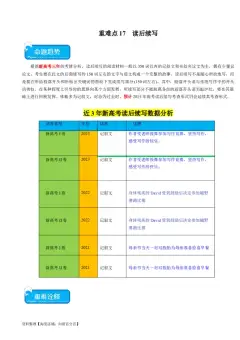
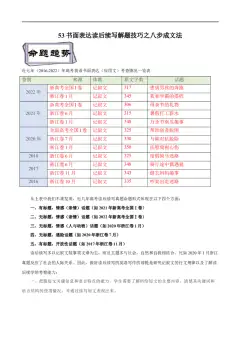
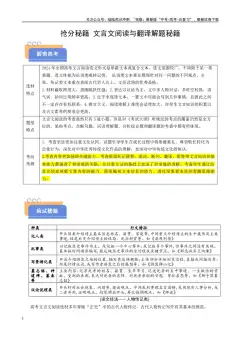
猜押 阅读理解记叙文
猜
押 词
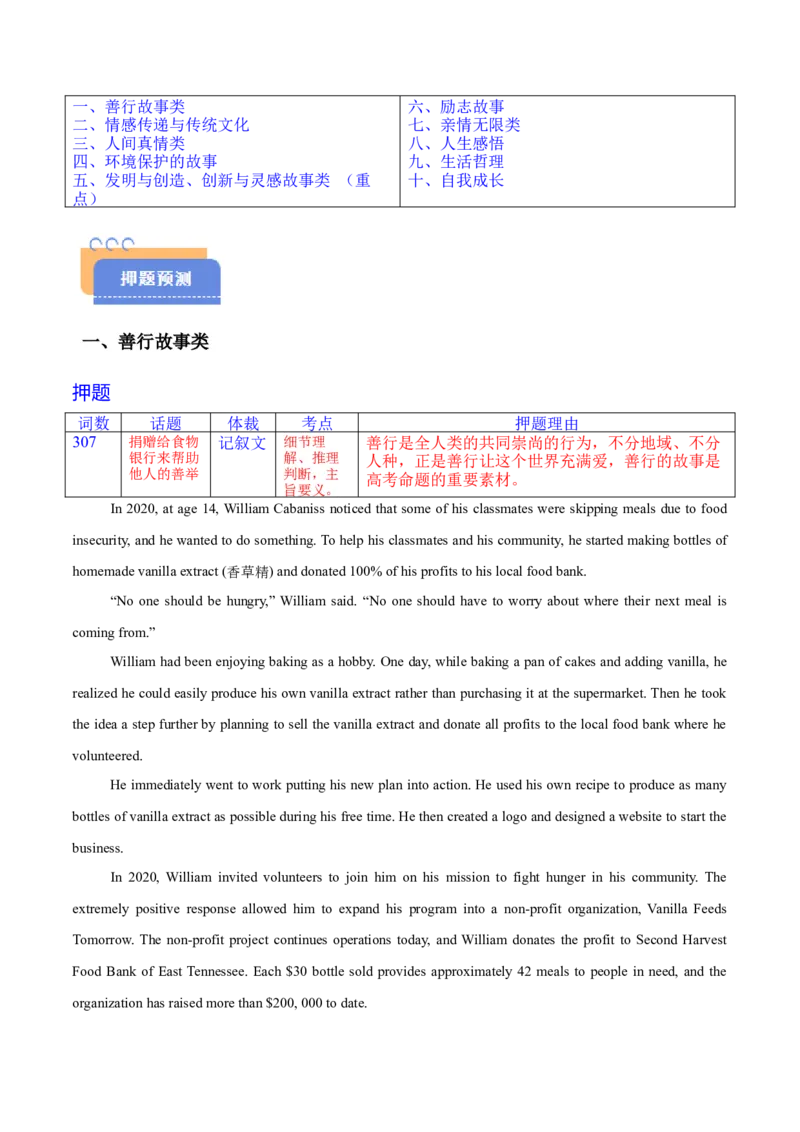
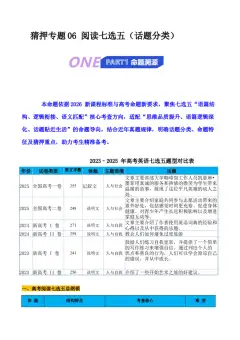
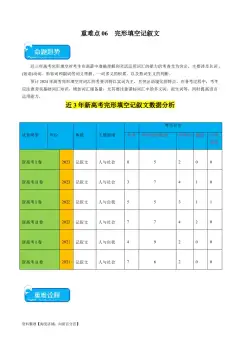
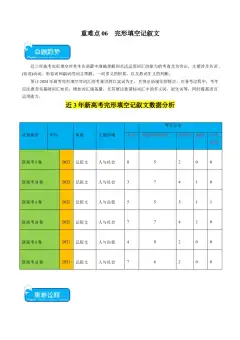
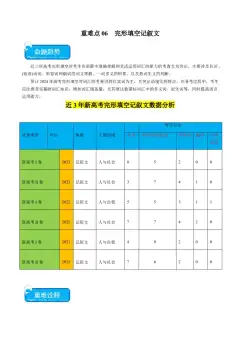
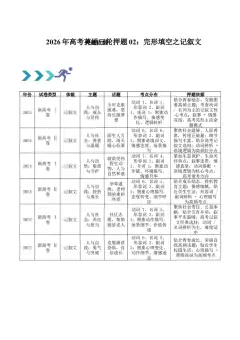
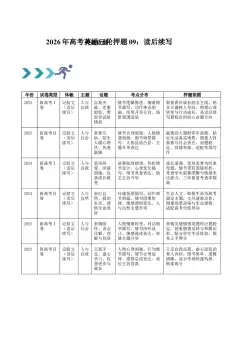
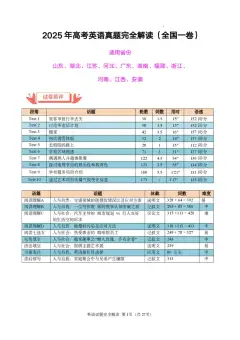
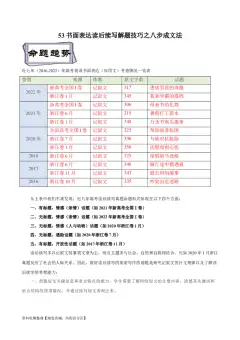
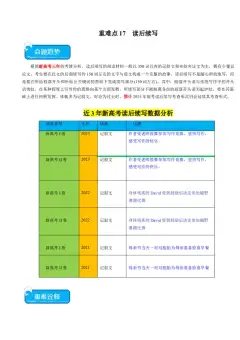
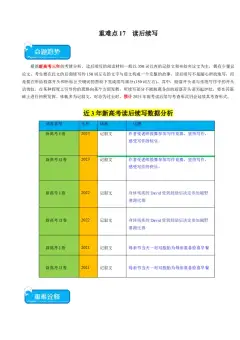
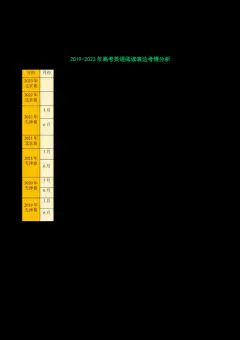
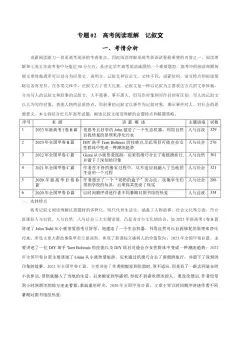
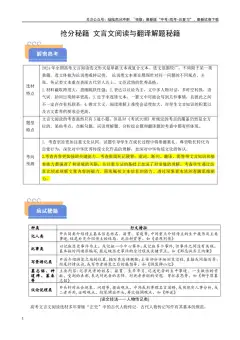
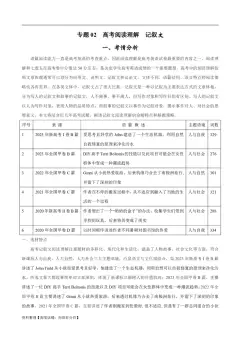
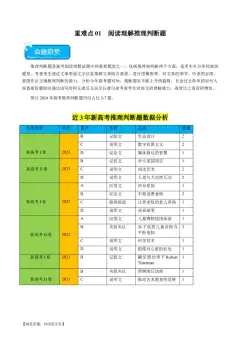
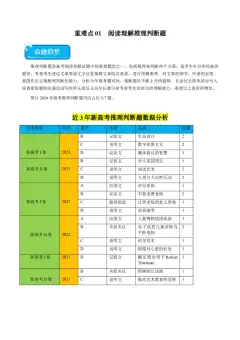
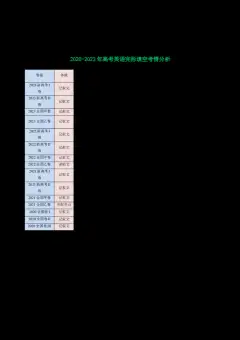
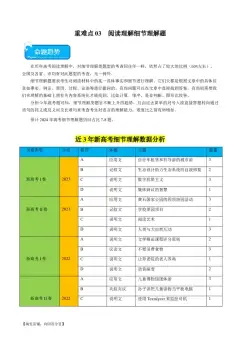
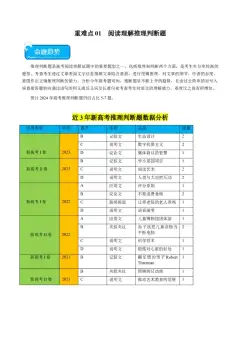
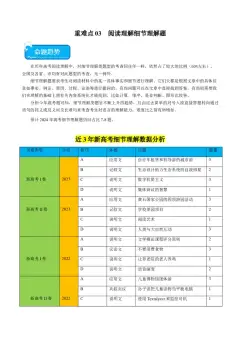
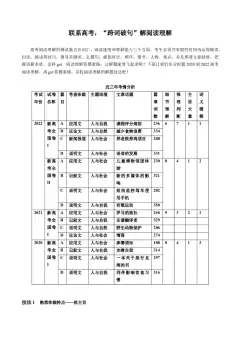
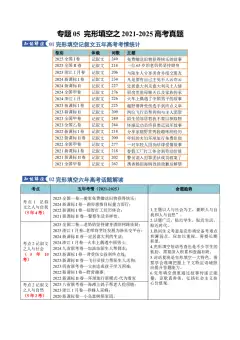
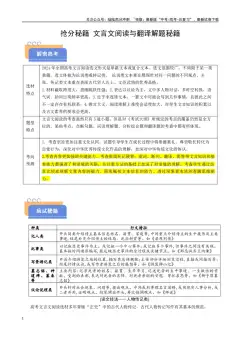
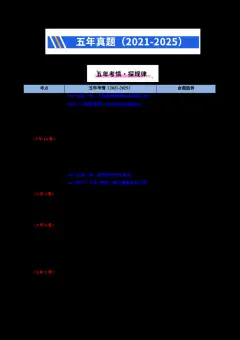
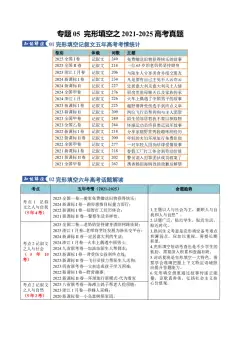
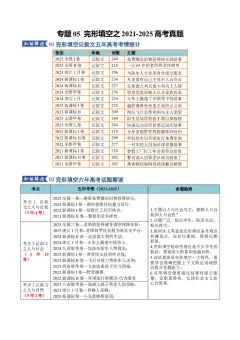
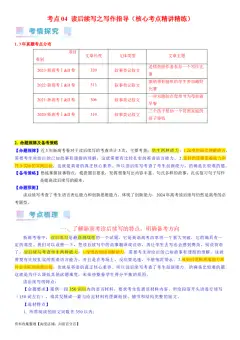
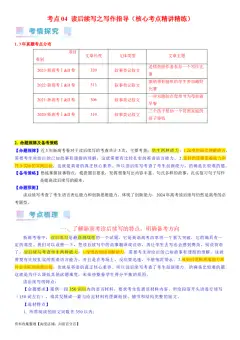
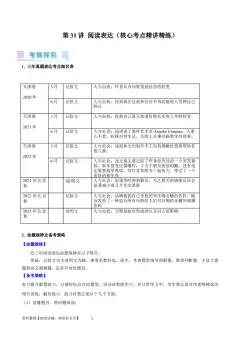
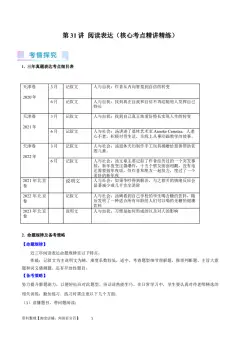
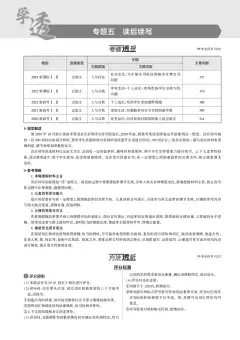
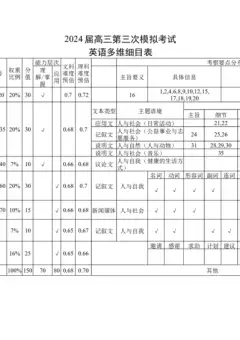
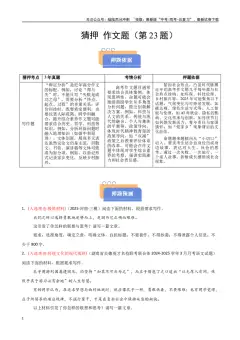
3年真题 话题 考情分析 押题依据
考 数
点
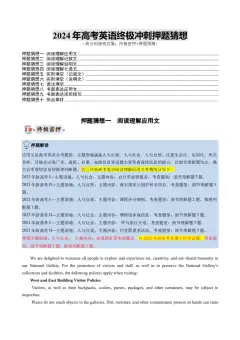
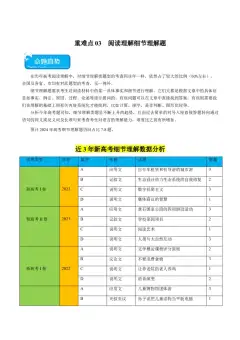
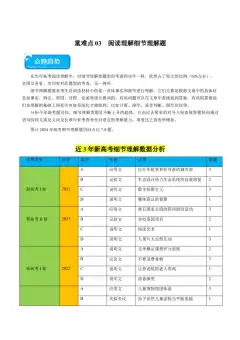
2024年新 兽 医 威 廉 · 法 伯 2024年新高考记叙文有以下
高考Ⅰ卷 (William Farber)博士在 特点:
阅读B篇 298 从针灸中受益后,将综
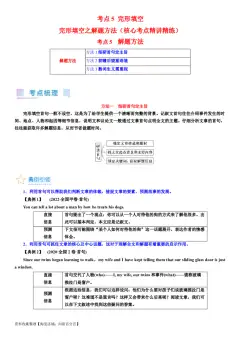
1、阅读理解记叙文细节理解题居
合医疗应用于动物的故
多,落实“定位原文”和“同义
事
替换”。
2024年新
2、阅读理解记叙文重视首尾段作 高考阅读理
高考Ⅱ卷
自动售货亭提供短篇故 用,尤其是标题概括题和写作意 解中的记叙文往
276
阅读B篇 事打印服务 图题。 往出现在阅读理
解的 B 篇位置,
3、猜词词义题注意运用“代入
试题命制难度适
法”“排除法”从逻辑性和褒贬
2023年新 John Todd 建造了 中。记叙文突出
性出发。
高考I卷阅 一个生态机器,利用自 特点:1.总结描述
336
读B篇 然可以自我修复的原理 4、文章寓意题选项字面意思和言 人物特征;2.描述
来净化污水 外之意与文章主旨结合,去伪存 作者对事件的态
真。 度和看法;3.对事
阅
读 2023年新 5、形容词适配题注意原文定位, 件的评价;4.总结
理 高考Ⅱ卷 学生通过体验乡村生 找到动词或形容词,确定最佳答 归纳文章标题
阅读B篇 273
解 活,对学生影响深远 案。
记
6、标题概括题既要注意文章线索
叙
“点睛”作用,还要注意首尾段
文 2022年新
呼应,
高考I卷
无 无
尤其是尾段主旨升华。记叙文
标题兼具概括性、新颖性和针对
性。
7、记叙文中推理判断题的特点:
①推断隐含意义——关键词句
2022年新 细推敲
高考Ⅱ卷
人与社会:把儿童 ②推断情感态度题——字里行
阅读B篇 325
读物误认平板电脑 间寻情愫
③推断写作意图——首尾结合
见意图
④推断人物性格——情节主旨
相结合
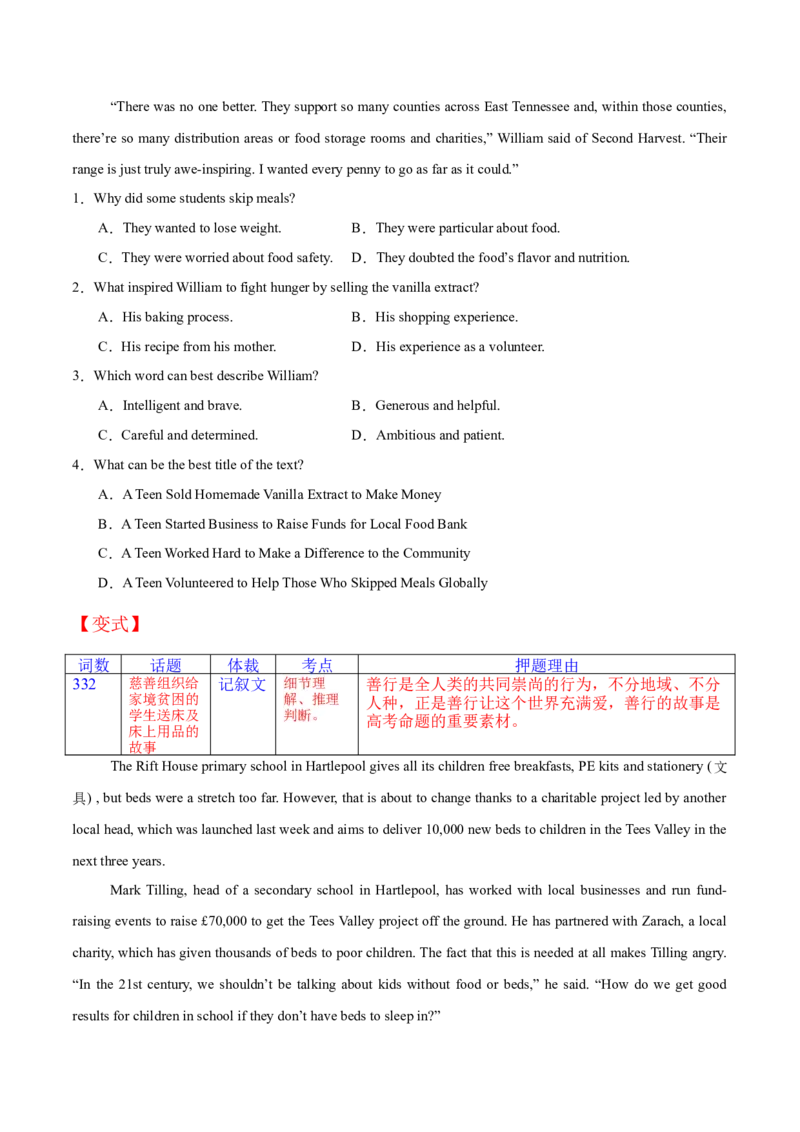
押题预测目录一、善行故事类 六、励志故事
二、情感传递与传统文化 七、亲情无限类
三、人间真情类 八、人生感悟
四、环境保护的故事 九、生活哲理
五、发明与创造、创新与灵感故事类 (重 十、自我成长
点)
一、善行故事类
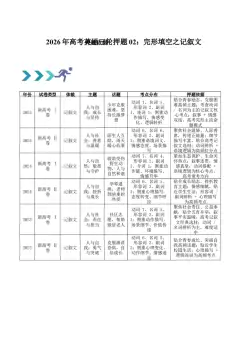
押题
词数 话题 体裁 考点 押题理由
307 捐赠给食物 记叙文 细节理 善行是全人类的共同崇尚的行为,不分地域、不分
银行来帮助 解、推理 人种,正是善行让这个世界充满爱,善行的故事是
他人的善举 判断,主
高考命题的重要素材。
旨要义。
In 2020, at age 14, William Cabaniss noticed that some of his classmates were skipping meals due to food
insecurity, and he wanted to do something. To help his classmates and his community, he started making bottles of
homemade vanilla extract (香草精) and donated 100% of his profits to his local food bank.
“No one should be hungry,” William said. “No one should have to worry about where their next meal is
coming from.”
William had been enjoying baking as a hobby. One day, while baking a pan of cakes and adding vanilla, he
realized he could easily produce his own vanilla extract rather than purchasing it at the supermarket. Then he took
the idea a step further by planning to sell the vanilla extract and donate all profits to the local food bank where he
volunteered.
He immediately went to work putting his new plan into action. He used his own recipe to produce as many
bottles of vanilla extract as possible during his free time. He then created a logo and designed a website to start the
business.
In 2020, William invited volunteers to join him on his mission to fight hunger in his community. The
extremely positive response allowed him to expand his program into a non-profit organization, Vanilla Feeds
Tomorrow. The non-profit project continues operations today, and William donates the profit to Second Harvest
Food Bank of East Tennessee. Each $30 bottle sold provides approximately 42 meals to people in need, and the
organization has raised more than $200, 000 to date.“There was no one better. They support so many counties across East Tennessee and, within those counties,
there’re so many distribution areas or food storage rooms and charities,” William said of Second Harvest. “Their
range is just truly awe-inspiring. I wanted every penny to go as far as it could.”
1.Why did some students skip meals?
A.They wanted to lose weight. B.They were particular about food.
C.They were worried about food safety. D.They doubted the food’s flavor and nutrition.
2.What inspired William to fight hunger by selling the vanilla extract?
A.His baking process. B.His shopping experience.
C.His recipe from his mother. D.His experience as a volunteer.
3.Which word can best describe William?
A.Intelligent and brave. B.Generous and helpful.
C.Careful and determined. D.Ambitious and patient.
4.What can be the best title of the text?
A.A Teen Sold Homemade Vanilla Extract to Make Money
B.A Teen Started Business to Raise Funds for Local Food Bank
C.A Teen Worked Hard to Make a Difference to the Community
D.A Teen Volunteered to Help Those Who Skipped Meals Globally
【变式】
词数 话题 体裁 考点 押题理由
332 慈善组织给 记叙文 细节理 善行是全人类的共同崇尚的行为,不分地域、不分
家境贫困的 解、推理 人种,正是善行让这个世界充满爱,善行的故事是
学生送床及 判断。
高考命题的重要素材。
床上用品的
故事
The Rift House primary school in Hartlepool gives all its children free breakfasts, PE kits and stationery (文
具) , but beds were a stretch too far. However, that is about to change thanks to a charitable project led by another
local head, which was launched last week and aims to deliver 10,000 new beds to children in the Tees Valley in the
next three years.
Mark Tilling, head of a secondary school in Hartlepool, has worked with local businesses and run fund-
raising events to raise £70,000 to get the Tees Valley project off the ground. He has partnered with Zarach, a local
charity, which has given thousands of beds to poor children. The fact that this is needed at all makes Tilling angry.
“In the 21st century, we shouldn’t be talking about kids without food or beds,” he said. “How do we get good
results for children in school if they don’t have beds to sleep in?”In the Tees Valley project, schools will refer families that they know are in need of a bed for their kids. A lot
of those they will be helping here are the working poor, who aren’t on benefits and don’t have any services
supporting them. Each new bed the charity gives out, designed to last the child for eight years, also comes with a
duvet (羽绒被) , bedding, new nightclothes and toiletries. McGrath, the project leader, explained, “Some parents
don’t have a washing machine to wash bedding, or they may struggle to get things dry in a house that is already
damp.” In Hartlepool, the first new beds went out to “delighted” children from the warehouse last week.
Eddie Huntington, an education expert, said that schools are in a good position to spot signs that families are
seriously struggling with poverty. “When other people can walk away, schools can’t,” he said. “Teachers and
pastoral (生活辅导的) workers in schools are now at the heart of social care, whether we like it or not.”
1.What does Mark Tilling think of kids lacking beds today?
A.Unacceptable. B.Doubtful. C.Strange. D.Awkward.
2.What can we know about the beds offered by Tees Valley?
A.They are mostly second-hand beds.
B.They are equally given to most families.
C.They are equipped with additional items.
D.They are designed for medium-height kids.
3.What role do teachers and pastoral workers play?
A.They manage financial aid programs.
B.They evaluate academic performances.
C.They organize after-class activities for students.
D.They help identify families in financial trouble.
4.In which column of a newspaper may the text appear?
A.Finance. B.Education. C.Health. D.Culture.
【变式2】
Many years ago, when Kimberly Godsey was training to become a nurse, she was doing rounds with a
physician named Dr. Joe Seibert.
It was an average day until they visited a patient who got a terminal (晚期的) cancer. Seibert did something
she’d never seen a physician do before. He picked up the phone and called her husband and said, “Hey, I’m worried
about your wife. Can you come up to the clinic?” Seibert asked his assistant to schedule all the tests and follow-ups
the woman would need. It’s a process that normally takes weeks, but the assistant scheduled the appointmentswithin an hour.
When they went back to the patient’s room to share the diagnosis (诊断), the woman received the news with
all her tests scheduled, and her husband by her side. Seibert told Godsey, “There will come a time when you can’t
save everybody. But what you can do is you can change how they experience it. ”
A few years passed and as Godsey went on to care for her own patients, she kept the doctor’s lesson in the
back of her mind. Then one day, Godsey’s mom began experiencing extreme pain. Godsey got a call from Seibert,
who had become her mother’s primary care doctor. And he said, “Hey Kim, I just saw your mom. It would be nice
if you could come.”
The next day, Seibert diagnosed her mom with cancer. Her mom received the news with her three children by
her side. And just as he had done with his terminal patient years ago, Seibert asked his assistant to schedule all of
Godsey’s mother’s follow-up appointments for the very same day.
“I take that lesson I learned from Dr. Seibert so many years ago into my personal life and into my
professional life every day,” Godsey said. “Because I’ve learned that it’s the little things that we can do that
actually can make a huge difference in how people experience life.”
1.How did Dr. Seibert respond when they visited the terminal cancer patiént?
A.He asked his assistant to leave the room. B.He didn’t talk about the patient’s condition.
C.He called the patient’s husband immediately.D.He scheduled the patient’s tests for weeks later.
2.Why did Dr. Seibert ask Godsey to attend her mother’s appointment?
A.He needed her to help make an accurate diagnosis.
B.He wanted her to support her mother at that time.
C.He was too busy to handle the appointment alone.
D.He wanted to teach her a new medical procedure.
3.What lesson did Godsey learn from Dr. Seibert?
A.Doctors should focus on curing diseases.
B.Terminal illnesses should be treated actively.
C.Family members need compassion in medical decisions.
D.Small acts can change how people experience difficulties.
4.What do we know about Dr. Seibert from the text?
A.He’s iron-willed. B.He’s open-minded.
C.He’s cool-headed. D.He’s warm-hearted.二、情感传递与传统文化
押题1
体
词数 话题 考点 押题理由
裁
317 意大利旅行者卡 记 细节理解、 有关传统文化和情感的故事经常出现在高考命题
马罗塔重走马 叙 推理判断、 中。
可・波罗之路,
文
词句猜测。
沿古丝绸之路徒
步到中国,见证
丝路变迁
On April 26th, 2022, Italian traveler Vienna Cammarota set off from Venice, the hometown of the
encouraging explorer Marco Polo, with the ambition of retracing his route to China along the ancient Silk Road on
foot.
With a simple backpack and two trekking poles, 74-year-old Cammarota covered over 20, 000 km and
passed through dozens of countries. The moment she set foot in China on August 29th, she was warmly greeted by
people who put on traditional dance and singing performances for her arrival via Xinjiang Uygur Autonomous
Region. From Xinjiang, Cammarota embarked on a 15-month cultural journey across China and explored over 30
cities in 17 provinces and autonomous regions. Her journey will come to an end in Beijing to mark the 750th
anniversary of Marco Polo’s arrival in China.
Throughout her journey, Cammarota witnessed the transformation of the ancient Silk Road into a corridor of
economic and cultural exchange, saying “I have seen the bridges. highways, and railways built under China’s Belt
and Road Initiative (BRI) , which connect countries in a way that echoes the Silk Road’ s historic role in facilitating
trade and cultural exchange. ” Cammarota reached Tajikistan, where she visited the China-Tajikistan highway
project. The infrastructure project, once completed, was expected to enhance regional connectivity and bring new
opportunities.
For Cammarota, this journey was more than retracing Marco Polo's footsteps. She hoped her travels would
help people in Italy and the West see the true beauty and greatness of China.
“This is a land filled with numerous UNESCO heritage sites, cutting-edge technology, and a harmonious
balance between urban development and natural preservation, ” Cammarota said.
Describing herself as an ambassador of cultural exchange and modern-day Marco Polo, Cammarota noted, “I
want to know about Marco Polo and the Silk Road, but I also want to send a message to women of my age—it’s
never too late to pursue your dreams. ”
1.What encouraged Cammarota to walk along the Silk Road?A.Marco Polo’s travelling experience. B.The transformation of the Silk Road.
C.Her love for adventure and exploration.D.Her desire to promote cultural exchange.
2.What does the underlined phrase “embarked on” mean in paragraph 2?
A.Changed. B.Started. C.Accomplished. D.Continued.
3.Which of the following is NOT witnessed by Cammarota in China?
A.The traditional performances. B.The friendliness of Chinese people.
C.The China-Tajikistan highway project. D.The infrastructures built under the BRI.
4.Which of the following can best describe Cammarota?
A.Cautious and persistent. B.Courageous and intelligent.
C.Generous and adaptable. D.Adventurous and ambitious.
押题2
体
词数 话题 考点 押题理由
裁
292 讲述了Ghaffar 记 细节理解、 有关传统文化和情感的故事经常出现在高考命题
Pourazar与京剧 叙 推理判断、 中。
的深厚渊源及传 文 主旨大意。
播贡献
An internationally praised cultural thing has introduced the attractive tale of Sun Wukong to audiences
worldwide. But for Ghaffar Pourazar, a British-American dual citizen living in California; this legendary figure has
been a part of his identity for decades.
Pourazar’s lifelong passion for Peking Opera began by chance. In 1993, Pourazar attended a performance at
London’s Queen Elizabeth Hall and was instantly captured. He went backstage right after the show and made
friends with the Chinese performers. With their help, Pourazar was enrolled at an opera school. Just three months
later, he left his life in Britain behind and. moved to Beijing to train in the martial roles of the art.
Starting as ar r adult was not easy, as Peking Opera is a complex mixture of vocal performance, mime,
martial arts, dance and acrobatics. In addition to the physical demands, mastering the Chinese language posed
another problem. “I was constantly reciting the subtitles and. songs, whether I was eating, bathing, walking, or even
dreaming,” Pourazar said.
Pourazar believes that great art transcends (超越) languages. Over the years, he has devoted himself to
introducing Peking Opera and Sun Wukong to international audiences. He has also been teaching courses and
organizing workshops in the United-States, bringing Peking Opera to curious Western learners. To better connectwith. Western audiences and learners, he adapted some classic plays such as The Monkey King: Uproar in Heaven
into English versions and he also adapted Shakespeare’s A Midsummer Night’s Dream into-Peking Opera.
In recognition of his contributions, Pourazar received the Great Wall Friendship Award from the Beijing
government in 2014. “Cultural exchange should be reciprocal. I aim to blend my expertise m opera with my
multicultural background to create enriching artistic experiences for the audiences,” said Pourazar.
1.What is the author’s intention of writing paragraph 1?
A.To prove Ghaffar Pourazar’s achievement.
B.To introduce a cultural influence on an individual.
C.To explain the cultural significance of Sun Wukong.
D.To highlight the fascination of ancient Chinese tales.
2.What do we know about Pourazar’s experience of learning Peking Opera?
A.Language was a significant barrier for him.
B.The performers he met backstage taught him the art.
C.Queen Elizabeth made him interested in Peking Opera.
D.His enthusiasm for Peking Opera started at an early age.
3.What is paragraph 4 mainly about?
A.His great love for Peking Opera.
B.His amazing performance on stage.
C.His belief in performing Peking Opera.
D.His contribution to spreading Peking Opera.
4.Which of the following words best describe Pourazar?
A.Persistent and gentle. B.Humorous and charming.
C.Traditional and cautious. D.Determined and innovative.
【变式】
体
词数 话题 考点 押题理由
裁
326 2009年一次参观 记 细节理解、 有关传统文化和情感的故事经常出现在高考命题
孔庙的经历以及 叙 推理判断。 中。
过程中的感悟 文
Last month, I finished my Level 2 Chinese lessons. With the next course starting only next spring, I decided
to visit the Confucius Temple in Beijing. The streets were crowded with tourists on that day. As I entered it, I
realized it was my second visit, the first being a rushed trip in 2009.This visit felt new, and I was impressed by the statue of Confucius at the entrance where a family was taking
photo. The temple grounds were quiet, with ancient trees providing shade and a sense of peace. I wandered through
the halls, each filled with historical artifacts (文物) and inscriptions (铭文) .
In one hall, I found a group of students practicing calligraphy. They were diligently copying Confucian texts,
their brushes moving gracefully across the paper. Watching them, I felt inspired to continue my own studies in
Chinese. The dedication and focus they showed reminded me of the importance of persistence in learning.
As I moved through the temple, I came across a small courtyard where a monk was giving a talk about the
teachings of Confucius. He spoke about the value of kindness, respect, and lifelong learning. His words resonated
with me, and I took a moment to reflect on how these principles could be applied to my own life.
After the talk, I explored the library and felt humbled by its knowledge preserved in this place. Before
leaving, I sat by a pond in the temple garden, watching the koi (锦鲤) fish swim lazily in the water. The quietness
of the scene was a perfect end to my visit. I felt grateful for the opportunity to connect with history and culture in
such a meaningful way.
As I left the temple, I promised myself to return again, perhaps after completing my next level of Chinese
lessons. The visit had not only enriched my understanding of Confucianism but also deepened my appreciation for
the journey of learning itself.
1.What can be inferred about the author’s feelings at the Confucius Temple?
A.The author felt peaceful and inspired.
B.The visit was repetitive and uninteresting.
C.The author didn’t care about Confucius’ teachings.
D.The author was disappointed by the few historical artifacts.
2.What is the author’s attitude towards learning when watching the students’ practice?
A.The author likes learning via modern technology.
B.The author holds that learning should be done alone.
C.The author treasures diligence and endurance in learning.
D.The author considers learning is effective only in a classroom.
3.Why did the author pay a visit to the Temple after Chinese lessons?
A.To relax from studying.
B.To get in touch with Chinese culture and history.
C.To meet other students and explore the library.
D.To practice Chinese with tourists and practise his calligraphy.4.What is the author’s main writing purpose?
A.To stress the importance of Confucian teachings in modern education.
B.To summarize the Confucius Temple’s history and cultural significance in China.
C.To highlight the architectural charm and relics in the Confucius Temple.
D.To share a personal experience and how it affects his view on learning.
三、人间真情类
押题
体
词数 话题 考点 押题理由
裁
326 Meg Medina与她 记 细节理解、 人间真情故事经常出现在高考命题中。
深爱的保姆Miuut 叙 推理判断。
之间的故事 文
In her new children’s book No More Mimi. Meg Medina recalled her beloved babysitter Miuut. She was a
wonderful babysitter but kind of a pain in the neck, as well-Medina says you could look at the things on her coffee
table, but you definitely couldn’t touch them. “She felt this was a very important skill,” she says. “We used to stand
at that table and she'd have us practice, like putting our hands behind our back, and you could lean (倾斜) forward
and look at all the pretty things.”
When Medina was five years old, her grandmother came to take care of her. She started out super excited
that her grandmother was coming. “I bet grandma will let me play whenever I want,” Medina told Mimi excitedly
and she shared this news with her teacher until she realized that a new babysitter meant no more Mimi. Brittany
Cicchese, the illustrator of the book, painted this moment with her soft style-Medina sat under the table and curled
up with a blanket, whispering sadly to her dog, “No more Mimi.”
Luckily, Mimi went exactly nowhere. She became friends with Medina’s grandmother, and they’d often
drink coffee together. “She loved us,” says Medina. Mimi stayed a part of her life forever. “I hold a space for her in
my heart,” she says. “Mimi is not buried very far from my real grandmother in Flushing, Queens”. She wrote this
children’s book in her honor.
So many people raise kids. There are our parents, of course, but also elder brothers and sisters, teachers,
cousins, librarians, and neighbors. It’s easy to forget just how ma people have a role in helping raise us.
“It feels good to know that there’s this story for kids right now, but that there’s a piece of this story that’s also
about remembering these wonderful women who helped raise us,” says Medina. “It feels like we’re paying them
honor. You know, we’re just honoring their memory.”1.What does the underlined part “a pain in the neck” in paragraph 1 mean?
A.Annoying. B.Painful. C.Dangerous. D.Impatient.
2.What can we learn from Brittany Cicchese’s description?
A.Medina was deeply attached to Mimi.
B.Mimi finally finished her job and left.
C.Mimi regretted taking care of Medina.
D.Medina came down with a severe cold.
3.Which of the following best describes Mimi?
A.Grateful and lively. B.Humorous and shy.
C.Kind and curious. D.Strict and caring.
4.What is the purpose of the author in writing the book?
A.To share stories of a babysitter.
B.To obtain a name in her career.
C.To propose life advice for kids.
D.To appreciate others' kindness.
【变式】
体
词数 话题 考点 押题理由
裁
303 犀牛Daisy和小斑 记 细节理解、 人间真情故事经常出现在高考命题中。
马Modjadji被救 叙 推理判断。
助、在庇护所相 文
遇并相互陪伴的
故事
When a baby rhino (犀牛) was found weak and alone in a national park in South Africa, she, a lucky rhino.
was immediately transported to the ICU at Care for Wild Rhino Sanctuary (庇护所). At only a few hours old, she
was struggling to survive. She needed round-the-clock care and treatments to boost her weak immune system.
Getting healthy hasn’t been easy, but she hasn’t had to go on this journey alone.
The baby rhino arrived at the shelter in December and was named Daisy, but another injured animal had
already arrived the month before. It was a baby zebra named Modjadji. Although she isn’t the same species, she
understands what Daisy has been through. Modjadji was admitted to the shelter’s ICU at the end of November after
being found motionless and barely breathing on the reserve after heavy rains and storms. Modjadji was thought to
be only a week old.Unlikely as their friendship may seem, Daisy and Modjadji were quick to form a deep connection. As they
grew stronger and braver, their curiosity got the best of them, and they started interacting with each other. Rhinos
are very social animals and require companionship. Modjadji is fantastic company for Daisy and very affectionate
toward her. From drinking milk out of bottles to “helping” some of the workers with their paperwork, these
adorable friends just love being around each other.
We can’t get over how cute they are — and neither can the fans they’ve got on the local social media, where
they love to give updates on this fantastic duo (搭档)! Once Daisy and Modjadji are healthy enough, the shelter will
let them go so they can live freely with their fellow rhinos and zebras. But until that day comes, these girls have no
problem being each other’s family.
1.Why did the author think Daisy was lucky?
A.Though in danger, she was rescued and treated in time.
B.Weak as she was, she was able to recover on her own.
C.She was in good health when found in the national park.
D.She could improve her immune system all by herself.
2.What can we learn about Modjadji in the second paragraph?
A.She is younger than Daisy.
B.She was abandoned by her mother.
C.She came to the shelter later than Daisy.
D.She was in poor condition when brought to the shelter.
3.Which of the following contributes to the friendship between Daisy and Modjadji?
A.They share one bottle of milk.
B.Daisy is in great need of companionship.
C.They belong to the same species that is social.
D.Modjadji often helps with the paperwork of the workers.
4.What can be inferred from the last paragraph?
A.Daisy and Modjadji have both recovered.
B.The shelter will share more details about Daisy and Modjadji.
C.Daisy and Modjadji will return to the place where they lived later.
D.Many fans are helping find their family for Daisy and Modjadji.
四、环境保护的故事押题
词
话题 体裁 考点 押题理由
数
307 Mike组织同学 记叙 细节理 随着全球环境问题日益严峻,环境保护已成为社会关注的焦
清理公园垃 文 解、推 点。在各类考试中,环境保护类文章频繁出现在阅读理解部
圾、发起植树 理判 分,旨在考查学生对环境问题的认知、分析和解决能力。押题
活动并推动学 断。 环境保护类文章的理由主要有以下几点:
校食堂使用环 社会热点:气候变化、污染治理、资源枯竭等环境问题是当前
保餐具的故事 全球面临的重大挑战,相关话题具有高度的时效性和社会影响
力。
政策导向:各国政府和国际组织不断推出环保政策和倡议,推
动社会向可持续发展转型,相关文章能够反映政策背景和实际
应用。
学科交叉:环境问题涉及科学、经济、社会等多个领域,阅读
理解文章常以跨学科视角呈现,考查学生的综合分析和逻辑思
维能力。
价值观引导:环境保护类文章传递生态文明理念,培养学生对
自然的敬畏感和责任感,符合教育立德树人的目标。
实践应用:文章内容常结合实际案例或解决方案,帮助学生理
解环保行动的重要性和可行性,提升实践能力。
因此,押题环境保护类文章不仅有助于学生应对考试,还能增
强其环保意识和社会责任感,为未来的可持续发展贡献力量。
On a chilly March morning, 16-year-old Mike stood at Willow Park’s entrance, shocked by the scene before
him. Plastic bags hung like worn flags from tree branches, rusty soda cans littered the ground, and a duck struggled
to free its leg from a soda can ring. He immediately texted classmates: “Emergency clean up this Saturday! Our
park needs us!” By noon, 18 students had joined “Operation Green Rescue”.
Under a rainy sky, volunteers worked tirelessly. They sorted trash into color-coded bins — blue for glass,
green for aluminum, and gray for non-recyclables. “Turtle eggs under these cans!” shouted Emma, uncovering a
nest beneath debris. By dusk, they had cleared 237 pounds of waste, filling three pickup trucks. A local baker
rewarded them with organic snacks, declaring, “You’re revived our park!”
A week later, Mike’s club screened Vanishing Forests, a documentary revealing rainforests disappearing at
30 football fields per minute. Maria wiped tears while apes held onto trees being cut down. “We must act,” Mike
urged. The club launched “Project Releaf” selling seed paper bookmarks and organizing “Bike-to-School Fridays”
Funds planted 45 oak saplings. “These trees will strengthen the ecosystem by absorbing 200 pounds of carbon
annually,” their teacher explained.
Mike’s toughest battle was cafeteria reform. Displaying jars of 1, 800 plastic forks collected monthly, he
faced cost objections. “ego-cutlery costs 25 % more,” the manager argued. Determined, Mike presented long-term
savings charts. After six debates and 500 + signature, ego-friendly utensils (餐具) were approved. Plastic use
dropped 78 %, earning the school a “Green Innovator” award and recognition for promoting sustainable practiced.
Today, families picnic under new trees with bamboo plates, while kids study recycling morals. Now anenvironmental science major, Mike reflects: “Sustainable change begins when ordinary people refuse to ignore one
piece of trash.” His story, carved on a park plague, inspires visitors daily.
1.What did volunteers do with aluminum cans during the clean up?
A.Sold them to a recycling company. B.Placed them in green bins.
C.Used them for art projects. D.Buried them in the park.
2.What can be inferred about the documentary Vanishing Forests?
A.It criticized government policies. B.It was filmed by the school club.
C.It focused on ocean plastic pollution. D.It inspired empathy and practical actions.
3.What does the cafeteria manager’s initial reaction imply?
A.They disliked student proposals. B.They lacked environmental knowledge.
C.They valued short-term costs over long-term benefits. D.They opposed all changes.
4.Which quality best described Mike’s character?
A.Persistent. B.Optimistic. C.Stubborn. D.Skeptical.
【变式】
词 体
话题 考点 押题理由
数 裁
332 Duncan 记 细节理 随着全球环境问题日益严峻,环境保护已成为社会关注的焦点。在各类
Jurman从 叙 解、推 考试中,环境保护类文章频繁出现在阅读理解部分,旨在考查学生对环
小对蝴蝶 文 理判 境问题的认知、分析和解决能力。押题环境保护类文章的理由主要有以
产生兴 断、主 下几点:
趣,并通 旨大 社会热点:气候变化、污染治理、资源枯竭等环境问题是当前全球面临
过创建蝴 意。 的重大挑战,相关话题具有高度的时效性和社会影响力。
蝶友好型 政策导向:各国政府和国际组织不断推出环保政策和倡议,推动社会向
花园、发 可持续发展转型,相关文章能够反映政策背景和实际应用。
起保护蝴 学科交叉:环境问题涉及科学、经济、社会等多个领域,阅读理解文章
蝶运动的 常以跨学科视角呈现,考查学生的综合分析和逻辑思维能力。
故事 价值观引导:环境保护类文章传递生态文明理念,培养学生对自然的敬
畏感和责任感,符合教育立德树人的目标。
实践应用:文章内容常结合实际案例或解决方案,帮助学生理解环保行
动的重要性和可行性,提升实践能力。
因此,押题环境保护类文章不仅有助于学生应对考试,还能增强其环保
意识和社会责任感,为未来的可持续发展贡献力量。
Duncan Jurman became interested in butterflies when he was around 5 years old. He noticed a couple of
caterpillars (毛虫) in his backyard and was attracted by the different ways that caterpillars can disguise (伪装)
themselves to stay safe in potentially dangerous surroundings. From there, he started to learn more about
caterpillars and butterflies.
Jurman believes that butterflies play a crucial role in our ecosystems. They’re very low on the food web, so
they support a lot of different species that rely on them. They’re an indicator species for the health of theenvironment. Once they disappear, everything else is soon to follow.
Jurman’s goal is to transform the landscape of Florida’s Broward County by turning a weedy suburb into a
lively butterfly reserve at a time when insect populations are decreasing quickly worldwide. Jurman believes that
every flower planted is a potential home and source of food for caterpillars and butterflies. He eventually developed
a butterfly-friendly garden in his backyard by researching the different plants that butterflies prefer. He has already
raised and released more than 5,000 butterflies from his garden.
Jurman also launched the Bring Butterflies Back campaign to educate people about butterflies and invite
them to join his cause of protecting butterflies. He said that a lot of people are surprised to learn that insects are
declining at such an alarming rate, largely because the decline has been so gradual. This phenomenon helps to
explain why people are unwilling to take meaningful actions to save the environment.
In 2018, Jurman helped to build a butterfly garden at his high school. The garden has had a regenerative
effect on the surrounding environment-birds, native lizards, and other insects have returned in great numbers. Other
schools have been inspired to start gardens. “I don’t know if we can ever reach the point that we were once at with
butterflies, but I think that if everyone gets involved and starts their own garden, they can make their own impact,”
Jurman said.
1.What does paragraph 2 mainly talk about?
A.The food chain of insects. B.The competition between species.
C.The potential danger to butterflies. D.The vital role of butterflies in nature.
4.Why did Jurman create a butterfly-friendly garden?
A.To teach people about butterflies. B.To study butterflies’ favorite plants.
C.To increase the number of butterflies. D.To improve the beauty of his backyard.
3.Which shows the phenomenon mentioned in the text?
A.People’s unawareness of environmental changes.
B.The impact of human activities on insect habitats.
C.The rapid decline of butterfly populations worldwide.
D.The process of transforming natural landscapes into reserves.
4.What can be inferred from Jurman’s words in the last paragraph?
A.More gardens are built to increase the number of other insects.
B.Jurman is pessimistic about the future of the butterfly population.
C.It’s impossible to restore the butterfly population to their previous levels.
D.People’s joint efforts can have a great impact on the butterfly population.五、发明与创造、创新与灵感故事类 (重点)
押题1
词
话题 体裁 考点 押题理由
数
330 Shastri从小对 记叙 细节理 发明创造与创新类文章是阅读理解中的热门题材,押题此类文
光的兴趣,到 文 解、主 章的理由如下:
后来研究光子 旨大 时代背景:科技创新是推动社会进步的核心动力,人工智能、
计算,并取得 意。 大数据、新能源等领域的突破性成果备受关注,相关文章具有
成就的过程 高度时效性和前沿性。
学科融合:发明创造类文章常结合科学、技术、工程、数学
(STEM)等多学科知识,考查学生的跨学科理解能力和逻辑
思维。
价值观塑造:创新精神是现代社会的重要品质,此类文章能够
激发学生的探索欲望和创造力,培养他们不畏挑战、勇于尝试
的品格。
实用价值:文章内容常涉及创新对社会、经济、生活的影响,
帮助学生理解科技如何改变世界,并启发他们思考如何将创新
应用于实际问题。
考试趋势:近年来,各类考试越来越注重考查学生的创新思维
和解决问题的能力,发明创造类文章成为命题的首选题材之
一。
押题此类文章不仅有助于学生提升阅读理解能力,还能拓宽视
野,激发创新思维,为未来的学习和生活奠定基础。
Bhavin Shastri’s interest in light started young. He recalls an experiment that he saw as a child: A plastic
water bottle was stuck near its base such that a steady stream of water flowed out and downward under the force of
gravity. A light shined through the hole in the bottle and, to Shastri’s amazement, it didn’t continue on a horizontal
path. Instead, it bent downward with the stream of water. “I was just so completely blown away by this
experiment,” he says.
Since then, Shastri has been thinking about how light can be controlled, while also exploring other research
interests. In college, he worked with a professor who was researching machine learning. As a postdoc at Princeton
University, Shastri met physicist Paul Prucnal. He told Shastri about his research creating a light that behaves like a
biological neuron (神经元), and how the team was looking to compute with such light. That idea caught Shastri’s
attention.
Though researchers have used light to send, store and process data in the lab, photonic (光子的) computing
is still at its early stage. Shastri has set out to push those boundaries. He engineers, builds and performs experiments
on chip-sized (芯片大小的) photonic devices. His team began by studying simpler devices similar to a single
neuron, analyzing how they could function like a biological neuron. Years later, in a yet-to-be-published work, the
researchers have demonstrated that a chip with 100,000 neuronlike components can perform 120 billion operationsper second, about 40 times faster than the average electronic computer.
Daniel Brunner, a computing researcher at FEMTO-ST Institute, praised Shastri’s groundbreaking work. “I
can’t even count the publications where he basically laid the foundation” for using photonics to create physical
neural networks, Brunner says.
Shastri may be set on transforming computing, but his work is motivated by a decades-old fascination with
light and its properties. “I have been very lucky to be able to do something,” he says, “that has always been my
childhood dream.”
1.What attracted Shastri most about the experiment in paragraph 1?
A.Effects of gravity on objects. B.Properties of plastic products.
C.The pressure of flowing water. D.The phenomenon of light bending.
2.What did Prucnal inspire Shastri to do?
A.Take an interest in light. B.Analyse the function of neurons.
C.Research into photonic computing. D.Learn about machine learning.
3.What is paragraph 3 mainly about?
A.Challenges Shastri faces in developing the chip.
B.The practical application of photonic computing.
C.The computing performance of electronic computers.
D.Achievements Shastri’s team makes in photonic computing.
4.Which of the following is the best title for the text?
A.The Wonders of Light B.The Light Pursuer’s Journey
C.In the Footsteps of Scientists D.Development of Computing Technology
押题2
词
话题 体裁 考点 押题理由
数
368 威廉发明风车 记叙 细节理 随着全球环境问题日益严峻,环境保护已成为社会关注的焦
的故事 文 解、推 点。在各类考试中,环境保护类文章频繁出现在阅读理解部
理判 分,旨在考查学生对环境问题的认知、分析和解决能力。押题
断、主 环境保护类文章的理由主要有以下几点:
旨大 社会热点:气候变化、污染治理、资源枯竭等环境问题是当前
意。 全球面临的重大挑战,相关话题具有高度的时效性和社会影响
力。
政策导向:各国政府和国际组织不断推出环保政策和倡议,推
动社会向可持续发展转型,相关文章能够反映政策背景和实际
应用。
学科交叉:环境问题涉及科学、经济、社会等多个领域,阅读
理解文章常以跨学科视角呈现,考查学生的综合分析和逻辑思
维能力。价值观引导:环境保护类文章传递生态文明理念,培养学生对
自然的敬畏感和责任感,符合教育立德树人的目标。
实践应用:文章内容常结合实际案例或解决方案,帮助学生理
解环保行动的重要性和可行性,提升实践能力。
因此,押题环境保护类文章不仅有助于学生应对考试,还能增
强其环保意识和社会责任感,为未来的可持续发展贡献力量。
William had worked hard to pass the exams to enter high school. When the term began, however, his father
told him that there was no money to pay for his school fees because of the summer drought. Still, William wanted
to learn.
He made the village library his school. One day, he found a book called Using Energy. On the book’s cover
was a picture of windmills, tall steel towers with blades (叶片) spinning like giant fans. He learned that wind —
something of which his hometown had plenty — could produce electricity.
He couldn’t help picturing his own windmill in mind, but collecting the parts and tools he needed would take
months. In a junkyard, he dug through piles of used metal, old cars, and worn-out tractors, searching for anything
that might help him construct his machine. He made four-foot-long blades from plastic pipe, which he melted over
a fire, flattened out, and hardened with bamboo poles.
Earning some money, he paid a blacksmith to attach the piston (活塞) to the pedal sprocket (踏板链轮) of an
old bicycle frame. This would be the axle (轮轴) of the windmill. When the wind blew, the spinning blades would
turn the bicycle wheel and spin a small dynamo (发电机), donated by his friend.
When he had collected all the parts, William began putting them together. He fixed the blades to the tractor
fan he found, using washers (垫圈) he’d made from bottle caps. Next he pushed the fan onto the piston joint to the
bicycle frame. With the help of his two best friends, William built a 16-foot-tall tower from trunks of trees and
lifted the ninety-pound windmill to the top.
The big moments eventually came. He climbed up the tower and connected two wires that held a small bulb.
As the wind whipped around him, the blades began to turn, slowly at first, then faster and faster. The light bulb
flickered (闪烁), then flashed to life. The crowd cheered from below. “Wachitabwina (well done)!”
William’s machine now powered his house. And the story of the boy who’d built a power-generating
windmill to rescue his family from the drought spread across the Internet.
1.After reading Using Energy, what did William decide to do?
A.Learn to survive a drought. B.Make use of wind.
C.Build a village library. D.Enter a high school.
2.According to Para.3, which of the following word can best describe William?A.Determined. B.Cooperative. C.Humorous. D.Optimistic.
3.What can you learn about William’s machine?
A.It was built by villagers. B.It was made from metal materials.
C.It took him years to complete it. D.It worked at the first attempt.
4.What is the best title for the passage?
A.Windmills for Villages B.Ideas Worth Spreading
C.Winds Of Hope D.Learning from Experience
【变式1】
词
话题 体裁 考点 押题理由
数
321 化学家 记叙 细节理 发明创造与创新类文章是阅读理解中的热门题材,押题此类文
Robert Hamers 文 解、推 章的理由如下:
发现有独特森 理判 时代背景:科技创新是推动社会进步的核心动力,人工智能、
林状图案的晶 断。 大数据、新能源等领域的突破性成果备受关注,相关文章具有
体 的故事 高度时效性和前沿性。
学科融合:发明创造类文章常结合科学、技术、工程、数学
(STEM)等多学科知识,考查学生的跨学科理解能力和逻辑
思维。
价值观塑造:创新精神是现代社会的重要品质,此类文章能够
激发学生的探索欲望和创造力,培养他们不畏挑战、勇于尝试
的品格。
实用价值:文章内容常涉及创新对社会、经济、生活的影响,
帮助学生理解科技如何改变世界,并启发他们思考如何将创新
应用于实际问题。
考试趋势:近年来,各类考试越来越注重考查学生的创新思维
和解决问题的能力,发明创造类文章成为命题的首选题材之
一。
押题此类文章不仅有助于学生提升阅读理解能力,还能拓宽视
野,激发创新思维,为未来的学习和生活奠定基础。
When chemist Robert Hamers cracked (打开) open the cup he had used to heat a brew of’ metal crystals (晶
体) , he was greeted with something special: a wonderful small forest in deep shades of green.
The cobalt-containing crystals he had been growing for two weeks in a tool had vined their way upward from
the base in a surprisingly familiar pattern and shade to match. It looked as if tiny elm trees, surrounded by shrubs
and hedges, had been skillfully drawn inside the egg-shaped cup.
“I was completely awestruck,” said Hamers. “What really surprised me was, you look at it and you see a
trunk is growing down from the bottom, and there are branches, and they are pretty well resolved.”
Hamers had set out to grow “a very large” crystal of lithium cobalt dioxide (二氧化钴锂) , the material used
in the batteries powering mobile phones, laptops, video cameras, and other electronic devices. He planned to use itto develop a fingerprint of the chemical in nature, through a technique known as Fourier-transform infrared
spectroscopy. Once developed, the fingerprint could be used to scan landfill sites and other environments for the
leaked chemical from discarded (丢弃的) batteries, tracing the chemical to its end of life.
There was a long lead up time to cracking open the sealed cup. First, a few bits of lithium cobalt oxide were
put inside, an ink-black powder to the eye. Extremely high temperatures are required, reaching beyond 1,292
degrees Fahrenheit. Then the cooling begins: Larger crystals only form if the cooling period is extremely slow — in
this case the scientists gave it two weeks. Ultimately, the experiment failed: The crystals that grew inside the cup
weren’t big enough for the tests Hamers wanted to do.
But his photo of the result won one of the awards of the university’s Science Image Contest. Even failure can
carry a touch of magic.
1.What was the outcome of Hamers experiment?
A.The crystals were big enough.
B.The crystals were dangerous to users.
C.The crystals formed a forest-like pattern.
D.The experiment was a complete success.
2.How did Hamers feel when he cracked open the cup?
A.Disappointed. B.Amazed. C.Doubtful. D.Relieved.
3.What was the main purpose of the chemical fingerprint Hamers wanted to develop?
A.To identify the crystal structure.
B.To enhance battery performance.
C.To improve crystal growth techniques.
D.To track the chemical in the environment.
4.What is the text meant to show us?
A.Every cloud has a silver lining.
B.Actions speak louder than words.
C.You can’t judge a book by its cover.
D.Don’t count your chickens before they hatch.
【变式2】
词
话题 体裁 考点 押题理由
数
337 机械工程师 记叙 细节理 发明创造与创新类文章是阅读理解中的热门题材,押题此类文Malligavad意 文 解、推 章的理由如下:
外掉进一个满 理判 时代背景:科技创新是推动社会进步的核心动力,人工智能、
是污水和塑料 断。 大数据、新能源等领域的突破性成果备受关注,相关文章具有
垃圾的湖里 高度时效性和前沿性。
后,决定清理 学科融合:发明创造类文章常结合科学、技术、工程、数学
这个湖,并最 (STEM)等多学科知识,考查学生的跨学科理解能力和逻辑
终成功的故事 思维。
价值观塑造:创新精神是现代社会的重要品质,此类文章能够
激发学生的探索欲望和创造力,培养他们不畏挑战、勇于尝试
的品格。
实用价值:文章内容常涉及创新对社会、经济、生活的影响,
帮助学生理解科技如何改变世界,并启发他们思考如何将创新
应用于实际问题。
考试趋势:近年来,各类考试越来越注重考查学生的创新思维
和解决问题的能力,发明创造类文章成为命题的首选题材之
一。
押题此类文章不仅有助于学生提升阅读理解能力,还能拓宽视
野,激发创新思维,为未来的学习和生活奠定基础。
After Anan d Malligavad accidentally fell into a lake, he thought he might die. Not from drowning (溺水),
but the strong, unpleasant smell. Like hundreds of other lakes in the southern Indian city of Bengaluru, the one Mr.
Malligavad suddenly found himself in was a container for sewage (污水) and plastic waste. His unplanned dip
happened one Friday in 2017, when Mr. Malligavad, a mechanical engineer, was on a walk with friends, discussing
a problem, near his company.
Walking back home, he smelled so bad that a guard refused his entry into his own office. The next day, Mr.
Malligavad made an unlikely proposal to his company: He would restore the 36-acre lake if it funded the project.
To his bosses at Sansera Engineering, one of the largest automotive manufacturers in India, the idea seemed foolish.
That Mr. Malligavad had no knowledge of lake management made it only more unconvincing. “They laughed at
me,” said Mr. Malligavad. “Everyone thought I was crazy.”
But he didn’t give up. Mr. Malligavad turned to the knowledge left behind in records from the Chola
Dynasty that, starting about 1,500 years ago, ruled the surrounding Deccan Plateau for five centuries and built a
self-sustaining network of irrigation lakes. After four months of studying the Chola methods — including how to
trap silt (淤泥) using carved stones, which need no maintenance — he won a $100,000 corporate social
responsibility fund from his company for the cleanup project. “Until I finished, they had no hope it would actually
work,” he said.
In 45 days, using a dozen excavators and hundreds of workers, Mr. Malligavad removed enormous amounts
of mud, waste and plastic from Kyalasanahalli Lake. He opened its blocked channels, created five islands with the
excavated mud and waited for the rains.
Six months later, after the rainy season, he was boating in the clean water of the lake, surrounded by ducksand migratory (迁徙) birds, with the same friends who had helped pull him out of the once-dirty spot.
1.What does paragraph 1 say about Mr. Malligavad?
A.He fell into a lake when rescuing a friend.
B.He found a lake full of plastic waste by accident.
C.He had an argument with his friend near a lake.
D.He almost got drowned while swimming in a lake.
2.Why did Mr. Malligavad study the records from the Chola Dynasty?
A.To gain information about the history of the dynasty.
B.To learn some knowledge of lake management.
C.To improve his stone-carving techniques.
D.To map the whole Deccan Plateau.
3.Which words can best describe Mr. Malligavad?
A.Ambitious and independent. B.Humble and innovative.
C.Enthusiastic and humorous. D.Responsible and determined.
4.What is the message delivered in the last paragraph?
A.The rainy season was key to the cleanup work.
B.The lake was an important habitat for migratory birds.
C.Malligavad’s cleanup project was a complete success.
D.Malligavad was grateful to his friends who had saved him.
【变式3】
词
话题 体裁 考点 押题理由
数
334 为解决问题发 记叙 细节理 发明创造与创新类文章是阅读理解中的热门题材,押题此类文
明压力传感器 文 解、主 章的理由如下:
设备监测祖父 旨大 时代背景:科技创新是推动社会进步的核心动力,人工智能、
行动,以保障 意。 大数据、新能源等领域的突破性成果备受关注,相关文章具有
其安全 高度时效性和前沿性。
学科融合:发明创造类文章常结合科学、技术、工程、数学
(STEM)等多学科知识,考查学生的跨学科理解能力和逻辑
思维。
价值观塑造:创新精神是现代社会的重要品质,此类文章能够
激发学生的探索欲望和创造力,培养他们不畏挑战、勇于尝试
的品格。
实用价值:文章内容常涉及创新对社会、经济、生活的影响,
帮助学生理解科技如何改变世界,并启发他们思考如何将创新
应用于实际问题。
考试趋势:近年来,各类考试越来越注重考查学生的创新思维
和解决问题的能力,发明创造类文章成为命题的首选题材之
一。押题此类文章不仅有助于学生提升阅读理解能力,还能拓宽视
野,激发创新思维,为未来的学习和生活奠定基础。
When I was four, my grandfather suddenly got lost in a park one day. It was the first instance that informed
us that he had Alzheimer’s disease (阿尔茨海默病). Over the past 12 years, his worsening condition and his
wandering have been worrying us. My aunt struggled to stay awake at night to watch over him, but often failed.
Concerned about my aunt’s well-being and my grandfather’s safety, I searched widely for a solution, but in vain.
Then two years ago, while looking after my grandfather, I was impressed by the moment when his foot
landed on the floor. Why don’t I put a pressure sensor on the bottom of his foot? Once he stepped onto the floor and
out of the bed, the pressure sensor would detect an increase in pressure caused by body weight and then wirelessly
send an alarm to the caregiver’s smartphone. My desire to create a sensor-based technology was born.
When laying out my plan, I faced three main challenges. First, I had to create a wearable sensor. After testing
different materials like rubber, which was too thick, I decided to print a film sensor with pressure-sensitive ink
particles (颗粒). Next, I had to design a wearable wireless circuit. Thankfully, I was able to find out about the
Bluetooth low energy technology, which produces little power and can be driven by a coin-sized battery. Lastly, I
learnt to code (编码) a smartphone app to turn the caregiver’s smartphone into a remote monitor.
Integrating these components, I successfully created two models: a built-in sock sensor and a re-attachable
one. Having tested it on my grandfather with 100% success in detecting his wandering, I beta-tested it at California
care facilities last summer. Now, I’m using response from tests to improve it into a marketable product.
One thing I’ll never forget is when my device first caught my grandfather’s wandering at night. At that
moment, I was really struck by the power of technology to change lives for the better.
1.What drove the author to seek a solution?
A.His knowledge about Alzheimer’s. B.The encouragement from his aunt.
C.His worries about treating patients. D.The struggle of tending his grandfather.
2.What is the purpose of detecting the pressure under a patient’s feet?
A.To measure his weight. B.To monitor his motion.
C.To record his walking pace. D.To estimate his health status.
3.Why did the author choose a printed film sensor?
A.It’s thin. B.It’s energy-saving.
C.It’s coin-sized. D.It’s wireless.
4.What is the best title of the text?
A.Protecting Wandering Loved OnesB.How Technology Empowers Lives
C.The Challenges of Alzheimer’s Disease Care
D.A Family’s Struggle with Alzheimer’s Disease
【变式4】
词
话题 体裁 考点 押题理由
数
353 作者通过结合 记叙 细节理 发明创造与创新类文章是阅读理解中的热门题材,押题此类文
科幻小说来向 文 解、推 章的理由如下:
大众普及科学 理判 时代背景:科技创新是推动社会进步的核心动力,人工智能、
知识,重拾了 断、词 大数据、新能源等领域的突破性成果备受关注,相关文章具有
对科学的热情 义猜 高度时效性和前沿性。
测。 学科融合:发明创造类文章常结合科学、技术、工程、数学
(STEM)等多学科知识,考查学生的跨学科理解能力和逻辑
思维。
价值观塑造:创新精神是现代社会的重要品质,此类文章能够
激发学生的探索欲望和创造力,培养他们不畏挑战、勇于尝试
的品格。
实用价值:文章内容常涉及创新对社会、经济、生活的影响,
帮助学生理解科技如何改变世界,并启发他们思考如何将创新
应用于实际问题。
考试趋势:近年来,各类考试越来越注重考查学生的创新思维
和解决问题的能力,发明创造类文章成为命题的首选题材之
一。
押题此类文章不仅有助于学生提升阅读理解能力,还能拓宽视
野,激发创新思维,为未来的学习和生活奠定基础。
Going into my Ph.D.program, I knew I loved to communicate science to the public as much as I liked
doing science. But research soon consumed most of my time. Gradually, I felt I was losing touch with the bigger
picture of why science matters.
To escape, I spent a weekend with some friends. They were excited to share stories about the latest books
they’d consumed. But I couldn’t remember the last book I had read for fun. And I found myself mostly talking
about my research. As I struggled to convey its broader relevance, I noticed the enthusiasm in my voice
disappeared. “Is my Ph.D.killing my love of science?” I thought. I knew I had been living in a scientific bubble
(泡泡), but that bubble seemed to grow smaller and smaller as the weekend progressed.
When I returned home. I resolved to read more for pleasure. I was recommended a science fiction book, so I
started with that. It was like nothing I had ever read before. I was really into it. I was blown away by the
scientifically reasonable technologies and thrilling scenes. It was refreshing to think about science in a new way.
I kept reading science fiction in the years after I finished my Ph.D.But I still hadn’t gotten back to
communicating science to the public. Then, one night I found myself in a conversation with my new colleagues
about science fiction concepts. One invited me to speak at the pop culture lecture.When the day came. I felt nervous until I saw the eager attendees. After I finished, I was surrounded with
enthusiastic audience. It suddenly occurred to me that this was my path back to science communication. Since then,
I’ve given more than 20 talks, exploring concepts like genetic engineering and brain-machine interfaces.
For young researchers. it’s easy to slide into a scientific bubble. I’m glad science fiction gave me a way to
break out. It not only provided something fun to do in my spare time. It also helped me professionally, fueling my
ability to communicate the wonders of science to the public.
1.What did the author realize at that weekend?
A.He couldn’t fit in a new environment. B.His memory was declining with time.
C.He lost passion for science communication. D.His knowledge was only a scientific bubble.
2.What does the underlined phrase “blown away” in paragraph3 mean?
A.Calmed. B.Impressed. C.Distracted. D.Discouraged.
3.Why did the author like science fiction?
A.It offered him a new angle to look at science.B.He wanted to put his knowledge to use.
C.It could explain many physical phenomena. D.He wanted to find inspirations from it.
4.What is the aim of this passage?
A.To introduce science fiction. B.To prove how important science is.
C.To show how science fiction helped the author. D.To emphasize the author’s love for science.
六、励志故事
押题
词
话题 体裁 考点 押题理由
数
290 讲述了 记叙 细节理 励志故事是阅读理解中常见且重要的题材,押题此类文章的理
Suzanne 文 解、推 由如下:
Heywood如何 理判 情感共鸣:励志故事通常以真实或虚构的人物经历为核心,展
在十年环球航 断。 现他们在逆境中坚持奋斗、克服困难的过程,能够引发学生的
海的艰难经历 情感共鸣,激发内在动力。
中坚持追求教 价值观引导:此类文章传递积极向上的价值观,如坚持不懈、
育,最终成功 勇于挑战、乐观面对生活等,帮助学生树立正确的人生观和奋
入读牛津大学 斗精神。
的励志故事 现实意义:励志故事往往与学生的学习和生活紧密相关,能够
启发他们面对困难时保持积极态度,找到解决问题的方法。
语言与结构:励志故事通常语言生动、情节引人入胜,适合考
查学生的阅读理解能力,包括主旨概括、细节分析、人物性格
分析等。
考试趋势:近年来,各类考试越来越注重考查学生的综合素
养,包括情感态度、价值观和思维能力,励志故事类文章成为
命题的热门选择。
押题励志故事类文章不仅有助于学生提升阅读理解能力,还能通过榜样的力量激励他们勇敢追梦、不断进步,为未来的成长
注入正能量。
When Suzanne Heywood was seven, she was pulled out of school to go on a three-year voyage around the
world. The family of three from the UK set out on their search to recreate Captain Cook’s voyage around the globe,
which ended up taking a decade instead of the promised three years. While her parents described the opportunity as
a “privilege”, Suzanne compared it to being locked up in prison.
Now 55 years old, Suzanne has shared her tale of survival on TikTok, and recalled her 10 years at sea in her
tell-all memoir (回忆录) Wavewalker. She shared details of a perilous journey from South Africa to Australia
where the boat hit an enormous storm. “The waves became bigger and finally one crashed over the boat,” she
recalled. “I was thrown against the ceiling of the cabin, cracking my skull and breaking my nose. ”
In order to get through her “very strange” childhood, Suzanne was determined to get an education, which
was her only hope to lead a normal life. While remote education wasn’t an option in 1969, Suzanne signed up for
an Australian correspondence school when she was 13 and studied in the cabin of the boat. When she was 16, her
parents sent her to a school in New Zealand while they continued sailing. Despite the gaps in her education,
Suzanne eventually landed a spot at Oxford University.
Suzanne’s book instantly became a bestseller and her tale touched the hearts of millions. “Wavewalker is one
of the best books I’ve read. I’m so sorry you went through all that,” one person replied, while another said, “Your
story has a great impact on me and I realize I can change my life no matter when and how.”
1.What did Suzanne Heywood describe her ten-year voyage as?
A.A boring experience. B.A valuable lesson.
C.A special privilege. D.A terrible journey.
2.What did education mean to Suzanne during the voyage?
A.An approach to pleasing her parents.
B.A tool for killing time on the vast sea.
C.A means of struggling for a better future.
D.A support of her admission into Oxford University.
3.Which of the following can best describe Suzanne?
A.Adaptable and trustworthy. B.Tough and persistent.
C.Ambitious and courageous. D.Respectful and independent.
4.What’s the author’s purpose of writing the passage?
A.To analyze the impact of family decisions and give warnings.B.To promote Suzanne’s memoir Wave Walker and excite readers.
C.To evaluate Suzanne’s educational achievements and praise her.
D.To record Suzanne’s remarkable life journey and inspire others.
【变式】
As long as she can remember, Khadijah has floated from shelters to parks to motels along the West Coast
with her mother, never in a permanent residence for more than a few months. She has attended 12 schools in 12
years. She was used to the teasing of students at a dozen schools who labeled her as “different”. “I have felt the
anger at having to catch up in school… I was bullied because they knew I was poor, different, and read too much,”
she wrote in her college essays.
However, academics proved to be a way for her to find confidence in herself again. Khadijah was in third
grade when she first realized the power of test scores, placing in the 99th percentile (百分位数) on a state exam —
that is, only 1% of students across the country tested better than she did. Her teachers marked the 9-year-old as
gifted, a special category that Khadijah, even at that early age, promised to keep. “I still remember that exact
number,” Khadijah said.
And in 11th grade, when she enrolled at Jefferson High School, she decided to stay, regardless of where her
mother moved. Graduation was not far off and she needed strong college letters of recommendation from teachers
who were familiar with her work. This decision meant taking a bus each morning at 4 a. m. and not getting home
until 11 p. m. She kept her grade-point average at just below a 4.0 while participating in the Academic Decathlon
(十项全能), the debate team and leading the school’s track and field team.
Her hard work paid off when she poured the story of her life into her Harvard University college application
— and was accepted. Now as a successful student at Harvard, Khadijah continues to use the lessons of her
extraordinary life to help and inspire other students.
1.What did some of Khadijah’s classmates think of her?
A.She was optimistic. B.She was distinctive.
C.She was distinguished. D.She was considerate.
2.What helped Khadijah to gain confidence?
A.Her teacher paid special attention to her.
B.She was marked by her classmates as gifted.
C.She received recognition for her debating skills.
D.Her score was better than 99% of others on a national test.3.Why did Khadijah determine to stay at Jefferson High School?
A.She had to stay where her mother moved.
B.She was tired of keep moving from place to place.
C.She wanted to participate in the Academic Decathlon.
D.She wanted to make preparations for applying to universities.
4.What can we learn from Khadijah’s story?
A.Actions speak louder than words. B.Good things come to those who wait.
C.Nothing is impossible to a willing heart.D.Don’t count your chickens before they hatch.
七、亲情无限类
押题1
词
话题 体裁 考点 押题理由
数
378 围巾所承载的 记叙 细节理 亲情故事是阅读理解中温暖而深刻的题材,押题此类文章的理
特殊意义及母 文 解、推 由如下:
子之间的珍贵 理判 情感共鸣:亲情是人类最普遍、最真挚的情感,亲情故事通过
回忆 断、词 细腻的描写和感人的情节,能够引发学生的情感共鸣,触动他
句猜测 们的内心。
题、主 价值观塑造:此类文章传递家庭、爱与责任的重要性,帮助学
旨大 生理解亲情的珍贵,培养感恩、关爱和包容的品质。
意。 现实意义:亲情故事常涉及家庭关系、代际沟通等现实问题,
能够启发学生反思自己与家人的相处方式,促进家庭和谐。
语言与结构:亲情故事通常语言朴实、情感真挚,适合考查学
生的阅读理解能力,包括情感分析、人物关系理解、主旨概括
等。
考试趋势:近年来,各类考试越来越注重考查学生的情感态度
和价值观,亲情故事类文章因其深刻的教育意义成为命题的热
门选择。
押题亲情故事类文章不仅有助于学生提升阅读理解能力,还能
通过温暖的故事传递爱与关怀,帮助他们更好地理解家庭的意
义,培养健康的情感态度。
Every winter season, I feel a rush of emotions and memories flood back as I look at the old scarf my mother
used to wear. It was a simple woolen scarf, frayed at the edges and a bit faded in color, but to me, it held a world of
meaning.
My mother was a hardworking woman. She would wake up before the crack of dawn to prepare breakfast for
the family, then rush off to her job at the local factory. Despite the long hours and tiring work, she always managed
to come home with a smile on her face, ready to listen to our stories and help us with our homework. I remember
how she would wrap that scarf around her neck on cold mornings, as if it were a shield against the harsh elements.
One Christmas, I decided to save up my pocket money to buy her a new scarf. I spent hours in the store,carefully choosing one that I thought would match her eyes and bring out the warmth in her smile. When I finally
presented it to her, her eyes lit up like stars. She immediately put it on and proudly showed it off to my father and
siblings, as if it were the most precious gift she had ever received. But even though she had the new scarf, she still
kept the old one, saying that it held too many memories to let go.
As the years passed, the scarf became a symbol of our bond. Whenever I saw it, I would think of the
countless times my mother had comforted me with a hug when I was sad, or cheered me on when I was facing a
challenge. She was my constant support, my rock in the stormy sea of life. Friends would come and go, but my
mother was always there, ready to offer a kind word or a shoulder to cry on.
Now, I am a father with two kids. Whenever the winter winds blow, I take out that old scarf and hold it close
to my heart. It reminds me of my mother's love, unwavering and unconditional. And I realize that the best gifts in
life are not the ones that are bought with money, but the ones that are wrapped in love and memories. Just like my
mother's scarf, which may be worn out and old, but to me, it is a treasure that I will cherish forever.
1.How did the author surprise his mom at Christmas?
A.By saving his pocket money. B.By helping with household chores.
C.By taking her on a trip. D.By giving her a new scarf.
2.What does the underlined word “frayed” in paragraph 1 mean?
A.Torn. B.Decorated. C.Colorful. D.Soft.
3.What can we infer about the author's mother?
A.She lives an economical life. B.She values family and memories.
C.She doesn't like new things. D.She is strict with her children.
4.What is the main idea of the passage?
A.The author's happy childhood.
B.The author's memories of his mother's scarf.
C.The relationship between the author and his mother.
D.The importance of buying proper gifts for parents.
押题2
词
话题 体裁 考点 押题理由
数
345 一位母亲 记叙 细节理 亲情故事是阅读理解中温暖而深刻的题材,押题此类文章的理
Antrum为了 文 解、推 由如下:
实现自己的承 理判 情感共鸣:亲情是人类最普遍、最真挚的情感,亲情故事通过
诺,背着残疾 断、主 细腻的描写和感人的情节,能够引发学生的情感共鸣,触动他
旨大 们的内心。的儿子Jimmy 意。 价值观塑造:此类文章传递家庭、爱与责任的重要性,帮助学
到世界各地旅 生理解亲情的珍贵,培养感恩、关爱和包容的品质。
游的故事 现实意义:亲情故事常涉及家庭关系、代际沟通等现实问题,
能够启发学生反思自己与家人的相处方式,促进家庭和谐。
语言与结构:亲情故事通常语言朴实、情感真挚,适合考查学
生的阅读理解能力,包括情感分析、人物关系理解、主旨概括
等。
考试趋势:近年来,各类考试越来越注重考查学生的情感态度
和价值观,亲情故事类文章因其深刻的教育意义成为命题的热
门选择。
押题亲情故事类文章不仅有助于学生提升阅读理解能力,还能
通过温暖的故事传递爱与关怀,帮助他们更好地理解家庭的意
义,培养健康的情感态度。
From Bali to Hawaii, from Turkey to Iceland, 26-year-old Jimmy Antram has “seen” plenty of the world
which seems unbelievable in the past for him. But it has all been from the vantage point (制高点) of his mother’s
back. Fulfilling a promise she made to herself to give her disabled son the best life she possibly could, Niki Antram
has spent years travelling the globe with Jimmy clinging to her shoulders.
Jimmy was born with physical and mental disabilities, including blindness, and requires round-the-cl ock
care fromMs. Antram. He has a wheelchair, but Ms. Antram has never enjoyed using it. She’s content to carry him
while she’s physically able and helps him walk short distances on his own. Incredible photographs taken around the
globe show their passion for life.
Ms. Antram makes a detailed plan and calls ahead for every place she wants to visit. “Even if I know we will
be okay, I like to inform the companies to make sure they understand and are okay with having us there,” she says.
She counts herself lucky that they have similar interests. They both enjoy the outdoors, the water and
adventures.“I’ d be staying out all night with Jimmy because he was a party animal like me at the time,” she says. “I
will find ways with Jimmy to get him the best and most adventurous life.”
When they’re not travelling, they wake up in the morning and go for a bike ride. The pair smile and wave as
they pass their neighbors. People who were once strangers have come to know and love Jimmy, and admire Ms.
Antram.Before their early outing, she’s already made breakfast, fed Jimmy and dressed him for the day. Her
schedule is exhausting, but she’s determined to give Jimmy the best life she can provide.
Ms. Antram says her heart“broke” the day she learned her son was permanently blind and it took a long time
to overcome those feelings of hurt. “Being a mom,I didn’t get that carefree life that most moms get,” she says, “but
it’s my obligation.”
1.Why does Ms. Antram carry Jimmy on her back instead of using a wheelchair?
A.Because the wheelchair causes some inconvenience.B.Because she wants to carry him from the inner heart.
C.Because Jimmy prefers to enjoy scenery on her back.
D.Because carrying Jimmy gives her a sense of accomplishment.
2.What can we learn about Ms. Antram and Jimmy?
A.They both have an appetite for adventures.
B.They are sick of dealing with their neighbors.
C.They sometimes stay out to get closer to animals.
D.They are frequently rejected by different companies.
3.Which of the following can best describe Niki Antram?
A.Curious and reliable. B.Adaptable and brave.
C.Ambitious and generous. D.Tough and optimistic.
4.What might be the most suitable title for the text?
A.A Great Mother: Love Heals Everything.
B.Tour on the Road: Life Full of Adventures.
C.World Tour on the Back: A Mother and Her Disabled Son.
D.Break the Disabilities: Blindness Can Never Hold You Back.
八、人生感悟
押题1
词
话题 体裁 考点 押题理由
数
360 自己从对衰老 记叙 细节理 人生感悟类文章是阅读理解中具有深刻哲理的题材,押题此类
抱有误解,到 文 解、推 文章的理由如下:
患乳腺癌后经 理判 思想深度:人生感悟类文章通常通过讲述生活经历或哲理故
历治疗,从而 断。 事,引导学生思考人生的意义、价值与方向,具有较强的思想
改变对生活的 性和启发性。
看法,领悟到 情感共鸣:此类文章涉及成长、选择、挫折、成功等普世话
生命价值的故 题,能够引发学生的情感共鸣,帮助他们更好地理解生活中的
事 困惑与挑战。
价值观引导:文章传递积极向上的人生态度,如乐观、坚持、
宽容、感恩等,有助于学生树立正确的人生观和价值观。
语言与结构:人生感悟类文章语言凝练、寓意深刻,适合考查
学生的阅读理解能力,包括主旨概括、细节分析、作者观点理
解等。
考试趋势:近年来,各类考试越来越注重考查学生的综合素
养,包括情感态度、思维能力和价值观,人生感悟类文章因其
深刻的教育意义成为命题的热门选择。
押题人生感悟类文章不仅有助于学生提升阅读理解能力,还能
通过深刻的哲理启发他们思考人生的意义,培养积极的生活态
度和解决问题的能力,为未来的成长奠定坚实的思想基础。As a fashion designer who transitioned from dressing rock stars to making jeans for aging women, I thought
aging meant reinventing yourself — finding new ways to feel confident and beautiful. However, I didn’t perceive it
until I was diagnosed (诊断) with breast cancer at 71 and beat it three years later at 74.
When I was younger, I thought, I’m never gonna get old. I harbored a lot of misconceptions about old age. I
thought it meant slowing down, losing your vitality, and having no goals or excitement in life.
While I was receiving treatment, I experienced a truly crucial moment. One day, the nurses excitedly called a
patient named Sheila, telling her how they had saved her a few of her favorite sandwiches. I was a little envious! I
assumed she was a soap opera star, a TV program host, or someone with a big name. It turned out she was a
homeless woman who had been abused and was living in a shelter with her child. She had Stage Ⅲ breast cancer
just like me. The food in the shelter was so terrible that those sandwiches were going to be her one meal a day for
the next three days. It gave me a whole new perspective.
By the time I finished with treatment, I saw life differently. And I wanted to share my journey and the
lessons I learned with others. So, I decided to start a podcast called Too Young to Be Old, also the name of my
second book. I hope to inspire others to embrace their own aging process and live life to the fullest.
That experience taught me everything I needed to know to handle the rest of my life. It taught me sympathy,
care and understanding, and helped me realize how precious life is. Cancer is a great leveler and a great revealer; it
doesn’t care if you’re wealthy or beautiful. Now my life is filled with gratitude, and I never pass up a moment to
think about how lucky I am — not just lucky to continue to be alive, but lucky to have learned that lesson in
understanding.
1.What is the author’s original view on aging?
A.Reinventing oneself. B.Losing enthusiasm.
C.Starting new projects. D.Requiring others’ care.
2.Why did nurses save sandwiches for Sheila?
A.To please her. B.To raise funds.
C.To support the shelter. D.To provide nutrition.
3.What can we learn about the author after her treatment?
A.She takes a good rest at home.
B.She helps the homeless in shelter.
C.She tries to share her life insight.
D.She writes stories about the youth.4.What message does the author convey in the last paragraph?
A.Aging is an unavoidable process.
B.Facing diseases is easy for the wealthy.
C.Cancer can be overcome through joint efforts.
D.Life value can be discovered through challenges.
押题2
词
话题 体裁 考点 押题理由
数
350 在希腊雅典一 记叙 细节理 人生感悟类文章是阅读理解中具有深刻哲理的题材,押题此类
次偶遇当地焊 文 解、推 文章的理由如下:
工的经历中, 理判 思想深度:人生感悟类文章通常通过讲述生活经历或哲理故
感悟到生活中 断、词 事,引导学生思考人生的意义、价值与方向,具有较强的思想
平凡之美的诗 句猜测 性和启发性。
意与满足 题。 情感共鸣:此类文章涉及成长、选择、挫折、成功等普世话
题,能够引发学生的情感共鸣,帮助他们更好地理解生活中的
困惑与挑战。
价值观引导:文章传递积极向上的人生态度,如乐观、坚持、
宽容、感恩等,有助于学生树立正确的人生观和价值观。
语言与结构:人生感悟类文章语言凝练、寓意深刻,适合考查
学生的阅读理解能力,包括主旨概括、细节分析、作者观点理
解等。
考试趋势:近年来,各类考试越来越注重考查学生的综合素
养,包括情感态度、思维能力和价值观,人生感悟类文章因其
深刻的教育意义成为命题的热门选择。
押题人生感悟类文章不仅有助于学生提升阅读理解能力,还能
通过深刻的哲理启发他们思考人生的意义,培养积极的生活态
度和解决问题的能力,为未来的成长奠定坚实的思想基础。
Traveling seemed like falsehood to me. I grew tired of backpackers expressing too much praise about how
petting a baby elephant in Thailand “transformed” them. Globe-traveling to me held no more promise than finding
a few bills in the pocket of an old coat. I needed something deeper than an Eat, Play, Love moment.
One day, Vasilis, my Greek best friend, reminded me of our decade-old promise: After our final exams, I
would visit his hometown in Athens. Maybe, it was time to make good on that promise. I finally boarded the plane.
Vasilis picked me up at the airport. I smiled, thinking how improbable this moment seemed all those years ago.
The decade-long wait proved to be well worth it. Every step through the ancient streets revealed new
wonders. However, none of them truly mattered. What would forever alter my perception of travel was a chance
encounter with a local.
Vasilis and I were wandering Athens when a special sound caught our attention — a rhythmic clinking
disturbing the quietness of the residential street. Curiously, we followed the sound to a humble workshop. Inside, awelder (焊工) gave no mind to our presence behind him. He wore no flashy protective suit — this was just another
day for him, another dance with fire and metal that had become second nature. Under the sunshade, his orange cat
rested in the comforting warmth.
As the man continued welding, I felt a bit of envy. I envied his peace and contentment. I admired the
simplicity he embodied. I imagined the welder happy, finding fulfillment in his craft and returning to his loving
family. The moment moved me to tears. Leaving the workshop, rain blending with tears, I realized how easily life’s
poetry could pass unnoticed.
Home again in Montreal, I stop simply pursuing better things, better experiences and better people that are
never grasped. I realize the real journey is inward — to appreciate life’s ordinary magic. That surely beats petting
any baby elephant. I may not have returned home “transformed”, but I’ll always think of the welder and his cat.
1.Why did the author feel uneasy when it came to traveling?
A.For her shortage of adequate funds. B.For her discomfort about dietary habits.
C.For the danger of petting baby animals.D.For the overstatement of travel’s effects.
2.What caused the author to go to Athens?
A.Meeting a commitment. B.Exploring the unique landscape.
C.Receiving further education. D.Escaping from the current life.
3.What does the underlined word “poetry” in paragraph 5 probably refer to?
A.Ordinary magic. B.Petting a baby elephant.
C.Spirit of craftsmanship. D.Rain mixing with tears.
4.What does the author want to tell us?
A.True friendship lasts forever. B.Globe-traveling shapes a better self.
C.The ordinary makes extraordinary. D.The pursuit of happiness never stops.
九、生活哲理
押题1
词
话题 体裁 考点 押题理由
数
317 作者通过自己 记叙 细节理 生活哲理类文章是阅读理解中富含智慧与启示的题材,押题此
的人生格言来 文 解、推 类文章的理由如下:
阐述感恩的实 理判 思想启迪:生活哲理类文章通过讲述生活中的小事或哲理故
践方式 断、主 事,揭示深刻的人生道理,能够启发学生思考生活的本质与意
旨大 义。
意。 情感共鸣:此类文章涉及成长、选择、挫折、幸福等普世话
题,能够引发学生的情感共鸣,帮助他们更好地理解生活中的
困惑与挑战。价值观引导:文章传递积极向上的生活态度,如乐观、坚持、
宽容、感恩等,有助于学生树立正确的人生观和价值观。
语言与结构:生活哲理类文章语言凝练、寓意深刻,适合考查
学生的阅读理解能力,包括主旨概括、细节分析、作者观点理
解等。
考试趋势:近年来,各类考试越来越注重考查学生的综合素
养,包括情感态度、思维能力和价值观,生活哲理类文章因其
深刻的教育意义成为命题的热门选择。
押题生活哲理类文章不仅有助于学生提升阅读理解能力,还能
通过深刻的哲理启发他们思考生活的意义,培养积极的生活态
度和解决问题的能力,为未来的成长奠定坚实的思想基础。
Gratitude (感激) is powerful. I know this isn’t the first time you’ve been encouraged to explore the word
with a promise that gratitude will enhance your life, but when we hear something often, it can seem antique. In a
world where we’ re constantly looking for what’s next, gratitude practices seem old-fashioned. But, we know
practicing gratitude can have benefits.
One of my favourite ways to show gratitude is to remember my life motto: Always try to help others as much
as you can. In my experience, this means you have to believe that everyone can achieve their dreams and that if you
help a colleague succeed, you succeed too. This means that success isn’t about stepping on others to get to the top;
it’s about working together as a community. It also means that we can be grateful for what we have, without feeling
jealous.
Recently, I’ve been inspired by a scholar, Sanai Graden, who went viral for listening to someone in need.
She ended up raising money to help the homeless man. “I just treat people how I want to be treated,” Graden says.
“I made my decision based on the fact that it would not only affect me, but also the people around me.”
That’s a key part of gratitude, and something Graden says she centers in her career. “I don’t want to be the
type of person who just gets by. I want to be the person who is making contributions and helping others through the
way. I’m not only going to win, but I’m taking people with me to win as well.”
Before I started regularly practising gratitude, I thought it meant being happy with what I have and not
complaining. This is mostly true. But now I think that being grateful also includes how we approach every part of
our lives, and how we use it to help us grow.
1.Which statement will the author probably agree with?
A.Gratitude practices are old-fashioned.
B.Opponents can prevent us from succeeding.
C.Supporting others is a way of expressing gratitude.
D.Success means helping others realize their dreams.
2.Why is Sanai Graden mentioned in the text?
A.To illustrate why people help the homeless.B.To make a comparison with other people’s ideas.
C.To explain how to become a celebrity overnight.
D.To be used as an example of practicing gratitude.
3.What does Sanai Graden focus on in her career?
A.Staying alive. B.Being a helper. C.Being a leader. D.Getting the win.
4.What might be the most suitable title for the text?
A.Getting to the Top to Get Success. B.Gratitude: Being Content with Life.
C.The Power of Gratitude in Action. D.Success: Affecting Others Around You.
押题2
词
话题 体裁 考点 押题理由
数
264 作者从钓鱼中 记叙 细节理 生活哲理类文章是阅读理解中富含智慧与启示的题材,押题此
学到了耐心、 文 解、推 类文章的理由如下:
毅力和自然之 理判 思想启迪:生活哲理类文章通过讲述生活中的小事或哲理故
美 断。 事,揭示深刻的人生道理,能够启发学生思考生活的本质与意
义。
情感共鸣:此类文章涉及成长、选择、挫折、幸福等普世话
题,能够引发学生的情感共鸣,帮助他们更好地理解生活中的
困惑与挑战。
价值观引导:文章传递积极向上的生活态度,如乐观、坚持、
宽容、感恩等,有助于学生树立正确的人生观和价值观。
语言与结构:生活哲理类文章语言凝练、寓意深刻,适合考查
学生的阅读理解能力,包括主旨概括、细节分析、作者观点理
解等。
考试趋势:近年来,各类考试越来越注重考查学生的综合素
养,包括情感态度、思维能力和价值观,生活哲理类文章因其
深刻的教育意义成为命题的热门选择。
押题生活哲理类文章不仅有助于学生提升阅读理解能力,还能
通过深刻的哲理启发他们思考生活的意义,培养积极的生活态
度和解决问题的能力,为未来的成长奠定坚实的思想基础。
The Unforgettable Fishing Trip
My grandfather was an avid fisherman. When I was a child, he would often take me on fishing trips to a
small lake near our town. One particular trip stands out in my memory.
It was a bright and sunny morning when we set off. The lake was calm, and the water was as clear as a
mirror. We rowed our small boat to a secluded spot where my grandfather claimed the fish were always biting. He
baited my hook with a worm and showed me how to cast my line.
For a long time, we sat in silence, waiting for a bite. I was starting to get impatient when suddenly I felt a tug
on my line. I got so excited and started reeling it in. It was a struggle, but finally, I pulled out a small but beautifultrout. My grandfather praised me and took a picture of me with my catch.
After that, we had a little picnic on the boat. We ate sandwiches and drank lemonade while enjoying the
peaceful surroundings. Then we continued fishing. As the sun began to set, we had caught several more fish.
On our way back, we encountered a small storm. The wind picked up, and the waves rocked our boat. I was
a bit scared, but my grandfather remained calm. He rowed steadily, and we made it back to shore safely.
That fishing trip with my grandfather is something I will always cherish. It not only taught me about fishing
but also about patience, perseverance, and the beauty of nature.
1.What was the weather like when they set off for the fishing trip?
A.Cloudy. B.Rainy. C.Sunny. D.Stormy.
2.Where did they have their picnic?
A.On the shore. B.In a cabin. C.On the boat. D.Under a tree.
3.How did the author feel when they encountered the storm?
A.Excited. B.Calm. C.Scared. D.Angry.
4.What did the author learn from this fishing trip?
A.How to build a boat. B.Patience, perseverance and the beauty of nature.
C.How to cook fish. D.How to predict the weather.
十、自我成长
押题1
词
话题 体裁 考点 押题理由
数
326 马修·马丁在 记叙 细节理 自我成长类文章是阅读理解中充满启发与激励的题材,押题此
Le Valle高中 文 解、推 类文章的理由如下:
的转变,从害 理判 成长主题:自我成长类文章聚焦于个人在学习、生活中克服困
羞新生蜕变为 断、词 难、提升自我的过程,能够引发学生对自身成长的思考与共
自信的运动员 句猜 鸣。
和求知者 测。 情感共鸣:此类文章涉及挫折、努力、坚持、成功等普世话
题,能够激励学生面对挑战时保持积极态度,找到自我突破的
方向。
价值观引导:文章传递积极向上的成长理念,如自律、坚持、
反思、自信等,有助于学生树立正确的成长观和奋斗精神。
语言与结构:自我成长类文章通常语言生动、情节真实,适合
考查学生的阅读理解能力,包括主旨概括、细节分析、人物性
格分析等。
考试趋势:近年来,各类考试越来越注重考查学生的综合素
养,包括情感态度、思维能力和价值观,自我成长类文章因其
深刻的教育意义成为命题的热门选择。
押题自我成长类文章不仅有助于学生提升阅读理解能力,还能
通过真实的故事和深刻的哲理启发他们反思自身成长,培养积
极的生活态度和解决问题的能力,为未来的发展奠定坚实的基础。
Freshman Matthew Martin has enjoyed playing sports, and forming friendships throughout his first year in
high school. As he finished Grade 8, Martin started the search for his high school and after applying to Jesuit High
School, Martin’s father brought up the idea of Le Valle and thought it would be a good fit to go there. After
spending time with Le Valle schoolmate Will Koch, Martin fell in love with the community.
This year, Martin played on Le Valle’s golf team and soccer team. While the sports themselves were nothing
new, he made the leap from recreational soccer to playing competitively and was on a golf team for the first time
rather than competing individually. Competing on these two teams taught Martin the value of hard work and the
importance of not cutting corners, both in athletics and life. “Always make sure everything gets done and make
sure it gets done right, 100% complete,” Martin said, “quality over quantity.”
In previous years, Martin noted that he wouldn’t ask as many questions and would be on the quiet side in
class, but thanks to all his teachers this year, he asked more questions and felt more comfortable engaging in
discussion. During and after class, Martin could be found as one of two freshmen in math teacher Mr. Linus Oey’s
Honors Algebra (代数) class. Martin said that although it was his hardest class, once he started asking questions
and started to really engage and try his hardest, he felt much more comfortable and confident with the class.
Martin has many pieces of advice he wishes he could tell himself on the first day of school this year and to
the incoming freshmen. “Just relax, have fun. Just make sure you try your hardest no matter what,” Martin said.
“Be sure to join clubs or sports. That’s seriously how you can meet somebody, like I’ve met so many best friends
through soccer and through the soccer camp.”
1.What led to Martin’s choosing Le Valle?
A.The competitive sports teams. B.The advice of his father.
C.The educational programs offered. D.The quiet persuasion by Will Koch.
2.What does the underlined phrase “cutting corners” in paragraph 2 probably mean?
A.Taking shortcuts. B.Making sharp turns.
C.Giving up teamwork. D.Stopping learning skills.
3.Which of the following best describes today’s Martin?
A.Innovative and responsible. B.Adventurous and independent.
C.Competitive and graceful. D.Hardworking and active.
4.What does Martin suggest for the incoming freshmen?
A.Select fun clubs first. B.Focus on hard subjects.C.Socialize to find friends. D.Try out for soccer camp.
押题2
词
话题 体裁 考点 押题理由
数
280 Stephanie 记叙 细节理 自我成长类文章是阅读理解中充满启发与激励的题材,押题此
Laska小时候 文 解、推 类文章的理由如下:
不爱运动且饮 理判 成长主题:自我成长类文章聚焦于个人在学习、生活中克服困
食习惯不健 断、词 难、提升自我的过程,能够引发学生对自身成长的思考与共
康,后来过于 句猜 鸣。
肥胖决定改变 测。 情感共鸣:此类文章涉及挫折、努力、坚持、成功等普世话
生活方式,接 题,能够激励学生面对挑战时保持积极态度,找到自我突破的
着描述她通过 方向。
改变饮食、开 价值观引导:文章传递积极向上的成长理念,如自律、坚持、
始运动最终爱 反思、自信等,有助于学生树立正确的成长观和奋斗精神。
上跑步的故事 语言与结构:自我成长类文章通常语言生动、情节真实,适合
考查学生的阅读理解能力,包括主旨概括、细节分析、人物性
格分析等。
考试趋势:近年来,各类考试越来越注重考查学生的综合素
养,包括情感态度、思维能力和价值观,自我成长类文章因其
深刻的教育意义成为命题的热门选择。
押题自我成长类文章不仅有助于学生提升阅读理解能力,还能
通过真实的故事和深刻的哲理启发他们反思自身成长,培养积
极的生活态度和解决问题的能力,为未来的发展奠定坚实的基
础。
Growing up, Stephanie Laska never worked out, preferring music class to P. E. and enjoying sugary drinks
and snacks. It wasn’t until her 40s, weighing around 300 pounds, that she decided to change her lifestyle. Simple
diet changes, like cutting out soda and limiting desserts, helped her lose 50 pounds. But she hit a plateau and
realized she needed to include moving.
Initially, Laska decided to just walk. Gradually, she added running, starting with just one side of a tennis
court and eventually running her first mile in 2014.
Laska kept her new habit a secret at first. One day, at the park with her kids, she ran to catch up with them on
their bikes. “The look on my daughter’s face when she saw me running was like she saw Santa Claus,” Laska
recalls. That’s when she started taking her one-mile jogs up to a 5 km,10 km, half-marathon and eventually
marathon distance. In 2015, she ran her first marathon and won first place in her age group.
“What motivated me was that it wasn’t as hard as I thought,” says Laska, who has lost a total of 140 pounds
and kept it off for four years. “People make huge decisions, but I just made a small choice to take a walk.” She
emphasizes that these small decisions can snowball into significant changes.
Taking life one step at a time has not only improved Laska’s well-being but promoted relationships with her
family and even brought on a promotion at work. When asked about the key to losing weight, Laska says,“Exercise. For me, it is not about running a marathon, but about those daily decisions to just go outside.”
1.Why did Laska intend to transform her lifestyle?
A.To stay youthful. B.To lose some weight.
C.To encourage kids. D.To enjoy music better.
2.What does the underlined sentence mean in paragraph 1?
A.She reached her goal weight.
B.She got in shape effortlessly.
C.She stopped losing weight despite her efforts.
D.She decided to give up on her fitness journey.
3.How did Laska’s daughter react when she saw her mother running?
A.She was angry. B.She was surprised.
C.She was uninterested D.She was disappointed.
4.What lesson does Laska’s story mainly teach?
A.Slow and steady wins the race. B.Actions speak louder than words.
C.The early bird catches the worm. D.Small beginnings lead to great ends.
押题3
词
话题 体裁 考点 押题理由
数
308 作者从小到大 记叙 细节理 自我成长类文章是阅读理解中充满启发与激励的题材,押题此
追求完美,到 文 解、推 类文章的理由如下:
大学时期因遇 理判断 成长主题:自我成长类文章聚焦于个人在学习、生活中克服困
到一些人而改 主旨大 难、提升自我的过程,能够引发学生对自身成长的思考与共
变对完美主义 意。 鸣。
态度的成长故 情感共鸣:此类文章涉及挫折、努力、坚持、成功等普世话
事 题,能够激励学生面对挑战时保持积极态度,找到自我突破的
方向。
价值观引导:文章传递积极向上的成长理念,如自律、坚持、
反思、自信等,有助于学生树立正确的成长观和奋斗精神。
语言与结构:自我成长类文章通常语言生动、情节真实,适合
考查学生的阅读理解能力,包括主旨概括、细节分析、人物性
格分析等。
考试趋势:近年来,各类考试越来越注重考查学生的综合素
养,包括情感态度、思维能力和价值观,自我成长类文章因其
深刻的教育意义成为命题的热门选择。
押题自我成长类文章不仅有助于学生提升阅读理解能力,还能
通过真实的故事和深刻的哲理启发他们反思自身成长,培养积
极的生活态度和解决问题的能力,为未来的发展奠定坚实的基
础。
When I was growing up, my mom often said that no matter what grades I got in school, as long as I did mybest, she’d be proud of me. Then she added, “But if you didn’t get an A, I’ll know you didn’t do your best.” She
said it with a smile, but I took it seriously: I shouldn’t settle for anything less than perfect. My greatest weakness is
that I’m too much of a perfectionist.
Perfectionism is the desire to be 100% perfect. The goal is zero faults and no failures. In an increasingly
competitive world, kids face growing pressure from parents to be perfect and severe criticism when they fall short.
Every fault is a blow to their self-esteem (自尊). I’ve lived it myself.
When I won the fifth-grade quiz bowl on world explorers, I beat myself up afterward for missing one
question. How could I forget that the sea route to India was discovered by da Gama, but not Magellan? When I
made the finals of a Mortal Kombat tournament and won a lifetime pass to a local movie theater, I didn’t celebrate.
Third place is the second loser. When I won the first prize in a math test, I was disappointed. Only a 98? Not good
enough. There was always a voice in the back of my mind whispering that it wasn’t enough and that I could have
done better.
It was during my college years that I started to question the value of this perfectionism. I met people who
didn’t seem to be weighed down by the same expectations, who accepted their mistakes and saw them as
opportunities for growth rather than failures. They taught me that it was okay to be imperfect, that it was human to
make mistakes, and that sometimes, the most important lessons come from our failures.
1.What is paragraph 1 mainly about?
A.Why the author became a perfectionist.B.The disadvantage of being a perfectionist.
C.How the author got the good grades in school. D.The feeling of being grateful to the author’s
mother.
2.What made the author unsatisfied with what had been achieved?
A.Blame from parents. B.Desire to get first prize.
C.Eagerness to be perfect. D.Pressure of competitions.
3.What made the author change the attitude towards perfectionism?
A.Losing expectation to succeed. B.Realizing the harm of being perfect.
C.Learning lessons from other people’s failure.D.Encountering those accepting imperfection.
4.Which column of a magazine may the text be taken from?
A.Parenting Styles. B.Coming-of-Age Stories.
C.People of Achievement. D.Challenges Facing Youth.