ARTICLE · 1188645
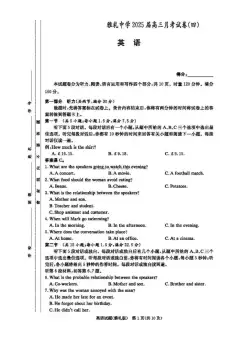
湖南省长沙市雅礼中学2027届高三月考试卷( 一)英语试题及答案(含听力音频+解析+听力原文)



湖南省长沙市雅礼中学2027届高三月考试卷(一)
英语试题
第一部分听力(共两节,满分30分)
第一节(共5小题;每小题1.5分,满分7.5分)
听下面5段录音。每段录音后有一个小题,从题中所给的A、B、C三个选项中选出最佳选项。听完每段录音后,你都有10秒钟的时间来回答有关小题和阅读下一小题。每段录音播放两遍。
1. Why does the man borrow the books?
A. To prepare for exams.B. To finish his research.C. To learn a language.
2. Where are the speakers?
A. In a garden.B. At home.C. At a shop.
3. What does Haley think of weather forecasts?
A. Often unreliable.B. Usually right.C. Always conservative.
4. What made Mike tired?
A. Overtime work.B. A fire emergency.C. A broken alarm.
5. What happened to Dianna?
A. She was fined by the police.
B. She couldn’t start the engine.
C. She got a flat tire.
第二节(共15小题;每小题1.5分,满分22.5分)
听下面5段录音。每段录音后有几个小题,从题中所给的A、B、C三个选项中选出最佳选项。听每段录音前,你将有时间阅读各小题,每小题5秒钟;听完后,每小题都有5秒钟的作答时间。每段录音播放两遍。
听下面的录音,回答第6和第7小题。
6. What are the speakers mainly talking about?
A. Motivations for taking risks.
B. Benefits of breaking records.
C. Results of a boat competition.
7. What might Max want to gain from the experience?
A. More money.B. Wider reputation.C. Greater satisfaction.
听第7段录音,回答第8至 10题。
8. Why does the woman make the complaint?
A. Andrew breaks the shower.
B. Andrew wastes water.
C. Andrew rarely goes outside.
9. When did Andrew start taking a shower?
A. At about 6 o’ clock.B. At about 7 o’ clock.C. At about 8 o’ clock.
10. What does the woman ask Andrew to care about at last?
A. Job opportunities.B. Household expenses.C. Family connections.
听第8段录音,回答第11至13题。
11. What caused Paul’s bicycle accident?
A. Riding too fast.B. Avoiding a car.C. Answering a call.
12. Which part of Paul’s body most probably got injured?
A. His neck.B. His leg.C. His head.
13. What did Paul do after his recovery?
A. He joined a running race.
B. He rode his bicycle again.
C. He carried on with his workout.
听第9段录音,回答第14至17题。
14. Which is equipped in the apartment?
A. A washing machine.B. A refrigerator.C. A television.
15. What is required for the agreement?
A. An advanced payment.
B. An Extra cleaning fee.
C. A maintenance service.
16. How much should the man pay as a guarantee?
A. $1, 800.B. $600.C. $400.
17. What kind of pets can be kept?
A. Dogs kept on a lead.
B. Birds locked in a cage.
C. Cats put on a cat bed.
听第10段录音,回答第18至20题。
18. Why did the speaker stop using paper planners?
A. They were too expensive.
B. They were difficult to use.
C. They were not always accessible.
19. What did the speaker have trouble doing with digital calendars?
A. Prioritizing tasks.B. Setting reminders.C. Sharing schedules.
20. What will the speaker probably do next?
A. Try a new system.
B. Switch back to old tools.
C. Continue the mixed way.
第二部分阅读(共两节,满分50分)
第一节(共15小题;每小题2.5分,满分37.5分)
阅读下列短文,从每题所给的A、B、C和D四个选项中,选出最佳选项。
A
If you fell under the spell of Harry PotterTM and the wizarding (魔法界的) world, a trip to Warner Bros. Studio Tour London (WBSTL) — The Making of Harry Potter will bring the popular films to life right in front of your eyes! Warner Bros. Studio Tour London is full of original sets and gives visitors a priceless look behind-the-scenes into the making of the film series. Come with us to discover the HogwartsTM Great Hall, explore the Forbidden Forest, and board the Hogwarts ExpressTM at Platform 9³/₄TM all before wandering down Diagon Alley. There’s no experience quite like it for Harry Potter fans of all ages!
WBSTL — The Making of Harry Potter | ||
Standard Package | Private Package | Transport Only |
7 hours | 7 hours | 7 hours |
√Return transport to WBSTL on a branded bus | √Private transport from Central London location | √Transfers to WBSTL on a branded bus |
√Entry ticket to WBSTL | √Entry ticket to WBSTL | √One-way or return transport, dependent on your selection |
× Digital Guide (available to hire at the Studio Tour for £5.75) | × Digital Guide (available to hire at the Studio Tour for £5.75) | × Entry ticket to WBSTL (tickets MUST be purchased separately) |
Adult (16+): £125 | From £315* | Adult (16+): return £71; one-way £45 |
Child (5-15): £120 | Child (5-15): return £71; one-way £40 |
*Private price varies by party size and vehicle choice.
21. What is included in both standard and private packages?
A. Entry to WBSTL.B. A digital guide.
C. Hotel pickup.D. One-way bus transport.
22. How much is the standard package for a couple?
A. £90.B. £250.C. £261.5.D. £630.
23. What is the main purpose of the text?
A. To explain film-making techniques.
B. To compare movie studios in London.
C. To promote different ways to visit WBSTL.
D. To review a Harry Potter film.
B
What does it mean to travel somewhere new and not be able to see it? That question led me on a 10-day journey through northern India with Traveleyes, a British tour company that pairs visually impaired (受损的) travelers and sighted travelers.
I was paired with Candie, a blind woman from Seattle. “The whole sights thing doesn’t excite me,” she said.“Tell me what people are doing even if it’s just someone sleeping on the sidewalk — that is more interesting to me than, ‘There’s a tree over here with yellow leaves.’” I looked out of the bus window. Along the roadside were hairdressers who’d hung mirrors on trees, shaving customers on low chairs. I told Candie how cars here drive on the left, and how clearly marked road lines were almost universally ignored.
I was beginning to notice how speaking these details aloud made me more observant. Things I might have otherwise overlooked or skimmed past became more visible to me when I put them into words. In naming them, I also saved them into memory.
We eventually arrived in Ranthambore, one of the best places in India to spot wild tigers. Touring the park in an open-topped bus, we spotted tiger tracks — but no tiger. Admittedly, I was disappointed. Candie wasn’t. Just moving through the wilderness in the open air, she said, holding tight the handlebar, had been exciting enough.
These words reminded me of the difference between how blind and sighted people experience travel: For sighted travelers, it’s more like watching a film as they tend to rely on immediate visual cues to form quick and vivid impressions. For blind ones, the world reveals itself more slowly, through layers of sound, touch and smell. It’s a more immersive (沉浸式的), interpretive process — just like reading a novel, where the story unfolds through detail and imagination. And the book is often better than the film.
24. Why did the author start his journey?
A. To satisfy his curiosity.B. To spend his vacation.
C. To help disabled people.D. To heighten his senses.
25. What appealed to Candie most during the journey?
A. Traffic rules.B. Local customs.
C. Beautiful scenery.D. People’s activities.
26. How did describing details affect the author?
A. It refreshed his memory.B. It boosted his social skills.
C. It sharpened his perception.D. It encouraged him to speak up.
27. What message is conveyed in the text?
A. Don’t judge a book by its cover.B. Every cloud has a silver lining.
C. Actions speak louder than words.D. Slow tasting reveals true flavor.
C
Cars produced today are essentially smartphones with wheels. For drivers, this means many new features: automatic braking (刹车), turn-by-turn directions, and entertainment systems. But carmakers are getting much more. They’re constantly collecting data from our vehicles, like how much we weigh, how fast we drive, how many children we have and even financial information. But who owns and, finally, controls that data? And what are carmakers doing with it?
The issue of ownership is not clearly known. Drivers usually sign away their rights to data. It’s not unlike buying a smartphone. The difference is that most customers have no idea that vehicles collect data. We know our smartphones collect data and we’ve come to accept that we trade personal information for convenience. With cars, we have no such expectation.
What carmakers are doing with the collected data isn’t clear. We know they use it to improve car performance and safety and that they have the ability to sell it to third parties they might choose. The data on your driving habits could be valuable to insurance companies. You may or may not choose to share it with these services. But while you can turn off location data on your cellphone, there is no opt-out feature for your car.
Carmakers use data to warn us when something needs repair or when our cars need to be taken in for service. For almost a century, car owners have been able to take their vehicles to whichever shop they trust for maintenance and repair. That may be changing. When carmakers control the data, they can choose which service centers receive our information. They’re more likely to share our data only with their branded dealerships (经销商) than with independent repair shops which could have an advantage in price and convenience.
It is clear that because of its value — as high as 750 billion dollars by 2030 — carmakers are unlikely to release control of the data collected from our vehicles. Policymakers, however, have the chance to give drivers control — not just so that they can keep their data private but also so that they can share it with the people who want to see it. This will let car owners maintain what they’ve had for a century: the right to decide who fixes their cars.
28. How is paragraph 2 developed?
A. By expressing ideas.B. By giving examples.
C. By exploring reasons.D. By making comparisons.
29. What does the underlined part “opt-out feature” in paragraph 3 refer to?
A. A useful tool.B. A special part.
C. A function to stop something.D. A way to start something.
30. What might happen if carmakers control users’ data?
A. More repair shops will appear.
B. Carmakers will offer more repair shops.
C. Users will spend more on car maintenance.
D. Independent repair shops will earn higher profits.
31. What is the author’s attitude towards the future of vehicle data control?
A. Policies may help drivers gain control of their data.
B. Car owners will release control over their vehicle data.
C. Drivers should realize the value of their personal data.
D. Carmakers may share vehicle data with drivers in no way.
D
Imagine it’s Saturday morning. You’re relaxing when your best friend texts, “Could you help me move today?” You sigh — there go your weekend plans — but reply, “Of course.” A week later, a coworker you barely know asks for a hand. This time, you hesitate. Psychologists call this tendency “social discounting”: our generosity declines as social distance increases.
But what happens in the brain during these decisions? A small region called the basolateral amygdala (BLA) plays a key role. It helps us balance self-interest with social intentions by assigning value to both our own well-being and that of others.
To test this, researchers studied individuals in South Africa with Urbach-Wiethe disease, a rare genetic condition that damages the BLA. They compared five women with this disease to 16 healthy participants in a social discounting task. Each person listed eight people, ranging from their closest friend to a complete stranger, and decided how much money to share with each.
As expected, all participants gave more to close contacts. Interestingly, those with BLA damage were less generous overall, and their generosity decreased more sharply as social distance increased. These differences could not be explained by personality or empathy levels.
The findings suggest the BLA helps people create a “model” of the social world to guide decision-making. An unharmed BLA allows us to consider social context and rules when deciding whether to be generous. Without it, individuals may rely on a “standard” strategy, unless the receiver is emotionally very close, in which case helping remains automatic.
Generosity is therefore not an all-or-nothing trait; it is a model-based social behavior, shaped by how close we feel to the receiver of help. And deep in the brain, the basolateral amygdala is helping us do that calculation.
32. Why does the author describe the “moving-day dilemma” in paragraph 1?
A. To illustrate how social discounting works.
B. To argue people should treat others equally.
C. To show generosity is mainly driven by emotions.
D. To suggest a conflict between self and others’ interest.
33. What do researchers try to show by comparing the two groups?
A. The risk of the Urbach-Wiethe disease.
B. The BLA’s role in social decision-making.
C. The difference in participants’ social network.
D. The personality’s influence on social discounting.
34. What can be inferred from the findings in social decision-making?
A. People with Urbach-Wiethe are more generous.
B. BLA damage leads to complete loss of generosity.
C. BLA allows individuals to weigh social information.
D. Personality can potentially affect BLA-harmed people.
35. What can be a suitable title for the text?
A. The Brain’s Role: How We Balance Choices.
B. The BLA: A Hidden Guide to Social Behavior.
C. Social Discounting: Why We Help Our Friends.
D. Urbach-Wiethe Disease: A Rare Genetic Condition.
第二节(共5小题;每小题2.5分,满分12.5分)
根据短文内容,从短文后的选项中选出能填入空白处的最佳选项。选项中有两项为多余选项。
Hiking has been gaining rapid popularity in recent years. From 2018 to 2021, the number of Americans hitting the trails increased from around 48 million to 59 million. 36
Hiking offers all the cardiovascular (心血管的)benefits of walking. 37the uneven trails strengthen legs and muscles more effectively than walking on flat surfaces. This in turn improves balance and stability, making hiking a full-body workout.
38Spending time in nature and experiencing awe-inspiring landscapes can reduce stress and anxiety. A 2015 study found that people who walked in nature for 90 minutes were less likely to suffer from depression — compared to those who walked in urban environments.
However, hiking does carry some risks. To ensure a safe and enjoyable experience, it’s important to take a few simple precautions. If you’re a new hiker, go with a friend or join a local group. 39Remember: The point is to be able to see the views and smell the flowers.
In conclusion, hiking is more than just exercise. 40By following basic safety guidelines, hikers can ensure they return home safe and ready for their next adventure. Whether you’re a seasoned hiker or a beginner, the trails offer something for everyone.
A. Tie your boots and start exploring.
B. Hiking also promotes mental well-being.
C. But its advantages go further than heart health.
D. Push yourself harder and faster through challenging trails.
E. It’s a well-rounded activity that benefits both the body and mind.
F. Always inform someone of your plans and check in with them afterward.
G. This growth reflects hiking’s appeal as a way to stay active and connect with nature.
第三部分语言运用(共两节,满分30分)
第一节完形填空(共15小题;每小题1分,满分15分)
阅读下面短文,从短文后各题所给的A、B、C和D四个选项中,选出可以填入空白处的最佳选项。
British photographer Beckie Burr first became interested in ancient sites during a trip to Dartmoor in 2018. “Standing among the stones, I found myself imagining how they looked thousands of years ago. That sense of 41endlessly inspires me.” She describes photographing ancient sites as something of a 42.
Burr always visits each location 43. She’ll walk around, looking at the site from all 44. “Some stones can look very different from one side to the other.” On a pre-shoot visit, it’s also important to work out 45, not least because many sites are on private land.
Burr admits that luck and patience play a part. Sometimes conditions will not be 46. “Many of my photographs are the 47of going back multiple times until I can get the shot I 48in the beginning.” 49to keep post-processing to a minimum, Burr tries to make each image as close to how she sees the scene as possible.
Searching for elements that 50the viewer into the scene — “leading lines, shapes, or viewpoints that make you feel part of the site” — Burr says every 51must tell a story. “I’m not interested in simply 52a site.”
Her advice to others is to just start. “Go to a place that calls to you and spend time there,” she 53. “You don’t need lots of gear. If you 54with the place, it will show in your photos. Each stone has its own personality, its own energy or ‘memory’. This is what I try to 55in my photos.”
41. A. directionB. mysteryC. belongingD. achievement
42. A. callingB. challengeC. competitionD. trend
43. A. secretlyB. soonC. hurriedlyD. beforehand
44. A. partiesB. sourcesC. anglesD. accounts
45. A. weatherB. accessC. equipmentD. lighting
46. A. badB. dangerousC. favorableD. crucial
47. A. resultB. drawbackC. reflectionD. sacrifice
48. A. earnedB. tookC. removedD. visualised
49. A. FailingB. RefusingC. RememberingD. Choosing
50. A. drawB. trickC. releaseD. transform
51. A. exhibitionB. compositionC. viewerD. step
52. A. buildingB. visitingC. documentingD. identifying
53. A. urgesB. recallsC. sighsD. admits
54. A. partB. connectC. helpD. come
55. A. makeB. avoidC. evaluateD. capture
第二节(共10小题;每小题1.5分,满分15分)
阅读下面短文,在空白处填入1个适当的单词或括号内单词的正确形式。
Catherine the Great set out to define Russia as an extremely important power in Europe. Her rule remained stable until 1768, when something began to threaten her people and her position — an ancient disease named smallpox.
By the 18th century, smallpox 56(become) particularly deadly. One in five people who caught it died. It was particularly dangerous for children, so parents would be advised not to count their children unless they survived smallpox. There was absolutely nothing that could be done. People tried keeping patients hot to sweat 57disease out or even bleeding them, neither of 58did any good.
Since the 16th century, there had been inoculation 59(practise) widely in China, the Middle East and Turkey. It involved a person 60(give) a controlled dose (剂量) of the disease. A tiny drop of pus (脓液) from the spots of someone with the disease 61(collect). Then the live virus was put into a cut on the arm of the healthy person.
In 1767, a British doctor named Dimsdale published an instruction manual and introduced his way of safe inoculation, 62he received little support in his own country. And that’s how he came to the attention of Catherine the Great. In the 1760s, inoculation wasn’t a common practice in Russia, a land where there was “enormous distrust” against it. Catherine made the brave decision to experiment with treatment first. She put her faith in science and her life in the hands of Dimsdale, calling for him in 1768 63(treat) her and her family.
Catherine’s inoculation went so well that her experience encouraged her people to get inoculated, too. Indeed, her first experiment demonstrated great 64(resolve) and firmness of her mind. To her people, she projected an image of herself 65a caring ruler. She was remembered for advancing public health in Russia and saving millions of lives.
第四部分写作(共两节,满分40分)
第一节(满分15分)
假设你是红星中学高三学生李华,暑假期间,你参观了省博物馆新开设的“当非遗遇见VR”(When Intangible Cultural Heritage Meets VR)展区。你的外国好友Jim对此很感兴趣,发来邮件询问有关情况。请你用英文给他回复,内容包括:
(1)展区亮点;
(2)你的体会。
注意:
(1)写作词数应为100个左右;
(2)请按如下格式在答题卡的相应位置作答。
Dear Jim,
Having visited the newly-launched exhibition When Intangible Cultural Heritage Meets VR in our provincial museum this summer,
Yours,
Li Hua
第二节(满分25分)
阅读下面材料,根据其内容和所给段落开头语续写两段,使之构成一篇完整的短文。
Our school’s annual Science Fair was approaching, and every class was busy preparing their exhibits. As the class monitor, I was eager to make ours stand out. My initial proposal was a smart-home display featuring programmed lights. However, Leo, my best friend, tasked with materials, advocated for a more engaging concept — a giant model of the human digestive passage constructed from recycled bottles and colored water.
I objected, arguing it was too childish for senior students. Leo did not give in, insisting that serious projects often lacked appeal. I eventually yielded, primarily because most classmates supported his idea. By Friday afternoon, the “Digestive Wonder” occupied a corner of the classroom. Transparent bottles linked by rubber tubes stretched across three desks. Saturday morning saw Leo pouring bright green liquid into the top of the model. Some bubbles surfaced, causing comments that the model appeared remarkably lifelike.
Then, disaster struck. Minutes before the opening ceremony, I spotted a small puddle beneath the table. A loose connection was letting the green liquid out onto the floor. Worse still, the principal and several parents were drawing near. My heart pounded. Without hesitation, I grabbed paper towels to cover the leak and signaled Leo to lean the model back. The flow slowed down, yet the damage could not be undone. The central section collapsed, sending a fresh wave of liquid toward the table’s edge.
Leo’s face turned extremely pale. He whispered that we were in big trouble. I opened my mouth to criticize his workmanship, but the words got stuck in my throat. Observing the chaos and his trembling hands, I hesitated. Suddenly, laughter erupted from the crowd. Mr. Jenkins, the biology teacher, pointed at the spill, saying that it looked exceptionally real before winking at us. The tension eased, and Leo managed a weak smile. Nevertheless, as visitors approached, urgent action was required. The model continued to drip, leaving the educational display soaking wet. I caught Leo’s eye and nodded toward the storage closet containing spare materials.
注意:
1. 续写词数应为150左右;
2. 请按如下格式在答题卡的相应位置作答。
Gathering my courage, I signaled to Leo, determining to repair the damage together.
By noon, our stand boasted the longest queue in the hallway.
湖南省长沙市雅礼中学2027届高三月考试卷(一)
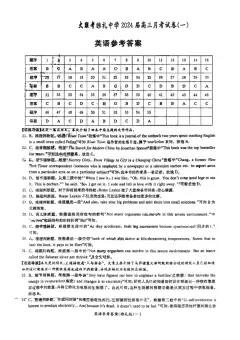
英语试题答案
听力
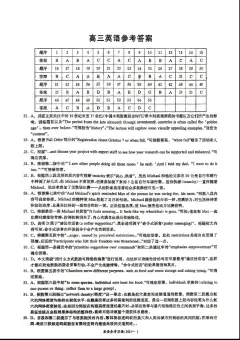
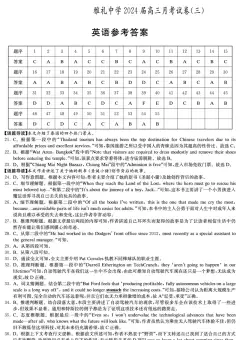
1-5 BCABC6-10 ACBAB11-15 CBABA16-20 CBCAC
阅读理解
21-23 ABC24-27 ADCD28-31 DCCA32-35 ABCB
七选五阅读
36-40 GCBFE
完形填空
41-45 BADCB 46-50 CADDA 51-55 BCABD
语法填空
56. had become57. the58. which59. practiced/practiced60. being given
61. was collected62. but63. to treat64. resolution65. as
应用文写作(官方范文)
Dear Jim,
Having visited the newly-launched exhibition When Intangible Cultural Heritage Meets VR in our provincial museum this summer, I’m thrilled to share its highlights and my reflections with you.
The exhibition stands out for the perfect integration of VR technology and traditional folk crafts. With immersive VR headsets, visitors are transported back to ancient times to virtually experience classic handicraft procedures like paper-making and paper-cutting.
Not only does advanced technology revitalize fading cultural heritage, but it also helps youth better inherit traditional culture. Admittedly, adding bilingual guidance would make the exhibition more visitor-friendly, allowing more foreign visitors to appreciate its unique charm. If you have a chance to visit China in the future, this innovative exhibition is absolutely worthy of every minute of your visit.
Yours,
Li Hua
读后续写(官方范文)
Gathering my courage, I signaled to Leo, determining to repair the damage together. We rushed to the storage closet and grabbed the spare bottles and tape. While I held the collapsed section steady, Leo worked quickly to reconnect the tubes. Green liquid still dripped onto our sleeves, but neither of us cared. “Hold it tighter,” I whispered, my heart pounding as the crowd drew nearer. Leo nodded, his earlier fear replaced by focus. Within minutes, the model was stable again, though wet marks covered the table. We managed a quick clean-up just as the first group of students arrived. Seeing their curious smiles, I knew we had bought ourselves a second chance.
By noon, our stand boasted the longest queue in the hallway. Surprisingly, the wet marks and repaired joints became the highlight of our exhibit. Whenever visitors asked about the green stains, Mr. Jenkins would smile and explain that science could be messy but real. Leo seized the moment, launching into lively descriptions of how the digestive system worked. I handed out leaflets, feeling a surge of pride as cameras flashed. Later, as the crowd thinned, Leo tapped me gently. “Guess childish projects aren’t so bad after all,” he joked. I laughed, realizing that true success lies not in flawless plans, but in embracing unexpected challenges together.