ARTICLE · 1326051
26年11月绍兴市高考科目诊断考试英语试题及完整答案解析纯净打印版
⬇️PDF可打印下载版放在评论区⬇️
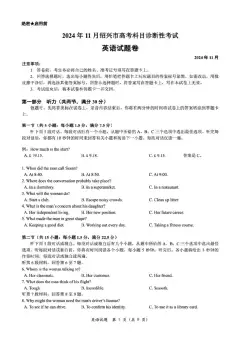
2026年11月绍兴市高考科目诊断性考试
第一部分听力(共两节,满分30分)
做题时,先将答案标在试卷上,录音内容结束后,你将有两分钟的时间将试卷上的答案转涂到答题卡上。
第一节(共5小题:每小题1.5分,满分7.5分)
听下面5段录音。每段录音后有一个小题,从题中所给的A、B、C三个选项中选出最佳选项。听完每段录音后,你都有10秒钟的时间来回答有关小题和阅读下一小题。每段录音播放两遍。
1. When will the speakers arrive at the hall?
A. At 7:30 am.
B. At 7:45 am.
C. At 8:00 am.
2. What will the speakers probably do next?
A. Treat the bird.
B. Build a nest.
C. Observe from a distance.
3. What are the speakers talking about?
A. A scenic spot.
B. An international event.
C. A challenging road test.
4. What does the man think makes a great company?
A. Social commitment.
B. Energy conservation.
C. Technological innovation.
5. What is the woman's attitude toward the man's suggestion?
A. Doubtful.
B. Favorable.
C. Cautious.
第二节(共15小题:每小题1.5分,满分22.5分)
听下面5段录音。每段录音后有几个小题,从题中所给的A、B、C三个选项中选出最佳选项。听每段录音前,你将有时间阅读各个小题,每小题5秒钟;听完后,每小题都有5秒钟的作答时间。每段录音播放两遍。
听第6段录音,回答第6至7题。
6. Where will the boy buy the oranges?
A. At the corner store.
B. At Matteloni's Market.
C. At Sam's Club.
7. Why does the woman recommend the place for meat?
A. It has the freshest chicken in town.
B. It is the closest one to their home.
C. It sells good meat at lower prices.
听第7段录音,回答第8至10题。
8. What made the conference special?
A. The flexible schedule.
B. The diverse participants.
C. The overall theme.
9. What was the focus of the conference?
A. Disease risk assessments.
B. AI image check standards.
C. Cross-field medical advances.
10. What benefit will the AI-based medical tools bring?
A. Reducing doctors' work burden.
B. Lowering hospital service costs.
C. Improving health policy-making.
听第8段录音,回答第11至13题。
11. Why was Luisa Yu given the award?
A. For her pursuit of dreams via travel.
B. For her popularity on social media.
C. For her visit to most UN countries.
12. When did Luisa finish visiting all 193 UN countries?
A. In 2024.
B. In 2025.
C. In 2026.
13. What did Luisa Yu do in Serbia?
A. She enjoyed a surprise party.
B. She attended a dance event.
C. She took on skydiving.
听第9段录音,回答第14至16题。
14. What job does the woman prefer?
A. A part-time server.
B. A computer operator.
C. An off-campus cook.
15. What should the woman do first to find a job?
A. Make a phone call.
B. Write a cover letter.
C. Check job listings online.
16. Where does the conversation most probably take place?
A. In a local restaurant.
B. In a campus job center.
C. In a university classroom.
听第10段录音,回答第17至20题。
17. What is the main purpose of the speech?
A. To demonstrate wall painting techniques.
B. To introduce an environmental art project.
C. To encourage temperature-change research.
18. What is special about the paint used in the project?
A. It's color-sensitive.
B. It's light-sensitive.
C. It's heat-sensitive.
19. What effect has the project brought?
A. The river has become clean again.
B. A volunteer group has been formed.
C. More people have got involved in art.
20. What does the speaker want to show through the successful project?
A. Art can inspire community action.
B. Artists should receive more support.
C. Joint efforts make wildlife loss visible.
第二部分阅读理解(共两节,满分50分)
第一节(共15小题:每小题2.5分,满分37.5分)
阅读下列短文,从每题所给的A、B、C和D四个选项中,选出最佳答案。
A
Integrating Precision Agriculture Technologies Into Data-Driven Farm Management
Precision agriculture adopts advanced technologies to collect data about crops, soil, weather, etc., to optimize farm management practices. It involves collecting detailed data about various agricultural operations, analyzing them, and applying the insights gained to make informed decisions about farm management practices. This helps farmers optimize resource allocation (分配), minimize wastage, increase crop yields, and enhance sustainability.
Benefits of precision agriculture
Improved crop yields due to optimal use of nutrients, water, and other inputs; Reduced costs associated with inputs such as water, seeds, and fertilizers; Enhanced sustainability through conservation of natural resources; Greater ability to predict and manage risks related to weather conditions and sudden market changes; Observance of regulations regarding chemical usage and protection of the environment.
Tools and technologies used in precision agriculture
Global Positioning Systems (GPS): Provide location data for accurate navigation and mapping.
Geographic Information Systems (GIS): Integrate spatial data from multiple sources to create visualizations and maps.
Remote Sensing: Use satellite imagery and airborne sensors to capture images and spectral (光谱的) signatures of crops and soil.
Drones: Capture high resolution images and video footage for crop inspecting, surveying land, and detecting issues at an early stage.
Sensors: Measure temperature, humidity, light intensity, soil moisture, and other variables.
Variable Rate Technology (VRT): Adjust application rates of seed, fertilizer, and inputs based on field variabilities.
Yield Monitors: Track grain flow and moisture during harvest to calculate yield estimates.
Data Analytics Software: Analyse historical and real-time data to generate actionable insights.
VRA (Variable rate application) is a precision agriculture technique that involves applying inputs such as fertilizers, pesticides, and irrigation at varying rates across a field, based on the specific needs of different areas.
21. What is precision agriculture mainly about?
A. Developing high-yield crop varieties.
B. Estimating possible risks in market instability.
C. Making strict regulations on farm technologies.
D. Using data insights to improve farm management.
22. What task do drones perform in precision agriculture?
A. Record grain flow in harvest seasons.
B. Create maps with multi-source data.
C. Collect data through land inspection.
D. Spot crop-related problems early.
23. What is the final output of data analytics and decision-making?
A. Data-driven field actions via VRA.
B. Promotion of remote-sensing images.
C. Storage of information in data base.
D. Application of fixed inputs across a field.
B
For most of his life, Mannie lived alone in an indoor enclosure at the Mondo Verde theme park in the Netherlands, with only a small outdoor passage and no contact with other lions. But now, he's beginning a new chapter—one filled with sunlight, open spaces, and the company of his own kind.
Thanks to the tireless work of animal advocates, Mannie has been relocated to The Lions Foundation, a private nature reserve that's now home to 24 rescued lions, including Mannie. Here, he's being lovingly monitored in a special adaptation enclosure to help him adjust to his new surroundings.
Soon, he'll be introduced to a 1.5-hectare savannah and, in time, to two lionesses—Sara and Naija—who have been at the sanctuary since 2022. With patience and care, there's hope they'll become his new pride.
Mannie's journey to freedom was made possible by a 2024 report from nonprofit organization Bite Back, which uncovered troubling welfare violations at Mondo Verde, including unlicensed animal displays. After the report's release, Bite Back successfully negotiated Mannie's relocation, and by November 2024, the plan was in motion.
World Animal Protection played a crucial role in this rescue. We brought Mannie's story to the Dutch government to call for lasting change in zoo policies, and we stood beside Bite Back through negotiations. Thanks to our incredible supporters, we raised over $50,000 in just five days to fund Mannie's transport and new enclosure.
But Mannie's journey doesn't end here. World Animal Protection has pledged to cover the cost of his food and medical care at the sanctuary. With your support, we're confident we can give Mannie the care he deserves.
Every dollar makes a difference. Whether it's helping a single lion like Mannie or working to eliminate the industries that harm billions of animals each year, your support brings us closer to a world where animals are no longer exploited.
24. What can we learn about Mannie in his old home?
A. He had limited outdoor access.
B. He was accompanied by two lions.
C. He lived in a private nature reserve.
D. He received regular medical check-ups.
25. What mainly contributed to Mannie's relocation?
A. The public's committed animal advocates.
B. The government's new nature reserve policies.
C. The Lions Foundation's request for lion rescue.
D. Bite Back's exposure of animal welfare problems.
26. What is the role of World Animal Protection in Mannie's rescue?
A. Ending industries harmful to animals.
B. Providing the long-term free housing.
C. Forcing the closure of the theme park.
D. Raising funds for animal conservation.
27. What is the author's main purpose in writing the text?
A. To criticize the present zoo policies.
B. To introduce a nonprofit organization.
C. To call for financial support for animal welfare.
D. To stress the value of World Animal Protection.
C
You might tell your phone, “Siri, text mom,” or, “Alexa, play ‘Flowers’ by Miley Cyrus.” Voice commands are convenient—unless you're at a noisy concert, in a quiet library, or you're unable to use your voice. New AI-embedded eyeglass frames that read the wearer's lips now offer a solution.
The glasses, created by Zhang Ruidong, a research scientist at Google, are called EchoSpeech. When EchoSpeech is turned on, its speakers emit inaudible, high-pitched sounds. The sound waves ripple in every direction, and some travel around the user's lips and mouth. When the users speak silently, their facial movements affect the paths of those sound waves, which in turn changes the echo patterns picked up by the microphones on the glasses. These echo patterns are then transmitted via Bluetooth to a smartphone, where an AI application developed by Zhang's team analyzes them.
To test this tech, 24 people took turns wearing the glasses, issuing silent commands while sitting or walking. During this testing, EchoSpeech's prototype, or test version of the glasses, performed well in both cases. It delivered a 95 percent success rate, even in situations with loud background noises.
The AI in EchoSpeech currently recognizes the echo patterns of 31 words or commands, such as “play” and “hey, Siri”. But those aren't limits, Zhang says, and he thinks future versions could be trained to recognize a significantly larger vocabulary. If so, users could send personal text messages using silent speech. In a bustling restaurant, for example, users could speak quietly instead of shouting over the noise or typing their words. The technology would also enable people who have lost their voices to engage in face-to-face conversations by converting their facial movements into text in real time.
EchoSpeech may also help recreate voices. People without voices often use text-to-voice programs that sound robotic, which Zhang notes “doesn't have your emotion and your speech style.” He is now exploring whether EchoSpeech can reproduce a person's own voice. “We're trying to keep that information to get an actual living voice,” he says.
28. Why does the author mention Siri and Alexa?
A. To recommend useful voice tools.
B. To prove the popularity of smartphones.
C. To introduce the limits of voice commands.
D. To compare voice commands with the new tech.
29. What is the key to EchoSpeech's operation?
A. Microphones recording users' voices.
B. Facial motion altering sound wave paths.
C. Speakers producing loud audible sounds.
D. Echo patterns featuring brief commands.
30. What does the underlined word “converting” in paragraph 4 mean?
A. Tracking.
B. Transforming.
C. Restricting.
D. Enhancing.
31. What can be learned about EchoSpeech's future?
A. It can create a larger vocabulary.
B. It will replace texting ultimately.
C. It may generate one's own natural voice.
D. It may help non-speakers restore speech.
D
Humans have been telling stories for millennia, which have long served to teach morals or make sense of the world. Lately, the advance of generative AI models that can invent a story from user prompts (提示词), using online works as a guide, has revealed and then sustained blind spots.
Researchers at the University of Washington (UW) have found that AI not only preserves gender biases in children's animal stories, where characters are highly ambiguous, but actually makes these biases worse. “Some human writers reportedly turn animal characters into universal subjects who go beyond identity categories,” said UW machine learning researcher Imani Finkley. Unexpectedly, further research shows those biases are actually more evident in animal stories than in human stories, reflecting stronger stereotypes (刻板印象) brought by real-life authors. This makes animal stories a striking test case for large-language models.
The study tasked six leading AI models with writing stories about talking animals whose gender was unstated. The findings were quite alarming. Among 23,800 AI responses, females were “virtually absent”, present in just 2 percent of stories. Characters were either described as male or left without an assigned gender. Though people know AI models reflect the data that they've been trained on, the bias seems to have been boosted in this case. “Our hypothesis is that these AI models are using neutrality to avoid gender bias—either with ‘it/its’ pronouns or no pronouns, but it ends up erasing female characters”, said UW information scientist Melanie Walsh.
Beyond gender, researchers noticed another feature of AI writing: a more generic and repetitive approach, which is likely a reflection of the underlying training. With AI being increasingly used as a tool for scientific research, this study is an important reminder that the biases and indeed accuracy of these “intelligent” models depend on the inputs they consume.
“There's this odd phenomenon where people forget to worry about human social biases when they're imagining animal stories. AI is replicating that tendency and reshaping it”, said Finkley. While children's books are often a little silly, they shape early conceptions of gender roles.
32. What led researchers to test AI models using animal story writing?
A. Its more obvious gender biases.
B. Its significant role in human life.
C. Its simpler processing prompts.
D. Its unique character identity category.
33. What can we infer from the research findings?
A. Pronouns ensure equal representation.
B. AI models exclude females by design.
C. Gender-free stories appeal to kids' taste.
D. Neutral wording brings opposite effects.
34. What mainly accounts for the gender biases in AI writing?
A. The input of common writing techniques.
B. The model of the researchers' mindset.
C. The pre-existing biases in the input data.
D. The impact of people's misconceptions.
35. What is the best title of the passage?
A. AI Writing Relies on People's Views
B. AI Writing Reflects and Worsens Biases
C. AI Models Erase Female Characters
D. AI Outshines and Replaces Storytellers
第二节(共5小题;每小题2.5分,满分12.5分)
阅读下面短文,从短文后的选项中选出能填入空白处的最佳选项。选项中有两项为多余选项。
Uncertainty is a widespread human reality. While people often feel pretty certain about many things, including daily rhythms going on as usual, each of us unavoidably faces the displeasure of not knowing what will happen next. 36
Scientific psychology has repeatedly highlighted the human distaste for not knowing. The theory of cognitive closure (认知闭合) indicates that people attempt to escape uncertainty through various responses such as jumping to conclusions and engaging in black-and-white thinking. 37The need for cognitive closure might make one draw premature conclusions or simply interpret not hearing back from someone as a rejection rather than getting to know them better.
38 While such mental stress cannot be removed, positive thinking can reduce our unease and help us spot promising opportunities ahead. Research suggests that viewing a situation as a challenge is empowering, which increases our confidence and can thus enhance our ability to turn uncertainty to our advantage. 39 As described by the psychologist Carol Dweck, a growth mindset involves believing that human capacities such as intelligence and competence are not fixed. Failure, therefore, is an opportunity to find alternative pathways towards what we want.
Uncertainty is a part of life. With the quickening pace of change that the world is experiencing, feelings of uncertainty are likely even more common now.40 What we can really do is to take some time to observe our thoughts, feelings and physical sensations that uncertainty brings up. And then, accept it as it is.
A. Such reactions can have negative consequences.
B. Uncertainty holds a silver lining yet stays discouraging.
C. It's worthwhile to handle life's uncertainty with full energy.
D. Feeling the unknown is only human and it brings mental stress.
E. Therefore, learning to live with uncertainty in a positive way matters.
F. In this way, we are combining problem-awareness with faith in our success.
G. Will you fear and escape it or embrace opportunities when uncertainty occurs?
第三部分语言知识运用(共两节,满分30分)
第一节(共15小题;每小题1分,满分15分)
阅读下面短文,从短文后各题所给的A、B、C和D四个选项中,选出可以填入空白处的最佳选项。
Javier Gamiz will never forget the first time he tried Chipotle Mexican Grill a decade ago while visiting Texas. He 41 the convenience of fast food but hated how it made him feel until he had a Chipotle bowl. “It's fast food, but it's 42 food.” Gamiz said. Since then, every time he visited the United States, he went 43 to Chipotle, becoming what he called a “genuine Chipotle-man”.
Recently Chipotle found its way to Gamiz's home city of Monterrey, Mexico. The American chain that 44 the fast-casual concept and has more than 4,000 locations in the United States, has launched its most 45 move: selling its “Mexican” food in Mexico. It is a(n) 46 put forward by Taco Bell, who once 47 but failed twice. “Like bringing ice to the Arctic,” went a famous quip (俏皮话) about Taco Bell's 48 into Mexico.
But Gamiz, who 49 eating his mother's traditional cooking, was 50nearly beyond words. “I was so happy,” said Gamiz, who has eaten at the restaurant more than a dozen times in two weeks. Every time, he has found the same 51 not a single table available; lines snaking along the windowed walls; everywhere, Mexicans eating Mexican food, American-style. Felicitas Martinez, a cook at the restaurant, said everything is cooked from the 52, and that's what brings people back.
53 whether the craze will last remains to be seen. Perhaps Mexico, with its celebrated 54 a country where Michelin stars decorate eateries from food stands to fancy restaurants, is ready to 55this accessible U.S. take on its food culture.
41.
A. desired
B. guaranteed
C. provided
D. treasured
42.
A. fresh
B. tasty
C. real
D. proper
43.
A. regularly
B. directly
C. eventually
D. occasionally
44.
A. explored
B. applied
C. defined
D. popularized
45.
A. random
B. aggressive
C. daring
D. unexpected
46.
A. proposal
B. claim
C. theory
D. assumption
47.
A. assessed
B. attempted
C. submitted
D. supported
48.
A. risk
B. integration
C. transition
D. inquiry
49.
A. got through
B. reflected on
C. approved of
D. grew up
50.
A. motivated
B. puzzled
C. delighted
D. frustrated
51.
A. atmosphere
B. scene
C. reality
D. condition
52.
A. recipe
B. experience
C. tradition
D. heart
53.
A. Otherwise
B. Still
C. Thus
D. Besides
54.
A. industry
B. custom
C. cuisine
D. tourism
55.
A. maintain
B. seek
C. share
D. embrace
第二节(共10小题;每小题1.5分,满分15分)
阅读下面短文,在空白处填入1个适当的单词或括号内单词的正确形式。
In the fishing village of Xunpu, Fujian Province, flowers don't just bloom in gardens, but also atop local women's heads. This ancient art, called zanhua,56 (transform) the sweat of labor into a display of beauty. 57(work) while keeping hair tidy, Xunpu women coil it up and grace it with flowers. This tradition is linked with 58 worship of Mazu, the sea goddess. Out of respect, fishermen wear fresh flowers when praying inside her temple 59 blessings.
The headdress offers more than novelty, embodying a longing for beauty and 60(connect) to a romanticized past. Today, fishermen continue to adorn themselves before facing the hardship of their work, carrying on a practice 61continues to blossom like the flowers themselves. These traditions, 62(consist) of the flower-wearing custom, local clothing and accessories, were 63(collective) listed as national intangible cultural heritage in 2008.
With zanhua going viral on social platforms, the public travel to Xunpu specifically to wear the floral headdresses for photographs. “With flowers in our hair, we feel no bitterness, whatever the hardship,” said Huang Liyong, a tradition's inheritor, by whom that beauty 64 (take) to nearly twenty countries to date. “Despite language 65 (barrier), foreigners get excited to see the flowers. The pursuit of beauty is universal.”
第四部分写作(共两节,满分40分)
第一节(满分15分)
假定你是李华,将参加学校摄影俱乐部举办的“色彩漫步(Color Walk)”摄影活动。请给英国交换生David写封邮件,邀请他一起参加。要点如下:
(1)介绍设想路线;
(2)说明具体理由。
注意:
(1)写作词数应为80左右。
(2)请按如下格式在答题纸的相应位置作答。
第二节(满分25分)
阅读下面材料,根据其内容和所给段落开头语续写两段,使之构成一篇完整的短文。
Ethan, a young travel blogger from a busy modern city, was visiting the remote Aran Islands off the west coast of Ireland. On a cold, windy afternoon, he chanced upon a small, cozy store hidden in a quiet street. It belonged to Mrs. Murphy, a kind and gentle elderly local craftswoman, who had devoted her entire life to creating authentic Aran wool sweaters purely by hand.
Stepping into the warm store, Ethan was instantly attracted by the delicate knitted works on wooden shelves. Bathed in soft sunlight, the sweaters featured elegant twisted knit patterns, looking simple but unique. Curious about the special traditional craft, he walked up to the old woman and asked patiently about the stories and cultural meanings behind these beautiful knitted patterns.
Smiling gently, Mrs. Murphy put down her wool needle and explained that Aran knitting is a time-honored local tradition passed down through generations. Each detailed stitch carries special cultural meanings, symbolizing firm family bonds and the tough but hopeful life of local islanders. With great patience and devotion, Mrs. Murphy wove every stitch carefully with pure local wool. Every handmade sweater was polished with countless efforts, making it a precious carrier of warmth and local history.
Unfortunately, as Mrs. Murphy related, this time-honored craft is gradually fading away in the digital age. Cheap machine-made products flood major online markets, and few tourists bother to travel to these distant islands. Therefore, the exquisite handmade sweaters are always left unnoticed. Mrs. Murphy was haunted by the fear that this valuable traditional craft would eventually be lost forever.
Deeply fascinated by the elegant craft and touched by the old craftswoman's helplessness, Ethan secretly made up his mind to do something to help preserve the fading tradition. He looked from the dust-covered sweaters to Mrs. Murphy's seasoned but steady hands. He understood what was disappearing was not merely a product, but a language of memory, family, and island life. A simple souvenir or a few sympathetic words would never be enough.
注意:
(1)续写词数应为150左右。
(2)请按如下格式在答题卡的相应位置作答。
Paragraph 1: Ethan soon came up with a thoughtful idea.
Paragraph 2: Weeks later, amazing changes took place in Mrs. Murphy's store.
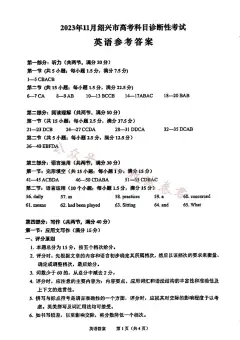
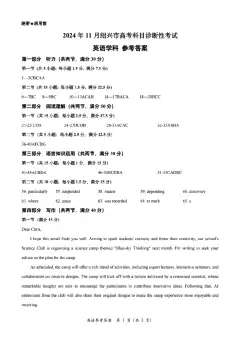
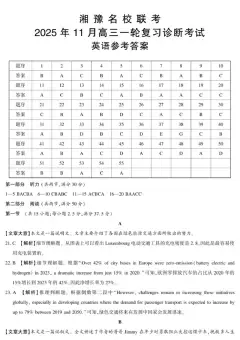
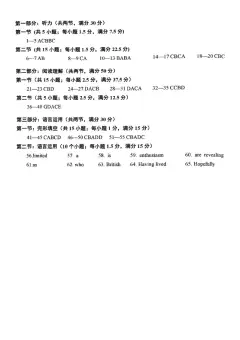
2026年11月绍兴市高考科目诊断性考试英语参考答案
第一部分听力(共两节,满分30分)
第一节(共5小题;每小题1.5分,满分7.5分)
1. B
2. C
3. B
4. A
5. B
第二节(共15小题;每小题1.5分,满分22.5分)
6. B
7. C
8. B
9. C
10. A
11. A
12. C
13. A
14. A
15. C
16. B
17. B
18. C
19. B
20. A
第二部分阅读理解(共两节,满分50分)
第一节(共15小题;每小题2.5分,满分37.5分)
21. D
22. D
23. A
24. A
25. D
26. D
27. C
28. C
29. B
30. B
31. C
32. A
33. D
34. C
35. B
第二节(共5小题;每小题2.5分,满分12.5分)
36. G
37. A
38. D
39. F
40. E
第三部分语言知识运用(共两节,满分30分)
第一节完形填空(共15小题;每小题1分,满分15分)
41. A
42. C
43. B
44. D
45. C
46. A
47. B
48. A
49. D
50. C
51. B
52. D
53. B
54. C
55. D
第二节语言运用(10个小题;每小题1.5分,满分15分)
56. transforms
57. To work
58. the
59. for
60. connection
61. which/that
62. consisting
63. collectively
64. has been taken
65. barriers
第四部分写作(共两节,满分40分)
第一节(满分15分)
一、评分原则
1. 本题总分为15分,按5个档次给分。
2. 评分时,先根据文章的内容和语言初步确定其所属档次,然后以该档次的要求来衡量、确定或调整档次,最后给分。
3. 词数少于60的,从总分中减去2分。
4. 评分时,应注意的主要内容为:内容要点、应用词汇和语法结构的丰富性和准确性及上下文的连贯性。
5. 拼写与标点符号是语言准确性的一个方面,评分时,应视其对交际的影响程度予以考虑。英美拼写及词汇用法均可接受。
6. 如书写较差,以至影响交际,将分数降低一个档次。
二、各档次的给分范围和要求
第五档(13—15分)
完全完成了试题规定的任务。
—覆盖所有内容要点。
—应用了较多的语法结构和词汇。
—语法结构或词汇方面有些许错误,但为尽力使用较复杂结构或较高级词汇所致;具备较强的语言运用能力。
—有效地使用了语句间的连接成分,使全文结构紧凑。
完全达到了预期的写作目的。
第四档(10—12分)
完全完成了试题规定的任务。
—虽漏掉1、2个次重点,但覆盖所有主要内容。
—应用的语法结构和词汇能满足任务的要求。
—语法结构或词汇方面应用基本准确,些许错误主要是因尝试较复杂语法结构或词汇所致。
—应用简单的语句间连接成分,使全文结构紧凑。
达到了预期的写作目的。
第三档(7—9分)
基本完成了试题规定的任务。
—虽漏掉一些内容,但覆盖所有主要内容。
—应用的语法结构和词汇能满足任务的要求。
—有一些语法结构或词汇方面的错误,但不影响理解。
—应用简单的语句间连接成分,使全文内容连贯。
整体而言,基本达到了预期的写作目的。
第二档(4—6分)
未适当完成试题规定的任务。
—漏掉或未描述清楚一些主要内容,写了一些无关内容。
—语法结构单调、词汇项目有限。
—有一些语法结构或词汇方面的错误,影响了对写作内容的理解。
—较少使用语句间的连接成分,内容缺少连贯性。
信息未能清楚地传达给读者。
第一档(1—3分)
未完成试题规定的任务。
—明显遗漏主要内容,写了一些无关内容,原因可能是未理解试题要求。
—语法结构单调、词汇项目有限。
—较多语法结构或词汇方面的错误,影响对写作内容的理解。
—缺乏语句间的连接成分,内容不连贯。
信息未能传达给读者。
0分
未能传达给读者任何信息:内容太少,无法评判;写的内容均与所要求内容无关或所写内容无法看清。
三、该题具体要求
(一)内容要点
1. 介绍设想路线;
2. 说明具体理由。
(二)应用词汇和语法结构的情况
1. 按语义表达的需要恰当选择与使用相应时态;
2. 使用与主题相关的词汇及表达;
3. 能够使用恰当的语法结构。
(三)上下文的连贯性
按照内容要点展开写作,使用恰当的连接词或表达使文章内容连贯。
A possible version:
Dear David,
Good news! Our school will be hosting a “Color Walk” photography activity. Would you like to join me?
As an engaging trend to embrace nature, a color walk encourages people to pick one color and explore the city through it. If you are in, we may chase golden hues all the way from the pedestrian street to the City Square: golden ginkgo leaves in nature, golden carvings on ancient buildings, and golden reflections in water. This route blends natural beauty with cultural sights in this warm and vibrant color, making photography easy and enjoyable. Photography Club will hold a photo exhibition of the best entries, and each participant may submit up to three photos.
I know you love photography and have an eye for beauty, so I believe we'll have fun together.
Yours,
Li Hua
第二节(满分25分)
一、评分原则
1. 本题总分为25分,按5个档次给分。
2. 评分时,应主要从内容、词汇语法和篇章结构三个方面考虑,具体为:
(1)续写内容的质量、完整性以及与原文情境的融洽度。
(2)所使用词汇和语法结构的准确性、恰当性和多样性。
(3)上下文的衔接和全文的连贯性。
3. 评分时,应先根据作答的整体情况确定其所属的档次,然后以该档次的要求来综合衡量,确定或调整档次,最后给分。
4. 评分时还应注意:
(1)词数少于120的,酌情扣分;
(2)书写较差以致影响交际的,酌情扣分;
(3)单词拼写和标点符号是写作规范的重要方面,评分时应视其对交际的影响程度予以考虑,英美拼写及词汇用法均可接受。
二、各档次的给分范围和要求
第五档(21—25分)
—创造了丰富、合理的内容,富有逻辑性,续写完整,与原文情境融洽度高;
—使用了多样且恰当的词汇和语法结构,可能有个别小错误,但完全不影响理解;
—有效地使用了语句间衔接手段,全文结构清晰,意义连贯。
第四档(16—20分)
—创造了比较丰富、合理的内容,比较有逻辑性,续写比较完整,与原文情境融洽度较高;
—使用了比较多样且恰当的词汇和语法结构,可能有些许错误,但不影响理解;
—比较有效地使用了语句间的衔接手段,全文结构比较清晰,意义比较连贯。
第三档(11—15分)
—创造了基本合理的内容,有一定的逻辑性,续写基本完整,与原文情境相关;
—使用了简单的词汇和语法结构,有一些错误或不恰当之处,但基本不影响理解;
—基本有效地使用了语句间的衔接手段,全文结构基本清晰,意义基本连贯。
第二档(6—10分)
—内容或逻辑上有一些重大问题,续写不够完整,与原文情境有一定程度脱节;
—所用的词汇有限,语法结构单调,错误较多,影响理解;
—未能有效地使用语句间的衔接手段,全文结构不够清晰,意义欠连贯。
第一档(1—5分)
—内容和逻辑上有较多重大问题,或有部分内容抄自原文,续写不完整,与原文情境基本脱节;
—所使用的词汇非常有限,语法结构单调,错误很多,严重影响理解;
—几乎没有使用语句衔接手段,全文结构不清晰,意义不连贯。
0分
—未作答;
—所写内容太少或无法看清以致无法评判;
—所写内容全部抄自原文或与题目要求完全不相关。
A possible version:
Ethan soon came up with a thoughtful idea. He intended to record Mrs. Murphy's traditional knitting and post the videos online, hoping to make this ancient craft known worldwide. Mrs. Murphy, however, remained skeptical — cold screens, she insisted, could never truly convey the spirit of handmade sweaters. It was only after Ethan communicated with her sincerely that the cautious old woman agreed to have a try. For days, Ethan filmed Mrs. Murphy with his camera. At first, Mrs. Murphy was camera-shy and avoided the lens. Gradually, she became so absorbed in her work that she forgot about the camera. After filming, Ethan added soft Irish-style music and brief captions explaining each pattern, and uploaded the video “The Heart of Aran Knitting” online.
Weeks later, amazing changes took place in Mrs. Murphy's store. The video became popular across the world overnight. Orders poured into the small cottage. Buyers spoke highly of the genuine and warm craftsmanship online. Surprisingly, some young people even travelled all the way to the Aran Islands, eager to learn the ancient knitting skill from Mrs. Murphy. The store, once silent, was filled with laughter and energy. No longer feeling any fear, the old craftswoman broke into a broad smile. She realized that digital technology would not wipe out tradition. Instead, it brought the old Irish craft a new chance to survive and shine in modern times, while spreading the spirit of handmade sweaters — patience, love and the warmth of human hands.
听力部分录音稿
这是绍兴市高考科目诊断性考试英语听力部分。该部分分为第一、第二两节。
注意,回答听力部分时,请先将答案标在试卷上。听力部分结束前,你将有两分钟时间将你的答案转涂到客观题答题卡上。
请看听力部分第一节。
第一节:听下面5段对话。每段对话后有一个小题,从题中所给的A、B、C三个选项中选出最佳选项。听完每段对话后,你都有10秒钟的时间来回答有关小题和阅读下一小题。每段录音播放两遍。
(Text 1)
W: We'll have to hurry if we don't want to miss the beginning of the lecture. It's already 7:30 am.
M: Well, it only takes a quarter to get to the hall, and the lecture doesn't begin until 8:00 am.
(Text 2)
W: Look, there's a damaged nest on the ground with a baby bird in it.
M: Its parents are probably not far away. We'd better watch from a distance for now.
W: OK. Let's stay back and keep quiet.
(Text 3)
M: Have you heard about the Zhangjiajie cycling event last Sunday?
W: The one at Tianmen Mountain? How was it?
M: 1,500 riders from 75 countries took part. The challenge was tough. It tested speed and endurance on a cliff road.
(Text 4)
M: I just read about this great software company. The owners donate a lot to charity and encourage employees to save electricity and other energy sources.
W: That does sound like a great company.
M: Indeed. Though technological advancement matters, social responsibility really shows a company's values.
(Text 5)
M: I think we should change our marketing strategy for the new product.
W: What do you suggest?
M: Let's focus on social media influencers instead of traditional ads.
W: That makes sense. Younger customers are more active on social media.
第一节到此结束。
第二节:听下面5段对话或独白。每段对话或独白后有几个小题,从题中所给的A、B、C三个选项中选出最佳选项。听每段对话或独白前,你将有时间阅读各个小题,每小题5秒钟;听完后,各小题将给出5秒钟的作答时间。每段录音播放两遍。
听下面一段录音,回答第6和第7两个小题。现在,你有10秒钟的时间阅读这两个小题。
(Text 6)
M: Mom, I'm going to the corner store to pick up a map. Do you need anything else?
W: Actually, yes. We need oranges for breakfast. Go to Matteloni's Market — their fruits and vegetables are always fresh and reasonably priced.
M: Got it. Anything else?
W: Oh, we're out of chicken. Could you pick up two pounds?
M: Where's the best place for that?
W: For meat and other groceries, go to the Sam's Club down the street. Their products are of good quality, and the prices are much better than those of small shops.
听下面一段录音,回答第8至第10三个小题。现在,你有15秒钟的时间阅读这三个小题。
(Text 7)
M: Clara, have you read the news about the medical development conference? It was held on April 19th and lasted for two days.
W: No, I haven't. What's special about this conference? I thought medical meetings were just for doctors.
M: Not this time! The conference brought together leading experts in mathematics, AI, medicine and public health. They discussed innovation, cooperation across different fields, and policy directions to push the medicine forward in the AI age.
W: Pretty interesting! They might develop AI tools like fast medical image checks or better disease risk tests for hospitals.
M: Exactly! With these AI tools, doctors won't have to take on all the workload.
听下面一段录音,回答第11至第13三个小题。现在,你有15秒钟的时间阅读这三个小题。
(Text 8)
M: Luisa Yu, you received the NomadMania Most Positive Traveller Award in 2025 for being a role model for others to chase their dreams. How do you feel about it now?
W: I still remember how excited I was, standing with other travelers who'd set foot in even more places.
M: You truly deserved the award by showing us that it's never too late to enjoy life and live to your fullest potential.
W: Thanks. I'm in my 80s now, but I'm still challenging myself to explore new places.
M: I've been following you on social media. You actually achieved your goal of visiting all 193 UN countries the year after you received the award, right?
W: That's right. Serbia was the last stop.
M: Any memorable moments from this lifelong adventure?
W: There were so many, like skydiving in Dubai, attending a traditional dance and singing event in Papua New Guinea, and enjoying a surprise party my friends arranged at my final stop.
听下面一段录音,回答第14至第16三个小题。现在,你有15秒钟的时间阅读这三个小题。
(Text 9)
W: I was wondering if you could help me use the Student Job Center system.
M: Sure! We have a few different options. Are you looking for an on-campus or off-campus opportunity?
W: I hope to find a restaurant job somewhere nearby.
M: Great choice! Would you prefer to work as a server or in the kitchen?
W: Oh, I hadn't thought about that ... Maybe starting as a server would be better?
M: Sounds like a good plan. Are you seeking part-time or full-time work? Most students do 15-20 hours a week.
W: Definitely part-time. Around 15 hours sounds manageable.
M: Here's what you can do: first, check these job boards on the computer. You'll need to enter your student number to access the listings.
W: Got it. Are there any new job postings today?
M: Yes, new ones are added every morning.
W: That sounds great!
M: You might want to write a job application letter. Don't worry — we have examples at Desk 3.
W: Thank you!
M: Come back if you need more help. Good luck!
听下面一段录音,回答第17至第20四个小题。现在,你有20秒钟的时间阅读这四个小题。
(Text 10)
Good evening. Tonight, I want to share with you how we can use art to raise awareness about climate change. In our day-to-day lives, the loss of local wildlife due to pollution can be hard to notice. We know our river is not clean, but we don't see the fish that are no longer there. So, I decided to do something to make this invisible visible. I started an art project called Fading Away. We painted huge, colorful images of the fish and birds that used to live in our city on the walls of buildings along the river. But here's the key: We used a special, heat-sensitive paint. On cool days, the animals in the pictures are bright and beautiful. But as the temperature rises on hot summer days, the paint slowly fades, and the animals seem to disappear right before your eyes. This shows people directly how environmental change is threatening our local wildlife. The project has already had a real-world impact. It inspired the formation of a new volunteer group, Friends of the City, which now organizes river clean-up activities every month.
第二节到此结束,现在,你有两分钟时间将试卷上的答案转涂到答题卡上。
听力部分到此结束。