ARTICLE · 1354650
高中英语|人教版|必修二|Unit 1: Cultural Heritage|语法&口语和写作
学习重点
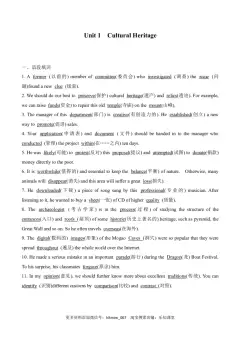
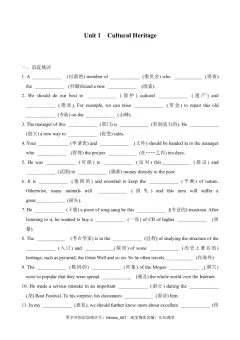
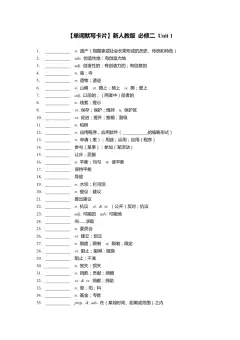
Ø词汇学习 高中英语|人教版|必修二|Unit 1: Cultural Heritage|词汇学习
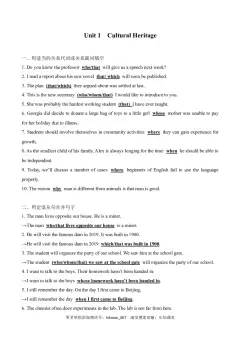
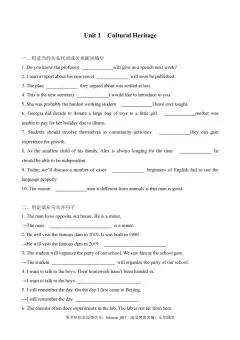
Ø语法:Restrictive relative clauses (3)
Ø口语&写作:A news report about cultural heritage protection & Learn about intangible cultural heritage
语法:用定语从句细化描述人/事物(relative clauses)
一、关系词
原句 1:
After listening to the scientists who had studied the problem, and citizens who lived near the dam, the government turned to the United Nations for help.
- who:关系代词,先行词 scientists / citizens(指人),从句中作主语
原句 2:
Temples and other cultural sites were taken down piece by piece, and then moved and put back together again in a place where they were safe from the water.
- where:关系副词,先行词 a place(地点),从句中作地点状语
✅ 核心小结
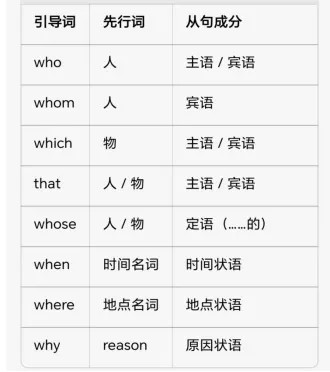
- 关系代词:who / whom / which / that / whose,在从句充当主语、宾语、定语
- 关系副词:when / where / why,在从句充当状语(时间、地点、原因)
二、合并句子
例句:
I have downloaded that free app, but it doesn’t work well.
→ The free app (which/that) I have downloaded doesn’t work well.
1. He showed me a photo in his room. It was a photo of a famous cultural relic in Egypt.
→ The photo (which/that) he showed me in his room was a photo of a famous cultural relic in Egypt.
解析:先行词 the photo,关系代词在从句作宾语,可省略。
2. The project team helped protect the national parks in the United Republic of Tanzania. It was formed by members from fifteen countries.
→ The project team which/that was formed by members from fifteen countries helped protect the national parks in the United Republic of Tanzania.
解析:先行词 the project team,从句作主语,which/that 不可省。
3. This temple was first built during the Qin Dynasty.
→ The time when this temple was first built was the Qin Dynasty.
解析:先行词 time,when 在从句作时间状语。
4. We met a professional archaeologist at the entrance to the Great Pyramid. He explained to us the process of building such a difficult structure.
→ The professional archaeologist (who/that) we met at the entrance to the Great Pyramid explained to us the process of building such a difficult structure.
解析:先行词 archaeologist(人),关系词作宾语,可省略;也可用 who/that。
5. The documents about the cultural relics from overseas are under the desk. I found them yesterday.
→ The documents about the cultural relics from overseas (which/that) I found yesterday are under the desk.
6. Scientists worked together day and night to rescue the temple because they wanted to preserve it for the next generation.
→ The reason why scientists worked together day and night to rescue the temple was that they wanted to preserve it for the next generation.
解析:the reason why … 固定结构,why 在从句作原因状语。
👉 讨论问题:什么时候可以删掉关系代词?
只有关系代词在定语从句中作宾语时,才可以省略;作主语/定语,或者是关系副词(when/where/why),一般不能省略。
四、语法核心清单
五、自测题
1. The temple ______ we visited last year has a long history.(that/which,可省)
2. The temple ______ many ancient ceremonies were held stands by the river.(where / in which)
3. The expert ______ we met at the meeting knows a lot about cultural relics.(who/whom/that,可省)
4. There was a time ______ many old buildings were at risk of being destroyed.(when)
5. The reason ______ we protect cultural heritage is that it carries our history.(why)
口语&写作:A news report about cultural heritage protection & Learn about intangible cultural heritage
💡Promoting Culture Through Digital Images
Lanzhou, 9 August 2017. A group of researchers and scientists from China and other countries are working together to help increase knowledge and appreciation of China’s ancient cultural heritage. They are recording and collecting digital images of cultural relics from the Mogao Caves, which were a key stop along the Silk Road throughout China’s ancient history. Nearly 500,000 high-quality digital photographs have been produced since the international project started in 1994.
The Mogao Caves have long been a meeting point for different cultures and are part of the history of many countries. Today, the caves are just as international as they were at the time when people travelled the Silk Road. Tourists from all over the world visit Dunhuang to see the caves, and the Getty Museum in Los Angeles has even reproduced a copy of the caves and paintings for people to admire in America.
By sharing so many digital photos over the Internet, the group hopes to promote even wider interest around the world in China’s ancient history, culture, and traditions. They also hope to further educate people about the importance of safeguarding historic and cultural relics for future generations to understand and appreciate. As one researcher who is working on the project explains, “Appreciating one’s own cultural heritage is very important for understanding oneself. Appreciating the cultural heritage of other countries is very important for international communication and understanding.”
兰州,2017 年 8 月 9 日。一组来自中国以及其他国家的研究人员与科学家正在协同合作,增进人们对中国古代文化遗产的了解与欣赏。他们正在记录、收集莫高窟文物的数字影像。莫高窟在我国古代历史上是丝绸之路上的关键站点。自 1994 年这个国际项目启动以来,已经生成了近 50 万张高质量数码照片。
莫高窟长期以来就是多元文化的交汇点,也是众多国家历史的一部分。时至今日,这些洞窟和当年丝绸之路通行之时一样,具备国际性。来自世界各地的游客前来参观洞窟,洛杉矶盖蒂博物馆甚至复刻了洞窟与壁画,供美国民众观赏。
通过在互联网上分享海量数码照片,该团队希望在全球范围内唤起更多人对中国古代历史、文化与传统的兴趣。他们也希望进一步让人们了解保护历史与文物的重要性,以便后代能够理解、欣赏这些瑰宝。正如参与该项目的一位研究者所说:“欣赏本国的文化遗产,对认识自我至关重要;欣赏其他国家的文化遗产,对于国际交流与理解意义重大。”
二、阅读问题
- What are the researchers and scientists trying to do?
They are working together to increase people’s knowledge and appreciation of China’s ancient cultural heritage, and educate people about the importance of safeguarding historic and cultural relics for future generations.
- What modern technology are they using?
They are using digital photography / digital images and the Internet.
- Why are so many people interested in the Mogao Caves?
Because the Mogao Caves were a key stop on the Silk Road and a meeting point for different cultures. They carry shared history and attract people worldwide.
- What do you think of the researcher’s opinion in the last paragraph?
(参考回答)I totally agree. Cultural heritage is a mirror of a nation. Respecting and understanding others’ cultural heritage helps reduce misunderstanding and build better cross‑cultural communication.
写作任务:写一篇文化遗产保护人物新闻报道
识别新闻要素
- A Lead sentence(导语):第一段第一句,交代人物、事件、时间地点,是新闻核心。
- B Direct quote(直接引语):最后一段研究者的原话,增强真实性。
- C Paraphrase(转述):用自己的话转述项目目标、成果(如介绍复刻洞窟、线上传播)。
- D Background information(背景信息):莫高窟在丝绸之路上的历史地位。
- E Reporting verbs(报道动词):explains, hope, are working 等。
- F Words for comparison / contrast:as…as(和……一样)。
写作框架
- Headline 标题:简洁抓人
- Lead sentence 导语:who, what, where, why(新闻五要素)
- Body 主体:事实、细节,多用定语从句,可以加入引语
- Ending 结尾:简短总结,升华主题
素材① Chen Lei(武汉)范文
Headline: Chen Lei: A Teacher Who Records the City’s Old Buildings
Wuhan, 15 October. Chen Lei, a senior teacher in Wuhan, is devoting himself to protecting local cultural heritage.
Chen Lei takes photos of old buildings around the city. He also interviews elderly local residents and writes stories about these buildings. To spread the idea of heritage protection, he often visits schools and tells students the history behind the old houses. He believes photos and stories can keep the old buildings alive even after they disappear.
“Buildings may fade away, but the memories they carry should not be lost,” Chen Lei says. His work helps young people realise the value of our local cultural heritage.
In short, Chen Lei is using his camera and words to save the stories of Wuhan’s past.
素材② Protectors of the Past, Wuhu(芜湖保护团队)范文
Headline: A Group That Protects Cultural Treasures in Wuhu
Wuhu, 20 October. A local group called “Protectors of the Past” is making efforts to save the city’s cultural heritage.
The volunteers repair old houses and look for hidden cultural relics. They hold exhibitions to show relics to the public and raise money for repairing temples. They hope more citizens will join them and learn to respect local history.
One volunteer says, “Cultural relics are our roots. We have a duty to pass them down.”
With their hard work, more people in Wuhu are beginning to care about cultural heritage protection.
Project:非物质文化遗产 intangible cultural heritage (ICH)
问题
1. What is it? 它是什么
2. What does it look like? 外观形式
3. Who practices it? 传承人群
4. What are its characteristics? 特点
5. How is it made / performed? 制作/表演方式
6. Does it have symbolic meaning? 象征意义
7. Why should we protect it? 保护的意义
8. How can we protect it? 保护途径
汇报示范
paper‑cutting
Paper‑cutting is a traditional Chinese intangible cultural heritage. It is a folk art that uses scissors to cut patterns on paper. Most paper‑cutting works show animals, flowers or festival scenes. It has a history of more than 1,500 years. People often put paper‑cuts on windows during the Spring Festival, which stands for good luck.
Now fewer young people master this skill. We can protect it by taking classes, watching videos and inviting folk artists to our school. It carries our folk culture and deserves our attention.
人教版必修一学案
高中英语|人教版|必修一|Unit 1: Teenage life|词汇学习
高中英语|人教版|必修一|Unit 1: Teenage life|语法&口语和写作
高中英语|人教版|必修一|Unit 2: Travelling around|词汇学习
高中英语|人教版|必修一|Unit 2: Travelling around|语法&口语和写作
高中英语|人教版|必修一|Unit 3: Sports and fitness|词汇学习
高中英语|人教版|必修一|Unit 3: Sports and fitness|语法&口语和写作
高中英语|人教版|必修一|Unit 4: Natural Disasters|词汇学习
高中英语|人教版|必修一|Unit 4: Natural Disasters|语法&口语和写作
高中英语|人教版|必修一|Unit 5: Languages around the world|词汇学习
高中英语|人教版|必修一|Unit 5: Languages around the world|语法&口语和写作
高中英语|人教版|必修二|Unit 1: Cultural Heritage|词汇学习
外研社完整学案