ARTICLE · 1411633
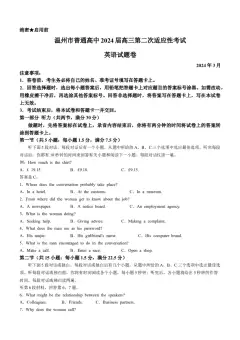
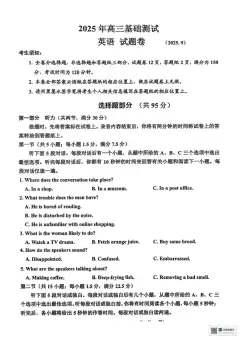
浙江省嘉兴市普通高中2026届高三第二次适应性考试英语试题
1.浙江省嘉兴市普通高中2026届高三第二次适应性考试听力.7z
2.
通过网盘分享的文件:浙江省嘉兴市普通高中2026届高三第二次适应性考试听力.7z
链接: https://pan.baidu.com/s/1MkfigIyeGSXgZZUJ4rOqzQ?pwd=2026 提取码: 2026
--来自百度网盘超级会员v6的分享
试卷来自“IAI English”公众号,解析来自龚露高考英语公众号,特此感谢!
绝密★启用前
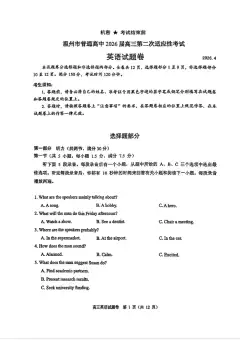
浙江省嘉兴市普通高中2026届高三第二次适应性考试英语试题
2026年4月
注意事项:
1.答卷前,考生务必将自己的姓名、准考证号填写在答题卡上。
2.回答选择题时,选出每小题答案后,用铅笔把答题卡上对应题目的答案标号涂黑。如需改动,用橡皮擦干净后,再选涂其他答案标号。回答非选择题时,将答案写在答题卡上,写在本试卷上无效。
3.考试结束后,将本试卷和答题卡一并交回。
第一部分听力(共两节,满分30分)
做题时,先将答案标在试卷上,录音内容结束后,你将有两分钟的时间将试卷上的答案转涂到答题卡上。
第一节(共5小题;每小题1.5分,满分7.5分)
听下面5段对话。每段对话后有一个小题,从题中所给的A、B、C三个选项中选出最佳选项。听完每段对话后,你都有10秒钟的时间来回答有关小题和阅读下一小题。每段录音读两遍。
1. What is the woman looking for?
A. A seat to have a rest.B. A quiet place to work.C. An inquiry desk for help.
2. What does Greg ask Susan to do?
A. Read an advertisement.B. Send an application.C. Draw up a notice.
3. Which sports game is airing on TV now?
A. A volleyball game.B. A football game.C. A basketball game.
4. When will the speakers leave for the train station?
A. At 5:30 pm.B. At 6:30 pm.C. At 7:30 pm.
5. What are the speakers probably working on?
A. A poster contest.B. A recycling program.C. A book fair.
第二节(共15小题;每小题1.5分,满分22.5分)
听下面5段对话或独白。每段对话或独白后有几个小题,从题中所给的A、B、C三个选项中选出最佳选项。听每段对话或独白前,你将有时间阅读各个小题,每小题5秒钟;听完后,各小题将给出5秒钟的作答时间。每段录音读两遍。
听第6段录音,回答第6、7题。
6. Why can’t the man use his own phone?
A. Its screen is broken.B. It has run out of battery.C. He has lost it somewhere.
7. How does the app help the woman sleep?
A. It limits screen time.B. It plays white noise.C. It blocks out blue light.
听第7段录音,回答第8至10题。
8. What is the man doing right now?
A. Decorating his new office.B. Hunting for office facilities.C. Buying furniture for his flat.
9. What is the man’s friend expert in?
A. Clothing design.B. English literature.C. Business management.
10. How does the man sound in the end?
A. Respectful.B. Encouraging.C. Sympathetic.
听第8段录音,回答第11至13题。
11. Where does the conversation probably take place?
A. On a bus.B. In a classroom.C. In a news studio.
12. What does the man think of social media platforms?
A. They offer one-sided content.B. They tell uninteresting stories.C. They are challenging for users.
13. What are the speakers mainly talking about?
A. Different lifestyles.B. Sources of news.C. Ways to stay awake.
听第9段录音,回答第14至16题。
14. What service does the woman try to sell?
A. Medical insurance.B. Computer lessons.C. A club membership.
15. Why does the man turn down the woman?
A. He dislikes sales calls.B. He thinks the price is too high.C. He already has a fitness routine.
16. What will probably happen to the man?
A. His name will be deleted soon.
B. He will still get promotion calls.
C. His phone number will be blocked.
听第10段录音,回答第17至20题。
17. Who are the listeners?
A. Teachers.B. Children.C. Parents.
18. What can the pupils expect next week?
A. A new canteen.B. More food.C. A bigger campus.
19. What are the pupils advised to do?
A. Shorten their lunch time.B. Volunteer at the serving points.C. Decide on their food in advance.
20. What will the old canteen be first used as?
A. A dining area.B. A storage space.C. A break room.
第二部分阅读理解(共两节,满分50分)
第一节(共15小题;每小题2.5分,满分37.5分)
阅读下列短文,从每题所给的A、B、C和D四个选项中,选出最佳答案。
A
Expedition Entomology (昆虫学) is a chance for you to join our research and conservation initiatives where you’ll gather samples, document behavior, and discover species while hiking, swimming, climbing, digging, and camping in some of the most remote and biodiverse places on Earth. You’ll gain cultural insight and develop unforgettable bonds with the researchers and fellow participants.
Every expedition (探险) generates essential insect biodiversity information from a wide variety of ecosystems. supporting global conservation plans and creating much-needed, long-term environmental datasets.
UPCOMING EXPEDITIONS

Cost: $3,200 Dates: June 5th-14th, 2026 Country: Panama Accommodation type: 2 nights hotel, 7 nights camping on raised platforms Minimum Age: 18 | Cost: $2,980 Dates: September 18th-27th, 2026 Country: Thailand Accommodation type: 2 nights hotel, 7 nights family or private cottage Minimum Age: 18 Single travelers welcome! |
Do you have a research or conservation project you’d like to get started? Do you have a list of insects you want to experience in the wild? Contact us and we can make all the travel arrangements, permit applications, official inquiries, insurance, etc. — we take care of the boring stuff so you don’t have to! Just let us know your bug (虫子) dreams and we’ll make it happen within your budget!
21. Who is Expedition Entomology most suitable for?
A. A student majoring in history.B. A teenager crazy about team sports.
C. An entomologist seeking financial aid.D. A traveler interested in nature conservation.
22. What do the two expeditions have in common?
A. They last ten days.B. They are open to children.
C. They are free for singles.D. They offer platform campsites.
23. What service can Expedition Entomology offer?
A. Guidance on budget cuts.B. Help with official procedures.
C. Care for young participants.D. Training in academic research.
B
They say that the truth comes out of the children’s mouth, and that truth is sometimes more upsetting than we realize. Jen Adams Beason, a 2nd-grade teacher from Louisiana, witnessed this when she asked her students to write about an invention that they didn’t like, or an invention that they wish would have never seen the light of day.
Jen has 21 students, and she was absolutely heartbroken when she noticed that four of her students shared the same invention: the smartphone. With dozens of notifications (通知) from apps, emails, and social media updates, it could be hard not to look at your phone for longer than five minutes.
Jen shared a boy’s essay on her Facebook page. “I hate my mom’s phone and I wish she never had one. That is an invention that I don’t like.” The essay is even accompanied by a sad and angry face saying “I hate it,” looking at a drawn phone with a cross through it.
“I had my 2nd graders write about an invention that they wish had never been created. Out of 21 students, 4 of them wrote about this topic. # getoffyourphone # listentoyourkids,” Jen posted on her Facebook wall.
Her message was seen by millions and even shared 300,000 times. It received dozens of eye-opening comments. “That is so sad. Great reminder for us all to put those phones down and engage with our kids more,” Tracy Jenkins posted.
Luckily, it seems that awareness about smartphone addiction is increasing. Both iPhones and smartphones running on a recent Android operating system will soon include features to monitor, control and restrict your personal smartphone use for your own health.
Still, it’s interesting to see that parents’ concerns about their children becoming addicted to smartphones and other smart devices, are also perfectly true the other way around.
24. What did Jen find through the writing task?
A. Parents’ overuse of their phones.B. Parents’ dislike for their children.
C. Children’s resistance to social media.D. Children’s poor performance in writing.
25. The boy included a picture in his essay to show ________________________.
A. his great drawing skillsB. his desire for a smartphone
C. his strong negative emotionsD. his insight into online interaction
26. How did Tracy Jenkins feel after reading Jen’s post?
A. Guilty.B. Helpless.C. Embarrassed.D. Confused.
27. What is the author trying to do in the last paragraph?
A. Draw a conclusion.B. Provide evidence.C. Put forward a proposal.D. Call for reflection.
C
Historically, the worker who worked the most hours was widely seen as an organization’s most valuable employee.But that is no longer true: as AI promises to transform how we work, and the four-day-workweek movement gains steam, it is time to admit once and for all that working more does not make you more productive.
In fact, many workers could dutifully keep themselves busy for an entire day without doing anything of real value, instead answering pointless emails and attending unnecessary meetings. Meanwhile, many are struggling under the unsustainable consequences of applying an industrial-era measure of productivity — namely, dividing output by hours — to our modern knowledge economy. As a result, workers are under constant pressure to relinquish their rightfully earned time to prove their commitment.
Those who finish their tasks more quickly are typically rewarded with more work to fill the hours they’ve saved, in what is sometimes referred to as “performance punishment.” A co-worker who works through evenings, weekends, or lunch breaks to complete the same workload, meanwhile, is often more likely to be praised or even promoted for their perceived commitment. This dynamic ultimately creates more pressure to look busy than to deliver value, which is getting in the way of actually getting work done and holding back organizational productivity while wearing down workers’ well-being.
So it is time for us to be smarter about how we work. That is ultimately what the four-day-workweek movement seeks to inspire. Instead of just giving everyone an extra vacation day each week, when positioned as a performance-based motivator, the four-day workweek becomes a wake-up call to refocus our time and energy at work on the things that really matter to the business.
In today’s knowledge economy and tomorrow’s AI reality, the most successful individuals, organizations, and nations won’t be those that work the most hours, but those that are the most effective at making their working hours count.
28. How does the author introduce the topic?
A. By listing AI-driven changes in work.B. By challenging the hours-productivity link.
C. By describing employee-centered practices.D. By advocating a short-time working pattern.
29. What does the underlined word “relinquish” in paragraph 2 mean?
A. Set aside.B. Count on.C. Give up.D. Care about.
30. What weakens organizational effectiveness according to paragraph 3?
A. Job burnout.B. Performative busyness.
C. Unfair punishment.D. Unnoticed commitment.
31. What does the author think of the four-day workweek?
A. A reward for efficiency at work.B. A wake-up call to stay competitive.
C. A push to think smarter about work.D. A preparation for the uncertain future.
D
At any bus stop or while waiting in line, most people will have their heads down scrolling (滚屏) on their phones. But studies suggest if you resist that urge and let your mind wander instead, there could be some serious benefits.
We actually spend nearly half our waking time daydreaming, but it isn’t always pleasant. A study found people even preferred electric shocks to being alone with their thoughts. This explains why we automatically reach for phones during downtime
Social psychology professor Erin Westgate compares mindless scrolling to “brain candy” — momentarily pleasurable but lacking in meaning. She adds human achievements largely come from higher-order thinking.
So next time you have a few minutes free, put away your phone and let your mind wander. Many people fear boredom, but this fear is often overblown. In a 2022 study, people predicted they would hate 20 minutes alone doing nothing, yet afterward reported greater enjoyment than expected. According to researcher Kou Murayama, the ability to mentally wander — to reflect on past experiences, and consider others’ viewpoints — is a distinctly human capacity that boosts learning and helps understand others.
Mind-wandering is also key to problem-solving. People often find solutions better after unfocused thinking than intentional effort alone, especially during routine tasks like driving or showering. Even when people are not actively thinking, their brains remain active in a so-called default mode (默认模式), allowing ideas to connect in new ways. It’s especially helpful for complex problems.
Beyond cognitive (认知的) benefits, daydreaming also boosts social and emotional connections. A study found imagining pleasant interactions with loved ones made people feel closer. Social daydreaming allows individuals to practice conversations, reflect on past interactions, and prepare for future social situations. As psychologist Poerio says, our ability to mentally “time travel” helps us better handle the social world.
Murayama says he now tries to resist checking his phone during short waits and let his thoughts wander. He finds simply entertaining oneself mentally can be both satisfying and meaningful.
32. Why does Erin Westgate compare mindless scrolling to “brain candy”?
A. It does harm to people’s health.B. It helps people to avoid boredom.
C. It replaces deep thinking in daily life.D. It brings quick but shallow enjoyment.
33. What is the 2022 study used to demonstrate?
A. Phone addiction is avoidable.B. Daydreaming is undervalued.
C. Being alone promotes learning.D. Self-reflection defines humans.
34. What does the default mode suggest?
A. Unfocused thinking fuels creativity.B. Intentional effort brings new ideas.
C. Complex tasks require active minds.D. Routines involve little brain activity.
35. Which of the following is a suitable title for the text?
A. Maintain Focus in the Digital AgeB. Discover the Joy of Being Truly Alone
C. Unlock the Power of Your Wandering MindD. Explore Secret Benefits of Social Daydreaming
第二节(共5小题;每小题2.5分,满分12.5分)
阅读下面短文,从短文后的选项中选出能填入空白处的最佳选项。选项中有两项为多余选项。
Have you ever found yourself reciting your grocery list out loud in the supermarket or saying something encouraging to yourself before a big moment? If so, you are not alone. Talking to ourselves, either within our heads or out loud, is a common behavior. Psychologists refer to it as “self-talk,” a mental tool like a Swiss army knife. 36
Saying something out loud, whether it’s positive or negative, can make the thought that you’re expressing seem more official, or public, than if you merely think about it. 37For them, working through a problem aloud helps them think more clearly and see how things fit together.
Some people report using self-talk to help them calm down in periods of negative mental states. Research, for instance, has found that when people are anxious or stressed, they are more likely to engage in self-talk. 38It is like giving yourself the support a friend would.
39“I really do believe in the power of positive self-talk, at the gym, in the mirror, before a big meeting — all of that,” says Carol Bergman, 52. She does it before she works out with “Come on, you got this!” or with “You look great!” if she needs to hear some kind words about herself from time to time.
In fact, we learn to talk to ourselves in childhood, where it is associated with better performance on tasks and challenging activities. 40As adults, we may return to speaking out loud when mentally or emotionally challenged. In such moments, it serves as an extra tool to help us focus and think and solve problems. So talking to yourself is not being as strange as you think you are.
A. However, we do it less as we grow older.
B. Self-talk also helps people stay motivated.
C. Here are some ways to put it into practice.
D. It’s a superpower that we all naturally possess.
E. It can be useful in many different situations in life.
F. Speaking emotions aloud makes them manageable.
G. Some people use self-talk to sort through a challenge.
第三部分语言知识运用(共两节,满分30分)
第一节(共15小题;每小题1分,满分15分)
阅读下面短文,从短文后各题所给的A、B、C和D四个选项中,选出可以填入空白处的最佳选项。
It was 1974. My friends and I decided to backpack around Tasmania in winter — go figure. We were all in our late teens, without a clear 41.
We got on a train owned by a mining company and travelled through Tasmania’s wild west coast to Queenstown. It was all forest and mountains. So 42was the weather that we were all 43to sit in our sleeping bags trying to warm up.
Queenstown’s economy 44the copper mine at the time. I remember the 45of travelling through hours of forest and then arriving at a place where the hills were left 46by pollution. The depressing mood wasn’t 47by the bitter cold and constant rain.
Our idea was to hitchhike (搭车旅行) from Queenstown to our next destination, and we walked along a road waiting 48for a ride. For a couple of hours, there were hardly any cars passing.
Our youthful enthusiasm was 49when a young boy came out of a neat cottage carrying a basket, explaining that he thought we might 50something to eat. Inside was a Thermos of tea, along with some cake and biscuits — 51offerings that brought unexpected 52on that freezing day.
We were53that someone had taken the 54to notice the three untidy teens hanging around and offer help. The rain stopped and we got our ride, with the memory of that brief but meaningful 55remaining vivid.
41. A. planB. clueC. ruleD. duty
42. A. mildB. relaxingC. awfulD. changeable
43. A. inspiredB. instructedC. forcedD. ordered
44. A. shifted fromB. contributed toC. ended inD. depended on
45. A. fearB. shockC. stressD. guilt
46. A. bareB. aloneC. hiddenD. burned
47. A. affectedB. helpedC. worsenedD. controlled
48. A. aimlesslyB. curiouslyC. hesitantlyD. anxiously
49. A. decliningB. continuingC. emergingD. recovering
50. A. receiveB. appreciateC. purchaseD. bring
51. A. rareB. expensiveC. simpleD. unique
52. A. praiseB. progressC. confidenceD. comfort
53. A. convincedB. touchedC. worriedD. ashamed
54. A. riskB. courageC. chanceD. trouble
55. A. activityB. accidentC. encounterD. cooperation
第二节(共10小题;每小题1.5分,满分15分)
阅读下面短文,在空白处填入1个适当的单词或括号内单词的正确形式。
Cheers echoed (回响) across the frozen Songhua River in northeast China’s Heilongjiang Province, where students from 56(lead) universities in China and Britain competed in a first-of-its-kind ice dragon boat race. The event, 57(know) as the “HIT-Cambridge-Oxford Cup,” brought together 14 teams, including those from Oxford, Cambridge and Harbin Institute of Technology (HIT), as well as universities from Hong Kong and Macao.
58traditional water dragon boating, ice dragon boating requires athletes to use ice picks to push their boats forward on solid ice, 59task demanding great upper body strength.
Edward Townsend from Cambridge described the race as a fantastic experience, admitting it was the first time that they 60(try) dragon boat racing on ice and that adapting to the cold climate 61(be) no easy task. With guidance provided by HIT 62(coach), however, his team gradually mastered the skills and secured the first prize in the race.
Besides the competition, participants also enjoyed 63(variety) cultural activities, visiting the Harbin Ice-Snow World, feeding Siberian tigers 64experiencing local cuisine. Organizers hope that the friendship race will serve as a positive beginning for youth exchanges between China and Britain, as well as an important link for universities to expand cooperation and 65(joint) develop talent.
第四部分写作(共两节,满分40分)
第一节(满分15分)
假定你是李华,最近你参加了学校举办的“心理韧性训练营(Resilience Training Camp)”。请你给美国网友David写一封邮件分享这次经历,内容包括:
(1)你的变化;
(2)你的感想。
注意:
(1)写作词数应为80左右;
(2)可适当增加细节,使内容充实、行文连贯。
Dear David,
__________________________________________________________________________________________
__________________________________________________________________________________________
Best wishes, Li Hua
第二节(满分25分)
阅读下面材料,根据其内容和所给段落开头语续写两段,使之构成一篇完整的短文。
The wind swept across the Irish coast as Grandfather bent to examine Caper’s front hooves (蹄). The little horse stepped back and let out a painful sound. “They are burning and swollen (肿胀的),” said Grandfather with a heavy heart. “I think he has a mild case of sickness. Horses will eat themselves sick any chance they get. And the sickness has gone straight to this one’s hooves.”
“When will he feel better?” asked Aislinn worriedly. Caper was not just their pet — he carried the load of fish to the market every week. Without him, they could not take the fish to the market. Without selling the fish, they would not get their rent paid.
Grandfather removed half of the grain from Caper’s feed. He then explained that Caper would soon be right as rain if they cut back on his diet and let him rest properly. The most important thing now, he added, was to bring the heat down and reduce the swelling. “Don’t worry about the fish, child. The sea has always been kind to us.” Grandfather smiled at Aislinn and urged her to get some sleep.
Aislinn lay in bed, but sleep would not come. She opened her window. The sliver moon had risen above the sea. Aislinn wondered how Grandfather could sell the fish he’d worked so hard to catch. She wished they had enough money for the rent. But above all, Aislinn wished Caper’s hooves would stop hurting. Damp wind filled the room as she watched the cold waves crash on the beach. Aislinn gradually remembered when she had got a swollen ankle, Grandfather had told her to keep ice on it, and the swelling had gone down.
If cold could reduce the heat and swelling in her ankle, perhaps it could ease Caper’s pain as well! There was ice in the fish crate (箱子) to keep the fish fresh, and the cold sea lay only a short walk away, with its waves rolling on and on toward the shore.
注意:
(1)续写词数应为150左右;
(2)请按如下格式在答题卡的相应位置作答。
Paragraph 1: Aislinn pulled on her sweater and boots and hurried down the hallway. _______________________
__________________________________________________________________________________________
Paragraph 2: The next morning, Aislin n woke beside the horse. _______________________________________
__________________________________________________________________________________________
浙江省嘉兴市普通高中2026届高三第二次适应性考试英语试题
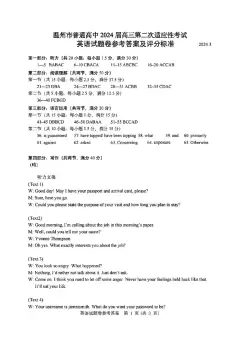
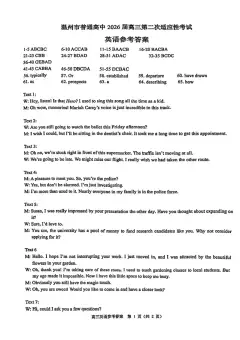
1-5 BCCAB6-10 BCBAB11-15 AABCC16-20 BCACA
21-23 DAB24-27 ACAD28-31 BCBC32-35 DBAC36-40 EGFBA
41-45ACCDB46-50 ABDAB51-55 CDBDC
第二节 (每小题1.5分, 满分15分)
56. leading 57. known 58. Unlike 59. a 60. had tried61. was v62. coaches 63. various64. and65. jointly
四、写作 (共两节, 满分40分)
第一节: 应用文写作 (满分15分)
Possible version:
Dear David,
How have you been lately? I'm writing to share my experience at the Resilience Training Camp recently organized by my school
Before the camp, I often felt discouraged when running into challenges. But the camp helped me see difficulties differently. Once, we did a teamwork challenge where we built a paper tower with limited materials. When our tower collapsed, I stayed calm and encouraged my teammates to try again instead of getting frustrated.
I feel more confident now and try to treat setbacks as opportunities to improve. Looking back, the experience was really rewarding
Best wishes,
Li Hua
读后续写:(AI范文)
Aislinn pulled on her sweater and boots and hurried down the hallway. She quietly grabbed the ice from the fish crate, then tiptoed to the stable where Caper was resting. The little horse lifted his head weakly as she approached. Aislinn gently placed the ice packs on his swollen hooves, murmuring soft words to soothe him. When the ice melted, she led Caper slowly to the shore, letting the cold seawater wash over his hooves. She stayed by his side all night, changing the ice and comforting him, determined to ease his pain.
The next morning, Aislinn woke beside the horse. To her joy, Caper’s hooves were no longer swollen, and he nudged her hand playfully, his energy fully restored. Grandfather came to the stable, amazed at the sight. “You’ve done it, child!” he exclaimed. With Caper healthy again, they loaded the fish onto his back and headed to the market, successfully selling all the catch and paying the rent on time. From that day on, Aislinn’s quick thinking became a beloved family story, proving that love and courage could overcome any hardship.
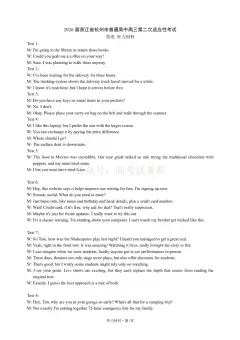
听力原文。
(Text 1)
W: Excuse me, I'd like to find a quiet spot where I can sit down and finish my work at hand.
M: OK, madam. There's a seating area near the inquiry desk.
(停顿2秒) (重复) (停顿10秒)
听下面的录音, 回答第2小题。
(Text 2)
M: Hey, Susan, we need some new blood. Could you please draft a job advertisement?
W: Sure, Greg. What details should it include?
M: Just cover the position, qualifications and the application process and the deadline for hiring is next Friday. Thanks a lot.
(停顿2秒) (重复) (停顿10秒)
听下面的录音, 回答第3小题。
(Text 3)
M: Having a TV to watch sports games on is great. I watched a volleyball match that took place in Australia yesterday.
W: That sounds great! But can we watch the football game today?
M: Sure. It's on after the basketball game, which is nearly finished.
(停顿2秒) (重复) (停顿10秒)
听下面的录音, 回答第4小题。
(Text 4)
M: We'd better hurry, Jasmine. It's 4:30 pm now.
W: Come on. Our train leaves at 7:30 pm. It usually takes us an hour to get to the train station.
M: What a relief! I thought it would leave at 6: 30 pm. Well, in that case, we can set off in an hour.
W: OK.
(停顿2秒) (重复) (停顿10秒)
听下面的录音, 回答第5小题。
(Text 5)
M: We collected 18 kilos of paper last week, not bad.
W: Better, but the goal was 25. Let's place a collection box outside the lecture hall.
M: Smart. I'll make a poster that says “One Sheet Helps”.
(停顿2秒) (重复) (停顿5秒)
第一节到此结束。 (停顿2秒)
第二节: 听下面5段录音。每段录音后有几个小题, 从题中所给的A、B、C三个选项中选出最佳选项。听每段录音前, 你将有时间阅读各个小题, 每小题5秒钟; 听完后, 每小题都有5秒钟的作答时间。每段录音播放两遍。 (停顿2秒)
听下面的录音, 回答第6和第7小题。现在, 你有10秒钟的时间阅读这两个小题。
(停顿10秒)
(Text 6)
M: Can I borrow your phone for a second? Mine is dead, and I can't find my charger.
W: Sure
M: Thanks. Hey, what s wrong with your screen? It's all dark and the colors look strange.
W: Oh! I've been using an app called “Sunset” to help me sleep at night.
M: Really? How?
W: Well, studies show that too much blue light from screens can make sleeping difficult. So, in the evenings, the app adjusts the screen to cancel it out.
M: Oh, interesting. Does it help?
W: Yeah, I think so! I also listen to white noise, which helps me fall asleep, too.
(停顿2秒) (重复) (停顿10秒)
听下面的录音, 回答第8至第10小题。现在, 你有15秒钟的时间阅读这三个小题。
(停顿15秒)
(Text 7)
W: Hi, Frank. I didn't expect to see you here. Are you buying some new furniture for your apartment?
M: No, Chloe. My friend and I are starting our own business. We've been busy decorating our office recently. I'm here to look for some office tables and chairs.
W: Starting your own business?
M: Yeah. We design clothing for our customers.
W: So you quit your job, didn't you?
M: Yeah. I just couldn't imagine myself selling cars forever.
W: Do you know anything about clothing design? I remember you majored in English literature in college.
M: Well, my friend has been in that field for over a decade and he is willing to teach me everything.
W: So brave of you. I've wanted to write a book for a long time since my kid went to college. I even looked for information about how to write on the Internet. But I just don't know if I'm capable…
M: Have a little faith in yourself, Chloe. Where there's a will, there's a way.
(停顿2秒) (重复) (停顿15秒)
听下面的录音, 回答第11至第13小题。现在, 你有15秒钟的时间阅读这三个小题。
(停顿15秒)
(Text 8)
W: Good morning! Ready for another day at school?
M: Not really! I was up late last night finishing my book report. I'm glad you're here. Now, I don't need to worry about missing my stop while sleeping here.
W: Ha-ha! Here…check the news with me. That will keep you awake.
M: On Weibo? No, thanks. I prefer the old-fashioned TV news.
W: Really? Why?
M: I just think it's more balanced.
W: What do you mean by that?
M: Social media platforms present you with information they think you'll like. In terms of the news, that means you rarely encounter stories that challenge your existing beliefs.
W: Ah, I've got it! That's a good point!
(停顿2秒) (重复) (停顿15秒)
听下面的录音, 回答第14至第16小题。现在, 你有15秒钟的时间阅读这三个小题。
(停顿15秒)
(Text 9)
M: Hello, this is Carl Philips speaking. Who's that?
W: Good evening, Mr. Philips. I have great news for you. You are offered a special reduction on…
M: Oh, let me guess. You want to sell me a great deal on medical insurance, right? Or, an unbelievable discount on computer lessons
W: Actually, we just invite you to sign up for our sports club in the downtown. It only costs you fifty dollars.
M: Fifty dollars? I thought you would say free! Uh, listen. I'm not interested.
W: But it includes unlimited use of the weight rooms, the swimming pool and.
M: Well, I have my own fitness program I do around the park nearby.
W: But this is a good deal.
M: Like what I said, I'll pass this time. And please put me on your “do not call” list.
W: OK. It'll take about two to three months before your name is removed from our computer. You might be called by another person during that time.
M: Oh, dear!
(停顿2秒) (重复) (停顿15秒)
听下面的录音, 回答第17至第20小题。现在, 你有20秒钟的时间阅读这四个小题。
(停顿20秒)
(Text 10)
M:
Good morning and thank you for coming here today. I'd like to bring you up to date with the change in the school that will affect the children. The school has grown as the local population has increased, so the canteen is always very busy throughout the lunch period. There's only one serving point, so most pupils have to wait a considerable time to be served. Now we've had a new Food Hall built, which will come into use next week. But one thing we ask you to do, to help in the smooth running of the Food Hall, is to discuss with your children each morning which type of food they want to eat that day, so they can go straight to the relevant serving point. You may be wondering what will happen to the old canteen. We'll still have tables and chairs in there, and pupils can eat food from the Food Hall or lunch they’ve brought from home. Eventually, we may use part of the canteen for storage, but first we'll see how many pupils go in there at lunchtime. OK, let's take a break, and then I'll talk more about our school.
(停顿2秒) (重复) (停顿20秒)
第二节到此结束。现在, 你有两分钟的时间将试卷上的答案转涂到答题纸上。 (停顿2分钟)
听力部分到此结束。
试卷来自“IAI English”公众号,解析来自龚露高考英语公众号,特此感谢!
详细解析:
21-23 DAB 24-27 ACAD28-31 BCBC 32-35 DBAC
A篇
A篇介绍昆虫科考探险项目,包含行程、费用、服务,适合自然保护爱好者。
21. D 根据原文“Expedition Entomology is a chance for you to join our research and conservation initiatives where you'll gather samples, document behavior, and discover species while hiking, swimming, climbing, digging, and camping in some of the most remote and biodiverse places on Earth.”可以推断,该项目面向热爱自然、关注生物多样性保护并愿意参与野外探险的人群,A 历史专业、B 团队运动爱好者、C 寻求资金援助的昆虫学家均不符合项目定位,只有对自然保护感兴趣的旅行者最适合,因此答案为 D。
22. A 根据原文“Panama: June 5th-14th, 2026;Thailand: September 18th-27th, 2026”可以推断,两个探险活动时长均为 10 天;原文同时注明最低年龄 18 岁、泰国项目住宿为家庭小屋、单人仅欢迎不免费,因此 B、C、D 均错误,答案为 A。
23. B 根据原文“Contact us and we can make all the travel arrangements, permit applications, official inquiries, insurance, etc.”可以推断,该项目可协助办理许可申请、官方手续等事务,对应选项 B 的协助办理官方流程,A、C、D 在文中无依据,答案为 B。
B篇
B篇讲述了小学生作文反映家长沉迷手机,引发社会对亲子陪伴的反思。
24. A 根据原文“four of them shared the same invention: the smartphone. I hate my mom's phone and I wish she never had one.”可以推断,孩子反感的不是手机本身,而是家长过度使用手机、缺少陪伴,因此老师发现的问题是家长手机使用过度,答案为 A。
25. C 根据原文“The essay is even accompanied by a sad and angry face saying ‘I hate it,’ looking at a drawn phone with a cross through it.”可以推断,男孩画图是为了直观表达对手机占用父母陪伴的愤怒与难过,即强烈的负面情绪,答案为 C。
26. A 根据原文“Great reminder for us all to put those phones down and engage with our kids more.”可以推断,Tracy 被孩子的心声触动,意识到自己和其他家长因手机忽略孩子,因此感到愧疚,答案为 A。
27. D 根据原文“parents' concerns about their children becoming addicted to smartphones and other smart devices, are also perfectly true the other way around.”可以推断,作者想提醒读者,亲子间的手机沉迷是双向问题,需要反思电子产品对家庭关系的影响,答案为 D。
C篇
C篇批判“工时越长效率越高”,倡导四天工作制,强调实效而非表面忙碌。
28. B 根据原文“Historically, the worker who worked the most hours was widely seen as an organization's most valuable employee. But that is no longer true…working more does not make you more productive.”可以推断,作者以推翻“工时越长越高效”的传统观念开篇,引出全文话题,答案为 B。
29. C 根据原文“workers are under constant pressure to relinquish their rightfully earned time to prove their commitment.”可以推断,员工被迫放弃应得的休息时间来表现敬业,因此 relinquish 意为“放弃”,对应 give up,答案为 C。
30. B 根据原文“This dynamic ultimately creates more pressure to look busy than to deliver value, which is getting in the way of actually getting work done and holding back organizational productivity.”可以推断,组织效率下降的根源是“表演型忙碌”,即追求看起来忙而非创造价值,答案为 B。
31. C 根据原文“So it is time for us to be smarter about how we work. That is ultimately what the four-day-workweek movement seeks to inspire.”可以推断,作者认为四天工作制的意义是推动人们更聪明地工作,而非单纯延长休息,答案为 C。
D篇
D篇论证“走神 / 发呆”的认知与社交益处,呼吁放下手机、激活大脑。
32. D 根据原文“Erin Westgate compares mindless scrolling to ‘brain candy’—momentarily pleasurable but lacking in meaning.”可以推断,无脑刷手机带来的是短暂、肤浅的快乐,如同糖果只有即时快感而无营养,答案为 D。
33. B 根据原文“people predicted they would hate 20 minutes alone doing nothing, yet afterward reported greater enjoyment than expected.”可以推断,人们原本低估了发呆的价值,发呆比想象中更令人愉悦,答案为 B。
34.A 根据原文“their brains remain active in a so-called default mode, allowing ideas to connect in new ways. It's especially helpful for complex problems.”可以推断,大脑默认模式下的无聚焦思考能让想法重新组合,提升创造力,尤其利于解决复杂问题,答案为 A。
35. C 根据原文“let your mind wander instead, there could be some serious benefits. mind-wandering is also key to problem-solving.”可以推断,全文核心是阐述走神 / 发呆的多重益处,强调释放大脑漫游的力量,因此标题选 C 最恰当。
七选五36-40 EGFBA
本篇围绕“自我对话(self-talk)”展开,说明其作用、使用场景与发展变化。
36. E 根据原文“Psychologists refer to it as ‘self-talk,’ a mental tool like a Swiss army knife.”可以推断,下文应总述自我对话的广泛用途,E “它在生活许多场景下都有用”与之衔接最自然,答案为 E。
37.G 根据原文“For them, working through a problem aloud helps them think more clearly and see how things fit together.”可以推断,前文应提到有人用自言自语解决难题,G “有些人用自我对话梳理挑战”符合逻辑,答案为 G。
38. F 根据原文“when people are anxious or stressed, they are more likely to engage in self-talk. It is like giving yourself the support a friend would.”可以推断,自言自语能帮助情绪可控,F“把情绪说出来会让情绪变得可控”衔接最紧密,答案为 F。
39. B 根据原文“I really do believe in the power of positive self-talk…‘Come on, you got this!’”可以推断,本段讲自我对话的激励作用,B “自我对话也能帮助人们保持动力”准确概括段意,答案为 B。
40.题 A 根据原文“we learn to talk to ourselves in childhood… As adults, we may return to speaking out loud when mentally challenged.”可以推断,童年常用、成年变少,A “然而随着长大我们这样做得更少了”构成转折,答案为 A。
完形填空
41-45 ACCDB46-50 ABDAB51-55 CDBDC
本篇文章主要讲述了几位青年冬日在塔斯马尼亚穷游受困,幸获陌生男孩赠食温暖慰藉。中等偏下,词汇与句式常规,主要考查上下文逻辑推理,而非生僻语法。对学生而言,拿满分需细心体会情感脉络。
41. A 文章开头说“我们决定在冬天去塔斯马尼亚背包旅行”,紧接着用破折号加了“go figure”(你想想看/真是搞不懂),这本身就暗示这个决定很随意、缺乏深思熟虑。结合后文“we were all in our late teens”(我们都才十八九岁),以及下文他们没车、在路边干等的情景,可以判断这群年轻人出发时并没有一个明确的“计划”。选项B“线索”、C“规则”、D“责任”代入后均无法体现年轻人说走就走、毫无规划的状态,因此只有A选项最贴合语境。
42. C 这一句的结构是“So ... was the weather that we were all ... to sit in our sleeping bags”,这是一个倒装的“so ... that”句型,表示天气的程度导致了后面的结果。他们所有人都在睡袋里坐着试图取暖,说明天气极其寒冷。既然是在冬天,又冷到需要钻睡袋,天气绝不可能是A“温和的”或B“令人放松的”;D“多变的”虽然符合山区特征,但无法直接导致“钻睡袋取暖”这一特定结果。因此,C“糟糕的/极坏的”最能准确描述这种恶劣的天气状况。
43. C 承接上一题的逻辑,天气如此糟糕,以至于他们“不得不”或“被迫”坐在睡袋里。这里的语境是他们主观上想取暖,但客观上是被天气所迫。A“受鼓舞的”与寒冷语境完全相反;B“被指示的”和D“被命令的”都带有被动接受他人指令的含义,而文中并无任何人指挥他们,完全是因为天气太冷而不得已为之,因此C“被迫的”最为精准。
44. D 这句话是在描述当时昆士城的经济状况与铜矿的关系。结合历史常识和下文提到的污染导致山体光秃,说明采矿是当地唯一的支柱产业。A“从……转移”暗示经济转型,但文末仍提到污染,说明矿业仍在进行;B“导致/贡献”通常是说某事引发了一个结果,不能说“经济引发了铜矿”;C“以……告终”不符合逻辑。D“依赖于”准确地表达了铜矿是当地经济的命脉这一事实,符合当时偏远矿业城镇的特征。
45. B 作者回忆当时乘车穿过数小时的森林后,突然抵达一个因污染而寸草不生的地方,这是一种视觉和心灵上的巨大反差。A“恐惧”语气过重,污染景象虽差但不至于令人恐惧;C“压力”是针对任务或心理负担而言;D“内疚”是指做错事后的自责。只有B“震惊/冲击”能准确传达出从郁郁葱葱的森林猛然看到光秃秃山丘时的那种错愕和强烈对比感。
46. A 句子提到“the hills were left ... by pollution”,说明山丘被污染弄得怎么样了。结合上文“hours of forest”(数小时的森林)与到达此地的对比,原本应该是森林覆盖的山丘现在肯定是没有植被了。B“单独的”通常形容人或物孤立;C“隐藏的”与事实相反,山丘是暴露的;D“烧毁的”虽然也可能导致光秃,但文中明确归因于“污染”(铜矿冶炼产生的废气通常导致植被死亡、土地裸露),因此A“光秃秃的/裸露的”最准确。
47. B 这句话说“压抑的情绪并没有被严寒和连绵的雨所……”。逻辑上,阴冷潮湿的环境会让压抑的心情更糟,所以空格内应该填一个表示“改善/缓解”的词,但由于前面有“wasn’t”,构成了否定,意思是“并没有得到改善”。A“影响”太宽泛;C“恶化”如果代入,否定后就变成了“没有被恶化”,即心情变好了,与原文压抑基调不符;D“控制”也不合适。只有B“帮助(即好转/改善)”代入后表示“压抑的情绪并未因寒冷雨天而好转”,符合逻辑。
48. D 他们走在路上等着搭便车,但好几个小时几乎没车经过。在这种前不着村后不着店、又冷又湿的情况下,内心肯定是焦急盼望有车来的。A“漫无目的地”不符合等车的状态,他们是目的明确地在等车;B“好奇地”和C“犹豫地”都无法体现这种渴望搭上车离开的心情。只有D“焦急地”准确地刻画了年轻人在困境中盼望援助的心理。
49. A 空格前主语是“youthful enthusiasm”(青春的狂热),后文描述一个小男孩送来了吃的。一开始没车坐,又冷又饿,热情肯定是在“消退”的。B“继续”与困境矛盾;C“出现”不合逻辑,热情是一开始就有的;D“恢复”应该发生在得到帮助之后,而不是在男孩出现之前。因此,在男孩拿着篮子走出来之前,他们的热情正处于A“下降/减退”的状态。
50. B 男孩拿来篮子,解释说他觉得我们可能会……一些吃的。男孩是来提供帮助的,用词应当是委婉客气的。A“收到”太过直白;C“购买”不符合情景,男孩不是来卖东西的;D“带来”主语是we,说不通。B“appreciate”在这里意为“感激/享用”,是给予帮助时的礼貌用语,相当于“我想你们或许会想用点吃的”,非常符合小男孩善良体贴的形象。
51. C 篮子里装的是茶、蛋糕和饼干,这些都是很家常、很普通的食物。A“稀有的”和B“昂贵的”明显不符合茶和饼干的特征;D“独特的”也不贴切,这些都是日常点心。C“简单的”最能形容这份朴实无华的礼物,也呼应了下文“unexpected comfort”——正是这份简单才显得尤为珍贵。
52. D 在一个寒冷刺骨的雨天,一份热茶和点心带来的感觉是什么?肯定不是A“表扬”,也不是B“进步”,C“信心”虽然有一定关联,但最能直接对应冰冷身体和低落情绪的,是那份温暖带来的D“安慰/舒适”。热茶暖身,善意暖心,这份简单的给予在特定环境下是巨大的慰藉。
53. B 我们对于有人能注意到我们这三个邋遢的少年并主动提供帮助这件事,内心感受如何?A“确信的”不符合语境;C“担心的”是对方可能会有的情绪,不是我们的;D“羞愧的”虽然可能因为邋遢而有点不好意思,但整篇文章的主旋律是感恩和温暖。B“感动的”最能概括这种被陌生人温柔以待的心情,与全文温情脉脉的结尾基调一致。
54. D 固定搭配“take the trouble to do sth.”意为“不辞辛劳地做某事/费心做某事”。小男孩不仅注意到了他们,还特意准备了茶点送出来,这是主动费心帮忙。A“risk”风险,搭配不当;B“courage”勇气,虽然送东西给陌生人需要一点勇气,但“take the courage”用法不地道,且这里强调的更多是费心费力;C“chance”机会,“take the chance”是利用机会,与文意不符。因此D是唯一正确选项。
55. C 文章最后总结,雨停了,他们也搭上了车,但那段短暂却意义非凡的……依然记忆犹新。A“活动”指代太泛;B“事故”是贬义词;D“合作”并未发生。小男孩送食物这件事是一场不期而遇的相逢,是一次人与人之间温暖的邂逅。C“encounter”(邂逅/相遇)最精准地定义了这次短暂却深刻的交会,既包含了偶然性,又蕴含了情感温度。
语法填空
56.leading57.known 58.Unlike 59.a 60.had tried 61.was 62.coaches 63.various 64.and 65.jointly
本篇讲述中英高校冰上龙舟赛,考查非谓语、介词、冠词、时态、词性转换等。
58. 根据原文“______ traditional water dragon boating, ice dragon boating requires athletes to use ice picks”,此处表示与传统龙舟对比,用 Unlike,故填 Unlike。
60.题根据原文“it was the first time that they ______(try) dragon boat racing on ice”,固定句型 It was the first time that…后用过去完成时,故填 had tried。
应用文写作:
Dear David,
How have you been lately? I'm writing to share my experience at the Resilience Training Camp recently organized by my school.
Before the camp, I often felt discouraged when running into challenges. But the camp helped me see difficulties differently. Once, we did a teamwork challenge where we built a paper tower with limited materials. When our tower collapsed, I stayed calm and encouraged my teammates to try again instead of getting frustrated.
I feel more confident now and try to treat setbacks as opportunities to improve. Looking back, the experience was really rewarding。
Best wishes,
Li Hua
读后续写:(AI范文)
Aislinn pulled on her sweater and boots and hurried down the hallway. She quietly grabbed the ice from the fish crate, then tiptoed to the stable where Caper was resting. The little horse lifted his head weakly as she approached. Aislinn gently placed the ice packs on his swollen hooves, murmuring soft words to soothe him. When the ice melted, she led Caper slowly to the shore, letting the cold seawater wash over his hooves. She stayed by his side all night, changing the ice and comforting him, determined to ease his pain.
The next morning, Aislinn woke beside the horse. To her joy, Caper’s hooves were no longer swollen, and he nudged her hand playfully, his energy fully restored. Grandfather came to the stable, amazed at the sight. “You’ve done it, child!” he exclaimed. With Caper healthy again, they loaded the fish onto his back and headed to the market, successfully selling all the catch and paying the rent on time. From that day on, Aislinn’s quick thinking became a beloved family story, proving that love and courage could overcome any hardship.