ARTICLE · 1435796
2026中考英语---实战演练
本试卷分第Ⅰ卷和第Ⅱ卷两部分。第Ⅰ卷1至8页,第Ⅱ卷9至12页,共150分。考试时间120分钟。
第Ⅰ卷(共80分)
第一部分听力(共25小题;1-20小题每题1分,21-25小题,每题2分,满分30分)
(一)听句子,选择适当的应答语。每个句子读两遍。
1. A. I have two.B. These are books.C. They’re mine.
2. A. Good luck!B. Good idea!C. Good job!
3. A. That’s right.B. Never mind.C. Sure, here you are.
4. A. For three months.B. Once a month.C. In two days.
5. A. Have a nice day.B. Thank you.C. That’s no excuse.
(二)听五段对话,选择正确答案。每段对话读两遍。你将有20秒钟的时间阅读下面5个小题。
6. What’s wrong with the boy?
A. He has a cold.
B. He has a headache.
C. He has a stomachache.
7. Where are the speakers probably?
A. In the library.
B. In the dining hall.
C. In the classroom.
8. What is the relationship between the two speakers?
A. Doctor and patient.
B. Teacher and student.
C. Mother and son.
9. How did the girl learn to cook?
A. From her mother.
B. From some cooks.
C. On the Internet.
10. What’s the weather like today?
A. Windy.B. Sunny.C. Rainy.
(三)听两段长对话,选择正确答案。每段对话读两遍。听每段对话前你将有10秒钟的时间阅读对应的3个小题。
听第一段对话,回答第11至13小题。
11. What does Matt think of the girl’s question?
A. Meaningless.B. Interesting.C. Different.
12. Which invention is the greatest according to the girl?
A. The Internet.B. The phone.C. The computer.
13. What do they think of the Internet?
A. It is boring.B. It changes the world.C. It is useless.
听下面一段较长对话,回答第8至第10三个小题。听第二段对话,回答第14至16小题。
14. Where did Jim go during the National Day holiday?
A. To a forest park.B. To a beach.C. To a village.
15. What did Jim do there?
A. He worked as a guide.
B. He took beautiful photos.
C. He saw different rocks.
16. How long did Jim stay there?
A. For a day.B. For two days.C. For three days.
(四)听短文,选择正确答案。短文读两遍。听录音前你将有20秒钟的时间阅读下面4个小题。
17. Who did Sally’s grandfather live with when he was little?
A. His mother.B. His aunt.C. His grandfather.
18. How was the life of Sally’s grandfather when he was young?
A. Difficult.B. Relaxing.C. Simple.
19. What was Sally’s grandfather’s dream?
A. To be a writer.B. To be a teacher.C. To be a doctor.
20. What was Sally’s grandfather like?
A. Warm-hearted.B. Humorous.C. Hard-working.
(五)听短文填表格。根据短文内容,写出下面表格中所缺信息,每空一词。短文读三遍。你将有20秒钟的时间阅读表格内容。答题完毕后,请将答案填写在答题卡的相应位置。
Today is a gift | |
Today | ※ The past is (21) ________ and we can no longer enjoyed it. ※ Losing ourselves in the past means (22) ________ the chance to enjoy the present. |
Tomorrow | ※The future is just a promise ※ We cannot fully enjoy tomorrow (23) ________ we know how to enjoy today. ※ With each new day, our life is one day (24) ________ than before. |
Each day | ※ Each day is a (25) ________ to live. ※ Today is a gift-that’s why we call it “the present”. |
第二部分完形填空(共10小题;每小题1分,满分10分)
阅读下面短文,掌握其大意,然后从每题所给的A、B、C三个选项中,选出能填入短文相应空白处的最佳选项,并在答题卡上将该项涂黑。
Born in Shanghai in 1926, Gu Fangzhou faced a difficult time when his father died suddenly in 1931. At school, he was often 26 fun of for being poor. Yet he overcame these difficulties and entered Peking UniversityMedical School in 1944, which later his success was from his mother’s continuous 27 .
In 1955, a serious polio (脊髓灰质炎) outbreak happened in Nantong and spread rapidly 28 China, leaving countless children paralyzed (瘫痪的) or dead. Two years later, Gu answered the call, leading a team and beginning to research polio vaccine (疫苗) in Kunming. However, this process was full of 29 .
When the vaccine entered human tests, Gu tried a bottle of the vaccine 30 to see its effects. Later, he took another bold (大胆的) step: he vaccinated his newborn son to further prove the safety of the vaccine for children. “If we don’t trust 31 we produce, how can others believe in it?” he said. Soon, his team members also volunteered their own children. 32, all participants (参与者) remained healthy afterward. However, ending polio required overcoming another problem. The liquid vaccine needed to be 33 at 2-8 ℃, nearly impossible in the 1960s in China. Gu’s team solved this by creating a sugar-coated pill, which was easy to transport, had a 34 shelf life (保质期), and was gladly accepted by children. Gradually, the “sugar pill” reached faraway parts of China, and the polio cases became fewer and fewer. The moment of victory came in 2000. Gu, then 74, signed the official paper proving polio was gone in China. Though this was a great achievement, he often said, “I only did 35 thing in my life, and that was to make a small sugar pill.”
26. A. madeB. takenC. carried
27. A. effortB. encouragementC. achievement
28. A. acrossB. fromC. above
29. A. surprisesB. challengesC. joys
30. A. in publicB. in personC. in silence
31. A. whereB. whoC. what
32. A. UsuallyB. HoweverC. Luckily
33. A. keptB. heatedC. signed
34. A. biggerB. longerC. easier
35. A. onceB. firstC. one
第三部分阅读(共20小题;每小题2分,满分40分)
第一节阅读下列短文或图表,从每题所给的A、B、C、D四个选项中,选出最佳选项,并在答题卡上将该项涂黑。(共15小题;每小题2分,满分30分)
A
When Samaira was just 6 years old, her dad introduced her to coding (编程). Then it became something exciting to her and even a way to bring what she dreamed of to life.
But, over time, she realized that her friends thought that coding was boring, hard, and never something that they would do for fun. That was the first time that she thought, “Hey, this is a problem. My friends don’t like coding as much as I do. But I think they could.” And her idea for sharing her hobby emerged.
She started creating games like Coderbunnzy (编码兔子) to teach her friends coding in a fun way. She quickly found that she enjoyed teaching her friends with these games. That’s when she started booking conference rooms on Saturday afternoons. Anybody who wanted to could come in, and she would teach them how to play and explain how what they learned connected to the real world and computer science.
Of course, she was just 7 years old and had no idea of selling a product. This was just a project she was doing for fun. But when more and more parents started telling her that this was something people would be expected to buy, which made her start thinking about how she could help more young people get into coding. So she started a company and slowly introduced more coding education products.
Samaira says that she sometimes cannot fully understand how much her project has grown, but she is happy to see more people support her and join in the games.
36. What does the underlined word “emerged” in Paragraph 2 probably mean?
A. Appeared.B. Disappeared.C. Changed.D. Stopped.
37. Why did Samaira start creating games like Coderbunnzy?
A. To sell them to make money for her family.
B. To teach her friends coding in a fun way.
C. To become a famous game designer at school.
D. To compete with other coding education companies.
38. What made Samaira start to think about helping more young people get into coding?
A. Her teacher’s advice at school.
B. Her friends’ request for more games.
C. Parents’ interest in buying her games.
D. Her dad’s encouragement to start a company.
39. What can we learn from Samaira’s story?
A. Coding is too difficult for most children to learn.
B. It’s impossible to turn a hobby into a big project.
C. We should stick to our ideas even if others don’t like them.
D. Small actions can make a big difference to the people around us.
B
⚠︎规范操作,远离危险,安全第一,探索无限;
How to extract DNA from a banana
Steps:
● Mash (捣烂)1 banana with some water in a plastic bag.
● Mix some dish soap, salt and water in a cup. Then stir gently with a spoon.
● Add the dish soap mixture to the bag and mix them thoroughly.
● Filter the mixture with a filter paper and collect the filtrate (滤液).
● Add some cold alcohol to the filtrate and let the mixture sit for s minutes.
●Dip a wood skewer into the liquid and slowly turn it, and pull out the DNA.
How it works:
Mashing the banana increases the surface area of the plant cells and makes extracting (提取) the DNA easier. Adding water helps separate the cells from each other. Dish soap breaks down the cell membrane (细胞膜) and nuclear membrane (核膜). These steps release the DNAinto the liquid. Salt removes proteins bound to the DNA and helps the DNA aggregate (聚集). After filtering, we have a liquid containing DNA, which then separates out of the solution in cold alcohol. Finally, we can use a wood skewer to collect the white, stringy (拉丝的) DNA.
Why dowe use a banana?
Bananas are a great choice for this experiment because their cells contain a lot of DNA. Unlike humans, who have two copies of each chromosome (染色体), bananas have three copies. This means their cells are packed with DNA, making it much easier for us to see it with our own eyes. In fact, strawberries are even better — they have eight copies!
(By Jennifer)
……… WORD BANK词汇集锦………
alcohol /'ælkəhɒl/ n. 酒精release /rɪ'li:s/ v. 释放
mixture /'mɪkstʃə(r)/ n. 混合物protein /'prəʊti:n / n. 蛋白质
thoroughly /'θʌrəli/ adv. 完全地;彻底地contain /kən'teɪn/ v. 含有
40. What is the right order of the experiment steps?
① Add cold alcohol to the filtrate.② Mash the banana with water in a bag.
③ Filter the mixture and get the filtrate.④ Mix dish soap, salt and water in a cup.
A. ②④③①B. ②③④①C. ④②①③D. ④③②①
41. What is the use of dish soap in the experiment?
A. It helps separate cells.B. It makes DNA aggregate quickly.
C. It keeps the DNA fresh for long.D. It breaks down cell and nuclear membranes.
42. The passage is mainly about ________.
A. the importance of DNA in plants
B. different ways to do biology experiments
C. how to get DNA from a banana and why it works
D. the differences between bananas and strawberries
C
In November, the temperature drops greatly. There are often groups of vegetables that look like “ugly ducklings”. They aren’t fresh or smooth. Instead, they look old and wrinkled (皱巴巴的) because of the cold frost (霜) outside.
You probably think that these vegetables aren’t tasty, delicious and healthy at all since they look so ugly. Their skins are old and wrinkled, their shapes are irregular, and they don’t have the smooth, perfect appearance of the vegetables you usually see on supermarket shelves.
But here’s a surprising fact: when you take a bite, you will find they taste surprisingly delicious and sweet, far better than many neatly (整齐地) grown vegetables. “Sellers must put some sugar in them!” you might think. In truth, these “ugly” vegetables often grow in more natural conditions, accepting more nutrients (养分) and sunlight, which gives them a richer, sweeter tasty. Their imperfect look is just a sign of their natural growth, not bad in taste. They are pretty good for people’s health.
Vegetables are clever living things-they want to stay alive in winter. They know they will “die” if the water inside their bodies turns into ice, so they have a clever way to avoid freezing and stay alive. Many vegetables contain something called “starch (淀粉)”. When it gets cold, the vegetables quickly change this starch into sugar to protect themselves from freezing. This is very important, and it has to do with a simple scientific fact: plain water (淡水) freezes easily, but sugar water has a lower freezing point and is harder to freeze. When vegetables fill their bodies with sugar and they are delicious and sweet, the water inside them becomes much harder to freeze.
This process protects the vegetables from the cold weather, keeping them from freezing to death. And that’s great news for us too-it means we are able to enjoy vegetables that are naturally sweet and delicious. So these vegetables aren’t just “ugly”; they’re actually pretty clever!
43. What makes the vegetables look old and wrinkled in November?
A. The hot weather.B. The cold frost.C. The lack of water.D. The insects.
44. What can we infer from the underlined sentence?
A. The vegetables are too sweet to eat.
B. People think the sellers are very clever.
C. People don’t believe the ugly vegetables are naturally sweet.
D. Sellers really add sugar to the vegetables to make them sweet.
45. Which of the following descriptions about vegetables stay alive in winter?
A. They won’t “die” if the water inside their bodies turns into ice
B. They turn starch into sugar so that the water inside them is harder to freeze.
C. They make the sugar water inside their bodies freeze more easily.
D. They use plain water to raises the freezing point of their bodies.
46. What does the writer think of the ugly vegetables?
A. They are useless and not worth buying.
B. They look terrible and taste bad as well.
C. They are smart, delicious, sweet and tasty.
D. They are only good for making money.
D
Think about how things like the telephone and the Internet changed lives. They quickly went from being new inventions to a normal part of our everyday. Now, the same thing is happening with AI.
Online search is moving from “finding information” “getting answers”. In the past, typing (打字) a question into a search engine (搜索引) might give you pages of links. You’d have to click (用鼠标点击) around to find what you need. Now, AI often jumps in right away with a full answer at the top with a few helpful links to support it. For example, if you searchXiaohongshu for advice on visiting the Great Wall, AI can quickly summarize (总结) the toptips and create a travel guide just for you.
Keeping focus on your health used to mean going to the hospital once a year. But today, AI can help you do it in real time. It powers smartwatches and fitness apps to give you a daily look to track (追踪) your health. When you exercise, AI can watch your heart rate count your steps, and keep an eye on your activity levels. It’s also a helpful tool for doctors. Now, AI can help them find problems faster and catch warning signs before they become dangerous.
Besides, thanks to AI, getting from place to place is much less stressful than before. Navigation (导航) apps working with AI help you find the best way. They learn about your daily lives, predict the latest traffic conditions, check the weather, and warn you about road accidents-all of that happens without your knowing. It can even make smart predictions, like guessing where you’re heading before you type it in. Ever noticed how your map app already knows you want to go home as soon as you open it.
47. Why does the writer mention the telephone and the Internet?
A. To suggest Al is better than them.B. To explain how they were invented.
C. To compare their speed of development.D. To show that AI follows a similar way.
48. How has online search changed according to the passage?
A. It includes more ads in its results.B. It now provides answers right away.
C. It now offers fewer search results.D. It requires more clicks than before.
49. What is the main idea of the third paragraph?
A. AI makes exercise more fun.B. AI helps track health anytime.
C. AI mainly works inside hospitals.D. AI only works during exercise.
50. What does the navigation app do without the user knowing?
A. It plans trips for the next month.B. It changes the user’s daily routines.
C. It predicts traffic and road problems.D. It shares the user’s location with others.
第二节根据短文内容,从短文后的方框中选出能填入空白处的最佳选项,并在答题卡上将该项涂黑。(共5小题;每小题2分,满分10分)
Recently, I’ve been feeling nervous whenever I talk to my teachers, My heart races, my words get mixed up, and sometimes I forget what I want to say, even when I just need to ask a simple question. It’s starting to stress me out. I really want to change this. Could you please give me some advice on how to handle this situations.
Change your view.
It’s something you can totally improve with a little practice, don’t be too hard on yourself. Here is some advice: so it’s easy to forget they are also human beings. 51. ________ When you remind yourself that you’re talking to another person, the conversation will feel friendlier.
52. ________
Try a simple “Good morning” when you see your teacher. No questions needed-just a greeting. Once that feels comfortable, try asking one easy question about homework. Taking tiny steps makes talking to teachers feel less scary over time.
Let your body talk.
53. ________ So stand or sit upright and make eye contact even if it’s just a quick look. Positive body language signals confidence - and sometimes, even if you don’t feel confident, acting confident can help your brain catch up.
Focus on the goal.
Instead of thinking about how nervous you are, remind yourself why you’re having the conversation.54. ________ When you focus on the reason, you’ll naturally pay more attention to the discussion and less to your racing heartbeat.
Practise outside the classroom
If talking to teachers still feels too hard, try practising with friends, family, or even in front of a mirror. The more you practise speaking up, the easier it becomes.55. ________
A. Start with something small. B. They have been in your shoes before too. C. Then, you’ll feel ready for the real thing. D. Your body language speaks before you do. E. The purpose is more important than your fear. |
第Ⅱ卷(共70分)
第四部分书面表达(共三节)
第一节词汇运用(共两题,满分30分)
(一)单词拼写(共5小题;每小题2分,满分10分)
根据句意和首字母或汉语提示,将单词的正确形式完整地写在答题卡相应的位置上。
56. Having a hobby can help you m________ your time better and own your more energy.
57. When you have difficulty s________ the problem, you can ask me for help, and I will give you a helping hand.
58. Mr. Zhang is an experienced teacher. He has t________ biology for over thirty years.
59. Don’t laugh at the ________ (残疾的) people at any time. They are the people who are in need. They need to be taken care of.
60. My home is very closed to the school. It’s only ten ________ (分钟) walk there. Let’s go there together on foot.
(二)综合填空(共10小题;每小题2分,满分20分)
根据短文内容,用方框中所给词语的适当形式填空,使文章通顺、完整。(每词限用一次)
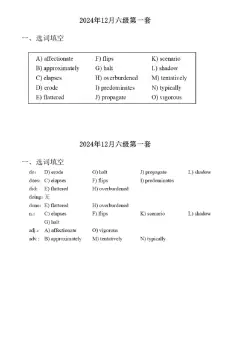
as use express choose a two family meaning gift tradition |
In Chinese culture, a name is far more than a simple mark;it is 61 expression of identity (身份) and familial bonds (纽带). Rooted in tradition, it offers a window into the heart of culture.
The tradition of Chinese name selection (挑选) for thousands of years. In ancient times, names were often 62 to reflect a child’s character, physical characteristics, or the situation when they were born. 63 society developed, names began to have many different meanings, taking ideas from classical literature, poems, characters and so on.
A 64 Chinese name often has. three characters: the family name, the general name (字辈), and the given name. The family name, inherited (继承) from the father’s side, is placed first. There are thousands of family names, which have been passed down through generations, forming the clan (宗族) culture. The generational name is 65 to show a person’s position within the family. This character is shared among all members of the samegeneration, creating a sense of unity. The given name is chosen to 66 their hopes for the child by the parents. This is the most personal and 67 part of the name.
Several key principles guide the selection of a Chinese name. First, the characters chosen for a name must have positive meanings. 68 , a well-chosen name should sound pleasant to the ear. Besides, many 69 may choose characters that are believed to go well with the child’s Chinese zodiac (生肖) and the five elements (五行), bringing balance to their life.
Despite (尽管) the changing times, the signal meaning of Chinese names remains deeply rooted in the culture. A well-chosen name is seen as a wonderful 70 , giving the child a sense of identity, purpose and connection to their heritage (文化遗产).
第二节阅读表达(共6小题;71-73小题每题2分,74-76小题每题3分,满分15分)
阅读下面的短文,并根据短文后的要求答题。(请注意问题后的词数要求)
【1】 What would happen if the Earth suddenly stopped turning? “If everyone on the Earth opened their fridges at the same time, would the planet get colder?” These questions are funny and might seem: “stupid”, but in Randall Munroe’s What If?. they are answered with serious yet funny scientific explanations.
【2】 This realization started with a new understanding of questions themselves. While reading, 75. I’m beginning to realize that asking questions isn’t a bad thing, and that some seemingly simple ones can be surprisingly difficult. For example, why does our hair stand up when we rub (揉) a balloon on it? Physics tells us that electrons (电子) are transferred (转移) from our hair to the balloon. But why do they move from our hair to the balloon, and not the other way around? Nobody knows the answer, because in physics, it’s a general rule without a clear explanation.
【3】 This book also showed me that a love for science can begin 74.①________ these small, everyday questions and science is present in my everyday life. I gradually started to notice the little details around me, such as why dumplings float to the surface when they’re fully cooked.
【4】 Most importantly, reading the book encouraged me to look at the world in a scientific way. Before, when I saw the light at the top of a flame (火焰) shaking, I would just think, “Wow, that’s cool.” But now, I understand that this is 74.②________ the flame heats the air, causing the refraction (折射) of light. This change - from simply thinking something is “cool” to understanding “why”-has given me a better understanding of the world around me.
【5】 To me, this book is like a key that unlocks the door to the unknown. If you’re looking for a book that is both fun and educational, What If? is truly worth 74.③________!
71. Why can’t people explain why electrons move from hair to the balloon? (no more than 12 words)
____________________________________________________________________________________________
72. How did the writer think of the shaking flame light in the past? (no more than 1 word)
____________________________________________________________________________________________
73. What makes the writer understand the world better? (no more than 11 words)
____________________________________________________________________________________________
74. Fill in each blank in the passage with a proper word.
①________ ②________③________
____________________________________________________________________________________________
75. Translate the underlined sentence in the 2nd paragraph into Chinese.
____________________________________________________________________________________________
76. What does the writer think of the book What If?? What about you?
____________________________________________________________________________________________
第三节写作(共1题,满分25分)
初中阶段是一段充满发现与蜕变的旅程。课堂上,我们汲取知识;交往中,我们学会理解;面对困难,我们日益勇敢;不懈努力,我们收获成长。学校英语广播站发起征稿,邀请同学们以I’velearnedto________为题,写一篇短文,分享初中阶段让你受益匪浅的成长感悟。内容包括:
1.简要描述一件让你学会某种品质或能力的具体事件;
2.说明这一经历对你产生了怎样的影响或改变;
3.表达你对这段成长历程的感悟。
注意:
1.补全题目,词数80-100,题目已给出,不计入总词数;
2.内容完整,语句通顺,意思连贯,书写规范;
3.文中不得出现真实人名、校名等信息。
I’ve learned to ________
____________________________________________________________________________________________
____________________________________________________________________________________________
中考英语练答案及听力原文
2026.05
本试卷分第I卷和第π卷两部分。第[卷1至8页,第π卷9至12页,共150 分。考试时间120分钟.
第I卷(共80分)
第一部分听力(共25小题;1-20小题每题1分,21-25小題,每题2分,满分30分) (一)听句子,选择适当的应答语。每个句子读两遍“
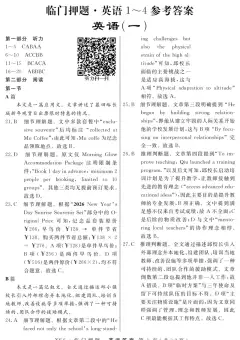
答案及听力原文:1-5 CBCAB
1.Whose books are these?
2.Lei's 봉。to the cinema at the weekend?
3.Can 1 use you dictionary, Tom?
4.How long have you been working here9
5.You have done a good job about this?
(二)听五段对话,选择正确答案,每段对话读两遍.你将有20秒钟的时间阅读下面5 个小題。
答案及听力原文:6-10 BBCCA
6.W: You don't look well, Mike. Have you got a cold?
M: No. I just didn't sleep well last night and I have a headache.
7.W: Excuse me, is that scat taken?
M: No, you can sit here. Is this your first lime having lunch here?
W: Yes, this is my first day in this school.
8.W: Take your lime. You haven'l finished your breakfast,
M: But 1 must hurry Ms. Green gave me the key and asked me to open the door of our classroom this morning,
W: I hen lake this apple. You can have it after class.
10.M: Wow! Cindy, you cook as well as those cooks in restaurants. Did your mother teach you to cook?
W: Well, 1 learned it from the online cookin퐁videos.
10 W: The wind is really strong today?
M: Anything is better than the rainy days in (he past week.
W: You are right. 1 hope it will be sunny tomorrow.
(三)听两段长对话,选择正确答案。每段对话读两遍。听每段对话前你将有10秒钟的时间阅读对应的3个小題。
听第一段对话,冋答第11至13小题.
答案及听力原文:11-13 BAB
W: Matt, what do you think is the greatest invention in the world?
M: Hmm... [hal's a fun question I have never thought about it before.
九年级英诏练习题答案及听力原文共4页第1页
W: Yeah. In my opinion, ihe Internet is the greatest. Think of all the things we do on it!
M: It has really changed the world. People can talk and shop online anytime.
W: I think so. And I just can't imagine what lite would be like without it.
M: Exactly. We can also learn new knowledge and watch movies on the Internet.
W: 1^5( 5 tnle.
听下面一段较长对话,回答第8至第10三个小题。.听第-段对话,回答第14至16小
题。
答案及听力原文:14-16 ACB
W: I didn't see you during the National Day holiday. Where did you go, Jim?
M: I visited the Zhangjiajie National Forest Park with my family.
W: How was your trip?
M: Interesting! We saw diHerenl roeks. They are certainly wonders of the natural world.
W: Well, how Ion옹did you stay there?
M: For two days. The park is nicer than I thought. Could I call you if I go there next time?
W: I want to visit it, too.
M: No problem. I will be your guide next time.
(四)听短文,选择正确答案。短文读两遍。听衆音前你将有20秒钟的时间阅读下面4个小题。
解案及听力原文:17-20 BACC
Good morning, everyone. Km Sally. In my heart, my grandfather is a hero. His parents died when he was a little boy, so he lived with his aunt. Life wasn't easy for them at that time because they never had enough money.
When he was 14, he left school and started working. He wanted to be a doctor, so he studied by himself at night after work. At the age of 18, he took the exams to 응ct into the college but failed. I lowever, he didn't give up. The next year, he passed the exams successfully and became a college student. He became a doctor when he was 27.
I admire my grandfather because he keeps working hard for his dream. I want to be like him when 1 grow up.
(五)听短文填表格.根据短文内容,写出下面表格中所缺信息,毎空•词。短文读三遍。你将有2。秒钟的时间阅读表格内容。答题完毕后,请将答案填写在答題卡的相应
位置。
答案及听力原文:21—25 gone wasting unless shorter decision
The best day of our life is today. The pasl is gone and we can no longer enjoy it. Losing ourselves in the past means wasting the chance to enjoy the present The future is just a promise - a time that never actually arrives, AH we truly have is today,
When tomorrow comes, it's no longer "tomorrow" - it becomes our "today". We cannot fully enjoy tomorrow unless we know how to enjoy today. If we are to live thirty more years, we wiH experience about 10,950 todays. But every day thal passes unnoticed is a day taken from our lite. With each new day, our life is one day shorter than before.
Each day is a decision to live. Today is a gift - that's why we cal! it "the present". How we use this is up to us. At the start of each new day, we decide whether to open that "gift” or leave it in the corner lo go lo waste. Each day is a decision to live our ideal life.
九年级英语练习題答案及听力原文共4页第2页
第二部分完形填空(共10小题;每小题1分,满分|θ分)
答案26-30. ABABB 31-35 C C A B C
第三部分阅读(共 20 小题; 每小题 고分, 满分 40 分)
第节阅读下列短文或图衣,从每題所给的A、R、C、D四个选项中,选出最佳选项,并在答题卡上将该项涂黑。(共15小趣:每小题2分,满分30分)
36-39 ABCD 40-셔2ADC 43-46BCBC47-50 DBBC
第二节•根据短文内容,从短文后的方框中选出能填入空白处的最佳选项,并在答题卡|:将该项涂黑.(共5小题;每小题2分,满分10分)
51-55 BADEC
第!!卷(共70分)
第四部分书面表达(共三节)
第一节词汇运用(共两题,满分30分)
(一)单词拼写(共5小题;每小题2分,满分|0分)
根据句意和首字母或汉话提示,将单词的正确形式完整地写在答题k相应的位置上。
56-60 manage solving taught disabled minutes'
(二)综合壊空(共10小题;每小題2分,满分20分)
根据短丈内容,用方框中所给词语的适当形式壊空,使文章通顺、完整。(每词限用一次)
61 -65 anchosenAstraditional used
66-70 express meaningful Second familiesgift
第二节阅读表达(共6小题;71-73小题每题2分,74.76小題每题3分,满分15分) 阅读下面的短文,并根据短文后的要:求答題。(请注意问題后的词数要求)
71.Because it's a general rule without clear explanation,
72.Cool.
73.This change - from simply thinking something is "cool" to understanding "why「Thc change of Ihinkin옴and understanding why./lt has given me a deeper understanding of the world.
74.with because reading
75.我升始明白问问题并不是一件坏事。
76.It's fun, educational and worth reading. To me, this book is like a key that unlocks the door to the unknown
九年级英语练习题答案及听力原文共4虫第3火
第三节写作(共1题,满分25分>
I've learned to help others
I ve learnt to help others in need during my junior high school lile. One year ago, my classmate Li Ming fell ill and missed many lessons. I oHered to help him with his schooIwork every afternoon after class. 1 explained difTieult points patiently and shared my notes with him Soon he caught up with the class, and we became better friends.
Helping others makes me feel warm and happy. In the future, ril keep doing smaH kind things for people around me. This good habit wiH make my life more meaningful and help me build more tnie friendships.
评分说明:
1.评分原则
(1)评分时,先根据文章的内容和语言初步确定其所属档次,然后以该档次的要求来衡量,确定或调整档次,最后给分。
(2)评分时,应注意的主要内容为:内容要点、应用词汇和语法结构的数量和准确性及上下文的连贯性。
(3)拼写与标点符号是语言准确性的一个方面,评分时,应视其对交际的影响程度予以考虑。
(4)如果书写较差,以至影响交际,将分数降低一个档次。
2.各档次的给分范围和要求
第一档(21—25分)很好地完成了试题规定的任务。
覆盖所有内容要点;应用了较丰富的语法结构和词汇;用词准确、句子通顺、行文连贯、表达清楚,没有或基本没有语言错误:书写工整;字数符合要求。完全达到了预期的写作目的,
第二档(16—20分)较好地完成了贰题规定的任务。
虽漏掉1、2个次重点,但覆盖所有主要内容;应用的语言结构和词汇虽不太丰*富、但能满足任务的要求;句子较通顺、表达较清楚;行少量语吉错误;书写工整;字数基本符合要求。达到了预期的写作目的.
第三档(10-15分)基本完成了试题规定的任务。
虽漏掉-些内容,但覆盖所有主要内容;应用的语言结构単-;句子不够通顺,行文不够连贯;语言错误较多;书写不够ェ整,字数较少。整体而言,基本达到了预期的写作目的。
第四档(0—9分)未恰当完成试题规定的任务。
漏掉或未描述清楚一些主.要内容,写了一些无关内容;应用的语言结构单一旦不规范;句子不通顺,行文不连贯;语言错误多;书写潦草,字数不足50。信息未能清楚地传达给读者。
九年级英语练习題答案及听力原文共4页第4页
声明:素材源于网络,经整理分享,仅供交流学习,未经同意,禁止商用、转载或修改,特此说明!