






文档内容
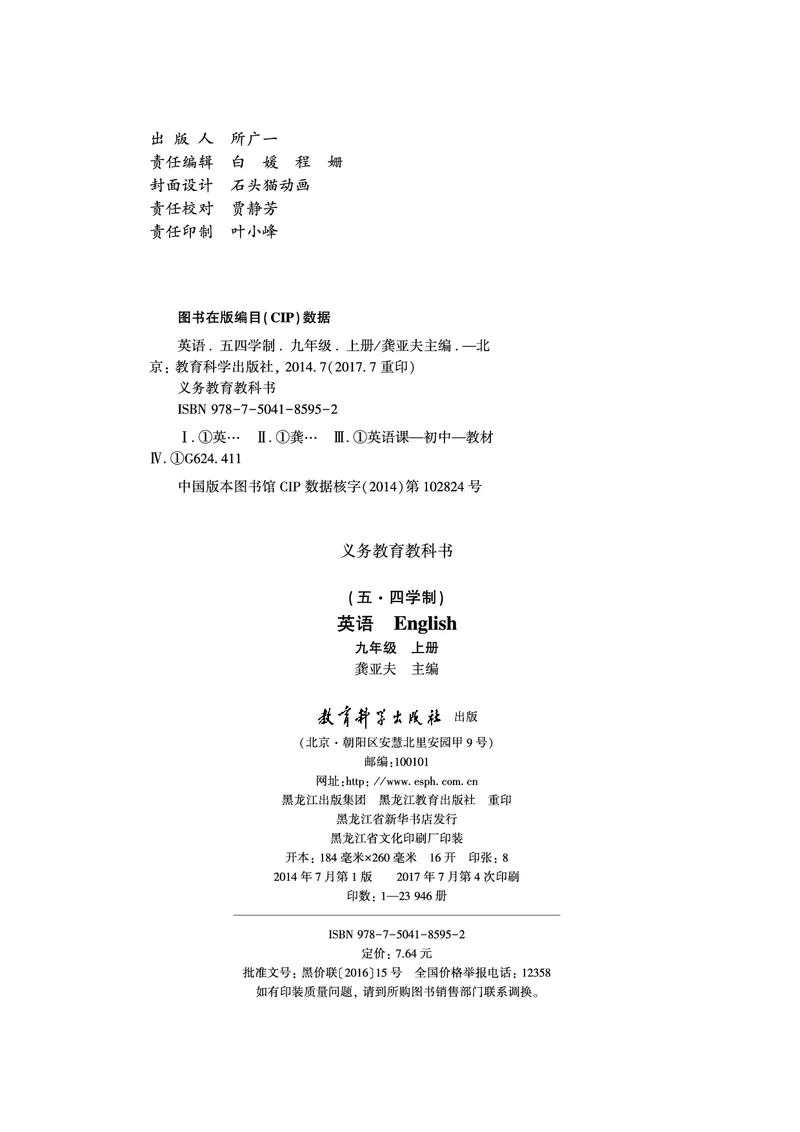
定价:7.64元
批准文号:黑价联〔2016〕15号
全国价格举报电话:12358
9年级--上册.indd 1 17-7-14 下午4:02义 务 教 育 教 科 书
五·四学制
九年级 上册亲爱的同学们,愉快的暑假过后,我们即将踏上九年级的
英语学习征程,你们准备得怎么样啦?
上学期我们从那些挑战自我、战胜困难的故事里,学习了
主人公们坚强的意志和永不言败的精神;从一些日常见到的、
发生在身边的小事中,体会到了世界的神奇与魅力,并引领大
家共同畅想未来。本学期,我们将从遵守承诺、团结合作、奉
献爱心这三个主题着手,学习并体会人生的许多重要价值:遵
守承诺是一种美德;团结合作会产生巨大的力量;奉献爱心会
让世界变得更美好。通过这些故事,让我们共同来提升精神境
界,培养自己优良的品性,做品德高尚的人!
从本学期开始,大家除了将学习内涵丰富、语言地道的名
篇佳作外,还要逐步地对前三个学年所学的语言知识进行系统
性、拓展性和综合性的复习、巩固和应用,以体现毕业学年的
学习特点。希望同学们能够围绕主题主动探究,积极参与讨
论,充分表达自己的观点和意见;能经常与他人进行沟通,合
作完成任务。在这里,我们衷心地祝大家本学期的英语学习更
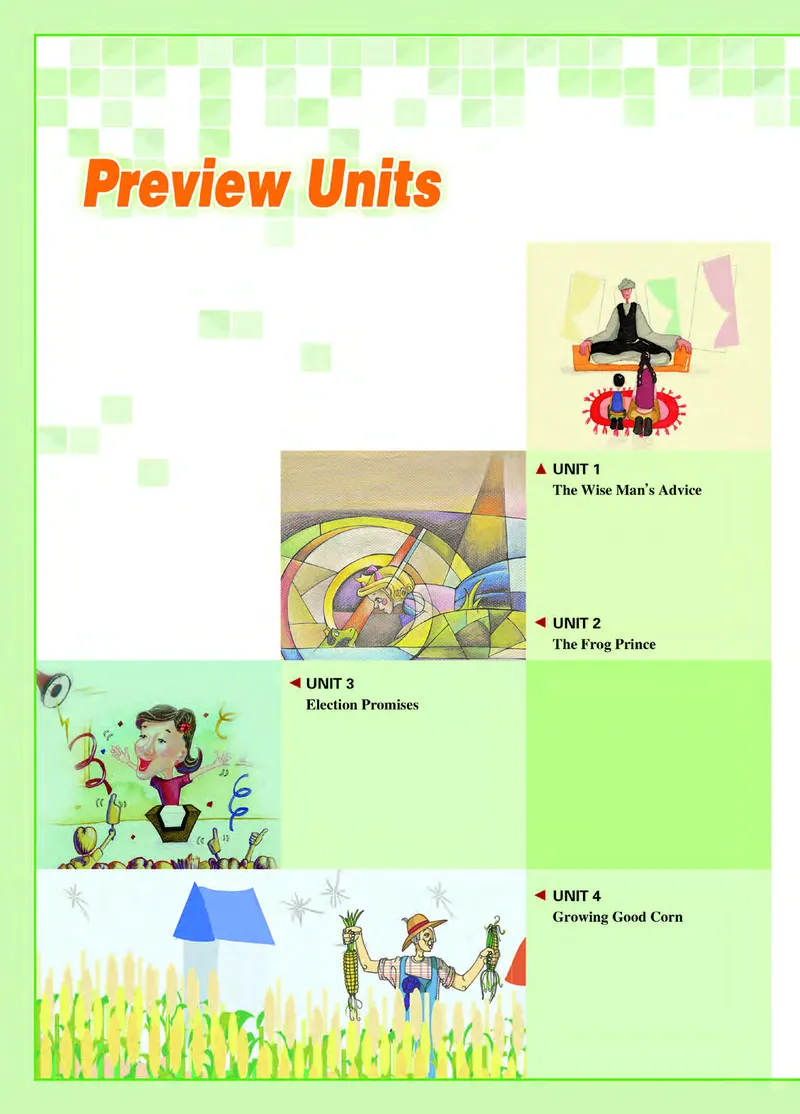
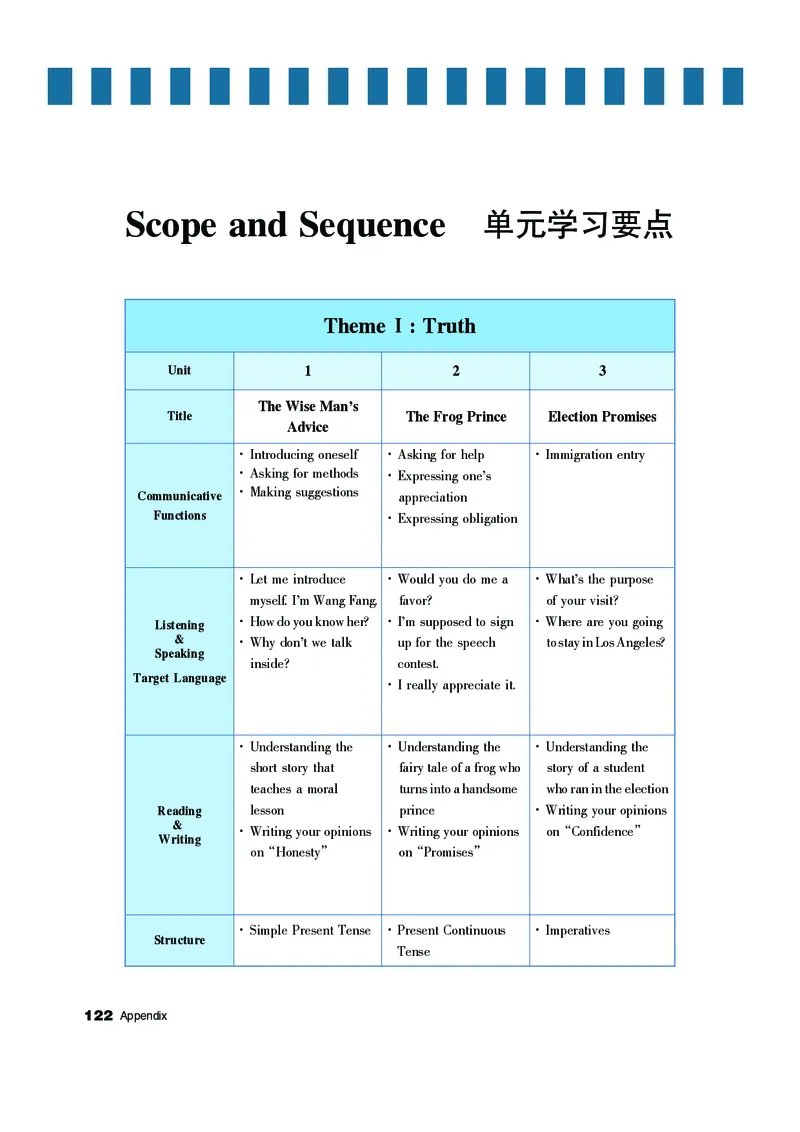
上一层楼!UNIT 1 The Wise Man’s Advice 3
UNIT 2 The Frog Prince 13
UNIT 3 Election Promises 23
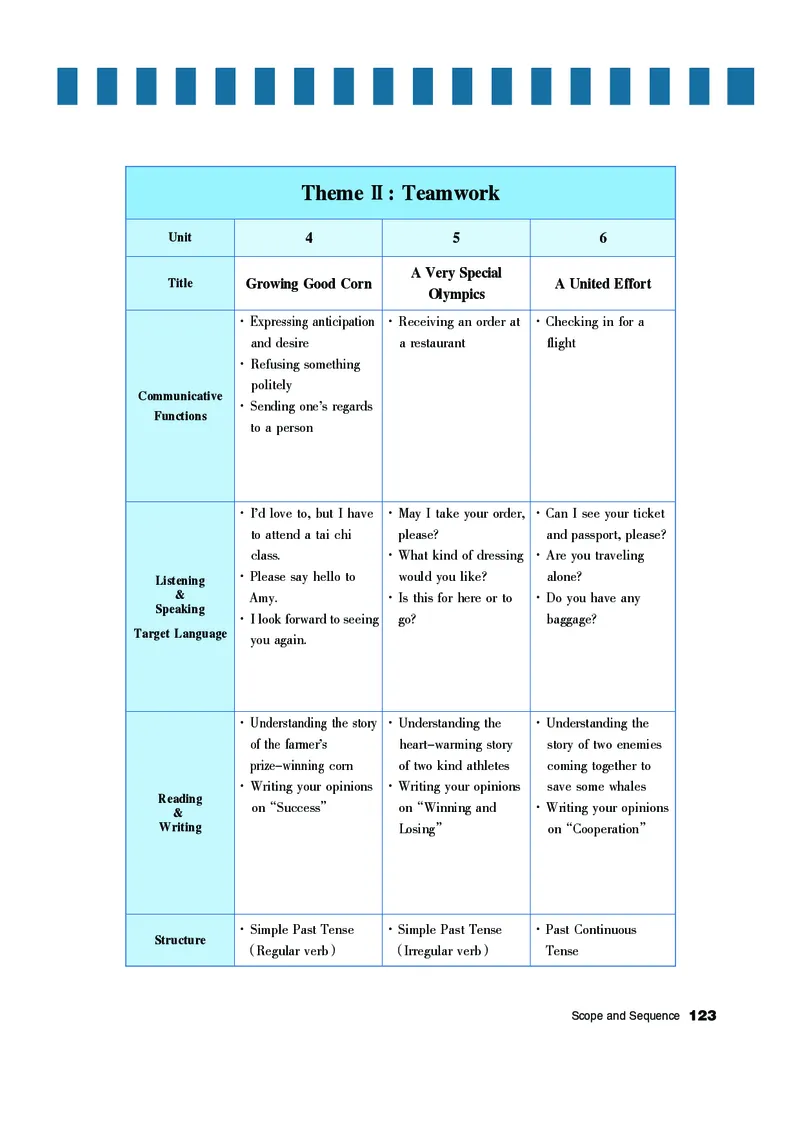
UNIT 4 Growing Good Corn 33
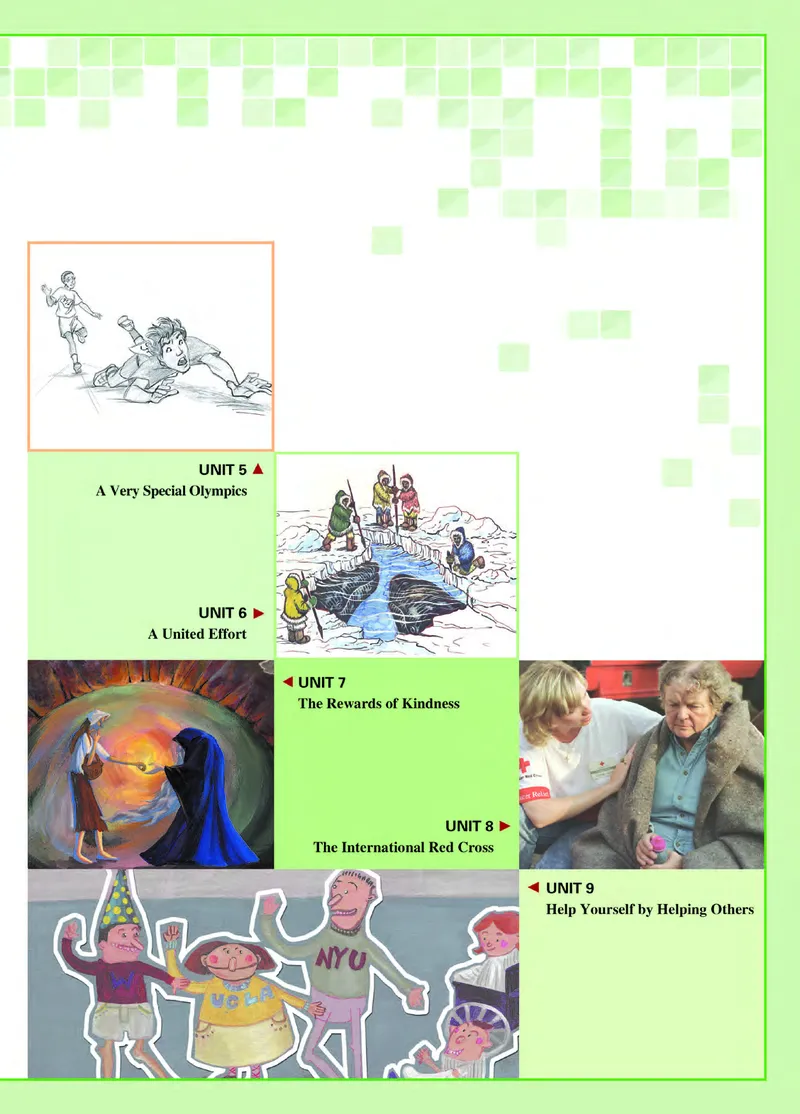
UNIT 5 A Very Special Olympics 43
UNIT 6 A United Effort 53
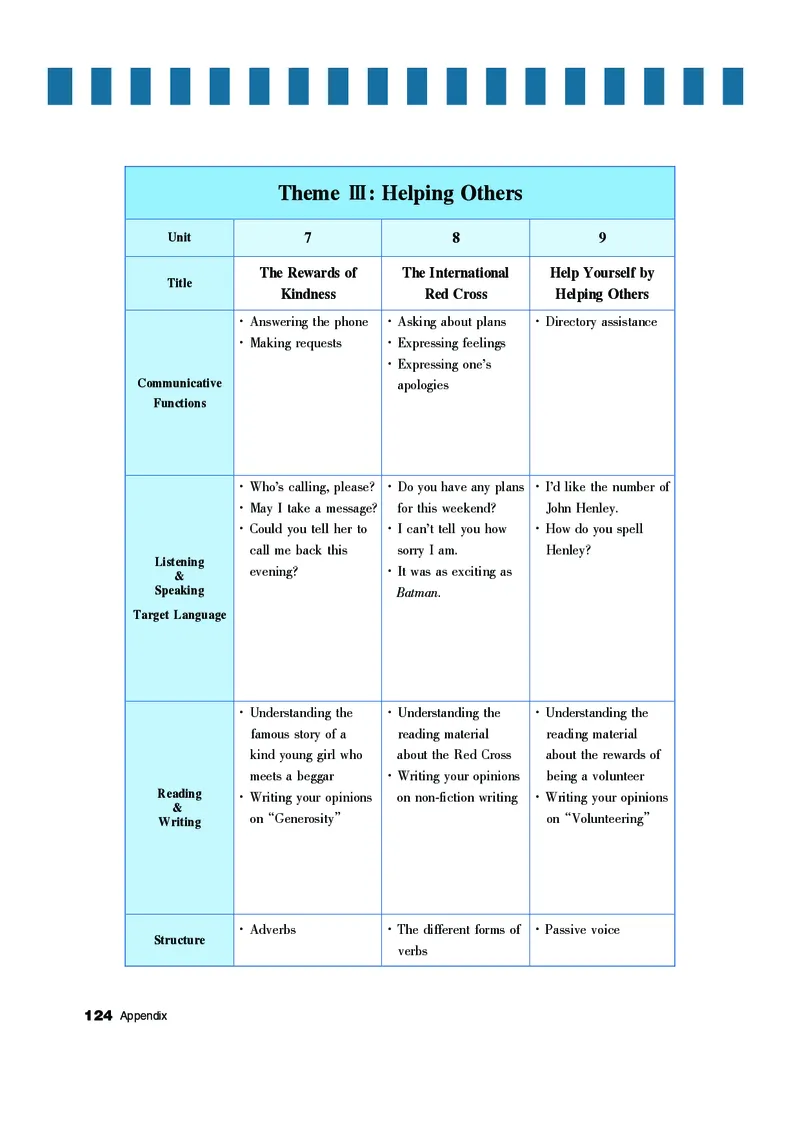
UNIT 7 The Rewards of Kindness 63
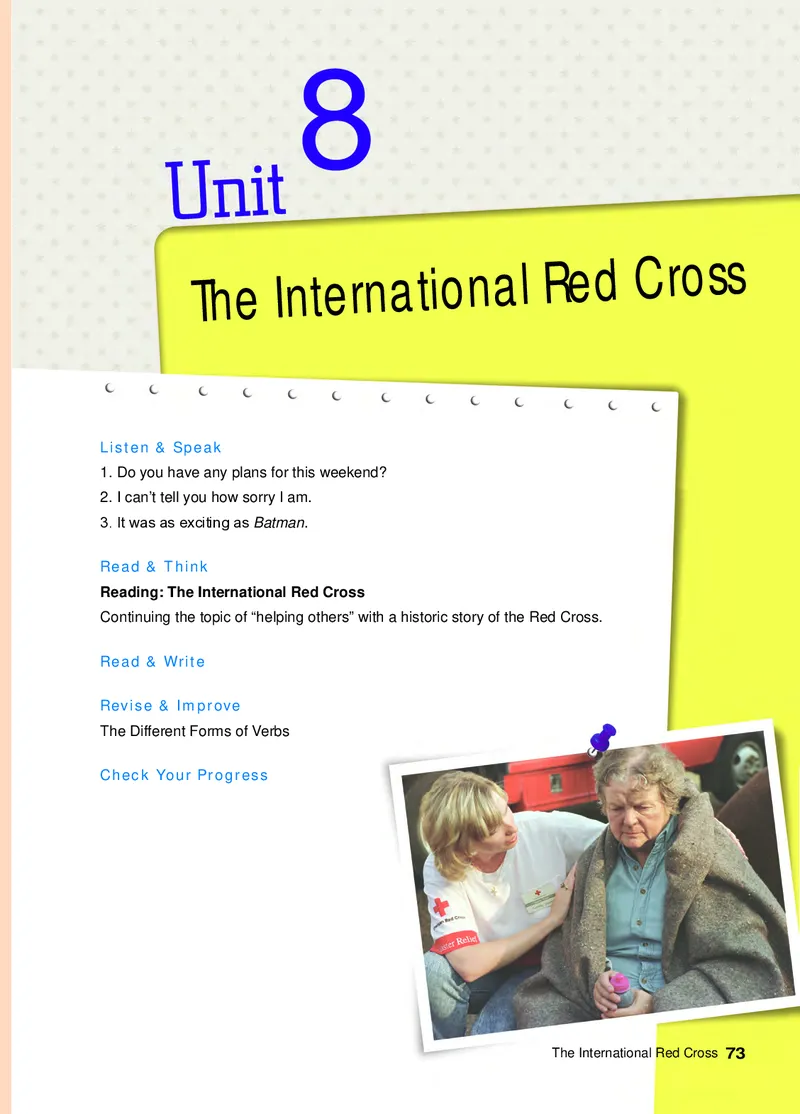
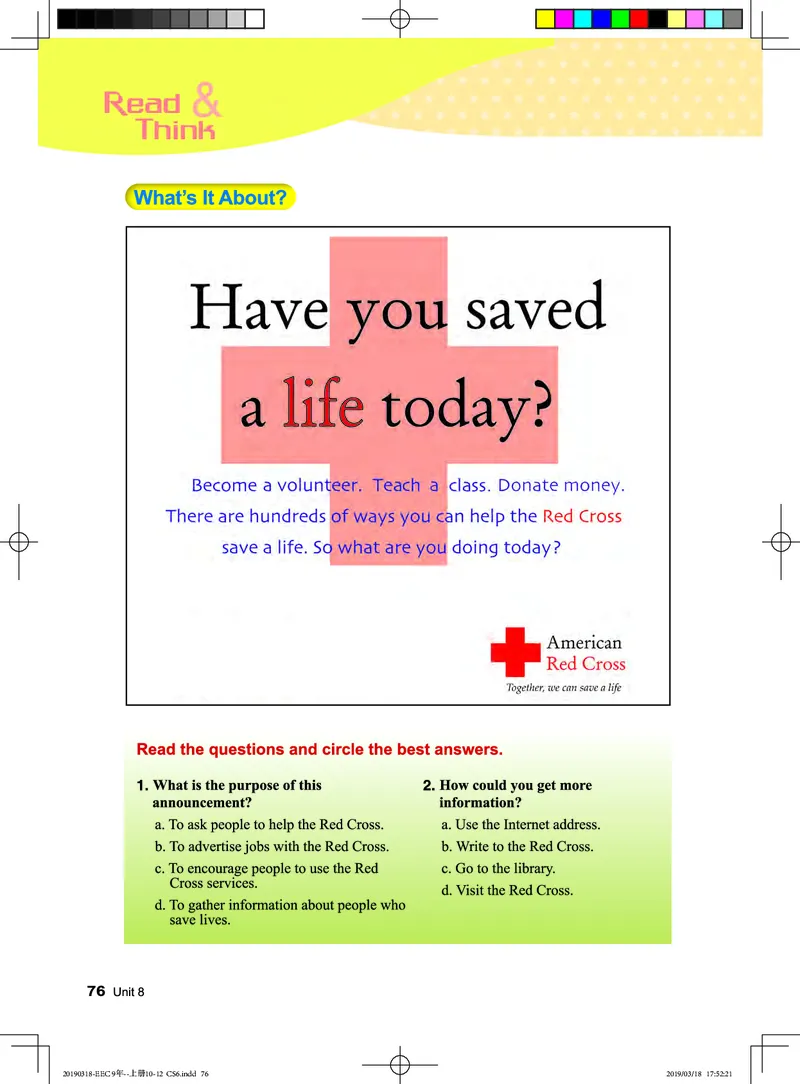
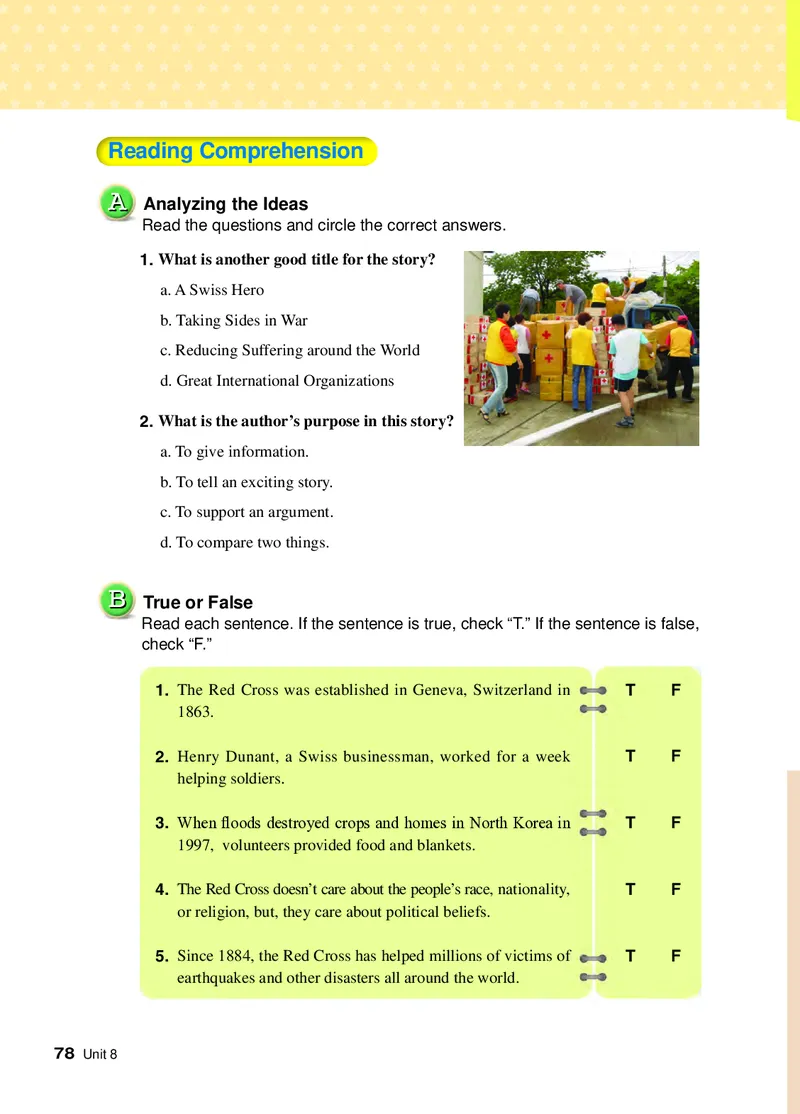
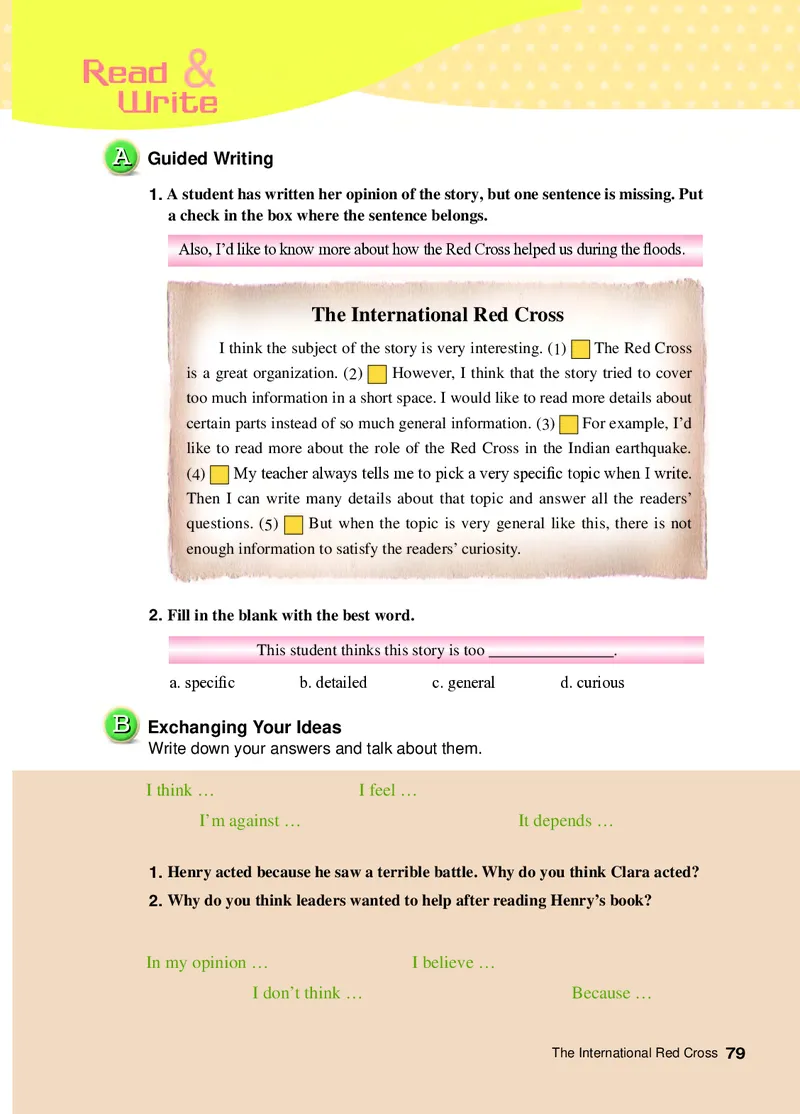
UNIT 8 The International Red Cross 73
UNIT 9 Help Yourself by Helping Others 83
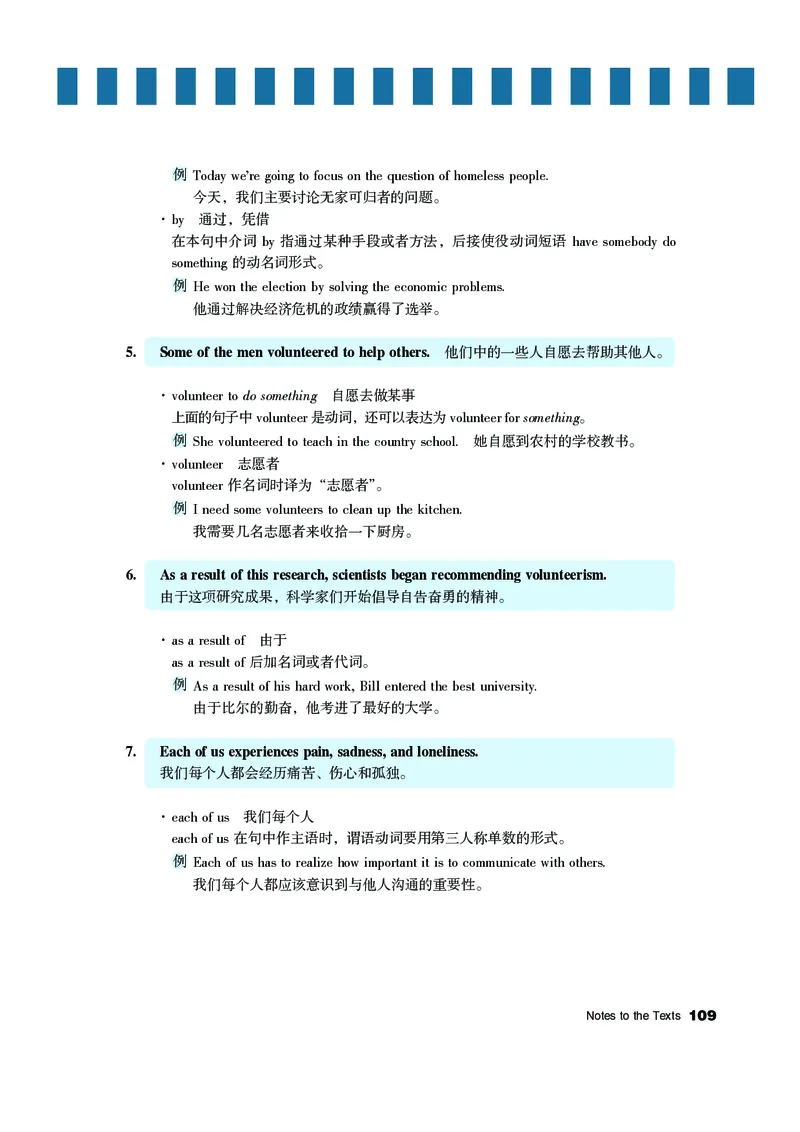
Appendix 附录 Notes to the Texts 课文注释 94
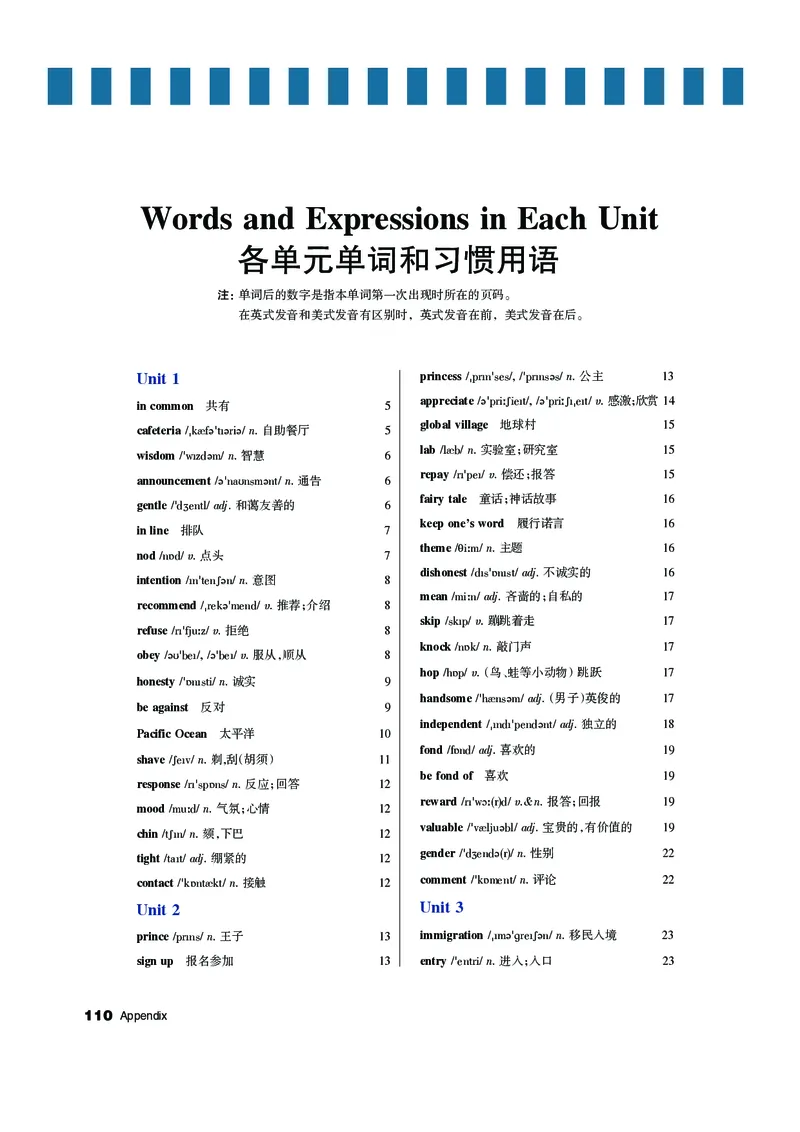
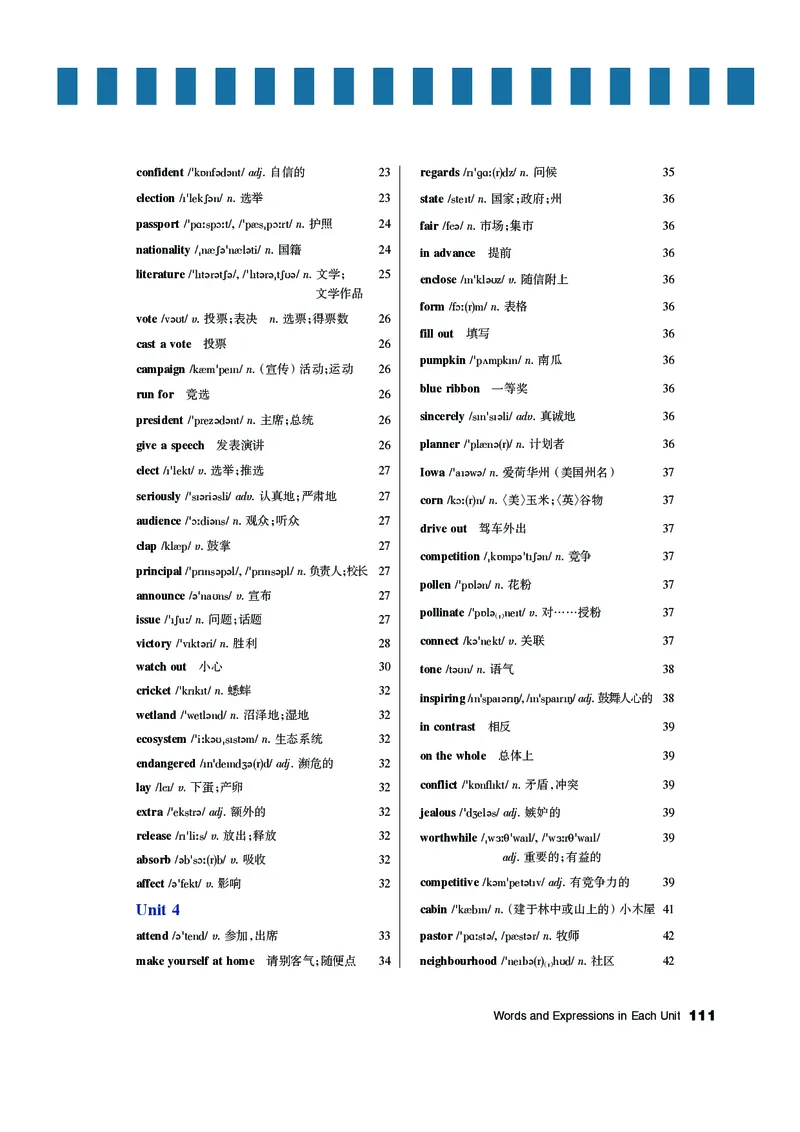
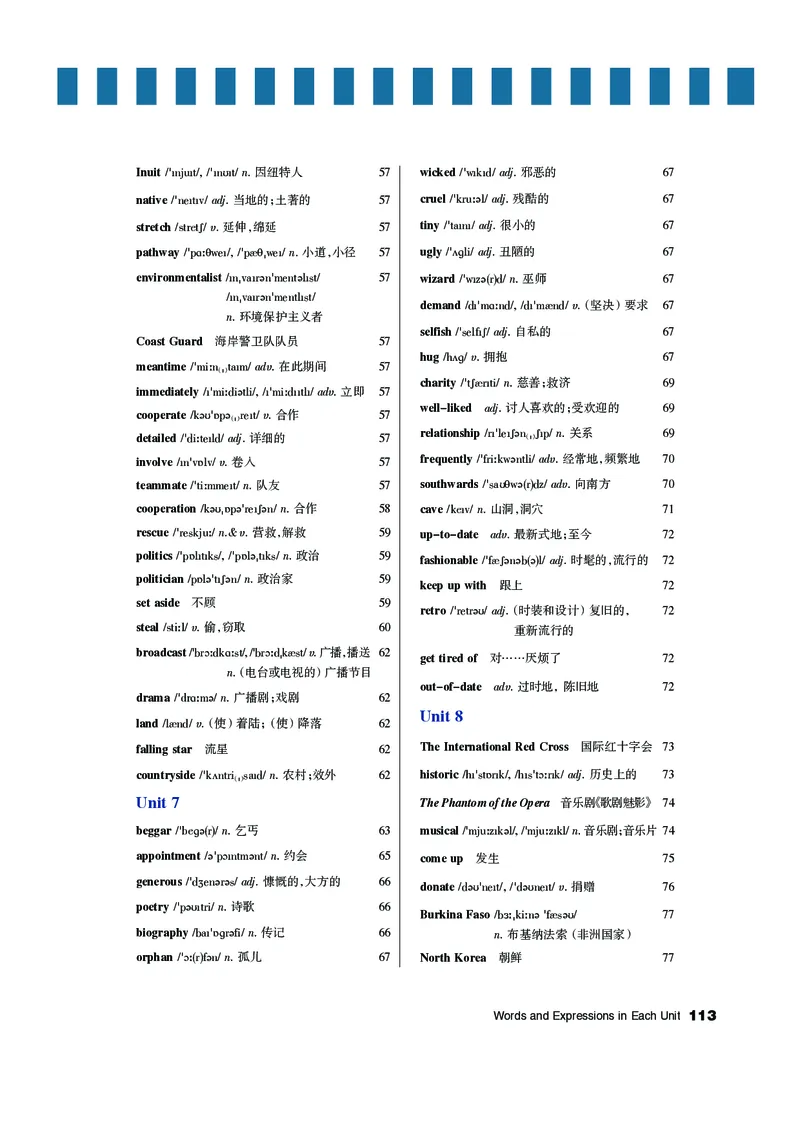
Words and Expressions in Each Unit
各单元单词和习惯用语 110
Vocabulary 词汇表 115
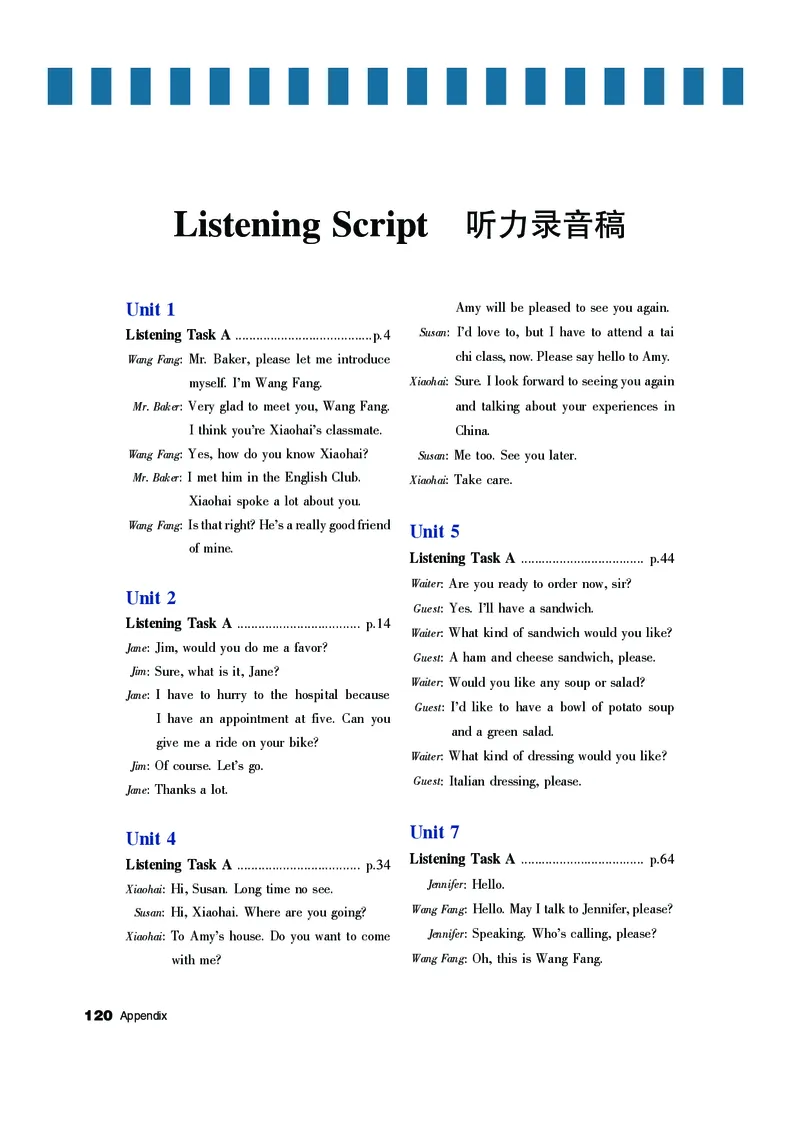
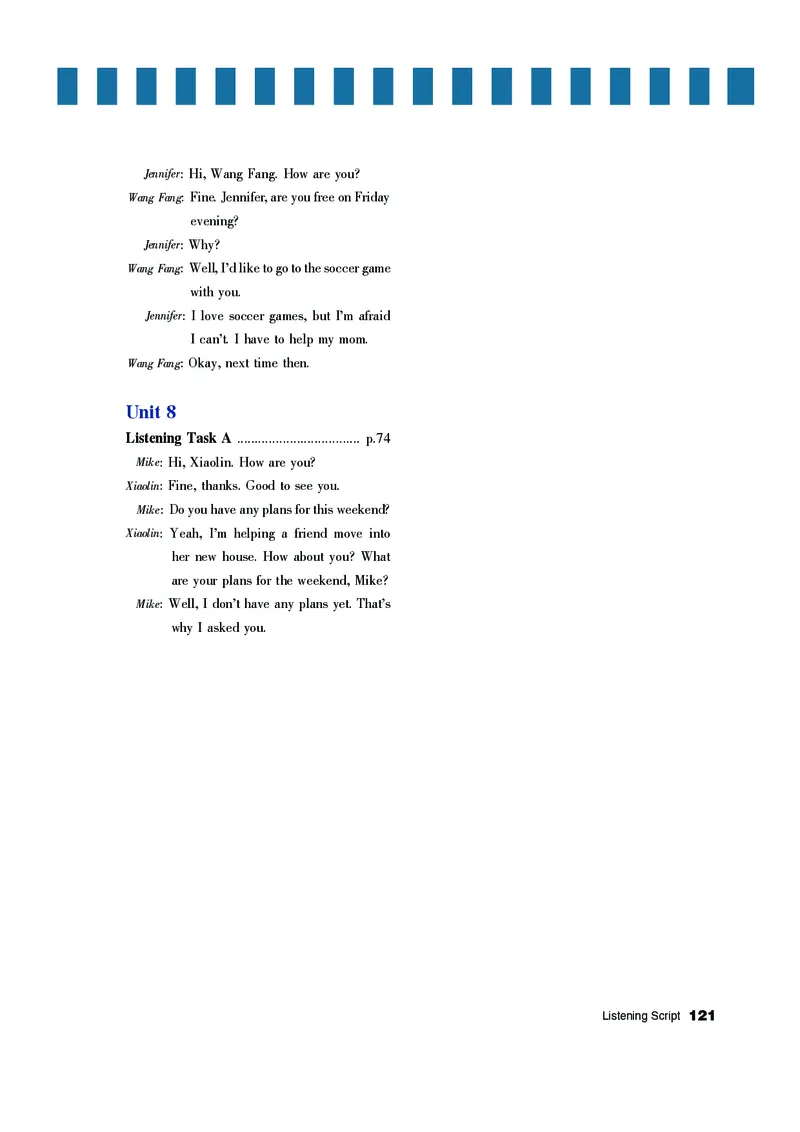
Listening Script 听力录音稿 120
Scope and Sequence 单元学习要点 1221
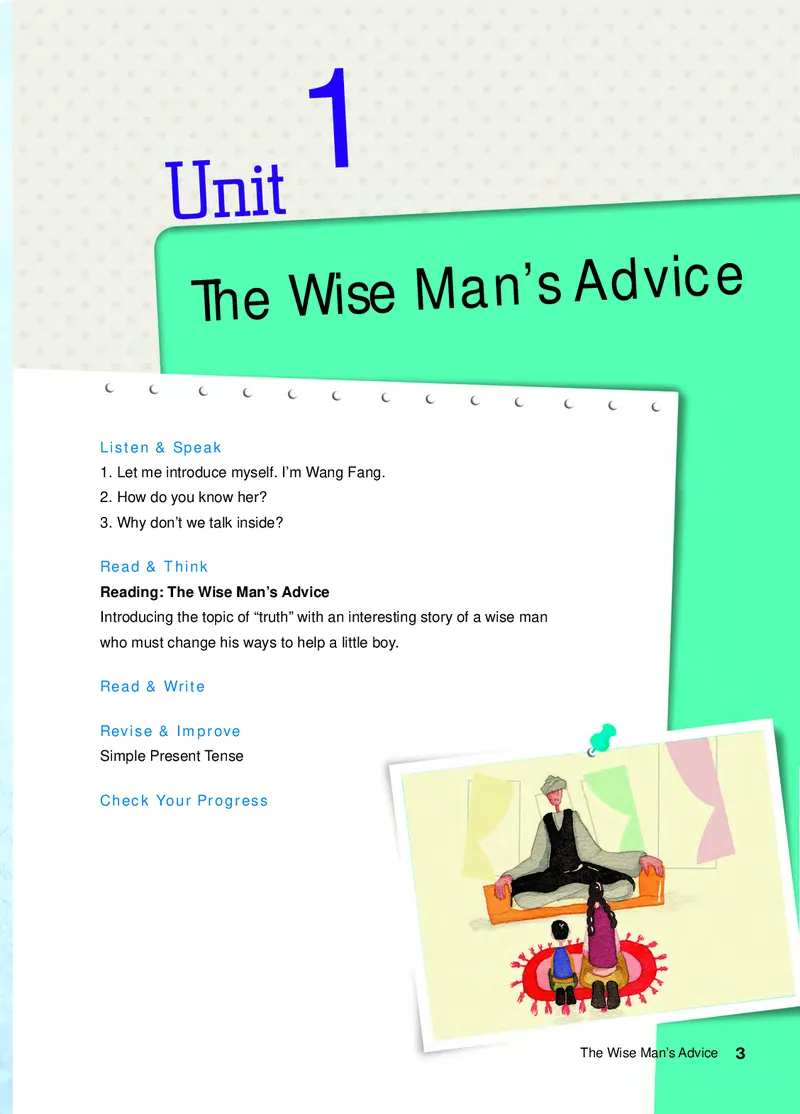
The
Wise
Man’s
Advice
Listen & Speak
1. Let me introduce myself. I’m Wang Fang.
2. How do you know her?
3. Why don’t we talk inside?
Read & Think
Reading: The Wise Man’s Advice
Introducing the topic of “truth” with an interesting story of a wise man
who must change his ways to help a little boy.
Read & Write
Revise & Improve
Simple Present Tense
Check Your Progress
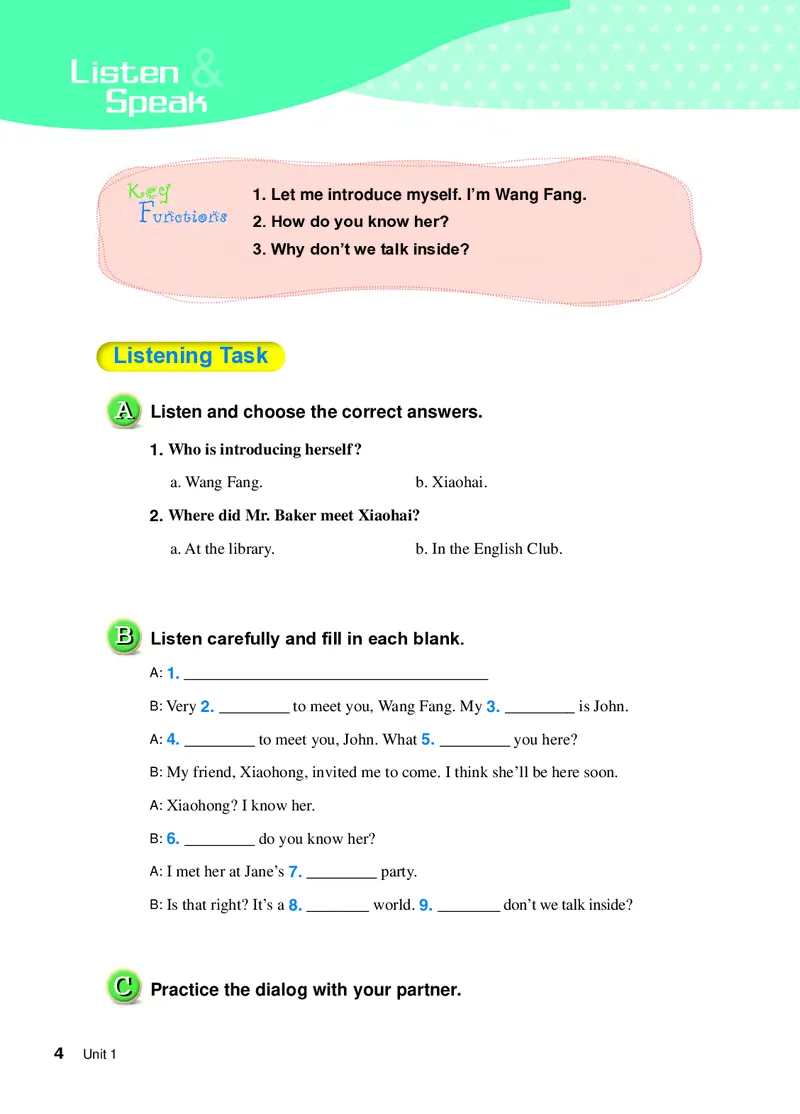
The Wise Man’s Advice 31. Let me introduce myself. I’m Wang Fang.
2. How do you know her?
3. Why don’t we talk inside?
Listening Task
AA
Listen and choose the correct answers.
1. Who is introducing herself?
a. Wang Fang. b. Xiaohai.
2. Where did Mr. Baker meet Xiaohai?
a. At the library. b. In the English Club.
BB
Listen carefully and fill in each blank.
A: 1. _______________________________________
B: Very 2. _________ to meet you, Wang Fang. My 3. _________ is John.
A: 4. _________ to meet you, John. What 5. _________ you here?
B: My friend, Xiaohong, invited me to come. I think she’ll be here soon.
A: Xiaohong? I know her.
B: 6. _________ do you know her?
A: I met her at Jane’s 7. _________ party.
B: Is that right? It’s a 8. ________ world. 9. ________ don’t we talk inside?
CC
Practice the dialog with your partner.
4 Unit 1Speaking Task
Recently, we have had many chances to meet foreigners. If you have a
chance to talk with foreigners, what would you say first?
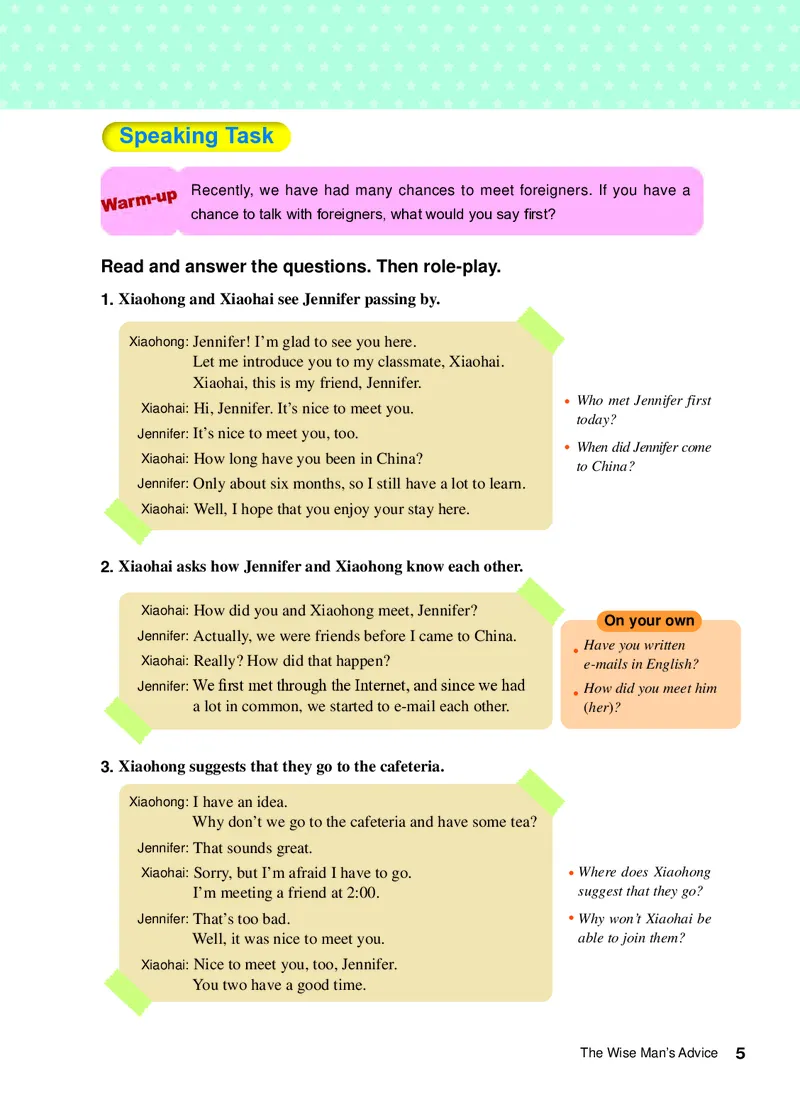
Read and answer the questions. Then role-play.
1. Xiaohong and Xiaohai see Jennifer passing by.
Xiaohong: Jennifer! I’m glad to see you here.
Let me introduce you to my classmate, Xiaohai.
Xiaohai, this is my friend, Jennifer.
Who met Jennifer first
Xiaohai: Hi, Jennifer. It’s nice to meet you.
today?
Jennifer: It’s nice to meet you, too.
When did Jennifer come
Xiaohai: How long have you been in China?
to China?
Jennifer: Only about six months, so I still have a lot to learn.
Xiaohai: Well, I hope that you enjoy your stay here.
2. Xiaohai asks how Jennifer and Xiaohong know each other.
Xiaohai: How did you and Xiaohong meet, Jennifer?
On your own
Jennifer: Actually, we were friends before I came to China.
Have you written
Xiaohai: Really? How did that happen? e-mails in English?
Jennifer: We first met through the Internet, and since we had How did you meet him
a lot in common, we started to e-mail each other. (her)?
3. Xiaohong suggests that they go to the cafeteria.
Xiaohong: I have an idea.
Why don’t we go to the cafeteria and have some tea?
Jennifer: That sounds great.
Xiaohai: Sorry, but I’m afraid I have to go. Where does Xiaohong
I’m meeting a friend at 2:00. suggest that they go?
Jennifer: That’s too bad. Why won’t Xiaohai be
Well, it was nice to meet you. able to join them?
Xiaohai: Nice to meet you, too, Jennifer.
You two have a good time.
The Wise Man’s Advice 5What’s It About?
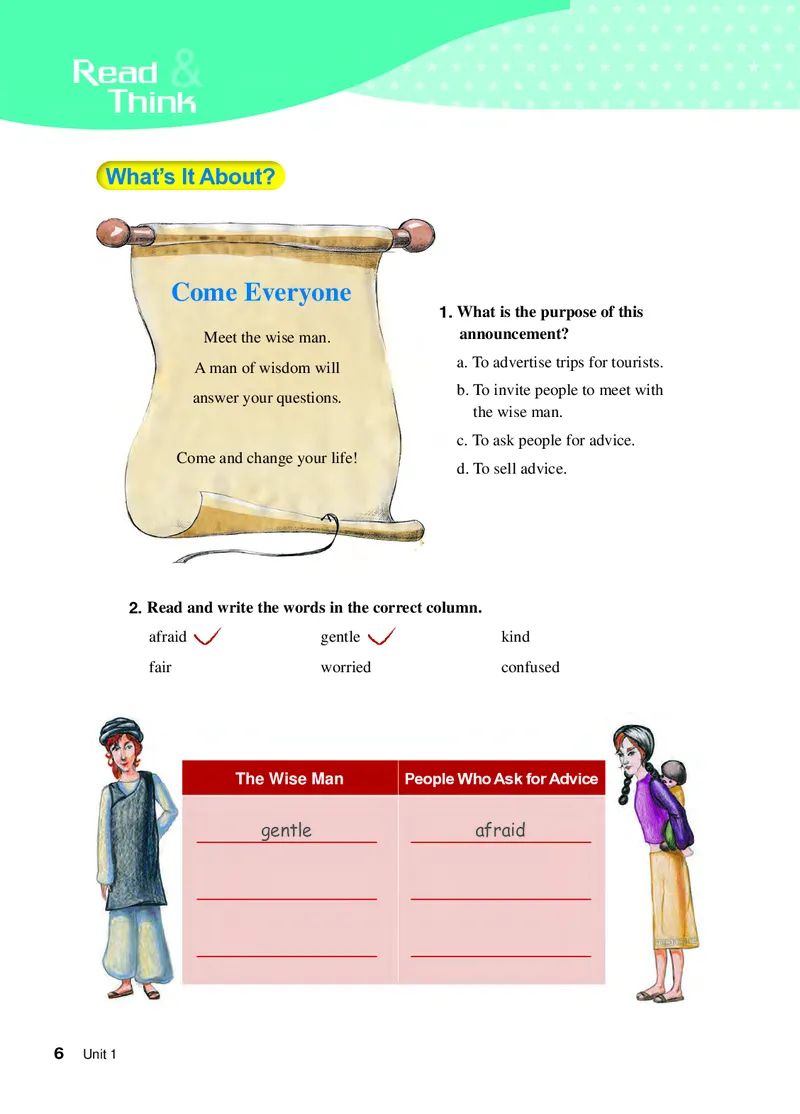
Come Everyone
1. What is the purpose of this
Meet the wise man. announcement?
a. To advertise trips for tourists.
A man of wisdom will
b. To invite people to meet with
answer your questions.
the wise man.
c. To ask people for advice.
Come and change your life!
d. To sell advice.
2. Read and write the words in the correct column.
afraid gentle kind
fair worried confused
The Wise Man People Who Ask for Advice
gentle afraid
6 Unit 1Reading
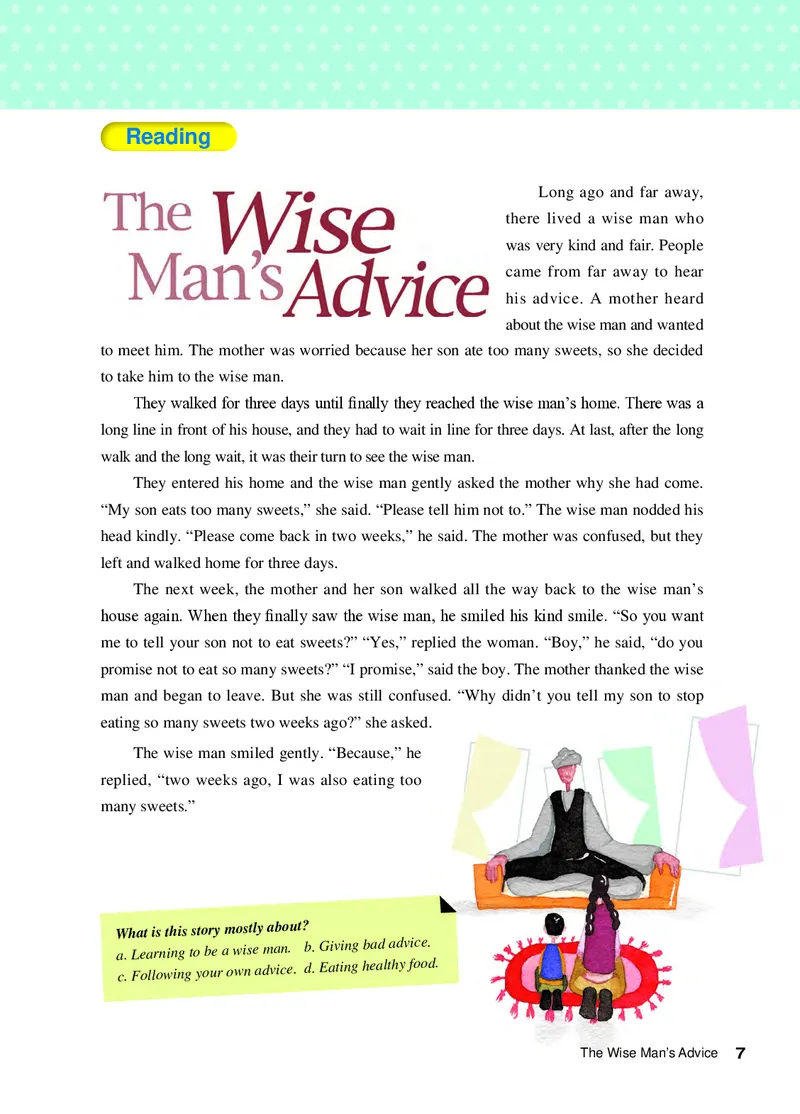
Long ago and far away,
there lived a wise man who
was very kind and fair. People
came from far away to hear
his advice. A mother heard
about the wise man and wanted
to meet him. The mother was worried because her son ate too many sweets, so she decided
to take him to the wise man.
They walked for three days until finally they reached the wise man’s home. There was a
long line in front of his house, and they had to wait in line for three days. At last, after the long
walk and the long wait, it was their turn to see the wise man.
They entered his home and the wise man gently asked the mother why she had come.
“My son eats too many sweets,” she said. “Please tell him not to.” The wise man nodded his
head kindly. “Please come back in two weeks,” he said. The mother was confused, but they
left and walked home for three days.
The next week, the mother and her son walked all the way back to the wise man’s
house again. When they finally saw the wise man, he smiled his kind smile. “So you want
me to tell your son not to eat sweets?” “Yes,” replied the woman. “Boy,” he said, “do you
promise not to eat so many sweets?” “I promise,” said the boy. The mother thanked the wise
man and began to leave. But she was still confused. “Why didn’t you tell my son to stop
eating so many sweets two weeks ago?” she asked.
The wise man smiled gently. “Because,” he
replied, “two weeks ago, I was also eating too
many sweets.”
What is this story mostly about?
a. Learning to be a wise man. b. Giving bad advice.
c. Following your own advice. d. Eating healthy food.
The Wise Man’s Advice 7Reading Comprehension
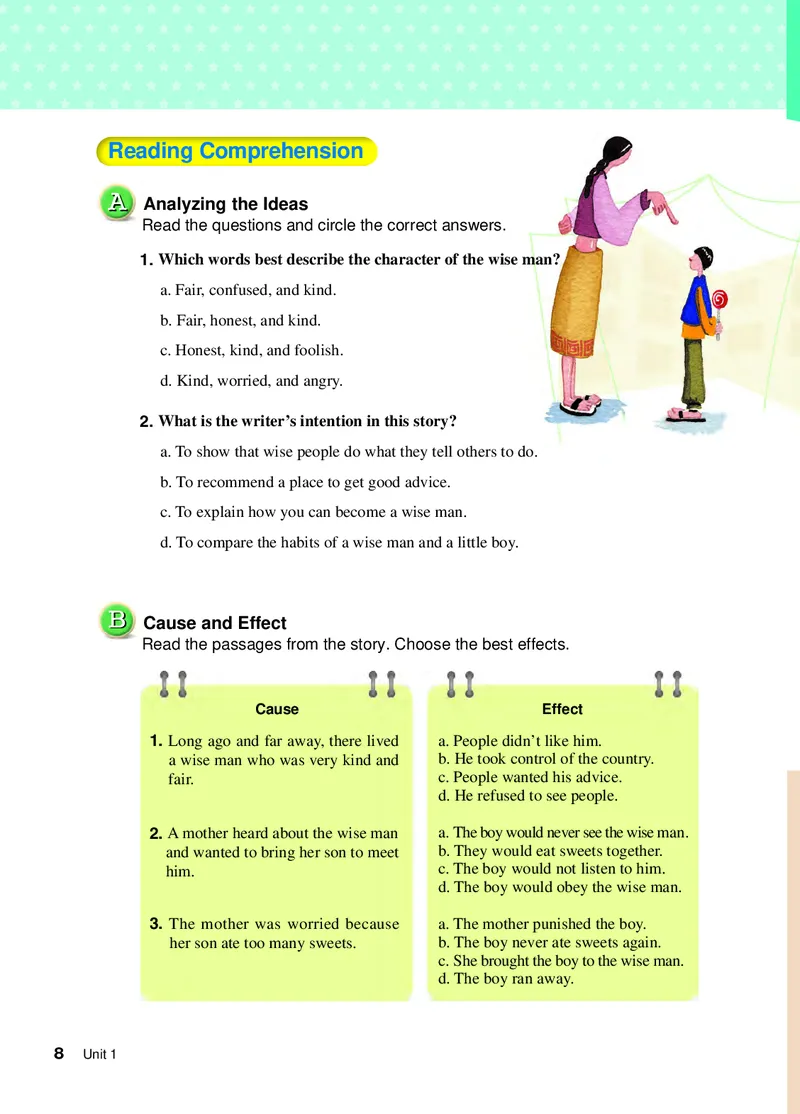
AA
Analyzing the Ideas
Read the questions and circle the correct answers.
1. Which words best describe the character of the wise man?
a. Fair, confused, and kind.
b. Fair, honest, and kind.
c. Honest, kind, and foolish.
d. Kind, worried, and angry.
2. What is the writer’s intention in this story?
a. To show that wise people do what they tell others to do.
b. To recommend a place to get good advice.
c. To explain how you can become a wise man.
d. To compare the habits of a wise man and a little boy.
BB
Cause and Effect
Read the passages from the story. Choose the best effects.
Cause Effect
1. Long ago and far away, there lived a. People didn’t like him.
a wise man who was very kind and b. He took control of the country.
fair. c. People wanted his advice.
d. He refused to see people.
2. A mother heard about the wise man a. The boy would never see the wise man.
and wanted to bring her son to meet b. They would eat sweets together.
him. c. The boy would not listen to him.
d. The boy would obey the wise man.
3. The mother was worried because a. The mother punished the boy.
her son ate too many sweets. b. The boy never ate sweets again.
c. She brought the boy to the wise man.
d. The boy ran away.
8 Unit 1AA
Guided Writing
1. A student has written her opinion of the story. Help her complete it by writing
the correct connector from the WORD BOX in each blank.
and then before however if until
The Wise Man’s Advice
I think this story teaches an important lesson. We should never give
advice if we do not follow that advice ourselves. In the story, the mother
wanted the wise man to tell her son not to eat sweets. (1)__________, the
wise man would not give the boy advice. At that time, the wise man was
eating too many sweets, too. He stopped eating sweets (2)__________ he told
the boy to stop eating them. No one would respect him (3)__________ he
told people to do things that he did not do himself. He waited (4)__________
the time was right. I wish more people would act with this kind of honesty.
I don’t like it when people give me advice (5)__________ they don’t follow
their own advice. It makes me lose respect for them.
2. Fill in the blank with the best word.
The student thinks the wise man is ________________.
a. foolish b. kind c. honest d. strange
BB
Exchanging Your Ideas
Write down your answers and talk about them.
I think … I feel …
I’m against … It depends …
1. Why did the boy obey the wise man, but not obey his mother?
2. The wise man could have told the boy not to eat sweets the first time the mother
and the boy went there. Why didn’t he do that?
In my opinion … I believe …
I don’t think … Because …
The Wise Man’s Advice 9Simple Present Tense
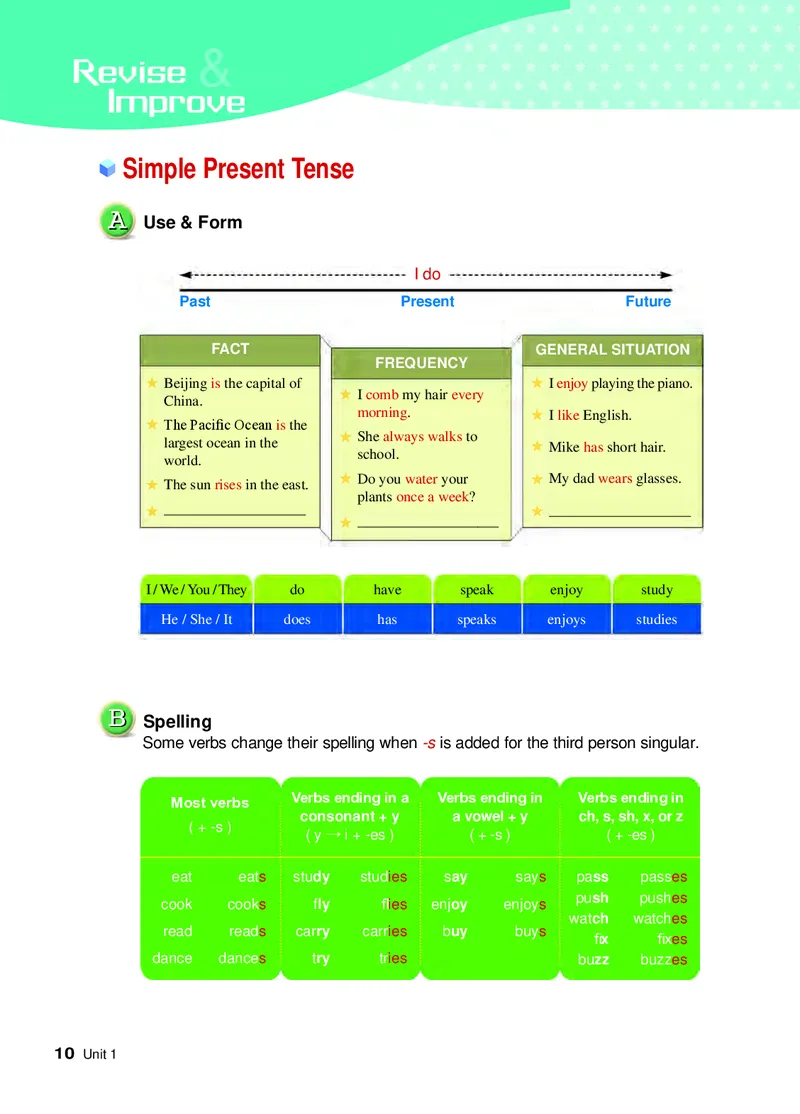
AA
Use & Form
I do
Past Present Future
FACT GENERAL SITUATION
FREQUENCY
Beijing is the capital of I enjoy playing the piano.
I comb my hair every
China.
morning. I like English.
The Pacific Ocean is the
She always walks to
largest ocean in the Mike has short hair.
school.
world.
Do you water your My dad wears glasses.
The sun rises in the east.
plants once a week?
____________________ ____________________
____________________
I / We / You / They do have speak enjoy study
He / She / It does has speaks enjoys studies
BB
Spelling
Some verbs change their spelling when -s is added for the third person singular.
Verbs ending in a Verbs ending in Verbs ending in
Most verbs
consonant + y a vowel + y ch, s, sh, x, or z
( + -s )
( y → i + -es ) ( + -s ) ( + -es )
eat eats study studies say says pass passes
push pushes
cook cooks fly flies enjoy enjoys
watch watches
read reads carry carries buy buys
fix fixes
dance dances try tries buzz buzzes
10 Unit 1WORD BANK
CC
Practice It
I / You / We He / She
1. Complete the WORD BANK table. They It
get gets
comb
2. Check your answers with your partner.
enjoy
3. Work as a class. study
Clap your hands and chant the words. like
get –– gets; comb ––
wake
4. Fill in each blank. speak
take
talk
Things Mr. Brown does and doesn’t do on Saturdays
hold
On Saturdays Mr. Brown doesn’t wake up at 6:00 a.m.
agree
He (1)__________ up at 8:00 a.m. He doesn’t get up at
look
6:15 a.m. He (2)__________ up at 9:00 a.m. He doesn’t take a
brush
shower. He (3)__________ a bath. After his bath he doesn’t
guesses
have a cup of coffee. He has a shave and (4)__________
pushes
his teeth. He doesn’t eat breakfast at 7:00 a.m. He
catch
(5)__________ breakfast at 10:00 a.m. After breakfast he
keep
doesn’t read the newspaper. He (6)__________ for a run.
eat
After his run he doesn’t go to work. He usually visits his
starts
friends.
begin
promise
5. Now in your notebook, write your story about allow
the things you do and don’t do on Sunday repeat
mornings.
arrive
cries
have
goes
The Wise Man’s Advice 11Your Progress
Fill in the blanks with the words from the box.
1. joke hard avoid change exercise comfortable along
Laughter is a basic human response. But this human response is not always
related to a (1)_________ or a funny situation. A person can laugh to show others he
or she is (2)_________ in a group. Laughter also makes other people relax. People can
also use laughter to (3)_________ or stop a fight. When two people are going to fight, a
third person can laugh to (4)_________ the mood of the situation.
Other than helping people get (5)_________ together, laughter is also healthy.
Laughing makes muscles relax. When a person laughs, the muscles in his or her face
get (6)_________. Then after laughing these muscles all relax. In fact, after laughing
really (7)_________, a person may be so relaxed that they feel weak!
2. useful benefits another thoughts proud movements guilty
Have you ever said one thing but felt (1)_________? Some people are good at
hiding their true feelings, but most people are not. They show their real (2)_________
and emotions through body language. The knowledge of how people use body
language can be (3)_________. A person who walks with his or her chin high is
confident or (4)_________. Someone who smiles with tight lips is not really smiling.
Is it difficult to make eye contact with the person you’re talking to? Then the person is
unsure of himself or herself, feels (5)_________ about something, or is lying to you.
Of course, this is not an exact science. But there are (6)_________ from knowing about
how people communicate through expressions and (7)_________.
12 Unit 12
The
Frog
Prince
Listen & Speak
1. Would you do me a favor?
2. I’m supposed to sign up for the speech contest.
3. I really appreciate it.
Read & Think
Reading: The Frog Prince
Continuing the topic of “truth” with a fable about a princess who makes a
promise she doesn’t want to keep.
Read & Write
Revise & Improve
Present Continuous Tense
Check Your Progress
The Frog Prince 131. Would you do me a favor?
2. I’m supposed to sign up for the speech contest.
3. I really appreciate it.
Listening Task
AA
Look at the picture and guess the
situation. Listen carefully.
BB
Listen again and choose the
correct answers.
1. Where is Jane going?
a. To the hospital.
b. To the library.
2. What does Jane ask Jim to do?
a. To meet her at five. b. To give her a ride on his bike.
CC
Listen carefully and fill in each blank.
A: Helen, I have a 1. _________ to ask you.
B: What is it?
A: Actually, I’m 2. _________ to sign up for the speech contest this Saturday.
Can you come over and 3. _________ my pronunciation?
B: Sure. How about 4. _________?
A: Good! Tomorrow I’m free. I really 5. _________ it.
DD
Practice the dialog with your partner.
14 Unit 2Speaking Task
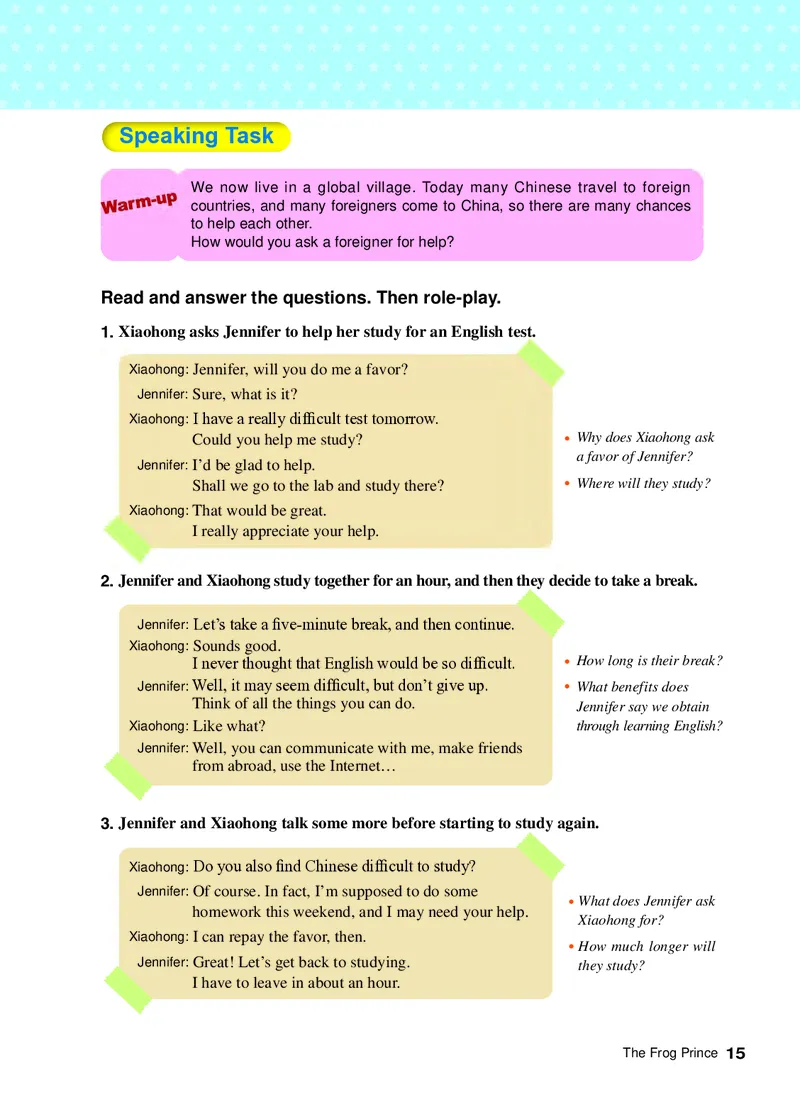
We now live in a global village. Today many Chinese travel to foreign
countries, and many foreigners come to China, so there are many chances
to help each other.
How would you ask a foreigner for help?
Read and answer the questions. Then role-play.
1. Xiaohong asks Jennifer to help her study for an English test.
Xiaohong: Jennifer, will you do me a favor?
Jennifer: Sure, what is it?
Xiaohong: I have a really difficult test tomorrow.
Could you help me study? Why does Xiaohong ask
a favor of Jennifer?
Jennifer: I’d be glad to help.
Shall we go to the lab and study there? Where will they study?
Xiaohong: That would be great.
I really appreciate your help.
2. Jennifer and Xiaohong study together for an hour, and then they decide to take a break.
Jennifer: Let’s take a five-minute break, and then continue.
Xiaohong: Sounds good.
I never thought that English would be so difficult. How long is their break?
Jennifer: Well, it may seem difficult, but don’t give up. What benefits does
Think of all the things you can do. Jennifer say we obtain
Xiaohong: Like what? through learning English?
Jennifer: Well, you can communicate with me, make friends
from abroad, use the Internet…
3. Jennifer and Xiaohong talk some more before starting to study again.
Xiaohong: Do you also find Chinese difficult to study?
Jennifer: Of course. In fact, I’m supposed to do some
What does Jennifer ask
homework this weekend, and I may need your help.
Xiaohong for?
Xiaohong: I can repay the favor, then.
How much longer will
Jennifer: Great! Let’s get back to studying. they study?
I have to leave in about an hour.
The Frog Prince 15What’s It About?
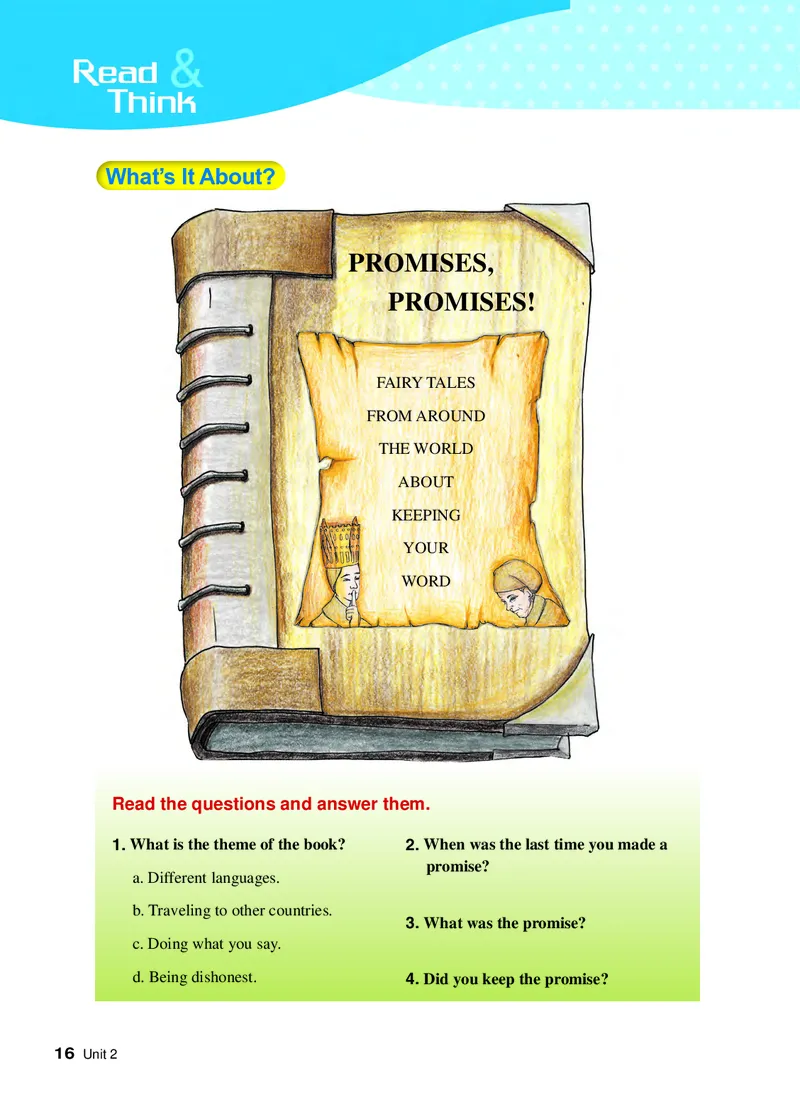
PROMISES,
PROMISES!
FAIRY TALES
FROM AROUND
THE WORLD
ABOUT
KEEPING
YOUR
WORD
Read the questions and answer them.
1. What is the theme of the book? 2. When was the last time you made a
promise?
a. Different languages.
b. Traveling to other countries.
3. What was the promise?
c. Doing what you say.
d. Being dishonest. 4. Did you keep the promise?
16 Unit 2Reading
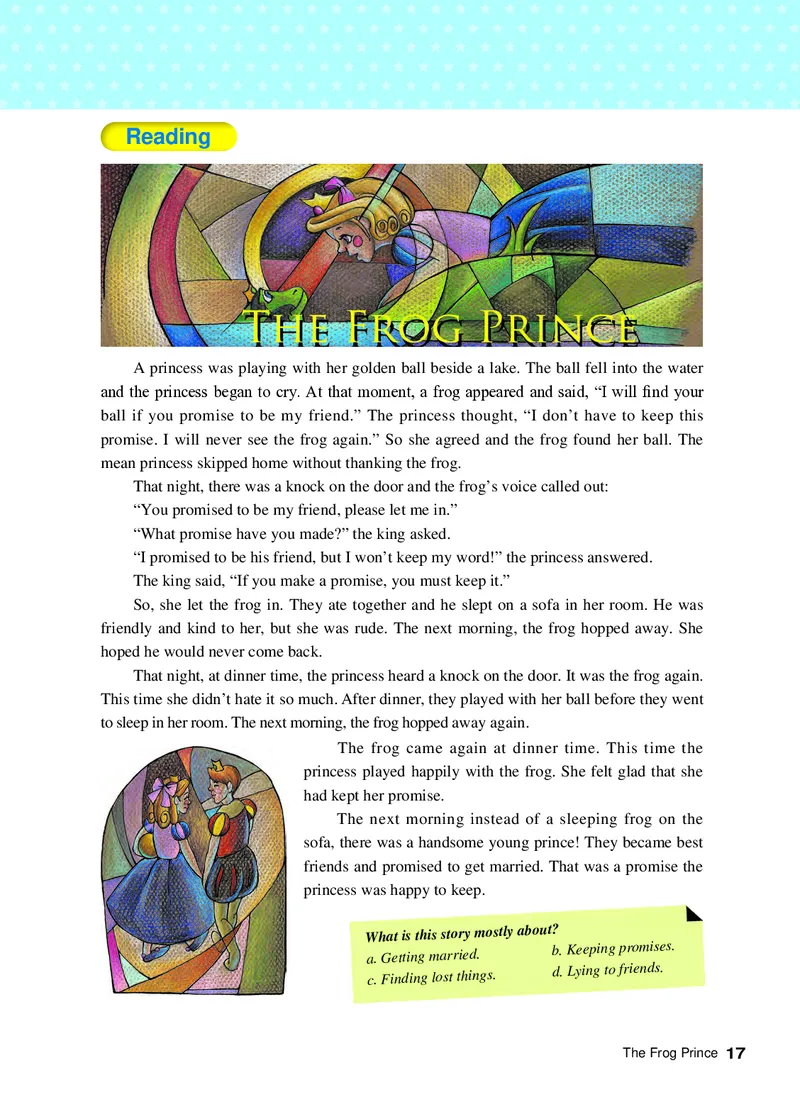
A princess was playing with her golden ball beside a lake. The ball fell into the water
and the princess began to cry. At that moment, a frog appeared and said, “I will find your
ball if you promise to be my friend.” The princess thought, “I don’t have to keep this
promise. I will never see the frog again.” So she agreed and the frog found her ball. The
mean princess skipped home without thanking the frog.
That night, there was a knock on the door and the frog’s voice called out:
“You promised to be my friend, please let me in.”
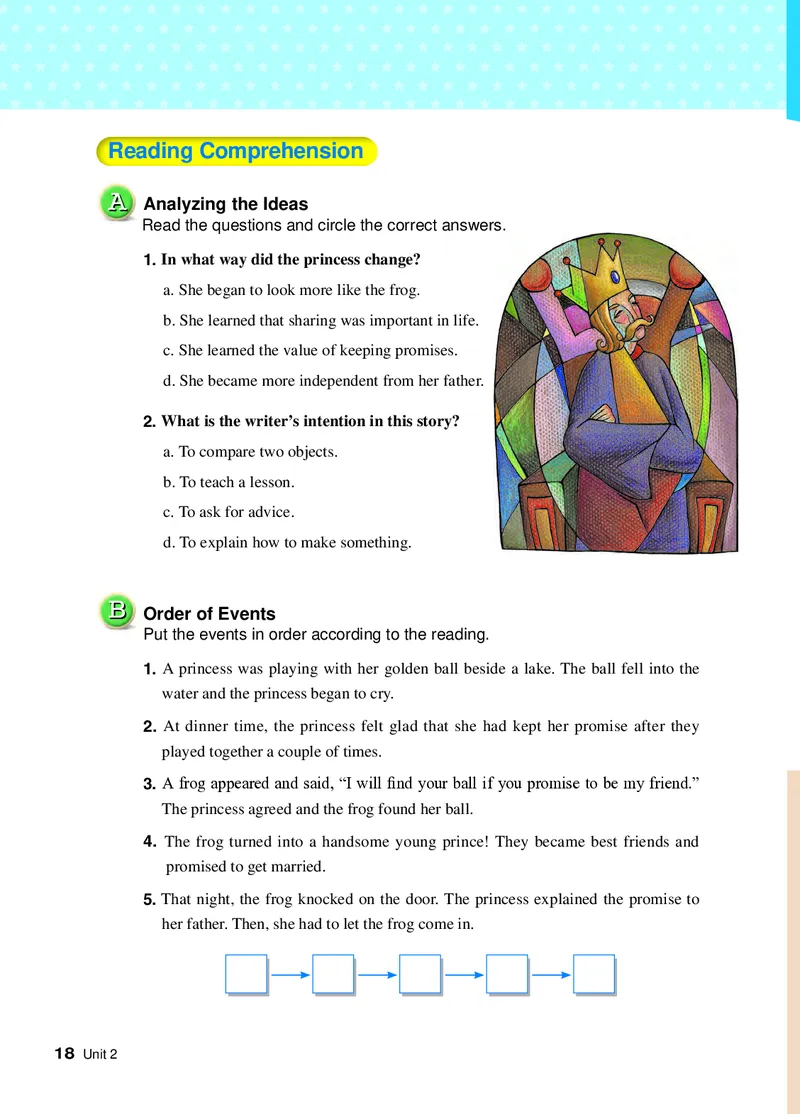
“What promise have you made?” the king asked.
“I promised to be his friend, but I won’t keep my word!” the princess answered.
The king said, “If you make a promise, you must keep it.”
So, she let the frog in. They ate together and he slept on a sofa in her room. He was
friendly and kind to her, but she was rude. The next morning, the frog hopped away. She
hoped he would never come back.
That night, at dinner time, the princess heard a knock on the door. It was the frog again.
This time she didn’t hate it so much. After dinner, they played with her ball before they went
to sleep in her room. The next morning, the frog hopped away again.
The frog came again at dinner time. This time the
princess played happily with the frog. She felt glad that she
had kept her promise.
The next morning instead of a sleeping frog on the
sofa, there was a handsome young prince! They became best
friends and promised to get married. That was a promise the
princess was happy to keep.
What is this story mostly about?
a. Getting married. b. Keeping promises.
c. Finding lost things. d. Lying to friends.
The Frog Prince 17Reading Comprehension
AA
Analyzing the Ideas
Read the questions and circle the correct answers.
1. In what way did the princess change?
a. She began to look more like the frog.
b. She learned that sharing was important in life.
c. She learned the value of keeping promises.
d. She became more independent from her father.
2. What is the writer’s intention in this story?
a. To compare two objects.
b. To teach a lesson.
c. To ask for advice.
d. To explain how to make something.
BB
Order of Events
Put the events in order according to the reading.
1. A princess was playing with her golden ball beside a lake. The ball fell into the
water and the princess began to cry.
2. At dinner time, the princess felt glad that she had kept her promise after they
played together a couple of times.
3. A frog appeared and said, “I will find your ball if you promise to be my friend.”
The princess agreed and the frog found her ball.
4. The frog turned into a handsome young prince! They became best friends and
promised to get married.
5. That night, the frog knocked on the door. The princess explained the promise to
her father. Then, she had to let the frog come in.
18 Unit 2AA
Guided Writing
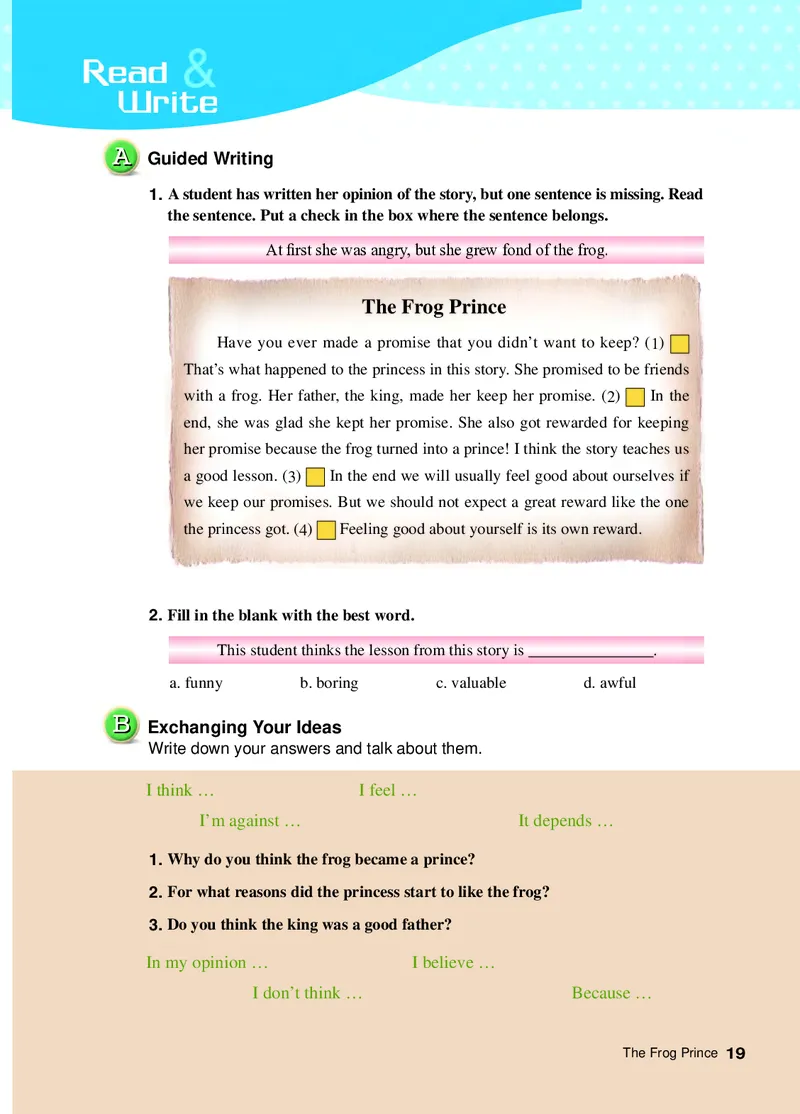
1. A student has written her opinion of the story, but one sentence is missing. Read
the sentence. Put a check in the box where the sentence belongs.
At first she was angry, but she grew fond of the frog.
The Frog Prince
Have you ever made a promise that you didn’t want to keep? (1)
That’s what happened to the princess in this story. She promised to be friends
with a frog. Her father, the king, made her keep her promise. (2) In the
end, she was glad she kept her promise. She also got rewarded for keeping
her promise because the frog turned into a prince! I think the story teaches us
a good lesson. (3) In the end we will usually feel good about ourselves if
we keep our promises. But we should not expect a great reward like the one
the princess got. (4) Feeling good about yourself is its own reward.
2. Fill in the blank with the best word.
This student thinks the lesson from this story is ________________.
a. funny b. boring c. valuable d. awful
BB
Exchanging Your Ideas
Write down your answers and talk about them.
I think … I feel …
I’m against … It depends …
1. Why do you think the frog became a prince?
2. For what reasons did the princess start to like the frog?
3. Do you think the king was a good father?
In my opinion … I believe …
I don’t think … Because …
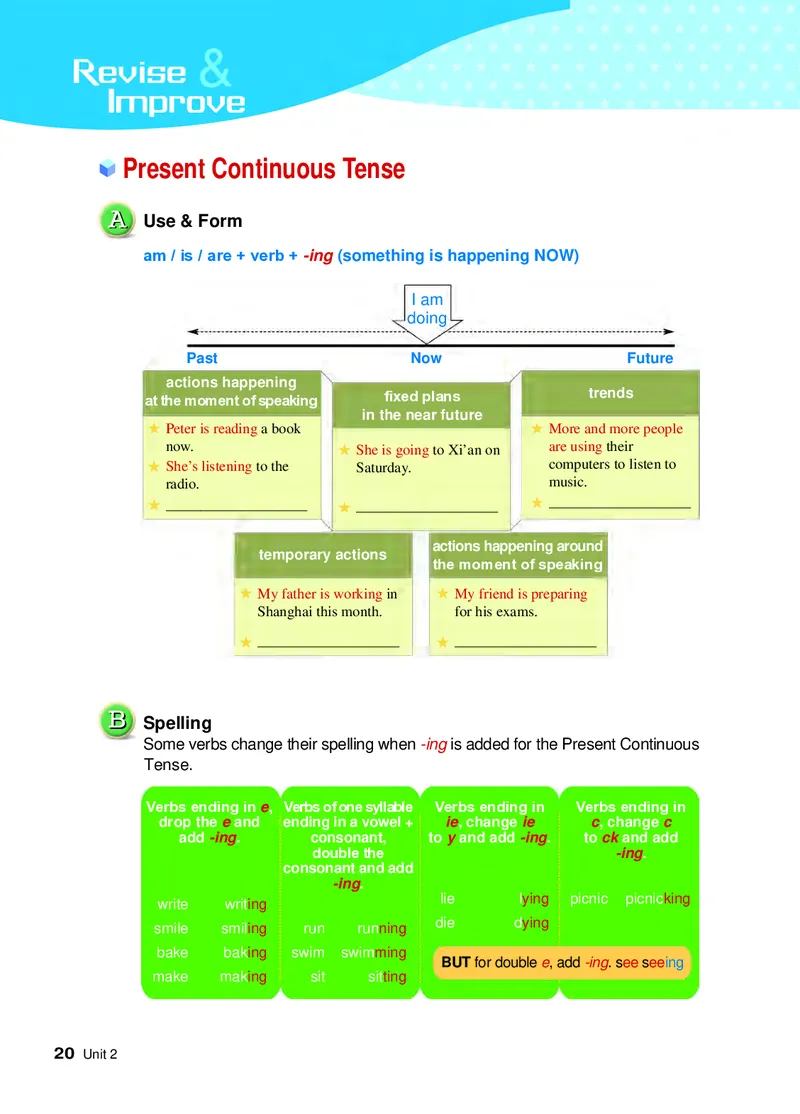
The Frog Prince 19Present Continuous Tense
AA
Use & Form
am / is / are + verb + -ing (something is happening NOW)
I am
doing
Past Now Future
actions happening
at the moment of speaking fixed plans trends
in the near future
Peter is reading a book More and more people
now. She is going to Xi’an on are using their
She’s listening to the Saturday. computers to listen to
radio. music.
____________________ ____________________ ____________________
actions happening around
temporary actions
the moment of speaking
My father is working in My friend is preparing
Shanghai this month. for his exams.
____________________ ____________________
BB
Spelling
Some verbs change their spelling when -ing is added for the Present Continuous
Tense.
Verbs ending in e, Verbs of one syllable Verbs ending in Verbs ending in
drop the e and ending in a vowel + ie, change ie c, change c
add -ing. consonant, to y and add -ing. to ck and add
double the -ing.
consonant and add
-ing.
lie lying picnic picnicking
write writing
die dying
smile smiling run running
bake baking swim swimming
BUT for double e, add -ing. see seeing
make making sit sitting
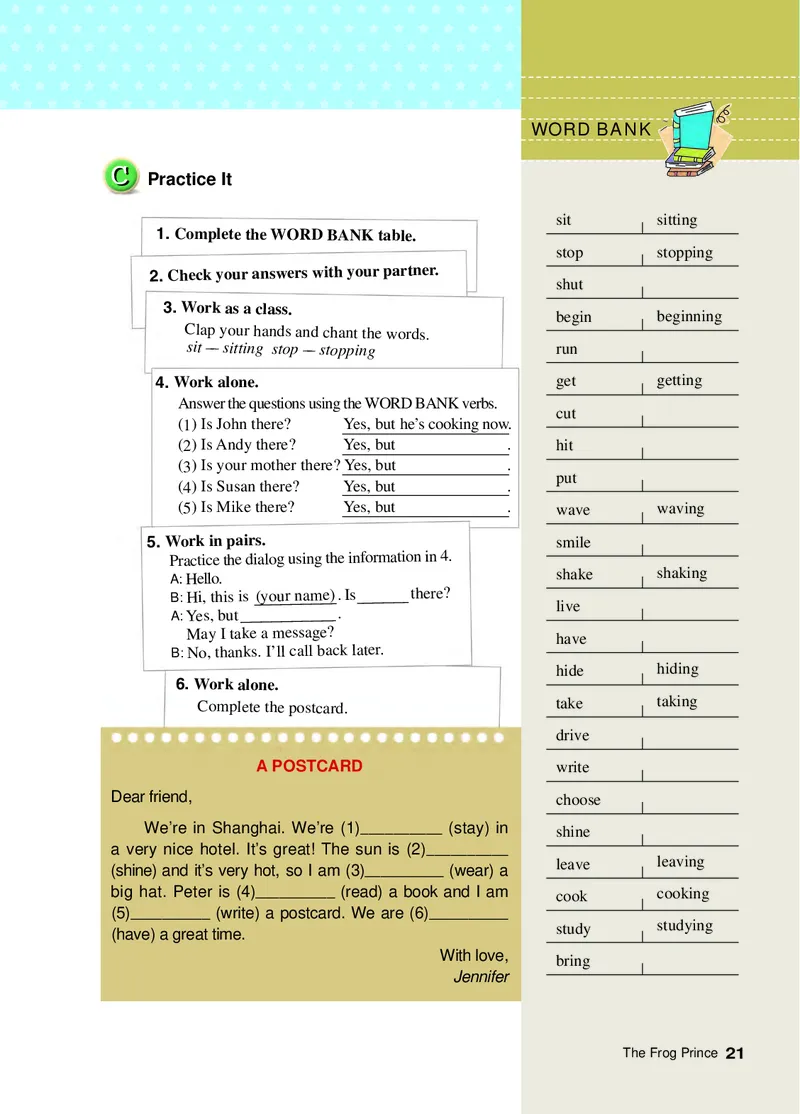
20 Unit 2WORD BANK
CC
Practice It
sit sitting
1. Complete the WORD BANK table.
stop stopping
2. Check your answers with your partner.
shut
3. Work as a class.
begin beginning
Clap your hands and chant the words.
sit –– sitting stop –– stopping run
4. Work alone. get getting
Answer the questions using the WORD BANK verbs.
cut
(1) Is John there? Yes, but he’s cooking now.
(2) Is Andy there? Yes, but . hit
(3) Is your mother there? Yes, but .
put
(4) Is Susan there? Yes, but .
(5) Is Mike there? Yes, but . wave waving
5. Work in pairs. smile
Practice the dialog using the information in 4.
A: Hello. shake shaking
B: Hi, this is (your name) . Is there?
live
A: Yes, but .
May I take a message?
have
B: No, thanks. I’ll call back later.
hide hiding
6. Work alone.
Complete the postcard. take taking
drive
A POSTCARD write
Dear friend, choose
We’re in Shanghai. We’re (1)__________ (stay) in shine
a very nice hotel. It’s great! The sun is (2)__________
leave leaving
(shine) and it’s very hot, so I am (3)__________ (wear) a
big hat. Peter is (4)__________ (read) a book and I am cook cooking
(5)__________ (write) a postcard. We are (6)__________
study studying
(have) a great time.
With love,
bring
Jennifer
The Frog Prince 21Your Progress
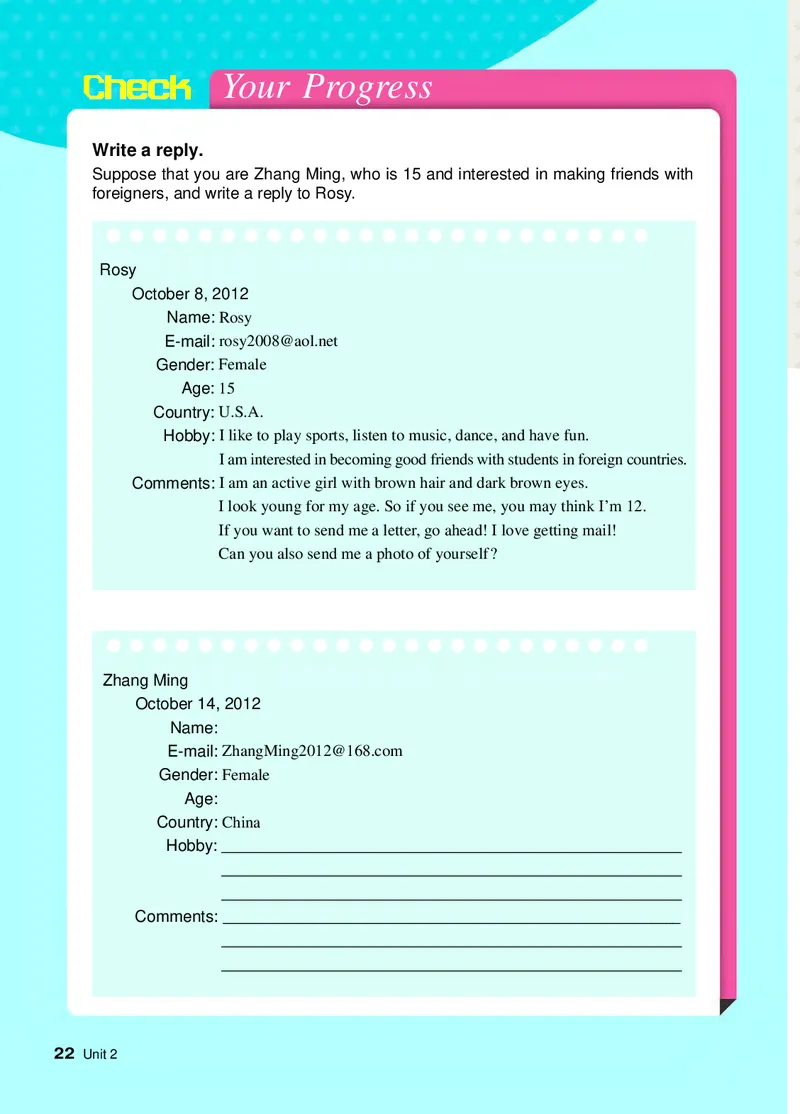
Write a reply.
Suppose that you are Zhang Ming, who is 15 and interested in making friends with
foreigners, and write a reply to Rosy.
Rosy
October 8, 2012
Name: Rosy
E-mail: rosy2008@aol.net
Gender: Female
Age: 15
Country: U.S.A.
Hobby: I like to play sports, listen to music, dance, and have fun.
I am interested in becoming good friends with students in foreign countries.
Comments: I am an active girl with brown hair and dark brown eyes.
I look young for my age. So if you see me, you may think I’m 12.
If you want to send me a letter, go ahead! I love getting mail!
Can you also send me a photo of yourself?
Zhang Ming
October 14, 2012
Name:
E-mail: ZhangMing2012@168.com
Gender: Female
Age:
Country: China
Hobby: ___________________________________________________________
___________________________________________________________
___________________________________________________________
Comments: ___________________________________________________________
___________________________________________________________
___________________________________________________________
22 Unit 23
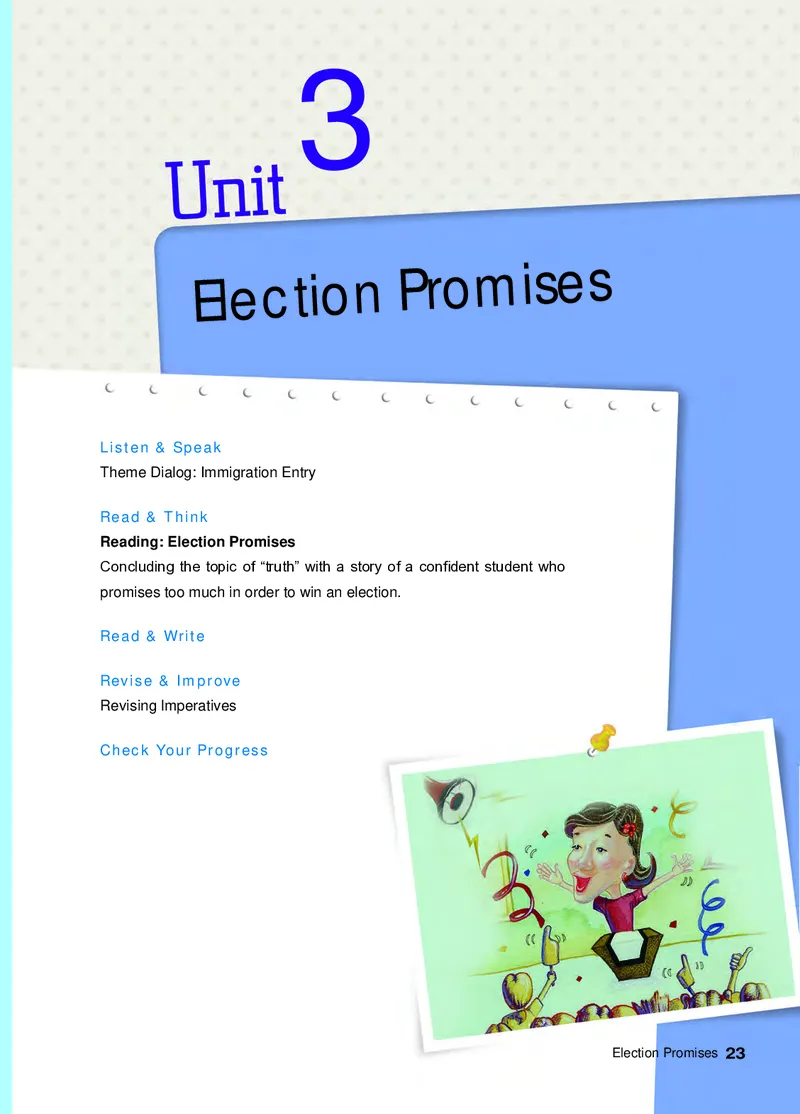
Election
Promises
Listen & Speak
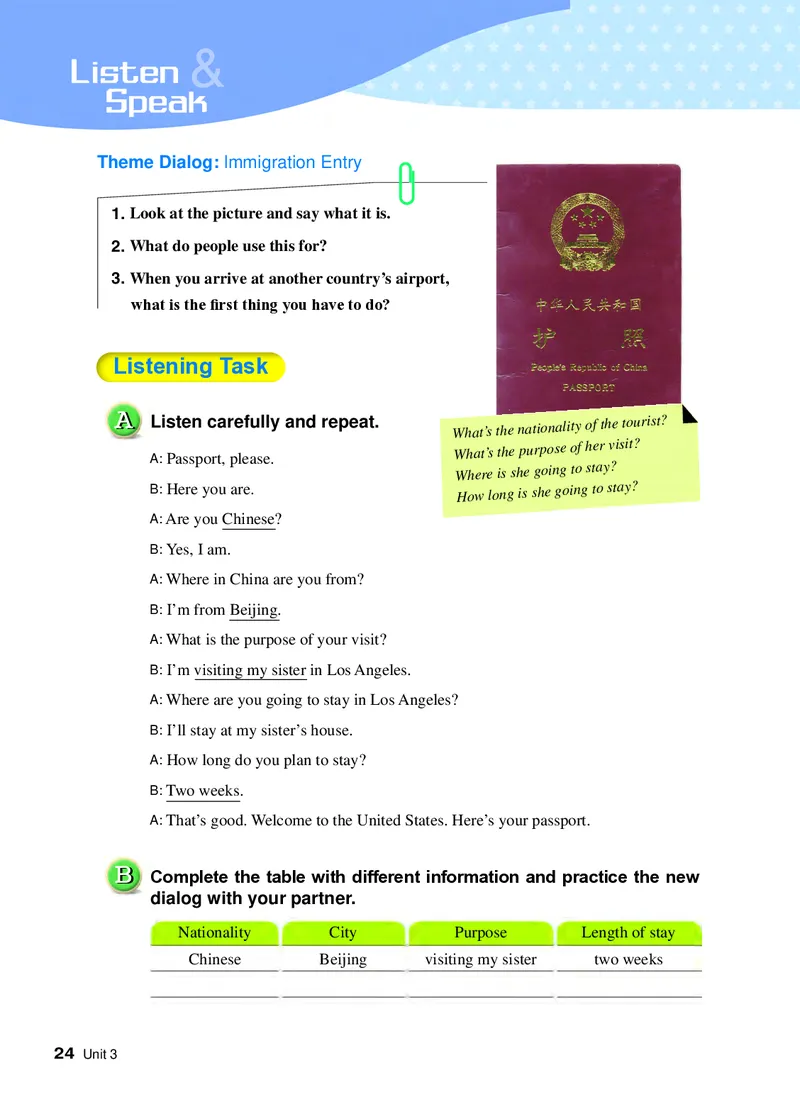
Theme Dialog: Immigration Entry
Read & Think
Reading: Election Promises
Concluding the topic of “truth” with a story of a confident student who
promises too much in order to win an election.
Read & Write
Revise & Improve
Revising lmperatives
Check Your Progress
Election Promises 23Theme Dialog: lmmigration Entry
1. Look at the picture and say what it is.
2. What do people use this for?
3. When you arrive at another country’s airport,
what is the first thing you have to do?
Listening Task
AA
Listen carefully and repeat. What’s the nationality of the tourist?
A: Passport, please.
What’s the purpose of her visit?
Where is she going to stay?
B: Here you are. How long is she going to stay?
A: Are you Chinese?
B: Yes, I am.
A: Where in China are you from?
B: I’m from Beijing.
A: What is the purpose of your visit?
B: I’m visiting my sister in Los Angeles.
A: Where are you going to stay in Los Angeles?
B: I’ll stay at my sister’s house.
A: How long do you plan to stay?
B: Two weeks.
A: That’s good. Welcome to the United States. Here’s your passport.
BB
Complete the table with different information and practice the new
dialog with your partner.
Nationality City Purpose Length of stay
Chinese Beijing visiting my sister two weeks
24 Unit 3Speaking Task
AA
Exchange the underlined expressions with the new ones below.
Practice the dialog with your partner.
A: What is the purpose of your visit?
B: I’m visiting my sister in Los Angeles.
A: Where are you going to stay in Los Angeles?
B: I’ll stay at my sister’s house.
What is the reason for your visit?
Why are you visiting the United States?
What will your address be in Los Angeles?
Where will you stay in Los Angeles?
BB
Imagine you are American and you have just arrived in China.
P ractice the dialog with your partner. Change the dialog using the
expressions or words below.
A: Passport, please.
B: Here you are.
A: Are you American?
B: Yes, I am.
A: What is the purpose of your visit to China?
B: I’ve been accepted to Peking University.
A: What are you going to study?
B: Chinese literature.
A: How long will the course last?
B: One year, but I’d like to travel around China after the course finishes.
A: Here’s your passport. Welcome to China and enjoy your stay.
Why are you visiting China? Nankai University –– Chinese language
What is the reason for your visit? Xi’an Jiaotong University –– Chinese culture
How long will you study here? Fudan University –– Chinese history
How long is your stay?
Tsinghua University –– Chinese art
Election Promises 25What’s It About?
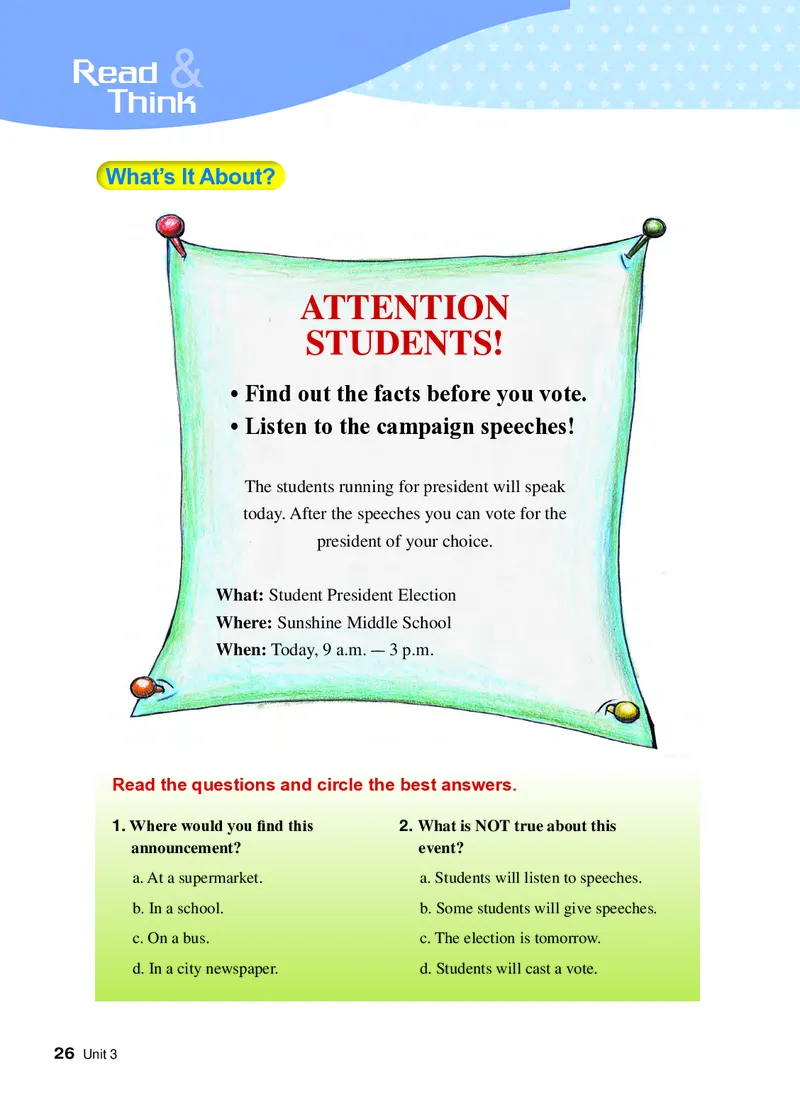
ATTENTION
STUDENTS!
• Find out the facts before you vote.
• Listen to the campaign speeches!
The students running for president will speak
today. After the speeches you can vote for the
president of your choice.
What: Student President Election
Where: Sunshine Middle School
When: Today, 9 a.m. –– 3 p.m.
Read the questions and circle the best answers.
1. Where would you find this 2. What is NOT true about this
announcement? event?
a. At a supermarket. a. Students will listen to speeches.
b. In a school. b. Some students will give speeches.
c. On a bus. c. The election is tomorrow.
d. In a city newspaper. d. Students will cast a vote.
26 Unit 3Reading
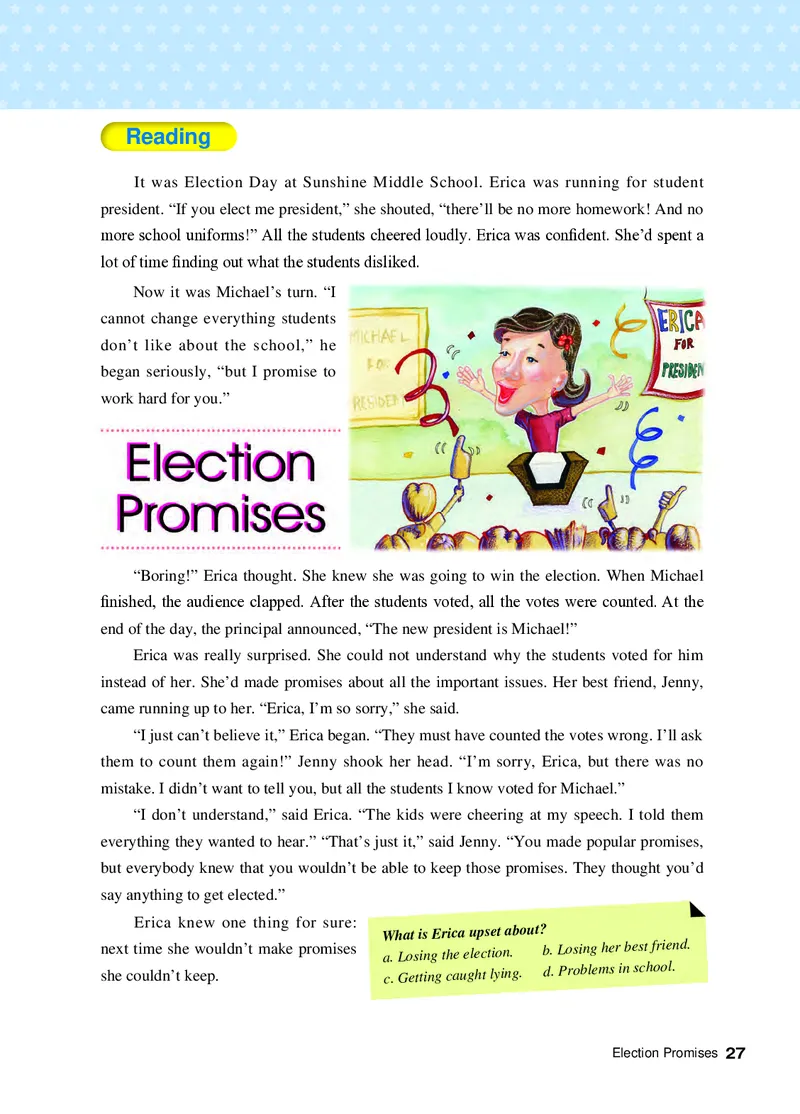
It was Election Day at Sunshine Middle School. Erica was running for student
president. “If you elect me president,” she shouted, “there’ll be no more homework! And no
more school uniforms!” All the students cheered loudly. Erica was confident. She’d spent a
lot of time finding out what the students disliked.
Now it was Michael’s turn. “I
cannot change everything students
don’t like about the school,” he
began seriously, “but I promise to
work hard for you.”
“Boring!” Erica thought. She knew she was going to win the election. When Michael
finished, the audience clapped. After the students voted, all the votes were counted. At the
end of the day, the principal announced, “The new president is Michael!”
Erica was really surprised. She could not understand why the students voted for him
instead of her. She’d made promises about all the important issues. Her best friend, Jenny,
came running up to her. “Erica, I’m so sorry,” she said.
“I just can’t believe it,” Erica began. “They must have counted the votes wrong. I’ll ask
them to count them again!” Jenny shook her head. “I’m sorry, Erica, but there was no
mistake. I didn’t want to tell you, but all the students I know voted for Michael.”
“I don’t understand,” said Erica. “The kids were cheering at my speech. I told them
everything they wanted to hear.” “That’s just it,” said Jenny. “You made popular promises,
but everybody knew that you wouldn’t be able to keep those promises. They thought you’d
say anything to get elected.”
Erica knew one thing for sure:
What is Erica upset about?
next time she wouldn’t make promises a. Losing the election. b. Losing her best friend.
she couldn’t keep. c. Getting caught lying. d. Problems in school.
Election Promises 27Reading Comprehension
AA
Analyzing the Ideas
Read the questions and circle the correct answers.
1. What is another good title for the story?
a. A Great Victory
b. Winning Votes
c. A Surprising Loss
d. A Successful Speech
2. In what way is this story like “The Frog Prince”?
a. Both stories happened in real life.
b. Both stories are about things that could never really happen.
c. Both stories teach us to take our own advice.
d. Both stories teach us that keeping promises is more important than making them.
BB
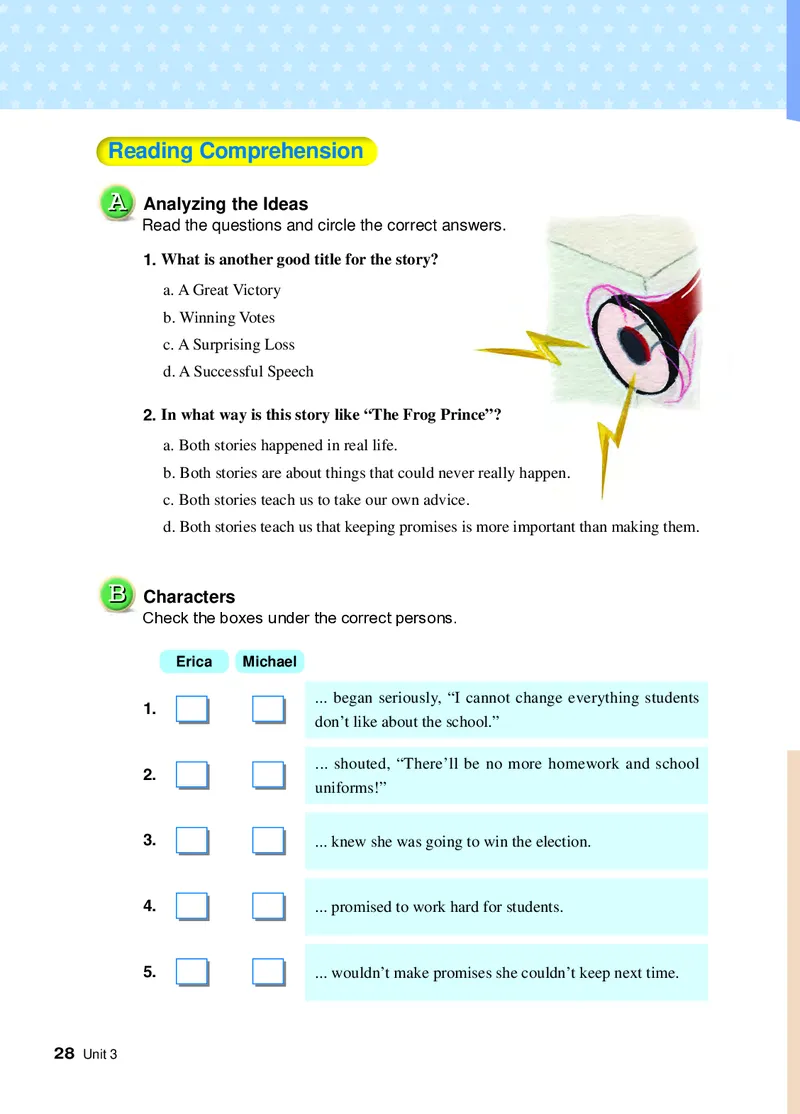
Characters
Check the boxes under the correct persons.
Erica Michael
... began seriously, “I cannot change everything students
1.
don’t like about the school.”
... shouted, “There’ll be no more homework and school
2.
uniforms!”
3. ... knew she was going to win the election.
4. ... promised to work hard for students.
5. ... wouldn’t make promises she couldn’t keep next time.
28 Unit 3AA
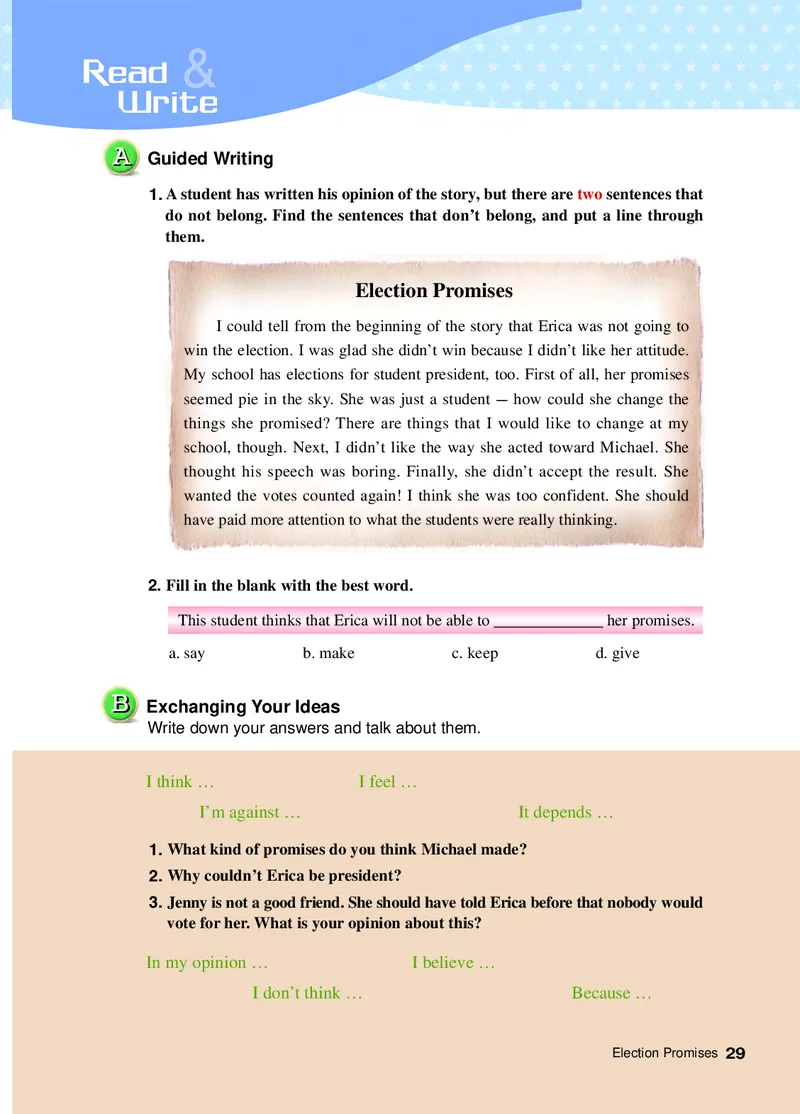
Guided Writing
1. A student has written his opinion of the story, but there are two sentences that
do not belong. Find the sentences that don’t belong, and put a line through
them.
Election Promises
I could tell from the beginning of the story that Erica was not going to
win the election. I was glad she didn’t win because I didn’t like her attitude.
My school has elections for student president, too. First of all, her promises
seemed pie in the sky. She was just a student --- how could she change the
things she promised? There are things that I would like to change at my
school, though. Next, I didn’t like the way she acted toward Michael. She
thought his speech was boring. Finally, she didn’t accept the result. She
wanted the votes counted again! I think she was too confident. She should
have paid more attention to what the students were really thinking.
2. Fill in the blank with the best word.
This student thinks that Erica will not be able to ______________ her promises.
a. say b. make c. keep d. give
BB
Exchanging Your Ideas
Write down your answers and talk about them.
I think … I feel …
I’m against … It depends …
1. What kind of promises do you think Michael made?
2. Why couldn’t Erica be president?
3. Jenny is not a good friend. She should have told Erica before that nobody would
vote for her. What is your opinion about this?
In my opinion … I believe …
I don’t think … Because …
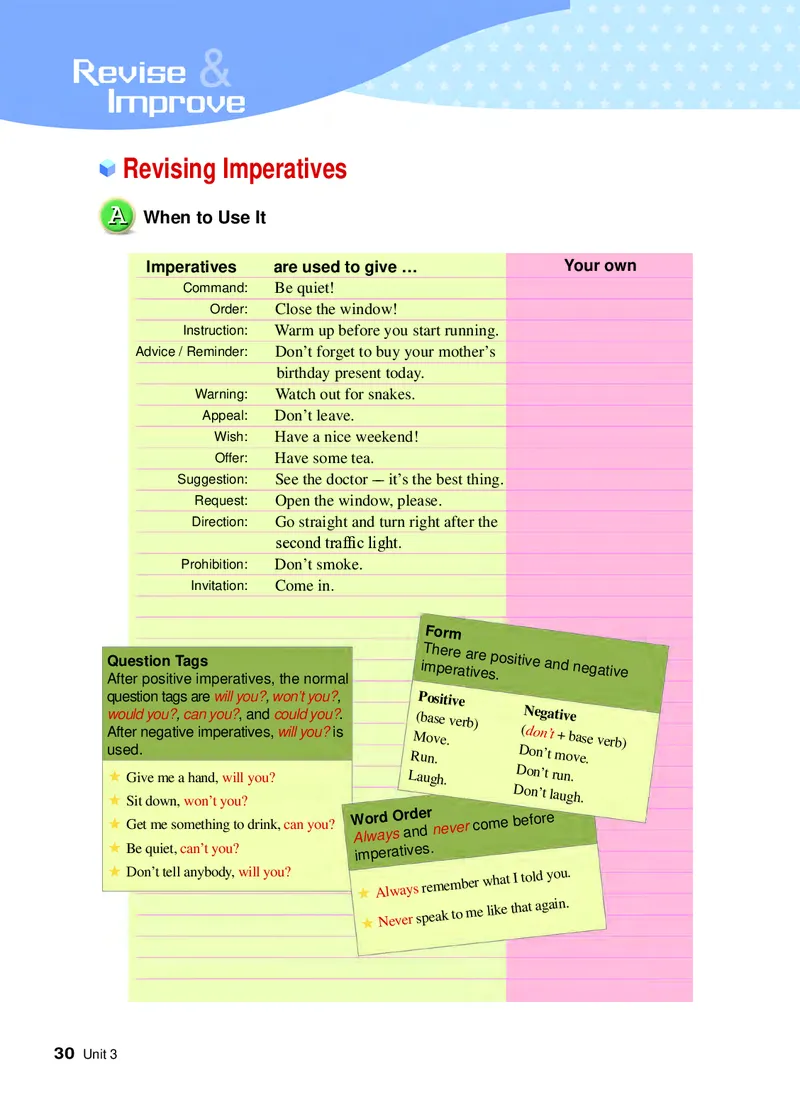
Election Promises 29Revising Imperatives
AA
When to Use It
Imperatives are used to give … Your own
Command: Be quiet!
Order: Close the window!
Instruction: Warm up before you start running.
Advice / Reminder: Don’t forget to buy your mother’s
birthday present today.
Warning: Watch out for snakes.
Appeal: Don’t leave.
Wish: Have a nice weekend!
Offer: Have some tea.
Suggestion: See the doctor –– it’s the best thing.
Request: Open the window, please.
Direction: Go straight and turn right after the
second traffic light.
Prohibition: Don’t smoke.
Invitation: Come in.
Form
Q Af u te e r s p ti o o s n it i T v a e g im s peratives, the normal i T m h p e e r r e a a tiv re e s p . ositive and negative
question tags are will you?, won’t you?, Positive
would you?, can you?, and could you?. (base verb)
Negative
After negative imperatives, will you? is Move. (don’t + base verb)
used. Run. Don’t move.
Give me a hand, will you? Laugh.
Don’t
run.
Sit down, won’t you?
Don’t
laugh.
Get me something to drink, can you? W Al o w r a d y s O a rd n e d r never come before
Be quiet, can’t you? imperatives.
Don’t tell anybody, will you?
Always
remember what I told you.
Never speak to me like that again.
30 Unit 3WORD BANK
BB
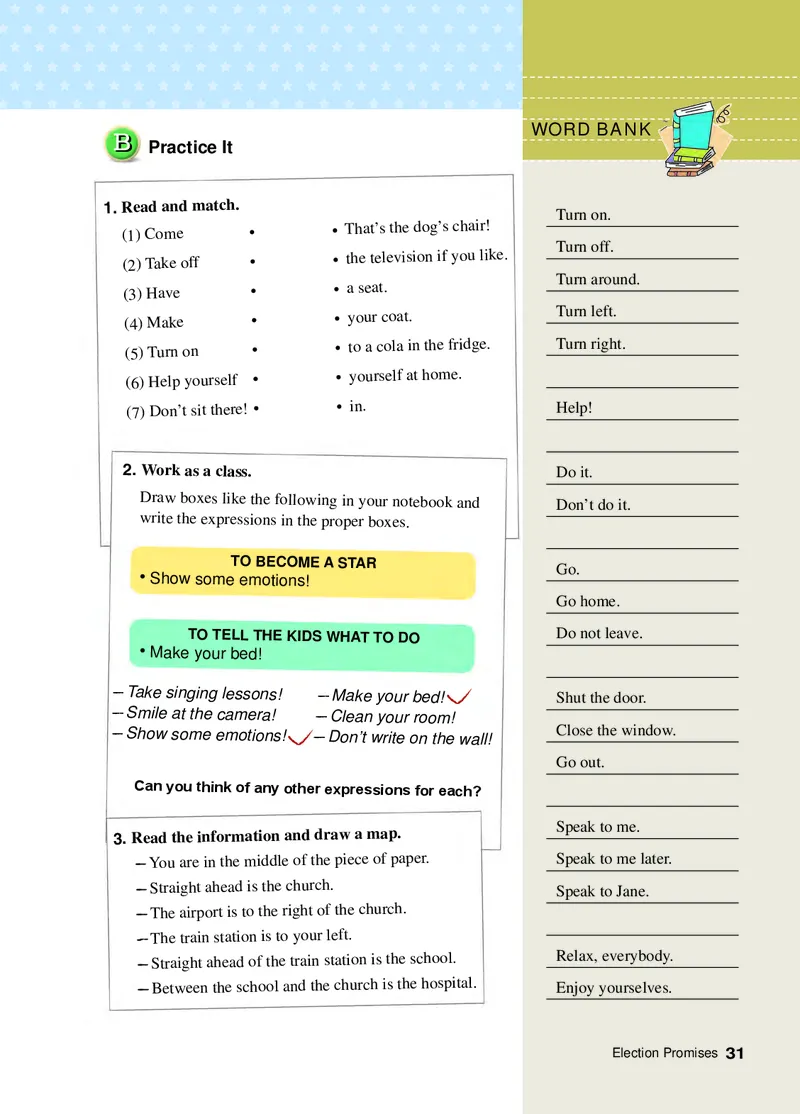
Practice It
1. Read and match.
Turn on.
(1) Come
That’s the dog’s chair!
Turn off.
(2) Take off the television if you like.
Turn around.
(3) Have
a seat.
Turn left.
(4) Make
your coat.
(5) Turn on to a cola in the fridge. Turn right.
(6) Help yourself yourself at home.
(7) Don’t sit there! in. Help!
2. Work as a class. Do it.
Draw boxes like the following in your notebook and Don’t do it.
write the expressions in the proper boxes.
TO BECOME A STAR Go.
Show some emotions!
Go home.
TO TELL THE KIDS WHAT TO DO Do not leave.
Make your bed!
---- Take singing lessons! ---- Make your bed! Shut the door.
---- Smile at the camera! ---- Clean your room!
---- Show some emotions! ---- Don’t write on the wall! Close the window.
Go out.
Can you think of any other expressions for each?
Speak to me.
3. Read the information and draw a map.
---- You are in the middle of the piece of paper. Speak to me later.
---- Straight ahead is the church. Speak to Jane.
---- The airport is to the right of the church.
---- The train station is to your left.
---- Straight ahead of the train station is the school. Relax, everybody.
---- Between the school and the church is the hospital. Enjoy yourselves.
Election Promises 31Your Progress
Write the correct answer to each question.
Imagine a flat area of land near a river. It is covered with beautiful tall grass. You can
hear many different birds singing. And you can see frogs hopping and crickets jumping. The
ground is wet, with large pools of water.
Welcome to the wetlands. Wetlands are near large bodies of water like rivers and
oceans. The land is partly covered with water. Wetlands are very important ecosystems.
Some endangered animals live in wetlands. Many fish and birds come to wetlands to lay
eggs. Wetlands also prevent floods. When the water in a river gets high, wetlands can keep
the extra water. When the water level of the river goes down, the wetlands slowly release
the extra water. Wetlands also clean water. Both the dirt and the plants in wetlands absorb
harmful things.
Unfortunately, wetlands are easily destroyed and they are disappearing quickly. Some
people use wetlands as a place to throw trash. Of course, this affects the whole ecosystem.
Other people destroy wetlands because they want to use the land. They fill some wetlands
with dirt to make the land higher and drier. Many governments in the world are trying to
save the wetlands, but some people think they are not doing enough.
1. Why are wetlands important?
___________________________________________________________________________
2. How do wetlands clean wastewater?
___________________________________________________________________________
3. How do people destroy the wetlands?
___________________________________________________________________________
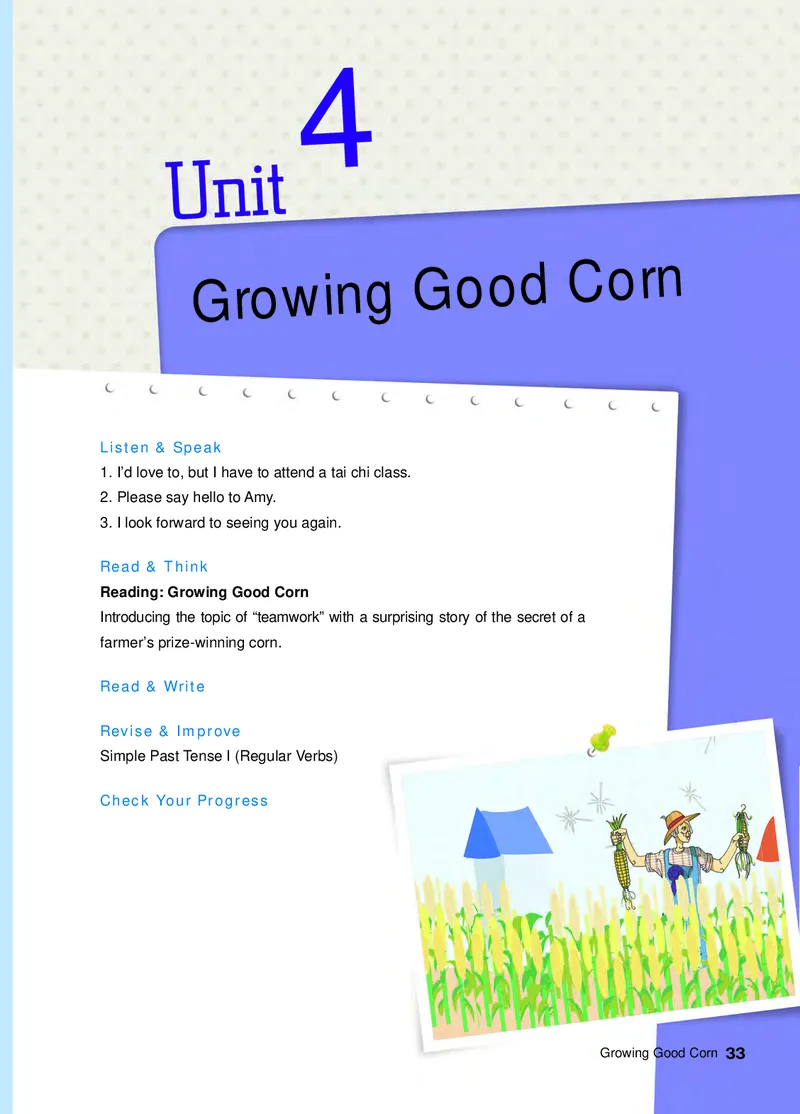
32 Unit 34
Growing
Good
Corn
Listen & Speak
1. I’d love to, but I have to attend a tai chi class.
2. Please say hello to Amy.
3. I look forward to seeing you again.
Read & Think
Reading: Growing Good Corn
Introducing the topic of “teamwork” with a surprising story of the secret of a
farmer’s prize-winning corn.
Read & Write
Revise & Improve
Simple Past Tense I (Regular Verbs)
Check Your Progress
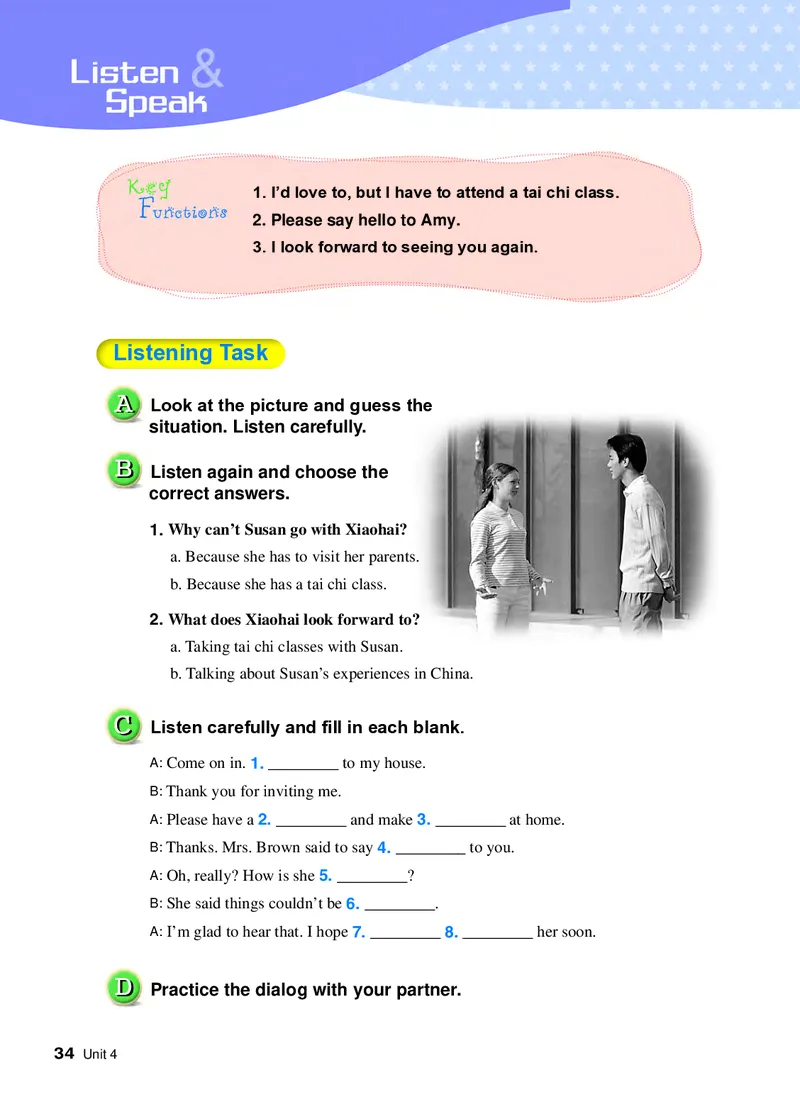
Growing Good Corn 331. I’d love to, but I have to attend a tai chi class.
2. Please say hello to Amy.
3. I look forward to seeing you again.
Listening Task
AA
Look at the picture and guess the
situation. Listen carefully.
BB
Listen again and choose the
correct answers.
1. Why can’t Susan go with Xiaohai?
a. Because she has to visit her parents.
b. Because she has a tai chi class.
2. What does Xiaohai look forward to?
a. Taking tai chi classes with Susan.
b. Talking about Susan’s experiences in China.
CC
Listen carefully and fill in each blank.
A: Come on in. 1. _________ to my house.
B: Thank you for inviting me.
A: Please have a 2. _________ and make 3. _________ at home.
B: Thanks. Mrs. Brown said to say 4. _________ to you.
A: Oh, really? How is she 5. _________?
B: She said things couldn’t be 6. _________.
A: I’m glad to hear that. I hope 7. _________ 8. _________ her soon.
DD
Practice the dialog with your partner.
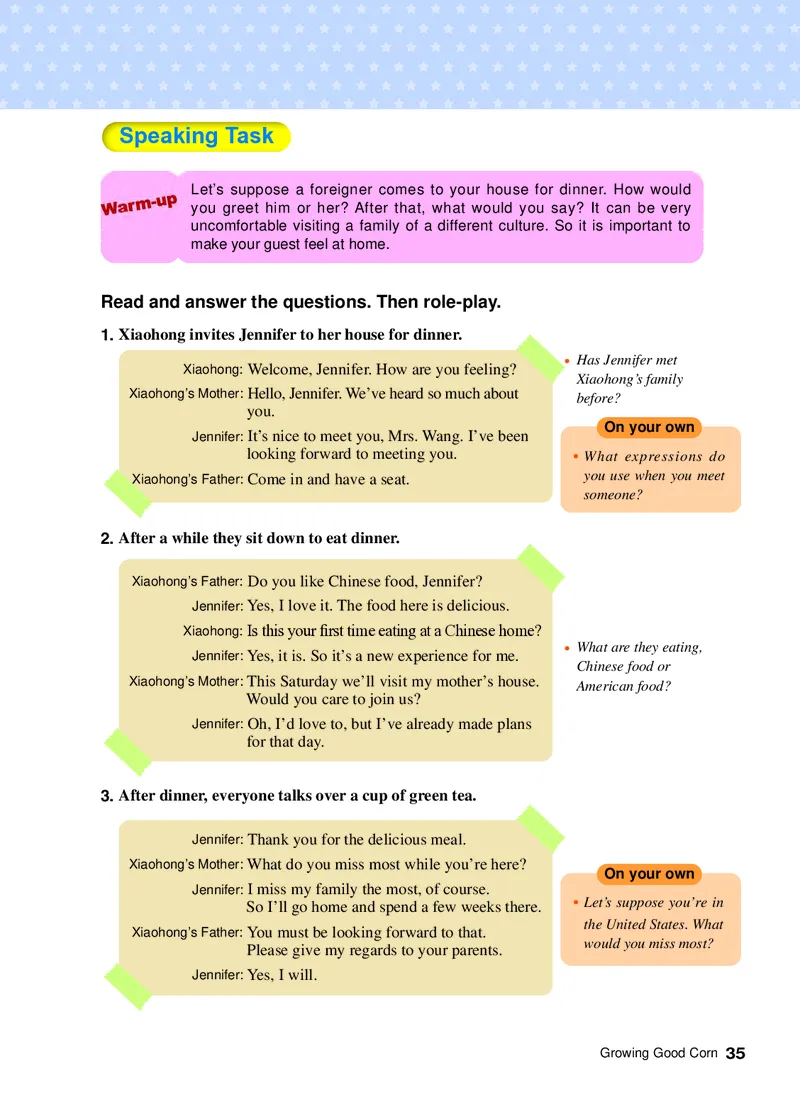
34 Unit 4Speaking Task
Let’s suppose a foreigner comes to your house for dinner. How would
you greet him or her? After that, what would you say? It can be very
uncomfortable visiting a family of a different culture. So it is important to
make your guest feel at home.
Read and answer the questions. Then role-play.
1. Xiaohong invites Jennifer to her house for dinner.
Has Jennifer met
Xiaohong: Welcome, Jennifer. How are you feeling?
Xiaohong’s family
Xiaohong’s Mother: Hello, Jennifer. We’ve heard so much about before?
you.
On your own
Jennifer: It’s nice to meet you, Mrs. Wang. I’ve been
looking forward to meeting you. What expressions do
Xiaohong’s Father: Come in and have a seat. you use when you meet
someone?
2. After a while they sit down to eat dinner.
Xiaohong’s Father: Do you like Chinese food, Jennifer?
Jennifer: Yes, I love it. The food here is delicious.
Xiaohong: Is this your first time eating at a Chinese home?
What are they eating,
Jennifer: Yes, it is. So it’s a new experience for me.
Chinese food or
Xiaohong’s Mother: This Saturday we’ll visit my mother’s house. American food?
Would you care to join us?
Jennifer: Oh, I’d love to, but I’ve already made plans
for that day.
3. After dinner, everyone talks over a cup of green tea.
Jennifer: Thank you for the delicious meal.
Xiaohong’s Mother: What do you miss most while you’re here?
On your own
Jennifer: I miss my family the most, of course.
Let’s suppose you’re in
So I’ll go home and spend a few weeks there.
the United States. What
Xiaohong’s Father: You must be looking forward to that.
would you miss most?
Please give my regards to your parents.
Jennifer: Yes, I will.
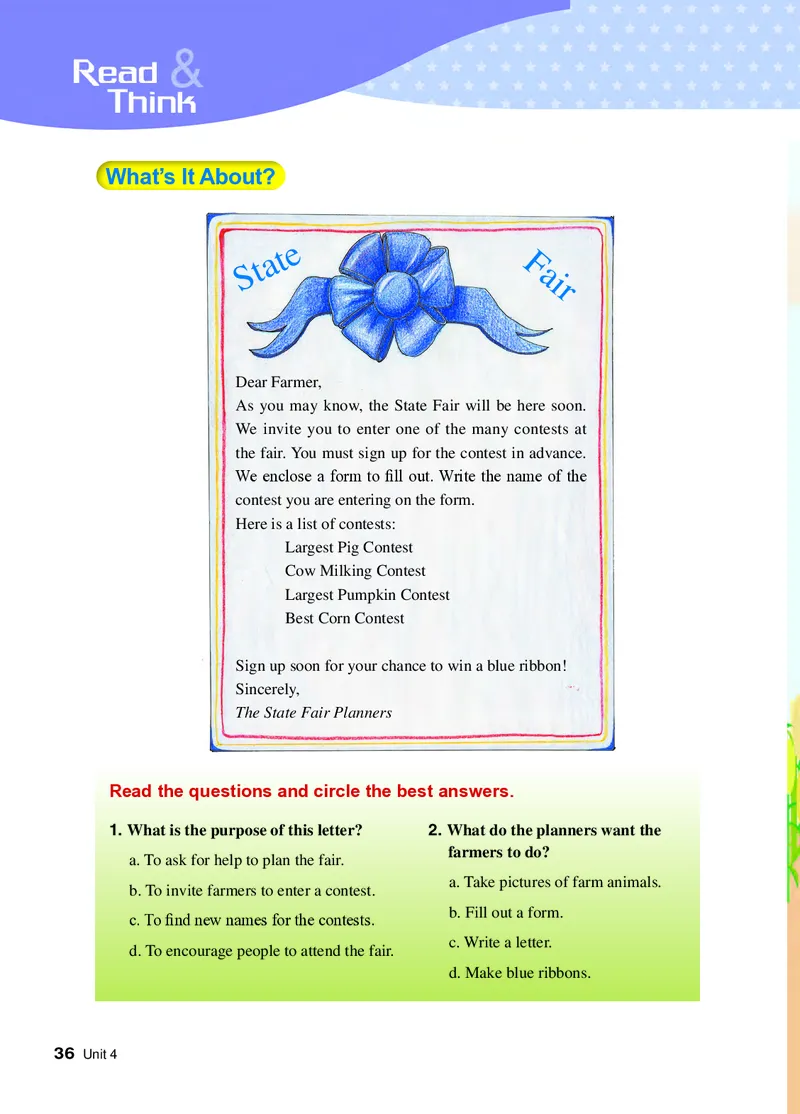
Growing Good Corn 35What’s It About?
e
at F
St a
i
r
Dear Farmer,
As you may know, the State Fair will be here soon.
We invite you to enter one of the many contests at
the fair. You must sign up for the contest in advance.
We enclose a form to fill out. Write the name of the
contest you are entering on the form.
Here is a list of contests:
Largest Pig Contest
Cow Milking Contest
Largest Pumpkin Contest
Best Corn Contest
Sign up soon for your chance to win a blue ribbon!
Sincerely,
The State Fair Planners
Read the questions and circle the best answers.
1. What is the purpose of this letter? 2. What do the planners want the
farmers to do?
a. To ask for help to plan the fair.
a. Take pictures of farm animals.
b. To invite farmers to enter a contest.
b. Fill out a form.
c. To find new names for the contests.
c. Write a letter.
d. To encourage people to attend the fair.
d. Make blue ribbons.
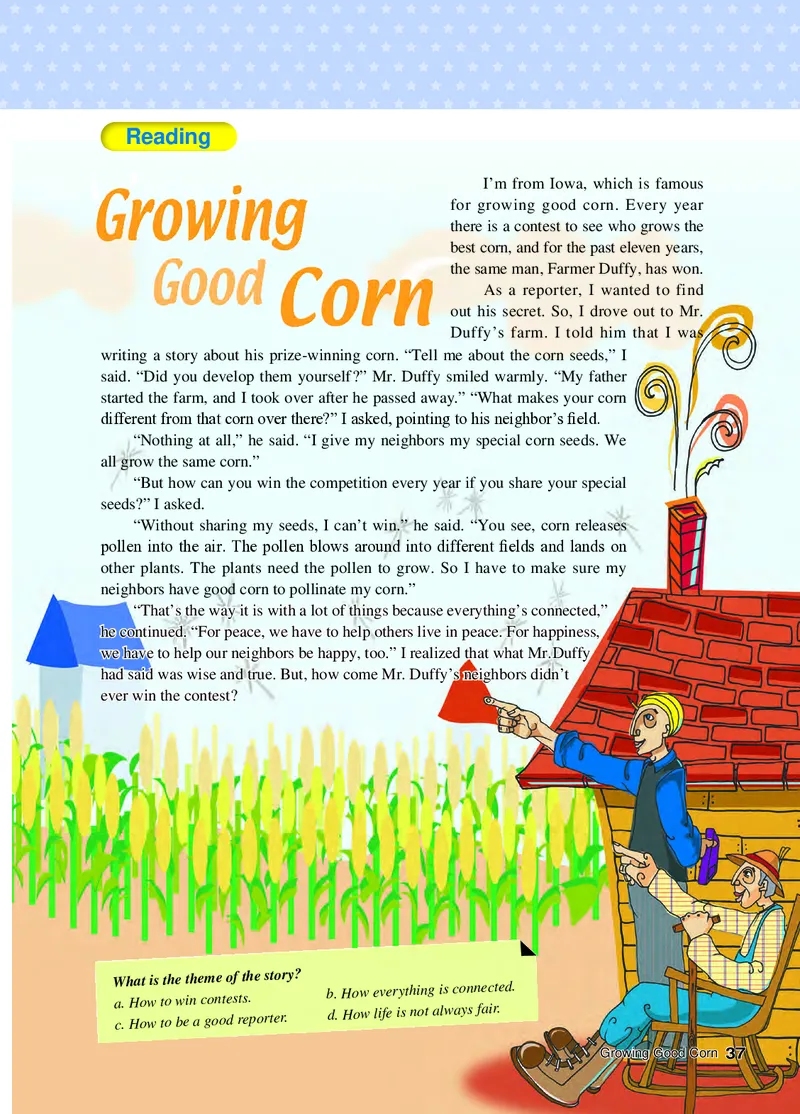
36 Unit 4Reading
I’m from Iowa, which is famous
for growing good corn. Every year
there is a contest to see who grows the
best corn, and for the past eleven years,
the same man, Farmer Duffy, has won.
As a reporter, I wanted to find
out his secret. So, I drove out to Mr.
Duffy’s farm. I told him that I was
writing a story about his prize-winning corn. “Tell me about the corn seeds,” I
said. “Did you develop them yourself?” Mr. Duffy smiled warmly. “My father
started the farm, and I took over after he passed away.” “What makes your corn
different from that corn over there?” I asked, pointing to his neighbor’s field.
“Nothing at all,” he said. “I give my neighbors my special corn seeds. We
all grow the same corn.”
“But how can you win the competition every year if you share your special
seeds?” I asked.
“Without sharing my seeds, I can’t win.” he said. “You see, corn releases
pollen into the air. The pollen blows around into different fields and lands on
other plants. The plants need the pollen to grow. So I have to make sure my
neighbors have good corn to pollinate my corn.”
“That’s the way it is with a lot of things because everything’s connected,”
he continued. “For peace, we have to help others live in peace. For happiness,
we have to help our neighbors be happy, too.” I realized that what Mr. Duffy
had said was wise and true. But, how come Mr. Duffy’s neighbors didn’t
ever win the contest?
W a. h H a o t w is t t o h e w i t n h e c m on e t e o s f t t s h . e st ory? b. How everything is connected.
c. How to be a good reporter. d. How life is not always fair.
Growing Good Corn 37Reading Comprehension
AA
Analyzing the Ideas
Read the questions and circle the correct answers.
1. What is the tone of the story?
a. Exciting.
b. Sad.
c. Inspiring.
d. Confusing.
2. What is the author’s intention in this story?
a. To explain how to do something.
b. To teach a lesson about life.
c. To compare two types of people.
d. To advertise an interesting event.
BB
Fact or Opinion
Read the following sentences. If you think the statement is a fact, check “Fact.”
If not, check “Opinion.” Explain your decision.
1. Every year there is a contest to see who grows the Fact Opinion
best corn, and for the past eleven years, Farmer Duffy
has won.
2. Mr. Duffy gave his neighbors his special corn seeds. Fact Opinion
3. For peace, we have to help others live in peace. Fact Opinion
4. I realized that what Mr. Duffy had said was wise and Fact Opinion
true.
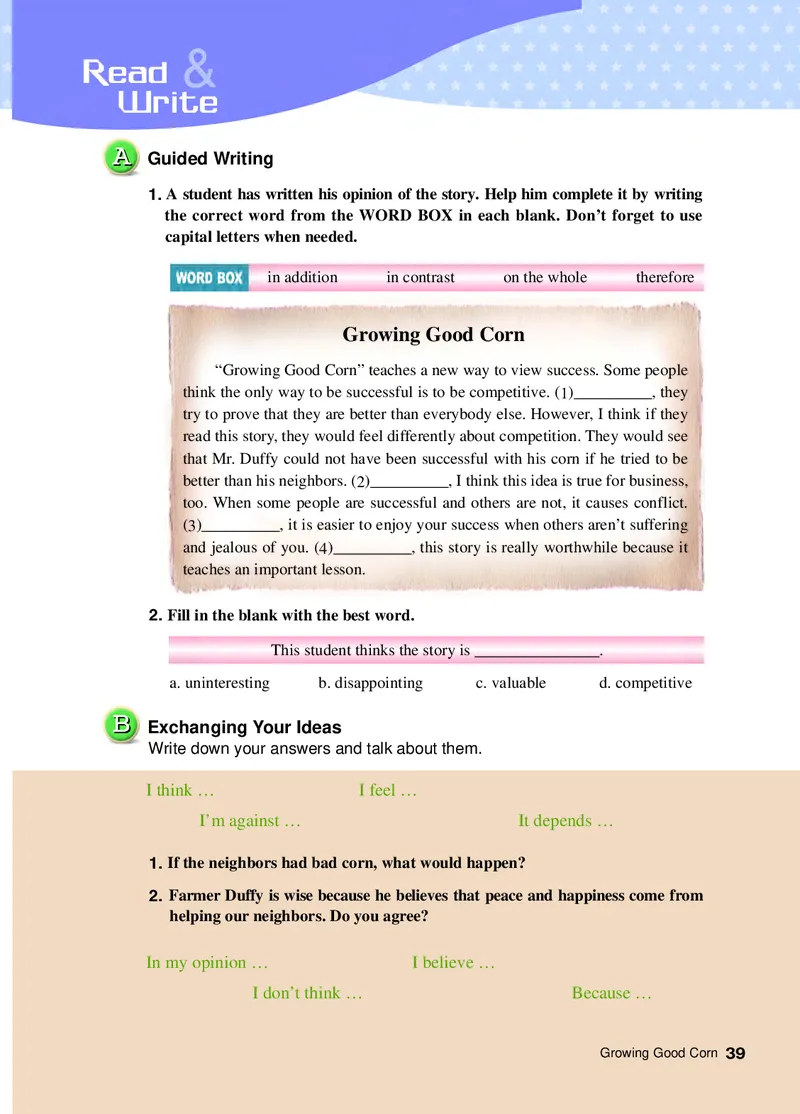
38 Unit 4AA
Guided Writing
1. A student has written his opinion of the story. Help him complete it by writing
the correct word from the WORD BOX in each blank. Don’t forget to use
capital letters when needed.
in addition in contrast on the whole therefore
Growing Good Corn
“Growing Good Corn” teaches a new way to view success. Some people
think the only way to be successful is to be competitive. (1)__________, they
try to prove that they are better than everybody else. However, I think if they
read this story, they would feel differently about competition. They would see
that Mr. Duffy could not have been successful with his corn if he tried to be
better than his neighbors. (2)__________, I think this idea is true for business,
too. When some people are successful and others are not, it causes conflict.
(3)__________, it is easier to enjoy your success when others aren’t suffering
and jealous of you. (4)__________, this story is really worthwhile because it
teaches an important lesson.
2. Fill in the blank with the best word.
This student thinks the story is ________________.
a. uninteresting b. disappointing c. valuable d. competitive
BB
Exchanging Your Ideas
Write down your answers and talk about them.
I think … I feel …
I’m against … It depends …
1. If the neighbors had bad corn, what would happen?
2. Farmer Duffy is wise because he believes that peace and happiness come from
helping our neighbors. Do you agree?
In my opinion … I believe …
I don’t think … Because …
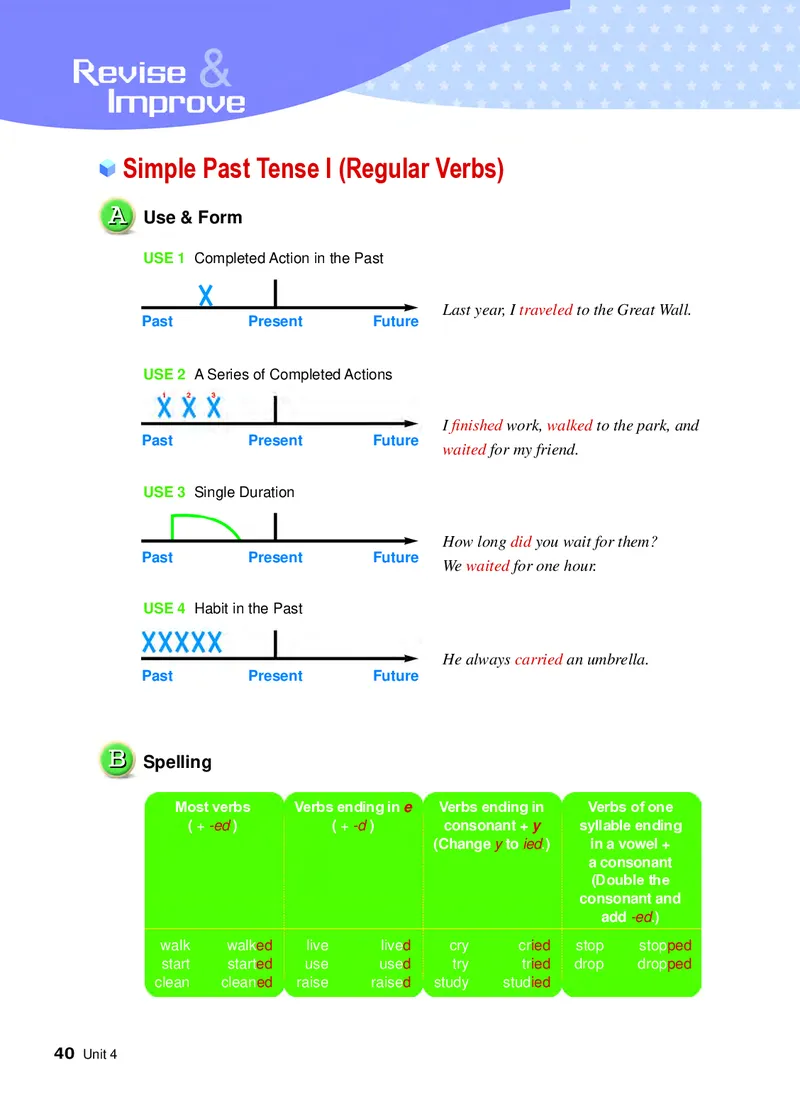
Growing Good Corn 39Simple Past Tense I (Regular Verbs)
AA
Use & Form
USE 1 Completed Action in the Past
Last year, I traveled to the Great Wall.
Past Present Future
USE 2 A Series of Completed Actions
I finished work, walked to the park, and
Past Present Future
waited for my friend.
USE 3 Single Duration
How long did you wait for them?
Past Present Future
We waited for one hour.
USE 4 Habit in the Past
He always carried an umbrella.
Past Present Future
BB
Spelling
Most verbs Verbs ending in e Verbs ending in Verbs of one
( + -ed) ( + -d) consonant + y syllable ending
(Change y to ied.) in a vowel +
a consonant
(Double the
consonant and
add -ed.)
walk walked live lived cry cried stop stopped
start started use used try tried drop dropped
clean cleaned raise raised study studied
40 Unit 4WORD BANK
CC
Practice It
1. Complete the WORD BANK table. Pronunciation of Past Tense
2. Check your answers with your partner. /p/, /f/, /s/, /∫/, /t∫/, /k/
3. Work as a class. + -ed =/t/
Clap your hands and chant the words.
/t/ – /t/ – asked /t/ – /t/ – danced ask asked
4. Fill in each blank using the word from the box danced
below. Change the word forms if necessary.
stopped
Young Abraham Lincoln look
Abraham Lincoln (1)__________ in a small turn talk
learn
cabin as a teenager. He had to work hard to
wash
live
help his family. Sometimes he (2)__________
ask
for his neighbors for twenty-five cents. His
study
neighbors (3)__________ him to cut trees. /t/, /d/ + -(e)d = /d/
work
Each winter, young Abraham (4)__________
in school for only a few weeks. But he (5)__________ a lot wait waited
because he read many books on his own. One of his
want
cousins said, “After Abraham (6)__________ twelve years
old, I never saw him without a book. It did not seem needed
natural.”
5. Write five sentences in your notebook about all other sounds+ -(e)d =/d/
what you did or didn’t do yesterday.
call called
watch / TV/ yesterday / morning help / mom / cook
lived
play /soccer / after school brush / teeth / after lunch
walk / to school wash / hands / before lunch loved
Yesterday, I didn’t watch TV in the morning. play
Yesterday, I brushed my teeth after lunch.
stay
Yesterday, __________________________________________.
cry cried
6. Ask your partner using the sentences you
study studied
wrote.
A: Did you watch TV yesterday morning?
B: No, I didn’t.
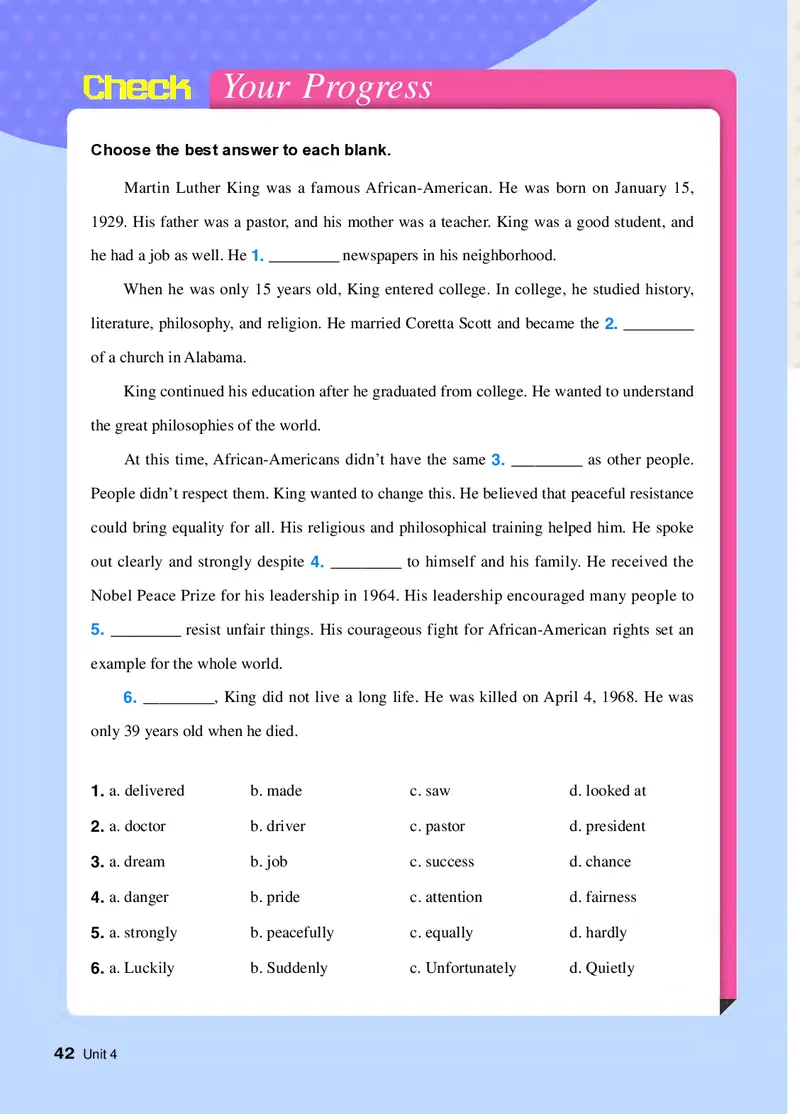
Growing Good Corn 41Your Progress
Choose the best answer to each blank.
Martin Luther King was a famous African-American. He was born on January 15,
1929. His father was a pastor, and his mother was a teacher. King was a good student, and
he had a job as well. He 1. _________ newspapers in his neighborhood.
When he was only 15 years old, King entered college. In college, he studied history,
literature, philosophy, and religion. He married Coretta Scott and became the 2. _________
of a church in Alabama.
King continued his education after he graduated from college. He wanted to understand
the great philosophies of the world.
At this time, African-Americans didn’t have the same 3. _________ as other people.
People didn’t respect them. King wanted to change this. He believed that peaceful resistance
could bring equality for all. His religious and philosophical training helped him. He spoke
out clearly and strongly despite 4. _________ to himself and his family. He received the
Nobel Peace Prize for his leadership in 1964. His leadership encouraged many people to
5. _________ resist unfair things. His courageous fight for African-American rights set an
example for the whole world.
6. _________, King did not live a long life. He was killed on April 4, 1968. He was
only 39 years old when he died.
1. a. delivered b. made c. saw d. looked at
2. a. doctor b. driver c. pastor d. president
3. a. dream b. job c. success d. chance
4. a. danger b. pride c. attention d. fairness
5. a. strongly b. peacefully c. equally d. hardly
6. a. Luckily b. Suddenly c. Unfortunately d. Quietly
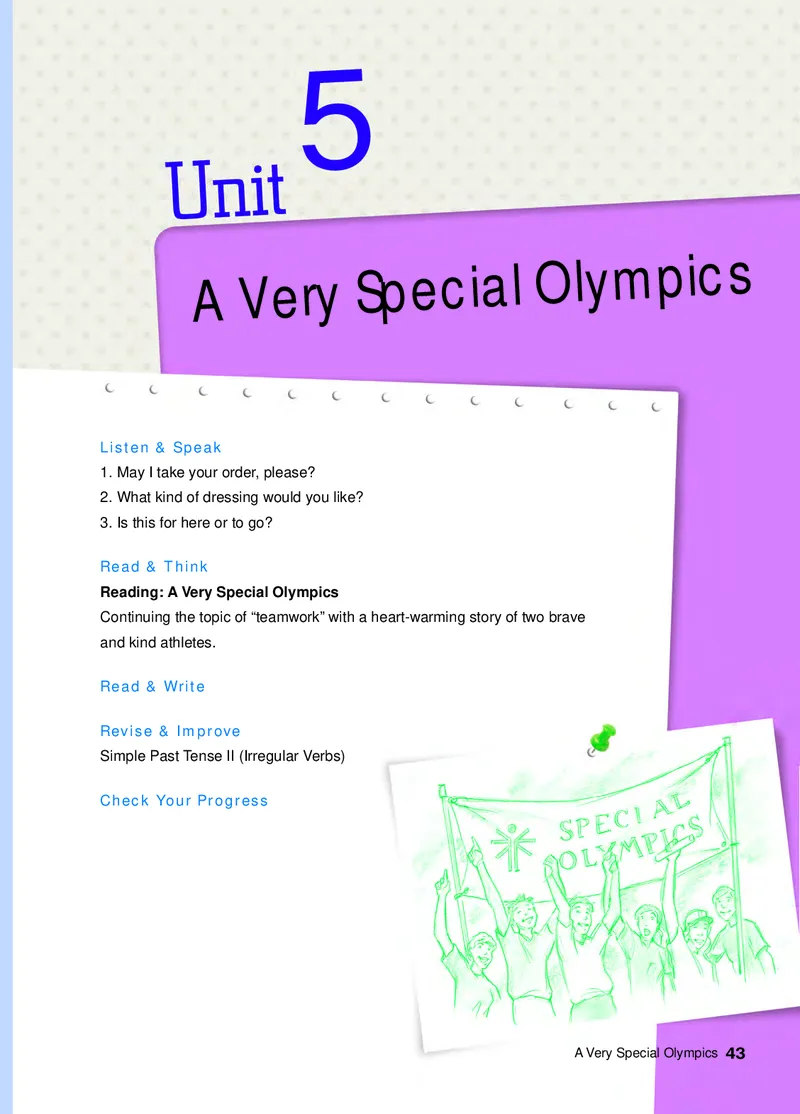
42 Unit 45
A
Very
Special
Olympics
Listen & Speak
1. May I take your order, please?
2. What kind of dressing would you like?
3. Is this for here or to go?
Read & Think
Reading: A Very Special Olympics
Continuing the topic of “teamwork” with a heart-warming story of two brave
and kind athletes.
Read & Write
Revise & Improve
Simple Past Tense II (Irregular Verbs)
Check Your Progress
A Very Special Olympics 431. May I take your order, please?
2. What kind of dressing would you like?
3. Is this for here or to go?
Listening Task
AA
Listen carefully and check the food that is ordered.
MENU
–– Where are they?
Sandwiches
Ham and Egg –– How do you know that?
Ham and Cheese
Salad
Green Salad
Soup
Chicken Salad
Onion
Fruit Salad
Cream
Potato
Dressing
Italian
French
BB
Listen carefully and fill in each blank.
A: May I take your 1. _________, please?
B: Yes. I’ll have a 2. _________ and 3. _________ French fries.
A: Would you like anything to 4. _________?
B: I’d like a cup of 5. _________ juice.
A: Is this for here or to 6. _________?
B: For here, please.
A: That 7. _________ to ten dollars.
CC
Practice the dialog with your partner.
44 Unit 5Speaking Task
We go to fast-food restaurants more often than other kinds of restaurants.
What differences are there when ordering food?
Read and answer the questions. Then role-play.
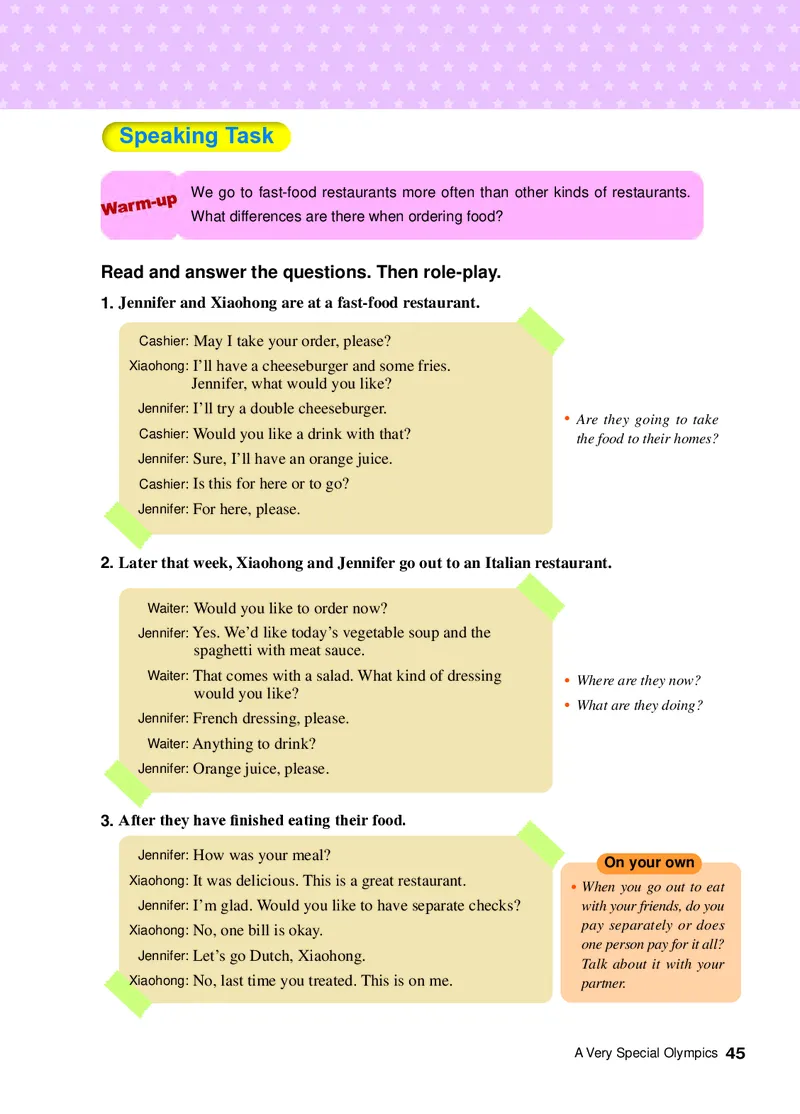
1. Jennifer and Xiaohong are at a fast-food restaurant.
Cashier: May I take your order, please?
Xiaohong: I’ll have a cheeseburger and some fries.
Jennifer, what would you like?
Jennifer: I’ll try a double cheeseburger.
Are they going to take
Cashier: Would you like a drink with that? the food to their homes?
Jennifer: Sure, I’ll have an orange juice.
Cashier: Is this for here or to go?
Jennifer: For here, please.
2. Later that week, Xiaohong and Jennifer go out to an Italian restaurant.
Waiter: Would you like to order now?
Jennifer: Yes. We’d like today’s vegetable soup and the
spaghetti with meat sauce.
Waiter: That comes with a salad. What kind of dressing Where are they now?
would you like?
What are they doing?
Jennifer: French dressing, please.
Waiter: Anything to drink?
Jennifer: Orange juice, please.
3. After they have finished eating their food.
Jennifer: How was your meal?
On your own
Xiaohong: It was delicious. This is a great restaurant.
When you go out to eat
Jennifer: I’m glad. Would you like to have separate checks? with your friends, do you
pay separately or does
Xiaohong: No, one bill is okay.
one person pay for it all?
Jennifer: Let’s go Dutch, Xiaohong.
Talk about it with your
Xiaohong: No, last time you treated. This is on me. partner.
A Very Special Olympics 45What’s It About?
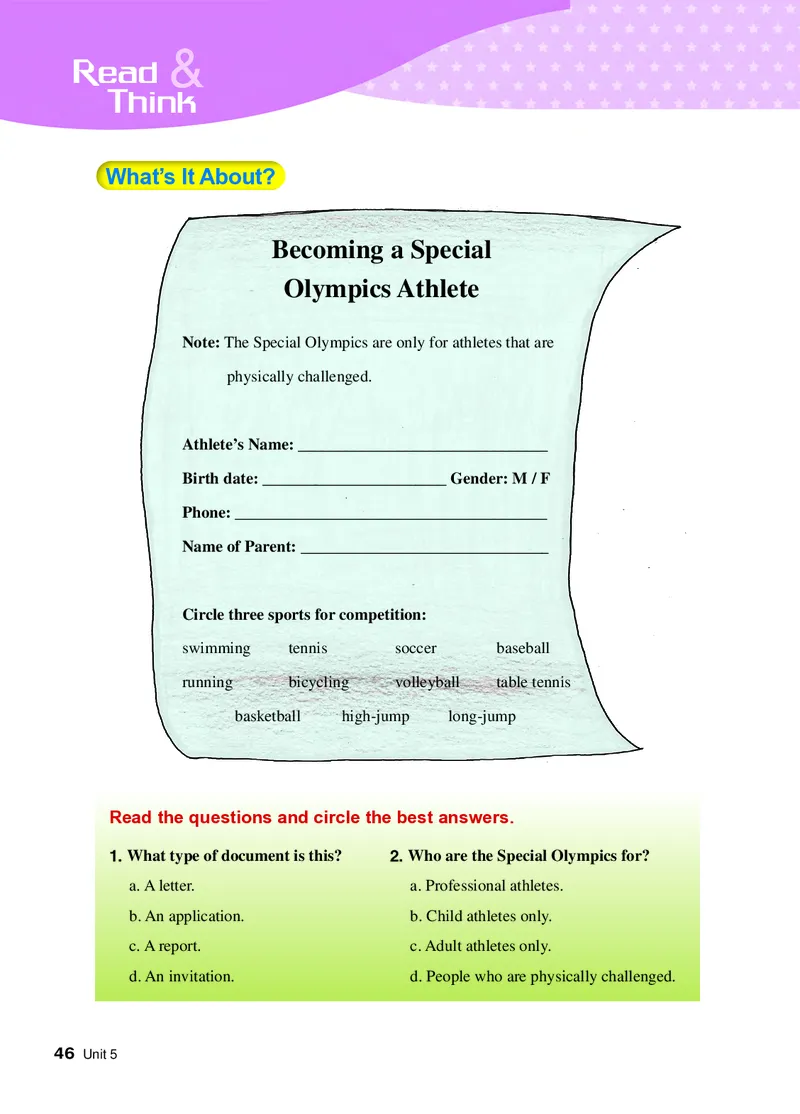
Becoming a Special
Olympics Athlete
Note: The Special Olympics are only for athletes that are
physically challenged.
Athlete’s Name: ________________________________
Birth date: ________________________ Gender: M / F
Phone: ________________________________________
Name of Parent: ________________________________
Circle three sports for competition:
swimming tennis soccer baseball
running bicycling volleyball table tennis
basketball high-jump long-jump
Read the questions and circle the best answers.
1. What type of document is this? 2. Who are the Special Olympics for?
a. A letter. a. Professional athletes.
b. An application. b. Child athletes only.
c. A report. c. Adult athletes only.
d. An invitation. d. People who are physically challenged.
46 Unit 5Reading
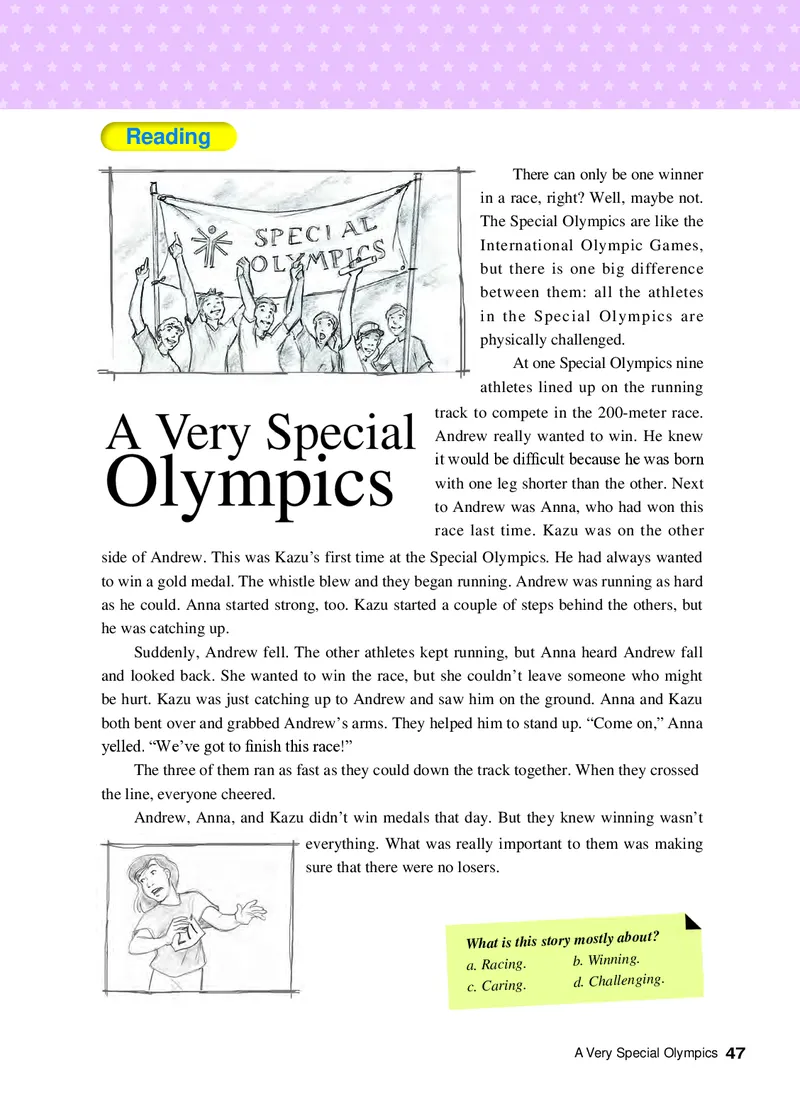
There can only be one winner
in a race, right? Well, maybe not.
The Special Olympics are like the
International Olympic Games,
but there is one big difference
between them: all the athletes
in the Special Olympics are
physically challenged.
At one Special Olympics nine
athletes lined up on the running
track to compete in the 200-meter race.
Andrew really wanted to win. He knew
it would be difficult because he was born
with one leg shorter than the other. Next
to Andrew was Anna, who had won this
race last time. Kazu was on the other
side of Andrew. This was Kazu’s first time at the Special Olympics. He had always wanted
to win a gold medal. The whistle blew and they began running. Andrew was running as hard
as he could. Anna started strong, too. Kazu started a couple of steps behind the others, but
he was catching up.
Suddenly, Andrew fell. The other athletes kept running, but Anna heard Andrew fall
and looked back. She wanted to win the race, but she couldn’t leave someone who might
be hurt. Kazu was just catching up to Andrew and saw him on the ground. Anna and Kazu
both bent over and grabbed Andrew’s arms. They helped him to stand up. “Come on,” Anna
yelled. “We’ve got to finish this race!”
The three of them ran as fast as they could down the track together. When they crossed
the line, everyone cheered.
Andrew, Anna, and Kazu didn’t win medals that day. But they knew winning wasn’t
everything. What was really important to them was making
sure that there were no losers.
What is this story mostly about?
a. Racing. b. Winning.
c. Caring. d. Challenging.
A Very Special Olympics 47Reading Comprehension
AA
Analyzing the Ideas
Read the questions and circle the correct answers.
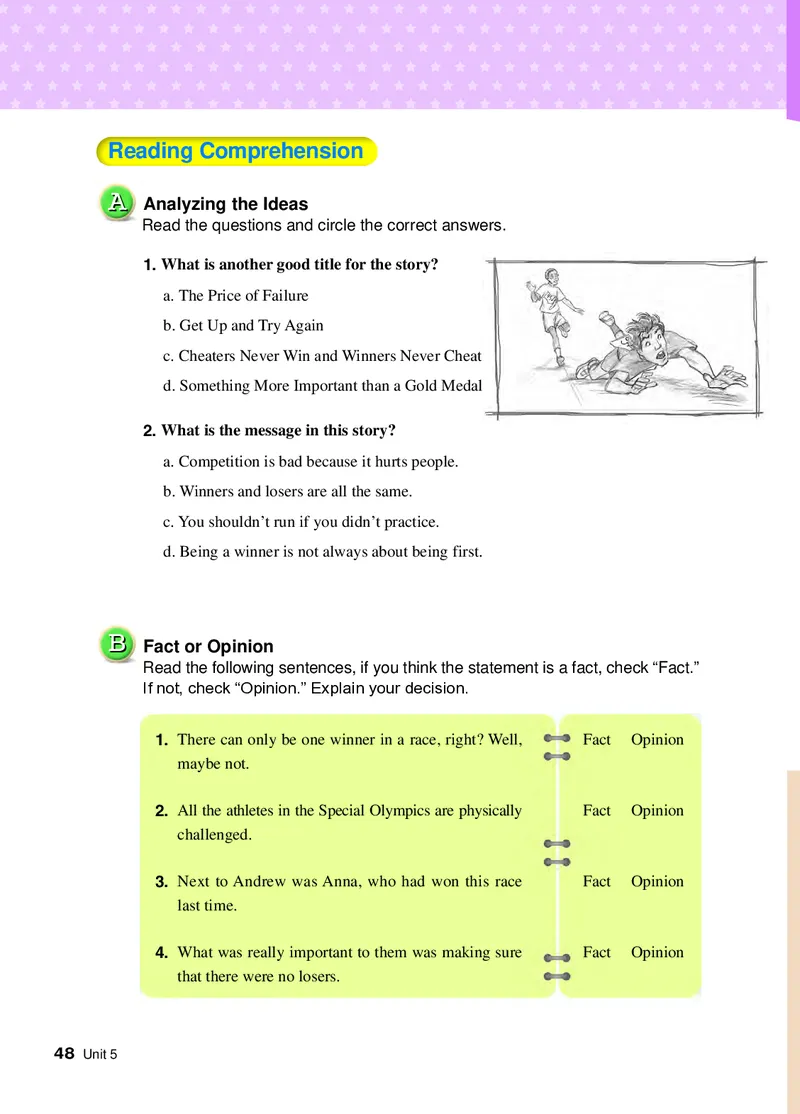
1. What is another good title for the story?
a. The Price of Failure
b. Get Up and Try Again
c. Cheaters Never Win and Winners Never Cheat
d. Something More Important than a Gold Medal
2. What is the message in this story?
a. Competition is bad because it hurts people.
b. Winners and losers are all the same.
c. You shouldn’t run if you didn’t practice.
d. Being a winner is not always about being first.
BB
Fact or Opinion
Read the following sentences, if you think the statement is a fact, check “Fact.”
If not, check “Opinion.” Explain your decision.
1. There can only be one winner in a race, right? Well, Fact Opinion
maybe not.
2. All the athletes in the Special Olympics are physically Fact Opinion
challenged.
3. Next to Andrew was Anna, who had won this race Fact Opinion
last time.
4. What was really important to them was making sure Fact Opinion
that there were no losers.
48 Unit 5AA
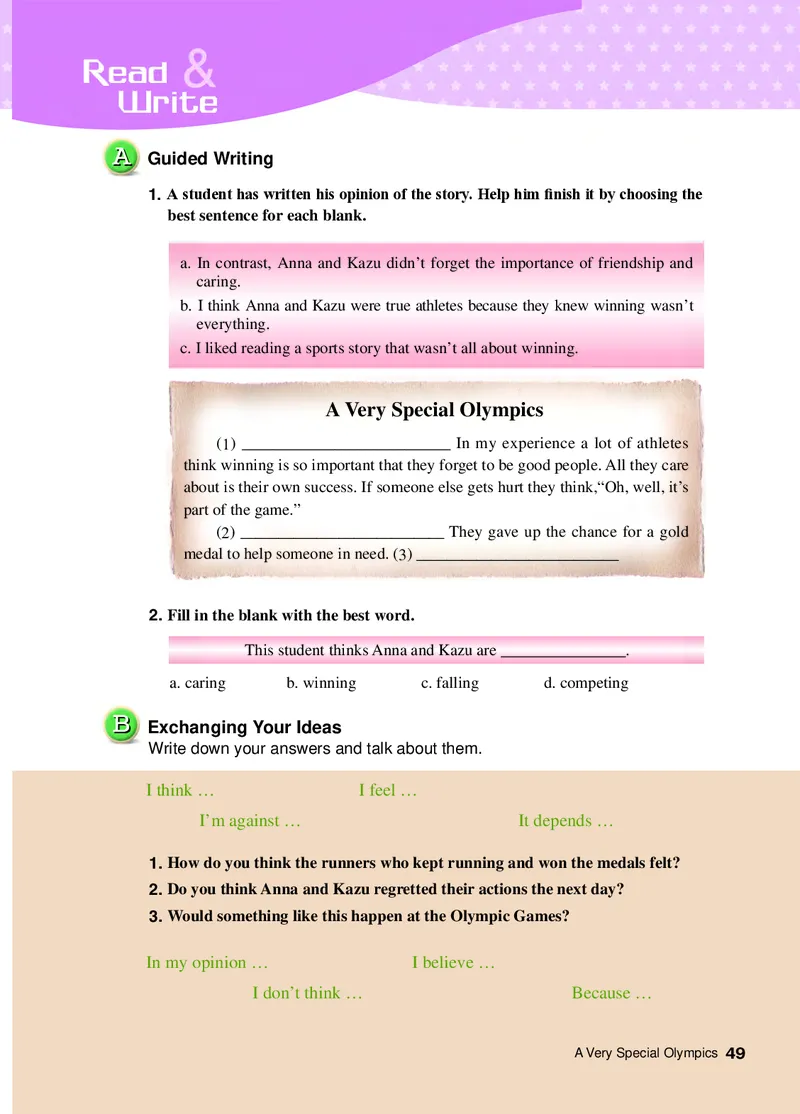
Guided Writing
1. A student has written his opinion of the story. Help him finish it by choosing the
best sentence for each blank.
a. In contrast, Anna and Kazu didn’t forget the importance of friendship and
caring.
b. I think Anna and Kazu were true athletes because they knew winning wasn’t
everything.
c. I liked reading a sports story that wasn’t all about winning.
A Very Special Olympics
(1) ___________________________ In my experience a lot of athletes
think winning is so important that they forget to be good people. All they care
about is their own success. If someone else gets hurt they think,“Oh, well, it’s
part of the game.”
(2) ___________________________ They gave up the chance for a gold
medal to help someone in need. (3) ___________________________
2. Fill in the blank with the best word.
This student thinks Anna and Kazu are ________________.
a. caring b. winning c. falling d. competing
BB
Exchanging Your Ideas
Write down your answers and talk about them.
I think … I feel …
I’m against … It depends …
1. How do you think the runners who kept running and won the medals felt?
2. Do you think Anna and Kazu regretted their actions the next day?
3. Would something like this happen at the Olympic Games?
In my opinion … I believe …
I don’t think … Because …
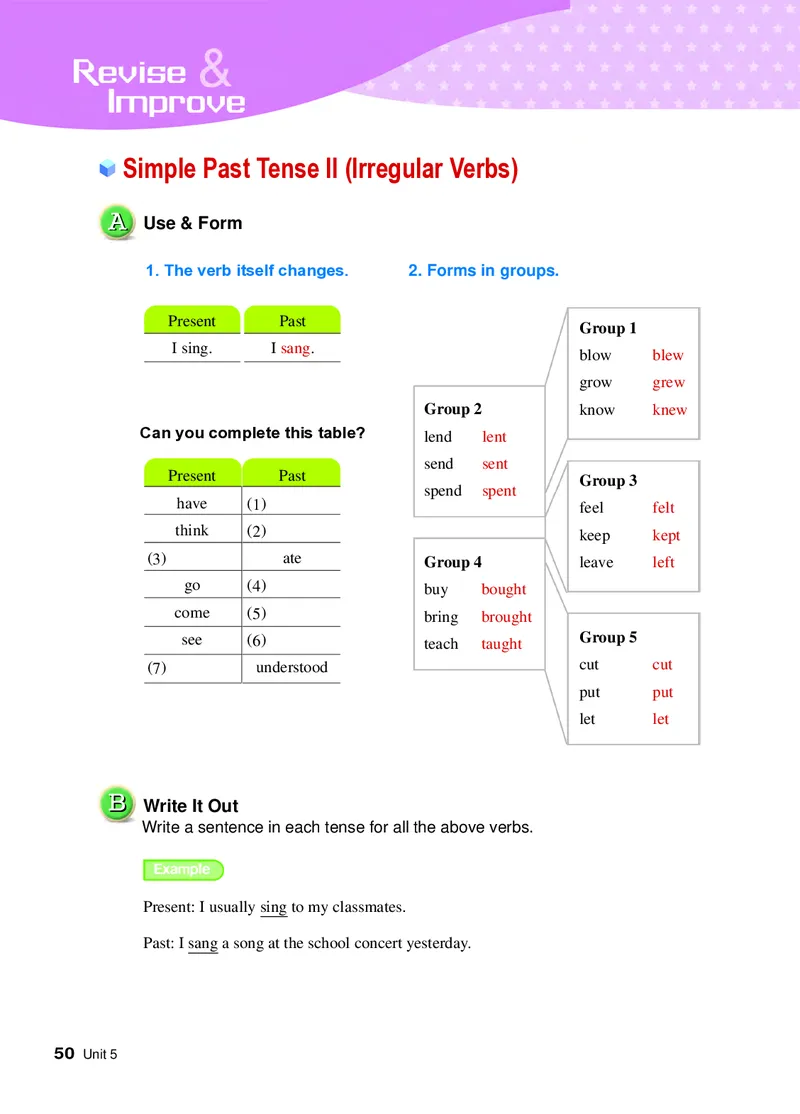
A Very Special Olympics 49Simple Past Tense II (Irregular Verbs)
AA
Use & Form
1. The verb itself changes. 2. Forms in groups.
Present Past
Group 1
I sing. I sang.
blow blew
grow grew
Group 2 know knew
Can you complete this table? lend lent
send sent
Present Past
Group 3
spend spent
have (1)
feel felt
think (2)
keep kept
(3) ate Group 4 leave left
go (4) buy bought
come (5) bring brought
see (6) teach taught Group 5
(7) understood cut cut
put put
let let
BB
Write It Out
Write a sentence in each tense for all the above verbs.
Present: I usually sing to my classmates.
Past: I sang a song at the school concert yesterday.
50 Unit 5WORD BANK
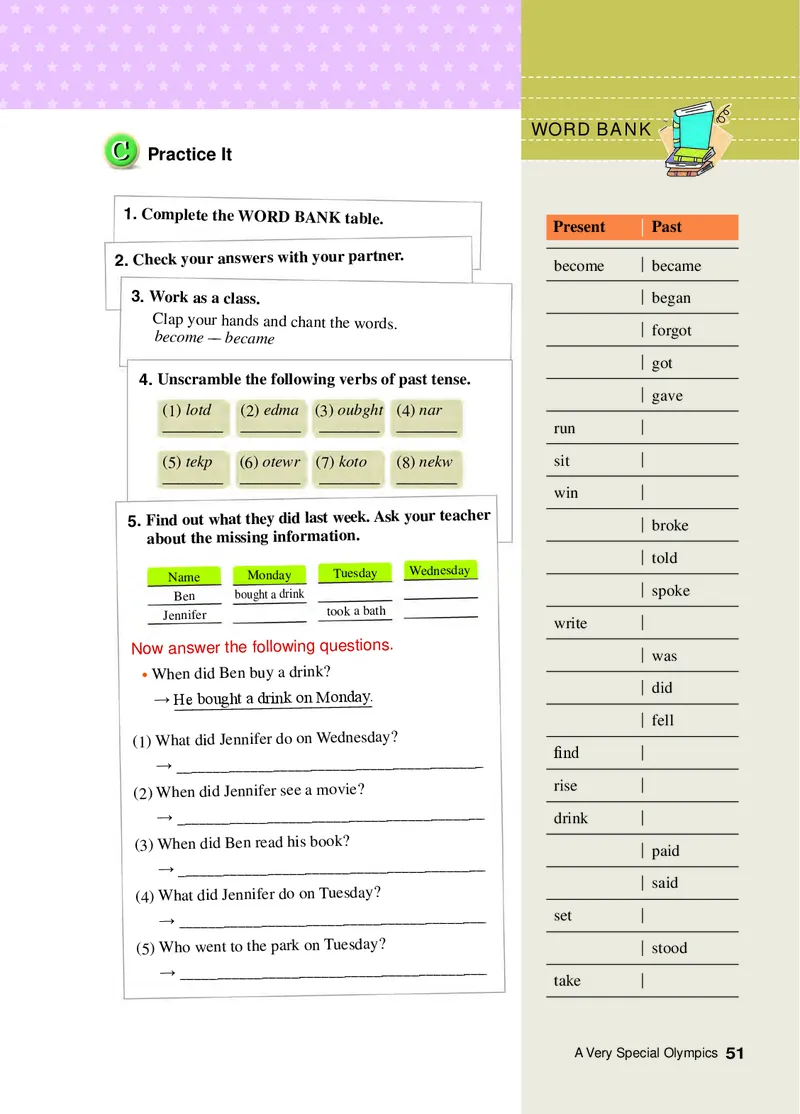
CC
Practice It
1. Complete the WORD BANK table.
Present Past
2. Check your answers with your partner.
become became
3. Work as a class. began
Clap your hands and chant the words.
forgot
become –– became
got
4. Unscramble the following verbs of past tense.
gave
(1) lotd (2) edma (3) oubght (4) nar
________ ________ ________ ________ run
(5) tekp (6) otewr (7) koto (8) nekw sit
________ ________ ________ ________
win
5. Find out what they did last week. Ask your teacher broke
about the missing information.
told
Name Monday Tuesday Wednesday
Ben bought a drink spoke
Jennifer took a bath
write
Now answer the following questions.
was
When did Ben buy a drink?
did
→ He bought a drink on Monday.
fell
(1) What did Jennifer do on Wednesday?
find
→
_________________________________________
(2) When did Jennifer see a movie? rise
→
_________________________________________
drink
(3) When did Ben read his book?
paid
→
_________________________________________
said
(4) What did Jennifer do on Tuesday?
→
_________________________________________ set
(5) Who went to the park on Tuesday? stood
→
_________________________________________
take
A Very Special Olympics 5120190318-EEC 9年--上册10-12 CS6.indd 52 2019/03/18 17:50:576
A
United
Effort
Listen & Speak
Theme Dialog: Checking In
Read & Think
Reading: A United Effort
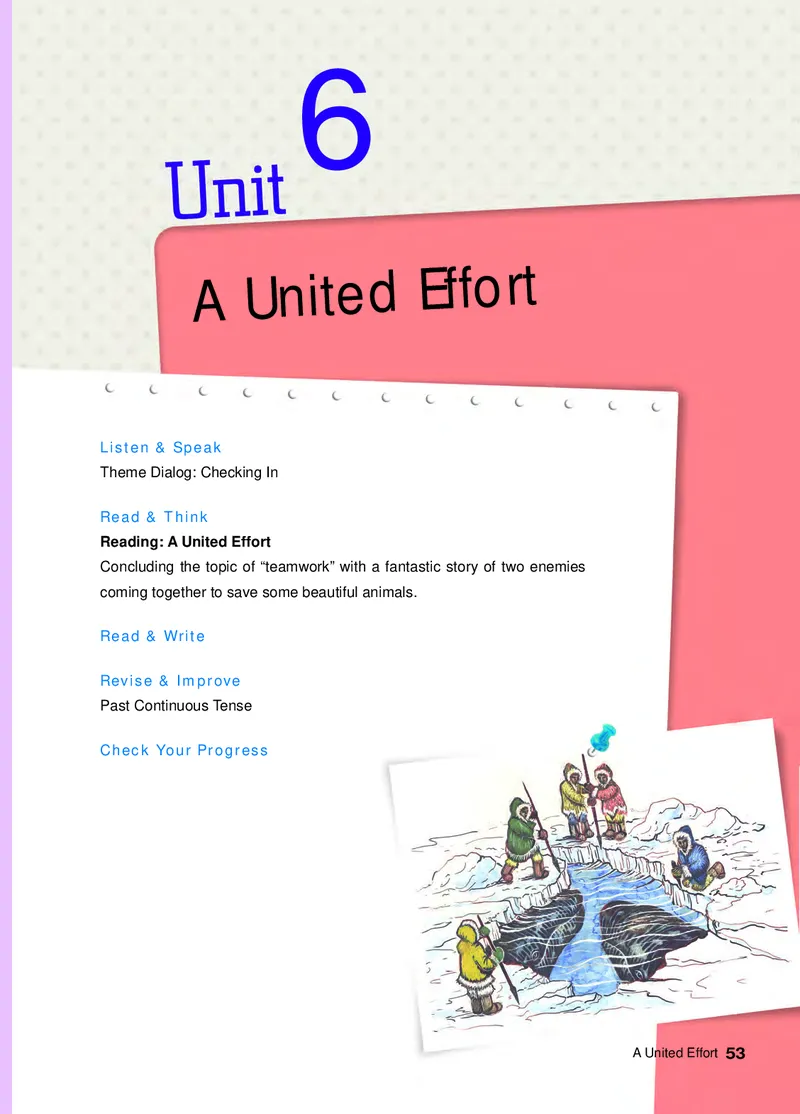
Concluding the topic of “teamwork” with a fantastic story of two enemies
coming together to save some beautiful animals.
Read & Write
Revise & Improve
Past Continuous Tense
Check Your Progress
A United Effort 53Theme Dialog: Checking In
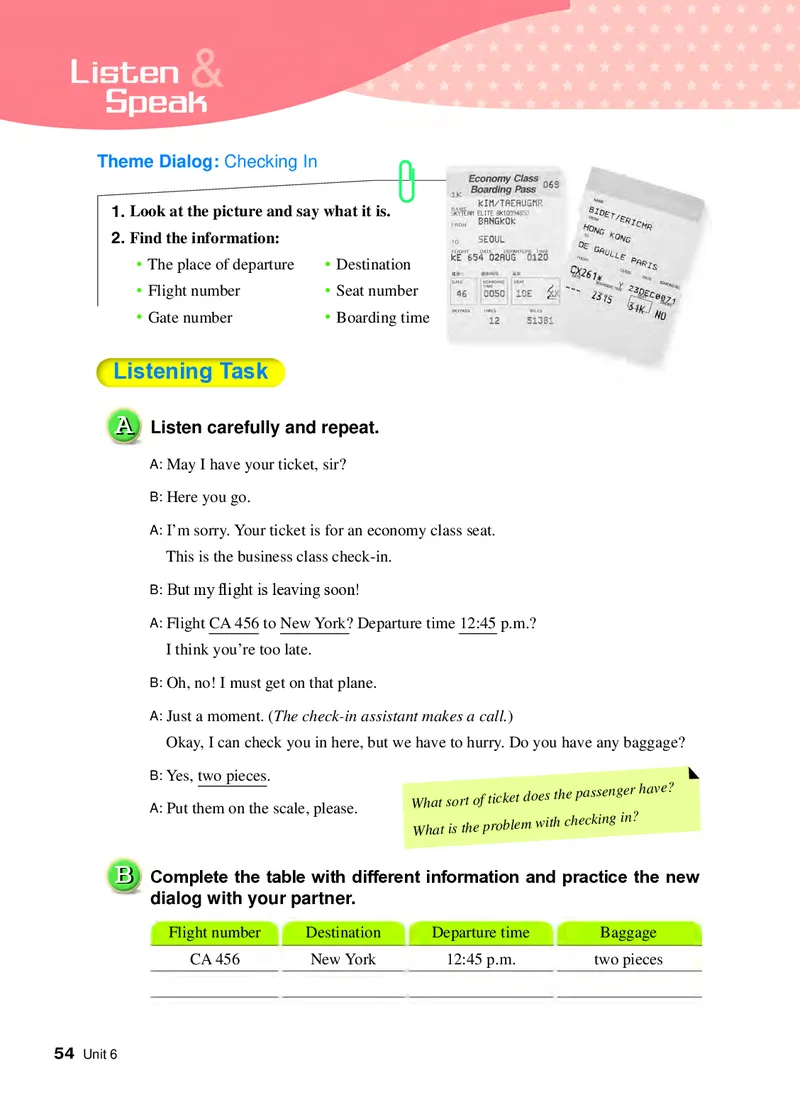
1. Look at the picture and say what it is.
2. Find the information:
The place of departure Destination
Flight number Seat number
Gate number Boarding time
Listening Task
AA
Listen carefully and repeat.
A: May I have your ticket, sir?
B: Here you go.
A: I’m sorry. Your ticket is for an economy class seat.
This is the business class check-in.
B: But my flight is leaving soon!
A: Flight CA 456 to New York? Departure time 12:45 p.m.?
I think you’re too late.
B: Oh, no! I must get on that plane.
A: Just a moment. (The check-in assistant makes a call.)
Okay, I can check you in here, but we have to hurry. Do you have any baggage?
B: Yes, two pieces.
What sort of ticket does the passenger have?
A: Put them on the scale, please.
What is the problem with checking in?
BB
Complete the table with different information and practice the new
dialog with your partner.
Flight number Destination Departure time Baggage
CA 456 New York 12:45 p.m. two pieces
54 Unit 6Speaking Task
AA
Practice the dialog with your partner. Exchange the underlined
expressions with the new ones on the right.
A: May I have your ticket, sir? Can I see your ticket and
passport, please?
B: Here you go.
Can I see your ticket,
A: I’m sorry. Your ticket is for an economy class seat. please?
This is the business class check-in.
But my flight is about to
B: But my flight is leaving soon!
leave!
But I have to hurry. I’m
late for my flight!
BB
Practice the dialog with your partner. Change the dialog each time
using the expressions on the right. Use the information in the box
below.
A: May I have your ticket and passport, please? Thank you.
Is it just yourself who will travel?
B: Yes.
A: You’re going to London? Are you traveling
alone?
B: That’s right.
Are you traveling by
A: Would you like a window seat or an aisle seat? yourself?
B: A window seat, please.
Do you have any
A: You can have Seat Number 46A. baggage?
How many bags do you have? Are you carrying any
luggage?
B: Just one.
A: Boarding time is 10:50 at Gate Number 17.
Paris / Aisle / 2 pieces
Sydney / Window / 3 pieces
New York / Aisle / 1 piece
Seoul / Window / None
Shanghai / Aisle / 2 pieces
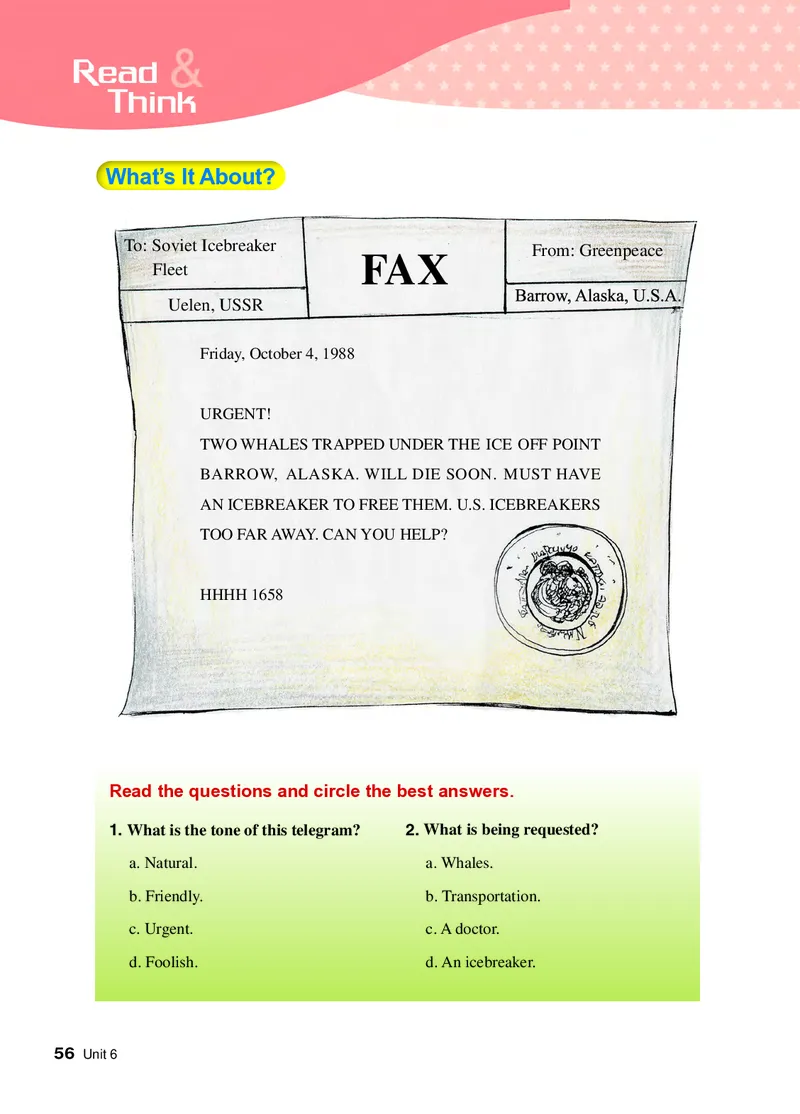
A United Effort 55What’s It About?
To: Soviet Icebreaker
From: Greenpeace
FAX
Fleet
Uelen, USSR
Friday, October 4, 1988
URGENT!
TWO WHALES TRAPPED UNDER THE ICE OFF POINT
BARROW, ALASKA. WILL DIE SOON. MUST HAVE
AN ICEBREAKER TO FREE THEM. U.S. ICEBREAKERS
TOO FAR AWAY. CAN YOU HELP?
HHHH 1658
Read the questions and circle the best answers.
1. What is the tone of this telegram? 2. What is being requested?
a. Natural. a. Whales.
b. Friendly. b. Transportation.
c. Urgent. c. A doctor.
d. Foolish. d. An icebreaker.
56 Unit 6Reading
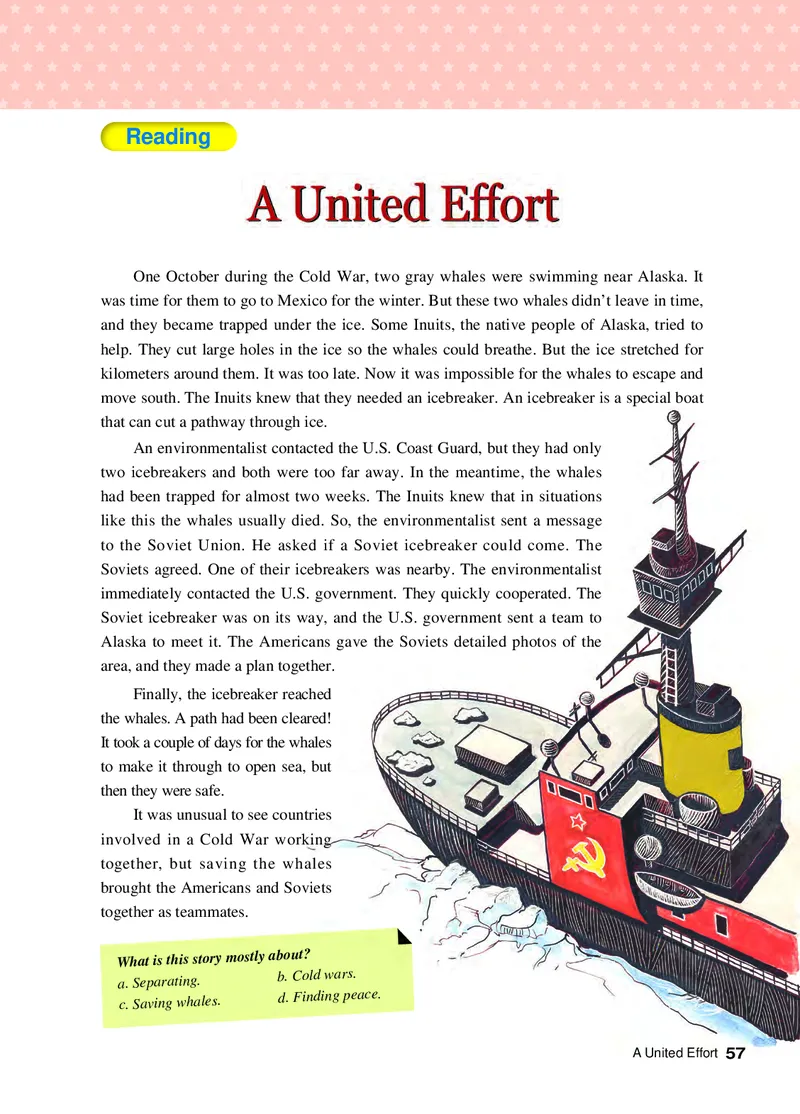
One October during the Cold War, two gray whales were swimming near Alaska. It
was time for them to go to Mexico for the winter. But these two whales didn’t leave in time,
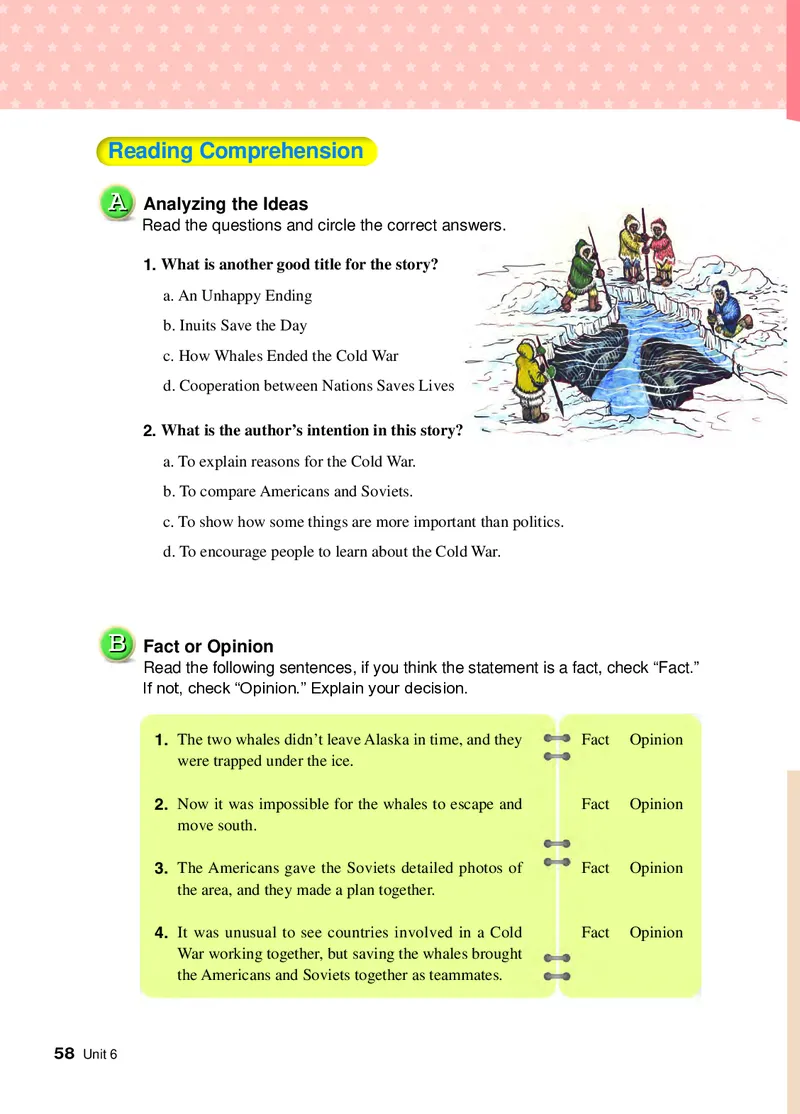
and they became trapped under the ice. Some Inuits, the native people of Alaska, tried to
help. They cut large holes in the ice so the whales could breathe. But the ice stretched for
kilometers around them. It was too late. Now it was impossible for the whales to escape and
move south. The Inuits knew that they needed an icebreaker. An icebreaker is a special boat
that can cut a pathway through ice.
An environmentalist contacted the U.S. Coast Guard, but they had only
two icebreakers and both were too far away. In the meantime, the whales
had been trapped for almost two weeks. The Inuits knew that in situations
like this the whales usually died. So, the environmentalist sent a message
to the Soviet Union. He asked if a Soviet icebreaker could come. The
Soviets agreed. One of their icebreakers was nearby. The environmentalist
immediately contacted the U.S. government. They quickly cooperated. The
Soviet icebreaker was on its way, and the U.S. government sent a team to
Alaska to meet it. The Americans gave the Soviets detailed photos of the
area, and they made a plan together.
Finally, the icebreaker reached
the whales. A path had been cleared!
It took a couple of days for the whales
to make it through to open sea, but
then they were safe.
It was unusual to see countries
involved in a Cold War working
together, but saving the whales
brought the Americans and Soviets
together as teammates.
What is this story mostly about?
a. Separating. b. Cold wars.
c. Saving whales. d. Finding peace.
A United Effort 57Reading Comprehension
AA
Analyzing the Ideas
Read the questions and circle the correct answers.
1. What is another good title for the story?
a. An Unhappy Ending
b. Inuits Save the Day
c. How Whales Ended the Cold War
d. Cooperation between Nations Saves Lives
2. What is the author’s intention in this story?
a. To explain reasons for the Cold War.
b. To compare Americans and Soviets.
c. To show how some things are more important than politics.
d. To encourage people to learn about the Cold War.
BB
Fact or Opinion
Read the following sentences, if you think the statement is a fact, check “Fact.”
If not, check “Opinion.” Explain your decision.
1. The two whales didn’t leave Alaska in time, and they Fact Opinion
were trapped under the ice.
2. Now it was impossible for the whales to escape and Fact Opinion
move south.
3. The Americans gave the Soviets detailed photos of Fact Opinion
the area, and they made a plan together.
4. It was unusual to see countries involved in a Cold Fact Opinion
War working together, but saving the whales brought
the Americans and Soviets together as teammates.
58 Unit 6AA
Guided Writing
1. A student has written his opinion of the story. Find two sentences that don’t
belong and put a line through them.
A United Effort
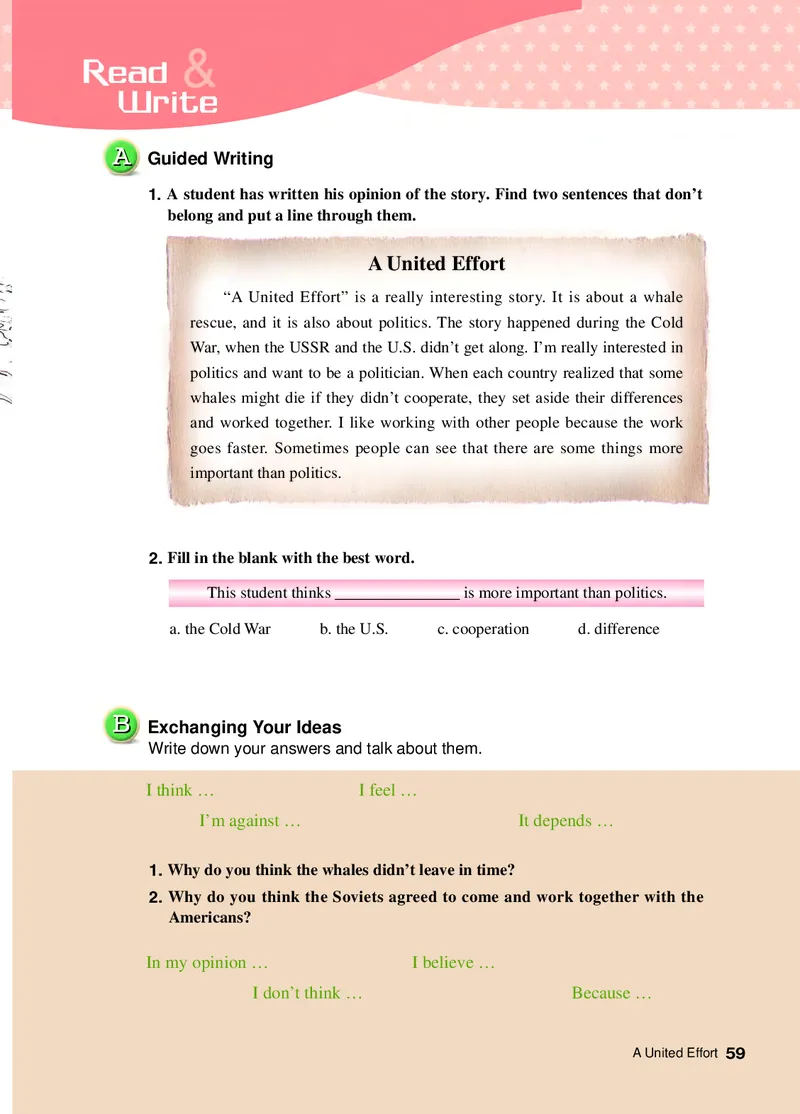
“A United Effort” is a really interesting story. It is about a whale
rescue, and it is also about politics. The story happened during the Cold
War, when the USSR and the U.S. didn’t get along. I’m really interested in
politics and want to be a politician. When each country realized that some
whales might die if they didn’t cooperate, they set aside their differences
and worked together. I like working with other people because the work
goes faster. Sometimes people can see that there are some things more
important than politics.
2. Fill in the blank with the best word.
This student thinks ________________ is more important than politics.
a. the Cold War b. the U.S. c. cooperation d. difference
BB
Exchanging Your Ideas
Write down your answers and talk about them.
I think … I feel …
I’m against … It depends …
1. Why do you think the whales didn’t leave in time?
2. Why do you think the Soviets agreed to come and work together with the
Americans?
In my opinion … I believe …
I don’t think … Because …
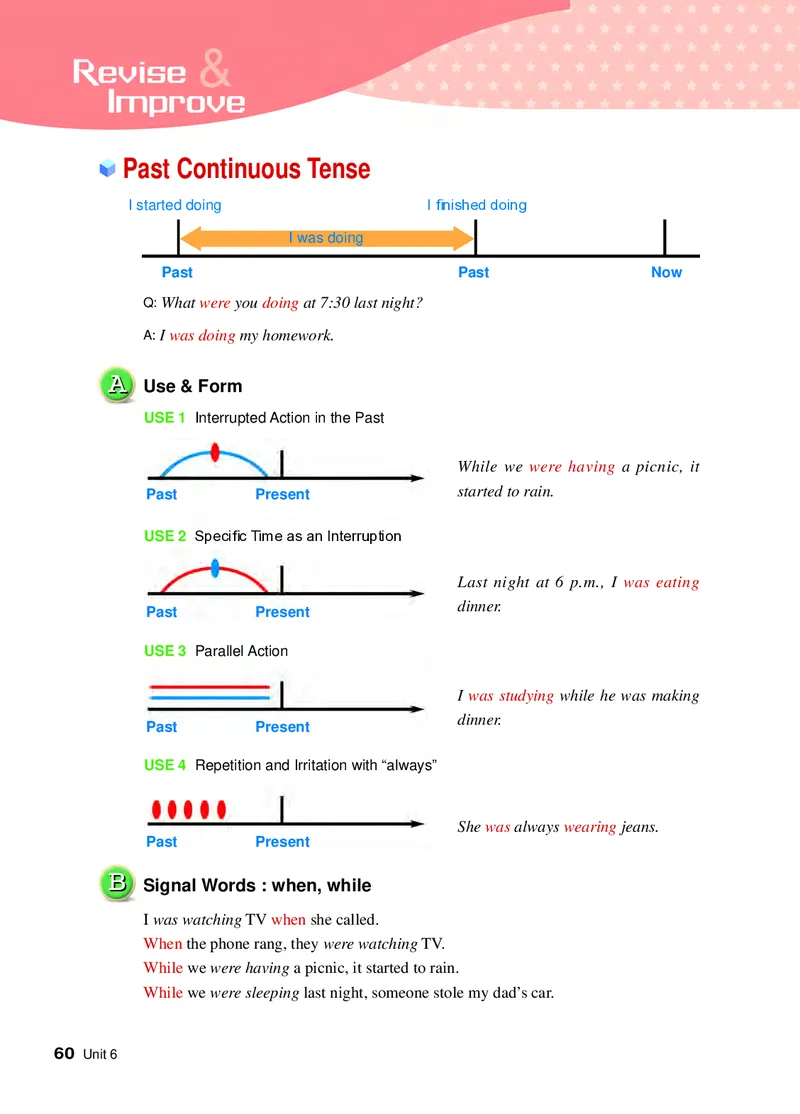
A United Effort 59Past Continuous Tense
I started doing I finished doing
I was doing
Past Past Now
Q: What were you doing at 7:30 last night?
A: I was doing my homework.
AA
Use & Form
USE 1 Interrupted Action in the Past
While we were having a picnic, it
started to rain.
Past Present
USE 2 Specific Time as an Interruption
Last night at 6 p.m., I was eating
dinner.
Past Present
USE 3 Parallel Action
I was studying while he was making
dinner.
Past Present
USE 4 Repetition and Irritation with “always”
She was always wearing jeans.
Past Present
BB
Signal Words : when, while
I was watching TV when she called.
When the phone rang, they were watching TV.
While we were having a picnic, it started to rain.
While we were sleeping last night, someone stole my dad’s car.
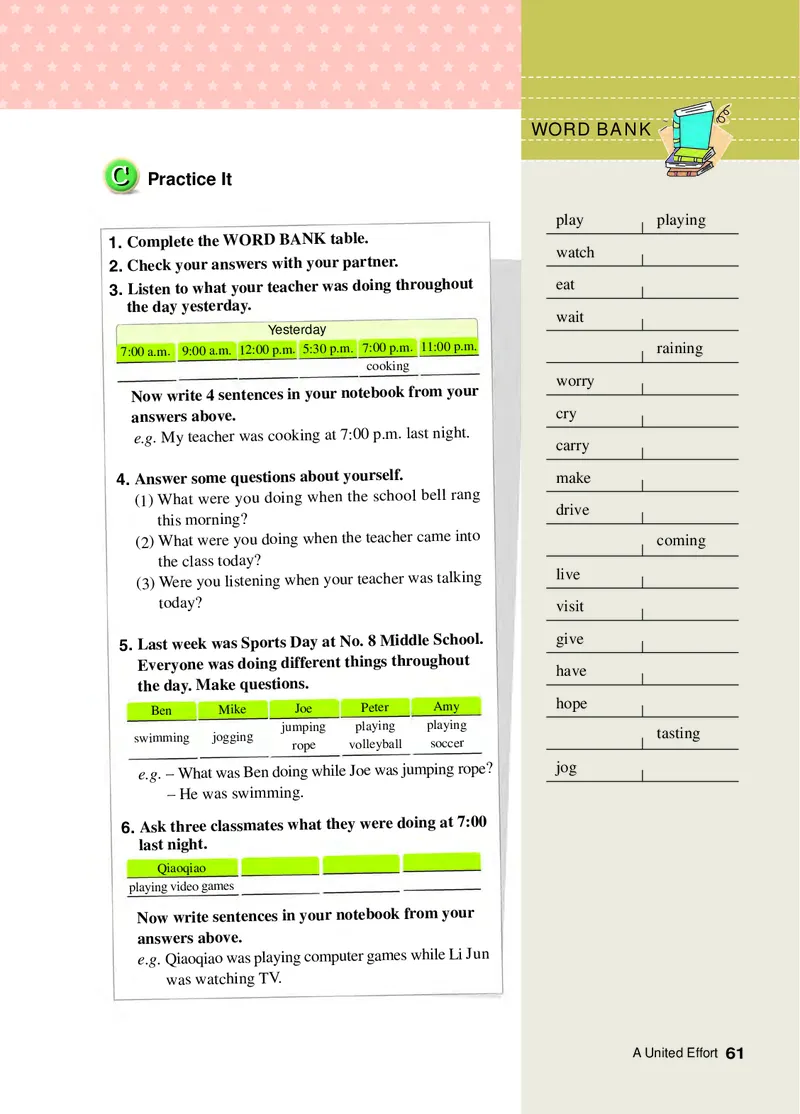
60 Unit 6WORD BANK
CC
Practice It
play playing
1. Complete the WORD BANK table.
watch
2. Check your answers with your partner.
3. Listen to what your teacher was doing throughout eat
the day yesterday.
wait
Yesterday
7:00 a.m. 9:00 a.m. 12:00 p.m. 5:30 p.m. 7:00 p.m. 11:00 p.m. raining
cooking
worry
Now write 4 sentences in your notebook from your
answers above. cry
e.g. My teacher was cooking at 7:00 p.m. last night.
carry
4. Answer some questions about yourself. make
(1) What were you doing when the school bell rang
drive
this morning?
(2) What were you doing when the teacher came into coming
the class today?
(3) Were you listening when your teacher was talking live
today? visit
5. Last week was Sports Day at No. 8 Middle School. give
Everyone was doing different things throughout
have
the day. Make questions.
Ben Mike Joe Peter Amy hope
jumping playing playing
tasting
swimming jogging
rope volleyball soccer
e.g. – What was Ben doing while Joe was jumping rope? jog
– He was swimming.
6. Ask three classmates what they were doing at 7:00
last night.
Qiaoqiao
playing video games
Now write sentences in your notebook from your
answers above.
e.g. Qiaoqiao was playing computer games while Li Jun
was watching TV.
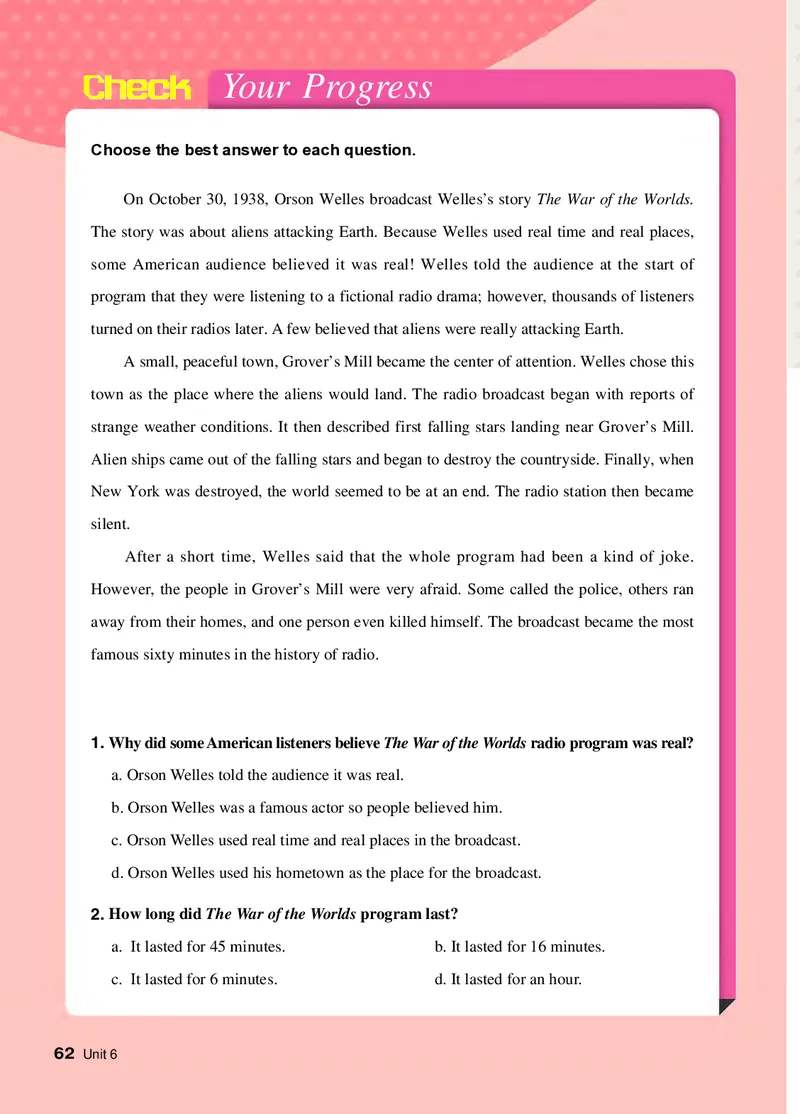
A United Effort 61Your Progress
Choose the best answer to each question.
On October 30, 1938, Orson Welles broadcast Welles’s story The War of the Worlds.
The story was about aliens attacking Earth. Because Welles used real time and real places,
some American audience believed it was real! Welles told the audience at the start of
program that they were listening to a fictional radio drama; however, thousands of listeners
turned on their radios later. A few believed that aliens were really attacking Earth.
A small, peaceful town, Grover’s Mill became the center of attention. Welles chose this
town as the place where the aliens would land. The radio broadcast began with reports of
strange weather conditions. It then described first falling stars landing near Grover’s Mill.
Alien ships came out of the falling stars and began to destroy the countryside. Finally, when
New York was destroyed, the world seemed to be at an end. The radio station then became
silent.
After a short time, Welles said that the whole program had been a kind of joke.
However, the people in Grover’s Mill were very afraid. Some called the police, others ran
away from their homes, and one person even killed himself. The broadcast became the most
famous sixty minutes in the history of radio.
1. Why did some American listeners believe The War of the Worlds radio program was real?
a. Orson Welles told the audience it was real.
b. Orson Welles was a famous actor so people believed him.
c. Orson Welles used real time and real places in the broadcast.
d. Orson Welles used his hometown as the place for the broadcast.
2. How long did The War of the Worlds program last?
a. It lasted for 45 minutes. b. It lasted for 16 minutes.
c. It lasted for 6 minutes. d. It lasted for an hour.
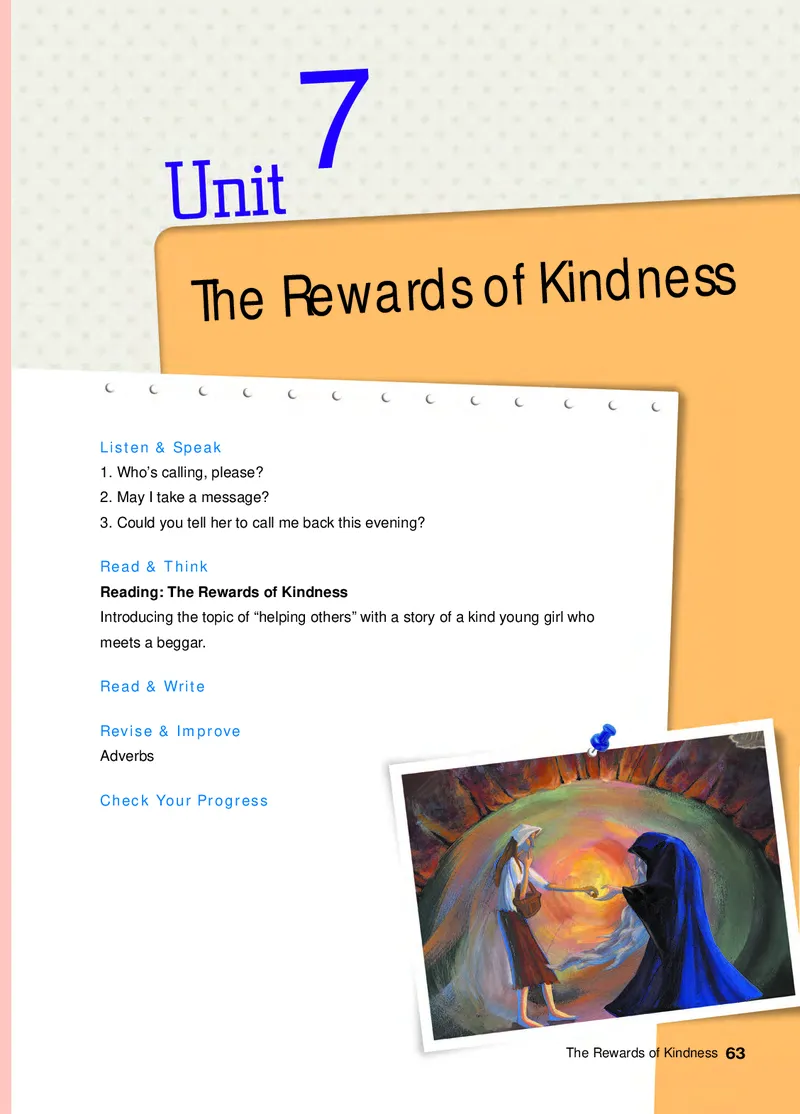
62 Unit 67
The
Rewards of
Kindness
Listen & Speak
1. Who’s calling, please?
2. May I take a message?
3. Could you tell her to call me back this evening?
Read & Think
Reading: The Rewards of Kindness
Introducing the topic of “helping others” with a story of a kind young girl who
meets a beggar.
Read & Write
Revise & Improve
Adverbs
Check Your Progress
The Rewards of Kindness 631. Who’s calling, please?
2. May I take a message?
3. Could you tell her to call me back this evening?
Listening Task
AA
Listen and choose the correct answers.
1. Is Jennifer free on Friday evening?
a. Yes, she is. b. No, she isn’t.
2. What did Wang Fang want to ask Jennifer?
a. To help her read a letter. b. To go to the soccer game.
BB
Listen carefully and fill in each blank.
A: Hello. Can I speak to Jennifer, please?
B: May I ask 1. _________ calling, please?
A: This is Jack Taylor.
B: Hi, Jack. I’m sorry, Jennifer’s out now.
May I take a 2. _________?
A: Yes, thank you. Could you 3. _________ her to call me back this evening?
B: Does she know your phone number?
A: Yes, she does, but just in case, it’s 8345-6789.
CC
Practice the dialog with your partner.
64 Unit 7Speaking Task
Let’s suppose that you are calling a foreign friend. What would you say when
someone answers the phone?
Read and answer the questions. Then role-play.
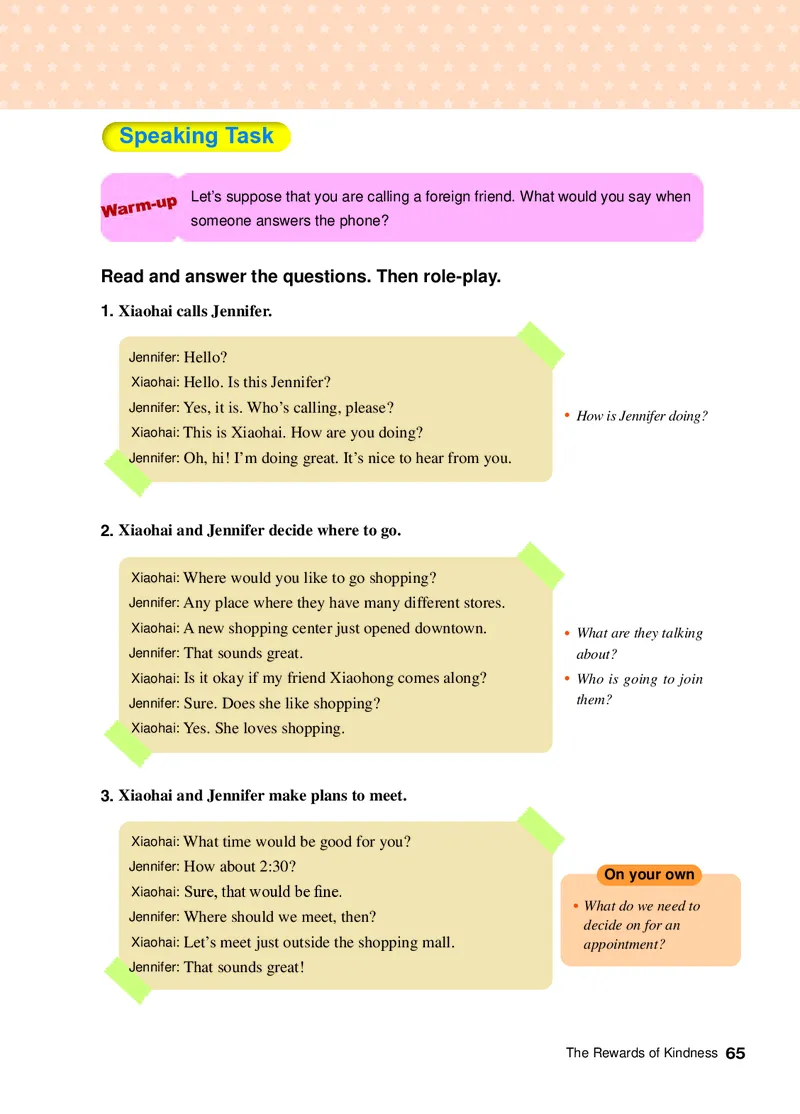
1. Xiaohai calls Jennifer.
Jennifer: Hello?
Xiaohai: Hello. Is this Jennifer?
Jennifer: Yes, it is. Who’s calling, please?
How is Jennifer doing?
Xiaohai: This is Xiaohai. How are you doing?
Jennifer: Oh, hi! I’m doing great. It’s nice to hear from you.
2. Xiaohai and Jennifer decide where to go.
Xiaohai: Where would you like to go shopping?
Jennifer: Any place where they have many different stores.
Xiaohai: A new shopping center just opened downtown. What are they talking
Jennifer: That sounds great. about?
Xiaohai: Is it okay if my friend Xiaohong comes along? Who is going to join
Jennifer: Sure. Does she like shopping? them?
Xiaohai: Yes. She loves shopping.
3. Xiaohai and Jennifer make plans to meet.
Xiaohai: What time would be good for you?
Jennifer: How about 2:30?
On your own
Xiaohai: Sure, that would be fine.
What do we need to
Jennifer: Where should we meet, then?
decide on for an
Xiaohai: Let’s meet just outside the shopping mall. appointment?
Jennifer: That sounds great!
The Rewards of Kindness 65What’s It About?
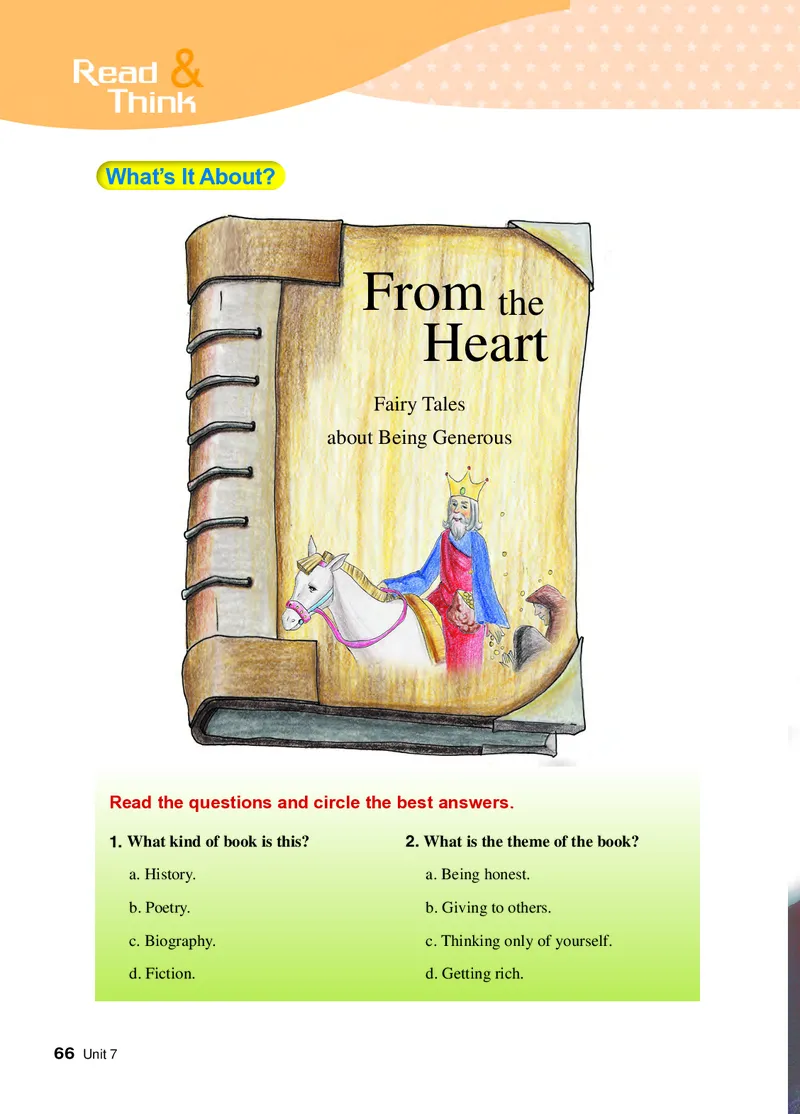
From
the
Heart
Fairy Tales
about Being Generous
Read the questions and circle the best answers.
1. What kind of book is this? 2. What is the theme of the book?
a. History. a. Being honest.
b. Poetry. b. Giving to others.
c. Biography. c. Thinking only of yourself.
d. Fiction. d. Getting rich.
66 Unit 7Reading
The Rewards of Kindness
Once upon a time an orphan named Charity lived in a fine house with a wicked old
woman and her mean daughter. They were cruel to Charity, making her work hard day and
night.
One day, they sent Charity to the market with only a tiny piece of bread for lunch. On
the way, Charity passed under a bridge where she saw an ugly old beggar.
“I have had nothing to eat for days,” the old beggar said.
Charity gave him her small piece of bread. Suddenly, he turned into a wizard.
“Your kindness will be rewarded,” he said. “Everything you touch will turn into gold.”
Charity reached down and touched a stone with her finger. It turned into gold.
Later, when the wicked woman and her daughter saw the gold stone, they demanded to
know where it came from. Charity told them about the wizard.
“Where is he?” they asked.
“Under the bridge,” replied Charity.
The next morning, the wicked woman and her daughter packed a fine lunch of bread,
cheese, and meat, and they went to the bridge. When they got there, they searched for the
wizard, but they only found the ugly old beggar.
“I have had nothing to eat for days,” he said.
“Get away from us!” the wicked woman shouted.
They pushed the beggar and he turned into the wizard.
“You selfish women,” the wizard said. “For this, you
shall be punished. Everything you touch will turn into
stone.” The mother tried to hug her daughter, but
when they touched each other, they turned into
stone. After that, Charity didn’t have to work
hard and lived happily ever after.
What is this story mostly about?
a. Gold.
b. Kindness.
c. Honesty.
d. Magic.
The Rewards of Kindness 67Reading Comprehension
AA
Analyzing the Ideas
Read the questions and circle the correct answers.
1. What is another good title for the story?
a. Being Generous Make You Happy
b. Learning to Be Selfish
c. The Mean Old Wizard
d. The Generous Beggar
2. What is the author’s intention in this story?
a. To provide facts.
b. To teach a lesson.
c. To discuss an issue.
d. To compare different persons.
BB
Cause and Effect
Read the passages from the story. Choose the best effects.
Cause Effect
1. “I have had nothing to eat for days,” a. Charity was punished for being selfish.
the old beggar said. Charity gave him b. Charity was turned into a wizard.
her small piece of bread. c. Charity was turned into stone.
d. Charity was rewarded for her kindness.
2. Later, when the wicked woman and a. They were happy for Charity.
her daughter saw the gold stone, they b. They were happy that she was safe.
demanded to know where it came c. They wanted a gold stone of their own.
from. d. They stole Charity’s gold stone.
3. “For this, you shall be punished. a. The women learned their lesson.
Everything you touch will turn into b. The women turned into stone.
stone,” the wizard said. The mother c. The women lived happily ever after.
tried to hug her daughter. d. The wizard turned into stone.
68 Unit 7AA
Guided Writing
1. A student writes her opinion of the story. Help her finish it by choosing the
best sentences to go in the blanks.
a. So I think it pays to be kind and hurts to be selfish.
b. The lesson of this story is that charity is rewarded and selfishness is punished.
c. In contrast, people who are caring are rewarded with more happiness.
The Rewards of Kindness
(1)___________________________ I think this is a very important lesson.
Sometimes it seems that selfish people are very successful. They have good
jobs, nice houses, and lots of money. It would seem that these people are
being rewarded for being selfish. But I don’t think these people are really
happy. Selfish people are not well-liked because they think only about
themselves. They don’t know the joy of helping people. Therefore, even if
they look successful on the outside, they are probably not happy on the inside.
(2)___________________________ These people have better relationships
and feel good about themselves. (3)___________________________
2. Fill in the blank with the best word.
This student believes that generous people are ________________.
a. not successful b. rewarded c. punished d. not well-liked
BB
Exchanging Your Ideas
Write down your answers and talk about them.
I think … I feel …
I’m against … It depends …
1. Why do you think the mother and daughter were cruel to Charity?
2. Why do you think the wizard pretended to be a beggar?
3. The power to turn things into gold would be a bad power to have. What is your
opinion?
In my opinion … I believe …
I don’t think … Because …
The Rewards of Kindness 69Adverbs
AA
Use & Form
Use adverbs:
to say how somebody does something or how something happens: The family
walks quickly. (how)
to say where or when something happens: I met him yesterday. (when)
to say how often something happens: She takes the bus daily. (how often)
to make an adjective, adverb, or verb stronger or weaker: Dave eats more
slowly than his wife. (degree)
BB
Some Adverbs
always very yesterday quickly home anywhere really
never tomorrow often sometimes frequently regularly
loudly sharply daily badly fast southwards today
upstairs angrily recently tonight next morning now
too enough last night just quietly happily almost
slowly beautifully every day monthly
Sort the adverbs in your notebook
Manner Time Frequency Place Degree
beautifully last night always southwards enough
Complete the story using adverbs of your own choice. Then share with your
classmates.
Sally (1)____________ visits her grandmother every Sunday. Today she was
(2)___________ happy because her uncle and aunt decided to join her family. They were
supposed to arrive at her grandmother’s house at 2:00 p.m., but it was (3)___________
1:30. Her father drove (4)___________ so that they could get there in time. When they
arrived, her grandmother welcomed Sally and her parents. When her grandmother saw
Sally’s uncle and aunt, she was (5)___________ surprised and smiled (6)___________.
70 Unit 7WORD BANK
CC
Practice It
Adjective Adverb
1. Complete the WORD BANK table.
sad sadly
2. Check your answers with your partner.
quiet
3. Work as a class.
Clap your hands and chant the words. nervous
sad –– sadly quiet –– quietly
soft
4. Answer each question with an adverb. Use the
beautifully
adverbs in the WORD BANK to help you.
happy happily
How did Jenny skate? She skated cheerfully.
angry
How did the sun shine? (1)
heavy
How did the rabbit move? (2)
hungrily
NOW! terrible
Invent some more adverb bubbles of your own.
friendly friendly
5. Can you make the following sentences more exciting? daily
“I’m going out!” shouted Rebecca angrily. early
(1) “What time are we going to the movies?” asked Jane
monthly
_________.
(2) “It’s such a lovely day today!” said Janet _________. fast
(3) “I love Spring Festival!” said Peter _________.
long
(4) “I can’t come out today I’m afraid,” said Liu Chang
hard
_________.
(5) “Wow, it’s a bit dark in that cave. I don’t think I want late
to go there alone,” stated Lucy _________.
well
6. Work in pairs. Complete the following sentence.
“Are you going to the Christmas concert?” asked Jane
_______________.
The Rewards of Kindness 71Your Progress
Choose the best answer to each question.
What kind of clothes do you wear? Do you like dressy, comfortable, or trendy clothes?
Some people like to stay up-to-date with today’s fashion. These people spend a lot of money
on fashionable clothes. They feel it is important to follow fashion trends. Such trends usually
begin in cities like New York and Paris. Many famous clothing designers open fashion
shows in these cities.
Keeping up with fashion can be very exciting. At the same time, the problem with
fashion is that it changes quickly. Styles come and go. This is why the word “retro” is used
to describe some fashions. A “retro” look means that the style once went away, but is now
popular again.
As you can imagine, you will never stop buying new clothes. Fortunately, there are
some styles that never seem to go away. Can you think of one? That’s right --- blue jeans!
Blue jeans have been very popular for many years. So if you get tired of keeping up with
fashion, you can always put on jeans and a T-shirt ... and look great, too!
1. People want to stay _______________ with today’s fashion.
a. out-of-date b. unfashionable
c. old-fashioned d. up-to-date
2. The problem with fashion is that _______________.
a. it comes and goes slowly b. it changes fast
c. it is exciting d. it becomes popular again
3. _______________ are one of the “retro” looks.
a. Blue jeans b. T-shirts
c. Comfortable styles d. Dresses
72 Unit 78
The
International
Red
Cross
Listen & Speak
1. Do you have any plans for this weekend?
2. I can’t tell you how sorry I am.
3. It was as exciting as Batman.
Read & Think
Reading: The International Red Cross
Continuing the topic of “helping others” with a historic story of the Red Cross.
Read & Write
Revise & Improve
The Different Forms of Verbs
Check Your Progress
The International Red Cross 731. Do you have any plans for this weekend?
2. I can’t tell you how sorry I am.
3. It was as exciting as Batman.
Listening Task
AA
Look at the picture and guess the
situation. Listen carefully.
BB
Listen again and choose the correct
answers.
1. What are Xiaolin’s plans for the weekend?
a. Doing nothing.
b. Helping her friend move.
2. Why did Mike ask Xiaolin about her plans?
a. Because he has special plans for the weekend.
b. Because he doesn’t have any plans for the weekend.
CC
Listen carefully and fill in each blank.
A: Do you have any 1. _________ for tomorrow?
B: Not 2. _________. How about you?
A: I’m going to the theater to 3. _________ The Phantom of the Opera.
B: Oh, good! It’s a 4. _________ musical.
A: Right! They say it’s as 5. _________ as Cats.
Will you come with me?
B: I can’t tell you how 6. _________ I am.
I’ve already seen it.
What are they talking about?
Are they going to the theater together tomorrow?
DD
Practice the dialog with your partner.
74 Unit 8Speaking Task
You may have been late for an appointment before. How did you feel on the way?
What did the person who was waiting for you say when you arrived?
What would you say if you were the person waiting?
Read and answer the questions. Then role-play.
1. Jennifer visits Xiaohong’s house on Saturday morning. They are waiting for Xiaohai.
Xiaohong: Xiaohai hasn’t come yet.
Jennifer: He’ll be here soon. By the way, how was the movie? Has Xiaohong seen
Xiaohong: It was as exciting as Batman. the movie?
Jennifer: Did you watch the movie alone? What does Xiaohong
think of the movie?
Xiaohong: No, I watched it with Xiaolin.
2. In the afternoon, Jennifer and Xiaohong go to a fast-food restaurant.
Xiaohong: Oh, that’s Xiaohai, isn’t it?
Jennifer: Right. Let’s ask him why he didn’t come to your
house this morning.
Xiaohong: Xiaohai, wait.
Xiaohai: Hi, Xiaohong. Hi, Jennifer. How does Xiaohai feel?
Xiaohong: Hi. Why didn’t you come to my house this morning?
Xiaohai: Something came up. I can’t tell you how sorry I am.
Xiaohong: That’s all right.
3. Jennifer asks her friends about their plans for tomorrow.
Jennifer: What are you going to do tomorrow, Xiaohong?
Xiaohong: I’m going to sleep late. How about you, Xiaohai? On your own
Xiaohai: I’m going to play tennis with my father.
What do you usually do
Jennifer, do you have any plans for tomorrow?
in your free time?
Jennifer: Not yet. That’s why I asked you.
Can you think of any
Xiaohai: How about playing tennis with me? activity for this Sunday?
Jennifer: That sounds great!
The International Red Cross 7520190318-EEC 9年--上册10-12 CS6.indd 76 2019/03/18 17:52:21Reading
2002: When a terrible disease started killing children
in Burkina Faso, volunteers provided medicine.
2001: When an earthquake hit India, volunteers
saved many lives.
1997: When floods destroyed crops and homes in
North Korea, volunteers provided food and blankets.
What do these stories have in common? The
volunteers are all Red Cross members.
The Red Cross is an international organization
whose mission is to stop suffering. They don’t
care about the people’s race, nationality, religion,
or political beliefs. They help anyone who needs
assistance.
The story of the Red Cross begins with Henry Dunant, a Swiss businessman who saw
a terrible battle in 1859 in Italy. After the battle, 40,000 soldiers were dead or injured, but
there was no one to take care of them. Dunant worked for three days helping them.
When he returned to Switzerland, he wrote a book about his experience. The leaders of
many countries read his book and wanted to do something. As a result, the Red Cross was
established in Geneva, Switzerland in 1863. It was an organization that would help people
affected by war.
In 1884, there was another Red Cross meeting in Geneva. An American woman named
Clara Barton wanted the Red Cross to help people in peacetime as well as in wartime. She
wanted the Red Cross to get involved in disaster relief. Since then, the Red Cross has helped
millions of victims of earthquakes and other disasters all around the world.
The Red Cross not only works worldwide at big disasters, but also works in the
community, helping victims of small accidents or fires. The Red Cross is clearly fulfilling its
mission to stop suffering in this world.
What is this story mostly about?
a. Henry Dunant. b. The conflicts of the Red Cross.
c. Clara Barton. d. The mission of the Red Cross.
The International Red Cross 77Reading Comprehension
AA
Analyzing the Ideas
Read the questions and circle the correct answers.
1. What is another good title for the story?
a. A Swiss Hero
b. Taking Sides in War
c. Reducing Suffering around the World
d. Great International Organizations
2. What is the author’s purpose in this story?
a. To give information.
b. To tell an exciting story.
c. To support an argument.
d. To compare two things.
BB
True or False
Read each sentence. If the sentence is true, check “T.” If the sentence is false,
check “F.”
1. The Red Cross was established in Geneva, Switzerland in T F
1863.
2. Henry Dunant, a Swiss businessman, worked for a week T F
helping soldiers.
3. When floods destroyed crops and homes in North Korea in T F
1997, volunteers provided food and blankets.
4. The Red Cross doesn’t care about the people’s race, nationality, T F
or religion, but, they care about political beliefs.
5. Since 1884, the Red Cross has helped millions of victims of T F
earthquakes and other disasters all around the world.
78 Unit 8AA
Guided Writing
1. A student has written her opinion of the story, but one sentence is missing. Put
a check in the box where the sentence belongs.
Also, I’d like to know more about how the Red Cross helped us during the floods.
The International Red Cross
I think the subject of the story is very interesting. (1) The Red Cross
is a great organization. (2) However, I think that the story tried to cover
too much information in a short space. I would like to read more details about
certain parts instead of so much general information. (3) For example, I’d
like to read more about the role of the Red Cross in the Indian earthquake.
(4) My teacher always tells me to pick a very specific topic when I write.
Then I can write many details about that topic and answer all the readers’
questions. (5) But when the topic is very general like this, there is not
enough information to satisfy the readers’ curiosity.
2. Fill in the blank with the best word.
This student thinks this story is too ________________.
a. specific b. detailed c. general d. curious
BB
Exchanging Your Ideas
Write down your answers and talk about them.
I think … I feel …
I’m against … It depends …
1. Henry acted because he saw a terrible battle. Why do you think Clara acted?
2. Why do you think leaders wanted to help after reading Henry’s book?
In my opinion … I believe …
I don’t think … Because …
The International Red Cross 79The Different Forms of Verbs
AA
Use & Form
1. They park their cars on the street. (base form)
They parked their cars on the street this time. (simple past)
They have parked their cars on the street. (past participle -- present perfect)
2. I’ll wake you up. (base form)
I woke up in the middle of the night. (simple past)
My little sister has woken up. (past participle -- present perfect)
BB
Irregular Verb
Present Past Past Participle Present Past Past Participle
begin began begun get got gotten
drink drank drunk forget forgot forgotten
sing sang (1)________ wake woke (9)_________
swim (2)________ (3)________ speak (10)________ (11)________
drive drove driven fly flew flown
write wrote written know knew known
rise rose (4)________ blow blew (12)________
ride (5)________ (6)________ throw (13)________ (14)________
take took taken fall fell fallen
mistake mistook mistaken give gave given
shake (7)________ (8)________ forgive (15)________ (16)________
80 Unit 8WORD BANK
CC
Practice It
Past
Present Past
Participle
1. Complete the WORD BANK table.
be was / were
2. Check your answers with your partner. break broke
3. Work in pairs. choose chosen
Ask and answer about the activities in the table.
cost cost
John’s daily routine
do did
Time Action Time Action
eat ate
6:30 a.m. Get up 7:00 a.m. Eat breakfast
7:45 a.m. Go to school 9:00 a.m. Attend English class hide
10:00 a.m. Attend math class 11:30 a.m. Eat lunch
3:30 p.m. Study at the library 4:30 p.m. Go home hurt
learn
Q: What does John do every day at 7:00 a.m.?
leave
A: John eats breakfast every day at 7:00.
Q: What does John do every day at 7:45 a.m.?
lost lost
A: John (1)_________ to school (2)_________ at 7:45.
mean meant
Q: It is 9:00 a.m. now. What is John doing now?
A: John is attending English class now.
meet
Q: It is 11:30 a.m. now. What is John doing now?
A: John (3)_________ lunch now. pay
Q: What did John do yesterday?
put put
A: John got up at 6:30 a.m., (4)_________ breakfast at 7:00,
(5)_________ to school at 7:45, (6)_________ English class at
read
9:00, (7)_________ lunch at 11:30. And he (8)_________ back
home at 4:30 p.m.
ring rang
Q: What was John doing yesterday at 10:00 a.m.?
see saw
A: John was attending math class.
Q: What was he doing yesterday at 11:30 a.m.?
sell
A: He (9)___________________________.
shine shone
Q: It is noon. What has John already done?
A: John has already attended English class.
shut
Q: It is noon. What hasn’t John done yet?
A: John has not (10)_________ at the library yet.
sit
smell smelt
4. Make your daily routine chart. Then ask and reply
like in Part 3 with your partner. wear wore
The International Red Cross 81Your Progress
Choose the best answer to each question.
One out of every ten people is left-handed. That is only ten percent of the world’s
population, which brings us to this question: Is left-handedness strange or special?
Centuries ago, many people believed left-handed people were the devil’s servants. Just
a generation ago, American parents tried to change their children’s left-handedness, even
tying their child’s left hand behind his or her back. Teachers also forced students to use their
right hands.
On the other hand, some people believe that left-handed people have special skills.
Scientifically, it has been shown that left-handed people use the right side of their brain more
than right-handed people. The right side of the brain is connected with genius, music, art, and
creativity. Famous lefties include Leonardo da Vinci, Michelangelo, Beethoven, and Albert
Einstein.
Although left-handed people have had a hard time throughout history, some have been
quite successful and have shown the world that being left-handed is not strange or evil,
but special and unique. In the end, what matters most is not whether we’re right-handed or
left-handed. The most important thing is what we do with our hands. How about waving a
friendly “Hello!” or giving someone a pat on the back? You can use either hand.
1. Which is NOT true according to the passage?
a. In the past, some people considered lefties as the devil’s servants.
b. American teachers forced students to use their left hands.
c. Some left-handed people have been very successful.
d. Ten percent of people in the world are left-handed.
2. What is the main idea of this passage?
a. Left-handed people are special.
b. People should develop the right side of their brain.
c. Left-handed people should try to use their right hands.
d. The most important thing is what we do with our hands.
82 Unit 89
Help
Yourself by
Helping
Others
Listen & Speak
Theme Dialog: Directory Assistance
Read & Think
Reading: Help Yourself by Helping Others
Concluding the theme of “helping others” with an inspiring story about the
rewards of being a volunteer.
Read & Write
Revise & Improve
Passive Voice
Check Your Progress
Help Yourself by Helping Others 83Theme Dialog: Directory Assistance
1. Look at the picture and guess what her job is.
2. What does she use for her job?
3. Why do people call her?
Listening Task
AA
Listen carefully and repeat.
A: Directory Assistance. What city?
B: San Francisco. I’d like the number of John Henley.
A: How do you spell Henley?
B: H-E-N-L-E-Y.
A: What street?
B: 3rd Street.
A: Just a moment. I’m sorry, but I don’t have a John Henley on 3rd Street. Are you
sure you have the correct address?
B: I think so. Let me check, please. Oh, it’s Henrey. H-E-N-R-E-Y.
A: Just a second, please. Yes, there is a number for that name on 3rd Street.
It’s 234-4343.
B: Oh, thank you. I really appreciate it.
BB
Complete the table with different information and practice the new
dialog with your partner.
Name City Street Phone number
John Henrey San Francisco 3rd Street 234-4343
84 Unit 9Speaking Task
AA
Exchange the underlined expressions with the new ones below.
Practice the dialog with your partner.
A: Directory Assistance. What city?
B: San Francisco. I’d like the number of John Henley.
A: How do you spell Henley?
B: H-E-N-L-E-Y.
Could you give me John Henley’s number, please?
I’m looking for John Henley’s number.
What’s the spelling for that name?
Could you spell Henley, please?
BB
Practice this dialog with your partner. Exchange the underlined
words using the information in the box below.
A: Directory Assistance. Can I help you?
B: I’d like the number of the library.
A: We have two libraries in the city. One is the City Library,
and the other is the State Library. Which one do you want?
B: Either one is fine.
A: I’ll give you the number of the State Library. It’s 225-6785.
B: Thanks a lot. Have a good day!
Central Post Office: 567-8971 Downtown Swimming Pool: 567-8763
Oldtown Post Office: 453-0987 Uptown Swimming Pool: 468-7373
Happy Hospital: 211-1134 Sleepwell Hotel: 238-4242
Getwell Hospital: 776-3567 Cozy Hotel: 746-7471
Help Yourself by Helping Others 85What’s It About?
Read the questions and circle the best answers.
1. What kind of book is this? 2. What is the theme of the book?
a. History. a. Helping other people.
b. Non-fiction. b. Living longer.
c. Biography. c. How to write essays.
d. Textbook. d. Improving your life.
86 Unit 9Reading
Can thinking about yourself too much make you sick? Many psychologists now think
so. “Self-focus” means thinking about yourself.
In the old days psychologists used to tell patients with depression to pay more attention
to themselves. They wanted patients to talk about their problems and feelings. They thought
that “self-focus” would cure depression. Then, some psychologists began wondering if they
were wrong. They realized that depressed people talked about themselves much more than
non-depressed people.
Psychologists began to wonder if it is possible for “self-focus” to cause depression. So,
psychologists began thinking of different ways to treat depressed people. They thought that
patients would feel better if they stopped thinking about their own problems. Some even
thought that they could cure depression by having patients focus on other people.
Scientists at the University of Michigan studied older men. Some of the men volunteered
to help others; others did not volunteer. The men who volunteered lived much longer. Duke
University scientists studied patients who had heart disease. Some patients were told to
volunteer. The patients who volunteered were happier and healthier than the others.
As a result of this research, scientists began recommending volunteerism. University
leaders think community service can improve the lives of students. Some medical doctors
recommend volunteerism to their patients.
Each of us experiences pain, sadness, and loneliness. One of the best ways to overcome
these feelings is to help others who are experiencing difficulty. Thinking about others all the time
is not going to solve all your problems, but it is nice to know that by helping others, you can
help yourself, too.
W a c . . h B R a e e t i s n i e s g a t r h n c i i h c s e i s n t t o o p r s y y y o m c u h r o o s s e l t o l l f y g . y a . b out? b d . . T T h ra e d b i e ti n o e n fi a t l s t o re f a h t e m lp e i n n t g s f o o t r h e d r e s p . ression.
Help Yourself by Helping Others 87Reading Comprehension
AA
Analyzing the Ideas
Read the questions and circle the correct answers.
1. What makes people healthier?
a. Experiencing difficulty.
b. Helping other people.
c. Recommending volunteerism.
d. Thinking about their own problems.
2. Why did the author write this story?
a. To study volunteerism.
b. To compare treatments for depression.
c. To tell us to take care of our own problems.
d. To tell us that helping others is good for us.
BB
Cause and Effect
Read the passages from the story. Choose the best effects.
Cause Effect
1. Psychologists began to wonder if it a. They considered new treatments.
was possible for “self-focus” to cause b. They continued with “self-focus.”
depression. c. They sent their patients home.
d. They think depression is okay.
2. Scientists at the University of Michigan a. The volunteers died.
studied older men. Some of the men b. The doctors were wrong.
volunteered to help others; others did c. The volunteers lived longer.
not volunteer. d. They became young again.
3. They studied patients who had heart a. Doctors now recommend volunteerism.
disease. Some patients were told to b. Volunteerism solves all problems.
volunteer. Those patients were happier c. People shouldn’t volunteer.
and healthier than the others. d. Volunteering doesn’t help much.
88 Unit 9AA
Guided Writing
1. A student writes his opinion of the story. Help him finish it by choosing the
best sentences for the blanks.
a. But the word “psychologist” made me think that it would be too difficult.
b. However, some of the details of this story were too hard for me to understand.
c. Second, helping others is connected with health, happiness, and living longer.
Help Yourself by Helping Others
I liked this story because it was very factual and detailed. (1)__________
__________________ The story talked about a lot of psychologists’ studies. The
vocabulary that was used was difficult for me. If I read carefully, it was often
easier to understand than I first thought. (2)______________________________
Even if I didn’t understand every detail of the story, the general points
were clear. First, thinking about yourself a lot is connected with depression.
(3)___________________________________ Therefore, our lives will be
better if we think about others more than we think about ourselves.
2. Fill in the blank with the best word.
This student thinks the story is ________________.
a. easy b. unbelievable c. general d. difficult
BB
Exchanging Your Ideas
Write down your answers and talk about them.
I think … I feel …
I’m against … It depends …
1. Why would “self-focus” make depression worse?
2. Why is thinking about others better than thinking about ourselves?
3. The only reason people should volunteer is to live longer. Do you agree?
In my opinion … I believe …
I don’t think … Because …
Help Yourself by Helping Others 89Passive Voice
AA
Use & Form
The passive is formed with the verb be (is / was / have been etc.) and the
past participle (done / cleaned / seen etc.).
My father planted this tree. (active)
This tree was planted by my father. (passive)
My brother broke the window. (active)
The window was broken by my brother. (passive)
BB
Write It Out
Find out who worked on these movies. Use the given information.
Q: Who directed Shrek?
A: Shrek was directed by _______________________________.
Q: Who wrote it?
A: It was written by ___________________________________.
Directed by Andrew Adamson
Vicky Jenson
Written by William Steig
Q: Who directed Titanic?
A: Titanic ____________________________________________.
Q: Who wrote it?
A: It ________________________________________________.
Directed by James Cameron
Written by James Cameron
Q: Who directed Harry Potter?
A: Harry Potter _______________________________________.
Q: Who wrote it?
A: It ________________________________________________.
Directed by Mike Newell
Written by J.K. Rowling
90 Unit 9WORD BANK
CC
Practice It
Simple Present
1. Complete the WORD BANK table. Active Passive
keeps is kept
2. Check your answers with your partner.
invents
3. Work as a class. teach
Clap your hands and chant the words.
keeps –– is kept invents –– is invented Present Continuous
Active Passive
4. Now answer the following questions about yourself.
is keeping is being kept
Use your notebook.
is inventing
(1) Look at the front of one of your books. When was it written?
is teaching
(2) What is your favorite movie? When was it made?
(3) Do you have a favorite picture of yourself? When was it taken?
Simple Past
(4) Do you live in a house or an apartment? When was it built?
Active Passive
kept was kept
5. Share your writing with your classmates.
6. Talk with your partners like the following
dialogs.
Past Continuous
(1) Who invented the telephone?
It was invented by __________. Active Passive
When was it invented? was keeping was being kept
It was invented in __________.
(2) Who painted Mona Lisa?
It was painted by __________.
When was it painted? Present Perfect
It was painted in __________. Active Passive
has kept has been kept
7. Survey.
Find out what your classmates’ favorite books are.
Then find out whom the book was written by.
Future
Whom Book Author (writer)
Active Passive
_____m_e_____ ___________ __________________ will keep will be kept
___________ ___________ __________________
Help Yourself by Helping Others 91Your Progress
Write the correct answer to each question.
When people think of cheese today, they think of Europe. Today, the most famous
cheeses come from Europe. However, people in Europe learned to make cheese from people
in the Middle East.
The ancient people of the Middle East were nomads. That means they lived in tents and
moved around a lot. These people needed to carry everything with them. To carry liquids
like water or milk, they used bags made of animal skin. These bags were carried by horses or
camels. But under the hot sun, the milk in the bags would curdle. That means some parts of
the milk would turn solid. As the animals walked, the bags would swing back and forth. The
swinging motion separated the solid parts of the milk from the liquids. The ancient nomads
drank the liquid. They also took out the solid parts, added some salt, and ate them. The solid
part of the milk had a lot of protein, so it was very good for these people. Over time, people
learned to use the liquid and the solid parts of milk in different ways.
1. What is the main idea of this passage?
___________________________________________________________________________
2. Where was the first cheese probably made?
___________________________________________________________________________
3. Why was the solid part of the milk good for the nomads?
___________________________________________________________________________
92 Unit 9Appendix 附 录
NotestotheTexts 课文注释
Unit 1
1. Ihopethatyouenjoyyourstayhere. 我希望你喜欢在这儿的生活。
· 停留,逗留(强调停留的状态)
stay
例
Hehasmadequiteafewfriendsduringhisstayhere.
在这次逗留期间他结交了很多朋友。
2. Howdidthathappen? 怎么会发生那样的事情?
上面的句子常用来表示听到意外的事情感到惊讶,或者听到别人发生不幸的事情表
示关心。
例 — 昨天他摔伤了腿。
Hehurthislegyesterday.
— 哦,怎么会这样?
Oh,howdidthathappen?
3. Wehadalotincommon. 我们有很多共同点。
· something 在(某方面)有共同之处
have incommon
例
IhavetoadmitmysisterandIhave alotincommon.
我得承认我和姐姐之间有很多共同点。
4. Therewasalonglineinfrontofhishouse,andtheyhadtowaitinlineforthree
days. 人们在他房门前排了很长的队,他们不得不排队等候了三天。
· 排队等候
waitinline
例 你是不是总是像这样排队等候呢?
Doyoualwayshavetowaitinlinelikethis?
94 Appendix
PDF 文件使用 "pdfFactory Pro" 试用版本创建 www.fineprint.cn5. Atlast,afterthelongwalkandthelongwait,itwastheirturntoseethewiseman.
经过长途跋涉和漫长的等待,最终,轮到他们去见那位智者了。
· 步行
walk
在上面的句子中 作名词,译为“步行”“跋涉。”
walk
例 我去散步了。
Iwentforawalk.
· 等待
wait
和上面的 用法相同,在这里作名词。
wait walk
例 我不喜欢这种长时间的等待。
Idon 蒺tlikethislongwait.
· one蒺s dosomething 轮到某人去做某事
it蒺s turnto
例 轮到吉姆打篮球了。
It蒺sJim 蒺sturntoplaybasketball.
6. Pleasetellhimnotto. 请告诉他不要吃了。
· somebody dosomething 告诉某人不要做某事
tell notto
上面的句子是一个省略句,为了避免重复,省略了上文提到的动词短语
eattoo
。这句话的完整表达为:
manysweets Pleasetellhimnottoeattoomanysweets.
7. Pleasecomebackintwoweeks. 请两周后再来吧。
· 两周之后
intwoweeks
“ 时间段”表示“在一段时间之后”,通常用于将来时态中。
in +
例 我会在三天后给你打电话。
Iwillcallyouinthreedays.
8. Thenextweek,themotherandhersonwalkedallthewaybacktothewiseman 蒺s
houseagain. 隔了一周,母亲和儿子沿原路又返回了智者的住处。
· somewhere 沿原路返回某地
allthewaybackto
例 我沿原路返回了学校。
Iwentallthewaybacktoschool.
Unit 2
1. Ihaveareallydifficulttesttomorrow. 明天我有个很难的考试。
上面的句子是一般现在时表示将来时的用法,一般在口语中表示按照规定、计划或
时间表要发生的事,并且句中通常会有一个表示将来的时间状语。
例 火车将在五分钟后离开。
Thetrainleavesinfiveminutes.
NotestotheTexts 95
PDF 文件使用 "pdfFactory Pro" 试用版本创建 www.fineprint.cn2. Let蒺stakeafive -minutebreak. 让我们休息五分钟。
· 休息五分钟
afive -minutebreak
英语中常用“数词 计量名词单数”构成新的形容词作定语来修饰名词的数量、
+
单位等,此时数词与计量名词之间要用连字符连接。
例 那是一栋七层高的建筑。
Thatisaseven -floorbuilding.
3. Icanrepaythefavor. 我可以报答你了。
· 报答
repay
例 我都不知道该如何报答你的恩情。
Idon 蒺tknowhowIcanrepayyourkindness.
4. Let蒺sgetbacktostudying. 让我们回到学习中去吧。
· 返回到,回去
getbackto
经常用来表示之前所做的事或所谈论的话题被中断后,讲话的一方提议回到之前
的行为或话题上来。短语中的介词 后要接名词或动名词。
to
例
Youaretoofarawayfromit.Let 蒺sgetbacktothemaintopic.
你离题太远了,让我们回归主题吧。
5. Iwillfindyourballifyoupromisetobemyfriend.
如果你承诺做我的朋友,我就会帮你找到你的球。
· dosomething 承诺做某事
promiseto
例 他承诺会完成这项任务。
Hepromisedtofinishthistask.
6. Idon 蒺thavetokeepthispromise. 我不必遵守这个诺言。
· 遵守……承诺
keep...promise
这个短语还可以表达为 one蒺s 。
keep word
例 诚实的人总是信守诺言。
Anhonestmanshouldalwayskeephispromises.
7. Therewasaknockonthedoorandthefrog蒺 svoicecalledout.
敲门声过后,传来了青蛙的叫声。
· 敲门声
aknockonthedoor
例 我昨夜听见有人敲门。
Iheardaknockonmydoorlastnight.
96 Appendix
PDF 文件使用 "pdfFactory Pro" 试用版本创建 www.fineprint.cn· 大声喊
callout
例
Whenheheardsomeonecallout,herushedoutofthehouse.
当听见有人大喊,他立刻冲出了房子。
8. So,sheletthefrogin. 所以,她让青蛙进来了。
· somebody 让某人进来
let in
例 是我,让我进去。
It蒺sme.Letmein.
9. Theybecamebestfriendsandpromisedtogetmarried.
他们成了最好的朋友,而且承诺要结婚。
· 结婚
getmarried
somebody 与某人结婚
getmarriedto/with
例 王子将和一个乡下女孩结婚。
Theprincewillgetmarriedto/withacountrygirl.
Unit 3
1. IhavebeenacceptedtoPekingUniversity. 我已被北京大学录取。
·be 被……录取或接收
acceptedto
例 兄弟俩都被部队接收入伍。
Thebrothersarebothacceptedtothearmy.
2. Thestudentsrunningforpresidentwillspeaktoday.
竞选主席的学生今天要演讲。
· 竞选
runfor
在上面的句子中 是现在分词短语作后置定语来修饰句中的主
runningforpresident
语 。本句转化成定语从句表达为:
thestudents Thestudentswhorunforpresident
willspeaktoday.
例 这是他第三次竞选主席。
Thisisthethirdtimehehasrunforpresident.
3. Ifyouelectmepresident,there 蒺llbenomorehomework!
如果你们选我当主席,将不会再有家庭作业!
· 选举,推选
elect
NotestotheTexts 97
PDF 文件使用 "pdfFactory Pro" 试用版本创建 www.fineprint.cn在上面的句子中, 作 的补语。
president me
例 老板选他做助理。
Thebosselectedhimassistant.
· 不再
nomore
例
Wehopetherewillbenomorehungerintheworld.
我们希望世界上不会再有饥饿。
4. Afterthestudentsvoted,allthevoteswerecounted.
学生投票后,全部选票都统计出来了。
· 投票;选票
vote
在上面的句子中,第一个 为动词,译为“投票”;第二个 为名词,译为
vote vote
“选票”。
例
EveryoneIknowvotedforhim,hehasgotthemostvotes.
我认识的每个人都为他投了票,他是获得选票最多的人。
5. Theymusthavecountedthevoteswrong. 他们一定是数错了选票。
· donesomething 一定是做了某事
musthave
在上面的句子中 表示猜测,并且表示非常确定自己的猜测,后接完成时态表
must
示被猜测的事情发生在过去或已完成。
例
Thisisyourjacket,youmusthavetakenthewrongone.
这才是你的夹克衫,你一定是拿错了。
Unit 4
1. IsthisyourfirsttimeeatingataChinesehome?
这是你第一次在中国家庭吃饭吗?
· one蒺s doingsomething 某人第一次做某事
it蒺s firsttime
这个句式也可以表达为 somebodyhasdonesomething 其中,如果是
It蒺sthefirsttime .
多次经历,句子中的序数词还可以用 等来表达。
second,third
例
Thisismyfirsttimewriting abookmyself.
这是我第一次写书。
=ItisthefirsttimeIhavewrittenabookmyself.
98 Appendix
PDF 文件使用 "pdfFactory Pro" 试用版本创建 www.fineprint.cn2. Pleasegivemyregardstoyourparents. 请代我向你的父母问好。
· one蒺s somebody 代某人向某人问好
give regardsto
这个句式常用于和朋友道别时, 向其家人表达问候,也经 常出现在书信的结
尾。
3. I蒺mfromIowa,whichisfamousforgrowinggoodcorn.
我来自爱荷华州,那里因种植优质玉米而闻名。
· 爱荷华州,是美国 个联邦州之一,位于美国中西部境内的大平原地区,
Iowa 50
土壤肥沃,农产丰富,素有“美国粮仓”之称。
· 因……而闻名
befamousfor
例 哈尔滨因美丽的冰雪而闻名。
Harbinisfamousforitsbeautifuliceandsnow.
· 是由关系代词 引导的非限制性定语从
whichisfamousforgrowinggoodcorn which
句,对先行词 起修饰的作用,其意思是:那里因种植优质玉米而闻名。
Iowa
4. Everyyearthereisacontesttoseewhogrowsthebestcornandforthepasteleven
years,thesameman,FamerDuffy,haswon.
这里每年都有一场竞赛,比一比谁种的玉米最好。而在过去的十一年间获胜的都
是同一个人,一位叫达菲的农场主。
·从句 是由 引导的宾语从句,作 的宾语,其意思是:
whogrowsthebestcorn who see
种植最优质玉米的人。
· 时间段,译为“在过去的一段时间里”。
forthepast +
例
Wehavestudiedhardonthissubjectforthepasteightyears.
在过去的八年里,我们一直努力地钻研这个课题。
· 是 的同位语,指同一个人,句中的 在姓氏
FarmerDuffy thesameman Farmer
前面大写开头字母表示人物的头衔或称呼。
Duffy
例 陈校长 刘长官
PrincipalChen OfficerLiu
5. ItoldhimthatIwaswriting astoryabouthisprize -winningcorn.
我告诉他我正在给他获奖的玉米写一篇文章。
· somebody/something 写一篇关于某人或某事的文章
write astoryabout
· 是合成形容词,表示“获奖的”。
prize-winning
例 他的获奖小说出版了。
Hepublishedhisprize -winningnovel.
NotestotheTexts 99
PDF 文件使用 "pdfFactory Pro" 试用版本创建 www.fineprint.cn6. MyfatherstartedthefarmandItookoverafterhepassedaway.
我父亲创建了这个农场,他过世之后,由我接管过来。
· 接管
takeover
例
Theassistanttookoverthecompanyafterthemanagerleft.
经理离开后,他的助手接管了公司。
· 去世( 的委婉用语)
passaway die
例 他去年不幸逝世了。
Heunfortunatelypassedawaylastyear.
7. Whatmakesyourcorndifferentfromthatcornoverthere?
是什么使你的玉米不同于那边的玉米呢?
· 使 不同于
makeAdifferentfrom B A B
例 知识使他不同于其他的农民。
Knowledgemakeshimdifferentfromotherfarmers.
8. Iaskedpointingtohisneighbor 蒺sfield. 我指向他邻居的田地并且问他。
· 是现在分词作伴随状语修饰动词 ,表示一个动作伴随另一个动作同时
pointing ask
发生。
例
Hestartedtothinklookingatsomewhereoutofthewindow.
他望着窗外开始思考。
9. Yousee,cornreleasespollenintotheair. 你看,玉米会把花粉释放到空气中。
· 在句中作插入语,表示“你看”“你是知道的”。
yousee
例 你是知道的,他的左腿上周受伤了。
Yousee,hehurthisleftleglastweek.
· 把……释放到……
release...into
例 人们将石油排放到海洋中。
Peoplereleasedoilintothesea.
10. Thepollenblowsaroundintodifferentfieldsandlandsonotherplants.
花粉会向四周飘散并飘进不同的田地里,落在其他的植物上。
副词 和介词 都是修饰动词 ,表示花粉飘散的方向,这种“动词
around into blow +
副词 介词”的用法在本句中表示动作方向的延伸。
+
100 Appendix
PDF 文件使用 "pdfFactory Pro" 试用版本创建 www.fineprint.cn11. Ihavetomakesuremyneighborshavegoodcorntopollinatemycorn.
因此我必须确保我的邻居们有好的玉米种来给我的玉米授粉。
· 给……授粉
pollinate
此句中动词不定式 作目的状语,说明动作的目的。
topollinatemycorn
12. But,howcomeMr.Duffy 蒺sneighborsdidn 蒺teverwinthecontest?
但是,达菲先生的邻居们怎么会从来没有赢得过比赛呢?
· ……怎么回事?怎么会……?
Howcome...?
例 你怎么会这样呢?
Howcomeyoubehavelikethis?
Unit 5
1. MayItakeyourorder,please? 我可以帮您点餐了吗?
上面的句子是在餐厅服务生点餐服务时的常用语,相同的表达有:
Wouldyouliketo
等。
order?/MayIhaveyourorder?/Areyoureadytoordernow?
2. Wouldyouliketohaveseparatechecks? 你想分开买单吗?
· 分开付账, 制
separatechecks 粤粤
例 您要分开付账吗?
Doyouneedseparatechecks?
3. No,lasttimeyoutreated.Thisisonme. 不,上次是你招待的,这次我来请客。
·be somebody 某人请客
on
例 , 今晚一起去吃饭吧,我请客!
Let蒺sgotohavedinnertonight it蒺sonme!
4. AtoneSpecialOlympicsnineathleteslinedupontherunningtracktocompetein
the200 -meterrace.
在一场特奥会比赛中,九名运动员依次排列在跑道上参加两百米赛跑。
· 排列
lineup
例 请按大小个排队。
Pleaselineupinorderofheight.
· 参加……比赛
competein
例 五个孩子参加赛跑。
Fivechildrencompetedintherace.
NotestotheTexts 101
PDF 文件使用 "pdfFactory Pro" 试用版本创建 www.fineprint.cn5. Heknewitwouldbedifficultbecausehewasbornwithonelegshorterthanthe
other. 他知道那会很艰难,因为他天生一条腿就比另一条短。
·be 天生……
bornwith
例 她天生拥有一副好嗓子。
Shewasbornwithabeautifulvoice.
6. Buthewascatchingup. 但是他正在赶超。
· 赶超
catchup
通常表示由于落后而想要赶上别人,还可以表示在学习或者专业技能等方面赶超别
人,常有 somebody 的搭配形式,与文章下一段中出现的
catchupwith catchupto
含义相同,常用固定搭配: somebody 赶超某人。
Andrew catchupwith/to
例
Ihavetoworkhardtocatchupwiththeotherstudents.
要想赶上其他同学,我得多加努力才行。
7. Theotherathleteskeptrunning,butAnnaheardAndrewfallandlookedback.
其他运动员继续跑着,但是安娜听见安德鲁跌倒的声音并回头看了一下。
· somebody something 听见某人做某事
hear do
感官动词 后接省略 的不定式,我们学习过的一些感官动词有:
hear to see,notice,
等,也有此类用法。
watch,feel
例
IheardsomeonecrynextdoorwhenIwashavingmydinnerathome.
在家吃晚饭的时候我听见隔壁有人在哭。
8. Shewantedtowintherace,butshecouldn蒺 tleavesomeonewhomightbehurt.
她想要赢得比赛,但是她不能丢下可能受伤的人而不管。
· somebody/something 留下某人或者某物
leave
例 有人把汽车停在车道中间。
Somebodylefttheircarinthemiddleofthedriveway.
·上面的句子中 是修饰先行词 的定语从句,其中情态动词
whomightbehurt someone
表示猜测。
might
9. Whatwasreallyimportanttothemwasmakingsurethattherewerenolosers.
对于他们来说真正重要的是确保没有输者。
上面的句子中 是由 引导的主语从句,在复合
whatwasreallyimportanttothem what
102 Appendix
PDF 文件使用 "pdfFactory Pro" 试用版本创建 www.fineprint.cn句中作主语。 是由 引导的宾语从句,在复合句中作
thattherewerenolosers that make
的宾语。
sure
Unit 6
1. Yourticketisforaneconomyclassseat. 您拿的是经济舱的票。
· 经济舱
economyclass
在此句中是名词,表示等级的含义。
class
航空公司票价一般分为头等舱 ( )、商务舱 ( ) 和经济舱
firstclass businessclass
( )三种等级的座位票。由于座位空间和座椅舒适度不同,价格也有
economyclass
很大差距。
2. Thisisthebusinessclasscheck -in. 这是商务舱的检票口。
· 办理登机手续处
check-in
例
Makesureyou 蒺reatthecheck -inby5:30.
务必要在 点 分之前办理登机手续。
5 30
也可以表示旅馆的登记处和医院的门诊挂号处。
check-in
3. Wouldyoulikeawindowseatoranaisleseat?
您想要靠窗的座位还是靠通道的座位?
飞机机舱内的每排座位中都有靠窗或靠通道的,靠窗的位置叫做 靠近
windowseat,
通道的位置叫做 。这两种名称也适用于火车上的座位。
aisleseat
4. OneOctoberduringtheColdWar,twograywhaleswereswimmingnearAlaska.
在冷战期间的某年十月份,两条灰鲸正在阿拉斯加附近游动。
· 冷战
ColdWar
指美国和苏联及他们的盟国在 年至 年代间在政治和外交上的对抗、冲
1945 1990
突和竞争。由于第二次世界大战刚结束,在这段时期,虽然分歧和冲突严重,但
对抗双方都尽力避免导致世界范围的大规模战争(世界大战)爆发,其对抗通常
通过局部代理人战争、科技和军备竞赛、外交竞争等“冷”方式进行,即“相互
遏制,却又不诉诸武力”,因此称为“冷战”。
NotestotheTexts 103
PDF 文件使用 "pdfFactory Pro" 试用版本创建 www.fineprint.cn5. SomeInuits,thenativepeopleofAlaska,triedtohelp.
一群因纽特人,阿拉斯加的土著人,试图帮助它们摆脱困境。
· 因纽特人
Inuits
也叫做爱斯基摩人 ( ),“爱斯基摩”一词是由印 第安人首先叫起来的,
Eskimo
即“吃生肉的人”。因为历史上印第安人与爱斯基摩人有矛盾,所以这一名字显然
含有贬意。因此,爱斯基摩人并不喜欢这个名字,而将自己称为“因纽特”人,在
爱斯基摩语中即“真正的人”之意。
· 当地人
nativepeople
是 的同位语,本句中的伊努伊特人就是指分
thenativepeopleofAlaska SomeInuits
布在阿拉斯加当地的土著居民。
例
BeforeyougototraveltoAfrica,you 蒺dbetterknowsomethingaboutthenativepeople.
在你去非洲旅行之前,你最好了解一些当地人的习俗。
6. Inthemeantime,thewhaleshadbeentrappedforalmosttwoweeks.
在此期间,这两条鲸鱼已经被困大约两个星期了。
· 在此期间,与此同时
inthemeantime
例
Inthemeantime,greatchangeshappenedinthiscountry.
在此期间,这个国家发生了巨大的变化。
7. Ittookacoupleofdaysforthewhalestomakeitthroughtotheopensea.
这两头鲸花了几天时间才穿过被困的地区,抵达了开阔的海域。
· 几天
acoupleofdays
例 他到这里已经有好几天了。
Hehasbeenhereforacoupleofdays.
·句中第一个 是形式主语, 是句子的真正主语,
It tomakeitthroughtotheopensea
表示花费时间的对象。第二个 指代上文提到的 。
it thepath
8. ItwasunusualtoseecountriesinvolvedinaColdWarworkingtogether,...
卷入冷战的国家彼此合作的情况是难得一见的,……
· 卷入,牵扯
involvein
此表达常用做被动语态 be something,本句中 是
involvedin involvedinaColdWar
104 Appendix
PDF 文件使用 "pdfFactory Pro" 试用版本创建 www.fineprint.cn过去分词作定语修饰 ,表示卷入冷战的国家。
countries
例 我不想被牵扯进来。
Idon 蒺twanttobeinvolvedinthis.
9. ...,butsavingthewhalesbroughttheAmericansandSovietstogetherasteammates.
……,但是在挽救两条鲸性命的过程中,美国人和苏联人却一起合作成为了队友。
· 使……联合,使……相聚
bring...together
例 怀着同样的梦想,我们相聚在一起。
Havingthesamedreambringsustogether.
Unit 7
1. Who蒺scalling,please? 请问您是哪位?
这是常用的电话用语,用来询问打电话的人是谁,还可以表达为: ?
Whoisit
2. OnceuponatimeanorphannamedCharity... 从前有个叫查丽蒂的孤儿……
· 从前,很久以前
onceuponatime
例 从前有一位国王。
Onceuponatimetherelivedaking.
·somebody 某人被称做……
named...
为过去分词作后置定语,相当于一个定语从句的功能,如:
named Iknowtheman
namedKevin.=IknowthemanwhoisnamedKevin.
例 我们在寻找一个叫蒂娜的女孩。
WearelookingforagirlnamedTina.
3. TheywerecrueltoCharity. 她们对查丽蒂很残酷。
·be somebody 对某人残酷
cruelto
be 形容词 somebody 表示对某人的态度
+ +to +
例 他总是对人很和善。
Heisalwayskindtopeople.
4. Heturnedintoawizard. 他变成了一位巫师。
· 变成;把……变成
turn...into
通常多指季节的交替、人物身份的转变、通过魔法的变化等。
例 几周后就会冬去春来。
Afewweekslaterwinterwillturnintospring.
他们把她变成了一位超级巨星。
Theyturnedherinto asuperstar.
NotestotheTexts 105
PDF 文件使用 "pdfFactory Pro" 试用版本创建 www.fineprint.cn5. Charityreacheddownandtouchedastonewithherfinger.
查丽蒂俯下身用手指碰了一下石头。
· 俯下身,弯下腰
reachdown
例
Hereacheddownandpickedupacoinfromtheground.
他俯下身从地上拾起一枚硬币。
6. Theydemandedtoknowwhereitcamefrom.
她们想要知道它是从哪里来的。
· dosomething 要求做某事
demandto
通常指较为严肃和正式地提出要求。
例 我要求了解正在发生什么事情!
Idemandtoknowwhat 蒺sgoingon!
7. Whentheygotthere,theysearchedforthewizard,buttheyonlyfoundtheugly
oldbeggar.
当他们到达那里时,便四处寻找那位巫师,但是他们只找到了一个又老又丑的乞丐。
· somebody/something 寻找、搜索(某人 某物)
searchfor /
例
Thepolicehavesearchedforhimeverywhere,butstillnonews.
警察已经到处寻找他了,但是仍然没有消息。
8. Youselfishwomen. 你们这些自私的女人。
此句为省略句,省略了谓语动词。省略句是英语中的一种习惯用法。按照语法的分
析,句子应该具备的成分,有时出于修辞上的需要,在句中并不出现,这种句子叫
做省略句。其特点是: 虽然省去句子语法结构所需要的组成部分,但仍能表达其完
整的意义。
例 你这个调皮的孩子!
Younaughtyboy!
Unit 8
1. Somethingcameup. 发生了一些事。
· 出现,发生
comeup
例
Whentheyweretalkingabouthim,hesuddenlycameup.
当人们正谈论他时,他突然出现了。
一旦有事发生请通知我。
Pleaseletmeknowifsomethingcomesup.
106 Appendix
PDF 文件使用 "pdfFactory Pro" 试用版本创建 www.fineprint.cn2. WhenaterriblediseasestartedkillingchildreninBurkinaFaso,volunteersprovided
medicine.
当一场可怕的疾病开始吞噬布基纳法索儿童的生命的时候,志愿者们提供了医药。
· 布基纳法索
BurkinaFaso
布基纳法索是位于非洲的内陆国。在经济上,以农牧立国。因该国资源匮乏,且
地处沙漠边缘,可耕地面积较少,导致布基纳法索一直是一个非常贫困的国家,
也是周边非洲国家主要的外来劳工输出国。
3. TheRedCrossisaninternationalorganizationwhosemissionistostopsuffering.
红十字会是一个国际组织,它的使命就是免除遭受苦难。
· 红十字会
RedCross
红十字会是一个独立、中立的组织,其使命是为因战争、自然灾害和其他暴力而
受害的人提供人道保护和援助。
· 是由关系代词 引导的定语从句,对先行词
whosemissionistostopsuffering whose
起修饰限定的作用。不定式 在此从句中作表语。
organization tostopsuffering
4. ThestoryofRedCrossbeginswithHenryDunant,aSwissbusinessman...
红十字会的故事起源于一个叫亨利·杜南的瑞士商人……
年 月 日,瑞士人亨利·杜南先生途径意大利北部伦巴第地区索尔弗利
1859 6 24
诺的村庄,正赶上奥地利陆军与法国一撤退联军之间的一场战役,由于缺乏医疗
救护,士兵伤亡惨重,约有 万多受伤垂死之人被遗弃在战场。亨利·杜南先生
4
途经此地目睹了无助伤兵痛苦挣扎的惨状,为 之所震惊,当即决定放弃个人事业,
组织居民抢救伤兵,掩埋尸体,并在战争结束后在欧洲发起呼吁创办了红十字国
际委员会。
5. Asaresult,theRedCrosswasestablishedinGeneva,Switzerlandin1863.
因此,红十字会于 年在瑞士的日内瓦成立了。
1863
· 因此,结果
asaresult
例 结果会议被取消了。
Asaresult,themeetingwasputoff.
· 成立,建立,创立
establish
例
Withalittlemoneyandseveralofhisfriends,theircompanywasestablished.
拿着一点钱,带着几个朋友,他们的公司就这样成立了。
NotestotheTexts 107
PDF 文件使用 "pdfFactory Pro" 试用版本创建 www.fineprint.cnUnit 9
1. Canthinkingaboutyourselftoomuchmakeyousick?
过多地考虑自己会容易惆怅吗?
这个疑问句的主语是动名词短语 ,翻译为“过多地考
thinkingaboutyourselftoomuch
虑自己”。谓语和宾语分别是情态动词 和 在疑问句中情态动词
can makeyousick,
提前。
can
例 吃得太多会使你变胖吗?
Caneatingtoomuchmakeyoufat?
2. Intheolddayspsychologistsusedtotellpatientswithdepressiontopaymore
attentiontothemselves.
在过去,心理学家常常让抑郁症患者多关注他们自身。
· 在过去
intheolddays
例 她过去有过痛苦的经历。
Shehadabitterexperienceintheolddays.
· 抑郁症患者
patientswithdepression
译为“具有”“带有”,在句中作后置定语。
with
例 中国是一个历史悠久的国家。
Chinaisacountrywithalonghistory.
· somebody/something 关注某人或某事
payattentionto
例 你们必须注意听老师讲课。
Youmustpayattentiontotheteacher.
3. Theyrealizedthatdepressedpeopletalkedaboutthemselvesmuchmorethannon -
depressedpeople.
他们意识到抑郁的人比不抑郁的人会更多地谈论自己。
· 抑郁的,沮丧的
depressed
例 她感到孤独和沮丧。
Shefeltlonelyanddepressed.
· 不抑郁的
non-depressed
否定前缀 表示“不”“没有”,与 合成后构成反义形容词,译为“不抑
non depressed
郁的”“不消沉的”。类似的用法还有: 非白种人的; 不停的,不
non-white non-stop
间断的。
4. Someeventhoughtthattheycouldcuredepressionbyhavingpatientsfocusonother
people.
有的医生甚至认为他们可以通过让病人把注意力集中到别人身上来治愈抑郁症。
· somebody/something 专注于某人 某事
focuson /
108 Appendix
PDF 文件使用 "pdfFactory Pro" 试用版本创建 www.fineprint.cn例
Todaywe 蒺regoingtofocusonthequestionofhomelesspeople.
今天,我们主要讨论无家可归者的问题。
· 通过,凭借
by
在本句中介词 指通过某种手段或者方法,后接使役动词短语
by havesomebodydo
的动名词形式。
something
例
Hewontheelectionbysolvingtheeconomicproblems.
他通过解决经济危机的政绩赢得了选举。
5. Someofthemenvolunteeredtohelpothers. 他们中的一些人自愿去帮助其他人。
· dosomething 自愿去做某事
volunteerto
上面的句子中 是动词,还可以表达为 something。
volunteer volunteerfor
例 她自愿到农村的学校教书。
Shevolunteeredtoteachinthecountryschool.
· 志愿者
volunteer
作名词时译为“志愿者”。
volunteer
例
Ineedsomevolunteerstocleanupthekitchen.
我需要几名志愿者来收拾一下厨房。
6. Asaresultofthisresearch,scientistsbeganrecommendingvolunteerism.
由于这项研究成果,科学家们开始倡导自告奋勇的精神。
· 由于
asaresultof
后加名词或者代词。
asaresultof
例
Asaresultofhishardwork,Billenteredthebestuniversity.
由于比尔的勤奋,他考进了最好的大学。
7. Eachofusexperiencespain,sadness,andloneliness.
我们每个人都会经历痛苦、伤心和孤独。
· 我们每个人
eachofus
在句中作主语时,谓语动词要用第三人称单数的形式。
eachofus
例
Eachofushastorealizehowimportantitistocommunicatewithothers.
我们每个人都应该意识到与他人沟通的重要性。
NotestotheTexts 109
PDF 文件使用 "pdfFactory Pro" 试用版本创建 www.fineprint.cnWordsandExpressionsinEachUnit
各单元单词和习惯用语
注:单词后的数字是指本单词第一次出现时所在的页码。
在英式发音和美式发音有区别时,英式发音在前,美式发音在后。
Unit 1 princess n. 公主
/謣责则覦灶謖泽藻泽/, /謖责则覦灶泽藜泽/ 13
appreciate v.感激;欣赏
incommon 共有 /藜謖责则蚤蘼蘩蚤藻覦贼/, /藜謖责则蚤蘼蘩覦謣藻覦贼/ 14
5
globalvillage 地球村
cafeteria n.自助餐厅 15
/謣噪覸枣藜謖贼覦藜则i藜/ 5
lab n. 实验室;研究室
wisdom n. 智慧 /造覸遭/ 15
/謖憎覦扎凿藜皂/ 6
repay v. 偿还;报答
announcement n.通告 /则覦謖责藻覦/ 15
/藜謖灶葬尬灶泽皂藜灶贼/ 6
fairytale 童话;神话故事
gentle adj.和蔼友善的 16
/謖凿廾藻灶贼造/ 6
keepone蒺sword 履行诺言
inline 排队 16
7
theme n.主题
nod v. 点头 /夼蚤蘼皂/ 16
/灶鬑凿/ 7
dishonest adj.不诚实的
intention n. 意图 /凿覦泽謖鬑灶覦泽贼/ 16
/覦灶謖贼藻灶蘩藜灶/ 8
mean adj.吝啬的;自私的
recommend v. 推荐;介绍 /皂蚤蘼灶/ 17
/謣则藻噪藜謖皂藻灶凿/ 8
skip v. 蹦跳着走
refuse v. 拒绝 /泽噪覦责/ 17
/则覦謖枣躁怎蘼扎/ 8
knock n. 敲门声
obey v.服从,顺从 /灶鬑噪/ 17
/藜尬謖遭藻覦/, /藜謖遭藻覦/ 8
hop v.(鸟、蛙等小动物)跳跃
honesty n.诚实 /澡鬑责/ 17
/謖鬑灶覦泽贼蚤/ 9
handsome adj.(男子)英俊的
beagainst 反对 /謖澡覸灶泽藜皂/ 17
9
independent adj.独立的
PacificOcean 太平洋 /謣覦灶凿覦謖责藻灶凿藜灶贼/ 18
10
fond adj.喜欢的
shave n.剃刮(胡须) /f鬑灶凿/ 19
/蘩藻覦增/ , 11
befondof 喜欢
response n.反应;回答 19
/则覦謖泽责鬑灶泽/ 12
reward v.&n. 报答;回报
mood n.气氛;心情 /则覦謖憎蘅蘼(r)凿/ 19
/皂怎蘼凿/ 12
valuable adj.宝贵的,有价值的
chin n. 颏,下巴 /謖增覸造躁怎藜遭造/ 19
/贼蘩覦灶/ 12
gender n.性别
tight adj.绷紧的 /謖凿廾藻灶凿藜(r)/ 22
/贼葬覦贼/ 12
contact n.接触 comment n.评论
/謖噪鬑灶贼覸噪贼/ 12 /謖噪鬑皂藻灶贼/ 22
Unit 2 Unit 3
prince n.王子 immigration n.移民入境
/责则覦灶泽/ 13 /謣覦皂藜謖弈则藻覦蘩藜灶/ 23
signup 报名参加 entry n.进入;入口
13 /謖藻灶贼则蚤/ 23
110 Appendix
PDF 文件使用 "pdfFactory Pro" 试用版本创建 www.fineprint.cnconfident adj.自信的 regards n. 问候
/謖噪鬑灶枣藜凿藜灶贼/ 23 /则覦謖弈藁蘼(r)凿z/ 35
election n. 选举 state n.国家;政府;州
/覦謖造藻噪蘩藜灶/ 23 /泽贼藻覦贼/ 36
passport n.护照 fair n.市场;集市
/謖责藁蘼泽责蘅蘼贼/, /謖责覸泽謣责蘅蘼则贼/ 24 /fe藜/ 36
nationality n. 国籍 inadvance 提前
/謣灶覸蘩藜謖灶覸造藜贼蚤/ 24 36
literature n.文学;
/謖造覦贼藜则藜贼蘩藜/,/謖造覦贼藜则藜謣贼蘩尬藜/ 25 enclose v. 随信附上
/覦灶謖噪造藜尬扎/ 36
文学作品
form n.表格
vote v. 投票;表决 n. 选票;得票数 /枣蘅蘼(r)皂/ 36
/增藜尬贼/ 26
fillout 填写
castavote 投票 36
26
pumpkin n. 南瓜
campaign n.(宣传)活动;运动 /謖责蘧皂责噪覦灶/ 36
/噪覸皂謖责藻覦灶/ 26
blueribbon 一等奖
runfor 竞选 36
26
president n.主席;总统 sincerely adv.真诚地
/謖责则藻扎藜凿藜灶贼/ 26 /泽覦灶謖泽覦藜造蚤/ 36
give aspeech 发表演讲 planner n.计划者
26 /謖责造覸灶藜(r)/ 36
elect v.选举;推选 Iowa n.爱荷华州(美国州名)
/覦謖造藻噪贼/ 27 /謖葬覦藜憎藜/ 37
seriously adv.认真地;严肃地
corn n.〈美〉玉米;〈英〉谷物
/謖泽覦藜则蚤藜泽造蚤/ 27
/噪蘅蘼(r)灶/ 37
audience n.观众;听众
/謖蘅蘼凿蚤藜灶泽/ 27 driveout 驾车外出
37
clap v.鼓掌
/噪造覸责/ 27 competition n.竞争
/謣噪鬑皂责藜謖t覦蘩藜灶/ 37
principal n.负责人;校长
/謖责则覦灶泽藜责藜造/,/謖责则覦灶泽藜责造/ 27
pollen n.花粉
announce v. 宣布 /謖责鬑造藜灶/ 37
/藜謖灶葬尬灶泽/ 27
pollinate v.对……授粉
issue n.问题;话题 /謖责鬑造藜(謣)灶藻覦贼/ 37
/謖覦蘩怎蘼/ 27
victory n.胜利 connect v.关联
/謖增覦噪贼藜则蚤/ 28 /噪藜謖灶藻噪贼/ 37
watchout 小心 tone n.语气
30 /贼藜尬灶/ 38
cricket n.蟋蟀
/謖噪则覦噪覦贼/ 32 inspiring adj.鼓舞人心的
/覦灶謖泽责葬覦藜则覦耷/,/覦灶謖泽责葬覦则覦耷/ 38
wetland n.沼泽地;湿地
/謖憎藻贼造藜灶凿/ 32 incontrast 相反
ecosystem n.生态系统 39
/謖蚤蘼噪藜尬謣泽覦泽贼藜皂/ 32
onthewhole 总体上
endangered adj.濒危的 39
/覦n謖凿藻覦灶凿廾藜(r)d/ 32
lay v. 下蛋;产卵 conflict n.矛盾,冲突
/le覦/ 32 /謖噪鬑灶枣造覦噪贼/ 39
extra adj.额外的 jealous adj.嫉妒的
/謖藻噪泽贼则藜/ 32 /謖凿廾藻造藜泽/ 39
release v.放出;释放 worthwhile
/则覦謖造蚤蘼泽/ 32 /謣憎誻蘼夼謖憎葬覦造/,/謖憎誻蘼则夼謖憎葬覦造/ 39
absorb v. 吸收 adj.重要的;有益的
/藜遭謖泽蘅蘼(r)遭/ 32
affect v. 影响 competitive adj.有竞争力的
/藜謖枣藻噪贼/ 32 /噪藜皂謖责藻贼藜t覦v/ 39
Unit 4 cabin n.(建于林中或山上的)小木屋
/謖噪覸遭覦灶/ 41
attend v. 参加,出席 pastor n.牧师
/藜謖贼藻灶凿/ 33 /謖责藁蘼泽贼藜/, /责覸泽贼藜则/ 42
makeyourselfathome 请别客气;随便点 neighbourhood n.社区
34 /謖灶藻覦b藜(r)(謣)澡尬凿/ 42
WordsandExpressionsinEachUnit 111
PDF 文件使用 "pdfFactory Pro" 试用版本创建 www.fineprint.cnphilosophy n.哲学 babysit v.(临时受雇替外出的
/枣藜謖造鬑泽藜枣蚤/ 42 /謖遭藻覦遭蚤(謣)泽覦贼/ 52
父母)照料(小孩)
religion n. 宗教
/则覦謖造覦凿廾藜灶/ 42
removal n.清除
resistance n. 抵抗 /则覦謖皂怎蘼增藜造/, /则覦謖皂怎蘼增造/ 52
/则覦謖扎覦泽贼藜灶泽/ 42
Unit 6
equality n.平等
/覦謖噪憎鬑造藜贼蚤/ 42
leadership n.领导才能 checkin (在机场)办理登机手续
/謖造蚤蘼凿藜(则)蘩覦责/ 42 53
resist v.抗拒,对抗 boarding n.登机;上船
/则覦謖扎覦泽贼/ 42 /謖遭蘅蘼(则)凿覦耷/ 54
courageous adj.勇敢的 economy n. 经济
/噪藜謖则藻覦凿廾藜泽/ 42 /覦謖噪鬑灶藜皂蚤/ 54
deliver v.递送,传递
/凿覦謖造覦增藜(则)/ 42 economyclass (客机的)经济舱
54
Unit 5
businessclass (客机的)商务舱
54
dressing n.调料调味酱
/謖凿则藻泽覦耷/ , 43 check-in n.(机场,旅馆等)登记处
54
doublecheeseburger 双层吉士汉堡
45 baggage n. 行李
/謖遭覸弈覦凿廾/ 54
separate adj.分开的
/謖泽藻责藜则覦贼/ 45 scale n.秤
/泽噪藻覦造/ 54
check n.(餐馆或酒吧的)账单
/贼蘩藻噪/ 45
aisle n.通道,过道
bill n.账单 /葬覦造/ 55
/遭覦造/ 45
luggage n.行李
Dutch adj.各自结帐; 制 /謖造蘧弈覦凿廾/ 55
/凿蘧贼蘩/ AA 45
Soviet 葬凿躁.苏联的
goDutch 各付各的账 /謖泽藜尬增蚤藜贼/ 56
45
treat v.请客
icebreaker n.破冰船
/謖葬覦泽謣遭则藻覦噪藜(则)/ 56
/贼则蚤蘼贼/ 45
document n.文件,公文 fleet n. 舰队
/謖凿鬑噪躁尬皂藜灶贼/,/謖凿鬑噪躁藜皂藜灶贼/ 46 /枣造蚤蘼贼/ 56
application USSR(UnionofSovietSocialistRepublics )
/謣覸责造覦謖噪藻覦蘩藜灶/,/謣覸责造藜謖噪藻覦蘩藜灶/ 46 56
n.申请表;申请 苏联(苏维埃社会主义共和国联盟)
invitation n.邀请函;邀请 fax n. 传真
/謣覦灶增藜謖贼藻覦蘩藜灶/ 46 /枣覸噪泽/ 56
professional Greenpeace n.(保护动物不遭猎捕等的)
/责则藜謖枣藻蘩藜灶藜造/, /责则藜謖枣藻蘩藜灶造/ 46 56
adj.专业的,职业的 绿色和平组织
international Barrow n. 巴罗(美国村镇)
/謣覦灶t藜謖灶覸蘩藜灶藜l/, /謣覦灶t藜r謖灶覸蘩藜灶l/ 47 /謖遭覸则藜尬/ 56
adj.国际的
Alaska n.阿拉斯加(美国州名)
/藜謖造覸泽噪藜/ 56
track n. 跑道
/贼则覸噪/ 47 whale n.鲸
whistle n.哨子声 /we覦l/ 56
/謖憎覦泽藜造/, /謖憎覦泽造/ 47
trap v. 困住;使陷于危险中
catchup 追上 /贼则覸责/ 56
47
bend v. 弯腰 telegram n.电报,电文
/遭藻灶凿/ 47 /謖贼藻造藜(謣)弈则覸皂/ 56
grab v. 抓住
/弈则覸遭/ 47 urgent adj.紧急的
/謖誻蘼(则)凿廾藜灶贼/ 56
loser n. 失败者
/謖造怎蘼扎藜(则)/ 47 request v. 请求,要求
caring adj.关心他人的 /则覦謖噪憎藻泽贼/ 56
/謖噪藻藜则覦耷/,/謖噪藻则覦耷/ 47
united adj.联合的,团结的
failure n.失败 /躁怎蘼謖灶葬覦贼覦凿/ 57
/謖fe覦lj藜(则)/ 48
cheater n.骗子;作弊者 ColdWar 冷战
/謖贼蘩蚤蘼贼藜(则)/ 48 57
112 Appendix
PDF 文件使用 "pdfFactory Pro" 试用版本创建 www.fineprint.cnInuit n.因纽特人 wicked adj.邪恶的
/謖覦灶躁怎覦贼/,/謖覦灶尬覦贼/ 57 /謖憎覦噪覦凿/ 67
native adj.当地的;土著的 cruel adj.残酷的
/謖灶藻覦贼覦增/ 57 /謖噪则怎蘼藜造/ 67
stretch v.延伸,绵延 tiny adj.很小的
/stret蘩/ 57 /謖贼葬覦灶覦/ 67
pathway n.小道,小径 ugly adj.丑陋的
/謖责藁蘼夼憎藻覦/, /謖责覸夼謣憎藻覦/ 57 /謖蘧弈造蚤/ 67
environmentalist wizard n. 巫师
/覦灶謣增葬覦则藜灶謖皂藻灶贼藜造覦泽贼/ 57 /謖憎覦扎藜(则)凿/ 67
/覦灶謣增葬覦则藜灶謖皂藻灶贼造覦泽贼/ demand v.(坚决)要求
n.环境保护主义者 /凿覦謖皂藁蘼灶凿/,/凿覦謖皂覸灶凿/ 67
selfish adj.自私的
CoastGuard 海岸警卫队队员 /謖泽藻造枣覦蘩/ 67
57
hug v.拥抱
meantime adv.在此期间 /澡蘧弈/ 67
/謖皂蚤蘼灶(謣)贼葬覦皂/ 57
charity n.慈善;救济
immediately adv.立即 /謖贼蘩覸则覦贼蚤/ 69
/覦謖皂蚤蘼凿蚤藜贼造蚤/, /覦謖皂蚤蘼凿覦覦贼造覦/ 57
well-liked 葬凿躁. 讨人喜欢的;受欢迎的
cooperate /噪藜尬謖鬑责藜(謣)则藻覦贼/ v.合作 57 69
relationship n. 关系
detailed adj.详细的 /则覦謖造藻覦蘩藜灶(謣)蘩覦责/ 69
/謖凿蚤蘼贼藻覦造凿/ 57
involve v. 卷入 枣则藻q怎藻灶贼造赠 adv.经常地,频繁地
/覦灶謖增鬑造增/ 57 /謖枣则蚤蘼噪憎藜灶贼造蚤/ 70
teammate n.队友 southwards adv.向南方
/謖贼蚤蘼皂皂藻覦贼/ 57 /謖泽葬尬夼憎藜(则)凿扎/ 70
cooperation n. 合作 cave n. 山洞,洞穴
/噪藜尬謣鬑责藜謖则藻覦蘩藜灶/ 58 /ke覦v/ 71
rescue n.&v. 营救,解救 up-to-date adv.最新式地;至今
/謖则藻泽噪躁怎蘼/ 59 72
politics
/謖责鬑造覦贼覦噪泽/, /謖责鬑造藜謣贼覦噪泽/
n.政治
59
fashionable 葬凿躁.时髦的,流行的
/謖枣覸蘩藜灶藜遭(藜)造/ 72
politician n. 政治家
/责鬑造藜謖贼覦蘩藜灶/ 59 keepupwith 跟上
72
setaside 不顾
59 retro 葬凿躁.(时装和设计)复旧的,
/謖则藻贼则藜尬/ 72
steal v.偷,窃取 重新流行的
/sti蘼l/ 60
broadcast v.广播,播送
/謖遭则蘅蘼凿噪藁蘼泽贼/,/謖遭则蘅蘼凿謣噪覸泽贼/ 62 gettiredof 对……厌烦了
72
n.(电台或电视的)广播节目
out-of-date adv.过时地,陈旧地
drama n.广播剧;戏剧 72
/謖dr藁蘼皂藜/ 62
Unit 8
land v.(使)着陆;(使)降落
/造覸灶凿/ 62
fallingstar 流星 TheInternationalRedCross 国际红十字会
62 73
countryside n.农村;效外 historic adj.历史上的
/謖噪蘧灶贼则蚤(謣)泽a覦凿/ 62 /h覦謖泽贼鬑则覦噪/,/h覦泽謖贼蘅蘼则覦噪/ 73
Unit 7 ThePhantomoftheOpera 音乐剧《歌剧魅影》
74
beggar n.乞丐 musical n.音乐剧;音乐片
/謖be弈藜(则)/ 63 /謖皂躁怎蘼扎覦噪藜造/,/謖皂躁怎蘼扎覦噪造/ 74
appointment n.约会 comeup 发生
/藜謖责蘅覦灶贼皂藜灶贼/ 65 75
generous adj.慷慨的,大方的
/謖凿廾藻灶藜则藜泽/ 66 donate v.捐赠
/凿藜尬謖灶藻覦贼/,/謖凿藜尬灶藻覦贼/ 76
poetry n.诗歌
/謖责藜尬覦贼则蚤/ 66 BurkinaFaso
/遭誻蘼謣噪蚤蘼灶藜謖枣覸泽藜尬/ 77
biography n.传记 n.布基纳法索(非洲国家)
/遭葬覦謖鬑弈则藜枣蚤/ 66
orphan n.孤儿 NorthKorea 朝鲜
/謖蘅蘼(则)枣藜灶/ 67 77
WordsandExpressionsinEachUnit 113
PDF 文件使用 "pdfFactory Pro" 试用版本创建 www.fineprint.cnblanket n. 毯子,毛毡 Michelangelo n. 米开朗基罗
/謖遭造覸耷噪覦贼/ 77 /謣mi蘼kel謖藁蘼灶凿廾藻造蘅蘼/ 82
(意大利科学家,艺术家)
organization
/謣蘅蘼弈藜灶葬覦謖扎藻覦蘩藜灶/, /謣蘅蘼r弈藜灶藜謖扎藻覦蘩藜灶/ 77
n. 组织;机构 throughout 责则藻责.遍及;在……各处
/夼则怎蘼謖葬尬贼/ 82
suffer 增.遭受(痛苦);吃苦头 evil adj.邪恶的
/謖泽蘧枣藜(r)/ 77 /謖蚤蘼增藜造/, /謖蚤蘼增造/ 82
race n.种族;人种 怎灶蚤择怎藻 葬凿躁.特别的;特有的
/则藻覦泽/ 77 /躁怎蘼謖灶蚤蘼噪/ 82
pat n.轻拍
belief n. 信仰 /p覸t/ 82
/遭覦謖造蚤蘼枣/ 77
Unit 9
assistance n. 帮助,援助
/藜謖泽覦泽贼藜灶泽/ 77
Swiss adj.瑞士的;瑞士人的 directory n.电话簿
/泽憎覦泽/ 77 /凿藜謖则藻噪贼藜则蚤/ 83
injured adj.受伤的 directoryassistance 查号服务;查号台
/謖覦灶凿廾藜(r)凿/ 77 83
Switzerland n. 瑞士 non-fiction n.非小说类文学作品
/謖泽憎覦贼泽藜造藜灶凿/ 77 /謣灶鬑灶謖枣覦噪蘩藜灶/ 86
establish v.成立,建立
essay
/謖藻泽藻覦/
n.短文;散文
86
/覦謖泽贼覸遭造覦蘩/,/藜謖泽贼覸遭造覦蘩/ 77
psychologist n.心理学家
Geneva n.日内瓦(瑞士城市) /泽葬覦謖噪鬑造藜凿廾覦泽贼/ 87
/凿廾覦謖灶蚤蘼增藜/ 77
self-focusn.以自我为中心
peacetime n. 和平时期 87
/謖责蚤蘼泽(謣)贼葬覦皂/ 77
depression n.抑郁症
wartime n. 战时 /凿覦謖责则藻蘩藜灶/ 87
/謖憎蘅蘼(则)(謣)贼葬覦皂/ 77
non-depressed adj.不忧郁的
disaster n. 灾难 /謣灶鬑灶謖凿覦责则藻泽贼/ 87
/凿覦謖扎藁蘼泽贼藜/, /凿覦謖扎覸泽贼藜r/ 77 focuson 将(注意力)集中于……
87
relief n. 减轻,缓解
/则覦謖造蚤蘼枣/ 77 Michigan n.密歇根州(美国州名)
/謖皂覦蘩覦弈藜灶/ 87
victim n. 受害者
/謖增覦噪贼覦皂/ 77 research n.&v. 研究
/则覦謖泽誻蘼(r)贼蘩/ 87
worldwid藻
/謣憎誻蘼(则)造凿謖憎葬覦凿/
adv.遍及全世界地
77
volunteerism n.志愿者主义
/謣增鬑造藜灶謖贼覦藜则覦扎藜皂/ 87
community n.社区 pain n. 痛苦;苦恼
/噪藜謖皂躁怎灶藜贼蚤/ 77 /责藻覦灶/ 87
fulfill v. 履行,实现 loneliness n.孤单;寂寞
/枣尬造謖枣覦造/ 77 /謖造藜尬灶造覦灶覦泽/ 87
argument 灶.论点;争论 factual adj.真实的;实在的
/謖藁蘼(则)弈躁藜皂藜灶贼/ 78 /謖枣覸噪贼蘩怎藜造/ 89
vocabulary n.
curiosity n. 好奇心 /增藜謖噪覸遭躁尬造藜则蚤/,/增藜謖噪覸遭躁藜謣造藻则覦/ 89
/謣噪躁尬藜则覦謖鬑泽覦贼蚤/, /謣噪躁尬则覦謖鬑泽藜贼蚤/ 79
词汇(量)
curious adj.好奇的;古怪的
/謖噪躁尬藜则蚤藜泽/,/謖噪躁尬则蚤藜泽/ 79 unbelievable
/謣蘧灶遭覦謖造蚤蘼增藜遭藜造/, /謣蘧灶遭覦謖造蚤蘼增藜遭造/ 89
routine 灶. 常规,惯例
/则怎蘼謖贼蚤蘼灶/ 81 adj.难以置信的
left-handed adj.左手的 direct v. 导演;指挥
82 /凿藜謖则藻噪贼/ 90
left-handness n.左撇子 ancient 葬凿躁.古代的;古老的
82 /謖藻覦灶蘩藜灶贼/ 92
nomad n. 游牧民族
责燥责怎造葬贼蚤燥灶 n. 人口 /謖灶藜尬皂覸凿/ 92
/謣责鬑责躁藜謖造藻覦蘩藜灶/ 82
liquid n.液体,液态物
devil n. 魔鬼 /謖造覦噪憎覦凿/ 92
/謖凿藻增藜造/,/謖凿藻增造/ 82
camel n.骆驼
servant n. 仆人,佣人 /謖噪覸皂藜造/,/謖噪覸皂造/ 92
/謖泽誻蘼(则)增藜灶贼/ 82 curdle v.变稠;凝结
/謖噪誻蘼(r)凿造/ 92
scientifically adv.合乎科学地
/謣泽葬覦藜灶謖贼覦枣覦噪造蚤/ 82 swing v. 摆动
/泽憎覦耷/ 92
genius n.天赋;天才 solid adj.固体的
/謖凿廾蚤蘼灶蚤藜泽/, /謖凿廾蚤蘼灶躁藜泽/ 82 /謖泽鬑造覦凿/ 92
creativity n.创造力 protein n. 蛋白质
/謣噪则蚤蘼藻覦謖贼覦增藜贼蚤/ 82 /謖责则藜尬贼蚤蘼灶/ 92
114 Appendix
PDF 文件使用 "pdfFactory Pro" 试用版本创建 www.fineprint.cnVocabulary 词汇表
注:单词后的前一个数字标示所在单元,后一个数字为本单词第一次出现时所在的页码。
在英式发音和美式发音有区别时,英式发音在前,美式发音在后。
A bend v.弯腰
/遭藻灶凿/ 5 47
absorb v.吸收
bill
/遭覦造/
n.账单
5 45
/藜遭謖泽蘅蘼(r)遭/ 3 32
affect v.影响 biography n.传记
/藜謖枣藻噪贼/ 3 32 /遭葬覦謖鬑弈则藜枣蚤/ 7 66
aisle n.通道,过道 blanket n.毯子,毛毡
/葬覦造/ 6 55 /謖遭造覸耷噪覦贼/ 8 77
Alaska n.阿拉斯加(美国州名) blueribbon 一等奖
/藜謖造覸泽噪藜/ 6 56 4 36
ancient 葬凿躁.古代的;古老的 boarding 灶.登机;上船
/謖藻覦灶蘩藜灶贼/ 9 92 /謖遭蘅蘼(则)凿覦耷/ 6 54
announce v. 宣布 broadcast
/藜謖灶葬尬灶泽/ 3 27 /謖遭则蘅蘼凿噪藁蘼泽贼/,/謖遭则蘅蘼凿謣噪覸泽贼/ 6 62
announcement n. 通告 v.广播,播送 n.(电台或电视的)广播节目
/藜謖灶葬尬灶泽皂藜灶贼/ 1 6
application BurkinaFaso
/謣覸责造覦謖噪藻覦蘩藜灶/,/謣覸责造藜謖噪藻覦蘩藜灶/ 5 46 /遭誻蘼謣噪蚤蘼灶藜謖枣覸泽藜尬/ 8 77
n.申请表;申请 n. 布基纳法索(非洲国家)
appointment n.约会 businessclass (客机的)商务舱
/藜謖责蘅覦灶贼皂藜灶贼/ 7 65 6 54
C
appreciate v.感激;欣赏
/藜謖责ri蘼蘩蚤藻覦贼/,/藜謖责则蚤蘼蘩覦謣藻覦/贼 2 14
argument n.论点;争论 cabin n.(建于林中或山上的)
/謖藁蘼(r)弈躁藜皂藜灶贼/ 8 78 /謖噪覸遭覦灶/ 4 41
小木屋
assistance n. 帮助,援助
/藜謖泽覦泽贼藜灶泽/ 8 77
糟葬枣藻贼藻则蚤葬 n.自助餐厅
attend v.参加,出席 /謣噪覸枣藜謖贼覦藜则蚤藜/ 1 5
/藜謖贼藻灶凿/ 4 33 camel n. 骆驼
/謖噪覸皂藜造/,/謖噪覸皂造/ 9 92
audience n. 观众;听众
/謖蘅蘼凿蚤藜灶泽/ 3 27 campaign n.(宣传)活动;运动
/噪覸皂謖责藻覦灶/ 3 26
B
caring adj.关心他人的
/謖噪e藜则覦耷/, /謖噪藻则覦耷/ 5 47
babysit v.(临时受雇替外出的 castavote 投票
/謖遭藻覦遭蚤(謣)泽覦贼/ 5 52 3 26
父母)照料(小孩)
catchup 追上
5 47
baggage n. 行李
/謖遭覸弈覦凿廾/ 6 54 cave n. 山洞,洞穴
/噪藻覦增/ 7 71
Barrow n. 巴罗(美国村镇)
/謖遭覸则藜尬/ 6 56 charity n.慈善;救济
/謖贼蘩覸则覦贼蚤/ 7 69
beagainst 反对 cheater n. 骗子;作弊者
1 9 /謖贼蘩蚤蘼贼藜(r)/ 5 48
befondof 喜欢 checkin (在机场)办理登机手续
2 19 6 53
beggar n.乞丐 check-in n.(机场,旅馆等)登记处
/謖遭藻弈藜(则)/ 7 63 6 54
belief n. 信仰 check n.(餐馆或酒吧的)账单
/遭覦謖造蚤蘼枣/ 8 77 /贼蘩藻噪/ 5 45
Vocabulary 115
PDF 文件使用 "pdfFactory Pro" 试用版本创建 www.fineprint.cnchin n.颏,下巴 dishonest adj.不诚实的
/贼蘩覦灶/ 1 12 /凿覦泽謖鬑灶覦泽贼/ 2 16
clap v.鼓掌 document
/噪造覸责/ 3 27 /謖凿鬑噪躁尬皂藜灶贼/,/謖凿鬑噪躁藜皂藜灶贼/ 5 46
CoastGuard 海岸警卫队队员
n.文件,公文
6 57
ColdWar 冷战 donate v. 捐赠
/凿藜尬謖灶藻覦贼/,/謖凿藜尬灶藻覦贼/ 8 76
6 57
doublecheeseburger 双层吉士汉堡
comeup 发生 5 45
8 75
drama n. 广播剧;戏剧
comment n.评论 /謖凿则藁蘼皂藜/ 6 62
/謖噪鬑皂藻灶贼/ 2 22
dressing n.调料;调味酱
community n.社区 /謖凿则藻泽覦耷/ 5 43
/噪藜謖皂躁怎灶藜贼蚤/ 8 77
driveout 驾车外出
competitive 葬凿躁.有竞争力的 4 37
/噪藜m謖责藻贼藜贼覦增/ 4 39
Dutch adj.各自结帐; 制
competition 灶. 竞争 /凿蘧贼蘩/ AA 5 45
/謣噪鬑m责藜謖贼覦蘩藜灶/ 4 37
E
confident adj.自信的
/謖噪鬑灶枣藜凿藜灶贼/ 3 23
conflict n.矛盾,冲突 economy n.经济
/謖噪鬑灶枣造覦噪贼/ 4 39 /覦謖噪鬑灶藜皂蚤/ 6 54
connect v.关联 economyclass (客机的)经济舱
/噪藜謖灶藻噪贼/ 4 37 6 54
contact n. 接触 ecosystem n.生态系统
/謖噪鬑灶贼覸噪贼/ 1 12 /謖蚤蘼噪藜尬謣泽覦泽贼藜皂/ 3 32
cooperate v.合作 elect v. 选举;推选
/噪藜尬謖鬑责藜(謣)则藻覦贼/ 6 57 /覦謖造藻噪贼/ 3 27
cooperation n.合作
election
/覦謖造藻噪蘩藜灶/
n.选举
3 23
/噪藜尬謣鬑责藜謖则藻覦蘩藜灶/ 6 58
enclose v.随信附上
corn n.〈美〉玉米;〈英〉谷物 /覦灶謖噪造藜尬扎/ 4 36
/噪蘅蘼(则)灶/ 4 37
endangered adj.濒危的
countryside /謖噪蘧灶贼则蚤(謣)泽葬覦凿/ n. 农村;效外 6 62 /覦n謖凿藻覦灶凿廾藜(r)凿/ 3 32
entry n. 进入;入口
courageous adj.勇敢的 /謖藻灶贼则蚤/ 3 23
/噪藜謖则藻覦凿廾藜泽/ 4 42
environmentalist
creativity n.创造力 /覦灶謣增葬覦则藜灶謖皂藻灶贼藜造覦泽贼/ 6 57
/謣噪则蚤蘼藻覦謖贼覦增藜贼蚤/ 8 82
cricket n.蟋蟀 /覦灶謣增葬覦则藜灶謖皂藻灶贼造覦泽贼/
/謖噪则覦噪覦贼/ 3 32 n.环境保护主义者
cruel adj.残酷的
/謖噪则怎蘼藜造/ 7 67 equality n.平等
curdle v. 变稠;凝结 /覦謖噪憎鬑造藜贼蚤/ 4 42
/謖噪誻蘼(则)dl/ 9 92 essay n. 短文;散文
curiosity n.好奇心 /謖藻泽藻覦/ 9 86
/謣噪躁尬藜则覦謖鬑泽覦贼蚤/,/謣噪躁尬则覦謖鬑泽藜贼蚤/ 8 79 establish v.成立,建立
curious adj.好奇的; /覦謖泽贼覸遭造覦蘩/,/藜謖泽贼覸遭造覦蘩/ 8 77
/謖噪躁尬藜则蚤藜泽/,/謖噪躁尬则蚤藜泽/ 8 79
evil adj.邪恶的
古怪的 /謖蚤蘼增藜l/,/謖蚤蘼增l/ 8 82
extra adj.额外的
D /謖藻噪泽贼则藜/ 3 32
F
deliver v.递送,传递
/凿覦謖造覦增藜(则)/ 4 42
demand v.(坚决)要求 factual adj.真实的;实在的
/凿覦謖皂藁蘼灶凿/,/凿覦謖皂覸灶凿/ 7 67 /謖枣覸噪贼蘩怎藜造/ 9 89
depression n.抑郁症 failure 灶.失败
/凿覦謖责则藻蘩藜灶/ 9 87 /謖fe覦lj藜(则)/ 5 48
detailed adj.详细的 fair n. 市场;集市
/謖凿i蘼贼藻覦造凿/ 6 57 /枣e藜/ 4 36
devil n. 魔鬼 fairytale 童话;神话故事
/謖凿藻增藜造/,/謖凿藻增造/ 8 82 2 16
direct v. 导演;指挥 fallingstar 流星
/凿覦謖则藻噪贼/ 9 90 6 62
directoryassistance 查号服务;查号台 fashionable
9 83 /謖枣覸蘩藜灶藜遭藜造/,/謖枣覸蘩藜灶藜遭造/ 7 72
directory n. 电话簿 adj.时髦的,流行的
/凿藜謖则藻噪贼藜则蚤/ 9 83
disaster n. 灾难 fax n. 传真
/凿覦謖扎藁蘼泽贼藜/, /凿覦謖扎覸泽贼藜r/ 8 77 /枣覸噪泽/ 6 56
116 Appendix
PDF 文件使用 "pdfFactory Pro" 试用版本创建 www.fineprint.cnfillout 填写 independent adj.独立的
4 36 /謣覦灶凿覦謖责藻灶凿藜灶贼/ 2 18
fleet n.舰队 injured adj.受伤的
/枣造蚤蘼贼/ 6 56 /謖覦灶凿廾藜(则)凿/ 8 77
focuson 将(注意力)集中于……
9 87 inline 排队
1 7
fond 葬凿躁. 喜欢的
/枣鬑灶凿/ 2 19 inspiring
/覦灶謖泽责葬覦藜则覦耷/,/覦灶謖泽责葬覦则覦耷/ 4 38
form n.表格 adj.鼓舞人心的
/枣蘅蘼(则)皂/ 4 36
枣则藻择怎藻灶贼造赠 葬凿增.经常地,频繁地
/謖枣则蚤蘼噪憎藜灶贼造蚤/ 7 70 intention n. 意图
/覦灶謖贼藻灶蘩藜灶/ 1 8
fulfill v.履行,实现
/枣尬造謖枣覦造/ 8 77 international
/謣覦灶贼藜謖灶覸蘩藜灶藜造/,/謣覦灶贼藜r謖灶覸蘩藜灶造/ 5 47
G adj.国际的
gender n.性别 Inuit n. 因纽特人
/謖凿廾藻灶凿藜(r)/ 2 22 /謖覦灶躁怎覦贼/,/謖覦灶尬覦贼/ 6 57
generous adj.慷慨的,大方的 invitation n. 邀请函;邀请
/謖凿廾藻灶藜则藜泽/ 7 66 /謣覦灶增藜謖贼藻覦蘩藜灶/ 5 46
Geneva n.日内瓦(瑞士城市) involve v. 卷入;介入
/凿廾覦謖灶蚤蘼增藜/ 8 77 /覦灶謖增鬑造增/ 6 57
genius n. 天赋;天才 Iowa n.爱荷华州(美国洲名)
/謖凿廾蚤蘼灶蚤藜泽/,/謖凿廾蚤蘼灶躁藜泽/ 8 82 /謖葬覦藜憎藜/ 4 37
gentle adj.和蔼友善的 issue n.问题;话题
/謖凿廾ent造/ 1 6 /謖覦蘩怎蘼/ 3 27
gettiredof 对……厌烦了 J
7 72
give aspeech 发表演讲 jealous adj.嫉妒的
3 26 /謖凿廾藻造藜泽/ 4 39
globalvillage 地球村 K
2 15
goDutch 各付各的账 keepone蒺sword 履行诺言
5 45 2 16
grab v.抓住 keepupwith 跟上
/弈则覸遭/ 5 47 7 72
Greenpeace n.(保护动物不遭猎捕等的) knock n. 敲门声
6 56 /灶鬑噪/ 2 17
绿色和平组织
L
H
lab n. 实验室;研究室
/造覸遭/ 2 15
handsome adj.(男子)英俊的 land v.(使)着陆;(使)降落
/謖澡覸灶泽藜皂/ 2 17 /造覸灶凿/ 6 62
historic adj.历史上的 lay v. 下蛋;产卵
/澡覦謖st鬑则覦噪/, /謣澡覦泽謖贼蘅蘼则覦噪/ 8 73 /le覦/ 3 32
leadership n. 领导才能
honesty n.诚实 /謖造蚤蘼凿藜(则)蘩覦责/ 4 42
/謖鬑灶覦泽贼蚤/ 1 9
left-handed adj.左手的
hop v.(鸟、蛙等小动物)跳跃 8 82
/澡鬑责/ 2 17 left-handness n.左撇子
8 82
hug v. 拥抱
/澡蘧弈/ 7 67 liquid n. 液体,液态物
/謖造覦噪憎覦凿/ 9 92
I literature
/謖造覦贼藜则藜贼蘩藜/,/謖造覦贼藜则藜謣贼蘩怎藜/ 3 25
n.文学;文学作品
icebreaker n.破冰船
/謖葬覦泽謣遭则藻覦噪藜(r)/ 6 56
loneliness n.孤单;寂寞
immediately adv.立即 /謖造藜尬灶造覦灶覦泽/ 9 87
/覦謖皂蚤蘼凿蚤藜贼造蚤/,/覦謖皂蚤蘼凿覦覦贼造覦/ 6 57 loser n.失败者
/謖造怎蘼扎藜(r)/ 5 47
immigration n. 移民入境
/謣覦皂藜謖弈则藻覦蘩藜灶/ 3 23 luggage n. 行李
/謖造蘧弈覦凿廾/ 6 55
inadvance 提前
4 36 M
incommon 共有
1 5 makeyourselfathome 请别客气;随便点
4 34
incontrast 相反 mean adj.吝啬的;自私的
4 39 /皂蚤蘼灶/ 2 17
Vocabulary 117
PDF 文件使用 "pdfFactory Pro" 试用版本创建 www.fineprint.cnmeantime adv.在此期间 pollen n. 花粉
/謖皂蚤灶(謣)贼葬覦皂/ 6 57 /謖责鬑造藜灶/ 4 37
Michelangelo pollinate v. 对……授粉
/謣皂蚤蘼噪藻造謖藁蘼灶凿廾藻造蘅蘼/ 8 82 /謖责鬑造藜(謣)灶藻覦贼/ 4 37
n.米开朗基罗(意大利科学家,艺术家) 责燥责怎造葬贼蚤燥灶
/謣责鬑责躁尬謖造藻覦蘩藜灶/, /謣责鬑责躁藜謖造藻覦蘩藜灶/ 8 82
Michigan n. 密歇根州(美国州名) 灶. 人口
/謖皂覦蘩覦弈藜灶/ 9 87
mood n. 气氛;心情 president n. 主席;总统
/皂怎蘼凿/ 1 12 /謖责则藻扎藜凿藜灶贼/ 3 26
musical prince n. 王子
/謖皂躁怎蘼扎覦噪藜造/, /謖皂躁怎蘼扎覦噪造/ 8 74 /责则覦灶泽/ 2 13
n. 音乐剧;音乐片 princess n.公主
/謣责则覦灶謖泽藻泽/,/謖责则覦灶泽藜泽/ 2 13
N principal
/謖责则覦灶泽藜责藜造/,/謖责则覦灶泽藜责造/ 3 27
nationality n.国籍 n. 负责人;校长
/謣灶覸蘩藜謖灶覸造藜贼蚤/ 3 24
professional
native adj.当地的;土著的
/责则藜謖枣藻蘩藜灶藜造/, /责则藜謖枣藻蘩藜灶造/ 5 46
/謖n藻覦贼覦增/ 6 57
adj.专业的,职业的
neighbourhood n. 社区
/謖n藻覦b藜(则)(謣)澡尬凿/ 4 42
protein n. 蛋白质
nod v.点头 /謖责则藜尬贼蚤蘼灶/ 9 92
/灶鬑凿/ 1 7
psychologist n.心理学家
nomad n. 游牧民族 /泽葬覦謖噪鬑造藜凿廾覦泽贼/ 9 87
/謖灶藜尬皂覸凿/ 9 92
non-depressed adj.不忧郁的
pumpkin
/謖责蘧皂责噪覦灶/
n.南瓜
4 36
/謣灶鬑灶謖凿覦责则藻泽贼/ 9 87
non-fiction R
/謣灶鬑灶謖枣覦噪蘩藜灶/ 9 86
n. 非小说类文学作品 race n.种族;人种
/则藻覦泽/ 8 77
NorthKorea 朝鲜 recommend v.推荐;介绍
8 77 /謣则藻噪藜謖皂藻灶凿/ 1 8
O refuse v. 拒绝
/则覦謖枣躁怎蘼扎/ 1 8
obey v. 服从,顺从 regards n.问候
/藜尬謖遭藻覦/, /藜謖遭藻覦/ 1 8 /则覦謖弈藁蘼(则)凿z/ 4 35
onthewhole 总体上 relationship n.关系
4 39 /则覦謖造藻覦蘩藜灶(謣)蘩覦责/ 7 69
organization
/謣蘅蘼弈藜灶葬覦謖扎藻覦蘩藜灶/,/謣蘅蘼则弈藜灶藜謖扎藻覦蘩藜灶/ 8 77 release v. 放出;释放
/则覦謖造蚤蘼泽/ 3 32
n. 组织;机构
relief n. 减轻,缓解
orphan n. 孤儿 /则覦謖造蚤蘼枣/ 8 77
/謖蘅蘼(r)枣藜灶/ 7 67
religion n. 宗教
out-of-date adv.过时地,陈旧地 /则覦謖造覦凿廾藜灶/ 4 42
7 72
removal n. 清除
P /则覦謖皂怎蘼增藜造/,/则覦謖皂怎蘼增造/ 5 52
repay v.偿还;报答
PacificOcean 太平洋 /则覦謖责藻覦/ 2 15
1 10
request v. 请求,要求
pain n.痛苦;苦恼 /则覦謖kwest/ 6 56
/责藻覦灶/ 9 87
passport n.护照 rescue n.&v. 营救,解救
/謖责藁蘼泽责蘅蘼贼/,/謖责覸泽謣责蘅蘼则贼/ 3 24 /謖则藻泽噪躁怎蘼/ 6 59
pastor n. 牧师 research n.&v. 研究
/謖责藁蘼泽贼藜/,/謖责覸泽贼藜则/ 4 42 /则覦謖泽誻蘼(则)贼蘩/ 9 87
pat n.轻拍 resistance n.抵抗
/p覸t/ 8 82 /则覦謖扎覦泽贼藜灶泽/ 4 42
pathway n.小道,小径 resist v. 抗拒,对抗
/謖责藁蘼夼憎藻覦/,/謖责覸夼謣憎藻覦/ 6 57 /则覦謖扎覦泽贼/ 4 42
peacetime n. 和平时期
/謖责蚤蘼泽(謣)贼葬覦皂/ 8 77 response n.反应;回答
/则覦謖泽责鬑灶泽/ 1 12
philosophy n.哲学
/枣藜謖造鬑泽藜枣蚤/ 4 42 retro adj.(时装和设计)复旧的,
/謖retr藜尬/ 7 72
planner n.计划者 重新流行的
/謖责造覸灶藜(则)/ 4 36
poetry n. 诗歌 reward v.&n. 报答;回报
/謖责藜尬覦贼则蚤/ 7 66 /则覦謖憎蘅蘼(则)凿/ 2 19
politician n.政治家 routine n. 常规,惯例
/责鬑造藜謖贼覦蘩藜灶/ 6 59 /ru蘼謖贼蚤蘼灶/ 8 81
politics n.政治 runfor 竞选
/謖责鬑造覦贼覦噪泽/,/謖责鬑造藜謣贼覦噪泽/ 6 59 3 26
118 Appendix
PDF 文件使用 "pdfFactory Pro" 试用版本创建 www.fineprint.cnS U
scale n.秤 ugly adj.丑陋的
/泽噪藻覦造/ 6 54 /謖蘧弈造蚤/ 7 67
scientifically adv.合乎科学地 unbelievable
/謣泽葬覦藜灶謖贼覦枣覦噪造蚤/ 8 82 /謣蘧灶遭覦謖造蚤蘼增藜遭藜造/,/謣蘧灶遭覦謖造蚤蘼增藜遭造/ 9 89
self-focusn. 以自我为中心 adj.难以置信的
9 87
selfish adj.自私的 unique adj.特别的;特有的
/謖泽藻造枣覦蘩/ 7 67 /躁怎蘼謖灶i蘼k/ 8 82
separate adj.分开的 united adj.联合的,团结的
/謖泽藻责藜则覦贼/ 5 45 /躁怎蘼謖灶葬覦贼覦凿/ 6 57
seriously adv.认真地;严肃地 up-to-date adv.最新式地;至今
/謖泽覦藜则蚤藜泽造蚤/ 3 27 7 72
servant n.仆人,佣人 urgent adj.紧急的
/謖泽誻蘼(则)增藜灶贼/ 8 82 /謖誻蘼(r)凿廾藜灶贼/ 6 56
setaside 不顾 USSR(UnionofSovietSocialist
6 59 6 56
shave n.剃,刮(胡须) Republics)
/蘩藻覦增/ 1 11
苏联(苏维埃社会主义共和国联盟)
signup 报名参加
2 13
V
sincerely adv.真诚地
/泽覦灶謖泽覦藜造蚤/ 4 36
skip v. 蹦跳着走 valuable adj.宝贵的,有价值的
/泽噪覦责/ 2 17 /謖增覸造躁怎藜遭造/ 2 19
solid adj.固体的 victim n.受害者
/謖泽鬑造覦凿/ 9 92 /謖增覦噪贼覦皂/ 8 77
southwards adv.向南方 victory n.胜利
/謖泽葬尬夼憎藜(则)凿扎/ 7 70 /謖增覦噪贼藜则蚤/ 3 28
Soviet 葬凿躁.苏联的 vocabulary
/謖泽藜尬增蚤藜贼/ 6 56 /增藜謖噪覸遭躁尬造藜则蚤/, /增藜謖噪覸遭躁藜謣造藻则覦/ 9 89
state n.国家;政府;州 n. 词汇(量)
/泽贼藻覦贼/ 4 36
steal 增.偷,窃取 volunteerism n.志愿者主义
/泽贼i蘼造/ 6 60 /謣增鬑造藜灶謖贼覦藜则覦扎藜皂/ 9 87
stretch 增. 延伸,绵延 vote v. 投票;表决 n. 选票;得票数
/泽贼则藻t蘩/ 6 57 /增藜尬贼/ 3 26
suffer 增. 遭受(痛苦);吃苦头 W
/謖泽蘧枣藜(则)/ 8 77
swing v.摆动 wartime n.战时
/泽憎覦耷/ 9 92 /謖憎蘅蘼(则)謣贼葬覦皂/ 8 77
Swiss adj.瑞士的;瑞士人的 watchout 小心
/泽憎覦泽/ 8 77 3 30
Switzerland n.瑞士 well-liked adj.讨人喜欢的;受欢迎的
/謖泽憎覦贼泽藜造藜灶凿/ 8 77 7 69
T wetland n.沼泽地;湿地
/謖憎藻贼造藜灶凿/ 3 32
teammate n.队友 whale n.鲸
/謖贼蚤蘼皂皂藻覦贼/ 6 57 /we覦造/ 6 56
telegram n.电报,电文 whistle n. 哨子声
/謖贼藻造藜(謣)弈则覸皂/ 6 56 /謖憎覦泽藜造/,/謖憎覦泽造/ 5 47
theme n.主题 wicked adj.邪恶的
/夼蚤蘼皂/ 2 16 /謖憎覦噪覦凿/ 7 67
TheInternationalRedCross 国际红十字会 wisdom n. 智慧
8 73 /謖憎覦扎凿藜皂/ 1 6
ThePhantomoftheOpera wizard n. 巫师
8 74 /謖憎覦扎藜(则)凿/ 7 67
音乐剧《歌剧魅影》 worldwid藻 adv.遍及全世界地
/謣憎誻蘼(则)造凿謖憎葬覦凿/ 8 77
throughout prep. 遍及;在……各处 worthwhile
/夼则怎蘼謖葬尬贼/ 8 82 /謣憎誻蘼夼謖憎葬覦造/,/謖憎誻蘼则夼謖憎葬覦造/ 4 39
tight adj.绷紧的 adj.重要的;有益的
/贼葬覦贼/ 1 12
tiny adj.很小的
/謖贼葬覦灶覦/ 7 67
tone n. 语气
/贼藜尬灶/ 4 38
贼则葬糟噪 n.跑道
/贼则覸噪/ 5 47
trap v. 困住;使陷于危险中
/贼则覸责/ 6 56
treat v. 请客
/贼则蚤蘼贼/ 5 45
Vocabulary 119
PDF 文件使用 "pdfFactory Pro" 试用版本创建 www.fineprint.cnListeningScript 听力录音稿
Unit 1
Amywillbepleasedtoseeyouagain.
ListeningTask A Susan
.......................................p.4 : I蒺dloveto,butIhavetoattendatai
WangFang
:Mr.Baker,pleaseletmeintroduce chiclass,now.PleasesayhellotoAmy.
Xiaohai
myself. I蒺mWangFang. :Sure.Ilookforwardtoseeingyouagain
Mr.Baker
:Verygladtomeetyou,WangFang. andtalkingaboutyourexperiencesin
Ithinkyou 蒺reXiaohai 蒺sclassmate. China.
WangFang Susan
:Yes,howdoyouknowXiaohai? :Metoo.Seeyoulater.
Mr.Baker Xiaohai
:ImethimintheEnglishClub. :Takecare.
Xiaohaispoke alotaboutyou.
WangFang Unit 5
:Isthatright?He 蒺sareallygoodfriend
ofmine. ListeningTask A
...................................p.44
Waiter
Unit 2 :Areyoureadytoordernow,sir?
Guest
:Yes. I 蒺llhave asandwich.
ListeningTask A
...................................p.14 Waiter
:Whatkindofsandwichwouldyoulike?
Jane
:Jim,wouldyoudome afavor? Guest
:Ahamandcheesesandwich,please.
Jim
:Sure,whatisit,Jane? Waiter
:Wouldyoulikeanysouporsalad?
Jane
:Ihavetohurrytothehospitalbecause Guest
: I蒺dliketohave abowlofpotatosoup
Ihaveanappointmentatfive.Canyou
andagreensalad.
giveme arideonyourbike?
Waiter
Jim :Whatkindofdressingwouldyoulike?
:Ofcourse.Let 蒺sgo.
Guest
Jane :Italiandressing,please.
:Thanksalot.
Unit 7
Unit 4
ListeningTask A
ListeningTask A
...................................p.64
...................................p.34
Jennifer
Xiaohai :Hello.
:Hi,Susan.Longtimenosee.
Susan WangFang
:Hi,Xiaohai.Whereareyougoing? :Hello.MayItalktoJennifer,please?
Xiaohai Jennifer
:ToAmy 蒺shouse.Doyouwanttocome :Speaking.Who 蒺scalling,please?
WangFang
withme? :Oh,thisisWangFang.
120 Appendix
PDF 文件使用 "pdfFactory Pro" 试用版本创建 www.fineprint.cnJennifer
:Hi,WangFang.Howareyou?
WangFang
:Fine.Jennifer,areyoufreeonFriday
evening?
Jennifer
:Why?
WangFang
:Well,I蒺dliketogotothesoccergame
withyou.
Jennifer
:Ilovesoccergames,but I 蒺mafraid
Ican 蒺t.Ihavetohelpmymom.
WangFang
:Okay,nexttimethen.
Unit 8
ListeningTask A
...................................p.74
Mike
:Hi,Xiaolin.Howareyou?
Xiaolin
:Fine,thanks.Goodtoseeyou.
Mike
:Doyouhaveanyplansforthisweekend?
Xiaolin
:Yeah, I 蒺mhelping afriendmoveinto
hernewhouse.Howaboutyou?What
areyourplansfortheweekend,Mike?
Mike
:Well,Idon 蒺thaveanyplansyet.That 蒺s
whyIaskedyou.
ListeningScript 121
PDF 文件使用 "pdfFactory Pro" 试用版本创建 www.fineprint.cnScopeandSequence 单元学习要点
Theme玉:Truth
Unit 1 2 3
TheWiseMan 蒺s
Title TheFrogPrince ElectionPromises
Advice
· · ·
Introducingoneself Askingforhelp Immigrationentry
· ·
Askingformethods Expressingone蒺s
·
Communicative
Makingsuggestions
appreciation
Functions ·
Expressingobligation
· · ·
Letmeintroduce Wouldyoudome a What蒺sthepurpose
myself.I蒺mWangFang. favor? ofyourvisit?
· · ·
Listening
Howdoyouknowher? I蒺msupposedtosign Whereareyougoing
& ·
Speaking Whydon 蒺twetalk upforthespeech tostayinLosAngeles?
inside? contest.
TargetLanguage
·
Ireallyappreciateit.
· · ·
Understandingthe Understandingthe Understandingthe
shortstorythat fairytaleofafrogwho storyofastudent
teachesamoral turnsintoahandsome whoranintheelection
Reading ·
lesson prince Writingyouropinions
&
· · “ ”
Writing Writingyouropinions Writingyouropinions on Confidence
“ ” “ ”
on Honesty on Promises
· · ·
Structure SimplePresentTense PresentContinuous Imperatives
Tense
122 Appendix
PDF 文件使用 "pdfFactory Pro" 试用版本创建 www.fineprint.cnTheme域:Teamwork
Unit 4 5 6
AVerySpecial
Title GrowingGoodCorn AUnitedEffort
Olympics
· · ·
Expressinganticipation Receivinganorderat Checkinginfor a
anddesire arestaurant flight
·
Refusingsomething
Communicative politely
·
Functions Sendingone 蒺sregards
to aperson
· · ·
I蒺dloveto,butIhave MayItakeyourorder, CanIseeyourticket
toattendataichi please? andpassport,please?
· ·
class. Whatkindofdressing Areyoutraveling
·
Listening
Pleasesayhelloto wouldyoulike? alone?
& · ·
Speaking Amy. Isthisforhereorto Doyouhaveany
·
Ilookforwardtoseeing go? baggage?
TargetLanguage
youagain.
· · ·
Understandingthestory Understandingthe Understandingthe
ofthefarmer 蒺s heart-warmingstory storyoftwoenemies
prize-winningcorn oftwokindathletes comingtogetherto
· ·
Reading Writingyouropinions Writingyouropinions savesomewhales
“ ” “ ·
&
on Success on Winningand Writingyouropinions
Writing ” “ ”
Losing on Cooperation
· · ·
Structure SimplePastTense SimplePastTense PastContinuous
( ) ( )
Regularverb Irregularverb Tense
ScopeandSequence 123
PDF 文件使用 "pdfFactory Pro" 试用版本创建 www.fineprint.cnTheme 芋:HelpingOthers
Unit 7 8 9
TheRewardsof TheInternational HelpYourselfby
Title
Kindness RedCross HelpingOthers
· · ·
Answeringthephone Askingaboutplans Directoryassistance
· ·
Makingrequests Expressingfeelings
·
Expressingone蒺s
Communicative
apologies
Functions
· · ·
Who蒺scalling,please? Doyouhaveanyplans I蒺dlikethenumberof
·
MayItake amessage? forthisweekend? JohnHenley.
· · ·
Couldyoutellherto Ican 蒺ttellyouhow Howdoyouspell
Listening callmebackthis sorryIam. Henley?
·
&
evening? Itwasasexcitingas
Speaking Batman
.
TargetLanguage
· · ·
Understandingthe Understandingthe Understandingthe
famousstoryof a readingmaterial readingmaterial
kindyounggirlwho abouttheRedCross abouttherewardsof
·
meetsabeggar Writingyouropinions being avolunteer
Reading · ·
& Writingyouropinions onnon -fictionwriting Writingyouropinions
“ ” “ ”
Writing
on Generosity on Volunteering
· · ·
Structure Adverbs Thedifferentformsof Passivevoice
verbs
124 Appendix
PDF 文件使用 "pdfFactory Pro" 试用版本创建 www.fineprint.cn