大学英语六级考试2015年12月真题(第二套)
Part I Writing (30 minutes)
Directions:Forthis part,youareallowed30minutes towrite ashortessaybasedonthe
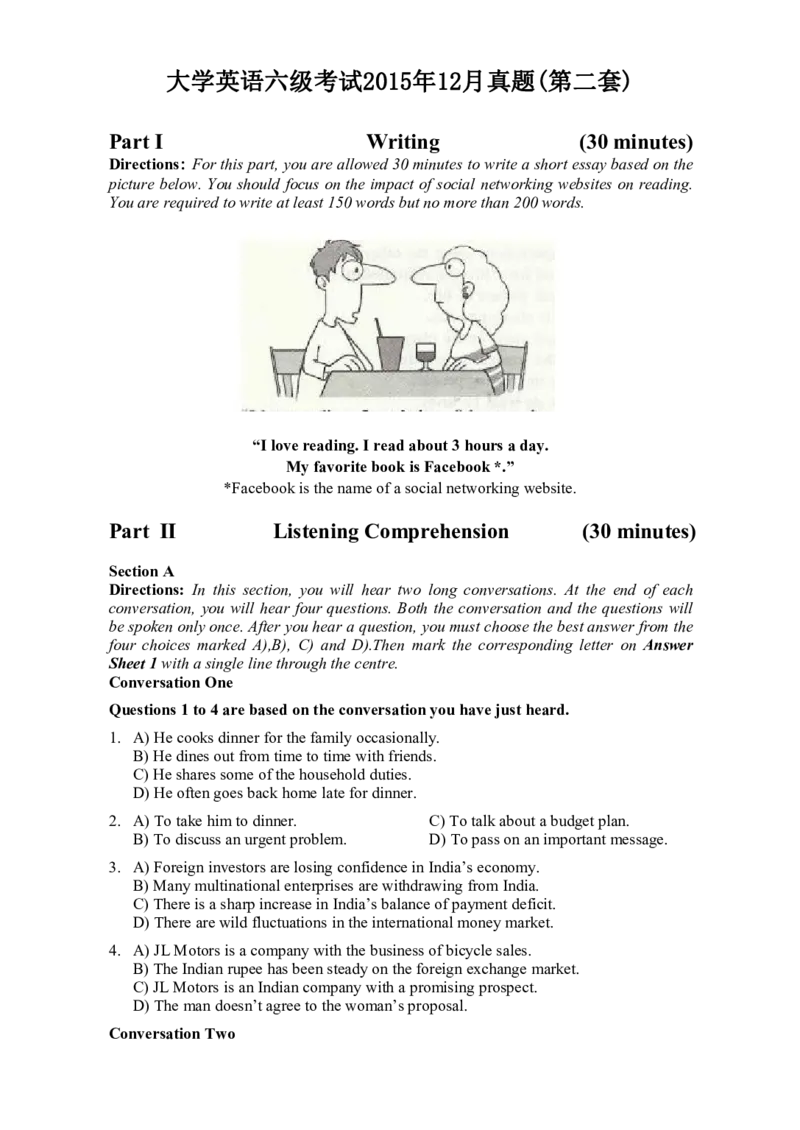
picture below. You should focus on the impact of social networking websites on reading.
Youarerequiredtowriteatleast150wordsbutnomorethan200words.
“Ilovereading.Ireadabout3hoursaday.
MyfavoritebookisFacebook*.”
*Facebookisthenameofasocialnetworkingwebsite.
Part Ⅱ Listening Comprehension (30 minutes)
SectionA
Directions: In this section, you will hear two long conversations. At the end of each
conversation, you will hear four questions. Both the conversation and the questions will
bespokenonlyonce.Afteryouhearaquestion,youmustchoosethebestanswerfromthe
four choices marked A),B), C) and D).Then mark the corresponding letter on Answer
Sheet1withasinglelinethroughthecentre.
ConversationOne
Questions1to4arebasedontheconversationyouhavejustheard.
1. A)Hecooksdinnerforthefamilyoccasionally.
B)Hedinesoutfromtimetotimewithfriends.
C)Hesharessomeofthehouseholdduties.
D)Heoftengoesbackhomelatefordinner.
2. A)Totakehimtodinner. C)Totalkaboutabudgetplan.
B)Todiscussanurgentproblem. D)Topassonanimportantmessage.
3. A)ForeigninvestorsarelosingconfidenceinIndia’seconomy.
B)ManymultinationalenterprisesarewithdrawingfromIndia.
C)ThereisasharpincreaseinIndia’sbalanceofpaymentdeficit.
D)Therearewildfluctuationsintheinternationalmoneymarket.
4. A)JLMotorsisacompanywiththebusinessofbicyclesales.
B)TheIndianrupeehasbeensteadyontheforeignexchangemarket.
C)JLMotorsisanIndiancompanywithapromisingprospect.
D)Themandoesn’tagreetothewoman’sproposal.
ConversationTwoQuestions5to8arebasedontheconversationyouhavejustheard.
5. A)Theytrytoadapttotheirchangingroles.
B)Theyformamorerealisticpictureoflife.
C)Theymaynotbepreparedforalifelongrelationship.
D)Theyhaveunrealisticexpectationsabouttheotherhalf.
6. A)Heisluckytobeabletodowhatheloves.
B)Heisabletomeetmanyinterestingpeople.
C)Heisabletoforgetallthetroublesinhislife.
D)Heisluckytohavevisitedmanyexoticplaces.
7. A)Itisstressful. C)itisfulloffun.
B)Itisallglamour. D)Itischallenging.
8. A)Amazed. C)Puzzled.
B)Bothered. D)Excited.
SectionB
Directions: In this section, you will hear two passages. At the end of each passage, you
will hear three or four questions.Both the passage and the questions will be spoken only
once. After you hear a question, you must choose the best answer from the four choices
marked A),B),C) and D). Then mark the corresponding letter on Answer Sheet 1 with a
singlelinethroughthecentre.
PassageOne
Questions9to11arebasedonthepassageyouhavejustheard.
9. A)Learntoberespectfulinahierarchicalorganization.
B)Followcloselythefastdevelopmentoftechnology.
C)Learnnewwaysofrelatingandworkingtogether.
D)Maintainthetraditionalorganizationalculture.
10.A)Howtheteamisbuilttokeepimprovingitsperformance.
B)Whattypeofpersonneltheteamshouldbecomposedof.
C)Howtheteamintegrateswithwhatitissupposedtoserve.
D)Whatqualificationsteammembersshouldbeequippedwith.
11.A)Ateammanagermustsetveryclearandhighobjectives.
B)Teamsmustconsistofmembersfromdifferentcultures.
C)Teammembersshouldbeknowledgeableandcreative.
D)Ateammanagershoulddevelopacertainsetofskills.
PassageTwo
Questions12to15arebasedonthepassageyouhavejustheard.
12.A)Word-of-mouthadvertising. C)Prestigeadvertising.
B)Distributingfreetrialproducts. D)Institutionaladvertising.
13.A)Tosellaparticularproduct. C)Topromoteaspecificservice.
B)Toattracthigh-endconsumers. D)Tobuilduptheirreputation.
14.A)Bycreatingtheirownadsandcommercials.
B)Bybuyingmediaspaceinleadingnewspapers.
C)Byhiringtheirownprofessionaladvertisingstaff.
D)Byusingtheservicesoflargeadvertisingagencies.
15.A)Conductalarge-scalesurveyoncustomerneeds.
B)Specifytheobjectivesofthecampaignindetail.
C)Pre-testalternativeadsorcommercialsincertainregions.
D)Decideonwhatspecificmeansofcommunicationtoemploy.SectionC
Directions:In this section, you will hear three recordings of lectures or talks followed by
threeorfourquestions.Therecordingswillbeplayedonlyonce.Afteryouhearaquestion,
you must choose the best answer from the four choices marked A),B), C) and D). Then
markthecorrespondingletteronAnswerSheet1withasinglelinethroughthecentre.
Questions16to19arebasedontherecordingyouhavejustheard.
16.A)Theeffectivecommunicationamongfamilymembers.
B)Theprincipleof“avoidaddingtroubletoothers”.
C)Themutualloveandcaringbetweenparentsandchildren.
D)Everyone’scommitmenttosupporteachother.
17.A)Thinkingbeforespeaking. C)Focusingonthepresent.
B)Adoptingempathyduringcommunication. D)Listeningattentively.
18.A)Adoptingnonverbalsignals.
B)Beingaggressiveoroverlystressed.
C)Maintainingeyecontacttoshowattentiveness.
D)Keepingasuitabledistanceandrespectingpersonalspace.
19.A)Tomakesureyouturnoffyourcellphones.
B)Torespectpeopleinvolvedintheconversation.
C)Toshowyouareaneasy-goingperson.
D)Tooffersuggestionsactively.
Questions20to22arebasedontherecordingyouhavejustheard.
20.A)Theabilityofspeakingacertainkindoflanguage.
B)Theabilityofmendingthings.
C)Theabilityofbuildingagoodrelationship.
D)Theabilityofhealingphysicalwounds.
21.A)Alwaysfeelingmiserablewhenencounteringdifficulties.
B)Keepingcalmthoughthechildhasmadethehouseamess.
C)Unwillingtoofferahandtothoseintroubles.
D)Feelingsuperiortoeverybodyelse.
22.A)MentalHealth:ToolCaseoftheMind
C)MentalHealth:TheKeytoSuccess
B)HowtoGainMentalHealth
D)BeCarefulofMentalProblems
Questions23to25arebasedontherecordingyouhavejustheard.
23.A)Studyinghardforarelativelyhighdegree.
C)Understandingthenewtrendofcareerplanning.
B)Havingenoughknowledgeaboutdifferentcareers.
D)Knowingmoreaboutyourself.
24.A)Askforprofessionaladvicefromexperiencedpeople.
B)Bringitdowntoapracticallevel.
C)Divideitintosmallerandachievablegoals.
D)Findanobjectivestandardtoreevaluateyourability.
25.A)Tohelpyoutodealwithnewproblemsyoumaymeetwithinyourcareerbetter.
B)Toensurethatyouachievesomethingbigsometimeinthefuture.
C)Toshortenthetimeyouaretangledupwithtrickysituations.
D)Toacceleratetheprocessofclimbingupthesocialladder.Part Ⅲ Reading Comprehension (40 minutes)
SectionA
Directions: Inthis section,thereis apassagewith ten blanks.Youarerequiredtoselect
onewordforeachblankfromalistofchoicesgiveninawordbankfollowingthepassage.
Read the passage through carefully before making your choices. Each choice in the bank
is identified by a letter. Please mark the corresponding letter for each item on Answer
Sheet 2 with a single line through the centre. You may not use any of the words in the
bankmorethanonce.
Questions26to35arebasedonthefollowingpassage.
It seems to be a law in the technology industry that leading companies eventually
lose their positions, often quickly and brutally. Mobile phone champion Nokia, one of
Europe’s biggest technology success stories, was no __26__ , losing its market share in
justafewyears.
In 2007, Nokia accounted for more than 40% of mobile phone sales __27__. But
consumers’ preferences were already __28__ toward touch-screen smartphones. With the
introduction of Apple’s iPhone in the middle of that year, Nokia’s market share __29__
rapidly and revenue plunged. By the end of 2013, Nokia had sold its phone business to
Microsoft.
What sealed Nokia’s fate was a series of decisions made by Stephen Elop in his
positionasCEO,whichhe__30__inOctober2010.EachdaythatElopspentinchargeof
Nokia, the company’s market value declined by $ 23 million, making him, by the
numbers,oneoftheworstCEOsinhistory.
But Elop was not the only person at __31__. Nokia’s board resisted change, making
itimpossibleforthe companytoadapttorapidshifts intheindustry. Most__32__, Jorma
Ollila, who had led Nokia’s transition from an industrial company to a technology giant,
was too fascinated by the company’s __33__ success to recognize the change that was
neededtosustainitscompetitiveness.
The company also embarked on a __34__ cost-cutting program, which included the
elimination of thousands of jobs. This contributed to the __35__ of the company’s once-
spirited culture, which had motivated employees to take risks and make miracles. Good
leaders left the company, taking Nokia’s sense of vision and direction with them. Not
surprisingly,muchofNokia’smostvaluabledesignandprogrammingtalentleftaswell.
A)assumed K)shifting
B) bias L) shrank
C) desperate M)subtle
D) deterioration N)transmitting
E) exception O)worldwide
F) fault
G) incidentally
H) notably
I) previous
J) relayedSectionB
Directions: Inthissection,youaregoingtoreadapassagewith tenstatements attached
to it. Each statement contains information given in one of the paragraphs. Identify the
paragraph from which the information is derived. You may choose a paragraph more
than once. Each paragraph is marked with a letter. Answer the questions by marking the
correspondingletteronAnswerSheet2.
First-GenerationCollege-Goers: UnpreparedandBehind
Kids who are the first in their families to brave the world of higher education come on
campuswith little academic know-how andare much more likely thantheir peers to drop
outbeforegraduation.
[A] When Nijay Williams entered college last fall as a first-generation student and
Jamaican immigrant, he was academically unprepared for the rigors of higher
education. Like many first-generation students, he enrolled in a medium-sized state
university many of his high school peers were also attending, received a Pell Grant,
and took out some small federal loans to cover other costs. Given the high price of
roomandboardandtheclosenessoftheschooltohisfamily, hechosetoliveathome
andworkedbetween30and40hoursaweekwhiletakingafullclassschedule.
[B] What Nijay didn’t realize about his school—Tennessee State University—was its
frighteningly low graduation rate a mere 29 percent for its first-generation students.
At the end of his first year, Nijay lost his Pell Grant of over $ 5,000 after narrowly
missing the 2.0 GPA cut-off, making it impossible for him to continue paying for
school.
[C] Nijay represents a large and growing group of Americans: first-generation college
students who enter school unprepared or behind. To make matters worse, these
schools are ill-equipped to graduate these students—young adults who face specific
challenges and obstacles. They typically carry financial burdens that outweigh those
of their peers, are more likely to work while attending school, and often require
significantacademicremediation(补习).
[D] Matt Rubinoff directs I’m First, a nonprofit organization launched last October to
reach out to this specific population of students. He hopes to distribute this
information and help prospective college- goers find the best post-secondary fit. And
while Rubinoff believes there are a good number of four-year schools that truly care
about these students and set aside significant resources and programs for them, he
saysthatnumberisn’thighenough.
[E] “It’s not only the selective and elite institutions that provide those opportunities for a
small subset of this population,” Rubinoff said, adding that a majority of first-
generation undergraduates tend toward options such as online programs, two-year
colleges, and commuter state schools. “Unfortunately, there tends to be a lack of
informationandsupporttohelpstudentsthinkbiggerandbroader.”
[F] Despite this problem, many students are still drawn to these institutions—and two-
year schools in particular. As a former high school teacher, I saw students choose
familiar, cheaper options year after year. Instead of skipping out on higher education
altogether, they chose community colleges or state schools with low bars for
admittance.
[G] “They underestimate themselves when selecting a university,” said Dave Jarrat, a
marketing executive for Inside Track, a for-profit organization that specializes in
coachinglow-incomestudentsandsupportingcollegesinordertohelpstudentsthrive.
“The reality of it is that a lot of low-income kids could be going to elite universitiesonafullridescholarshipanddon’tevenrealizeit.”
[H] “Many students are coming from a situation where no one around them has the
experience of successfully completing higher education, so they are coming in
questioning themselves and their college worthiness,” Jarrat continued. That helps
explain why, as I’m First’s Rubinoff indicated, the schools to which these students
end up resorting can end up being some of the poorest matches for them. The
University of Tennessee in Knoxville offers one example of this dilemma. A flagship
university in the South, the school graduates just 16 percent of its first-generation
students, despite its overall graduation rate of 71 percent. Located only a few hours
apart, The University of Tennessee and Tennessee State are worth comparing.
Tennessee State’s overall graduation rate is a tiny 39 percent, but at least it has a
smaller gap between the outcomes for first-generation students and those of their
peers.
[I] Still, the University of Tennessee deserves credit for being transparent. Many large
institutionskeepthiskindofdatasecret—oratleastmakeitincrediblydifficulttofind.
The University of North Carolina at Chapel Hill, for instance, admits only that the
graduation rate for its first-generation pupils is “much lower” than the percentage of
allstudentswhograduatewithinfouryears(81percent).
[J] It is actually quite difficult to find reliable statistics on the issue for many schools.
Higher education institutions are, under federal law, required to report graduation
rates, but these reports typically only include Pell recipient numbers—not necessarily
rates specific to first-generation students. Other initiatives fail to break down the data,
too. Imagine how intimidating it can be for prospective students unfamiliar with the
complexitiesofhighereducationtonavigatethiskindofinformationandthenidentify
whichschoolsarethebestfit.
[K] It was this lack of information that prompted the launch of I’m First in 2013,
originally as an arm of its umbrella organization, the Center For StudentOpportunity.
“If we can help to direct students to more of these types of campuses and help
students to understand them to be realistic and accessible places, have them apply to
these schools at greater frequency and ultimately get in and enroll, we are going to
raise the success rate,” Rubinoff said, citing a variety of colleges ranging from large
stateinstitutionstosmallerprivateschools.
[L] Chelsea Jones, who now directs student programming at I’m First, was a first-
generation college student at Howard. Like other students new to the intimidating
higher-education world, she often struggled on her path to college, “There wasn’t
reallyacollege-boundculture atmy high school,”shesaid. “I wantedto go tocollege
but I didn’t really know the process.” Jones became involved with a college-access
programthroughPrincetonUniversityinhighschool.Now,sheattributesmuchofher
understanding of college to that: “But once I got to campus, it was a completely
differentballgamethatnoonereallypreparedmefor.”
[M] Shewasfortunate,though.Howard,awell-regardedhistoricallyblackcollege,hadan
array of resources for its first-generation students, including matching kids with
counselors, connecting first-generation students to one another, and TRIO, a national
program that supported 200 students on Howard’s campus. Still, Jones represents a
smallpercentageof first-generationstudentswhoareabletogain entryinto moreelite
universities, which are often known for robust financial aid packages and remarkably
highgraduationratesforfirst-generationstudents.(Harvard,forexample,boastsasix-
yeargraduationrateforunderrepresentedminoritygroupsof98percent.
[N] Christian Vazquez, a first-generation Yale graduate, is another exception, his success
story setting him far apart from students such as Nijay. “There is a lot of support atYale,toanextent, after awhile, thereis toomuchsupport,” hesaid, half-jokingabout
the countless resources available at the school. Students are placed in small groups
with counselors (trained seniors on campus); they have access to cultural and ethnic
affinity ( 联 系 ) groups, tutoring centers and also have a summer orientation
specifically for first-generation students (the latter being one of the most common
programsforstudents).
[O] “Our support structure was more like: ‘You are going to get through Yale; you are
going to dowell,’” he said, hintingatmentors(导师), staff, and professorswho all
provided significant support for students who lacked confidence about “belonging” at
suchatopinstitution.
36. Many first-generation college-goers have doubts about their abilities to get a college
degree.
37. First-generation college students tend to have much heavier financial burdens than
theirpeers.
38. The graduation rate of first-generation students at Nijay’s university was incredibly
low.
39. Some top institutions like Yale seem to provide first-generation students with more
supportthantheyactuallyneed.
40. On entering college, Nijay Williams had no idea how challenging college education
was.
41. Many universities simply refuse to release their exact graduation rates for first-
generationstudents.
42. According to a marketing executive, many students from low-income families don’t
knowtheycouldhaveachanceofgoingtoaneliteuniversity.
43. Some elite universities attach great importance to building up the first-generation
students,self-confidence.
44. I’m First distributes information to help first-generation college-goers find schools
thataremostsuitableforthem.
45.Eliteuniversitiestendtograduatefirst-generationstudentsatahigherrate.
SectionC
Directions: There are 2 passages in this section. Each passage is followed by some
questionsorunfinishedstatements.ForeachofthemtherearefourchoicesmarkedA),B),
C) and D). You should decide on the best choice and mark the corresponding letter on
AnswerSheet2withasinglelinethroughthecentre.
PassageOne
Questions46to50arebasedonthefollowingpassage.
Saying they can no longer ignore the rising price of health care, some of the most
influential medical groups in the nation are recommending that doctors weigh the costs,
notjusttheeffectivenessoftreatments,astheymakedecisionsaboutpatientcare.
The shift, little noticed outside the medical establishment but already controversial
inside it, suggests that doctors are starting to redefine their roles, from being concerned
exclusively about individual patients to exerting influence on how healthcare dollars are
spent.
In practical terms, the new guidelines being developed could result in doctors
choosing one drug over another for cost reasons or even deciding that a particulartreatment—at the end of life, for example—is too expensive. In the extreme, some critics
havesaidthatmakingtreatmentdecisionsbasedoncostisaformofrationing.
Traditionally, guidelines have heavily influenced the practice of medicine, and the
latestonesareexpectedtomakedoctorsmoreconsciousoftheeconomicconsequencesof
their decisions, even though there’s no obligation to follow them. Medical society
guidelines are also used by insurance companies to help determine reimbursement(报
销)policies.
Some doctors see a potential conflict in trying to be both providers of patient care
and financial overseers. “There should be forces in society who should be concerned
about the budget, but they shouldn’t be functioning simultaneously as doctors,” said Dr.
Martin Samuels at a Boston hospital. He said doctors risked losing the trust of patients if
theytoldpatients,“I’mnotgoingtodowhatIthinkisbestforyoubecauseIthinkit’sbad
forthehealthcarebudgetinMassachusetts.”
Doctors can face some grim trade-offs. Studies have shown, for example, that two
drugs are about equally effective in treating macular degeneration, an eye disease. But
one costs $50 a dose and the other close to $2,000. Medicare could save hundreds of
millions of dollars a year if everyone used the cheaper drug, Avastin, instead of the
costlierone,Lucentis.
But the Food and Drug Administration has not approved Avastin for use in the eye,
andusingitratherthanthealternative,Lucentis,mightcarryanadditional,althoughslight,
safetyrisk.ShoulddoctorsconsiderMedicare’sbudgetindecidingwhattouse?
“Ithinkethically(在道德层面上)wearejustworriedaboutthepatientinfrontof
usandnottryingtosavemoneyfortheinsuranceindustryorsocietyasawhole.”saidDr.
DonaldJensen.
Still, some analysts saythatthere’sarole fordoctors toplayin costanalysis because
not many others are doing so. “In some ways,” said Dr. Daniel Sulmasy, “it represents a
failureofwidersocietytotakeuptheissue.”
46.Whatdosomemostinfluentialmedicalgroupsrecommenddoctorsdo?
A)Reflectontheresponsibilitiestheyaresupposedtotake.
B)Paymoreattentiontotheeffectivenessoftheirtreatments.
C)Takecostsintoaccountwhenmakingtreatmentdecisions.
D)Readjusttheirpracticeinviewofthecutsinhealthcare.
47.Whatweredoctorsmainlyconcernedaboutinthepast?
A)Specificmedicinestobeused. C)Professionaladvancement.
B)Effectsofmedicaltreatment. D)Patients’trust.
48.Whatmaythenewguidelinesbeingdevelopedleadto?
A)Theredefiningofdoctors’roles. C)Conflictsbetweendoctorsandpatients.
B)Overuseoflesseffectivemedicines. D)Theprolongingofpatients’suffering.
49. What risk do doctors see in their dual role as patient care providers and financial
overseers?
A)Theymaybeinvolvedinaconflictofinterest.
B)Theymaybeforcedtodividetheirattention.
C)Theymayhavetouselesseffectivedrugs.
D)Theymaylosetherespectofpatients.
50.Whatdosomeexpertssayaboutdoctors’involvementinmedicalcostanalysis?
A)Itmayaddtodoctors’alreadyheavyworkloads.
B)Itwillhelptosavemoneyforsocietyasawhole.
C)Itresultsfromsociety’sfailuretotackletheproblem.
D)Itraisesdoctors’awarenessoftheirsocialresponsibilities.PassageTwo
Questions51to55arebasedonthefollowingpassage.
Economic inequality is the “defining challenge of our time,” President Barack
Obama declared in aspeechlast month to theCenter forAmerican Progress. Inequality is
dangerous, he argued, not merely because it doesn’t look good to have a large gap
between the rich and the poor, but because inequality itself destroys upward mobility,
making it harder for the poor to escape from poverty. “Increased inequality and
decreasingmobilityposeafundamentalthreattotheAmericanDream,”hesaid.
Obama is only the most prominent public figure to declare inequality Public Enemy
No.1 and the greatest threat to reducing poverty in America. A number of prominent
economists have also argued that it’s harder for the poor to climb the economic ladder
todaybecausetherungs(横档)inthatladderhavegrownfartherapart.
For allthenewattentiondevotedtothe1percent,anewdatasetfromtheEquality of
Opportunity Project at Harvard and Berkeley suggests that, if we care about upward
mobility overall, we’re vastly exaggerating the dangers of the rich-poor gap. Inequality
itself is not a particularly strong predictor of economic mobility, as sociologist Scott
Winshipnotedinarecentarticlebasedonhisanalysisofthisdata.
So whatfactors,atthe communitylevel,dopredictif poorchildrenwill moveupthe
economic ladder as adults? What explains, for instance, why the Salt Lake City metro
areaisoneofthe100largestmetropolitanareasmostlikelytoliftthefortunesofthepoor
andtheAtlantametroareaisoneoftheleastlikely?
Harvard economist Raj Chetty has pointed to economic and racial segregation,
community density, the size of a community’s middle class, the quality of schools,
community religiosity, and family structure, which he calls the “single strongest correlate
of upward mobility.” Chetty finds that communities like Salt Lake City, with high levels
oftwo-parentfamiliesandreligiosity,aremuchmorelikelytoseepoorchildrengetahead
thancommunitieslikeAtlanta,withhighlevelsofracialandeconomicsegregation.
Chetty has not yet issued a comprehensive analysis of the relative predictive power
of each of these factors. Based on my analyses of the data, of the factors that Chetty has
highlighted, thefollowing threeseem to be most predictive of upwardmobility in a given
community:
1.Per-capita(人均)incomegrowth
2.Prevalenceofsinglemothers(wherecorrelationisstrong,butnegative
3.Per-capitalocalgovernmentspending
In other words, communities with high levels of per-capita income growth, high
percentages of two-parent families, and high local government spending—which may
stand for good schools—are the most likely to help poor children relive the Horatio
Alger’srags-to-richesstory.
51.HowdoesObamavieweconomicinequality?
A)Itisthebiggestobstacletosocialmobility.
B)Itisthegreatestthreattosocialstability.
C)ItistheNo.1enemyofincomegrowth.
D)Itisthemostmalicioussocialevilofourtime.
52.WhatdowelearnabouttheinequalitygapfromScottWinship’sdataanalysis?
A)ItisfastwideningacrossmostpartsofAmerica.
B)Itisnotareliableindicatorofeconomicmobility.
C)Itisnotcorrectlyinterpreted.
D)Itisoverwhelminglyignored.53.ComparedwithAtlanta,metropolitanSaltLakeCityissaidto_______.
A)haveplacedreligiousbeliefsabovepartypolitics
B)havebridgedthegapbetweentherichandthepoor
C)offerpoorchildrenmorechancestoclimbthesocialladder
D)sufferfromhigherlevelsofracialandeconomicsegregation
54.WhatisstronglycorrelatedwithsocialmobilityaccordingtoeconomistRajChetty?
A)Familystructure. C)Schooleducation.
B)Racialequality. D)Communitydensity.
55.Whatdoestheauthorseemtosuggest?
A)Itisimportanttoincreasethesizeofthemiddleclass.
B)Itishighlyimportanttoexpandthemetropolitanareas.
C)Itismostimperativetofocusoureffortsontheeliminationofincomeinequality.
D)Itisbettertostartfromthecommunitytohelppoorchildrenmoveupthesocialladder.
Part Ⅳ Translation (30 minutes)
Directions: For this part, you are allowed 30 minutes to translate a passage from
ChineseintoEnglish.YoushouldwriteyouransweronAnswerSheet2.
在帮助国际社会于2030年前消除极端贫困过程中,中国正扮演着越来越重要的角
色。
自20世纪70年代末实施改革开放以来,中国已使多达四亿人摆脱了贫困。在未来五
年中,中国将向其他发展中国家在减少贫困、发展教育、农业现代化、环境保护和医
疗保健等方面提供援助。
中国在减少贫困方面取得了显著进步,并在促进经济增长方面做出了不懈努力,这
将鼓励其他贫困国家应对自身发展中的挑战。在寻求具有自身特色的发展道路时,这些
国家可以借鉴中国的经验。