姓名: 班级
Unit 4 Body Language
4.1 Reading and Thinking
一、基础巩固
I.单词拼写
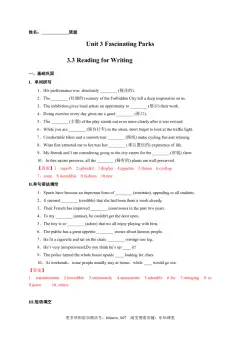
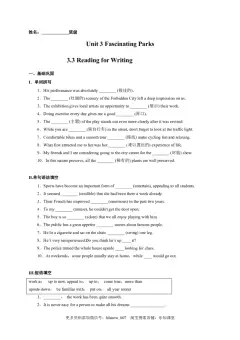
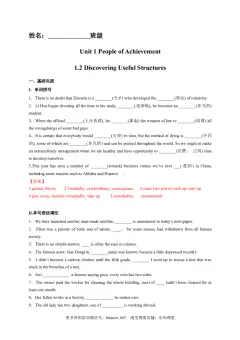
1. Jeans are not a for a formal party.
2. Prices may v so it’s well worth shopping around before you buy.
3. The police had to e force to enter the building.
4. How can you d to us that your story is true?
5. She is a r person whom you can trust.
6. The building plan was finally (批准) by the local government.
7. The warm climate (有利于) many types of tropical plants.
8. Japanese don’t use as much (手势) as Europeans.
9. Two (目击者) were telling the police about the whole accident.
10. Her face was red with (愤怒).
答案:
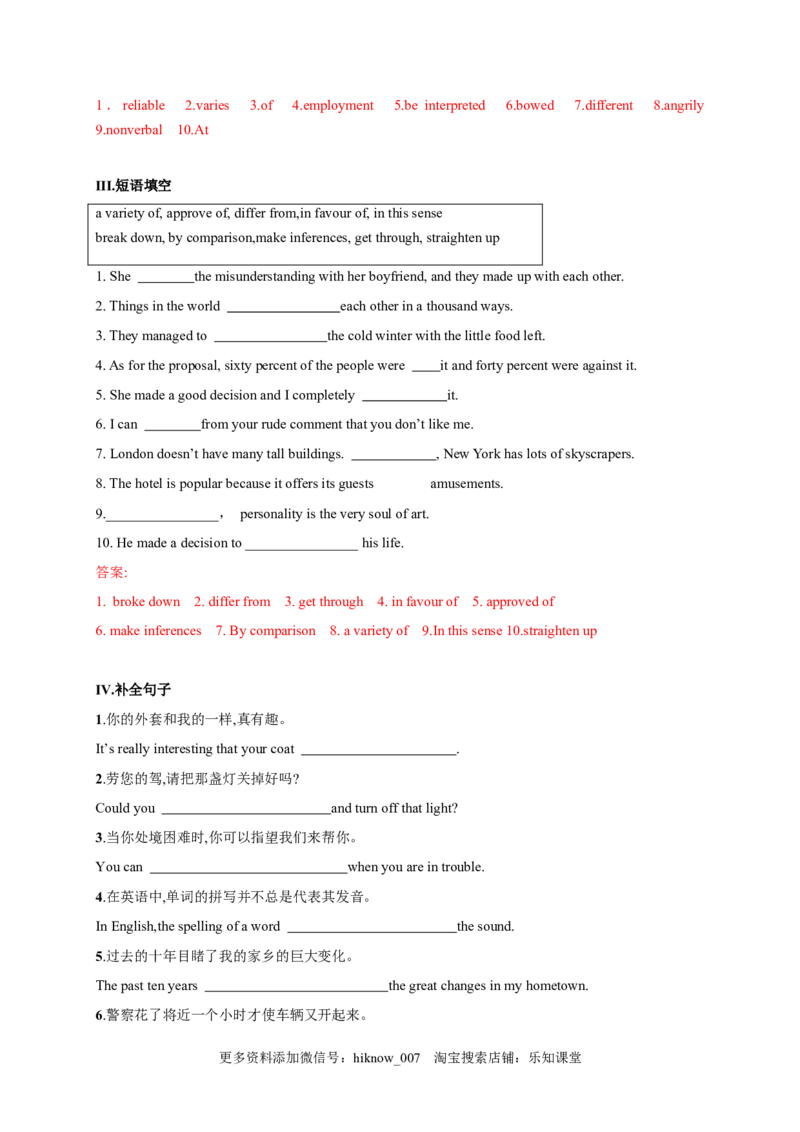
1. appropriate 2. vary 3. employ 4. demonstrate 5. reliable
6. approved 7. favours 8. gesture 9. witnesses 10. anger
II.单句语法填空
1.It is difficult to obtain ________ (rely) evidence now.
2.The menu ________ (various) with the season every year.
3.All the world has tended to approve ________ their plans.
4.The state of ________ (employ) in this city is improving.
5.The fact that he has decided to help us may ________ (interpret) as a sign of friendship.
6.They stood in silence with their heads ________ (bow).
7.We have completely ________ (differ) opinions.
8.He shut the door ________ (anger) and left.
9.This ________ (verbal) way of communication is called body language.
10.________ the trial, he kept silent all the time.
答案:
更多资料添加微信号:hiknow_007 淘宝搜索店铺:乐知课堂1.reliable 2.varies 3.of 4.employment 5.be interpreted 6.bowed 7.different 8.angrily
9.nonverbal 10.At
III.短语填空
a variety of, approve of, differ from,in favour of, in this sense
break down, by comparison,make inferences, get through, straighten up
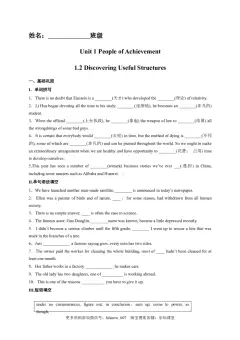
1. She the misunderstanding with her boyfriend, and they made up with each other.
2. Things in the world each other in a thousand ways.
3. They managed to the cold winter with the little food left.
4. As for the proposal, sixty percent of the people were it and forty percent were against it.
5. She made a good decision and I completely it.
6. I can from your rude comment that you don’t like me.
7. London doesn’t have many tall buildings. , New York has lots of skyscrapers.
8. The hotel is popular because it offers its guests amusements.
9.________________, personality is the very soul of art.
10. He made a decision to ________________ his life.
答案:
1. broke down 2. differ from 3. get through 4. in favour of 5. approved of
6. make inferences 7. By comparison 8. a variety of 9.In this sense 10.straighten up
Ⅳ.补全句子
1.你的外套和我的一样,真有趣。
It’s really interesting that your coat .
2.劳您的驾,请把那盏灯关掉好吗?
Could you and turn off that light?
3.当你处境困难时,你可以指望我们来帮你。
You can when you are in trouble.
4.在英语中,单词的拼写并不总是代表其发音。
In English,the spelling of a word the sound.
5.过去的十年目睹了我的家乡的巨大变化。
The past ten years the great changes in my hometown.
6.警察花了将近一个小时才使车辆又开起来。
更多资料添加微信号:hiknow_007 淘宝搜索店铺:乐知课堂It took the police nearly an hour to get the traffic again.
7.那位著名的歌唱家的老师用钢琴为他伴奏。
The well-known singer the piano by his school teacher.
8.我不喜欢吃蔬菜,虽然我知道他们对我有好处。
I don’t like vegetables I know they are good for me.
9.多数人赞成在公共场所吸烟的禁令。
Most people are for the ban in public places.
10.我以前总是和妈妈一起熬夜看电影。
I with my mom and watch movies.
答案:
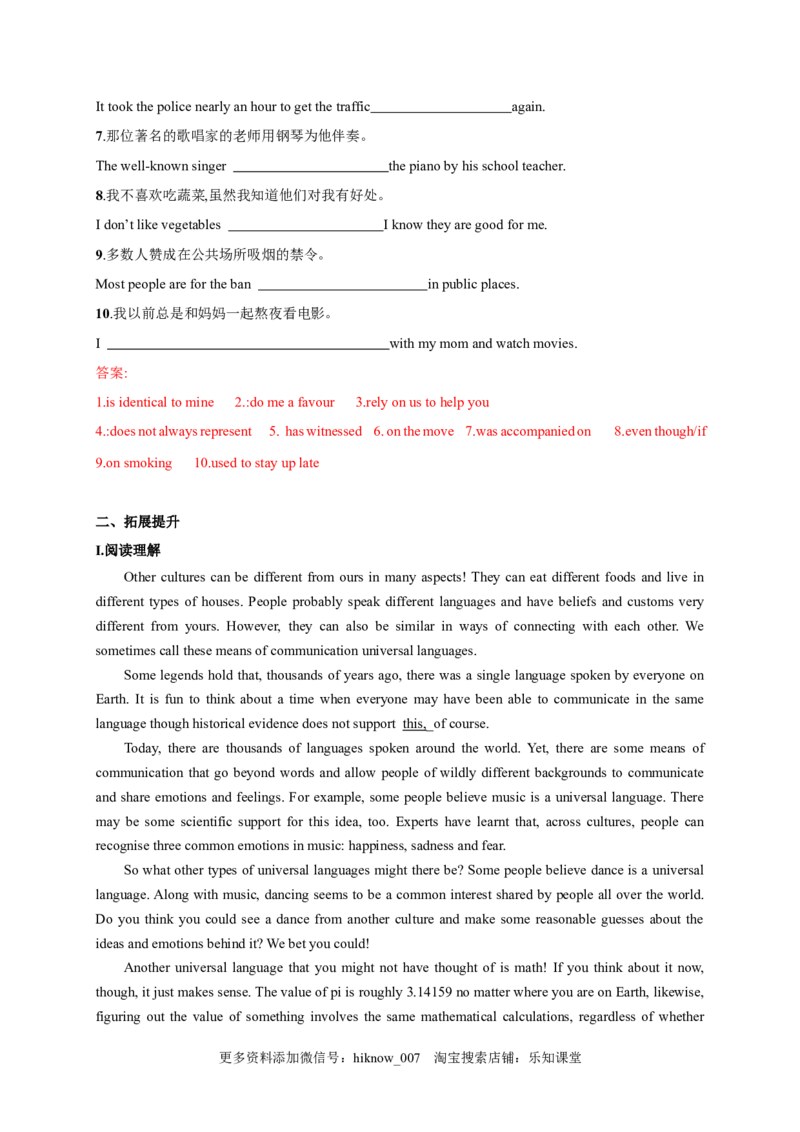
1.is identical to mine 2.:do me a favour 3.rely on us to help you
4.:does not always represent 5. has witnessed 6. on the move 7.was accompanied on 8.even though/if
9.on smoking 10.used to stay up late
二、拓展提升
I.阅读理解
Other cultures can be different from ours in many aspects! They can eat different foods and live in
different types of houses. People probably speak different languages and have beliefs and customs very
different from yours. However, they can also be similar in ways of connecting with each other. We
sometimes call these means of communication universal languages.
Some legends hold that, thousands of years ago, there was a single language spoken by everyone on
Earth. It is fun to think about a time when everyone may have been able to communicate in the same
language though historical evidence does not support this,_of course.
Today, there are thousands of languages spoken around the world. Yet, there are some means of
communication that go beyond words and allow people of wildly different backgrounds to communicate
and share emotions and feelings. For example, some people believe music is a universal language. There
may be some scientific support for this idea, too. Experts have learnt that, across cultures, people can
recognise three common emotions in music: happiness, sadness and fear.
So what other types of universal languages might there be? Some people believe dance is a universal
language. Along with music, dancing seems to be a common interest shared by people all over the world.
Do you think you could see a dance from another culture and make some reasonable guesses about the
ideas and emotions behind it? We bet you could!
Another universal language that you might not have thought of is math! If you think about it now,
though, it just makes sense. The value of pi is roughly 3.14159 no matter where you are on Earth, likewise,
figuring out the value of something involves the same mathematical calculations, regardless of whether
更多资料添加微信号:hiknow_007 淘宝搜索店铺:乐知课堂you're counting in dollars, pesos or coconuts.
1.What does the underlined word “this” in Paragraph 2 probably refer to?
A.The view that people only used one language.
B.The fact that there used to be many languages.
C.The evidence that proves old languages funny.
D.The doubt that people didn't understand each other.
2.Why is music regarded as a universal language?
A.It can be enjoyed by people from all walks of life.
B.It can be understood more easily than languages.
C.It usually comes from different backgrounds.
D.It helps people to share common feelings.
3.What are the universal languages according to the passage?
A.Math, English and music.
B.Music, dance and math.
C.History, culture and music.
D.Emotion, pi and music.
4.What can be a suitable title for the text?
A.Various Differences Between Cultures
B.Music Helps People Show Feelings
C.Universal Languages Connect Different Cultures
D.Crosscultural Communication History
答案:ADBC
【语篇解读】 本文为说明文。其他文化可能在很多方面与我们不同。他们可以吃不同的食物
住不同类型的房子。人们可能说着不同的语言,有着与你截然不同的信仰和习俗。然而,他们在相
互联系的方式上是相似的。我们有时称这些沟通方式为通用语言。文章主要介绍了几种通用语言。
1.答案与解析:A 词义猜测题。根据画线词所在句句意“虽然想想每个人都能用同一种语
言进行交流的时代是很有趣的,但是历史证据当然并不支持这一点。”可知,this指的是“人们只
用同一种语言进行交流”。故选A项。
2.答案与解析:D 细节理解题。根据第三段中的 Experts have learnt that, across cultures,
people can recognise three common emotions in music: happiness, sadness and fear.(专家们已经了解到,
在不同的文化中,人们可以识别音乐中的三种常见情感:快乐、悲伤和恐惧。)可知,音乐被认为
是一种通用的语言是因为它帮助人们分享共同的情感。故选D项。
3.答案与解析:B 细节理解题。根据第三段中的For example, some people believe music is a
universal language.及第四段中的 Some people believe dance is a universal language.和第五段中的
Another universal language that you might not have thought of is math!可知,音乐、舞蹈和数学被认
为是通用语言。故选B项。
更多资料添加微信号:hiknow_007 淘宝搜索店铺:乐知课堂4.答案与解析:C 主旨大意题。通读全文可知,文章主要介绍了三种通用语言,因此C项
“通用语言连接了不同的文化”适合作本文最佳标题。故选C项。
Ⅱ.七选五
How to Develop Interpersonal Skills
People use interpersonal skills daily—socially as well as professionally—and usually without even
being conscious of their effectiveness. In the workplace, listening, communicating, working together and
manners are important interpersonal skills. An employee who falls short of any of these soft skills must
work consciously to strengthen and develop them. __1__
Listen up.
Active listening is a skill that must be learned and practiced. __2__ The active listener provides
feedback by focusing their full attention on the speaker and responding with verbal and nonverbal clues
that the speaker's message is heard and understood.
Avoid failure to communicate.
Simply talking to people does not guarantee that your message is getting across. Common barriers to
communication are lack of verbal clues, cultural differences, lack of interest, distractions, and unfamiliar
expressions. Expect such barriers and deal with them. Learn to think before you speak, and express yourself
clearly and carefully. __3__
Get it together.
Working together is the key to working effectively. __4__ Create such an environment, rather than
competition, and respect the opinions of others. Praise and thank coworkers for their contributions and treat
all suggestions and opinions with respect.
__5__
The basics of these interpersonal skills are the rules of politeness and good manners. Respecting other
cultures can strengthen a relationship. Be aware of what is happening in your coworkers' lives and care for
them. Stay cheerful and positive in the office.
A.Mind your manners.
B.Stay positive to infect others.
C.Working successfully with others can make a career.
D.It can avoid letting the speaker's message disappear.
E.Practice smiling in front of the mirror until you feel confident.
F.Otherwise, the employee can't get along with superiors and coworkers.
G.Control your nonverbal communication—facial expressions, body language and eye contact.
【语篇解读】 本文是一篇说明文。人们处在繁忙的工作生活当中,复杂的人际关系无疑给人
们增添了新的压力。那么,该怎样经营好你的人际关系呢?本文主要说明了人际交往能力在工作中
的重要性,并从四个方面介绍了提高人际交往能力的方法。
1.答案与解析:F 上一句提到缺乏这些软技能中的任何一项的员工必须有意识地工作以加强
和培养这些技能。F项“否则,员工无法与上级以及同事和睦相处”,符合语境。
更多资料添加微信号:hiknow_007 淘宝搜索店铺:乐知课堂2.答案与解析:D 上一句提到积极的倾听是一种必须学习和练习的技能。D项“这可以避免
漏掉说话者的信息”,符合语境。
3.答案与解析:G 联系本段小标题和上一句可知,在说话之前,要学会思考,并且要能够
清楚和认真地表达自己,避免沟通失败。G项“要控制你的非言语交流——面部表情、肢体语言和
眼神接触”,符合语境。
4.答案与解析:C 上一句提到合作是提高工作效率的关键。C项“与他人成功的合作可以使
你在事业上有所成就”,同样说明了合作的重要性,符合语境。
5.答案与解析:A 设空处是该段的小标题,该段提到所有这些人际关系技能的基础是礼貌
和良好的礼仪的规则。A项“要注意你的礼仪”,符合本段大意。
Ⅲ.完形填空
I was born 50% deaf in both ears. But my life changed __1__ recognition at the age of 35. My world
totally changed when I was diagnosed with deafness and eventual blindness.
My wife Elizabeth first noticed there was a problem with my eyes. She __2__ a pencil past my face
and was __3__ to discover I couldn't see it unless it was directly in front of me. My eyesight had been
__4__ for years but I simply hadn't noticed. I couldn't imagine __5__ my life would be, but in fact it has
__6__ greatly.
Of course, coming to terms with it was hard __7__. My first reaction was denial, followed by severe
depression. I had built effective coping measures to __8__ my hearing loss; losing my sight, too, just made
me feel too much to handle. I __9__ so much information about the world through my eyes, so the idea of
those being taken away was __10__. I felt all my choices were __11__.
But I was very positive and didn't feel depressed for long. I decided to train as a homeopath (同种疗
法医师). __12__, I think it was a way of working through my problems.
We started a farm in the country. It was just what I __13__: clean air, spring water and space. So
many __14__ things have happened so far and now, at age 50, I feel that I am living a second life. I aim to
remain active and engaged with life. I don't think of myself as a disabled person. __15__, I've learned to
live with them.
1. A.through B.against C.beyond D.from
2. A.moved B.Saw C.placed D.listened
3. A.happy B.Ashamed C.bored D.shocked
4. A.dropping B.Failing C.adding D.recovering
5. A.how B.Why C.when D.where
6. A.lifted B.Improved C.raised D.increased
7. A.after all B.above all C.at first D.at last
8. A.hold in B.keep in C.deal with D.go with
9. A.absorbed B.Occupied C.wasted D.pursued
10.A.interesting B.Surprising C.exciting D.terrifying
更多资料添加微信号:hiknow_007 淘宝搜索店铺:乐知课堂11.A.escaping B.Dying C.disappearing D.disturbing
12.A.Looking back B.Looking ahead
C.Looking around D.Looking up
13.A.recognised B.Needed C.charged D.hated
14.A.correct B.fresh C.careful D.wonderful
15.A.Instead B.Therefore C.Yet D.Besides
【语篇解读】 面对一次又一次的人生打击,作者没有消沉,反而保持积极的人生态度,学会了与
疾病共存。
1.答案与解析:C 根据下一句“My world totally changed...”可知,作者的生活有了翻天覆地
的变化。beyond recognition“面目全非”。
2.答案与解析:A 句意:她拿着一支铅笔从“我”的面前“移动(move)”,震惊地发现,除
非铅笔正好在“我”面前,否则“我”无法看到它。
3.答案与解析:D 结合上下文可知,作者的妻子发现作者的眼睛有问题应该觉得非常“震
惊(shocked)”。
4.答案与解析:B fail表示“(视力、记忆、健康等)衰退”。drop表示“降低;减少”。
5.答案与解析:A 作者不敢想象失明后生活会“怎样(how)”。
6.答案与解析:B 根据but in fact的转折和全文最后的结果可知,作者正确的生活态度使生
活得以“改善(improve)”。
7.答案与解析:C 作者从本段起开始描述自己与失明作斗争的过程。根据下面的描写可知,
“一开始(at first)”还是很困难的。after all“毕竟”;above all“最重要的是”;at last“最后”。
8.答案与解析:C 根据文章首句可知,作者听觉天生有缺陷,因此慢慢形成了一整套“应对
(deal with)”失聪的行之有效的方法。go with“伴随”;hold in“压抑,忍耐,抑制”;keep in“抑制”。
9.答案与解析:A 由于听觉天生有缺陷,作者“获取(absorb)”信息的主要途径是眼睛。
10.答案与解析:D 正因为眼睛对作者如此重要,所以现在一想到失明,作者就感到“可怕
(terrifying)”。
11.答案与解析:C 根据上文可知,由于听觉天生有缺陷,作者主要通过视觉来获取信息,
而现在作者的眼睛也出现了问题,所以作者觉得自己毫无选择。disappear“消失”符合语境。
12.答案与解析:A 现在“回过头来看(Looking back)”,这确实是解决这些问题的一个好方
法,让“我”熬过了那些困难的日子。
13.答案与解析:B 根据冒号后的内容可知,那些都是“我”“需要(need)”的东西。
14.答案与解析:D 根据“clean air, spring water and space”可知,wonderful符合语境。
15.答案与解析:A 表示意义上的转折,实际上是另外一种选择。
Ⅳ.语法填空
When 1.________ (meet) people at the airport, most people smile and shake hands with people they
更多资料添加微信号:hiknow_007 淘宝搜索店铺:乐知课堂meet. We know that a smile is usually a sign that people feel 2.________ (friend) and happy, but what if we
don't know 3.________ the new person is? What if we are not introduced by a friend? What if we are
meeting a stranger in 4.________ unfamiliar place? Sometimes people are 5.________ (danger) and
humans have to find ways to protect 6.________ (they). We have to make sure we can trust people we do
not know, and we have to show that we are not aggressive. Showing our hands 7.________ (mean) that we
are not armed. In many cultures today, the Western custom of shaking hands 8.________ (use). We use our
right hand, 9.________ is usually stronger than the left one. If we are using our hand this way, it means that
we cannot be holding a knife 10.________ a gun. It shows that we trust the other person, and that the other
person can trust us.
【语篇解读】 本文是一篇议论文。微笑让人感到友善和高兴,但是如果遇到陌生人,我们如
何知道他们不是危险的呢?而握手特别是用我们有力的右手,恰恰表明我们彼此信任。
1.答案与解析:meeting 考查现在分词。meet与其逻辑主语most people是主动关系,因此用
现在分词作状语。
2.答案与解析:friendly 考查形容词。feel是连系动词,后面应该用形容词作表语,friendly
是形容词,意为“友好的”。
3.答案与解析:who 考查宾语从句。know后面跟的是宾语从句,该空在从句中作表语指人
故应填疑问代词who。
4.答案与解析:an 考查冠词。此处指一个不熟悉的地方。unfamiliar以元音音素开头,所以
用an。
5.答案与解析:dangerous 考查形容词。根据该句的结构可以判断,are后面应该填形容词作
表语。dangerous“危险的”。
6.答案与解析:themselves 考查反身代词。反身代词通常表示它与句中的主语是同一人,在
句中作宾语,不能省略。反身代词以self(单数)或selves(复数)结尾。由humans可知填themselves。
7.答案与解析:means 考查主谓一致。主句的主语为动名词短语Showing our hands,动名词
短语作主语,谓语动词应该用单数形式。
8.答案与解析:is used 考查时态和语态。此处指这种握手的西方的习俗被使用,应该用被
动语态,根据上下文句子的时态,可以判断此处应该用一般现在时,因此应该填is used。
9.答案与解析:which 考查非限制性定语从句。设空处引导非限制性定语从句,先行词是
right hand,表示物,在从句中作主语,因此该空应该用关系代词which。
10.答案与解析:or 考查并列连词的用法。此处指不可能拿着刀子或者枪,此处应该表示选
择关系,or表示“或者”
V.书面表达
假设你是李华,你的英国朋友罗伯特(Robert)准备来中国学习,因此想了解一些中国的肢体语言。
请你用英语给他写封邮件,介绍一些日常的肢体语言。
1.词数100左右;
更多资料添加微信号:hiknow_007 淘宝搜索店铺:乐知课堂2.信的开头和落款已为你写好(不计入总词数)。
Dear Robert,
_________________________________________________________________________________
______________________________________________________________________________________
______________________________________________________________________________________
______________________________________________________________________________________
______________________________________________________________________________________
______________________________________________________________________________________
______________________________________________________________________________________
Yours,
Li Hua
【参考范文】
In China, we wave our hands to say “hello” or “goodbye”. We usually greet our guests by shaking
hands with them. Some people may nod and smile instead of shaking hands. When you are introduced to a
Chinese group, they may greet you by clapping their hands.
Like in many countries, we nod our heads to say “yes” and shake our heads to say “no”. People will
hold their thumbs up to praise a person, if he does something great. Sometimes, we bow to show great
respect and thanks to others.
I hope this information will be helpful to you.
更多资料添加微信号:hiknow_007 淘宝搜索店铺:乐知课堂