26高等数学17堂课
专题8 不定积分与定积分的计算
(P104-113)
主讲 武忠祥 教授(一)不定积分
(二)定积分一,不定积分
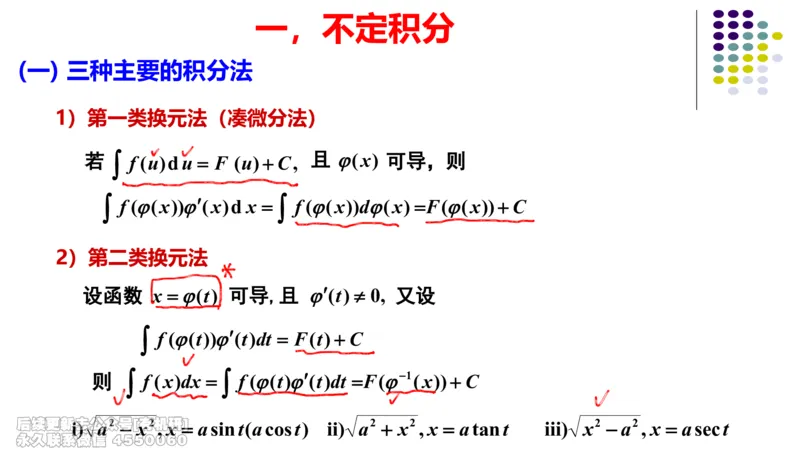
(一) 三种主要的积分法
1)第一类换元法(凑微分法)
若 f (u)d u F (u) C, 且 (x) 可导,则
f ((x)) (x)d x f ((x))d(x) F((x)) C
2)第二类换元法
设函数 x (t) 可导,且 (t) 0, 又设
f ((t)) (t)dt F(t) C
则 f ( x)dx f ((t) (t)dt F( 1 (x)) C
i) a 2 x 2 , x a sin t(a cost) ii) a 2 x 2 , x a tant iii) x 2 a 2 , x a sect3)分部积分法
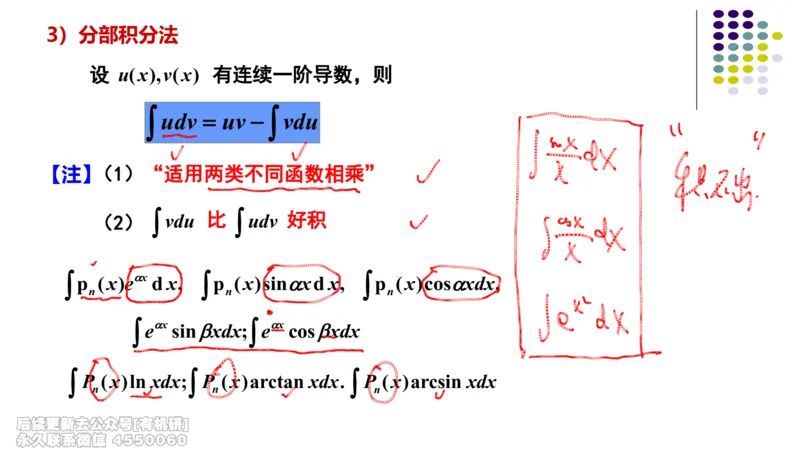
设 有连续一阶导数,则
u(x),v(x)
udv uv vdu
(1)“适用两类不同函数相乘”
【注】
(2) vdu 比 udv 好积
p (x)e x d x, p (x)sinxd x, p (x)cosxdx,
n n n
e x sinxdx; e x cosxdx
P (x)ln xdx; P (x)arctan xdx. P (x)arcsin xdx
n n n(二)三类常见函数积分
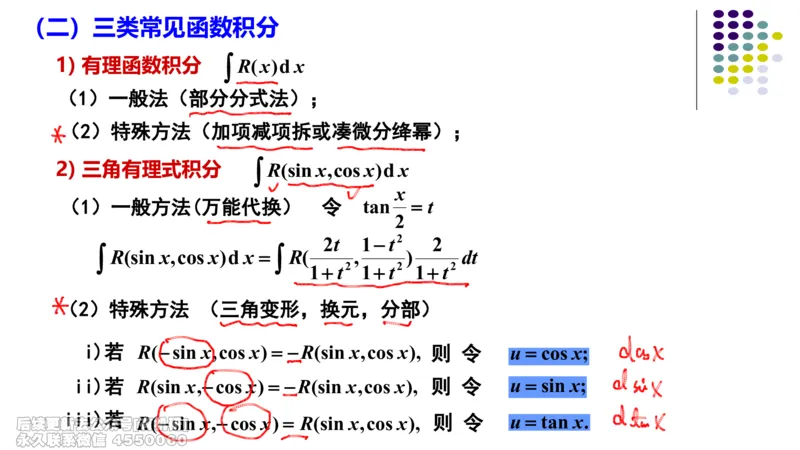
1) 有理函数积分 R(x)d x
(1)一般法(部分分式法);
(2)特殊方法(加项减项拆或凑微分绛幂);
2) 三角有理式积分 R(sin x,cos x)d x
x
(1)一般方法(万能代换) 令 tan t
2
2t 1 t 2 2
R(sin x,cos x)d x R( , ) dt
1 t 2 1 t 2 1 t 2
(2)特殊方法 (三角变形,换元,分部)
i)若 R( sin x,cos x) R(sin x,co s x ) , 则 令 u cos x;
ii)若 R(sin x, cos x) R(sin x,cos x ) , 则 令 u sin x;
iii)若
R( sin x, cos x) R(sin x,cos x ) , 则 令 u tan x.ax b
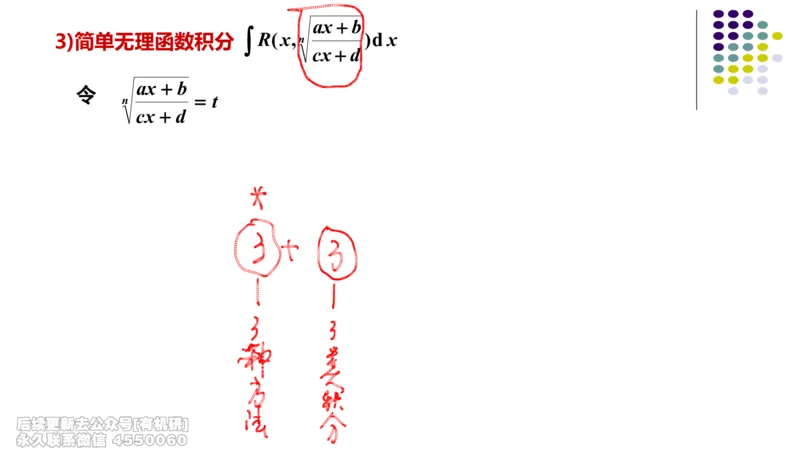
3)简单无理函数积分
R(x,n )d x
cx d
ax b
令
n t
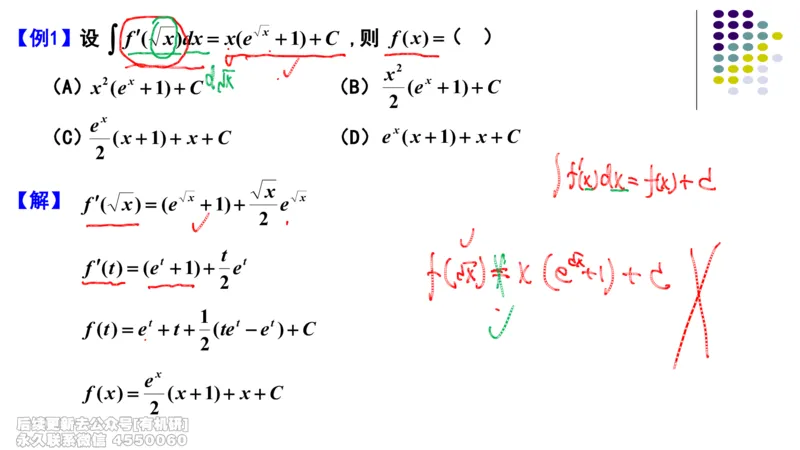
cx d【例1】设 f ( x)dx x(e x 1) C ,则 f (x) ( )
2
x
(A) x 2 (e x 1) C (B) (e x 1) C
2
x
e
(C) (x 1) x C (D)e x (x 1) x C
2
x
【解】
f ( x) (e x 1) e x
2
t
f (t) (e t 1) e t
2
1
f (t) e t t (te t e t ) C
2
x
e
f (x) (x 1) x C
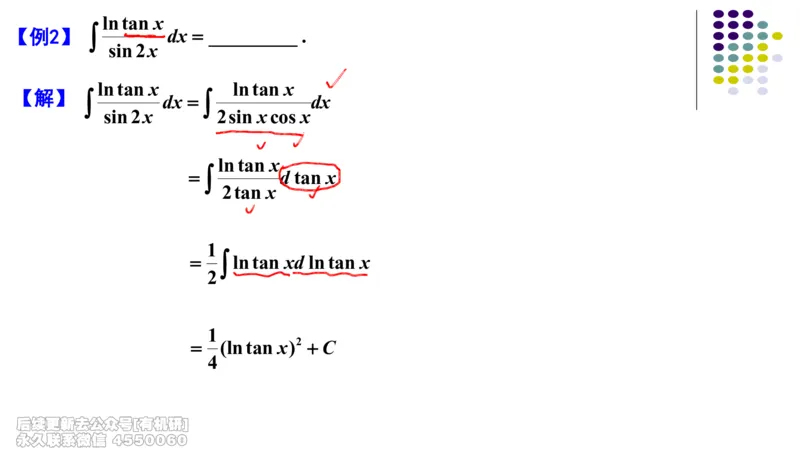
2ln tan x
【例2】 dx _________ .
sin 2x
ln tan x ln tan x
【解】
dx dx
sin 2x 2sin x cos x
ln tan x
d tan x
2tan x
1
ln tan xd ln tan x
2
1
(lntan x) 2 C
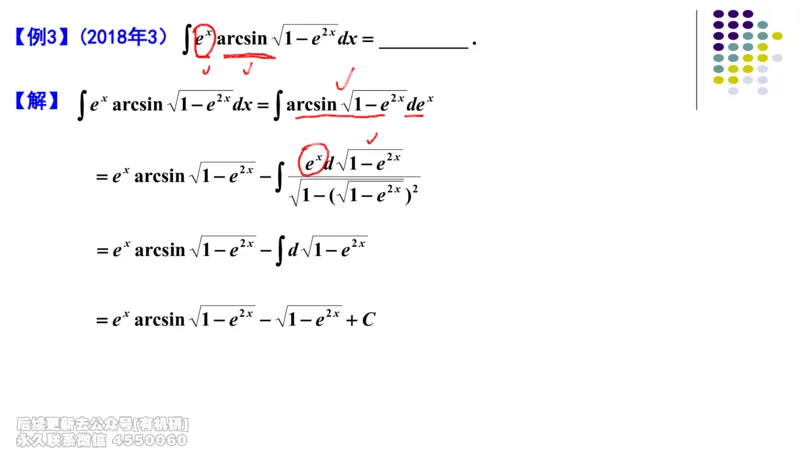
4【例3】(2018年3) e x arcsin 1 e 2x dx _________ .
【解】
e x arcsin 1 e 2x dx arcsin 1 e 2x de x
e x d 1 e 2x
e x arcsin 1 e 2x
1 ( 1 e 2x ) 2
e x arcsin 1 e 2x d 1 e 2x
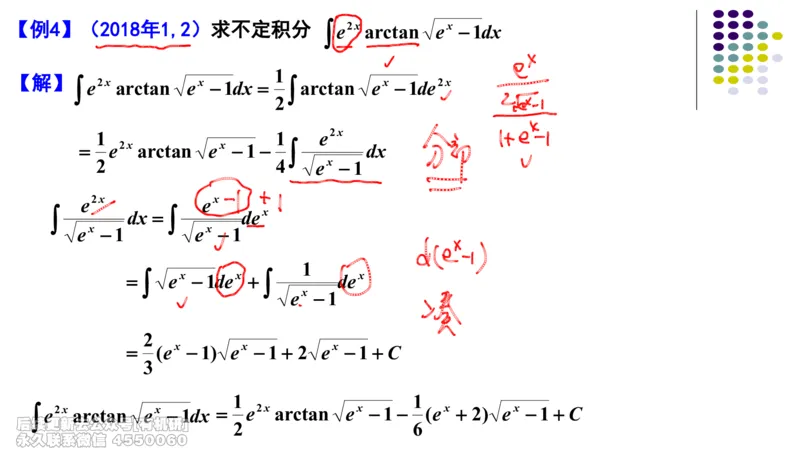
e x arcsin 1 e 2x 1 e 2x C【例4】(2018年1,2)求不定积分 e 2x arctan e x 1dx
1
【解】
e 2x arctan e x 1dx arctan e x 1de 2x
2
2x
1 1 e
e 2x arctan e x 1 dx
2 4 e x 1
2x x
e e
dx de x
e x 1 e x 1
1
e x 1de x de x
e x 1
2
(e x 1) e x 1 2 e x 1 C
3
1 1
e 2x arctan e x 1dx e 2x arctan e x 1 (e x 2) e x 1 C
2 6arctan x
xe
【例5】(2003年2)
dx
(1 x 2 ) 3/2
【解1】 设 x tan t, 则
arctan x t
x e e tan t
d x sec 2 t d t e t sin t d t
(1 x 2 ) 3/2 (1 tan 2 t) 3/2
又 e t sin t d t sin t d e t e t sin t e t cos tdt
e t sin t cos tde t
e t sin t e t cos t e t sin t d t,
1
故
e t sin tdt e t (sin t cos t) C.
2
arctan x
x e 1 x 1
因此
d x e arctan x C
(1 x 2 ) 3/2 2 1 x 2 1 x 2
(x 1)e arctan x
C.
2 1 x 2arctan x
x e x
【解2】 d x de arctan x
(1 x 2 ) 3/2 1 x 2
arctan x arctan x
x e e
d x
1 x 2 (1 x 2 ) 3/2
arctan x
x e 1
de arctan x
1 x 2 1 x 2
arctan x arctan x arctan x
x e e x e
d x,
1 x 2 1 x 2 (1 x 2 ) 3/2
移项整理,得
x e arctan x (x 1)e arctan x
d x C.
(1 x 2 ) 3/2 2 1 x 2x 3 3
【例6】 dx
x 2 (1 x)
x 3 3 A B C
【解1】令 1
x 2 (1 x) x x 2 x 1
由
Ax(x 1) B(x 1) Cx 2 3 x 2
A C 1
得
A B 0
B 3
解得 A 3, B 3,C 2.
x 3 3 3 3 2
dx 1 dx
x 2 (1 x) x x 2 x 1
3
x 3ln x 2ln x 1 C
xx 3 3
【例6】 dx
x 2 (1 x)
3
x 1
【解2】原式 dx 3 dx
x 2 (1 x) x 2 (1 x)
x (1 x 2 ) x 2
dx 3 dx
1 x x 2 (1 x)
1 1 x 1
(1 )dx 3 [ ]dx
1 x x 2 1 xx
【例7】 dx
x 3 x 2 x 1
【解1】由于 x 3 x 2 x 1 (x 1)( x 2 1) ,设
x A Bx C
x 3 x 2 x 1 x 1 x 2 1
则 x A(x 2 1) (Bx C)( x 1)
1 1 1
由此解得 A , B ,C .
2 2 2
x 1 dx 1 x 1
dx dx
x 3 x 2 x 1 2 x 1 2 x 2 1
1 1 1
ln x 1 ln(x 2 1) arctan x C
2 4 2x
【例7】 dx
x 3 x 2 x 1
x
【解2】原式 dx
(x 1)(x 2 1)
1 (x 2 1) (x 1) 2
dx
2 (x 1)(x 2 1)
1 dx 1 x 1
dx
2 x 1 2 x 2 1dx
【例8】
sin x cos 2x
dx
【解】原式
R( sin x,cos x) R(sin x,cos x),
sin x(cos 2 x sin 2 x)
d cos x
(1 cos 2 x)(2cos 2 x 1)
2(1 u 2 ) (2u 2 1)
du
(1 u 2 )(2u 2 1)
du du
2
2u 2 1 u 2 1
1 2u 1 1 u 1
ln ln C
2 2u 1 2 u 1
1 2 cos x 1 1 cos x 1
ln ln C
2 2 cos x 1 2 cos x 1二,定积分
计算定积分常用方法
1) 牛顿-莱布尼兹公式
b
f (x)d x F (b) F(a)
a
2) 换元积分法
b
f (x)d x f (t))td t.
a
3) 分部积分法
b
b b
ud v uv v d u.
a a
a4)利用奇偶性和周期性
为奇函数时,
0, f (x)
a
( 1 ) f (x)d x a
为偶函数时
2 f (x)d x, f (x) .
a
0
aT T
( )
2 f (x)d x f (x)d x.
a 0
5)利用公式
n 1 n 3 1
, n偶
n n 2 2 2
(1) 2 sin n x d x 2 cos n x d x
n 1 n 3 2
0 0
, n奇
n n 2 3
π
(2) x f (sin x)d x f (sin x)d x
0 2 0
x
【例1】 2 [cos 2 x e t 2 dt]sin 2 xdx ___________ .
0
2
x
【解】 e t 2 偶函数,则 e t 2 dt 为奇函数.
0
π
原式 2 2 cos 2 x sin 2 xdx
0
π
π
2 2 (1 sin 2 x)sin 2 xdx .
0 82
【例2】(2012年1) x 2x x 2 dx ____________ .
0
2
【解1】 原式 x 1 (x 1) 2 dx
0
π
x 1 sin t
2 (1 sin t)cos 2 tdt
π
2
2 2 cos 2 tdt
0 2
2
【解2】原式 x 1 (x 1 ) 2 dx
0
2
[(x 1) 1] 1 (x 1) 2 dx
0
2
2x x 2 dx
0 2
【例3】 x cos 2 x cos 4 xdx __________ .
0
π
π
【解】原式 cos 2 x cos 4 xdx
2 0
cos x sin xdx
2 0
2 cos x sin xdx cos x sin xdx
2 0
2
22 dx
【例4】计算定积分 .
0 1 cos 2 x
2 dx dx
【解】 4 2
0 1 cos 2 x 0 1 cos 2 x
2 dx 2 d tan x
0 1 cos 2 x 0 2 tan 2 x
d tan x
4 2
0 2 tan 2 x 2
1 tan x
arctan
2 2
4 tan x 0
2
arctan
2 2
0
0
2
经典的错误 标准的0分
【例5】已知 f (x) x f (x)cos xdx ,则 f (x)sin 4 xdx _________ .
0 0
【解1】 f (x)cos xdx x cos xdx cos xdx f (x)cos xdx
0 0 0 0
xd sin x 2
0
f (x) x 2
f (x)sin 4 xdx (x 2)sin 4 xdx
0 0
( 2) 2 2 sin 4 xdx
2 0
3
( 2)
2 8
【例5】已知 f (x) x f (x)cos xdx ,则 f (x)sin 4 xdx _________ .
0 0
【解2】 f (x)cos xdx f (x)d sin x
0 0
f (x)sin x f (x)sin xdx
0
0
sin xdx
0
2
【例5】已知 f (x) x f (x)cos xdx ,则 f (x)sin 4 xdx _________ .
0 0
【解3】令
f (x)cos xdx a
0
x a x (x a)cos xdx
0
x xd sin x
0
x sin xdx x 2
0f (x) ln(1 t)
1 x
【例6】(2013年1)计算
dx, 其中 f (x) dt.
0 x 1 t
f (x)
1 1
【解】 dx 2 f (x)d x
0 x 0
ln(1 x)
1 1
2 x f (x) 2 dx
0 0 x
1
4 ln(1 x)d x
0
x
1 1
4ln(1 x) x 4 dx
0 0 1 x
4ln 2 8 2x
2
【例7】计算定积分 dx.
0 e x e 2x
【解】令 x 2 t, 则 dx dt,
x 2 t
2 2
dx dt.
0 e x e 2x 0 e 2t e t
1 x 2 x
2 2
[ dx dx]
2 0 e x e 2x 0 e x e 2x
2 dx 2 de x
0 e x e 2x 0 e 2x e 2
2
x
1 e 1 1
arctan [arctan e arctan ]
e e e e
0ln(1 x)
1
【例8】计算定积分 dx
0 1 x 2
ln(1 x) xtant
1
【解】
dx 4 ln(1 tan t)dt
0 1 x 2 0
t u
4 1 tan u
4 ln[1 ]du
0 1 tan u
2
4 ln du
0 1 tan u
ln 2 4 ln(1 tan u)du
4 0
ln 2
81
【例9】 设 f (x) arctan( x 1) 2 , f (0) 0, 求 f (x)dx
0
1 1
【解】 f (x)dx f (x)d(x 1)
0 0
1
(x 1) f (x) 1 (x 1)arctan( x 1) 2 dx
0
0
1
(1 x)arctan( x 1) 2 dx
0
1
1
arctan ud u (令 (x 1) 2 u )
2 0
1 1 u 1
1
1
uarctan u du ln 2
2 0 2 0 1 u 2 8 4【例10】设 为非负连续函数,且 x
f (x) f (x) f (x t)dt cos 4 x
0
求 f (x) 在 上的平均值.
[0, ]
2
x x
【解】 令 x t u, 则 f (x t)dt f (u)du
0 0
x
f (x) f (u)du cos 4 x
0
π π
x
2[ f (x) f (u)du]dx 2 cos 4 xdx
0 0 0
1 3 1 π
x
2
( f (u)du) 2
0
2 0 4 2 2
π
1 3π
2 f (x)dx
0 2 2
2 f ( x)dx
3
0
则 f (x) 在 [0, ] 上的平均值为
2 2
2【例11】设 f (x) 在 [0,) 连续且单调, f (x 2) f (x) 4(x 2), f (0) 1,
28 3
9
f 1 (x)dx , 则 f (x)dx _________ .
1 3 1
x2
【解】令 F(x) f (t)dt, 则 F (x) f (x 2) f (x) 4(x 2)
x
F(x) 2(x 2) 2 C
f (2) f (0) 8 f (2) 9,
2 9 2 9
f (x)dx f 1 (x)dx f (x)dx f 1 ( y)dy 2 9 18
0 1 0 1
28 26
, 2 26 2
f (x)dx 18
F(0) 8 C C
0 3 3
3 3
,
2 2 56
3
F(x) 2(x 2) 2 f (x)dx F(1) 18
3 1 3 3祝同学们
考研路上一路顺利!