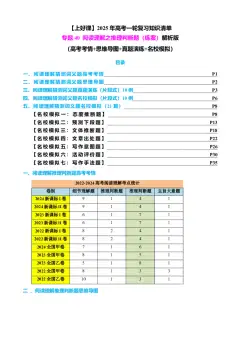
【上好课】2025年高考一轮复习知识清单
专题38 阅读理解之细节理解题(讲案)原卷版
(快问快答+思维导图+考法点拨+真题再练+名校模拟)
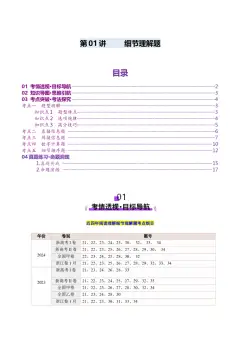
目录
一、阅读理解细节理解题快问快答 P1
二、阅读理解细节理解题高考考情 P2
三、阅读理解细节理解题命题特点 P2
四、阅读理解细节理解题命题规律 P2
五、阅读理解细节理解题考法点拨 P3
考法一:直接信息题 P 3
考法二:间接信息题 P 5
考法三:数据计算题 P 7
六、阅读理解细节理解题同义替换归纳 P 8
七、阅读理解细节理解题真题再练 P 10
八、阅读理解细节理解题名校模拟 P 13
一、阅读理解细节理解题快问快答
Q1:阅读理解细节理解题有什么特点?
A1:一是属于阅读基础题型,占比大,难度低,需要有满分意识,二是正确答案和原文是同义替换关系。
Q2:阅读理解细节理解题做题步骤如何?
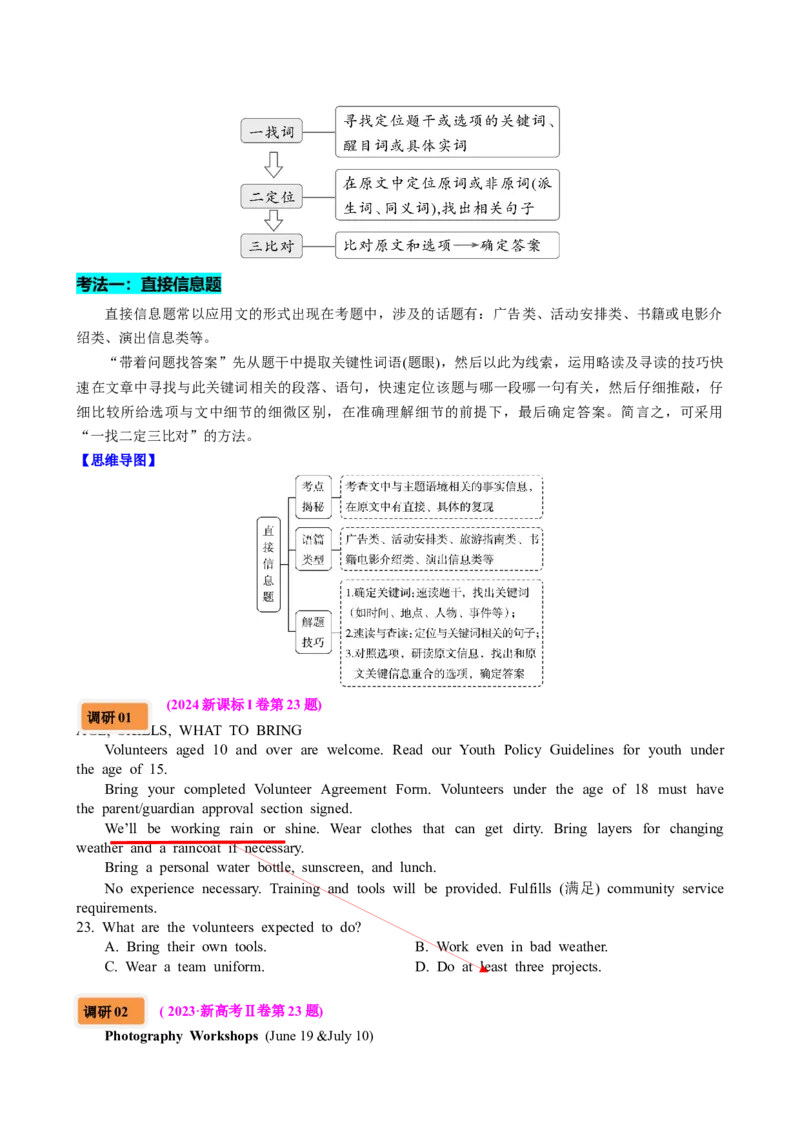
A2:一是“找词”--先从题干中提取关键性(题眼),二是“定位”--寻找与此关键词相关的段落、语句做
好标记,三是“比对”--仔细比对四个选项与文中细节的细微区别,最后确定答案。
Q3:如何把握选项与原文同义替换关系?
A3:同义替换有三种情况:一是同义词或近义词替换,二是主被动语态替换,三是单词与短语替换。不
管如何替换,终极目标是“形式改变,意思相同”。
Q4:如何提高阅读理解细节题正答率?
A4:一要掌握阅读理解细节理解题命题规律和选项特征,二要不断练习实践,积累经验,摸索出一套行
之有效的个性化做题模式,三要重视纠错,探寻错误原因,防止出现类似错误。
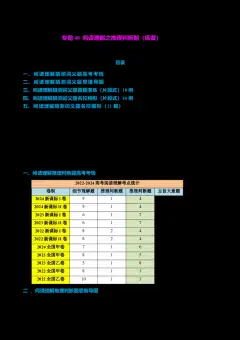
二、阅读理解细节理解题高考考情
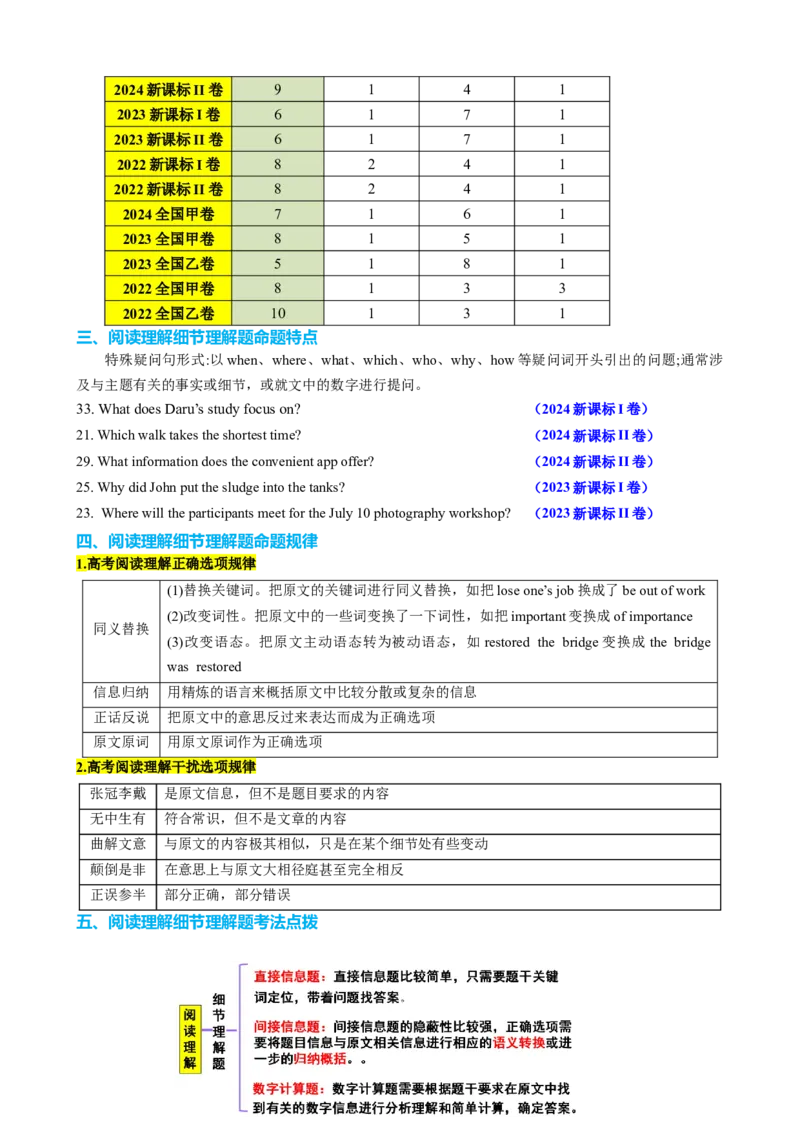
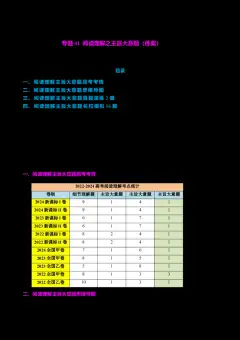
综合最近三年高考考情统计,高考15道四选一选择题以细节理解题和推理判断题为主,兼顾猜测
词义题和主旨大意题。细节理解题有时比较直接,理解字面意思即可答题;有时则较为间接,需要归纳
概括和推理才能答题。细节理解题占阅读理解总题量的60%左右,是最重要的得分点。
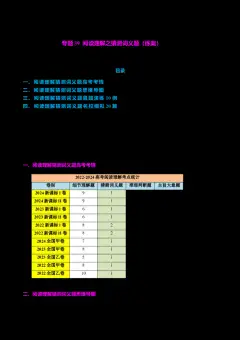
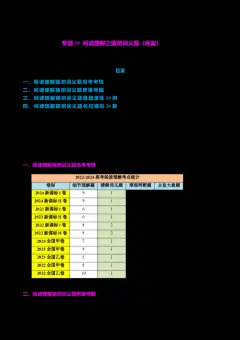
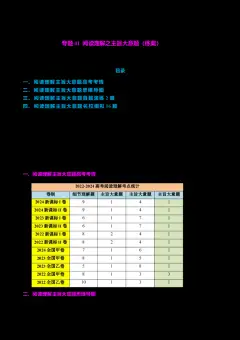
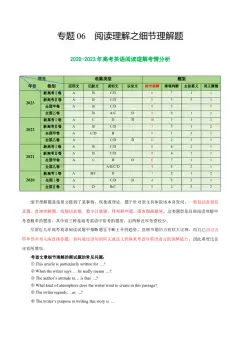
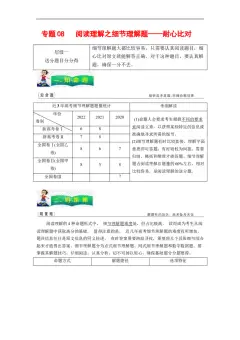
2022-2024高考阅读理解考点统计
卷别 细节理解题 猜测词义题 推理判断题 主旨大意题
2024新课标I卷 9 1 4 12024新课标II卷 9 1 4 1
2023新课标I卷 6 1 7 1
2023新课标II卷 6 1 7 1
2022新课标I卷 8 2 4 1
2022新课标II卷 8 2 4 1
2024全国甲卷 7 1 6 1
2023全国甲卷 8 1 5 1
2023全国乙卷 5 1 8 1
2022全国甲卷 8 1 3 3
2022全国乙卷 10 1 3 1
三、阅读理解细节理解题命题特点
特殊疑问句形式:以when、where、what、which、who、why、how等疑问词开头引出的问题;通常涉
及与主题有关的事实或细节,或就文中的数字进行提问。
33. What does Daru’s study focus on? (2024新课标I卷)
21. Which walk takes the shortest time? (2024新课标II卷)
29. What information does the convenient app offer? (2024新课标II卷)
25. Why did John put the sludge into the tanks? (2023新课标I卷)
23. Where will the participants meet for the July 10 photography workshop? (2023新课标II卷)
四、阅读理解细节理解题命题规律
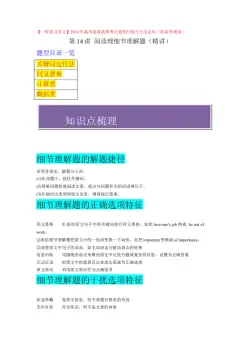
1.高考阅读理解正确选项规律
(1)替换关键词。把原文的关键词进行同义替换,如把lose one’s job换成了be out of work
(2)改变词性。把原文中的一些词变换了一下词性,如把important变换成of importance
同义替换
(3)改变语态。把原文主动语态转为被动语态,如restored the bridge变换成the bridge
was restored
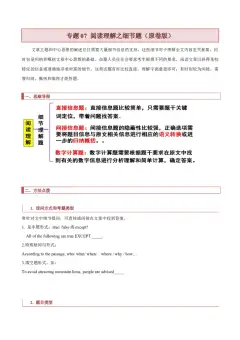
信息归纳 用精炼的语言来概括原文中比较分散或复杂的信息
正话反说 把原文中的意思反过来表达而成为正确选项
原文原词 用原文原词作为正确选项
2.高考阅读理解干扰选项规律
张冠李戴 是原文信息,但不是题目要求的内容
无中生有 符合常识,但不是文章的内容
曲解文意 与原文的内容极其相似,只是在某个细节处有些变动
颠倒是非 在意思上与原文大相径庭甚至完全相反
正误参半 部分正确,部分错误
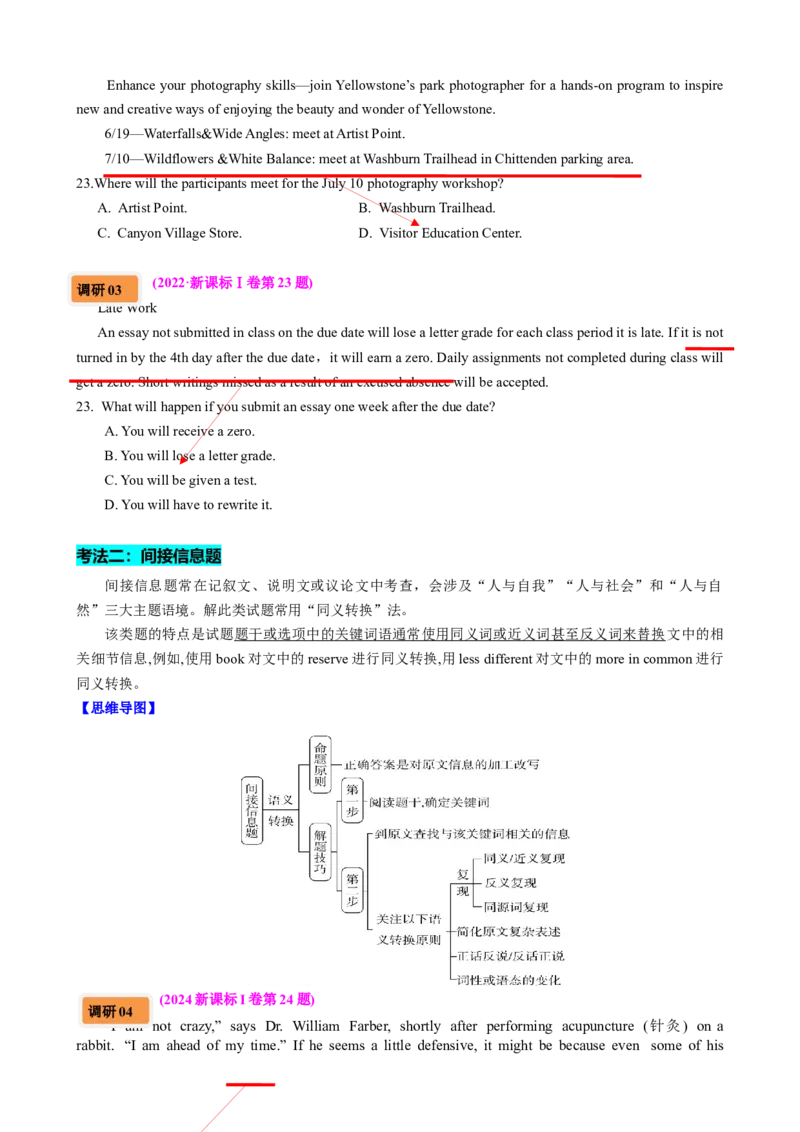
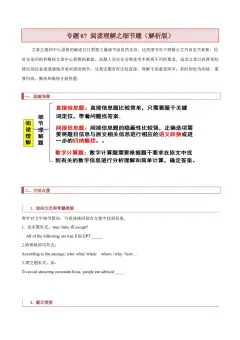
五、阅读理解细节理解题考法点拨考法一:直接信息题
直接信息题常以应用文的形式出现在考题中,涉及的话题有:广告类、活动安排类、书籍或电影介
绍类、演出信息类等。
“带着问题找答案”先从题干中提取关键性词语(题眼),然后以此为线索,运用略读及寻读的技巧快
速在文章中寻找与此关键词相关的段落、语句,快速定位该题与哪一段哪一句有关,然后仔细推敲,仔
细比较所给选项与文中细节的细微区别,在准确理解细节的前提下,最后确定答案。简言之,可采用
“一找二定三比对”的方法。
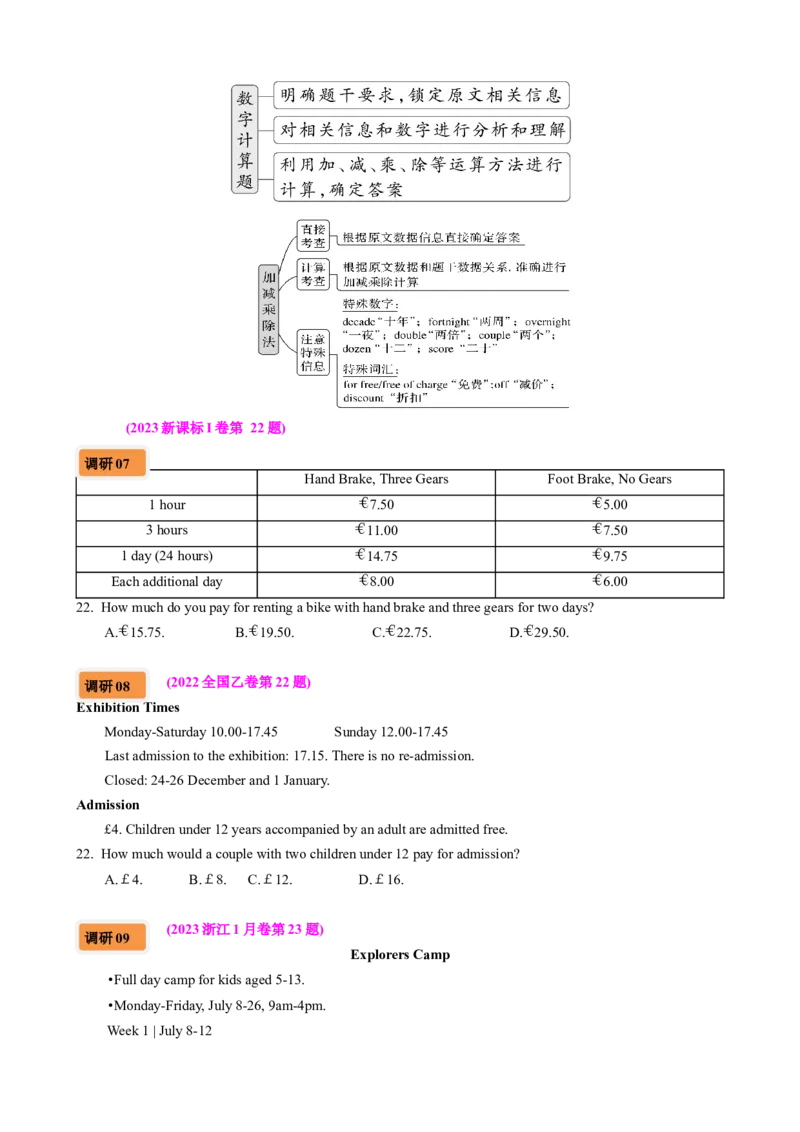
【思维导图】
(2024新课标I卷第23题)
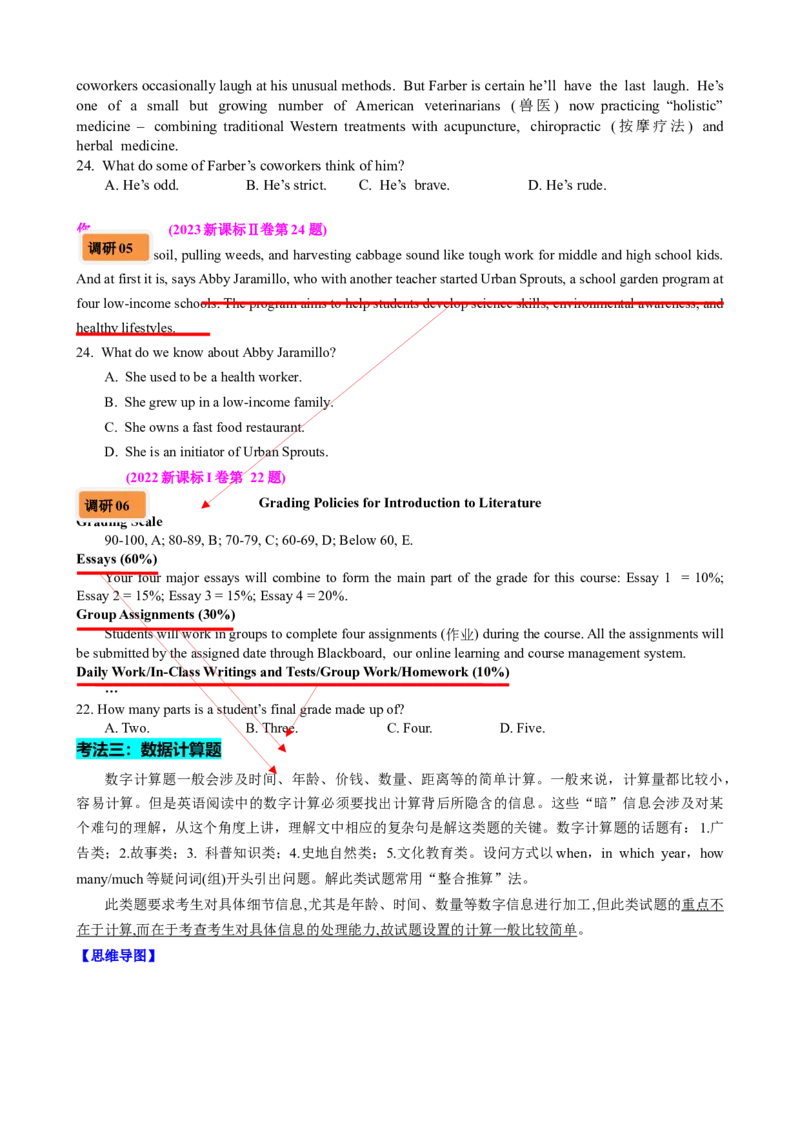
调研01
AGE, SKILLS, WHAT TO BRING
Volunteers aged 10 and over are welcome. Read our Youth Policy Guidelines for youth under
the age of 15.
Bring your completed Volunteer Agreement Form. Volunteers under the age of 18 must have
the parent/guardian approval section signed.
We’ll be working rain or shine. Wear clothes that can get dirty. Bring layers for changing
weather and a raincoat if necessary.
Bring a personal water bottle, sunscreen, and lunch.
No experience necessary. Training and tools will be provided. Fulfills (满足) community service
requirements.
23. What are the volunteers expected to do?
A. Bring their own tools. B. Work even in bad weather.
C. Wear a team uniform. D. Do at least three projects.
调研02 ( 2023·新高考Ⅱ卷第23题)
Photography Workshops (June 19 &July 10)Enhance your photography skills—join Yellowstone’s park photographer for a hands-on program to inspire
new and creative ways of enjoying the beauty and wonder of Yellowstone.
6/19—Waterfalls&Wide Angles: meet at Artist Point.
7/10—Wildflowers &White Balance: meet at Washburn Trailhead in Chittenden parking area.
23.Where will the participants meet for the July 10 photography workshop?
A. Artist Point. B. Washburn Trailhead.
C. Canyon Village Store. D. Visitor Education Center.
(2022·新课标Ⅰ卷第23题)
调研03
Late Work
An essay not submitted in class on the due date will lose a letter grade for each class period it is late. If it is not
turned in by the 4th day after the due date,it will earn a zero. Daily assignments not completed during class will
get a zero. Short writings missed as a result of an excused absence will be accepted.
23. What will happen if you submit an essay one week after the due date?
A. You will receive a zero.
B. You will lose a letter grade.
C. You will be given a test.
D. You will have to rewrite it.
考法二:间接信息题
间接信息题常在记叙文、说明文或议论文中考查,会涉及“人与自我”“人与社会”和“人与自
然”三大主题语境。解此类试题常用“同义转换”法。
该类题的特点是试题题干或选项中的关键词语通常使用同义词或近义词甚至反义词来替换文中的相
关细节信息,例如,使用book对文中的reserve进行同义转换,用less different对文中的more in common进行
同义转换。
【思维导图】
(2024新课标I卷第24题)
调研04
“I am not crazy,” says Dr. William Farber, shortly after performing acupuncture (针灸) on a
rabbit. “I am ahead of my time.” If he seems a little defensive, it might be because even some of hiscoworkers occasionally laugh at his unusual methods. But Farber is certain he’ll have the last laugh. He’s
one of a small but growing number of American veterinarians (兽医) now practicing “holistic”
medicine – combining traditional Western treatments with acupuncture, chiropractic (按摩疗法) and
herbal medicine.
24. What do some of Farber’s coworkers think of him?
A. He’s odd. B. He’s strict. C. He’s brave. D. He’s rude.
你 (2023新课标Ⅱ卷第24题)
调研05
Turning soil, pulling weeds, and harvesting cabbage sound like tough work for middle and high school kids.
And at first it is, says Abby Jaramillo, who with another teacher started Urban Sprouts, a school garden program at
four low-income schools. The program aims to help students develop science skills, environmental awareness, and
healthy lifestyles.
24. What do we know about Abby Jaramillo?
A. She used to be a health worker.
B. She grew up in a low-income family.
C. She owns a fast food restaurant.
D. She is an initiator of Urban Sprouts.
(2022新课标I卷第 22题)
调研06 Grading Policies for Introduction to Literature
Grading Scale
90-100, A; 80-89, B; 70-79, C; 60-69, D; Below 60, E.
Essays (60%)
Your four major essays will combine to form the main part of the grade for this course: Essay 1 = 10%;
Essay 2 = 15%; Essay 3 = 15%; Essay 4 = 20%.
Group Assignments (30%)
Students will work in groups to complete four assignments (作业) during the course. All the assignments will
be submitted by the assigned date through Blackboard, our online learning and course management system.
Daily Work/In-Class Writings and Tests/Group Work/Homework (10%)
…
22. How many parts is a student’s final grade made up of?
A. Two. B. Three. C. Four. D. Five.
考法三:数据计算题
数字计算题一般会涉及时间、年龄、价钱、数量、距离等的简单计算。一般来说,计算量都比较小,
容易计算。但是英语阅读中的数字计算必须要找出计算背后所隐含的信息。这些“暗”信息会涉及对某
个难句的理解,从这个角度上讲,理解文中相应的复杂句是解这类题的关键。数字计算题的话题有:1.广
告类;2.故事类;3. 科普知识类;4.史地自然类;5.文化教育类。设问方式以when,in which year,how
many/much等疑问词(组)开头引出问题。解此类试题常用“整合推算”法。
此类题要求考生对具体细节信息,尤其是年龄、时间、数量等数字信息进行加工,但此类试题的重点不
在于计算 , 而在于考查考生对具体信息的处理能力 , 故试题设置的计算一般比较简单 。
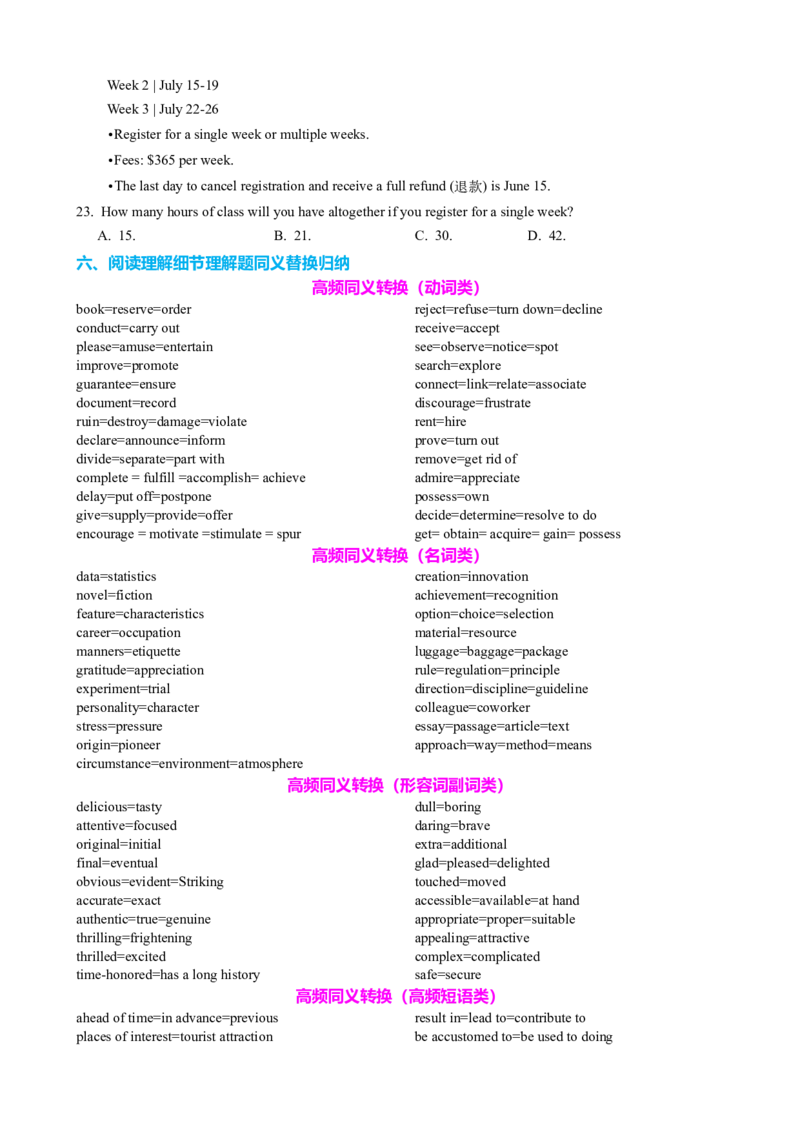
【思维导图】(2023新课标I卷第 22题)
Prices
调研07
Hand Brake, Three Gears Foot Brake, No Gears
1 hour 7.50 5.00
3 hours 11.00 7.50
1 day (24 hours) 14.75 9.75
Each additional day 8.00 6.00
22. How much do you pay for renting a bike with hand brake and three gears for two days?
A. 15.75. B. 19.50. C. 22.75. D. 29.50.
调研08
(2022全国乙卷第22题)
Exhibition Times
Monday-Saturday 10.00-17.45 Sunday 12.00-17.45
Last admission to the exhibition: 17.15. There is no re-admission.
Closed: 24-26 December and 1 January.
Admission
£4. Children under 12 years accompanied by an adult are admitted free.
22. How much would a couple with two children under 12 pay for admission?
A.£4. B.£8. C.£12. D.£16.
(2023浙江1月卷第23题)
调研09
Explorers Camp
•Full day camp for kids aged 5-13.
•Monday-Friday, July 8-26, 9am-4pm.
Week 1 | July 8-12Week 2 | July 15-19
Week 3 | July 22-26
•Register for a single week or multiple weeks.
•Fees: $365 per week.
•The last day to cancel registration and receive a full refund (退款) is June 15.
23. How many hours of class will you have altogether if you register for a single week?
A. 15. B. 21. C. 30. D. 42.
六、阅读理解细节理解题同义替换归纳
高频同义转换(动词类)
book=reserve=order reject=refuse=turn down=decline
conduct=carry out receive=accept
please=amuse=entertain see=observe=notice=spot
improve=promote search=explore
guarantee=ensure connect=link=relate=associate
document=record discourage=frustrate
ruin=destroy=damage=violate rent=hire
declare=announce=inform prove=turn out
divide=separate=part with remove=get rid of
complete = fulfill =accomplish= achieve admire=appreciate
delay=put off=postpone possess=own
give=supply=provide=offer decide=determine=resolve to do
encourage = motivate =stimulate = spur get= obtain= acquire= gain= possess
高频同义转换(名词类)
data=statistics creation=innovation
novel=fiction achievement=recognition
feature=characteristics option=choice=selection
career=occupation material=resource
manners=etiquette luggage=baggage=package
gratitude=appreciation rule=regulation=principle
experiment=trial direction=discipline=guideline
personality=character colleague=coworker
stress=pressure essay=passage=article=text
origin=pioneer approach=way=method=means
circumstance=environment=atmosphere
高频同义转换(形容词副词类)
delicious=tasty dull=boring
attentive=focused daring=brave
original=initial extra=additional
final=eventual glad=pleased=delighted
obvious=evident=Striking touched=moved
accurate=exact accessible=available=at hand
authentic=true=genuine appropriate=proper=suitable
thrilling=frightening appealing=attractive
thrilled=excited complex=complicated
time-honored=has a long history safe=secure
高频同义转换(高频短语类)
ahead of time=in advance=previous result in=lead to=contribute to
places of interest=tourist attraction be accustomed to=be used to doingprevent...from=keep...from=stop...from from one’s perspective=from one’s point of view
join in=take part in=participate in try doing=attempt to
=involve in=be engaged in be filled with=be charged with=be full of
get ready for=be prepared for run into=come across
focus on =concentrate on take the place of=replace
transform A into B=turn A into B from time to time=once in a while
in the long term=in the long run be caught in=be trapped in
hold on to=insist consist of =be made up of
take action=take measures=take steps to for a moment=for a while
keep in touch with=contact a collection of =a series of
deal with=cope with=handle with=address figure out=find out
at the same time=meanwhile bright up=light up
on the spot=on the scene roll around=turn up
be proud of=take pride in give...a lecture=deliver a speech
head into=leave for draw one’s attention=attract one’s attention
arrive at=reach=get to=approach be desperate for=desire for=be thirsty for
in spite of=despite in favor of=favorable
七、阅读理解细节理解题真题再练
演练 0 1 (2024新课标II卷B篇)
Do you ever get to the train station and realize you forgot to bring something to read? Yes, we all have our
phones, but many of us still like to go old school and read something printed.
Well, there’s a kiosk (小亭) for that. In the San Francisco Bay Area, at least.
“You enter the fare gates (检票口) and you’ll see a kiosk that is lit up and it tells you can get a one-minute, a
three-minute, or a five-minute story,” says Alicia Trost, the chief communications officer for the San Francisco
Bay Area Rapid Transit — known as BART. “You choose which length you want and it gives you a receipt-like
short story.”
It’s that simple. Riders have printed nearly 20,000 short stories and poems since the program was launched
last March. Some are classic short stories, and some are new original works.
Trost also wants to introduce local writers to local riders. “We wanted to do something where we do a call to
artists in the Bay Area to submit stories for a contest,” Trost says. “And as of right now, we’ve received about 120
submissions. The winning stories would go into our kiosk and then you would be a published artist.”
Ridership on transit (交通) systems across the country has been down the past half century, so could short
stories save transit?
Trost thinks so.
“At the end of the day all transit agencies right now are doing everything they can to improve the rider
experience. So I absolutely think we will get more riders just because of short stories,” she says.
And you’ll never be without something to read.
24. Why did BART start the kiosk program?
A. To promote the local culture. B. To discourage phone use.
C. To meet passengers’ needs. D. To reduce its running costs.
25. How are the stories categorized in the kiosk?
A. By popularity. B. By length.
C. By theme. D. By language.
26. What has Trost been doing recently?
A. Organizing a story contest. B. Doing a survey of customers.
C. Choosing a print publisher. D. Conducting interviews with artists.
27. What is Trost’s opinion about BART’s future?
A. It will close down. B. Its profits will decline.
C. It will expand nationwide. D. Its ridership will increase.演练02
(2024全国甲卷B篇)
The Saint Lukas train doesn’t accept passengers—it accepts only the sick. The Saint Lukas is one of five
government-sponsored medical trains that travel to remote towns in central and eastern Russia. Each stop lasts an
average of two days, and during that time the doctors and nurses on board provide rural(乡村)populations with
basic medical care, X-ray scans and prescriptions.
“People started queuing to make an appointment early in the morning,” says Emile Ducke, a German
photographer who traveled with the staff of the Saint Lukas for a two-week trip in November through the vast
regions(区域)of Krasnoyarsk and Khakassia.
Russia’s public health care service has been in serious need of modernization. The government has struggled
to come up with measures to address the problem, particularly in the poorer, rural areas east of the Volga River,
including arranging doctor’s appointments by video chat and expanding financial aid programs to motivate
doctors to practice medicine in remote parts of the country like Krasnoyarsk.
The annual arrival of the Saint Lukas is another attempt to improve the situation. For 10 months every year,
the train stops at about eight stations over two weeks, before returning to the regional capital to refuel and
restock(补给). Then it starts all over again the next month. Most stations wait about a year between visits.
Doctors see up to 150 patients every day. The train’s equipment allows for basic checkups. “I was very
impressed by the doctors and their assistants working and living in such little space but still staying focused and
very concerned,” says Ducke. “They were the best chance for many rural people to get the treatment they want. ”
28. How is the Saint Lukas different from other trains?
A. It runs across countries. B. It reserves seats for the seniors.
C. It functions as a hospital. D. It travels along a river.
29. What can we infer from paragraph 3 about Krasnoyarsk?
A. It is heavily populated. B. It offers training for doctors.
C. It is a modern city. D. It needs medical aid.
30. How long can the Saint Lukas work with one supply?
A. About a year. B. About ten months.
C. About two months. D. About two weeks.
31. What is Ducke’s attitude toward the Saint Lukas’ services?
A. Appreciative. B. Doubtful C. Ambiguous. D. Cautious.
演练03 (2023新课标I卷B篇)
When John Todd was a child, he loved to explore the woods around his house, observing how nature solved
problems. A dirty stream, for example, often became clear after flowing through plants and along rocks where tiny
creatures lived. When he got older, John started to wonder if this process could be used to clean up the messes
people were making.
After studying agriculture, medicine, and fisheries in college, John went back to observing nature and asking
questions. Why can certain plants trap harmful bacteria (细菌)? Which kinds of fish can eat cancer-causing
chemicals? With the right combination of animals and plants, he figured, maybe he could clean up waste the way
nature did. He decided to build what he would later call an eco-machine.
The task John set for himself was to remove harmful substances from some sludge (污泥). First, he
constructed a series of clear fiberglass tanks connected to each other. Then he went around to local ponds and
streams and brought back some plants and animals. He placed them in the tanks and waited. Little by little, these
different kinds of life got used to one another and formed their own ecosystem. After a few weeks, John added the
sludge.
He was amazed at the results. The plants and animals in the eco-machine took the sludge as food and began
to eat it! Within weeks, it had all been digested, and all that was left was pure water.Over the years, John has taken on many big jobs. He developed a greenhouse — like facility that treated
sewage (污水) from 1,600 homes in South Burlington. He also designed an eco-machine to clean canal water in
Fuzhou, a city in southeast China.
“Ecological design” is the name John gives to what he does. “Life on Earth is kind of a box of spare parts for
the inventor,” he says. “You put organisms in new relationships and observe what’s happening. Then you let these
new systems develop their own ways to self-repair.”
24. What can we learn about John from the first two paragraphs?
A. He was fond of traveling. B. He enjoyed being alone.
C. He had an inquiring mind. D. He longed to be a doctor.
25. Why did John put the sludge into the tanks?
A. To feed the animals. B. To build an ecosystem.
C. To protect the plants. D. To test the eco-machine.
26. What is the author’s purpose in mentioning Fuzhou?
A. To review John’s research plans. B. To show an application of John’s idea.
C. To compare John’s different jobs. D. To erase doubts about John’s invention.
27. What is the basis for John’s work?
A. Nature can repair itself. B. Organisms need water to survive.
C. Life on Earth is diverse. D. Most tiny creatures live in groups.
八、阅读理解细节理解题名校模拟
【模拟01】(2024·四川达州·二模)
STEM Competitions for Students
NSTA ExploraVision
Are you interested in what the future holds? Consider Explora Vision’s STEM (science, technology,
engineering & mathematics) competition. Working in teams of two to four, students will research a particular
technology and assess the ways in which it may impact lives moving forward. Participants are required to write a
paper and draw web pages communicating their vision.
Grades: 7th-9th and 10th-12th
Competition Type: Regional and nationaleCyberMission
You can participate in this competition without leaving the house. eCyberMission is a web-based con test in
which participants — working in teams of two to four students — use science, math and technology to solve
problems facing their communities. First-place winners receive $1,000.
Grades:9th
Competition Type: Regional, state and nationalTEAMS Competition
Held annually, TEAMS invites students to use their engineering talent to contribute to the community.
Working in groups of two to four students, participants complete real-life engineering challenges. The competition
includes multiple-choice questions, an essay and a design-build component.
Grades: 9th-12th
Competition Type: State and nationalThe Conrad Challenge
In this challenge, participants work in teams of two to five students to develop products or services inresponse to key issues facing people around the world. The Conrad Challenge empowers students to take control
of their learning and apply it to real-life situations. Winners are eligible (有资格的) for scholarships, patent
assistance and aid in creating companies.
Grades: 9th-12th
Competition Type: International
1.What does NSTA Explora Vision’s STEM competition focus on?
A.Engineering innovation.
B.Students’ paper writing skills.
C.New technology shaping the future.
D.Students’ ability in web page design.
2.What do the four STEM competitions have in common?
A.Winners will get a big cash prize.
B.They are all national competitions.
C.Participants are required to work in teams.
D.Participants must solve real-life problems.
3.Which competition involves foreign students?
A.NSTA ExploraVision. B.eCvberMission.
C.TEAMS Competition. D.The Conrad Challenge.
【模拟02】(2024·江苏宿迁·一模)
I was surprised to find the congestion (拥塞) outside Layla’s primary school was unusually absent—I’d
driven right into a parking space, and I was on time, for once. The school bell rang, and in a moment a stream of
children made their way through the gate. But something was different—the kids were piling into vehicles in
threes and fours.
Before I could enquire my daughter Layla, Mr Trent, the deputy head, approached. “Mrs Pavis, did you not
read our letter?” Letter? What letter? I had a history of not looking out for them, and not reading them in most
cases. “The letter? Of course. It must have just slipped my mind—I’ve been away with work.”
Now I was digging around in Layla’s messy schoolbag at home. Eventually, I found several letters, all
addressing the same topic—parking outside the school gates. Apparently with some parents parking illegally, the
police were about to get involved. “Why didn’t you give me these letters?” I demanded. Layla shrugged. “I
forgot.” I was about to launch into a severe lecture when it occurred to me that I had always forgotten—I had
forgotten to give Layla her money for cookery that morning and forgotten to hang out the kids’ washed clothes.
I contained myself and figured out that they wanted the parents to car-pool (拼车). I spent the next half
hour ringing round Layla’s friends’ parents, enquiring if they would like to car-pool with us. Unfortunately, they
were all sorted. It was my own fault—I should have read those letters ages ago. “Er... I overheard others talking
about it,” Layla said, “They said they didn’t know who would car-pool with us, because we’re always late.” I
flushed instantly. We were a disorganised family, and I was the one to blame.
I resolved to change. With responsibility for my kids, I find I am never, ever late. It’s good for Layla and
for her older brothers, and it’s good for me, because now I never leave the house unprepared. I’ve even started
checking the kids’ schoolbags for notes from school.4.What did the author notice when the school was over?
A.It was hard to find a parking space. B.Children were picked up in groups.
C.Her daughter was absent from class. D.She arrived much earlier than others.
5.What stopped the author criticizing her daughter?
A.The reflection of her daily routine. B.The realization of her carelessness.
C.The knowledge of her kid’s character. D.The awareness of her kid’s depression.
6.Why did others refuse to car-pool with them according to Layla?
A.Because they contacted them late. B.Because they failed to keep the house tidy.
C.Because they couldn’t be on time. D.Because they ignored the school’s request.
7.What can we learn from the passage?
A.Action creates motivation. B.Mother’s love never changes.
C.It’s never too late to mend. D.Patience is the key to success.
【模拟03】(2024·广东江门·二)
Every day, people share more than 2 billion photos on the Internet. While visual content provides a fun and
expressive way for people to communicate online, consuming and creating it poses challenges for people who are
blind or severely visually impaired (受损的). With more than 39 million people who are blind, and over 246
million who have a severe visual impairment, many people may feel excluded from the conversation around
photos on the Internet. The researchers from Harvard University want to build technology that helps the blind
community appreciate photos in the same way others enjoy them.
Automatic alternative text is a new development that generates a description of a photo using advancements
in object recognition technology. People using screen readers on digital devices will hear a list of items a photo
may contain as they click photos on the Internet. Before today, people using screen readers would only hear the
name of the person who shared the photo, followed by the term “photo” when they came upon an image. Now
they can offer a richer description of what’s in a photo thanks to automatic alternative text. For instance, someone
could now hear “an image containing three people, smiling, outdoors”.
This is possible because of Harvard University’s object recognition technology, which is based on a
network that has billions of parameters and is trained with millions of examples. Each advancement in object
recognition technology means that the researchers will be able to make technology even more accessible to more
people. When people are connected, they can achieve extraordinary things as individuals and as a community, and
when everyone is connected, we all benefit from it.
They are launching automatic alternative text first on cellphone screen readers set to English, but they plan
to add this functionality for other languages and platforms soon. While this technology is still nascent, using its
current capabilities to describe photos is an important step toward providing our visually impaired community
with the same benefits and enjoyment that everyone else gets from photos.
8.Why is the technology launched?
A.There are so many photos on the Internet.
B.There are many people suffering from blindness.
C.Some digital devices are in need of the technology.
D.People with vision problems fail to enjoy photos online.9.What is the advantage of the technology over the previous one?
A.It can offer more photos to blind people.
B.It can describe more about online photos.
C.It can recognize the person who shares photos.
D.It can satisfy the common needs of blind people.
10.What is the key to promoting the technology?
A.The photos on the Internet. B.People’s care for blind people.
C.People’s connections to each other. D.The object recognition technology.
11.Which can best explain the underlined word “nascent” in the last paragraph?
A.Emerging. B.Reliable. C.Powerful. D.Conventional.