MBA英语面试全攻略
MBA大师:余美丽目录
一、部分院校MBA考情分析
二、MBA版的自我介绍模板
三、部分高频问题的MBA版本模板
四、MEM/MTA专业的核心问题
五、如何应对面试翻译题及真题案例
六、随机问题回答技巧及案例
七、组面技巧及总结模板
八、圆场话术五、如何应对面试翻译题及真题案例
浙江大学MBA:
复试内容:
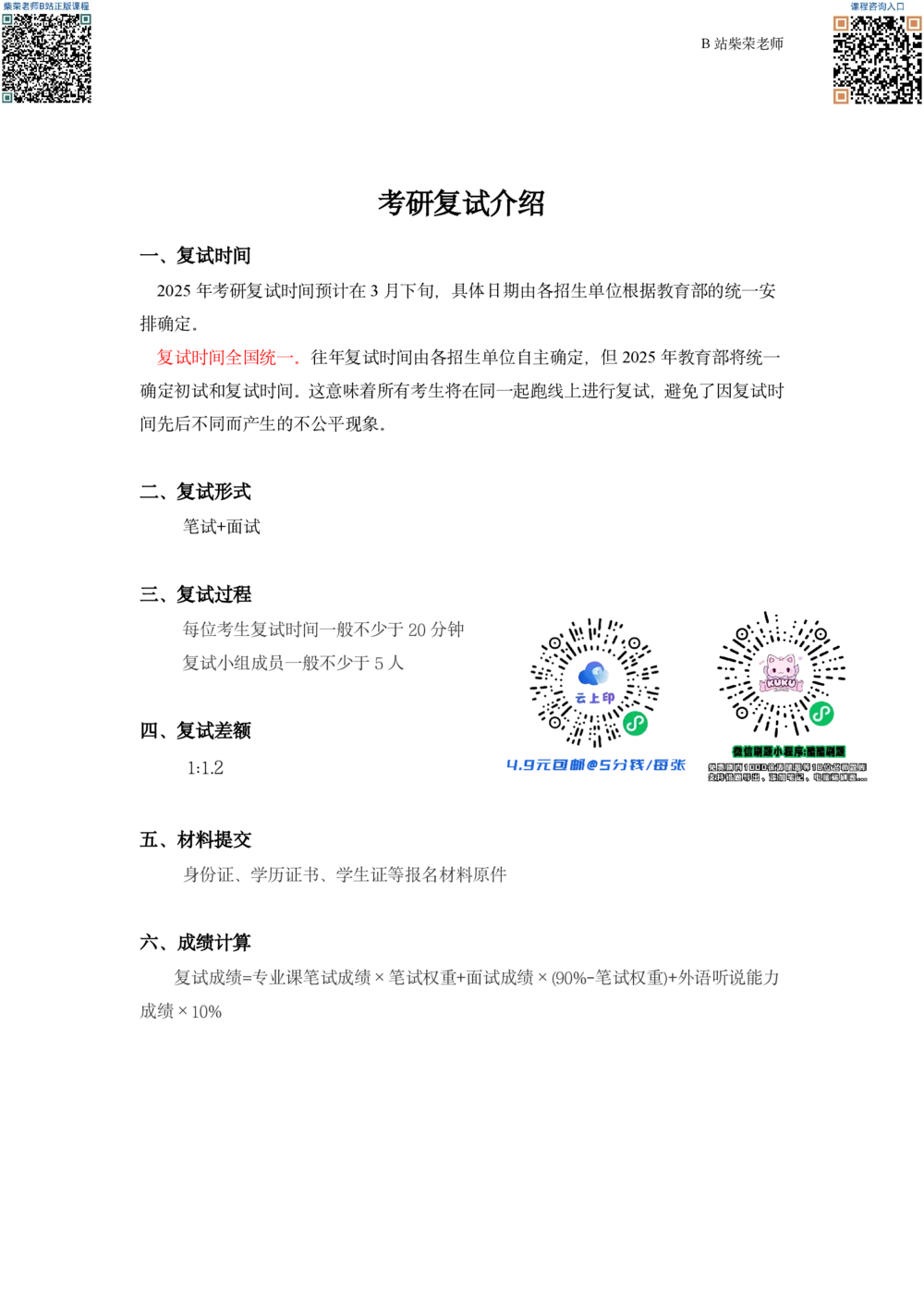
(1)个人面试含综合素质、英语。
综合素质包括中文自我介绍以及问题回答。问题的范围会涉及到工作内容、职业规划
以及一些常规性问题。英语按往年情况即一段英文,先英文朗读,继而中文翻译。此
环节一般每位考生不少于20分钟。
(2)政治理论
官网会提前公布复习参考资料,笔试为开卷形式,考生仅可携带纸质材料进入考场。五、如何应对面试翻译题及真题案例
朗读+翻译(提问)策略分析:
部分院校会要求学生先将材料进行通读,之后在短时间内对材料内容
进行概述(虽然这种类型叫做翻译,但不建议逐句翻译),或通读文
章之后,面试官会就文章内容进行提问。通过这种测试方式能够真实
反映出学生的英语朗读和理解能力。
在进行朗读翻译时,千万不要因为某个单词不认识而慌神。抓住文章
的主旨,不必每个词都翻译出来。尽可能多的记住材料的信息,从而
方便在复述时能够流畅地组织出语言。五、如何应对面试翻译题及真题案例
浙大真题:
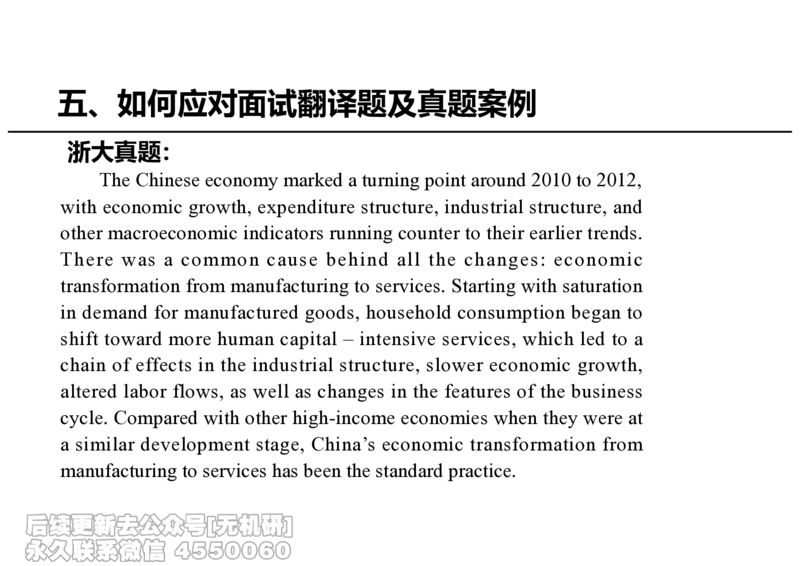
The Chinese economy marked a turning point around 2010 to 2012,
with economic growth, expenditure structure, industrial structure, and
other macroeconomic indicators running counter to their earlier trends.
There was a common cause behind all the changes: economic
transformation from manufacturing to services. Starting with saturation
in demand for manufactured goods, household consumption began to
shift toward more human capital – intensive services, which led to a
chain of effects in the industrial structure, slower economic growth,
altered labor flows, as well as changes in the features of the business
cycle. Compared with other high-income economies when they were at
a similar development stage, China’s economic transformation from
manufacturing to services has been the standard practice.五、如何应对面试翻译题及真题案例
浙大真题:
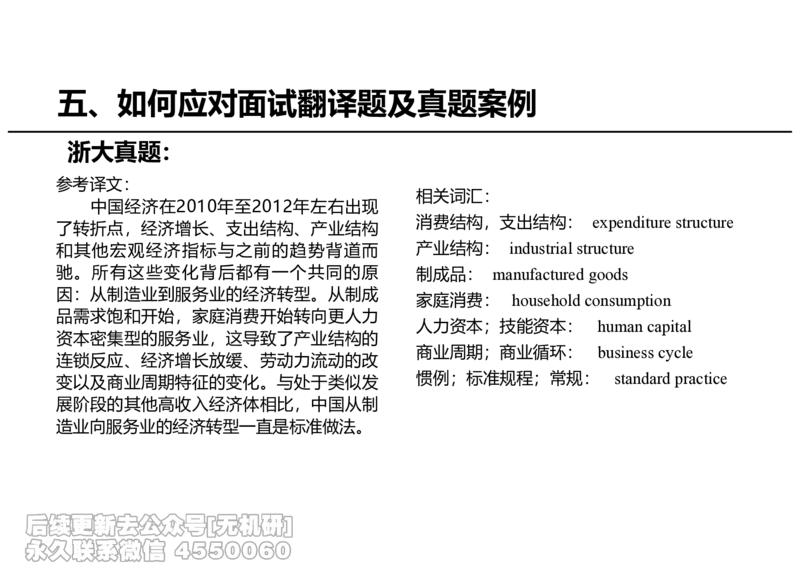
参考译文:
相关词汇:
中国经济在2010年至2012年左右出现
消费结构,支出结构: expenditure structure
了转折点,经济增长、支出结构、产业结构
和其他宏观经济指标与之前的趋势背道而 产业结构: industrial structure
驰。所有这些变化背后都有一个共同的原 制成品: manufactured goods
因:从制造业到服务业的经济转型。从制成
家庭消费: household consumption
品需求饱和开始,家庭消费开始转向更人力
人力资本;技能资本: human capital
资本密集型的服务业,这导致了产业结构的
商业周期;商业循环: business cycle
连锁反应、经济增长放缓、劳动力流动的改
惯例;标准规程;常规: standard practice
变以及商业周期特征的变化。与处于类似发
展阶段的其他高收入经济体相比,中国从制
造业向服务业的经济转型一直是标准做法。五、如何应对面试翻译题及真题案例
贵州大学真题:
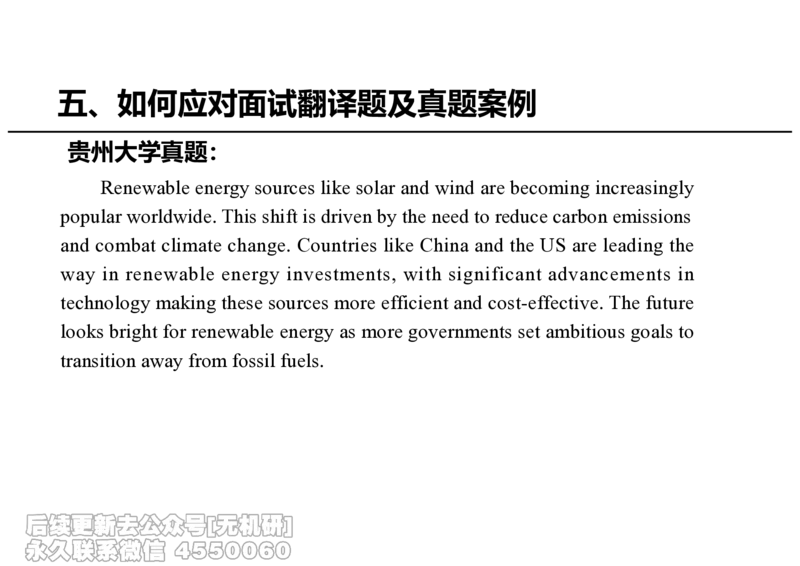
Renewable energy sources like solar and wind are becoming increasingly
popular worldwide. This shift is driven by the need to reduce carbon emissions
and combat climate change. Countries like China and the US are leading the
way in renewable energy investments, with significant advancements in
technology making these sources more efficient and cost-effective. The future
looks bright for renewable energy as more governments set ambitious goals to
transition away from fossil fuels.五、如何应对面试翻译题及真题案例
贵州大学真题:
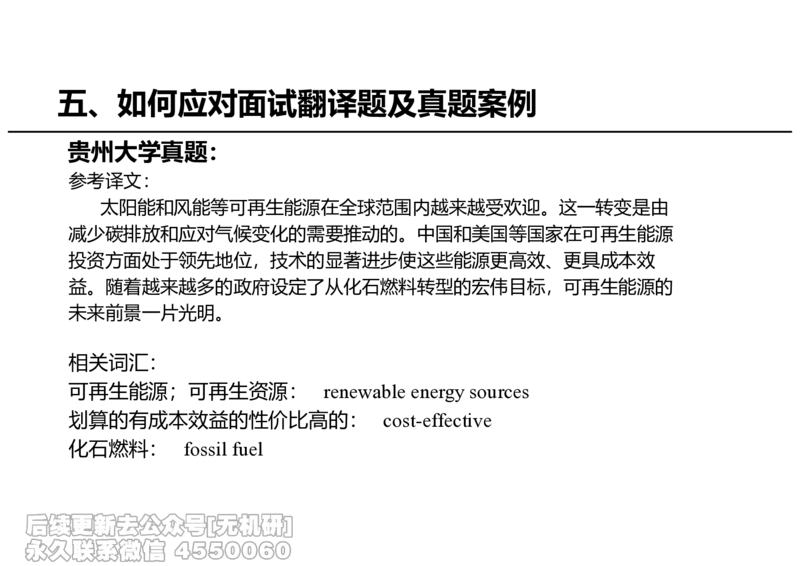
参考译文:
太阳能和风能等可再生能源在全球范围内越来越受欢迎。这一转变是由
减少碳排放和应对气候变化的需要推动的。中国和美国等国家在可再生能源
投资方面处于领先地位,技术的显著进步使这些能源更高效、更具成本效
益。随着越来越多的政府设定了从化石燃料转型的宏伟目标,可再生能源的
未来前景一片光明。
相关词汇:
可再生能源;可再生资源: renewable energy sources
划算的有成本效益的性价比高的: cost-effective
化石燃料: fossil fuel六、随机问题回答技巧及案例
知识点回顾:高频问题有哪三个提问方向?
1. 基本信息 Basic Information
2. 工作经历 Work Experience
3. 未来发展 Future Development
除此之外,面试官还经常会就考生的日常工作或生活,以及材料中所展
示出的内容进行更深层次的挖掘提问,我们把这类问题统称为即兴提问。
部分院校还会提问与此次面试完全无关的英语问题,并以此来测试学生
真实的英语能力。本节我们主要讨论这两类的问题。六、随机问题回答技巧及案例
常规问题的追问:
第一个问题:
Please introduce your hometown.
追问:
Do you prefer to work in Beijing or your homwtown?(北漂)
回答思路:
1. 想一想目前生活的城市和家乡的区别:
目前生活的城市:机遇更多、发展更快、收入更高,但压力大、缺少归属感等
家乡:生活安逸、压力小、家人支持,但缺少机会、没有专业发展等
2. 自己更适合在哪里工作或结合现阶段的人生目标来决定选择在哪里发展。六、随机问题回答技巧及案例
常规问题的追问:
第一个问题:
Please introduce your hometown.
追问:
Do you prefer to work in Beijing or your homwtown?(北漂)
Professor, thank you for your question. That’s a good question.(表达礼
数,恭维对方的同时给自己争取一点点思考的时间) If I can work in a
much smaller city like my hometown, my life would be much easier, and I
would feel less pressure. I can even spend more time taking care of my
parents. But I still want to work in Beijing to strive for better development
and make greater contribution. Besides, my major is something related to the
AI, there is no suitable job for me in a small city.六、随机问题回答技巧及案例
常规问题的追问:
第一个问题:
Please introduce your hometown.
追问:
Do you prefer to work in Beijing or your homwtown?(北漂)
教授,谢谢你的提问。这是一个好问题。如果我能在像家乡这样
的小城市工作,我的生活会轻松得多,压力也会更小。我甚至可以花
更多的时间照顾我的父母。但我仍然想在北京工作,争取更好的发展,
做出更大的贡献。此外,我的专业与人工智能有关,在一个小城市没
有适合我的工作。六、随机问题回答技巧及案例
关于日常工作的提问:
• What is the biggest difficulty/challenge in your career so far?
• When you are managing your team/company, have you ever met any
difficulties or challenges?
回答思路:
1. 首先用一两句话来引入主题,说明你正在谈论的是你职业生涯中遇到的最大困难或
挑战;
2. 具体描述你遇到的困难或挑战,包括你在哪个环境、哪个项目中遇到了什么问题;
3. 描述你是如何应对并克服了这些挑战,以及在应对过程中你学到了什么。六、随机问题回答技巧及案例
回答范例:
When I started to manage my team at the beginning, I do have encountered
various difficulties and challenges. One of the most significant ones was leading
a team with diverse personalities and skill sets. Each team member had their
unique strengths and weaknesses, and it was my responsibility to bring everyone
together to achieve our objectives.
To overcome this challenge, I tried several ways. Firstly, I ensured open
communication channels where everyone was encouraged to share their ideas
and feedback. This helped in understanding different perspectives and opinions.
Secondly, I emphasized on team building activities to strengthen relationships
and foster better cooperation.
Overall, this experience taught me the importance of effective leadership
and communication in managing a team. Through this challenge, I have grown
as a leader and have better understanding of the dynamics of team management.六、随机问题回答技巧及案例
回答范例:
当我刚开始管理我的团队时,我确实遇到了各种困难和挑战。其中最重要的
一点是领导一个具有不同个性和技能的团队。每个团队成员都有自己独特的优势
和劣势,我有责任让每个人团结起来实现我们的目标。
为了克服这个挑战,我尝试了几种方法。首先,我确保了开放的沟通渠道,
鼓励每个人分享他们的想法和反馈。这有助于理解不同的观点和观点。其次,我
非常重视团队建设活动,并加强了团队成员之间的练习,促进了更好的合作。
总的来说,这段经历教会了我有效领导和沟通在管理团队中的重要性。通过
这次挑战,我成长为一名领导者,对团队管理的动态有了更好的了解。六、随机问题回答技巧及案例
随机问题:
论述类
Is it necessary for young children to take art classes?
(上海交通大学安泰学院)
小孩子上艺术课(培训班)有没有必要?
回答思路:
1.对于这个观点,我是支持还是反对(观点并不重要,重要的是能自圆其说);
2.我支持或反对的原因是什么(最好不止一点);
3.总结并再次表明观点。六、随机问题回答技巧及案例
支持 反对
Opinion I think it is necessary for children to take art
I think children shouldn’t have art classes.
观点 classes.
Reason 1 The effect of early learning systematic
Learning art can cultivate children’s creativity.
论点 1 knowledge is not obvious.
Learning art encourages children to see the
Evidence 1 Children's understanding and memory are
world with unique eyes, so as to be more
论据 1 in the developing stage…
creative.
Reason 2 Too many lessons will take up children’s
Learning art can improve their taste of beauty.
论点 2 playing time.
Evidence 2 It’s a good way to teach children what beauty This will make children lose their original
论据 2 is and how to discover the beauty of life. interest and even become unhappy.
Opinion Taking art classes has many benefits for Taking art classes is a waste of time and
观点 children. money.六、随机问题回答技巧及案例
参考例文(支持):
I think it is necessary for children to take art classes.
Learning art can cultivate children‘s creativity. Learning art encourages
children to see the world with unique eyes, so as to be more creative.
Learning art can also improve their taste of beauty. It’s a good way to
teach children what beauty is and how to discover the beauty of life.
To conclude, taking art classes has many benefits for children.
我认为孩子们上美术课是必要的。学习艺术可以培养孩子的创造
力。学习艺术鼓励孩子们用独特的眼光看待世界,从而更有创造
力。学习艺术也可以提高他们的审美情趣。这是教孩子什么是美以
及如何发现生活之美的好方法。
总之,上艺术课对孩子们有很多好处。六、随机问题回答技巧及案例
参考例文(反对):
I think children shouldn’t have art classes.
The effect of early learning systematic knowledge is not obvious. Children’s
understanding and memory are in the developing stage, they won’t be able to
remember and understand the knowledge very well.
Too many lessons will take up children’s playing time. This will make children
lose their original interest and even become unhappy.
All in all, taking art classes is a waste of time and money.
我认为孩子们不应该上美术课。早期学习系统知识的效果不明显。儿童的理
解和记忆处于发展阶段,他们将无法很好地记住和理解知识。太多的课会占
用孩子们的玩耍时间。这会让孩子失去最初的兴趣,甚至变得不快乐。
总而言之,上艺术课是浪费时间和金钱。六、随机问题回答技巧及案例
随机问题:
叙述类
If you were given a million dollars, what will you do?
(中山大学)
结合你的工作,谈一谈乡村振兴如何展开?
回答思路:(答案不重要,重要的是不要紧张,保持冷静大胆发挥。注意要有
清晰的条理并一定程度上体现自己的价值观)
1.理解问题:面试官可能想了解你的价值观、目标和决策能力。
2.设定目标:选择一个明确的目标(如社会贡献、感恩家庭或个人愿望)。
具体行动:描述你将如何使用这笔钱来实现目标。
总结:强调你的选择如何体现你的价值观或未来规划。六、随机问题回答技巧及案例
If I were given a million dollars, I would use it to do three things.
First, I would donate to charitable causes, especially those focused on education and
healthcare. I think these areas can make a significant impact on society. Second, I would
allocate some of the money to my family, ensuring their happiness and well-being. They
raised me, and I want to give back to them. Lastly, I would use the remaining money to
travel around the world. I want to see beautiful landscapes and experience the charm of
different cultures. This has been my dream for many years.
Overall, I would use the money to create happiness for myself and others, while also
contributing to the greater good.
如果给我一百万美元,我会用它做三件事。
首先,我会捐给慈善事业,尤其是那些专注于教育和医疗保健的慈善事业。我认为这些
领域可以对社会产生重大影响。其次,我会分配一部分给我的家人保证他们的幸福生活。
他们养育了我,我想回报他们。最后,我会用剩下的钱环游世界。我想看看美丽的风景,
体验不同文化的魅力。这是我多年来的梦想。
总的来说,我会用这笔钱为自己和他人创造幸福,同时也为更大的利益做出贡献。七、组面技巧及总结模板
“无领导小组讨论”形式:
小组成员随便发言,不设定主持人,不限定每人的发言次数,考官通过考生
在发言中展现个人的才能或管理潜质。考生通常是6人一个小组,考官有3位。
特别注意的是,“无领导小组讨论”意味着大家彼此平等,不设主持人,所
以讨论是不要出来当“领导”,或以其他形式安排其他人的工作。
“无领导小组讨论”流程:
1. 讨论一个案例或话题(共35分钟左右)
2. 阅读并构思案例(7分钟)
3. 中文讨论(23分钟)
4. 英文总结(5分钟)七、组面技巧及总结模板
第一个发言:(简单介绍议题、陈述观点)
参考模板:
Good morning, distinguished professors and my teammates.
Now I will be the first one to briefly summarize the discussion. What
this case was talking about is that ________. During our discussion, our
teammates have made many different ideas/solutions/opinions from their
own aspects. Finally, we have reached an agreement that ________.
First, Reason 1 ________. Evidence ________. Second, Reason 2
________. Evidence ________. (Third, …)
To sum up, we all believe that ________. However, we cannot deny that
________. By doing so we can make sure that ________.七、组面技巧及总结模板
其他序号发言:(简单对前面的人表示赞同,提一下观点)
参考模板:
Thanks for the previous speakers.
As we were talking, the problem is very pressing and urgent. So, I strongly
agree that ________. Otherwise, ________.
First, Reason 1 ________. Evidence ________. Second, Reason 2 ________.
Evidence ________. (Third, …)
In conclusion, it is interesting to note that most of us finally agree upon the
same solution that ________.八、圆场话术
听懂了,但又没完全听懂
Sorry, professor. I didn’t quite catch your question. Could you
please repeat the question? Thank you.
不好意思,教授。我没有太听清您的问题。能麻烦您再说一遍吗?谢谢。八、圆场话术
能听懂,不会说
Sorry, professor. I can understand your question. But my English is
not so good/I haven’t use my English since graduation. It’s too hard
for me. Could you please change a question for me? Thank you.
不好意思,教授。我能够听懂您的问题。但我的英语确实不太好/我毕业后
就没说过英语,这个问题对于我来说太难了。能麻烦您换个问题吗?谢谢。八、圆场话术
完全没听懂
Sorry, professor. I really don’t understand your question.
Could you please change a question for me? Thank you.
不好意思,教授。我实在听不懂您的问题。能麻烦您换
个问题吗?谢谢。八、圆场话术
担心自己的回答过于简单
在回答之前:
Thank you, professor. I haven’t use my English since graduation. So
it’s so hard for me to answer such a question and I am not sure if I
could answer it well. But I will try my best to answer the question.
谢谢您,教授。我毕业后就没用过英语。因此,回答这样一个问题对我来
说有些困难,我不确定我是否能很好地回答。但我会尽力回答这个问题。八、圆场话术
担心自己的回答过于简单
在回答之后:
Thank you, professor. I am not very good at this, so my answer may be
not perfect. I will study hard to make this answer better in the future.
谢谢您,教授。我不太擅长这个,所以我的答案可能并不完美。我会努力
学习,在将来给您一个更好的答案。Thanks for watching