文档文本内容
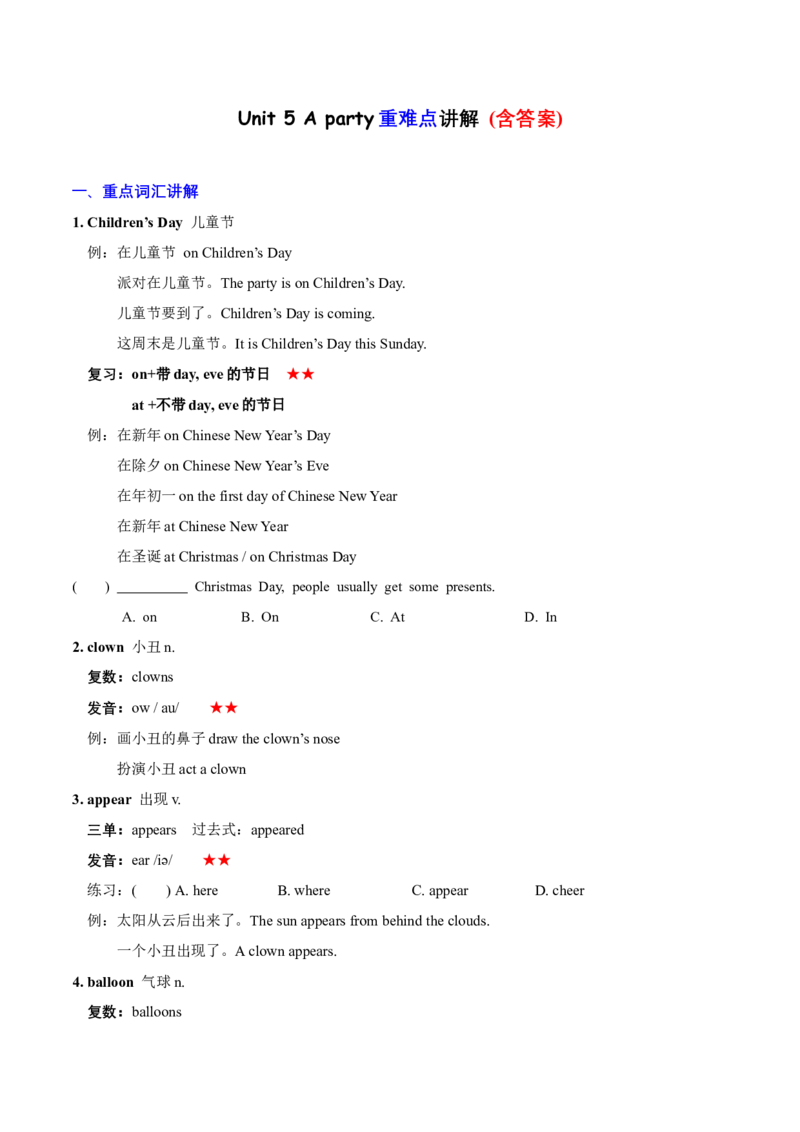
Unit 5 A party重难点讲解 (含答案)
一、重点词汇讲解
1. Children’s Day 儿童节
例:在儿童节 on Children’s Day
派对在儿童节。The party is on Children’s Day.
儿童节要到了。Children’s Day is coming.
这周末是儿童节。It is Children’s Day this Sunday.
复习:on+带day, eve的节日 ★★
at +不带day, eve的节日
例:在新年on Chinese New Year’s Day
在除夕on Chinese New Year’s Eve
在年初一on the first day of Chinese New Year
在新年at Chinese New Year
在圣诞at Christmas / on Christmas Day
( ) Christmas Day, people usually get some presents.
A. on B. On C. At D. In
2. clown 小丑n.
复数:clowns
发音:ow / au/ ★★
例:画小丑的鼻子draw the clown’s nose
扮演小丑act a clown
3. appear 出现v.
三单:appears 过去式:appeared
发音:ear /iə/ ★★
练习:( ) A. here B. where C. appear D. cheer
例:太阳从云后出来了。The sun appears from behind the clouds.
一个小丑出现了。A clown appears.
4. balloon 气球n.
复数:balloons发音:oo /u:/
例:放一个气球fly a balloon
买一些气球buy some balloons
这儿有些气球给你们。Here are some balloons for you.
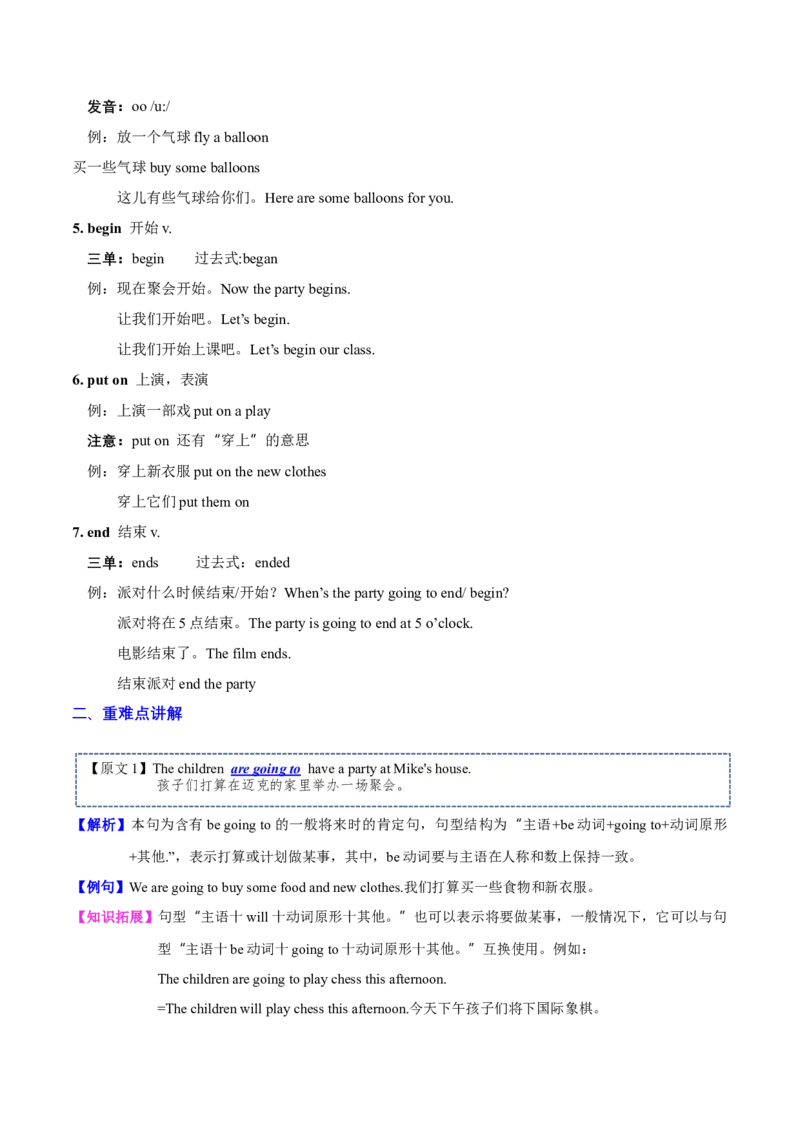
5. begin 开始v.
三单:begin 过去式:began
例:现在聚会开始。Now the party begins.
让我们开始吧。Let’s begin.
让我们开始上课吧。Let’s begin our class.
6. put on 上演,表演
例:上演一部戏put on a play
注意:put on 还有“穿上”的意思
例:穿上新衣服put on the new clothes
穿上它们put them on
7. end 结束v.
三单:ends 过去式:ended
例:派对什么时候结束/开始?When’s the party going to end/ begin?
派对将在5点结束。The party is going to end at 5 o’clock.
电影结束了。The film ends.
结束派对end the party
二、重难点讲解
【原文1】The children are going to have a party at Mike's house.
孩子们打算在迈克的家里举办一场聚会。
【解析】本句为含有be going to的一般将来时的肯定句,句型结构为“主语+be动词+going to+动词原形
+其他.”,表示打算或计划做某事,其中,be动词要与主语在人称和数上保持一致。
【例句】We are going to buy some food and new clothes.我们打算买一些食物和新衣服。
【知识拓展】句型“主语十will十动词原形十其他。”也可以表示将要做某事,一般情况下,它可以与句
型“主语十be动词十going to十动词原形十其他。”互换使用。例如:
The children are going to play chess this afternoon.
=The children will play chess this afternoon.今天下午孩子们将下国际象棋。【练习】单项选择。
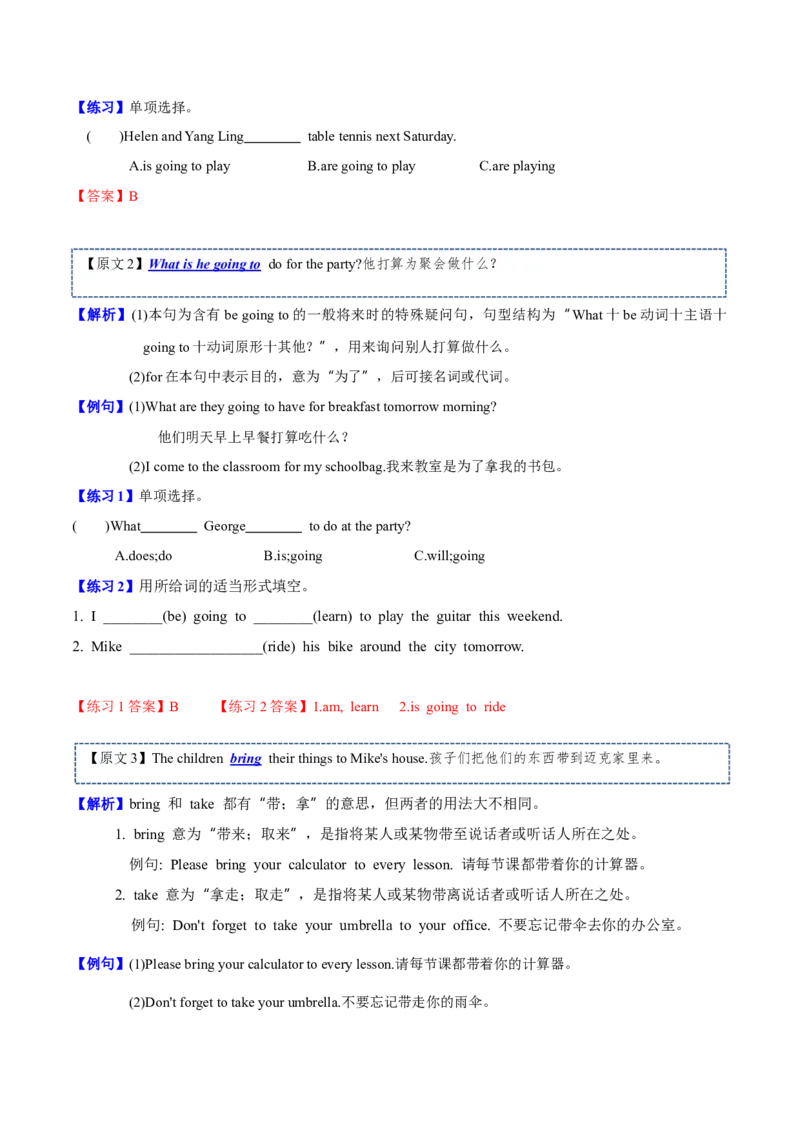
( )Helen and Yang Ling table tennis next Saturday.
A.is going to play B.are going to play C.are playing
【答案】B
【原文2】What is he going to do for the party?他打算为聚会做什么?
【解析】(1)本句为含有be going to的一般将来时的特殊疑问句,句型结构为“What十be动词十主语十
going to十动词原形十其他?”,用来询问别人打算做什么。
(2)for在本句中表示目的,意为“为了”,后可接名词或代词。
【例句】(1)What are they going to have for breakfast tomorrow morning?
他们明天早上早餐打算吃什么?
(2)I come to the classroom for my schoolbag.我来教室是为了拿我的书包。
【练习1】单项选择。
( )What George to do at the party?
A.does;do B.is;going C.will;going
【练习2】用所给词的适当形式填空。
1. I ________(be) going to ________(learn) to play the guitar this weekend.
2. Mike __________________(ride) his bike around the city tomorrow.
【练习1答案】B 【练习2答案】1.am, learn 2.is going to ride
【原文3】The children bring their things to Mike's house.孩子们把他们的东西带到迈克家里来。
【解析】bring 和 take 都有“带;拿”的意思,但两者的用法大不相同。
1. bring 意为“带来;取来”,是指将某人或某物带至说话者或听话人所在之处。
例句: Please bring your calculator to every lesson. 请每节课都带着你的计算器。
2. take 意为“拿走;取走”,是指将某人或某物带离说话者或听话人所在之处。
例句: Don't forget to take your umbrella to your office. 不要忘记带伞去你的办公室。
【例句】(1)Please bring your calculator to every lesson.请每节课都带着你的计算器。
(2)Don't forget to take your umbrella.不要忘记带走你的雨伞。【练习】用 bring 或 take 的适当形式填空。
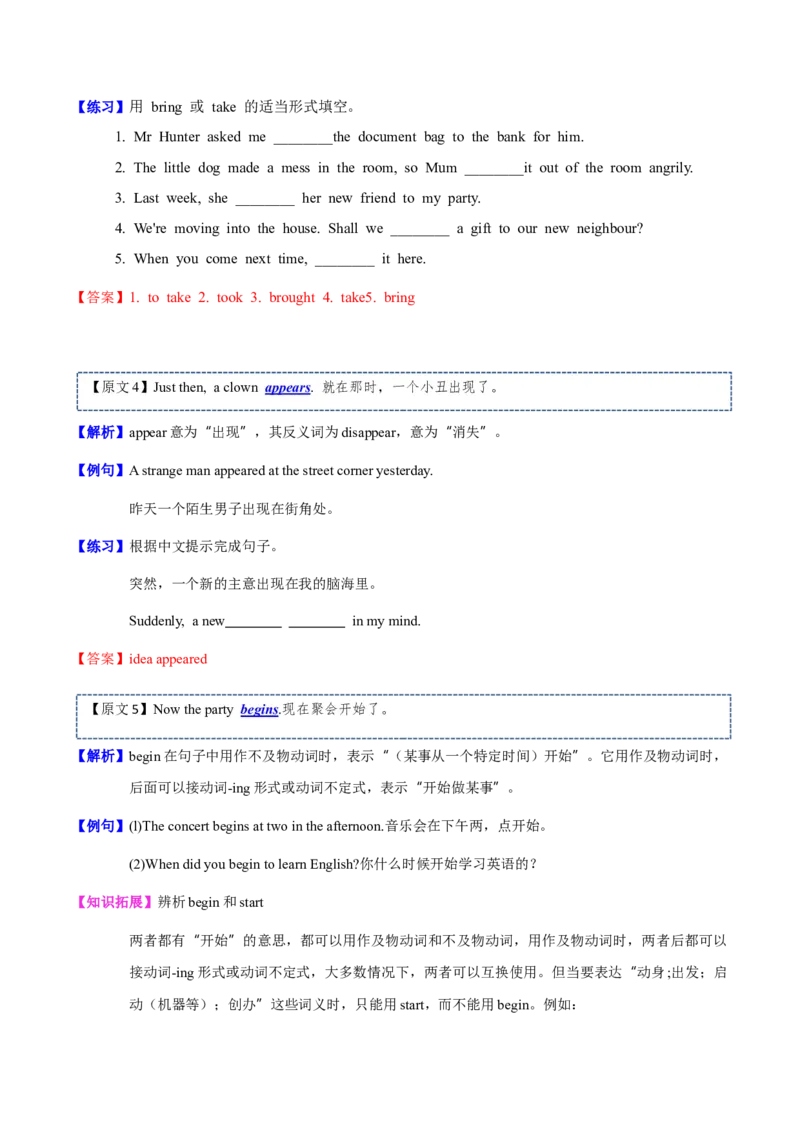
1. Mr Hunter asked me ________the document bag to the bank for him.
2. The little dog made a mess in the room, so Mum ________it out of the room angrily.
3. Last week, she ________ her new friend to my party.
4. We're moving into the house. Shall we ________ a gift to our new neighbour?
5. When you come next time, ________ it here.
【答案】1. to take 2. took 3. brought 4. take5. bring
【原文4】Just then, a clown appears. 就在那时,一个小丑出现了。
【解析】appear意为“出现”,其反义词为disappear,意为“消失”。
【例句】A strange man appeared at the street corner yesterday.
昨天一个陌生男子出现在街角处。
【练习】根据中文提示完成句子。
突然,一个新的主意出现在我的脑海里。
Suddenly, a new in my mind.
【答案】idea appeared
【原文5】Now the party begins.现在聚会开始了。
【解析】begin在句子中用作不及物动词时,表示“(某事从一个特定时间)开始”。它用作及物动词时,
后面可以接动词-ing形式或动词不定式,表示“开始做某事”。
【例句】(l)The concert begins at two in the afternoon.音乐会在下午两,点开始。
(2)When did you begin to learn English?你什么时候开始学习英语的?
【知识拓展】辨析begin和start
两者都有“开始”的意思,都可以用作及物动词和不及物动词,用作及物动词时,两者后都可以
接动词-ing形式或动词不定式,大多数情况下,两者可以互换使用。但当要表达“动身;出发;启
动(机器等);创办”这些词义时,只能用start,而不能用begin。例如:(1) He stood up and began/started to move around the room. 他站起来,开始在屋里来回走动。
(2) We must start at once.我们必须马上出发。
【练习】按要求完成句子。
The party is going to start at six in the evening.(改为同义句)
The party is going to at six in the evening.
【答案】begin
【原文6】--Are we going to eat or play with the toys first?我们是先吃东西还是先玩玩具?
--Let's have some fun first!咱们先玩得愉快!
【解析】问句为含有be going to的一般将来时的选择疑问句。在选择疑问句中,一般用连词or连接两个被
选项。回答时不能简单地用 Yes或No回答,而要根据实际情况选择被选项中的其中一项来回
答。
【例句】--Do you want me to give you cash or scan the QR code to make a payment??
你是想让我给你现金还是扫二维码支付?
--Please give me cash.请给我现金。
【练习】单项选择。
( )--Shall we see a film or go to the concert? -- .
A.Sorry, we won't. I'm very busy today.
B.I'd prefer to go to the concert.
C.Good idea!Let's go.
【答案】B
【原文7】Are you going to bring some snacks to the party?你(们)打算带一些零食到聚会上来吗?
【解析】本句为含有be going to的一般将来时的一般疑问句,句型结构为“Be动词十主语十going to十动
词原形+其他?”,用来询问别人是否打算做某事。其肯定回答为“Yes,主语十be动词。”,否
定回答为“No,主语十be动词十not.”。
【例句】--Are you going to visit your grandparents this weekend?
你(们)这个周末打算去拜访你(们)的祖父母吗?
--Yes,I am/we are.是的,我(们)打算。【练习】按要求完成句子。
Roy is going to put on a play at the class party.(改为一般疑问句)
Roy a play at the class party?
【答案】Is, going to put on
【原文8】Let's put on a play.咱们表演一部戏剧吧。
【解析】本句中的put on译为“上演,表演”,它还可以表示“穿上”,此时后接衣服、鞋帽类名词(短
语)作宾语。当put on表示“穿上”时,它的反义短语为take off,意为“脱下”。
【例句】(l)The drama club is putting on Romeo and Juliet..
剧社正在上演《罗密欧与朱丽叶》。
(2)Put on your sweater, or you'll have a cold.穿上你的毛衣,否则你会感冒的。
【练习】根据中文提示完成句子。
他们下个星期五将在这里上演一部新戏剧。
They will a new here next Friday.
【答案】put on, play
第二部分:易错易混全解
there be句型的一般将来时的用法
【例题】单项选择。
( )There a magic show in the school hall tomorrow.
A.is going to B.have C.is going to be
【答案】C
点拨:
there be句型的一般将来时表示将来某地会有某人或某物,含有 be going to的there be句型的句型结构为
“There is/are going to be...”。注意,该句型只表示人或物所处的地点,人或物与该地点之间并不存在所属
关系,所以句型中不能使用have或has。故选C。
易混淆bring和take的用法【例题】选词填空。
(1)John (brought/took) a book with him when he left.
(2)The east wind (brings/takes) a lot of rain here every year.
【答案】(l)took (2)brings
点拨:
bring是指将某人或某物带至说话者或听话人所在之处,而 take与bring的方向刚好相反,是指将某人或某
物带离说话者或听话人所在之处。第(1)小题,句意为“John离开时随身携带了一本书。”此处John是将
书“带离”它原本的位置到别的地方去,故填 took。第(2)小题,句意为“东风每年为这里带来许多雨
水。”此处是指东风“带来”雨水,故填brings。