文档文本内容
Unit 5 A party
知 识 归 纳
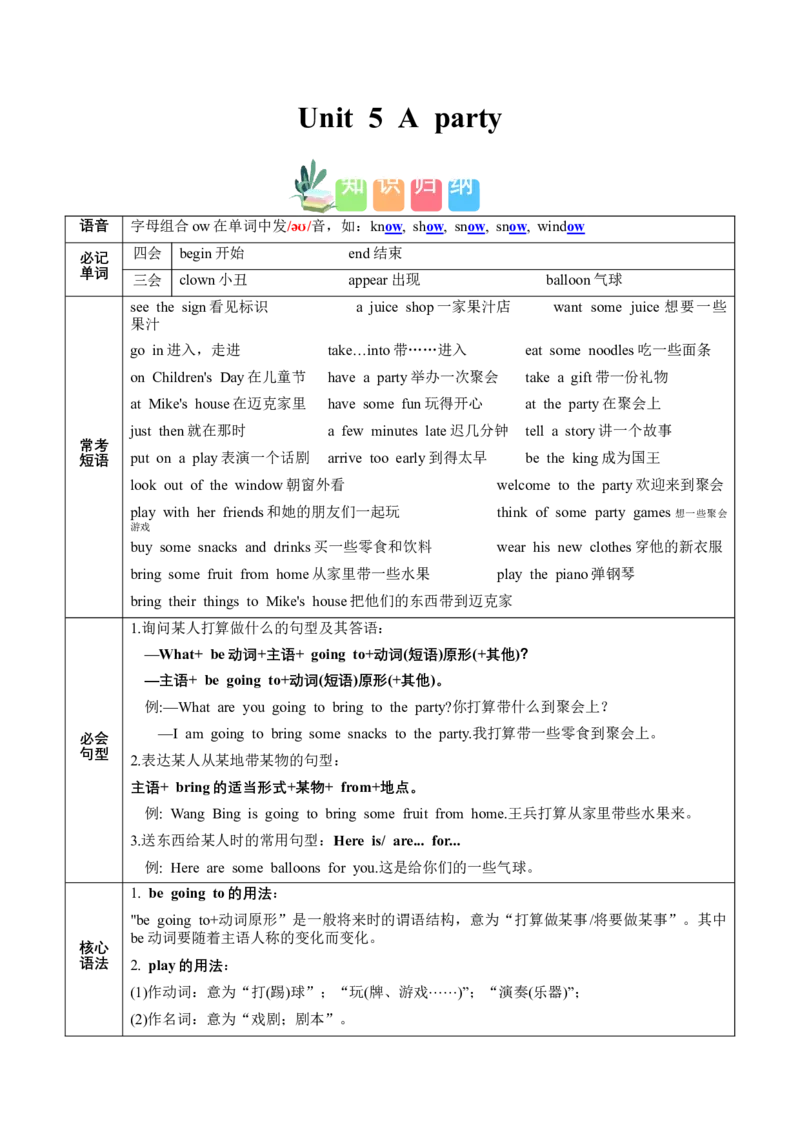
语音 字母组合ow在单词中发/əʊ/音,如:know, show, snow, snow, window
四会 begin开始 end结束
必记
单词
三会 clown小丑 appear出现 balloon气球
see the sign看见标识 a juice shop一家果汁店 want some juice 想要一些
果汁
go in进入,走进 take…into带……进入 eat some noodles吃一些面条
on Children's Day在儿童节 have a party举办一次聚会 take a gift带一份礼物
at Mike's house在迈克家里 have some fun玩得开心 at the party在聚会上
just then就在那时 a few minutes late迟几分钟 tell a story讲一个故事
常考
短语 put on a play表演一个话剧 arrive too early到得太早 be the king成为国王
look out of the window朝窗外看 welcome to the party欢迎来到聚会
play with her friends和她的朋友们一起玩 think of some party games想一些聚会
游戏
buy some snacks and drinks买一些零食和饮料 wear his new clothes穿他的新衣服
bring some fruit from home从家里带一些水果 play the piano弹钢琴
bring their things to Mike's house把他们的东西带到迈克家
1.询问某人打算做什么的句型及其答语:
—What+ be动词+主语+ going to+动词(短语)原形(+其他)?
—主语+ be going to+动词(短语)原形(+其他)。
例:—What are you going to bring to the party?你打算带什么到聚会上?
—I am going to bring some snacks to the party.我打算带一些零食到聚会上。
必会
句型
2.表达某人从某地带某物的句型:
主语+ bring的适当形式+某物+ from+地点。
例: Wang Bing is going to bring some fruit from home.王兵打算从家里带些水果来。
3.送东西给某人时的常用句型:Here is/ are... for...
例: Here are some balloons for you.这是给你们的一些气球。
1. be going to的用法:
"be going to+动词原形”是一般将来时的谓语结构,意为“打算做某事/将要做某事”。其中
be动词要随着主语人称的变化而变化。
核心
语法 2. play的用法:
(1)作动词:意为“打(踢)球”;“玩(牌、游戏⋯⋯)”;“演奏(乐器)”;
(2)作名词:意为“戏剧;剧本”。3. 不同的“穿”
4. 易错易混辨析:①there be句型的一般将来时的用法
②易混淆bring和take的用法
考 点 速 记
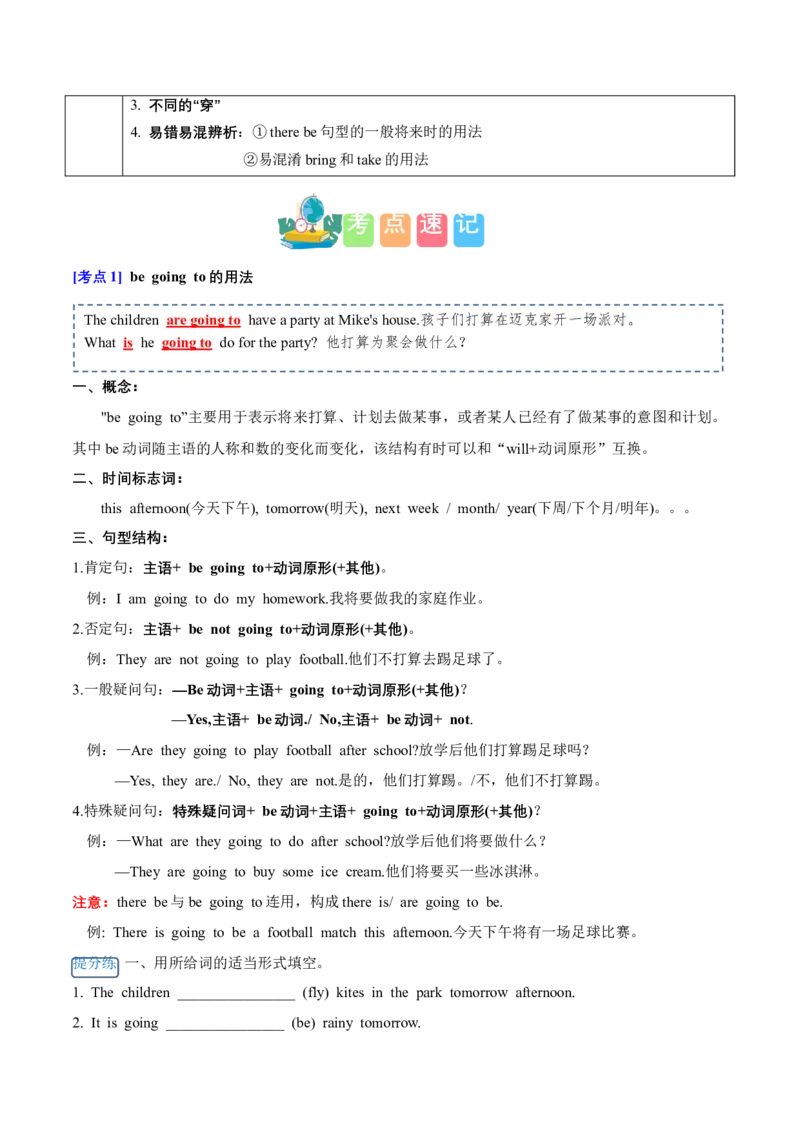
[考点1] be going to的用法
The children are going to have a party at Mike's house.孩子们打算在迈克家开一场派对。
What is he going to do for the party? 他打算为聚会做什么?
一、概念:
"be going to”主要用于表示将来打算、计划去做某事,或者某人已经有了做某事的意图和计划。
其中be动词随主语的人称和数的变化而变化,该结构有时可以和“will+动词原形”互换。
二、时间标志词:
this afternoon(今天下午), tomorrow(明天), next week / month/ year(下周/下个月/明年)。。。
三、句型结构:
1.肯定句:主语+ be going to+动词原形(+其他)。
例:I am going to do my homework.我将要做我的家庭作业。
2.否定句:主语+ be not going to+动词原形(+其他)。
例:They are not going to play football.他们不打算去踢足球了。
3.一般疑问句:—Be动词+主语+ going to+动词原形(+其他)?
—Yes,主语+ be动词./ No,主语+ be动词+ not.
例:—Are they going to play football after school?放学后他们打算踢足球吗?
—Yes, they are./ No, they are not.是的,他们打算踢。/不,他们不打算踢。
4.特殊疑问句:特殊疑问词+ be动词+主语+ going to+动词原形(+其他)?
例:—What are they going to do after school?放学后他们将要做什么?
—They are going to buy some ice cream.他们将要买一些冰淇淋。
注意:there be与be going to连用,构成there is/ are going to be.
例: There is going to be a football match this afternoon.今天下午将有一场足球比赛。
提分练 一、用所给词的适当形式填空。
1. The children ________________ (fly) kites in the park tomorrow afternoon.
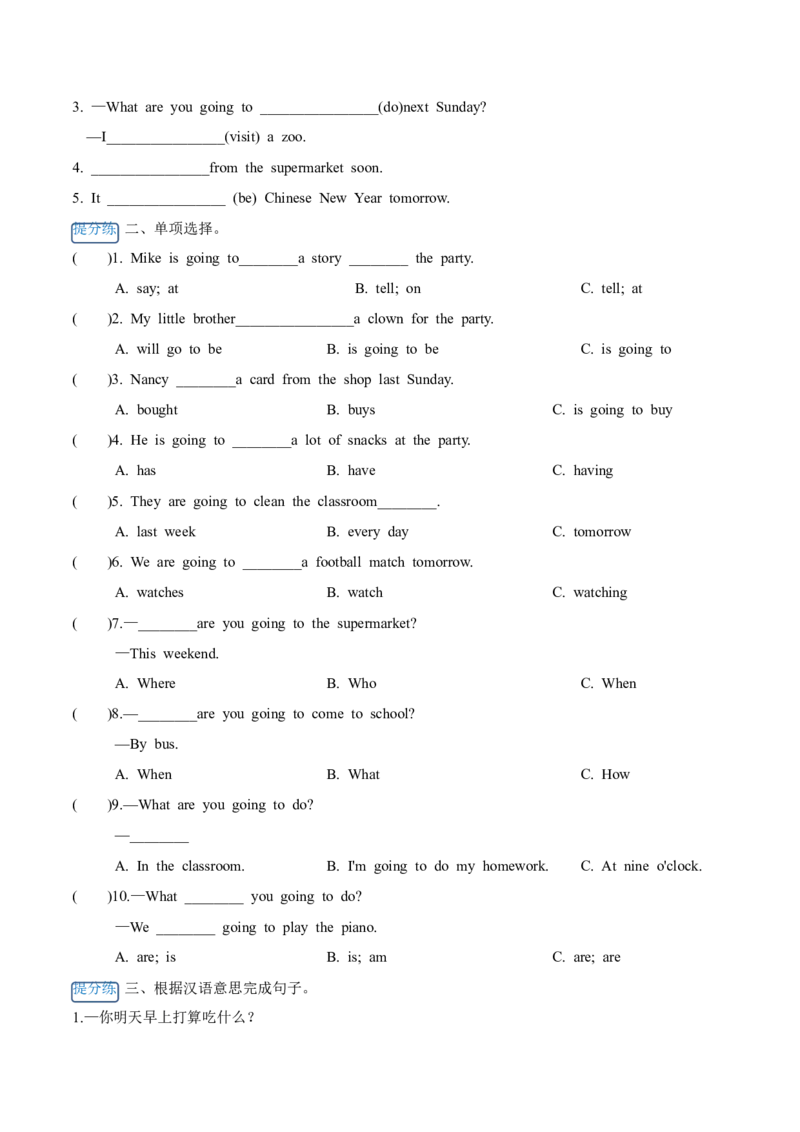
2. It is going ________________ (be) rainy tomorrow.3. —What are you going to ________________(do)next Sunday?
—I________________(visit) a zoo.
4. ________________from the supermarket soon.
5. It ________________ (be) Chinese New Year tomorrow.
提分练 二、单项选择。
( )1. Mike is going to________a story ________ the party.
A. say; at B. tell; on C. tell; at
( )2. My little brother________________a clown for the party.
A. will go to be B. is going to be C. is going to
( )3. Nancy ________a card from the shop last Sunday.
A. bought B. buys C. is going to buy
( )4. He is going to ________a lot of snacks at the party.
A. has B. have C. having
( )5. They are going to clean the classroom________.
A. last week B. every day C. tomorrow
( )6. We are going to ________a football match tomorrow.
A. watches B. watch C. watching
( )7.—________are you going to the supermarket?
—This weekend.
A. Where B. Who C. When
( )8.—________are you going to come to school?
—By bus.
A. When B. What C. How
( )9.—What are you going to do?
—________
A. In the classroom. B. I'm going to do my homework. C. At nine o'clock.
( )10.—What ________ you going to do?
—We ________ going to play the piano.
A. are; is B. is; am C. are; are
提分练 三、根据汉语意思完成句子。
1.—你明天早上打算吃什么?—我打算吃一些面包和一个鸡蛋。
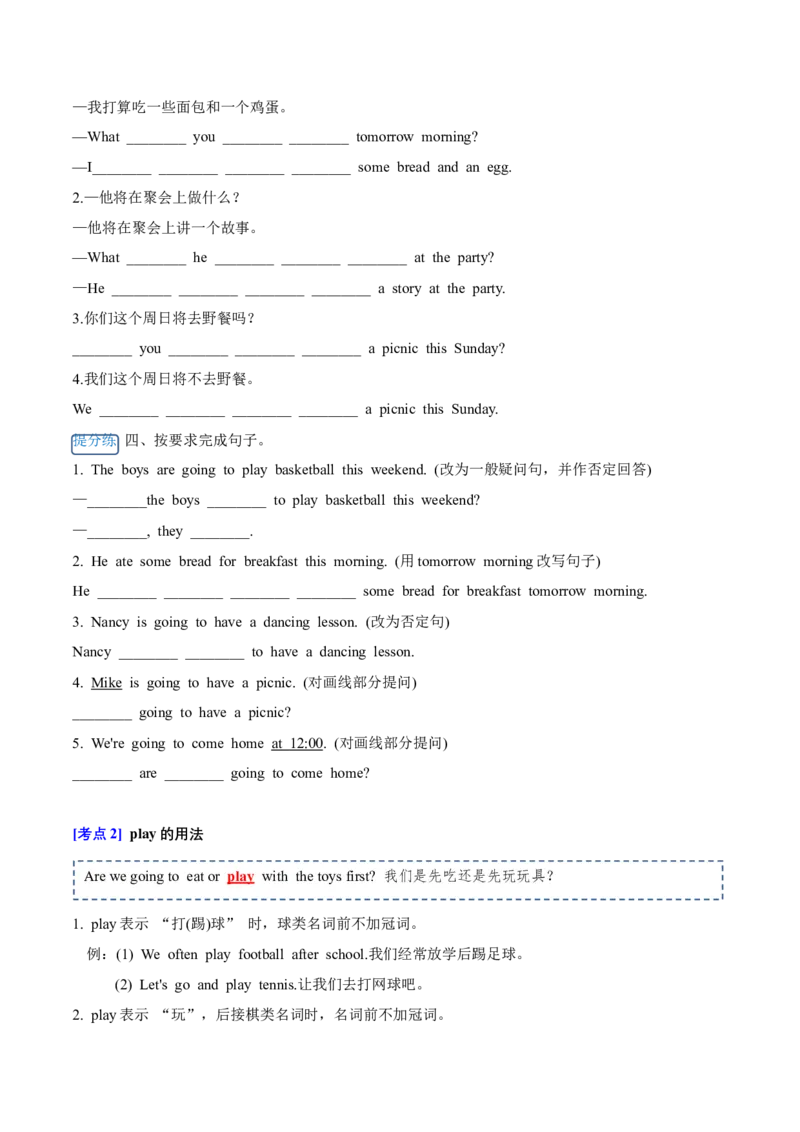
—What ________ you ________ ________ tomorrow morning?
—I________ ________ ________ ________ some bread and an egg.
2.—他将在聚会上做什么?
—他将在聚会上讲一个故事。
—What ________ he ________ ________ ________ at the party?
—He ________ ________ ________ ________ a story at the party.
3.你们这个周日将去野餐吗?
________ you ________ ________ ________ a picnic this Sunday?
4.我们这个周日将不去野餐。
We ________ ________ ________ ________ a picnic this Sunday.
提分练 四、按要求完成句子。
1. The boys are going to play basketball this weekend. (改为一般疑问句,并作否定回答)
—________the boys ________ to play basketball this weekend?
—________, they ________.
2. He ate some bread for breakfast this morning. (用tomorrow morning改写句子)
He ________ ________ ________ ________ some bread for breakfast tomorrow morning.
3. Nancy is going to have a dancing lesson. (改为否定句)
Nancy ________ ________ to have a dancing lesson.
4. Mike is going to have a picnic. (对画线部分提问)
________ going to have a picnic?
5. We're going to come home at 12:00 . (对画线部分提问)
________ are ________ going to come home?
[考点2] play的用法
Are we going to eat or play with the toys first? 我们是先吃还是先玩玩具?
1. play表示 “打(踢)球” 时,球类名词前不加冠词。
例:(1) We often play football after school.我们经常放学后踢足球。
(2) Let's go and play tennis.让我们去打网球吧。
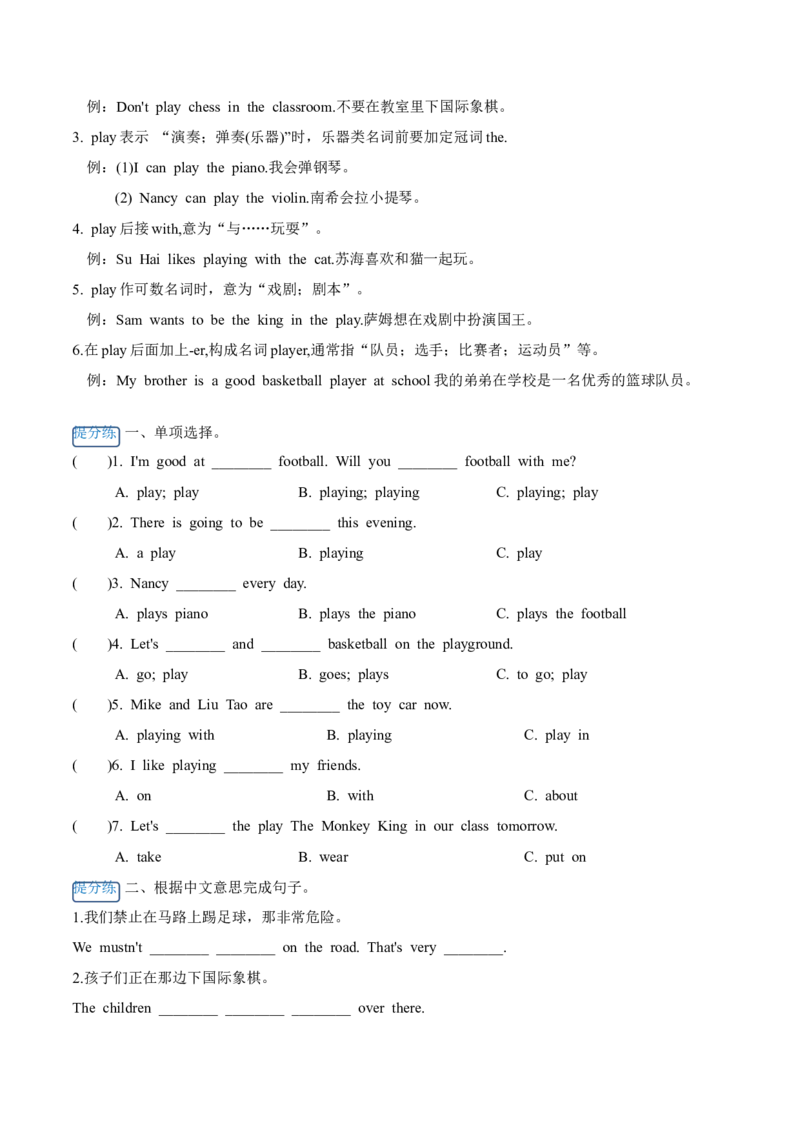
2. play表示 “玩”,后接棋类名词时,名词前不加冠词。例:Don't play chess in the classroom.不要在教室里下国际象棋。
3. play表示 “演奏;弹奏(乐器)”时,乐器类名词前要加定冠词the.
例:(1)I can play the piano.我会弹钢琴。
(2) Nancy can play the violin.南希会拉小提琴。
4. play后接with,意为“与……玩耍”。
例:Su Hai likes playing with the cat.苏海喜欢和猫一起玩。
5. play作可数名词时,意为“戏剧;剧本”。
例:Sam wants to be the king in the play.萨姆想在戏剧中扮演国王。
6.在play后面加上-er,构成名词player,通常指“队员;选手;比赛者;运动员”等。
例:My brother is a good basketball player at school我的弟弟在学校是一名优秀的篮球队员。
提分练 一、单项选择。
( )1. I'm good at ________ football. Will you ________ football with me?
A. play; play B. playing; playing C. playing; play
( )2. There is going to be ________ this evening.
A. a play B. playing C. play
( )3. Nancy ________ every day.
A. plays piano B. plays the piano C. plays the football
( )4. Let's ________ and ________ basketball on the playground.
A. go; play B. goes; plays C. to go; play
( )5. Mike and Liu Tao are ________ the toy car now.
A. playing with B. playing C. play in
( )6. I like playing ________ my friends.
A. on B. with C. about
( )7. Let's ________ the play The Monkey King in our class tomorrow.
A. take B. wear C. put on
提分练 二、根据中文意思完成句子。
1.我们禁止在马路上踢足球,那非常危险。
We mustn't ________ ________ on the road. That's very ________.
2.孩子们正在那边下国际象棋。
The children ________ ________ ________ over there.3.那个男孩总是和那只狗玩。
The boy always ________ ________ the dog.
4.—你喜欢这部电视剧吗?是—是的,喜欢。
—Do you like this________ ________?
—Yes,I do.
5.我们学校有许多篮球队员。
There are many ________ ________ in our school.
[考点3] 不同的“穿”
He is wearing his "new clothes".他正穿着他的“新衣服”。
1. put on是动词短语,意思为“穿上;戴上”,强调“穿”的动作,即由“没穿”到“穿”这一动作
的完成,后接衣服、鞋帽等。其反义词组是take off, 意思是“脱下”。如:
It's raining. Pun on your raincoat. 下雨了,穿上你的雨衣。
2. wear是动词,意思为“穿着;戴着”,表示状态,宾语可以是衣帽,也可以是饰物、奖章等。
如:
I wear a green coat. 我穿着一件绿色的外套。
3. dress是动词,意思为“给……穿衣服”,表示穿衣打扮,或给某人穿衣服,常用 dress sb来表示,
dress up意为“打扮”,如:
Can you dress your brother? 你能给你弟弟穿衣服吗?
I usually dress up at 6:30 every day. 我每天在6:30穿衣打扮。
4. in是介词,意思为“穿着,戴着”,后接表示衣服或表示颜色的词,侧重于服装的款式或颜色,
“in+衣服”表示穿着某种款式的衣服,“in+颜色”表示穿着什么颜色的衣服。如:
Look at the boy in red. 看那个穿红色衣服的男孩。
提分练 一、选择合适的内容,并用其适当形式填空。
dress wear put on in
1. Look! Jenny is ________ a red sweater today.
2. The woman ________ blue is my teacher.
3. Mrs Brown has to ________ her baby son every morning.
4. Please ________ your coat when you go out.提分练 二、单项选择。
( )1. Miss Yang always ________ a red dress and white shoes.
A. wears B. in C. puts on D. dresses
( )2. Miss Jones ________ a ring every day.
A. puts on B. wears C. in D. dresses
( )3.—Billy, can you help me ________ your little sister? I'm busy in the kitchen now.
—________
A. dress; All right. B. wear; That's all right.
C. put on; That's right. D. be in; You are welcome.
( )4. At the party, Annie ________ as a clown to make us laugh.
A. was wearing B. put on C. dressed up D. was in
( )5. Lucy is ________ a beautiful white dress today. She looks gorgeous(优雅的) in it.
A. dressing B. in C. putting on D. dressed
[考点4] 易错易混辨析
①there be句型的一般将来时的用法
【例题】一、单项选择。
( )There ________ a magic show in the school hall tomorrow.
A.is going to B.have C.is going to be
点拨:there be句型的一般将来时表示将来某地会有某人或某物,含有 be going to的there be句型
的句型结构为“There is/are going to be...”。注意,该句型只表示人或物所处的地点,人或物与该
地点之间并不存在所属关系,所以句型中不能使用have或has。故选C。
②易混淆bring和take的用法
【例题】二、选词填空。
(1)John ________(brought/took) a book with him when he left.
(2)The east wind ________(brings/takes) a lot of rain here every year.点拨:bring是指将某人或某物带至说话者或听话人所在之处,而 take与bring的方向刚好相反,
是指将某人或某物带离说话者或听话人所在之处。第(1)小题,句意为“John离开时随身携带了一
本书。”此处John是将书“带离”它原本的位置到别的地方去,故填took。第(2)小题,句意为
“东风每年为这里带来许多雨水。”此处是指东风“带来”雨水,故填brings。
参考答案
[考点1] be going to的用法
一、1. are going to fly/ will fly 解析:tomorrow afternoon表示本句话是一般将来时,谓语结构要用
be going to do/ will do, 故填are going to fly/will fly.
2. to be
3. do; am going to visit
4. is going to buy/ will buy 解析:soon表示本句话是一般将来时,谓语动词结构为 be going to
do/will do, 故填is going to buy/ will buy.
5. will be
二、1. C解析:tell a story和at the party是固定短语,分别意为“讲故事”和“在派对上”,故选
C.
2. B
3. A解析:last Sunday表示本句话是一般过去时,谓语动词用过去式,故选A.
4. B 解析:be going to do是固定结构,故选B.
5. C6. B 解析:be going to do是一般将来时的谓语结构,故选B.
7. C 解析:由答语“This weekend.”可知问句问的是时间,要用特殊疑问词when,故选C.
8. C 解析:由答语“By bus.”可知问句问的是出行方式,要用特殊疑问词how,故选C.
9. B解析:问句在询问做的具体内容,故选B.
10. C 解析:you是第二人称, be动词要用are,we是人称复数, be动词也用are,故选C.
三、1. are; going to have; am going to have
2. is; going to do; is going to tell
3. Are; going to have
4. aren't going to have
四、1. Are; going; No; aren't 2. is going to eat
3. isn't going 4. Who's 5. When; you
[考点2] play的用法
一、1. C 解析:at是介词,其后动词用ing形式,故一空为playing; will后的动词用原形,故二空为
play, 故选C.
2. A
3. B 解析:球类运动前不加the,乐器前要加the, 故选B.
4. A 解析:let's do sth.是固定结构,意为“让我们做某事”,and作为连接词,前后词形式保持一
致,故选A.
5. A
6. B 解析:play with是固定短语,意为“和……一起玩”,故选B.
7. C 解析:put on a play是固定短语,意为“上演一出戏”,故选C.
二、1. play football; dangerous 2. are playing chess
3. plays with 4. TV play 5. basketball players
[考点3] 不同的“穿”
一、1.wearing 2.in 3.dress 4.put on
二、1~5 ABACB
1.根据“Miss Yang always_____a red dress and white shoes."可知,此处指杨小姐总是 穿着红色连
衣裙和白鞋子,表示状态,应用 wears,故选A。
2.根据“Miss Jones____ a ring every day" 和语境可知,此处强调“戴戒指”的状态,应用动词wear作谓语,故选B。
3.根据“...can you help me____your little sister"可知,此处表示穿的动作,且后面 的宾语是人,应
该用dress,问句是请求,答语 “All right.”符合语境,故选A。
4.根据“...Annie__as a clown ...”可 知,她装扮成了小丑的样子,故选C。
5.“in a beautiful white dress"表示“穿着一件漂 亮的白色连衣裙”,in在这里强调穿的状态,故选
B。
[考点4] 易错易混辨析
一、C
二、(1)took (2)brings