Unit 4 Road safety
知 识 归 纳
在一个句子中,有些单词需要重读,有些单词需要弱读。一般情况下,句子中的名词、动
词、形容词和副词需要重读;而代词、介词、连词和情态动词常需要弱读。在实际应用中,
语音
为了强调某一个词,就会重读这个词。如: 'Stop! There's a 'red man. We 'mustn't walk
now.
四会 road马路,公路 must必须 safe安全的 follow遵守 light灯
必记
safety安全 cross穿过,穿行 safely安全地 pavement人行道
单词
三会
easily容易地 rule规则 stay保持
many busy roads许多繁忙的道路 road safety道路安全
a zebra crossing斑马线 look for寻找
wait for the green man等待绿灯 look at the traffic lights看交通信号
灯
wait on the pavement在人行道上等待 see the red man看见红灯
look left/ right向左/右看 see you easily容易看见你
常考
with other people和其他人一起 follow the rules遵守规则
短语
on the road在马路上 cross the road safely 安全地过
马路
take the bus乘坐公共汽车 run quickly快速地跑
stop and wait停下来等待 get on the bus上公共汽车
on the left/ right side of the road在马路左/右边 stay safe保持安全
look out for cars and bikes当心汽车和自行车
1.表达某人必须做某事的句型:主语+must+动词原形(+其他)。
例: You must look at the traffic lights.你必须看交通信号灯。
必会
2.表达某人禁止做某事的句型:主语+mustn't+动词原形(+其他)。
句型
例: You mustn't run on the road.你禁止在马路上跑。
3.询问如何到达某地的句型:How do/ does+主语+ get to+某地?
例: How do we get to your house?我们怎样到达你家?
1.重音(Stress)
2.情态动词can和must的用法:
核心 can和must都是情态动词,没有人称和数的变化,必须和动词原形共同构成谓语结构,
语法 二者在用法上有很大的区别:
(1)can的用法:①表示能,会(指能力)②表示可以、允许③表示推测
(2)must的用法:①表示义务性或必要性②其否定形式mustn't表示禁止,语气强烈③其一般疑问句的否定回答要用“No,主语+ don't/ doesn't have to.”.
3. safe、safety和safely的区别:三个词词性不同, safe是形容词,意为“安全的”; safety是
名词,意为“安全”;safely是副词,意为“安全地”,常用于修饰动词。
考 点 速 记
[考点1] Stress重音
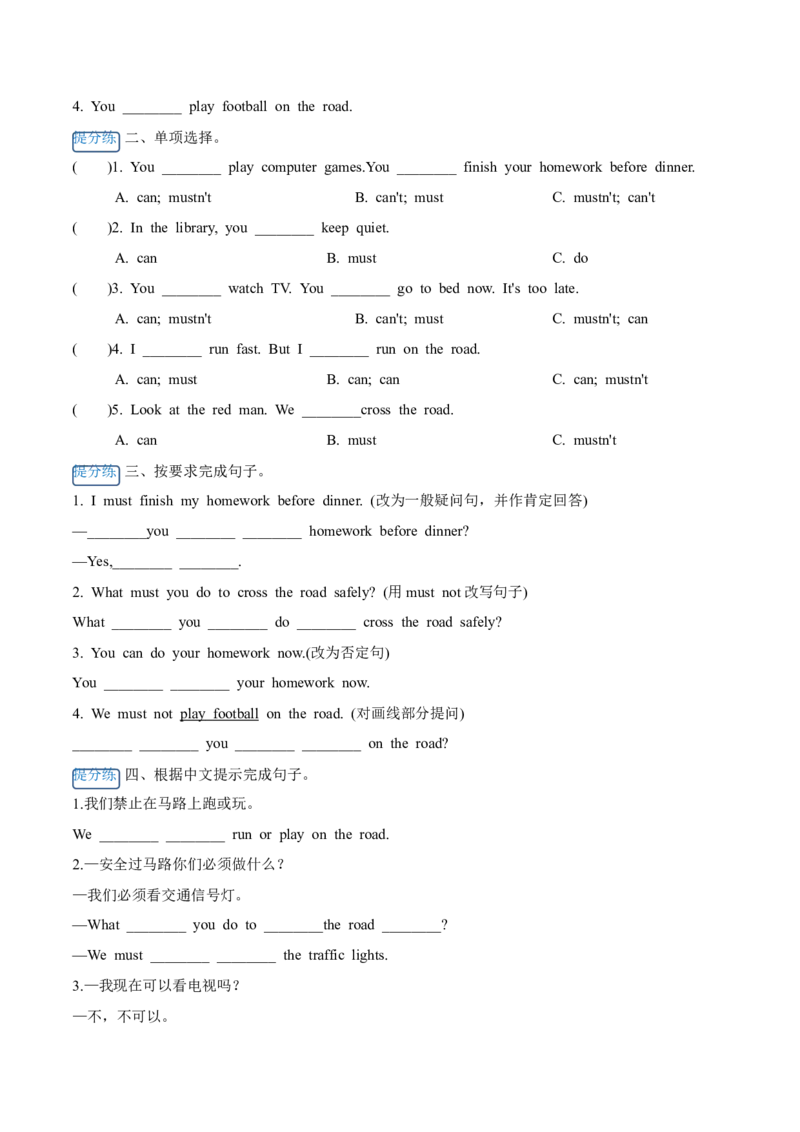
'Stop! There’s a 'red man. 停!红灯亮了。
We 'mustn’t walk now. 我们现在不能走。
We must 'wait for the 'green man. 我们必须等待绿灯。
'There he is! 'Now we can walk, 绿灯亮了!现在我们可以走了,
But 'don’t run! 但是不要奔跑!
解析:1.什么是重音?
在朗读英语或用英语交谈时,并不是句子中的每个词都读得声音一样大小、一样清楚。一句话中有的词
汇在朗读时,需要音长相对饱满、语调清晰响亮,这些词就是重读词汇(Stressed words)。相反,在连贯的
话语中,有些词读得或说得又轻又快,比较含糊,音长短且没有语调变化,这些词称为弱读词汇(unstressed
words)。
2.哪些词在句子中需重读?
(1) 实词需要重读
实词有实际意义,能独立承担句子成分,有词形的变化。包括:
名词(n.):表示人、事物、地点或抽象概念的名称。如:boy,morning,bag,ball,class,orange.
代词(pron.):主要用来代替名词,共分为9种,总体上代词是实词,如:who,she,you,it .但人称代词被
看作虚词。
形容词(adj.):表示人或事物的性质或特征。如:good,right,white,orange .
数词(num.):表示数目或事物的顺序。如:one,two,three,first,second,third,fourth.
动词(v.):表示动作或状态。如:am,is,are,have,see .
副词(adv.):修饰动词、形容词或其他副词,说明时间、地点、程度等。如:now,very,here,quickly,
badly
(2) 虚词弱读
虚词没有实在意义,在句子中不能独立承担句子成分,虚词没有词形的变化。包括:
冠词(art.):用在名词前,帮助说明名词。如:a,an,the.介词(prep.):表示它后面的名词或代词与其他句子成分的关系。如in,on,from,above,behind.
连词(conj.):用来连接词、短语或句子。如and,but,before .
感叹词(interj.)表示喜、怒、哀、乐等感情。如:oh,well,hi,
助动词(Auxiliary verbs)如:has, have, may, will, do,does,etc.
例如:I 'can't 'find my 'wallet. 我找不到我的钱包了。
'What can I 'do for you? 我能为你做些什么呢?
提分练 判断下列句子中单词重读的标注是(√)否(×)正确。
( )1. 'Stop! There's a 'bus coming.
( )2. You 'mustn't walk now.
( )3. 'We must wait for the green 'man.
( )4. You can walk 'now, but 'don't run.
( )5. 'There is 'much food in the fridge.
[考点2] 情态动词can和must的用法
First, you must look for a zebra crossing. 首先,你必须寻找一条斑马线。
You must not play on the road because there are many cars and bikes.
你不准在马路上玩,因为有很多汽车和自行车。
一、can的用法
1.概念:情态动词can有一定的词义,但不能独立存在,它必须与动词原形共同构成谓语。情态动词
can没有人称和数的变化。
2.具体用法:
(1)表示“能、会”,指脑力或体力方面的“能力”。
例:I can speak English.我会讲英语。
(2)表示“可以”,指允许或请求做某事,常用于口语中。
例: Can I have a cup of tea, please?请问我可以喝一杯茶吗?
(3)表示“可能”,常用于否定句或疑问句中,指某种可能性,推测。
例: Liu Tao can't be in the classroom.刘涛不可能在教室里。
3.句型结构:
(1)肯定句:主语+can+动词原形+其他。
We can play basketball.我们会打篮球。(2)否定句:主语+ cannot (can't) +动词原形+其他。
I can't draw well.我不能画得好。
(3)一般疑问句:—Can+主语+动词原形+其他?—Yes,主语+ can./ No,主语+ can't.
—Can I have a cup of coffee?我可以喝一杯咖啡吗?
—Yes, you can.是的,你可以。/ No, you can't.不,你不可以。
(4)特殊疑问句:特殊疑问词+can+动词原形+其他?
Who can dance in your class?你们班里谁会跳舞?
二、must的用法
1.概念:must是情态动词,后接动词原形,没有人称或数的变化。
2.具体用法:
(1)表示义务或必要性时,意为“应该,必须”,常用于肯定句或疑问句。
例: You must go to bed now.你现在必须去睡觉。
(2) must的否定形式是must not/ mustn't,意为“不可以,禁止”,语气较强烈。
例: You mustn't open this box.你不可以打开这个盒子。
(3) must引导的一般疑问句,肯定回答用“Yes,主语+ must.”, 否定回答要用“No,主语+ don' t/doesn't
have to/ needn't.”,不能用mustn't, 因为mustn't表示“不许;禁止”,与问句原意不符。
例:—Must I do my homework?我必须做我的家庭作业吗?
—Yes, you must. / No, you needn't.是的,你必须做家庭作业。/不,你不需要做家庭作业。
3.句型结构:
(1) 肯定句:主语+must+动词原形+其他。
I must go home now.我现在必须回家。续表
(2) 否定句:主语+ must not(mustn't)+动词原形+其他。
You mustn't play on the road.你禁止在马路上玩。
(3) 特殊疑问句:特殊疑问词+must(+主语)+动词原形+其他?
What must you do on the road?在马路上你必须做什么?
提分练 一、选词填空。
can can't must mustn't
1. You ________ look at the traffic lights and wait for the green man.
2. You ________ sit here, because it is for my sister.
3. We ________ cross the road now. The light is green.4. You ________ play football on the road.
提分练 二、单项选择。
( )1. You ________ play computer games.You ________ finish your homework before dinner.
A. can; mustn't B. can't; must C. mustn't; can't
( )2. In the library, you ________ keep quiet.
A. can B. must C. do
( )3. You ________ watch TV. You ________ go to bed now. It's too late.
A. can; mustn't B. can't; must C. mustn't; can
( )4. I ________ run fast. But I ________ run on the road.
A. can; must B. can; can C. can; mustn't
( )5. Look at the red man. We ________cross the road.
A. can B. must C. mustn't
提分练 三、按要求完成句子。
1. I must finish my homework before dinner. (改为一般疑问句,并作肯定回答)
—________you ________ ________ homework before dinner?
—Yes,________ ________.
2. What must you do to cross the road safely? (用must not改写句子)
What ________ you ________ do ________ cross the road safely?
3. You can do your homework now.(改为否定句)
You ________ ________ your homework now.
4. We must not play football on the road. (对画线部分提问)
________ ________ you ________ ________ on the road?
提分练 四、根据中文提示完成句子。
1.我们禁止在马路上跑或玩。
We ________ ________ run or play on the road.
2.—安全过马路你们必须做什么?
—我们必须看交通信号灯。
—What ________ you do to ________the road ________?
—We must ________ ________ the traffic lights.
3.—我现在可以看电视吗?
—不,不可以。—________ ________ watch TV now?
—No,________ ________.
[考点3] safe、safety 和 safely的区别
How can you cross them safely? 你怎样才能安全地穿过它们呢?
To keep safe, you can wait on the pavement and look our for cars and bikes.
为了保持安全,你可以在人行道上等,小心汽车和自行车。
一、词性不同
(1) safe: safe是形容词。
(2) safely: safely是副词。
(3) safety: safety是名词。
二、用法不同
(1) safe: safe的基本意思是“安全的,不会有危险的”,指某人或某物处于一种不受危险威胁的状
态,也可指“没有受到损害的,平安的”,多指某人或某物在经受长时间的危险之后安全地回来。
safe还可指“不致导致损害或损伤的”“不冒险的,小心的”等,用来修饰名词。
(2) safely: safely意为“安全地;安稳地”,通常用来修饰动词或动词短语。
(3) safety: safety的基本意思是“安全,平安”,指远离危险的威胁而处于不受伤害的状态。引申可
指“平安地带”。safety多用作不可数名词,常用于 in safety或 with safety短语中。
提分练 一、用safe的适当形式填空。
1.—Can we cross the road ________ now?
—Yes, it's ________ to cross now.
2. ________ is very important for us.
3. Playing on the road is not ________.
4. You must stay ________ on the road and cross it ________.
5. To keep ________, we must look out for the car.
6. We should learn about road ________.
提分练 二、单项选择。
( )1.—What do you know about road ________?
—We must follow the rules and stay ________ on the road.
A. safe; safely B. safety; safe C. safety; safely( )2. It is ________ to wait for the green man.
A. safety B. safe C. safely
( )3. We should pay attention to(关注)food ________.
A. safety B. safe C. safely
( )4.—How can we cross the road ________?
—You can look for a zebra crossing.
A. safe B. safety C. safely
提分练 三、根据中文意思,补全句子。(每空一词)
1.在马路上踢足球是不安全的。
It ________ ________ ________ to play football on the road.
2.为了保持安全,在马路上我们必须遵守规则。
To keep ________, we must follow the rules on the road.
3.现在我们安全了。
We ________ ________ now.
4.他们刚才安全地过了马路。
They ________ the road ________ just now.
提分练 四、按要求完成句子。
1. You can cross the busy road safely.(改为一般疑问句)
________ ________ cross the busy road ________?
2. We should know about the road safety .(对画线部分提问)
________ should you ________ about?
3. We should follow the rules to keep safe on the road.(对画线部分提问)
________ should you ________ to keep safe on the road?
4. The girl is safe. The girl is crossing the road.(合并为一句话)
The girl ________ ________ the ________ ________.参考答案
[考点1] Stress重音
1. √ 2. √ 3. × 4. × 5.√
[考点2] 情态动词can和must的用法
一、1. must 2. can't 3. can 4. mustn't
1. B 解析:根据句意“你不可以玩电脑游戏。你必须在晚饭前完成作业。”,可知选B.
2. B解析:根据句意“在图书馆你必须保持安静。”,可知使用情态动词 must表示“必须”,故选
B.
3. B 解析:根据句意“你不能看电视。你必须去睡觉。已经太晚了。”,可知选B.
4. C 解析:根据句意“我能跑得很快。但我不能在马路上跑。”,可知用can表示“能够”,mustn't
表示“禁止,不能”,故选C.
5. C 解析:根据句意“看那个红灯。我们不能过马路。”,可知用mustn't表示“禁止,不能”,故
选C.
二、1. Must; finish your;I must 2. must; not; to3. can't do 4. What must; not do
三、1. must not 2. must; cross; safely; look at 3. Can I; you can't
[考点3] safe、safety 和 safely的区别
一、1. safely; safe 解析:cross是动词,需用副词修饰,be动词后面加形容词,故填safely;safe.
2. Safety 解析:此处缺少名词作主语,故填Safety.
3. safe 解析:分析句子结构可知是主系表结构,缺形容词作表语,故填safe.
4. safe; safely 解析:stay后加形容词, cross是动词,用副词修饰,故填safe; safely.
5. safe 解析:keep后加形容词,故填safe.
6. safety 解析:road safety意为“道路安全”,故填safety.
二、1. B解析:第一空road safety意为“道路安全”,第二空stay后加形容词,故选B.
2. B 解析:It is+形容词+ to do sth.是固定句型,意为“做某事是⋯⋯的。”,故选B.
3. A解析:food safety意为“食品安全”,故选A.
4. C 解析:cross是动词,其后要用副词修饰,故选C.
三、1. is not safe 2. safe 3. are safe 4. crossed; safely
四、1. Can you; safely 2. What; know 3. What; do 4. is crossing; road safely