译林版(六下)•期中复习讲练测•知识清单
Unit 4 Road safety
第一部分 知识梳理
语音
句子中的单词重读规则:一般情况下,句子中的名词、动词形容词和副词需要重读,因为它
们决定了句子的主要语义。代词介词、连词和情态动词通常要弱读。在实际应用中,为
了凸显某需一个单词,就会重读这个单词重读的单词听起来较慢但更清楚,弱读的单词则
听起来较快且较模糊。如:'Stop!There’s a 'red man. We 'mustn't walk now.We must ' wait
for the 'green man .'There he is! 'Now we can walk,but 'don't run!
[典例精练] 判断题
判断下列句子中单词重读的标注是(T)否(F)正确。
1.'Stop! There’s a 'bus coming. ( )
2.You 'mustn’t walk now. ( )
3.'We must wait for the green 'man. ( )
4.You can walk 'now, but 'don’t run. ( )
5.'There is 'much food in the fridge. ( )
必会单词
四会
safety(安全)、cross(穿过,穿行)、safe(安全的)、pavement(人行道)、zebra
crossing(斑马线)、follow(遵守)、rule(规则)、stay(停留)
三会
road(马路,公路)、must(必须)、look out for(当心,提防)、easily(容易地)、left
(左边)、right(右边)、side(边,侧)、also(也)、except(除了)、light(灯)、wait
(等待)、last(最后的)、street(街道)、keep(保持)
重点短语road safety(道路安全) many busy roads(许多繁忙的马路)
cross the road safely(安全地过马路) look for a zebra crossing(寻找斑马线)
look out for cars and bikes(当心汽车和自行车) wait for the green man(等待绿灯)
look left(向左看) look right(向右看)
look left and right(左右看) on the pavement(在人行道上)
follow the rules(遵守规则) stay safe(保持安全)
the other side of the road(马路的另一边) a good idea(一个好主意)
play football on the road(在路上踢足球) in the UK(在英国)
drive on the left side of the road(在马路左侧行驶) except Hong Kong(除了香港)
look right first(先向右看) at the traffic lights(在交通信号灯处)
must wait for the green light(必须等待绿灯) last time(上次)
go to see their aunt(去看望他们的阿姨) take the bus(乘坐公共汽车)
get on the bus(上车) get off the bus(下车)
so many cars(这么多汽车) go fast(开得快)
in the street(在街上) keep safe(保持安全)
wait on the pavement(在人行道上等待) get to(到达)
核心句型
1. How can you cross the road safely?你怎样才能安全地过马路呢?
【辨析】句子当中的 safely意为“安全地”,是副词,可用于修饰动词;safe 意为“安全的”,
是形容词,通常用在系动词后面作表语,或名词及名词短语前面作定语;safety意为“安全”,是
名词。
2. First, you must look for a zebra crossing.首先,你必找一条斑马线。
【提醒】must 意为“必页”,是一个情态动词,没有人称和数的变化,后面直接加动词原形
3. Then, you must look at the traffic lights and wait for the green man.然后,你必须看交通信与灯
并等待绿灯。
4. Can you see the red man? You mustn't cross the road now.你能看见红灯吗?你不立该现在过马
路。
5. Here's the green man, You can cross the road now.是绿灯了。你现在可以过马路了。
6. To keep safe, you can wait on the pavement and look out for cars and bikes.为了保持安全,你可以在人行道上等候并当心小汽车和自行车。
7. You must first look left, then right and then left again.你必须先向左看,再向右看,然后再向左
看。
8.You can also cross the road with other people.你也可以和其他人一起过马路。
9.Follow the rules and stay safe on the road!遵守规则,在路上保持安全!
10.The bus goes on,but soon it stops again,公共汽车继续前进,但很快它又停下来了。
第二部分 语法强化
语法 1:safe、safely和safety 的区别
safe 是形容词,意为“安全的”,常放在系动词后、名词前safely 是副词,意为“安全地”,常放
在动词后;safety 是名词,意为“安全”
【例】1.How can you cross the road safely?你怎样才能安会例地过马路呢?
2. There's a red light. It's not safe to cross the road now.红灯了。现在过马路不安全。
3. I want to know something about food safety.我想知道些有关食品安全方面的知识.
【新题特训】单项选择
( )Road______is important. To stay______,we should follow the rules.
A.safe;safety B. safety;safe C. safety;safely
解析:解析第一句意为“道路安全是重要的”,这里的“安全”是名词,要用 safety 表
示,故排除A 选项;第二句意为“为了保持安全,我们应该遵守规则”,stay 是系动词,后
面要接形容词,表示保持某种状态,safe 是形容词,意为“安全的”,safely 是副词,意为
“安全地”,故选 B。
语法 2:情态动词must的用法
must 是情态动词,意为 “必须”,没有人称和数的变化,后接动词原形,表示有必要做某事。
其否定形式 mustn't 意为 “禁止;不可以”,表示绝对不能做某事。
例:1.You must wear a seat belt in the car.(你必须在车里系安全带。)2.You mustn't run in the classroom.(你不可以在教室里跑。)
【新题特训】对画线部分提问。
He must follow the rules on the road.
______ ______he______on the road?
解析:对“做什么事”进行提问时,用疑问词 what,情态动词 must 放在 what 的后面,
注意句首字母大写,动词用 do 的原形,故填 What must,do。
语法 3:祈使句的用法
祈使句用于表达命令、请求、建议、警告等语气。肯定祈使句通常以动词原形开头;否
定祈使句则是在动词原形前加 Don't。
【例】1.Open the door, please.(请打开门。)
2.Don't be late for school.(上学不要迟到。)
【新题特训】请保持安静!学生们正在上课,
______ _______please! The students______ _______a class.
解析:第一句话为祈使句,句首用动词 keep(保持)的原形,注意首字母大写,后面跟上形
容词 quiet 作表语。第二句话要用现在进行时,students 是复数,因此 be 动词用 are,行
为动词 have 用-ing 形式,故填Keep quiet, are having。
第三部分 考点精练
一、选择题
1.You must look ______ the traffic lights and look out ______ the cars. ( )
A.at; at B.for; at C.at; for
2.—Mum, _______ I watch TV after dinner? ( )
—Sure, but you _______ finish homework first.
A.must; can B.can; can C.can; can’t D.can; must
3.—______ I watch TV? ( )
—No, you can’t. It’s late. You ______ go to bed now.
A.Must; must B.Can; must C.Can; can
4.To keep ______, drivers ______ drive so fast. ( )A.safe; must B.safely; must C.safe; mustn’t D.safely; mustn’t
5.We ______ shout in the classroom. This is one of our classroom rules. ( )
A.can B.should C.must D.mustn’t
6.To get on the bus _______, we mustn’t run after the bus. ( )
A.safe B.safety C.safely
7.Mike is _______ a zebra crossing on the road. ( )
A.looking for B.finding C.finding out
8.We must pay attention(关注) to school ______ and stop bullying(霸凌). ( )
A.safety B.safe C.safely
9.Can you tell me how __________ your home? ( )
A.get to B.to get C.to get to
10.—______ did you go to the supermarket yesterday? ( )
—I went there by bike.
A.why B.Where C.How
二、按要求填空。
1.who(所有格) 2.she(宾格)
3.danger (反义词) 4.free(反义词)
5.busy(反义词) 6.left (反义词)
7.drive (名词) 8.take(过去式)
9.run(反义词) 10.before(反义词)
三、完成下面句子。
1.To cross a busy road safely, we must first look for a and then look at the .
2.Sometimes, we can wait on the . We must first look cars and
bikes, then and the look again before we cross the road.
3.We can also cross the road with .
4.We must not or on the road.
四、用下列单词的适当形式补全句子。
1. (keep) safe, we must look out of the car.
2.Bobby (ask) Sam some questions about the traffic lights now.
3.We can cross the road with other (people).4. (keep) safe. we must wait for a moment.
5.The driver must (look) at the traffic lights.
6.The driver sees the red light. He (stop) the bus again.
7.Sam sings (bad). I can’t stay here.
8.I (can’t / mustn’t) see any birds in the tree.
9.Look, the children (cross) the road with their teachers.
10.Nancy (see) a film tomorrow afternoon.
五、句型转换
1.People could go to work by ship every day. (对画线部分提问)
people to work every day?
2.You mustn’t run on the road. (对划线部分提问)
I not do on the road?
3.We mustn’t play ball games in the classroom. (对划线部分提问)
What you in the classroom?
4.He must follow the rules on the road. (对画线部分提问)
he do on the road?
5.He mustn’t talk loudly in class. (对画线部分提问)
he do in class?
六、补全对话
Liu Tao: 1
Su Hai: Good idea. It’s not far. 2
Liu Tao: OK. Let’s go.
Su Hai: Stop! 3
Liu Tao: I’m sorry.
Su Hai: We must wait for the green man.
Liu Tao: There he is. 4 Be quick!
Su Hai: 5
A.We can walk there.
B.Now we can go across the road.
C.Here’s the red man.
D.Don’t run! It’s dangerous.E.Let’s go to Green Park.
七、完形填空
To keep 1 when we cross the busy roads, everyone should 2 the traffic rules.
The walkers should look both left and 3 4 when they cross the road. When people
are 5 , they 6 wear a seat belt. Drivers 7 not allowed (允许) to drive 8
drinking. They must stop when the lights are 9 . Many people take buses. They should 10
the buses at the bus stop, not on the road.
If everyone follows the traffic rules, there will be fewer traffic accidents.
( )1.A.safe B.safely C.safety
( )2.A.follows B.follow C.
following
( )3.A.left B.down C.right
( )4.A.careful B.careless C.
carefully
( )5.A.driving B.drive C.
drives
( )6.A.shouldn’t B.can’t C.
must
( )7.A.is B.are C.was
( )8.A.before B.behind C.after
( )9.A.red B.green C.yellow
( )10.A.wait B.waiting C.wait for
八、阅读理解
(A)阅读下列短文,从各题所给的A、B、C三个选项中,选出最佳选项。
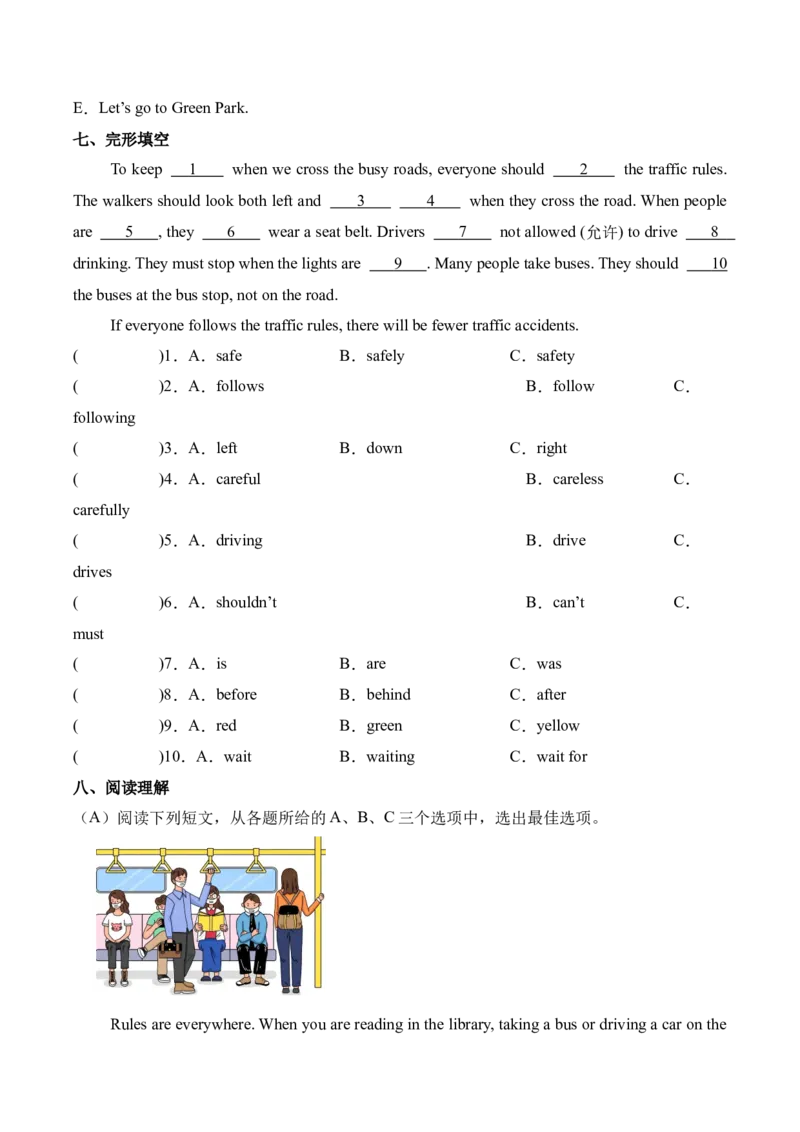
Rules are everywhere. When you are reading in the library, taking a bus or driving a car on theroad, you must follow some rules. But do you know about any rules on a metro? If you take a metro
in Xuzhou.
At the metro station:
*Wait in line before getting on the metro. Stand behind the yellow line.
*Let the passengers (乘客) get off first. Don’t rush onto the metro.
*When you hear a “beep” sound,don’t get on the metro. The door is closing.
Wait for another metro.
On the metro:
*No smoking.
*No eating &drinking
*Give your seat to old people, the disabled or women carrying babies.
1.The text is mainly about (主要是关于) the rules _________. ( )
A.in the library
B.on the metro in Xuzhou
C.on the road
2.What can you do at the metro station? ( )
A.Rush onto the metro.
B.Get on the metro when there is a “beep” sound.
C.Stand behind the yellow line.
3.What can we do on the metro? ( )
A.Smoking.
B.Drinking some milk.
C.Giving seats to help others.
(B)阅读短文,选择正确的答案。
Why do we use red traffic lights?
When the traffic lights turn red, we must stop driving a car or crossing a street. Why is red usedfor traffic lights? Why people don’t use other colours?
As we know, scattering( 散 射 ) happens when light goes through the air. For the same
medium(介质), if the wavelength is long, the scatterting will be weak. If the wavelength is short,
then the scatterting will be strong.
The red light has the longest wavelength, so the scattering is the weakest. It means the red light
can travel far.
The red light can help drivers in farther place see the lights. It helps drivers slow down or stop
in time. If drivers don’t see the red light until they are close, they may not be able to stop the car in
time. An accident may happen. Red can also excite people. We can act more quickly when we see the
colour red. In a word, red lights help drivers stop in time and help prevent(阻止) accident.
1.When the traffic lights turn ______, we must stop driving a car. ( )
A.red B.yellow C.green
2.According to the passage, the red light has the ______ wavelength. ( )
A.longest B.weakest C.farthest
3.The underlined word “wavelength” means “______” in Chinese. ( )
A.水花 B.波长 C.身高
4.What can the red light help drivers do? ( )
A.The red light can help drivers in farther place see the lights.
B.It helps drivers slow down or stop in time.
C.Both A and B.
5.A(n) ______ may happen if drivers don’t see the red light until they are close. ( )
A.surprise B.scattering C.accident
典例精练答案1.T 2.T 3.F 4.F 5.T
【解析】1.句意:停下!有车来了。本题考查重读。句子中需要重读的单词是实词:名词,
代词,形容词,数词,动词和副词。不需要重读的是虚词:冠词,介词,连词,感叹词和助
动词。本题中stop是动词,bus是名词,需要重读,故答案为T。
2.句意:你现在禁止走。本题考查重读。句子中需要重读的单词是实词:名词,代词,形容
词,数词,动词和副词。不需要重读的是虚词:冠词,介词,连词,感叹词和助动词。
mustn’t 是情态动词和not的缩写,要重读,故答案为T。
3.句意:我们必须等着绿灯。本题考查重读。句子中需要重读的单词是实词:名词,代词,
形容词,数词,动词和副词。不需要重读的是虚词:冠词,介词,连词,感叹词和助动词。
we是人称代词,被看作是虚词,不重读,man是名词,需要重读。故答案为F。
4.句意:你现在可以走,但是不要跑。本题考查重读。句子中需要重读的单词是实词:名
词,代词,形容词,数词,动词和副词。不需要重读的是虚词:冠词,介词,连词,感叹词
和助动词。now是现在,是时间副词,需要重读,don’t是助动词不需要重读,故答案为F。
5.句意:在冰箱里有很多食物。本题考查重读。句子中需要重读的单词是实词:名词,代
词,形容词,数词,动词和副词。不需要重读的是虚词:冠词,介词,连词,感叹词和助动
词。There是副词,需要重读,much是形容词,需要重读,故答案为T。
考点精练答案
一、1.C
【详解】句意:你必须看红绿灯,小心汽车。本题考查动词短语。look at看,look for寻找,
look out for提防,选项C符合题意,故选C。
2.D
【详解】句意:—妈妈,我晚饭后能看电视吗?—当然,但是你必须先完成作业。本题考查
情态动词。根据句意第一空为can能,可以;第二空为must必须,故选D。
3.B
【详解】句意:—我可以看电视吗?—不,你不可以。太晚了,你现在必须睡觉了。本题考
查情态动词,can可以,must必须,根据can’t可知问句是Can引导的一般疑问句,排除A;
根据答句后半句可知must符合句意,排除C。故选B。
4.C
【详解】句意:为了保证安全,司机不能开的太快。本题考查形容词的用法和情态动词的否
定形式。根据题干中keep,可知后面加形容词,构成系表结构,safe形容词,安全的。mustn’t不要,不能。故选C。
5.D
【详解】句意:我们不得在教室里大喊大叫。这是我们的课堂规则之一。本题考查陈述句否
定形式。A能,B应该,C必须,D不得,根据句意可知不得在教室里大喊大叫,故选D。
6.C
【详解】句意:为了安全地上公共汽车,我们不能追着公共汽车跑。本题考查副词的用法。
A安全的,形容词;B安全,名词;C安全地,副词。横线处填副词修饰动词,故选C。
7.A
【详解】句意:迈克正在路上寻找斑马线。本题考查动词和动词短语的辨析。A寻找,表示
过程;B找到,表示结果;C找出。选项A符合句意,故选A。
8.A
【详解】句意:我们必须关注校园安全,阻止霸凌。本题考查名词词组,school safety校园安
全,故选A。
9.C
【详解】句意:你能告诉我怎样到你家吗?本题考查动词短语和动词的形式。到达get to,该
句中how+动词不定式做tell的宾语,how to do怎么做,所以应是to get to,故选C。
10.C
【详解】句意:—你昨天怎么去超市了的?—我骑自行车去的。本题考查疑问词。A为什
么,B在哪里,C怎么,根据答语可知问句是问交通方式,用how提问,故选C。
二、1.whose 2.her 3.safe 4.busy 5.free 6.right 7.driver 8.
took 9.stop 10.after
三、1.zebra crossing traffic lights 2.pavement out for right left 3.
other people 4.play football run
【解析】1.句意:为了安全地过马路,我们必须先寻找一条斑马线然后看交通灯。所以填的
是zebra crossing /traffic lights。
2.句意:有时,我们可以在人行道上等。我们必须当心汽车和自行车,然后在我们过马路前
向右看再像左看。所以填的是pavement/ out for/ right/ left。
3.句意:我们也可以和其他人一起过马路。所以填的是other people。
4.句意:我们禁止在路上踢足球和跑。所以填的是. play football/ run。
四、1.To keep 2.is asking 3.people 4.To keep 5.look 6.stops 7.badly 8.can’t 9.are crossing 10.will see
五、1.How could go
【详解】原句句意:人们每天可以乘船去上班。本题考查句型转换。画线部分是交通方式,
对其提问用how,首字母需要大写;原句情态动词用could,问句也用could,后跟动词原形
go,句意为:人们每天可以怎样去上班?故答案为How;could;go。
2.What must
【详解】原句句意:你不可以在马路上跑。本题考查句型转换。划线部分是run,对动作提问
用疑问词what,后接一般疑问句。把must提到主语的前面。故答案为What,must。
3.mustn’t do
【详解】原句句意:我们不可以在教室里玩球类游戏。本题考查句型转换。划线部分是具体
事情,应问你们不可以在教室里做什么?不可以mustn’t,做do,前有情态动词,do用原
形,故答案为mustn’t;do。
4.What must
【详解】句意:他在马路上必须遵守规则。本题考查句型转换。follow the rules是遵守规则,
疑问词是what,剩余部分把情态动词must提前,变成一般疑问句放在疑问词后面,故答案为
What;must。
5.What must not
【详解】原句句意:他不能在班上大声交谈。本题考查句型转换。根据划线部分可知要提问
不能做什么,用what提问,句意为:他不能在班上做什么?该句型结构为:What must+主语
+not+do?故答案为What;must;not。
六、1.E 2.A 3.C 4.B 5.D
【导语】本文是关于刘涛和苏海等红绿灯过马路的一段对话。
1.下句句意:好主意。根据回答可知上句提出了建议,选项E“咱们去格林公园吧。”符合
语境,故选E。
2.上句句意:它离得不远。可知可以步行去那里。选项A“我们可以步行到那。”符合语
境,故选A。
3.上句句意:停下!根据下文苏海说“我们必须等绿灯。”可知他们遇到了红灯。选项
C“是红灯。”符合语境,故选C。
4.上句句意:(绿灯)亮了。可知绿灯了可以过马路。选项B“现在我们可以过马路了。”符合
语境,故选B。5.上句句意:快点!可知刘涛可能走的太快,这样是危险的。选项D“别跑!危险。”符合
语境,故选D。
七、1.A 2.B 3.C 4.C 5.A 6.C 7.B 8.C 9.A
10.C
【导语】本文主要描述了交通安全。
1.句意:当我们过马路时应该注意安全。A安全的,B安全地,C安全,keep后接形容词作
表语,故选A。
2.句意:每个人应该遵守交通规则。A是动词的第三人称单数,B是动词原形,C是动词的
现在分词或动名词,should后接动词原形,故选B。
3.句意:当人们过马路时应该小心注意左右两边。A左边,B向下,C右边。选项C符合句
意,故选C。
4.句意:当人们过马路时应该小心注意左右两边。A小心的,B粗心的,C小心地。副词放
句末修饰句子,故选C。
5.句意:当人们正在开车时,他们必须系好安全带。A是动词的现在分词或动名词,B是动
词原形,C是动词的第三人称单数。该句时态为现在进行时,结构为:be+动词的现在分词。
故选A。
6.句意:当人们正在开车时,他们必须系好安全带。A不应该,B不能,C必须。选项C符
合句意,故选C。
7.句意:司机喝酒后不可以开车。主语Drivers是名词复数,be动词用are,故选B。
8.句意:司机喝酒后不可以开车。A在……之前,B在……后面,C在……之后。选项C符
合句意,故选C。
9.句意:红灯时他们必须停下。A红色的,B绿色的,C黄色的。选项A符合句意,故选
A。
10.句意:他们应该在公交车站等车,而不是在路上。A是动词原形,B是动词的现在分词
或动名词,C是动词短语。wait for等待,符合句意。故选C。
八、(A)1.B 2.C 3.C
【导语】本文主要讲了在徐州乘地铁的注意事项。
1.句意:这篇短文主要是关于_______的规则。A图书馆。B徐州的地铁。C马路。根据全
文可知是关于徐州的地铁的,故选B。
2.句意:在地铁站你可以做什么?A冲上地铁。B当有一个蜂鸣声的时候上地铁。C站在黄线之后。根据 “Wait in line before getting on the metro. Stand behind the yellow line.” ,可知站
在黄线之后符合规则,故选 C。
3.句意:在地铁上你可以做什么?A吸烟。B喝些牛奶。C让座帮助其他人。根据“Give
your seat to old people, the disabled or women carrying babies.”,可知让座帮助其他人。故答案
为C。
(B)1.A 2.A 3.B 4.C 66.C
【导语】本文讲了为什么用红色的交通信号灯。
1.句意:当交通信号灯变______,我们必须停止开车。A红色,B黄色,C绿色,根据
“When the traffic lights turn red, we must stop driving a car or crossing a street.”,可知当交通信
号灯变红色,我们必须停止开车,故选A。
2.句意:根据文章,红光的波长______。A最长,B最弱,C最远,根据“The red light has
the longest wavelength, so the scattering is the weakest.”,可知红光的波长最长,故选A。
3.句意:划线单词“wavelength”的中文意思是“_______”。根据短文语境,可知wavelength
的中文意思是波长,故选B。
4.句意:红灯能帮助司机做什么?A红灯可以帮助远处的司机看到灯。B它可以帮助驾驶员
及时减速或停车。根据“The red light can help drivers in farther place see the lights. It helps
drivers slow down or stop in time.”,可知红灯的作用包括A和B项,故选C。
5.句意:如果驾驶员在靠近时才看到红灯,就可能发生_____。A惊喜,B散射,C事故,
根据“If drivers don’t see the red light until they are close, they may not be able to stop the car in
time. An accident may happen.”,可知可能发生事故,故选C。