Unit 1 The lion and the mouse
知 识 归 纳
语音 特殊疑问句的语调是降调。例: Where are you going?↘ What do you want to buy? ↘
large 大的 strong 强大的,强壮的 quietly 小声地,安静地
四会
weak 弱的,软弱的 loudly 大声地 happily 开心地,高兴地
mouse 老鼠 net 网 bite咬
必记
单词
sharp 锋利的,尖的 sadly 难过地,伤心地 soon不久,很快
三会
cheer 欢呼 hit打,击 deep深的
reach 够得着 quickly 迅速地,快地
walk by 走过,路过 large and strong又大又强壮 wake... up 吵醒,叫醒
some day某一天 the next day 第二天 let... go释放,放开
small and weak 又小又弱 sharp teeth锋利的牙齿 laugh loudly 大声地笑
常考
get out from 从······出来 just then 就在那时 say quietly小声地说
短语
cheer for them为他们欢呼 from then on 从那时起 pour... into 把······倒入
too excited 太兴奋 hit the ball hard用力地击球 become friends 成为朋友
reach the ball 够到球 a hole in the ground 地上的一个洞
1.副词修饰谓语动词的句型:主语+谓语+副词.
例: The lion asked sadly.狮子伤心地问。
2.询问某人怎样能够做某事的句型:How can+主语+谓语(+其他)?
必会
句型 例: How can you help me?你能怎样帮助我?
3.表达某人过去做了某事的句型:主语+动词过去式+其他.
例: The next day, two men caught the lion with a large net.
第二天,两个男人用一张大网把狮子抓住了。
1.副词的用法:
副词用来修饰动词、形容词、其他副词或整个句子,是说明时间、地点、程度、方式等的
词。
2.形容词变副词的规则:
核心
语法 (1)一般情况下,直接在形容词词尾加-ly。
(2)以“辅音字母+y”结尾的,变y为i,再加-ly。
(3)部分以e结尾的形容词,去e,加-ly。
3.动词过去式的不规则变化。
考 点 速 记[考点1] 副词及其用法及形容词变副词的规则
“How can l get out?” asked the lion sadly. “我怎么才能出去呢?”狮子伤心地问。
“Thank you!” said the lion happily. “谢谢你!”狮子高兴地说。
一、副词及其用法
1.定义
副词用来修饰动词、形容词、其他副词或整个句子,是说明时间、地点、程度、方式等概念的词。
2.副词的分类
① 时间副词: yesterday、now、tonight、soon
② 地点副词: here、there、home、anywhere、upstairs、downstairs
③ 方式副词: carefully、fast、quietly、happily、slowly、quickly、directly
④ 程度副词: very、too、much、so、pretty、quite、deeply
⑤ 疑问副词: where、why、when、how
⑥ 否定副词: no、not、never、neither、hardly、seldom
⑦ 频率副词: always、usually、often、sometimes、never
⑧ 连接副词: however、then、thus、besides、therefore
3.副词的用法 ★★★
(1) 修饰动词时一般位于被修饰的动词之后。例:I can run fast.我可以跑得快。
(2) 时间副词、地点副词和方式副词一般位于句末。例:I'm writing now.我现在正在写字。
(3) 频率副词一般位于 be 动词、情态动词或助动词之后 , 实义动词之前 。
例: I often go to school on foot.我经常步行去上学。
(4) 程度副词一般修饰形容词和副词,位于被修饰词之前。
例: The weather is too hot.天气太热了。
(5) 疑问副词一般位于句首。例: Where did you live last year?你去年住在哪里?
二、形容词变副词的规则 ★★★★★
1.一般情况下,直接在形容词后加-ly。例:bad→badly, excited-excitedly, quiet→quietly
2.以“辅音字母+y”结尾的,变y为i,再加-ly。例:happy→happily, angry→angrily
3.部分以e结尾的形容词,去e加-ly。例:true→truly
4.不规则变化。例:good→well5.本身既是形容词也是副词,无需改变,如:fast—fast, early—early, high—high, hard—hard,
late—late, far—far;
6. 有些形容词本身即为副词,同时也有加 ly的副词形式。但加不加 ly意思不一样,使用时需注意,
如:
wide(adj.宽阔的,睁大地)—wide(adv.充分地)/ widely(adv. 广泛地),
high(adj. 高的)—high(adv.高地)/ highly(adv. 高度地),
hard(adj.硬的)—hard(adv.努力地)/ hardly(adv.几乎不);
拓展:hard的副词形式容易写成 hardly, hardly意思为“几乎不”,与 hard无任何关系。★★
如: It was raining hard, and she didn't take an umbrella.雨下得正大,而且她没有带伞。
提示: lovely(可爱的)、friendly(友好的)、lonely(孤独的)是形容词,不是副词。
提分练 一、根据首字母或中文提示填空。
1. The boy pointed at the king and laughed h________ , because the king was so foolish.
2. The boy is too e________ and he hits the ball h________.
3. I'm thirsty. I drink some water q________.
4. The baby is sleeping. Please talk q________.
5. My mum is standing here ________________(生气地) because we make the room messy.
提分练 二、用所给词的适当形式填空。
1. The girl slipped and fell. She cried ________(loud).
2. The little boy likes playing football. He can play ________(good).
3. Ben got up ________(early) this morning.
4. The girl is running ________(fast).
5. Be ________! The floor is wet. You should walk ________.(careful)
6. In the library, we should keep ________(quiet).
7. Su Hai and Su Yang are singing and dancing ________(happy) at the party.
8. You’re ________(real) nice to help us.
9. It snowed ________(heavy) yesterday!
10. She is a ________ girl and she dances ________.(beautiful)
提分练 三、单项选择。
( )1. Don't go out. It's raining ________.
A. quietly B. heavily C. fast( )2. Look! The bird is flying ________ in the sky.
A. happy B. highly C. high
( )3. The ________ boy is laughing ________.
A. excitedly; excited B. excited; excitedly C. excited; excited
( )4. The boy cried ________. But now he is ________.
A. sad; happy B. sadly; happily C. sadly; happy
( )5. I have a good friend. She is ________ to me.
A. friendly B. strong C. excitedly
( )6. The old man walked ________.
A. quiet B. slowly C. slows
( )7. The lion asked ________, “Who can help me?”
A. happy B. sad C. sadly
( )8. The lion became ________ and shouted________.
A. angry; angrily B. sadly; quietly C. angrily; loudly
( )9. The question is ________ and I can do it ________.
A. easy; easily B. easily; easily C. easy; easy
( )10. My mother also does ________ at home.
A. good B. well C. very good
( )11. He gets up ________ in the morning.
A. early B. lately C. well
提分练 四、根据中文提示,补全句子。
1.学生们在操场上开心地玩游戏。
The students ________ games ________ in the playground.
2.我爸爸正在沙发上安静地看书。
My father is ________ ________ on the sofa.
3.他迅速地捡起了书。
He ________ the book ________.
4.萨姆和波比正在开心地打乒乓球。
Sam and Bobby are ________ table tennis ________.
5.那个男孩渴了。他快速地拿来一些水。
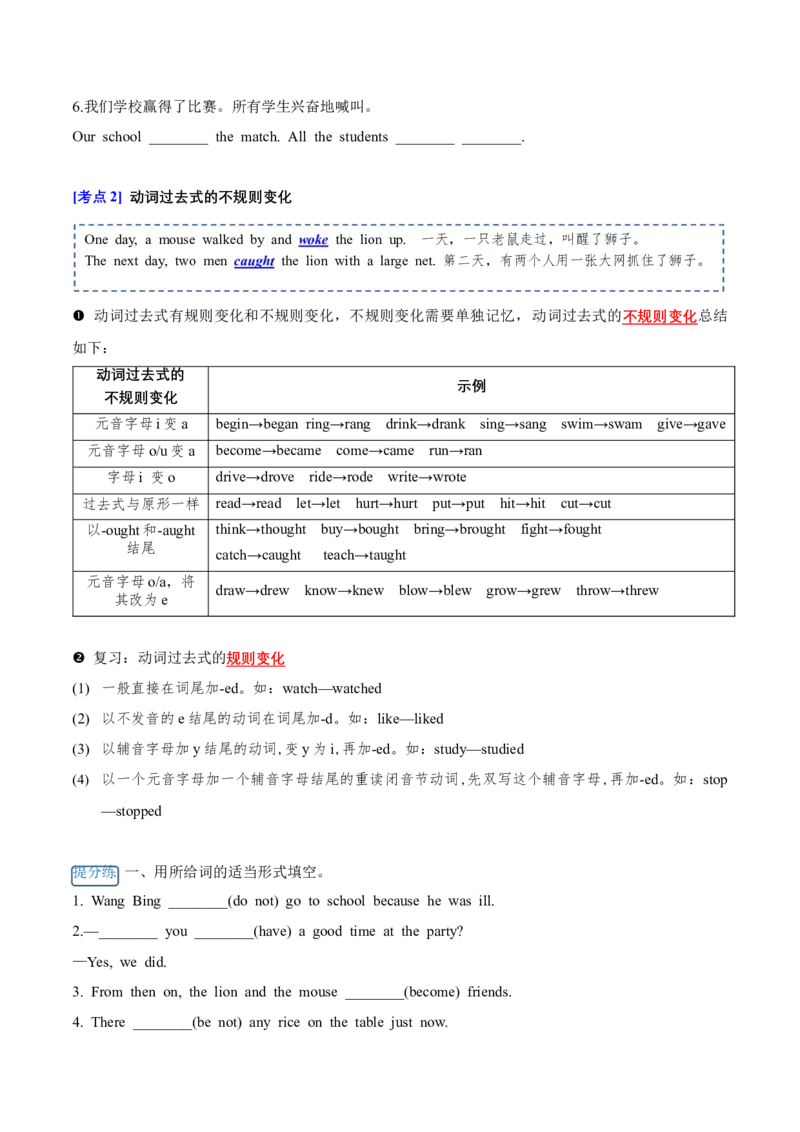
The boy was ________. He ________ some water ________.6.我们学校赢得了比赛。所有学生兴奋地喊叫。
Our school ________ the match. All the students ________ ________.
[考点2] 动词过去式的不规则变化
One day, a mouse walked by and woke the lion up. 一天,一只老鼠走过,叫醒了狮子。
The next day, two men caught the lion with a large net. 第二天,有两个人用一张大网抓住了狮子。
➊ 动词过去式有规则变化和不规则变化,不规则变化需要单独记忆,动词过去式的不规则变化总结
如下:
动词过去式的
示例
不规则变化
元音字母i变a begin→began ring→rang drink→drank sing→sang swim→swam give→gave
元音字母o/u变a become→became come→came run→ran
字母i 变o drive→drove ride→rode write→wrote
过去式与原形一样 read→read let→let hurt→hurt put→put hit→hit cut→cut
以-ought和-aught think→thought buy→bought bring→brought fight→fought
结尾
catch→caught teach→taught
元音字母o/a,将
draw→drew know→knew blow→blew grow→grew throw→threw
其改为e
➋ 复习:动词过去式的规则变化
(1) 一般直接在词尾加-ed。如:watch—watched
(2) 以不发音的e结尾的动词在词尾加-d。如:like—liked
(3) 以辅音字母加y结尾的动词,变y为i,再加-ed。如:study—studied
(4) 以一个元音字母加一个辅音字母结尾的重读闭音节动词,先双写这个辅音字母,再加-ed。如:stop
—stopped
提分练 一、用所给词的适当形式填空。
1. Wang Bing ________(do not) go to school because he was ill.
2.—________ you ________(have) a good time at the party?
—Yes, we did.
3. From then on, the lion and the mouse ________(become) friends.
4. There ________(be not) any rice on the table just now.5. My cousin ________(wake) up at six this morning.
提分练 二、单项选择。
( )1. Yesterday it was sunny. My mum________ with her friends.
A. did shopping B. does shopping C. did the shop
( )2. The lion ________ the net with his teeth, but that didn’t________
A. bite; help B. bit; help C. bit; helped
( )3. The mouse ________ at last yesterday.
A. get out B. got out C. gets out
( )4. Last Sunday, Nancy ________ to the zoo with her mum.
A. go B. goes C. went
( )5. He ________ some water quickly and________ it into the hole last week.
A. bring; pour B. brings; pour C. brought; poured
( )6.—Who ________a big hole in the box?
—The cat did.
A. make B. made C. making
提分练 三、根据汉语提示完成句子。
1.迈克今天早上感到饿。
Mike ________ ________ this morning.
2.从那时起,这两个男孩变成了朋友。
From then on, the two boys ________ ________.
3.今天早上我早早地去上学了。
I ________ ________ school ________ this morning.
4.昨天我在桌上发现许多书。
I________ many books on the table yesterday.
[考点3] Intonation语调
Where are you going? ↘To the sweet shop. 你打算去哪里?去糖果店。
What do you want to buy?↘ A lollipop. 你想买什么?一个棒棒糖。
Who is it for?↘ The boy over there. 给谁?那边的男孩。
What will he say?↘ It doesn’t matter. 他将说什么?这无所谓。解析:六年级上册我们学习了降调在陈述句中的用法和升调在一般疑问句中的用法。
本单元我们主要学习降调在特殊疑问句中的用法,下面我们一起总结下:
总结:
用降调(↘)
例如:I don’t know her name.(陈述句)
What did you see?(特殊疑问句)
Please be quiet.(祈使句)
Thank you!(感叹句)
★ 注:一般疑问句用升调(↗),如:Are you Mike? (↗)
升调rising intonation, 降调falling intonation
提分练 给下面语段中的句子标上升调(↗)或降调(↘)。
What do you like to do?( )
Do you want to be good? ( )
It's important to study hard at school. ( )
To be a good student, you should read more books. ( )
What do you like reading?( )
Tell me more about your favourite book. ( )参考答案
(1)副词及其用法及形容词变副词的规则
一、1. happily 2. excited; hard 3. quickly 4. quietly 5. angrily
二、1. loudly 2. well 3. early 4. fast
5. careful; carefully 6. quiet 7. happily
8. really 9. heavily 10. beautiful; beautifully
三、1. B 解析:由“Don't go out.”可推测雨下得很大, 故选 B。
2. C 解析:副词修饰动词, 故选C。
3. B 解析:boy是名词,前面要用形容词修饰,故一空为 excited; laughing是动词, 其后要用副词修
饰, 故二空为 excitedly, 故选B。
4. C 解析:一空前是动词 cried, 要用副词修饰, 故一空为 sadly; 二空前是 be动词 is, 其后要接形
容词, 故二空为 happy, 故选 C。
5. A 解析:be friendly to sb.意为“对某人友善”, friendly是形容词, 故选 A。
6. B 解析:walked是动词, 其后要用副词修饰, 故选B。
7. C 解析:asked是动词, 其后要用副词修饰, 故选C。
8. A 解析:became意为“变得”, 其后跟形容词, 故一空为 angry, 故选 A。
9. A 解析:is是 be动词, 其后接形容词, 一空为 easy;do是动词,用副词修饰,二空为 easily, 故
选A。10. B 解析:does是动词,其后用副词修饰,故选B。
11. A 解析:get up 是动词短语, 其后用副词修饰,由句意可知选A。
四、1. played; happily 2. reading quietly
3. picked up; quickly 4. playing; happily
5. thirsty; brought; quickly 6. won; shouted excitedly
(2)动词过去式的不规则变化
一、1. didn’t 解析:由 was可知本句为一般过去时, 助动词要用过去式,故填 didn't。
2. Did; have 解析:由答语“Yes, we did.”可知要用 Did提问, 故一空填 Did, 且 did是助动词,其后
要用动词原形,故二空填 have。
3. became 解析:From then on 是一般过去时的标志, 动词要用过去式, 故填 became。
4. wasn't 解析:由 just now 可知本句为一般过去时, 动词要用过去式, 故填 wasn't。
5. woke 解析:由 this morning 可知本句为一般过去时,动词要用过去式,故填 woke。
二、1. A 解析:由 Yesterday可知时态为一般过去时, 动词要用过去式, do shopping是固定短语,意为
“购物”,故选A。
2. B 解析:由后句的 didn’t可知时态为一般过去时,动词要用过去式,故一空为 bit,二空前的
didn't 后应加动词原形, 故选 B。
3. B 解析:由 yesterday可知时态为一般过去时, 动词要用过去式,故选B。
4. C 解析:由 Last Sunday可知时态为一般过去时, 动词要用过去式,故选C。
5. C 解析:由 last week可知时态为一般过去时, 动词要用过去式,故选 C。
6. B 解析:由答语中的 did 可知时态为一般过去时,故选B。
三、1. felt hungry 2. became friends 3. went to; early 4. found
(3)Intonation语调
↓ ↑ ↓ ↓ ↓ ↓