每日小纸条
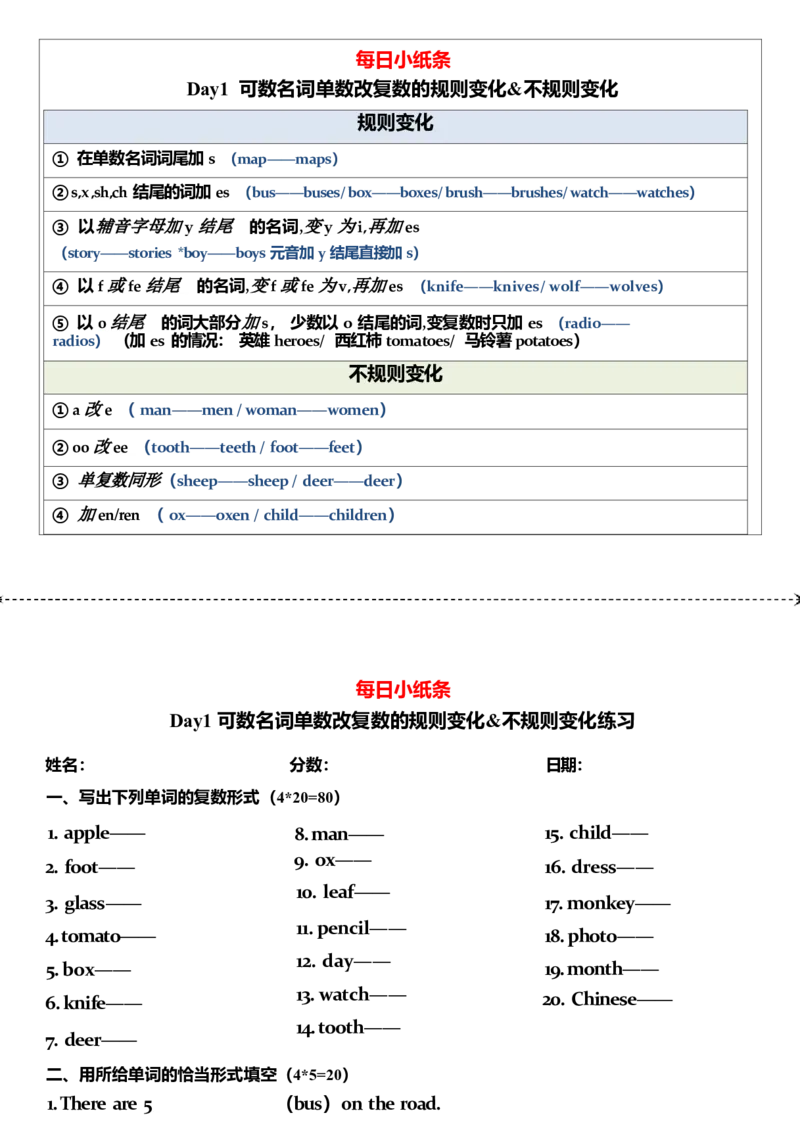
Day1 可数名词单数改复数的规则变化&不规则变化
规则变化
① 在单数名词词尾加 s (map——maps)
② s,x ,sh,ch 结尾的词加 es (bus——buses/ box——boxes/ brush——brushes/ watch——watches)
③ 以 辅音字母加 y 结 尾 的名词, 变 y 为 i , 再 加 e s
(story——stories *boy——boys 元音加 y 结尾直接加 s)
④ 以f 或 fe 结尾 的名词, 变 f 或 fe 为 v , 再加 e s (knife——knives/ wolf——wolves)
⑤ 以 o 结 尾 的词大部分 加 s, 少数以 o 结尾的词,变复数时只加 es (radio——
radios) (加 es 的情况: 英雄 heroes/ 西红柿 tomatoes/ 马铃薯 potatoes)
不规则变化
① a 改e ( man——men / woman——women)
② oo 改 ee (tooth——teeth / foot——feet)
③ 单复数同形(sheep——sheep / deer——deer)
④ 加 en/ren ( ox——oxen / child——children)
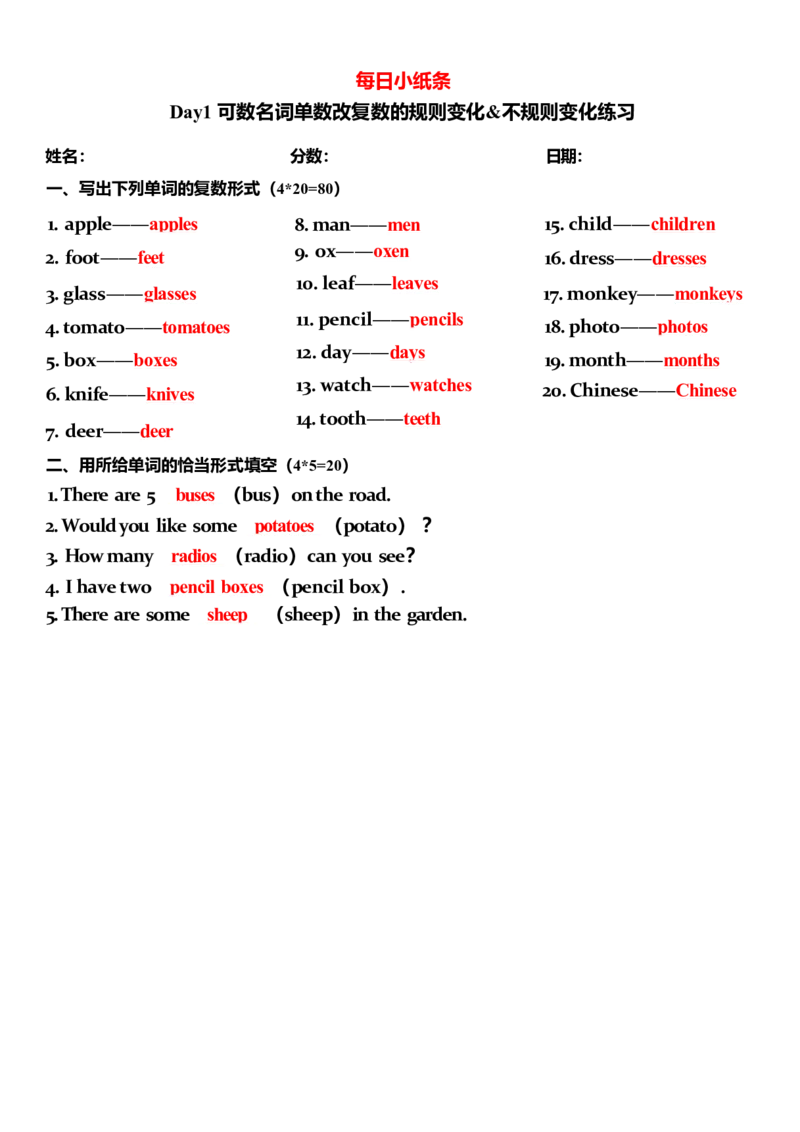
每日小纸条
Day1 可数名词单数改复数的规则变化&不规则变化练习
姓名: 分数: 日期:
一、写出下列单词的复数形式(4*20=80)
1. apple—— 8. man—— 15. child——
9. ox——
2. foot—— 16. dress——
10. leaf——
3. glass—— 17. monkey——
11. pencil——
4. tomato—— 18. photo——
12. day——
5. box—— 19. month——
13. watch——
6. knife—— 20. Chinese——
14. tooth——
7. deer——
二、用所给单词的恰当形式填空(4*5=20)
1. There are 5 (bus)on the road.2. Would you like some (potato) ?
3. How many (radio)can you see?
4. Ihave two (pencil box).
5. There are some (sheep)in the garden.每日小纸条
Day1 可数名词单数改复数的规则变化&不规则变化练习
姓名: 分数: 日期:
一、写出下列单词的复数形式(4*20=80)
1. apple——apples 8. man——men 15. child——children
9. ox——oxen
2. foot——feet 16. dress——dresses
10. leaf——leaves
3. glass——glasses 17. monkey——monkeys
11. pencil——pencils
4. tomato——tomatoes 18. photo——photos
12. day——days
5. box——boxes 19. month——months
13. watch——watches
6. knife——knives 20. Chinese——Chinese
14. tooth——teeth
7. deer——deer
二、用所给单词的恰当形式填空(4*5=20)
1. There are 5 buses (bus)on the road.
2. Would you like some potatoes (potato) ?
3. How many radios (radio)can you see?
4. I have two pencil boxes (pencil box).
5. There are some sheep (sheep)in the garden.每日小纸条
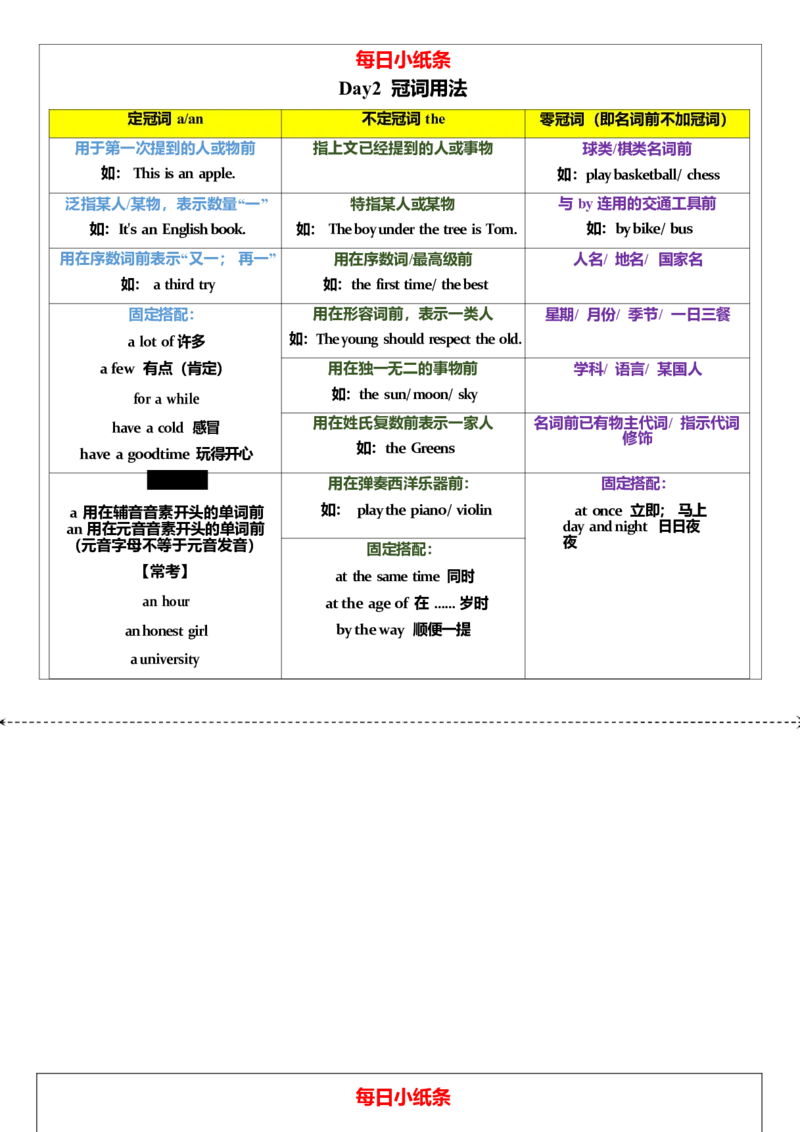
Day2 冠词用法
定冠词 a/an 不定冠词 the 零冠词(即名词前不加冠词)
用于第一次提到的人或物前 指上文已经提到的人或事物 球类/棋类名词前
如: This is an apple. 如:play basketball/ chess
泛指某人/某物,表示数量“一” 特指某人或某物 与 by 连用的交通工具前
如:It's an English book. 如: The boy under the tree is Tom. 如:by bike/ bus
用在序数词前表示“又一; 再一” 用在序数词/最高级前 人名/ 地名/ 国家名
如: a third try 如:the first time/ the best
固定搭配: 用在形容词前,表示一类人 星期/ 月份/ 季节/ 一日三餐
a lot of 许多 如:The young should respect the old.
a few 有点(肯定) 用在独一无二的事物前 学科/ 语言/ 某国人
如:the sun/ moon/ sky
for a while
用在姓氏复数前表示一家人 名词前已有物主代词/ 指示代词
have a cold 感冒
修饰
如:the Greens
have a goodtime 玩得开心
用在弹奏西洋乐器前: 固定搭配:
【注
a 用在辅音音素开头的单词前 如: play the piano/ violin at once 立即; 马上
an 用在元音音素开头的单词前 day and night 日日夜
(元音字母不等于元音发音) 固定搭配: 夜
【常考】
at the same time 同时
an hour at the age of 在 …… 岁时
an honest girl by the way 顺便一提
a university
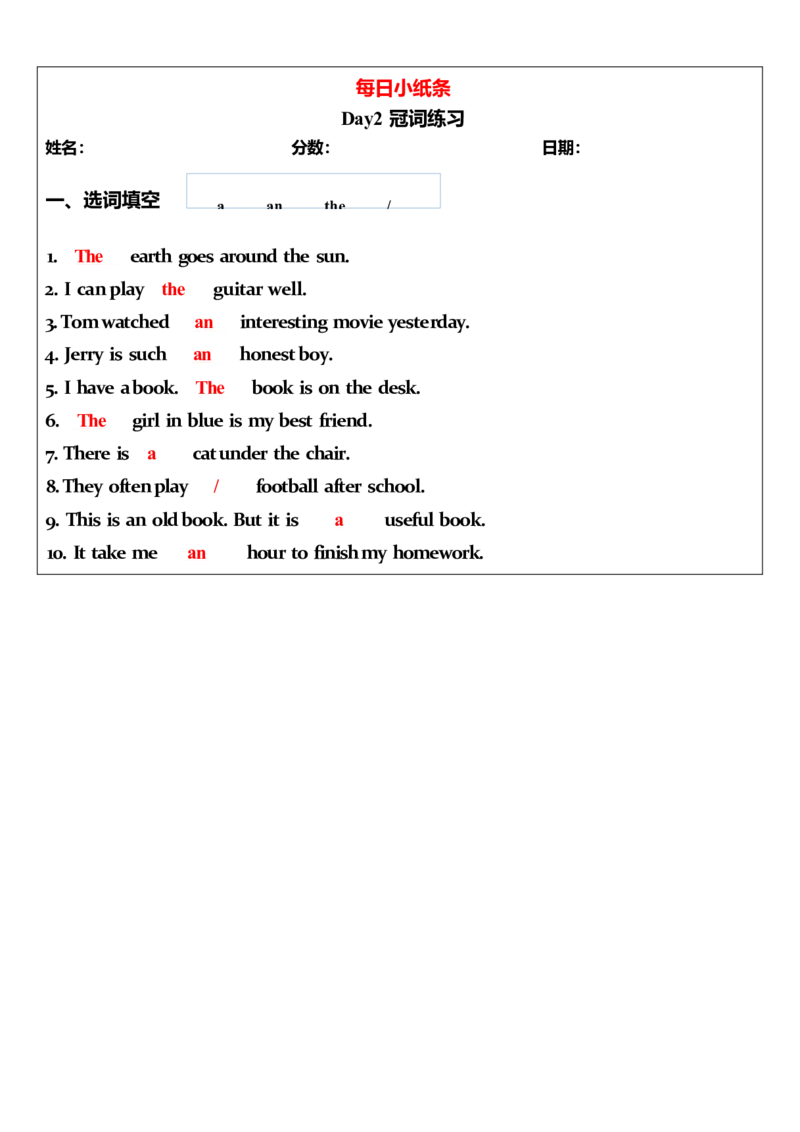
每日小纸条Day2 冠词练习
姓名: 分数: 日期:
一、选词填空
a an the / (10*10=100)
1. earth goes around the sun.
2. I can play guitar well.
3. Tom watched interesting movie yesterday.
4. Jerry is such honest boy.
5. I have a physics book. book is on the desk.
6. girl in blue is my best friend.
7. There is cat under the chair.
8. They often play football after school.
9. This is an old book. But it is useful book.
10. It take me hour to finish my homework.每日小纸条
Day2 冠词练习
姓名: 分数: 日期:
一、选词填空
a an the /
1. The earth goes around the sun.
2. I can play the guitar well.
3. Tom watched an interesting movie yesterday.
4. Jerry is such an honest boy.
5. I have a book. The book is on the desk.
6. The girl in blue is my best friend.
7. There is a cat under the chair.
8. They often play / football after school.
9. This is an old book. But it is a useful book.
10. It take me an hour to finish my homework.每日小纸条
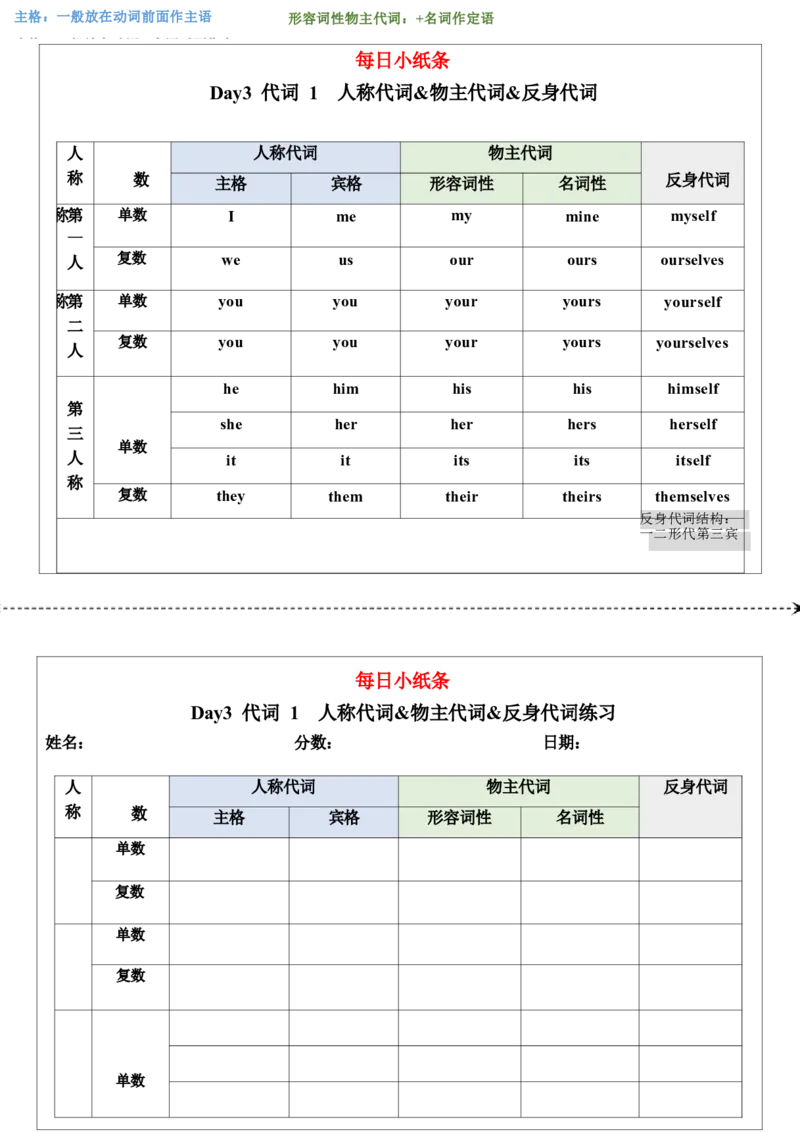
Day3 代词 1 人称代词&物主代词&反身代词
人
反身代词结构:
一二形代第三宾
人称代词 物主代词
称 数 主格 宾格 形容词性 名词性 反身代词
第
一
人
称 单数 I me my mine myself
复数 we us our ours ourselves
第
二
人
称 单数 you you your yours yourself
复数 you you your yours yourselves
第
三
人
he him his his himself
she her her hers herself
单数
it it its its itself
称
复数 they them their theirs themselves
每日小纸条
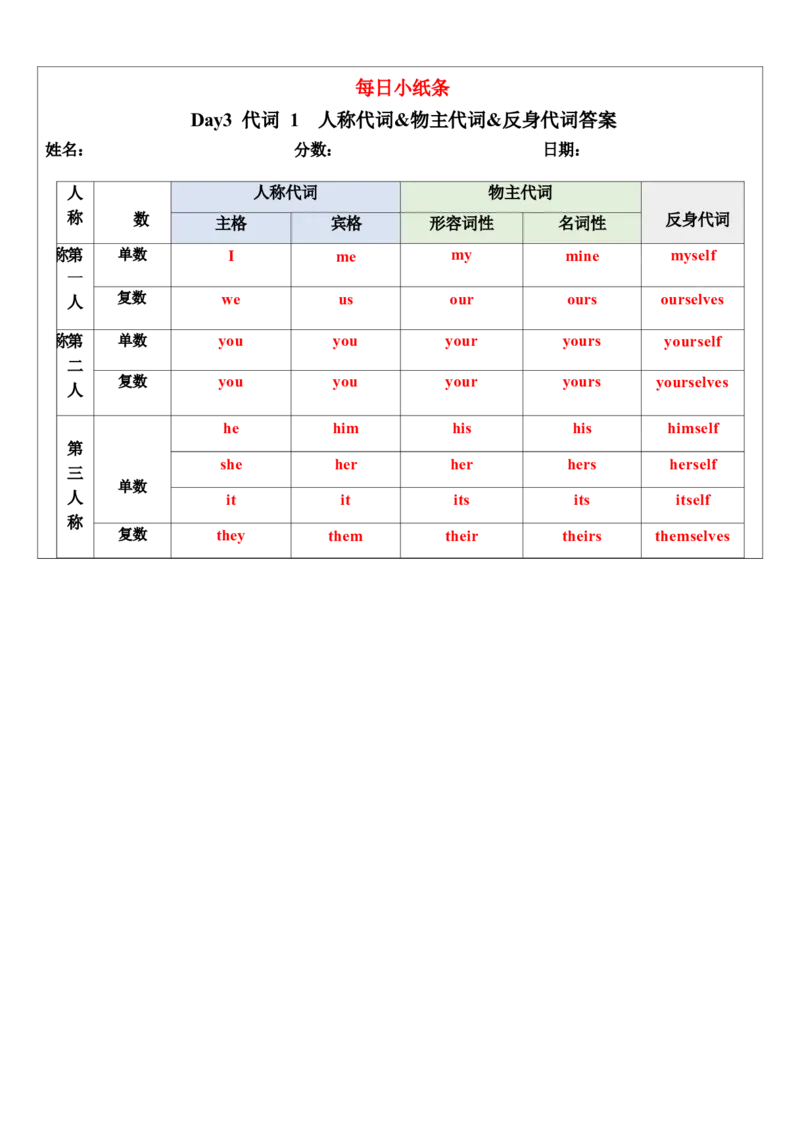
Day3 代词 1 人称代词&物主代词&反身代词练习
姓名: 分数: 日期:
人
主格:一般放在动词前面作主语 形容词性物主代词:+名词作定语
宾格:一般放在动词&介词后面作宾 名词性物主代词= 形容词性物主代词+名
人称代词 物主代词 反身代词
称 数 主格 宾格 形容词性 名词性
单数
复数
单数
复数
单数复数每日小纸条
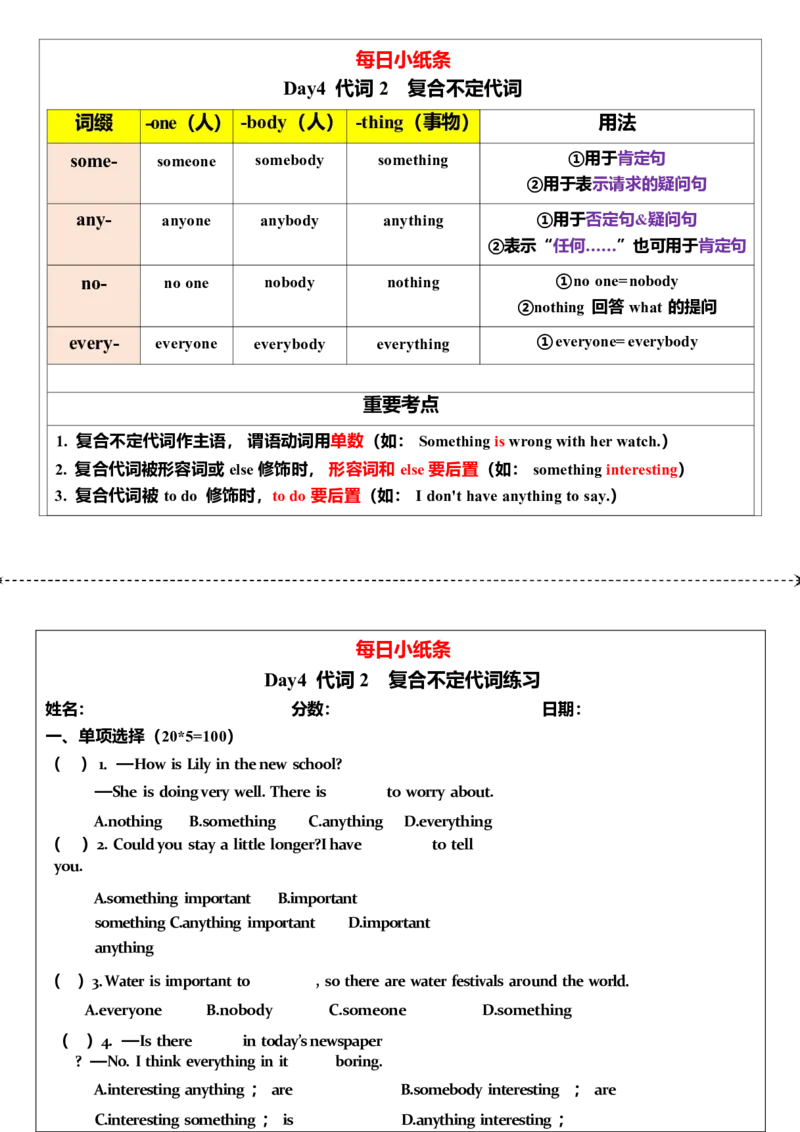
Day3 代词 1 人称代词&物主代词&反身代词答案
姓名: 分数: 日期:
人 人称代词 物主代词
称 数 主格 宾格 形容词性 名词性 反身代词
第
一
人
称 单数 I me my mine myself
复数 we us our ours ourselves
第
二
人
称 单数 you you your yours yourself
复数 you you your yours yourselves
第
三
人
he him his his himself
she her her hers herself
单数
it it its its itself
称
复数 they them their theirs themselves每日小纸条
Day4 代词 2 复合不定代词
词缀 -one(人) -body(人) -thing(事物) 用法
some- someone somebody something ①用于肯定句
②用于表示请求的疑问句
any- anyone anybody anything ①用于否定句&疑问句
②表示“任何……”也可用于肯定句
no- no one nobody nothing ①no one=nobody
②nothing 回答 what 的提问
every- everyone everybody everything ①everyone=everybody
重要考点
1. 复合不定代词作主语, 谓语动词用单数(如: Something is wrong with her watch.)
2. 复合代词被形容词或 else 修饰时, 形容词和 else 要后置(如: something interesting)
3. 复合代词被 to do 修饰时,to do 要后置(如: I don't have anything to say.)
每日小纸条
Day4 代词 2 复合不定代词练习
姓名: 分数: 日期:
一、单项选择(20*5=100)
( ) 1. —How is Lily in the new school?
—She is doing very well. There is to worry about.
A.nothing B.something C.anything D.everything
( ) 2. Could you stay a little longer?I have to tell
you.
A.something important B.important
something C.anything important D.important
anything
( ) 3. Water is important to , so there are water festivals around the world.
A.everyone B.nobody C.someone D.something
( ) 4. —Is there in today’s newspaper
? —No. I think everything in it boring.
A.interesting anything ; are B.somebody interesting ; are
C.interesting something ; is D.anything interesting ;is ( ) 5. —What a great thing to have a robot at home!
—Robots are rally useful. One day they will help people do almost .
A.something B.everything C.nothing D.anyone每日小纸条
Day4 代词 2 复合不定代词练习答案
一、单项选择(20*5=100)
(A) 1. —How is Lily in the new school?
—She is doing very well. There is to worry about.
A.nothing B.something C.anything D.everything
(C)2. Could you stay a little longer?I have to tell you.
A.anything important B.important
something C.something important
D.important anything
(A)3. Water is important to , so there are water festivals around the world.
A.everyone B.nobody C.someone D.something
(D)4. —Is there in today’s newspaper ?
—No. I think everything in it boring.
A.interesting anything ; are B.somebody interesting ; are
C.interesting something ; is D.anything interesting ;
is (B)5. —What a great thing to have a robot at home!
—Robots are rally useful. One day they will help people do almost .
A.something B.everything C.nothing D.anyone每日小纸条
Day5 数词 1 基数词变化规则表
1-12 特殊记 13-19 + teen 20-90 整十 + ty 其它
1 one 13 thirteen 20 twenty 一百
2 two 14 fourteen 30 thirty hundred
3 three 15 fifteen 40 forty 一千
4 four 16 sixteen 50 fifty thousand
5 five 17 seventeen 60 sixty 百万
6 six 18 eighteen 70 seventy million
7 seven 19 nineteen 80 eighty 十亿
8 eight 90 ninety billion
9 nine 21-99(非整十): 三位数:
十位与个位之间加“- ” 在百位与十位或个位之间加“and ”
10 ten
11 eleven 21 twenty-one 108 one hundred and eight
35 225
12 twelve thirty-five two hundred and twenty-five
每日小纸条
Day5 数词 1 基数词变化规则表默写
姓名: 分数: 日期:
1-12 13-19 20-90 其它
1 13 20 一百
14 30
2
3 15 40 一千
4 50
16
5 17 60 百万6 18 70
7 19 80 十亿
90
8
9 21-99(非整十): 三位数:
10
11 21 108
35 225
12每日小纸条
Day6 数词 2 基数词用法
1. 基数词表示时间
顺读法 先读小时, 再读分钟 (整点: 小时数 + o'clock 如: 6:00 读作 six o'clock)
逆读法 先读分钟,再读小时 分钟数≤30 用 past(过了) 分钟数 + past + 小时数
分钟数>30 用 to(到) (60-分钟数)+ to +(小时数+1)
[注意]①15 分钟可用 a quarter 表示 ②半个小时可用half an hour 表示 (如 8:30 half past eight)
【例】 7:15 顺读法: seven fifteen 逆读法: fifteen past seven 或 a quarter past seven
9:45 顺读法 :nine forty-five 逆读法: fifteen to ten 或 a quarter to ten
2. 基数词表示百/千/百万/十亿
(1)表示具体数量, 不加 s 不加 of 【例】两百 two hundred / 三百万 three million
(2)表示模糊概念, 加 of, 加 s 【例】成百上千的 hundreds of / 数百万的 millions of
3. 基数词表示年龄
(1)基数词 + year(s) + old 意为“某人几岁了” 【例】ten years old 十岁了
(2)at the age of + 基数词 意为“在……几岁时”【例】at the age often 在……十岁时
(3)in one's + 整十的复数形式 意为“某人几十多岁”【例】I’m in my twenties. 我二十多岁。
每日小纸条
Day6 数词 2 基数词用法练习
姓名: 分数: 日期:
一、用基数词表达下列表格中的时间(10*6=60)
顺读法 逆读法
10:50
8:15
6:30
二、单项选择(10*4=40)
() 1. The volunteers sent books to a mountain village school on Children's Day.
A. two hundreds of B. two hundred of C. two hundreds D. two
hundred () 2. There are over students in their school.A. hundreds B. nine hundreds C. hundreds of D. nine
hundred () 3. The old man began to learn to drive a car at the age of
.
A. sixty B. the sixtieth C. sixty years old D.
sixties () 4. He became a famous writer when he was .
A. in his fifty B. in his fifties C. in fifty years old D. in fifties每日小纸条
Day6 数词 2 基数词用法练习答案
姓名: 分数: 日期:
一、用基数词表达下列表格中的时间(10*6=60)
顺读法 逆读法
10:50
ten fifty ten to eleven
8:15 eight fifteen fifteen past eight/ a quarter past eight
6:30 six thirty half past six
二、单项选择(10*4=40)
( D )1. The volunteers sent books to a mountain village school on Children's
Day.
A. two hundreds of B. two hundred of C. two hundreds D. two
hundred ( C )2. There are over students in their school.
A. hundreds B. nine hundreds C. hundreds of D. nine
hundred ( A )3. The old man began to learn to drive a car at the age of
.
A. sixty B. the sixtieth C. sixty years old D.
sixties ( B )4. He became a famous writer when he was .
A. in his fifty B. in his fifties C. in fifty years old D. in fifties每日小纸条
数词 3 序数词变化规则&用法
Da
变化规则 例子
基变序, 有规律, 词尾要添 th 如: four → fourth , six → sixth
123, 特殊记, 词尾字母 tdd 如: one →first, two →second, three →third
八去 t, 九去 e 如, eight →eighth, nine →ninth
(第十九 nineteenth /第九十 ninetieth 不去 e)
5 和 12 一起记,ve 要用 f 替 如: five →fifth, twelve →twelfth
若要遇到整十数,ty 变成 tie,后面再加 th 如: forty →fortieth, fifty →fiftieth
若是遇到几十几, 只变个位就可以 如:twenty-one →twenty-first
序数词用法
1. 用序数词表示顺序,前面一般要加冠词 the(前面有形容词性物主代词和名词所有格修饰时除外)
2. 表达分数: 分子用基数词, 分母用序数词(当分子>1, 分母+s)
如: 三分之一 one third/ 三分之二 two thirds/ 四分之一 one fourth 或 a quarter
【注意】分数作主语时,谓语动词由分数后的名词决定, 可数名词复数 →复数, 不可数名词 →单数
每日小纸条
Day7 数词 3 序数词变化规则&用法练习
姓名: 分数: 日期:
一、写出下列基数词的序数词(5*9=45)
one five nine
two twelve fifty
three eight thirty-two
二、根据句意及所给单词提示完成下列句子(5*11=55)
1. February is the (two)month of a year.
2. Tomorrow is her (twenty)birthday.
3. There are month in a year. The month is December.(twelve)
4. In our class, three (five)of the students (be) girls.5. The (thirty-three)lessons is difficult.
6. (五分之四)of the water (be)clean.
7. Susan is the (three)tall girl in her class.
8. My mother will be forty years old next week. I’m planning to buy a gift for her birthday.
(forty)每日小纸条
Day7 数词 3 序数词变化规则&用法练习答案
姓名: 分数: 日期:
一、写出下列基数词的序数词(5*9=45)
one first five fifth nine ninth
two second twelve twelfth fifty fiftieth
three third eight eighth thirty-two thirty-second
二、根据句意及所给单词提示完成下列句子(5*11=55)
1. February is the second (two)month of a year.
2. Tomorrow is her twentieth (twenty)birthday.
3. There are twelve month in a year. The tw elfth month is December.(twelve)
4. In our class, three fifths (five)of the students are (be) girls.
5. The thirty-third (thirty-three)lessons is difficult.
6. Four fifths (五分之四)of the water is (be)clean.
7. Susan is the third (three)tall girl in her class.
8. My mother will be forty years old next week. I’m planning to buy a gift for her fortieth birthday.
(forty)每日小纸条
Day8 介词 1 时间介词 in on at
in in 年 in 月 in 季节 in 2024/ in July/ in summer
>1 天
或泛指一天当中的上午/下午/晚上 in the morning/ afternoon/ evening
on Monday
on 加具体某一天 on December 25th
on
或特定的早上/下午/晚上 on Children's Day
=1 天
on a cold morning
at at 要加具体时间点 at 3 o'clock
中午夜晚和黎明
<1 天 at noon/ night/ dawn
in 年 in 月in 季节, 上午下午和晚
上 on 加具体某一天, 星期节日和
周末 at 要加时间点, 中午夜里和
黎明
若是遇到有修饰, 就把介词 on 放
前 这那上下每个前,in on at 都不
填
每日小纸条
Day8 介词 1 时间介词 in on at 练习
姓名: 分数: 日期:
一、用“in/ on/ at”或“/”填空(4*20=80)
1. autumn 7. 9:45 15. the evening
2. November 8. March 7th 16. Mother's Day
3. Thursday 9. Saturday evening 17. this afternoon
12. noon
4. last Friday 18. July 12th
13. spring
5. night 19. Sunday afternoon
6. the morning 14. ten o'clock 20. next Friday
二、单项选择(5*4=20)
( ) 1. --David, is your mother’s birthday November? --Yes, it’s November 3rd.
A. in; on B. of; in C. on; at D. for;on ( ) 2. Lucy was born a summer evening June, 2000.
A. in; in B. in; at C. on; at D. on;
in ( ) 3. Tom usually gets up 6:30.
A. in B. on C. at
D. / ( ) 4. We will hold an art festival next Tuesday.
A. in B. on C. at D. /每日小纸条
Day8 介词 1 时间介词 in on at 练习答案
姓名: 分数: 日期:
一、用“in/ on/ at”或“/”填空(4*20=80)
1. in autumn 7. at 9:45 15. in the evening
2. in November 8. on March 7th 16. on Mother's Day
9. on Saturday evening 17. / this afternoon
3. on Thursday
12. at noon 18. on July 12th
4. / last Friday
5. at night 13. in spring 19. on Sunday afternoon
6. in the morning 14. at ten o'clock 20. / next Friday
二、单项选择(5*4=20)
( A )1. --David, is your mother’s birthday November? --Yes, it’s November 3rd.
A. in; on B. of; in C. on; at D. for;
on ( D )2. Lucy was born a summer evening June, 2000.
A. in; in B. in; at C. on; at D. on;
in ( C )3. Tom usually gets up 6:30.
A. in B. on C. at
D. / ( D )4. We will hold an art festival next Tuesday.
A. in B. on C. at D. /每日小纸条
Day9 介词 2 其它介词
空间位置 in/ on/ at 上下 above/ below 穿过 考点
in+大地点(国家城市) above 在……上方 across 表面穿过 ①介词+
动词 ing
on 在……上(有接触) below 在……下方 through 内部穿过
②介词+
at+小地点/ 门牌号 正上正下 over/ under past 旁边经过
人称代词
之间 between/among over 在……正上方 along 沿着……
宾格
between 两者之间 under 在……正下方 over 上面越过
③地点副词
among 三者及以上之间 用……工具/手段 在树上 前不加介词
(这那里
地理位置 in/ on/ to in+语言 on the tree(树上长出的)
楼上下
in 范围内 with+具体工具 in the tree (外来物) 家国外)
on 范围外, 接壤 by+名词/ 动词 ing 在墙上 ④ 介 词
by+交通工具 短 语
to 范围外, 不接壤 on the wall 在墙表面
在……前面(里 the 外不the) in the wall 在墙里面
in front of 在外部的前面/ in the front of 在内部的前面
每日小纸条
Day9 介词 2 其它介词 练习
姓名: 分数: 日期:
一、用恰当的介词或“/”填空(6.25*16=100)
1. I will arrive Beijing tomorrow.
2. Hainan is the south of China.
3. There is a book (在……上)the table.
4. There is a clock the wall.
5. The sunshine goes the window.
6. Go (穿过)the street, and you will find the park.
7. She made money selling flowers.
8. Amy is sitting (在……之间)Linda and Judy.
9. Our teacher usually stands (在……前面)our classroom.
10. I wrote the letter this blue pen.
11. There are many birds singing (在树上)the tree.
12. What’s this English?
13. Japan is the east of China.14. Tom is the tallest boy his classmates.
15. To arrive the airport on time, he took a taxi..
16. There is a big tree (在……前面)my house.每日小纸条
Day9 介词 2 其它介词 练习答案
姓名: 分数: 日期:
一、用恰当的介词或“/”填空(6.25*16=100)
1. I will arrive in Beijing tomorrow.
2. Hainan is in the south of China.
3. There is a book on the table.
4. There is a clock on the wall.
5. The sunshine goes through the window.
6. Go across (穿过)the street, and you will find the park.
7. She made money by selling flowers.
8. Amy is sitting between Linda and Judy.
9. Our teacher usually stands in the front of (在……前面)our classroom.
10. I wrote the letter wi th this blue pen.
11. There are many birds singing in the tree.
12. What’s this in English?
13. Japan is to the east of China.
14. Tom is the tallest boy among his classmates.
15. To arrive at the airport on time, he took a taxi..
16. There is a big tree in front of my house.每日小纸条
Day10 形容词用法
基本用法 位置 例子
①放在名词或代词前, 作定语 adj. + n. a beautiful flower
②放在 enough 前面 adj. + enough interesting enough
③放在不定代词后, 作后置定语 不定代词 + adj. something important
④放在系动词(be 动词/感官动词后), 作表语 系动词 + adj She is smart.
The cat looks cute.
⑤ed 结尾的形容词(人感到……), 主语一般是 excited 激动的
人 ing 结尾的形容词(令人感到……),主语一般
exciting 令人激动的
是物
特殊句型 例句
①It’s + adj. + for/ of sb. to do sth. It's important for us to learn English well.
(用 for 时,形容词形容物/用of 时,形容词形容人) It’s kind of you to help the old man.
②sb. find/ think it + adj. to do sth. I find/ think it useful to read more books.
【口诀】美小圆旧黄 中国木书房
多个形容词顺序
(品质特征/大小长短高低/形状/新旧/颜色/国家地区出处/材质/用途)
【注意】有些词 ly 结尾实为形容词: friendly/ lovely/ lonely/ daily(每天的)
每日小纸条
Day10 形容词用法练习
姓名: 分数: 日期:
一、翻译(8*10=80)
1. 一辆新的自行车
2. 一个诚实的男孩
3. 没什么重要的
4. 尝起来美味的
5. 感到放松的
6. 令人感到有趣的
7. 足够耐心
8. 感觉糟糕的
9. 每天锻炼对我们来说是有必要的。
10. 我发现独自去河里游泳是很危险的。
二、单项选择(10*2=20)() 1. I bought for my mother.
A. anything special B. special anything C. something special D. special something
() 2. Mr. Green, do you have to tell me?
A. everything important B. important anything C. anything important D. something important每日小纸条
Day10 形容词用法练习
姓名: 分数: 日期:
一、翻译(8*10=80)
1. 一辆新的自行车 a new bike
2. 一个诚实的男孩 an honest boy
3. 没什么重要的 nothing important
4. 尝起来美味的 taste delicious
5. 感到放松的 relaxing
6. 令人感到有趣的 interesting
7. 足够耐心 patient enough
8. 感觉糟糕的 feel terrible
9. 每天锻炼对我们来说是有必要的。 It ' s necessary for us to exercise every day .
10. 我发现独自去河里游泳是很危险的。 I find it dangerous to swim alone in the river .
二、单项选择(10*2=20)
(C) 1. I bought for my mother.
A. anything special B. special anything C. something special D. special something
(C)2. Mr. Green, do you have to tell me?
A. everything important B. important anything C. anything important D. something important每日小纸条
Day11 副词用法
修饰 句子/ 副词/ 形容词/ 动词 (【助记】聚 富 行 动)
1. Luckily, I achieved my dream in the end. (修饰句子)
2. He runs very fast. (修饰副词)
用法
3. You are quite right. (修饰形容词)
4. She speaks English well. (修饰动词)
分类 例子
①时间副词(句首/句末) now, today, tomorrow, yesterday
②地点副词(一般放句末) here, there, down, up, inside, outside
③方式副词(一般放动词后面) simply, closely, slowly, carefully
④频度副词(be/情/助后, 实义动词前) always, usually, often, sometimes, hardly ever, never
⑤程度副词(形/副/实义动词前) rather, pretty, quite, very, too, so
⑥疑问副词(句首) where, when, why, how
每日小纸条
Day11 副词用法练习
姓名: 分数: 日期:
一、翻译句子(10*5=50)
1. Tom 有时候坐公交车去上学。
2. 这些花真的很美丽。
3. Jerry 能够很容易地回答出这个问题。
4. 他们非常相信我。
5. 不幸的是,John 数学考试不及格。
二、单项选择(10*5=50)
( ) 1. Ms. Green is a teacher and she plays the piano .
A. well; well B. well; good C. good; well D. good;
good ( ) 2. were you late for school? ——Because I missed the bus.
A. When B. Why C. How D.
Where ( ) 3. I will visit my teacher .
A. tomorrow B. yesterday C. now D. last
Friday ( ) 4. He drinks milk because he doesn’t like it.
A. always B. never C. often D.sometimes ( ) 5. Don’t talk . Your grandmother is sleeping.
A. loud B. quiet C. loudly D. quietly每日小纸条
Day11 副词用法答案
一、翻译句子(10*5=50)
1. Tom 有时候坐公交车去上学。 Tom sometimes goes to school by bus .
2. 这些花真的很美丽。 These flowers are really beautiful .
3. Jerry 能够很容易地回答出这个问题. 。 Jerry can answer this question easily .
4. 他们非常相信我。 They believe me very much .
5. 不幸的是,John 数学考试不及格。 Unfortunately , John failed his math exam .
二、单项选择(10*5=50)
(C) 1. Ms. Green is a teacher and she plays the piano .
A. well; well B. well; good C. good; well D. good;
good (B)2. were you late for school? ——Because I missed the bus.
A. When B. Why C. How D.
Where (A)3. I will visit my teacher .
A. tomorrow B. yesterday C. now D. last
Friday (B)4. He drinks milk because he doesn’t like it.
A. always B. never C. often D. sometimes
(C)5. Don’t talk . Your grandmother is sleeping.
A. loud B. quiet C. loudly D. quietly每日小纸条
Day12 形容词/副词的比较级&最高级规则/不规则变化
规则变化
1. 直接+er/est
fast faster fastest
2. e 结尾,+r/ st
late later latest
3. 辅音字母+y 结尾, 改 y 为 i 加 er/est busy busier busiest
4. 重读闭音节,且词尾只有一个辅音字母,双写尾 big bigger biggest
字母, 再加 er/est
5. 多音节和部分双音节, 形容词前加 more/less careful more careful most careful
不规则变化
两好 good/ well better best 一远 far farther farthest
两坏 bad/ badly worst further furthest
worse
两多 many/mush more most 一老 old older oldest
一少 little less least elder eldest
每日小纸条
Day12 形容词/ 副词的比较级&最高级练规则不规则变化
姓名: 分数: 日期:
一、写出下列形容词/副词的比较级和最高级(5*20=100)
原级 比较级 最高级 原级 比较级 最高级
lazy good/well
bad many/much
little hothard beautiful
fat early每日小纸条
Day12 形容词/ 副词的比较级&最高级规则/不规则变化答案
姓名: 分数: 日期:
一、写出下列形容词/副词的比较级和最高级(5*20=100)
原级 比较级 最高级 原级 比较级 最高级
lazy lazier laziest good/well better best
bad worse worst many/much more most
little less least hot hotter hottest
hard harder hardest beautiful more beautiful most beautiful
fat fatter fattest early earlier earliest每日小纸条
Day13 形容词/副词的比较级&最高级
用法 例子
原级 ①as + 原级 +as Tom is as thin as Jerry.
②not + as/so +原级 + as Lucy is bot as/so tall as Amy.
③倍数 + as + 原级 + as This table is twice as big as that one.
比较级 ①比较级+than Henry is more careful than me.
(两者之间)
②比较级 + and 比较级 It is getting hotter and hotter.
③the + 比较级, the + 比较级 The more, the better.
最高级 ①the + 最高级 + of/in Fiona is the tallest of the three girls.
(三者及以上)
②the + 序数词 + 最高级 The Yellow River is the second longest in China.
③one of + the +最高级+名词复数 Beijing is the one of the biggest cities in China.
比较级表示 比较级+than any other+名词单数 Jack is taller than any other boy in his class.
最高级
每日小纸条
Day13 形容词/ 副词的比较级&最高级用法练习
姓名: 分数: 日期:
一、翻译句子(10*5=50)
1. 这本书比那本书有趣。
2. Jack 是我们班最高的的学生。
3. 上海是中国最繁忙的城市之一. 。
4. 你越努力学习, 你就会取得越好的成绩。
5. Jerry 没 Tom 跑得快。
二、单项选择(10*5=50)
( ) 1. Who climbs ,Jim, Peter or Sam?
A.high B. higher C. the highest D.
highest ( ) 2.The you write, the mistakes you will make.
A. more careful; fewer B.careful; few C. more carefully; few D. more carefully;
fewer ( ) 3. Which do you like , tea or coffee?
A. good B. well C. better D.
best ( ) 4. John doesn’t write as as Tom. In fact, he writes in hisclass.
A. carefully; the worst B. careful; worse C. carefully;worse D. careful; the
worst ( ) 5. Lucy dances any other student in her class.
A. good than B. as good as C. better than D. the best每日小纸条
Day13 形容词/ 副词的比较级&最高级用法练习答案
姓名: 分数: 日期:
一、翻译句子(10*5=50)
1. 这本书比那本书有趣。 This book is more interesting than that one .
2. Jack 是我们班最高的的学生。 Jack is the tallest student in our class .
3. 上海是中国最繁忙的城市之一 。 Shanghai is one of the busiest cities in China .
4. 你越努力学习, 你就会取得越好的成绩。 The harder you study , the better grade you can get .
5. Jerry 没 Tom 跑得快。 Jerry can't run a s fast as Tom .
二、单项选择(10*5=50)
( C )1. Who climbs ,Jim, Peter or Sam?
A.high B. higher C. the highest D. highest
( D)2.The you write, the mistakes you will make.
A. more careful; fewer B.careful; few C. more carefully; few D. more carefully;
fewer ( C )3. Which do you like , tea or coffee?
A. good B. well C. better D.
best ( A )4. John doesn’t write as as Tom. In fact, he writes in his
class.
A. carefully; the worst B. careful; worse C. carefully;worse D. careful; the
worst ( B )5. Lucy dances any other student in her class.
A. good than B. better than C. as good as D. the best每日小纸条
Day14 连词 1 并列连词
连词 注意
1. and ①和(肯定句) ②然后 ③并且 and 前后连接的内容一般结构/时态相同
2. or 和(否定句) /
3. both...and...两者都 …… 谓语动词用复数
并列关系
4. not only...but also...不仅 ……而且 …… 就近原则,谓语动词的单复数由最靠近谓
语动词的主语决定
5. neither...nor...两者都不 ……
1. or 或者(常用于疑问句) 常用于 either...or...结构中
选择关系
2. either...or 或者 ……或者 ……(二选一) 就近原则
1. but 但是 but 不能和 although/though 一起使用
2. while 然而(强调对比性的转折) /
转折关系
3. yet 但是 /
4. however 然而 要用逗号把 however 与句子隔开
1. so 所以; 因此 so 不能和 because 一起使用
因果关系 2. therefore 因此 /
3. for 因为 补充说明,或为前面的内容提供推断理由
每日小纸条
Day14 连词 1 并列连词练习
姓名: 分数: 日期:
一、根据句意完成下列句子(5*20=100)
1. my father my mother (like)pop music. They prefer classical music.
2. Tom Jerry are going to New York tomorrow.
3. Neither Eric Nancy (like)bananas.
4. I don’t like milk juice.
5. his parents but also his sister (be)friendly to me.
6. There are no buses, you have to walk.
7. It was difficult to climb the mountain, Sam go to the top at last.
8. He may be ill, he is absent(缺席)from the meeting today.
9. Would you like to leave would you like to stay?10. I like swimming my brother likes playing basketball.
11. Lucy or her parents interested in reading, for there are many books in their house.
12. Study hard, you will make great progress.
13. We should study hard keep in good health.每日小纸条
Day14 连词 1 并列连词练习答案
姓名: 分数: 日期:
一、根据句意完成下列句子(5*20=100)
1. Neither my father nor my mother likes (like)pop music. They prefer classical music.
2. Both Tom and Jerry are going to New York tomorrow.
3. Neither Eric nor Nancy likes (like)bananas.
4. I don’t like milk or juice.
5. Not only his parents but also his sister is (be)friendly to me.
6. There are no buses, so you have to walk.
7. It was difficult to climb the mountain, but Sam go to the top at last.
8. He may be ill, for he is absent(缺席)from the meeting today.
9. Would you like to leave or would you like to stay?
10. I like swimming while my brother likes playing basketball.
11. Either Lucy or her parents are interested in reading, for there are many books in their house.
12. Study hard, and you will make great progress.
13. We should not only study hard but also keep in good health.每日小纸条
Day15 连词 2 从属连词
概念: 从属连词通常引导一个从句, 作主句的一个成分。
引导宾语从句 if/ whether 是否
1. 引导时间状从 when/ while/ after/ before/【 as soon as(主将从现)】 ...
2. 引导地点状从 where/ wherever
3. 引导原因状从 because/ since/ 【*as 因为(一般放句首)】
4. 引导条件状从 if/ unless/as long as(主将从现)
5. 引导目的状从 in order that/ so that
引导
状语从句 6. 引导让步状从 although/ though/ even if/ even though/【*as 虽然, 尽管】
7. 引导结果状从 so/so...that.../ such...that...
8. 引导比较状从 than/ *as 和 …… 一样
①【主将从现】原则, 主句用一般将来时, 从句用一般现在时
②while 引导的句子要用延续性动词
注 ③so...that.../ such...that...(名词前用 such, 形副前用 so)每日小纸条
Day15 连词 2 从属连词练习
姓名: 分数: 日期:
一、根据句意填空(10*3=30)
1. He got up early / he could catch the bus.
2. Sanya is a beautiful city that many people go there for holidays.
3. Canada is large, the population is small.
二、翻译句子(10*5=50)
1. 他的英语讲得和美国人一样好。
2. 我一到巴黎就给你打电话。
3. 我想知道她是否会回来。
4. 当我们在外面玩时, 突然下起了雨。
5. 她是如此的聪明以至于很容易就解决了问题。
三、单项选择(10*2=20)
() 1. The students were talking the teacher came in.
A. while B. when C. since D.
as () 2. They a picnic unless it next weekend.
A. have; rain B. have; rains C. will have; rains D. will have; rain每日小纸条
Day15 连词 2 从属连词练习答案
姓名: 分数: 日期:
一、根据句意填空(10*3=30)
1. He got up early so tha t/ in order that he could catch the bus.
2. Sanya is such a beautiful city that many people go there for holidays.
3. Though/ Although Canada is large, the population is small.
二、翻译句子(10*5=50)
1. 他的英语讲得和美国人一样好。 He speaks English as well as Americans .
2. 我一到巴黎就给你打电话。 I ’ ll call you as soon as I get to Paris .
3. 我想知道她是否会回来。 I wonder if / whether she will come back .
4. 当我们在外面玩时, 突然下起了雨。 It started to rain while we were playing outside .
5. 她是如此的聪明以至于很容易就解决了问题。 She is so smart that she can solve the problem easily .
三、单项选择(10*2=20)
(B) 1. The students were talking the teacher came in.
A. while B. when C. since D. as
(C)2. They a picnic unless it next weekend.
A. have; rain B. have; rains C. will have; rains D. will have; rain每日小纸条
Day16 动词 1 动词的分类
概念: 用来表示动作或状态的词【☆英语中最重要的词汇】
分类 例词 【注意】
实 及物动词(可跟宾语) give, show ,enjoy ,love , 部分动词可接双宾
borrow
义
动词
不及物动词(不跟宾语) laugh ,work ,listen ,die 若要加宾语,须借助介词
状态系动词 be( am ,is ,are )
持续系动词 keep, stay ,remain
表象系动词 appear, seem
连系
动词 感官系动词 feel, smell, sound ,taste ,look 接形容词作表语
变化系动词 become ,grow ,turn ,get
终止系动词 prove
助动词 be ,do ,have 助动词 do 后加动词原形
情态动词 can ,may ,must ,will ,might 情态动词后加动词原形
补充
实义动词: 具有实际意义, 可单独作谓语 连系动词: 表示主语身份、性质、状态的动词
助动词: 帮助句中的谓语动词构成否定、疑问, 时态、语态 情态动词: 不独立作谓语, 须加动词原形作谓语
每日小纸条
Day16 动词 1 动词的分类练习
姓名: 分数: 日期:
一、找出下列句子里的动词, 并说明动词的类型(5*8=40)
1. My parents bought me a nice backpack. 动词: 类型:
2. They were very angry then. 动词: 类型:
3. I don’t like pink at all. 动词①: 类型: 动词②: 类型:
二、翻译句子(10*5=50)
1. 这汤尝起来很美味。
2. 上课时, 你应该认真听老师讲课。
3. Tom 喜欢打篮球吗?
4. Jerry 是一位语文老师。
5. Amy 会弹吉他。
三、改写句子(5*2=10)
学科网(北京)股份有限公司1. They are from Canada.(改为否定句)
2. Bob had a great time visiting the Great Wall yesterday. (改为疑问句)
学科网(北京)股份有限公司每日小纸条
Day16 动词 1 动词的分类练习
姓名: 分数: 日期:
一、找出下列句子里的动词, 并说明动词的类型(5*8=40)
1. My parents bought me a nice backpack. 动词: bought 类型: 实义动词(及物动词)
2. They were very angry then. 动词:were 类型: 连系动词
3. I don’t like pink at all. 动词①: do 类型: 助动词 动词②: like 类型: 实义动词(及物动
词)
二、翻译句子(10*5=50)
1. 这汤尝起来很美味。 The soup tastes delicious .
2. 上课时, 你应该认真听老师讲课。 You should listen to your teacher carefully in class .
3. Tom 喜欢打篮球吗? Does Tom like playing basketball ?
4. Jerry 是一位语文老师。 Jerry is a Chinese teacher .
5. Amy 会弹吉他。 Amy can play the guitar .
三、改写句子(5*2=10)
1. They are from Canada.(改为否定句)
They are not from Canada .
2. Bob had a great time visiting the Great Wall yesterday. (改为疑问句)
Did Bob have a great time visiting the G reat Wall yesterday?
学科网(北京)股份有限公司【一般用法】
【已计划或思考
每日小纸条
过】 【即将发
Day17 动词 2 动词时态(3 个一般)
一般现在时
用法 ①客观真理 ②日常习惯 ③主将从现
结构 主语 + 动词原形/ 三单 + 其
(当主语是第三人称单数时, 谓语动词要用三单形式)
时间标志词 ①频度副词 ②every 类 ③once/ twice
一般过去时
用法 ①过去发生的事或存在的状态 ②过去经常、反复发生的动作
结构
+ 动词过去式 + 其
主语
①yesterday 类 ②last 类 ③just now
时间标志词
④...ago ⑤in the past ⑥once upon a time
一般将来时
1. 主语 + will + 动词原形 + 其它
2. 主语 + be going to + 动词原形 + 其它
3. 主语 + be about to + 动词原形 + 其它
结构
①tomorrow 类 ②next 类 ③in the future
时间标志词
④in + 一段时间(……之后) ⑤soon ⑥one day/ some day
每日小纸条
Day17 动词 2 动词时态(3 个一般)练习
姓名: 分数: 日期:
一、用括号内动词的适当形式填空(10*5=50)
1. David and Tom often (play) football after class.
2. I (not do) my homework because I (have) a fever yesterday.
3. There (be) a football match tomorrow.
4. Gary (read) the newspaper by the window just now.
二、单项选择(10*5=50)
( ) 1. he to the park at 6:30 every morning? --No, he .
A. Does; goes; does B. Does; go; doesn’t C. Do; go; doesn’t D. Does; goes;
doesn’t ( ) 2. Mr. Green usually his newspaper in the evening, but he TV yesterday
evening.
A. reads; watches B. reads; watch C. reads; watched D. read;
学科网(北京)股份有限公司watch ( ) 3. Bella around the world in the future.
A. travels B. traveled C. travel D. is going to
travel ( ) 4. What will you do tomorrow? --We will have a picnic if it sunny.
A. is B. be C. was D. will
be ( ) 5. The earth around the sun.
A. go B. goes C. went D. will go
学科网(北京)股份有限公司每日小纸条
Day17 动词 2 动词时态(3 个一般)练习答案
姓名: 分数: 日期:
一、用括号内动词的适当形式填空(10*5=50)
1. David and Tom often play (play) football after class.
2. I didn’t do (not do) my homework because I had (have) a fever yesterday.
3. There will be (be) a football match tomorrow.
4. Gary read (read) the newspaper by the window just now.
二、单项选择(10*5=50)
(B) 1. he to the park at 6:30 every morning? --No, he .
A. Does; goes; does B. Does; go; doesn’t C. Do; go; doesn’t D. Does; goes; doesn’t
(C)2. Mr. Green usually his newspaper in the evening, but he TV yesterday evening.
A. reads; watches B. reads; watch C. reads; watched D. read; watch
(D)3. Bella around the world in the future.
A. travels B. traveled C. travel D. is going to
travel (A)4. What will you do tomorrow? --We will have a picnic if it sunny.
A. is B. be C. was D. will
be (B)5. The earth around the sun.
A. go B. goes C. went D. will go
学科网(北京)股份有限公司每日小纸条
Day18 动词 3 动词时态(2 进行 1 完成)
现在进行时
①表示说话时正在进行的动作
用法
②表示现阶段正在进行的动作,但是此时此刻动作不一定正在进行
结构
+ be(am/ is/ are) + 现在分词 + 其
主语
时间标志词 ①now/ right now ②these days ③look/ listen/ be quiet
过去进行时
①表示过去某个时刻正在进行的动作
用法
②表示过去某一段时间内一直持续进行的动作
结构
+ be(was/ were) + 现在分词 + 其
主语
时间标志词 ①at that time ②this time yesterday ③过去某一个具体时间点
现在完成时
①表示过去的行为对现在产生的影响
用法
②表示过去的某一动作/状态一直持续到现在
结构 主语 + have/ has + 过去分词 + 其它 (主语是三单时用 has)
①already (肯定句) ②yet (疑问句/否定句) ③so far
时间标志词
④since + 时间点 ⑤for + 时间段 ⑥recently
每日小纸条
Day18 动词 3 动词时态(2 进行 1 完成)练习
姓名: 分数: 日期:
一、用括号内动词的适当形式填空(10*5=50)
1. When he called me, I (have)dinner.
2. Be quiet! The baby (sleep).
3. Lucy (receive)many letters from her friends so far.
4. I (have)this dictionary for 3 years.
5. They (not read)this interesting book yet.
二、单项选择(10*5=50)
() 1. Let's go for a walk .-- But I my work yet.
A. don’t finish B. won’t finish C. haven’t finish D. didn’t
finish () 2. Tom his room at seven yesterday morning.
学科网(北京)股份有限公司A. cleans B. cleaned C. was cleaning D. has
cleaned () 3. My father has worked in the factory 1999.
A. in B. since C. for D.
at () 4.We each other three weeks .
A. haven’t seen; since B. haven’t seen; for C. didn’t see; for D. saw;
since () 5. Look! Jerry on the playground now.
A. run B. runs C. running D. is running
学科网(北京)股份有限公司每日小纸条
Day18 动词 3 动词时态(2 进行 1 完成)练习答案
姓名: 分数: 日期:
一、用括号内动词的适当形式填空(10*5=50)
1. When he called me, I was having (have)dinner.
2. Be quiet! The baby is sleeping (sleep).
3. Lucy has received (receive)many letters from her friends so far.
4. I have had (have)this dictionary for 3 years.
5. They haven’t read (not read)this interesting book yet.
二、单项选择(10*5=50)
(C) 1. Let's go for a walk .-- But I my work yet.
A. don’t finish B. won’t finish C. haven’t finish D. didn’t finish
(C)2. Tom his room at seven yesterday morning.
A. cleans B. cleaned C. was cleaning D. has
cleaned (B)3. My father has worked in the factory 1999.
A. in B. since C. for D.
at (B)4.We each other three weeks .
A. haven’t seen; since B. haven’t seen; for C. didn’t see; for D. saw; since
(D)5. Look! Jerry on the playground now.
A. run B. runs C. running D. is running
学科网(北京)股份有限公司每日小纸条
Day19 动词 4 动词变化规则
第三人称单数变化规则
1. 直接在动词词尾加 s speak——speaks ,read——reads
2. 以 s ,x, ch, sh, o 结尾的动词,在词尾加 pass——passes, go——goes
es
3. *以辅音字母加 y 结尾的动词, 改 y 为 i 加 es study——studies ,cry——cries
4. 不规则变化 have——has
动词 ing 变化规则(现在分词)
1. 直接在动词词尾加 ing fly——flying ,play——playing
2. 以不发音的 e 结尾, 去 e 再加ing make——making ,take——taking
3. 以 ie 结尾的动词, 改 ie 为 y 再加 ing lie——lying ,tie——tying
4. #重读闭音节, 词尾只有一个辅音字母, 双写尾字母, 再加 ing put——putting
动词过去式变化规则
1. 直接在动词词尾加 ed look——looked
2. 以不发音的e 结尾的动词, 直接加d live——lived
3. *以辅音字母加 y 结尾的动词, 改 y 为 i 加 ed study——studied
4. #重读闭音节, 词尾只有一个辅音字母, 双写尾字母, 再加 ed stop——stopped
5. 不规则变化 /
每日小纸条
Day19 动词 4 动词变化规则练习
姓名: 分数: 日期:
一、写出下列动词的过去式(4*6=24)
1. plant 3. plan 5. like
2. cook 4. dance 6. try
二、 写下列动词的三单形式(4*6=24)
1. do 3. teach 5. have
2. play 4. carry 6. fix
三、 写出下列动词的现在分词形式(4*6=24)
学科网(北京)股份有限公司1. say 3. take 5. run
2. die 4. use 6. get
四、根据句意用所给单词的适当形式填空(4*7=28)
1. (do)Amy like (take)photos?
2. Mike often (watch)TV in the evening.
3. Listen!Eric (sing)in the classroom.
4. Alice (arrive) in Beijing last Sunday.
5. Sam’s grandpa usually (have)breakfast on time.
6. They (swim)in the pool now.
学科网(北京)股份有限公司每日小纸条
Day19 动词 4 动词变化规则练习答案
姓名: 分数: 日期:
一、写出下列动词的过去式(4*6=24)
1. plant planted 3. plan planned 5. like liked
2. cook cooked 4. dance danced 6. try tried
二、 写下列动词的三单形式(4*6=24)
1. do does 3. teach teaches 5. have has
2. play plays 4. carry carr ies 6. fix fixes
三、 写出下列动词的现在分词形式(4*6=24)
1. say saying 3. take taking 5. run running
2. die dying 4. use using 6. get getting
四、根据句意用所给单词的适当形式填空(4*7=28)
1. Does (do)Amy like taking (take)photos?
2. Mike often watches (watch)TV in the evening.
3. Listen!Eric is singing (sing)in the classroom.
4. Alice arrived(arrive) in Beijing last Sunday.
5. Sam’s grandpa usually has (have)breakfast on time.
6. They are swimming (swim)in the pool now.
学科网(北京)股份有限公司每日小纸条
Day20 被动语态
被动语态是由“助动词 be+及物动词的过去分词 ”构成
的。 be 动词本身无词义,但有时态、人称和数的变化。
用法
1. 强调动作的承受者时 Mr. Green is respected by all of us.
2. 不必指出或不知动作的执行者时 Printing was introduced into Europe from China.
3. 动作的执行者是无生命的事物时 I was deeply impressed by the Great Wall.
结构(以动词 do 为例, 过去分词为done)
一般现在时的被动语态 am/ is/ are + done Chinese is spoken by many people.
一般过去时的被动语态 was/ were + done The cup was broken by the boy,
一般将来时的被动语态 will be done A new library will be built next year.
am/ is/ are going to be + done
现在进行时的被动语态 am/ is/ are + being + done The problem is being discussed now.
现在完成时的被动语态 have/ has been done All the work has been finished by now.
含情态动词的被动语态 情态动词 + be + done Teenagers should be allowed to
choose their own clothes.
每日小纸条
Day20 被动语态练习
姓名: 分数: 日期:
一、翻译句子(10*5=50)
1. 我的工作将在明天完成。
2. 这封信是用英语写的。
3. 这些书不准被带出图书馆。
4. 一条新铁路正在被修建。
5. Jimmy 应该为他的诚实受到表扬(praise)。
二、单项选择(10*5=50)
() 1. Last month, the little girl well enough by the neighbors while her parents are volunteering.
A. is cared for B. was cared for C. will be cared for D. should be cared
for () 2. Now teenagers to take part in more social activities.
学科网(北京)股份有限公司A. have encouraged B. were encouraged C. will be encouraged D. are encouraged
() 3. Many research labs in the next five years to develop science and technology in
China.
A. are building B. will be building C. will be built D. were
built () 4. To make the environment much better, more trees next year.
A. plant B. will be planted C. are planted D. will
plant () 5. So far, the moon by man already.
A. has been visited B. is visited C. will be visited D. was visited
学科网(北京)股份有限公司每日小纸条
Day20 被动语态练习答案
姓名: 分数: 日期:
一、翻译句子(10*5=50)
1. 我的工作将在明天完成。 My work will be finished tomorrow .
2. 这封信是用英语写的。 The letter was written in English .
3. 这些书不准被带出图书馆。 These books mustn ’ t be taken out of the library .
4. 一条新铁路正在被修建。 A new railway is being built .
5. Jimmy 应该为他的诚实受到表扬(praise)。 Jimmy should be praised for his honesty .
二、单项选择(10*5=50)
(B) 1. Last month, the little girl well enough by the neighbors while her parents are
volunteering.
A. is cared for B. was cared for C. will be cared for D. should be cared for
(D)2. Now teenagers to take part in more social activities.
A. have encouraged B. were encouraged C. will be encouraged D. are encouraged
(C)3. Many research labs in the next five years to develop science and technology in China.
A. are building B. will be building C. will be built D. were
built (B)4. To make the environment much better, more trees next year.
A. plant B. will be planted C. are planted D. will
plant (A)5. So far, the moon by man already.
A. has been visited B. is visited C. will be visited D. was visited
学科网(北京)股份有限公司每日小纸条
Day21 句子成分
主
学科网(北京)股份有限公司
要
成
一个句子叙述的主体,一般位于句首。
主语
We often play basketball after school. (代词作主语)
说明主语所做的动作或具有的特征和状态,由动词或动词短语担当,位于主语后面。
分 谓语
I usually get up at seven o’clock in the morning. (动词短语作谓语)
次
要
成
说明主语的身份、特征和状态,位于连系动词之后。
表语
The tall young lady is a teacher.(名词作表语)
表示动作的对象或承受者,位于及物动词或介词后面。
宾语
The young should respect the old.(名词化的形容词作宾语)
对名词或代词起修饰、限定作用的句子成分。
定语
She likes the blue pen.(形容词作定语)
分
用来修饰动词、形容词、副词以及全句。
状语
There are many kinds of living things in the sea.(介词短语作状语)
有些及物动词接宾语后意义仍不完整,还需要一个成分补充说明宾语的意义、状态
补足语
We should keep our room clean and tidy. (形容词作宾补)
对句子中的主语、宾语、表语等成分作进一步解释
同位语
The news that he died shocked us.(从句作同位语)
每日小纸条
Day21 句子成分练习
姓名: 分数: 日期:
一、判断划线部分的句子成分(5*20=100)
1. The picture looks nice.
2. Smoking is harmful to health.
3. Mike can play the guitar well .
4. I often go to school on foot.
5. She said that she was happy .
6. Tom is a doctor .
7. We each have a mobile phone n ow .8. Swimming alone in the river is dangerous.
9. I have many things to do.
10. Jerry was late for school because he got up late .
11. The boy who is reading a b ook is my brother.
12. Please keep the dog out.
13. The girl in pink is Alice.
14. I can see an English book on the table .
学科网(北京)股份有限公司每日小纸条
Day21 句子成分练习答案
姓名: 分数: 日期:
一、判断划线部分的句子成分(5*20=100)
1. The picture looks nice. 主 语 表语
2. Smoking is harmful to health. 主语
3. Mike can play the guitar well . 谓语 状语
4. I often go to school on foot. 状语
5. She said that she was happy . 宾语
6. Tom is a doctor . 表语
7. We each have a mobile phone now. 同位语 状语
8. Swimming alone in the river is dangerous. 主语 表语
9. I have many things to do. 定语
10. Jerry was late for school becau se he got up late . 谓语 状语
11. The boy who is readin g a book is my brother. 定语
12. Please keep the dog out. 宾语补足语
13. The girl in pink is Alice. 定语
14. I can see an English book on the table . 宾语 状语
学科网(北京)股份有限公司每日小纸条
Day22 句子结构
五个简单句的基本句型
主语 + 谓语 (S-V)
此句型中的谓语是不及物动词, 不及物动词本身有完整意义, 不需要加宾语。
They walked and laughed.
主语 + 系动词 + 表语 (S-V-P)
此句型中系动词包括 be 动词、感官动词以及 seem 、appear 、remain 、keep 、become 等。
The flowers look beautiful.
主语 + 谓语 + 宾语 (S-V-O)
此句型中的谓语是及物动词, 本身不具有完整意义, 需要加宾语完成整个动作。
Lucy played basketball yesterday.
主语 + 谓语 + 间接宾语 + 直接宾语(S-V-Oi-Od)
此句型中间接宾语一般是指人的名词或代词,直接宾语是指物的名词或代词,表明动作的承受者。
Jerry bought his sister a story book.
主语 + 谓语 + 宾语 + 宾语补足语(S-V-O-C)
此句型中谓语动词是及物动词,在宾语后面加上宾语补足语对宾语进行补充说明,使句子更完整。
Grace wants me to help her.
每日小纸条
Day22 句子结构练习
姓名: 分数: 日期:
一、判断下列句子的句子结构(10*10=100)
例:
He is a teacher. 主 系
表 Sue works hard. 主
谓
1. The leaves turn yellow.
2. I see Jack running in the park.
3. My friend Amy gives me a beautiful kite.
4. I found a lovely bird in the tree.
学科网(北京)股份有限公司5. The rain stopped.
6. Jimmy’s hobby is collecting stamps.
7. My mother asks me to finish my homework.
8. Nancy told me an interesting story yesterday.
9. The sun rises in the east.
10. They carried out the plan successfully.
学科网(北京)股份有限公司每日小纸条
Day22 句子结构练习答案
姓名: 分数: 日期:
一、判断下列句子的句子结构(10*10=100)
例:
He is a teacher. 主 系
表 Sue works hard. 主
谓
1. The leaves turn yellow. 主 系 表
2. I see Jack running in the park. 主 谓 宾 宾补
3. My friend Amy gives me a beautiful kite. 主 谓 宾 宾
4. I found a lovely bird in the tree. 主 谓 宾
5. The rain stopped. 主 谓
6. Jimmy’s hobby is collecting stamps. 主 系 表
7. My mother asks me to finish my homework. 主 谓 宾 宾补
8. Nancy told me an interesting story yesterday. 主 谓 宾 宾
9. The sun rises in the east. 主 谓
10. They carried out the plan successfully. 主 谓 宾
学科网(北京)股份有限公司每日小纸条
Day23 句子种类 1 陈述句&疑问句
用来说明一个事实或表明说话人的看法、态度等。
陈述 1. 肯定句 We all agree.
句
2. 否定句 Ken doesn't like playing basketball.
用来提出问题让对方回答的句子叫作疑问句。
用 yes 或 no 来回答的疑问句
1. 一般疑问句
Do you often go to school by bike?
用一个疑问代词或疑问副词就句子某一部分进行提问的疑问句
2. 特殊疑问句
疑 Where are you going?
说话者对问题提出两个或两个以上的答案供对方选择,由 or 连接
(or 连接的被选择部分成分必须相同)
3. 选择疑问句
Which color do you like, blue or green?
在陈述句之后,附加上一个简短问句,对陈述句所叙述的事情提出相反的
提问。
构成:①肯定陈述句 + 否定问句 或 ②否定陈述句 + 肯定问句
4. 反义疑问句
Amy likes English, doesn’t she?
Tom isn’t a doctor, is he?
每日小纸条
Day23 句子种类 1 陈述句&疑问句练习
姓名: 分数: 日期:
一、、翻译句子(10*6=60)
1. Emma 是一位英语老师。
2. Freya 不会拉小提琴。
3. 你有没有一些新的故事书?
4. 你昨天去看望谁了?
5. 你的妈妈是一名医生还是一名律师?
6. 这本书是你的,不是吗?
二、单项选择(10*4=40)
( ) 1. Lucy wasn't at home yesterday , ?
学科网(北京)股份有限公司A. did she B. was she C. wasn't she D. is
she ( ) 2. season do yo like best? --Spring.
A. Why B. Where C. Which D. How
( ) 3. How do you usually go to school? -- .
A. By bike. B. I go to school at 6:00. C. I like math. D. Twenty minutes.
( ) 4. you your homework now?
A. Do; do B. Are; do C. Are; doing D. Do; doing
学科网(北京)股份有限公司每日小纸条
Day23 句子种类 1 陈述句&疑问句练习答案
姓名: 分数: 日期:
一、翻译句子(10*6=60)
1. Emma 是一位英语老师。 Emma is an English teacher .
2. Freya 不会拉小提琴。 Freya can ’ t play the violin .
3. 你有没有一些新的故事书? Do you have any new story books ?
4. 你昨天去看望谁了? Who did you visited yesterday ?
5. 你的妈妈是一名医生还是一名律师? Is your mother a doctor or a lawyer ?
6. 这本书是你的, 不是吗? This book is yours , isn ’ tit ?
二、单项选择(10*4=40)
(B) 1. Lucy wasn't at home yesterday , ?
A. did she B. was she C. wasn't she D. is she
(C)2. season do yo like best? --Spring.
A. Why B. Where C. Which D. How
(A)3. How do you usually go to school? -- .
A. By bike. B. I go to school at 6:00. C. I like math. D. Twenty minutes.
(C)4. you your homework now?
A. Do; do B. Are; do C. Are; doing D. Do; doing
学科网(北京)股份有限公司每日小纸条
Day24 句子种类 2 祈使句
用来发出命令或指示, 提出要求、建议、劝告等的句
子 (主语通常被省略, 谓语动词没有时态和数的变
化)
1. Do 型: 动词原形 + 其它
Put the books in your bag.
2. Be 型: Be + 名词/形容词
肯定祈使句 Be careful. / Be a good student.
3. Let 型: Let + 宾语 + 动词原形 + 其它
Let me help you.
1. Don't 型: Don't + 动词原形 + 其它
Don't go there, please.
2. Never 型: Never + 动词原形 + 其它
否定祈使句 Never do that again.
3. No 型:No + 动名词/名词
No smoking! / No photos!
祈使句 + and + 陈述句(表结果) ……,那么 ……(陈述句用一般将来时)
补充
祈使句 + or + 陈述句(表结果) ……,否则 ……(陈述句用一般将来时)
每日小纸条
Day24 句子种类 2 祈使句练习
姓名: 分数: 日期:
一、翻译句子(10*6=60)
1. 别担心。
2. 请把门打开。
3. 禁止钓鱼!
4. 不要在课上讲话!
5. 快点, 否则你要迟到了。
6. 我们今晚去看电影吧。
二、单项选择(10*4=40)
( )1. in the street. It’s dangerous.
A. Don’t play B. Doesn’t play C. Didn’t play D. Don’t
playing ( )2. Tom, to be here at 8 o’clock.
学科网(北京)股份有限公司A. is sure B. will be sure C. be sure D.
sure ( )3. Let me a look at your new watch.
A. to have B. have C. has D. having
( )4. as many English words as you can, you will improve your reading a
lot.
A. Know; and B. Know; or C. Knowing; and D. Knowing; or
学科网(北京)股份有限公司每日小纸条
Day24 句子种类 2 祈使句练习答案
姓名: 分数: 日期:
一、翻译句子(10*6=60)
1. 别担心。 Don ' t worry .
2. 请把门打开。 Please open the door .
3. 禁止钓鱼! No fishing !
4. 不要在课上讲话! Don ' t talk in the class !
5. 快点, 否则你要迟到了。 Hurry up , or you ’ ll be late .
6. 我们今晚去看电影吧。 Let ' s go to the movies tonight .
二、单项选择(10*4=40)
(A) 1. in the street. It’s dangerous.
A. Don’t play B. Doesn’t play C. Didn’t play D. Don’t playing
(C)2. Tom, to be here at 8 o’clock.
A. is sure B. will be sure C. be sure D.
sure (B)3. Let me a look at your new watch.
A. to have B. have C. has D. having
(A)4. as many English words as you can, you will improve your reading a
lot.
A. Know; and B. Know; or C. Knowing; and D. Knowing; or
学科网(北京)股份有限公司每日小纸条
Day25 句子种类 3 感叹句
用来表达喜悦、愤怒、悲哀、惊奇等不同的感情色彩 。一般用 what 或how 引导。
what 引导的感叹句中心词为名词
1. What + a/an + 形容词 + 可数名词单数(+ 主语 + 谓语)!
What a cute girl (she is)! / What an interesting story(it is)!
2. What + 形容词 + 可数名词复数(+ 主语 + 谓语)!
What What beautiful flowers (these are)!
3. What + 形容词 + 不可数名词(+ 主语 + 谓语)!
What fine weather it is today!
how 引导的感叹句中心词为形容词或副词
1. How + 形容词/副词 + 主语 + 谓语 + 其他成分!
How lovely the cat is!/ How hard she works!
How
2. How + 主语 + 谓语!
How time flies!
去主谓 定末尾 名词 what 形副how
做题口诀 a/an 出现要注意 形名相连就用 what 形名不连就用 how
how a / how an 永不选 副词只能用how
每日小纸条
Day25 句子种类 3 感叹句练习
姓名: 分数: 日期:
一、选用 What/ What a/ What an/ How 完成下列感叹句(10*10=100)
1. heavy the box is!I can’t carry it.
2. exciting news it is!
3. fast the boy is running!
4. important role she plays in this opera!
5. delicious food!
6. beautiful picture it is!
学科网(北京)股份有限公司7. good students they are!
8. the wind blows!
9. honest boy he is!
10. useful tool it is!
学科网(北京)股份有限公司每日小纸条
Day25 句子种类 3 感叹句练习答案
姓名: 分数: 日期:
一、选用 What/ What a/ What an/ How 完成下列感叹句(10*10=100)
1. How heavy the box is!I can’t carry it.
2. What exciting news it is!
3. How fast the boy is running!
4. What an important role she plays in this opera!
5. What delicious food!
6. What a beautiful picture it is!
7. What good students they are!
8. How the wind blows!
9. What an honest boy he is!
10. What a useful tool it is!
学科网(北京)股份有限公司每日小纸条
Day26 主谓一致 1 语法一致
指句子的谓语动词和主语在人称和数上要保持一致, 主要遵循三个原则
主谓一致
一、语法一致 二、意义一致 三、就近/就远一致
一、语法一致(主语和谓语从语法形式上保持一致)
1. 由单个动名词 v-ing、不定式 to do 作主语时, 谓语动词用单数
Drinking milk is good for your health. / To work out the problem is difficult.
2. and/ both...and...连接的是并列主语时两个或两个以上的人或事物时, 谓语动词用复
数; 若并列主语表示同一人或事物(and 后面的主语无冠词), 谓语动词用单数
Tom and Jerry are good friends. / The writer and teacher is Ms. Green. (and 后无冠词)
3. 复合不定代词(如 someone 、everything)作主语时, 谓语动词用单数
Everyone is here.
4. 有些只有复数形式的名词(如 trousers 、glasses)单独作主语时, 谓语动词用复数;
但当这些词前有 pair/ piece/ bottle 等表示度量的词修饰时, 由这些表示度量的词决定单复数
The trousers are comfortable./ This pair of trousers is comfortable.
5. [a number of + 可数名词复数]作主语, 谓语动词用复数(表示许多, 中心词是可数名词复数)
[the number of + 可数名词复数]作主语, 谓语动词用单数(表示……的数量, 中心词是 number)
A number of trees are planted. / The number of students in our class is 50.
学科网(北京)股份有限公司每日小纸条
Day26 主谓一致 1 语法一致练习
姓名: 分数: 日期:
一、用所给词的适当形式填空(10*10=100)
1. Reading books (be)good for our study.
2. The reporter and writer (be) her friend.
3. Both rice and wheat (be) grown in this place.
4. A pair of shoes (be)lying under the bed.
5. To read English aloud every day (do) you a lot of good.
6. The writer and the professor (have) arrived.
7. Playing football and swimming (be) his favorite sports.
8. Something (be)wrong with the computer.
9. The number of the books on the table (be) 32.
10. A number of measures (be)being taken to protect the endangered animals.
学科网(北京)股份有限公司每日小纸条
Day26 主谓一致 1 语法一致练习答案
姓名: 分数: 日期:
一、用所给词的适当形式填空(10*10=100)
1. Reading books is (be)good for our study.
2. The reporter and writer is (be) her friend.
3. Both rice and wheat ar e (be) grown in this place.
4. A pair of shoes is (be)lying under the bed.
5. To read English aloud every day does (do) you a lot of good.
6. The writer and the professor have (have) arrived.
7. Playing football and swimming are (be) his favorite sports.
8. Something is (be)wrong with the computer.
9. The number of the books on the table is (be) 32.
10. A number of measures are (be)being taken to protect the endangered animals.
学科网(北京)股份有限公司每日小纸条
Day27 主谓一致 2 意义一致
(谓语动词的变化以主语所表达的单复数概念而定)
二、意义一
1. 有些集体名词作主语, 谓语动词取决于集体名词的意义, 如 family, class, public 等
①若表示整体概念, 谓语动词用单数
My family is a small one with three people.
②若表示集体中的成员, 谓语动词用复数
My family are having supper.
2. 有些集体名词, 如 people 、cattle 、police 等作主语时, 谓语动词只用复数形式
The police are looking for him.
3. 以-ics 结尾的表示学科的名词作主语时, 谓语动词用单数
Physic is one of the hardest subject for a middle school student.
4. 以-s 结尾的表示海峡、山脉、群岛等的名词作主语时, 谓语动词常用复数
The Himalayas extend along the border of India and China.
5. 分数、百分数作主语时, 根据被指代的词的单复数决定谓语动词的形式
Three fourths of surface of the earth is sea. / 60% of the students in our class are boys.
6. 两数相加或相乘的算式作主语,谓语动词可用单数也可用复数;两数相减或相除,谓语用单数
Five and six make/ makes eleven. / Ten divided by five is two.
学科网(北京)股份有限公司每日小纸条
Day27 主谓一致 2 意义一致练习
姓名: 分数: 日期:
一、用所给词的适当形式填空(10*10=100)
1. His family (be) music lovers.
2. Two thirds of the doctors in this hospital (be) women.
3. The injured (have) been sent to hospital.
4. Maths (be)the science of numbers.
5. Traffic police (be) always busy, especially at busy streets.
6. Three months (have) passed since you left.
7. Three and five (be) eight.
8. Two fifths of the water (be) dirty.
9. Physics (be) interesting and useful.
10. The people there (be) very friendly.
学科网(北京)股份有限公司每日小纸条
Day27 主谓一致 2 意义一致练习答案
姓名: 分数: 日期:
一、用所给词的适当形式填空(10*10=100)
1. His family are (be) music lovers.
2. Two thirds of the doctors in this hospital are (be) women.
3. The injured have (have) been sent to hospital.
4. Maths is (be)the science of numbers.
5. Traffic police are (be) always busy, especially at busy streets.
6. Three months has (have) passed since you left.
7. Three and five is/ are (be) eight.
8. Two fifths of the water is (be) dirty.
9. Physics is (be) interesting and useful.
10. The people there are (be) very friendly.
学科网(北京)股份有限公司每日小纸条
Day28 主谓一致 3 就近&就远一致
(谓语动词的单复数由最靠近它的主语决定)
三、就近一
There is a book and some books on the
1. there be 句型
desk. There are some books and a pen on
the desk.
2. neither...nor...既不……也不 …… Neither the students nor the teacher knows anything about it.
3. either...or...要么……要么 …… Either you or I am going to attend the meeting tomorrow.
4. not only...but also...不仅……而 Not only Jerry but also his friends are happy about the news.
且 ……
5. whether...or...是……还是 …… Whether he or you are wrong is still a question.
(谓语动词的单复数由离它最远的主语决定)
就远一
1. 四个和(with/ together with/along with/ as
well as) The teacher , with his students, has seen the film.
2. 五个除(but/ besides/ except/ in addition to/
apart from) Nobody, but two students, is in the classroom.
3. 一个不是(rather than) Tom, rather than Jerry and David, is to blame.
4. 一个包括(including) All his children , including Amy, are playing chess.
【助记】不分主次就选近 陪伴跟随就选
学科网(北京)股份有限公司每日小纸条
Day28 主谓一致 3 就近&就远一致练习
姓名: 分数: 日期:
一、用所给词的适当形式填空(10*10=100)
1. Henry, with his classmates, (be) playing basketball on the playground now.
2. Everybody except John and Jack (be) in the classroom when the teacher came
in.
3. There (be) some bread and two eggs on the table.
4. Neither Judy nor I (be) interested in playing computer games.
5. All the students including Cindy (take) part in the activity..
6. Either you or she (make) the mistakes.
7. The teacher, as well as the students, (enjoy) reading.
8. Not only my parents but also my sister (want) to go to the movies.
9. Ross and Rachael, rather than Joe, (be) responsible for the loss.
10. Linda, together with her sisters, often (go) to the zoo to see animals.
学科网(北京)股份有限公司每日小纸条
Day28 主谓一致 3 就近&就远一致练习答案
姓名: 分数: 日期:
一、用所给词的适当形式填空(10*10=100)
1. Henry, with his classmates, is (be) playing basketball on the playground now.
2. Everybody except John and Jack is (be) in the classroom when the teacher came
in.
3. There is (be) some bread and two eggs on the table.
4. Neither Judy nor I am (be) interested in playing computer games.
5. All the students including Cindy take (take) part in the activity..
6. Either you or she makes (make) the mistakes.
7. The teacher, as well as the students, enjoys (enjoy) reading.
8. Not only my parents but also my sister wants (want) to go to the movies.
9. Ross and Rachael, rather than Joe, are (be) responsible for the loss.
10. Linda, together with her sisters, often goes (go) to the zoo to see animals.
学科网(北京)股份有限公司每日小纸条
Day29 宾语从句
在句子中起宾语作用的从句称为宾语从句(三大考点:1. 语序 2. 时态 3. 引导词)
语
陈述语序(主语 + 谓语 + 其它)
序
Where will he go?→ I wonder where he will go.
①主现从不限:当宾语从句的主句是现在类时态时,从句可以是任何时态
时
②主过从必过:当宾语从句的主句是过去类的时态时,从句使用相应的过去时态
态
③真理永一现:当从句是客观事实或真理时,只能使用一般现在时
引
学科网(北京)股份有限公司
① that 引导宾从(无意义,不作句子成分,可省略)
I know (that) you are a good student.
②if / whether 引导宾从(意为“是否”,不作句子成分,不可省略)
【注意】只能用 whether 的情况:介词之后&与or not 连用时
导
Tom asks me if/ whether Jerry likes eating cheese.
词
Tom asks me whether Jerry likes eating cheese or not.
③关系代词(who/ whom/ whose/ which/ what)引导宾从(有意义,作主语或宾语,不可省)
I don't know what they are going to do.
④关系副词(when/ where/ why/ how)引导宾从(有意义,作状语,不可省略)
I wonder where she goes.
每日小纸条
Day29 宾语从句练习
姓名: 分数: 日期:
一、单项选择(5*10=50)
( ) 1. Can you tell me the post office?
A. how can I get to B. how I can get to C. where I can get to D. where can I get
to ( ) 2. The policeman asked the little boy .
A.where he lived B. where he lives C. when does he live D. when did he
live ( ) 3. Please tell me .--She lives in Xiamen.
A. where Julia lives B. where does Julia live C. where did Julia live D. where Julia
lived ( ) 4. I ask Linda whether .
A. will she come B. she will comes C. she will come D. did shecome ( ) 5. The teacher told us that the earth around the sun.
A. went B. go C. will go D. goes
二、翻译句子(5*10=50)
1. 我不知道这是什么。
2. 我听说 Jack 明天会回来。
3. 我想知道他们明天是否去钓鱼。
4. Nancy 告诉我为什么她喜欢下象棋。
5. 这取决于明天是否会下雨。
学科网(北京)股份有限公司每日小纸条
Day29 宾语从句练习答案
姓名: 分数: 日期:
一、单项选择(5*10=50)
( B )1. Can you tell me the post office?
A. how can I get to B. how I can get to C. where I can get to D. where can I get
to ( B )2. The policeman asked the little boy .
A.where he lived B. where he lives C. when does he live D. when did he
live ( A )3. Please tell me .--She lives in Xiamen.
A. where Julia lives B. where does Julia live C. where did Julia live D. where Julia
lived ( C )4. I ask Linda whether .
A. will she come B. she will comes C. she will come D. did she
come ( D )5. The teacher told us that the earth around the sun.
A. went B. go C. will go D. goes
二、翻译句子(5*10=50)
1. 我不知道这是什么。 I don ' t know what it is .
2. 我听说 Jack 明天会回来。 I hear that Jack will come back tomorrow .
3. 我想知道他们明天是否去钓鱼。 I wonder if / whether they will go fishing tomorrow .
4. Nancy 告诉我为什么她喜欢下象棋。 Nancy told me why she was interested in playing chess .
5. 这取决于明天是否会下雨。 It depends on whether it will rain tomorrow .
学科网(北京)股份有限公司每日小纸条
Day30 定语从句
在句子中起定语作用, 修饰主句中的某一名词或代词的句子称为定语从句
被定语从句修饰的名词、代词称为先行词; 引导定语从句的词称为关系词(考点: 关系词)
关系代词(在定从中充当主语或宾语, 作宾语时可省略)
关系代词 先行词 充当成分 例句
who 人 主语、宾语 The boy who is in the office is my brother.
whom 人 宾语 The man whom they are talking with is Jack.
that 人/物 主语、宾语 This is the dress that I bought yesterday.
which 物 主语、宾语 I like the dress which is beautiful.
whose 人/物 定语(……的) I like the room whose windows are big.
【注意】①介词后面用 whom 或 which, 且不能省略; ②先行词既指人又指物只能用 that
关系副词(在定从中充当状语, 定从本身不缺主语和宾语时用关系副词)
关系副词 先行词 充当成分 例句
when 时间 时间状语 Tom remembers the day when he met Jerry.
where 地点 地点状语 Tom remembers the park where he met Jerry.
why 原因 原因状语 That is the reason why he was late for school.
每日小纸条
Day30 定语从句练习
姓名: 分数: 日期:
一、根据句意选择合适的关系代词或关系副词填空(10*10=100)
1. That’s the place I work.
2. He is the man / / I saw yesterday.
3. This is the house of the windows face south.
4. Daisy is my classmate mother is a doctor.
5. This is the city / I visited two years ago.
学科网(北京)股份有限公司6. I am looking forward the day we will have a holiday.
7. I can’t forget the teacher and the school I visited in Shanghai years ago.
8. I will never forget the time / we spent on campus.
9. This is my friend Jerry / likes eating cheese.
10. I don’t know the reason he likes this book.
学科网(北京)股份有限公司每日小纸条
Day30 定语从句练习答案
姓名: 分数: 日期:
一、根据句意选择合适的关系代词或关系副词填空(10*10=100)
1. That’s the place where I work.
2. He is the man who/ whom/ that I saw yesterday.
3. This is the house of which the windows face south.
4. Daisy is my classmate whose mother is a doctor.
5. This is the city that/which I visited two years ago.
6. I am looking forward the day when we will have a holiday.
7. I can’t forget the teacher and the school that I visited in Shanghai years ago.
8. I will never forget the time that/which we spent on campus.
9. This is my friend Jerry who/t hat likes eating cheese.
10. I don’t know the reason why he likes this book.
学科网(北京)股份有限公司每日小纸条
Day31 状语从句 1 时间状从
在句中作状语的从句叫作状语从句,修饰谓语、定语、状语或整个句子(考点:引导状从的连词)
时间状从
连词(词组) 意思 用法
①引导的从句谓语既可用延续性动词也可用非延续性动词
when 当……时
②从句的动作与主句动作可同时发生也可先后发生
Judy was having dinner when I saw her.
当……时/ ①强调主句和从句的动作同时发生/ 对比转折
while 而
②从句谓语动词必须是延续性动词或表示状态的动词
Tom is playing the piano while Jerry is dancing. / The weather was fine while we were in Xiamen.
until/ till 当主句为肯定句, 意为“直到……为止”;
直到 ……
(till 不可放句首) 当主句为否定句,结构为“not...until”,意为“直到……才…… ”
I’ll wait until/till the concert is over. / I didn’t go to bed until I finished my homework.
before 在……之前 有时译为“……之后才……”;“没来得及……就 …… ”
I have to go home before it gets dark.
as soon as 一……就 …… 从句的动作发生后主句的动作也随之发生(主将从现/主过从过
As soon as I get to Beijing, I will call you. / As soon as Bob got home, he drank some orange juice.
学科网(北京)股份有限公司每日小纸条
Day31 状语从句 1 时间状从练习
姓名: 分数: 日期:
一、根据句意从括号内选择合适的词/短语完成句子(10*10=100)
1. (When / While / Until) the fire broke out, all the students were sleeping.
2. (When / While / Until) Helen is playing the violin, her father is cooking.
3. Little Mary says good night to her parents (until / before / while) she goes to bed every
day.
4. It's raining heavily outside. You’d better waithere (until / while /as soon as)it stops.
5. I’m interested in swimming (when/ while / before)he likes playing basketball.
6. I must finish this (when / while / before) I go home.
7. I was reading a newspaper (while / when / until) the rainstorm came.
8. We mustn’t cross the road (until / after / when) the traffic light is green.
9. Henry will gives us a call as soon as he (arrive/ arrives/ will arrive)in Guangzhou.
10. I will (go/ went / will go) to visit my aunt in England as soon as the holiday starts.
学科网(北京)股份有限公司每日小纸条
Day31 状语从句 1 时间状从练习答案
姓名: 分数: 日期:
一、根据句意从括号内选择合适的词/短语完成句子(10*10=100)
1. When(When / While / Until) the fire broke out, all the students were sleeping.
2. While(When / While / Until) Helen is playing the violin, her father is cooking.
3. Little Mary says good night to her parents before(until / before / while) she goes to bed every day.
4. It's raining heavily outside. You’d better waithere until(until / while / as soon as)it stops.
5. I’m interested in swimming while (when/ while / before)he likes playing basketball.
6. I must finish this before(when / while / before) I go home.
7. I was reading a newspaper when(while / when / until) the rainstorm came.
8. We mustn’t cross the road until(until / after / when) the traffic light is green.
9. Henry will gives us a call as soon as he arrives(arrive/ arrives/ will arrive)in Guangzhou.
10. I will go(go/ went / will go) to visit my aunt in England as soon as the holiday starts.
学科网(北京)股份有限公司每日小纸条
Day32 状语从句 2 地点状从&原因状从
在句中作状语的从句叫作状语从句,修饰谓语、定语、状语或整个句子(考点:引导状从的连词)
地点状从
连词(词组) 意思 用法&例句
where ……的地方 We live where the road crosses the river.
wherever 无论什么地方 Sit wherever you like.
【注意】where 引导状从与定从的区别:where 引导定从时, 需要有先行词, 引导状从则不需要
原因状从
直接加未知的原因, 语气最强, 常用来回答 why 引起的提问
because 因为
It was because he was late that he didn’t go with us.
语气最弱,常放于主句前,较口语化,所表达的原因比较明显
因为; 由于
as
As you are a child, you can’t drive a car.
语气较弱, 常放于主句前,表示对方已知的事实
since 既然
Since he can't answer this question, you’d better ask someone else.
表示推断的理由是对前面分句加以解释, 只能后置
for 因为
Amy went to bed early, for she didn’t feel well.
【注意】若强调原因状语从句, 只能用 because 引导
学科网(北京)股份有限公司每日小纸条
Day32 状语从句 2 地点状从&原因状从练习
姓名: 分数: 日期:
一、根据句意从括号内选择合适的词完成句子(10*10=100)
1. Charles was absent from school (because/ since)he was ill..
2. (Where/ Wherever)Alice goes, she always take many pictures.
3. It must have rained yesterday, (for/ since)the ground is wet.
4. (Because/ Since)everyone is here, let’s begin our meeting.
5. You should put the book (where/ wherever) it was.
6. I will follow you (where/ wherever) you go.
7. (Because/ Since) you can’t work out the problem, why don’t you ask your teacher for
help?
8. (Where/ Wherever) there is a will, there is a way.
9. He must get good grades in the exam, (for/ as) he looks so happy.
10. (Since/ As) he was in a hurry, he left his bag home.
学科网(北京)股份有限公司每日小纸条
Day32 状语从句 2 地点状从&原因状从练习答案
姓名: 分数: 日期:
一、根据句意从括号内选择合适的词完成句子(10*10=100)
1. Charles was absent from school because (because/ since)he was ill..
2. Wherever (Where/ Wherever)Alice goes, she always take many pictures.
3. It must have rained yesterday, for (for/ since)the ground is wet.
4. Since (Because/ Since)everyone is here, let’s begin our meeting.
5. You should put the book where(where/ wherever) it was.
6. I will follow you wherever(where/ wherever) you go.
7. Since(Because/ Since) you can’t work out the problem, why don’t you ask your teacher for help?
8. Where(Where/ Wherever) there is a will, there is a way.
9. He must get good grades in the exam, for(for/ as) he looks so happy.
10. As(Since/ As) he was in a hurry, he left his bag home.
学科网(北京)股份有限公司每日小纸条
Day33 状语从句 3 目的状从&方式状从&让步状从
在句中作状语的从句叫作状语从句,修饰谓语、定语、状语或整个句子(考点:引导状从的连词)
的状
目
连词(词组) 意思 用法&例句
常位于句中, 从句常含有情态动词
so that 为了; 以便
Speak louder so that everyone here can hear you.
可位于句中/句首
in order that 为了; 以便
In order that I could get the bus, I get up early.
【注意】当主句主语和从句主语一致时, 目的状从可以与 in order to/ so as to 的不定式转换
方式状从
按……方式
as You should do the experiment as I am doing.
as if/ as though 好像; 似乎
She closed her eyes as if/ though she was tired.
让步状从
两者通常可互换使用, 不与 but 连用
though/ although 虽然; 尽管
Though/ Although he was ill, he still went to school.
两者通常可互换
even if/ even though 即使
Even if/ though you say so, I don’t believe it.
学科网(北京)股份有限公司每日小纸条
Day33 状语从句 3 目的状从&方式状从&让步状从练习
姓名: 分数: 日期:
一、根据句意从括号内选择合适的词/短语完成句子(10*10=100)
1. Please do (as/ as if) Itold you.
2. Take this medicine (so that/ as if) you can recover soon.
3. It looks (as if/ even if)it were going to rain.
4. He behaved (even though/ as though) nothing had happened.
5. When in Rome, do (as/ as if)Romans do.
6. (As/ Though) she was young, she can speaks English well.
7. (Though/ As if) he worked hard, yethe failed.
8. He always works hard (as if/ so that) he can make progress.
9. (Though/ Even if) it rains tomorrow, we won’t give up going hiking.
10. (In order that/ So that) we can hear clearly, we will sit in the front of the hall.
学科网(北京)股份有限公司每日小纸条
Day33 状语从句 3 目的状从&方式状从&让步状从练习答案
姓名: 分数: 日期:
一、根据句意从括号内选择合适的词/短语完成句子(10*10=100)
1. Please do as(as/ as if) Itold you.
2. Take this medicine so that (so that/ as if) you can recover soon.
3. It looks as if (as if/ even if)it were going to rain.
4. He behaved as though(even though/ as though) nothing had happened.
5. When in Rome, do as (as/ as if)Romans do.
6. Though(As/ Though) she was young, she can speaks English well.
7. Though(Though/ As if) he worked hard, yethe failed.
8. He always works hard so that (as if/ so that) he can make progress.
9. Even i f(Though/ Even if) it rains tomorrow, we won’t give up going hiking.
10. In order that (In order that/ So that) we can hear clearly, we will sit in the front of the hall.
学科网(北京)股份有限公司每日小纸条
Day34 状语从句 4 结果状从&条件状从
在句中作状语的从句叫作状语从句,修饰谓语、定语、状语或整个句子(考点:引导状从的连词)
结果状从
连词(词组) 意思 用法/例句
1. so + 形容词/副词 + that 从句
2. so + 形容词 + a/an + 可数名词单数 + that + 从句
so...that... 如此……以至于
3. so + many/ few + 可数名词复数 + that + 从句
4. so + much/ little + 不可数名词 + that+ 从句
1. such + a/an + 形容词 + 可数名词单数 + that + 从句
such...that... 如此……以至于 2. such + 形容词 + 可数名词复数 + that + 从句
3. such + 形容词 + 不可数名词 + that + 从句
【口诀】多多少少要用 so 名短 such 形副 so 如遇 little 要记牢 小用 such 少用 so
条件状从
if 如果 If you come to the party, you’ll have a great time!
unless(if...not)
除非 You will be late again unless you hurry.
as / so long as 只要 As/ So long as you study hard, you’ll get good grades.
【注意】 1. 条件状从的时态: ①主将从现 ②主情从现 ③主祈从现
学科网(北京)股份有限公司每日小纸条
Day34 状语从句 4 结果状从&条件状从练习
姓名: 分数: 日期:
一、根据句意从括号内选择合适的词/短语完成句子(10*10=100)
1. (If/ Unless) it snows tomorrow, we will build a snowman.
2. He is (so/ such) strong that he can carry the heavy box.
3. She is (so/ such) a cute girl that we all like her.
4. If she turns to me, I (try/ will try) my best to help her.
5. I will get to school on time (unless/ as long as) I catch the bus.
6. They are (so/ such) good children that the teacher likes them.
7. We will climb the mountain (unless/ as long as) it rains.
8. In summer, food goes bad easily (unless/ if) it is put in the
refrigerator. 9. He made (so/ such) many mistakes that he failed the
exam once again. 10.There’s (so/ such) little time that we need to
speed up.
学科网(北京)股份有限公司每日小纸条
Day34 状语从句 4 结果状从&条件状从练习答案
姓名: 分数: 日期:
一、根据句意从括号内选择合适的词/短语完成句子(10*10=100)
1. If(If/ Unless) it snows tomorrow, we will build a snowman.
2. He is so(so/ such) strong that he can carry the heavy box.
3. She is such(so/ such) a cute girl that we all like her.
4. If she turns to me, I will tr y (try/ will try) my best to help her.
5. I will get to school on time as long as (unless/ as long as) I catch the bus.
6. They are such(so/ such) good children that the teacher likes them.
7. We will climb the mountain unless(unless/ as long as) it rains.
8. In summer, food goes bad easily unless(unless/ if) it is put in the
refrigerator. 9. He made so (so/ such) many mistakes that he failed the exam
once again.
10.There’s so(so/ such) little time that we need to speed up.
学科网(北京)股份有限公司