现在完成时
一. 含义:表示到目前为止已经完成的动作或存在的状态。
二. 结构:
助动词have/ has + 过去分词done
★ 肯定句: 主语+ have/ has + 过去分词done
否定句: 主语+ have/ has + not + 过去分词done
一般疑问句: Have/ Has + 主语 + 过去分词done
简略答语: Yes, 主语 + have/ has.
No, 主语 + haven’t / hasn’t.
★ 过去分词:
1 、规则动词:规则动词的过去分词的构成规则与规则动词的过去式的构成规
则相同。四点变化规则:
(1). 一般动词,在词尾直接加“ ed ”:
work---worked---worked ,visit---visited---visited
(2). 以“ e ”结尾的动词,只在词尾加“ d ”:
live---lived---lived ,
(3)、以“辅音字母 + y ”结尾的动词,将 "y" 变为 "i" ,再加“ ed ”:
study---studied---studied ,cry---cried---cried
(4)、重读闭音节结尾,末尾只有一个辅音字母,先双写该辅音字母,再加“ ed
”: stop---stopped---stopped , drop---dropped--dropped
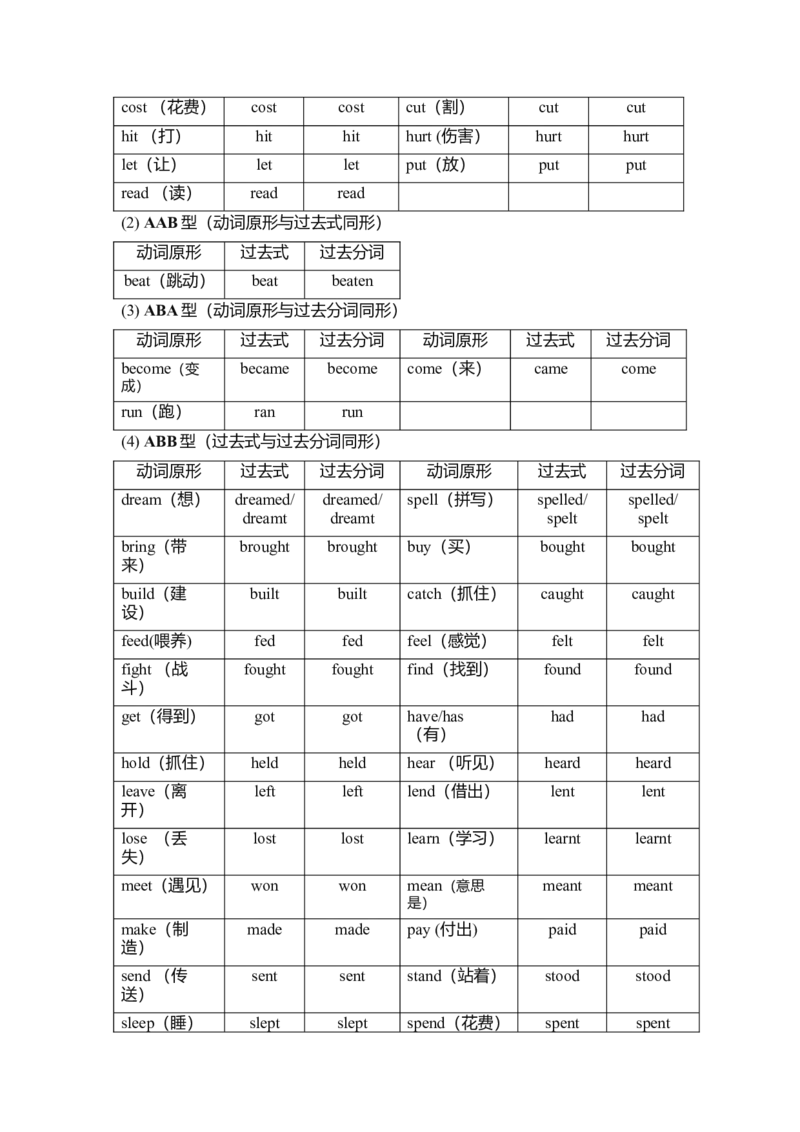
2. 不规则动词
三. 用法
1. 现在完成时表示过去发生或已经完成的动作对现在造成的影响或结果,有以下四大
标志词:
①already, just和yet:
He has already got her help. 他已得到她的帮助。
He has just seen the film. 他刚刚看过这场电影。
He hasn't come back yet. 他还没有回来。
②ever和never:
This is the best film I have ever seen. 这是我曾经看过的最好的一部电影。
He has never been to Beijing. 他从没有到过北京。③以动作发生的次数为标志
He says he has been to the USA three times.
④so far,before, recently, lately
He has bought a new car recently.
I haven’t heard from him Jane lately.
Scientists haven’t found the cure of AIDS so far.
★现在完成时不能和明确表示过去时间的状语连用,如ago, yesterday, last year, at that
time, then等。
2. 现在完成时可以用来表示发生在过去某一时刻的, 持续到现在的动作, 常与for
(+时间段),since(+时间点或过去时的句子),或 how long连用:
①for + 时段
Mary has been ill for three days.
②since + 过去一个时间点(译为:自从……以来)
He has been a teacher since 1998.
③since + 时段 + ago
He has studied English since 4 years ago.
④since + 从句(过去时)
I have lived here since I was born.
⑤It is + 时段 + since + 从句(过去时)
It is three days since he arrived here.
★ 非延续性动词leave, arrive, come, go, return, join, die, buy, borrow等的完成时,
在肯定句中不能与for 或 since等引导的时间段连用:
他到这里三天了。
He has arrived here for three days.
He has been here for three days.
It is three days since he arrived here.
It has been three days since he arrived here.
四. Have gone to, have been to, 与have been in的区别
have/has gone(to) :去了(现在不在说话现场)
Where is your father?He has gone to Shanghai.
have/has been (to) :去过(已不在去过的地方)
My father has been to Shanghai.
have/has been in:呆了多久(还在所呆的地方)
My father has been in Shanghai for two months. /since two months ago.【练一练】
句型转换:
1. He has already gone home. He _________ __________ home ____________. (否定句)
____________ he __________ home ___________? (疑问句)
2. He has lunch at home. He __________ _____________ lunch at home. (否定句)
____________ he __________ lunch at home? (疑问句)
3. He has been there twice.
__________ __________ ________ __________ he been there? (划线提问)
4. I have lunch at school.
__________ __________ you ____________ lunch. (划线提问)
用never, ever, already, yet, for, since填空
1. I have _______ seen him before, so I have no idea about him.
2. Jack has _________ finished his homework ________ an hour ago.
3. Mr. Wang has taught in this school ________ ten years.
4. “Have you ________ seen the film?” “No, I have ________ seen it.”
5. “Has the bus left _______?” “Yes, it has _________ left.”
翻译下列句子:
1. 他们已经打扫了教室吗?
2. 我们已经认识有二十年了。
3. 打那以后,她一直住在这。
4. “你曾经到过那里吗?” “不,我从来没到过那里。”
5. 我父亲以前到过长城。
6. 我来到海南已经一周了。
7. 他这些天上哪儿去了?
五.现在完成时与一般过去时的区别
一般过去时所表示的事情纯属过去,与现在情况没有关系。现在完成时所表示的事情
与现在情况有关系,是过去发生的事情对现在产生的结果或对现在的影响,或一直持
续着:I have lost my Nokia X7. (= I lost my Nokia X7 and I have no Nokia X7 now. )
He bought a house 10 years ago. 十年前他买了栋房子。
(现在是否还拥有那栋房子就说不定了)
He has bought a house. 他已经买了房子。(到说话的这时候他仍然拥有那栋房子)
【练一练】
用适当的时态填空:
1. She’s _____________ (live) here ever since she was ten.
2. Both of them ________________ (be) in Hongkong for ten days.
3. Both of them ________________ (come) to Hongkong ten days ago.
4. Half an hour __________ (pass) since the train __________ (leave).
5. Mary________(lose) her pen. ____________ you ______________ (see) it here and there?
6. _____________ you ____________ (find) your watch yet?
7. ---Are you thirsty? ---No I _________ just _____________ (have) some orange.
8. We _____________already ______________ (return) the book.
9. ___________ they ____________ (build) a new school in the village?
10. I ________________(not finish) my homework . Can you help me?
11. My father _____ (read) the novel twice.
12. I _________ (buy) a book just now.
13. I _________ (lost ) my watch yesterday.
14. My father ___________ (read) this book since yesterday.
不规则动词过去式、过去分词表
(1) AAA型(动词原形、过去式、过去分词同形)
动词原形 过去式 过去分词 动词原形 过去式 过去分词cost (花费) cost cost cut(割) cut cut
hit (打) hit hit hurt (伤害) hurt hurt
let(让) let let put(放) put put
read (读) read read
(2) AAB型(动词原形与过去式同形)
动词原形 过去式 过去分词
beat(跳动) beat beaten
(3) ABA型(动词原形与过去分词同形)
动词原形 过去式 过去分词 动词原形 过去式 过去分词
become(变 became become come(来) came come
成)
run(跑) ran run
(4) ABB型(过去式与过去分词同形)
动词原形 过去式 过去分词 动词原形 过去式 过去分词
dream(想) dreamed/ dreamed/ spell(拼写) spelled/ spelled/
dreamt dreamt spelt spelt
bring(带 brought brought buy(买) bought bought
来)
build(建 built built catch(抓住) caught caught
设)
feed(喂养) fed fed feel(感觉) felt felt
fight (战 fought fought find(找到) found found
斗)
get(得到) got got have/has had had
(有)
hold(抓住) held held hear (听见) heard heard
leave(离 left left lend(借出) lent lent
开)
lose (丢 lost lost learn(学习) learnt learnt
失)
meet(遇见) won won mean(意思 meant meant
是)
make(制 made made pay (付出) paid paid
造)
send (传 sent sent stand(站着) stood stood
送)
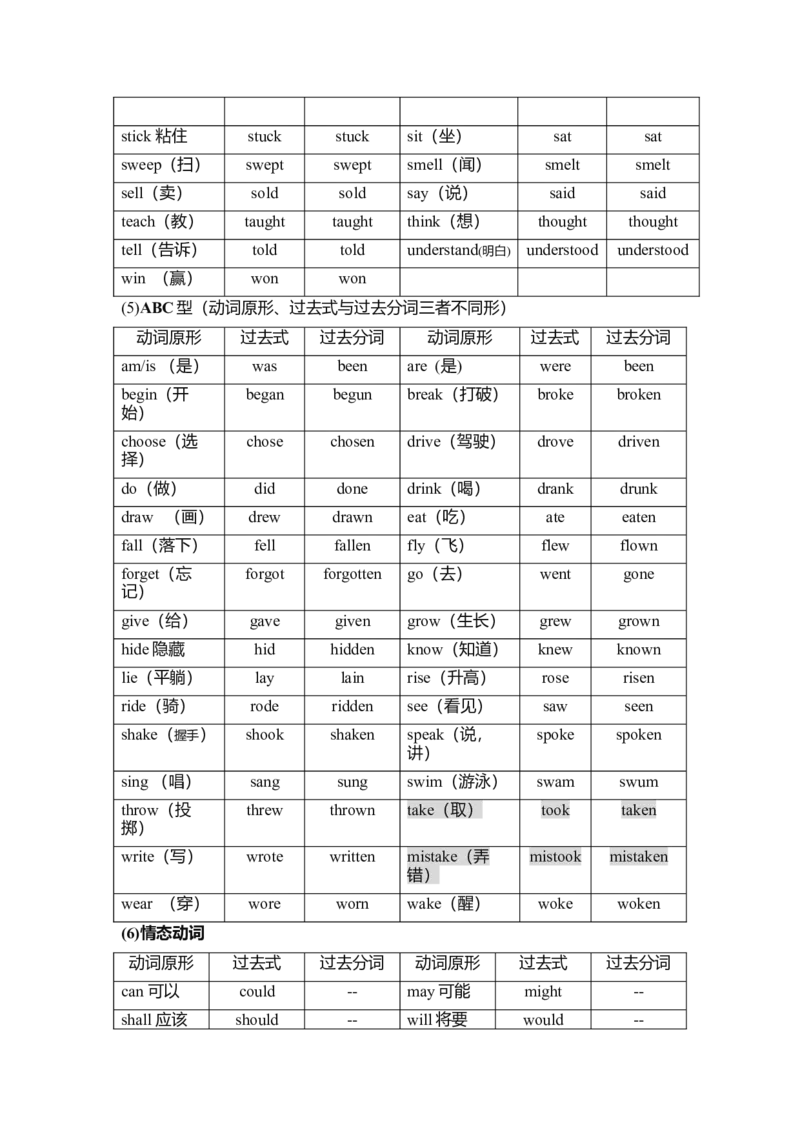
sleep(睡) slept slept spend(花费) spent spentstick 粘住 stuck stuck sit(坐) sat sat
sweep(扫) swept swept smell(闻) smelt smelt
sell(卖) sold sold say(说) said said
teach(教) taught taught think(想) thought thought
tell(告诉) told told understand(明白) understood understood
win (赢) won won
(5)ABC型(动词原形、过去式与过去分词三者不同形)
动词原形 过去式 过去分词 动词原形 过去式 过去分词
am/is (是) was been are (是) were been
begin(开 began begun break(打破) broke broken
始)
choose(选 chose chosen drive(驾驶) drove driven
择)
do(做) did done drink(喝) drank drunk
draw (画) drew drawn eat(吃) ate eaten
fall(落下) fell fallen fly(飞) flew flown
forget(忘 forgot forgotten go(去) went gone
记)
give(给) gave given grow(生长) grew grown
hide隐藏 hid hidden know(知道) knew known
lie(平躺) lay lain rise(升高) rose risen
ride(骑) rode ridden see(看见) saw seen
shake(握手) shook shaken speak(说, spoke spoken
讲)
sing (唱) sang sung swim(游泳) swam swum
throw(投 threw thrown take(取) took taken
掷)
write(写) wrote written mistake(弄 mistook mistaken
错)
wear (穿) wore worn wake(醒) woke woken
(6)情态动词
动词原形 过去式 过去分词 动词原形 过去式 过去分词
can 可以 could -- may可能 might --
shall 应该 should -- will将要 would --小升初英语全真模拟试卷
姓名: 成绩:
一、语音知识:请区分划线部分的读音,如有一种读音,填“1”;两种读音,填“2”;三种
读音,填“3”;四种读音,填“4”。 (每小题1分,共10分)
( ) 1. A. yet B. yes C. cry D. silly
( ) 2. A. early B. hear C. near D. ear
( ) 3. A. mended B. invited C. called D. arrived
( ) 4. A. choose B. chess C. watch D. chemistry
( ) 5. A. key B. keep C. wine D. west
( ) 6. A. wash B. fat C .about D. after
( ) 7. A. fact B. cut C. close D. ceiling
( ) 8. A. above B. moment C. to D. opposite
( ) 9. A. trip B. trick C. tree D. metre
( ) 10. A. see B. best C. discover D. miss
二、单项选择。(每小题1分,共20分)
( ) 1. — do you spell“book”?—B-O-O-K, book.
A. How B. What C. What’s D. Where
( ) 2. They sat on the chair and ______a chat.
A. had B. have C. got. D. met
( ) 3. Look! GaoShan is getting_____ the bus.
A. up B. for C. on D. in
( ) 4. David is making plans ______his class meeting.
A. with B. to C. for D. of
( ) 5. The pizza ______by my mother. Would to like to have some?
A. makes B. was making C. made D. was made
( ) 6. ______the brother and the sister______ good at maths at school.
A. Either; is B. Neither; is C. Both; are D. All; are
( ) 7.Football is one of _____in China.A. More popular sport B. the most popular sport
C. more popular sports D. the most popular sports
( ) 8.It is the first time I ______Beijing.
A. visit B. visited C. had visited D. have visited;
( ) 9.On my way home, I stopped ______some fruit.
A. buy B. buying C. to buy D. bought
( ) 10.--What is the date today?--_______________________.
A. It is Saturday. B. It is July 1st C. On Saturday D. In July
( ) 11. Three days_________ he died.
A. after B. behind C. later D. in front of
( ) 12.Summer is ______and ______in China.
A. sunny; snowy B. sunny; cold C. sunny; hot D. warm; snowy
( ) 13. The students in Class 2 are very__________.
A. exciting B. excited C. excite D. excitd
( ) 14. I asked him_____ it to the police station.
A. to take B. take C. took D. taking
( )15. Look, danger! Please____ touch it.
A. can’t B. not C. don’t D. no
( )16.Here are your clothes, please___________.
A. put it on. B. put on them C. put them on D. put on it
( ) 17. Bruce, look at your dirty shoes. You’d better _______ them right now.
A. Washed B. washing C. wash D. to wash
( )18. Shanghai is _____ the east of China.
A. to B. at C. on D. in
( )19. Would you like to ______with me ?
A. going B. goes C. went D. go
( )20. We have___________ to the bus stop.
A. 10 minute’s walk B. 10 minutes’ walk C. 10 minute’ walk D. 10 minute’s walk
三、词汇运用。(每空1分,共20分)
(I)在下列各句A、B或C中找出与划线部分意义相近的词或句子。
( )1. WangHai does well in English.
A. likes B. speaks C. is writing D. is good at( )2. I'd like some melons.
A. I want B. I like C. I need D. I eat
( )3. Let me see.
A. look at B. think over C. watch D. know
( ) 4. How does she go there?
A. get up B. do C. get D. come
( )5. We have three lessons this afternoon.
A. texts B. glasses C. classes D. books
(II) 根据句意和首字母,写出句中所缺单词。
1. Christmas is the most important f_________ in western country.
2. Today I am free. But yesterday I was b________.
3. Could you tell me the w______ to the Guangzhou Zoo.
4. Do you often make a shopping l_______ before you go shopping.
5. January is the f________ month of a year.
(III) 根据题意,用所给词的适当形式填空。
1. Let’s __________ ( speak ) English in class.____________ ( not speak ) Chinese .
2. There ________( be ) eight ________________( thousand ) books in our library.
3. Everyone in the ______________( live ) room is quiet.
4. Don’t _________ ( forget ) to close the door when you go outside.
5. This book is the lightest and _______ ( thin ) of all the books.
6. Tom ________ ( go ) to plant trees every year. He_______ ( go ) to plant trees next day .
7. The girl sometimes _________ ( have) lunch at home.
四、按要求改写句子。(每小题2分,共10分)
1. Jackie has lunch at school. (改为一般疑问句 )
_________________________________________________________________________
2. You need to take the medicine three times a day .(就划线部分提问)
_________________________________________________________________________
3.I like summer best. (改为同义句)
_______ __________ __________ is summer
4. Tom is reading books in the library. (就划线部分提问)
_________________________________________________________________________
5. A cat is looking for something to eat. (改为过去式)_________________________________________________________________________
五、完形填空。(每小题1分,共10分)
English names and Chinese names are quite different in some 1 ways, but it's not hard for us
to know.Unlike Chinese, most English people have 2 names. One is their family name, both of
the other names are given names.Their family name is 3 the given name. They use Mr., Mrs. or
Miss with the 4 name, but they never use 5 with the first name. For example, we can 6 a man
named James Allan Green Mr. Green, 7 we can't call him Mr. James or Mr. Allan.People
usually use Jim 8 James. Jim is short for James because it's 9 to remember.
But Chinese names are the opposite.A girl with the name Han Limei 10 her family name Han
first. Of course, she can be called Ah Mei for short in China if you wish.
( )1.A.another B.other C.others D.the others
( )2.A.one B.two C.three D.four
( )3.A.above B.front C.back D.behind
( )4.A.last B.given C.middle D.full
( )5.A.their B.them C.its D.it
( )6.A.ask B.say C.call D.write
( )7.A.so B.or C.and D.but
( )8.A.instead of B.for long C.so far D.next to
( )9.A.important B.easy C.difficult D.interesting
( )10.A.put B.putting C.puts D.was put
六、阅读理解。(每小题2分,共20分)
(I)Today is Sunday, so Peter doesn’t go out. He asks his parents about the traditional Chinese
clothes. Mother tells him that Qipao is the traditional dress for women in China. It is usually made
of colourful silk and sometimes made of cotton. Many women in the west like it very much too.
Father can remember that all the VIPs wore Tang suit (唐装) at APEC in Shanghai. They all
looked smart in the traditional Chinese clothes. Many young people find it cool to wear the clothes
in their own styles. Peter’s cousin says the modern clothes are better. Finally, they think the
fashion should be comfortable first.
( )1.Where does Peter talk with his parents?
A. At home. B. At school. C. At APEC in Shanghai D. At a fashion show.
( )2. Qipao is usually made of .A. cotton B. leather C. silk D. paper
( )3.The VIPs at APEC in Shanghai wore clothes in .
A. modern style B. Tang style
C. the style from the 1980s D. their own styles
( )4.Peter’s ____ is at his home too.
A. sister B. brother C. grandfather D. cousin
( )5.They think the clothes should be _____ first.
A. beautiful B. cheap C. comfortable D. expensive
(II) Helen Keller lived in the USA. When she was a baby, she got very sick. After she was
better, she couldn’t see and hear well. A few years later, things got worse. There was no way for
Helen to speak to other people. She heard nothing, She saw nothing. She didn’t understand
anything.
One day a teacher came to live with Helen and her family. The teacher helped Helen learn
about words. Helen was such a bright girl that she could spell her first word soon. When she was
older, she went to college.
Helen became very famous later. She traveled around the world and helped many blind and
deaf people. The world remembers her today as a brave and wonderful person. She was blind and
deaf, but she found a way to see and hear.
( ) 6.Helen Keller got very sick when________
A. she was a baby B. she went to college
C. she was taught by a teacher D. she was very old
( ) 7. ______taught Helen Keller her first word.
A. Helen herself B. Helen’s teacher C. Helen’s doctor D. Helen’s parents
( )8.Helen Keller was famous because______
A. she traveled around the world. B. she was an American.
C. her teacher taught her many things. D. she helped many disabled people in the world.
( )9.People admires Helen Keller because______
A. she was very talented B. she was blind and deaf
C. she was brave and wonderful D. she wont to college
( ) 10.Helen Keller was blind and draft, but______
A. she found a way to understand the world B. she found a way to travel around the worldC. she met a good teacher D. she was proud of her parents
七 、写作。(10分)
请你想象一下公园发生的事情,以“In the park”为题写一篇小作文。要求:条理清楚,
语句通顺,书写规范,不少于50词。
_________________________________________________________________________
_________________________________________________________________________
_________________________________________________________________________
_________________________________________________________________________
_________________________________________________________________________
_________________________________________________________________________
_________________________________________________________________________
_________________________________________________________________________
_________________________________________________________________________