Unit4 Why don’t you talk to your parents?
Section B 1a-1e 分层练习
基础达标
一、用所给单词的正确形式填空
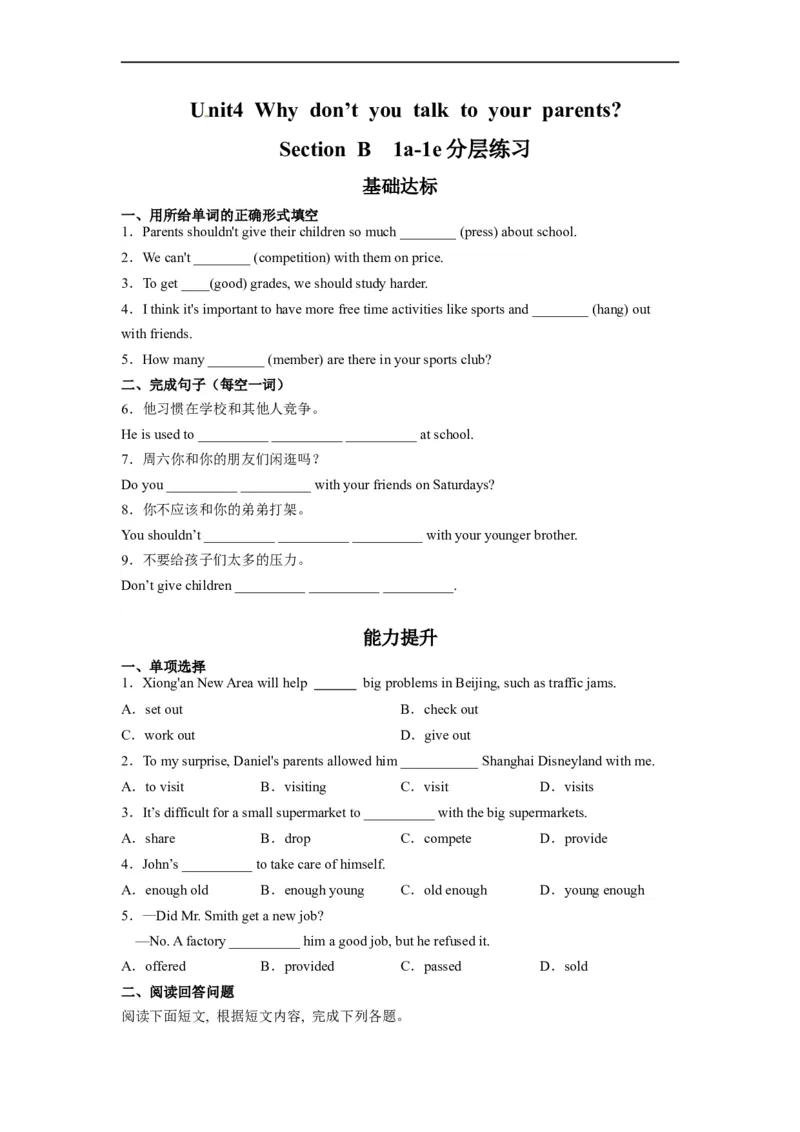
1.Parents shouldn't give their children so much ________ (press) about school.
2.We can't ________ (competition) with them on price.
3.To get ____(good) grades, we should study harder.
4.I think it's important to have more free time activities like sports and ________ (hang) out
with friends.
5.How many ________ (member) are there in your sports club?
二、完成句子(每空一词)
6.他习惯在学校和其他人竞争。
He is used to __________ __________ __________ at school.
7.周六你和你的朋友们闲逛吗?
Do you __________ __________ with your friends on Saturdays?
8.你不应该和你的弟弟打架。
You shouldn’t __________ __________ __________ with your younger brother.
9.不要给孩子们太多的压力。
Don’t give children __________ __________ __________.
能力提升
一、单项选择
1.Xiong'an New Area will help big problems in Beijing, such as traffic jams.
A.set out B.check out
C.work out D.give out
2.To my surprise, Daniel's parents allowed him ___________ Shanghai Disneyland with me.
A.to visit B.visiting C.visit D.visits
3.It’s difficult for a small supermarket to __________ with the big supermarkets.
A.share B.drop C.compete D.provide
4.John’s __________ to take care of himself.
A.enough old B.enough young C.old enough D.young enough
5.—Did Mr. Smith get a new job?
—No. A factory __________ him a good job, but he refused it.
A.offered B.provided C.passed D.sold
二、阅读回答问题
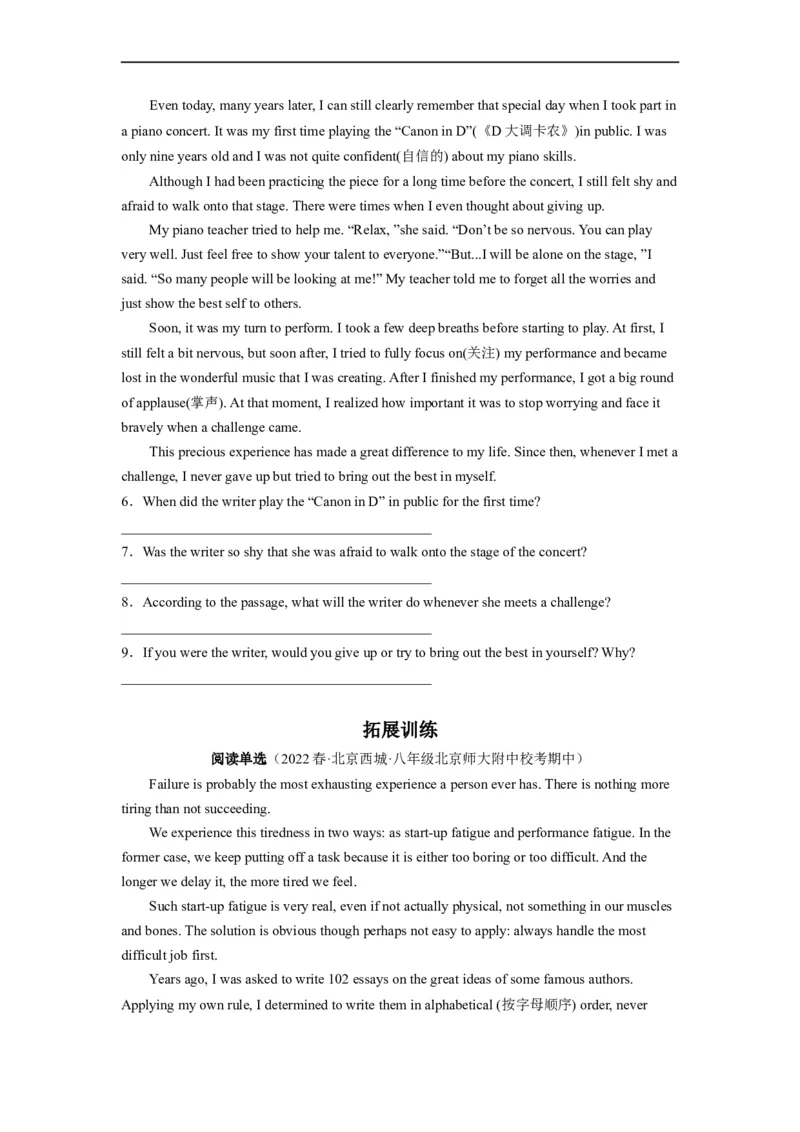
阅读下面短文, 根据短文内容, 完成下列各题。Even today, many years later, I can still clearly remember that special day when I took part in
a piano concert. It was my first time playing the “Canon in D”(《D大调卡农》)in public. I was
only nine years old and I was not quite confident(自信的) about my piano skills.
Although I had been practicing the piece for a long time before the concert, I still felt shy and
afraid to walk onto that stage. There were times when I even thought about giving up.
My piano teacher tried to help me. “Relax, ”she said. “Don’t be so nervous. You can play
very well. Just feel free to show your talent to everyone.”“But...I will be alone on the stage, ”I
said. “So many people will be looking at me!” My teacher told me to forget all the worries and
just show the best self to others.
Soon, it was my turn to perform. I took a few deep breaths before starting to play. At first, I
still felt a bit nervous, but soon after, I tried to fully focus on(关注) my performance and became
lost in the wonderful music that I was creating. After I finished my performance, I got a big round
of applause(掌声). At that moment, I realized how important it was to stop worrying and face it
bravely when a challenge came.
This precious experience has made a great difference to my life. Since then, whenever I met a
challenge, I never gave up but tried to bring out the best in myself.
6.When did the writer play the “Canon in D” in public for the first time?
____________________________________________
7.Was the writer so shy that she was afraid to walk onto the stage of the concert?
____________________________________________
8.According to the passage, what will the writer do whenever she meets a challenge?
____________________________________________
9.If you were the writer, would you give up or try to bring out the best in yourself? Why?
____________________________________________
拓展训练
阅读单选(2022春·北京西城·八年级北京师大附中校考期中)
Failure is probably the most exhausting experience a person ever has. There is nothing more
tiring than not succeeding.
We experience this tiredness in two ways: as start-up fatigue and performance fatigue. In the
former case, we keep putting off a task because it is either too boring or too difficult. And the
longer we delay it, the more tired we feel.
Such start-up fatigue is very real, even if not actually physical, not something in our muscles
and bones. The solution is obvious though perhaps not easy to apply: always handle the most
difficult job first.
Years ago, I was asked to write 102 essays on the great ideas of some famous authors.
Applying my own rule, I determined to write them in alphabetical (按字母顺序) order, neverletting myself leave out a tough idea. And I always started the day’s work with the difficult task of
essay-writing. Experience proved that the rule works.
Performance fatigue is more difficult to handle. Though willing to get started, we cannot
seem to do the job right. Its difficulties appear so great that, however hard we work, we fail again
and again. In such a situation, I work as hard as I can—then let the unconscious take over.
When planning Encyclopaedia Britannica (《大英百科全书》), I had to create a table of
contents based on the topics of its articles. Nothing like this had ever been done before, and day
after day, I kept coming up with solutions, but none of them worked. My fatigue became almost
unbearable.
One day, mentally exhausted, I wrote down all the reasons why this problem could not be
solved. I tried to convince myself that the trouble was with the problem itself, not with me.
Relived, I sat back in an easy chair and fell asleep.
An hour later, I woke up suddenly with the solution clearly in mind. In the weeks that
followed, the solution which had come up in my unconscious mind proved correct at every step.
Though I worked as hard as before, I felt no fatigue. Success was now as exciting as failure had
been depressing.
Human beings, I believe, must try to succeed. Success, then, means never feeling tired.
1.What does the author recommend doing to prevent start-up fatigue?
A.Writing essays in strict order. B.Building up physical strength.
C.Leaving out the toughest ideas. D.Dealing with the hardest task first.
2.On what occasion does a person probably suffer from performance fatigue?
A.Before starting a difficult task. B.When all the solutions fail.
C.If the job is rather boring. D.After finding a way out.
3.According to the author, the unconscious mind may help us ________.
A.ignore mental problems B.get some nice sleep
C.gain complete relief D.find the right solution
4.What could be the best title for the passage?
A.Success Is Built upon Failure B.How to Handle Performance Fatigue
C.Getting over Fatigue: A Way to Success D.Fatigue: An Early Sign of Health Problems